



Abstract
This article examines non-legislative avenues for parliamentary influence and legitimacy in the Pan-African Parliament (PAP). It argues for an incremental approach to increasing the powers of the PAP. To make this case, the paper first expounds on the composite nature of regional parliaments, showing the convergence of complex political and institutional issues that make Regional Parliamentary Assemblies unique parliamentary entities. Given the unsuccessful attempt by the PAP to increase its legislative powers through an amendment of its protocol, the aim is to make an alternative argument for legislative powers by locating the legal and institutional legitimacy and influence drivers for the PAP.
Keywords
Introduction
The push for legislative powers for the Pan-African Parliament (PAP) and other regional assemblies is a legitimate pursuit as far as parliamentary functions go. However, there are political and institutional challenges. Politically, Regional Parliamentary Assemblies (RPAs) have to find and consolidate their own space in an environment of competition with member state parliaments as well as surmount the complication of sovereignty concerns of Heads of States. Institutionally, while there are arguments for or against legislative transformation, one major issue that needs attention is the level of preparedness of the PAP to take up the mammoth task of law-making and the responsibilities required in terms of specialisation, research and knowledge competencies, and resource and capacity generation.
Moreover, institutional and political dimensions should also be taken into a broader consideration of the composite character of Trans-National Regional Organisations (TNROs) in general and the African regionalism environment in particular. For instance, the African Union (AU) is an equally new development with huge capacity and competency challenges. Also, state systems in Africa are diverse and as such collective initiatives are very difficult to manage. Proponents are of the view that legislative powers can increase the influence of the PAP, especially in delivering the dividends of good governance in Africa. This paper disagrees and argues that in its current form and given the realities of AU governance, the PAP does not need legislative powers for political legitimacy and to exercise influence in the AU. To this end the article will seek to answer the question: Is legitimacy and influence in the PAP predicated upon acquiring legislative powers?
Basis for analysis
In 2009, in terms of the provision of the PAP protocol, the PAP presented to the AU Assembly its intention to acquire legislative competency. However, in July 2012 the Assembly of Heads of States rejected the draft protocol citing the need for ‘more in-depth consultations’ on the issue (African Union, 2012a). The basis for analysis in this paper is informed by the assumption that legislative powers will give the PAP greater influence in AU decision-making. Studies into the first parliament (2004–2009) show that the PAP failed to make any impact in AU decision-making as its recommendations were never acknowledged as part of decision-making by the AU (Manpanye, 2009: 4; Nzewi, 2011a). The PAP has argued that its lack of influence is informed by the present PAP protocol arrangement which gives only consultative and advisory responsibilities to the PAP (Amadi, 2009). The argument for proponents of legislative powers is that they will give legitimacy to the pronouncements coming from the Parliament, making them more binding, thus increasing the influence of the PAP in AU decision-making. Nevertheless, this article argues that the failure of the first and second parliaments to exert influence in AU decision-making is not a reflection of the limitations of the founding protocol, but rather a reflection of the PAP’s inability to fully exploit these powers of consultation as well as non-legislative opportunities within the protocol in strengthening its influence and legitimacy in the African Union (AU).
Consequently, this article seeks to interrogate the notion that regional parliamentary influence and parliamentary legitimacy hinges on acquiring legislative competencies. It asks if regional parliamentary influence and legitimacy can be acquired and expanded through other means, given the proven tendency of member states to resist supranationality at the regional level, especially in the early stages of the regional experiment.
Once key concepts are laid out, the succeeding section sets the tone for discussion by giving a brief background on the evolution and spread of regional parliaments. It will also show the convergence of complex political and institutional issues that make RPAs unique parliamentary entities. Critical to this section is the treatise on supranationality and its expressions in regional experiments like TNROs. The next section then identifies the legal and institutional frameworks that define PAP’s legitimacy. The third section looks at the transformation debate, which gained a lot of momentum during the 12th session of the PAP in October 2009, and will set out some of the main arguments for and against the transformation debate. The final section will make recommendations by discussing those non-legislative opportunities which can increase the PAP’s influence and legitimacy.
Use of concepts and terms
The next sections examine the key issues and discussions in this article. It first takes a broad look at the context of RPAs, examining key determinants of RPA manifestations and in particular TNROs. The aim is to set the scene for discussions of RPAs as composite institutions within TNROs.
Key determinants of supranationality in trans-national regional organisations
Regionalism has been studied from integration and co-operation standpoints. Its character has been analysed from supranational, institutional, intergovernmental and sovereignty dimensions. For instance, TNROs like the Asia-Pacific Economic Cooperation (APEC) and the Association of South East Asian Nations (ASEAN) operate based on economic co-operation and intergovernmental principles (ASEAN is particularly designed to preserve nationalism). Alternatively, the European Union (EU) is modelled on a principle of integration and a voluntary transference of authority to supranational institutions. Apart from a few RPAs like the Latin American parliament (PARLATINO), most RPAs belong to TNROs. Understanding RPAs requires one to focus on the TNROs in which they are created and operate.
Over the years the EU has provided a lot of fodder for research and theory-building on TNROs. The trajectory of European integration since the 1950s caused some early students of EU integration to see the EU as an emerging state-like structure, subject to the same expectations of accountability and representativeness accorded to individual countries (Haas, 1970; Wallace and Wallace, 1996). These views were crystallised in the early neo-functionalist grand theory, which attempted to predict the terminal point of the regionalism as a state-like entity with supranational characteristics and qualities. This theory, however, received much criticism and one of its foremost promoters Ernst Haas dismissed its validity years later (Haas, 1975). Nevertheless, elements of the neo-functionalist school are found in other theories such as neo-institutionalism (Schmitter, 2002) and constructivism (Smith, 2004; Tusicisny, 2007: 426), in which less attention is paid to power structures with processes and institutions are seen as the relevant agents of international relations (Hall and Taylor, 1996).
The implications of neo-functionalism on the future of Sovereign Nation States (SNS) in Europe presents exciting new perspectives on global political restructuring (Hoffman and Vleuten, 2008). It interrogates notions such as the possibility of an alternative political system to the state and the implications of this in terms of the governance across the globe.
Nonetheless, there are contrasting views from other scholars (Hix, 2002; Puchala, 1999), who argue that no new European polity is emerging and that the empowering of institutions, rather than a sign of the nation state’s ‘loss of control’, should be viewed as a deliberate process of nations delegating powers to regional institutions for effective management of integration processes. This school argues that EU integration is the outcome of nation state interests, which in turn are fuelled by national political pressures. For this school, the SNS is still the central locus for political studies and analyses. The significant point of departure here is that, while some scholars view the gradual empowerment of regional institutions as pointing to a loss of national sovereignty, others view it as a rational and conscious choice of member states through negotiations to abnegate some degree of authority for the efficient and effective running of the regional entity (Pierson, 1996).
Irrespective of which explanation is put forward, there is a convergence in the acknowledgement of the growing supranational character of regional institutions in the EU. Although the European Union provides a credible example of the institutionalisation of regional integration, it also presents a dilemma for comparative analysis. This is because although a regional experiment like the African Union is perceived as institutionally driven and mirroring European Union structures (Maluwa, 2003; Tieku, 2007), there are historical, structural and political circumstances that make it difficult to engage the EU experience for comparative analytical purposes. Be that as it may, taking into consideration the difficulties of such an approach, there are lessons to be drawn from the European experience of regional integration and governance.
Given these considerations, understanding TNROs’ potential for nurturing supranational institutions means that the conditions which favour such developments need to be highlighted. These are discussed in the following sub-sections: ‘The goal of the regional project’, ‘Perception and role of sovereignty’ and ‘A predisposition to a democratic ethos’.
The goal of the regional project
Studies show that TNROs have different goals. For some TNROs, the goal of trans-national relations is co-operation and for others it is integration. Co-operation is based on loosely structured and intergovernmental TNRO arrangements (Hurrell, 1995: 42). In this case, having institutions as foundations of the organisation is not prioritised, loyalty to regimes is minimal and entry and exit from transactions costs little (Schmitter, 2007). Asian regionalism mirrors these arrangements, while Other TNROs have integration goals. In this case spatially proximal states construct supranational linkages with a distinctive institutional framework to achieve common economic, social and/or political goals. Integration also implies community-building (Bourenane, 1997; Schmitter, 2007) – in this case, the TNRO acquires legitimacy to make decisions and implement policies; however, entry and exit into TNRO agreements becomes more costly (irreversible negotiations) and there is a strong conformity to regimes, supported by a politico-institutional framework based on a strategic vision of a common future. Supranational institutions will therefore have greater opportunity to thrive in an integration-focused TNRO than in a co-operation-focused TNRO. The EU mirrors this goal.
There is enough historical, rhetorical and treaty-based evidence to show that integration has been the goal of Pan-African efforts since the 1950s. A cursory examination of post-independence integration history in Africa shows that the motivations for the formation of a super ‘African’ state can be traced back to the concept of a United States of Africa held by Kwame Nkrumah (Mazrui and Tidy, 1984: 344). Even so, there was reluctance among newly independent states to champion an idea that would entail a level of surrender of national sovereignty (Walraven, 1999). As a result the Organisation of African Unity (OAU), which was formed in 1963, was not a supranational entity but rather a regional body with a legal pronouncement on the right to sovereignty (Organisation of African Unity, 1963). Nevertheless, during the years of the OAU, the question of a supranational continental body was a recurring one. The transformation of the OAU into the AU began in 1991 with the Abuja Treaty, which detailed the integration aspirations of the African continent and laid the foundation for the creation of an African Economic Community (AEC) with organs like the Court of Justice and the PAP (Organisation of African Unity, 1991). Although the AEC was in limbo for more than 10 years it was collegiated as part of the African Union, which was inaugurated in July 2002. The AU has 11 organs, including the PAP, the Peace and Security Council and the Court of Justice and People’s Rights. In terms of powers and functions, these institutions have supranational potential (Nzewi, 2011a).
The succeeding sections further examine other critical determinants of supranationality, in particular the roles that sovereignty and common values play in building the type of trust needed to create supranational institutions. Nathan’s (2012: 97–119) internal and external logic for a successful TNRO, while focused on his explanation of the failures of the South African Development Community (SADC), provides a theoretical crutch to understanding how sovereignty and values (such as the democratic ethos recommended by his article) play an important role in the successful design and implementation of regimes and institutions.
Perception and role of sovereignty
In assessing the success of SADC security and conflict resolution regimes, Nathan (2012: 99) presents external logic as interests and objective conditions that make a TNRO a beneficial venture for member states. In this case, external logic offers a situation where rational choice and utilitarian considerations such as state interest makes it unlikely that states will accept regimes and rules that are unfavourable to them. Yet, therein also rests the dilemma, because in unstable conditions, the resultant regimes are designed in such a way that there is no guarantee of state adherence. As Nathan shows (2012: 100), realist schools of thought suggest that there is no guarantee that regimes have an independent effect on state behaviour. In offering an explanation Nzewi (2011b: 701), using arguments based on intentionality, suggests that ‘recently established regional institutions may be derived from intentional acts aimed at establishing institutions with minimal leeway for growth’. This section argues that one reason for this is the concern over sovereignty.
Sovereignty, its role as well as how it is perceived, is a central element in the design of TNROs. In other words, sovereignty concerns can prescribe limits on integration values and structure. Kyambalesa and Houngnikpo (2006: 1) describe a regional integration continuum ranging from ‘shallow integration’ (preferential trade agreements, free trade area, customs union and common market) to ‘deep integration’ (economic union, monetary union, political union). Regionalism experiments in Asia and Europe manifest two polar ends of this regionalism continuum, which when compared to the African regionalism experience shows some interesting convergences and divergences.
Asian regionalism reflects a bi-lateral security, economic consultation and co-operation structure (Kim, 2010: 3). One can argue that this design of Asian regionalism is concomitant with sovereignty concerns. Largely, the pre- and post-cold war nature of Asian regionalism has been marked with a strong adherence to state sovereignty and a culture of non-interference (Acharya, 2012: 14). An analysis of Asian regionalism shows that the key drivers of regionalism between 1947 and 2009 ranged from nationalism in its early stages to trans-national threats in its later stage (Acharya, 2012: 6). There was also the legacy of imperialist Asia, dominated by Japanese imperialism and its Pan-Asian movement, which was characterised by coercion and political dominance (Acharya, 2011: 2–11). Acharya’s (2011) historical framework demonstrates how historical legacies forged the basic values of interdependence and economic growth which underpin the preference for loose regional formations in Asia. Asian TNROs, like the ASEAN, even in recent years have shown little deviation from the non-interference principle as seen in its sustained resistance to United States-led sanctions against member Myanmar (Aljazeera, 2012; Khalik and Haswidi, 2011).
Asia’s example shows parallels with regionalism experiments in Africa, where regionalism was driven by early concerns over sovereignty spurring a nationalist drive to end colonialism through regionalism efforts (Mazrui and Tidy, 1984: 344; Nkrumah, 1965: 11); and later concerns over the challenge of globalisation and hegemony within the global community (Hettne, 2002: 30; Joffe, 2007: xiv). Despite reform in the AU, the culture of non-interference still pervades African regionalism (Murithi, 2009; Tieku, 2007: 32–35). However, reflecting the high premium on state sovereignty Asian regionalism, unlike the institutionalised structure of African regionalism, is loosely structured, deliberative, with flexible engagements and highly limited institutionalisation (Acharya, 2012: 6).
Finally, although they both share a common ascription to the protection of state sovereignty, Asian and African regionalism are structural opposites. In the case of Asian regionalism this is clearly manifested in the design of its regionalism ethos; in African regionalism, this represents a contradiction of sorts. Mistry (2000: 553) articulates this as conflicting predispositions, namely the tendency to adhere to political separation by colonial borders while emphasising unity, albeit at arm’s length. Thus, as argued by Haas (1970: 618), although African regionalism may be propelled by unobtrusive and functional objectives, early politicisation of issues has meant that it has not followed Europe’s pattern of spill-over. This is discussed below.
In regionalism studies, deeper integration is concomitant with the gradual ceding of sovereignty. Despite its institutionalised nature, African integration, unlike the experience of EU integration, has shown no notable gradual ceding of powers to AU institutions, even with the rhetorical allusions to such (Nzewi, 2009). Notwithstanding its distinct institutional form, one can argue that the key issues of legitimatisation and empowerment are lacking in AU institutions. Although there are several factors that can be given as explanations for this it is clear that the perception and role of the SNS in regional integration presents a starting point for assessment.
Nevertheless one should note that the history, structure and competency of the state in Africa and in Europe were different leading up to each continent’s venture into regional projects. The perception of the SNS in post-independence Africa differed from the perception of SNS in post-World War II (WWII) Europe. These two conditions spurred efforts towards regional integration in the respective continents. In Europe, as much as post-WWII integration efforts were a route to building up war-battered Europe, it was also geared towards curbing the excessive ‘nationalist’ sentiments that spurred German aggression and soured relations between France and Germany (Goodman, 1996: 35). On the contrary, early integration efforts in Africa were based on ‘nationalist’ strategies which focused on co-operation with the sole aim of solving political problems for emerging African states (Sitter, 2005: 53). As a result a fierce culture of non-interference and respect of sovereignty was entrenched in the OAU Charter. The historical precedence of non-interference and sovereignty still dictate the character of the African integration space (Nzewi, 2011a: 202). So, despite amendments in the Constitutive Act of the AU to accommodate more AU intervention at certain levels of internal conflict, sovereignty and state interest are still the greatest incentives for conformity to regimes (African Union, 2003). It is important to recognise this fundamental character of the AU in trying to understand regional institutions in general and the PAP in particular.
A predisposition to a democratic ethos
Successes in TNROs are sustained through requisite common values which Nathan (2012: 97) describes as the internal logic of TNROs. For this article in particular, the principle behind having a political-institutional framework in a regional integration system is based on democracy, with its principles of broad representation and participation. However, there has to be a congruence of these values at both domestic and regional levels (Nathan, 2012: 100, 103). For instance in Africa, while the number of democratic governments as defined though an electoral process has grown, results from the World Democracy Audit report for 2009 1 show that the quality of governance and leadership is still largely autocratic, with most African countries ranking quite low in overall democracy rankings as a result. The coup d’états in the past four years 2 in Guinea Bissau (2009), Guinea Conakry (2008), Mauritania (2008), and Madagascar (2009), and the Malian coup d’etat in 2012, raise questions over the integrity and longevity of democracy in African states. Moreover, only 17 out of 53 African states have ratified the African charter on democracy, elections and governance (African Union, 2012c). This is just above the 15 needed for ratification, and it took five years after its adoption in 2007 to get the required minimum ratifications. If democracy remains untenable in some member states, democratising the regional space becomes difficult and where internal conflict is evident, external relations become largely weak. Conversely, European member states subscribe to democratic leadership at the national level, which makes the adoption of such principles at the regional level workable.
The African experience also shows that the problem is not a lack of common values, but the nature of these values themselves. Values underpinning regional relations in Africa still tend to coalesce around the perennial and historically shared value of solidarity against colonialism, imperialism and non-interference in member state affairs.
Nevertheless, these values are not sustainable as changes globally and in African regionalism in particular show a growing need for a set of common values which is underscored by a commitment to universal values of human rights, democracy and justice for all. Thus, while there has been considerable structural reform of the AU, Nathan’s (2012: 100) thesis on internal logic suggests that along with this transformation in African TNROs, there should be a corresponding values reform reflecting domestic and regional common policy goals. In 2010, the Assembly made a declaration on greater unity and integration through shared values (African Union, 2010). While this reflects an acknowledgment of the need for values reform, the reluctance of member states to ratify common values instruments like the African charter on democracy does not show corresponding action. This paper argues that the principle of democracy is of integral value in ensuring the growth of regional governance institutions like RPAs.
Finally, this section argued that RPAs will thrive where TNROs recognise they are best administered when given enough powers to manage good governance within the regional polity. However, this can only take place where TNROs are clear about their goals and recognise that sovereignty concerns, while credible, must be weighed against a set of common values such as democracy and participation to ensure the success of governance institutions in the TNRO. A transnational forum like an RPA can provide the platform for representatives and collective scrutiny of TNRO decisions. The EU shows that in creating institutions, enough opportunities must be given to encourage the growth of these institutions. This section was an analytical foundation prior to examining the character of the RPAs in general and the PAP in particular, which is explored next.
The anatomy of regional parliamentary assemblies
The phenomenon of contemporary RPAs can be said to have begun in the early years of the European Union. The European Coal and Steel Community instituted the Assembly which later became the European Parliament. As a regional arrangement the EU has been time tested and its form of multi-level governmental systems has inspired other regional experiments like the African Union and the Union of South American Nations (USAN), which have instituted RPAs modelled on the EU example.
Traditionally, parliaments have four functions within a democratic system: representation, legislation, executive selection and control (Mill, 1961). Parliaments do not govern, administer or execute, rather governments govern through parliaments. This emphasises parliaments as elected representatives of the people, whose power of control and legitimacy is sanctioned by the people. From the foregoing, parliamentary powers comprise of policy-making and policy-influencing powers. Policy influence, however, is exhibited largely in the oversight powers of parliaments to keep the executive branch in check by ensuring transparent and accountable leadership. Both parliamentary competencies of policy-making and executive control are essential for any parliament to exert influence and acquire legitimacy within the polity.
Like national parliaments, regional parliaments are supposed to be representative, oversight bodies. In the Malamud and De Sousa (2007) review of four Latin American regional parliaments, 3 the area of challenges and the character of emerging regional parliaments do not differ from those of the PAP. Although most of these parliaments are older than the PAP, 4 they have recorded little progress towards supranationality either in terms of legislative powers (output legitimacy) or in terms of strong oversight competencies (control legitimacy). Apart from the PARLACEN, representation through direct elections (input legitimacy) has not been achieved in these parliaments. Some of the reasons for this are the difficulty in finding consensus on appropriate representative balance and the political and functional expediency of selecting rather than electing members.
In analysing the comparative lack of success of the Latin American RPAs in relation to the European Parliament (the model on which these parliaments, like the PAP, are based), Malamud and De Sousa isolate several points. First is the factor of time, given that the European Parliament is a much older parliament and by implication a more established parliament. The second is the order the EU process of integration has followed. In this case integration is incrementally pursued. Third, the aforementioned conditions of time and defined order which have resulted in a progressively deepening integration in Europe has not translated into success in Latin American RPAs. This is because there seems to be a difficulty in balancing the need to fast track integration without compromising the process. As such, Latin American TNROs compromise functional and institutional consolidation by setting up a replica of EU institutions without allowing for the necessary processes that evolved them in the EU case. This perhaps is also a challenge for African TNROs like the AU. Fourth, Malamud and De Sousa argue that the effectiveness of a regional project can be linked to the effectiveness of the institutions and systems of individual states. Thus, weak national systems will not augur well for the development of a regional system. Lastly, differing democratic and governance systems, processes and priorities define the pace and character of the regional supranational experiment.
This section has shown that RPAs are important institutions where the goal of integration is identified. However, apart from perhaps the EU, regional parliaments around the world struggle for legitimacy both in terms of representation, executive oversight, and decision/policy-making. The following section identifies and defines the legal and institutional framework that defines PAP legitimacy.
Legal and institutional dimensions of Pan-African Parliament legitimacy and influence
The Abuja treaty of 1991 first introduced a continental parliament into African regionalism. This did not materialise. However, the PAP was re-introduced in the AU Constitutive Act in 2000 as one of the organs of the African Union. The Protocol to the Treaty establishing the AEC relating to the PAP details its objectives, functions, powers and privileges. It was adopted in 2001 and entered into force in 2003. The first parliament was inaugurated in 2004.
Legitimacy as prescribed through legal frameworks
According to the Protocol, the ultimate aim of the PAP according to Articles 2 and 3 of its Protocol shall be to ‘evolve into an institution with full legislative powers, whose members are elected by universal adult suffrage’. (Organization of African Unity, 2001: 2–4). Other objectives are to facilitate the implementations of the AU’s objectives, promote human rights and democracy, peace, security, encourage good governance and facilitate the integration process. Provisions for the functions and powers of the PAP are spelt out in the PAP protocol and articulated in the PAP Rules of Procedure. The Protocol is the AU’s instrument that defines the PAP’s principal functions, and the PAP Rules of Procedure is the Parliament’s instrument for government of its internal systems and processes in carrying out the Protocol mandate. In addition to this, the Rules of Procedure also have the potential to act as the framework for building the PAP’s organisational culture.
The Protocol confers little authority to the PAP in terms of legislative functions. Its powers are consultative and thus limited to only recommending for or against legislation. In terms of oversight functions, the Protocol is very constrained in its provisions, as it does not allow the PAP formal powers in appointment of AU officials, and sets limits in overseeing the executive branch’s attendance of sessions and production of documents (OAU, 2001). However, using these provisions as leverage, the PAP defined its own role in clearer terms in its Rules of Procedure by ‘overseeing’ the development and implementation of policies and in having AU officials ‘furnish explanations in plenary’ (PAP, 2004: 11).
It is clear that the Protocol as a legal framework confers little authority to the PAP in terms of the formal functions of a working Parliament. However, it is also significant that the protocol allows the PAP powers to determine its own rules of procedure, giving it a level of responsibility for its own institutional growth. The PAP’s Rules of Procedures acts as both a control and co-ordinating instrument. What is relevant to this study is the potential of the Procedure to promote an internal shared vision, rationality and unity in the PAP, thus enabling the PAP to build its own capacity, grow and strengthen inter-institutional relationships, build on its complementary roles and other non-legislative functions.
Legitimacy as prescribed through institutional functions
The institutional dimensions of PAP roles and functions focus on the PAP’s role in relation to the AU, its organs and all other parties within the African regional integration system. How the PAP defines its role in the AU system, its relationship with other AU organs and how the other AU organs define their relationship with the PAP are important in assessing legitimacy. Figure 1 shows the PAP’s extrapolated relationship with other AU organs (Nzewi, 2011a: 215) garnered from the different treaties and protocols that govern these institutions. The arrows represent the direction of reporting. The figure indicates that the PAP has oversight powers in relation to the organs of the AU, especially the democratic and human rights institutions like the Peace and Security Council, the Court, and the Economic, Social and Cultural Council (ECOSOCC). African Union Organs like the Executive Council, the Permanent Representatives’ Committee (PRC) the African Union Commission (AUC) and the Specialised Technical Committee in certain areas play a more supervisory role in terms of their relationship to the PAP.
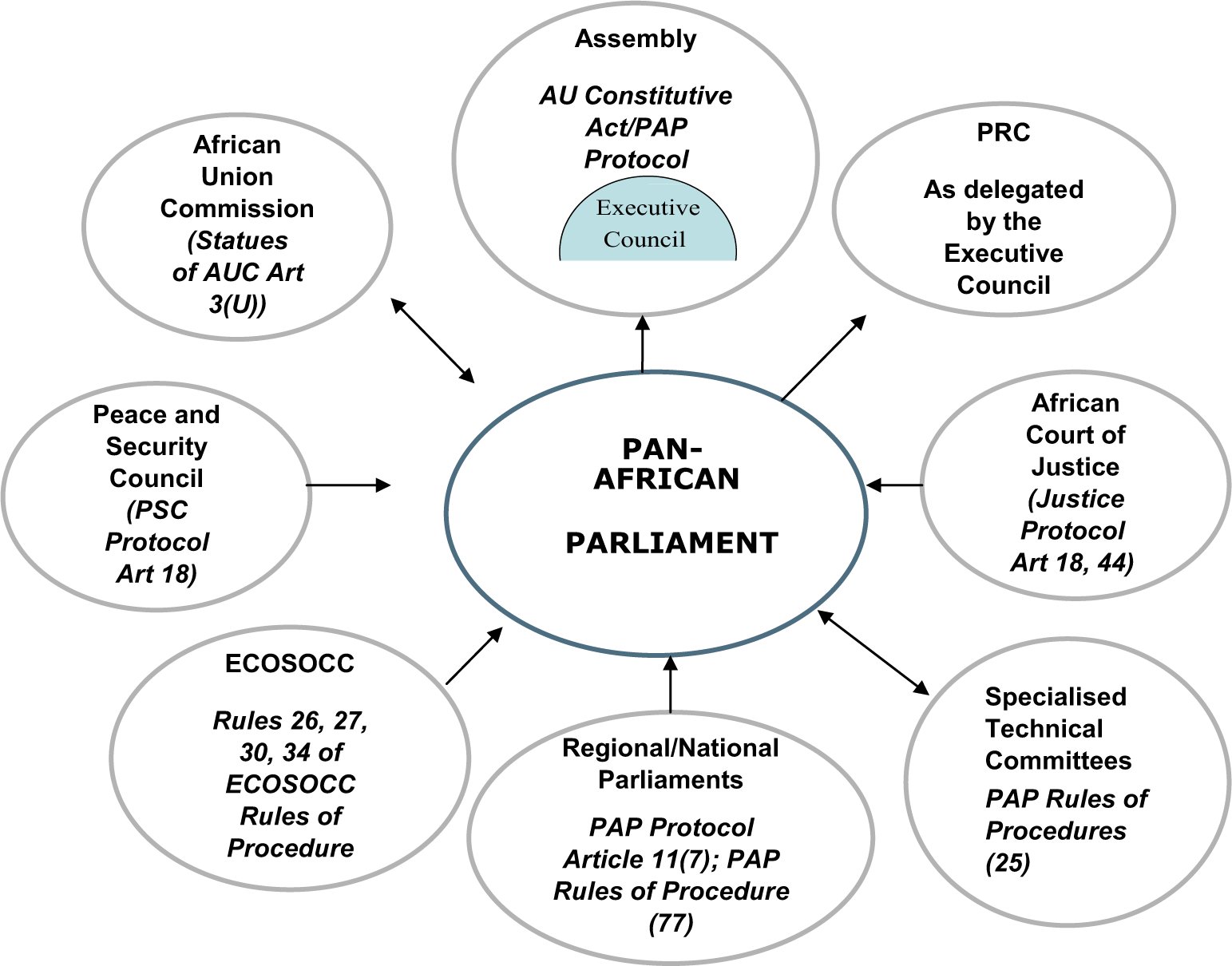
Legal provisions on the Pan-African Parliament’s oversight functions in relation to African Union organs (source: Nzewi, 2011a). ECOSOCC: Economic, Social and Cultural Council; PRC: Permanent Representatives’ Committee; PSC: Peace and Security Council.
The institutional description of the PAP should be seen within the context of an emerging and evolving AU. As such, the definition of responsibilities, duties and relationships within the AU system is still evolving. Thus, there seems to be a disjuncture between the provisions of treaty and the practical interpretation of institutional relationships (Nzewi, 2011a: 215). This misunderstanding, as well as a lack of clarity on roles, seems to be one of the biggest challenges faced by the first parliament as implied by the AU Commission Chairperson address to the first session of the 2nd Parliament (Nzewi, 2010:15):
The relationship that has to be established between the AU has not been clearly demarcated, and the understanding of PAP has not been properly perceived that is also reciprocally true, PAP itself until now was taking itself as not being a part of AU institution, now steps are being taken to make PAP a family of the AU, so that all its activities will be understood by all AU organs.
Indications are that there is an institutional distance between PAP and the AU executive as well as other institutions (PAP, 2009a). It is clear that the whole system of PAP’s organisation and that of the AU is a complex one. Therefore, there is a need for the parameters of reporting, co-ordination and control to be defined in the AU.
The next sections examine the basis of analysis of this article. The first argument is that legislative transformation is the key to greater influence of PAP. The second and alternative argument, which is the point of the paper, is that regional parliaments like the PAP can establish credible and legitimate powers and influence through non-legislative functions of regional parliaments.
Legislative transformation as a key to greater influence and legitimacy for the Pan-African Parliament
The first ordinary session of the second parliament was dominated by deliberations on the transformation of the PAP into a legislative institution. However, its draft revised protocol was rejected by the Assembly of Heads of State (African Union, 2012a). While the second parliament’s eagerness for this position is understood, the same eagerness seems to be lacking from the AU. Indeed, within the AU, the issue of legislative transformation is constructed as a long term goal hinged on sovereignty issues: ‘I think we should not worry so much about it. It is an ultimate objective and we are moving towards this objective…We don’t intend frightening people by imagining that it is for tomorrow’ (Nzewi, 2010:22).
This scenario represents the different approaches to the transformation debate. The optimists argue that legislative powers will give this parliament greater influence in AU decision-making and legitimise it as the AU legislative and oversight institution. The pragmatists caution that the issue of legitimacy and influence should be interrogated further and weighed against the practical/functional challenges of building a regional polity as well as the political and legal dimensions of ascribing supranationality to regional institutions. Indeed, with the election of South Africa’s Nkosazana Dlamini-Zuma as the new AUC chairperson in July 2012, AU watchers will be keen to see whether there will be a stronger drive towards the greater influence by AU institutions in decision-making in the AU. The next sections analyse arguments for legislative transformation against those for an incremental approach examining the opportunities and limitations of these arguments.
Arguments for urgent legislative transformation
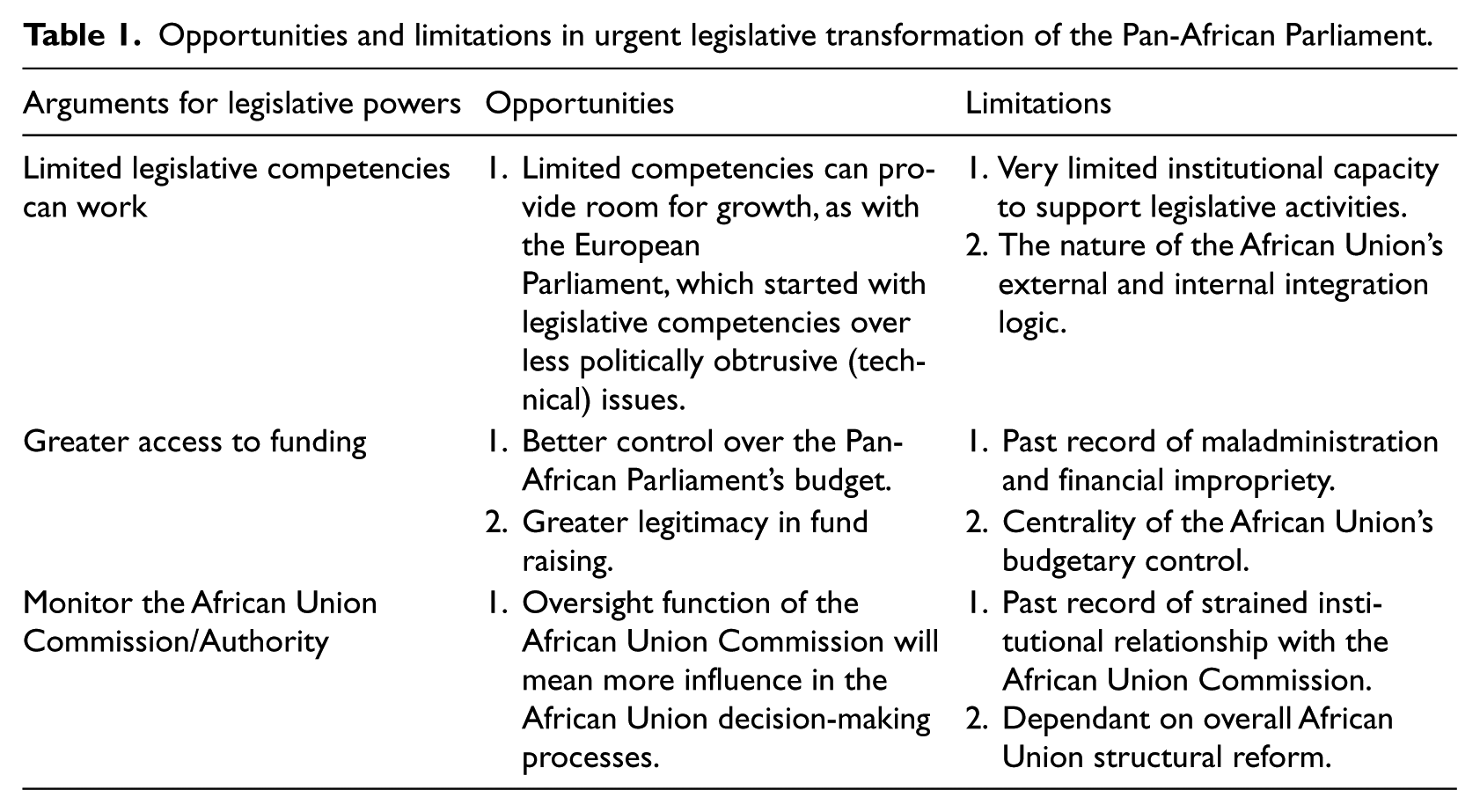
Information garnered from the PAP ordinary session in 2009 (which focused on the legislative transformation debate), suggests that the PAP seems to view legislative powers as the answer to its capacity, legitimacy, political institutional and financial challenges (Nzewi, 2010: 2). There is an acknowledgement of PAP’s institutional, political and financial shortcomings (Mpanyane, 2009; Nzewi, 2011a). However, the sticking point is in the approach towards solving the problem. The PAP sees the solution as legislative powers, arguing that the same arguments used to highlight the PAP’s lack of readiness for legislative power can be equally used to make a credible case for its transformation. Some of the notable points for legislative powers as provided by the Vice President of the PAP Bureau (Amadi, 2009) are presented in Table 1 and discussed subsequently.
Opportunities and limitations in urgent legislative transformation of the Pan-African Parliament.
Limited legislative competencies can work
The present Bureau has identified 18 competency areas for consideration and adoption as ‘Pan-African Legislative Acts’ (PLA) (PAP, 2009a). Some of these are: democracy, good governance and human rights; free circulation of persons and goods at the continental level; education; public health; voting regarding the budget of the AU; and ratification of AU treaties and agreements. The PAP envisioned limited competency in only six areas by 2011. However, with limited capacity in technical, research and human resources the PAP will struggle to effectively administer this mandate (Mpanyane, 2009: 9). Additionally, without a set of common democratic values that support the competencies of democratic institutions like the PAP in the AU, it will be a struggle for the PAP to influence AU decision-making.
Greater access to funding
This issue is directly tied to the budgetary processes within the AU. Although the PAP protocol gives it the mandate to advise on the AU budget, the centralisation and control of the AU budget has greatly hampered this role and also limited the PAP in terms of ownership of its own budget. Legislative power is supposed to free up this area of the PAP’s tasks and also ensure that its own plans and activities are carried out independently of AU control. Thus, in the reviewed version of the PAP Protocol (PAP, 2009b), the PAP proposes to vote directly on the AU budget. However, PAP’s past record in terms of poor accountability in the management of its own finances has not endeared it to the AU, and the integrity of the first parliament was questioned in an AU audit report in 2006 (Hailu, 2007). Moreover, AU budgetary and financial authority in the African Union is currently shared between the AUC and the advisory sub-committee on Administrative, Budgetary and Financial matters of the Permanent Representative Committee (Executive Council, 2004, 2005).
A legislative Pan-African Parliament will be needed to monitor the African Union Authority
At the AU summit in July 2009 (African Union, 2009), African Heads of State decided to set up an African Union Authority towards the goal of achieving the United States of Africa. The legislative PAP will be able to exercise full parliamentary oversight powers over such a body in terms of good governance and democratic principles. In reality there was a protracted institutional distance between the first parliament and the AU executive as well as other institutions, a situation acknowledged by the PAP in its 2009 Evaluation Report (2009a). Unless the PAP is able to overcome the many institutional and structural limitations in the AU (some of which will be discussed subsequently), it will likely remain isolated from the decision-making axis of the AU.
Arguments in support of a more incremental approach
There are several fundamental arguments that can be raised for an incremental approach to the question of legislative powers. These arguments are analysed from a strength and limitations viewpoint, and are described in Table 2.
Strengths and limitations in arguments for an incremental approach.

AU: African Union; PAP: Pan-African Parliament
Unresolved institutional relationships in the African Union
Institutional relationships within the AU remain unclear (Nzewi, 2011a). Without a formal organisational graphic representation of the AU, the relationship between the respective AU organs as interpreted based on provisions of AU constitutive acts remain ambiguous. For instance, in terms of its budget, the PAP reports to the Permanent Representatives Committee. However, within the legislative framework of the AU, PAP is not obligated to report to the Permanent Representative Committee on budgetary matters (African Union, 2002; Organisation of African Unity, 2000, 2001).
One of the strengths of this argument is tied to the readiness of the PAP to transform, given the judicial gap within the AU system. The 2008 Protocol on the Statute of the African Court of Justice and Human rights is still to be ratified and entered into law (African Union, 2012b). This legal vacuum in the AU is also the legal reason for the rejection of the PAP review protocol by the Assembly. This is because the African Court of Justice and Human Rights has 28 country signatures out of 53 states, and only five countries have ratified and acceded. There needs to be at least 15 member ratifications for the protocol to enter into force. The argument is that there can be no parliament with legislative powers without a Court of Justice as interpreter and arbiter. Indeed, Article 20 of PAP protocol sets the Court of Justice as the interpreter of all matters emanating from the protocol. The legitimacy of legislation and laws coming from the PAP can be questioned without the court. This is crucial because institutional complementarity is essential in ensuring institutional growth within a regional system. However, legislative competencies can also speed up institution-building processes in the PAP. This is because the PAP, through national parliaments, can put more pressure on member states to ratify AU treaties as national parliaments are known to play a role in treaty ratification (Vos, 2005: 9).
Role and jurisdiction of PAP in relation to national parliaments
There are two general distinctions that need to be noted in discussing regional and national parliaments. The first is that they are two different entities and operate under different political contexts; the second is that as far as the existence of an SNS is concerned, national parliaments are the primary institutions with the strongest influence. As a result, there needs to be a clear understanding between national parliaments and the PAP and other AU organs on the extent and limits of parliamentary powers at both parliamentary levels. The limitation of this argument is that national parliaments tend to want to exert a lot of influence over the way national ministers behave at the regional decision-making levels (Vos, 2005: 11). In so far as national parliaments have an important role to play in the domestication of regional policies and the ratification of treaty, the balance of power through a legislatively competent PAP can help in ensuring that regional policies are effectively domesticated.
Finally, the AU is a highly intergovernmental system with decision-making centralised at the highest level of the Assembly of the Heads of States. Consequently, the PAP, while showing a manifested intent on supranationality through the Constitutive Act pronouncements, is heavily constrained through its own founding protocol. However, as seen in previous sections in this article, there are opportunities for the PAP to increase its influence. Should the AU begin to transform its pre-independence values of anti-colonialism and non-interference to embrace values which are much more relevant to the present realities of Africa there may be openness to ceding greater powers to regional institutions like the PAP. However, until this happens and in light of the continued resistance of the AU Assembly to empower the PAP, the next section presents non-legislative opportunities for the PAP to increase its influence in AU decision-making.
Non-legislative opportunities for parliamentary influence and legitimacy
This section outlines non-legislative avenues and opportunities the PAP can leverage, in lieu of a long term goal of acquiring legislative powers. Parliaments have formal/classical and non-formal/non-classical functions. Formal functions of parliaments are its representative, legislative, oversight, and leadership selection and formation functions; non-formal functions involve any other activities of parliaments which compliment, strengthen and support all its classical functions.
While legislative powers can bolster legality towards greater enforcement of recommendations, without the institutional capacity to follow up enforcement, the argument fails. The PAP can leverage non-formal parliamentary opportunities like building and strengthening institutional relations and exploring other avenues to build its legitimacy.
Strengthening institutional relationships
There are three critical areas that the PAP has to work on in terms of building strong relationships that will deepen its influence within the AU. These are discussed below.
Pan-African Parliament/African Union inter-institutional rapport
Institutional rapport and liaison is critical to the goal of PAP increased influence. The parliament will need to make itself relevant, or ‘market’ itself, to the AU Executive Council, through the AUC and the Permanent Representatives Committee, who enjoy certain discretionary powers from the Executive Council. In this case, the PAP ought to establish a diplomatic corridor with the Executive Council and the Permanent Representatives Council.
Pan-African Parliament/national parliaments
Regional parliaments cannot perform all the traditional functions of a national parliament. It is also important to note that there are areas where the national parliaments have greater control than regional parliaments (Vos, 2005: 7). Regional watchers have begun to realise the importance of national parliaments in regional governance in building legitimacy in TNROs, especially in Europe (Vos and Jeroen, 2003). Broadly speaking, national parliaments can contribute to bolstering the work of regional parliaments through debates which provide general direction to national governments in terms of treaty negotiations and in the ratification of treaties, among other activities. National parliaments also play a role in the domestication/implementation of regional policies at the national level. However, this power should be viewed within the varying contexts of democracy and leadership in some African states. Whereas there are states where there is a robust participation of national parliaments in national grand debates, there are other states where national parliaments are passive actors in governance and still more where parliaments as defined in practice do not exist.
Civil society and parliamentary advocacy
Diplomacy and advocacy is as crucial to the PAP’s institutional growth within the broader AU system as it was to the European Parliament. The PAP in particular has the opportunity to leverage this space to complement and strengthen its own work. So far, PAP’s interaction with civil society has been based largely on pecuniary values. For instance, the more influential and well-resourced local and international organisations or groups are being courted by the PAP for funding conferences and capacity-building initiatives. The PAP ought rather to develop its relationship with civil society organisations and groups in terms of developing and strengthening its advocacy and lobbying role on pertinent governance and human rights issues within the continent.
Strengthening non-legislative formal functions within limitations provided
The PAP’s own rules of procedure (PAP, 2004) spell out certain mechanisms that the PAP can use in its oversight or control functions. These are its parliamentary question and answer, reports to Parliament, investigations and strong budgetary oversight and accountability in terms of its own funds.
Moreover, the PAP’s continued growth is tied to institutional integrity and transparency and thus should itself be above reproach. This is especially true if it has to play an oversight role in the accountability and transparency of other AU organs. There has to be transparency in cost efficiency, strategies of communication with African people, equitable processes in hiring, firing, engaging consultants, and so on. The first Parliament did not acquit itself satisfactorily in this regard, as the PAP’s integrity was put into question with an AU audit report in 2006 (Hailu, 2007). Thus it behoves the second parliament to ensure commendable institutional performance which will increase the likelihood of growth in the PAP’s acceptance and role within the AU system.
Finally, what is clear is that while the PAP has attempted to perform some of these roles, it has not fully exploited all avenues and platforms to test and improve these competencies in terms of executive oversight. From the foregoing rather than supplicate for legislative powers it has little capacity or level of responsibility to lever and cultivate advocacy, and transparency and accountability should become strong competences of the PAP towards increasing its influence and legitimacy in the African Union.
Concluding remarks
To answer the question posed at the beginning of this article, legitimacy and influence in the PAP cannot be predicated upon acquiring legislative powers alone. This is because there are other important qualifications attached to the issue of legitimacy and influence. First is the nature of the regional experiment, which determines the level of willingness of member states to delegate supranational powers to the institution and the readiness of member states to comply with the PAP’s dictates. Secondly, the PAP’s legislative power is largely hinged on the establishment and development of African Union institutions such as the court of justice and the AU as a whole. Thirdly, parliaments thrive on legitimacy and the PAP is no exception. As strong determinants of legitimacy, an ethos of strong performance and accountability have to be entrenched as a culture of the PAP. Finally, while legislative transformation is a credible objective, this article argues that there are institution-building and legitimating priorities which the PAP should focus on. It has been shown that concentrating on these issues incrementally but steadily continues to consolidate the influence and legitimacy of regional parliamentary institutions within the regional system.
Footnotes
Funding
This research received no specific grant from any funding agency in the public, commercial, or not-for-profit sectors.