




Abstract
Both inward and outward foreign direct investment (FDI) have implications for the wage rates of home-country workers. Such implications have been particularly noteworthy in Japan where the traditional internal labor-market practices, which value long-term sustainability of employment and wages, collide with the pressure for change in the globalizing Japanese economy on many fronts. In this paper we estimate the impacts of FDI on workers’ wages in Japanese manufacturing industries. We find that Japanese employees benefit, in the form of wage gains, from their employers’ association with both inward and outward FDI operations. These wage effects differ systematically depending on gender and worker ranks within their employer firms and are likely to weaken the mechanisms underlying the sustainability of Japanese firms’ traditional internal labor markets. The presence of FDI effects on worker wages also implies an increasing disparity between the incomes of workers who work for successfully globalizing firms and workers who do not, jeopardizing Japan’s traditional policy objective to sustain harmonious economic growth across all economic sectors. This would also deepen the structural divide including the wage gap of the Japanese economy that exists between large firms and small- and medium-size enterprises (SMEs) since firms which get involved in FDIs are mostly large firms.
Introduction
Foreign direct investment (FDI) can have important implications for domestic economies. For example, inward FDI is thought to bring in new foreign technologies, employment, and competition, while outward FDI is associated with hollowing out and skill upgrading of domestic economies. These in turn have effects on domestic wages. However, available empirical evidence on the wage effects of FDI for the United States of America (USA), the United Kingdom (UK), and other countries appear mixed. For example, evidence on the wages and skill upgrading of the home-country workers of foreign-owned operations (inward FDI) and of firms with foreign operations (outward FDI) are either mixed (in the case of inward FDI) or non-existent (in the case of outward FDI). We also note that there is relatively limited evidence for wage effects of outward FDI for Japan (Hayami, Nakamura and Nakamura, 2012). This paper intends to fill in this gap. It starts by presenting estimation results on the wage effects of firms’ outward and inward FDI operations on domestic male and female workers in Japan. Second, we show that such wage effects depend on gender and worker ranks (e.g. non-managerial workers vs. workers in managerial ranks) within their employer firms. We interpret these effects in the context of Japan’s internal labor market practices, the sustainability of which in the long-run is being challenged by the rapid globalization of the Japanese economy.
Home Wages and Firms’ Foreign Connections: Literature and Our Hypotheses
Inward FDI
Compared to domestic firms, foreign firms often possess little host country-specific knowledge and suffer from problems such as a lack of local distribution channels and suppliers, a lack of local political connections, and cultural problems in dealing with local employees. For these reasons, foreign firms are regarded as being disadvantaged in the host country. In order to compensate for these disadvantages, foreign firms entering host countries’ markets must be able to take advantage of their strengths for their survival. For this reason it is likely that foreign firms which are able to operate productive activities in a host country tend to be self-selected. This is particularly the case for Japan, which traditionally discouraged inward FDI and hence the climate for foreign businesses in Japan has not been as hospitable as in other Western countries. This strategy that Japan has adopted on inward FDI is quite unlike that of China. China’s economic growth and technology were driven by inward FDIs from Japan, the US, and Western Europe for a long period of time (Nakamura and Fruin, 2012). In recent years Japan, under Prime Minister Junichiro Koizumi’s initiative, has shifted to a more contemporary policy like those found in many Western countries, which generally welcomed inward FDIs (Japan External Trade Organization [JETRO], 2012).
One hypothesis, which has been studied in the literature, is if foreign operations (including the operations of joint ventures) are more productive than their domestic counterparts, then we expect this productivity difference between foreign and domestic firms to be reflected in their workers’ wages. Inward FDI affiliations are associated with higher productivity (Fukao, Ito and Kwon, 2005; Lipsey, 2004; Lipsey and Sjöholm, 2005). Findings in the literature on this for the US and the UK, however, are mixed. For example, using matched industry state data, Feliciano and Lipsey (1999) found no evidence of higher wages for foreign-owned manufacturing firms, but higher wages for foreign-owned non-manufacturing firms were found. On the other hand, Blonigen and Figlio (1999) found evidence that is consistent with our hypothesis using country-level data.
Some of the more recent studies, however, report substantial empirical evidence that foreign-owned firms pay a wage premium (Lipsey and Sjoholm, 2005). Generally, foreign-owned firms pay higher wages than domestic firms in both developed and developing countries when you control for firm-specific characteristics (Lipsey and Sjoholm, 2005). There is also empirical evidence that these wage premiums are too large to be explained by foreign firms’ selective acquisitions of operations in high wage-paying industries (Lipsey and Sjoholm, 2002). But Blonigen and Slaughter found that: using US manufacturing data from 1977 to 1994, inward FDI has not contributed to US within-industry skill upgrading. In fact, the 1980s wave of Japanese greenfield investments was significantly correlated with lower, not higher, relative demand for skilled labor. This casts doubt upon one possible channel of skill-biased technological change that was previously unexplored. (2001: 362)
This is also consistent with earlier studies by Graham and Krugman (1991) and by Julius (1990) which found that foreign-owned firms behave very much like their domestically owned firms in the same industry. In particular, they pay similar wages.
We note that another reason why foreign firms with operations in Japan might have to pay higher wages than otherwise, at least at the outset of their operations, is that Japanese labor markets tend to lack the flexibility that facilitates the movement of workers from one employer to another (Mincer and Higuchi, 1988; Nakamura, 1993). The firm-specific nature of employment relationships between workers and firms in Japan often prevent experienced workers and unemployed workers of all ages and gender from getting jobs with new employers. For example, Aoki (1988), Kato and Morishima (2002), Li (2005 ), Lincoln, Hanada and McBride (1986), Nakamura (1993), and Nakamura and Hübler (1998) discuss characteristics of Japan’s traditional internal labor markets. However, industrial relations practices based on firms’ internal labor markets and long-term employment became significantly weakened by Japan’s financial crisis in the 1990s (Konoe, 2012), during which many Japanese manufacturers lost global competitiveness. One indication of the weakened industrial relations practices is that more Japanese firms now employ skilled mid-career workers from outside rather than train and promote workers inside. This has resulted in a certain level of fluidity in Japan’s labor markets.
Our data sets allow us to study wages of workers by gender and their ranks. The implications of inward FDI for the wages of their workers in different ranks in the host country have not been studied in the literature. Wage differentials based on gender are of interest since US firms’ operations in Japan are thought to follow US-style equal treatments of female workers, unlike their Japanese counterparts.
Our empirical evidence on the wage effects of inward FDI would be of policy interest in Japan. Japan’s new policy (JETRO, 2012; METI, 2006) promotes inward FDI, emphasizing the positive role foreign firms’ operations play in Japan in technology transfer, introduction of competition, and creating new employment opportunities.
Outward FDI
Considerable research attention has been paid to the home-country exports and employment effects of outward FDI. Using firm-level data, Lipsey, Ramstetter and Blomstrom (2000) found that, after controlling for their output levels, both US and Japanese parent firms’ export to a particular region increases as these firms’ production activities in the region increase. However, empirical results about the employment effects of FDI on parent firms are mixed. For example, Blomstrom, Fors and Lipsey (1997) and Lipsey, Ramstetter and Blomstrom (2000) found that, in response to their increased overseas production, US manufacturers appear to reduce employment at home while Japanese and Swedish counterparts tend to increase employment after controlling for the level of production. But Lipsey (2004) also notes that the directions of the effects on US parent companies’ employment per unit of output are sector specific and positive for machinery sectors, but negative for transport equipment sectors.
Home-country employment effects may also depend on the level of aggregation at which the effects were estimated. For example, the share of home-country non-production workers in an industry do not seem to be significantly affected by the ratio of overseas affiliated firms’ employment to the total employment (including both overseas and home-country employment). Slaughter, using US industry data over the 1977–1994 period, finds that: regression analysis of a panel of industry-year observations does not support the hypothesis that multinational enterprises (MNEs) transfer has contributed to US skill upgrading within industries. Across all specifications, most measures of MNE transfer have small and imprecisely estimated effects on US relative labor demand. This finding is inconsistent with models of MNEs in which affiliate activities substitute for parent unskilled-labor-intensive activities. (2000: 467)
On the other hand, Feenstra and Hanson (1999) found that foreign outsourcing (defined as the substitution of imported inputs and finished goods for domestically produced goods) can account for a substantial rise in the non-production worker share of the wage bill for their sample of four-digit standard industrial classification (SIC) industries.
Using firm-level data on 1070 Japanese firms for the period 1985–1990, Head and Ries (2002) found that a higher proportion of overseas affiliates’ employment results in a higher home-country non-production workers’ wage share, provided that the overseas affiliates are in developing countries. This suggests the existence of skill upgrading in the home country resulting from increased overseas production activities. They also found that firms’ average wages per worker increase as the ratio of the firms’ overseas employment increases.
In previous empirical studies the ratios of a parent firm’s production and non-production workers to the firm’s total employment including all domestic and foreign affiliates’ employment are typically used as proxies for the intensity of the parent firm’s usage of unskilled and skilled workers (Head and Ries, 2002; Slaughter, 2000). Leamer (1994: 5) raises some concern about the use of such proxies: ‘…the classification of workers into “production” and “non-production” doesn’t have much to do with “unskilled” and “skilled”. More appropriate data may provide very different answers.’ He points out that production workers include line supervisors and product development personnel, while non-production includes delivery truck drivers and cafeteria workers. Our data sets have information about every worker’s rank within their employer firm and hence does not suffer from the types of issues raised by Leamer (1994).
Effects of Japanese Manufacturing Firms’ Outward FDI on Wages of Workers in Different Managerial Ranks
Empirical evidence in the literature on the implications of outward FDI for home-country wages are mixed with positive or negative impacts with relatively small numerical effects. Many reasons have been speculated for these observations. For example, home wages may either increase in response to new outward FDI, supporting exports, or decrease in response to outward new FDI, displacing exports, or both. Or, if outward FDI shifts less-skilled operations from home to overseas production, then less-skilled home-country workers’ wages may go down. If such less-skilled labor is replaced by high-skilled labor, then wages (and employment) of skilled workers in home countries will grow.
Such skill upgrading takes many forms and potentially affects workers in all ranks in the home country. Once firms have their overseas operations, the immediate demand will arise at their home operations for new managerial skill to manage foreign operations within the firms, such as coordinating the global operations in terms of production, distribution, new product development, marketing, and accounting. Foreign operations tend to increase the firms’ potentially profitable intra-firm trade and previously unneeded management of such activities for firms’ overall profit maximization will become necessary. Another important task often associated with Japanese manufacturers’ outward FDI operations is the requirement to train workers in the host country. While many low-skill jobs in Japan may be lost in this process, many new jobs with previously unneeded skills (e.g. upgraded managerial skills, jobs with international content such as foreign language and culture skills) will be created in Japan.
We argue that, in the context of Japanese corporations, increases in domestic worker responsibilities associated with outward FDI are substantial. This is, to a large extent, due to the reasons that are peculiar to Japanese corporations. These reasons, for example, arise from Japanese firms’ internal management structures and supplier and other keiretsu (corporate groupings) management practices. Ongoing assembler–supplier relationships among Japanese manufacturers (known as vertical [supplier] keiretsu) allow them to effectively implement just-in-time production systems and also reduce the time to market for new products (Aoki, 1988; Morck and Nakamura 2007; Nakamura, 2001, 2004, 2008; Ndubisi, Jantan, Hing and Ayub, 2005; Tsurumi, 1984).
This is also consistent with the findings by Lipsey et al. (2000) that: US firms allocate labor-intensive parts of their production to affiliates in developing countries; Swedish firms allocate the more capital-intensive parts of their production to their foreign affiliates, mostly in high-wage countries; and, in Japanese firms, supervisory and ancillary employment at home to service foreign operations outweighs any allocation of labor-intensive production to developing countries (Shiraki, 2006a, 2006b).
To the extent that Japanese managers and workers have advantages over their foreign workers hired at their overseas locations in the types of managerial environments discussed earlier, Japanese firms will continue to use Japanese nationals for the aforementioned managerial tasks.
If domestic workers in Japan bear much of the added outward FDI management related responsibilities, we expect this to benefit many workers in all ranks in terms of wage premiums. At the same time, we also expect that higher rank managers will bear more responsibilities resulting from FDI and hence receive more foreign wage premiums.
Inward and Outward FDI Connections and Worker Wages: Hypotheses
We summarize our working hypotheses below. None of these hypotheses have been empirically tested in the literature.
(H1) Inward FDI (sample firm is owned in part or fully by a foreign firm[s]):
(H1a) The presence of a foreign parent firm(s) increases the wages of the sample firm’s workers.
(H1b) The higher the ownership share of the foreign parent firm, the higher the foreign wage premiums are for the sample firm’s workers;
(H1c) The higher the managerial ranks of workers, the higher the foreign premiums; and
(H1d) Foreign premiums do not discriminate between male and female workers.
(H2) Outward FDI (sample firm owns foreign operations):
(H2a) The presence of foreign operations increases the wages of the sample firm’s workers;
(H2b) The higher the ownership share of foreign operations, the higher the foreign wage premiums are for the sample firm’s workers; and
(H2c) The higher the managerial ranks of workers, the higher the foreign premiums. (No prediction is available for male/female differentials for outward FDI wage premiums.)
In both hypotheses we identify parent firms’ ownership shares in their foreign operations as potentially important determinants of Japanese workers’ wages. This is based on the general notion that the higher the foreign parent firm’s ownership share, the more effective their management is. For example, in the case of Japanese firms operating abroad (outward FDI), higher ownership shares of their foreign operations would generally allow them to operate their just-in-time production systems more effectively and hence enhance their productivity. For these and other reasons, FDIs’ ownership shares are regarded as important decision variables for firms. FDIs’ ownership shares typically reflect their bargaining power relative to their foreign (host-country) partners’ bargaining power (Nakamura, 2005; Nakamura and Xie, 1998).
Implications of the Wage Effects of Inward and Outward FDI for the Sustainability of the Equality of the Japanese Income
The effects of globalization of national economies on domestic income and wealth distributions have been studied from various perspectives by many authors (World Trade Organization, 2011). Interestingly, globalization is generally blamed for the widening income gap between the rich and the poor not only for developing countries (e.g. Derichs, 2002; Gaiha, Imai and Nandhi, 2009; Gibson, 2004; Meschi and Vivarelli, 2007), but also for developed countries such as the US, Canada, European Union (EU) countries, and Japan (e.g. Burtless, 2007; Conference Board of Canada, 2012; The Economist, 2006; Harjes, 2007; Heshmati, 2003; O’Loughlin, 1997; Pavcnik, 2011; Pethokoukis, 2012). While many agree that international trade and foreign direct investment, the main components of globalization, might have played some role in widening the income gap in many countries, many academic studies cited earlier and elsewhere have not found adequate empirical evidence, which would allow them to conclude that globalization is primarily responsible for the increased income inequality observed in many countries. In this paper, we pay attention to the role of inward and outward foreign direct investment in changing the wage distributions for workers in various ranks of Japanese manufacturing industries. Sustaining income equality across all economic sectors has been among the most important policy objectives of the Japanese government. Yet foreign direct investment, international trade, and changes in global institutions such as free trade arrangements have been drastically changing the economic conditions in which Japanese firms operate. Our hypotheses are to test the assumed responses to the impacts of increased inward and outward FDIs of the basic wage determination mechanisms, which have worked well for a long time to sustain Japanese income equality. Our hypotheses, if accepted, mean that globalization measured in terms of incidences of FDI would lead to certain changes in the incomes of workers, which may not be compatible with the sustainability of the income equality in Japan.
Data
Our sample of workers comes from the Japanese wage censuses of regular workers who work at privately owned establishments in Japan with at least 10 workers. Each of our samples comes from the censuses for 1998, 2000 and 2002 (Hayami, Nakamura and Nakamura, 2012). Our basic unit of employer organization is what type of establishment it is and we study the wages of the workers who work for their establishments. For notational convenience we distinguish two types of establishments as follows in this paper: establishments consisting of manufacturing facilities will be called establishments; and establishments consisting of head offices will be called head offices. The types of workers we consider here are: male and female non-managerial workers at establishments and head offices; and male and female department heads (called ‘kacho’) at establishments and head offices. These two sub-groups are representative sub-groups of the workers in our entire sample (the other sub-groups are not presented to save space.) Appendix 1 presents the definitions of our variables used in our regressions. Descriptive statistics for the variables are available on request.
Estimation Results: Summary
Methodology
We use ordinary least square (OLS) regressions to identify wage effects of foreign direct investment.
Empirical Specification
Given worker i’s wage wi, our regression equation takes the following form:

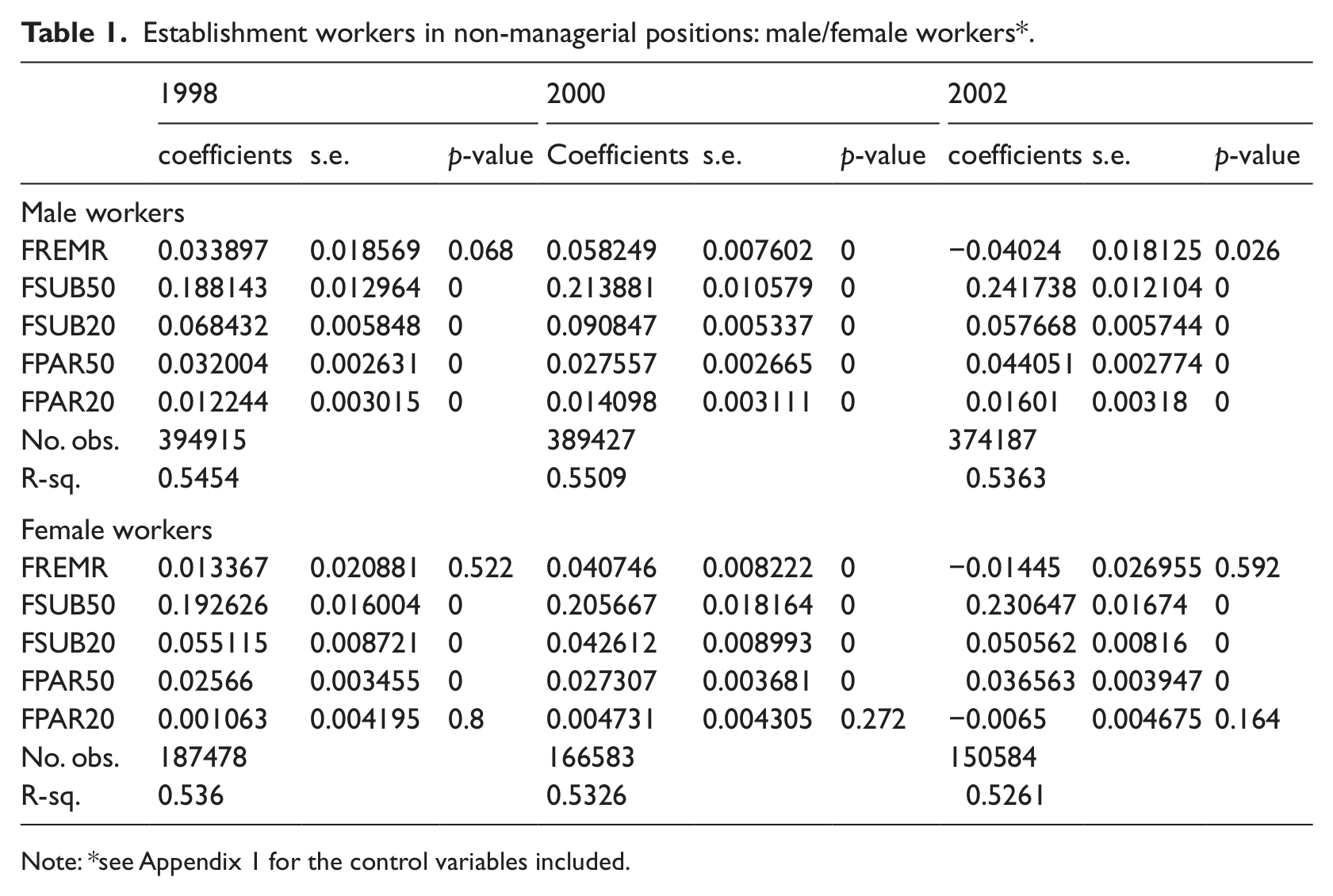
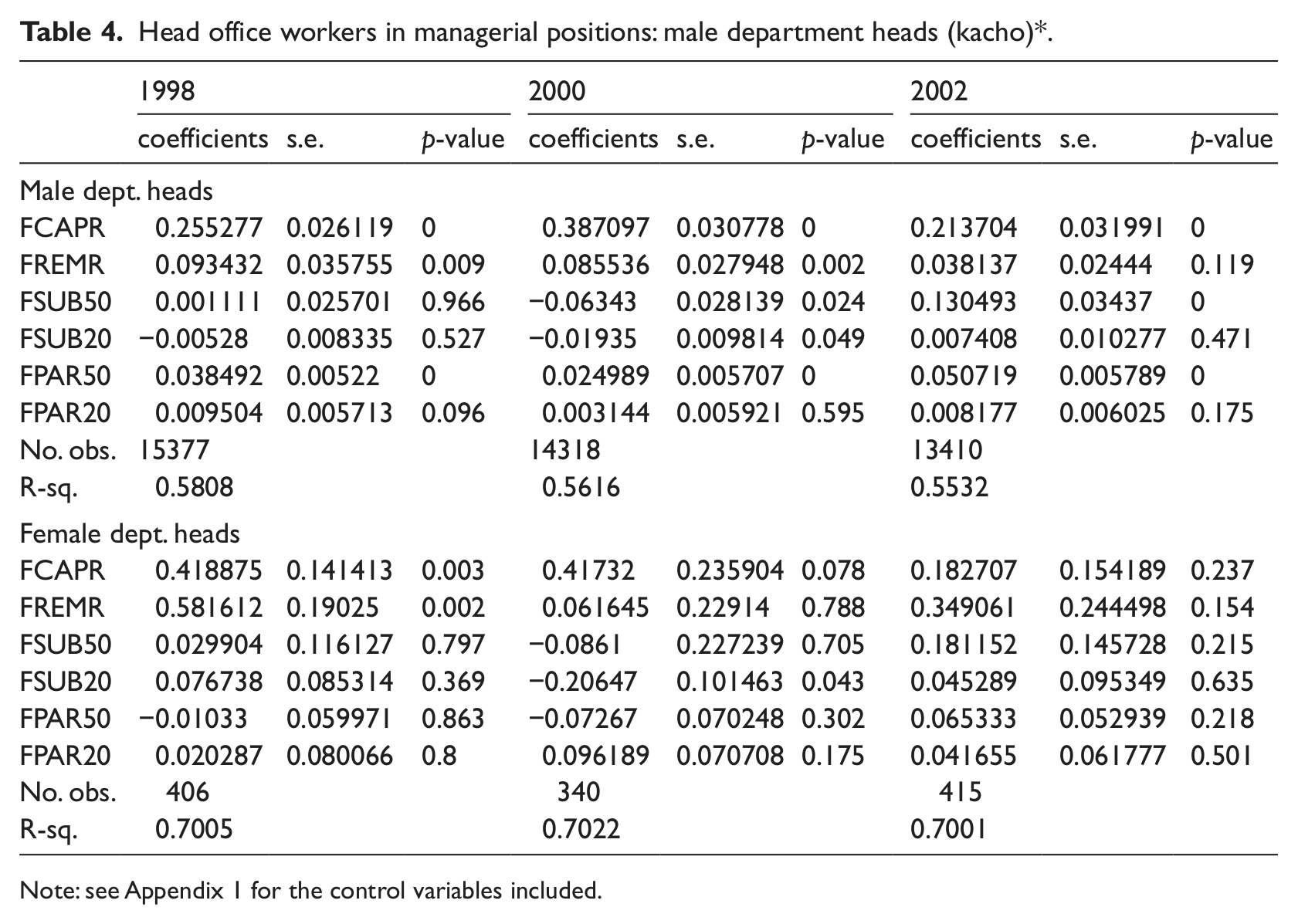
where a0 is a regression constant term, a1–a5 are regression coefficients for FDI-related explanatory variables, α1–α4 are (vector) regression coefficients for the four main control variables, Zi, Ri, Fi and INDi, and μi is the regression error term. The control variables used in the wage regressions estimated below include, among other factors, workers’ demographic, educational and experience characteristics, and establishments’ locational and industry characteristics (see Appendix 1 for the definitions of the variable included in our regressions.) Our regression results are summarized in Tables 1–4.
Establishment workers in non-managerial positions: male/female workers*.
Note: *see Appendix 1 for the control variables included.
Head office workers in non-managerial positions: male/female workers*.

Note: *see Appendix 1 for the control variables included.
Establishment workers in managerial positions: male/female department heads (kacho)*.

Note: *see Appendix 1 for the control variables included.
Head office workers in managerial positions: male department heads (kacho)*.
Note: see Appendix 1 for the control variables included.
Wage Effects of Inward FDI
Generally, foreign ownership, particularly foreign ownership of more than 50% of their firms, increases the wages of workers. The premiums due to foreign ownership are systematically different depending on the ranks, the degree of foreign ownership, the gender, and the location of worksite (establishments vs. head offices). These are discussed in the following sections.
Ranks and Establishments versus Head Offices
Non-management workers at firms which are 50%+ owned by foreign firms receive statistically significant wage premiums, and these premiums are larger for workers at establishments than workers at head offices. These premiums for male and female non-managers are (in percent): 19.0 for establishments versus 2.0 for head offices for male workers, and 19.0 versus 1.0 for female workers for 1998; 21.4 versus 5.7 and 20.6 versus 0.4 for 2000; and 24.2 versus 14.3 and 23.1 versus 13.5 for 2002.
For both male and female workers in management ranks at establishments, the premiums are generally higher for those in higher ranks than those in lower ranks. The premiums for male and female kacho (department heads) at establishments are (in per cent; Tables 3 and 4): 18.0 and 23.0 for 1998; 22.3 and 24.6 for 2000; and 28.6 and 19.2 for 2002. Many estimated premiums are statistically insignificant for managers at head offices and clear patterns are not observed.
These results suggest that foreign-affiliated firms pay significant amounts of premiums for their workers at establishments in general. Particularly, management ranks’ wages contain large amounts of foreign premiums. This is consistent with the general view that many foreign firms experience a lot of difficulty in Japan in securing and holding on to competent managers in their production facilities. This also implies that the cost of operating a manufacturing subsidiary in Japan is very expensive for foreign firms.
For male workers at both establishments and head offices and female workers at establishments, the higher the ranks of the workers the larger the wage premiums of foreign ownership are. This is particularly so for firms with 50%+ foreign ownership. (The only exception is female workers at head offices.) It is also particularly noteworthy that, at establishments, both male and female workers in non-management positions benefit significantly from foreign ownership. We also note that the benefits at firms with 20%+ foreign ownership are considerably larger for workers at establishments than workers at head offices.
Ownership Share (50%+ versus 20%+)
Where statistically significant, the larger the foreign ownership share, the larger our estimated benefits.
Gender
No systematic differences are apparent between male and female non-management workers and managers at establishments. For management ranks at head offices, the premiums seem higher for male than for female managers.
Wage Effects of Outward FDI
Ranks and Establishments versus Head Offices
Both male and female workers in non-management positions generally benefit from their firms’ outward FDI operations. Workers at establishments benefit more than workers at head offices. For example, having an overseas operation with more than 50% ownership implies wage increases of 3.2% (1.7%), 2.7% (2.6%) and 4.4% (3.3%) for male non-management workers at establishments (head offices) for 1998, 2000 and 2002, respectively (Tables 1 and 2).
The same figures for female non-management workers are: 2.5% (0.3%), 2.7% (0.2%) and 3.6% (1.9%) for 1998, 2000 and 2002, respectively. This means that the premiums for male and female non-management workers are not so different for workers at establishments but are quite different for workers at head offices. The premiums for female non-management workers at head offices appear to be considerably less than their male counterparts’ but this requires further investigation.
These wage premiums due to outward FDI decrease as the firm’s ownership share in overseas operations decreases. The fact that establishment workers receive larger outward FDI premiums holds in general for male workers in management positions. Furthermore, the premiums increase with management ranks for workers at both establishment and head offices.
The outward FDI premiums (in per cent) for 50%+ ownership for male kacho for establishments are: 5.0 for 1998, 4.4 for 2000 and 5.5 for 2002. The same figures for head offices are: 3.8 for 1998, 2.5 for 2000 and 5.1 for 2002.
Most of estimated premiums for female managers at both establishments and head offices are statistically insignificant.
Ownership Share (50%+ versus 20%+)
Our estimates, when statistically significant, are consistent with the hypothesis that the premiums increase as the ownership share increases for all types of workers.
Gender
Outward FDI premiums are generally higher for male non-management workers than for female non-management workers at both establishments and head offices.
The Effects of Foreign Expansion (Per Cent of Foreign Worker Ratio to Firm’s Total Employment) on the Wages of Workers
Male Workers
Foreign expansion has very often more positive impacts on the wages of workers in every rank at head offices than at establishments whenever the differences in the coefficients are statistically significant. In fact, there is no statistically significant coefficient observed for male workers at head offices, for whom foreign expansion was negative over the three years.
Estimated premiums for male kacho and non-management workers are (in per cent): – and 3.4 for establishments versus 9.3 and 5.9 for head offices for 1998 ( – denotes a statistically insignificant number); 7.7 and 5.8 for establishments versus 8.5 and 5.2 for head offices for 2000; and – and −4.0 for establishments versus – and 2.8 for head offices for 2002. That is, firms’ overseas expansion tends to raise the wages of male workers at their head offices more than workers at establishments. Also the coefficients for non-managers for 2002 at establishments are negative and statistically significant. We see that the overseas expansion can have negative impacts on the wages of workers in Japanese firms’ factories in Japan.
These results are broadly consistent with our hypotheses that firms’ overseas expansions demand new skills such as organizational, managerial, and cultural skills on the part of head office workers and managers. At the same time firms’ overseas expansions generally imply lower cost of production for the entire firm and hence allow workers at firms’ factories to focus more on higher value-added products. These are consistent with our results that the workers at establishments generally benefit from their firms’ overseas expansions in terms of higher wages. It seems to be the case, however, that the wages of workers at establishments are likely to be affected negatively also by the potential problems of such overseas expansions.
Female Workers
Because of relatively small sample sizes for female managerial ranks, their coefficients are less precisely estimated and more difficult to interpret. Nevertheless, estimated premiums for female workers in all ranks at both establishments and head offices are positive whenever they are statistically significant (Tables 1–4).
Estimated premiums for female kacho and non-management workers are (in per cent): –and – for establishments versus 10.8 and 3.6 for head offices for 1998; 28.3 and 4.1 for establishments versus 8.5 and 7.6 for head offices for 2000; and – and – for establishments versus 4.1 and 7.4 for head offices for 2002.
Concluding Remarks
We have shown that Japanese workers benefit, in the form of wage gains, from their employers’ associations with inward and outward FDI operations. These wage effects differ systematically depending on gender and worker ranks within their employer firms. Using our regression framework and statistical testing we are able to show that our hypotheses 1a–1d for inward FDI and 2a–2c for outward FDI are generally accepted. Policy implications of our findings are as follows: (i) inward FDI can potentially raise domestic productivity and help modernize managerial practices (such as gender equality); (ii) even though firms’ outward FDI in manufacturing industries can result in domestic job losses, it can also raise productivity and hence wages of home-country workers by upgrading their managerial skills; (iii) while workers working for firms with successful FDIs benefit from skill upgrading, wage raises across ranks and improved wage equalities between genders, workers who belong to firms with little exposure to internationalizing business activities will suffer from added competition with workers from low-wage countries; and (iv) FDI effects on worker wages will change Japanese firms’ internal labor markets and industrial relation practices, which have generally contributed to the sustainability of the relatively even income distribution across households but are likely to change.
Implications for the Sustainability of Japanese Income Equality
Until the massive shock of globalization on the Japanese economy began in the late 1990s and 2000s, Japanese firms’ traditional internal labor market-based employment practices were in equilibrium (e.g. Aoki, 1988; Nakamura, 1993) and Japan’s policy objective to maintain income equality was operational. However, as summarized in (iii) and (iv) above, our results suggest a possibly worrisome outcome for Japan’s income equality policies: an implication of (iii) and (iv) may be that globalization may jeopardize Japan’s traditional policy objective to sustain harmonious and economy-wide economic growth. Many analysts have observed a gradually increasing trend in Japan’s income inequality, which is consistent with our results (e.g. Cofference Board of Canada, 2012; The Economist, 2006; Nagahama, 2012; Tajika and Yashio, 2007). More specifically we think that our results are consistent with the following mechanism by which FDIs (our proxy for globalization in this paper) contributes to the increasing trend in income inequality among workers in Japanese manufacturing industries. First, overwhelming empirical evidence exists for Japan (as well as the US) that most firms engaged in international business activities such as FDI and international trade are large and competent firms. For example, Kiyota and Urata (2005) show that, while internationalized firms, which are generally large and engage in exporting and FDI operations, constitute only 13.8% of all Japanese firms, they accounted for 95.1% of all Japanese exports in 2000 (see also Wakasugi, 2009 for similar observations). Such concentrations of global business activities in a handful of large firms are also well documented for the US as well. For example, 40% of the more than 2000 large US firms with at least 2399 employees employ 95% of all workers employed by the US firms’ subsidiaries abroad (Jackson, 2012).
We also point out that companies which are not internationalized in Japan are generally small firms (in the SME sector). (For example, in 2009, only 22% of regular workers worked for manufacturing firms with at least 500 employees in Japan [Japanese Government, 2009], while the remaining 80% of workers in manufacturing worked in the SME sector, often very small firms.)
Our results suggest that the income gap between the workers working for productive large firms with FDI and other international operations and the workers working for other small firms in the SME sector will continue to increase. Also, as gender equality improves in terms of female–male earnings differentials for workers of large firms, more households with high-income couples emerge and their income levels are likely to grow faster than low-income couples who continue to work for low-wage paying employers (Nagahama, 2012). This would also imply that the income distribution among Japanese households will have to go through readjustments towards a more unequal distribution.
These implications all point to the possibility that the sustainability of Japan’s policy to maintain equal income among workers in all sectors is in jeopardy. To cope with this possibility of deteriorating sustainability our results also suggest that the government undertake aggressive policy measures that would facilitate firms in the SME sector to undertake internationalizing. One effective measure along these lines would be to rapidly upgrade the skill levels of workers in the SME sector so that their employer firms become able to compete in the globalized market. (See also Bernard et al., 2007; and Guarino, 2010 for discussions on similar issues about many non-internationalized firms in the US.)
Footnotes
Appendix 1
Acknowledgements
The author thanks two anonymous referees, Dr. Raisa Yakimova, and particularly Professor Nelson Ndubisi for their helpful comments on earlier versions of this paper.
Funding
Research reported in this paper is in part supported by research grants from the Social Science and Humanities Research Council of Canada.
Author’s Note
This paper is a substantially revised version of the paper presented at the Global Conference on SME, Entrepreneurship & Service Innovation conference at Griffith University, Gold Coast, Australia, July 2012.