



Abstract
Green initiatives are fast becoming a catchphrase among societies and business entities as these entities strive to ensure more sustainable business operations and lifestyle. Research in green behaviors of consumers especially in Asia and Africa is only just emerging. The objective of this study, therefore, is to examine the factors that influence consumers’ green buying behavior. The conceptual framework and hypotheses development are grounded on related literature. We examined six independent variables (environmental attitude, pro-environmental behavior, values, eco-literacy, low price sensitivity and social influence) and the effects on consumer (green) buying behavior. The questionnaire was adapted from validated items from related prior works. The analysis was based on 227 valid responses from residents of a southern state in Malaysia. The findings reveal that four of the six hypotheses were supported. Managerial and research implications of the findings are discussed.
Introduction
The rising concern over the environment has evolved through several distinct stages. In the 1960s the ecology movement was more focused on pollution and energy conservation, which was before the earliest stage of green marketing in the late 1980s (Peattie and Crane, 2005). It was widely believed that there would be an opportunity for growth in the green marketing domain, and firms would have to become more environmentally and socially sensitive to stay competitive in the market. This led firms to expect positive responses from consumers, increase in firm reputation (Ndubisi, 2011), and increase in goodwill and market share (Lee, 2008). Notwithstanding reports that environmental problems constituted public concerns, market growth for green products fell disappointingly short of marketers’ expectations (Wong, Turner and Stoneman, 1996).
Subsequently, the growth in green marketing excitements in the early 1990s gradually subsided (Peattie and Crane, 2005). Consequently, marketers started experiencing a backlash in the 1990s, which then marked the second stage of green marketing. Peattie and Crane (2005) identified some marketing practices which had adverse effect on green marketing during this period, including green spinning. However, in the mid-1990s consumers started to become more environmentally and socially aware (Strong, 1996). Finally, since 2000 green marketing has evolved tremendously into the third stage and shown signs of improvement following years of environmental campaigns. Ottman (2007) indicated that, in order to avoid the wrath of consumers and government agencies, the industry must focus on sustainable marketing practices. Ndubisi (2008) found that the public are actively scrutinizing and rewarding organizations which are promoting environmental wellbeing and penalizing those which have activities that are harmful to the environment. Sustainable practices include reaching out to employees and a broad range of external stakeholders using multidisciplinary teams to develop greener products and marketing programs, and maintaining good relationships with the community. It is believed that sustainable development is the theme for 21st-century commerce.
Green marketplaces are now developing in many countries to promote sustainable living, which includes delivering greener and cleaner alternatives to consumers based on socio-demographic segments. Specialized green producers and retailers have since emerged and are competing for the patronage of this segment with mainstream companies that have also launched initiatives targeting green consumers (Hartmann and Ibáñez, 2006). Malaysia, like many developing nations, is faced with emerging environmental challenges including domestic waste management and increasing frequency of interruption in water supply.
The concept of green buying behavior derives from the criticism that the early marketing concept neglected the impact of individual consumption on society (Follows and Jobber, 2000; Kotler, 1972). This concept and its application in business and society is not new, however. Lee (2008) indicated that there is less, although growing, emphasis on green consumption in Asia. This has in part contributed to the limited prior research on green buying behavior in Asia in general compared to research in Europe and North America. The study by Tanner and Kast (2003) is one example that focused on uncovering personal and contextual factors influencing green buying drivers. Subsequently, Ndubisi (2008) adopted the organization buying behavior as a theoretical lens in comparative studies of green initiatives of organizations in Africa and (Malaysia) Asia. Apart from these, we are unaware of other similar efforts in the Malaysia context. This limitation provides the impetus for the present study.
Thus the purpose of this study is to determine the factors that influence consumers’ willingness to buy green products. The paper attempts to provide some understanding by examining consumers’ green buying behavior in Malaysia and the determinant factors. Six factors identified from a review of extant literature, namely eco-literacy, environmental attitude, pro-environmental behavior, values, social influence and low price-sensitivity, were examined in this study. It is expected that the study’s findings will serve as an important source of reference for future research and for policymakers, firms or marketers seeking to gain critical information relating to key determinants of green buying behavior of consumers in Malaysian.
Theoretical Framework and Research Hypotheses
Consumer buying behavior is used in reference to the purchase behavior of final consumers, individuals and households who buy goods and services for personal consumption (Armstrong and Kotler, 2003). To understand consumer buying behavior, different models have been used. For example, the stimulus-response model, which often serves as a foundation, reasons that marketing stimuli (namely the marketing mix or 4Ps – product, price, promotion and place) and other stimuli (i.e. economic, technological, political and cultural trends) enter the consumer’s ‘black box’ and produce certain responses (Armstrong and Kotler, 2003). These stimuli are processed in the consumer’s mind to produce observable responses such as product choice, timing of purchase, purchase of green or eco-friendly product, green supplier choice, and amount spent.
Consumer buyer behavior theorists (e.g. Armstrong and Kotler, 2003; Moorhead and Griffin, 1995) argue that four broad factors influence consumer behavior, namely: cultural factors (including culture, subculture and social class); social factors (namely, reference groups, family, and roles and status); personal factors (e.g. age and life cycle stage, occupation, economic situation, lifestyle, personality and self-concept); and psychological factors (motivation, perception, learning, and beliefs and attitudes). Based on this theorizing, the paper develops its conceptual framework, schematized as Figure 1.
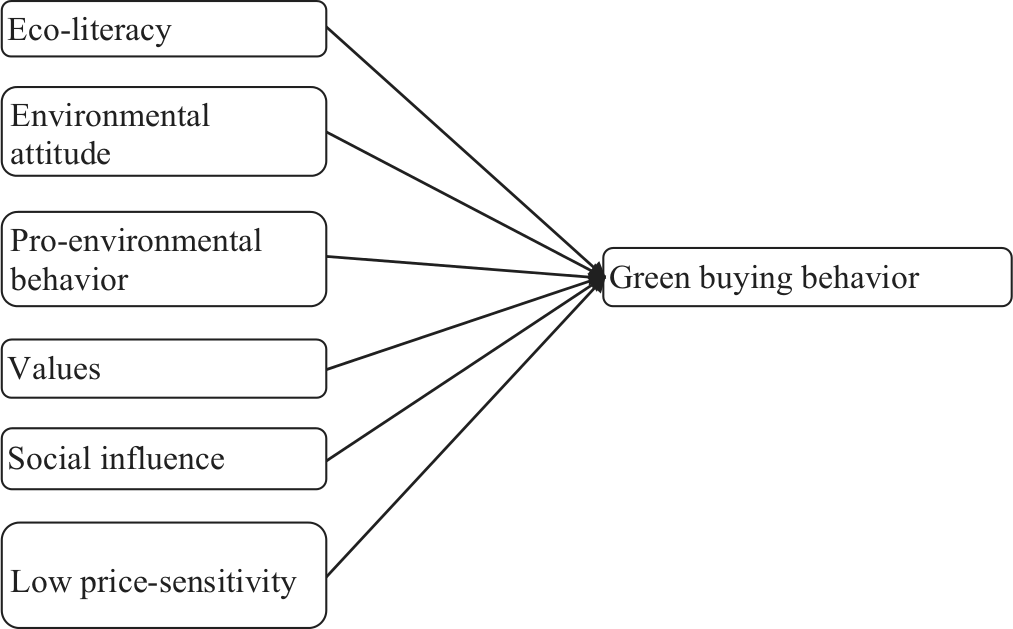
Conceptual framework.
As indicated, the framework is based on consumer behavior models and relevant literature. The framework indicates that there are six independent variables (namely eco-literacy, environmental attitude, pro-environmental behavior, consumer value, social influence, and low price sensitivity) which have potential influence on the dependent variable: green buying behavior.
Eco-Literacy
Ecological literacy is defined as ‘the capacity to perceive and interpret the relative health of environmental systems and to take appropriate action to maintain, restore, or improve the health of those systems’ (Disinger and Roth, 1992: 3). Generally, the behavioral literature reports a positive relationship between knowledge and behavior. However, in the field of environmental research, empirical findings on this link are anecdotal. For instance, some studies (e.g. Arbuthnot and Lingg, 1975) have shown that ecological knowledge exerts no significant direct effect on the performance of eco-friendly acts. As the authors (Arbuthnot and Lingg, 1975) suggested more than two decades ago, ecological knowledge might act as a mediating variable for ecological attitudes and behavior. On the other hand, Dispoto (1977) reported a positive association between ecological knowledge and environmentally responsible behavior. Davis (1993) has also asserted that augmented knowledge of environmental issues may lead to more positive ecological attitudes. Given the strong attitude–behavior link in the literature (e.g. Davis, 1989; Ndubisi, 2008), and significant knowledge–behavior relationship (Dispoto, 1977), it is reasonable to expect a positive relationship between eco-literacy and green buying behavior. Thus the ecological knowledge one holds may influence one’s decision-making process, which may affect actual behavior. Hence the following hypothesis:
H1: Eco-literacy will positively influence green buying behavior.
Environmental Attitude
Environmental attitude can be defined as an individual’s value judgment of environmental protection (Lee, 2008). An area of research in consumer attitude suggests that most individuals act in ways consistent with their attitudes. However, past research suggests that the presence of a pro-environmental attitude does not necessarily lead to pro-environmental action; others showed a weak relationship between attitude towards the environment and behavior (Tanner and Kast, 2003). Furthermore, even if people express positive attitudes toward environmentally friendly products, this may not translate into actual purchase behavior because green alternatives may not be available in every product category. On the other hand, there have been studies indicating a positive relationship between attitude and behavior. A survey by Mainieri and Barnett (1997) clearly supports the notion that specific consumer beliefs predict environmentally friendly consumer behavior more accurately than does general environmental concern. Additionally, the study by Laroche, Bergeron and Barbaro-Forleo (2001) strongly showed that pro-environmental attitude is positively related to consumer willingness to pay more for environmentally friendly products. This analysis leads to the second hypothesis:
H2: Environmental attitude will positively influence consumers’ green buying behavior.
Pro-Environmental Behavior
Pro-environmental behavior relates to behavior that consciously seeks to minimize the negative impact of one’s actions on the natural and built world (Kollmuss and Agyeman, 2002). Past research has argued and shown mixed results regarding relations between consumers’ behavior and green buying behavior. Although Laroche et al. (2001) hypothesized that environmentally friendly behavior is an important factor in influencing consumers’ willingness to pay more for green products, people who practice recycling may not necessarily purchase green products at a higher price. However, other studies have shown a positive relationship between environmental intention and behavior. Stern (2000) reported that consumers’ growing concern about their actions on the environment would be intent-orientated. This suggests that people who behave pro-environmentally and have the intention to do so would naturally exert pro-environmental actions. Hence, the following hypothesis:
H3: Pro-environmental behavior will positively influence consumers’ green buying behavior.
Consumer Value
Schwartz (1994) identified value as desirable goals, varying in importance, which serve as guiding principles in people’s lives. Value is responsible for shaping most people’s intrinsic motivation and is believed to be what guides them to behave in a particular way. The term value, as used in this paper, represents personal values that could enable consumers to engage in green buying behavior. Fraj and Martinez (2006) consider value as the criterion that individuals use to select and justify their actions and to value objects and the others’ conducts. Stern (2000) found that values play primary roles in influencing pro-environmental behavior. Schwartz (1977) argued that altruistic behavior would occur when individuals hold personal norms on a specific behavior. He also argued that these norms resulted from individuals’ awareness and consequences of engaging or not engaging in a specific behavior and the supposed cause of own responsibility to behave altruistically. Thus values will influence pro-environmental behavior when they are activated by concern for welfare of the environment. McCarty and Shrum (1994) believe that it makes intuitive sense that the values one holds influence behaviors that work for a common or societal good. In other words, individual values oriented towards the pursuit of self-interest or values related to the welfare of others. Therefore, although values do not exactly guarantee pro-environmental behavior, it is more likely that an individual’s intrinsic values will lead to pro environmental behavior. Hence the following hypothesis:
H4: Consumer values will positively influence consumers’ green buying behavior.
Social Influence
Social influence can be described as a condition where someone conforms to the expectations of another or to accept information obtained from another as evidence about reality (Deutsch and Gerard, 1955). Gupta and Ogden (2009) indicated that, although social value orientation of an individual was ineffective in discriminating between green and non-green consumers, most green consumers tend to have high trust and expect that others would engage in green buying behavior. Research has shown that consumers with high levels of trust are more likely to cooperate and show commitment loyalty than those with low levels of trust who will more likely defect because of the tendency to maximize self-gain (Ndubisi, 2011). Thus consumers may choose green brands that will enable them to demonstrate their environmental consciousness to others and society. Moreover, Maram and Kongsompong (2007) concluded that collectivists are more susceptible to social influence in buying situations than individualists. Therefore collectivists, as the study’s (Malaysian) samples are known (Hofstede, 1980), are more easily influenced by others than individualists who seek to act in own self-interest. Hence the following hypothesis:
H5: Social influence will positively influence consumers’ green buying behavior.
Low Price-Sensitivity
Hansen and Sørensen (1993) referred to consumers’ price-sensitivity as the importance of price in decision making. Low price sensitivity means demand for a product does not vary much as a result of variation in price. Often, consumers take into account the price attribute when it comes to making purchase decisions. They concluded that high prices seem to both keep a number of consumers from buying ecological products at all, and reduce the consumption of those who do buy ecological products. Marketers have found that consumers are price-sensitive when it comes to ‘buying green’ (Mandese, 1991). It has been argued that there is low consumer involvement in the convenience goods market, which implies that consumers seek only a little information. Jacoby and Olson (1977) refer to a number of experimental studies that deal with the information sought by consumers, in which the respondents were given a choice of a number of attributes to be evaluated. Findings from the studies indicated that brand was first and price was next. Additionally, Essoussi and Linton (2010) in a recent survey on how much consumers were willing to pay for recycled products found that willingness to pay a premium depends on type of product. Hence this indicates consumers’ intent to purchase may be due to the perceived benefits attached to the higher price, although this does not guarantee that will actually purchase it. We therefore develop the following hypothesis:
H6: Low price-sensitivity will positively influence consumers’ green buying behavior.
Table 1 provides a summary of the variables, descriptions of the variables and sources.
Variables, Descriptions and sources.

Research Method
Primary data were obtained by administering survey questionnaires to the participants. A survey questionnaire was chosen as it is considered more suitable in covering a wider range of respondents and with relatively reasonable constraints with respect to time. Survey questionnaires are widely used in business and social science research, for instance by Rivera-Camino (2007) and Tan and Lau (2010). We employed a personally administrated approach in this study. This approach enables the researcher to clarify doubts with respondents on the spot collect responses within a short period (Sekaran and Bougie, 2010).
A convenience sampling procedure was used in the study to obtain responses from respondents who were conveniently available for the research. Although the findings of this non-probability sampling technique may not be generalized to the population, however many scholars (e.g. Sekaran and Bougie, 2010) have remarked that convenience sampling is an appropriate sampling method to obtain preliminary information for concepts, which are relatively new and developing. As such, convenience sampling was appropriately chosen for this study. A number of past studies in the area had employed the convenience-sampling method (e.g. Paco and Raposo, 2009).
The target population for the purpose of this study consisted of mainly young adults (constituting approximately 34% of the Malaysian population; Official Portal Economic Planning Unit, 2010) resident in Malacca, Malaysia – an area that has witnessed and experimented with environmentally friendly programs (e.g. recycling). Malacca was declared as a developed state on 20 October 2010 by the Malaysian Prime Minister, Datuk Seri Najib Tun Razak. On the same day, the Chief Minister of Malacca state, Datuk Seri Ali Rustam, indicated that Malacca aims to be a green technology city in 10 years by emphasizing the use of renewable energy and pollution reduction (NST Online, 2010).
The questionnaire had two sections. The first section focused on the demographic profile of respondents, which was designed to collect information regarding the respondents’ gender, age, ethnicity, nationality and economic status. Additionally, this section included a number of general questions relating to this study, which was used to probe respondents. The second section comprised six subsections; each of them included a number of items used to measure a particular variable. The items in the questionnaire were adapted and measured using a five-point Likert-scale from Laroche et al. (2001), Lee (2008) and Ng (2009). The instrument was pre-tested to improve the quality of the questionnaire. According to Fraj and Martinez (2006), a pre-test is conducted to discover any possible weaknesses in the design questionnaire. In this study, the questionnaire was pre-tested on a small sample of 50 respondents to gather feedbacks. A number of items were found to be inappropriate or poorly constructed during the pre-test and were rectified. Corrective measures included revising and restructuring the identified items to ensure that they were relevant to the constructs being measured. Consequently, respondents were able to understand the questions and the items in the specific constructs. Survey forms were distributed to a sample of 290 (volunteers) respondents in Malacca. However, out of the 290 questionnaires distributed to participants, only 256 of copies were returned. The copies returned were then screened and evaluated to check for any mistakes such as inconsistencies, incompleteness, or missing data, which may have affected the analysis. After filtering through, we had 227 usable responses.
To establish the absence of non-response bias, we compared the mean values of early and late responses (Compeau, 1995). This approach has the capacity to reveal any differences between early and late responders who required prompting. Tests were conducted on the first week responses and responses after five weeks, and the differences between the two groups were insignificant (two-tailed t-test P > 0.05), indicating that time had no apparent effect on the perceptions and that non-response bias was remote. Subsequently, the data were analyzed using Statistical Package for the Social Sciences (SPSS), and were subjected to some analysis techniques such as descriptive analysis, reliability tests, normality testing, correlation analysis and multiple regression analysis. Descriptive analysis was used to summarize the demographic profile of the respondents. Reliability analysis was assessed by calculating the Cronbach’s alpha coefficient against the acceptable Cronbach’s alpha value of 0.07 (Nunnally, 1978). A normality test was then conducted to determine if the data were normally distributed using the P-P Plot. Subsequently, we conducted correlation analysis and multiple regression analysis.
Data Analysis and Findings
Description and Results
There were more female respondents (51.5%) compared to male respondents (48.5%). The student participants were all above 18 years old, which qualified them as young adults in this context. Most of the respondents (54.2%) were in the younger age group, aged between 20 and 22 years old. Based on race, the Chinese responded most (56.4%). The majority of the respondents (67.4%) were either pursuing or had completed a bachelor’s degree in their respective fields. Most of the respondents were familiar with the term ‘green products’ (80.6%) compared to those who were not (19.4%). Additionally, the majority of the respondents (95.2%) recognized the recycling symbol that was depicted in the questionnaire. Most of the respondents had purchased environmentally friendly products in the past (82.8%). The choice of environmentally friendly product category that respondents most frequently looked for was food packaging (33.5%). The most common source of information about environmentally friendly products for the respondents included reading materials (42.7%). The majority of respondents stated that buying environmentally friendly products sometimes satisfied their needs (58.1%).
Factor and Reliability Analyses
We conducted factor analysis (FA) using principal component analysis (PCA) with a maximum variance extraction (VARIMAX) rotation method from the variables (Pavlou, 2003). During factor analysis, items were retained according to the following criteria: (i) factor loadings greater than 0.5; and (ii) no high cross-loading of items. In other words, items were dropped if they had loadings that were less than 0.5 or the same amount of cross loadings. As shown in Table 2, the analysis showed no cross construct loadings above 0.50, indicating good discriminant validity (Klopping and McKinney, 2004). Each item loaded in its designated factor (variable), which indicates strong convergent validity. FA shows items’ consistency with the instrument’s underlying structure and reflects the factors identified from prior literature (Bagozzi, Yi and Phillips, 1991; Eze, 2008; Jayasingh and Eze, 2012; Klopping and McKinney, 2004; Ndubisi, 2008).
Factor loadings.
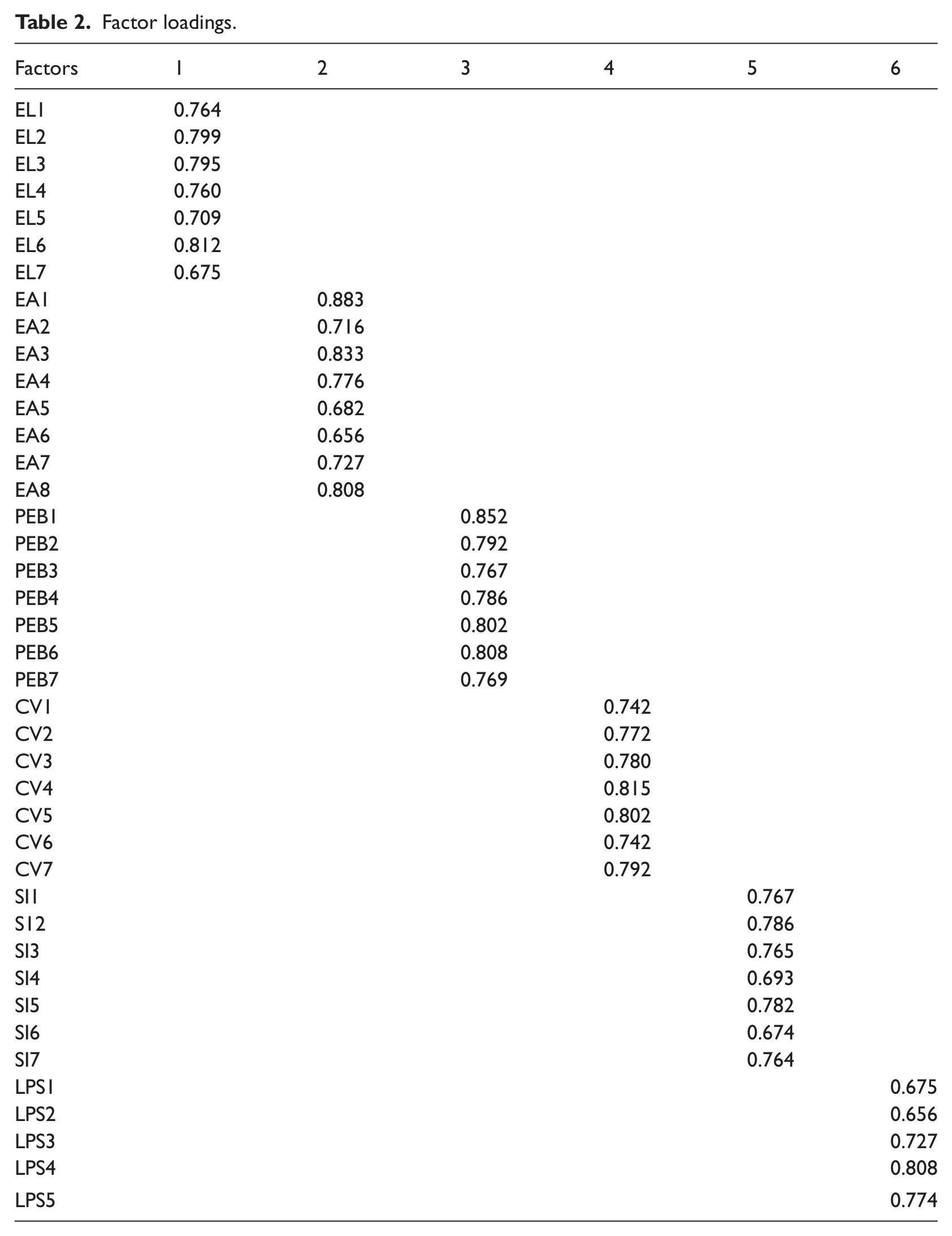
Table 3 shows the Cronbach’s alpha coefficients for the six independent variables and dependent variable. The results show that the Cronbach’s alphas varied from 0.70 to 0.87 for all the variables: environmental attitude (0.83); pro-environmental behavior (0.83); consumer values (0.85); social influence (0.85); price sensitivity (0.87); green buying behavior (0.82); and eco-literacy (0.70). As Nunnally (1978) suggests, the minimum acceptable alpha for scale reliability is 0.70; as such all the variables are considered to have adequate reliability.
Mean and reliability value of variables.
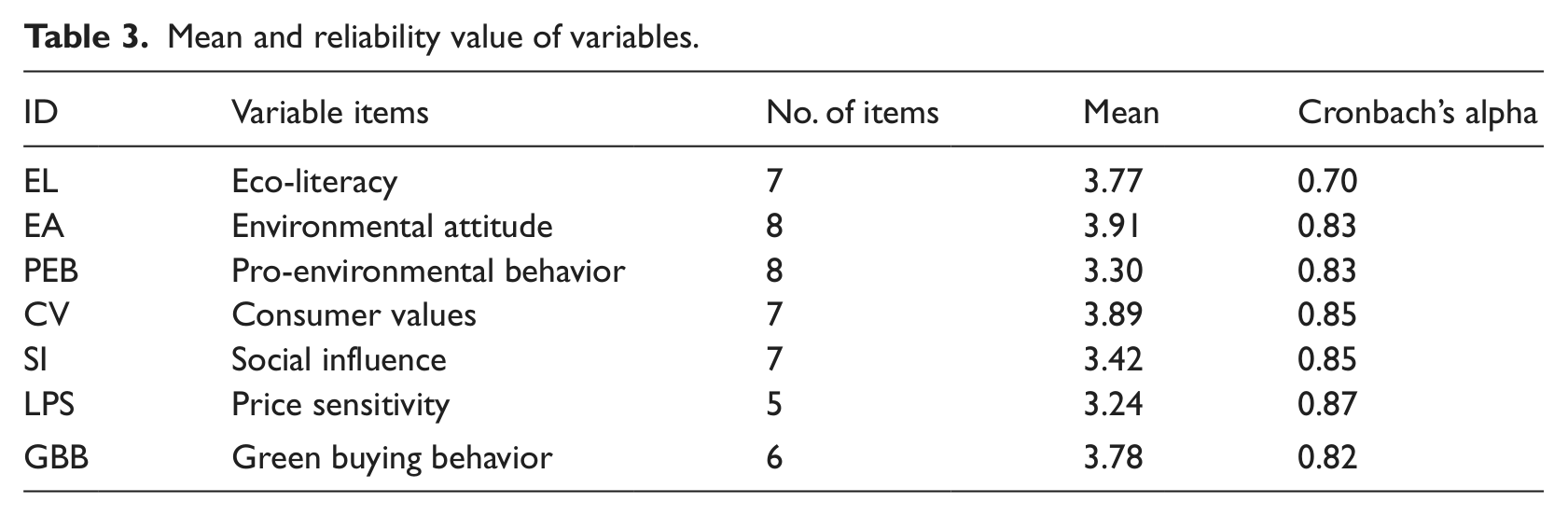
Table 4 shows the correlation analysis conducted to examine the association among the variables, namely eco-literacy, environmental attitude, pro-environmental behavior, consumer values, social influence, low price sensitivity and green buying behavior. As seen from the correlation table, all the variables have a positive correlation. A two-tailed test showed that all independent variables were significant (p < 0.05). The most strongly correlated variables were consumer values and green buying behavior (0.721) and between low-price sensitivity and green buying behavior (0.680).
Pearson correlation matrix.

Note: *Correlation is significance at 0.05 level.
Table 5 illustrates the regression analysis for model summary. It shows the computed R2 value of 0.739, which indicates that 74% of the variance in green buying behavior is explained by the independent variables combined. The F-value (103.778) is large with p < 0.001. Thus the independent variables contribute significantly to the green buying behavior of the respondents.
Multiple regression analysis – model summary.
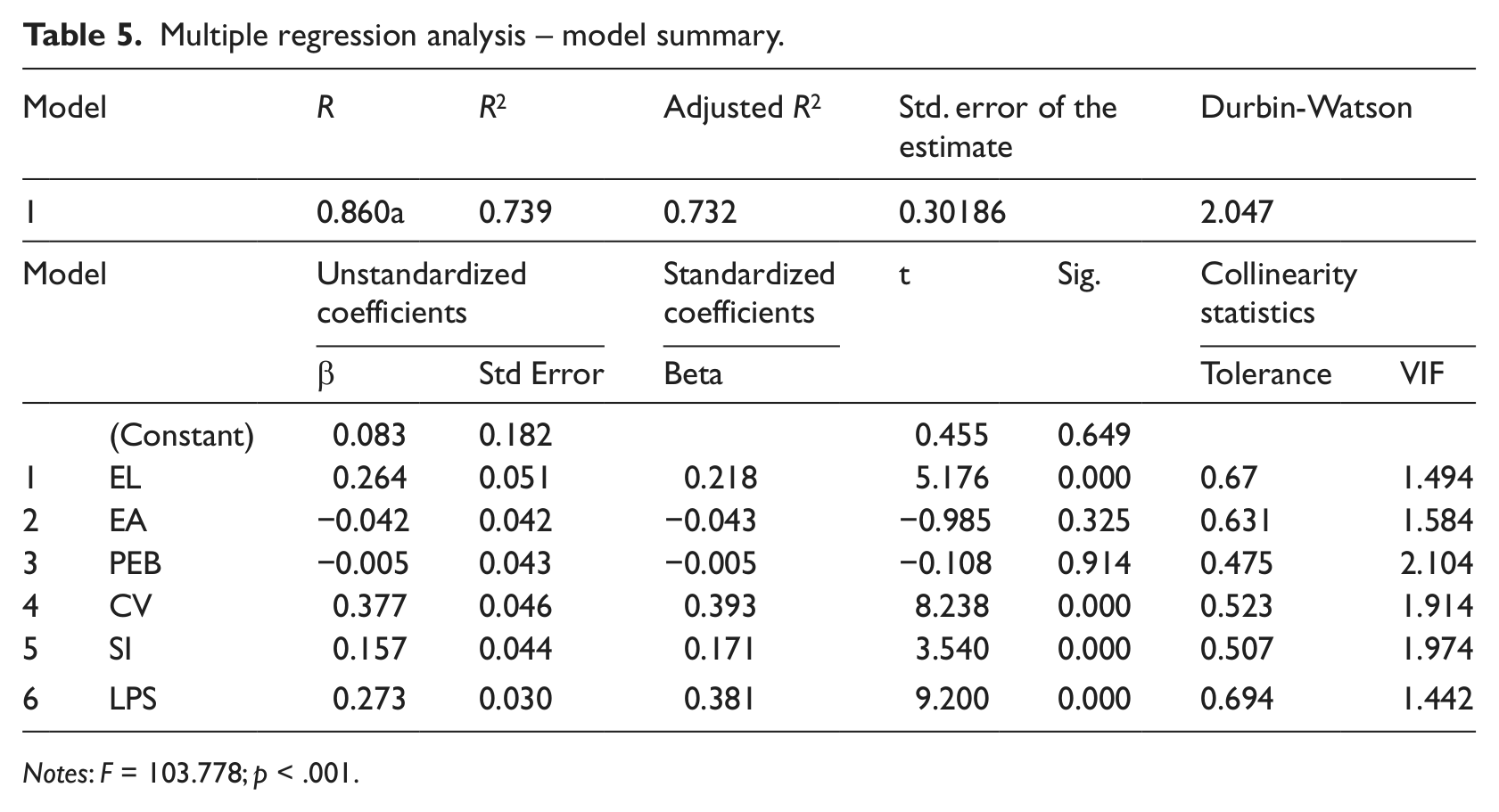
Notes: F = 103.778; p < .001.
The results in Table 5 further indicate that four of the six variables emerged significant at a .1% significance level. These variables are eco-literacy (EL; p < .001), consumer values (CV; p < .001), social influence (SI; p < .001), and low price sensitivity (LPS; p < .001). However, environmental attitude (EA) and pro-environmental behavior (PEB) recorded insignificant p-values of 0.914 and 0.325, respectively. The positive coefficients show positive influences. Hence eco-literacy, consumer values, social influence, and low price sensitivity could be considered as important determinants of green buying behavior. Consumer values (CV) emerged with the highest β value, which indicates the most important determinant.
The regression equation is cast as follows:

For every increase in eco-literacy, green buying behavior will go up by 0.264, provided that all the other variables – environmental attitude (EA), pro-environmental behavior (PEB), consumer values (CV), social influence (SI) and low price-sensitivity (LPS) – remain unchanged.
Contribution to Research
The findings of this study contribute to the consumer buyer behavior literature by providing some insights into the motives behind green purchase behaviors of Malaysian consumers. It presents empirical evidence showing that eco-literacy, consumer values, social influence, and low price sensitivity are key determinants of green buying behavior in an often overlooked but key Asian economy. Research on green buying behavior and motives of green consumers is still in its infancy stages in Asia in general and Malaysia in particular. More studies are called for if a greater understanding of this phenomenon is to be gained. This study provides other researchers with some insight into current market trends with respect to green products and behaviors of consumers in the Malaysian market. The study contributes to theory by situating eco-literacy, consumer values, social influence, and low price sensitivity at the crux of the environmental marketing debate, and underlining their relevance for a range of desired outcomes, namely enhanced consumer green buying behavior, eco-friendly product choices, mindful consumption and mindful marketing (Ndubisi, 2012).
Contribution to Practice
Findings in this study would benefit marketers as they provide some insights into the motives of green consumers, characteristics of markets for green products, and current market trends for green products. Marketers can perpetuate the importance of green behavior by conveying social norms and by increasing the use of societal pressure to shape attitude and behavior towards green products favorably. It is important for marketers to better understand and adopt practices that can guide consumers and convince them to buy green products routinely. For the future of sustainable living in Malaysia, this paper will be a useful source of reference for policymakers seeking information regarding consumers’ green buying behavior and motives in order to provide positive interventions. Policymakers will have a more profound understanding as to what motivates consumers in Malaysia to purchase green products and they will be able to use this information to build ecological policies that will help to consummate the nation’s sustainability vision.
Limitations and Future Research
Despite the interesting findings of this study, it is important to note that this study is based on self-reported data, which could be prone to social desirability bias. To address this issue, we developed the questionnaire with materials from different sources in the literature. We also ensured anonymity and informed participants that there was no preferred or correct answer. Future studies could consider a multi-method approach in data collection to reduce the social desirability bias effects from self-reports. In addition, future studies may consider variables not used in this study to explore further possibilities on motivations for green buying behavior. This could help future researchers to identify other factors contributing to green buying behavior.
One of the limitations of this study is that the respondents represent a fraction of consumers in Malaysia, which calls for caution in applying the findings. Respondents to this survey were drawn from a single state and city; therefore the results should be interpreted with this limitation in mind. Rural and urban cities might have different perspectives on, knowledge about and motives towards green products patronage, which may require further studies in other locations.
Evidence indicates that research in consumer behavior towards green products is still developing; therefore there is a need to heighten the intensity of research in this field. For instance, marketing scholars should focus on a host of business strategy and public policy issues, including eco-labels and market segmentation, and the role of structural factors and economic incentives in influencing consumer behavior (Prakash, 2002). Longitudinal studies could be conducted to enable the investigation of the resulting variation in the relative strength and influence of individual predictors’ overtime. Lastly, these results are initial findings in an area of growing importance in theory and practice. The increase of global coverage on ecological degradation and the recent highlight on greener and cleaner alternatives indicate the need for more research on environmentally conscious consumers.
Conclusion
The major contributions of this study are the investigation of factors that could influence green consumer buying behavior in Malaysia. Four of the six hypotheses emerged significant. Eco-literacy, consumer values, social influence, and price sensitivity are important determinants of green buyer behavior. By understanding the motives behind consumer green buying behavior, positive interventions can be developed by marketers and policymakers to respectively increase patronage and environmental and societal wellbeing. Understanding what will motivate consumers to increase their involvement in pro-environmental decisions is important for marketers in designing effective communication, whether it be through messages that draw on self-interest, concern for others, or the intrinsic value of the environment; and whether those messages are structured using rational cognitive arguments, emotional cues or a combination of the two (see Hartmann and Ibáñez, 2006). Therefore marketers will be able to explore different communication strategies that would be suitable in positioning environmentally friendly products and motivating green buying behaviors.