



Abstract
My central aim in this paper is to evaluate the outcomes of the amnesty programme established in mid-2009 by the Nigerian government as a way of resolving the groundswell of violence in the oil-rich Niger Delta region. In particular, I focus analytic attention on the planning and implementation of the Disarmament, Demobilisation and Reintegration (DDR) process of the amnesty. I argue that while the amnesty promotes non-killing alternatives to conflict resolution and opens a door for stabilisation, its current planning and implementation is flawed and unable to reduce the long-term potential for armed conflict in the Niger Delta. Far from been a transformational strategy, I argue that the amnesty programme has become a strategy of gilded pacification essentially targeted at buying off militants and re-establishing oil and gas production in the Niger Delta without addressing the multilayered causes of peacelessness in the region.
Keywords
Introduction
Since the end of the Second World War, the incidence of intrastate armed conflict 1 (internal conflicts fought between a government and a non-state group) has increased in number and intensity compared to interstate conflict (conflicts fought between two or more states), which has been relatively rare (Buhaug et al., 2007; Harbom and Wallensteen, 2009; Lotta and Wallensteen, 2012). Figure 1 shows the trend in the number of armed conflicts since 1946. Despite the significant increase in conflicts from 2010 to 2011 − the largest increase in the number of active armed conflicts between any two years since 1990 (Lotta and Wallensteen, 2012: 566) – the pattern is one of relative stability when we consider the trend for the past five years (Goldstein, 2011; Pinker, 2011). In 2011, the Uppsala Conflict Data Program (UCDP) recorded 36 active intrastate armed conflicts compared to only one interstate conflict: Cambodia-Thailand 2 (Lotta and Wallensteen, 2012: 565). This level of disparity is not unexpected if we recall the forecast of the Hart-Rudman Commission (Hart and Rudman, 1999: 6) that ‘Interstate wars will occur over the next 20 years, but most violence will erupt from conflicts internal to current territorial states’. This report was predated by Holsti’s (1996: 19–20) apt observation that recent wars have by and large been fought by ‘loosely knit groups of regulars, irregulars, cells, and not infrequently by locally-based warlords under little or no central authority’ rather than by ‘the organised armed forces of two or more states’. It is instructive to note that most intrastate armed conflicts are now fought in Asia or Africa (see Figure 2) and these continents have not contributed much to the appreciable decline in armed conflict in recent years (Buhaug et al., 2007; Lotta and Wallensteen, 2012).

Armed Conflicts by Type, 1946–2011.
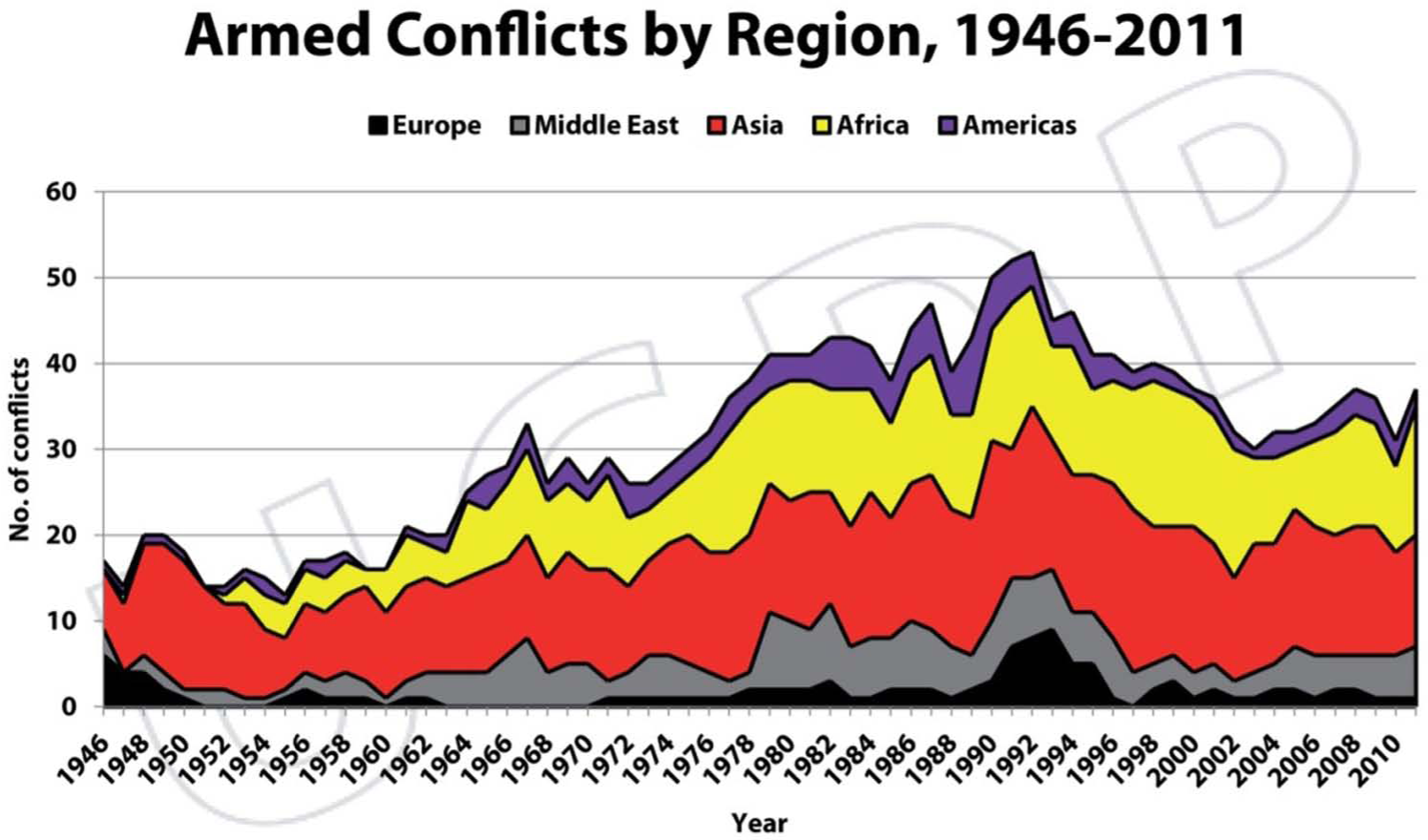
Armed Conflicts by Region, 1946–2011.
Despite the fact that intrastate conflict is the most frequent form of armed conflict (see Figure 1), the vast bulk of data-based research has focused on interstate conflict (Buhaug et al., 2007; Hensel, 2001; Wallensteen and Sollenberg, 2001 and 2002). The intrastate nature of armed conflicts calls for a set of peacekeeping concepts and approaches that transcends traditional statist diplomacy (Hegre and Sambanis, 2006; Lederach, 1997). Conflict analysts have argued that effective peacebuilding initiatives in the contemporary world should incorporate a wide range of activities and functions that both precede and follow formal peace accords (Fox and Hoelscher, 2012 ), including ‘processes, approaches, and stages needed to transform conflict toward more sustainable, peaceful relationships’ (Kriner, 2011: 1). Subsequently, recent peacebuilding literature has focused on the many institutional alternatives available to build peace, such as power-sharing (Hartzell and Hoddie, 2007; Jarstad and Nilsson, 2008), security sector reform (Toft 2010), peacekeeping forces (Doyle and Sambanis, 2006), and post-conflict justice (Bell, 2009; BinningsbØ et al., 2012). These processes represent the melange of options for government and oppositions to address violence from a previous conflict (Elster, 2004). Of all these options, however, the process of disarmament, demobilisation, and reintegration (DDR) of ex-combatants, a critical aspect of amnesties, have become increasingly integral to UN practices in conflict and post-conflict societies (Berdal, 1996; Jennings 2008; Muggah, 2009; Söderström, 2013; UN, 2000).
Briefly, disarmament describes the ‘collection, documentation, control and disposal of small arms, ammunition, explosives, and light and heavy weapons of combatants and often also of the civilian population’ in a post-conflict context (UN-SG, 2005). Disarmament also includes the development of a ‘responsible arms management program’ (UN-SG, 2005). The driving force of disarmament is ‘to reduce or control the number of weapons held before demobilisation in order to build confidence in the peace process, increase security and prevent a return to conflict’ (UN-SG, 2005). Demobilisation describes a planned process by which the armed forces of the government and/or opposition or fractional forces either downsize or completely disband; it is the ‘formal and controlled discharge of active combatants from armed forces and other armed groups’ (UN, 2006). Last of all, reintegration describes the process whereby ex-combatants and their families are integrated into the socioeconomic and political life of (civilian) communities (Knight and Ozerdem, 2004: 500; cf. Jennings 2008).
The DDR has repeatedly proven to be vital to stability in a post-conflict situation (Söderström 2013; UN, 2000). Countries like Papua New Guinea, Rwanda, DR Congo, El Salvador, Cambodia, Côte d’Ivoire, Uganda, Ethiopia, Somalia, Liberia, Russia, Angola, Sierra Leone, Guatemala, India, Tajikistan, Afghanistan, Colombia, Mozambique, Burundi, and Bosnia-Herzegovina, have all applied DDR to armed conflicts with some levels of success. Two factors are critical to the success of any DDR programme: (1) the political context in which it is carried out; and (2) the political will among the belligerent parties (Knight and Ozerdem, 2004: 500). In addition, experience suggests that the ways in which DDR is operationalised have significant implications for the reintegration of ex-combatants and for keeping the peace. So conceived, it is important to evaluate any implemented DDR programmes in order to gain insight into what has worked and what has not. As Jennings (2008: 5) cogently argues, ‘examining how DDR plays out on-the-ground would likely enable future programming to be formulated and implemented more effectively, improving outcomes and mitigating potential unintended and harmful consequences’.
The central purpose of this paper is to evaluate the outcomes of the so-called Nigerian version of DDR, established in mid-2009 by the federal government as a way of resolving the groundswell of violence in the oil-rich Niger Delta region and its crippling effects on the oil industry in Nigeria. In exchange for the surrender of arms and cessation of fighting, the amnesty – conceived in this paper as a promise or formal legislation on the part of the ruling party to not prosecute or punish past violators (Binningsbo et al., 2012: 735) – guaranteed Niger Delta combatants freedom from prosecution and a disarmament, demobilisation, and reintegration process with monthly stipend payments (Nwajiaku-Dahou, 2010). This paper argues that while the amnesty promotes non-killing alternatives to violence and opens a door for stabilisation through the tactics of political dialogue, its current planning and implementation are flawed and incapable of reducing the long-term potential for violence in the Niger Delta because they fail to address the multilayered causes of peacelessness in the region. At best, the amnesty offers a cosmetic and short-term panacea to the conflict.
Literature review
There is no single cause of a conflict. Nor is there any single precondition for sustainable peace. Different factors vary in importance and reinforce or neutralise each other. The analysis of the situation must therefore include assessing the relative importance of the different indicators and their inter-relationship (Forum on Early Warning and Early Response (FEWER), 2001: 7).
The scramble by groups to wrest away rights and to break asunder from the shackles of the state are found in a number of conceptual castings (Ross, 2002: 4). One perspective attributes the onset of intrastate violence to variation in political–institutional arrangements, specifically the terms of executive recruitment and the degree of political participation (Fox and Hoelscher, 2012; Suberu, 1996; Uzodike et al. 2010). Huntington (2006: 1) argues that the maintenance of political order requires ‘strong, adaptable, coherent political institutions’ and that ‘the differences between democracy and dictatorship are less than the differences between those countries whose politics embodies consensus, community, legitimacy, organisation, effectiveness, stability, and those countries whose politics is deficient in these qualities’. Toeing a similar line, Fox and Hoelscher (2012: 431–444) hypothesize that countries with coherent political orders, whether autocratic or democratic, are more prone to lower levels of social violence than ‘hybrid’ ones. They further argue that ‘where political participation exists in limited form, competition between rival parties, and between marginalised and non-marginalised groups, may present a further risk of political contestation being channelled into acts of social violence’ (Fox and Hoelscher, 2012: 434; cf. Gates et al., 2006; Goldstone et al., 2010; Hegre and Sambanis, 2006). In Africa, for example, public participation in politics has tended to be hemmed in by discordant struggles among rival groups over power and resources (Sklar 1986: 115). Fearing increased marginalisation and political underrepresentation, subordinated groups tend to rally around shared lines of affinity in an attempt to agitate vigorously for redress (Agbiboa, 2011: 3). As former Secretary-General of the United Nations, Kofi Annan pointedly notes, ‘in extreme cases, rival communities may perceive that their security, perhaps their very survival, can be ensured only through control of state power’ (cited in Agbiboa, 2011: 3).
The traditional view of civil war breakout posits that the higher the grievances, the higher the chances of organised violence (Birrel, 1972; Daly, 2012: 473; Gurr, 1970).
Granted that every country contains groups with grievances that may inspire rebellion, Goldstone et al. (2010: 191) powerfully argue that ‘it is where regimes are paralysed or undermined by elite divisions and state-elite conflicts that revolutionary wars can be sustained and states lose out to insurgencies’. Taking the traditional view further, scholars like Fearon and Laitin (2003) and Collier, Hoeffler and Rohner (2009) explore why motivations for rebellion exist everywhere and yet insurgency breaks out only in some places. They conclude that ‘what is critical is not whether people actually have reason to commit violence, but what enables them to carry it out in particular circumstances… feasibility is a rare phenomenon’ (Sherman, 2001: 28). The particular circumstances include poverty, rough terrain, weak states, lootable natural resources, and large, sparsely distributed populations (Blattman and Miguel, 2010; Daly, 2012; Collier and Hoeffler 2007: 1–27; Hegre and Sambanis, 2006).
Ethnicity has also been identified as one of the core threats to institutional stability, political order and state cohesion in pluralistic societies (Diamond, 1987; Gurr, 1993; Hall, 2001; Suberu, 1996). However, authors have differed in their explanations of the sources and nature of these conflicts. A number of variables have been adduced to explain ethnic conflicts. They include: (1) the emotional power of ‘primordial givens’ or cultural ties; (2) the struggle for relative group worth; (3) mass-based resource competition; (4) electoral mobilisation; (5) elite manipulation; (6) false consciousness; (7) defective political institutions and inequitable state policies (Diamond, 1987; Doornbos, 1991; Suberu, 1996:4). In his work entitled ‘Minorities at Risk,’ Gurr (1993: 5–11) advances the central thesis that ethnic groups are ‘at risk’ only to the degree that they are discriminated against economically, socially, culturally, or politically. He implicates several conditions in the mobilisation of ethnic minority grievances since 1945. These include: (1) unequal treatment of minority communities by dominant or ‘mainstream’ groups; (2) competition with other groups for access to power in new states; (3) the contagious effect of ethnopolitical activism elsewhere; (4) patterns of state-building, political power and economic development that channel communal energies into either protest or rebellion; and (5) the emergence of new ethnic minority elites who are willing to, and are adept at, mobilising their constituents in response to changing political developments, opportunities and resources (Gurr 1993: 23). A similar study by Rummel (1997: 170) suggests that ‘when political power is centralised, nondemocratic and highly dependent upon one’s social group membership, be it race, religion, ethnicity, or some cultural division, then collective violence is also highly likely’.
Moving on, the positive relationship between poverty and the likelihood of conflict is one that is discussed ad nauseam in the conflict literature (Collier and Hoeffler, 2004; Fearon and Laitin, 2003; Goldstone et al., 2010; Gurr, 1970; Hegre and Sambanis, 2006). In his recent personal account of the Nigerian Civil War (1967–1970), the late Professor Achebe (2012: 231) argues that ‘[e]conomic deprivation and corruption produce and exacerbate financial and social inequities in a population, which in turn fuel political instability’. Similarly, Evans (1994: 2) contends that:
a downward spiral of economic decline, often exacerbated by official corruption and mismanagement, has created governments that are at or near the point of collapse and that are being challenged often violently, by their own citizens. Economic decline has hastened the process of national disintegration, and vice versa.
Furthermore, Evans argues that it is no accident that ‘those countries whose economies are declining… should also be the ones experiencing the greatest amounts of violence and turmoil (Evans,1994: 2). Similarly, in their book Breaking the Conflict Trap, Collier et al. adopt an economic approach to the causes of intrastate conflict. They argue that:
Countries with low, stagnant, and unequally distributed per capita incomes that have remained dependent on primary commodities for exports face dangerously high risks of prolonged conflict. In the absence of economic development, neither good political institutions, nor ethnic and religious homogeneity, nor high military spending provide significant defences against large scale violence. (Collier et al., 2003: 53)
Explanations such as these are anchored on the human needs theory of social conflicts, which holds that all humans have basic needs that they seek to fulfil and failure to meet these needs could lead to the outbreak of violent conflict (Rosati et al., 1990). The theory resonates with the frustration–aggression theory of violence, which argues that the occurrence of aggressive behaviour presupposes the existence of frustration (McNeil, 1959; Pear, 1950). The frustration–aggression theory provides the psychological dynamic for the relative deprivation theory – the proposed nexus between the intensity of deprivation and the potential for collective violence (Davies, 1962; Gurr, 1970).
The link between economic deprivation and the onset of violence seems simplistic and no longer particularly useful or interesting, because it fails to explain why some poor people or places do not participate in violence, and because it offers very little in the way of clear recommendation for policymakers. Following a detailed review of the relevant empirical literature on terrorism causes, Krieger and Meierriek (2011: 3) conclude that ‘there is only limited evidence to support the hypothesis that economic deprivation causes terrorism… poor economic conditions matter less to terrorism once it is controlled for institutional and political factors’. Instead, they argue that terrorism is closely linked to political instability, sharp divides within the populace, country size and further demographic, institutional and international factors (Krieger and Meierriek, 2011: 3). Also, the frustration–aggression theory is narrowly framed as it ignores the salience of rational choice theory and capacity for the mobilisation of resources.
The conflict literature also stresses the impact that the nature of political regimes has on the mode and scale of state repression. A rehearsed view in the literature is that democracies repress much less than authoritarian regimes (Poe and Tate, 1994: 860). However, this hypothesis has been questioned on account of its inability to explain wide variations in levels of violence across countries with the same political regimes. Other variables frequently adduced to explain the scale of state-sanctioned violence include: the presence of authoritarian ideologies that justify the use of violence (Rummel 1997); various aspect of political culture (Daly, 2012); a record of state repression in the past (Gurr, 1970); state complicity in a civil war (Collier and Hoeffler, 2004); the level of socioeconomic inequality (Stewart, 2003); international monitoring of human rights (Amnesty International 2009; Doyle and Sambanis, 2000); and state weakness (Osaghae, 1995; Rotberg, 2002).
Framework for analysis
One of the major research findings in the conflict literature is that natural resources, 3 especially those that are easily exploited, increase the likelihood of conflict (Auty, 1998; Buhang and Gates, 2002; Collier and Hoeffler, 1998, 2004; De Soysa, 2002; Doyle and Sambanis, 2000; Fearon and Laitin, 2003; Keen, 1998; Reynal-Querol, 2002; Ross, 2002 ). This research also argues that environmental pressure and resource scarcity escalate violence and affect both national and international security (Homer-Dixon, 1999). Two main lines of explanation have emerged: first, natural resources provide the motivation and means for rebel uprisings. Second, abundant natural resources lead to poor policy choices and a weak state, exposing the society to violent conflict (Lujala, 2010: 15). In addition, abundant resources provide easily accruable rents that can sustain political structures, such as corruption and nepotism, which would not persist without those resources (Agbiboa, 2012; Auty and Gelb, 2001). Rustad and Binningsbo (2012: 532) identify three different mechanisms linking natural resources to conflict: (1) disagreements over natural resources (revenue) distribution may motivate rebellion; (2) revenues from natural resources may create funding opportunities for rebels; and (3) natural resources may aggravate ongoing conflict acting either as motivation or opportunity for rebels, but through other roles than as distributional claims or as funding sources. Following a careful study of the duration of post-conflict peace periods, Rustad and Binningsbo (2012: 531–546) argue that natural resource conflicts are more likely to recur than conflicts unaffected by natural resources.
Theoretical explanations of the link between natural resources and civil conflict have typically followed two approaches. Theories of ‘relative deprivation’ link rebellion to atypical severe grievances arising from high levels of inequality, government repression and lack of political rights, or ethnic and religious divisions (Borjas, 1992; Cramer, 1999; Goodhand, 2003). On the other hand, rationalist theories focus on the economic opportunities for rebellion that arise from availability of resources (Oyefusi, 2008). These models bear a semblance to Becker’s (1968) economic model of crime and law and draw heavily on Grossman (1995) and Hirshleifer (1995). In these models, greed is the underlying motivation for rebellion which is assumed to occur only when it is profitable for rebels. There is now a consensus, however, that the greed-grievance dichotomy stops short of explaining the link between natural resources and civil war (Ballentine and Sherman, 2003; Collier et al., 2009; Oyefusi, 2008: 541).
In an insightful paper, Ross (2002: 1–40) argues that resource dependence can promote civil war through four types of effects: (1) by harming a country’s economic performance; (2) by making its government weaker, more corrupt, and less accountable; (3) by giving people who live in resource-rich regions an incentive to form an independent state (for example, the Aceh separatist rebellion in Indonesia); and (4) by helping to finance rebel group movements. Added to this, resource-inspired insurrections have several common elements. One is that before the resource was exploited, people in these regions had a distinct identity – whether ethnic, linguistic, or religious – that set them apart from the majority population. Another was the widespread belief that the central government was unfairly appropriating the wealth that belonged to them, and that they would be richer if they were a separate state. Finally, in most cases local people bore many of the costs of the extraction process itself – due to land expropriation, environmental damage, and the immigration of labour from other parts of the country (Ross, 2002: 15). According to Ross (2003), the Niger Delta region of Nigeria contains the key ingredients for a resource-based conflict. It accounts for over 90 percent of the nation’s oil revenue, and its gas reserves are now touted as the next great potential revenue-earner for the nation (cf. Oyefusi, 2008: 540). It is important to note that natural resource dependence never makes conflict inevitable; resource wealth heightens the danger that conflict will break out (Ross, 2002: 4).
Armed conflicts marked by natural resource distribution mechanisms include both high-value natural resource conflicts (such as oil in the Niger Delta in Nigeria) and conflicts over land ownership (such as the civil war motivated by rural landlessness in El Salvador). Many rebel groups such as the insurgents in Nepal point to asymmetrical distribution of natural resource revenues and ownership as their casus belli (Murshed and Gates, 2006: 188–206). Not infrequently, conflicts with distribution mechanisms subsume an element of horizontal inequality; that is, where some groups think that others are receiving more than they are, or groups in natural resource-rich areas expect to get a bigger share of the resource revenues than they realistically can get (Ostby, 2006; Ostby et al., 2009). Authors like Mancini (2005), Ostby (2008), and Stewart (2003) argue that horizontal inequalities (i.e. inequality between groups) can lead to the politicisation of group identities and stimulate intergroup (as opposed to interclass) violence. High levels of inequality have two effects that are likely to contribute to grievances. First, high levels of inequality exacerbate the redistributive claims that minorities are likely to make on the central state. Second, as the prospective costs of such redistribution climb, the central government may be less likely to meet them. Ethnicity and/or religion are likely to accentuate these dynamics (Acemoglu and Robinson, 2000; Boix, 2003). For example, the Niger Delta of Nigeria is populated by minority ethnic groups that have borne a disproportionate share of the cost of oil extraction for which they believe they have not been adequately compensated (Agbiboa and Maiangwa, 2012; Oyefusi, 2008).
Building on the above, some scholars have applied a ‘motivation framework’ to explain the nexus between natural resources and conflict (Collier and Hoeffler, 2004; Doyle and Sambanis, 2000; De Soysa, 2002; Elbadawi and Sambanis, 2001; Fearon and Laitin, 2003; Hegre, 2002; Keen, 1998; Reynal-Querol, 2002; Ross, 2002). From the perspective of the rebel groups, the grievance and aggression against the government is motivated by ‘unfair access to natural resources, unsatisfactory distribution of benefits from natural resources, and lack of control over such resources’. Their motivation writ large is to ameliorate the skewed distribution of natural resources in terms of revenues, control, and access. From the perspective of the government, the motivation to use violence is to avoid ceding control over valuable natural resources. Some have also attributed the widespread use of repression, especially by authoritarian regimes, to the need to instil fear into those it needs to control; to attain compliant behaviour from citizens or to maximise power, with the constraint of the citizen’s loyalty (Agbiboa, 2011; Fox and Hoelscher, 2012).
In Africa, the struggle for scarce resources has become the real stuff of contemporary politics (Reno, 2001). This is evident in the fact that most conflict and wars in the continent tend to occur around resource-rich regions (Ikelegbe, 2005: 210). Keen (2003: 67) observes that the violent struggles in Sierra Leone occurred largely in the diamond-rich areas. The same can be said of Liberia and Democratic Republic of Congo (DRC) where the emergence of personal militias and armed networks is ‘underpinned by the struggle for control of external commerce and social and trade networks’ (Agbiboa, 2011: 3; Ikelegbe, 2005: 210). In Nigeria, the resource-rich Niger Delta region has been the site of armed conflict and violence for decades.
The above review offers a sufficiently nuanced framework for analysing the multilayered causes of peacelessness in the Niger Delta. In particular, the resource–conflict nexus, in combination with the horizontal inequality-cum-motivation framework, offers a useful framework for analysing the root causes of peacelessness in the Niger Delta and for uncovering the underlying motivations of the three stakeholders in the conflict – the local inhabitants, the oil multinational companies, and the Nigerian government (Omotola, 2006).
Multilayered causes of peacelessness in the Niger Delta
The Niger Delta region is ranked among the 10 most important wetland and coastal marine ecosystems in the world and is home to some 31 million people (Ibeanu, 2006; Obi, 2009). Officially, it is made up of nine states (Abia, Akwa-Ibom, Bayelsa, Cross River, Delta, Edo, Imo, Ondo and Rivers). Six of these states (excludes Abia, Imo and Ondo) form the South–South geopolitical zone (SSZ) of Nigeria, an area predominated by several minority ethnic groups (Agbiboa, 2011; Suberu, 1996). Some authors refer to these as the ‘geographical Niger Delta’ in contradistinction to the official Niger Delta (Oyefusi, 2008: 540). Importantly, the Niger Delta is also the site of massive oil deposits, which have been extracted for decades by the oil multinationals in the region. Although an estimated US$600 billion has been generated by the oil industry in Nigeria since the 1960s (Onuoha, 2009), the majority of Niger Delta inhabitants are mired in poverty while their region is engulfed by a jolting sense of neglect (Agbiboa, 2012; Ibeanu, 2006; Osha, 2006). According to Watts (2008: 44), ‘by any measure of social achievement the oil states are a calamity’, characterised by ‘nestled shacks, broken down canoes, and children who will be lucky to reach adulthood’.
In 2006, a UNDP report on the Niger Delta described the region as suffering from ‘administrative neglect, crumbling social infrastructure and services, high unemployment, social deprivation, abject poverty, filth and squalor and endemic conflict’ (UNDP, 2006: 16). The report added that ‘the prevailing situation not only explains the increasing waves of restiveness in the region, it also presages a grim future for the region and the country’ (UNDP, 2006: 16). In a recent empirical study – entitled Rethinking Conflict in the Niger Delta – published in 2012, Joab-Peterside et al. (2012: 18) underscored the uneasy stasis in the Niger Delta. The report stated that 90 percent of rural Niger Delta inhabitants still fall below the conventional poverty line of US$1 per day. Furthermore, ‘the ratio of doctor-to-population is 1: 27,000 in Delta State (and 1 to 282,000 in some of the local government areas in Bayelsa State)’ (Joab-Peterside et al., 2012: 18). Thus, they conclude that the Niger Delta remains a classic example of the ‘resource curse’ (Joab-Peterside et al., 2012: 2). But how can we appropriately locate the armed conflict in the Niger Delta?
The causes of the Niger Delta conflict are essentially multilayered (see a useful article on this topic by Idemudia and Ite, 2006: 391–406). In this section, I identify five core layers of conflict in the Niger Delta. The first is what I call the ‘centralisation problematic’. The problem here is that the Nigerian government has centralised the ownership and control of oil resources in such a way that nearly all component states and local government areas depend primarily on transfers. Many in the Niger Delta often adjudge the transfers to be done so unfairly that the north – with apparent control of political power and, as such, resource-sharing power – is unduly favoured (Joab-Peterside et al., 2012; Uzodike et al., 2010). According to Suberu (1996: xi), these processes legitimised ‘the expropriation of the resources of the oil-producing communities as part of the official strategy of centralised cake-sharing’. A second layer is what I describe as the ‘derivation problematic’. Rather than having a right to 50 percent of oil revenues on the basis of the derivation principle of revenue allocation, the Niger Delta share was progressively de-emphasised until it dropped to a mere 3 percent in the early 1980s (Obi, 2009). It was only in 1999 that it was again reviewed upwards, to 13 percent derivation. In 2005, during the proceedings of a National Political Reform Dialogue Conference, representatives of the Niger Delta had demanded an immediate increase in derivation revenue from the current constitutionally prescribed 13 percent to 25 percent and gradually up to 50 per cent (Constitution of the Federal Republic of Nigeria, section 162(2), cited in Ebeku, 2008). But the proposal was contemptuously rejected 4 at a plenary session of the entire representatives (mostly opposed by northern delegates) and this led the Niger Delta representatives to walk out from further participation in the proceedings (Omotola, 2009).
A third layer is what I describe as the ‘ownership problematic’. The Niger Delta people have no legal claim to the ‘ownership’ of oil produced from under their lands and waters (CLO, 1996; Omotola, 2009). A military decree by fiat was established that vested ownership and control of all petroleum in, under or upon any lands in the Nigerian state (Ebeku, 2007; Obi, 2001). In particular, the provisions of the 1979 and 1999 constitutions and other legislations such as the Territorial Waters Act (1967), the Petroleum Act (1969), the Exclusive Economic Zone Act (1978) and the Land Use Act (1978) served to firmly entrench the nationalisation policy that vested the ownership and control of land and the resources therein in the federal government (Agbiboa, 2011: 125). This contravenes the common law doctrine of quic quid plantatur solo cedit (what is attached to the land accrues to the land and belongs to the owner). A fourth layer is what I call the ‘environmental problematic’. Decades of oil operations in the Niger Delta have impacted disastrously on the region’s environment, massively threatening the subsistent peasant economy and hence the entire livelihood and basic survival of the people (Eteng, 1997; Omotola, 2006). According to a recent empirical study by a team of international environmental experts, ‘The damage from oil operations is chronic and cumulative, and has acted synergistically with other sources of environmental stress to result in a severely impaired coastal ecosystem and compromised the livelihoods and health of the region’s impoverished residents’ (Amnesty International, 2011: 9).
A final layer is the ‘governance problematic’. This concerns how the spectacular failure of the Nigerian government to properly and promptly address the grievances of the Niger Delta people, combined with the brutal and incendiary response of government security forces, have led to the internationalisation and radicalisation of local resistance in the region (Agbiboa, 2011). All of these conflict layers, individually and/or collectively contributed to the appreciable shift in approach in the Niger Delta (from non-violence to violence) in the pursuit of resource control (Ebeku, 2008; Okonta and Douglas 2003: 16).
5
As Douglas, environmental lawyer and leading activist member of the Ijaw Youth Council (IYC), puts it:
There is a big debate in the Niger Delta right now about what is the best means of removing the yoke of oppression visited on our people, and the overwhelming position is that non-violent struggle is preferred… But the government has adopted a very violent strategy of suppression that angers people like Dokubo, who see the strategy of negotiation [non-violence] failing woefully and are crying out for armed struggle. (Ebeku, 2008: 27)
Resistance movements in the Niger Delta
The latent manifestation of the Niger Delta conflict starts with the Niger Delta minorities’ delegation to London on the eve of independence that raised the issue of minority domination in the emerging entity called Nigeria. However, the violent manifestation of the conflict starts with the 1966 Isaac Adaka Boro’s led armed revolt popularly known as the ‘twelve days revolution’. This was the first serious attempt to secede in Nigeria and to confront the oil multinationals. With about 150 volunteer forces, Isaac Boro declared the Niger Delta Republic (NDR) on 23 February 1966 at Tantonabau in the Riverrine areas of the former Eastern region. In his autobiography, published posthumously, Boro explained his motivation for the revolt when he writes that ‘year after year we are clenched in tyrannical chains and led through a dark alley of perpetual political and social deprivation. Strangers in our country!’ (Omotola, 2009: 132). Addressing his army before the revolt, Boro declared:
Today is a great day, not only in your lives, but also in the history of the Niger Delta. Perhaps it will be the greatest day for a very long time. This is not because we are going to bring haven down, but because we are going to demonstrate to the world what and how we feel about oppression. Before today, we were branded robbers, bandits, terrorists or gangsters but after today, we shall be heroes of our land. (Tebekaemi 1982: 112) …remember your seventy-year-old grandmother who still farms before she eats; remember also your poverty stricken people; remember too your petroleum which is being pumped out daily from your veins, and then fight for your freedom. (Tebekaemi, 1982: 117)
Although the 12 days revolution was quashed by the federal government, it set the stage of the Niger Delta struggle for autonomy, resource control and development. As Omotola (2009: 134) notes, the first revolt ‘succeeded in awakening the ethnic consciousness of the minorities of the Niger Delta as much as the establishment of several civil society groups of various types’ (notably the Movement for the Survival of the Ogoni People (MOSOP)). Boro’s rebellion points to the depth of ‘republican sentiments’ felt in the region and the tensions between the growing recognition of oil in the delta and political marginalisation (Joab-Peterside et al., 2012: 7). After the routing of the Boro’s revolt by the Nigerian military there was a period of quietness as resistance was mainly by community associations and non-violent in nature, until the early 1990s when the Ogoni non-violent social movement started under the banner of MOSOP.
MOSOP was established in the early 1990s under the leadership of playwright and environmental activist Ken Saro-Wiwa and traditional heads of various Ogoni clans. MOSOP, which became an instant rallying point for the Ogonis, planned to take action against the state and oil multinationals for the oil exploitation and attendant environmental dislocations in Ogoniland (Omotola, 2009: 134). MOSOP’s mandate was to campaign non-violently to: (1) promote democratic awareness; (2) protect the environment of the Ogoni people; (3) seek socioeconomic and physical development for the region; (4) protect the cultural rights and practices of the Ogoni people; and (5) seek appropriate rights of self-determination for the Ogoni people (Na’Allah, 1998). In October 1990, MOSOP presented the Ogoni Bill of Rights (OBR) to the government of the Federal Republic of Nigeria. Therein, MOSOP demanded: (1) political control of Ogoni affairs; (2) the right to control and use a fair proportion of Ogoni economic resources for Ogoni development; (3) the right to protect the Ogoni environment and ecology from further degradation; and (4) adequate and direct representation in all Nigerian national institutions (MOSOP, 1992). These demands suggest that what the Ogonis desired was ‘a right to self-determination through the creation of an exclusively Ogoni state’ (Omotola, 2009: 134). As Osaghae (1995: 329) argues, the formation of MOSOP could be said to have spelt a salient shift in Ogoni identity-formation when they were radically transformed from an ‘ethnic group-in-itself’ to an ‘ethnic group for-it-self’.
MOSOP linked up with transnational rights advocacy networks such as Amnesty International, Human Rights Watch, Rainforest Action Group, Sierra Club, and Friends of the Earth in an attempt to internationalise its local resistance and increase its pressure on the government and on Shell, the largest multinational oil operator in the Niger Delta. The OBR was presented to various international organisations, including the United Nations sub-committee of human rights on the Prevention of Discrimination Against and Protection of Minorities and the African Human Rights Commission. The OBR was also presented at various international gatherings, including the tenth session of the working group on Indigenous Population in Geneva in 1992 and at the General Assembly of the Unrepresented Nations and People’s Organisation at the Hague in 1993. The internationalisation of the Ogoni struggle greatly unsettled the Nigerian government and oil multinationals as it exposed their human rights abuses against oil-producing ethnic minorities (Agbiboa, 2011).
Beginning in December 1992, the conflict intensified on the back of fresh demands by MOSOP from the three major oil stakeholders in Ogoniland – Shell, Chevron, and the Nigerian National Petroleum Corporation (NNPC). These demands included: (1) payment of US$6 billion for accumulated rents and royalties for oil exploration since 1958; (2) payment of US$4 billion for damages and compensation for environmental pollution; (3) immediate cessation of environmental degradation, especially gas-flaring in Yorla, Korokoro, and Bornu; (4) immediate covering of all exposed high-pressure oil pipelines; and (5) initiation of negotiation with the Ogoni people. To meet these demands, MOSOP announced a 30-day ultimatum (Omotola, 2009: 135). It was in this phase of the conflict that overt violence was applied on a large scale by the Nigerian government. For the Nigerian government, so heavily dependent on oil revenues, the example set by the Ogonis was likely to embolden other oil-bearing minority groups in the region. As a result, the Nigerian government, in complicity with the oil multinationals, chose to repress the Ogoni struggle.
The Nigerian government imposed draconian laws designed to instil fear and command compliance in the Niger Delta, particularly in Ogoniland. These included: (1) the proscription of ethnic minority associations; (2) the confinement, detention, arbitrary conviction and/or imprisonment of outspoken oil minority elites; (3) the violent suppression, by military force, of protests, demonstrations and uprisings by oil minority communities; and (4) the official declaration of ethnic minority agitations for self-determination, or any disturbances of oil production activities for that matter, as a seditious or treasonable offence punishable with the death penalty! (Suberu, 1996: xii). At the end of the 30-day ultimatum, the Ogonis staged a mass rally at Bori on 3 January 1993. The mass action peaked when MOSOP led a total Ogoni boycott of the 12 June 1993 presidential elections. Following mass protests that were designed to stop contractors from laying a new pipeline for Shell in Ogoniland, state security forces raided the area to quell the unrest. In the ensuing chaos, 27 villages were allegedly raided, resulting in the death of 2000 Ogoni people and the displacement of 80,000 (Obi 2009). These attacks virtually sounded the death knell of the mass action phase of the Ogoni struggle, which would seem to have been the reason for state involvement in these attacks.
The Ogoni struggle suffered a fatal blow on 21 May 1994 when Saro-Wiwa and eight of his colleagues were found guilty of inciting Niger Delta youths to murder four left-wing Ogoni chiefs and, consequently, sentenced to death by hanging (Agbiboa, 2011). The chicanery and hanging of Saro-Wiwa was a deliberate attempt by the Nigerian government to eliminate the pivotal figure of opposition around which a united Niger Delta front could emerge (Soyinka, 1996). Moreover, the execution was not so much a sign of disrespect for international opinion but more ‘a sign to Nigerians themselves that there was no escape from the state’s totalitarian apparatus and that nobody in the whole world could save them’ (Na’Allah, 1998: 75). Following Saro-Wiwa’s death, the Ogoni struggle declined, aided by state repression and leadership bickering. The establishment of MOSOP, the hanging of the ‘Ogoni 9’, and the militarisation of the region between 1990 and 1998 represented a fundamental watershed. It marked not simply the proliferation of a large number of forms of ethnic mobilisation across the region but by a passing of the political torch to a generation of more militant and activist youth (Joab-Peterside et al., 2012: 7).
In December 1998, the Ijaw Youth Council (IYC) was formed at a meeting of Ijaw activists and representatives from 40 Ijaw clans from across the coastal states of southern Nigeria. It comprises a confederation of youth associations of the Ijaw ethnic group of the Rivers, Bayelsa and Delta states of the Niger Delta. Its overriding goal was to ‘fight against the marginalisation, neglect, underdevelopment, militarisation, and repression of the minorities in the Niger Delta by the federal government and multinational oil companies’ (Omotola, 2009: 136). Perhaps, the major achievement of the IYC was the famous Kaiama Declaration of 11 December 1998, made at a meeting of 5000 youths drawn from 500 communities, 40 clans, and 25 organisations, held at Kaiama in Bayelsa State (Agbiboa, 2011). The Kaiama Declaration insisted that ‘we cease to recognise all undemocratic decrees that rob our peoples/communities of the right to ownership and control of our lives and resources, which were enacted without our participation and consent’ and demanded the ‘Ijaw control of Ijaw oil’. For the IYC, ‘any oil company that employs the services of the armed forces of the Nigerian State to “protect” its operations will be viewed as an enemy of the Ijaw people’ (IYC 1998, cited in Agbiboa, 2011). Like MOSOP, the IYC appealed to the youth and ordinary people by drawing upon Ijaw traditional beliefs about justice and resistance, including the use of Egbesu, an Ijaw deity of war, whose real significance lay in Ijaw cosmology as a symbol of spiritual protection.
In late December 1998, the IYC mobilised the Ijaw through Operation Climate Change, a programme of non-violent protest demanding that all oil companies leave the Niger Delta before the end of the year (Nwajiaku-Dahou, 2010). Rather than engaging the IYC in a political dialogue or responding to the demands made in the Kaiama Declaration, the military government sent in troops backed by warships that forcefully quelled the protests in January 1999 (Obi, 2009). Under the democratic rule of Olusegun Obasanjo (1999–2007), the practice of deploying soldiers to shoot-to-kill protesting indigenes, and to raze down communities, became a standard state response mechanism. A prime example is the invasion of Odi (a town populated by the Ijaws) by state security forces in revenge for the murder of 12 policemen by youths in the town on 20 November 1999. Over 2000 Odi inhabitants were killed and several thousands displaced in the state-sanctioned massacre (Omotola, 2009). Obasanjo justified this dastardly action by arguing that the brutal measure was necessary to deter communities from killing security officials as a way of pressing for their demands (OMCT & CLEEN, 2002). In his reaction to the Odi massacre, Felix Tuodolo, the IYC president, declared:
It is clear to us that the whole operation was designed to instil fear on the Ijaw and stop the mass of our suffering people from continuing our peaceful struggle to end the degradation of our lands and creeks by transnational oil companies and the Nigerian state. (IYC Press Release 1999, cited in Agbiboa, 2011: 132)
The continued militarisation of the Niger Delta region contributed to the feeling in some circles that the state and the oil multinationals would neither listen to the demands of the local people nor respect their human rights. Such views were informed by the apparent ‘failure’ of peaceful protest to effect any meaningful change (Na’Allah, 1998; Omotola, 2009).
The return to violence in the Niger Delta reminiscent of Boro’s revolt came on the back of the Kaiama Declaration. The declaration set the scene for armed resistance, with the Movement for the Emancipation of the Niger Delta (MEND) being the most formidable (Obi, 2009). MEND’s emergence has been located within ‘the lethal cocktail of economic deprivation, military dictatorship and worsening environmental crisis’ in the Niger Delta, and its tapping into ‘the fifty year Ijaw quest for social and environmental justice in the Niger Delta’ (Obi, 2009: 122; Okonta, 2007: 1–11). According to several sources, MEND is not a well-defined entity but rather a coalition of armed groups operating in the Niger Delta (Obi, 2008: 424; The Jamestown Foundation 30 October 2009). In April 2011, an article published by Le Monde describes MEND as a ‘nebulous group’ [translation] that lacks a command structure and a clear number of members (16 April 2011). According to Jomo Gbomo, MEND’s spokesperson, ‘MEND is an amalgam of all arm bearing groups in the Niger Delta fighting for the control of oil revenue by indigenes of the Niger Delta who have had relatively no benefits from the exploitation of our mineral resources by the Nigerian government and oil companies over the last fifty years’ (cited in Obi, 2009: 123).
MEND first became the cynosure of international eyes in 2006 through its kidnapping of foreign oil workers (Onuoha, 2009). The group initially emerged to demand the release of two key Ijaw leaders – Asari Dokubo and Diepreye Alamieyeseigha. However, its demands later extended to political issues such as resource control. MEND has gained most attention internationally from its threats to ‘cripple the Nigerian oil exports’ (IRIN News, 17 January 2006). To this end, MEND launched back-to-back attacks on oil installations and abducted several dozen oil workers beginning in December 2005 and January–February 2006 (Watts, 2007: 637–660). One reliable source notes that within the first three months of 2006, around 29 members of the Nigerian military had been killed and US$1 billion in oil revenues had been lost due to attacks by MEND. By July 2007, ‘700,000 barrels per day were shutdown due to growing political instability and insurgent attacks’ (Watts, 2007: 637). Another source claims that beginning from January 2006 there were at least four kidnappings a month and numerous battles between the state security services and militia groups, with significant impact on world oil prices by locking 800,000 barrels per day (Omotola, 2009: 46). Some estimates point to losses of US$100 billion to the Nigerian treasury between 2003 and 2008 as a result of conflicts (Nwajiaku-Dahou, 2010). According to a ‘Report of the Technical Committee of the Niger Delta’ released in late 2008, the Nigerian government lost a staggering US$23.7 billion in oil revenues due to MEND attacks and sabotage (Joab-Peterside et al., 2012). By April 2009, crude oil exports had fallen to 1.6 million barrels per day, down from 2.6 million in 2006. Between January 2006 and summer 2009, over 400 expatriate oil worker hostages were taken (Joab-Peterside et al., 2012: 8). The increasing waves of attacks on the oil industry by MEND and the abduction of (foreign) oil workers pointed to the urgent need for a truce.
The Niger Delta Amnesty Programme: A source of hope or hopelessness?
In April 2009, the idea of an amnesty for repentant militants in the Niger Delta was first mooted by the late President Yar’Adua in an escalating bid to curb relentless MEND attacks on oil facilities in the region (Omeje, 2004). In June 2009, Yar’Adua signed an offer of unconditional amnesty for militants operating in the Niger Delta (AFP, 25 June 2009). According to Ndutimi Alaibe, National Coordinator of the Amnesty Programme:
The amnesty programme was a response to security conditions in the Niger Delta at the time. It was a response by the then President to reduce fundamentally the violence that was taking place. After consultation with stakeholders, it was decided that there was a need to get the militants to lay down their weapons. That was the basis of the amnesty which was meant to stabilise, consolidate and sustain the security conditions in the Niger Delta region, as a requisite for promoting economic development in the area. (Interview, Daily Independent, June 3, 2012)
Although the Nigerian government claims to execute a ‘home grown DDR’, Joab-Peterside et al. (2012: 11) argue that ‘the Amnesty Programme draws from international standards and principles that are consistent with national context’.
The amnesty policy stated that militants who freely surrender their arms within 60 days (6 August 2009 to 4 October 2009) will not be prosecuted for the crimes committed in the process of disrupting the Nigerian oil industry. President Yar’Adua made clear that the amnesty deal was aimed at reintegrating and rehabilitating militants willing to surrender their arms into the Nigerian society (Onuoha, 2011: 52). A member of the presidential amnesty plan, Dr Timiebi Koripamo-Agary, noted that militants were expected to make their way to the nearest screening centre, turn in their arms and ammunitions, take the oath of renunciation (of armed violence) and receive presidential amnesty and unconditional pardon, and then register for a rehabilitation and reintegration programme (Nigerian Tribune, 11 July 2010). According to Korpamo-Agary, the disarmament and subsequent reintegration of the militants is only a first step towards bringing the urgently needed development to the Niger Delta region since there cannot be development without peace (Agbiboa, 2013). In writing about the amnesty’s objectives and deliverables, the Nigerian government identified the following three phases:
A disarmament phase to take place between 6 August 2009 and 4 October 2009 and to include the collection of biometric data;
A demobilisation and rehabilitation phase to last six to 12 months and to include the provision of, among other things, counselling and career guidance for the participants;
A reintegration phase to last up to five years and to include the provision of, among other things, occupational training and microcredits for the participants (Immigration and Refugee Board of Canada, 2011).
The DDR was a policy recommended by the Niger Delta Technical Committee (NDTC) established in 2008 by the Nigerian government to determine appropriate peacebuilding strategies in the restive region (Ibaba and Ikelegbe, 2010: 219–255). Made up of scholars and opinion leaders drawn from the region, the 40-member committee consulted widely with stakeholders, including the combatants, before making its recommendations. In part, the policy recommendations on DDR states that the federal government should:
Establish a credible and authoritative DDR institution and process, including international negotiators to plan, implement, and oversee the DDR programmes at regional, state and local government levels;
Grant amnesty to all Niger Delta militants willing and ready to participate in the DDR programme;
Work out long-term strategies for human capacity development and reintegration for ex-militants; and
Exclude from amnesty and criminalise the activities of those militants committed to the DDR process and unwilling to surrender their arms (NDTC, 2008: 66).
In particular, state governments were required to support the rebuilding of communities destroyed by military invasion, and establish youth development centres and community demobilisation and reintegration committees to enhance reintegration and capacity-building (Ibaba, 2011). State governments were also required to provide social amenities, including health centres and schools at the site of former militant camps (NDTC, 2008).
In July 2009, a budget of N52 billion (US$145 million) was controversially announced for the amnesty deal intended for 20,192 registered militants. There was an appreciable lack of clarity about exactly how the budget was to be spent, and the proportion that was to be allocated to monthly allowances versus the proportion allocated to a broader reintegration and rehabilitation package. Former combatants who registered for the 42-month period of training, reintegration and rehabilitation in government-designated residential training centres received monthly allowances of N65,000 (US$413), the payment of rent, and vocational training over the same period. This was more than three times the average salary for a young public sector worker in Nigeria but just a little higher than the foot soldier salary, which stood at N50,000 (US$400) in 2006 (Nwajiaku-Dahou, 2010). However, the criteria used to establish eligibility for inclusion were largely unclear, with the numbers of intended ‘beneficiaries’ widely believed to have been inflated (Joab-Peterside et al., 2012).
The disarmament phase of the Niger Delta amnesty covered a period of 60 days. This period saw over 15,000 militants surrender their weapons at the expiry date of the Disarmament and Demobilisation phase (). Weapons surrendered to the Presidential Amnesty Committee included ‘2,760 assorted guns, 287,445 ammunitions of different calibre, 18 gun-boats, 763 dynamite sticks, 1,090 dynamite caps, 3,155 magazines and several other military accessories, such as dynamite cables, bulletproof jackets and jack-knives’ (Agbiboa, 2011; Onuoha, 2011: 52). Many militants also turned themselves in as well, albeit major militant groups like MEND viewed the amnesty with suspicion since it made less room for dialogue and it does not address the root causes that gave rise to the struggles in the first place (RFI, 12 July 2009). In an interview posted in the Daily Independent newspaper (3 June, 2012), Ndutimi Alaibe noted that ‘these militants… wanted assurances… Some of them went to the mundane level of committing me to take an oath with them’. The popular belief is that militants only handed in a small fraction of their arms as most of them doubted the government’s genuine commitment to the amnesty deal (Onuoha, 2011). According to the Nigerian government, some 26,000 ex-militants enrolled in the amnesty programme (Reuters, 8 October 2009; The Nation, 26 June 2011).
The demobilisation phase commenced with putting militants into camps at temporary centres with support packages to cover their basic needs and those of their families (including food, clothes, shelter and medical services). This phase also involved non-killing and non-violence transformational trainings, ending with graduation and demobilisation. According to Joab-Peterside et al. (2012: 11), ‘23,358 ex-militants have been successfully demobilised between June 2010 − December 2011’. The demobilisation phase of the DDR officially ended on 24 September 2011. The United States’ ‘Country Report on Human Rights Practices for 2010’ stated that, between June and December 2009, an estimated 20,000 ex-militants had completed training programmes in non-violence, in a camp in Obubra, in Cross River State (US, 8 April 2011, Sec. 1g.). According to the Special Adviser to the President of Nigeria on the Amnesty Programme, between June 2010 and May 2011, 15,434 people had participated in the training programme offered (The Nation, 26 June 2011).
The aim of the reintegration phase is to enable the ex-militants to acquire real civilian status by providing them with training that will help increase their capabilities to responsibly take control of their lives. These skills are meant to help them gain sustainable employment and income as well as reconcile with local communities. According to a statement released on 11 December 2011, 7556 ex-militants (at home and abroad) have graduated from the programme (Agbiboa, 2013). In addition, the Minister of Niger Delta Affairs stated that the Ministry had organised a job fair meant to link the youths in the amnesty programme with potential employers (Immigration and Refugee Board of Canada, 2011).
Although the amnesty has led to a lull in violence in the Niger Delta and an increase in oil production (from 700,000 barrels to 2.4 million barrels per day) since 2009, especially since President Goodluck Jonathan, a native of the Niger Delta, assumed power, this paper argues that the programme affords only a cosmetic and short-term panacea to the protracted conflict. 6 Specifically, cash payouts to armed militants and proposals to give oil-bearing communities a 10 percent stake in state oil revenues fail to seriously address the underlying issues of government corruption, political sponsorship of violence and environmental degradation that continue to fuel resistance in the Niger Delta (Nwajiaku-Dahou, 2010). According to Omeje (2004), what prompted the proposal of the amnesty programme was not the environmental tragedy in the Niger Delta region but the urgent need to stem the tide of MEND’s crippling attacks on oil facilities in Nigeria, which has negatively affected the country’s oil productivity. In short, ‘the prime concern by the Nigerian state in the management of the oil conflicts in the Niger Delta has been to maximise oil revenues’ (Omeje, 2004: 425). However, recent reports from the Nigerian National Petroleum Corp show that attacks on Nigerian oil pipelines are rising again (Hinshaw, 2012; see Figure 3). In a May 2011 report, Human Rights Watch stated that despite the amnesty programme, some criminal groups and militants operating in the Niger Delta have carried out ‘kidnappings, bombings and attacks on oil facilities’ (HRW, 28 May 2011). According to a human rights defender, these attacks (with particular reference to the March 2010 bombing of the city of Warri, Delta State, near a meeting to debate the amnesty programme) ‘are enough to inform the whole world that the post-amnesty rehabilitation programme is not working’ (UN-IRIN, 2010).

More in the pipeline: Attacks on Nigerian oil pipelines are rising again after a fall during a 2009 amnesty for militants.
The Amnesty Programme itself is bedevilled by a number of challenges. This is despite the dubious claims by the Special Adviser on the Amnesty Programme that peace, security and sustainable development have returned to the Niger Delta and that this stems from the successful management of the post-amnesty programme (The Nation, 26 June 2011). A human rights activist cited by the United Nations Integration Regional Information Networks (IRIN) noted that ‘the rehabilitation centres… do not have essential equipment… the programme is failing’ (UN-IRIN, 2010). Similarly, an analyst of the International Crisis Group bemoaned the insufficient effort invested in the rehabilitation and reintegration of the Niger Delta militants (UN-IRIN, 2010). Le Monde argues that ‘a new outburst of violence should not be ruled out [in the Niger Delta] in the short or long term because the amnesty program did not resolve anything politically’ ([translation], 16 April 2011). In April 2011, an online press release by MEND stated that ‘with billions of naira spent, the amnesty and reintegration programme… is an obvious failure, given that the initial programme objective was overlooked for political ambitions and personal interests’ (cited in PANA, 3 April 2011). At the administration level, Joab-Peterside et al. (2012: 11) draw attention to:
the slow paced process in deployment of ex-militants offshore as a result of complexities in funds transfer and immigration matters, the random emergence of groups queuing up for benefits associated with the amnesty process, a lack of adequate and specialised training centers in Nigeria, low availability of jobs after training, low level of involvement of oil and gas companies in the program and reconciling those ex-militants who have been outlawed by their communities and village and justice issues.
In an interview posted in the Daily Independent newspaper (3 July, 2012: 1–2), National Coordinator of the Amnesty Programme, Ndutimi Alaibe, noted that:
Some of the challenges facing the programme today have to do with the background of some of the militants themselves and the initial process of de-briefing. You may take them abroad, and on arrival find that the individual is not even psychologically prepared and then indulge in negative habits and in the process, they get deported. There is therefore need to properly engage the ex-militants to determine their career aspirations before re-integration. The programme has recorded fundamental success in terms of some of them who have been trained in specialised disciplines; and more can still be achieved. There are those who have graduated as pilots. Managing 26,000 ex-militants through reintegration can be very challenging. The cooperation of all stakeholders is imperative.
Conclusion
Almost four years into the amnesty programme, oil-bearing communities in the Niger Delta continue to lack basic infrastructural facilities such as paved roads, pipe-borne water, and stable power supplies; unregulated oil pollution continues to lay waste to land and water – the major source of livelihood in the region. The 2011 United Nations Environment Programme (UNEP) report bears witness to the enduring environmental problems in the Niger Delta, estimating that it would take 30 years to clean the waters of the region that once sustained fisheries (Hinshaw, 2012). Despite the fact that there is an Environmental Remediation Committee established to study the root causes of oil pollution and proffer solutions on how the region can be reintegrated, the committee is yet to produce any report. For all the hopes it raised, Yar’Adua’s announcement of a presidential pardon is essentially conceived in this paper as a means of buying off militants and re-establishing oil and gas production in the Niger Delta without dealing with the multilayered causes of peacelessness in the region. This gilded pacification strategy of the Nigerian government is untenable and sends the message to youths in the Niger Delta, nay Nigeria, that militancy promises more rewards than risks.
Moreover, the illness and subsequent death of Yar’Adua – the main architect of the amnesty – meant that little real progress was made on the reintegration and rehabilitation front. Former militants complained bitterly that promised training was either not forthcoming or ill suited to their needs. Furthermore, the allowances promised to ex-combatants were often delayed, or less than designated, or not paid to them by their commanders. As Oluwaniyi (2011: 50) writes, ‘The commanders benefitted from the largesse and state patronage while their foot soldiers were short-changed’. Many of these un(der)paid foot soldiers continue to pursue prosperity by tapping pipelines, even as the former kingpins profess to have left the oil-theft business. The report of a panel set up in January 2010 to review the rehabilitation aspect of the DDR reveals that about 80 percent of the budget has been used to pay the commanders of ex-militants, the managers of the programme, and the rising number of consultants, leaving just 20 percent for the rehabilitation of ex-militants. To improve ties with former Delta warlords, the Nigerian government invited the top ‘generals’, as they call themselves, for extended stays on the uppermost, executive floors of Abuja’s Hilton hotel. According to fresh reports, the Nigerian state oil company is giving US$3.8 million-a-year apiece to two former rebel leaders – General Ebikabowei ‘Boyloaf’ Victor Ben and General Ateke Tom – to have their foot soldiers guard Delta pipelines they once attacked. Another General ‘Tompolo’ Ekpumopolo, maintains a US$22.9 million-a-year (N3.614 billion) contract to do the same (Hinshaw, 2012). The recent acknowledgement that the federal government paid US$40 million in the past 12 months to four Niger Delta warlords to guard the country’s oil pipelines has led some to describe the amnesty as a ‘lucrative business’ rather than a ‘transformational strategy’ (Oluwaniyi, 2011: 52).
In the light of the above, it would seem that the amnesty poses serious challenges that may jeopardise the possibility of future peace, security and development, and possibly exacerbate the crisis in the Niger Delta rather than abate it. According to Dimieari Von Kemedi, a former government mediator, ‘Everybody seems to believe… that the Niger Delta problem is over. It’s just on pause. The challenge is to move from pause to stop’ (cited in Hinshaw, 2012). Despite its shortcomings, especially its flawed planning and implementation, the amnesty remains a laudable project because it pursues a tactic of negotiation that promotes non-killing alternatives to intrastate conflict and paves the way for achieving sustainable peace and development. As Golda Meir, former Prime Minister of Israel once remarked, ‘the only alternative to war is peace and the only road to peace is negotiations’. 7
Footnotes
Funding
This research received no specific grant from any funding agency in the public, commercial, or not-for-profit sectors.