



Abstract
The aim of study was to address the factors influencing landholdings and fertility among women in rural Kenya. The data used are from the 2008–2009 Kenya Demographic and Health Survey (KDHS) of a representative sample size of 6761 women, aged 15–49 years. Statistical tests are utilized to answer the research question, such as Chi-square and logistic regression and P-tests. The results show that the relationship between fertility and landholdings influences family sizes. The relationship between fertility behaviour and occupational status is found to be statistically significant with a P-value of 0.00 and χ2 of 268.24. A high proportion (68.9%) of the women had worked in the preceding reference period. The result of this study is expected to be of particular use for policy makers, planners and other interested stakeholders in population and development spheres.
Introduction
Kenya has enormous agricultural production, which is the country’s biggest economic activity. Landholding access in this country is governed mainly by men or, now more rarely, by their lineages. This is the case under both traditional landholding tenure systems (in which land was controlled by communities/societies or lineages, and allocated to their family members) and the systems of individual ownership that have emerged from the various resettlement and title registration schemes of recent decades. To farm productively, Kenyans recruit their children for various farming as well as housekeeping tasks (Frank and McNicoll, 1987). Three decades ago, Kenya’s human fertility rate was roughly similar to the rest of Africa: between six and seven children per woman. Now, total fertility in Kenya has exceeded 8 live births per woman. This raised concerns with the population research agenda, which sought to understand why fertility levels were so high and when and how they might be expected to decline. Kenya’s transition to emotional and economic nucleation is rampant among its people, referred to as the urban middle class. Some of these people are from the Gikuyu tribes who have adopted the complex, specialized culture that is associated with the industrial world. Women from these communities place greater value on educating their children than their labour output on farms. This might not be the case in some rural areas, where nuclear families are still embedded in larger kinship groups that discourage economic and emotional nucleation. A lack of official will to curb population growth stems from incomplete knowledge about the causes and consequences of high fertility in Africa, particularly in Kenya. Even the fundamental relationship between landholding and the reproductive decisions of Kenya farm couples is poorly understood (Mwangi and Nyika, 2010). Conflicting theories and inconsistent evidence have led to a dispute over the causal direction of the association between the amount of land couples own or operate and the number of children they have. Large landholdings may raise couples’ needs for farm labour and, thus, their birth rate. However, a large amount of support has been mustered for the reverse hypothesis, i.e., that family labour for the farm (due to a high birth rate) may raise a household’s need for, and ability to afford, greater operational holdings. It is also conceivable that these two causal paths operate reciprocally. Another author, Caldwell, 2005 argues optimistically that ‘there is a near consensus on the pre-modern insurance value of children’. Childless parents face almost insurmountable problems in converting surpluses from their young adulthood into support for their old age.
Research problem
Landholdings in Kenya are a source of livelihood, mostly in rural areas. It’s stated that women who have a lot of children have big portions of land holdings, to encompass the labour they may want when cultivating land. Culture encourages women to have many children as a sign of fertility ignoring the difficulty in providing for all of them. Families with large amounts of land prefer to employ family members in their enterprise. This ensures more income and profits, faithful workers with little supervision needed, and more productivity. Rural populations have been growing at an alarming rate, and one of the reasons for this is the link that has undergone severe scrutiny and resulted in an intense land debate. Several studies have documented the empirical inverse relationship between farm size and the fertility behaviour of human beings, and subsequently offered an explanation for it. They suggest that the number of children in a family may be inversely proportional to the amount of land owned by a household, while others suggest that the family size is related to one’s security at old age. Within the rural sector, the principal store of value is land. The centrality of land to rural economic (namely, income) and social structure suggests that the distribution of this resource is important for an understanding of the fertility behaviour of women. Kenyan women have for ages been involved in agricultural practices, and it is not until recently that they have opted for other strategies to help them improve their economic status. The association between landholding and fertility among these women has been a debatable subject that has appealed to different writers in different ways (Frank and McNicoll, 1987). Through analysis of patrilineal kinship and marriage systems in Kenya, some (Dow, Archer, Khasiani & Kekovole,1994) suggest that high fertility is a woman’s way of managing her social and economic position, as it ensures continued access to land and labour (children). Their argument is that wives are granted limited rights to use land because of the persistence of indigenous inheritance systems which allow a widow access to her deceased husband’s landholding only through her sons.
A similar study in India argues that among Indian farmers in the Punjab, high fertility (many sons) represented a means of acquiring land, holding on to land and obtaining maximum benefits from the land through the elimination of hired labour (Mamdani, 1972; Filmer and Pritchett 2002). In such circumstances, concern over long-term security is only one of a number of motives for acquiring land. Most of Africa’s population resides in rural areas and is fully dependent on agricultural land and other natural resources for its livelihood. Of these, the greatest proportion is of women practicing agricultural production while the men migrate in search of jobs. The majority of these women are not owners of land, but rather owners of crops – meaning they generally have rights to cultivate land and control income from the resulting crop production, but rarely have rights to allocate or alienate land. Decrease in land size has been rampant all over Africa and has had a negative effect on the economic security of most rural populations. As a result, some countries have taken up the challenge of reducing their fertility, since the affordability of basic human survival has been deemed unbearable (Galor, Moav and Vollrath (2009). By the early 1990s, a reduction in Kenyan fertility was underway. This outcome was clearly identified during 1995–2000 with an average growth rate of 2.7%; Kenya’s fertility rate had declined to 37%, moving the average number of births per woman from 4.5 to 2.8. This decline raised the question of whether a corresponding modification in wealth flow and nucleation patterns had occurred. Indeed, patterns of lineage have decreased over the years and families have independently brought up their children. This situation has led to splitting landholdings among families, resulting in economic instability. This condition has led to a negative relationship in the fertility behaviour of women. An exercise carried out by the Welfare Monitoring Survey of Kenya asked respondents about their household income (from the land sector), consumption and fertility. The results show a negative relationship between consumption per adult and fertility for women aged 25–44, suggesting that a 10% increase in income is associated with a 1% decrease in fertility (Schultz, 2005).
The implication derived from this relationship tends to produce more questions than answers. Kenyan communities are dependent on agriculture for their livelihood, and for these land holdings to be easily available to households. But with the harsh environment and an increase in the population, land has become scarce. This has decreased the level of security within a household and has subjected women to reduced fertility patterns. Yet, the outcome of this is that rural women in Kenya who do not own land give birth more often. In addition, illiteracy is prevalent in rural areas due to the inaccessibility of schools, incurring greater costs to a family in the future. However, this has changed with the award of free primary education since 2007 and, now, the inclusion of secondary education. Illiteracy is related to the desire for big families (Akmam, 2002; Bongaarts, 2003; Adenekan, 2011) . However, lack of landholdings has been associated with more options such as education and employment for women. In return, these factors have led to a decline in fertility. Attainment in socioeconomic situations has contributed to later marriage age and birth spacing increase. Family planning has been welcomed and is playing a major role in Kenyan society.
Before now, few studies have focused on fertility and landholding in Kenya. This study is a completely new focus and comprises some of the contraceptive matters with landholding fertility, such as the current contraceptive method (women practicing both traditional and modern family planning methods), preferred waiting time for another child, unmet need, and children at first use.
Aim of study
This paper seeks to determine (a) the relationship between landholding and fertility behaviour among rural women in Kenya, and (b) the effects of socioeconomic, demographics and family planning characteristics on the relationship between land and fertility. These relationships shall be elaborated through various tests. Based on previous evidence from the literature and a theoretical framework, we consider some hypotheses for landholding and fertility. Regarding rural women, we hypothesize that the majority of the Kenyan rural women-headed households are landless or have small-size landholding. Women who are illiterate and own large amounts of land tend to produce fewer children, whereas literate rural women who do not have land holding produce more births.
To reiterate: the aim of the study is therefore to determine the relationship between landholding women (whether they own land, are renting land, or are involved in agricultural activities/labourer) and their fertility behaviour in rural Kenya. More particularly, the selected landholding and fertility issues were observed with regard to the influence of socioeconomic demographics and family planning characteristics. This study is guided by two main research questions.
What is the relationship between landholding and fertility among rural women in Kenya?
How can family planning influences reduce landholding mothers’ fertility in Kenya?
Data
The 2008 Kenya Demographic and Health Survey (KDHS) is a nationally representative sample survey of 8444 women aged 15–49 and 3465 men aged 15–54. It selected a representative sample of 10,000 households; of this, a total of 9936 households were selected for the sample but eventually generated responses from 9268. This sample was selected from 400 sample points (clusters) throughout Kenya. Among the households, 8444 eligible women from both the urban and rural sector were found to be eligible for the questionnaire. Of the 9034 women interviewed, 2273 reside in urban areas and 6761 reside in rural areas.
The 2008 KDHS used three questionnaires to collect data, namely the Household, Women’s, and Men’s Questionnaires. The first, the household questionnaire, records all basic information on the household members and visitors, its main purpose being to identify women aged 15–49 and men aged 15–54 who were eligible for the individual interviews. The second is the woman’s questionnaire, used to capture individual information from all women aged 15–49, including respondents’ background characteristics, reproductive history, husbands’ background characteristics, nutrition, maternal mortality, and gender violence. Third, the Men’s Questionnaire, was administered to all men aged 15–54 years, living in every second household in the sample. It should be noted that all three questionnaires were translated from the original English into Kiswahili and 10 other local languages (Kalenjin, Kamba, Kikuyu, Kisii, Luhya, Luo, Maasai, Meru, Mijikenda and Somali).
Data used for analysis are the 2008–09 KDHS. These datasets are available online and access to them is through written request for research purposes of universities, institutions and agencies. This accessibility is approved by government officials. These datasets are available in four formats, including birth record, children record, household record, and household members in the SPSS version. Before analysis, the data were first cleaned, recoded, checked for inconsistency, and some variables were joined together. The variables for this analysis were selected from two different files, namely household record and birth record. The required variables for the analysis of birth record were joined into the household record through the use of the SPSS’s ‘merging data from multiple file’ command.
In addition, a cross-sectional study is conducted with the use of a quantitative research method to assess the extent of the research problem, while identifying a better determining link between the fertility behaviour of women and ownership of land. Furthermore, cross-tabulation, logistic regression and multivariate analysis methods are undertaken to show the relationship between selected independent variables such as age, education, marital status and contraceptive use, and the two selected dependent variables: children ever born and number of living children. The researchers obtained interesting results from the children ever born and surviving children data. We noticed that the overall child mortality in Kenya was suddenly a declining scenario, and it is very clearly visible. Although we have not included any mortality data here, we are considering a separate analysis for child mortality in the near future. The two models were adopted based on the study’s dependent variables by other selected independent variables. These models could be used to determine a relationship or association between variables and see which have the most effect on the dependent variables, according to the developed objectives. The Statistical Package for Social science (SPSS) version 21.0 data analysis package was used for data capturing and analysis.
Setting of the study
This study is based on rural Kenya in East Africa. The country has a young population, with 73% of residents aged below 30 years, due to rapid population growth – from 2.9 million to 40 million inhabitants over the last century (Central Intelligence Agency, 2009). The country was divided into eight provinces, with the capital, Nairobi, being its regional commercial hub. But the enactment of the new constitution, following a referendum in August 2010, led to the division of these provinces into 47 semi-autonomous counties (Rough Guides, 2006; Oparanya; 2010). Kenya largely depends on agricultural production, with this sector being the second largest contributor to Kenya’s gross domestic product (GDP), after the service sector. The agricultural sector in Kenya is the least developed and is largely inefficient, employing 75% of the workforce. This is compared to less than 3% in food-secure developed countries, yet this still sets Kenya as having the most advanced economy in East and Central Africa. It is also worth noting that Kenya is known as the financial hub for East and Central Africa (Yin and Kent, 2007).
Measures
For the outcome variable, we have measured separately by socioeconomic and demographic factors. Univariate analysis is employed to summarize data and will be expressed as means, standard deviations, frequencies and percentages. This gives us a quick summary of the variables’ characteristics in the data file. Bivariate analyses are carried out to show the associations between the independent and dependent variables. The first test is the Pearsons chi-square test. This test is used to explore the relationship between two categorical variables. Each of these variables can have two or more categories. This test compares the observed frequencies or proportions of cases that occur in each of the categories, with the values that would be expected if there were no association between the two variables being measured. An independent variable from any of the demographic, socioeconomic, or family planning characteristics would be analyzed against any of the dependent variables, namely children ever born and number of living children. When this is generated in a form of cross tabulation, the output from chi-square includes an additional correction value. An output is formulated to help us understand if there is any relationship between the independent variables and dependent variables. This is stipulated by a value seen to be significant, when the Sig. value is 0.05 or smaller. In this case, the value is larger than the alpha value of 0.05, so we could easily understand that our result is not significant.
Operational definitions
‘Children ever born’ is the total number of children to whom a woman gave birth at time of the survey.
‘Living children’ is a respondent’s total number of children still alive at the time of the survey.
Logistic regression
The models created through this test show the relationship of fertility-trend dependent variables such as children ever born (CEB), number of living children, and a landholding variable (i.e., land useable for agriculture). The independent variables comprise socioeconomic, demographic, family planning, and landholding variables. The dichotomous variables are used to test the statistical significance of the independent variables by predicting the probability that there would be change in the fertility behaviour of rural women in Kenya with given characteristics.
The logistic regression analysis will create two models.
A model that examines the relationship between children ever born and independent variables.
A model that examines the relationship between number of living children and independent variables.
Furthermore, we perform a multinomial logistic regression, which is a simple extension of binary logistic regression that allows for more than two categories of the dependent or outcome variable. Multinomial logistic regression is a model that is used to predict the probabilities of the different possible outcomes of a categorically distributed dependent variable, given a set of independent variables.
Our dependent variables in question are children ever born and living children. These are nominal and form more than two categories. The independent variables to be used in this analysis are education, literacy, wealth index, age group, marital status, a household’s owned land, household-owned structures, pattern of use, children at first use, occupation, and current contraceptive use. Some of the independent variables contain small values or the number 0 (zero) for some of the categories. Thus, we redefine the categories and make them smaller to simplify the analysis. We achieve this by recording some of the variables as three subsets: education is formed into three categories of not educated, primary, and highly educated; wealth index is formed into the categories of poor, middle, and rich. This was due to small sample sizes found within the poorer and poorest category, and thus were redefined into the poor category, and those within the richer and richest category were redefined into the rich category. Other regrouped variables were literacy household-owned structure(s), household-owned land under structure, occupation (formed into ‘currently employed’ and ‘not employed’), and current contraceptive use (into ‘using’ and ‘not using’).
Dependent variables
The dependent variables in this study explain fertility behaviour of rural women in Kenya. From them, we shall look at the parity of each individual woman and her family size. The analysis examines two basic dependent variables, namely, children ever born and living children. A bivariate analysis, including a chi square test, is used to analyses the association between the two dependent variables: children ever born, with codes ‘1–3 children’ as one category and ‘above’ as another category, and living children, with the same category codes.
Independent variables
Independent variables are grouped into three categories and considered as a categorical. These are demographic variables, socioeconomic variables, and the family planning variables that have been shown in earlier studies to be influential in fertility and landholdings. The same variables are also used to assess their impact on the behaviour of rural women in Kenya.
Results
As shown in Table 1, socioeconomic factors are contributing factors to the slowing or hastening pace of the reproductive behaviour of women all over the world. Kenya is no exception from this trend. KDHS 2008–2009 data collected have been used to explain the extent of these factors and the role they play in women’s lives. Some characteristics used in this tests included women’s highest educational level, wealth index, literacy status, type of earnings for work, occupation, religion, own land for agriculture and landholding. Factoring in the educational attainment level of women and fertility behaviour, a bivariate test was performed. The findings indicate that 64.7% of women in rural areas with high fertility rates have attained primary education only, while 3.6% of women with the lowest fertility rates have attained higher education (through college and university studies). The findings found a statistical significant result of P = 0.00.
Percentage distributions of socioeconomic factors by fertility behaviour of landholding rural women in Kenya, DHS 2008–2009.
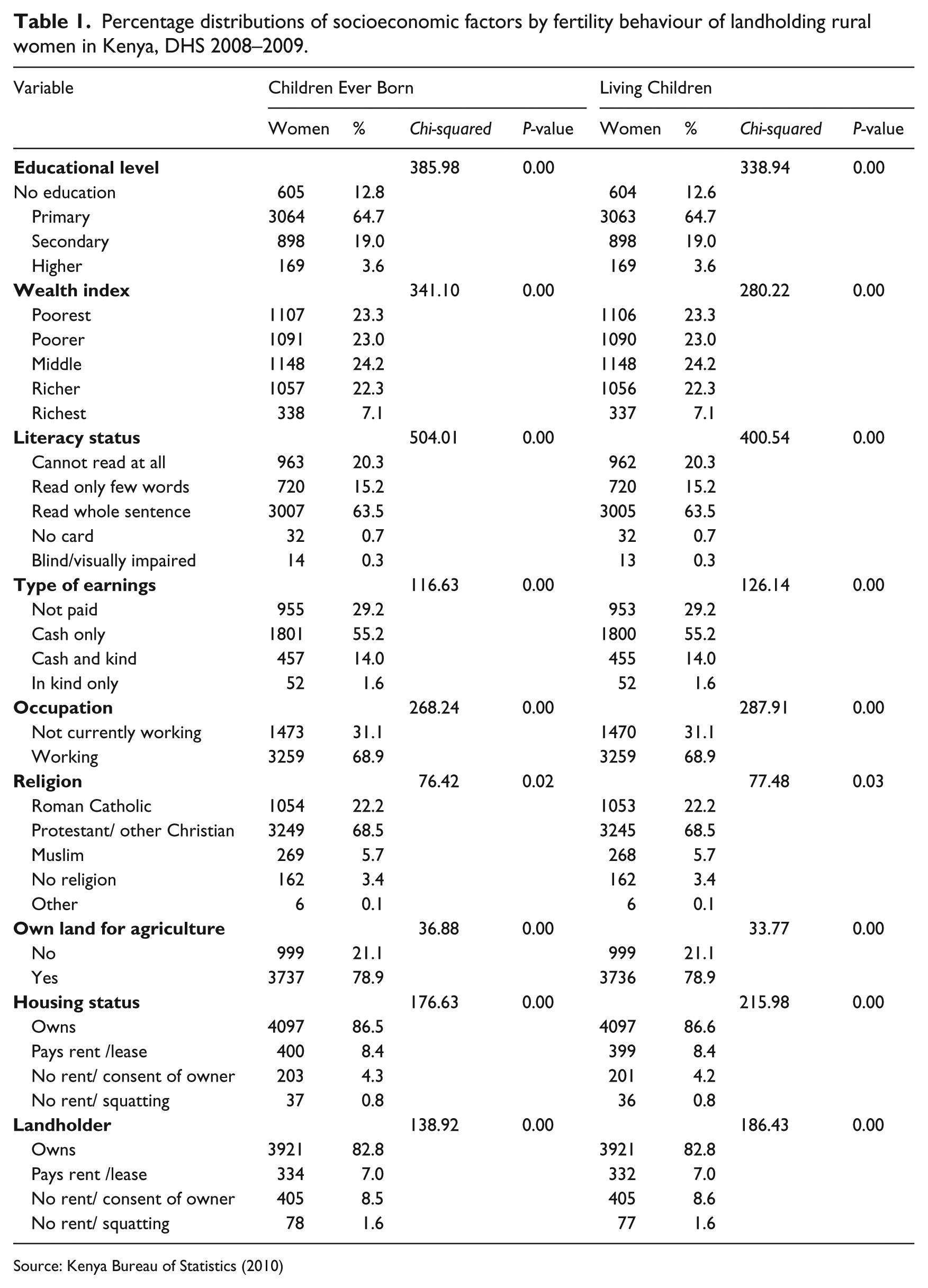
Poverty is correlated with population progression in African countries and the situation in Kenya is no exception to this case, as majority of the country’s population fall in this category. Many studies (Vlassoff and Vlassoff, 1980; Yin and Kent, 2007; Ogunlela and Mukhtar, 2009) confirmed that poorer individuals have a tendency to have many children and use them as labourers in rural farms for additional income in the homesteads, and vice versa. After an analysis using the DHS data, the findings show that 29.4% of the rich or richest cases were reported as having the greatest proportion of total children ever born, while the poor or poorest reported 46.3%. The association is significant at P-values of 0.00 and χ2 of 341.1. As hypothesized, literacy is an important variable, assuming that methods of fertility are linked to the ability to read or write. The findings show that, unlike what most individuals may assume, those who cannot read will not be likely to reproduce more than those who can. Our results show a 63.5% prevalence rate among those who are able to read a whole sentence. It is further shown that, among working women, those currently working reported a 68.9% prevalence, and those receiving an amount of cash reported 55.2%. The relationship between fertility behaviour and occupational status is found to be statistically significant with a P-value of 0.00 and χ2 of 268.24.
The prevalence of the high fertility behaviour is found in currently employed women. In addition, the form of payment influences the size of family. Around 80% of mothers reported that they have their own land for agricultural purposes and 87% of women’s families have their own house. Only 8% of mothers pay for renting or leasing land. 83% of mothers have their own landholding and 8.5 % reported that they do not need to pay any rent for landholding. This suggests that owned landholdings are equivalent to a woman’s fertility behaviour. With reference to Table 1, a woman’s reproduction is highly related to land ownership. The children ever born and living children data show roughly similar results. On average, the X2 value is slightly varied, but P-values are statistically positive with significant effects on landholding mothers. One interesting result is that only a few mothers lost their children, which means very few mothers having child or infant mortality (CEB – LC = M). This is a good sign of landholding, healthy mothers and their children. No doubt, this result helps achieve MDG 4 and 5 in Kenya.
Table 2, which presents distributions of demographic factors by fertility behaviour among landholding rural women in Kenya, DHS 2008–2009, shows the results of the association between demographic characteristics and children ever born/living children. We noticed that there were three important variables, namely, mother’s age, marital status, and head of household playing a major role. A mother’s present age and marital status seem to be important factors with regard to fertility behaviour, which is statistically significant (with the exemption of household head). The reproductive cycle of a woman is dependent on various external factors in terms of age, age at marriage, number of living children, etc. Here, we included in the analysis each mother’s age group, marital status, and gender of household head; these statistics were run to show their association with children ever born. We particularly noticed that the 25–29 age group had the highest (19.5%) rate of children ever born. Findings further reveal that age groups 20–24 and 30–34 are not far behind, with 19.1% and 18.4%, respectively. This means that Kenyan mothers whose age at marriage was above 20 years accounted for around 60% of births). This is confirmed from the study findings, yielding a significant statistical result P-value of 0.000 and χ2 of 3177.6.
Percentage distributions of Demographic factors by fertility behaviour among landholding rural women in Kenya.

We explored another important finding from our analysis, involving the Kenyan women age group of 15–49. In this wide range, there were only 9 women who had lost a child. This finding also supports those from national development and MDG 4. Apart from mothers in Kenya, marital status is a determining factor of fertility behaviour within a landholding family. Culturally or traditionally, a woman’s role or command was to go and fill the earth (bear offspring). Table 2 shows that 77.8% are married cases, 9.1% never married, 6.8% widowed and 6.3% divorced or not living together. The association of these variables shows a statistically significant P-value of 0.000, χ2 = 976.9 in CEB, and χ2 = 855.1 in living children. Finally, the gender of the head of the household is revealed to be statistically insignificant in determining children ever born in a household, with P-values of 0.247 and χ2 = 16.0. This result might be male dominated households (64% of male and 36% female headed households).
Table 3 shows the association between family planning variables and fertility behaviour of landholding in Kenya. The family planning methods and fertility behaviour of women in rural Kenya shows that 60.8% do not use any kind of contraceptives, while the rest (39.2%) do. We have included different set of issues such as current user, pattern of use (by the mother who is currently using), use since last birth, use before last birth, and those who have never used it. The pattern of use differs according to the intention of the user. The findings show that 18.5% of mothers used contraception before their last birth, and 11.8% have used it since their last birth; others are currently not using it and/or never did. The pattern of children at first use shows that the highest proportion of 26% is among those with one child, and 13.8% among those with two. A higher proportion of 30.5% is found among those who have never used contraception, both for children ever born or living children. The result of first time contraceptive use rate is 26% for those who have one child. Unfortunately, use rate for mothers who have 3 children was less than 10%. For the category of ‘unmet need for family planning’, we used different sets of issues, including unmet need for space, unmet need for family member limit, usage of space, using space to its limit, less than 2 years of wanting children, lack of sex, desire to wait, sterility and menopause. Interestingly, 27% of mothers reported that using any kind of family planning method is limiting their family size. 15% reported that they had desired a birth for less than 2 years. Another important association between family planning and fertility with landholding mothers was preferred birth interval. The results for preferred birth interval varied with child parity. The highest proportions of 18.4% preferred to wait for 5 years, while the lowest proportion of 7% preferred to wait 4 years. Some of the non-numeric or missing values (for those who did not know) were 6.3 and 3.1, respectively. Based on the study, 30% of mothers’ preferred birth interval was 2 to 3 years. This is also a good sign of improving maternal health in Kenya.
Associations between family planning variables and Fertility behaviour of landholding rural women in Kenya.

Multivariate analysis
Table 4 presents a binary logistic regression model, predicting the odds of fertility by selected background factors among landholding rural women in Kenya. Based on the bivariate analyses, we have to make sure the present objective of the study aligns with our hypothesis. Because children ever born (CEB) is a non-negative count variable, we use standard backward step logistic regression for the multivariate analysis. We report the incidence ratios (odds ratio) for meaningful interpretation. For categorical variables, a risk ratio significantly greater than one indicates, that women with this attribute have higher fertility than those in the reference category. The reverse holds if the risk ratio is significantly less than one. Many studies (Dow Archer, Khasiani and Kekovole, 1994; Yin and Kent, 2007) have used any one of the fertility variables, which means CEB or living children (LC). But here, we have intentionally included both CEB and LC cases because of the infant and child mortality decline. Infant and child mortality reduction is a significant improvement on the health sector and maternal health of mothers.
Binary logistic regression models predicting the odds of fertility by selected background factors among landholding rural women in Kenya.

Source: Kenyan Demographic and Health Survey 2008–09
Table 4 illustrates the following: Kenyan women’s education, especially secondary level education, strongly influences marital fertility, independent of the mother’s literacy status (ability read whole sentences) in rural areas. Wealthier households have lower marital fertility, while the reverse is true for poorer mothers. Mothers who owe no rent or land consent have much lesser marital fertility than others. This relationship holds mainly only for rural women who are not paying any rent, just like primary owners, at the end of their reproductive activity. Working mothers have lower fertility. Interestingly, a high proportion (68.9%) of the women had worked in the preceding reference period. Women who worked were more likely to be widowed, have fewer children, be slightly more educated, and first use contraception by the first child.
Discussion
We observe that households with small family sizes of 0 to 4 children are the group of individuals that represent a minimal percentage of land owners, proving that land owners are more likely to have larger family sizes than those that do not have land. This indicates further that those who own any form of land, or have accessibility to it, tend to have larger families. In this way, family labour is increased, whether it is within the household’s piece of land or a rented-out space. Work by, for example, (Vlassoff and Vlassoff, 1980; Frank and McNicoll 1987) points out that high fertility is a woman’s way of managing her social and economic position, as it ensures continued access to land and labour via children.
Marriage ensures a form of security for mothers, leading to child birth and larger families for those not in unions. Through observing mothers’ present ages, we see that older women are more likely to have given birth to many children. This corresponds with KDHS 1998 where, except for the age group 15–19, the rest of the groups showed small systematic increases in family sizes as the women aged. Headship also plays a vital role in fertility behaviour. Our results show that households with men as the heads represent 64.6% of those with children, while homes of women as household heads represent 35.4%. In Sub Sahara Africa, population growth rates are 3% per year, and prospects for fertility decline are quite remote in many African countries. But fertility behaviour is slightly different in Kenya’s landholding mothers. As supporting documents show from a demographic history of the world and from countries’ recent experiences, levels of social economic development have a powerful influence in fertility change (Singh et al., 1985; Jacobs, 1991 and Sokoni, 2008). Another key factor is maternal education, an aspect that plays a crucial role in fertility differentials of women, especially in rural landholding mothers. This is absolutely true and produces a positive relationship. At very low levels of education, women give birth to more children than those with higher levels of education, as explained, who state that higher levels of schooling are associated with fewer children per woman, namely in societies where female education enrolment and attainment are higher. This is because educated women are more likely to be open minded about new ideas and new technologies. The findings of the secondary-level educated mothers were a sample for how to reduce mothers’ fertility.
Another relevant socioeconomic factor was income, because the poorest households are four times more likely to have a large family size than the richest group of women (Filmer and Pritchett, 2002). This represents a situation wherein households with the lowest number of assets will have three to four times the number of children than those with the highest number of assets. In such cases, costs of children are assumed to be relatively low and the benefits high (Sathiya Susuman, 2006; Carr et al., 2006). Other studies mention that getting married, coupled with childbearing and childrearing, becomes a constraint for their careers (Subedi, 2006). Furthermore, the presence of additional births can hinder parents in competing for the increasing demand for consumer goods and opportunity for female employment (Hoffman and Hoffman, 1973; Faroutan, 2008). The findings reveal differences between the number of children by those currently working (68.9%) and those without work (31.1 %). The persons of interest in the study are rural women who are mainly employed in the rural sector and whose form of employment is agricultural production. Women on the smallest farms had more than double the number of births as women on the largest farms.
The findings suggest that those who have high fertility do not use contraceptives, while knowledge of various methods was found to be inadequate. Thus, there is still an inadequate understanding of reproductive physiology upon which the success rate of traditional and modern contraceptive methods is based. Moreover, a large gap still exists between knowledge and actual practice of contraception (Sathiya Susuman, 2006 & 2009). In Kenya, recent trends in contraceptive use among currently married women aged 15–49 years show that after experiencing a stall between 1998 and 2003, the contraceptive prevalence rate (CPR) – the percentage of currently married women aged 15–49 years using any method of family planning – increased from 39% in 2003 to 46% in 2008–2009 (Central Bureau of Statistics (Kenya), Ministry of Health (MoH) Kenya, Operational Research Centre (ORC) Macro Kenya National Bureau of Statistics, 2010 and International Coach Federation (ICF) Kenya 2010 and Macro International 1999). Although the increase in CPR after 2003 is encouraging, there is limited understanding of how these changes affect landholding rural women, especially married women, given the unique fertility reduction challenges that they face.
This article is therefore based on analysis of the recent Kenya Demographic and Health Surveys data to understand the landholding rural women’s fertility, as well as possible determinants of contraceptive use among rural women aged 15–49 years in Kenya. In such situations where current uses are within large family sizes, patterns of use differ. These strategies are evident in conditions where women adopt family planning methods once they have achieved their desired family size. Furthermore, females may be trying to prevent the additional birth of children. This observation is similar to that of children at first use, where the prevalence of contraceptive usage is found among females that have given birth to more than four children. Many of the high fertility families have moderately high levels of unmet need for family planning.
Conclusion
Each year the national government develops strategies that it can use to curb the population expansion in Kenya. This study attempts to communicate one reason why growth has occurred over the years, by looking at the association between land and fertility. The total fertility rate of eight children per year in1970 was reduced to an average of 4.5 births per woman during 1990–2000, and was further reduced to 2.8 births per woman by 2010 (Kenya Bureau of Statistics, 2010). Poverty is an escalating issue among developing nations that has hindered development, and is the primary cause of high fertility across all borders of developing nations. In addition, it is the most challenging Millennium Development Goal (MDG), and eradicating it is a priority for all nations that face it. Overall, 79.8% of Kenyan households own land useable for agricultural production. Land ownership ensures a sense of security for women and thus leads to large family sizes. Likewise, agricultural production forms the economic foundation of most of Kenya, and employs 75% of those in the labour market. Our results show that of the 68.9% women currently employed, 25.1% were employees or self-employed in the agricultural sector. The rite of passage of land from parents to children is still prevalent among land owners. Nevertheless, land acres per household have left families opting for smaller, more manageable family sizes to suit their pieces of land. Due to the sudden inefficiency of land to distribute from one generation to the next, families from the rural sector are getting smaller. It implies that the surety of security to both parents and children is lacking (Lee and Kramer, 2002). The results of the study show that land ownership is significant, when considering one’s family size. This means that the land owners are more likely to have large family sizes, unlike their counterparts. It is evident that both male and female household heads have equal proportions of land owned. Moreover, this equalization has resulted from the sensitization of women’s rights over the land. When looking at this outcome from the cultural aspect, widows tend to have mature sons who enable them retain the piece of land after the death of their husband (Price, 1996). The decline in fertility has occurred under the influence of several indicators, with the most potential impact advancing from educational attainment. Education among Kenyan communities is supported for newer generations, due to a lack of landholdings within a family to distribute among its members. Moreover, parents’ expectations for future financial help are a significant determinant of education enrollment, where parents educate children to provide not only for the social mobility of offspring but also to secure their own economic welfare.
Kenya’s workforce comprises 25.1% of employees and self-employers from the agricultural sector. Married women in rural areas are more likely to have large family sizes, unlike any other marital group. Implementation of family planning services is evident among rural women in Kenya, although 60.8% of women are not using contraceptives, 30.1% use contraceptives after the first birth and 27.5% use it after five or more children. This is an indicator that in some instances where family planning services are available, they are rendered useless by communities of a patriarchal nature. Furthermore, a lack of information about these programmes to the relevant parties inhibits their success. Age at first marriage in Kenya has risen among girls, resulting in relatively late child bearing. The security invested in all the aforementioned factors is overwhelming: some cause a shift on the negative side (smaller fertility), while others show positivity (increased fertility). The studies have indicated that a family can be as large as wanted, as long as the parents can provide for them. Scaling of family sizes has occurred due to a lack of resources and an increase in the standards of living. Increases in knowledge and family planning services have also played a major part in decreasing family sizes.
Recommendations
Some goals are the 2015 MDGs that global organizations set up and address from time to time to help improve the lifestyles and economy of the country. Based on our study’s findings, some recommendations can be made.
First, throughout the study it is noted that Kenya’s rural areas are the foundation of patriarchal headship. This translates to women lacking any decision-making power (autonomy) when it concerns their reproductive behaviour and ability to own land. Information could be provided to encourage women to become vocal when it concerns their reproductive cycle. In addition, we recommend establishing women’s organizations that empower women’s rights and land ownership. The Kenyan government, during the March 2013 general election, saw the country elect six posts for each county, and one of them was of a woman representative. It is intended that this may be one of the effective systems towards progress for women’s rights with the inclusion of the right to land.
Second, Kenya’s system of education has improved with the introduction of free pre-school education. Unfortunately, the generation at the prime of its reproductive cycle was not a beneficiary to this. This fact raises challenges for the current generation, which was not privileged with these benefits. Education is a vital component of the development spectrum, key to every successful story. Similarly, it acts as a replacement for landholdings and a strong indicator of the success of other involved factors; it is through the acquisition of knowledge that families can see the benefits of reducing their family sizes and becoming less dependent on land. Consensus when assessing the fertility behaviour of a woman involves two parties, both males and females, but due to the patriarchal system females tend to lack a voice concerning this issue. Governments should formulate community organizations to help women voice their grievances and ensure no harm comes to them. Concerned officials should find a solution to encourage people to become involved in the employment sector, acquire knowledge, take up family planning programmes, increase their age at marriage, etc. These initiatives, if implemented, would help ensure a positive effect on the rights of women on landholdings. Finally, to understand this study better, further in-depth research is required to determine fully landholding mothers and their fertility trends, both in terms of regional studies and rural-to-rural comparisons.
Footnotes
Acknowledgements
The authors would like to thank the Kenya Bureau of Statistics and Macro International Demographic and Health Survey data providers, especially the Kenya DHS and the University of the Western Cape, Cape Town, South Africa. Our special thanks to Professor R. Nagarajan at the Population Research Centre, Gokhale Institute of Politics and Economics, Pune, for his valuable suggestions and critical comments.
Declaration of Conflicting Interests
The author(s) declared no potential conflicts of interest with respect to the research, authorship, and/or publication of this article.
Funding
The author(s) received no financial support for the research, authorship, and/or publication of this article.