




Abstract
This paper draws from two case study informal settlements and their recent Constitutional Court litigation to explore the connection between informal living spaces, democracy, and housing. The temporal element of this development dynamic is examined through the erosion and building of hope resulting from the political actions of the state and the political agency of the poor. This engagement of time as an element of space is considered through residents’ expectations manifested in social processes reflecting either the criticality of hope as a catalyst for bottom-up developmental agency or waiting as a fortification of the top-down status quo.
The bird that sings the refrain sings by habit, reacts to its environment but also asserts itself to create its environment. Its repetition produces its place, itself… The bird that marks its territory with a refrain engages in habit, but it is not the habit of the state institution…Its refrain is governed not by instinct, but by the vagaries and contingencies of what is outside; yet, there is repetition. (Janz, 2002: 8–9)
Introduction
In recent decades, South Africa’s urban poor have repeatedly been mobilized to support the African National Congress (ANC), yet after repeated majority wins, housing promises have not been delivered. This cycle becomes an interesting context within which to explore the relational functionality of the dynamic between time, the informal development of space/place, and democracy. The exploration is rooted in Pithouse’s (2012: 7) contention that South Africa’s promise of housing has two faces: firstly, the physical reality of living environments; and secondly, ‘a mode of inclusion into the post-apartheid nation…a realisation of the promise of democratic citizenship’.
Drawing from two case study informal settlements, this paper queries how South African informal residents’ acts of citizenship (voting), as well as knowledge of their constitutional rights, and the decisions made by the Constitutional Court have and continue to shape de facto informal spatial development. While admittedly extrapolating an interview pool drawn from just two informal communities, the paper argues that there is worth in understanding the consequences of the study’s empirical findings. These findings reveal socio-spatial dynamics at play among the influences of: location in the city; residents’ democratic rights as citizens (and non-citizens); and the intrinsic value of the spaces that are being informally developed in the urban context.
The arena of democracy for this exploration is drawn by the sphere of influence between the political will of the city of Ekurhuleni (and by extension the province of Gauteng), the jurisprudence and decision-making of South Africa’s Constitutional Court, and the political agency of shack dwellers, within the context of informal spatial production and citizens’ right to the city. The discussion examines these stakeholders in relation to informal settlement and uses hope and waiting as means to integrate time into the understanding of space. As will be seen, hope, as a quantifier of resiliency, manifests in many lenses. On the one hand, Sandercock (2003: 172) states that there is ‘the organisation of hope’, which includes the efforts of the community leadership and activist planners. The case can be made that in the South African context legal counsel should be added to her definition, given the history of the poor availing themselves on the courts to demand land rights dating back to the 1930s (Pithouse, 2008), even if this practice was stamped out during the height of apartheid – the 1950s and 1960s (Bonner, 1990). On the other hand, Appadurai (2007: 31) argues that ‘the politics of hope has [post World War II] become essential to democratic theory and practice on the ground’. He asserts that this is seen in the linkage between participation (of the poor) and political process, which is ‘built on the premise that human suffering and misery require ethical and practical attention’ (Appadurai (2007: 32).
Paralleling hope is waiting. Currently, in South Africa informal dwellings make up about 13% of the housing stock, and in the province of Gauteng (the Johannesburg-Ekurhuleni-Pretoria metroplex) the percentage jumps up to 21.5% (Statistics South Africa, 2011a). Arguably, the consequence is an organization of waiting built around the Department of Human Settlements’ waiting lists for state housing, and maintained by the promise of housing provision, and by cities’ and (partnered) non-governmental organizations’ (NGOs’) and community-based organizations’ (CBOs’) repeated enumerations of the informal settlements’ shacks and of residents’ right to a formal dwelling. Residents contend that waiting for the fulfillment of governments’ promises to develop, promises for a house and with it the perceived legitimacy of belonging, are significant attributes to their living experience and further that it impacts their living environments. Statistics South Africa’s Selected Development Indicators states that in the greater-Johannesburg area 30.8% of people on the waiting list have been on it for more than 9 years, which is more than double the national average (Statistics South Africa, 2011b). It is also arguable that there is a politics of waiting. Miraftab (2009), among others, suggest that in contemporary South Africa informal settlements have become synonymous with status quo housing. Informal urban dwellers, believing in something better to come, acquiesce to passive citizenship (Kornienko, 2013).
Within the scope of this paper, the discussion on the political actions of the State is largely defined by the State’s relationship with the Constitutional Court and the Court’s role in enabling or dis-enabling the transformative powers at the core of South Africa’s Constitution. The inclusion of the tenets of dignity and equality within the realm of housing make this Constitution and its role in urban development unique. Potentially, these tenets are particularly powerful tools for the poor as they respond to the injustices of the past, and at the same time have implications for the future in light of their capacity to inspire hope. However, critical to this capacity is, firstly, the content of the socio-economic rights guaranteed by the Constitution; and secondly, the current trends of jurisprudence, which as Bilchitz (2010: no page number) points out, suffer from ‘a hangover from the formalism of apartheid legal structure’.
The first section briefly outlines the study’s methodology and the theory within which it is rooted. The next two sections comprise the body of the discussion in which I draw together the characterizations of hope discussed in the literature with the qualities of waiting and action described by residents in my fieldwork. I examine how informal residents’ acts of citizenship and their beliefs in a deeper democracy have impacted the development of the spaces they inhabit (Appadurai, 2010). I frame this discussion using two different engagements with time: firstly, the dynamics of hope and waiting; and secondly, those of action and hope. In the second section residents’ waiting becomes an analogy for the predominant lack of spatial and structural consolidation seen in these two informal settlements, along with the government’s shortfalls in basic service provision, land security, and commitment to urban development for the poor. In contrast, the third section responds to the question of informal residents’ political agency. Here I show how residents and communities practice bottom-up development efforts through the following three mechanisms: the use of the legal system and the Courts; the actions of community leadership; and engaging development expertise on their terms.
Theory and methodology
The watch-a-ma-call-it waiting list. (Harry Gwala resident, personal communication, 3 November 2012)
Waiting lists are one of the post-apartheid legacies resulting from the ANC’s 1994 intent to house the country’s most precarious populations of urban poor. Today these lists plague city governments and urban residents across South Africa (Tissington et al., 2013). The wily comment cited above speaks of this shack resident and leader’s understanding of the politico-social complexity inherent in these lists, and of his refusal to accept state-sponsored pacification. The resultant time frames of delay endured by informal residents structure the study’s effort to understand how expectation (hope) and uncertainty (waiting) impact the development of informal living space and place.
Heidegger (1962) and Lefebvre (1991) root their concepts of place in history; an element of this is appropriate to this study in light of the inherited apartheid urban form and the post-colonial/post-oppressed mindset that South Africa’s poor strive to overcome (Fanon, 1961/2004). I build on this with Rajchman’s (2000: 94) argument that Deleuze and Guattari root place in people’s ‘“manners of being”…and their distribution in space and time’. In other words, people form spaces and places through their everyday habits, responding to their local environments. In unraveling this time/space notion of place production, it is worth paralleling Rajchman’s (2000: 97) suggestion that Deleuze’s concept of ‘becoming other’ is the ‘process in which we depart from our given or constituted selves without knowing quite who or what we may become’ with Pithouse’s (2012) thoughts regarding dignified housing as a transition or means of inclusion into the post-apartheid state, and Simone’s (2005: 40) interpretation of Fanon’s (1961/2004) notion that formerly oppressed ‘people [need] to find their own vernaculars and practices for realising themselves as creator of life’ in their process of change. Of course, imbedded in this is the influence of the past. Simone (2005: 40) alludes to this with his comment that people need time to find a ‘capacity for a confident self-fashioning’, which he argues is as important as space. This dynamic lens layers the historic and the everyday, drawing these theoretical threads into the reality of physical space.
The above concepts are drawn together to form a framework within which to examine the effects of hope and waiting as they play out through the now seemingly inextricable link between housing and democracy in post-apartheid South Africa (Pithouse, 2012; Ross, 2010). I choose the case study sites of Harry Gwala and Makause, two of the estimated 112 informal settlements in Ekurhuleni, as they reflect two different settlement typologies in South Africa: the overflow development of land adjacent to well-established townships and the invasion of well-located. Ekurhuleni has a population of some 2.7 million (EMM, 2011a) with 70% of the population living in peripheral townships (EMM, 2011b). This is the highest rate of any major urban center in South Africa (EMM, 2011b). I then explore how physical living spaces are influenced by informal residents’ social transitions, first through the dynamic of hope and waiting; and then the dynamic of agency and hope. Underlying this is a deeper consideration around informal housing processes that I work to understand using data collected during the course of 55 narrative interviews between 2008 and 2012, extensive photo documentation of existing conditions, and the sketching of interviewees’ private spatial layouts, as well as relevant public spaces. The analysis of this data using qualitative sampling techniques begins to reveal the potential of socio-spatial processes as a vehicle for residents to find their own vernacular in the new South Africa.
Acknowledging the role of time in informal socio-spaces
Interviews in the two case study informal settlements, Harry Gwala and Makause, brought to light the widespread phenomenon of waiting. This revelation resulted in a questioning of the impact of expectation and waiting on the informal development of living space. Interestingly, as the following text will bear out, the dynamic of waiting as related to the residents’ expectations from the government is quite different in the two communities. In an effort to make sense of this, parallels were drawn between waiting, the residents’ rate of voting, and their belief in the government’s actions. What emerged was an enlightening contradiction that in turn began a conversation, both within my own thinking and with the informal residents, on citizenship, democracy, hope, and space.
Almost exclusively, the people interviewed at Harry Gwala stated or implied that the government’s promises of development, and the act of waiting for the fulfillment of those promises, significantly contributed to the consolidation 1 (or lack of consolidation) of their living environments. This begs the question: have the government’s promises distorted the informal residents’ ‘capacity for a confident self-fashioning’ (Simone, 2005: 40)? In the 20 years since Harry Gwala was given ‘the permission of the Wattville Council to develop…for residents purposes’ (Anderson, personal communication, 24 November 1993), few of the households interviewed showed significant evidence of a ‘confident self-fashioning’ manifesting in living space consolidation. Interestingly, the residents of the more consolidated sites did not mention waiting in their interviews.
One of these, Miriam, explained that the Wattville Town Council ‘told us in 1994 that there is nothing wrong with the place and that those who have money can build a house, it’s then that we started to build’ (Mrs Gwala, interview, 20 September 2008) (Figure 1a). Another, Catriene and her husband (Mrs Mdlalose, interview, 6 September 2008), now pensioners, show me their incrementally consolidated dwelling. The improvements include replacing the corrugated metal with molded concrete siding; improving their vegetable and ornamental gardens, and establishing a business raising and selling chickens (Figure 1b). Catriene also describes close ties to the community and its location: strong, supportive relations with her neighbors, and a connection to the Wattville cemetery, where family members are buried.
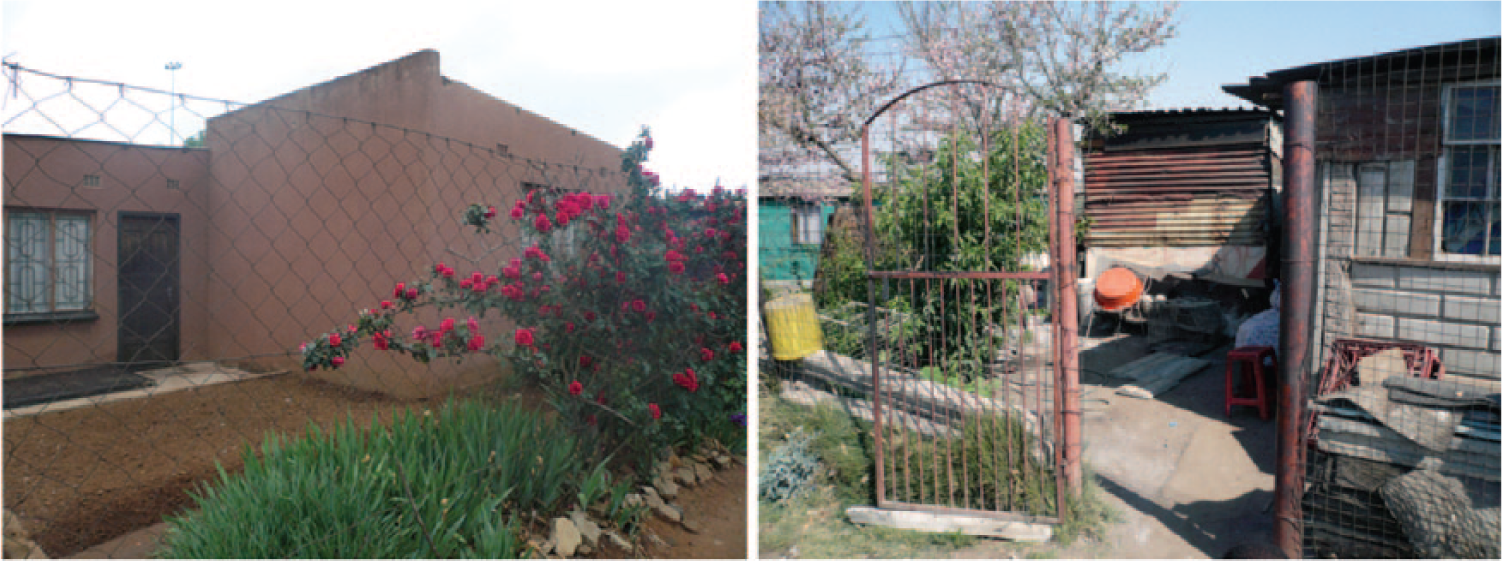
(a) Miriam’s consolidated house and garden. (b) Catriene’s incremental consolidation process, both examples from Harry Gwala informal settlement (photographs by the author).
However, the study’s data reflects that these stories are exceptions. The vast majority of Harry Gwala residents interviewed comment on waiting for the ANC to recognize urban informals and implement the post-apartheid policy of dignified living environments for all. Arguably, the sentiment of loyalty to the ANC, as the anti-apartheid struggle party, fuels these expectations. Further findings suggest that this waiting effectively manifests around two concepts, citizenship and invisibility. The first relates to citizenship’s act of voting, a right experienced by all of the interviewees for the first time in 1994. In 2008, in Harry Gwala, nearly all those I ask voted in the last election (2004), and yet the majority say that they had lost their faith in the government. Interestingly, Miriam and Catriene are among the small minority of residents who still voice faith in the government.
The informal settlement of Makause tells a somewhat different story. There, just over half of the interviewees comment on waiting for the government, a number significantly lower than at Harry Gwala. The others comment that they do not look to the government to improve their lives, and in fact do not want help. Nancy (Mrs Maapola, interview, 28 August 2008), a resident in this second group, describes close connections with friends and neighbors, and proudly shows me around the incremental improvements that she and her husband (both employed) have made to their stand, ‘I get bricks from the dump. I want to build with bricks because it is important to us…I want visitors see my improvements with bricks and the nice garden’ (Figure 2). Similarly, Bukhosibakhe (Mr Mflatelwa, interview, 21 July 2010), a spaza shop owner, member of the community crime patrol, and a 2010 FIFA World Cup volunteer, observes that ‘the government usually only comes here during election times, so you see we have to build ourselves up’. Ronald (Mr Makgwarela, interview, 21 July 2010), who has his own recycling business and proudly speaks of his daughter going to college on his earnings, tells me that ‘things only change if you are doing it for yourself, not if you are begging from someone else, and it is better that way’. None of the interviewees in this group are over 40 years old, which could reflect a changing attitude among some of the younger residents.

An example of consolidation in Makause: Nancy’s flower garden and brick dwelling (photograph by the author).
Also, in the 2008 interviews the respondent data around voting is somewhat different in Makause. The vast majority of interviewees voted in the last election (2004) and half of those who I ask respond that they have lost faith in the institutions of the government, but not necessarily in the ruling ANC party. While admittedly I am extrapolating a trend from two communities, a relatively small interview pool, these responses indicate that although the informal residents are fulfilling the actions of citizenship, in this case the right to vote, most do not believe that they will be treated as citizens. In other words, they are waiting for the machinery of government, yet they do not believe it will do anything.
Added to this dilemma is that within the sphere of the State’s housing status quo the act of waiting seems to invite the second manifestation: invisibility. Here, I use Mbembe’s (2011) consideration of humans as waste within the socio-economic machinery of urban development as an interesting point of intersection between the time element concepts of the different thinkers mentioned above. South Africa’s historic legacy of colonialism, of ‘turning black life into waste’, interplays with the new South Africa’s contemporary trend of embracing a capitalism with ‘the intrinsic capacity to generate “the human” as waste’ (Mbembe, 2011: 1,2). He goes on to comment that in the contemporary reality the everyday for many of the urban poor is reduced to a ‘process of producing life [which] now tends to take the form of a struggle to make it from today to tomorrow’ (Mbembe, 2011: 5). The respondent data from this study reflects this characterization of the everyday struggle, and with it the observed consequences on individuals’ abilities to produce spaces. Similarly, Selmeczi (2012: 499) argues that South Africa’s ‘aspiring “world class cities”’ are creating a ‘distinction between useful and disposable lives’, suggesting that the invisibility of the urban poor is a product of the spatial practices of city leadership. This seeming interchangeability of the terms (black) human waste and invisibility in the current climate of competitive city development is frighteningly reminiscent of the country’s legacy of discarding unwanted population groups.
Residents’ feelings of unfulfilled expectations of urban development promises clearly emerge throughout the interviews. In addition, there is a substantiation of the feeling of invisibility. Residents from both settlements voice feelings that the city leadership closes its eyes to their suffering. The feeling of unfulfilled expectations can be aligned with the end of apartheid and the conviction that Mandela’s ANC will improve the lives of all citizens in the new South Africa over the course of time. For this, the overwhelming consensus is that they are willing to wait. However, as will be shown, the feeling of invisibility speaks to a trend of unfulfilled socio-economic rights, rights that the majority of interviewees know are guaranteed in South Africa’s Constitution. It is this second point, the perceived loss of citizenship, that manifests as an increasing invisibility of the urban poor.
To this end, it is worth noting that basic dignified service provision and tenure security are repeatedly brought up by the residents with increasing despair from the 2008 interviews to the 2010 interviews. In Harry Gwala, I am told: ‘we are waiting, waiting, waiting and nothing is happening’ (Mr Mhlongo, interview, 20 September 2008); ‘it is five years since the city said they were going to upgrade here but nothing has changed’ (Mrs Maselela, interview, 25 July 2010). In Makause, people express their despair at the: ‘slow pace of development’ (Mr Nkosi, interview, 6 September 2008); ‘everything is the same…today is Friday and every weekend someone dies’ (Miss Mjoli, interview, 23 July 2010); ‘there is no change…we are struggling’ (Ms Majali, interview, 23 July 2010); and ‘there is no improvement…no assurance of safety’ (Miss Zwane, interview, 3 July 2010).
The powerlessness brought about by this state of limbo of waiting and unfulfilled promises effectively becomes what Ross (2010: 5) refers to as an ‘erasure of hope’. Paraphrasing the language of Deleuze and Guattari (1987), does this invisibility reflect the informal residents’ inability to become ‘other’ in their effort to overcome ‘the colonial negation of black humanity’ (Mbembe, 2011: 2)? Or in Simone’s (2005) words, are the urban poor unable to find a vernacular that is recognizable and visible to the formal city? Instead perhaps this invisibility results from a lack of political will ensuing from capital-driven agendas that render the formal city blind.
Examining informal residents’ agency and their role in in situ upgrading
Two general trends in academic thought come to light in the literature on the political agency of the poor in the context of informal settlement. On the one hand, there is the thinking in line with De Soto’s (2000: 37) notion of the poor as ‘heroic entrepreneurs’, who, with reform to the legal system, can participate in mercantilism and thus have an avenue out of poverty. In other words, the informal sector, or ‘extralegal sector’, is a separate body from the formal sector, and therefore it is in need of formal input in order to move forward. At the time of its publishing, this theory garnered much interest from governments and development agencies around the world.
On the other hand is the thinking around informality as an integral element of the city with its own potentials. Holston (1998) outlines a concept of insurgent citizenship based on urban citizenship and the right to the city. Also from this perspective are the thoughts of Bayat (2000: 536) and Simone (2004: 407), with their notions of ‘quiet encroachment’ and ‘people as infrastructure’; both describing systematic negotiations by the poor to navigate the formal urban landscape and thus fulfill their needs for basic livelihood. This second group of concepts reflects a shift in thinking, making the political agency of the poor, or their ability to act for themselves, the cornerstone. Roy (2011) suggests that this form of agency represents a potential mechanism for authentic change, with the caveat that it must first shed its associated ‘slum’ stereotypes.
Embedded in this concept of agency is action. The previous sections used waiting as a means to interject time into space; this section attempts to effect a similar spatial exploration by way of informal residents’ popular political agency. The undercurrent in both of these socio-spatial engagements with time is hope. Above it was shown that waiting proved to be what Ross (2010: 5) alludes to as the ‘erasure of hope’. This section examines how informal communities realize the possibility to empower themselves through action via the legal courts, resulting in the generation of hope. To this end, it examines the role of South Africa’s Constitutional Court, and by extension the potential of bottom-up participatory planning.
Networking and legal action
Although the role of social movements around informal civic agency is beyond the scope of this paper, it is worth noting that both Harry Gwala and Makause have gained valuable insights and knowledge into the potential of legal action to counter evictions via their engagement with those larger arenas. Harry Gwala’s contact with the Landless People’s Movement (LPM) led to their introduction to pro bono human rights lawyer Moray Hathorn (Webber Wentzel), who has been their ongoing legal council since 2004. Huchzermeyer (2006: 7) points out that through associations with legal resources, such as Mr Hathorn, communities have become aware of their rights under the National Department of Human Settlements’ legislation: ‘immediate provision of basic services, inclusion of all residents, minimal disruption to livelihoods, community empowerment, community participation in decision-making, development of community facilities, alternative forms of tenure, etc’.
In a 2010 interview, Hathorn characterizes how his association with Harry Gwala began:
At that time [2004] they were under acute threat of eviction and relocation, the lorries were there and the Red Ants were removing people to Chief Luthuli. It was a desperate situation. I was being called on a Saturday morning because the lorries were there rounding people up and I was having to call the officials and say to them ‘you cannot take people unless they consent or you have a court order’. The upshot was, I do believe that nobody was taken that didn’t want to go. And that sort of an effort to remove them came to a halt, it stopped. (Interview, 21 July 2010)
Since 2005, Hathorn and the residents of Harry Gwala have been building a legal case based on the policies laid out in South Africa’s Housing Code (Chapters 12 and 13, now Volume 4 Part 3) for the in situ upgrading of informal settlements (Mr Hathorn, interview, 21 July 2010; Huchzermeyer, 2011). As will be described, this culminates in the 2008 Johannesburg High Court and the 2009 Constitutional Court cases.
In the interim years since 2004, the community of Harry Gwala and Ekurhuleni Department of Housing (now Department of Human Settlements) have had ongoing negotiations. The City puts forth various reasons (environmental, geotechnical, health, and so on) why Harry Gwala is not suitable for in situ upgrading. The legal counsel refutes every claim (Huchzermeyer, 2011). Finally, in August 2006, the City put through an application to the province of Gauteng to upgrade in situ under the guidelines of Chapter 13 of the Housing Code.
However, time passes and there are no further signs of engagement from Ekurhuleni toward a plan for development. Consequently,
In 2007, people felt emboldened to ask for another meeting to request interim services. To ask for toilets, which we were told was not possible. For refuse removal, which we were told would happen. And for electricity, which we were told we would have to wait until July to hear about that. Nothing happened. (Mr Hathorn, interview, 21 July 2010)
It is at this point that the Harry Gwala community leadership approached Hathorn to take legal action against the City. Hathorn is always very clear that it is the community and its leadership who make the decisions, thus drawing attention to the residents’ political agency as the driving force behind his work.
Turning to Makause we see a different story unfold (Table 1). Unlike Harry Gwala, this informal settlement has not had one consistent legal representative. Makause’s chronicle of legal action begins at a ‘housing beneficiary workshop’ in February 2007 where they are told that residents of the community are to be evicted (Mr Moyo, interview, 8 September 2008; Kuny and Moyo, 2008). Shortly thereafter, a community mass meeting to organize a response was broken up by the police (ibid). Effectively, the residents were given 10 days notice that they will be relocated to Tsakane 10, a new township development 40 km away. This new site was described by a journalist as ‘a treeless and dry landscape on an open veld…[where] their new homes were made of four poles and plastic bags’ (Bangerezako, 2007). Added to this, the location of Tsakane 10 does not meet the relocation requirements of Chapter 12 of the Housing Code; however, Ekurhuleni carried on with the evictions (Mr Moyo, interview, 8 September 2008; Kuny and Moyo, 2008).
A timeline outlining the significant dates of Makause’s socio-spatial history (Kornienko, 2013; SERI, 2014).
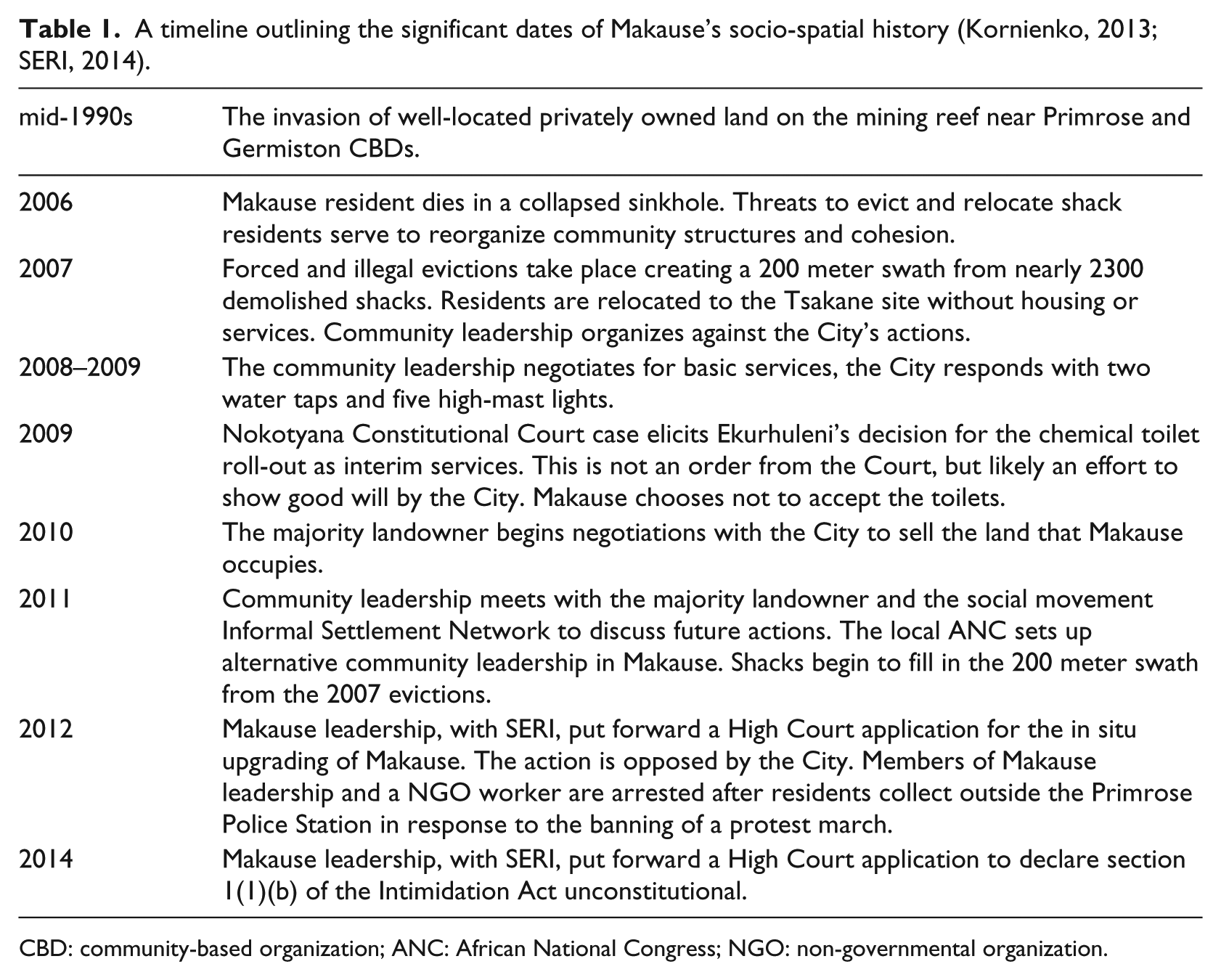
CBD: community-based organization; ANC: African National Congress; NGO: non-governmental organization.
Later that month (February 2007), the relocation initiative turned violent. This led to the issuance of an emergency court order through the efforts of Advocate Steve Kuny. It transpires that the documents of consent to relocate, allegedly signed by residents, are fraudulent (Kuny and Moyo, 2008). Alfred, a resident and member of the community leadership, was directly involved in these evictions (Mr Moyo, interview, 8 September 2008). He explained that this experience was the catalyst that led to his self-education on and engagement with the socio-economic rights in South Africa’s Constitution, as well as the Housing Code, within the context of housing rights. In that same year, on the day he organized a housing rights march, his shack with all his belongings was burned to the ground. It is understood that this was a direct consequence of his role in leading the legal challenges against Ekurhuleni questioning the illegal evictions. Months of struggle to find legal representation followed. The evictions stopped; however, the community returned to a status quo racked with uncertainty.
On 11 June 2008, Moyo and fellow Makause committee member Michael were invited to the Roundtable on Informal Settlement Upgrading at Wits University in the School of Architecture and Planning. This contact was a result of Alfred’s networking in the region, which enabled his engagement with members of social movements, municipal and provincial officials, and members of the legal profession from all over South Africa. Over lunch, the Centre for Applied Legal Studies at Wits University agreed to take on Makause’s case. Their case has since been transferred to the Socio-economic Rights Institute of South Africa (SERI).
Although in both locations the illegal evictions stopped, neither community is experiencing consistent meaningful engagement from Ekurhuleni to move toward in situ upgrading. Figure 3 illustrates the extent to which both Harry Gwala (a) and Makause (b) underwent significant spatial change as a result of these illegal evictions. In Harry Gwala this area was later walled off and remains abandoned. However, in Makause after several years of stagnation the 200 m swath through the community again was filled in with shack dwellings. This redevelopment is the upshot of changes in the community leadership (Moyo, personal communication, 11 June 2013). These stories illustrate a turning point in both community case studies, a shift from the passive hope of waiting to the active hope of action.

Aerial images of Harry Gwala (a) and Makause (b) with dashed lines showing the areas of the communities where eviction and demolition of dwellings occurred.
The Constitutional Court’s ruling on Nokotyana (Harry Gwala) v Ekurhuleni Metropolitan Municipality (EMM): the passage of time over the content of socio-economic rights
The escalation of Harry Gwala’s and Makause’s legal actions to the higher courts reflect the residents’ efforts to put pressure on the city of Ekurhuleni to implement South Africa’s existing policies on in situ upgrading. One could argue that it reflects what Sandercock (2003: 178) refers to, admittedly in a Western context, as a shift from ‘putting out fires’ to a change in ‘modus operandi’. In other words, a shift from the lower Court efforts to stop evictions to the higher Court and the Constitutional Court in an effort to access their ability to change policy. It is a demand by informal residents, as citizens under their Constitution, for a change in the upgrading paradigm and that the City hear their voices and acknowledge their needs. Preparations for both the Harry Gwala and Makause cases represent efforts by the network of housing rights lawyers in greater Johannesburg to support these demands; in other words, to attempt to force the implementation of in situ upgrading under the Upgrading of Informal Settlements Programme of the Housing Code.
Guided by the Harry Gwala residents, Hathorn built the Constitutional Court case of Nokotyana v EMM (in 2009) around a direct appeal for interim basic services on the grounds of ‘the Constitution’s intent of dignity and equality’, thus making the statement that ‘sanitation should be addressed on this ground’ (interview, 21 July 2010). This was an attempt to use the power of the socio-economic rights in the Constitution as a tool, a means for poor communities to demand their equal rights as citizens. However, in reality this did not occur.
Harry Gwala’s Constitutional Court experience was partially successful. On reflection, after the ruling had been handed down, Hathorn commented that the Court did not accept either the direct appeal for interim basic services or the argument that they should be granted on the grounds of dignity and equality (interview, 21 July 2010). Instead, the Court ruled that the time period, the three year delay from 2006 when the City put through the application for upgrading to the Province, to 2009 is the real crux of the case. Bilchitz (2010) observed that the rejection of the argument based on dignity and equality guaranteed by the Constitution points to the issue of the Court’s problematic jurisprudence around socio-economic rights. Similarly, other scholars (Bilchitz; 2010; Kapindu, 2011; Pieterse, 2007) argue that a lack of defined content to the Constitution’s socio-economic rights, the Court’s use of procedural technicalities, and its misuse of the ‘reasonableness test’ all serve to undermine the Constitution’s power as a transformative agent in South African society. Bilchitz (2010), Kapindu (2011), and O’Connell (2011) all suggest that the potency of the Constitution’s socio-economic rights is being undermined by recent decisions and the current trends of jurisprudence in the Constitutional Court. Their observations suggest that the transitional and developmental powers of the Constitution are currently at stake.
To this end, Bilchitz (2010: no page number) infers that the Court becomes ‘simply the arbiter of whether the government’s actions are reasonable’. Similarly, Kapindu (2011: 218) states that ‘the Court had regrettably decided to reduce itself to a passive onlooker’. The Court’s finding in the Nokotyana case that: ‘As long as the status of the settlement [Harry Gwala] remains in limbo, little can be done to improve the situation regarding sanitation and lighting’, underlines these scholars’ concerns (Nokotyana vs EMM, 2012: 2). The Constitutional Court’s ruling that the Province (with the City) must make a final decision on upgrading Harry Gwala informal settlement within 14 months of the Court’s decision (by January 2011) has done little to alleviate the living conditions of the poor residents. On the contrary, and critical to the argument in this paper, Bilchitz (2010) points out that it has eroded the political agency of the poor by undermining their faith in the Court as a tool of social justice.
Kapindu (2011) and O’Connell (2011), among others, argue that at stake in recent decisions, such as Nokotyana and Mazibuko,
2
is the question of the protection of socio-economic rights under South Africa’s Constitution. In his review of the Constitutional Court’s Nokotyana decision, Kapindu (2011: 76) writes that
…the rather mundane manner in which the claims in this case were dismissed does resonate with the sentiments of those who have started a conversation on ‘the death of socio-economic rights’…in Nokotyana, the socio-economic rights claims of desperately poor litigants for the provision of the basic necessaries of life seem to have been shipwrecked.
He describes the Court’s decision on this case and others in this realm as ‘a perilous retreat from the court’s fairly progressive jurisprudence on socio-economic rights’ (Kapindu, 2011: 201).
O’Connell (2011: 551) takes this concern a step further by placing it in the larger politico-economic context and pointing out that this shift in the courts is causing socio-economic rights to be
…fundamentally undermined through a pincer movement which on the one hand distorts and narrows the meaning of socio-economic rights, stripping them of their egalitarian potential, and on the other by macro-economic policies, including privatisation and commodification of essential services, which fundamentally undermine peoples’ ability to enjoy these rights, thereby reducing the promise of socio-economic rights to mere empty rhetoric.
He points out that what set South Africa’s Constitution apart in 1996 was its inclusion of socio-economic rights and its sentiment of social transformation; like Kapindu (2011), he notes the early progressive role of South Africa’s post-apartheid constitutional jurisprudence. However, he then singles out Mazibuko v City of Johannesburg (2009) and Nokotyana v EMM (2009) as a turning point; they are, he suggests, ‘the most worrying example of judicial harmonisation of domestic constitutional praxis with respect to socio-economic right so as to entrench the neo-liberal world view’ (O’Connell, 2011: 551–552).
However, O’Connell’s (2011) concluding comments suggest that he believes that the courts still hold a critical potential for social change. He makes the point that socio-economic rights and ‘counter-hegemonic movements will play a key role’ in any struggle for an alternative future to that of the privatization of basic necessities promised under the neoliberalism (O’Connell, 2011: 554).
The rationale reflected in O’Connell’s argument is in line with SERI’s ongoing preparations on behalf of Makause to bring an application in the Johannesburg High Court (date as yet unknown), with its eventual aim of the Constitutional Court. This case is based on Ekurhuleni’s failure to make an application for funding to upgrade (Tissington, personal communication, 24 October 2012). In effect, this argument draws on the experiences of the Nokotyana case; again it will be a demand for interim services, but this time from the angle that these services fall within the application for funding rather than the Nokotyana argument that they are a right to dignity and equality.
Harry Gwala’s process of realizing the politics of hope
The Harry Gwala case study unfolded in a way that draws me, as a design professional resource, into the development process. This process becomes a useful demonstration of the residents’ efforts to actualize their hopes. Table 2 outlines the timeline of the community’s socio-spatial history, highlighting significant fixed points of reference that functioned in the study as mechanisms with which to examine the community’s spatial development.
A timeline outlining the significant dates of Harry Gwala’s socio-spatial history.
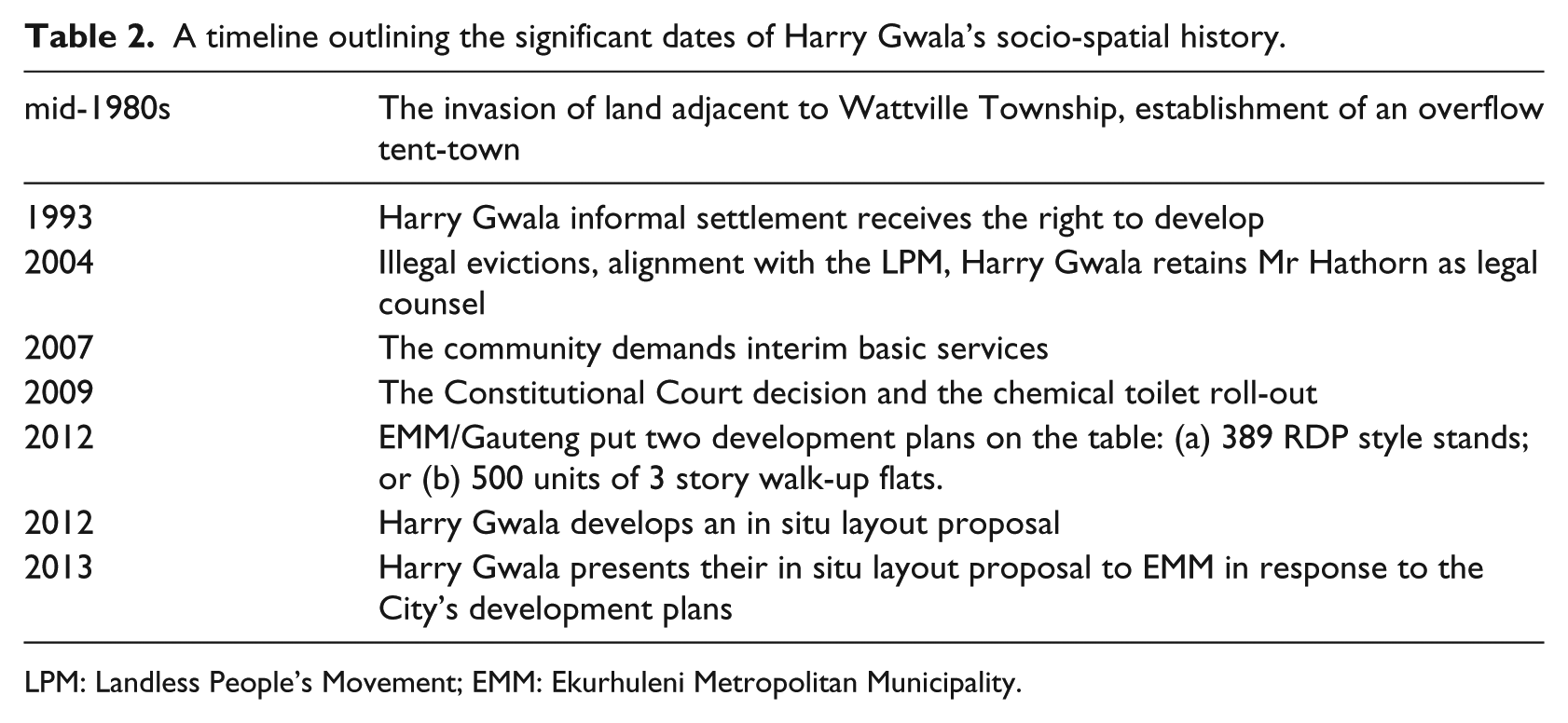
LPM: Landless People’s Movement; EMM: Ekurhuleni Metropolitan Municipality.
In 2012, more than a year after the Constitutional Court decision’s deadline and after nearly 30 years of informal development, 20 years of which have seen residents waiting for the government to fulfill its promises of formal development, the community received Ekurhuleni’s proposed ‘in situ upgrading’ plan. The residents met this plan with consternation, but then chose to respond with a posture of hope. In October 2012, the Harry Gwala Civic Committee (on behalf of the residents) and Moray Hathorn approached me, given my training in landscape architecture and my history of engagement with the community, to assist them in developing their own viable layout proposal for an in situ upgrade. This plan was to be based on the existing conditions in the community and to address the needs of all current residents. To this end, I spent three weeks in Harry Gwala in October/November 2012 building on my existing knowledge of the community and listening to the input from the committee and the residents. We put together a design/development team: the community members; myself, as design consultant; Moray Hathorn, as legal expert; Marie Huchzermeyer, as policy expert; Peter Roloff, as civil engineer with expertise in water and sewer retrofit system design; and Thobile Siphetu, former resident of Harry Gwala, land rights activist and former provincial organizer for Gauteng LPM. During this three-week period, we met with the committee, conducted mass meetings with the community, and documented existing conditions (Figure 4).

Community engagement with Harry Gwala: (left to right) meeting with committee members; residents voicing their concerns, needs, and opinions; discussing in situ upgrading with the community; documenting the residents’ input (photographs by the author).
As the design/development team, we came to the community with no layout or layout options in hand, no plans for their buy-in. In fact, we came empty handed, with technical knowledge and with the intent to support their efforts to generate a viable layout for the in situ upgrading of their own community. At first this caused some confusion, reflecting the residents’ inexperience as project leaders. However, the community’s leadership committee persevered and together we developed a process. Together we thought about such things as how to implement sanitation; how to replace the women’s gathering space; how to gently densify stands to make room for social and physical amenities; and so on, always with the dignity implicit in the Constitution in mind. As time went on, what became evident was the residents’ level of excitement as their voices were welcomed and heard and their ideas were developed on paper: what was evident is that these actions were generating hope.
This story parallels Sandercock’s (2003: 172) notion of ‘a core story that is about the organisation of hope. The work of the community leaders, and of the leading activist planner [and team]…can be described as…a very human story in which individuals support and inspire each other’. Together with the residents we produced a set of 10 design boards, which describe why in situ upgrading is appropriate for Harry Gwala, how the residents would like to see their community develop, and the technical expertise with which it can be achieved. The community is now in the process of engaging National, Provincial, and Municipal Departments of Housing/Human Settlement. Ekurhuleni’s proposed plan includes the demolition of all existing dwellings and spaces; in response Harry Gwala’s leadership have put their own upgrading proposal on the table. This bottom-up proposal will likely not be accepted by the City; however, the process is empowering the residents. If the negotiations for development prove unsuccessful, Harry Gwala (with the assistance of Moray Hathorn) may again choose to take their demands for their right to the city to the Constitutional Court to argue that their proposal, which preserves and therefore gives value to their organic community development, is viable according to the verbiage of the National Housing Code.
The next hurdle for Harry Gwala’s inclusion into the city, given South Africa’s urban aspirations of ‘world class cities’, is to overcome the City’s and Province’s lack of political will. Critically, the timeframe for this is urgent. The community has been disappointed in the past by time lags and unfulfilled promises so there is concern that the residents’ newly found action-based hope will lose its momentum and the strains of poverty will again become an eraser of hope (Ross, 2010).
Conclusion
In an effort to draw the threads of this paper together, I return to the notion of finding vernacular and authentic democratic change within the context of informal space. The two case study settlements proved sources of rich empirical data for the following three themes: the informal processes of organic spatial production; the agency of the urban shack dwellers within the sphere of South Africa’s legal system; and the potential of participatory planning. What becomes evident in studying these themes is the potential for authentic development when they engage with and respond to each other. Harry Gwala’s legal actions and their in situ upgrading proposal emerge as symbols of a shift away from pacification and a waning hope based on waiting, to an empowering hope derived from action. In Makause, a similar empowered hope is being voiced by those residents who are not waiting. Further, both informal settlements are slowly struggling toward an empowering hope through their efforts via the courts to implement the socio-economic right in South Africa’s Constitution. Although the study has shown that this avenue through the courts is indeed problematic, still it speaks to the question of whether democracy has improved the lives of South Africa’s poorest urban residents. Returning to Pithouse’s (2012) contention that I began with, that housing represents a mode of inclusion into the new South Africa, the avenue of the courts proves to be a critical link between housing and democracy. To this end, it is the primary means with which the shack dwellers can attempt to, firstly, safeguard their authentic spaces with their intrinsic value; and secondly, demand the dignity and equality that come with the necessary social and physical basic services. In this way the courts continue to represent a valuable avenue toward authentic change.
However, such physical change resulting from residents’ agency proves agonizingly slow. While this process reflects the residents’ desires as citizens to engage with their democratic rights, it also highlights the lack of political will to implement court decisions, as seen with the Harry Gwala case. Instead, South Africa’s current market-driven development agendas continue to undermine the need-based policies of the early post-apartheid years. It was this early belief in need-based policy that contributed to the inclusion of the socio-economic rights in South Africa’s Constitution. For now, these fundamental differences at the core of policy and political action seem to be at loggerheads. It is into this critical disagreement that the informal settlements residents’ actions, their demand to participate in their nation’s democracy, fall. Given this, their actions can be articulated as a countervailing of the generation of what Mbembe (2011: 2) refers to as ‘“the human” as waste’.
To this end, the physical manifestations of waiting and hope over time, seen as living spaces, are in fact a spatial chronology of a struggling young democracy. What has emerged through the data of this study is the individual nature of these physical living spaces and therefore their worth as communities. The places in these shack communities reflect organic development processes continually responding to local environment, social practices, democratic civic processes, individual needs, group needs, and so on. Viewed in this light these communities represent the individuality of the resident population’s needs and therefore this development must be seen as valuable. Again calling to mind the thinking of Fanon (1961/2004) and Simone (2005) on evolving vernacular, the study argues that shack development has the potential to be interpreted as a legitimate process of authentic change. However, as the study also shows, this requires a further activation in the link between housing and democracy. To base development on the Constitution’s tenets of dignity and equality, as Mr Hathorn suggests in building the Nokotyana case, there must be parallel political will and its resultant action in order to implement necessary physical and social upgrading.
Footnotes
Acknowledgements
The findings presented in this paper were drawn from the author’s PhD thesis from the School of Architecture and Planning, University of the Witwatersrand, and research from an earlier Fulbright Fellowship during which the author was hosted by the same School. However, the positions stated in this paper are those of the author and not attributable to any organization. The author would like to acknowledge the crucial insights shared by human rights lawyer Moray Hathorn, Head of the Pro Bono Unit Webber Wentzel, and the leadership committee of Harry Gwala informal community; and to thank Prof. Marie Huchzermeyer and Dr. Hlonophile Simelane, of the University of Witwatersrand, and Daniel McKerracher for their valuable feedback on this manuscript.