



Abstract
Drawing on 70 interviews with civil society staff in Malawi, I argue that when development trends and issues in the country change, at donors’ wishes, organizations proactively strategize to vie for donor funds. Collected over three research trips, my data show that between 2008 and 2010 there was a widespread belief among civil society in Malawi that climate change was becoming the “it” issue, surpassing HIV/AIDS in predominance. Alongside this belief, there was a dynamic, if invisible, process of organizational repositioning. Comparing the earlier interviews with those conducted in 2014, I contend that the issues of focus, while interesting, are less telling than the ways Malawian organizations endeavor to adapt and respond to them. This paper adds a critical dimension to development literature, investigating a process that occurs when development agendas change.
Introduction
This paper employs a grounded theory approach to explore the process by which perceived donor and government development agendas are interpreted and incorporated into diverse organizational programming. A small heavily donor-dependent nation, Malawi is subject to the preferences of donors and, between 2008 and 2010 my fieldwork showed a significant shift in the perception of donor priorities—from HIV/AIDS to climate change. Returning in 2014, after significant economic and political upheavals in the country, I was struck by the absence of one particular “big issue”: unlike previous years, respondents did not perceive one issue dominant above all others. Parsing out the ways people in civil society organizations (CSOs) interpret development trends and the ways in which they position their organizations to attract funding and donors, I found that while CSOs may not be setting development agendas, they respond to them in very active ways.
Beginning with a brief overview of theoretical literatures that guide my work, followed by a synopsis of data and methods, I examine how climate change entered development discourse, considering both elite conceptions of the issue as well as ways CSO workers saw their roles within this potential new agenda. I conclude with an analysis of a more recent perceived lack of donor/global priorities, highlighting both the continuance of top-down development and the process by which CSOs position themselves to take advantage of funding streams.
The literature on foreign aid identifies problems of methods and outcomes, offering critiques, generally related to development failures and inequalities, at the continent or global level (Calderisi, 2006; Easterly, 2006; Moyo, 2009) as well as the local (Braun, 2011; Englund, 2006; Hunsberger, 2010; Mannell, 2012). International attention to humanitarian and development problems can change often, leading to a succession of disconnected development trends (Mohan and Stokke, 2000; Morfit 2011; Mosse and Lewis, 2005; Olesen, 2008; Saunders, 2008; Warren, 2012). Few authors, though, have examined a change from one development priority to another while it is happening. This paper is unique in that it situates us in two particular moments in time when governmental and donor attention appear to be in flux. By providing a “thick description” of the ways Malawians address these observed development shifts, emphasizing the seeming interchangeability with which climate change usurped AIDS’ top-priority status and comparing this with the supposed lack of priority several years later, this paper adds an essential dimension to development research, investigating a process by which changing development agendas are incorporated into local discourse and programming.
Critical development studies literature (Cooper, 1997; Diouf, 1997; Escobar, 1995; Ferguson, 1990, 2006; Finnemore, 1997; Fridell, 2013; Gupta and Sharma, 2006; Li, 2007; Zalanga, 2014) shows that development is often depoliticized, failing to address underlying power structures that help perpetuate global inequality. Critical development theory thus highlights the relational quality of discourse creation, its connectedness to power, and its importance in critiquing donor agendas and local responses. Governments, CSOs, and donor organizations interact to form “transnational topographies of power” (Ferguson, 2006), structuring global authority and governance. More recent scholarship investigating challenges to the development landscape (Burger et al., 2015; Hackenesch, 2013; Kragelund, 2014; Lange and Tjomsland, 2014; Nega and Schneider, 2014) demonstrate that while the aid industrial complex still thrives, various power and economic shifts, including the growing influence of China in Africa, may impact how African governments interact with traditional donors as well as civil society.
Sociological institutionalism, or world culture theory, offers a means to understand globalization and the seeming universalism of economic development models and agendas in diverse nation-states; it posits the nation-state as a worldwide institution created and upheld by globally sanctioned cultural and political models. Specifically, sociological institutionalism highlights the ways non-governmental organizations legitimize world society values (Beckfield, 2003; Boli and Thomas, 1997; Meyer et al., 1997; Meyer and Jepperson, 2000; Robinson 2015), how professionalization of civil society may devalue or undermine local ideas and participation (Fridell, 2013; Ghosh, 2009; Hunsberger, 2010; Olesen, 2008), and the ways world cultural values may take precedence over economic development (Frank and McEneaney, 1999). Literature on sociological institutionalism led me to examine how global discourse was being interpreted by those in CSOs and to question whether local elites 1 might influence local strategies or must simply adapt to world cultural goals, thus conceptualizing CSOs’ embeddedness in a complex “field of tension” (Sadomba and Helliker, 2010).
In 2010, listening to Malawians discuss how climate change was altering the development landscape in Malawi, I noticed how much of the language, methods, and opportunities echoed those I had heard two years earlier, when respondents were still heavily focused on AIDS. Rakner et al. (2004) discuss “budget as theatre” in Malawi, noting that there is almost a performative element to creating a budget, which can purposely highlight particular ideas to attract donors’ interests and protect the interests of the powerful. But while it is important to recognize the strength of global discourse and ideology, it is also vital to consider how people on the ground interpret and modify them in current or succeeding development strategies. Eerily similar discourse and development structures, putting “old wine in a new skin,” as one of my respondents terms it, may be one of the unintended consequences of global development priorities.
Data/Methods
Over the course of multiple research trips to Malawi, spanning 2000–2014, I noticed marked changes in respondents’ perceptions of donor interests, but obvious similarities in the ways they addressed and discussed these changes. I lived in Malawi for a year and a half during 2000 and 2001, doing research in both urban and rural settings and returned to Malawi for several months each in the summers of 2008, 2010, and 2014. Data for this paper are drawn from the latter three trips and the completion of 70 in-depth interviews with CSO staff in Lilongwe. Using a method referred to as “onion-snowball” sampling (Cress and Snow, 1996) to locate CSOs, 2 I rely on a grounded theory approach (Glaser, 1978; Glaser and Strauss, 1967) to examine relationships between themes in the three rounds of interviews. Rather than attempting to integrate data with pre-existing literature, grounded theory requires the researcher to avoid pre-conceived assumptions and, instead, to carefully code the data, interrogating it for patterns and enabling concepts and ideas to emerge through this process. This paper investigates what are essentially snapshots in time, people’s thoughts and feelings in a particular moment. It is important to remember that perceptions are not necessarily grounded in hard evidence. But by noting patterns in people’s insights at different moments in time, then comparing them across time, I show how issues change, but how structural realities of development work in Malawi remain fairly constant.
In 2010, the overwhelming discourse on AIDS I found in the early 2000s and in 2008 had been eclipsed by discussions about climate change. While many of my respondents were troubled by this new agenda, they were resigned to the shift and actively strategizing ways to benefit from climate change funding. I contrast perceptions of this shift with information gathered on a more recent trip. In June and July 2014, no single issue seemed to overshadow all others in terms of priority. But while the lack of one big issue may not necessarily be noteworthy, it is important because respondents did not feel they could actively strategize: in fact, there was a sense that many organizations were somewhat in limbo—waiting to see what the next “big issue” might be.
2008–2010: A Shift from HIV/AIDS to Climate Change
In 2008, most people I interviewed responded that HIV/AIDS was the biggest donor focus. For many, the fixation with HIV/AIDS was dissatisfying: no one claimed HIV/AIDS was not a significant problem, but they lamented the sheer amount of funds going to it, which, they felt, took money away from even more pressing issues. In 2010, however, I was somewhat taken aback when relatively few of my interviewees mentioned HIV/AIDS as a priority. 3 People with whom I spoke felt donors were largely focused on climate change and that AIDS had been relegated to a lesser importance. Respondents may have noted an actual shift in global funding trends: in 2009, global donor funding for the AIDS pandemic flattened for the first time since 2002, leaving a gap of US$7.7 billion between allocated and necessary funds (Kaiser, 2010) and, likely due to the global economy after the recession of 2008, remained flat (Kaiser, 2013). Global assistance for HIV/AIDS worldwide actually declined from US$7.6 billion in 2009 to US$6.9 billion in 2010. While disbursements rose to US$7.9 billion in 2012, monies were still inadequate to address the global pandemic (UNAIDS, 2011). Yet between 2010 and 2012, rich countries pledged approximately US$30 billion for climate change adaptation, mitigation, and REDD+ (Nakhooda and Norman, 2014).
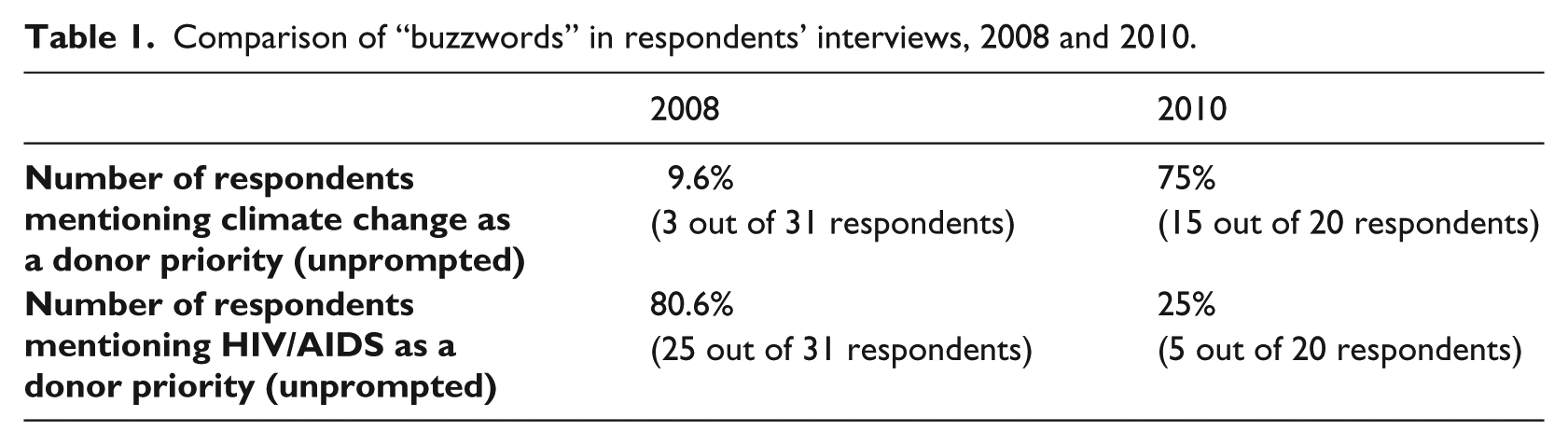
Despite changes in global funding, it is important to note that respondents’ perceptions do not necessarily align with in-country data: there was (and is) still an enormous amount of international funding for HIV/AIDS in Malawi. Resource mapping conducted by the Clinton Health Initiative (CHI) shows that AIDS funding was high, relatively stable, and distributed by need to various districts in the country (CHI, 2014). Still, it is important that respondents believed funding decreased and it is instructive that globally, there was a reduction in funds for the pandemic. This apparent shift is obvious when I compare priorities in 2008 with those in 2010. Though inexact, a basic “buzzword count” can be indicative of changing ideals and trends.
Table 1 indicates there was a substantial shift in the perceived priorities of donors by those working in the CSO sector. Whereas only 3 out of 31, 9.6% of all respondents, mentioned climate change as a major donor priority in 2008, 15 out of 20, 75%, mentioned climate change as the greatest priority in 2010. In contrast, in 2008, 25 out of 31, 80.6%, of my interviewees thought AIDS was the significant donor priority while only 5 out of 20, 25%, discussed AIDS as a donor priority in 2010. Though it is instructive to note the frequency with which climate change entered discussions about donor priorities, it is important to move beyond this simple count and consider how elites were talking about climate change.
Comparison of “buzzwords” in respondents’ interviews, 2008 and 2010.
2008–2010: Climate Change Enters Development Discourse
While in 2010 there seemed to be a general consensus in Malawi that climate change was a problem, there was tremendous uncertainty about how to approach it. Not only did respondents feel that donor interest had shifted to this “new” topic, which meant they needed to shift their agendas as well, but they also believed climate change gained importance as a development issue for both practical and political reasons. They observed that they had not yet seen much climate change programming, with the exception of reforestation initiatives: they levelled a critique against the government for failing to coordinate a national policy to guide their work, which, they felt, allowed for a lack of focus. Respondents seemed to consider climate change just another donor development priority for which CSOs (and possibly the government) needed to position themselves in order to receive critical funding. Similar to the earlier emphasis on HIV/AIDS, the focus appeared more about organizational sustainability than the experiential realities of climate change.
Changing Issues
Chisoni, 4 director of a local agricultural CSO, said, “HIV/AIDS is not the issue as of now … But of course, maybe over the years, the attention is coming maybe too much into climate change, overshadowing the importance of HIV/AIDS.” According to Chisoni, climate change took attention away from the potentially more important issue of HIV/AIDS. It is a somewhat ironic stance, given that in 2008, most people I interviewed noted that though AIDS was a problem, it was not the biggest problem and, in fact, took focus away from other more pressing concerns. Nsanje, a consultant who works with numerous CSOs, said, “I see that donors are beginning now to think, when you say HIV/AIDS, they won’t dig as deep in their pocket as they would.” Because of a diminishing emphasis on HIV/AIDS, the once seemingly inexhaustible funds associated with the illness were thought to be slowing. While many of my respondents told me that there was still plenty of money available at the National AIDS Commission (NAC), there was less “noise” around the issue.
Christopher, a program manager at an international relief organization told me, “With the global warming and whatnot, the environment has taken center stage … HIV/AIDS has ceased to be a priority.” In 2008, CSO staff felt that they had to incorporate HIV/AIDS in their proposals and strategic plans, even if their organizations had nothing to do with HIV, or they risked losing out on competitive funding, since donors were emphatic about the need to fight AIDS. In 2010, most felt that was no longer the case: Chisoni said, “I don’t know if it’s still a donor requirement.” But with climate change having usurped AIDS’ place of primacy, I noticed a similar feeling among my respondents. George, director of grant writing at an international aid organization, said, “I think now [donors] are moving toward issues of climate change … So basically ourselves too, we have to change our focus to try to align with that paradigm shift.” Takondwa, director at a local health agency said:
It sounded minimal in the beginning but now you can see that all donors and the efforts and the funds are going toward climate change. So now as CSOs we also have to see what is our role within the scenario of climate change that we’re having so that we can participate in that because that’s where the money is.
As was the case with HIV/AIDS, none of my respondents felt climate change would be a wasted issue, even if they thought other issues were more pressing. It is important to note, though, that most did not have a strong sense of interest in climate change. Instead, they recognized that in order to remain financially viable, this perceived new agenda necessitated learning to incorporate a new language into their old programming and devising ways to make climate change seem like a natural component of possibly disconnected organizational missions. Nelson, assistant director at a local AIDS organization, noted the growing attention to climate change when he said:
I think we haven’t done much to date but that’s an area we think we have to. Not because there is that talk but we feel we’re also being affected greatly by climate change. We are talking of people living with HIV for example being impacted greatly by climate change than maybe those who are not infected. And as a result, we think it’s time we have to mainstream climate change activities.
Despite his assurance that the organization was not interested in shifting to climate change “because there is that talk,” were climate change funding to materialize, it would seem an opportune time to realize such a connection.
The shift to climate change and its concomitant necessitation of changing organizational missions troubled some CSO staff with whom I spoke. People were concerned that the overwhelming interest in climate change, like the overwhelming interest in HIV/AIDS that came before, diminished their ability to focus on anything off the donor radar which they saw as equally, if not more, important. Frank, executive director of a local agricultural advocacy organization, said:
Before climate change, HIV/AIDS was top of the agenda. But in a way, we are also overlooking other critical issues for consideration, because if you add up the effect of climate change and HIV/AIDS, you’ll still find out that malaria still ranks highest, number one killer for under-five children. So it’s like HIV/AIDS, climate change, have actually stolen the show.
While not disputing the legitimacy of climate change, respondents were concerned that this was yet another donor agenda that failed to incorporate other vital issues. The sense that donors might be missing the point, thereby preventing Malawian organizations from pursuing the problems they felt most pressing, caused an understated ill will among many of my respondents, who connected these thoughts to Western power and global politics.
Why the Change?
Given the shift in attention to climate change, I asked respondents why they thought climate change had overtaken AIDS. Responses fell into two main categories, natural disasters related to global warming or Western guilt and power. Their responses highlighted both experiential reasons as well as more complicated hegemonic understandings, including the cyclical nature of development agendas. But the most cited reason was the preponderance of natural disasters and shifting weather patterns. Among my respondents, there was a sense that the opportunity to ignore climate change had passed. Nsanje mentioned flooding and said, “People will do something until they really have to be stopped by some disaster … I would say it’s because of the catastrophic results that we’re seeing here and there and we’re told it’s climate change.” And Esther, founder of a regional CSO, said:
We are experiencing conditions that we have never experienced before … Scientifically, maybe it was far off, but it’s happened sooner than we thought. And therefore it’s action time … When we talk to communities, they are telling us about their historical experiences … There’s much less rain and they’re erratic and these diseases …
While mentions of diseases were not as common as droughts or floods, several people noted increases in illnesses. (Malawi had a widespread outbreak of measles in 2010.) Endfield et al. (2009) argue that climate change may be driving the re-emergence of various diseases and Tang et al. (2009) write disease prevalence as a result of climate change is a cause of reduced life expectancies in Africa.
Numerous people thought that changes in the beginnings and endings of rainy seasons were evidence of the effects of climate change. Chisoni said, “In the last twenty years, the frequency of drought … has increased. And much of that is being attributed to climate change.” Nsanje, Esther, and Chisoni’s quotes highlight an important part of the process of transitioning to a new development agenda—in this case, climate change: connecting personal observations with the theoretical concept. While Jasanoff (2010) points out that climate change science is disconnected from lived experience and observation, and McCright and Dunlap (2010) show how this detachment of meaning and experience has been wielded by those opposed to climate change science as proof it is manufactured, in 2010, framing of climate change in Malawi hinged upon viewing environmental disasters as evidence of climate change.
Beyond shifting weather patterns, respondents discussed Western power and the vagaries of aid as another reason for the focus on climate change. Najere, who has worked in the development sector for more than 20 years, said:
I think every four or five years, there’s something new that is introduced that draws attention of everybody. And then somebody looks at it and says … “I think we’re misplacing our energies.” But since the majority are making reference to that and have done studies, convincing people, then this will go on.
By referencing the studies done to convince people about the legitimacy of various issues, Najere speaks to the creation of knowledge that guides Western priorities. Because of the cost inherent in research, studies are often funded by donors: the studies then help guide interventions. Thus the studies, as well as the agendas themselves, are heavily influenced by the interests of foreign funding organizations and governments.
Takondwa said, “It would be like any other agenda that comes up … It goes by prioritization of what they feel is something to be addressed.” She added, “HIV/AIDS is mostly in Africa but climate change is across—it doesn’t matter where you are, you are equally affected. So you will see people more putting effort on something which they will equally be affected by.” Saying donors cared about climate change because it affects everyone, whereas AIDS is “mostly in Africa,” she indicated a belief that African lives matter when protecting them also protects Western lives. Whether her suspicions were or were not reasonable, the fact that Takondwa felt like foreign agenda-setters value African lives less, is telling. Development and aid are supposedly premised on “partnership,” but Takondwa is one of many respondents who indicated that, in her opinion, partnership was a farce and donor agendas were based solely on the whims of the West.
Western power in agenda-setting was a common theme in my interviews, but when I pushed further to determine why climate change might be the new agenda, respondents were quick to point out Western fear of the effects of climate change. George echoed Takondwa’s observations, saying:
Climate change issues are basically issues of you guys from the north, developed countries, basically it’s their issues
5
… If they do more research and find out how the environment is polluted in those countries, people will be more worried and they will commit a lot of resources to those development agendas.
George believed that climate change was enjoying rapid advancement in donor prioritization, because it is not, fundamentally, an African problem. In Takondwa’s and George’s views, burgeoning awareness of the dangers of climate change in rich nations was the impetus for rising interest in climate change in Malawi. Because we in the West are fearful of the effects of rising oceans, polluted air, and the caprices of weather, we grew interested in trying to reverse the situation.
In addition to practical benefits of slowing effects of climate change, several respondents felt that the West was ramping up efforts for adaptation and mitigation projects in Malawi out of a sense of guilt. Christopher told me that
[m]ost of the countries which release a lot of carbon into the atmosphere have to be seen to be doing something. Even though those countries are doing the polluting, the effects are being felt on a global scale, so they have to be seen to be responsible.
Yanus, director of a small local CSO said, “Maybe they’ve realized that Western countries have raped us for quite a lot of time. They’ve advanced their own agendas at the expense of the vulnerabilities of developing countries.” He went on to point out how at the Copenhagen summit on climate change, poor countries pushed for high emissions reductions but rich countries balked at the figures. Both Christopher and Yanus felt rich nations were focused on climate change because of a realization that poor nations had done little or nothing to create the problem.
2008–2010: All Talk, No Action? Maybe Not
Though the majority of respondents felt that climate change was mostly at a talking stage in 2010, with little actual work being done, I argue that even if it seemed insignificant, CSOs and the Malawi government were actively making preparations to ready themselves for big donor funds. Arrangements for a climate change push were reminiscent of ways both the Malawi government and CSOs positioned themselves for HIV/AIDS funding. In the fight against HIV/AIDS, the government advocated for international assistance, incorporated HIV/AIDS into its overarching development plans, and created NAC to streamline all HIV/AIDS activities and funds in the country. With regard to climate change, the Malawi government participated in global forums on climate change, such as those in Copenhagen and Cancun, as well as the Group of 77, poor and middle income countries lobbying for more international attention to problems facing developing nations. Additionally, the government created a new department related to climate change, similar to that of NAC, and altered its public priorities, highlighting climate change. CSOs, for their part, worked “mainstream” climate change into existing programs, learning to incorporate climate change as a “cross-cutting” issue, language and skills used widely to talk about HIV/AIDS programming. 6
During the struggle to make generic anti-retroviral drug treatments available to poor countries, African governments and activists positioned themselves within global frameworks, using various forms of advocacy and activism, to argue for the cause (Friedman and Mottiar, 2005; Heywood, 2009). By attending international climate change conferences, the Malawi government was participating in a global field of climate change. By participating in the Group of 77, Malawi was positioning itself in another field, as a nation aware not only of the perils of climate change but also of how climate change is, in Yoweri Museveni, President of Uganda’s words, “the latest form of aggression” against African nations by wealthy Western ones (Kristof, 2007). It is fairly well accepted that poor people and nations are more vulnerable to the effects of climate change (Bartlett, 2008; Douglas et al., 2008; Meadows and Hoffman, 2003; Tang et al., 2009). In joining with other poor nations, the Malawian government signified a stake in the fight for climate justice, even if talk was mainly rhetoric. It seems plausible that Malawi’s government gleaned lessons from the former AIDS fights and, within this knowledge structure, saw the opportunity to position itself for struggles related to climate change.
In 2001, the Malawi government created NAC, a semi-autonomous agency, to streamline the process of disbursing donor money for HIV/AIDS, improving accountability and transparency in a country known for corruption. For some years, donors had confidence in the organization; the Global Fund, known for stringent reporting and accountability guidelines, funnelled millions of dollars through NAC. In 2009, President Mutharika altered national priorities, lumping HIV/AIDS in with public health and sanitation, rather than its own category, while adding climate change and environmental management as an issue (Fast Facts, 2009). Around the same time, the government changed what used to be the Department of Meteorology to the Department of Meteorology and Climate Change (DMCC). While the new DMCC is no NAC—it does not have the same structure, and whereas NAC is semi-autonomous, DMCC is a government department—the fact that the government created it, while adding climate change as a national priority, further intimated that climate change was a serious component of national development plans. It is unclear whether the government’s emphasis on climate change reflected genuine interest and commitment. As Nsanje said:
The Met Department has been renamed Met and Climate Change Department. Again, this is pasting a name to something, you’re not sure whether it’s reflecting inner changes or the same old way of doing things and just putting old wine in a new skin … To what extent those changes reflect inner serious thoughts of government other than separating it from donor movement, donor pressure, it’s hard to tell.
Regardless of the motivation of the Malawi government and whether or not commitment to climate change mitigation was (or is) authentic, the government was posturing itself as dedicated to the issue. Rakner et al. (2004: 4) argue that budgeting in Malawi is performative—stakeholders (government officials, CSOs, and donors) “act” strategically as if the budget planning and formulation will actually have a bearing on the implementation and distribution of resources. Chipo, who works in the health sector, underscored this point saying:
Our government, they can have priorities written down but normally they will not follow those priorities because they are also influenced by donor priorities. So if they know the money’s there, they will make extra effort to show that there’s progress in that area even though it’s not a priority area within government.
Participating in global meetings, including climate change in national priorities and modifying a government department to oversee climate change issues, signifies that Malawi’s government takes climate change seriously, the better to take advantage of potential funding for adaptation or mitigation efforts. Furthermore, perhaps building on the success of NAC, the government created a department that could conceivably oversee climate change funds or oversee the creation of another semi-autonomous organization through which climate change funds could reach development organizations. While the DMCC has not become a centralized point for disbursement of climate change funding, its creation was important because it served as an indicator that the government prioritizes environmental issues.
While the Malawi government was highlighting concern for climate change, my data show CSOs were also readying themselves for climate change funding, should it become available. Respondents were clear that they would shift their own agendas in order to match this new donor preference, acknowledging that they would do so to gain access to the money. Grant writing and executive staff at CSOs learned how to connect their organizational missions and agendas with HIV/AIDS even if they did not immediately seem compatible. As George told me, “We try to alter [organizational agendas] to fit what [donors] basically want.” Using the same terminology, CSO staff attempted to “mainstream” climate change into their programs, recognizing it as a “cross-cutting” issue. Funding available for the fight against HIV/AIDS prompted CSOs to find any way possible to make their organizations appealing to funders (Morfit, 2011). I believe that the institutional knowledge gained in attracting AIDS funding was used to shift missions toward climate change, in preparation for a possibility that similar tranches of funding might be forthcoming.
In addition to the work going on within CSOs, there was a growing discussion in the media of various seemingly disconnected issues and how they overlap with climate change. For instance, in the 19 January 2010 issue of The Nation, Grey Kasunda wrote an article entitled, “Deforestation: catalyst for gender based violence.” Deforestation means women have to walk further in their searches for cooking firewood and may come home later, resulting in beatings from their husbands. They are also vulnerable to rape while out scouring the woods. The article states cutting down trees is related to climate change and changes in rainfall, linking structural violence against women with cutting down trees and, thus, climate change. 7 It is difficult to ascertain how seriously people in the sector consider these connections but, still, these linkages are critical for CSOs—they help connect seemingly disconnected organizational missions with whatever donor initiative has priority. CSOs, like the Malawi government, are strategic in (en)acting their budgets and plans: they must be inventive and creative in order to woo donors and their organization-sustaining funds.
Both the government and CSOs employed knowledge gained in attracting HIV/AIDS funding to position themselves in a global and national field of aid recipients to acquire more funding. In this way, while respondents felt little was actually happening with regard to climate change and while, in fact, few functional programs were actually in place at the time, there were significant machinations underway by the Malawi government and CSOs to ensure a place for themselves in the field of competition for climate change funding.
2014: Limbo-Land
In 2014, my interviews indicated the absence of one big issue. Whereas my 2008 and 2010 data showed unequivocal perceptions about donor and government interests in HIV/AIDS and climate change, respectively, there was no distinct issue of concentration in 2014. For example, good governance and human rights were noted the most, but were mentioned in only six interviews each (less than a third of all interviews in 2014). Climate change, modality of aid (donor support for government versus donor support for CSOs), and mining came up in four interviews each (just about one fifth of all interviews). Unlike 2008 and 2010, when people listed multiple priorities but where there were clear “winners” in terms of primacy (see Table 1), respondents in my most recent round of interviews did not share a common view of development priorities. But while lack of a singular agenda makes a comparison of issues impossible, the circumstances behind it help underscore the process that occurs when donors and the national government are focused on a single issue. Recent political, economic, and social events have certainly contributed to the ostensible lack of development focus.
To understand this seeming limbo-land, it is important to consider Malawi’s recent history. Between 2010 and 2014, Malawians experienced significant changes and upheavals in their economy, national government, and international donor relations. Toward the end of 2010 and into 2011, some of President Mutharika’s actions, including perceived curtailment of freedom of speech, were viewed as dictatorial, resulting in pullback from donors (BBC 2011; Smith 2012). Economic and governance problems dovetailed to weaken Malawi’s already weak economy: 2011 saw water and electricity shortages as well as serious fuel and FOREX shortages. In 2012, President Mutharika died of a heart attack and his Vice-President, Joyce Banda, took over. But while her leadership was initially lauded and donors strengthened ties with the government, in late 2013, investigators found that millions of dollars had been misused under the Banda administration, becoming a financial scandal locally termed “Cashgate.” Major donors, such as the UK and IMF, withdrew budgetary support for the Malawi government, causing many development projects to cease (Dionne, 2014). In May 2014, national elections were held and, after a hotly contested set of results, Peter wa Mutharika (the late President’s brother) became Malawi’s newest President. Malawi’s recent past, including a brief foray toward autocracy and curtailment of rights, may help explain why good governance, human rights, and modality of aid came up as donor priorities in more interviews (even if they were not in a majority of interviews) than any other issues in 2014.
Given these recent events, it is perhaps not surprising that there was a feeling of “wait and see” in the air: donors waiting to see what the national government prioritizes and how it conducts itself before re-establishing ties; government trying to devise its priorities and waiting to see who its friends are internationally; and many CSOs waiting to see what both donors and the national government might do. My 2014 interviews showed that CSO staff were deferring plans until donors or the Malawi government make clear a direction for development. Respondents were not idle, as their organizations have ongoing programs and strategic plans, but did seem to be actively anticipating when directives would come and point them toward the next funding stream(s).
Fundamentally, it is not what issue (or issues) takes precedence that is of interest but, rather, the fact that many CSO staff I spoke with felt they were currently spinning their wheels, unable to strategize or plan for the next big development agenda, because there was no clear development agenda. Emily, an American working in the health sector told me, “last November or December, everything just seemed to stop … and we’re still waiting.” The top-down nature of development has created an environment in which CSO staff are adept at pivoting from issue to issue, actively strategizing how to access new funding and building on knowledge they have gained over time, but in which they can not set the agenda themselves, which accords with much development literature (Escobar, 1995; Ferguson, 1990; Hunsberger, 2010; Lange and Tjomsland, 2014; Morfit, 2011). Broadly speaking, my respondents viewed the current development landscape as sluggish for several broad reasons: waiting to see what the new Malawi government would prioritize and needing government direction/leadership; the continuing strength of donor values and priorities; and shifting ties with China and “the East.”
Government Shortcomings
Numerous respondents spoke of the failure of government to lead the nation properly, in terms of laying out development agendas and following through on them. During our interviews, respondents indicated that the new President, Cabinet, and Parliament were completely uncertain of their plans. Isaac, a program manager at an international organization who worked in the CSO sector for over 15 years, said:
Everybody’s waiting … It’s a government that is forming some of their priorities now. Even during the campaign, you didn’t really have a clear picture of what these guys are doing … Coming from an era under Banda, they are trying to demonstrate that they are trying to be efficient, effective … Doing a review, trying to impress the donors. Get them back in bed like, “Come on, guys, it’s cold in here!”
The sense that the government was busily plotting how best to recapture donors and that this maneuvering was causing delays in government planning was not uncommon. Chimwemwe, who has worked in development for more than a decade, told me, “The government is just new and they want three months to present a budget in parliament. But I know they want to take time to see what IMF will do and to see what kind of support they’ll get.” Others noted that donors, too, were waiting. Robert, a lifelong development worker said, “With the current leadership, it’s very difficult just for them [donors] to resume giving aid to the Malawi government unless they see tangible steps being taken by the administration.”
Asked how Cashgate and the distancing of donors impacted their organizations, respondents felt that, in theory, it presented opportunities for CSOs to access funds once allocated for government but in practice allowed donors more scrutiny over their work. Michael, having worked in multiple local and international CSOs for over 15 years, said, “Every time there is a serious governance issue in financial management there are doors that actually open to NGOs to get more visibility.” But while visibility is positive, he reflected that, “The only thing that you suffer is that there’s very little response when you are advocating something, [donors] will say ‘no, money was stolen’.” Violet, having worked in the CSO sector for less than two years, coming directly from a master’s program, said, “I think the Cashgate just gave the opportunity to donors to keep telling us what to do in our own country. And we really can’t say much.” Isaac agreed with Michael that there is opportunity for CSOs as a result of Cashgate but said, “It’s a different kind of opportunity. NGOs simply cannot match government in terms of capacity … An opportunity for NGOs, but a loss for Malawi because NGOs cannot plow all the fields as government can.”
Respondents viewed the administration’s newness, politicking, and cleaning up the Cashgate mess as reasons for lack of agenda-setting, but even more respondents saw lack of government plans and priorities as a systemic problem with negative outcomes for development. There was a strong sense that development agendas and priorities are heavily weighted to political party affiliation, so that each new president brings an entirely new development agenda and focus. Liwizi, who has been working in development since the mid-1990s said, “We also need to have a focused kind of strategy. Our worry, some of us, is that each government that comes brings in their own policy direction.” Robert echoed this sentiment, adding, “Planning most of the time is based on the feelings of the political party in power. So plans keep on changing. You can have good plans today, come next Friday, we have a new government, those plans are abandoned.”
Lack of centralized government planning was thus interpreted as creating problems in the CSO sector, but also for the country as a whole. Interestingly, many respondents wished for a stronger government mandate. Chipo said, “Parliament needs to pass a law saying this [a non-changing plan] is what we’ll do.” But others spoke of the need for even stronger leadership. Michael said,
Sometimes I’m tempted to say—in countries like this one with the attitudes of the people, democracy is good but in my view we need a goodwill dictator. Goodwill underlined, dictator in small letters … who will say, “I think this is what will move us forward, no more questions, let’s do it.” That’s the kind of bravery that will move us forward.
Another respondent, Frances, with an international NGO said, “I don’t believe in democracy. What has democracy brought to this country? … Ask around, people will say we were much better under Banda [President, 1964–1994].” Thus even among relatively elite and highly educated Malawians, there was a desire for far greater, stronger leadership, without a corresponding feeling that non-elected Malawians could push for, or create, a new agenda.
While Malawians I spoke with seemed to have no hesitation about blaming government for its lack of planning and lack of leadership, the sense that even elite Malawians viewed themselves as powerless was also telling. For example, noting a variety of problems related to education, Liwizi, a strong-willed and politically active woman said, “Not being a leader, what can you do? You can only lament about them but you have no power to change those things. Leaders have to decide.” And Violet told me:
At the end of the day, it’s up to our government. They need to take a stand … For a long time, we’ve had people willing to just take us from this point to that point but there haven’t been people who are more visionary. More significant changes that would put our country on the map. I think it’s up to the leaders, who do we put in power.
Overwhelmingly, respondents noted a dearth of leadership from government and did not generally see themselves as having any power to push for changes, outside of voting. But while my respondents showed a clear willingness to lay blame for lack of agenda-setting at the doors of parliament, they also felt that government, no less than CSOs, is caught up in an ongoing dance with the donors.
Continuing Donor Power and the Expanding Influence of China
Malawi’s reliance on foreign donors for approximately 40% of its national budget (Dionne, 2014) has meant that donor agendas are significant in government planning, as we saw in its methods for dealing with both HIV/AIDS and climate change. While issues may seem to come from the Malawi government, Robert questions that: “Sometimes I’m not very sure if it is the political leadership getting interested in the donors’ areas of interest or if it’s the political leaders taking the lead to attract donors’ interest.” And again, numerous respondents spoke of playing the “aid game,” harkening back to the idea of budgeting or prioritizing as a performance (Rakner et al., 2004). Gregson, who co-founded a local CSO, said:
It becomes so difficult to say here you have got your own areas of interest where you may need the support, but now the person to support you is not interested in those … So now what we do is we bring in those other areas as cross-cutting … When you play around with words, this donor is happy and can bring the money to you.
While my respondents saw this process in their own organizations, they clearly saw it happening within government as well. Mary, who has worked mainly for large multilateral donors, said, “if it’s an idea a donor is really pushing, the government will just say, at least in the Malawian context, ‘Yeah, yeah, it’s fine’.”
In addition to frustration with donors’ apparent power, my 2014 interviews revealed people’s increasing awareness of the Malawi government’s growing relationships with China and “the East.” China’s rising influence and the government’s amenability to greater partnership with China (Inaugural, 2014) seemed to strike some respondents as one more reason for a lack of clear development agendas. Chipo said, “It’s difficult for Malawi to come up with its own agenda without external influence. And now we need to balance interests from the West versus interests from the East.” Many respondents noted China’s oft-cited differences with the West, particularly the notion of “soft power.” China has tended to focus on infrastructure and economic development—roads and buildings as well as exports of goods, whereas Western donors have typically focused on social and political issues. Frank, an engineer in the CSO sector, said, “When you look at China’s approach, not only in Malawi but in Africa in general, they’re good at looking at what you need and just giving without much strings, without much conditions.” While Malawians with whom I spoke certainly blame government for the lack of priorities, they also attribute the uncertainty to Malawi’s shifting position between East and West.
Conclusions
By contrasting the strange limbo-like quality of my most recent interviews with those that came before, I have demonstrated CSOs’ reliance on donors and government, not just for funds but for direction of their programs and activities. Power inequalities and donor-driven agendas are not novel themes in development (Englund, 2006; Escobar, 1995; Ferguson, 1990; Hunsberger, 2010; Mannell, 2012) so the perception of a donor priority change from HIV/AIDS to climate change between 2008 and 2010 is not surprising. But my data show that there is an active process that occurs when there is a potential new “big issue.” CSOs (and the Malawi government) engage the new issue, incorporating lessons learned and knowledge gained from past experiences or, according to some respondents, simply rearticulating existing efforts.
In 2014, when I asked what had become of climate change as a priority, John, who has expertise in agriculture, told me:
Mostly, they’re the very same interventions that have always been there which you [now] talk of as climate change related. Because in climate change they’re talking of mitigation … Issues of promotion of irrigation we’ve been doing are some of the coping mechanisms of this, eh, climate change … Even issues of HIV/AIDS because there was impact mitigation in HIV/AIDS. And then we said I think if somebody’s suffering, I think has AIDS or has the virus, definitely they need labor-saving technologies. And they also need a lot of food. So let’s bring in irrigation. So these very same interventions, they just change terms. It’s like the same somebody, today you call him by this name, tomorrow you call him by that name.
In addition, Chipo said, “Of course, there has been a lot of support in the environmental affairs department on understanding climate change, but I haven’t really seen on the ground how they are doing it.” Climate change concerns loom large globally, as evidenced in the recent UN Climate Change Conference in Paris, and climate change related efforts are certainly ongoing in Malawi. But climate change did not seem to become an overarching priority in the way HIV/AIDS did for either CSOs or the Malawi government. The climate change funding that is available seems to focus on various connected issues, as indicated by John in the quote above, with small amounts disbursed through some CSOs and larger amounts administered by agencies like the UNDP (UNDP, 2015).
Ironically, the process by which CSOs position themselves to attract donor funds was highlighted by the perceived absence of one major issue in 2014. Reasons for the lack of clear focus include Malawi’s recent history of scandals and donor withdrawals, an observed paucity of governmental capacity to set an agenda, and the possibility of new funding streams, moving away from traditional donors. While CSOs were actively working on their ongoing programming, it is telling that respondents could not agree on one or two big issues and felt that neither donors nor government were setting an agenda, which meant CSOs, too, had to wait and see what to prioritize next.
In 2008, respondents indicated frustration that donors focused too heavily on HIV/AIDS, and in 2010, they were dissatisfied with a possible new concentration on climate change, because it meant pulling effort away from more holistic consideration of Malawi’s development needs. But in 2014, respondents were frustrated by a lack of donor focus and an inability or unwillingness of government to dictate an agenda, as it was believed that government, too, was waiting to see what donors would do. This is a vital point, because it indicates the entrenched strength of donor-driven development goals for Malawi. Neither CSOs nor the Malawi government can strategize or maneuver to take advantage of big donor funding when there are no clear development priorities.
Conceptualizing the process that occurs in Malawi, at both the government and organizational levels, when global development agendas shift, emphasizes the continuing skewness in power relationships between donors and those they fund, continuing to raise questions about the possibilities for just partnerships. Framing development agenda changes through the lens of an active process on the part of organizations thereby provides us with a unique glimpse into the ongoing nature of development work in Malawi.
Footnotes
Declaration of Conflicting Interests
The author(s) declared no potential conflicts of interest with respect to the research, authorship, and/or publication of this article.
Funding
The author(s) received no financial support for the research, authorship, and/or publication of this article.