



Abstract
This article aims to conceptualize political relations in Bangladesh by building a descriptive model of these relations. It draws on the concept of segmentary opposition developed by Evans-Pritchard in his study of the Nuer political system and on the concept of vertical integration used in the study of both industrial relations and party structures in federal states. It is argued that the structure of political relations in Bangladesh is based on the interaction of the logic of segmentary opposition and of vertical integration under leader-based groups. The descriptive model is then applied to two cases, based on qualitative fieldwork in Dhaka and Chittagong, to further clarify the model and illustrate its use as an analytical tool.
Introduction
This paper wants to provide starting points for analyzing the structure of political relations in Bangladesh. It aims to build a descriptive model through which this basic structure can be understood, but which also provides analytical starting points to understand local variations to the form that political relations take. It thus wants to describe general patterns in the way different individuals, groups and organizations within party political networks operate, relate, connect and disconnect. It focuses on the structure of political relations rather than on formal politics, as in the working of the parliament, the role of the executive, etc. As such, it is not only interested in relations between and internal to political parties, but integrates a much larger group of people, groups and organizations. This is, of course, highly pertinent in Bangladesh where politics is not only the realm of political parties, but also pertains to a number of auxiliary organizations, including student, youth, volunteer and labor organizations. Given its nature as a general descriptive model, there are many localized variations of the model proposed here. Yet, it wants to provide a starting point to more accurately analyze these variations.
The paper builds on two concepts and sets of literature somewhat outside the typical discussion of politics in Bangladesh: first, segmentary opposition, 1 developed by renowned anthropologist Evans-Pritchard (1940) in his study of the Nuer political system, and, second, vertical integration, used both in the study of industrial policy and of political parties in federal states. These two concepts are borrowed, adapted and integrated to offer a descriptive model of political relations in Bangladesh. They form two logics of political organization whose interaction, this paper argues, determines the specific form political relations in a given setting in Bangladesh take. While the concept of segmentary opposition shows well how factions operate within political organizations, vertical integration helps to describe better what coalitions across political organizations (but within the same political family) look like. While the paper engages in a relatively formal exercise, it is based on a reflection on field research conducted over the past five years into different aspects of political life in Bangladesh (examples of the specific research outputs can be found here: Suykens and Islam, 2013; Suykens, 2015). This research was conducted in Dhaka and Chittagong, the two most important urban centers in the country. While Dhaka is the heart of Bangladesh political life, including an important secondary city like Chittagong reveals the interaction between national and local patterns of dominance. However, more case studies should be conducted looking at political relations at the local level, in secondary and small cities, and certainly also in rural locations. At the end of the paper we include a discussion of two cases from this fieldwork to show how the model can be used to understand specific cases.
The rest of this paper will be structured as follows: first, it will offer a general overview of the main actors we are interested in in this study and give a tentative indication of their relations. Second, a theoretical section will outline the two main concepts in their original form. Third, we will then show how these can be adapted and integrated into a descriptive model of political life in Bangladesh. Although we will include a number of short examples in this section, in the fourth part we will provide two more extensive examples based on fieldwork: the first on student politics in Dhaka and the second on ward-level politics in Chittagong. In a final section, we will conclude and argue how this descriptive model provides starting points for further analytical work on local variations in the organization of political life in Bangladesh.
Political relations in Bangladesh
This paper discusses political relations in Bangladesh in the current democratic period. Before Bangladesh turned democratic in 1991 it was predominantly ruled by a number of autocratic (military-backed) rulers. Democratic politics in Bangladesh has revolved predominantly around two main political parties, the Awami League (AL) and the Bangladesh Nationalist Party (BNP), and their allies. The most important other parties are the Islamist Jamaat-e-Islami and the Jatiya Party, established by Ershad, one of the country’s former military rulers. This paper is predominantly interested in the political relations between and internal to the AL and BNP (and their related organizations), which shape, to a large degree, the structure of political life in Bangladesh. This is warranted given that these parties have together controlled between 78 per cent (in 2014 2 ) and 86 per cent (in 2008) of seats in the Parliament (Jatiya Sangsad) and have, (mostly) alternatively, held government power.
Both the AL and BNP are central organizations in what can be considered as a political family of organizations. To be clear, in this paper ‘political family’ will be used to denote a group of organizations under a party political umbrella. The term ‘organization’ denotes groups with specific functions within the family (as political parties, both the AL and BNP are also organizations). The two main political families, under the AL and BNP, have many such functionally different organizations. They both have their respective student – Bangladesh Chhatro League (BCL) and Jatyotabadi Chhatro Dal (JCD) – and youth – Bangladesh Jubo League (BJL) and Jatiyotabadi Jubo Dal (JJD) – wings. They also maintain volunteer, women and farmer organizations and have associated trade unions. All these organizations are to be taken into account when discussing political relations in this paper (although for reasons of clarity in the text we focus on political parties, youth and student groups). They play crucial roles in supporting their party’s agenda, not only by publicly voicing party policy, but also by providing crucial man- and muscle-power. Moreover, while they support the overarching struggle between the AL and BNP, this struggle also takes the form of a more direct struggle with their direct rival organization (BCL vs. JCD; BJL vs. JJD). Moreover, each organization in turn is the theater of internal struggles for power in local-, regional- and national-level committees. As a result – and this will be further elaborated on below – the AL and BNP family is highly factional. The model presented here is mainly aimed to describe relations within and between AL and BNP. As the formation of factions is a crucial element in the descriptive model, it works less well for less factionalized parties like Jamaat-e-Islami, who have a more integrated political ideology and, although participating in a number of government coalitions, have less state resources to distribute than the AL and BNP.
Both the AL and BNP have been built on weak ideological foundations. They have, from their inception, integrated a wide number of different social groups with different ideological orientations. For the AL it has been argued that its own class structure was antithetical to its left-leaning orientation (Khondker, 2004: 24; see also: Ahmed, 1983; Mohsin and Guhathakurta, 2007). When the BNP was founded in 1978 it included both Maoists and rightist groups (Ali, 2010: 148; Hossain, 1988). Thus, factional divisions were present from the beginning. These parties are, as such, often considered as vehicles for patronage, rather than centered on ideological differences (Islam, 2013). Patron–client relations are considered central, with interactions between leaders and workers based on reciprocal benefits, which strengthens factional divisions (Khan et al., 2008). Commentators have thus found the ideological distinction between the two parties limited (Osman, 2010). Dynastic relations are also crucial in maintaining the leadership of both main political parties (Amundsen, 2016). Khaleda Zia, the widow of BNP founder Ziaur Rahman, has been at the helm of the party since the 1980s. Her son, Tarique Rahman, has been integrated in the BNP leadership as senior vice president, giving him a good chance of eventually taking over the party helm (see Jahan, 2003). Sheikh Hasina, the daughter of AL leader and ‘father of the nation’ Sheikh Mujibur Rahman, has also appeared at the head of the party after factional struggles in the 1980s. This dynastic element is also present at lower levels of the political organization, with family ties offering a prime entry point into politics. It has not contributed to the ideological consolidation of either party.
Bangladesh democratic politics is considered highly contentious, with little scope for the opposition to make its voice heard within the formal political system (mainly parliament). It is dominated by a winner-takes-all mentality (Islam, 2015), which, in the influential 2006 State of Governance report of the Dhaka-based Institute of Governance Studies, has been dubbed ‘partyarchy’: In the Bangladeshi system where the winning party enjoys the monopoly of power for the duration of their electoral term, […] the ruling party and its innermost circle have emerged as the unrivalled centre of political power. (Hasan, 2006: 20)
Given the importance of factions, political relations are not simply contentious between political parties, but also, internally, the political families are conflict-ridden. These contestations revolve around the control over resources, positions and territory. Violence is an important element in many of these conflicts, both within and between political families (for a quantitative overview of political violence in Bangladesh, see: Suykens & Islam 2015). Many commentators of Bangladesh politics agree that political violence has become one of the defining factors of its politics (e.g. Chowdhury, 2003; Datta, 2005; Moniruzzaman, 2009). It must be clear that while conflict in the descriptive model can mean both violent and non-violent conflict, many of these conflicts eventually lead to violent clashes between political families, their organizations or within either family or organization. 3 The use of Evans-Pritchard’s work on the Nuer is, thus, no accident, as it also directly deals with the formation of groups for warfare.
Segmentary opposition and vertical integration: conceptual building blocks
This section will provide the building blocks of a descriptive model of political relations in Bangladesh. We will first discuss the notion of segmentary opposition as discussed by Evans-Pritchard and then the concept of vertical integration, developed in scholarship on industrial organization and the working of political parties in federal states. We will present both building blocks side by side and only integrate them in the presentation of the descriptive model in the next section.
Segmentary opposition
Evans-Pritchard developed the notion of segmentary opposition in his discussion of the political system of the Nuer, a tribe living in what is currently South Sudan. 4 Evans-Pritchard’s work on the Nuer, and the notion of segmentary opposition which is central in the work, is at the same time highly regarded as a classic of British anthropology and has been radically critiqued as a false representation of Nuer society (for an excellent overview, see McKinnon, 2000). However, and taking account of this critique, this article is not concerned with the Nuer as such, but wants to use the notion of segmentary opposition as a building block to understand political relations in Bangladesh. Thus, we are more interested in the formal reasoning than in the ethnographic evidence of its actual existence in the Nuer case.
According to Evans-Pritchard’s account the Nuer tribe is split into segments (primary, secondary and tertiary). This is illustrated (in a simplified manner 5 ) by Figure 1. The primary segments A and B are divided in respectively secondary segments A1 and A2 and B1 and B2, and, similarly, in further tertiary segments. It is a simplified model as there can be more primary, secondary and tertiary segments and not all subdivisions need to have a similar amount of segments.
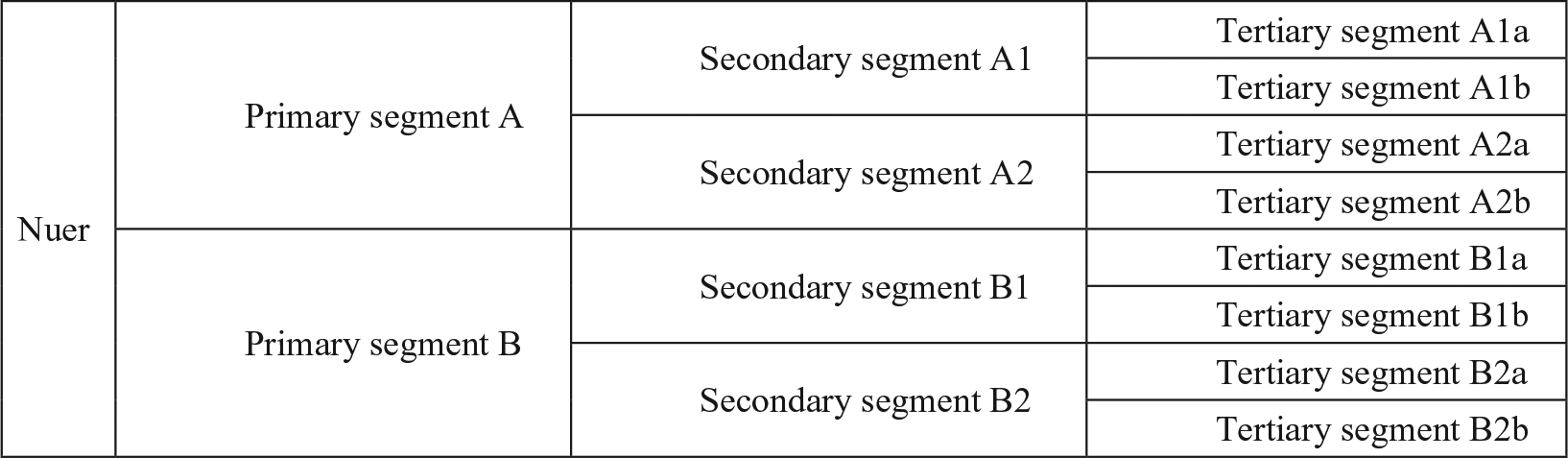
Simplified model of segmentary system.
Crucially, he states that: Each segment is itself segmented and there is opposition between its parts. The members of any segment unite for war against adjacent segments of the same order and unite with these adjacent segments against larger sections. (Evans-Pritchard, 1940: 142)
In our simplified model this means that while tertiary segments A1a and A1b might have adversarial relations to each other – including bloody feuds – they unite for war (under the banner of secondary segment A1) to wage war against segment A2. Similarly, while segments A1 and A2 wage war against each other, they would (under the banner of primary segment A) wage war against primary segment B. Finally, primary segments A and B would also unite under the name of the Nuer to fight with other tribes; in this case, for example, the Dinka.
This focus on war and feuding as one of the basic determinants not only in establishing different segments, but also the relations between segments both of the same and of a different order is highly relevant for the Bangladeshi context. As we will argue more substantially further, the crucial importance of political violence in the Bangladesh political system, while of course different from the tribal warfare that Evans-Pritchard describes, and the way it not only helps to constitute but also foreground segmentary opposition (at the local level) resonates well with the discussion on Nuer warfare.
Not unimportantly for our argument about the nature of political relations in Bangladesh and as will be discussed further, in a system of segmentary opposition there are a number of contradictions in defining exact political groups, as this depends on the exact level of segmentation you are considering. In understanding this level of segmentation it is crucial to not only understand internal group cohesion, but also how this group relates to other adjacent groups of the same order. As Evans-Pritchard argues: Any segment sees itself as an independent unit in relation to another segment of the same section, but sees both segments as a unity in relation to another section; and a section which from the point of view of its members comprises opposed segments is seen by members of other sections as an unsegmented unit. Thus there is […] always contradiction in the definition of a political group, for it is a group only in relation to other groups. (1940: 147)
This Evans-Pritchard further develops: the political system is an equilibrium between opposed tendencies towards fission and fusion, between the tendency of all groups to segment, and the tendency of all groups to combine with segments of the same order […] for although any group tends to split into opposed parts these parts must tend to fuse in relation to other groups. (1940: 147–148)
Although I would not use the word equilibrium – part of a larger structural functionalist focus on stability and equilibriums – also in our case the combination of these ‘two contradictory, yet complementary, tendencies’ (Evans-Pritchard, 1940: 148), of opposition and combination, is quite crucial to understand the workings of the political system in Bangladesh.
This also has repercussions on the ways values are shared within a segmentary political system and to what extent we can still see cohesion at different levels of political organization. Evans-Pritchard argues that while segments can ‘recognize a formal unity, […] there may be little actual cohesion. […A]ctual relations may be in conflict with [overarching values] since they are based on local allegiances’ (1940: 149).
A final element that is important in understanding the segmentary structure and these local allegiances is the territorial aspect of the segmentary structure. In the case of the Nuer, each segment in his case is associated with a particular territory and often the segments are, as such, clearly distinguished territorially. While this element of territoriality is also of crucial importance in the context of Bangladesh, different segments often share the same territory and opposition between lower-tier segments is often, specifically, over the control of territory (see below).
Vertical integration
The term vertical integration is mostly associated with industrial organization. It denotes the industrial strategy to combine all of the different steps in the production process in one firm. All companies acquired within this industrial conglomerate have their specific function within the overall production of one or a number of products (Perry, 1989). It is the opposite of horizontal integration in which one company tries to acquire others who have the same function in the production process. In Figure 2 a strategy of vertical integration would integrate production (and also marketing) steps 1–5, while a strategy of horizontal integration would lead to acquiring different firms engaged in one step of the production process (step 3 in this case). In this paper we are, of course, not interested in the benefits of either industrial policy, but rather in the idea and how it can pertain to a political system. More concretely, the notion of vertical organization can help to show how sections of organizations with specific functions within a political family come to operate in a coalition.

Schematic representation of vertical and horizontal integration.
In political science, the notion of vertical integration is predominantly used to analyze party integration in federal states, in which there is both a central party level and party structures in the different states of the federation. As stated by Thorlakson (2009: 160), ‘Vertical integration refers to the extent and strength of formal and informal linkages between state and federal parties. [… It] describes the organizational and strategic linkages that connect state and federal parties’. Within the vertical integration of parties there are many different options in which state and federal parties are only loosely integrated and federal parties have a large degree of autonomy, and others in which the integration is very profound.
Combining elements of these two approaches in our case we will use the term vertical integration to denote the formal and informal linkages which connect different levels and organizations of different political groups (see above). As in the literature on industrial policy, these different organizations have different functions within politics and, thus, alliances are created, vertically integrating different organizations in the political field. In line with the literature on vertical integration in federal systems, the autonomy of local political structures can vary, with some being very closely integrated with central-level politics, while others steering a fairly independent course, limiting the role of such vertically integrated networks. However, vertical integration can take place in a central–local way, but also within specific local political arenas, where different types of (local) political organizations, each with their specific function, become (vertically) integrated (see below). To be more specific, and as will be elaborated below, vertical integration is often the result of an effort made by specific leaders, who become the central players in such vertically integrated networks. Leaders can be engaged in central-level politics, or can be locally or regionally based, with both types of what Mattison Mines in a different context 6 has called ‘leader-centered groups’ (Mines, 1994: 41) sometimes existing in the same locality. As will be discussed below, rival vertically integrated networks can also form around rival leaders, cross-cutting the logic of segmentary opposition.
Segmentary opposition and vertical integration: a descriptive model of political relations in Bangladesh
In this section, we want to introduce the descriptive model to understand political relations in Bangladesh, adapting and integrating the concepts of segmentary opposition and vertical integration. As a first step, we will discuss them separately (see Figures 3–5), but they only fully work when combined in a more complex model (see Figure 6). As we will show, the concept of segmentary opposition works best to describe relations within specific organizations of political families and to describe relations between political families. However, to describe relations between different organizations of a political family, vertical integration is more apt. The specific shape of political relations, at the intersection of relations internal to political organizations, between functionally similar organizations of different political families, across different organizations of the same political family and between the political families as a whole, will be a case-specific outcome of the interaction between the logic of segmentary opposition and of vertical integration.
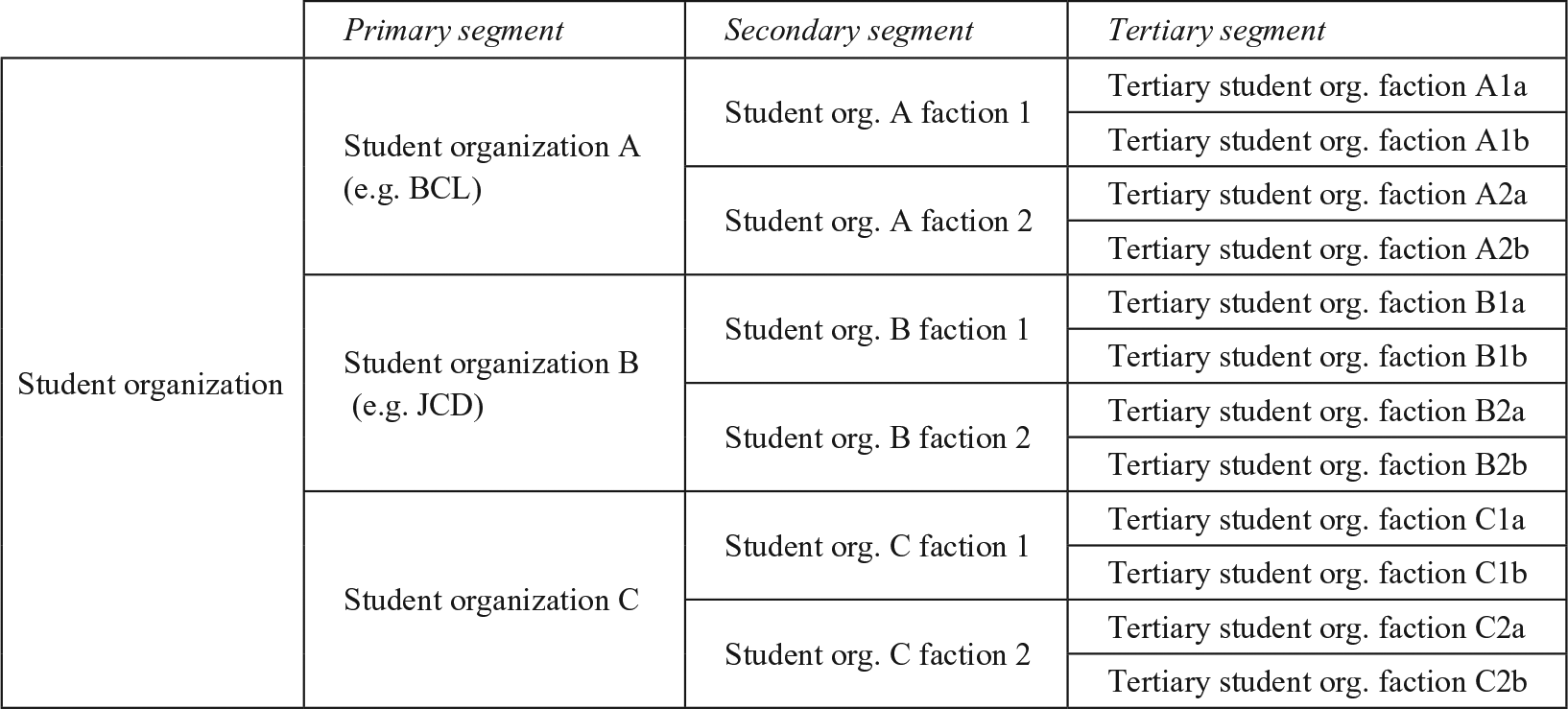
Simple model of segmentary opposition in Bangladesh (type of organization).

Simple model of segmentary opposition in Bangladesh (political family).

Simple model of vertical (vs. horizontal) integration in Bangladesh (political family).

Schematic representation of the descriptive model (AL, BNP).
As previously mentioned, this is only a model and, although it is aimed to include the most common political relations in Bangladesh, it remains a model and the reality is much more complex, with many variations. Also, as mentioned before, the model works best to describe relations within and between the AL and BNP political families. However, we would argue that it provides a starting point to analyze variations within this basic structure of political relations in Bangladesh. In this section we will provide a number of general examples to illustrate the basic properties of the descriptive model. These are, as will be clearly indicated, either fictional (true examples) or based on data gathered from news reports. While the examples in this section are only meant to clarify certain points, in the next section we will analyze more extensively two examples based on fieldwork carried out in Dhaka and Chittagong.
Segmentary opposition in Bangladesh can be described along two organizing logics: first, for a type of organization (e.g. a student organization) and second, according to the political family the different segments belong to. In the first case (see Figure 3) we use student organizations as an example. The general category of student organization is segmented into different specific student organizations, associated with their particular political family (see above). In the example, we have BCL and JCD. These student organizations are again divided into different factions (secondary segments) and, often, these are again divided into factions (tertiary segments). These are sometimes even further segmented. In line with the model of segmentary opposition (and as will be further shown below), factions in specific segments are in conflict with factions in the same segment of the same order (so in this case faction B1a is in conflict with faction B1b), but they (often) unite when in conflict with a section in a higher order (so in this case B1a and B1b unite as B1 when clashing with B2). Finally, these secondary segments unite again when in conflict with a higher order segment of the other section (in this case B (or JCD) against A (or BCL).
However, and this is an initial limit to fully applying the model of segmentary opposition to the Bangladesh context, unlike the Nuer uniting to fight the Dinka, different student organizations normally do not unite to fight other organizations (although some exceptions can be noted, see below). This would mean that BCL and JCD would form a united student front to combat a united youth front of BJL and BJD.
In the second case (see Figure 4) the segmentation occurs along the lines of the different political families. The family is segmented into different organizations or primary segments (including the ones listed here: party, youth and student organizations) who are then further segmented in a similar way as was mentioned above. From the secondary segment, these operate in much the same way as the aforementioned. A fictitious, but very possible, example can help to clarify this. Take the situation where a local political party committee (P1) is replaced by another one (P2) (with backing at the central level). This leads to violence with members of the ousted committees clashing according to their secondary segments (P1 vs. P2). 7 However, as is quite common, these individual committees are also factionally divided into tertiary segments. As a result, when the threat of the ousted committee is (temporarily) removed, the new committee splits again in its constituent segments (P2a, P2b); one, for example, under the leadership of the committee president and one behind the committee secretary. While these segments unite in fighting competitors (the ousted committee P1) they engage in feuding and clashes between (tertiary) segments to establish supremacy in the committee and the area (as well as over the control of resources).
Importantly, and one of the reasons for presenting Figure 4 here, this points to another limit in fully applying the model of segmentary opposition in the Bangladesh context: normally, the different primary segments are not the ones who are in conflict with each other. Otherwise, this would mean that the student segment would (always) unite against the youth (segment) and the party (segment). This is not very common. However, sometimes these types of clashes between the primary segments occur, as can, for example, be observed in a clash between the Jubo League and the Chhatro League over submitting tender for a building contract – with both groups representing different contractor interests – in Barisal (The Daily Star, 2015a). Still, the primary segments (student, youth and party) do unite under the banner of their political family when in conflict with a common enemy, mostly another political family.
It is from this last limit to the model of segmentary opposition that the notion of vertical integration gets its salience. Rather than that party, youth and student organizations of the same political party are in conflict, different factions (or secondary and tertiary segments) of the different groups (or primary segments) are vertically integrated. This often occurs under ‘leader-centered groups’, in which a central or regional leader integrates factions of a party, youth and student organization to combat other such vertically integrated units. As such, while segmentary opposition describes well the factional politics within party, youth and student organizations, to understand how it operates across these three main organizational structures, we need vertical integration. A vertically integrated group cross-cuts the student, youth and party forces and is the basis for (violent) opposition between such vertically integrated leader-centered groups.
In the final instance, all party, youth and student organizations are vertically integrated under the leadership of the central leadership, and the party president especially. As such, both Sheikh Hasina (AL) and Khaleda Zia (BNP) form the apex of a vertically integrated political family, in which different individual political party leaders again try to connect and vie for support (for a discussion, see, e.g., Kochanek, 2000; Khan et al., 2008).
The logic of vertical integration is illustrated in Figure 5, taking as a starting point the segments in Figure 4. Rather than that all the different student factions (S1a, S1b, S2a and S2b) horizontally integrate (to clash with all the youth factions), in the logic of vertical integration different factions of party, youth and student groups vertically integrate to form two ‘leader-centered groups’ (1a and 2b). These two such vertically integrated groups, which have adversarial relations, are each made up of a faction of party (P1a and P2b), youth (Y1a and Y2b) and student (S1a and S2b) organizations. 8
Given that the vertically integrated organizations are also functionally different, such a form of integration brings a lot of benefits to individual leaders. In fact, we would argue that a successful political leader, almost exclusively as part of the political party organization, is in fact able to integrate segments from many of the functional organizations of the political family. Only in this way is one able to provide both the man- and the muscle-power to successfully control a given territory (whether a ward, a union, a district or a constituency). Moreover, as the different functional organizations are intended for different sections of society, a vertically integrated network will allow having direct connections to many different sections, or polities within society. Given the same logic, a contender to the position of (party political) leadership will have to organize a similar vertically integrated group. For this, he can either exploit existing tensions as a result of already existing segmentary opposition, or his quest to build a vertically integrated group can lead to segmentation as he strives to wean parts of segments associated with his rival (see below).
As a result, the particular form factional opposition and violence takes in specific cases is, I would tentatively argue, an outcome of the tensions between the logic of segmentary opposition and vertical integration (under leader-centered groups). To be more specific, the splitting off of further segments seems to be at least partly dependent on a struggle for a position within and between leader-centered groups. Let me illustrate this with a fictitious, but not unimaginable, example: a minister is the central leader to which all local-level leaders and activists of different organizations within one political family within his constituency (the primary segment) want to connect. This would (most likely) lead to a segmentation of the primary segment in which, although every one of these secondary segments combine under this minister, they are factionally divided and strive for (and clash over) supremacy in their relation with the minister. These secondary segments could take the shape of the different functionally different organizations, but these would then segment further as different factions within these organizations strive for the preferential treatment of the minister as part of his core vertically integrated group. If a contender for the central leadership position of the minister would arrive (e.g. a member of parliament (MP)) this might lead to a realignment in which the logic of vertical integration would lead to the formation of two (secondary) factions, one with the minister and one with the MP, which would again be subdivided into (now tertiary and quarterly) segments, which vie for primacy in their relation to the minister and the MP, respectively. Yet, according to the logic of segmentary opposition, the tertiary segments would unite in the struggle over which secondary segment (the minister or the MP) is dominant in this area. Such a struggle is quite common, also between current and former MPs, as is exemplified by a clash in Atgharia (Pabna) where at least 40 people were hurt after a clash about the formation of the new district committee between supporters of the sitting MP Shamsur Rahman Sharif Dilu and those of former MP Panjab Ali Biswas. Factional lines run across the functionally different organizations and included student, youth and political party activists aligned with one of the two factions under both the MP and former MP’s leader-centered groups (bdnews24.com, 2005).
Figure 6 combines the two elements of segmentary opposition and vertical integration and, thus, summarizes the descriptive model. It focuses on the AL and BNP, whose internal and external political relations follow the model most closely. If you combine the two types of segmentary opposition in one AL–BNP model, you have two overlapping systems of segmentation. Segmentation is both vertical and horizontal. Along the horizontal axis the main segments are divided along the lines of the political families. Along the vertical axis the main segments are divided along the lines of the type of organization (e.g. student, youth, party, etc.). Moreover, the logic of vertical integration (indicted by * and ° for AL and BNP, respectively) unites factions (of a tertiary or secondary nature) of different organizations within the political family in their struggle with other factions of the same order. Moreover, the logic of segmentary opposition also allows for cooperation across political family lines. Although quite rare, such cooperation could be noticed to some degree in the anti-Ershad movement before the advent of democracy in 1991. Finally, it must be clear that there can be more or less orders of segmentation. As previously mentioned, this seems to be related to the logic of vertical integration, as further segmentation occurs depending on the possibilities of getting access to a vertically integrated leader-centered network in this way.
To further clarify the integration of the logic of segmentary opposition and vertical integration, the aspect of territory is quite useful. It must be kept in mind that political relations in Bangladesh, to a large extent, are connected to the control over territory. Domination in a particular territorial unit (whether administrative, electoral or functional) is the raison d’etre of both segmentary opposition and vertical integration. In the work of Evans-Pritchard each segment is also associated with a specific territory. In Bangladesh, many feuds are fought over the control of territory, between different segments. Different rival factions of student, youth or party organization might try to gain access to particular territories, both in terms of administrative units, student halls, sections of the campus and, very directly, over the occupation of (agricultural) land. The struggle also takes the form of inter-political family feuds, when segments of student, youth and party organizations clash with their rivals of the other political party (certainly around election time). Vertical integration also focuses on territories a leader controls or wants to control. It is in these specific territorial units that a leader looks for allies in the functionally different organizations to support his control. However, recursively, segments of these functionally different units also actively seek these alliances to a leader, which provides support in making their own claims of territorial domination (within the bounds of their organization). Thus, both logics do not appear out of thin air, but are directly related to the practice of domination in specific territories.
The model in action: student and ward politics in Dhaka and Chittagong
While we have already provided a number of (fictitious) examples of the operation of the descriptive model, in this section we want to provide two further, more extensive, examples of its operation. These two examples are taken from fieldwork data, although a close reader of the Bangladeshi political landscape might provide any number of similar examples. The first focuses on student politics in Dhaka and the second, on ward-level politics in Chittagong. Given the dominance of AL at the central level at the time the fieldwork was carried out, and the way the structure of these factions seems to become more apparent when there are state resources to be distributed, both focus predominantly on the segmentary opposition of the AL political family, although it must be said that, in line with the logic of segmentary opposition, the segments discussed here unite in their struggle with (rival organizations of) the BNP.
Student politics in Dhaka
Different campuses across Bangladesh include student dormitories, called halls, where students are able to live at subsidized rates. These halls, while providing cheap accommodation for students of poorer backgrounds, are often a basic building block for political relations in the campus and student politics more broadly. In the schematic representation presented in Figure 7, they form the secondary segment. These different halls all have a hall committee and in these hall committees – and in political relations on the hall level – there is a faction with the hall president and one behind the hall general secretary (the tertiary segments). One could even include an order of quarterly segments along the different other members of the hall committee in their allegiance to either president or general secretary, but at the same time in competition with other hall committee members in the same segment and of the same order. On the hall level, relations are not always highly conflictual, although both groups try to get the upper hand and, thus, a major stake in the resources is generated through the control over the hall. This can lead to violent clashes, for instance, over the control of common rooms, like the recreation and the reception room.

Segmentary opposition in hall-based student politics.
Halls and their leadership are often connected (in a relatively stable way) to specific political leaders (e.g. MPs or ministers) and are, thus, part of vertically integrated leader-centered groups. In some cases this association is regional, in which a hall is associated with a specific region and also connects to the political leaders of this region for support. In a reciprocal way, the hall will also work for the benefit of one or a few political leaders. The current hall leadership can also benefit from connections to previous residents and hall committee members. If these become themselves leaders, they can provide support to their former hall.
Individual halls have often highly conflictual relations, as the hall leadership is trying to vie for positions within the university campus, but also over the control of territory in the near vicinity of the campus. Hall leaders, through their control over both manpower and connections, are able to collect considerable taxes, for example, from markets and their associations or in tender processes in exchange for their support and protection. As the relative strength of specific halls also reflects the possibility to collect such spoils, halls are in (violent) competition, which leads to violent clashes or ‘showdowns’.
In some cases, halls operate on an individual basis in their competition with other halls, and the segmentary structure would consist of the campus section of Chhatro League with the different halls as primary levels of segmentation. In one of the studied campuses, however, there was a fairly well-established pattern of coalitions between halls, in which a number of halls united in a coalition under a (primary) segment, as shown in Figure 7, against a coalition of the remaining halls. This was also reflected in the university committee, where this balance between two coalitions of halls also resulted in the president of the university’s Chhatro League committee representing one coalition of halls and the general secretary the other. This, however, was fairly unstable as not only, in line with the theory of segmentary opposition, did individual halls (on the level of secondary segments) vie for supremacy in their primary segment (in the form of the position of university committee president or general secretary), but the primary segments also frequently clashed for gaining dominance in the committee.
As was already mentioned in the introduction to the conceptualization of segmentary opposition and in the previous section, the territorial aspect is quite important. Also, in the study of student politics, the territorialization of student and hall power is crucial, and segments are in conflict and clash frequently over the control of specific territories. Clashes do not simply occur over territory within the halls, as was already mentioned, but also emanate to include clashes over territory within the campus and beyond. As such, specific halls are, for instance, said to have control over specific markets where they collect protection money . These territories are, however, not stable and frequent clashes occur over who has the right to collect where. These clashes over territory unite the quarterly segments in a fight against other tertiary hall segments.
Notwithstanding the segmented nature of Chhatro League politics, the segments do unite in clashes with their main political rival Chhatro Dal, or with Chhatro Shibir, the student wing of Jamaat-e-Islami. When there is a changeover in the government at the central level the party in power takes over the campus. This happens on the level of the halls (tertiary segments) but is also accompanied by more major clashes in which the different segments unite (under their primary segments). Also, when the student group out of power wants to enter the campus (forcibly), such primary segment clashes occur. Yet, we should keep in mind that, even when united under their primary segments, the different actors and groups involved remain heavily segmented according to lower-order segments, and their participation under the banner of the primary segments is partly in function of power relations along the lines of these lower-order segments.
As the halls themselves (and thus the main structure of segmentation) is already associated with one or a group of leaders, there seems to be, when just discussing student campus politics, less scope for vertical integration under leader-centered groups. Rather, as previously mentioned, coalitions of specific halls emerge to guide higher-order political relations. It is only in their relation with other political groups (like youth and local AL groups) that vertical integration becomes more pronounced according to the logic of vertical integration in uniting segments of functionally different organizations. This will be further illustrated in the discussion of ward-level politics in the next section.
Ward-level politics in Chittagong
Our second example shows more clearly how leader-centered vertical integration determines the form segmentary opposition takes, and is based on field research on hartal politics and land relations in Chittagong in 2011. At the time, the AL political family held most power in the ward under research (the AL family was also in power at the center, while the mayor was from the BNP). Yet, AL activists were divided along two main leader-centered groups. One group was aligned with the senior AL politician and long-term mayor Mohiuddin Chowdhury, while the second group was aligned with Afsarul Ameen, at that time a Chittagong-based minister in the AL government (in close cooperation with leaders like AJM Nasir Uddin and Nurul Islam).
As Figure 8 shows, the two main factions were present in all of the AL organizations present in the field site, of which the youth and party wings were most active. As a result, in all of the different organizations there was a faction with the Chowdhury and one with Ameen. These factions were in open conflict, which, in this case, for example, resulted in disputes of over land. While both factions used to be more integrated behind Chowdhury, his loss in the 2010 city corporation election (which had already partially been the result of factional divisions in Chittagong AL), led to a realignment to another, potentially more powerful patron, the minister Ameen. The clear existence of these two factions resulted in relatively close (vertically integrated) cooperation between members of the same secondary segments (indicated in Figure 8 by * and °).

Segmentary opposition and vertical integration in ward politics in Chittagong.
While the factional divisions led to segmentation in all organizations, both factions were again divided into tertiary segments, with different local leaders, both of the AL and BJL trying to gain the upper hand in their respective (secondary) segments. Quite interestingly, in these tertiary segments there was a second layer of vertical integration (as indicated with ^), in which different tertiary AL leaders tried to integrate a number of youth and student activists under their leadership in an effort to gain the upper-hand in their own segmentary conflict with other tertiary AL leaders. Yet, according to the logic of segmentary opposition, these different tertiary factions were quite united when confronting the other main faction. All segmentary segments also united under the AL family banner when confronting the BNP opponents.
The structure of political relations in this ward was, thus, the outcome of the interaction between the logics of segmentary opposition and vertical integration on two levels. This example also shows that a change in the leadership pattern can resonate throughout the segmentary political system. Interestingly, while the two leader-centered groups had been in conflict from around 2010, they again integrated to fight the 2015 Chittagong City Corporation elections under AJM Nasir Uddin, who won the election. Nasir Uddin had been part of the group around Ameen and with Chowdhury also having had mayoral ambitions and still a strong following, it remains to be seen whether rival vertically integrated groups will again appear. As this (temporary) unity was the result of direct interference of the penultimate AL family leader, Sheikh Hasina, it stresses again the importance of leader-based groups. While political leaders are able to build their own vertically integrated groups, they all aim to be integrated into Hasina’s. This struggle then takes the form of segmentary opposition in which segment leaders are in permanent opposition with other such leaders for direct access to the penultimate leader.
Conclusion
This paper has proposed a descriptive model to analyze political relations in Bangladesh. Appropriating the concepts of segmentary opposition from Evans-Pritchard’s classical work on the Nuer, and vertical integration from industrial management and political party theory, this model allows describing the overall shape of political relations in Bangladesh. This paper has also tried, by providing short examples from student politics in Dhaka and ward-level politics in Chittagong, to show how such a model can be applied to understand the political relations in a specific location.
At the same time, we should not overstate the capacity of such a descriptive model. While we would argue that the interaction of both its logics allows describing the majority of political relations in Bangladesh, the specific form these relations take is very much dependable on the circumstances in which they take shape. As such, there will be a large variety in the specific form the model takes in each of these different situations. This, however, should not be considered a drawback. Rather, this would allow using the descriptive model as a starting point to analyze exactly this local variance. Thus, we would argue that this descriptive model can have most value as an analytical tool to better understand the specific shape of political relations across Bangladesh.
As such, it is also an invitation to conduct further research into the organizing logics of factional politics in different parts of Asia and Africa. The descriptive model presented here, based on the interaction of two organizing logics – segmentary opposition and vertical integration – could provide a starting point for a comparative analysis of party political factionalism(s), in which fission and fusion, and unity and divergence are not simply opposing tendencies, but a structural outcome of the organizing rationale of the political system itself.
Footnotes
Acknowledgements
The author would like to thank Julian Kuttig for his comments on an earlier version of the article and Aynul Islam for both his comments and fieldwork assistance.
Declaration of conflicting interests
The author(s) declared no potential conflicts of interest with respect to the research, authorship, and/or publication of this article.
Funding
The author(s) disclosed receipt of the following financial support for the research, authorship, and/or publication of this article: Field research for this paper was supported by a FWO post-doctoral research grant.