



Abstract
This study investigates what factors affect Republic of Korea (South Korea)–United States (ROK–US) relations based on a theoretical framework, using event data created by content analysis from 1990 to 2011. South Korea’s economic development led to democratization, which resulted in elite changes. New progressive elites interpreted national interests differently and demanded changes in ROK–US relations. Accordingly, the ROK–US relationship was tense during the progressive administrations. ROK’s economic development attracted more trade with the US, which enhanced the bilateral relationship due to heightened interdependence. By contrast, the Democratic People’s Republic of Korea (North Korea)–US relationship and the trade between ROK and China did not significantly affect ROK– relations, meaning ROK’s relationship with other countries does not affect ROK–US relations.
Introduction
The United States has been one of the most important allies of South Korea (Republic of Korea, ROK) since it was liberated from Japanese colonial rule in 1945. The US military saved South Korea from the North Korean (Democratic People’s Republic of Korea, DPRK) invasion and has provided security assistance since that time. Overall, the ROK–US relationship was strong during the Cold War as the US military stayed in South Korea for security. Due to South Korea’s reliance on the US for security, the two countries had a patron–client relationship (Lee S, 2003). Despite the unequal nature of the relationship, most South Koreans appreciated US protection from the North Korean threat and accepted the strong US influence (Lee and Heo, 2001).
With the end of the Cold War, however,
To make matters worse, the US government demanded improvement in the trade balance due to the perennial trade deficits (Taylor, 1989). Washington tolerated a trade deficit while the South Korean economy was growing. As South Korea started enjoying economic prosperity, however, Washington demanded friendlier trade policies toward US products to improve the trade balance.
There is a vast volume of studies on Korea–US relations. Yet, few studies have empirically tested what factors affect the relationship between the two countries using a statistical analysis. In general, previous studies on ROK–US relations can be categorized in two groups: (1) historical analysis of ROK–US relations or ROK–US alliances (e.g. Cha, 2010; Kang, 2006; Park JJ, 2011); and (2) focusing on specific issues, such as US forces in South Korea and/or status of forces agreement (Park WG, 2013), anti-Americanism (Oh and Arrington, 2007; Sim, 2008), economic and trade issues (Noland, 1993; Shin, 1993), North Korean nuclear crisis (Bae, 2010), or the ROK–US military alliance (Lee and Heo, 2001; Manyin et al., 2014). These studies are theoretical and/or analytical, but they do not provide statistical evidence.
To fill the gap in the literature, we created a quantitative data set describing the relationship between the two countries based on events and media reports. Analyzing interstate relationships using events data has been widely employed in the international relations literature. For instance, Ben-Dak (1972) analyzed the Arab–Israeli relationship using event data and Chan (1978) did a similar analysis for US–Vietnam relations. Furthermore, Schrodt and Mintz (1988) conducted an analysis using events data for six Middle Eastern countries and Schrodt and Gerner (1997) studied third party mediation in the Middle East and Balkans using events data.
Following the tradition of using events data to describe interstate relationships, we empirically test what factors affected Korea–US relations from 1990–2011. Considering the relationship between the two countries is asymmetrical (the US is far more important to South Korea than vice versa), we focus on the factors on the South Korean side. Since the Korea–US relationship has had ups and downs after the end of the Cold War, we investigate the post-Cold War period. The findings of this study will help us better understand why the Korea–US relationship has fluctuated in the recent past.
ROK–US relations since the end of the cold war
The end of the Cold War significantly changed the international environment surrounding the Korean Peninsula. To cope with the change, the ROK normalized its relationship with the Soviet Union in 1990 and China in 1992. These diplomatic efforts were possible thanks to the ROK’s economic development. Since South Korea launched its first five-year economic development plan in 1962, South Korea enjoyed rapid growth and became the 12th largest economy in the world. Thus, Beijing and Moscow wanted to improve their relationships with Seoul even at the expense of their ties with Pyongyang. In 1991, South Korea provided $1.5 billion in loans to the Soviet Union following the normalization in 1990. Trade between Korea and China soared after their rapprochement, and China has been South Korea’s largest trade partner since 2003.
Thanks to the solid relationship, Washington supported these diplomatic efforts by Seoul. However, the relationship between Seoul and Washington began to have problems with the outbreak of the North Korean nuclear crisis. The first North Korean nuclear crisis occurred in the early 1990s as the US learned about the North Korean nuclear program. To deal with the issue, Washington directly negotiated with Pyongyang. Although the DPRK–US negotiation produced the Agreed Framework in 1994 ending the first North Korean nuclear crisis, the negotiation did not go smoothly and the US government considered a surgical air strike at one point. South Korea vehemently opposed the use of force because of the potential escalation, worried about being direct recipients of that escalation. Seoul was furthermore worried about being excluded in the negotiation process despite South Korea being directly faced with North Korea’s nuclear threat.
When Kim Dae-jung came to office in South Korea in 1998 inter-Korean relationships improved. Both Kim and Clinton pursued an engagement policy towards North Korea. However, George W. Bush succeeded Clinton in the US. Bush did not trust the North Korean leader Kim Jong-il, and considered the engagement policy as a failure. Furthermore, Washington found out about North Korea’s highly enriched uranium based nuclear program which ended the Agreed Framework and the second North Korean nuclear crisis began (Bae, 2010). As a result, the ROK–US relationship became unstable.
When Roh Moo-hyun succeeded Kim Dae-jung in 2003, the relationship between Seoul and Washington became even more complex because the Roh administration demanded the return of ROK troops’ wartime operational control while maintaining the engagement approach to North Korea. Since the US was in the middle of war in Afghanistan and Iraq, Washington requested help in Iraq. Because the Roh administration wanted to get Washington’s support on its North Korea policy and cooperation for the return of wartime operational control, the ROK sent its troops to Iraq despite severe domestic oppositions.
The Roh administration wanted wartime operational control back for national pride. Initially, US officials were displeased with South Korea’s request to restore its sovereignty through regaining the wartime operational control (Lee DS, 2007: 481). However, since transferring the wartime operational control meant a lower US defense burden, Washington agreed to transfer wartime operational control to South Korea (Bae, 2010; Lee K, 2011; Park M, 2010).
After 10 years of progressive presidents, a conservative President Lee Myung-bak came to office in February 2008, strengthening the ROK–US relationship. In a summit in Washington in April 2008, Presidents Lee and Bush agreed to maintain United States Forces Korea at a level of 28,500 people and this agreement was reaffirmed in the summit between the two states in April 2009. Also, South Korea and the US upgraded the ROK–US relationship into a comprehensive strategic alliance including bilateral, regional, and global levels. In addition, the two states agreed to postpone transferring wartime operational control until December 1, 2015 considering North Korean provocations such as the Cheonan sinking and bomb shelling on the Yonpyeong Island. Since then, the relationship between the two countries has been cooperative.
Theory
There is a growing literature on the relationship between domestic politics and foreign policy because a state’s foreign policy is affected by domestic politics as well as international factors (Bueno de Mesquita and Smith, 2012). For example, as a country enjoys economic development, its military may be strengthened with increased defense spending. Changes in the ruling party may lead to modified foreign policy due to different political orientation. At the same time, changes in the international political environment may also require adjustment. Thus, various factors in domestic politics and international relations affect a nation’s foreign policy.
According to Heo and Roehrig (2014), economic development leads to foreign policy changes. The reason is that economic development leads to transition to democracy, which gives way to elite changes, resulting in modification of foreign policy. The theoretical link behind this argument is that economic development leads to industrialization, urbanization, and increased investment in education. With higher spending on education, people’s literacy and understanding of their political rights and national governance improves. Those who received higher education expect more from the government and participate in the political process to make demands and to enhance their political rights, which eventually leads to democratization.
After the transition to democracy, changes in political elites are likely to follow as people want to have new leaders who respect democratic values. In a democratic system, voters can also hold their political leaders accountable in the election if their leaders do not meet the public expectation. Accordingly, elite changes commonly occur, which may result in changes in foreign and domestic policies for three reasons: (1) new political leaders need to reflect their supporters’ interests in domestic and foreign policy, which may be different from those of the previous authoritarian regime supporters; (2) various political parties pursue different ideologies and policy priorities based on their political orientation; and (3) as constructivists argue, new leaders may interpret national interests differently compared with their predecessors. For these reasons, governments after the transition to democracy tend to have different assessments of national interests, national identity, and priorities and focus in foreign policy. Accordingly, it is not uncommon that changes in foreign policy and demands result in modification of foreign relations following a country’s experience of democratization (Heo and Roehrig, 2014).
In addition, economic development attracts more trade. According to the gravity model, income and population are the two most important factors that affect trade (Anderson, 1979: 106–116). Thus, as a nation’s economy develops, trade also increases because other nations want to enjoy the new and growing market that provides a lucrative opportunity for their exports. Increased trade deepens the relationship with the new trade partners, requiring adjustment in the relationship with the existing trade partners. Modified foreign policy may follow reflecting the changes in relative economic importance.
Application to ROK–US relations
Economic development
In the 1950s, the ROK was one of the world’s poorest countries, but it has the 12th largest economy today. Since the 1950s, gross domestic product (GDP) per capita went up from $65.6 in 1954 to $24,363 in 2011 (see United Nations (UN) data at: http://data.un.org/Data.aspx?q=GDP+per+capita&d=SNAAMA&f=grID%3a101%3bcurrID%3aUSD%3bpcFlag%3a1). Since the end of the Korean War, US aid was one of the most important financial resources, which totaled $3.8 billion and lasted until the mid-1960s. However, with the 5-year economic plan launched in 1962, the South Korean economy enjoyed rapid growth until it was hit by a financial crisis in 1997. South Korea was bailed out by the International Monetary Fund (IMF) due to this 1997 financial crisis, and it recovered by 2011, three years earlier than originally planned (see elibrary-data.imf.org.ezproxy.lib.uwm.edu/QueryBuilder.aspx?s=323&key=1445284).
South Korea’s rapid economic development significantly affected the Korea–US relationship for two reasons. First, economic development led to the generation gap in South Korea with respect to the views on the United States and North Korea. Older generations tend to appreciate US military efforts during and after the Korean War and the US economic aid after the war ended. The Korean War devastated South Korea and US aid was a lifesaver, which accounted for almost half of South Korea’s annual government budget in the 1950s. For this reason, older generations tend not to have a problem with the patron–client relationship between the two countries.
By contrast, younger generations grew up enjoying economic prosperity. They take high national pride and refuse to accept the patron–client nature of the existing relationship. They believe the current relationship between the US and South Korea is unfair and needs to be changed reflecting the growth of South Korean power. Younger generations desire equal partnership with the US based on national interests and make demands for that. Moreover, younger generations believe that the US delayed South Korea’s democratization by supporting the authoritarian Park Chung-hee and Chun Doo-hwan administrations. Because the US armed forces held the operational control of the ROK forces, the younger generations believed Chun Doo-hwan was able to send troops to suppress protests for democracy in Kwangju in 1980 with Washington’s approval. Thus, Cha (2004) argues Korean younger generations are unfavorable to the US as well as the deployment of US forces in South Korea.
Second, economic development gave way to a substantial increase in South Korea’s national capability. According to Morrow (1991), changes in national capability often harm the existing alliance because the country that experienced the growth would like to modify the nature of the alliance structure. This theory is applicable to the ROK–US relationship. South Korea has the 12th largest economy in the world today and in 1996 became a member of the Organization for Economic Cooperation and Development, the symbol of developed states. To reflect its growth in the relationship with Washington, Seoul requested the revision of the State of Forces Agreement in addition to transferring the operational control of its own military. The US government also demanded an increase in South Korea’s military-burden sharing with respect to the cost of US forces in South Korea. In other words, South Korea’s economic development led the government in Seoul to take a stronger stance in its policy toward the US and conflicts of interest between the two countries affected the relationship. Thus, we hypothesize,
Hypothesis 1: South Korea’s economic development has a negative impact on the ROK–US relationship.
Domestic politics: enhancement in education, democratization, elite changes
South Korea’s economic development enhanced education attainment, access to information, and the expansion of the middle class, which led to democratization. The transition to democracy brought in institutional changes and political and social liberalization including the expansion of information sharing, freedom of expression, and freedom of the press (Kim and Lee, 1993). As a result, new political elites, who were based on nationalism, came to be on the political stage. These new elites thought that the US supported the authoritarian regime, delaying democratization in South Korea. Lee DS (2007: 471) wrote, “Nationalist elites who believe in the principle of national sovereignty pursue foreign policy goals that are potentially damaging to asymmetric alliance. First, they decline to grant political influence to the allied government and demand an equitable, autonomous relationship, often regardless of the power disparity between two nations. The powerful ally, however, finds it hard to accept these policies.”
During the conservative administrations and the authoritarian regimes, the ROK and the US enjoyed close cooperation. However, as new liberal/progressive elites come to power after the transition to democracy, friction between Seoul and Washington emerged as the Korean progressive administrations (the Kim Dae-jung and Roh Moo-hyun administrations) interpreted national interests differently. Accordingly, their perceptions and attitudes towards the US were much different from that of the conservatives. They requested greater autonomy from the US and changes in the ROK–US relationship toward an equal partnership. Considering political influence is one of the critical rewards for a strong ally in return for its security guarantee for a small state, Washington had a hard time accepting the demand.
As a result, Seoul and Washington frequently disagreed on various issues. For example, one of the main reasons for the ROK–US security cooperation was the North Korean threat. However, the progressive administrations reduced the perceived threat from North Korea with an engagement policy and undermined the reason for US military deployment in South Korea as they did not consider North Korea a threat. Since the summit meeting between the two Koreas in 2000, the progressive governments focused on cooperation with North Korea. Nationalism emerged with the improved relationship between the two Koreas. Lee S (2005: 93) argues that new nationalism is expressed as “assertive nationalism” to the US and as “inter-Korean nationalism” to North Korea. These new nationalist elites demand more autonomy from the US, emphasizing solidarity between the two Koreas. As a result, some young Koreans even think that the ROK–US relationship hampers unification with North Korea. When an ally’s threat perception changes, it will have a negative impact on the existing alliance (Leeds and Savun, 2007). The ROK–US relationship is not an exception. South Korea’s progressive leaders’ nationalistic attitude caused serious conflicts with the US, particularly during the George W. Bush administration. Thus, we hypothesize that
Hypothesis 2a: Education attainment has a negative effect on the ROK–US relationship.
Hypothesis 2b: Progressive administrations in South Korea have a negative impact on the ROK–US relationship.
The North Korean factor
Another factor that affects ROK–US relations is the relationship between North Korea and the US because the nature of the ROK–US relationship is an asymmetrical alliance. An asymmetrical alliance is the outcome of the bargaining between autonomy and security. Since each state tries to maximize its benefit and minimize its costs, there are always some strains between the two allies. These strains are called the dilemma of alliance: “abandonment;” and “entrapment” (Snyder, 1984: 466). Abandonment is defection, which is realigning with the opponent. No matter how strong the alliance is, the fear of being abandoned always exists. Entrapment is being pulled into a conflict over an ally’s interests (Snyder, 1984: 467).
In the ROK–US relationship, South Korea’s fear of abandonment by the US goes up when Washington and Pyongyang get closer. South Korea’s fear becomes amplified if the US denies the request of South Korea’s political or military support at the time of North Korea’s provocations (Lee, 1999: 27). In that case, South Korea would demand strong security commitments from the US while offering additional concessions such as new military bases or an increase in defense spending. If the US takes South Korea’s request, South Korea’s fear of abandonment will be dismissed. However, if the hostility between the US and North Korea escalates, South Korea’s fear of entrapment is enhanced. The crisis caused by hostile confrontation between the US and North Korea might trigger an arms race or lead to the unwanted outbreak of war on the Korean Peninsula. In this case, South Korea pressures the US to change its hardline policy and improve the relations between the US and North Korea (Lee, 1999: 28). This is South Korea’s cycle of fear of abandonment and entrapment.
The first nuclear crisis during the Kim Young-sam Administration is an example of the fear of entrapment. After North Korea joined the Nuclear Non-Proliferation Treaty, the International Atomic Energy Agency (IAEA) inspected North Korea’s nuclear site at Yongbyon. The IAEA requested further inspection as they suspected North Korea reprocessed consumed fuel rods. Pyongyang did not allow another inspection and rounds of negotiations failed. The Clinton administration considered a surgical airstrike on Yongbyon before the US and North Korea reached an agreement, the so-called Agreed Framework (Heo and Roehrig, 2010, 2014; Koo and Ahn, 2010: 137).
However, South Korea was not part of the agreement, which increased South Korea’s fear of abandonment. It was North Korea’s strategy to negotiate with only the US and exclude South Korea. Accordingly, there was no meaningful improvement in the relationship between Seoul and Pyongyang (Wit et al., 2004: 67). Out of fear of abandonment, South Korean President Kim Young-sam in an interview with BBC on June 17, 1993 publicly urged the US not to concede too much to North Korea (DongA Ilbo, June 26, 1993). The New York Times also reported that “President Kim Young Sam cautioned that North Korea was manipulating its current negotiations with the US to buy time to finish their project to build nuclear weapons” (New York Times, July 2, 1993). In response, the US agreed in the summit meeting on November 11, 1993 to exchange a special envoy with South Korea (Koo and Ahn. 2010: 139). As a result, South Korea’s fear of abandonment considerably lessened.
As discussed, the North Korean nuclear crisis and the relationship between the US and North Korea have had significant implications for the ROK–US relationship. The reason is that North Korea strategically tried to isolate South Korea by directly dealing with the US without South Korea being involved. Seoul was very uncomfortable when Washington made a decision without Seoul’s input in dealing with North Korea although the decision directly affected South Korea. For example, the Clinton administration directly negotiated with North Korea to resolve the first North Korean nuclear crisis without South Korea’s involvement. When Washington and Pyongyang reached an agreement, the Agreed Framework, Seoul had to take a significant financial responsibility to establish the Korean Peninsula Energy Development Organization and build two light water nuclear reactors in North Korea.
At the same time, when North Korea and the US had a conflict, it also affected the ROK–US relationship. During the George W. Bush administration, Washington employed harsh rhetoric towards Pyongyang. Moreover, the Bush administration did not support Seoul’s efforts to improve the relationship between the two Koreas. Consequently, President Roh Moo-hyun criticized President Bush for aggravating the North Korean nuclear crisis (Gregg, 2004: 148). Thus, we hypothesize,
Hypothesis 3: The North Korea–US relationship has a negative effect on the ROK–US relationship.
Trade
Since South Korea developed its economy based on export-oriented industrialization, trade has been the driving engine of the South Korean economy. The US was South Korea’s largest trade partner for decades. However, South Korea’s normalization with China gave way to a significant increase in trade between South Korea and China. In 2003, China surpassed the US in trade amount with South Korea and became South Korea’s largest trade partner. As a result, South Korea’s trade dependence on China enhanced while that on the US declined. Today, the US is South Korea’s third largest trade partner only behind China and Japan. For the United States, South Korea is the 7th largest trade partner behind Canada, China, Mexico, Japan, Germany, and the United Kingdom (Heo and Roehrig, 2014).
Trade between South Korea and the US has had two facets. South Korea’s exports to the US helped economic development and strengthened the relationship. However, the trade balance since the late 1990s has been in South Korea’s favor, which caused friction between the two countries. Due to the trade deficits, US businesses complained about formal and informal trade barriers in South Korea. They complained that Korean regulatory agencies did not monitor violations of the regulation or punish the violator(s) of fair trade rules (Shin, 1993: 173–174). In addition, the US businesses complained about the difficulties of communication and the corruption of Korean officials as informal barriers (Shin, 1993: 175–176).
According to Noland (1993), South Korea has higher tariffs and greater quantitative restrictions than the US. Without the trade barriers, the US believes it would be able to export more. Thus, the US actively tried to eliminate them. In the process, friction between the two countries was aggravated.
Shin (1993) argues that one of the reasons why trade causes trouble between the US and South Korea is because the US businesses in South Korea tend to solve the business issues through political channels. They tend to appeal to the US government or embassy in South Korea to put pressure on the South Korean government. This politicization of business issues gives a benefit to the US businesses in the short run, but is harmful for long-term economic relations between the two states as South Korea sees the US government’s involvement as unfair intervention in internal matters. To deal with trade deficit and other trade-related issues, Seoul and Washington signed a free trade agreement (KORUS FTA) on June 30, 2007, which went into effect on March 15, 2012. Thanks to the KORUS FTA, trade amount between the two countries is expected to increase considerably.
Overall, South Korea’s trade with the US had a positive effect in the early stage of South Korea’s economic development. However, increased trade deficit became a source of friction between Seoul and Washington. Thus, the impact of trade on the relationship between the two countries is an empirical question. Accordingly we hypothesize,
Hypothesis 4a: South Korea’s trade with the US affects the ROK–US relationship.
South Korea’s trade with China also has significant implications for the ROK–US relationship because South Korea’s increased trade with China reduced the economic importance of the US for South Korea. Prior to the normalization with China, the United States was South Korea’s largest trade partner. After the rapprochement in 1992, trade between South Korea and China rapidly increased. For example, South Korea’s trade with China in 1992 was $6.37 billion, but the figure rose to $235 billion in 2014. With an annual growth of approximately 35 percent, China became South Korea’s largest trade partner in 2003, replacing the US (Chan and Kuo, 2005), and has maintained the status since that time. Moreover, South Korea enjoys considerable trade surplus, enhancing South Korea’s trade dependence on China.
In 2014, the ROK and China signed a free trade agreement, which is likely to augment the bilateral trade between the two countries even more. Such improvements in ROK–China economic relations reduced the value of the US as a trade partner (Manyin, 2004).
South Korea’s trade increase with China has significant implications for the ROK–US relationship as it reduces South Korea’s trade dependence on the US, meaning China’s economic importance for South Korea grew at the price of the US in terms of economic importance to South Korea. Reduced importance of the US to South Korea also allows South Korea to take a bolder position in dealing with trade issues with the US. Thus, the effects of trade on the ROK–US relationship come from South Korea’s trade with the US and that with China. Thus, we hypothesize,
Hypothesis 4b: South Korea’s trade with China has negative effects on the ROK–US relationship.
Research design
Empirical model
Based on theories discussed above, we develop our empirical model as follows:

Data 1
Dependent variable: R-score
The ROK–US relationship was measured by event data created by content analysis of daily newspapers, labeled R-score. It was created by summing the quantified weight of international events between the US and South Korea from 1990 to 2011. International events provide the details of international interactions with respect to “who did or said what to whom about what issue-area(s) and when” (Azar, 1993: 6). We coded these events to quantify the annual relationship between South Korea and the US. The specific coding procedure is presented in the Appendix.
Turning to the coding scheme of R-score, we employed the coding scheme of the World Event Interaction Survey (WEIS) to generate R-score. There are two reasons why we employed the WEIS’s coding scheme. First, it includes 22 verbal categories. Since we quantitatively measured the ROK–US relationship using the content analysis, it is crucial to interpret the verbal expressions used by the government officials reported in news articles. Second, since the WEIS’s coding scheme and the data are widely used and accepted in the literature, the data we created are reliable and we do not need to justify the coding scheme. Third, the WEIS’s coding scheme generates data that measures “net cooperation scale running from extreme conflict or hostility at one end to extreme cooperation or friendliness at the other” (Goldstein, 1992: 374).
The only concern with employing the WEIS coding scheme is inter-coder reliability. Since we code government officials’ verbal statements according to the coding scheme, different coders may have different interpretations, resulting in different coding. However, we do not have this issue because the first author of this paper did all the coding.
To show the changes of R-score, we plotted them, as shown in Figure 1.
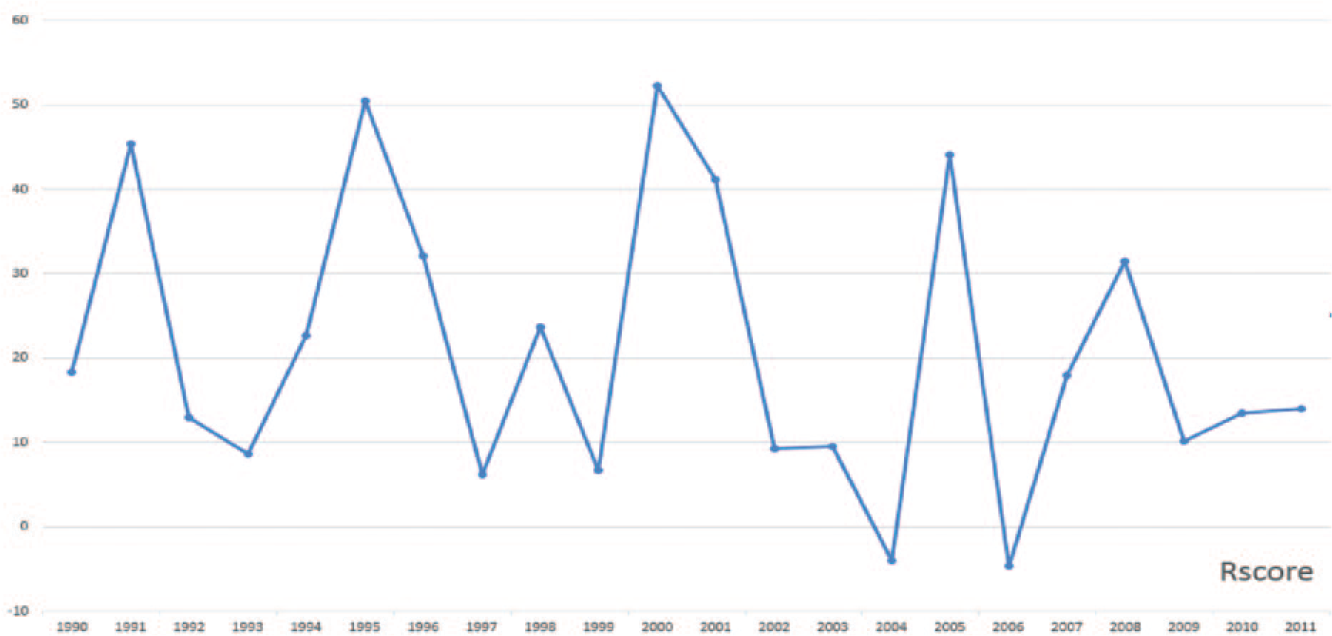
Plot of R-score.
As can be seen, Figure 1 displays periods of ups and downs in ROK–US relations. In 1993, Seoul and Washington had a disagreement in dealing with North Korea as the Clinton administration considered a surgical airstrike whereas Seoul was against any types of use of force. After the Agreed Framework was signed in 1994, the relationship between the two countries substantially improved. After George W. Bush came to office in 2001, Seoul and Washington began having friction and the relationship between the two countries was even more aggravated after two teenage girls were killed during a US military drill in 2002. Anti-Americanism widely spread. However, since conservative Lee Myung-bak was elected president, the relationship between Seoul and Washington has been cooperative.
Economic development
To measure economic development, we employ GDP per capita (constant 2000 US$), a commonly used measure for economic development. South Korea’s economic development has affected the ROK–US relationship (Heo and Roehrig, 2014). These data are from the World Bank (see http://databank.worldbank.org/ddp/home.do?Step=3&id=4).
Education
As a proxy of education attainment, we employed the percentage of population aged 15 and over that attained tertiary education. These data are from the Barro–Lee Educational Attainment dataset (see http://www.barrolee.com/).
Progressive government
This variable is a dummy variable coded 1 for progressive presidents and 0 otherwise. Since the new term of South Korean presidency starts in February, the last year of the departing presidency was coded as the beginning of the new presidency.
Trade
The trade data are from the Korea International Trade Association (see http://stat.kita.net/top/state/n_submain_stat_kita.jsp?menuId=01&subUrl=n_default-test_kita.jsp?lang_gbn=kor^statid=kts&top_menu_id=db11) and GDP data are from the IMF’s International Financial Statistics (see http://elibrarydata.imf.org.ezproxy.lib.uwm.edu/ViewData.aspx?qb=79d6deb661ab1004113eff57e1a8e9e7). Since South Korea’s trade with the US and that with China affect the ROK–US relationship, we include both trade variables. To measure trade interdependence, we employed the method used by Oneal and Russett (1999), which is:



North Korea
To measure the impact of the relationship between the US and North Korea on the ROK–US relationship we employed three different measures: NUscore; NUcon; and NUcoop. NUscore represents the relations between North Korea and the US. This score is the summation of NUcon and NUcoop. NUcon denotes the conflicts between North Korea and the US coded as annual scores based on event data. NUcoop is the annual scores of the cooperation between the two states produced by event data.
Findings
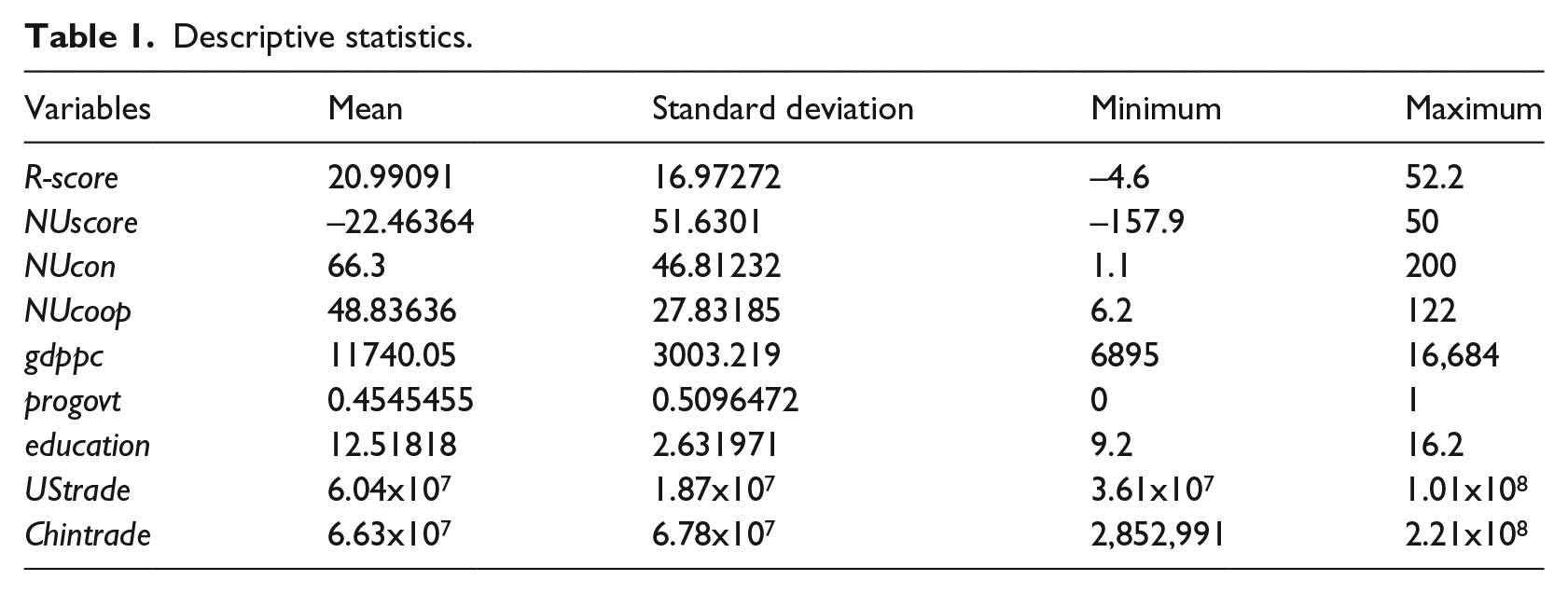
In order to provide general information about the variables included in this analysis, we provide a summary of descriptive statistics in Table 1.
Descriptive statistics.
This analysis employs the generalized least squares using the Prais–Winsten method because the Durbin–Watson (DW) test showed the presence of autocorrelations (DW=2.5, 2.7, and 2.56 for models 1, 2, and 3 respectively).
Table 2 reports the results of the empirical analysis. 2 We have employed three different measures of the impact of North Korea–US relations (NUscore, NUcon, and NUcoop) on the ROK–US relationship. Regardless of the measures, DPRK–US relations have no statistically significant impact on ROK–US relations, meaning no matter how Pyongyang approaches Washington, ROK–US relations do not seem to be influenced by that, indicating the solid relationship between two states.
Generalized least squares results of ROK–US relations.
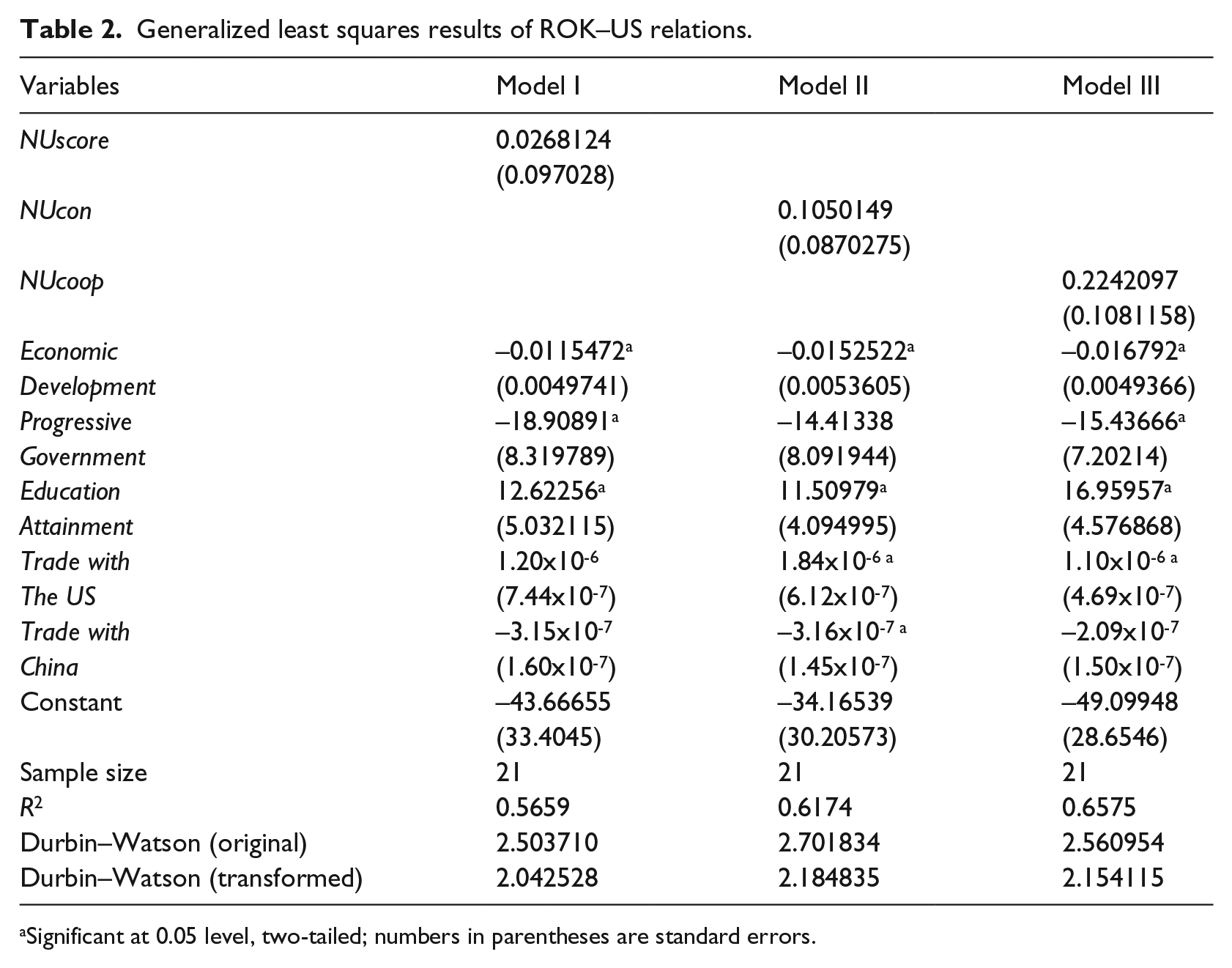
Significant at 0.05 level, two-tailed; numbers in parentheses are standard errors.
In all three models, economic development has a negative and statistically significant effect on the ROK–US relationship as we expected. This implies that as South Korea’s economy develops, conflicts of interest occur between the two nations as South Korea demands change in the nature of the relationship as Heo and Roehrig (2014) argued. ROK–US relations also aggravate during the progressive administrations in South Korea. As hypothesized, frictions occur between Seoul and Washington when the ROK has progressive presidents. Considering the relationship between South Korea and the US during the Bush administration, the effect may be severe when the US has Republican presidents. One of the primary reasons for this effect may come from the fact that Korean progressive leaders consider North Korea as a poor neighbor while Republican presidents in the US tend not to trust North Korean leaders.
In contrast to our expectation, education shows positive and statistically significant effects in all three models. This may mean that as education attainment in South Korea increases, the two countries enjoy a better relationship. Since South Korea’s economy is likely to continue to develop, the education level of Korean citizens is expected to go up, too, making further positive contributions to the ROK–US relationship.
Trade between South Korea and the US also has a positive and statistically significant impact on the ROK–US relationship in two of the three models. Since trade between the two countries is expected to augment thanks to the KORUS FTA, the ROK–US relationship is likely to be strengthened as the two countries expand economic exchanges. By contrast, South Korea’s trade with China has a negative and statistically significant effect on the relationship between Seoul and Washington in one of the three models.
Turning to the empirical analysis using the affinity of the UN roll call vote (s3un), the results are disappointing as none of the independent variables are statistically significant. The reason for this result may be because South Korea supported the US in the UN whether or not their relationship was strained. This makes sense considering South Korea relies on the US for its security.
Conclusion
In this study, we examined the relationship between South Korea and the United States during the post-Cold War period. Because the transition to democracy and the end of the Cold War had significant implications of the ROK–US relationship, we empirically tested what factors affect the relationship between the two countries using events data created by content analysis.
Our empirical analysis reveals that South Korea’s economic development and progressive administrations have a negative effect on the ROK–US relationship. By contrast, education attainment and trade between the two countries improve the relationship. Although there are some anti-American sentiments on college campuses and among intellectuals, educated people tend to see the importance of the ROK–US relationship.
These findings, however, raise a question concerning the effect of ROK’s economic development on ROK–US relations. As the economy develops, the level of education attainment also goes up. Since economic development has a negative effect on ROK–US relations while education attainment shows a positive effect, we compared the size of the effects of these two variables. As the economy develops the ROK–US relationship worsened by -0.012, -0.015, and -0.017 in three equations that used R-score. By contrast, as the education level goes up, the relationship between South Korea and the US improves by 12.62, 11.52, and 16.96. The positive effect of enhancement in educational attainment is much greater than that of direct impact of economic development on ROK–US relations. Due to educational attainment improving as the economy develops, the overall effects of economic development on ROK–US relations are positive. Although the US trade deficit with South Korea raised some concerns in Washington, the positive effects of trade on the ROK–US relationship make sense as the two countries deepened the relationship by signing a free trade agreement, which is expected to further increase trade.
The relationship between Washington and Pyongyang does not seem to have a significant impact on the ROK–US relationship. This result is consistent with reality as Seoul and Washington have cooperated in dealing with Pyongyang and are likely continue to do so.
Contrary to our expectation, South Korea’s trade with China does not seem to have a significant effect as it is significant in only one equation. This result may have occurred because of the security relationship between the ROK and the US. Owing to the North Korean threat, South Korea continues to want US security assistance while the US wants South Korea’s support to protect its national interests in Asia, especially in the rapidly changing international political and military environment resulting from China’s growing status as an international power.
The implications for these findings are twofold: (1) the future of the ROK–US relationship is bright. With the free trade agreement between South Korea and the US, the trade amount between the two countries is expected to skyrocket and education attainment in South Korea will continue to improve; and (2) the ROK–US relationship will experience ups and downs as frictions may occur while progressive leaders are elected as South Korean presidents while the US has Republican presidents.
Footnotes
Appendix
Declaration of Conflicting Interests
The author(s) declared no potential conflicts of interest with respect to the research, authorship, and/or publication of this article.
Funding
Uk Heo’s participation in this work was supported by the Academy of Korean Studies Grant funded by the Korean Government (MEST) (grant number AKS-2012-AAZ-2101).