



Abstract
This paper aims to address the emergence of parallel yet contradictory social movements in Bangladesh and explore the following question: what political factors in Bangladesh led to the emergence of these parallel movements? Unlike what social movements discourse has addressed, Bangladesh has seen the rise of two powerful and binary camps. To understand the growth of such conflicting movements, this paper hypothesizes that the framing of identity and ideology by the movement participants and the media have engendered the concurrent yet conflicting movements in Bangladesh. The paper focuses on how framing strategies led to ideological polarization between these movements.
Introduction
Social movements have played and continue to play significant roles in many societies. Between 2010 and 2014, protests erupted in thousands of cities in over one hundred countries around the world (Castells, 2013). From the Arab Spring to the Occupy Wall Street movements, from Gezi Park Resistance to the Umbrella Revolution, hundreds of thousands of people took to the streets to demand changes in their respective countries. Recent protests have been some of the largest in history (Ortiz et al., 2013). Over the course of 2013, for example, more than 100 million Indians took to the streets to protest low living standards and high levels of inequality. In the same year, 17 million Egyptians protested against, and ultimately toppled, President Hosni Mubarak’s authoritarian regime (Ortiz et al., 2013). In 2011, in the context of the global waves of dissent shaking the world that year, TIME Magazine named “The Protestor” as its Person of the Year (Anderson, 2011).
In 2013, Bangladesh also saw the simultaneous emergence of two conflicting social movements: the Shahbag movement; and Hefazat-e-Islam. The Shahbag movement began in February 2013 to protest the ‘lenient verdict’ of a ‘war criminal.’ The movement characterized itself as a ‘secularists’ movement representing the spirit of Bangladesh’s liberation war. It also demanded banning the third largest political party in the country, Jamaat-i-Islam. On the other hand, Hefazat-e-Islam, an Islamist coalition, appeared in April and was accused of pushing for “ultraconservative” demands including severe punishment for ‘self-declared atheist bloggers’ of the Shahbag movement, who supposedly demeaned Islam and the Prophet. Even though these movements marked an important time for the country, there has not been any substantial work to understand how simultaneous yet conflicting social movements develop. Taking Bangladesh as a case study, this paper examines the factors contributing to such development. It argues that framing of identity and ideology by the movement participants and the media have engendered the concurrent yet conflicting movements in Bangladesh. It is important to note that this study does not intend to investigate why these movements emerged. Rather, it focuses on how framing strategies led to ideological polarization between these movements.
Social movements’ literature
Defining a social movement can be difficult. It is not a political party or interest group, which are stable political entities that have regular access to political power and political elites; nor is it a mass fad or trend, which are unorganized, fleeting and without goals; instead social movements are somewhere in between (Freeman and Johnson, 1999). Some characteristics of social movements are that they are “involved in conflictual relations with clearly identified opponents; are linked by dense informal networks; [and they] share a distinct collective identity” (De la Porta and Diani, 2006). Social movements, then, can be thought of as organized yet informal social entities that are engaged in an extra-institutional conflict that is oriented towards a goal (De la Porta and Diani, 2006). Such goals can be either aimed at a specific and narrow policy or be more broadly aimed at cultural change.
Within the social movements’ literature, framing theory attempts to understand the way in which social movements and social movement actors create and use meaning, or how events and ideas are framed. The idea of frame analysis comes from the work of Erving Goffman. Goffman (1974) argued that people frame experiences to organize and understand the world around them. Framing helps people interpret the world based on their social position and their previous experiences. Every social interaction that occurs is understood through a frame of reference within which people react based on their perception of the situation and the way they perceive the people with whom they are interacting (Goffman, 1974). Similarly, Benford and Snow explain that, “collective action frames are action-oriented sets of beliefs and meanings that inspire and legitimate the activities and campaigns of a social movement organization (SMO)”. According to Benford and Snow (2000), social movement framing analysis focuses on four broad areas: (1) “the creation and use of collective action frames”; (2) “framing processes”; (3) “opportunities and constraints”; and (4) “the effect of framing on movement outcomes and other processes.” However, the construction of a collective action frame is dependent on the ability of a movement’s proponents to negotiate a shared understanding of some problematic condition or situation that they “define as in need of change, make attribution regarding who or what is to blame, articulate an alternative set of arrangement, and urge others to act in concert to affect change” (Benford and Snow, 2000). Snow and Benford (1988) categorized the core framing tasks as “diagnostic framing” (problem identification and attributions), “prognostic framing,” and “motivational framing.”
Social movements emerge in order to indicate the contestation regarding some aspect of reality in a society (Benford, 1993), which gives the opposition of a movement opportunity to challenge the movement’s diagnostic and prognostic framings. Attempts “to rebut, undermine, or neutralize a person’s or group’s myths, versions of reality, or interpretive framework” have been referred to as counter-framing (Benford, 1987: 75). “Opponents’ counter- frames, in turn, often spawn reframing activity by the movement: attempts to ward off, contain, limit, or reverse potential damage to the movement’s previous claims or attributes” (Benford and Hunt, 1994). Such square-offs between movements and their detractors have been referred to as “framing contests” (Ryan, 1991). McAdam in 1996 noted that “framing contests occur within complex, multi-organizational – and sometimes multi-institutional – arenas” as well as, that “social movement framing activity and the extent of its resonance are affected by the cultural and political environment, including the framings/counter-framings of institutional elites.”
Even though the topic has been the subject of extensive reviews, framing theory has faced criticism as well. Benford (1997) claimed that the term has become a “ cliché ” while pointing out the deficiency of the concept in his article “An Insider’s Critique of the Social Movement Framing Perspective.” Other criticism of “Framing” is that it can be used uncritically when attempting to debate or define social movements. Framing may not always portray the “ideational complexity of a social movement” objectively (Munson, 1999) or may diminish diminishing “the richness of culture to recruitment strategies (Jasper, 1997). Another criticism of framing theory is that the construction of meaning is highly personal and can never be fully understood at an individual level. As pointed out by Goffman (1974), every person brings a unique and distinct set of values and beliefs into every social interaction. Thus, attempting to understand how people understand the meanings that social movements construct is fruitless because everybody interprets them differently.
Framing theory analyzes how meaning, identities, and ideas are created and framed. It allows movements’ actors to frame their issues in a way that resonates with potential participants’ experiences and ideologies. Within framing theory, there has been little research that analyzes two movements through the framing and counter-framing lens. Studying the “secularist” Shahbag movement and “Islamist” Hefazat-e-Islam in Bangladesh and how the framing of identity and ideology leads to the development of conflicting social movements will be a unique contribution to existing social movements’ literature. Evaluating the growth of two simultaneous movements in Bangladesh will also fill the void in social movements’ research focusing on Bangladesh and, by extension, South Asia. Moreover, Bangladeshi politicians, academics as well as the observers of Bangladeshi politics at home and abroad accuse radical Islam as the biggest threat to the country, thus overlooking the impact of radical secular ideology (Parvez, 2015). This research may help to get a different perspective on the issue.
The Shahbag Movement and Hefazat-e-Islam
The Shahbag movement, also known as “Gonojagoron Moncho,” started on 5 February 2013 to protest against Jamaat-i-Islam leader Abdul Quader Molla’s verdict by the International Crimes Tribunal (ICT). Abdul Quader Molla was sentenced to life in prison for his crime against humanity. Following the verdict, a group of online activists and bloggers started the protest at Shahbag, a busy intersection of Dhaka, the capital city of Bangladesh; they claimed that the verdict given by the ICT did not ensure justice to the victims and demanded the death sentence. By the end of the week, the protesters organized the largest mass demonstration the country has seen in 20 years (Anam, 2013). Qadar Mollah was hanged on 12 December 2013 after the Supreme Court revised the sentence to the death penalty following an appeal by the Prosecution that considered the previous sentence too light (Ahmed and Das, 2013). The Shahbag movement has claimed to represent the “spirit of Bangladesh’s liberation war” as well as illustrated the people’s sentiment towards its Bengali nationalism.
Nevertheless, in a country like Bangladesh where a majority of people is Muslim, soon Jamat-i-Islam along with other Islamist groups such as Hefazat-e-Islam tried to brand the Shahbag movement as an ‘anti-Islamic’ gathering initiated by atheist bloggers. The Shahbag movement energized the activities of Hefazat-e-Islam, an ultraconservative Islamist group based on widespread Qawmi Madrasas in Bangladesh. On 5 May 2013, thousands of activists of Hefazat-e-Islam gathered in Dhaka and chanted “Hang the atheist bloggers” followed by their extensive protests in both Dhaka and the port city of Chittagong. Hefazat-e-Islam placed ‘The 13-point demands’ to be conceded by the government (Habib, 2013). The demands included a ban on the mixing of men and women in public places, the removal of sculptures and a demand that the former wording of the constitution be reinstated, affirming “Absolute trust and faith in the Almighty Allah” as one of the fundamental principles of state policy. 1
Bangladesh’s secular origin and resurgence of religion in politics
Bangladesh state emerged on the basis of secular–socialistic principles, and in its first constitution framed in November 1972, a ban was imposed on the use of religion in politics (Riaz, 2004). The secular foundation of the constitution did not, however, reflect the role Islam played in its society. The country has the fourth-largest Muslim population in the world, and the number is expected to grow from 148.6 million to 187.5 million by 2030 (Pew Research Centre Religion and Public Life Project, 2011). Thus, in order to gain political advantages, General Ershad imposed an amendment in 1977 that inserted the term ‘absolute trust and faith in the Almighty Allah’ instead of the principle of secularism. Then in June, 1988 a further constitutional amendment made Islam the state religion (Bouissou, 2013). These constitutional changes, including the deletion of secularism as a state principle and declaration of Islam as a state religion marked a decisive move away from a secular nationhood and established the role of religion in politics. Even the leader of the “secular” Awami League (AL) and the founding president of the country declared that he was proud to be Muslim and frequently made use of Islamic rhetoric in his speeches as early as 1972 (Riaz, 2004). Subsequently, the military regimes, which usurped power through coups in 1975 and 1982 and ruled the country until 1990, pursued policies of Islamization as a means to gain much needed political legitimacy (Hasan, 2012).This provided the previously banned religion-based parties with the opportunity to resurface in the political arena.
In December 1990, the military regime of General Ershad was toppled in a popular urban uprising; opposition political parties, including secularists, worked closely with the Islamists, thus providing the latter with political legitimacy while idioms and icons of religion became central to the political discourse of Bangladesh (Hasan, 2012). In the new era of electoral politics in Bangladeshi history (1991–present), the two main political parties have sought the support of Islamists, particularly the Jaamat-i-Islam, either to achieve power or to topple a democratically elected regime. Over the preceding years, the Islamist forces in general and the Jaamat-i-Islam in particular have not only gained recognition as legitimate political actors but have also emerged as kingmakers both in the electoral equation and on the ideological terrain (Riaz, 2004: 7). This historical manipulation of religion for political interests provided Islamist groups an excellent political opportunity to mobilize as well as to challenge the social and political order. The acrimonious relationship between two major political parties both of whom are “unable to provide a moral leadership and earn spontaneous consent from the masses” (Riaz, 2004: 6) paved the way for Hefazat-e-Islam to rise to prominence. Hence, the absence of an institutionalized political system and the instability of a broad set of elite arrangements assisted Islamist groups such as Hefazat-e-Islam to gain strength and mobilize a large number of people.
Moreover, Bangladesh state has been sponsoring a traditional Islamic education system called madrassas. For example, in a Parliamentary response made by the Information Minister during the last Bangladesh Nationalist Party government (2001–2006) we hear that “no Madrassa has been closed down in this country, to the contrary, 200 more Madrassas have been established during the last financial year” (Mehdy, 2003). The government in power today that claims to be secular is also trying to present itself as a friend of Madrassa education, an attempt reflected in various acts of the government. For instance, a Qawmi Madrassa Education Commission in Bangladesh was established in April 2012 by the current ‘secular’ AL government. In addition, Sheikh Hasina, on 13 April 2013 said that the state would be run in keeping with the Charter of Madinah and the ‘Prophet’s Sermon on the Last Pilgrimage’ and warned that the government would not tolerate defamation of the great Prophet and would surely take punitive actions against the culprits (The Daily Star, 2013). Therefore, over the decades the main political parties have emerged as the elite allies of the Islamist groups in Bangladesh.
Framing of Ideology, Identity, and Formation of the “Other”
The new state of Bangladesh in 1971 was the product of ‘Bengali nationalism’ that arose to challenge West Pakistan’s economic exploitation of its Eastern wing, its attempt to impose religious hegemony, and its repression of Bengali political voices (Bhardwaj, n.d.). While the idea of secular Bengali nationalism was important in events leading up to the Liberation struggle of 1971, identities have since moved on. Even though secularism along with socialism, democracy, and nationalism served as the basis of the country’s first constitution, Islam has been an integral part of more than 90 percent of its people’s social and political life. Hence, an erosion of secular trends began soon after the birth of Bangladesh, and subsequently both military and democratic regimes have attempted to reshape religious and national identities. Since independence, Bangladesh’s struggle for identity – by extension ideology – has revolved around a recurring tension between two distinct ‘constructs’: the ‘Bengali’ and the ‘Bangladeshi’ identities. The ‘Bengali’ identity evolved largely due to two factors: first, on account of the syncretic secularist traditions that were present in the early history of Bengal; and second, from the Language Movement that arose in the early 1950s within East Pakistan (Bhardwaj, n.d.). On the other hand, the ‘Bangladeshi’ identity was forged by taking recourse to Islamic loyalties that were initially crystallized during the movement for Pakistan, and then later by the process of Islamization set in motion by the military regime of General Zia and later continued by General Ershad (Bhardwaj, n.d.).
Against this background of historic struggle, the Shahbag movement and Hefazat-e-Islam shaped a grand narrative in 2013 where they portrayed each other as “enemies” and quested to “save” what they believe should be the basis of Bangladesh’s collective identity and ideology. Both movements’ actors and participants framed their versions of the narrative based on the ideology and identity they adhere to, and thus formed “the other” or “the enemy.” The Shahbag movement, though it started with the demands related to the ICT or capital punishment for the indicted war criminals, did not limit itself to those demands. It portrayed itself as the “soul” of the nation. This portrayal was exclusive in the sense that it implies a singular soul of the nation, of a singular narrative of history (Sood, 2013). Shahbag activists and media presentation of the movement conveyed that the movement was reclaiming the secular “soul of the nation” (Sood, 2013). Moreover, the movement’s actors actively tried to establish the hegemony of “Bengali” identity through slogans and blogposts. Slogans such as “Tumi Ke, Ami Ke; Bengali, Bengali (Who are you; who am I; Bengali; Bengali)” faced criticism for excluding the non-Bengali participants in the movement as well as their experiences in 1971. In addition to identity, Bengali values were emphasized. For example, Asif Mohiuddin, in a blog post titled “Shahbag movement – Rebuilding Bengali Identity” writes, “The innate “Bengali” value set and moral stance, suppressed by myriad of territorial and colonial propaganda, obsoleted by cultural and economic aggression, has been put back in limelight once again through this movement. We are rediscovering the part of our lost selves, our conscious in Shahbag” (Mohiuddin, 2013). It is important to note the characteristics of the majority of participants of this movement: they were mostly middle class urban youth with access to mainstream Bengali and English medium education, which provides better access to social, political, and economic resources; access to the Internet; many supporters of movements included members of civil society, Bangladeshis living and studying in Western countries; and some were members of political and social elites. 2
On the other hand, Hefazat-e-Islam, an umbrella organization of Islamic scholars associated with privately operated traditional Qawmi madrassa, launched a verbal assault on the Shahbag movement. It demanded that the government immediately dismantle the movement and arrest the bloggers. Hefazat-e-Islam insisted that the existence and actions of Shahbag are “un-Islamic,” and that Shahbag is a representation of atheism; furthermore, according to Parvez (2015) Hefazat-e-Islam made it clear that there was “no place” for atheism in a Muslim majority country and atheists “do not have the right to live in Bangladesh”. “Atheism,” thus, became a synonym of anti-Islamism. In contrast to the self-proclaimed “progressive, free thinker” identity of the Shahbag movement, the Islamists defined the atheist bloggers as “enemies of Islam”. They chanted slogans such as “Hang the atheist bloggers,” “Slaughter the atheist bloggers,” and “destroy the Shahbagis.” They also criticized the government for not taking actions against the “atheist bloggers.” Other key terms that were used to define participants of the Shahbag movement are “atheists”, “evil”, “anti-Islam”, “anti-Bangladesh;” “they drink and dance at Shahbag and have sex at night;” and “conspirators against Islam” (Parvez, 2015). The participants of the Hefazat-e-Islam movement included: Qawmi madrassa students; teachers; Imams; and other relevant actors (exclusively men). These groups were predominantly from rural areas where madrassas are the alternative education system for people who cannot afford mainstream education; this education largely results in social, political, and economic exclusion from the mainstream society. 3
As these groups were recounting their narratives, they were not only creating a common cognitive framework against each other but also defining “the other” or “the enemy.” Parvez (2015) categorized this radicalization of ideology and identity by both camps as: “radical pro-freedom”; and “radical pro-Islamist.” They actively framed the issues based on their shared social and political understanding and experience. In doing so, both movements created collective action frames by identifying and adhering to the social reality of the participants. They also negotiated a shared understanding of a problematic situation (Shahbag movement for Hefazat-e-Islam and vice versa), ascribed who or what to blame, and motivated actions to resolve the issues. In Figures 1 and 2, Riaz (2015) presents the schematic versions of the narratives of the two contending interpretations of the sentencing of Quader Mollah and subsequent events. Figure 1 shows the process of how the Secularist created a meta-narrative where they claimed secularism in under threat from the Islamist. The second meta-narrative claims that Islam is under attack from the secularist.
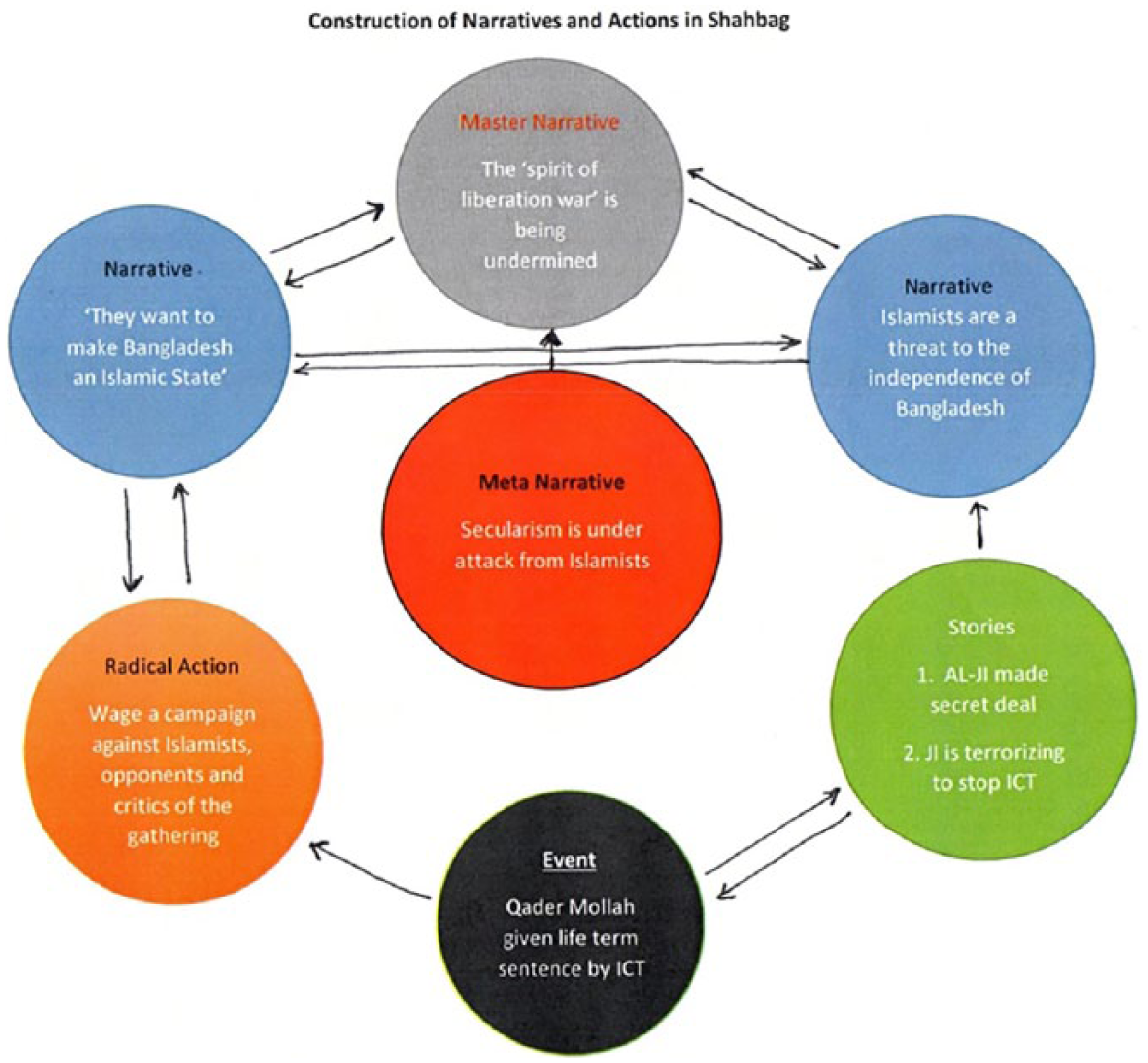
Interpretative narrative by Shahbag movement (Riaz, 2015).
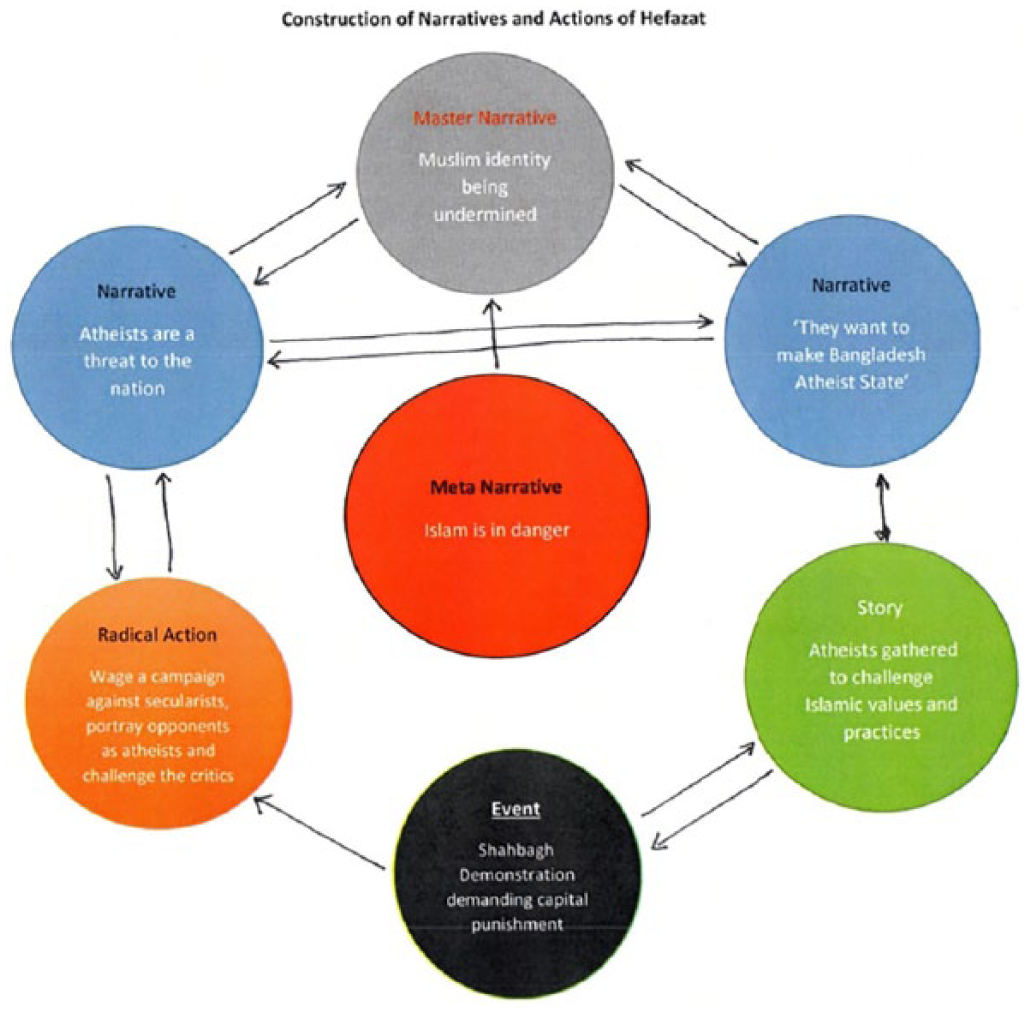
Interpretative narrative by Hefazat-i-Islam (Riaz, 2015).
Role of media and “Us” versus “Them”
The Shahbag and Hefazat-e-Islam protests have largely divided the nation into two radical and binary camps. These two camps construct their different national identities on the basis of their allegiance to “liberation war” or “Islam” narratives. Unfortunately, media outlets might play a role to strengthen the division by favoring either one of the two camps. For example, three days after the initial spontaneous gathering of the online activists and left activists protesting the lenient sentencing of Quader Mollah, a mammoth public gathering took place on 8 February 2013. While media coverage was quite substantial from the second day, this gathering made it imperative to cover the event significantly. Almost all the newspapers covered the event extensively. Indeed, from the point of news value it was necessary. Therefore, it is not the amount of coverage or the treatment it received that deserves our attention but the ‘representation’ of the event (Riaz, 2015); representation in the case of these movements depicted more than a mere reflection of the events. Understanding the media representation is significant in understanding the framing of these movements in Bangladesh. Certain representation of the Shahbag movement and Hefazat-e-Islam was aimed to create specific meaning targeting a specific group of people. For example, a content analysis of elite newspapers in Bangladesh by Parvez (2015) finds that Prothom Alo and Janakantha coverage portrays Shahbag protesters and organizers as “hero”, “savior of the nation”, “new freedom-fighters”, and constructs a radical pro-Shahbag identity. On the contrary, according to Parvez (2015) their narratives portray Hefazat-e-Islam as “Taliban”, “vandals”, and “backward fundamentalists”. Thus, Prothom Alo and Janakantha create a divided ideological world between “us” (supporters of the “grand narrative” of the 1971 war and Shahbag movement) and “them” (war criminals, Jamaat-i-Islam, Hefazat-e-Islam and/or other radical Islamist perpetrators, and anyone who oppose Shahbag). On the other hand, Parvez (2015) notes that Amar Desh reports explicitly support radical narratives of Hefazat-e-Islam and project the Hefazat-e-Islam members as “peace-loving, unarmed and religious Muslims”, whereas, their coverage portrays Shahbag protesters and bloggers as the “enemies of Islam and its prophet”. In doing so, Amar Desh constructs a “we” community of the radical Islamist camps against “them.” Prothom Alo and Janakantha, on the other side of the spectrum, extend support to the Shahbag movement unequivocally and oppose the radical “Islamist” narrative of Hefazat-e-Islam. The framing of these movements by the major newspapers in Bangladesh highlighted their respective political/ideological positions and that violates the principle of objectivity.
Media institutions “tend to construct reality in a manner congruent with their underlying ideological and political functions” (Kuo and Nakamura, 2005), thus can be used to create a meaning that resonate with their own political ideology. The coverage of these Bangladeshi major newspapers framed events and actors in a binary manner – “self versus others; us versus them; and ‘in group’ versus ‘outgroup’ (Riaz, 2015). Citing Van Djik (1998), Riaz (2015) mentions that “ideological discourse often features the overall strategies called the ‘ideological square’”: “emphasize Our good things; emphasize Their bad things; de-emphasize Our bad things; de-emphasize Their good things” (Van Dijk, 2005). For example, Hefazat-e-Islam was heavily critisized and accused of “using” the “innocent” teenagers, as many of its protesters were school-going, to push for agendas they allegedly did not understand. However, pictures of children, slogans such as “Death for war criminals” painted on their body, surfaced, the newspapers either celebrated their presence as a sign of a “new Bangladesh.” Or, they failed to mention, not unlike many Hefazat-e-Islam protesters, these children may not understand what agendas they are pushing for either. 4 Moreover, this subjective representation of Shahbag (the good) and Hefazat-e-Islam (the bad) are evident in the newspaper’s word choices and overall tones as well. For example, the participants of the Shahbag movement were called “brave” and that they were going build a “new Bangladesh” whereas, Amar Desh’s insisted that participants of the Shahbag movement are “fascists,” an inherently negative expression (Riaz, 2015).
However, it was also noted that both camps demanded unconditional support and loyalty from its supporters. Seuty Sabur stated that in the context of Shabagh, “anyone who had differences of opinion or asked questions about existing grand narratives was attacked. Personal attacks and defamation of activists became commonplace online” Sabur (2013). The meta-narrative that both these movements created resulted in polarized societies in Bangladesh. The radical pro-Shahbag movement camp consisted of a group of people who believed that their version of the 1971-war narrative should be the basis of the nation’s identity and cannot tolerate any different opinions outside their narrative. They also labeled the radical Islamists as “terrorists”, “agents of Pakistan” and “enemies of the Bengali nationhood”, and name anyone who criticized them as “collaborators”, and “traitors”. On the other hand, radical Islamist groups believed that Islam should be the basis of Bangladesh’s social, political, and cultural identity and ideology. They labelled anyone who disagrees as “atheists” thus “enemies of Islam.” Therefore, contemporary Bangladesh has seen the rise of two violent and binary camps, the radical Islamist and radical secularist, neither of which “represents the syncretic and tolerant nature of Bangladeshi national identity” (Parvez, 2015). It also “provided legitimacy to extremist thinking and rhetoric within mainstream politics and society” (Riaz, 2015) where intolerance towards different opinion and ideas is increasing proportionally.
Conclusion
In 2013, the Shahbag movement and Hefazat-e-Islam have shed light on Bangladesh’s longstanding struggle with regards to identity and its quest for justice for a forgotten genocide in 1971. While both of these movements gathered tens of thousands of people to support their respective causes, the framing of their issues created radical binary camps: “pro-Shahbag movement” and “pro-Islamist.” These conflicting binary groups legitimized intolerance and created a greater division in the already polarized country regarding issues of identity. However, it is important to acknowledge that there are certainly more variables at work. For example, the longstanding acrimonious relationship between the two political parties, states’ institutional weakness, and lack of effective democracy have played significant roles in creating the ideological division among people both before and after these movements emerged. Moreover, other mediums of communication such as television, radio and/or social media also shaped people’s understandings of news texts. Although newspapers are one of the most influential media to shape public opinion, they do not completely represent all the media outlets. However, it is beyond the scope of this project to overcome all these limitations. Future studies should analyze to what extent the aforementioned variables have affected the development and outcome of these movements.
Footnotes
Declaration of conflicting interest
The author(s) declared no potential conflicts of interest with respect to the research, authorship, and/or publication of this article.
Funding
The author(s) received no financial support for the research, authorship, and/or publication of this article.