



Abstract
Over the past decades, East Asian states have enjoyed economic development and progress toward democracy through extensive economic transformation: trade and financial liberalization. To explain the theoretical mechanism of these variables, we investigate the direct and indirect effects of globalization on democratic development via economic development. To this end, a two-equation model is specified and estimated using data from 1972 to 2010 for 12 East Asian countries. The results show that globalization has not only a direct effect, but also an indirect effect on democracy via economic development.
Introduction
Does economic globalization promote democracy? Scholars and policymakers alike have sought the answer to this question, as globalization has shown a gradual upward trend since the 1980s, with a particularly significant increase after the end of the Cold War in 1989 (KOF Swiss Economic Institute, 2018). As a result, there is a plethora of studies that investigate the globalization–democracy nexus, leading to three schools of thought on how globalization affects democracy: (1) positive; (2) negative; and (3) insignificant. The positive perspective, often dubbed the “Washington Hypothesis,” is that globalization fosters democracy by reducing the capacity of authoritarian leaders to extract rents and strengthening the bargaining power of businesses (Maxfield, 2000). The second position is that globalization may obstruct democracy because it undermines state autonomy, which makes it difficult for nation-states to act in the interest of their citizens (Peck, 2001). Conversely, another group of scholars argue that globalization does not have a systematic effect on democracy because the effects may vary over countries (Milner and Mukherjee, 2009; Papaioannou and Siourounis, 2008).
In this study, we join the debate by investigating the effects of economic globalization on democracy development in East Asia for 1972–2010. 1 There are four reasons for us to explore the relationship between globalization and democracy in East Asia. First, the East Asian states have been active participants in economic globalization (Adams, 2006). These countries have developed their economies through export-oriented industrialization, and trade has played a key role in their economic development. Second, foreign capital inflows have increased considerably in East Asia since the mid 1980s and made a significant contribution to regional economic growth (Hahm and Heo, 2008). Third, East Asian countries have experienced a notable increase in political freedom after an extensive liberalization of trade and financial markets in the late 1980s (Haggard, 2005; Rudra, 2005). Finally, as Armijo (1999) and Beeson (2007) noted, it may be more reasonable to study the democratizing impact of globalization in a specific region than the entire world considering regional differences. Given East Asian states’ experience in globalization and democratic development, East Asia is an excellent region for studying the relationship between these two trends.
The contribution of this paper is threefold. First, regardless of the views on the effect of globalization on democracy, previous studies have suggested direct and indirect theoretical links between the two variables. Nevertheless, the existing empirical literature tends to include both direct and indirect effects in the same equation. However, the single-equation estimation approach does not spell out the indirect effects of globalization on democracy through economic development. In this paper, we develop a two-equation model to accurately test the indirect effects of globalization on democracy via economic development, in addition to its direct effects. Second, East Asian countries experienced both political and economic liberalization in recent decades, but few studies have systematically examined the relationship between globalization and democracy development in the region. Thus, we attempt to fill the gap in the literature. Finally, the findings of this study will have significant theoretical and policy implications. If the findings are significant, previous findings of insignificant result might be the outcome of testing the entire world. Moreover, a positive relationship between globalization, economic development, and democracy will have policy implications for the world.
Literature review on the relationship between globalization and democracy
Findings of previous studies on the globalization–democracy nexus have been mixed. A group of scholars argue that globalization helps improve democracy (Eichengreen and LeBlang, 2008; Freeman and Quinn, 2012; Lopez-Cordova and Meissner, 2008). Increased openness in trade and financial markets reduces state capacity to control the economy. As a result, public authorities can no longer provide preferential treatment to the private sector as they did before. 2 With these changes, business groups turn to international capital to take advantage of new business opportunities. Over time, the business sector favors liberal political institutions under which they can pursue their economic interests without government interference. Under such circumstance, governing elites are divided into two groups: (1) hard-liners who resist the liberalization; and (2) soft-liners who support it. This cleavage in the elite group creates political turbulence, and authoritarian leaders may seek a quick “political outlet,” which provides an opportunity for the soft-liners to promote political liberalization (O’Donnell and Schmitter, 2013; Rudra, 2005).
Moreover, globalization makes it easier for the public to access information about democracy and other democratic government systems because of extensive economic exchanges and contacts with foreign businessmen. The newly acquired knowledge leads to citizens’ demand for political development, which gives way to democratization (Boix, 2011; Boix and Stokes, 2003).
On the other hand, some studies report a negative relationship between globalization and democracy (Li and Reuveny, 2003; Rigobon and Rodrik, 2005). Globalization undermines state autonomy because increased liberalization in trade and financial markets lowers the extent of state capacity to manage their own economies and societies. This makes it difficult for the government to act in the interest of their citizens. For instance, to survive in a competitive global economy, states employ public policies appealing to foreign investors to attract foreign capital, although these policies may not best serve the interest of their citizens. Such environments undermine the move towards democracy (Peck, 2001). In addition, globalization might give rise to the type of political culture that hinders the development of democracy. Im (1996: 289) suggests that the “losers” in the global economy may try to shelter in parochial or particularistic cultures, seeking a united identity based on ethnicity, religion, or language. Such political culture weakens democracy, which flourishes in pluralistic societies, tolerant of various ideas and opinions. In a similar vein, Bloom (2016: 42) argues that, faced with a disintegrating state and alienating corporate globalization, some leaders may have the desire for strong political sovereignty that can “rule” globalization, not be “ruled by” it.
In contrast to these findings, some studies argue that there are no significant and/or consistent effects of globalization on democracy. According to Armijo (1999), foreign capital inflows strengthen the existing political system, regardless of regime types. Thus, globalization may help mature democracy in a democratic system, while it obstructs democratization in non-democracies. Uhlin (2002: 162–163) contends that there is no clear causal link between globalization and democratization that can be universally applicable because the effects of globalization can vary in different countries depending on the specific national context. Milner and Mukherjee (2009) also report no evidence of the effects of globalization on democracy.
Globalization, economic development, and democracy: the indirect effect
According to the extant literature, the influence of globalization on democracy can be both direct and indirect. However, previous studies did not examine the two different theoretical linkages separately. To flesh out the indirect effects of globalization on democracy via economic development, we add an equation while still accounting for the direct impact. Our theoretical framework is described in Figure 1.
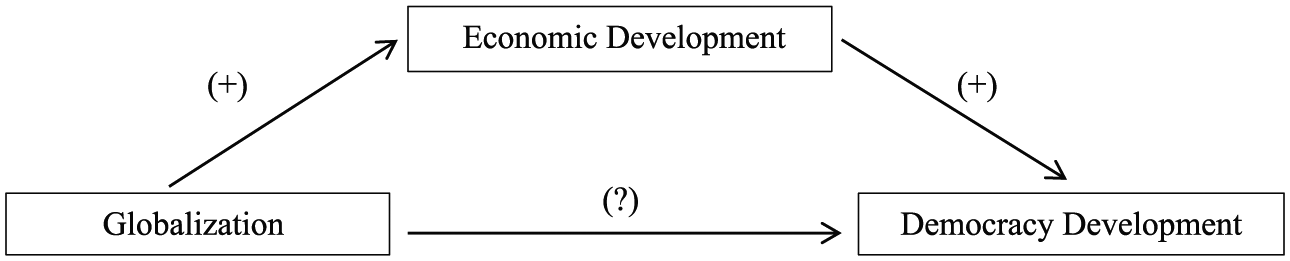
Globalization and democracy: an indirect link.
Globalization and economic development
Trade spurs economic growth as it promotes the efficient use of resources, which leads to countries’ specialization in line with their absolute and comparative advantage. Under such circumstances, capital and other resources are utilized in the sectors where they are more productive than other sectors. As a result, overall economic welfare and allocative efficiency substantially improve (Langenfeld and Nieberding, 2005). Trade also increases international and domestic competition, which forces firms to improve their productivity to survive in the market. Improved productivity contributes to economic growth (Navas and Licandro, 2011).
Financial openness also improves economic performance by boosting domestic and foreign investment. Since foreign investors prefer financially liberalized markets, opening the financial market attracts more foreign direct investment (FDI), which becomes an important source of capital in less-developed countries, complementing the lack of domestic investment (Chowdhury and Mavrotas, 2006). In addition, opening the financial market facilitates technology transfer as well as knowledge spillovers into management and marketing. Since FDI tends to come from transnational corporations (TNCs), new business resulting from FDI is likely to involve international production and training by the foreign affiliates of TNCs. These newly acquired technologies and management knowledge help firms become more competitive, which in turn accelerates economic growth (Prasad et al., 2005; Hahm and Heo, 2008).
Finally, financial integration with the world facilitates financial sector development, which promotes economic growth. For example, foreign banks entering the developing world often introduce advanced technologies and expertise in banking, which can advance the development of the domestic financial sector. The entry of competitive foreign banks also generates competition that may improve the quality of the domestic banking system (Eller et al., 2006; Goldberg, 2004). 3
As noted above, increase in trade and FDI stimulates economic growth. Economic growth indicates the speed of wealth accumulation, measured by the growth rates of GDP or per capita GDP. Economic development represents the level of prosperity, often measured by per capita GDP. They are not the same concepts, but they are closely related because economic development is not possible without economic growth. Thus, we assume economic growth leads to economic development, as it is typically the case, and assume that globalization leads to economic development (Freund and Bolaky, 2008; Heo and Hahm, 2015).
Economic development and democracy
The notion that economic development fosters democratic development has been one of the most dominant theoretical frameworks in the democracy literature. This proposition has been extensively tested and widely supported (Boix, 2011; Boix and Stokes, 2003). Burkhart and Lewis-Beck (1994) even argue that the economic effect of development on democracy is one of the few iron laws in social sciences. There are various channels through which economic development may influence democratic development.
Economic development enhances educational attainment because increasing wealth enables people to invest in human capital. High levels of education are considered a prerequisite for democracy since they enable a “culture of democracy” (Acemoglu et al., 2005: 44). Emphasizing the importance of education in promoting political development, Lipset (1959: 79) states that “…education presumably broadens men’s outlooks, enables them to understand the need for norms of tolerance, restrains them from adhering to extremist and monistic doctrines, and increases their capacity to make rational electoral choices… .”
Economic development also facilitates democratization through industrialization. Industrial-ization is accompanied by urbanization, creating the urban working class, whose members have the organizing power that is a crucial source of pressure for democratic change. These societal changes make it difficult to maintain non-democratic rule, giving way to a pluralistic society. Urbanization also increases the size of the middle class. A financially independent middle class demands expanded political rights and forms the basis for democratic governance (Acemoglu and Robinson, 2006).
Przeworski et al. (2000) report that economic development not only facilitates democratization, but also helps democracies to survive and mature. Newly established government often faces economic difficulties due to the citizens’ prodigal expectations. However, new democracies tend to survive when their economies continue to develop. According to Przeworski et al. (2000: 109), “When they [democracies] face a decline in income, they die at the rate of 0.0512, so that about one in twenty of them dies, but when incomes are growing they die at the rate of 0.0152, one in sixty-six.” If the state experiences three or more consecutive years of growth in per capita income, only one out of 135 democracies dies, which makes the finding even more convincing.
Modeling the effects of globalization on democracy
Based on our theory, we hypothesize that increased trade and FDI promote economic development, which in turn fosters democracy. To test the hypothesis, we develop our empirical model that can test both direct and indirect effects of globalization on democracy development. Thus, our empirical model includes two equations representing economic development and democracy, respectively. The Economic Development model tests the effects of globalization on economic development, while the Democracy model examines the democratizing impact of economic development. The Democracy Model also tests the direct impact of economic globalization on democracy.
Economic development model
To test the influence of globalization on economic development, we develop our empirical model as follows:

where,
Economic development: level of economic development
Global: level of economic globalization
Edu: level of education
Pop: population growth
Govsize: government size (government expenditure)
Llock: landlockedness
Polcon: political constraint
Infl: inflation
Insta: political instability
E: error term
i: country
t: year
β0: constant
β: coefficient
The dependent variable in this model is Economic Development, measured by logged per capita GDP in constant US dollars (2010 = 100). Although various measures have been employed in previous studies (e.g., per capita income, energy consumption, industrialization, etc.), the most widely used and perhaps the “best indicator” to measure the level of economic wealth is per capita GDP (Heo and Hahm, 2015; Przeworski et al., 2000: 81). Thus, we employ per capita GDP for economic development in this analysis.
Our main explanatory variable is globalization. Globalization has been measured in various ways in the literature, such as trade, capital flows, FDI inflows, and portfolio investment inflows. However, each of these variables analyzes one particular aspect of globalization, while the goal in our study is to assess the overall effects of globalization on democracy development in East Asian countries. To this end, we created a new measure by combining the two “standard” globalization measures, trade (export and import) and FDI inflows divided by GDP. We use a proportion of GDP to reflect the size of the economy. This measure mirrors the level of both market and financial openness (Kai and Hamori, 2009). For robustness tests, we also measured globalization with the data for financial openness from Chinn and Ito (2006) and portfolio investment.
We also control for other factors. The control variables included in the model are fairly standard in economic development studies, and comprise education, population growth, government spending, landlockedness, political constraint, inflation, and political instability. Education is one of the most widely used variables in the studies of economic development because education can have a substantially positive effect on economic development. Education improves the quality and competitiveness of human capital, which boosts productivity, creates new technology, and facilitates spillover effects from leading countries, thereby making significant contributions to economic development (Bloom et al., 2006). To measure this variable, we use the average years of schooling completed for people aged 15 and over.
Population growth may contribute to economic development by making economy of scale possible, which raises the incentive for adopting more advanced techniques and institutional arrangements (Bloom and Freeman, 1986). At the same time, according to fertility theories, a growing population may hinder economic development. As family size increases, the average investment in each child decreases, thereby lowering the general quality of human capital (Krieckhaus, 2006). Annual population growth rate is used for this variable.
Governments may play a critical role in economic development by providing public goods and services. At the same time, a large government may be harmful to economic performance as its operations are often characterized by inefficiency and government policies and regulations can impose excessive burdens and costs on the economic system, ultimately lowering productivity (Afonso and Furceri, 2010). To measure the role of government, we employ government expenditures as a share of GDP.
A country’s geographical characteristic can also influence economic performance because if a country is landlocked, transaction costs for trade go up. Thus, landlocked countries are considered at a disadvantage, particularly in terms of trade (Sachs and Warner, 1997). We use a dummy variable to measure landlockedness. It is coded 1 if state i is geographically landlocked, otherwise zero. Thus, this variable is time invariant as it has the same value every year for the same country.
Political constraints may affect economic performance since frequent policy changes create uncertainty, which in turns dampens investment and growth (Henisz, 2000; Henisz and Mansfield, 2006). Thus, we account for any effects that political constraints might have on economic development. The degree of constraints on policy change is measured using Henisz’s measure of veto points, calculated based on: (1) the number of veto points over policy outcomes; and (2) the distribution of preferences across and within government branches. 4
Inflation is used as a proxy for macroeconomic stability, widely perceived as a necessary condition for long-term economic growth (Alguacil et al., 2011; Fischer, 1993). Policy-induced macroeconomic volatility impairs the efficiency of the price mechanism, which ultimately lowers the overall productivity of the economy (Fischer, 1993). Furthermore, macroeconomic uncertainty may discourage investment, leading potential investors to delay their investment until the resolution of the uncertainty (Bleaney, 1996). This variable is measured as the annual growth rate of the GDP deflator.
The final control variable taps political instability experienced by a specific nation. States suffering from political instability tend to undergo economic hardships due to its negative impact on the economy (Alesina et al., 1996). The uncertainty created by an insecure and unstable political environment discourages private investment, which hampers economic development in the long run. Following Ellingsen (2000), a state i is coded as politically unstable if the political regime has experienced a major transition in the past five years, and zero otherwise.
Democracy model
In this model, we examine the effects of economic development on democracy as well as the direct effects of globalization on democratic development. Since economic development is the mediator variable in our empirical analysis, an indirect relationship between globalization and democracy exists if the coefficient of globalization in the economic development model and coefficient of economic development in the democracy model are positive and statistically significant. A direct relationship exists if the coefficient of globalization in the democracy model is statistically significant. Our democracy model is:

where,
Democracy: level of democracy
Econ: level of economic development
Global: level of economic globalization
Pdem: past democracy
Infl: inflation
Dmcon: domestic conflict
Intlcon: international conflict
Resource: natural resource
Contagion: contagion effect
E: error term
j: country
t: year
β0: constant
β: coefficient
The dependent variable in this equation is the level of democracy. Since we analyze the influence of globalization on gradual improvement (including the transition to democracy) or deterioration of democracy, we employ a continuous measure of political development. To this end, we use the commonly used level of democracy in the Polity IV data in this analysis. This index measures the degree of democratic development on a scale between −10 (strongly autocratic) and 10 (strongly democratic) based on: (1) the extent of institutionalization of executive recruitment; (2) the competitiveness and openness of executive recruitment; (3) the extent of constraint on executive authority; and (4) the regulation and competitiveness of political participation. Polity IV also provides the data for 167 countries from 1888 to 2016, providing sufficient observations for our analysis.
There are two main explanatory variables in this equation: (1) economic development; and (2) globalization. We measure economic development with the logged value of per capita GDP and globalization with the combined value of total trade and FDI as a percentage of gross domestic products, like we did to estimate the economic development equation. For control variables, we include past democracy, inflation, internal and external conflicts, natural resource, and contagion, to capture both internal- and external-level variables that may influence democratic development.
Past experiences with a democratic system may affect the prospect of democratic development. On the one hand, political systems tend to have an inertia, which makes it less likely for a country with historical experience in developing democratic institutions to turn into a non-democratic regime (Li and Reuveny, 2003). On the other hand, a history of democracy implies a history of democratic collapse, and it is unclear whether this factor will have a positive or negative impact on democratic development (Pevehouse, 2002). The expected direction of the relationship is thus not clear, although it is likely to influence democracy development. This variable is coded 1 if state j was a democracy in any year during the past decade; otherwise the variable is coded zero.
Inflation is included to account for any possible effects of economic stability on democratization. Some scholars argue that economic crises caused by severe inflation help democratization, while others find the opposite (Li and Reuveny, 2003). Gasiorowski (1995) reports that economic crises hindered democratic transition from the 1950s to 1970s, but the influence became positive in the 1980s. To measure economic instability, we employ the annual growth rate of the GDP deflator.
We also control for domestic conflicts, as they may be associated with political change. Recent studies report that internal warfare may bring about more democratic systems, balancing the power between the competing parties in a nation (Gurses and Mason, 2008; Wantchekon, 2004). Internal conflict is included to capture this dynamic and is coded 1 if state j suffers from an internal war over the past five years, otherwise zero.
Involvement in international conflicts may also constrain political development because political power concentration is likely to occur to carry on the war, which can also lead to an authoritarian government (Gleditsch and Ward, 2006). To address this issue, we include international conflict, using the Militarized Interstate Disputes 4 data set by the Correlates of War Project. The variable equals 1 if state j is involved in an external conflict in year t-1, otherwise zero.
Natural resource is included since previous studies pointed out that resource wealth may play a role in democratization. The conventional wisdom is that natural resource wealth is detrimental to the development of democracy. According to Jensen and Wantchekon (2004) and Wantchekon (2004), in resource-abundant countries with weak political institutions, authoritarian rulers can use their discretion over the distribution of resource to maintain their political power, making it difficult for the opposition to gain political power and/or to attempt political transition via constitutional means. However, Dunning (2008) challenges the notion of resource curse, suggesting that resource wealth can promote both authoritarianism and democracy, depending on the mechanisms involved. To account for this relationship, natural resource is included in the model. This variable is measured by total natural resource rents as a percentage of GDP.
Finally, we control for the spatial diffusion effect of democracy in neighboring countries. Transition to democracy and a type of political institution in neighboring states can affect regime change in other states (Brinks and Coppedge, 2006; Huntington, 1991). This variable is measured by the proportion of democratic countries in a given region to which country j belongs in year t-1, excluding state j. Therefore, the yearly value is equal for every country located in the same region.
Data and method
Data
Data on democracy and political instability are from the Polity IV project (http://www.systemicpeace.org/inscrdata.html). We also used this data set to generate the contagion variable. Per capita GDP, trade and FDI inflows, population growth, inflation, government spending, and natural resource data are obtained from the World Development Indicators, available online (https://data.worldbank.org/indicator?tab=all). Data for educational attainment are from Barro and Lee, also available online (http://www.barrolee.com). Data for political constraints are from the Political Constraint Index created by Henisz (2002). Data on domestic conflict and international conflict are taken from the Political Instability Task Force State Failure Problem Set (http://www.systemicpeace.org/inscrdata.html) and Militarized Interstate Disputes 4 data set by the Correlates of War Project (http://cow.dss.ucdavis.edu/data-sets/MIDs), respectively. Chinn and Ito’s financial openness data are from the Chinn-Ito Index available online (http://web.pdx.edu/~ito/Chinn-Ito_website.htm). Portfolio investment data are from the World Bank, also available online (https://data.worldbank.org/indicator/BX.PEF.TOTL.CD.WD?view=chart). 5
Since Taiwan is not a member of the United Nations, the World Development Indicators do not contain the data for Taiwan. Thus, per capita GDP and economic openness data are from the Penn World Table. Data for FDI and GDP are from the Taiwan Central Bank and Taiwan National Statistics respectively. Population data are from the Taiwan Ministry of the Interior, and the data for government expenditures are from the Taiwan Ministry of Finance. Inflation data are from the Taiwan Statistical Data Book published by the National Development Council. However, the data on costs of production for crude oil and natural gas, which are necessary to calculate resource rents, are not available. Thus, we conduct statistical analyses with two data sets: one without Taiwan and the other with Taiwan but omitting the resource variable (Penn World Table: https://fred.stlouisfed.org/categories/33402, Taiwan Central Bank: https://www.cbc.gov.tw/mp.asp?mp=2, Taiwan National Statistics: https://eng.stat.gov.tw/mp.asp?mp=5, Taiwan Ministry of the Interior: https://www.moi.gov.tw/english/, Taiwan Ministry of Finance: https://www.mof.gov.tw/Eng/Home, Taiwan Statistical Data Book: https://www.ndc.gov.tw/en/News_Content.aspx?n=607ED34345641980&sms=B8A915763E3684AC&s=1897C8025B0899A0).
Method
There are two equations in our empirical analysis: (1) the economic development model, and (2) the democracy model. We can estimate the questions separately employing standard Ordinary Least Squares (OLS) or jointly using Zellner’s Seemingly Unrelated Regression. According to Zellner (1962), the latter approach is asymptotically more efficient—error variances are smaller—than the former if the error terms of the equations are contemporaneously correlated. Otherwise, OLS is more efficient. To test the existence of the contemporaneous correlation of disturbances, we employed the Breusch–Pagan test. The test results show that the contemporaneous correlations of errors across equations are not statistically significant (with p-value of 0.500 for the sample without Taiwan and with p-value of 0.559 for sample with Taiwan but omitting the resource variable), meaning there is no contemporaneous error correlation between the two equations. Thus, we estimate the equations separately.
Following Beck and Katz (1995), we utilize OLS with panel-corrected standard errors to correct for both heteroscedasticity and contemporaneous autocorrelation. Table 1 provides a summary of descriptive statistics of the variables included in the analysis.
Descriptive statistics.

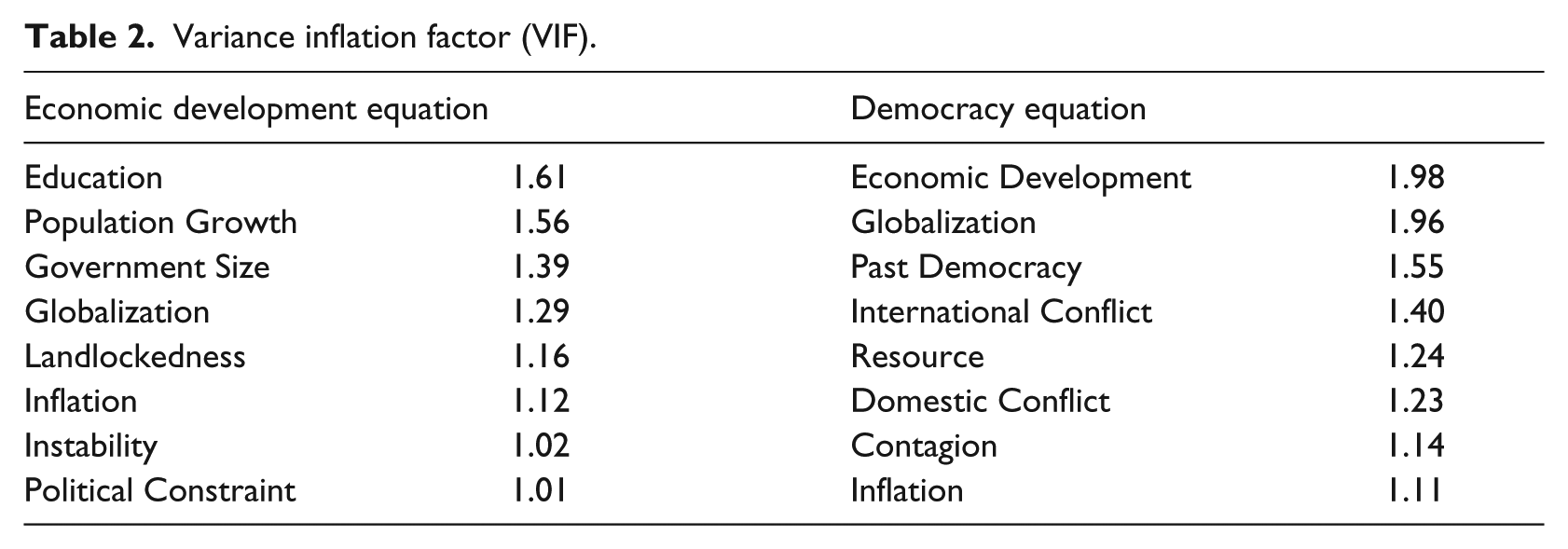
Due to the potential correlation between independent variables, we tested for multicollinearity, utilizing the variance inflation factor (VIF). Table 2 reports the results from the VIF test, showing that the highest VIF is 1.98. VIF values greater than 5 or 10 are commonly considered an indication of a collinearity problem (Hair et al., 2009). Thus, we conclude that multicollinearity is not an issue in our analysis.
Variance inflation factor (VIF).
To avoid reverse effects, we lag all our independent variables by a year. Although this is a partial solution, we take this approach following Li and Reuveny (2003) and Rudra (2005).
Findings
We conducted statistical analyses of two data sets: one fully specified model without Taiwan and the other with Taiwan but without the resource variable. Table 3 reports the results of a fully specified model. The results reveal that globalization facilitates democratic development not only directly, but also indirectly via economic development in East Asian states. Specifically, according to the development equation, globalization has a positive and statistically significant impact on economic development, indicating that trade and financial liberalization encourages economic development. In the democracy equation, economic development also has a positive and statistically significant effect on democracy, confirming the indirect link between globalization and democracy through economic development. In addition to the indirect effect of globalization on democracy, the democracy equation also reveals that globalization has a direct, positive, and statistically significant impact on democracy.
The effects of globalization on democracy in East Asia without Taiwan.
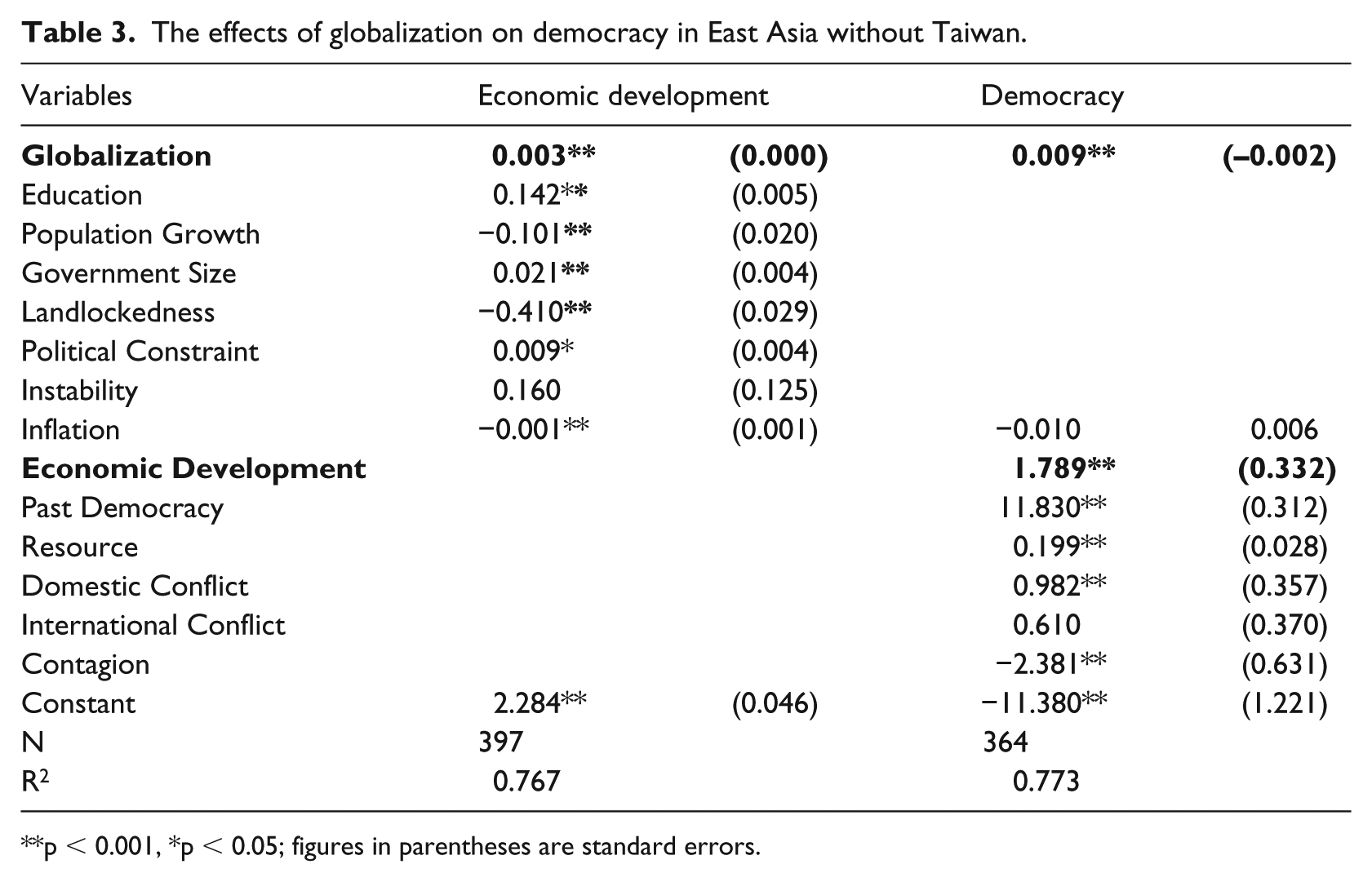
p < 0.001, *p < 0.05; figures in parentheses are standard errors.
Table 4 presents the estimates of the model including Taiwan but excluding the resource variable. Although Taiwan is an important case in explaining East Asian economic and political development, it was not included in the initial analysis because the data for Taiwan’s resource rents were not available. Thus, we estimated an additional model that included Taiwan but without the resource variable as a robustness check. The test results confirm the findings of the fully specified model. Both key independent variables, globalization in the economic development model and per capita income in the democracy model, remain stable under the change. Another main variable in the democracy equation, globalization, also remains positive and statistically significant, confirming the robustness of the findings. The democratic effects of globalization through direct and indirect channels in East Asia thus consistently remain stable regardless of model specifications and countries included in the analysis.
The effects of globalization on democracy with Taiwan but without resource variable.

p < 0.001, *p < 0.05; figures in parentheses are standard errors.
Turning to the control variables in the development model, all the controls show the expected signs, but one estimate does not achieve statistical significance. Education has a positive and statistically significant effect on economic development. This result is consistent with other studies that included this variable, suggesting that education plays an important role in economic development by improving the quality of human capital and thereby increasing productivity (Bloom et al., 2006). The impact of population growth is statistically significant and negative, lending support to Krieckhaus’s (2006) finding that an increase in family size will lead parents to reduce their average investment in each child, therefore lowering the quality and competitiveness of human capital. Government size also has a significant and positive impact on development, in accord with past studies that emphasize the role of governments in economic success in East Asia (Heo and Roehrig, 2014; Kim and Heo, 2017).
The negative and statistically significant results regarding landlocked locations illustrate the influence of geographical disadvantage on economic performance. The estimate of the effect of political constraints is positive and statistically significant, suggesting the importance of governments’ ability to provide credible commitment to economic development. Inflation has a negative impact on the economy, lending support to the thesis that macroeconomic stability plays a significant role in economic success. Political instability shows a statistically insignificant impact on development. One possible explanation of this result is that some East Asian states (e.g., South Korea, Taiwan, Thailand) developed their economies while experiencing political protests demanding democracy. Moreover, as Jong-A-Pin (2009) suggests, various dimensions of instability might result in different economic outcomes, indicating that political instability may not always harm economic performance.
Moving to the democracy equation, past democracy experience has a positive and statistically significant impact on democratization, indicating that countries with past experience of democracy are more likely to return to democratic rules. Internal warfare also shows a positive and statistically significant impact on democracy, consistent with previous studies arguing that domestic conflicts may lead to more democratic polities (Gurses and Mason, 2008; Wantchekon, 2004). The positive coefficient for the resource variable is in line with Dunning’s (2008) hypothesis that resource wealth does not necessarily lead to autocracy. Depending on the process through which resource wealth exerts political influence, the consequences could be either authoritarian or democratic.
Inflation and interstate conflicts show statistically insignificant effects on democratic development. Perhaps, as Gasiorowski (1995) argues, the relationship between economic crises and democracy may change over time and is therefore difficult to generalize. The negative coefficient of the contagion variable does not coincide with Huntington’s (1991) argument on the contagion effect. One possible explanation for this result could lie in East Asia’s political heterogeneity. According to Beeson (2014: 94–95), there has been a question as to whether the wave of democratization would be possible in East Asia, given the region’s diverse political structure and traditions.
Our robustness tests, using Chinn and Ito’s financial openness data for globalization and portfolio investment data for globalization, reaffirm the positive direct and indirect effects of globalization on democratic development in East Asia. The results indicate that various measures of globalization yield the same relationship between globalization and democratic development in East Asia, as illustrated in Tables 5–7.
The effects of globalization on democracy in East Asia without Taiwan, using the Chinn-Ito index.
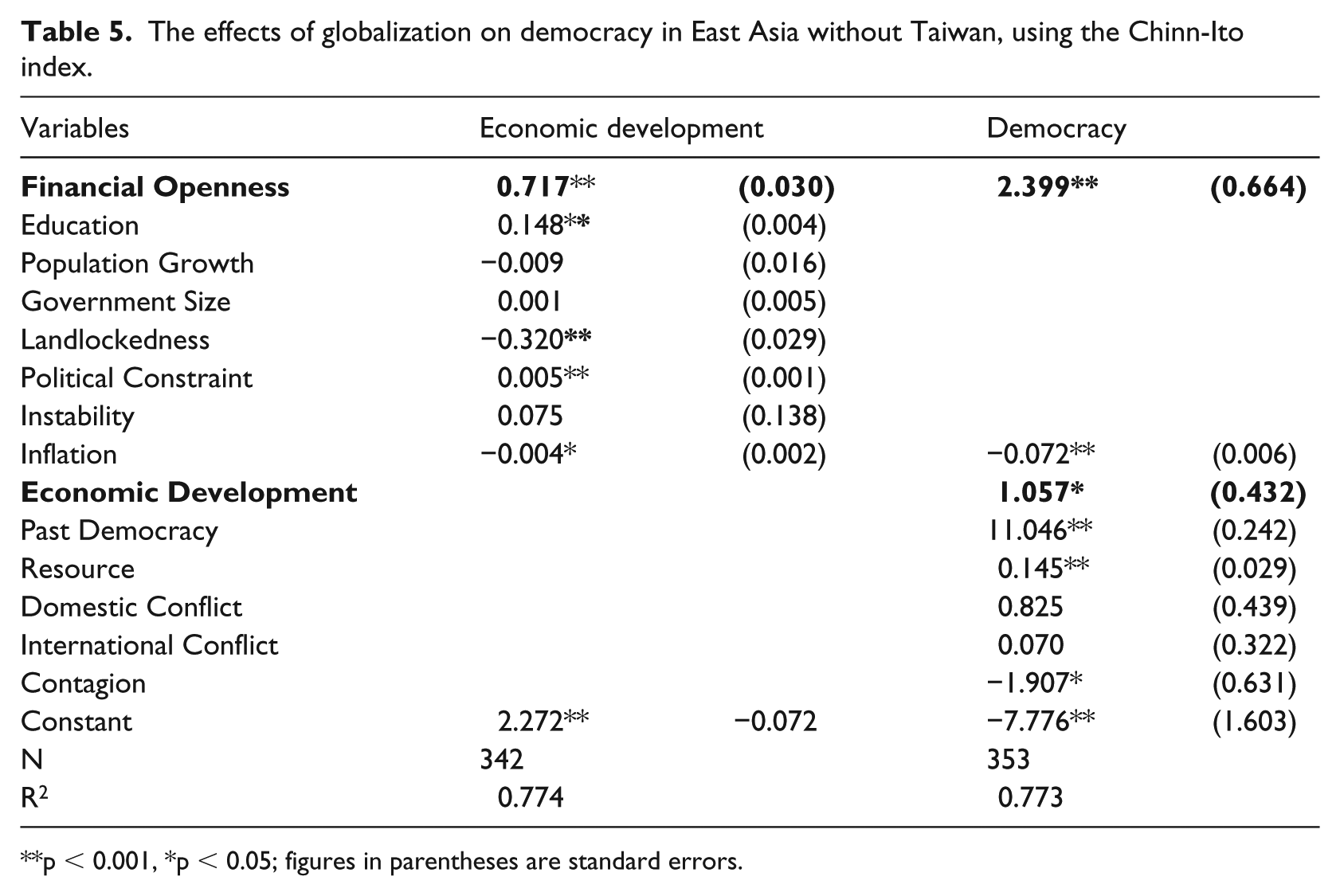
p < 0.001, *p < 0.05; figures in parentheses are standard errors.
The effects of globalization on democracy in East Asia without Taiwan, including portfolio investment.

p < 0.001, *p < 0.05; figures in parentheses are standard errors.
The effects of globalization on democracy with Taiwan but without resource variable, including portfolio investment.
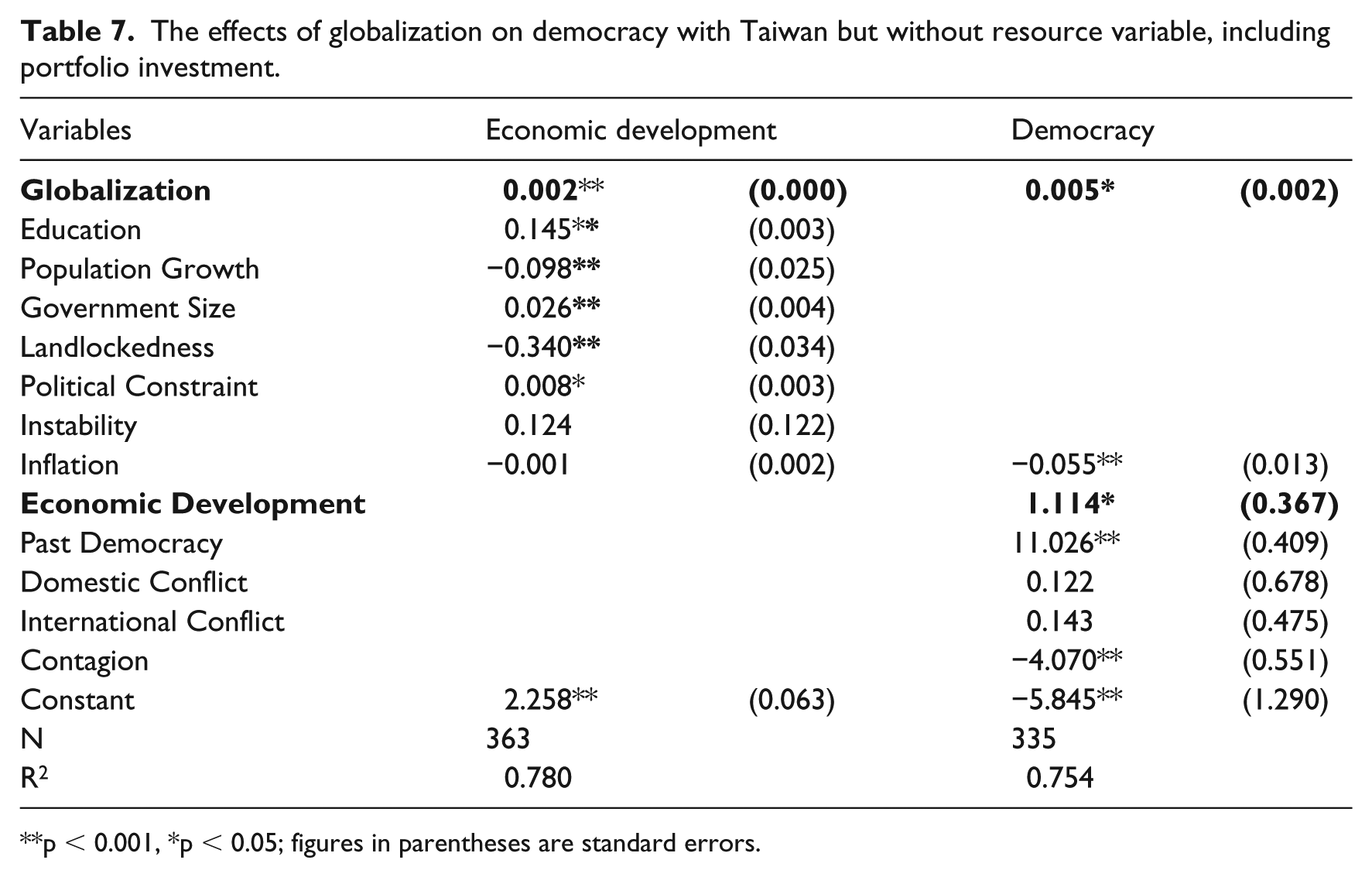
p < 0.001, *p < 0.05; figures in parentheses are standard errors.
To summarize, globalization does have a positive and significant impact on advancing democracy in East Asia. Trade and FDI, financial openness, and portfolio investment directly and indirectly encourage countries to become more democratic by fostering economic development. Of course, globalization is one of the variables that helps democratic development. The results of our analyses indicate that internal as well as external variables are important determinants of East Asian democratization.
Conclusion and discussion
Previous studies on East Asian democracy can be generally categorized into two groups: 1) analyzing the factors that affected the transition to democracy; and 2) studying how East Asian democratization is different from that of other regions, often expressed as “why has the development of East Asian democracy lagged behind?” The first group investigated the role of various socio-economic factors (e.g., economic development, education, industrialization), while the latter focused on the role of culture, especially Confucianism (e.g., Fukuyama, 2013; Heo, 2013; Heo and Hahm, 2014; Shin, 2012). Regardless of the approach, international factors have been largely ignored in the literature.
To fill this theoretical lacuna, in this study we theorized how globalization may affect democracy through economic development and empirically tested the direct and indirect impact of economic globalization on democracy in East Asia. Results of our analysis reveal that there is an indirect as well as a direct relationship between globalization and democracy via economic development. These findings shed light on the effects of external factors, particularly globalization, on democracy development in East Asian states.
Turning to some individual countries’ experiences, globalization has affected both economic and political transformation in South Korea because economic liberalization due to globalization led to ending ties with the authoritarian power structure. As a result, democracy development became a central aspect of economic change, meaning abandoning the “growth first” model to seek wider social inclusion and economic equity through increased welfare spending. In other words, globalization led to economic development, which resulted in the transition to democracy (Gills and Gills, 2000). Taiwan has had a similar experience in terms of economic openness leading to development followed by the transition to democracy, although, unlike South Korea, the business sector did not have close ties with the authoritarian government even before democratization.
The effects of globalization on the economy have not always been rosy, as economic openness made the economies vulnerable in Indonesia and Thailand. Since the economic fundamentals of these countries were weak, external shocks caused a financial crisis, the so-called Asian financial crisis in 1997. Despite the economic difficulties, both countries underwent democratic transition after the crisis; Thailand alternating between authoritarian and democratic governments.
In contrast to Indonesia and Thailand, Malaysia did not democratize after the 1997 Asian financial crisis. The Malaysian government refused to adopt neo-liberal policies recommended by the International Monetary Fund and maintained restrictions on civil societies. Thus, despite globalization and the economic crisis, the semi-authoritarian regime in Malaysia remained intact (Uhlin, 2002: 163). These cases indicate that globalization may cause economic crises, and authoritarian governments’ policies to deal with these crises affect whether or not democratic transition will occur.
The impact of globalization hardly touched the political systems in Vietnam and Laos. In these countries, leaders did not allow economic globalization to result in social and political changes (Jonsson, 2002). Similarly, China has enjoyed rapid economic growth with globalization, followed by social change; yet it has not led to democratization. The reason might be that civil societies, which would otherwise push for political development, did not grow in China because of the government’s strong restrictions. The authoritarian regime has continuously limited the role of civil societies and persecuted democratic movements (Beeson, 2014; Ogawa, 2018).
As described above, individual country experience may vary, but almost all East Asian states have enjoyed economic growth over the past decades through increased economic exchanges. As globalization gathered pace, economic development followed and the overall level of democracy in the region improved. Thus, it is likely that economic globalization advances democratization in the long run by promoting economic development.
That said, to cross-validate our findings, further study would be needed by separately analyzing the effects of globalization on the transition to and the deepening of democracy, because our study focused on the increase in the level of democracy. Moreover, globalization may aggravate income inequality or economic openness may cause financial crises. Investigating the indirect channel through inequality and/or financial crisis would thus be desirable for better understanding the relationship between globalization and democracy.
Footnotes
Funding
The author(s) received no financial support for the research, authorship, and/or publication of this article.