



Abstract
This study examines the effects of the Big Five personality traits on individual attitude toward the independence–unification issue in Taiwan. Using an original dataset, this study finds that extraversion and openness to experience are significantly associated with individual attitude toward the independence–unification issue. Specifically, a higher level of extraversion is associated with an increased likelihood of support for unification with China, whereas a higher level of openness to experience is associated with an increased likelihood of support for Taiwan independence. Moreover, higher levels of extraversion and openness to experience increase the likelihood of support for change in cross-strait relations. Also, there are no gender-differentiated effects of personality traits on individual attitude toward the independence–unification issue. Overall, this study concludes that personality traits can provide some explanatory power for individual attitude toward the independence–unification issue. Therefore, personality traits merit more serious attention in the analysis of Taiwanese peoples’ positions on cross-strait relations.
Introduction
The independence–unification issue, defined as whether Taiwan should declare independence, unify with China, or maintain the status quo in the future, has been one of the most salient political issues in Taiwan, and it has exerted significant influence on Taiwanese people’s party identification, national identity, and voting behavior (Lacy and Niou, 2012; Niou, 2004; Sheng, 2002; Wang, 2012). Given the importance of the independence–unification issue in Taiwanese politics, a number of studies have examined the factors influencing individual attitude toward the independence–unification issue and revealed the associations of several factors such as Chinese/Taiwan identity, ethnicity, political generations, and individual business and security concerns with Taiwanese people’s attitudes toward the independence–unification issue (Achen and Wang, 2017; Chen and Chen, 2003; Chen and Chou, 2004; Gries and Su, 2013; Hsieh, 2004; Rigger, 2011; Chang and Wang, 2005; Weng, 2017). On the other hand, over the past decade, studies on the relationships between personality and individual political attitudes and behavior have attracted scholarly attention and demonstrated the importance of personality in individual responses to political stimuli. In particular, previous research has provided evidence that personality traits have a direct influence on individual opinions on a variety of political issues such as the usage of military force in foreign affairs (Schoen, 2007), environmental preferences (Soliño and Farizo, 2014), immigration (Dinesen et al., 2016), and attitudes toward other countries and international organizations (Bakker and de Vreese, 2016; Ha, 2013; Schoen, 2007). As a result, it is evident that personality traits can help explain the formation of individual attitudes toward political issues.
So far, however, no studies have been done linking personality traits and individual attitude toward the independence–unification issue in Taiwan. Therefore, this study attempts to extend extant research on personality and political attitudes by examining the influence of personality measured by the five-factor model on Taiwanese people’s attitudes toward the relationship between Taiwan and China. The data are based on a nationally representative telephone survey conducted in Taiwan and include the Ten Item Personality Inventory (TIPI) developed by Gosling et al. (2003). The empirical results of this study demonstrate that personality plays a non-trivial role in individual attitude toward the independence–unification issue. The increasing levels of both extraversion and openness to experience are associated with decreased support for maintaining the status quo. Specifically, an increasing level of extraversion is associated with increased support for unification with China, whereas an increasing level of openness to experience is associated with increased support for Taiwan independence. Furthermore, as the levels of extraversion and openness to experience increase, people are inclined to favor a change in cross-strait relations.
Overall, this study enhances our understanding of the relationship between personality and individual attitude toward the independence–unification issue, and offers new insight into the role of personality in the political arena in Taiwan that has rarely been explored. In addition, past research on personality has rarely targeted East Asian countries, and existing studies have simply focused on South Korea (see Ha, 2013; Ha et al., 2013; Wang et al., 2017; Wang and Weng, 2018). Therefore, this study expands our knowledge about how personality can come into play in forming individual political attitudes in East Asia. The remainder of this study is structured as follows. In the second section, we outline the theoretical framework for the relationships between personality traits and individual attitude toward the independence–unification issue, and propose the hypotheses for empirical testing. In the third section, we describe the data, measurement of variables, and model specification. In the fourth section, we report the empirical findings on the effects of personality traits on individual attitude toward the independence–unification issue. In the fifth section, we conduct supplemental analysis to take a further look at the relationships between personality traits and individual preference for change in cross-strait relations. In the final section, we summarize the key findings and discuss the implications of this study.
Personality and individual attitude toward the independence–unification issue
Research on political behavior in Taiwan has produced much insight into the antecedents of political attitude. While the independence–unification issue is central in the most prominent works regarding public opinion in Taiwan, the fundamental aspects of individuals’ personalities are missing in the discussion. Nothing in this study challenges the importance of any other factors influencing the variance in individual attitude toward the independence–unification issue, but we argue that personality traits may also matter for which direction people lean toward and for which they do not. We start with a discussion of the relationships between the Big Five personality traits and political attitudes that could help delineate the fundamental connection between personality and individual attitude toward the independence–unification issue in Taiwan. Then we attempt to offer a theoretical framework of how different personality traits shape individual attitude toward the independence–unification issue and propose hypotheses for empirical analysis.
Relationships between personality and political attitudes
Scholars have made great efforts to summarize an individual’s personality (Allport and Allport, 1921; Buss and Finn, 1987; Eysenck, 1944). While there are many classifications and operationalizations of personality, the Big Five model of personality has been widely accepted as a valid and reliable assessment of personality (Gosling et al., 2003; John and Srivastava, 1999). The Big Five model of personality identifies five distinct dimensions to describe an individual’s personality. Specifically, the five dimensions of personality are extraversion, agreeableness, conscientiousness, emotional stability, and openness to experience. Extraversion refers to the degree to which an individual is energetic, sociable, talkative, and assertive; agreeableness denotes the degree to which an individual is trustful, altruistic, sympathetic, and prosocial; conscientiousness involves the degree to which an individual is thoughtful, well-organized, norm-abiding, and mindful of details; emotional stability means the degree to which an individual is emotionally resilient, unworried, less stressed, and relaxed; and openness to experience refers to the degree to which an individual is creative, insightful, curious, and open-minded (John and Srivastava, 1999). Because personality traits reflect an individual’s characteristic patterns of thoughts, feelings, and behaviors, an understanding of someone’s personality traits could give us clues about how that person is likely to respond to the stimuli he or she encounters in a variety of political and non-political situations. Previous research has suggested that both genetic and environmental factors play a pivotal role in shaping an individual’s personality traits (Kandler, 2012), although genetic factors might matter more than environmental factors (Bouchard, 1994, 2004). More importantly, personality traits tend to be relatively stable over the course of the lifecycle (Roberts and DelVecchio, 2000) and thus once an individual’s personality traits are formed, it is not easy to change his or her personality.
A significant number of studies have examined the relationships between personality traits and individual political attitudes. In particular, the relationship between personality and political ideology has received much scholarly attention and relevant studies have produced the most fruitful results. In general, conscientiousness is more likely to be associated with conservative ideology, whereas openness to experience is more likely to be related to liberal ideology (e.g., Carney et al., 2008; Gerber et al., 2010; Mondak and Halperin, 2008). By contrast, the findings on the relationships between the other three personality traits (i.e., extraversion, agreeableness, and emotional stability) and political ideology are not conclusive. Whereas previous research has typically found that extraversion, agreeableness, and emotional stability are not significantly associated with political ideology, some studies have demonstrated positive relationships between these three personality traits and conservatism (e.g., Carney et al., 2008; Gosling et al., 2003; Verhulst et al., 2010). Given the close link between personality traits and political ideology, some studies have relied on the connections between personality traits and political ideology to derive the theoretical relationships between personality traits and political attitudes. For instance, Gerber et al. (2012) theorize that the relationships between the Big Five personality traits and which party an individual identifies with should track the relationships between these traits and political ideology. Specifically, they expect that the Big Five personality traits that are associated with liberalism would be associated with Democratic identification, whereas those associated with conservatism would be associated with Republican identification. Furthermore, since there is a close link between openness to experience and liberalism, several studies have demonstrated that people with higher levels of openness to experience tend to support more liberal social/moral issues (Gerber et al., 2010; Mondak and Halperin, 2008; Mondak et al., 2010).
Instead of the link between personality traits and general liberalism–conservatism, some studies have theoretically discussed how personality traits form individual political attitudes mainly based on the nature of dispositional characteristics for each personality trait. In terms of foreign policy issues, Schoen (2007) argues that different personality traits influence how people shape their motivations, goals, and values, which then provide criteria to evaluate external stimuli and affect their foreign policy attitudes. Based on a random sample of German adults, Schoen (2007) found that agreeableness and openness to experience enable people to prefer international cooperation and cast doubt on the use of military force, whereas conscientiousness displays reverse effects. In addition, Bakker and de Vreese (2016) looked into the relationships between personality traits and different European Union (EU) attitudes. In particular, they reveal that high levels of agreeableness and openness to experience and low levels of extraversion and emotional stability are associated with support for widening of the EU. A low level of emotional stability and a high level of conscientiousness are associated with support for deepening of the EU. Moreover, conscientiousness is positively associated with individual trust in EU institutions, whereas a low level of emotional stability is related to the experience of negative affect toward the EU. Furthermore, Ha (2013) examined the impact of personality on South Koreans’ attitudes toward North Korea and showed that people with higher levels of conscientiousness are less likely to feel close to North Korea and are more likely to view North Korea as a hostile nation, while those with higher levels of openness to experience are more likely to hold positive attitudes toward North Korea. Overall, it is evident that there exist significant relationships between personality traits and individual attitudes toward other countries and international organizations. Given the findings from previous studies, in the context of Taiwanese politics, it is reasonable to argue that personality traits exert a significant influence on Taiwanese people’s attitudes toward the relationship between Taiwan and China.
Hypotheses for the relationships between personality traits and individual attitude toward the independence–unification issue
Since the independence–unification issue has played a dominant role in Taiwanese politics, and voters in Taiwan have relied on their positions on this issue to make their political decisions, this study aims to uncover how personality traits shape individual attitude toward the independence–unification issue.
First, some of the general characteristics associated with extraversion include optimism, risk taking, and love of excitement and change. Past studies have demonstrated that extraverted individuals are more likely to engage in risky behaviors as a way to enhance positive affective experience (Cooper et al., 2000). In other words, extraversion would motivate people to take risks in order to make changes. Because the choices of unification with China or Taiwan independence are both considered risky options for Taiwanese people compared to maintaining the status quo, this study expects that people with higher levels of extraversion should be more likely to support either unification with China or Taiwan independence than maintain the status quo.
Second, the relationship between agreeableness and individual attitude toward the independence–unification issue is not clear in terms of its direction. If agreeableness is characterized by compliance to mainstream values of a society, it is expected to correspond to negative attitudes toward China and skepticism on unification with China given the fact that the majority of Taiwanese people have regarded China as hostile to Taiwan. 1 As shown in Figure 1, Taiwanese people have thought that the Chinese government is unfriendly to the Taiwanese government. In particular, since August 2012, the absolute majority of Taiwanese people have viewed the Chinese government as unfriendly to the Taiwanese government. The percentage significantly increased after the 2016 presidential election, and reached its highest point (i.e., 68.9%) in January 2017, which then has gradually decreased to 57.0% in April 2018 but increased to 65.1% in August 2018, probably because some countries terminated diplomatic relationships with Taiwan due to China. Compared to the percentage of the Chinese government’s unfriendliness to the Taiwanese government, the percentage of the Chinese government’s unfriendliness to Taiwanese people has been relatively lower. Although the percentage increased to 49.5% in January 2017, it gradually decreased to 41.0% in August 2018. In short, Taiwanese people have viewed China as unfriendly to Taiwan. Accordingly, people with higher levels of agreeableness should be more likely to support either the status quo or Taiwan independence. On the other hand, benevolence toward China (another important facet of agreeableness) may lead people with higher levels of agreeableness to be in favor of unification with China instead of maintaining the status quo or supporting Taiwan independence. Therefore, it is inconclusive to anticipate the effect of agreeableness on individual attitude toward the independence–unification issue.

Taiwanese people’s perceptions of the Chinese Government’s unfriendliness from 2008 to 2018.
Third, people with higher levels of conscientiousness are expected to be attracted to social norms and traditions. Therefore, they are more likely to reject the challenges to social norms by defending the status quo. In other words, conscientious people are more likely to prefer the status quo over unification with China and Taiwan independence.
Fourth, emotionally stable individuals tend to exhibit stability (Mondak, 2010: 63), and, thus, they are afraid of dramatic changes that might lead to an unstable and dangerous situation. It is obvious that compared to the status quo, both choices of unification with China and Taiwan independence will inevitably make Taiwan face an uncertain and unstable future. Accordingly, it is expected that people with higher levels of emotional stability are more likely to support the status quo than unification with China and Taiwan independence.
Fifth, and lastly, openness to experience is expected to correspond to open-minded attitudes toward novel stimuli. Therefore, people with higher levels of openness to experience are more likely to support social changes, which usually require a willingness to accept unconventional behaviors. Therefore, it is expected that compared to maintaining the status quo, people who score high on openness to experience are more likely to support either unification with China or Taiwan independence. Table 1 summarizes the expected relationships between personality traits and individual attitude toward the independence–unification issue.
Hypotheses on the relationships between personality traits and individual attitude toward the independence–unification issue.
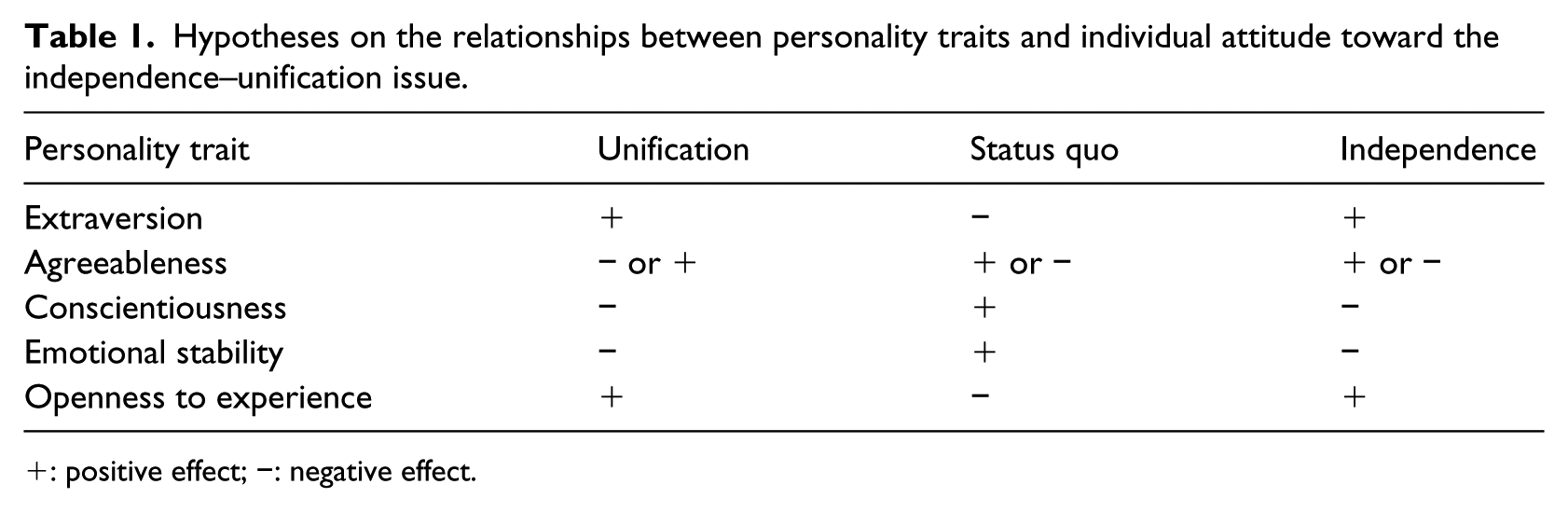
+: positive effect; −: negative effect.
Data, measurement of variables, and model specification
To examine the relationships between the Big Five personality traits and individual attitude toward the independence–unification issue, we conducted a telephone survey between 13 October and 17 October 2016. The Election Study Center at National Chengchi University is responsible for the data collection. The sample consists of 1069 Taiwanese citizens aged 20 and above. Given missing values due to nonresponses, the effective number of observations for empirical analysis is reduced to 858 in this study. In addition, the data are weighted by rating method along with population distribution of sex, age, education, and residence area to ensure a nationally representative sample. Therefore, we apply the weights to produce estimates of the relationships between personality traits and individual attitude toward the independence–unification issue. Next, we explain how we operationalize the variables for empirical analysis. 2
One conventional question has been used to evaluate individual attitude toward the independence–unification issue in Taiwan as follows: Concerning the relationship between Taiwan and mainland China, which of the following six positions do you agree with: (a) immediate unification; (b) immediate independence; (c) maintain the status quo, and move toward unification in the future; (d) maintain the status quo, and move toward independence in the future; (e) maintain the status quo, decide either unification or independence in the future; and (f) maintain the status quo forever.
Figure 2 shows the long-term tracking of public opinion about the independence–unification issue in Taiwan from 1994 to 2018. It is obvious that the majority of Taiwanese people have favored “maintain status quo, decide at later date” over time. People who want to maintain the status quo indefinitely have increased from 9.8 percent in 1994 to 23.7% in 2018, and we can observe a similar trend for “maintain status quo, move toward independence” increasing from 8.0% in 1994 to 15.5% in 2018. Although the percentage of support for unification with China has been relatively lower, it is noted that people who support either “maintain status quo, move toward unification” or “unification as soon as possible” have been slowly increasing since 2014, from 7.9% to 12.5% and from 1.3% to 3.0%, respectively. It requires more time to observe whether this current trend will continue. With regard to operationalization of the dependent variable in this study, previous research has combined options (a) and (c) as support for unification with China, options (b) and (d) as support for Taiwan independence, and options (e) and (f) as support for maintaining the status quo. Therefore, we adopt the same strategy to classify individual attitude toward the independence–unification issue. Moreover, we use the respondents who support the status quo as the reference group while performing data analysis.
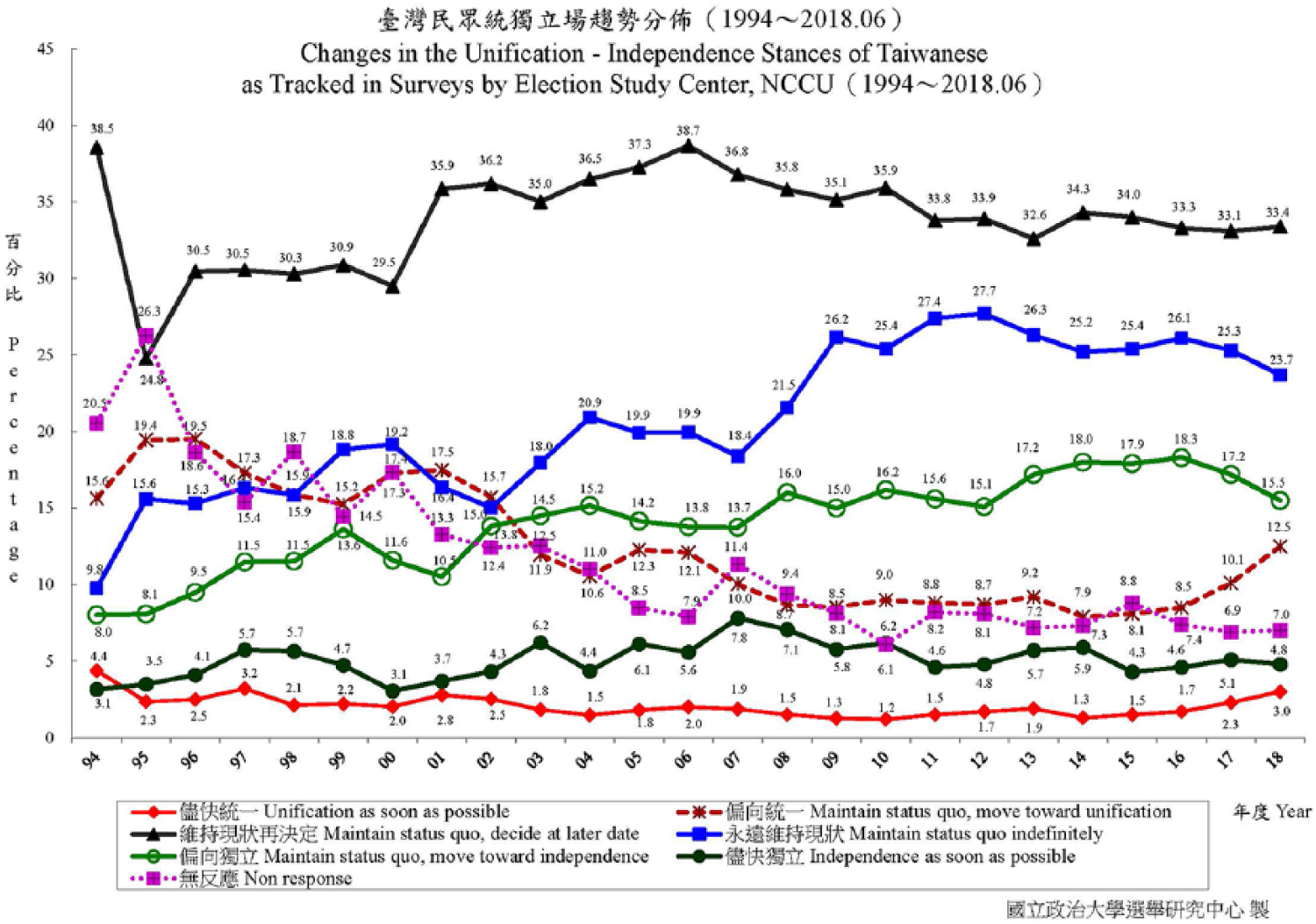
Taiwanese people’s attitudes toward the independence-unification issue from 1994 to 2018.
The key independent variables in this study are the Big Five personality traits. We include a careful Chinese-translated version of the TIPI developed by Gosling et al. (2003) in the survey. The TIPI measurement of personality has been widely used to examine the impact of personality traits on individual political attitudes and behavior (Gerber et al., 2010, 2011, 2012; Mondak, 2010; Mondak and Halperin, 2008; Wang, 2016). Each of the five personality traits (extraversion, agreeableness, conscientiousness, emotional stability, and openness to experience) is measured by pairs of items. Specifically, the respondents are asked to indicate the extent to which the pair of traits applies to themselves on a 7-point scale from “strongly disagree” to “strongly agree,” with the paired items being “extraverted, enthusiastic” and “reserved, quiet” for extraversion; “critical, quarrelsome” and “sympathetic, warm” for agreeableness; “dependable, self-disciplined” and “disorganized, careless” for conscientiousness; “anxious, easily upset,” and “calm, emotionally stable” for emotional stability; and “open to new experiences, complex” and “conventional, uncreative” for openness to experience.
The score for each personality trait is obtained by adding, after appropriate recoding, the two items used to measure the particular personality dimension. A higher score means that an individual has a more prominent personality trait. In this study, the range of each personality trait is specified between 2 and 14. Although some might prefer longer survey instruments to measure the Big Five personality traits (such as the 44-item Big Five Inventory and the 240-item Revised NEO Personality Inventory), it is not feasible in the telephone survey, which does not allow too many questions to be asked. Fortunately, the TIPI is found to have high construct validity and test–retest reliability, and be highly correlated with the longer versions of personality measures (Gosling et al., 2003). Therefore, the TIPI represents an adequate measure to capture the five dimensions of personality traits. Table 2 reports the correlation coefficients among the Big Five personality traits, indicating that personality traits are weakly correlated with each other and therefore they should capture different dimensions of personality. 3
Correlations among the Big Five personality traits.

p < 0.001.
To correctly estimate the effects of the Big Five personality traits on individual attitude toward the independence–unification issue, we control for some variables that are relevant to individual attitude toward the independence–unification issue, including partisanship, Taiwanese identity, and demographic characteristics such as ethnicity, education, gender, and age.
First, although there are many political parties in Taiwan, they can be classified into two political camps in terms of the independence–unification issue: the Pan-Green and Pan-Blue coalitions. In general, the Pan-Green coalition favors Taiwan independence over Chinese reunification, whereas the Pan-Blue coalition tends to favor a Chinese nationalist identity and greater linkage with China. Therefore, it is expected that people who support political parties belonging to the Pan-Green coalition tend to support Taiwan independence, whereas those identifying with political parties in the Pan-Blue coalition are inclined to support unification with China. Thus, we create two dummy variables respectively for the Pan-Blue and Pan-Green coalitions and treat the independents as the reference group. 4
Second, previous research has indicated that people who think of themselves as Taiwanese tend to support Taiwan independence, whereas those who see themselves as Chinese are inclined to support unification with China (Chen, 2000; Lin, 2012). Due to the fact that only 39 respondents have a Chinese identity in our survey, we simply generate a dummy variable coded 1 for people with Taiwanese identity and 0 otherwise to avoid biased estimate. Accordingly, people with Chinese identity and dual identity are treated as the reference group.
Third, with regard to demographic variables, we generate two dummy variables, “Minnan” and “Mainlander,” to operationalize ethnicity with “1” for the respondents who self-identify as Minnan people or Mainlanders and “0” for those belonging to the other ethnic groups as the reference group. With regard to education, we create one dummy variable, “College and above degree,” to measure the respondents’ educational levels with “1” for those who are in the relevant categories and “0” otherwise. That is, those with an educational level of senior high school and below degree are treated as the reference group. We also create one dummy variable for gender and code it as “1” if the respondents are female and “0” otherwise. Furthermore, we divide the respondents into five age groups, respectively representing the age ranges 20–29, 30–39, 40–49, 50–59, and 60 and over, and use the 20–29-age group as the reference group. 5 Table 3 reports the descriptive statistics of all variable used for empirical analysis.
Descriptive statistics of variables.

SD: standard deviation.
With regard to model specification, given that our dependent variable has more than two possible discrete outcomes, we employ the multinomial logistic regression model to estimate the relationships between personality traits and individual attitude toward the independence–unification issue. Specifically, the multinomial logistic regression model takes the following form

where b is the base category, referring to people who are in favor of maintaining the status quo; m denotes people who support Taiwan independence or unification with China; x is a vector of independent variables (in this study, they include the Big Five personality traits of partisanship, Taiwanese identity, ethnicity, education, gender and age); and β is a vector of regression estimates.
Empirical results
Table 4 reports the estimates of the relationships between personality traits and individual attitude toward the independence–unification issue using the multinomial logistic regression model. 6 The results show that contrary to our expectations, agreeableness, conscientiousness, and emotional stability are not associated with individual attitude toward the independence–unification issue. 7 On the other hand, in comparison with support for the status quo, a higher level of extraversion is associated with an increased likelihood of support for unification with China, whereas a higher level of openness to experience is associated with an increased likelihood of support for Taiwan independence. 8 In contrast to our hypotheses, extraversion does not lead people to be more likely to support Taiwan independence and openness to experience does not motivate people to be more likely to pursue Taiwan independence. One possible explanation lies in the fact that people high in extraversion tend to be politically conservative, whereas those high in openness to experience are inclined to be politically liberal. 9 Given that the left–right ideology can be well matched to individual positions on the independence–unification issue in Taiwan (Hsiao and Cheng, 2014), it is reasonable to find that extraversion is associated with an increased likelihood of support for unification with China, whereas openness to experience increases the likelihood of support for Taiwan independence. Specifically, a one-unit increase in extraversion is associated with a 0.107 increase in the relative log odds of support for unification with China versus support for the status quo, whereas a one-unit increase in openness to experience is associated with a 0.106 increase in the relative log odds of support for Taiwan independence versus support for the status quo. Because it is difficult to understand the real sense of the relative log odds, we further interpret the regression results in terms of relative risk ratios. In particular, the relative risk ratio for a one-unit increase in extraversion is 1.113 for support for unification with China versus support for the status quo. That is, if an individual increases the level of extraversion by one unit, the multinomial log odds for support for unification with China relative to support for the status quo would be expected to increase by 11.3%. Moreover, the relative risk ratio for a one-unit increase in openness to experience is 1.112 for support for Taiwan independence versus support for the status quo. That is, if an individual increases the level of openness to experience by one unit, the multinomial log odds for support for Taiwan independence relative to support for the status quo would be expected to increase by 11.2%. In summary, this study finds that as the level of extraversion increases, people are more likely to support unification with China. However, as the level of openness to experience increases, people are more likely to support Taiwan independence.
Multinomial logistic regression analysis of the relationship between personality and individual attitude toward the independence–unification issue.
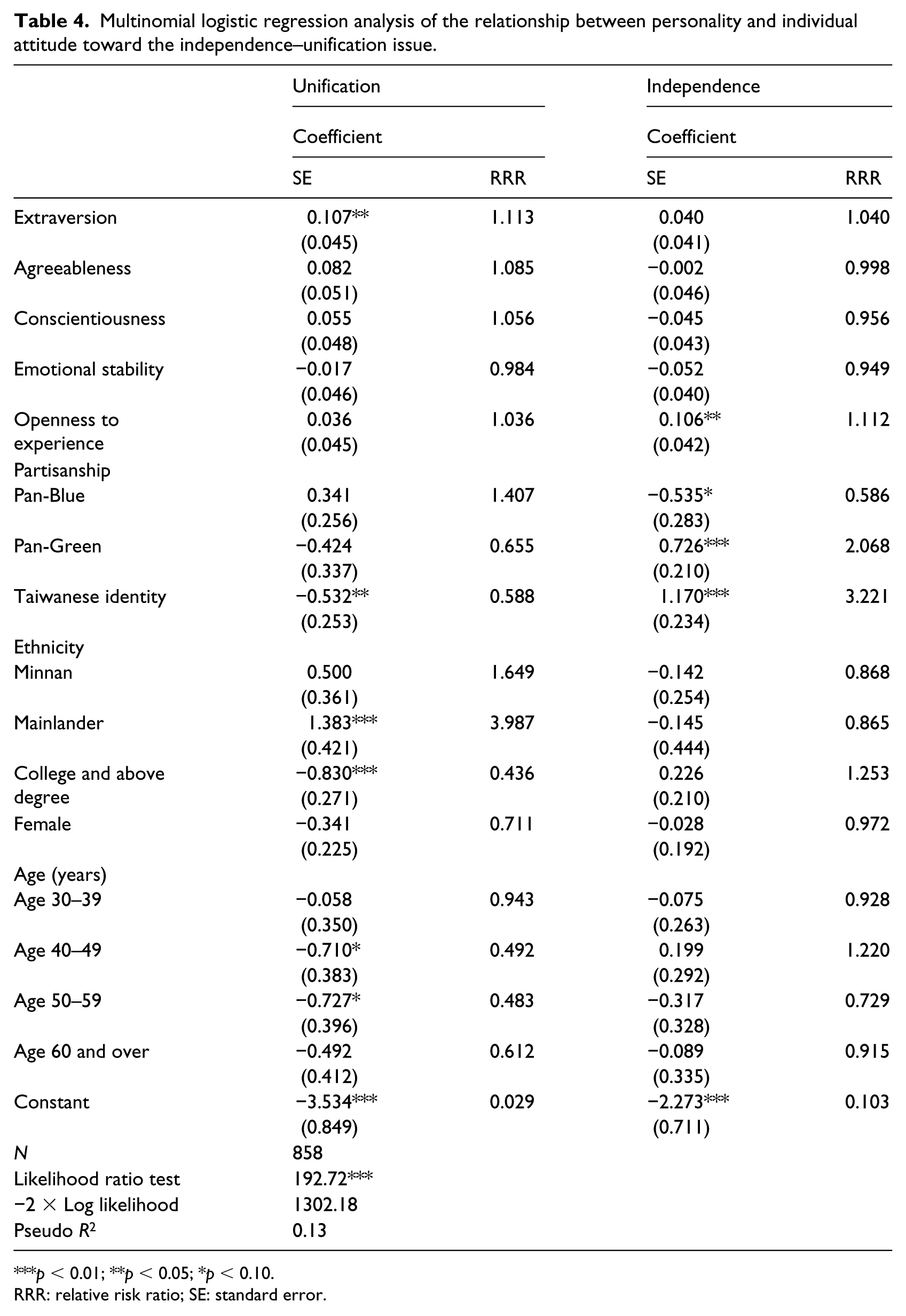
p < 0.01; **p < 0.05; *p < 0.10.
RRR: relative risk ratio; SE: standard error.
To clearly demonstrate the substantial impact of personality traits on individual attitude toward the independence–unification issue, we further compute the average marginal effects in terms of probability change in three different attitudes—support for unification with China, support for the status quo, and support for Taiwan independence. As shown in Table 5, on average, a one-unit increase in extraversion could increase the probability of support for unification with China by 1.1%, but decrease the probability for support for the status quo by 1.5%. Although a higher level of extraversion seems to increase the probability of support for Taiwan independence, the effect of extraversion on support for Taiwan independence fails to achieve statistical significance. On the other hand, a one-unit increase in openness to experience could increase the probability of support for Taiwan independence by 1.5%, but decrease the probability for support for the status quo by 1.7%. Furthermore, the positive effect of openness to experience on support for unification with China is not statistically significant. Figures 3 and 4 show a clear pattern for the effects of extraversion and openness to experience on individual attitude toward the independence–unification issue. In general, as the levels of extraversion and openness to experience increase, people become less likely to support the status quo, but become more likely to support unification with China or Taiwan independence. While the other three personality traits—agreeableness, conscientiousness, and emotional stability—are not associated with individual attitude toward the independence–unification issue, the result from Wald test shows that the coefficients for the Big Five personality traits are jointly statistically significant at the 0.05 level. On the whole, personality plays a pivotal role in forming individual attitude toward the independence–unification issue in Taiwan.
Average marginal effects of explanatory variables on individual attitude toward the independence–unification issue.

p < 0.01; **p < 0.05; *p < 0.10.
The numbers in cells show the average marginal effects in terms of probability change.
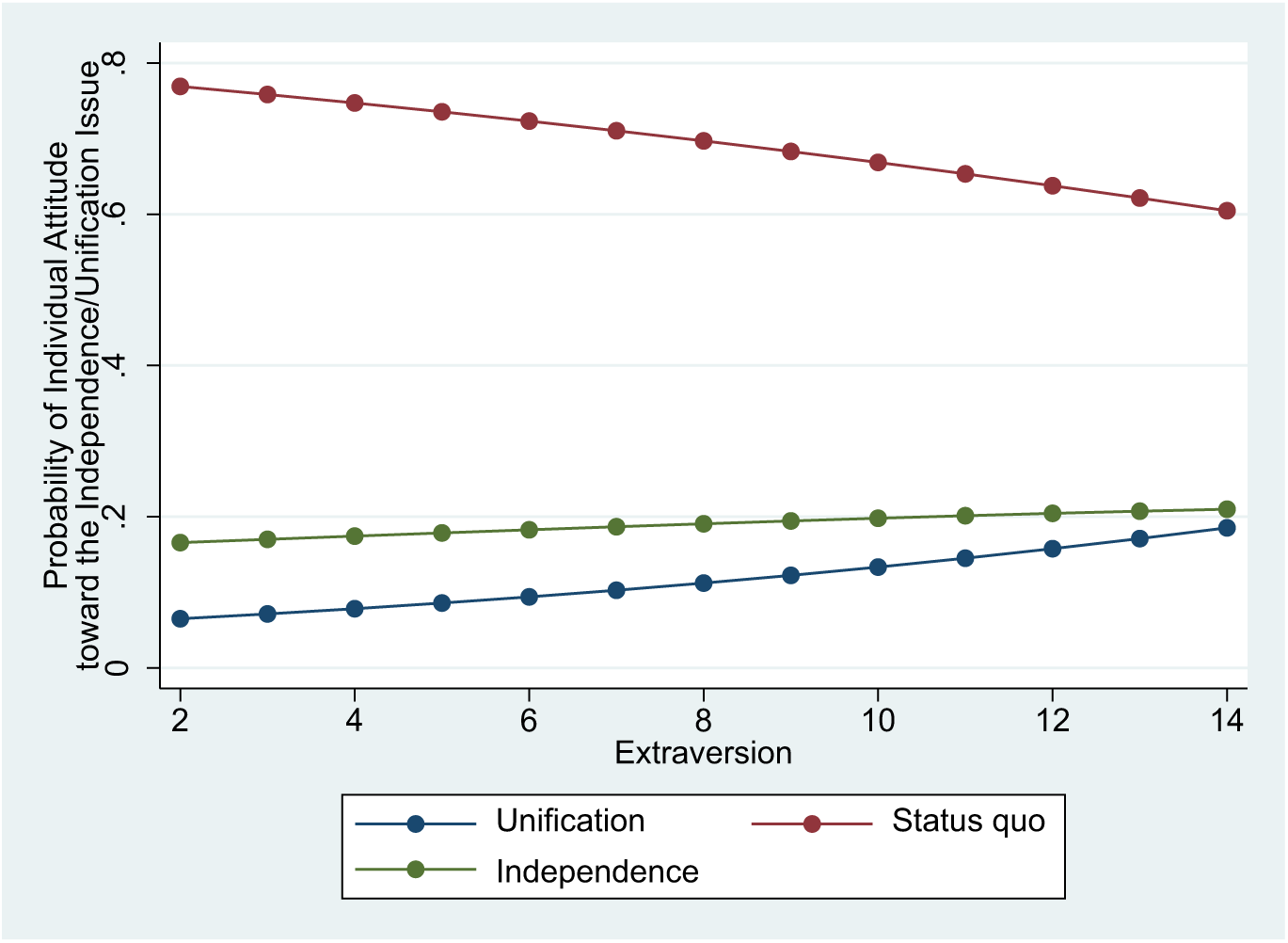
The effect of extraversion on individual attitude toward the independence–unification issue.
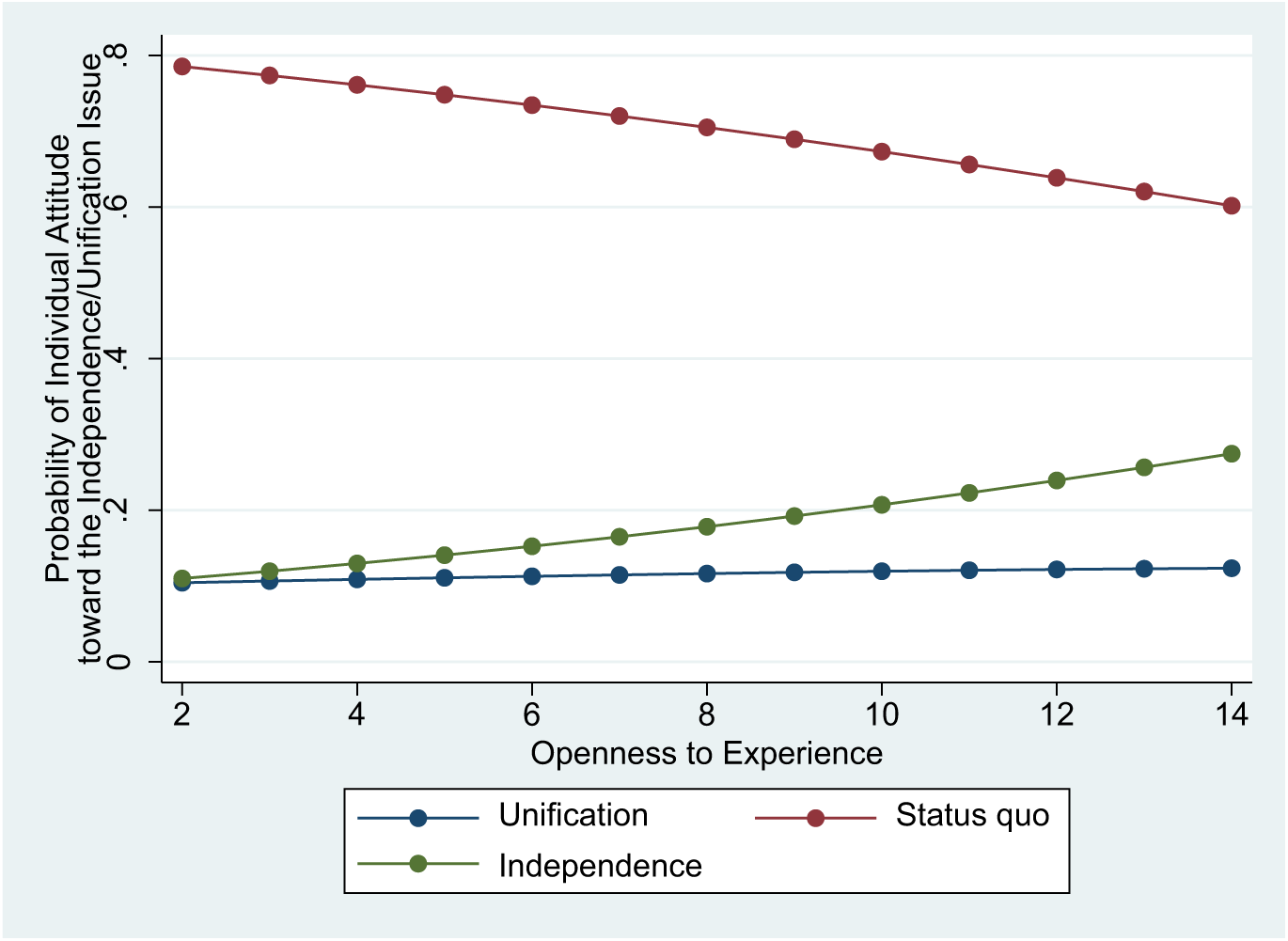
The effect of openness to experience on individual attitude toward the independence–unification issue.
In addition, consistent with previous research (Chen, 2000; Lin, 2012; Wang, 2012), this study demonstrates that partisanship and Taiwanese identity are significant determinants of individual attitude toward the independence–unification issue. As shown in Table 4, people who identify with the Pan-Blue camp are more likely to support unification with China and are less likely to support Taiwan independence compared to independents. By contrast, those identifying with the Pan-Green camp are more likely to support Taiwan independence than independents. On the other hand, people with Taiwan identity tend to be in favor of Taiwan independence and disfavor unification with China. In particular, Table 5 shows that if people identify with the Pan-Blue camp, the probability of their support for unification with China will increase by 5.4%, but the probability of their support for Taiwan independence will decrease by 7.5%. By contrast, if people identify with the Pan-Green camp, the probability of their support for Taiwan independence will increase by 13.8%. However, their probabilities of support for unification with China and maintaining the status quo will decrease by 5.5% and 8.3%, respectively. In terms of Taiwanese identity, if people self-identify as Taiwanese, the probability of their support for Taiwan independence will increase by 18.9%. Nevertheless, Taiwanese identity will decrease the probabilities of support for unification with China and maintaining the status quo by 8.1% and 10.8%, respectively. In contrast with partisanship and Taiwanese identity, demographic factors have less influence on individual attitude toward the independence–unification issue. In particular, this study reveals that people who self-identify as Mainlanders are more likely to support unification with China in comparison with those in the other ethnic groups, whereas Minnan people’s attitudes toward the independence–unification issue are not significantly different from those in the other ethnic groups. In addition, this study also finds that people with a college and above degree are less likely to support unification with China compared to their counterparts, whereas women are less likely to support unification with China than men.
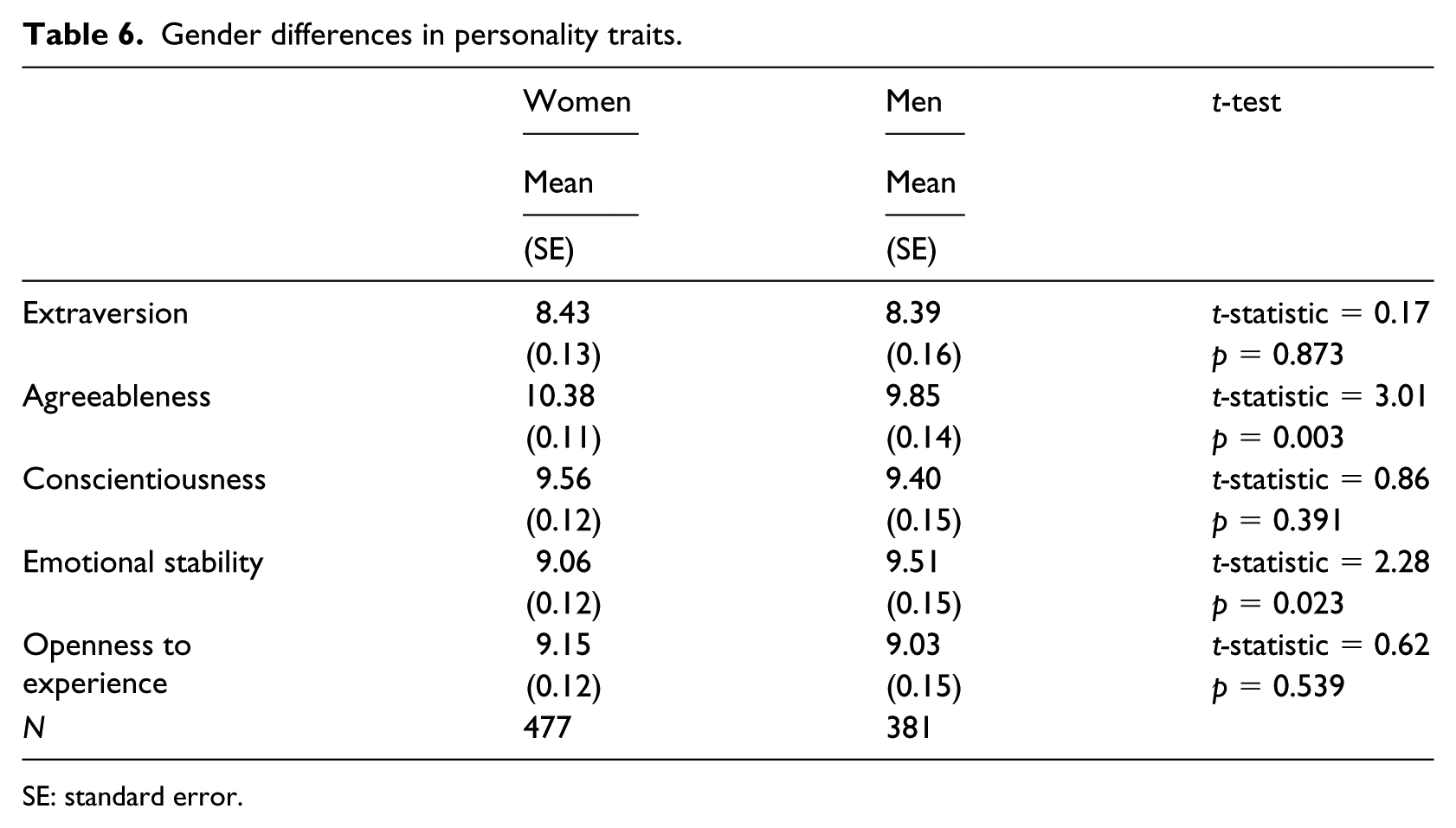
To sum up, this study identifies the significant relationship between personality and individual attitude toward the independence–unification issue in Taiwan. Apparently, personality can provide some explanatory power for Taiwanese people’s positions on the independence–unification issue. Past studies have indicated gender-differentiated effects of personality traits on individual political attitudes and behavior (Wang, 2014, 2017). This study further examines whether there are gender differences in the effects of personality traits on individual attitude toward the independence–unification issue. In accordance with previous research (Budaev, 1999; Chapman et al., 2007; Schmitt et al., 2008), this study finds that women do report higher levels of agreeableness than men, whereas men display higher levels of emotional stability than women; however, there were no significant gender differences found in the levels of extraversion, conscientiousness, and openness to experience (see Table 6), which were also studied here. This study has taken a deeper look into whether agreeableness and emotional stability have different effects on women’s and men’s attitudes toward the independence–unification issue by adding additional interaction terms to the model. The results show no gender-differentiated effects of agreeableness and emotional stability on individual attitude toward the independence–unification issue. 10 In short, the effects of personality traits on individual attitude toward the independence–unification issue are homogeneous for women and men.
Gender differences in personality traits.
SE: standard error.
Supplemental analysis
Because the main mechanism of the relationship between personality and individual attitude toward the independence–unification issue is more relevant to whether people want to make a change in the status quo in cross-strait relations, an alternative analytic approach is to classify individual attitude toward the independence–unification issue into different levels of preferences for change. Therefore, we recode individual attitude toward the independence–unification issue as three levels of preferences for change by combining “maintain the status quo, decide either unification or independence in the future” and “maintain the status quo forever” as no change; “maintain the status quo, and move toward unification in the future” and “maintain the status quo, and move toward independence in the future” as gradual change; and “immediate unification” and “immediate independence” as immediate change. Specifically, we code “no change” as 1; “gradual change” as 2; and “immediate change” as 3. Then we examine the effects of personality traits on this revised measurement of individual attitude toward the independence–unification issue as an ordinal variable, namely individual preference for change in cross-strait relations, by estimating the ordered logistic regression model with the same control variables. 11
As demonstrated in Table 7, two of the Big Five personality traits, extraversion and openness to experience, are significantly associated with individual preference for change in cross-strait relations, which is consistent with our previous findings on the relationships between personality traits and individual attitude toward the independence–unification issue. Specifically, people with higher levels of extraversion and openness to experience tend to prefer a change in cross-strait relations, either unification with China or Taiwan independence. To see the substantive effects of extraversion and openness to experience on individual preference for change in cross-strait relations, we calculate and graph predicted probabilities according to the procedure outlined by Long (1997). As shown in Figures 5 and 6, it is evident that with the increase of extraversion and openness to experience, the probabilities of preferences over gradual change and immediate change increase, whereas the probability of support for no change decreases. In particular, people with the highest level of extraversion are 5.1 percentage-points more likely to prefer immediate change than those with the lowest level of extraversion. Similarly, people with the highest level of openness to experience are 5.2 percentage-points more likely to prefer immediate change than those with the lowest level of openness to experience. In addition, people with the highest levels of extraversion and openness to experience are more likely to prefer gradual change than those with the lowest levels of extraversion and openness to experience, respectively, by 15.1% and 15.8%.
Ordered logistic regression analysis of the relationship between personality and individual preference for change in cross-strait relations.

p < 0.01; **p < 0.05; *p < 0.10.
SE: standard error; OR: odds ratio.
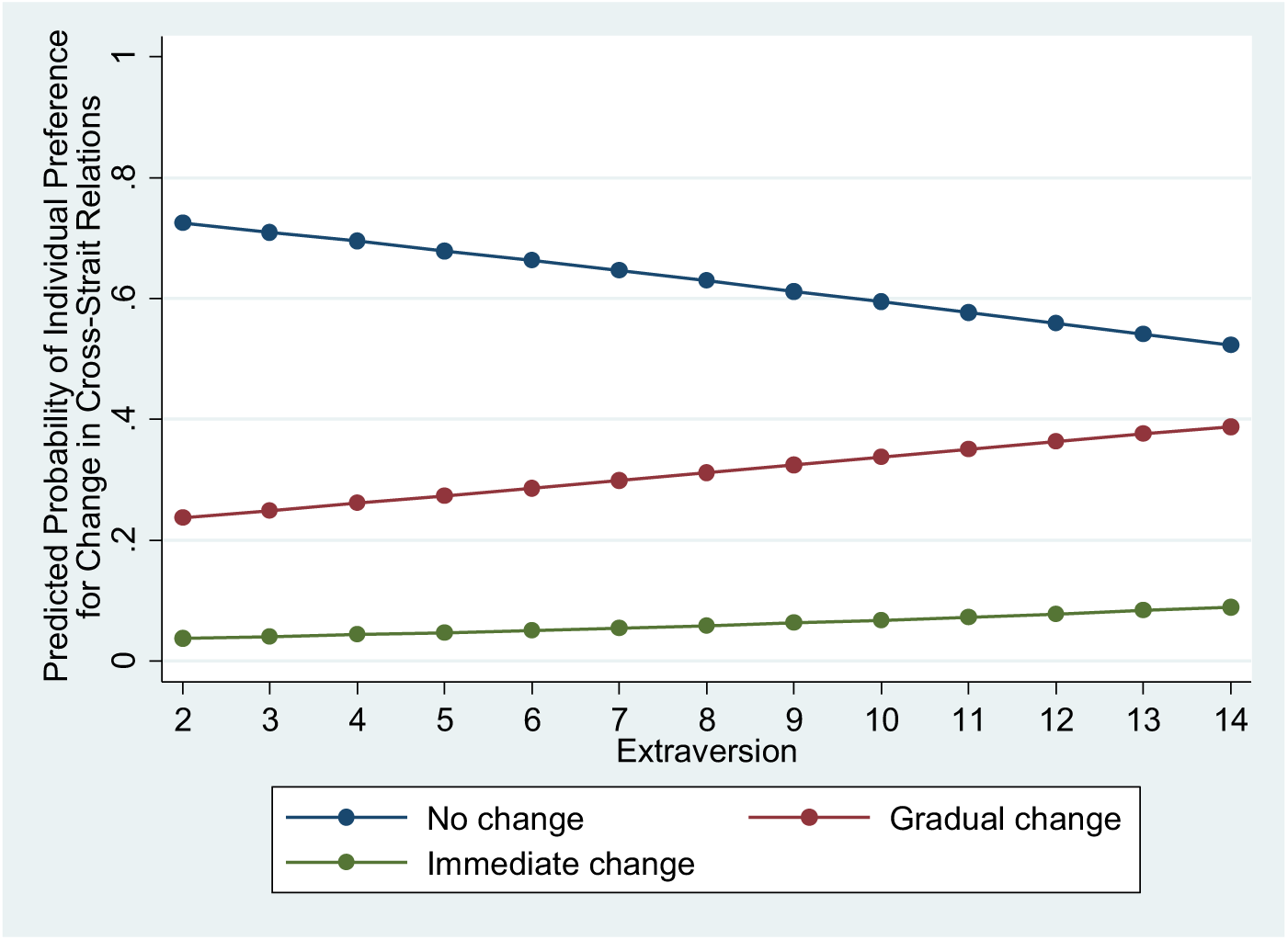
The effect of extraversion on individual preference for change in cross-strait relations.
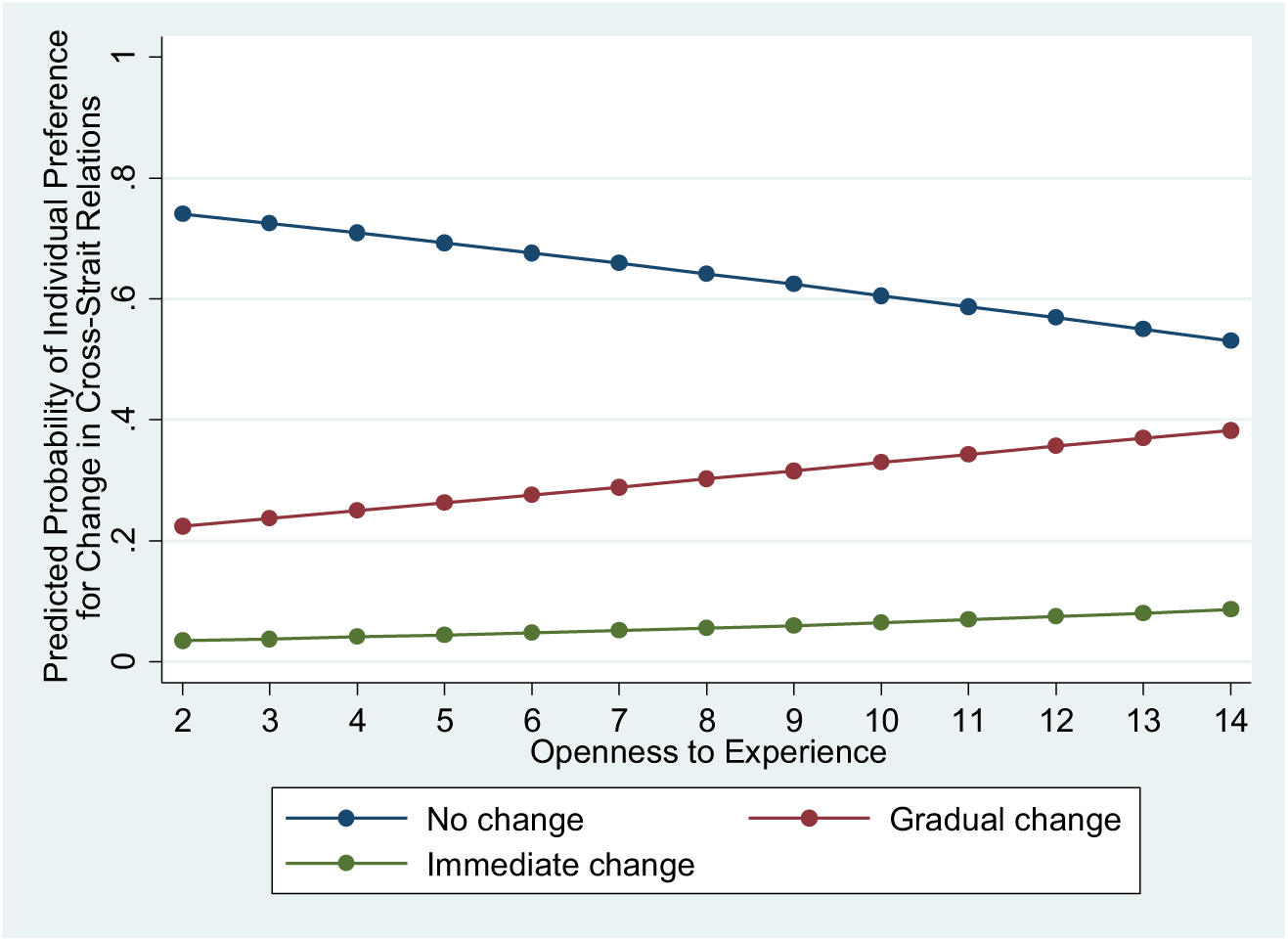
The effect of openness to experience on individual preference for change in cross-strait relations.
Overall, the above results again confirm the significance of extraversion and openness to experience in individual attitude toward cross-strait relations in Taiwan. That is, extraversion and openness to experience drive Taiwanese people not only to be more likely to support either unification with China or Taiwan independence, but also be more likely to prefer a change in cross-strait relations. As a result, in addition to attitudinal factors such as partisanship and Taiwanese identity, we should also take dispositional characteristics into consideration to account for Taiwanese people’s attitudes toward cross-strait relations.
Conclusion
Although a growing number of studies have looked into the relationships between personality traits and individual political attitudes, it is unclear whether and how personality traits could influence individual attitude toward the independence–unification issue in Taiwan. This study represents the first attempt to establish the theoretical framework and provide empirical evidence for the relationships between the Big Five personality traits and individual attitude toward the independence–unification issue. The results from this study confirm that extraversion and openness to experience are significantly associated with individual attitude toward the independence–unification issue. In particular, people who score high on extraversion are more likely to support unification with China, but are less likely to support maintaining the status quo. On the other hand, those who score high on openness to experience tend to support Taiwan independence, but are less in favor of maintaining the status quo. In addition, people with higher levels of extraversion and openness to experience are also more likely to prefer a change in cross-strait relations, either unification with China or Taiwan independence. Past studies on individual attitude toward the independence–unification issue have mainly focused on attitudinal factors such as partisanship, Taiwanese identity, and demographic characteristics. This study, however, points out the importance of personality as a dispositional factor in shaping individual attitude toward the independence–unification issue, implying that we should not ignore the role of personality in individual political attitudes and behavior in Taiwan.
Given the nature of cross-sectional data used in this study, some might suspect that the relationships between personality traits and individual attitude toward the independence–unification issue is correlational rather than causal. This study does not mean to emphasize the causal relationships between personality traits and individual attitude toward the independence–unification issue. Nevertheless, past studies have documented that genetic factors play a more important role in determining an individual’s personality traits compared to environmental factors (Bouchard, 1994, 2004). In other words, personality traits are suggested to be innate and inherited. Therefore, an individual’s personality should be formed before he or she develops the attitude toward the independence–unification issue. We acknowledge that this study fails to offer clear evidence for the causal relationship between personality and individual attitude toward the independence–unification issue. Nonetheless, previous research could help us validate that the direction of influence should go from personality traits to individual attitude toward the independence–unification issue and not vice versa.
On the other hand, this study acknowledges that the independence–unification issue is a specific political issue in Taiwan and thus it is difficult to generalize the findings of this study to other countries. However, the results of this study can offer some implications for the relationships between personality traits and attitudes toward foreign policy issues in other countries. That is, personality traits can play an important role in shaping individuals’ foreign policy attitudes. Foreign policy issues vary considerably across countries, but the influence of personality on attitudes toward different policy issues might follow a similar theoretical framework shown in this study. Consequently, this study can help extend our understanding of the relationship between personality and foreign policy attitudes in other countries.
Lastly, this study simply focuses on the direct relationships between personality traits and individual attitude toward the independence–unification issue. However, previous research has suggested the existence of mediation mechanism for the relationships between personality traits and political behavior (Blais and Labbé St-Vincent, 2011; Gallego and Oberski, 2012; Schoen and Steinbrecher, 2013; Wang, 2016; Wang et al., 2017). That is, attitudinal factors, such as civic duty, political interest, political efficacy, political discussion and so on, could mediate the effects of personality traits on voter turnout, vote choice, and protest participation. In Taiwan, individuals’ attitudes toward the independence–unification issue are mainly shaped by partisanship, and past studies in the USA and Europe have identified the close connection between personality traits and party identification (Caprara et al., 1999; Gerber et al., 2012; Schoen and Schumann, 2007). Accordingly, it is reasonable to contend that personality might indirectly influence individuals’ attitudes toward the independence–unification issue through party identification. However, due to a missing theoretical framework for the relationship between personality and partisanship in Taiwan, it might be immature to establish a mediation mechanism of the relationships among personality, partisanship, and individual attitude toward the independence–unification issue. Therefore, further studies are needed to first examine how personality traits shape individuals’ partisan attitudes and then look into how party identification mediates the effects of personality traits on individual attitude toward the independence–unification issue. In addition to partisanship, it is also worthwhile for future research to investigate whether the relationships between personality traits and individual attitude toward the independence–unification issue could be mediated by other attitudinal factors. On the other hand, there is also a pressing need to understand the effect of personality on political participation in Taiwan due to an insufficiency in existing literature on the relationship between personality and individual political behavior in Asia.
Footnotes
Author’s note
Ching-Hsing Wang is now affiliated to the National Cheng Kung University, Taiwan.
Funding
The authors disclosed receipt of the following financial support for the research, authorship, and/or publication of this article: This research was funded by Top University Project of National Chengchi University, made possible by a grant from Ministry of Education, Taiwan.