



Abstract
The study analyses the dynamic effect of rural-urban relationship, economic growth and urban agglomeration in sub-Saharan Africa with a view of testing the validity of the Williamson-Kuznets hypothesis. The study utilized panel data analysis with pooled ordinary least squares with secondary annual time series data ranging from 1970 to 2017 and sourced from the World Bank database. The study equally employed both homogeneous and heterogeneous panel unit root tests to verify the stationarity of the panel data variables before estimating the model. However, the estimation result revealed that both rural and urban population growth has a negative impact as well as a statistically significant result on urban agglomeration in sub-Saharan Africa. The result equally showed a negative impact but statistically insignificant relationship between urban agglomeration and foreign direct investment. Also, a statistically significant and positive relationship was recorded between economic growth and urban agglomeration, thereby validating the Williamson-Kuznets hypothesis in sub-Saharan Africa. Based on the findings, the study among other numerous policy recommendations calls for a critical review of policies in the economies of sub-Saharan Africa to ensure effective utilization of the foreign direct investment net inflows towards initiating more and robust development projects both in the cities and rural areas, as well as expand the provisions of the basic infrastructural facilities and development projects. This would aim to curtail any perceived and unwarranted influx to the urban areas by the rural dwellers, hence they do not contribute significantly to growth in urban agglomeration.
Keywords
Introduction
Generally, the economies in sub-Saharan Africa are characterized by underdeveloped human and material resources to stimulate economic growth (Tripathi, 2017). The rural-urban population drift has experienced a tremendous increase in numbers and size, and this has caused urban agglomeration in recent decades (Oyeleye, 2013). Urban agglomeration is a population of more than 1 million and it is the percentage of a country’s population living in metropolitan areas such that in 2018 had a population of more than 1 million people (World Bank, 2019).
As simply defined by the French Statistical Institute, ‘an urban agglomeration is an extended city or town area comprising the built-up area of a central place and any suburbs linked by continuous urban area’, and in a nutshell, an urban agglomeration is an ‘extended city, urban area, or large urban clusters’. In most countries in sub-Saharan Africa, the rural population has been experiencing a decreasing rate in relation to the urban population given the increase in rural-urban migration propensities in search of more economically viable means of livelihood. Also, the unprecedented increase in rural-urban populations in the recent past is attributable to a lack of adequate development drivers in the rural areas of sub-Saharan Africa to absorb the growing rural population in which unemployed youth account for over 60% of the entire populace (Blochet al., 2015).
Rural population refers to people living in rural areas as defined by national statistical offices. It is a population below 5 million and it is the percentage of the total population living in areas where the elevation is 5 m or less. Similarly, the urban population refers to people living in urban areas and is calculated using World Bank population estimates and urban ratios from the United Nations World Urbanization Prospects. However, aggregation of the urban and rural population may not add up to the total population because of different country coverages (World Bank, 2019).
According to the United Nations Population Division, the increase in rural-urban migration is evidenced in the perceived disproportion of provision of infrastructural facilities which is not limited to social amenities and other socio-economic amenities to boost rural economic growth. This rural-urban migration to cities and suburban areas stimulates the growth in urban population and invariably affects urban agglomeration positively (Wei et al., 2016). Generally, rural-urban migration is seen as movement or relocation among rural dwellers to urban areas or cities for settlements. The migration can be consequent upon limitations of economic opportunities in the rural communities as well as the search for more meaningful livelihoods rooted in robust economic opportunities in the cities. Essentially, economic growth simply implies an increase in aggregate output which can invariably stimulate development which in turn can accelerate urban agglomeration. Mostly in some economies in Africa, the upsurge in growth in rural-urban populations is characterized by declining agricultural productivities due to local and armed conflict among rural dwellers and herdsmen (Ellis and Harris, 2004). More precisely, the search for better education, employment, transportation systems, communication, and trade and commerce do contribute significantly to increased urban populations (Ikwuyatum, 2016). Also, there have been growing trends in urban and rural populations as well as urban agglomeration in sub-Saharan Africa over the past decades (World Bank, 2019), and this is graphically represented in Figure 1.

Trends in rural and urban population growth, and urban agglomeration in sub-Saharan Africa, 1970–2017.
Figure 1 presents the interactive trends in the urban agglomeration, rural and urban population growth in sub-Saharan Africa. The data sourced from the World Bank database as presented in Figure 1 revealed that urban agglomeration has maintained a steady increase over time. For instance, it has grown from 7.71 million in 1970 to 9.69 million in 1980, 11.66 million in 1990, 13 million in 2000, and 14.35 million in 2010, and stands at 15.37 million in 2017. On the other hand, urban population has maintained a slight variation over time from 4.77 million in 1970 to approximately 5.05 million in 1978, and dropped to 4.75 million in 1979; since then, it has been hovering between the minimum value of 3.84 million and maximum value of about 5.09 million over the extended time period ranging from 1980 to 2017. Similarly, rural population growth is not excluded from the oscillation as the population has been fluctuating from a minimum value of about 2.03 million in 1970 and 2.15 million in 2007 before it began to decrease steadily from 1.98 million in 2008 to approximately 1.82 million in 2017.
This study is centred on the 48 sub-Saharan African economies: Angola, Benin, Botswana, Burkina Faso, Burundi, Cabo Verde, Cameroon, Central African Republic, Chad, Comoros, Congo (Democratic Republic of the), Congo (Republic of the), Cote d’Ivoire, Equatorial Guinea, Eritrea, Eswatini, Ethiopia, Gabon, Gambia, Ghana, Guinea, Guinea-Bissau, Kenya, Lesotho, Liberia, Madagascar, Malawi, Mali, Mauritania, Mauritius, Mozambique, Namibia, Niger, Nigeria, Rwanda, Sao Tome and Principe, Senegal, Seychelles, Sierra Leone, Somalia, South Africa, South Sudan, Sudan, Tanzania, Togo, Uganda, Zambia and Zimbabwe (World Development Indicators (WDI), 2019).
In sub-Saharan Africa, substantial economic and population growths have been recorded over the past for decades. The arguments on whether the economic and/or population growths impair urban agglomeration have remained unclear as some recent studies such as Ellis and Harris (2004) and Da-Mata et al. (2007) fall short of unravelling the relationships. However, the total population of sub-Saharan Africa rose from about 2.93 million in 1970 to 3.86 million in 1980, 5.12 million (1990), 6.71 million (2000), 8.78 million (2010) and 1.06 billion in 2017; while the gross domestic product (GDP) grew continuously from US$6.41bn up to US$9.06tn in 2006 before decreasing to US$1.67tn in 2017 (World Bank, 2019) (see Figures 2 and 3 in the Appendix for trends in total population and GDP, respectively). Moreover, the recent fluctuation in the GDP in sub-Saharan Africa according to Imo (2017) can be attributed to growth in rural-urban migration as characterized in African economies at large; and persistent conflicts between local farmers and nomadic herdsmen as a result of daily open grazing activities of the herdsmen within the region.
Furthermore, despite the decreasing level of the general decrease in agricultural productivities in rural areas in sub-Saharan Africa, continuous expansion of development within the cities and urban areas constitute another compelling factor that stimulates rapid urban influx from the rural communities with a higher propensity for the envisaged population explosion in urban areas in coming years (Bloch et al., 2015). In Africa as a whole, the total population hit about 1.2 billion in 2018 which represents about a 2.52% yearly change against the 2.55% annual increase in 2017. This goes further to buttress the fact that the population of Africa represents about 16.87% of the world population, which was estimated at about 7.6 billion in 2018. The percentage of the urban population in Africa continues to grow from 39.5% in 2015, 39.9% in 2016 and 40.2% in 2017 to 40.6% in 2018. The total population of Africa is forecasted to hit about 1.3 billion in 2020, 1.5 billion in 2015 and 1.7 billion in 2030; and the corresponding percentage rise in the urban population is 41.4% in 2020, 43.3% in 2025 and 45.1% in 2030 (United Nations Department of Economic and Social Affairs (UN DESA), 2018). The implication is that the absolute size of the urban population is clearly expected to be persistently on the increase in the coming years (Bloch et al., 2015).
Consequently, an urban agglomeration is also likened to urbanization proper, as it can be also viewed as densely populated or built-up areas made up of the suburbs, cities, frequently settled commuters and other connecting areas with residential density at urban levels (UNICEF, 2012). Most significantly in the developing nations, the rate of urbanization over recent decades is overwhelming. This is equally attributable to rural-urban migration as occasioned by a myriad of factors, not limited to the search for viable employment opportunities and an increase in welfare. On the contrary, an urban agglomeration is not totally devoid of accompanying social and economic phenomena as growth of cities increases environmental pollution, congestion, crime, food insecurity and growth in slums (d’Addio and d’Ercole, 2005; Li et al., 2019; Reddy and Roberts, 2018).
Essentially, given the fact that urban population growth is further explained as directional rural-urban movement geared towards increasing the population of urban areas, the urban agglomeration is further explained or viewed by different studies. Further to the already defined urban agglomeration concept, an urban agglomeration is taken to mean urbanization as well as external economies inherent in the cities (Frankhauser, 1998). Also, Glaeser (2008) is of the opinion that urban agglomeration can be seen as the delineation of the spatially continuous regions; while Fang and Yu (2017) contend that urban agglomeration can be viewed from six categorical perspectives. First, from the ecological perspective, it is an evolution from spatial forms and external morphology resulting from the product of a symbiotic growth of all elements with a self-organizing process. Second, urban agglomeration from statistical and quantitative perspective is a specific identified spatial size and has properties such as the community of spatial landscape, population density and urban/township functions. Third, it is also viewed in terms of accessibility such as urban field and functional interconnectivity such as urban functional economic zones. Fourth, it is seen as an identifiable population count within a geographical zone in cities. Fifth, urban agglomeration is perceived to mean a certain or minimum number of population and residential locations within the peripheral areas of a city. The sixth categorical perspective views urban agglomeration as a distance between the main city to the most peripheral areas or zones with certain criteria such as commuting a 4-hour distance.
In conclusion, studies like Stark and Fan (2007) argued, in the model of new general equilibrium linking rural-urban migration, externality and urban agglomeration, that income in both urban and rural areas, on average, tends to reduce consequent upon the unrestricted rise in rural to urban migration. Similarly, Carl et al. (2012) assert that rural migration to the city or urban area especially in the developing countries is one of the necessary conditions of initializing urbanization activity. Even though this has been the focus of different studies, a detailed review of the existing literature shows that there exists no empirical evidence of the effect of rural-urban population growth and economic growth on urban agglomeration in both country-specific and cross-country studies in sub-Saharan Africa.
Based on the foregoing, the motivation for this study is drawn from the dynamics of rural-urban population growth as well as economic growth in relation to urban agglomeration in sub-Saharan Africa over the years. Consequent upon the motivation, the broad objective of the study is to examine the relationship among the rural-urban population, economic growth and urban agglomeration in sub-Saharan Africa with the aim of determining the validity of the Williamson-Kuznets hypothesis by using panel data analysis with pooled ordinary least squares (OLS) technique.
Review of related literature
A myriad of literature exists in the area of urban agglomeration and rural-urban population growth over the recent and past decades. One notable theory in the literature in this area is the Williamson-Kuznets hypothesis. The hypothesis is an inverted U-shaped curve which presents the phenomenon as increasing in the initial stage and tending to decrease after reaching an optimal point. Kuznets (1955) posits that personal income inequality tends to increase or widen at the initial stage of development and decrease or contract at the later stage of development. The outcome of the Kuznets hypothesis was later adopted in Williamson’s (1965) study of the spatial degree of inequality in developed and developing economies. The outcome of Williamson’s work revealed that inequality grows in regional development in the early stages and tends to decrease continually in the later stage of development after attaining an optimal development level or turning-point – hence the term, Williamson-Kuznets hypothesis.
Comparatively, one of the most recent empirical studies was carried out by Fang and Yu (2017) on urban agglomeration as an emerging phenomenon in the evolving concept in China. The study provided more robust practical and theoretical support to urban agglomeration. The study reviewed over 120 years of research in 32,231 related studies on urban agglomeration and identified four distinct phases of urban agglomeration’s spatial expansion and thus proposed operational perspectives for explaining urban agglomeration. Also, Wei et al. (2016) in the Pearl River Delta of southern China measured urban agglomeration using a city-scale asymmetric population map with medium to high remote sensing data of 28 cities to delineate, measure and evaluate urban agglomeration over time periods and across different jurisdictional boundaries with a view to providing practical guidance. On that note, the result from the evaluation of the 28 cities in southern China furnished the investigators of spatial agglomeration in a megacity with much-needed information on urban planning and sustainable development effects.
Ahrend et al. (2017) determined the nexus between urban agglomeration, cities and economic productivity in Organisation for Economic Co-operation and Development metropolitan regions using cross-section data spanning from 1995 to 2010 while employing information from Google Maps to track the speed of linking one city to another in the urban areas. The findings of the study showed a significant positive relationship between growth in urban agglomeration with per capita income (proxied by GDP) and economic productivity. These findings corroborated a study in India by Tumbe (2016) who studied the relationship between urbanization and urban growth. The study concluded that an increase in urbanization tends to hugely increase income in India.
In India, Tripathi and Kaur (2017) investigated the determinants of rural-urban migration in large cities/agglomerations using OLS regression analysis. The study focused on 51 large cities with data sourced from Indian population census and national survey data on employment, unemployment and expenditure on consumption. The regression result reveals a significant impact of city employment and unemployment on rural-urban migration. The study equally shows that rural-urban migration is negatively impacted by inequality conditions and the level of poverty in the urban area. In Germany, Oded and Fan (2007) examined the relationships among rural-urban migration, human capital and agglomeration in developing countries using a new general equilibrium model. The study reveals that on average, uncontrolled rural-urban migration reduces the income of the average urban and rural population. Based on the findings, the study highlighted that Pareto equilibrium or optimality in both rural and urban populations can be improved by restricting unskilled migrants to the urban areas.
Also, Hasan et al. (2017) used multiple data sets of cities in India to estimate the wages elasticity in relation to the population density of the urban populace. The study revealed that optimal urbanization can be realizable in India if issues such as efficient public service delivery, urban planning and infrastructure can be fully addressed. Tripathi (2017) equally analysed the nexus between population agglomeration and infrastructural development in the urban area in India by ranking cities based on the availability of infrastructural facilities. The study showed that an abysmally low rate of urbanization in the cities of India is directly linked to poor infrastructural facilities. The overall findings of the study posit that population agglomeration in India is not significantly affected by infrastructural development.
In addition, Sridhar (2016) in India analysed the costs and benefits of urbanization while paying greater attention to the effect of urbanization on economic productivity by finding the microeconomic proof. The study result highlighted a unidirectional causality from urbanization to economic gorwth without feedback. In urban India, Tripathi (2013) used data of about 59 large cities with a new economic-geography model to examine the determinants of urban agglomeration. The study result revealed that efficient policy and markets contribute significantly to urban agglomeration in India. The study equally showed strong evidence of a correlation between economic growth and urban agglomeration in India.
In a related study, Ferreira et al. (2016), in their analyses of cities and slums in Brazil, developed a simple model under the theoretical and methodological framework of two-period lived overlapping generations (OLG) and examined the interactions of urban development, structural transformation, social mobility, and income and skill distribution. However, analysis of public policies effect on housing costs in the cities/urban areas and slums revealed that a rise in housing costs in the cities has a high tendency to drive the city or urban population to slums with a reduced pace of growth of human capital development and urban areas. In France, Cottineau et al. (2016) used income, wage and population data to examine cities’ complexity and spatial agglomeration with a view to providing empirical measurements for urban agglomeration. The study result highlighted that income concentration and economic specifications are denser in the urban area though there are local production advantages in the rural area.
A similar study was conducted in China on the rationale for world cities agglomeration by Tabuchi (2013) using World Urbanization Prospects international data while employing panel regression analyses. The study revealed that the factors behind the change in an urban agglomeration and the level of agglomeration in world cities differ. The result from the regression analysis highlighted that trade openness negatively affects the level of world city agglomeration. Furthermore, evidence from the regression result also revealed that economic development, secondary and tertiary shares positively affect agglomeration, but it is unaffected by national capital. The study concluded that the fixed effects of the country are crucial factors that influence changes in world city agglomeration.
In the Jing-Jin-Tang area of China, Lu et al. (2014) used multi-temporal Landsat images to study the dynamics of cities or urban areas in the territory between 1990 and 2010. The study paid attention to the enhanced built-up areas. The result from the study revealed that all cities experience substantial but divergent growth in built-up areas with Beijing and Tianjin taking the lead on optimal development in the region. In another related study (Tripathi, 2012) a panel data approach of about 52 large cities was employed in investigating the connection between large agglomerations and growth in the urban area in India spanning from 2000 to 2009. The study result supported the Williamson hypothesis that economic growth is stimulated by agglomeration at a given threshold of economic development.
In another similar study, Da-Mata et al. (2007) studied the determinants of city growth in Brazil using a structured demand and supply ambitions model to capture the evolution of urban sizes and their decennial growth as well as the output at the metropolitan level. The result reveals very strong effects of growth in the sizes of local markets and the accessibility of domestic markets upon the urban growth rates. The result equally highlighted that improvement in the quality of human capital development is highly imperative in attaining economic growth. Corroborating these findings are Greenstone et al. (2007) who examined agglomeration spillover using a good number of US data of over 123 cities spanning from 1970 to 2006.
Therefore, following the extensive review of related literature on the key variables such as rural-urban population growth, economic growth and urban agglomeration and given the already stated research objective, this study adopts a corresponding null hypothesis (H0) as follows: rural-urban population growth and economic growth have no significant effects on urban agglomeration, and the Williamson-Kuznets hypothesis is not supported in sub-Saharan Africa.
Methodology and estimation technique
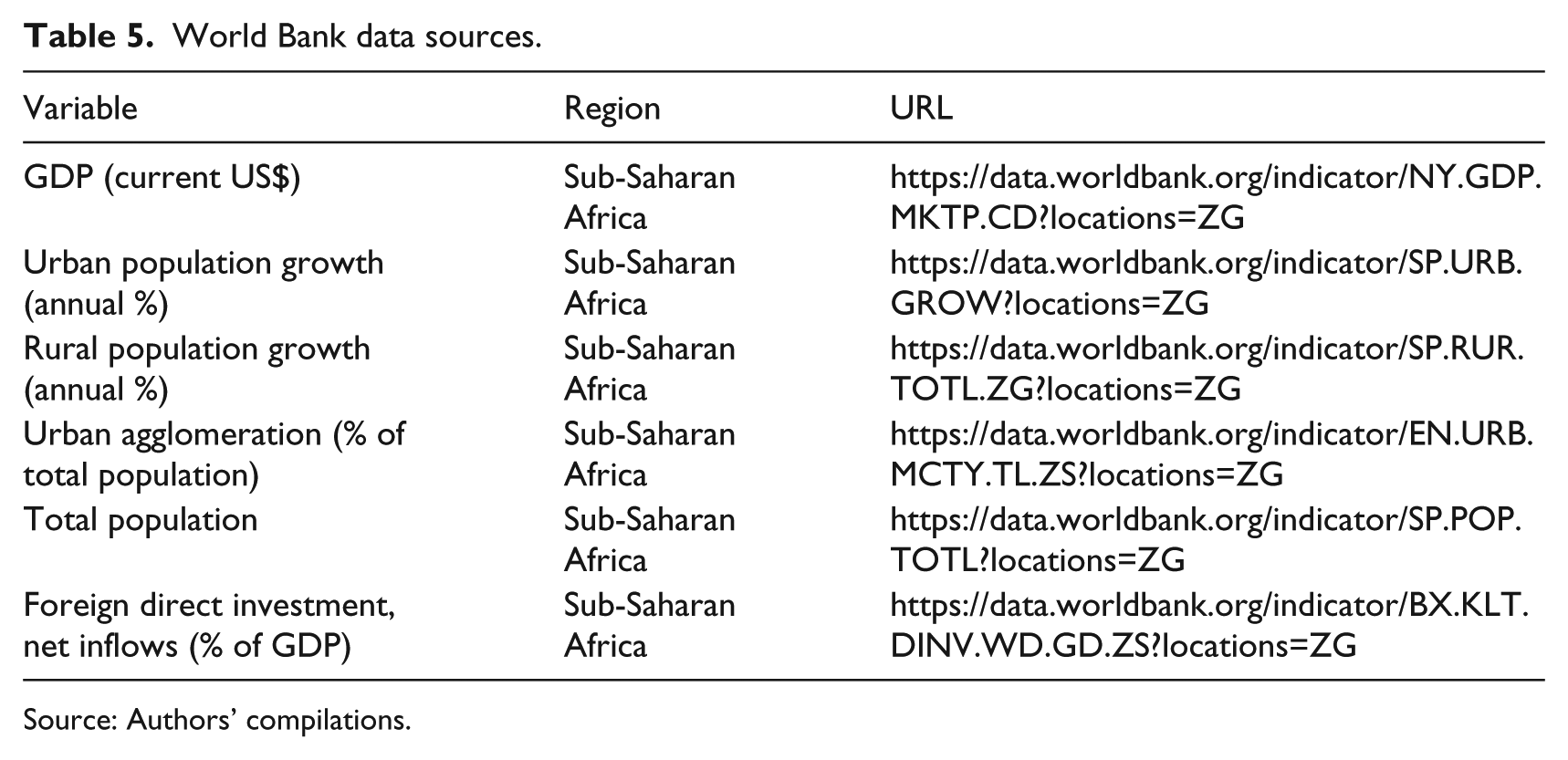
Theoretically, this study is rooted in the inverse U-shaped curve of the Williamson-Kuznets hypothesis, which states the relationship between economic development and differences in regional development. This hypothesis was also adopted in related studies such as Tripathi (2013, 2017), Tánczos and Egri (2010) and Ozturk (2010). The analysis is considered by utilizing urban agglomeration, rural-urban population growth and GDP data of 48 counties in sub-Saharan Africa from 1970 to 2017 with accurate data sourced from the World Bank database (see Appendix, Table 5 for the data sources with their Uniform Resource Locator (URL) and Figures 2 and 3 for trends in total population and GDP, respectively). However, Williamson (1965) introduced the coefficient of variation (CV) and national per capita income which measure the inequality among regions and economic development (proxied by GDP). However, the inverted U-shaped hypothesis/curve was captured using quadratic regression models as follows

where,

where,
Empirically, the study utilized panel data analysis with a pooled OLS model. However, the pooled OLS model is very useful when analysing the impact of variables that vary over time, as well as determining the regressor and outcome variables within the country, region and other entity (Baltagi, 2008). Therefore, the panel pooled OLS is as follows

where,
On that note, the mathematical expression for determining the objects of the study is articulated into the following relationship

where,
More so, equation (4) is transformed into the econometric model, thus

where: i = 1, 2, 3, . . ..n represents countries in sub-Saharan Africa (48 countries). Note that other variables and acronyms were explained in equations (3) and (4) above.
Results and discussion
Descriptive statistics of variables in the model
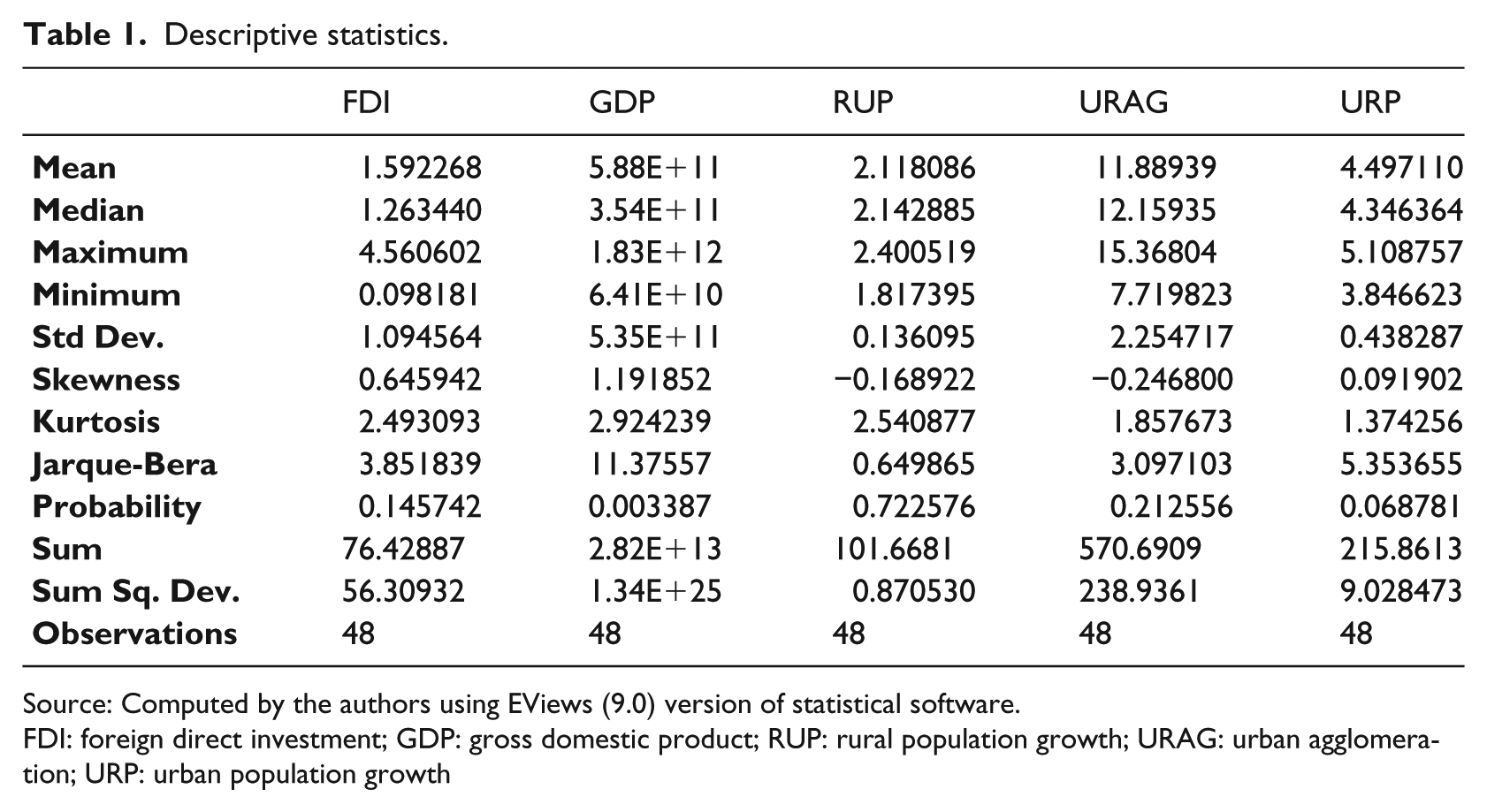
The study considered the dynamic interactions among rural-urban population growth, urban economic development and urban agglomeration using data collected from 48 countries in sub-Saharan Africa from World Bank database (see Appendix Table 5 for the data sources and URL links). The key variables utilized for the analyses include rural population growth (RUP), urban population growth (URP), GDP and foreign direct investment (FDI). Table 1 provides the summary descriptive statistics for the variables used for the analysis.
Descriptive statistics.
Source: Computed by the authors using EViews (9.0) version of statistical software.
FDI: foreign direct investment; GDP: gross domestic product; RUP: rural population growth; URAG: urban agglomeration; URP: urban population growth
Table 1 shows that the analysis used balanced observation with a total of 48 observations with a normal mean, kurtosis, Jarque-Bera and standard deviation variables. All the variables presented in the descriptive table have a positive skewness with the exception of the rural population growth (RUP) and urban agglomeration (URAG). Furthermore, to ensure more clarity in the non-existence of structural defects and the need for extended normalization of the data before the analysis, the study employed more robust checks for the presence of multicollinearity and unit roots.
Correlation analysis
Table 2 presents the output of the Pearson correlation coefficients for the variables used in the model. A typical Pearson’s correlation coefficient measures the degree of association between two continuous variables. The ordinary correlation matrix provides an opportunity to assess the degree of multicollinearity between the variables under study before the estimation is carried out.
Correlation matrix.

Source: Computed by the authors using EViews (9.0) version of statistical software.
FDI: foreign direct investment; GDP: gross domestic product; RUP: rural population growth; URAG: urban agglomeration; URP: urban population growth
The table shows that rural population growth (RUP) has a negative association or correlation with foreign direct investment (FDI) and gross domestic product (GDP). Urban agglomeration has a negative correlation with rural population growth, while urban population growth equally exhibits a negative association with FDI, GDP and urban agglomeration (URAG). The implications of the associations among these variables are not yet clear until further pre-tests (stationarity or unit root tests) and proper estimation are conducted.
Stationarity or unit root test
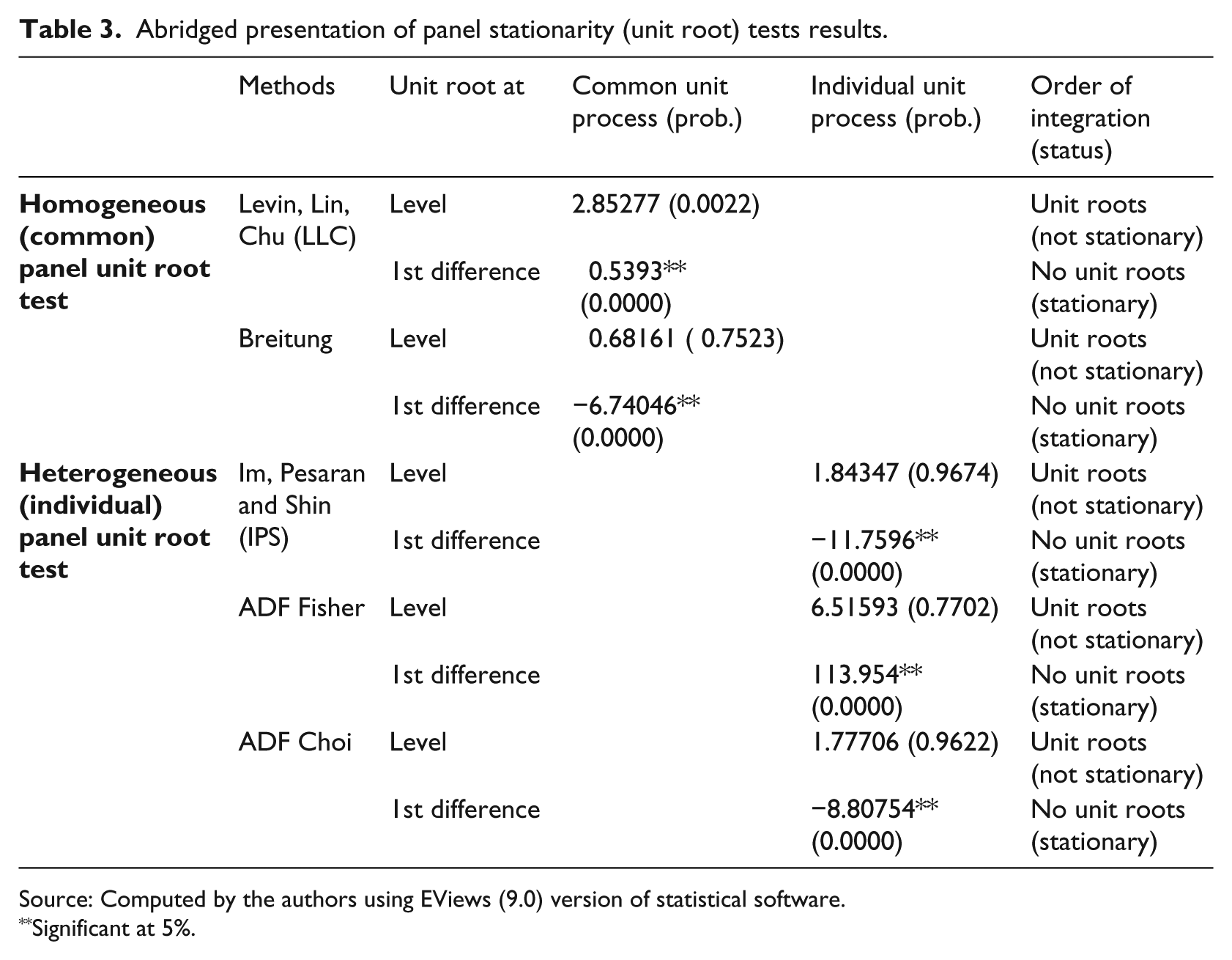
In panel data analysis, there are two broad categories of testing for unit roots, the homogeneous or common unit process and the heterogeneous or individual unit process (Baltagi, 2008). Both the homogeneous and heterogeneous unit processes are further classified into different methods. While the homogeneous methods of the unit process include but are not limited to Levin et al. (2002) and Breitung (2000), the heterogeneous methods include Im et al. (2003), Fisher-type tests using Augmented Dickey-Fuller (ADF) and Choi (2001). Table 3 presents the abridged unit root tests with relevant statistics.
Abridged presentation of panel stationarity (unit root) tests results.
Source: Computed by the authors using EViews (9.0) version of statistical software.
Significant at 5%.
The information in Table 3 described the concise but vital output of the stationary tests using both the homogeneous and heterogeneous methods of a unit root process to ensure accuracy in test results. Obviously, the stationarity tests revealed that all the variables in the model are stationary at 1st difference after it showed the presence of unit roots at level. The uniformity and outcomes of the stationarity result further solidify the confidence in the regression model. Consequently, Table 4 presents the estimated output/result of the panel OLS model as specified in equation (5).
Abridged presentation of the estimated model’s results; dependent variable: urban agglomeration (URAG).

Source: Estimated by the authors using STATA 13.0 statistical software.
Estimated results from the panel data pooled OLS technique
Table 4 presents the concise results of the estimation output of the estimation of panel data pooled ordinary least squares technique of econometric equation (5). The equation has urban agglomeration as the dependent variable, with the rural-urban population growth, economic growth (GDP) and foreign direct investment (FDI) as the independent variables. The empirical output of the regression analysis shows a very interesting outcome as evidenced in Table 4.
Table 4 shows the panel regression result, and it concentrates on the most essential part of the regression result with the intention of reducing the level of technicality inherent in the study. On that note, however, fitting the estimation result in the regression equation (5) shows that urban agglomeration = −2.846774 (URP) − 5.173083 (RUP) + 1.38E-12 (GDP) − 0.214505 (FDI) + 35.17871 (constants otherwise abbreviated as ‘cons’). The estimation output literally shows that, holding every other variable constant, urban agglomeration decreases by 2.846774 when URP goes up by 1%, decreases by 5.173083 when rural population growth goes up by 1%, increases by approximately 1.38 when GDP goes up by 1%, and further decreases by 0.214505 when foreign direct investment goes up by 1%, and then, at the value of 35.17871, all the independent variables (URP, RUP, GDP and FDI) are zero.
In addition, the result shows, especially from the coefficient column that rural-urban population growth and foreign direct investment (FDI) have a negative relationship with urban agglomeration in sub-Saharan Africa. This means that as the values of rural-urban population growth and foreign direct investment increase, the mean value of urban agglomeration tends to decrease ceteris paribus. Aside from the negative relationships among the three stated variables (URP, RUP, FDI) with urban agglomeration, both rural and urban population growth have a statistically significant impact on urban agglomeration, while foreign direct investment has an insignificantly negative impact on the dependent variable (urban agglomeration). Consequently, these startling findings call for a critical review of the internal policies in the urban areas of the economies in sub-Saharan Africa as the relationship between urban population growth and urban agglomeration is expected to conform to a priori expectations, which are for a positive relationship. Technically, all other features of the estimation output such as R2 (0.934), adjusted R-squared (0.8944), Prob > F (0.0000) and so on are indications that the regression output is robust.
Furthermore, FDI has a negative relationship with a statistically insignificant result (given that the t-statistic equals −1.29 which is less than 2 tabulated) revealing that the FDI impact on urban agglomeration has an infinitesimal effect. Conversely, the GDP has a positive relationship with statistically significant impact on urban agglomeration in sub-Saharan Africa. This goes a long way in demonstrating that an increase in economic growth can lead to an increase in urban agglomeration as postulated in the Williamson-Kuznets hypothesis. These findings validate the usefulness of the Williamson-Kuznets hypothesis in sub-Saharan Africa which is in line with the studies by Ahrend et al. (2017), Tumbe (2016), Tripathi (2012, 2013), and Greenstone et al. (2007). In sum, the inability of foreign direct investment and urban population growth to influence urban agglomeration positively in sub-Saharan Africa call for a proper inward review of policies within the region.
Conclusion and policy recommendations
There has been growing interest in finding solutions to some puzzles or phenomena in sub-Saharan African countries given that some macroeconomic indicators, programmes and interventions are not yielding desirable results. This could be as a result of not identifying the actual cause of the leakages in policies that could provide or engender effective policy-making process to tackle the development questions. In the light of the foregoing, the idea behind this topical study and policy paper is to fill the gap in the growing literature on rural-urban population growth, economic growth and urban agglomeration in sub-Saharan Africa with data sourced from the World Bank database between 1970 and 2017. Despite the competing models of economic and econometric analysis, the study utilized panel data analysis with pooled OLS technique in examining the effects of rural-urban population growth, economic growth and urban agglomeration in sub-Saharan Africa with a view to testing the validity of the Williamson-Kuznets hypothesis in the region.
Uniquely, the empirical findings revealed a negative impact of rural-urban population growth and foreign direct investment on urban agglomeration in sub-Saharan Africa. While the rural-urban population growth is statistically significant, foreign direct investment is statistically insignificant. Again, GDP, a proxy for economic growth, revealed a positive and statistically significant impact on urban agglomeration, thereby validating the Williamson-Kuznets hypothesis in sub-Saharan Africa. Based on the empirical findings, the study prescribes the following policy recommendations:
The economies in sub-Saharan Africa should review and ensure effective utilization of their foreign direct investment net inflows towards initiating more and robust development projects in both the cities and rural areas. Hence the findings revealed that rural population growth does not contribute significantly to urban agglomeration; therefore the economies in sub-Saharan Africa should expand their expenditures on infrastructural development and provision of employment opportunities in the rural areas to curtail the unwarranted influx of rural dwellers to urban areas in search of basic amenities and means of livelihood.
Similarly, an inward policy review and fiscal revenue ‘checks and balances’ should be conducted to ensure fiscal discipline so that foreign direct investment and other revenues and grants are used prudently. This is because gross mismanagement and embezzlement have been a recurrent feature of the leaders in the economies of sub-Saharan Africa.
Indeed, almost none of the economies in sub-Saharan Africa have an efficient agricultural policy to meet modern needs and aspirations to drive economic growth and development. At the present time, so many African countries, especially Nigeria, Ghana, Niger, Cameroon, Mali and Benin, have no standard grazing laws and regulations limiting the open grazing activities of Fulani herdsmen, which often causes communal conflicts and crises between the rural dwellers and the Fulani herdsmen. This crisis has caused fear and panic among rural dwellers/farmers and a greater propensity for migration to the nearest urban areas and cities with a devastating effect on both the local economies and agricultural productivity with the likelihood of causing food insecurity in sub-Saharan Africa.
Also, government agencies with responsibility for cities or capital territory developments should pursue more divergent and decentralized city and urban area development to ensure opening up of adjoining urban areas in sub-Saharan Africa to stimulate growth in urban population and urban agglomeration. This helps to decongest the overcrowded urban areas with its accompanying menace of an increase in slums, crime and poverty levels due to an increase in the rental price of residential accommodation.
Finally, more attractive incentives should be provided to the civil servants and specialists domiciled in the rural areas across sub-Saharan Africa to motivate them and thus curtail the incessant clamour for job transfers from the rural areas to urban areas to the detriment of rural dwellers.
Footnotes
Appendix
World Bank data sources.
| Variable | Region | URL |
|---|---|---|
| GDP (current US$) | Sub-Saharan Africa | https://data.worldbank.org/indicator/NY.GDP.MKTP.CD?locations=ZG |
| Urban population growth (annual %) | Sub-Saharan Africa | https://data.worldbank.org/indicator/SP.URB.GROW?locations=ZG |
| Rural population growth (annual %) | Sub-Saharan Africa | https://data.worldbank.org/indicator/SP.RUR.TOTL.ZG?locations=ZG |
| Urban agglomeration (% of total population) | Sub-Saharan Africa | https://data.worldbank.org/indicator/EN.URB.MCTY.TL.ZS?locations=ZG |
| Total population | Sub-Saharan Africa | https://data.worldbank.org/indicator/SP.POP.TOTL?locations=ZG |
| Foreign direct investment, net inflows (% of GDP) | Sub-Saharan Africa | https://data.worldbank.org/indicator/BX.KLT.DINV.WD.GD.ZS?locations=ZG |
Source: Authors’ compilations.
Funding
The author(s) received no financial support for the research, authorship, and/or publication of this article.
