




Abstract
This article attempts to analyse contemporary reforms of public bureaucracy in Bangladesh from the perspective of ‘political settlements’. After elaborating the concept of political settlement and identifying critical reform initiatives in the public bureaucracy, it argues that variations in the state of the implementation of bureaucratic reforms are decidedly affected by the differences in the pattern of political settlements that the nation has experienced at various times since independence. Thus, in the process of consolidating dominant power coalitions, reform measures were subverted, and formal and informal privileges given to the public bureaucracy resulted in inefficient, ineffective and unaccountable administration.
Keywords
Introduction
‘Political settlement’ as a theoretical construct in analysing social, political and economic issues in relation to the developing world has received increased attention in recent years. It is a form of contract between contending elites on ways of organising and exercising power, based on agreed rules of engagement to obtain power equipoise in a political setting. Formal political interactions between institutions, non-official accords between opposing groups, and both formal and informal rules crystallise political settlement (Khan, 2011). It is the bedrock of political order in any society and the source for state-building. 1
The concept of political settlement is not static. It varies across the developing world. More importantly, there are variations in political settlement in a single country over an extended period depending on how dominant classes negotiate in reaching settlement at a particular time. In general, the dominant elites manage conflicts through negotiations with constituents and control or limit their access to resources, functions and forms of social organisations as a means of generating rents. In the inevitability or presence of conflict, if disgruntled members of the coalition denied an adequate share of rents become defiant, dominant segments in possession of privileges prefer resolving conflicts through negotiation and cooperation rather than unsettling the relationship. This ensures protection of the stakes of each constituent. Informal institutional forms may eclipse formal ones in the rent creation process and vibrant political settlement may manipulate or reconfigure economic dynamics to create rents as a means of accommodating contrary positions (North et al., 2007).
In the developing world context, Khan (2010) uses it to analyse the performance of different forms of institutions. However, while Kelsall (2016) and Khan (2011) have posited the bureaucracy along the political spectrum, they have not discussed the implications of the politics–bureaucracy interface for administrative change from a holistic perspective. On the other hand, Levy (2015) has developed a framework incorporating the interface between political settlements and reforms. The framework is quite important for the international donor agencies. Being perplexed by the ceaseless failures of reforms in the developing world, the World Bank also felt the necessity of alternative approaches to financing bureaucratic reform programs. Therefore, the relevance of political settlement in the reform of public bureaucracy, which developing world ruling elites tend to accomplish in augmenting economic growth, cannot be discounted.
This article aims to link political settlement with bureaucratic/administrative reform/change in a developing country setting. This is particularly pertinent in Bangladesh as the public bureaucracy there, tracing its origins and development back to colonial times, has always been a powerful and dominant institution. After decolonisation, its powers and privileges remained generally unscathed, mainly as an after-effect of differing and often contradictory political settlement attempts akin to those pursued by many other developing polities. Complementing this was the conservative stance of the bureaucracy, which by its nature always favoured the status quo. In most cases, prescriptions for reforming public bureaucracy came from international multilateral donor agencies recommending systems that, largely, corresponded to models relevant to advanced countries in the West. These did not take into cognisance incentives for and interface among members of the dominant coalition, including the bureaucracy.
This article focuses on bureaucratic reforms in developing countries from the political settlement perspective, with reference to Bangladesh. While there is a large body of literature on the politics–bureaucracy interface and its implications for bureaucratic reform in the liberal and modernisation theoretical traditions (Dasandi and Esteve, 2017), these provide limited insight into the paradoxes of reforms. Moreover, these studies attribute the failure of reforms to the lack of political will, power imbalance, lack of skills and knowledge, obsession with power and privileges, state incapacity and so forth. On the other hand, the political settlement perspective, primarily developed for understanding the dynamics of economic development in the developing world, reflects the interplay of politics and economics. It particularly considers the interests and incentives driving the behaviour of diverse groups and the distribution of power (Kelsall, 2016; Khan, 2010; North et al., 2007). A conceptual framework is developed with three important segments relevant to the reform process – political settlement type, bureaucratic reform trend, and the linkage between the patterns of political settlements and the state of bureaucratic reform implementation. This study attempts to investigate the following questions:
The burgeoning literature on political settlements reviewed in this article provides vital insights into the relative position of the bureaucracy. Presumably, however, analysis of the state of bureaucratic reform implementation is inconspicuous by its absence in the literature on political settlements. In the context of this assumption, this article will attempt to make a significant contribution and add value to the existing stock of knowledge in administrative reforms in developing countries in general, and Bangladesh in particular.
Political settlement–bureaucratic reform nexus: conceptual matters
This section attempts to connect two concepts – political settlement and bureaucratic reform – to develop a framework for assessing the dynamics of bureaucratic reforms in developing countries. There is a lack of proper understanding of the social-political context, more specifically the evolution and nature of political settlement and dominant coalitions, the privileges the state creates, the character of formal institutions, and informal norms and values.
Political settlement
The term ‘political settlement’ signifies the contrived relationship among elites based on mutual understanding of the way power is organised and exercised (Hickey, 2013; Khan, 2010; Parks and Cole, 2010). Some other phrases such as ‘elite-enforced social order’, ‘informal balance of power’ and ‘informal rules of the game’ are used to signify the meaning of political settlement (Parks and Cole, 2010: 5). According to Khan (2010: 4), durable political settlement ‘is a combination of power and institutions that are mutually compatible and also sustainable in terms of economic and political viability’. Institutions (rules of the game) can be impersonal (Weberian) or personalised. While impersonal institutions are codified in law and enforced by third parties, personalised institutions ‘are [shaped] around specific identities of the parties involved’ (Levy, 2015: 240). These specific identities are deep-rooted socio-cultural norms which get preponderance over impersonal institutions in pre-capitalist societies (Wood et al., 2017).
The role of rent is also crucial as the nature of institutions engenders diverse types of incentives and constraints across different political settlements. Rents are ‘returns which exceed the opportunity cost of resources which might otherwise be deployed in a competitive market’ (Levy, 2015: 6). In personalised political settlements, rents are distributed mostly through the clientelist networks to the members of the coalition to maintain stability. This has made clientelism an important phenomenon in the political economy of the developing world (Sarker and Khalid, 2018). The bureaucracy as a sought-after coalition partner is also involved in the rent distribution process. Personalised settlement also creates opportunities for members of the higher bureaucracy to get involved in rent seeking, also acceptable to the dominant coalition. In the context of this study, this is particularly important as comprehensive or incremental administrative reforms may lose track if expected outcomes become incompatible with the perceived interests of the bureaucracy.
Political settlement in the developing world is not only clientelist but also riddled with partyarchy, which basically refers to the capture of and influence upon state and non-state institutions by ruling political parties (BIGD, 2014). This has been a trend in clientelist political systems in the developing world. A clientelist system arrayed with partyarchy attributes diminishes the scope of participation, intensifies political violence and drastically crushes the propensity towards competitive politics. In the context of Mexican politics, for instance, Serra (2012) observes two trends: partyarchy and ‘democratic backsliding’, the latter discernible in the electoral law of 2007. He identified problems in four areas: strength of electoral institutions, internal democracy of parties, freedom of speech and political communication.
Political settlement can be typified along various typologies (Kelsall, 2016; Khan, 2010; Levy, 2015). The construction of a typology is conditioned by the nature of clientelism (authoritarian versus competitive) and institutions (personalised versus impersonal). Based on these two factors, Levy (2015) identifies dominant discretion, rule by law, personalised-competitive and rule-of-law competitive as common political settlement types in the developing world. However, these typologies are broad categories for analytical purposes only. Based on available literature, the following types of political settlement are identified for this study:
Populist authoritarian clientelism: defined as a power coalition characterised by weak party structure, numerous clientelist groups, populist slogans and dysfunctional electoral institutions. Informality subsumes the formal institutions and rents are widely grasped by numerous clientelist groups (Khan, 2010; Levitsky and Way, 2010; Lewis, 2011).
Military authoritarian clientelism: in which the military takes control of the state, limited party activities are allowed, and benefits distributed centrally to selected loyalist groups (Khan, 2010).
Competitive clientelism and partyarchy: where political competition and formal democratic institutions are marred by malpractices. The ruling coalition assuming power indulges in patronage distribution and monopolisation of state institutions. Power may shift from one ruling coalition to another coalition depending on the strength of the clientelist networks and the mobilisation of the opposition (BIGD, 2014; Hassan, 2014; Khan, 2013).
Elected authoritarian clientelism and partyarchy: representing a power coalition made of the most loyal clientelist groups. Government is formed through manipulated elections and rents are distributed through an organised arrangement. Potential political mobilisers are crushed, and the state maintains complete hegemony over state and non-state institutions. This kind of settlement is quite vulnerable (Hassan and Nazneen, 2017; Khan, 2017; Levitsky and Way, 2010).
Bureaucratic reform and its implementation
As a form of institutional structure, the public bureaucracy is a complex web of government departments and agencies that are staffed by public servants. In the Weberian tradition, bureaucracy is a vital social group with powers and privileges, albeit working under political orders. The reform of bureaucracies has, in general, involved activities seeking to improve public administration structurally, functionally and behaviourally. It has also to do with initiatives to systematically enhance efficiency and effectiveness, democratic norms, consensus building and equity in core public service institutions (Denhardt and Denhardt, 2000). Indeed, bureaucratic reform focuses on deliberate design to bring about substantive changes (Pollitt and Bouckaert, 2011: 8).
Until the 1980s, the Weberian model was the benchmark for administrative reform and was embraced by international development agencies as best practice for the developing world. However, countries within its fold faced a daunting task in implementing the Weberian precepts to build administrative capacity. One fundamental condition – a culture of following rules and maintaining impersonality in discharging administrative duties – was to be fulfilled to generate the desired results (McCourt, 2013). In pre-capitalist societies, culture-based social-political relations seemed to have influenced the bureaucracy, often resulting in corruption and patronage distribution (Andrews, 2012; Rinnert, 2015). Amidst hopeless conditions, some countries, particularly in East and South East Asia, succeeded in building bureaucratic capacity in lead agencies that provided efficient support to the political elites in socio-economic transformation (Khan, 2011).
The reform discourse of the 1980s focused on best practices embodied in the ‘good governance’ and ‘new public management’ (NPM) models. The good governance model came up with normative descriptors such as voice and accountability, rule of law, political stability, control of corruption, regulatory control and government effectiveness (Grindle, 2017). On the other hand, the NPM model underscored precepts borrowed from business management, includes the desegregation of large bureaucracies, corporatisation, performance management, marketisation, outsourcing, privatisation, managerial autonomy, customer orientation and so forth (Hughes, 2017). However, both these models came under the critics’ scanner because of lapses in implementation.
In the developing world, market-oriented reform programs have not proven to be useful. Lack of political will, weakened state capability and structural inadequacies have been major constraints in reform implementation. In particular, structural constraints embodied in the political economy of the developing world came to be recognised as major hurdles toward the implementation of market-oriented reforms (Ankamah and Khoda, 2018; Brinkerhoff and Brinkerhoff, 2015; Grindle, 2017; Khan, 2010; Levy, 2015)). However, East Asian countries did succeed in achieving viable political settlements conducive to the development of integrated and intensive bureaucratic systems (Khan, 2011). That is why Levy (2015) and Kelsall (2016) emphasised a proper fit between political settlements and bureaucratic reforms.
Influence of political settlement on bureaucratic reform implementation
Current interest in the analyses of the implications of political settlements for institutional reforms have grown largely because of the discontent with the ‘best practice’ models, such as good governance and NPM. The one-size-fits-all is accused of having failed in diagnosing the structural deficiencies in the developing world bureaucracies (Andrews, 2012; Brinkerhoff and Brinkerhoff, 2015; Grindle, 2017; Khan, 2010, 2011; Levy, 2015; Yanguas, 2017).
In his analyses of political settlements in Bangladesh, Khan (2011, 2013, 2017) has identified four types of political settlements (pre-capitalist, capitalist, clientelist and crises-affected) and explained their implications for overall institutional reforms. However, he contends, ‘the configuration of power across political organisations is likely to have an important effect on the distribution of power across bureaucratic organisations’ and highlights reforms in enhancing bureaucracy’s ‘technocratic and technological capabilities’ (Khan, 2011: 52).
Kelsall (2016) also provides an understanding of the political settlement–bureaucracy interface by explaining the congruence between the inclusiveness and exclusiveness of political settlement, the factors motivating elites to accept political settlement (coordinated for a common purpose versus easy access to spoils) and the norms that govern the bureaucracy (impersonal rule versus patron–client relations and nepotism). Based on this, he has identified six diverse types of settlements: inclusive, coordinated, impersonal settlements; exclusive, spoils-driven, personalised settlements; hybrid settlements; exclusive, spoils-driven, impersonal settlements; exclusive, coordinated, personalised settlements; and exclusive, spoils-driven, impersonal settlements. However, his theoretical study has two major limitations. One, it does not link the types of political settlements with the trends of administrative reforms. Second, since it is a theoretical framework, it does not reveal the implications of different settlements for reform implementation.
Levy’s (2015) typology of political settlements and concomitant institutional reforms offers a framework for comprehending the dynamics of the political settlements–public sector reforms interface. His model is a suggestive one for both international donor agencies and national state decision-makers. He identifies two broad reform approaches – principal-agent and multiple-principals. The principal-agent approach is divided into comprehensive public management reforms and incremental public management improvements. These approaches to reforms are considered feasible for different political settlement types arising from conflict; dominant discretionary; personalised competitive; rule-by-law dominant; rule-of-law competitive; and sustainable democracy. While Levy’s model is very useful for this study, lack of empirical indices and time span within each settlement make it complicated to operationalise.
Yanguas’s (2017) comparative study on Ghana, Uganda and Rwanda provides very useful insights into the political settlements–institutional reforms interface. For him, public sector reforms encompass two domains – public sector management (planning, coordination, budget formulation, public procurement or public service management) and compliance (monitoring and evaluation, auditing, transparency, codes of ethics and anti-corruption sanctions). He emphasises the proximity of the policy domain, elite time horizons, and ideational fit to help understand the implications of different settlements for public sector reforms.
In the Bangladesh context, apart from Khan’s (2010, 2011, 2013, 2017) extensive research, some other studies (Hassan, 2014; Hassan and Nazneen, 2017; Hassan and Prichard, 2016; Hossain et al., 2017) have made a meaningful contribution to the discourse on political settlements. Hassan (2014), for instance, in studying the changing patterns of political settlements in the post-1990 period, reflects on the role of incentives and informal negotiations in building up dominant coalitions. According to him, during the most recent competitive clientelistic phase (1991–2012), the civil bureaucracy was part of the ‘inner circle’ of dominant coalition along with the politicians and the military. Therefore, the civil bureaucracy, notwithstanding its factional divisions, thwarted any reforms meant for undermining the privileges of civil bureaucracy.
Hassan and Prichard (2016), applying the political settlement framework in their analysis of tax reform in Bangladesh, found the high degree of informality in the tax system comprising trading classes, political elites and tax officials. As long as the rent-seeking behaviour of tax officials did not slow economic growth and the political elites obtained bureaucratic support to perpetuate regime domination, essential reform of tax administration seemed trivial to them.
Bangladesh’s current political settlement crises and vulnerabilities have been succinctly analysed by Hassan and Nazneen (2017). The informal elite consensus that the major two political parties – Bangladesh Awami League (BAL) and Bangladesh Nationalist Party (BNP) – had in 1990 regarding alternation of power through the caretaker government (CTG) system collapsed in late 2006. The current ruling BAL-led coalition that regained power in 2009 embarked on immoderate constitutional changes that neutralised the opposition and other potential mobilisers at various levels with the aid of coercive forces. This offset rather than reinforced the political balance of power and within such a frame the civil bureaucracy has remained an essential partner in political settlement.
A few studies (BIGD, 2014; Hassan, 2014; Hassan and Nazneen, 2017; Hassan and Prichard, 2016; Serra, 2012) have reflected on partyarchy, a phenomenon that implies capture of vital state and non-state institutions by the ruling coalition that gained momentum after 1990 and which still endures. For this article, the concept of partyarchy carries enormous significance, mainly because the systematic process it entails has virtually made even incremental bureaucratic reform initiatives impossible to undertake, let alone providing radical solutions.
The foregoing review of relevant literature has singled out substantive gaps in terms of the political settlement–bureaucratic reforms interface. Based on a detailed discussion to follow, this article proposes a conceptual model (see figure 1). The interface between political settlement and the state of the implementation of bureaucratic reforms will be analysed with the aid of this model.
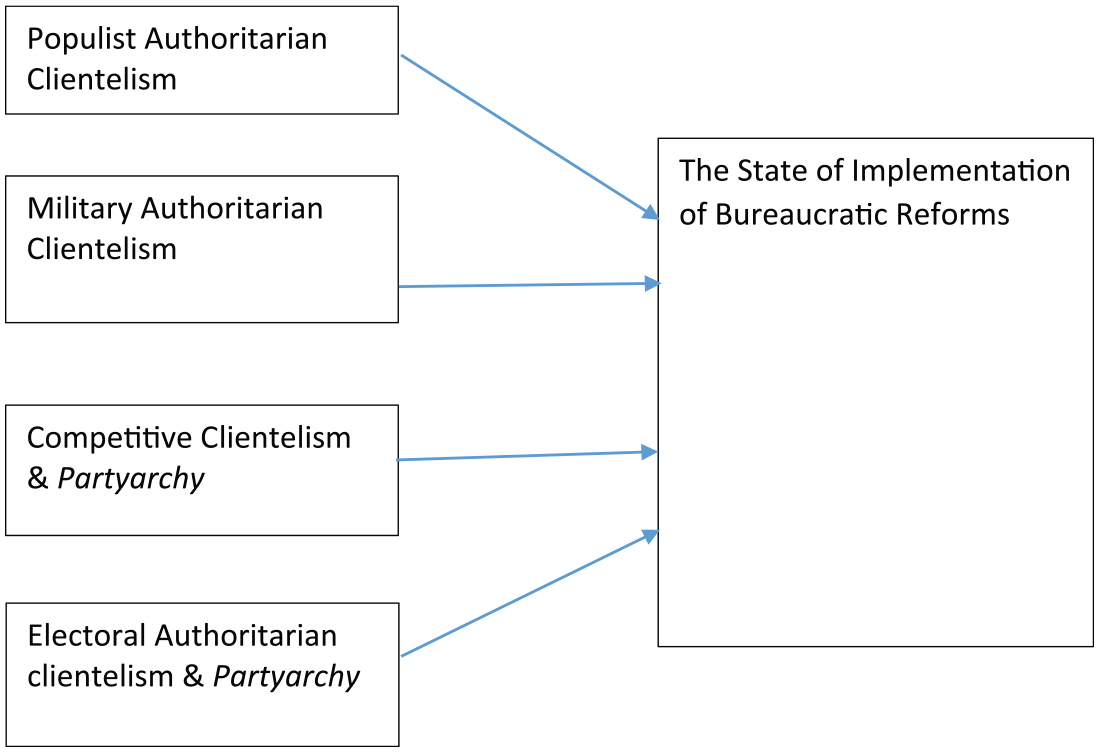
Conceptual model: The interface between political settlements and the state of the implementation of bureaucratic reforms.
Methodology
This study is based on conceptual research, which, as opposed to empirical research, is also a social science research method that identifies the limitations of existing models and constructs an alternative to investigate social, economic and political phenomena (Kothari, 2004). This study has reviewed the existing models of political settlements in general and that of the political settlements-administrative reforms in particular. More precisely, there is an absence of any model that explains the relationships between divergent political settlements models and the implementation of bureaucratic reforms. Based on the limitations of the existing models, a new conceptual framework is developed and applied to examine the Bangladesh case. This article has primarily relied on secondary sources of literature on political settlements and administrative reforms in Bangladesh.
Political settlements, bureaucratic reform initiatives and implementation in Bangladesh
This section aims at analysing the nature and ramifications of different political settlement forms and their implications for the state of implementation of bureaucratic reforms in Bangladesh. The intent is to see the interlocking of power configurations, both formal and informal institutions and incentives in developing a particular settlement that facilitates or thwarts bureaucratic reform. Table 1 summarises the four distinct types of political settlements and their implications for the state of the implementation of bureaucratic reforms.
Summary of political settlement – Bureaucratic reform implementation nexus in Bangladesh.

Source: Islam (2018); Khan (2011, 2013, 2017); Sarker (2004); Zafarullah (2007).
Bangladesh was part of British India until 1947 when partition created two states – India and Pakistan. In 1971, through a violent war of liberation, Bangladesh separated from Pakistan and became an independent nation. Some distinct periods can be delimited regarding institutional reforms and reversals. We explore the trajectory of political settlements and reversals since independence.
Populist authoritarian clientelism and bureaucratic reform
After independence, the Bangladesh Awami League (BAL) that spearheaded the liberation movement adopted the parliamentary democratic form of government. The state structure dominated by middle-class elements and surrounded by numerous clientelist groups provided an ideal platform for populist political rhetoric. However, the dominant party lost control over its unruly constituents bent on grabbing national assets while being unable to quell anti-regime rebellion by political renegades (Khan, 2013; Lewis, 2011). Conflicts within and between two broad groups had wide ramifications. In the first instance was the public sector managerial cadres’ scepticism of the technocratic ‘socialist’ Planning Commission and its approach to economic management under the leadership of the ‘radical’ petty bourgeoisie. The bureaucracy manifested a negative attitude towards the ideological premise of the nationalisation policy and its indifference caused problems and, for all practical purposes, was snubbed (Khan, 2013; Lewis, 2011). Yet the initial estrangement of the semi-colonial condescending and contemptuous bureaucracy by the political leadership was reversed as economic and political crises and an administrative vacuum forced the latter to rely on its support (Zafarullah, 2007). On the other hand, large-scale appointments of party loyalists to key civil service positions and higher echelons of public enterprises created factions that almost tore the bureaucracy asunder.
A new administrative order suitable for nation building and development was required. Reform issues were pertinent, political commitment was high (at least initially), the timing for change precise and popular support rife. This inspired the high-profile Administrative and Services Reorganization Committee (ASRC), instituted soon after independence, to thoroughly investigate the administrative system and come up with a comprehensive plan that would enable it to undertake increasing developmental responsibilities. Its near-radical report submitted in 1973, however, was shelved and its commendable work rendered fruitless. The members of the higher echelons of the bureaucracy placed constraints, as implementation would have thwarted their status and privileges. In addition, the regime’s reappraisal of its earlier adverse relationship with the bureaucracy, due to prevailing economic and political crises, propelled it to increasingly depend on its advice and support. Stripping it of its position and power in the governmental hierarchy was not considered prudent for the government at that time. The bureaucracy, in effect, colluded with the political elites in political accumulation and were able ultimately to thwart reform initiatives (Zafarullah, 2007; Zafarullah and Khan, 2005).
The futile attempt to transform a chaotic political order into a one-party system – a petty-bourgeois-dominated machine with mandatory participation of all dominant groups in the party – threatened major social groups. This rendered the political system fragile and encumbered the social order. Political volatility deepened and economic decline precipitated, forcing the prime minister to admit the failure of ‘free style democracy’ (Khan, 2011). Political revision was an attempt to restrict the organisational rights of the petty bourgeoisie that rebounded and triggered subsequent military takeovers (Khan, 2011, 2013; Lewis, 2011). Bureaucratic reform was no longer in the government’s agenda.
Authoritarian clientelism, bureaucratic reform and state of implementation
During military rule – both direct and indirect (1975–1990), an authoritarian-clientelist state emerged within a multi-party framework. Electoral politics resumed but elections were engineered. Potential business groups, parts of the bureaucracy and rural elites who prospered on primitive accumulation during pre-military rule, benefitted even more from selective distribution of clientelist pay-offs – a tactical feature of the military’s civilianisation syndrome. The presence of patron–client politics was strongly felt in all major spheres, including public administration, social sectors and private sector development programs. A web of interlocking exchanges among political elites, business and bureaucratic elites and intermediate or middle-class organisers mediated social discontents (Chowdhury, 2002; Khan, 2013, 2017).
With the bureaucracy disordered, unreformed and unable to pursue desired objectives, the military regime (1975–1979) established the Pay and Services Commission (P&SC) in 1976. It recommended a plan, one that would be more practicable to implement. Thus, a large part of its plan was accepted and put into effect, albeit with modifications. Some overt bureaucratic resistance was, however, obvious but covert manipulation of parts of the report by an insider bureaucrat was blatantly outrageous (Khan and Zafarullah, 1982). The military government took exception but discounted such intransigence and restructured the civil service system more or less in line with the P&SC plan by creating 28 functional cadres in the bureaucracy. In essence, the reform design was comprehensive, but the strategy for implementation was gradual and incremental in nature. Eventually, the recruitment system was streamlined, and training and development of incumbent and newly inducted civil officers was rationalised. It was the consequence of an authoritarian style of administration with the military and generalist administrators firmly positioning themselves at the helm of power and making decisions ad libitum. A small dominant political coalition organised the distribution of rents among the potentially threatening groups in a very selective way (Khan, 2017). The bureaucracy being a dominant partner of the coalition kept its position intact by contributing to regime maintenance and its aspiration for political stability (Zafarullah and Khan, 2005).
The second bout of military rule (1982–1989) made some changes to the administrative setup both at the national and sub-national levels. Based on the recommendations of two Martial Law Committees, the military administration made some changes in central administration, including the rationalisation of the organisation and functions of the government. The government accepted only two recommendations relating to reduction of lower-level employee numbers and the charter of duties of civil servants in the central secretariat (Sarker, 2004). The most notable change implemented by this regime was political and administrative decentralisation with the aim of taking ‘government closer to the people’. This move abandoned the highly centralised system, a legacy of colonial rule. The decentralisation policy did take away some of the powers of the officials deployed at the sub-national level, with the constitution of representative governments at the upazila (sub-district) level for managing local affairs and undertaking development activities. This created a new layer of patronage and clientelistic politics (Sarker, 2006). Local officials, instead of playing politically subservient roles, behaved like imperators in local governance and often dominated council affairs. This decentralised policy, however, was short-lived, its reversal accomplished after the fall of the military strongman.
Competitive clientelism, partyarchy and bureaucratic reform
The post-military period saw reinstallation of democratic politics. To hold parliamentary elections in a free and fair manner, the contending political parties reached consensus on conducting parliamentary elections through a third party, caretaker government (CTG) system. It was essentially a negotiated elite settlement as the country gradually was inclining towards fragility due to unremitting political disorder. The two parties – BAL and BNP – alternated power between 1990 and 2006. Evidently, no party could win parliamentary elections in subsequent terms with elections conducted by the third-party referee although both BAL and BNP attempted to put their respective party men in critical positions in administration (Hassan and Nazneen, 2017; Khan, 2015; Hossain, 2017). Both regimes went hard at reinforcing their respective dominant coalitions and seeking to create opportunities for their coalition partners from within the political elites, military, business groups, rural society and so forth. It was a sort of competitive-clientelism within a corrupted democratic structure with conciliations between rival factions that often miscarried but, at the same time, moved to establish organisations external to the dominant coalition.
The reinstallation of ‘democratic’ politics in the country provided an excellent opportunity to instil professional dynamism in the administrative system. Yet the first of the democratically elected BNP governments lost the plot and bureaucratic reform remained unrealised. The reports framed by the United Nations Development Program (UNDP) underscored major changes, which would have implications for sound governance, including the public management system (Sarker, 2004; Zafarullah, 2007), but the government was not interested. Even the government’s appointed Administrative Reform Committee was left to rue, being generally ignored.
The report of the Public Administration Reform Commission (PARC), which was established by the successor BAL government, was influenced by NPM precepts, such as service quality, proper usage of public assets, value for money, citizen charter, performance management, performance contract and so forth (Government of Bangladesh, 2000). Some initiatives such as citizen charter, annual performance agreement and result-based budgeting were implemented but without any tangible results (Huque and Ahsan, 2016; Razzaque, 2012).
As a sequel to the PARC report, several initiatives financed by the international donor agencies have been implemented. These were ‘Managing at the Top’ (MATT1 and MATTII) and the Civil Service Change Management Program (CSCMP). Both these reform initiatives were meant to prepare a new generation of civil servants who could be innovative in terms of coping with the changing needs of citizens and turbulent environments (Islam, 2018). One study (Jacobs, 2009) suggests senior civil servants demonstrating a positive attitude regarding the MATT plan and willingness to support it, while another reported no substantive impact (Majeed, 2011).
Electoral authoritarianism, partyarchy and bureaucratic reform
For two years (2007–2008), competitive-clientelism was displaced by a military-backed ‘caretaker’ administration to diffuse a serious political crisis caused by intense inter-party hostilities. This regime cracked down on corruption and put thousands of politicians and business people behind bars. However, during its stint, it utterly failed to prove corruption cases in the courts of law because of the paucity of evidence. Bureaucratic reform was deprioritised and attempts at righting the wrongs of the political system and the practices it entrenched proved abortive (Hassan and Nazneen, 2017).
In terms of the political settlements perspective, the two-year stint was authoritarian in nature and expected to achieve some successes in the reforms programs as it was devoid of strong clientelist pressures. In cases such as, the provisions of the separation between the executive and judiciary and the establishment of Local Government Commission were approved through executive diktats but once the elected government came to power in 2009, both were declared null and void. Anti-corruption drives through the rejuvenated Anti-Corruption Commission failed miserably. Khan (2013: 63) remarks that ‘[t]he experience of anti-corruption cases globally suggests that even a single successful prosecution is very difficult as the participants do not leave paper trails and bank transactions that unequivocally be established as corruption’. More importantly, the dominant power coalition headed by military authoritarianism was not at all cohesive since the dominant members of the civil bureaucracy also felt isolated because of anti-corruption drives.
BAL with its coalition partners won the parliamentary elections in December 2008 and formed a government. From the very beginning, it fixated itself on neutralising opponents assumed to be potential threats to its political survival. Major constitutional reforms eroded the polity of its democratic character, especially in terms of electoral practices; the suppression of opposition politicians pushed them underground; and civil liberties were overwhelmed (Hassan and Nazneen, 2017; International Crisis Group, 2015, 2016). The military was moderated via lucrative entrepreneurial deals, international peacekeeping assignments and life-long benefits. The bureaucracy was deeply politicised and transformed into a stronghold of partisan loyalists. Both institutions entrenched their place in the power coalition. With its brute majority in the parliament, the ruling party scrapped the constitutional provision of the caretaker arrangement – a move that ‘polarised the political field and led to sporadic bouts of political violence’ (BIGD, 2014: 14; see also Feldman, 2016; Hassan and Nazneen, 2017; International Crisis Group, 2015, 2016; Shah, 2016).
The scrapping of the CTG from the constitution signalled the end of negotiated settlement of electoral democracy and the ruling coalition created obstacles for the opposition, disabling it to play its proper role in the polity. The scheduled parliamentary elections of January 2014 were stage-managed without the participation of major opposition parties, including the BNP, to ensure BAL’s ‘massive victory’ (Hassan and Nazneen, 2017; International Crisis Group, 2015).
The threats of the opposition political parties were neutralised by coercive and administrative means. The potential opposition Jamaat-e-Islami was crushed through the trial and capital punishment of some senior leaders for their alleged collaboration with Pakistani military forces during the war of liberation in 1971. The law enforcers stifled threats from Islamic fundamentalist groups. While the government demonstrated its high-handedness against some Islamic groups, it brought another potential Islamic mobiliser, Hefazat-e-Islam, under the fold of its patronage network.
The government’s consolidation of political settlement has been complemented further by some other important developments. Vital state institutions including the judiciary, local government establishments, constitutional bodies, and public bureaucracy were entrapped by the political executive as loyalists to the ruling party occupied their hierarchies. To secure victory in the next parliamentary elections, the government ensured that policing and administrative personnel involved in electoral management were ardently loyal to the ruling party. Any kind of right-based social movements were crushed. The demand for quota reform in the civil service by university students and calls for making roads safer by young people and school children were stifled by police and student activists of the ruling party (Rahman, 2018; Sarker, 2018). This is clearly symptomatic of an authoritarian-clientelist settlement type. If the ruling coalition succeeds in influencing the electoral process according to its whims, it would solidify authoritarianism but remain vulnerable because such strategies do not work for long (Khan, 2017).
The position of the bureaucracy along with that of the law enforcement agencies is much firmer in the power coalition than any time before, largely because of the impunity it enjoys in their coercive and rent-seeking activities (Hassan and Nazneen, 2017; Khan, 2017; Rahman, 2018, Aminuzzaman and Khair, 2017). Complete partyarchy made them essential partners of the power coalition.
As sequels to the 2000 PARC’s recommendations, citizen charter and performance management have been implemented, but empirical studies do not indicate any marked improvement in the working of the bureaucracy (Huque and Ahsan, 2016; Razzaque, 2012). The annual performance agreement (APA), an initiative implemented since 2014, has largely been a ritual rather than a vital tool in enforcing results-based management in the bureaucracy (Islam, 2018).
Analysis and discussion
The discussion above shows the interface between political settlements, bureaucratic reform design and their implications for reform implementation. The first political government in Bangladesh with a splash of ‘radical’ petty bourgeois attributes initially tried to challenge bureaucratic influence. However, the desired political settlement could not keep the bureaucracy at bay as mounting political and economic crises erupted. The radical reform plan of the ASRC was quashed as its spirit was at odds with the interests of the higher civil service and the incorporation of political settlement (Zafarullah, 2007).
From mid-1975, the military was not only the real power wielder in the dominant coalition, but also played a crucial role in distributing both formal and informal rents among competing groups, including the bureaucracy, to maintain political stability. There were glimpses of competitive-clientelism but manipulated elections by the military rulers kept the power coalition as a closed entity of armed forces personnel and selected bureaucrats. In general, the bureaucracy enjoyed high power and corporate coherence. It had the ability to thwart any radical reform initiative. The first comprehensive reform drive orchestrated by the first military regime was successful mainly because of the regimes’ strength of leadership and firm will. It needed a cohort of efficient public servants for managing private sector-led economic growth. However, the powers and privileges of the generalist civil servants (Bangladesh Civil Service – Administration cadre), which constituted the most dominant group in the bureaucracy, remained intact. Historically, this group of civil servants has been responsible for regulatory administration in the field and policy-making in the central secretariat. For political stability, even the relatively autonomous military regime relied upon this cohort of higher bureaucrats.
In the second period of authoritarian clientelism, several recommendations of the two Martial Law committees and the Committee for Administrative Reform/Reorganisation were implemented. In the case of the former, the changes were rudimentary and limited in scope. As for the latter, the military regime succeeded in implementing far-reaching reforms. Two reasons can be attributed to the latter’s relative success. First, because of the authoritarian nature of the government, civil political elites though apathetic toward devolution of power to elected local government offices failed to exert any pressure. Secondly, the bureaucracy did not resist the reform package, as it was not a real threat to its power and privileges. For development matters, the bureaucracy was accountable to the elected local council at the sub-district level. However, regulatory administration was under the overall control of the bureaucracy. On top of this, the military regime succeeded in diffusing urban opposition by co-opting local elites within the patronage network for the time being.
The competitive clientelist political era (1991–2006) demonstrated mixed results in terms of implementing reforms. The reports of the ‘Four Secretaries’ and UNDP released in the early 1990s that sought to curtail the power and privileges of generalist civil servants were entirely shelved. While PARC advanced a more contemporary reform package, only a few of its recommendations were implemented but the outcome was insignificant (Hassan and Nazneen, 2017; Huque and Ahsan, 2016; Islam, 2018).
Though BAL and BNP alternated power during this period, neither could secure subsequent wins in the parliamentary elections conducted by the non-partisan CTG although the practice of partyarchy was evident during the tenure of both parties. Since both were obdurate, in maintaining their hold on power, they relied excessively on the bureaucracy and flouted recruitment, promotion, and transfer rules to keep their loyal civil servants in key positions. On the contrary, a latent force lowered morale in the administrative system as growing politicisation of the civil service and the judiciary jettisoned its neutrality and apolitical character. In recruitment, promotion and transfer processes, loyalty toward the ruling party became the criterion of reward, while merit as the key principle was compromised. Politically ‘untrustworthy’ officers were denied promotion, kept under threats or given sinecures (officers on ‘special’ duty but with no specific assignments). On the flip side, the opposition attempted to destabilise the system by promising public officials lucrative privileges if returned to power. For instance, in 1996, civil servants aligned to the BAL established the so-called Janotar Moncho (people’s platform) and employed it to oust the BNP-led government. Such blatant political exercise on the part of a section of the bureaucracy did not escape the public’s attention, yet these politicised public employees were rewarded with money-spinning privileges after their political principals regained power. It is also evident that several public servants who had lost their jobs during the BNP tenure (2001–2006) were reinstated by the BAL government in 2009 and given compensation for losing their salaries during their short absence as ‘terminated’ employees. Their re-entry was instrumental in instigating a group of civil servants to resort to political cronyism (Khan, 2015; Zafarullah, 2007).
Competitive clientelism has delivered moderate to weak operational equilibrium as informal institutions supporting the alternation of power between two major parties resulted in a politically divided (and gradually fragmented) bureaucracy (Khan, 2011). This made contemporary NPM-type reforms too tough to implement. Successive governments simply accorded lip service to reform as actuated by the structure of political settlement (Islam, 2018).
The period beginning in 2009 heralded a new political settlement with wider implications for bureaucratic reforms. The much-hyped NPM-oriented citizen charter and the performance management initiative have failed to enhance bureaucratic efficiency, accountability and ethical standards. At present, the bureaucracy has a very strong incentive to thwart any reform attempt at either the formulation or the implementation stage. Again, Citizens’ Charter, Annual Performance Agreements and the two ‘Managing at the Top’ (MATT) programs are specific cases that point to the failure of reform. The Civil Service Act of 2018 is a classic example of supporting a power coalition as it seeks to provide impunity to civil servants by preventing the ‘independent’ Anti-Corruption Commission from charging any one for corruption without the government’s approval (Liton, 2019). The bureaucracy is to be shielded from being indicted for many kinds of misdeeds, including private accumulation and abuse of power. The involvement of law enforcers in custodial killings, forced disappearances, repression and suppression of oppositions and potential mobilisers is now well evident, yet they cannot be charged (Rahman, 2018; Sarker, 2018; Thomson, 2018).
An intensive exercise to discover, denude and discipline disloyalty in the bureaucracy has become the norm. On the other hand, for their explicit allegiance, incompetent pro-ruling party civil servants are promoted rapidly and given impunity from corrupt practices by flouting rules of the Republic (Hassan and Nazneen, 2017; Khan, 2015). The partisan Public Service Commission and the incompetent Anti-Corruption Commission have also contributed to vitalising the patron–client nexus constituted of political and bureaucratic elites. The bureaucracy remains fragmented and steeped in traditional practices, resulting in extremely low implementation capability (Khan, 2011; Zafarullah, 2013). The kind of political settlement currently in place provides no hope for holistic reform meant for enhancing managerial competence of the public bureaucracy in Bangladesh.
There is historical evidence that clientelism itself is a temporary phenomenon, as is partyarchy-based clientelist electoral authoritarianism. If the 1990s created a new web of democratisation, the last two decades have incubated a system of partyarchy or the dominant party systems in different parts of the developing world (Trantidis, 2015). Regression and progression in the pursuit of credible democratic governance are undeniably parts of the process. Bangladesh gained some credibility in rising to competitive clientelism in the 1990s. It has backslided to electoral clientelist authoritarianism with a high degree of partyarchy elements, which has resulted in negative implications for bureaucratic/administrative reform. However, it is not a permanent phenomenon. Since the number of clientelist groups in Bangladesh is high and not all can be accommodated within the existing patronage structure due to the paucity of adequate resources, the current system may falter subject to the mobilisation capacity of the potential but disgruntled political mobilisers.
Conclusions
In terms of our conceptual model, four dissimilar political settlements emerged in Bangladesh at different times in its history, each producing a variant of bureaucratic reform initiative and implementation. While clientelism has been a systematic phenomenon in the whole gamut of the political settlement phenomenon, the rules of engagement between contending elites have led to changing configurations. Short-term equilibria were often replaced by volatility in power relationships and intermittent breakdowns. Though dominant all along, the position/status of the bureaucracy has also altered in various episodes of political settlement. The changing political settlement–bureaucracy interface over the years has had direct implications for the nature and implementation of administrative reforms.
The first political government characterised by populism and authoritarian inclinations failed to implement the ASRC recommendations that were generally ‘radical’ in historical terms. Short-term political ‘gains’ stemming from clientelism deterred the regime from challenging the entrenched interests of generalist civil servants, as they were the ‘custodians’ of regulatory administration. On the other hand, the two military regimes resorted to clientelist practices by incorporating the higher bureaucracy into the dominant power bloc to strengthen their rule and swathe it with some sort of legitimacy. The implementation of the major recommendations of the P&SC report was made possible because of the authoritarian nature of the state that helped reduce internal anomalies in the service structure and succeeded in streamlining personnel management practices. However, the generalist bureaucracy’s deep-rooted interests were never threatened.
The competitive clientelist (1990–2006) and elected clientelist authoritarian (2009 to date) phases have accomplished very little in terms of modernising the administrative system, though a moderate level of economic growth has been achieved amidst mal-governance and perverted democracy. Endemic politicisation of the bureaucracy by either of the major parties while in power has had the effect of creating rifts within it and lowering morale in the administrative system. Its apolitical character has been distorted. Loyalty has replaced merit and performance in personnel management practices and has become the key yardstick in judging ‘achievement’.
The total effect of the various forms of political settlement vis-à-vis the bureaucracy in distinct phases of Bangladesh’s political history since independence has been extremely limited in reforming the administrative system structurally, functionally and behaviourally. If placed in a ‘major reform’–‘no reform’ continuum, bureaucratic reform would be somewhere closer to the latter as the status quo has not significantly been disturbed. Successive governments have given lip service to reform as actuated by the structure and nature of extant political settlement.
Footnotes
Funding
The authors received no financial support for the research, authorship and/or publication of this article.
