



Abstract
Water scarcity is increasing in South Africa and communities need to be educated about water conservation practices. This article investigated the perceptions of Raymond Mhlaba Local Municipality’s residents concerning the use of social media for water conservation education in their community. Through a quantitative methodology, a sample of 383 respondents answered a questionnaire and the main findings were that 75 per cent of respondents did not know about the municipality’s social media platforms. This article recommends that the municipality creates awareness about its social media platforms, increases social media usage and employs persuasive strategies for participation.
Introduction
Water conservation is a global phenomenon and requires collaborative efforts from government and citizens. Preceding this study, Hove and Osunkunle (2019) established that local municipalities in Amathole District in the Eastern Cape Province of South Africa rarely used social media platforms for water conservation education despite the drought and water crisis that affected Amathole District where Raymond Mhlaba Local Municipality is located. The district experienced drought which caused water shortages, increased water cuts by the municipalities and had dramatic effects on agriculture and livestock loss (Dayimani, 2017). Local municipalities in the district however had to see to it that they provided services to their residents despite the water shortages. Methods used to alleviate the situation included carting water to residents using water tankers. With such a water crisis at hand, municipalities are left with a mandate to educate residents about water conservation. An effective way to achieve this can be the use of social media, and Raymond Mhlaba Local Municipality has a website, a Facebook page and a Twitter account. This should make it easier for social media to be used for participatory water conservation education. Involving the residents in the water conservation education process would ensure that the knowledge is embedded and communities may benefit in the long run.
Raymond Mhlaba Local Municipality is a recently formed municipality after the amalgamation of Nkonkobe Local Municipality and Nxuba Local Municipality in August 2016 (Municipalities of South Africa, 2019). The municipality has social media platforms, but does not have a social media campaign for water conservation education. This is because all six local municipalities in Amathole District leave the water conservation issues to be handled by Amathole District Municipality which is responsible for water infrastructure and supply. Amathole District Municipality is actively involved in water conservation campaigns on social media, newsletters, radio interviews, meetings, roadshows and posters (Hove and Osunkunle, 2019). This article seeks to advocate for the local municipalities to emulate and assist the district municipality concerning water conservation.
In South Africa, reports indicate that most people have access to social media (Majangaza, 2016). The Community Survey 2016 issued by Statistics South Africa (2016a) indicates that of the 16.9 million households in South Africa, the number of those with cell phones had increased from 88.9 per cent in 2011 to 93.8 per cent in 2016. The social media access context in Raymond Mhlaba Local Municipality indicates that many people access social media, considering that it is a rural municipality (Statistics South Africa, 2016b). This study therefore sought to find out how social media is used by Raymond Mhlaba Local Municipality for water conservation education.
Aim of the study
This article aims to find out the views of the residents of Raymond Mhlaba Local Municipality about their municipality’s social media use for water conservation education by answering the following research questions.
RQ1: How familiar are residents of Raymond Mhlaba Local Municipality with their municipality’s social media platforms?
RQ2: To what extent is social media received as a tool for water conservation education in Raymond Mhlaba Local Municipality?
Literature review
Water conservation is defined as preservation, control and development of water resources, both surface and groundwater, and prevention of pollution (Organisation for Economic Co-operation and Development, 2016). Globally, water conservation has been on the increase due to climate change perpetuated by global warming. In Raymond Mhlaba Local Municipality, the water crisis was critical to the point where some schools closed due to lack of water (Zamxaka, 2017). Increasing water shortages call for interventions in expediting water conservation education to municipality residents. Community education about water conservation is therefore a necessity and social media can be used to achieve this.
White (2012: 9) defines social media as ‘forms of electronic communication which allow users to create online communities for sharing information, ideas, personal messages and other content’. This definition implies that social media can be used for community education since it allows for networking (Van Dijk, 2006), edutainment (Levinson, 1999) and public administration (Ahn, 2011). Social media has been described as beneficial by aiding fast and reliable communication which cuts across time and geographical boundaries (Kietzmann et al., 2011). Such attributes can be harnessed by municipalities to educate about water conservation, especially with the drought and water crisis that was faced in the Eastern Cape, South Africa. There are no studies about social media use for water conservation especially for rural municipalities in South Africa; therefore this article seeks to fill that gap.
Research has shown that social media can be used by governments to engage its citizens. Lee and Kwak (2012) state that social media supports open government initiatives which promote transparent, interactive, participatory and collaborative public engagement. Lee and Kwak (2012) propose an Open Government Maturity Model which has five levels: (a) initial conditions, (b) data transparency, (c) open participation, (d) open collaboration, and (e) ubiquitous engagement. However, Lee and Kwak (2012) caution that there is a logical sequence for increasing social media-based public engagement; therefore government agencies should focus on achieving one maturity level at a time so as to realise organisational and technological capabilities in an orderly manner. This study also cautions local municipalities to approach the open government concept in a sequence and assess the feasibility before increasing social media usage.
Social media contributes to e-governance which has increased chances of accountability by local governments, thereby promoting transparency (Pina et al., 2010). According to Bonson et al. (2014), one of the main reasons why government and community engagement is important is to build trust by promoting transparency and effective services. Tolbert and Mossberger (2006) indicate that the declining citizen engagement with government is one of the reasons governments are investing in the use of social media to engage the citizens. Snead (2013) believes the use of social media by local governments is a reaction to declining trust and confidence in governments by citizens. Therefore, social media offers a channel for direct interaction, information dissemination, participation and education which cannot be achieved on a ‘static’ website (Mergel and Bretschneider, 2013). In addition, transparency and e-governance on social media can be helpful in the process of public policy formulation that is fair and beneficial to everyone. Charalabidis et al. (2012) indicate that public policy formulation is possible on social media because of its ability to facilitate e-participation and participatory democracy. The use of social media for water conservation education will not only dispatch information but increase transparency in municipal activities as there will be dialogue between the municipality and its residents.
Social media allows for participation and participation on electronic platforms such as social media is referred to as e-participation (Linders, 2012). Community members may not have the time to attend a meeting or personally go to submit their views at government offices but can participate online. On social media, participation is easy as social media is viewed as a tool which influences citizen participation initiatives because of its potential to inform, educate and empower citizens (Bonson et al., 2014). This article concedes that social media informs, educates and empowers citizens and, therefore, sought to find out how Raymond Mhlaba Local Municipality informs and educates community members about water conservation using social media since there are no studies that have been done concerning this phenomenon yet.
Primarily, many people use social media to circulate informal resources on their social networks by sharing content such as images, experiences and learning resources with those they are connected to (Safko, 2010). Social media has been used for formal education (Baran, 2010) and informal education (Cain and Policastri, 2011) with successful results. Servaes (2008) indicates that government agencies which use the internet have taken advantage of networking and information sharing to educate while entertaining citizens and this is referred to as edutainment. This provides a basis for a friendly environment for learning and it results in a favourable outcome. In the health sector, edutainment on social media has been used and successful campaigns promoting good public health were achieved (Freeman et al., 2015). This article advocates that municipalities can also use social media for edutainment when educating community members about water conservation.
Social media can be used for community education, which is essential for community development. Education towards social change does not have to be rigid but does have to be flexible so as to keep the community interested in learning more about the new ideas that are being imparted (Servaes, 2008). Community education has to be flexible and allow for a certain level of entertainment so as to make it interesting and keep the community’s attention. Community education has to be mainly informative to the target community. Katz (2008) points out that many people have access to mobile phones and they use them for accessing information. Community education on social media can, therefore, be prioritised by municipalities.
Information technologies such as social media can be used to enable education and cater for people with different learning styles and attention spans (Wang et al., 2001), in this case, water conservation education. Social media is therefore a platform for extensive learning which enables the public to experience different levels of interaction (Santra and Giri, 2009). There is also fast exchange of information on social media and a vast amount of information which can be targeted at specific audiences. Interestingly, social media caters for different media such as text, pictures, audio and video and this attribute allows for comprehension for all literacy levels and age groups considering that municipalities target different people and communities. With social media, different languages can be used to accommodate all the publics, which leaves no one behind. By doing this, municipalities will include every community member in the water conservation education.
Social media heightens the spread of information as people share information. This sharing of information is referred to as electronic word of mouth (e-WOM). The existence of e-WOM on social media might promote the spread of information about water conservation among community members. Studies by De Gregorio and Sung (2010) suggest that people learn and understand information under the influence of external and environmental sources such as peers. Such individuals can be referred to as social learners whose attitudes and behaviours towards, for example, water conservation, are subject to the influence of friends and peer communication or e-WOM as the most effective way to transmit information.
Social media usage also facilitates persuasion. According to Teng et al. (2014), persuasion on social media involves using messages to influence and change attitudes and behaviour in the communication. Persuasive messages are designed to modify people’s beliefs, values and attitudes, and also to exert the force of the contained arguments to influence message recipients in their process of reasoning. Hong and Park (2012) also hint that persuasion on social media is linked to the influence of e-WOM. With reference to this study, if municipalities use social media for water conservation, this may persuade community members to conserve water by adopting Water Conservation Practices while community members also persuade each other to conserve water through their networks on social media. Municipalities should therefore be persuasive to their community members on social media by being entertaining, creative and engaging with social media followers. This encourages the social media followers to participate, thereby leading to social behaviour change towards water conservation.
Social media can be vital in the encouragement of voluntary participation and community attachment especially in rural areas in an effort to address community development (Stern and Adams, 2010). Raja-Yusof et al. (2016) states that volunteering on social media, also known as cyber volunteering, allows people to freely give their services to do some online tasks or practical duties. It is also vital to note that social media volunteering depicts teamwork as it aids team-based learning (Rasiah, 2014) and this is essential for community development. It is however important to note that in this study, volunteerism on social media for water conservation education is not only about doing online tasks on social media but also about practical tasks aimed at water conservation within the community. Studies on cyber volunteering for water conservation education have not been done for rural municipalities; hence this article seeks to contribute to this area.
Social media has also been used for social capital, through advocating for common causes within communities. Social capital, according to Stern and Adams (2010) is concerned with coordination and cooperation for mutual benefit through social organisation, such as networks. Networks can be achieved through social media whereby community members can volunteer or participate and build social capital for the good of their community. It is important to note that if municipalities educate about water conservation on social media and complement this with practical activities such as anti-pollution clean-up activities, community members are more likely to volunteer.
While social media can be effective in creating awareness about water conservation, it has its own disadvantages. Social media is well known for being a fertile site for fake news (Spohr, 2017). In some cases, social media is prone to abuse by users because there is no gate-keeping (Coddington and Holton, 2014). The unequal accessibility of social media between the information elite and the technologically disadvantaged communities has the potential to polarise society (Van Dijk, 2006). In addition, there is excessive information on social media which may lead to important and informative messages being lost. In most instances, social media seeks to address numerous people and in trying to satisfy a heterogeneous audience, it does not spare the weak and vulnerable. Research by other scholars has shown that social media can be used for propelling good or bad ideologies, and in this regard, municipalities have to use social media carefully in order to allow for different levels of interaction (Safko, 2010; White, 2012). This therefore requires municipalities to ensure that their social media usage is monitored to minimise these disadvantages.
To ensure effectiveness of social media use, Kaplan and Haenlein (2010) outline five recommendations to organisations considering using social media. Firstly, an organisation has to choose social media platforms carefully by considering the target audience and its purpose in using social media. Secondly, the organisation has to pick the application or make its own by comparing the benefits of using known, existing social media platforms and creating personalised and innovative applications. Thirdly, Kaplan and Haenlein (2010) indicate the need to ensure activity alignment in the case where an organisation has various social media platforms. Messages across the organisation’s social media platforms should speak in the same voice by publishing coherent messages. Fourthly, an organisation has to have a media plan integration which allows it to integrate different forms of multimedia such as text, pictures, audio and videos on its social media platforms. Lastly, Kaplan and Haenlein (2010) emphasise the need to ensure that the social media platforms that an organisation uses are accessible to all its target audience. These recommendations can be adopted by municipalities to effectively use social media to educate community residents about water conservation.
Theoretical framework
The diffusion of innovations theory was used as the theoretical framework. Diffusion of innovations is the way an idea, practice or object which is seen as new is communicated through certain channels over a period of time among members of a social system (Rogers, 2003). This refers to the dissemination of ideas that are perceived as new or those that are not common. According to Rogers (2003), diffusion is a kind of social change that occurs when new ideas are invented, diffused and adopted or rejected leading to alteration of a social system. There are four elements that are present in the diffusion process. These are innovation, communication channels, time and social system. Rogers (2003) points out that the time factor is important since it is influential in the adoption of an innovation process and has three subcategories: namely innovation-decision process, relative time in which an innovation is adopted, and the innovation’s rate of adoption.
Rogers (2003) separates the adoption process from the diffusion process in that the diffusion process occurs within a society, as a group process while the adoption process relates to an individual. The adoption process is defined as the mental process through which an individual goes through from initially hearing about an innovation to the final adoption (Rogers, 2003). The adoption process occurs in five-stages: namely, awareness, interest, evaluation, trial, and adoption. Other scholars such as Degerli et al. (2015) have these stages as knowledge (awareness), persuasion (interest), decision (evaluation), implementation (trial) and confirmation (adoption). It is important to note that adoption occurs at different levels ranging from innovators, early adopters, early majority and late majority, to laggards. Kaminski (2011) suggests that sometimes a sixth type of adopter, called non-adopters, is added to the adoption process.
The diffusion of innovations theory has been critiqued as it is not always guaranteed that diffusion of innovations can occur. In some cases, a failed diffusion can occur which requires organisations to consider consequences in the following categories: desirable versus undesirable, direct versus indirect and anticipated versus unanticipated (Rogers, 2003). In addition, Lundblad (2003) states that diffusion is hard to quantify while it is also hard to measure what can cause an adoption of an innovation. In responding to these criticisms, Rogers (2003) came up with four categories, namely, the pro-innovation bias, individual-blame bias, recall problem and issues of equality, to better explain the diffusion of innovations theory.
The local municipality’s social media platforms are an innovation on their own and they have to be adopted by the community residents so that it becomes easier for the municipality to educate residents about water conservation. The diffusion of innovations theory was applied to the way residents accept or resist change on communicating with their municipality on social media platforms. On the other hand, through participation, the ideas that residents put forward on these social media platforms are an innovation to the municipality and have to be considered by the municipality so as to improve service delivery concerning water conservation.
Methodology
Research design
A quantitative research design was used for this study. Quantitative research is relatively quick to organise as data collection and analysis can be done with a computer program (Du Plooy, 2009) therefore enabling research results to become independent of the researchers (Baxter and Babbie, 2004). Wimmer and Dominick (2011) point out that quantification enables researchers to summarise and report results more effectively. In this article, the use of a quantitative methodology helped to include a larger population of respondents in Raymond Mhlaba Local Municipality in order to be able to generalise the findings of the residents’ perceptions on social media use for water conservation education in the municipality.
Sampling
Raymond Mhlaba Local Municipality (formerly known as Nkonkobe Local Municipality) has a population of 127,115 residents (Statistics South Africa, 2011). A sample of 383 respondents was used for data gathering. The sampling error was calculated at 95 per cent confidence level using a guide from Du Plooy (2009: 113) and Roasoft sample size calculator for determining the number of units needed in the sample in relation to population size. The sample was selected from five communities in Raymond Mhlaba Local Municipality and respondents were distributed as follows: Alice (77 respondents), Fort Beaufort (78 respondents) and Hogsback, Middledrift and Seymour (76 respondents each). Respondents were purposively sampled to participate in this study. Adults were selected as they could relate to knowledge about municipality services. Two variables were used to select these adults. Firstly, they had to be able to access the internet so that they could answer questions about Raymond Mhlaba Local Municipality’s social media use for water conservation education. Secondly, these adults had to be knowledgeable about their municipality to be able to respond to the questionnaire.
Research instrument
A self-administered questionnaire with closed-ended questions was given to respondents from Raymond Mhlaba Local Municipality for data collection. Leedy and Ormrod (2005) state that a questionnaire’s basic function is to collect data and it must be designed to fulfil a definite research objective. The aim was to get an insight on residents’ views about their knowledge of the municipality, its social media platforms and water conservation education on social media.
Data analysis
The data from the questionnaire was analysed using the Statistical Package for Social Sciences (SPSS). The responses to the structured questions were rated in percentages. At this stage, the descriptive statistical analysis was done to produce the results through the use of frequencies, percentages and cross-tabulations. These were calculated and recorded using SPSS and Microsoft Excel whereby each respondent was assigned to a column and all the responses to the questions on the questionnaire were coded. According to Du Plooy (2009), working with data in numerical form allows for better and easier summarisation of research findings. The data was quantitatively presented through graphs, tables and pie charts in numerical form.
Ethical considerations
The paper upheld sound ethical principles such as ensuring voluntary participation, informed consent and anonymity of respondents. The researchers informed respondents prior to participation what the research was all about and how to answer the questionnaire. After the briefing about the research, respondents who wished to continue signed an informed consent form. Respondents were free to discontinue at any time during the research.
Findings
Social media usage
The respondents used various devices to go online as presented in Figure 1. Cell phones are mainly used to access social media by 99 per cent of the respondents while tablets were used by 4 per cent, laptops 3 per cent and desktop computers only 1 per cent. The respondents had to indicate all the devices they used for accessing the internet. The results indicated that some respondents used two or more devices to access the internet. This indicates that there is social media access in Raymond Mhlaba Local Municipality and that residents are aware of social media as a communication innovation.
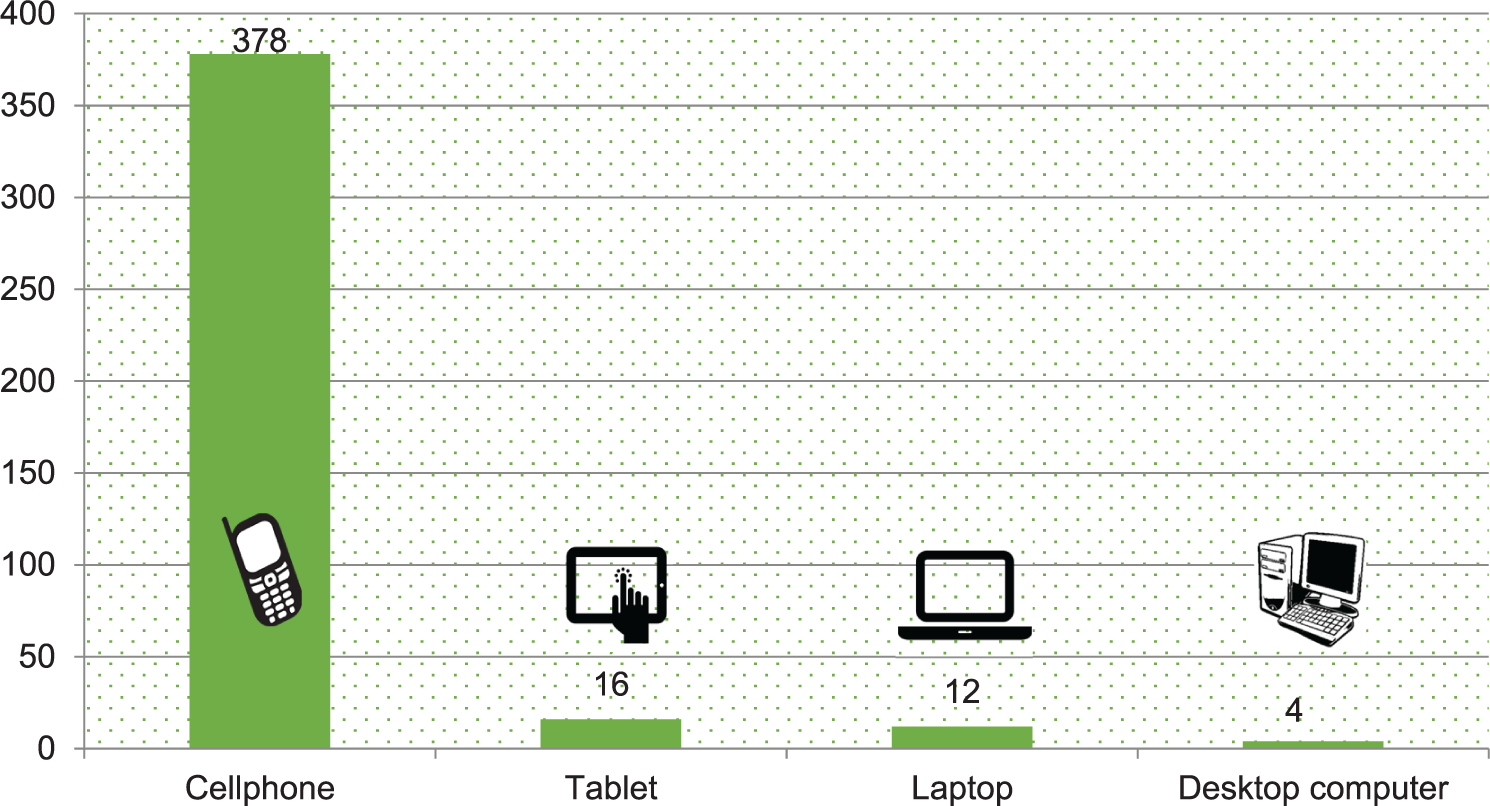
Devices used to go online.
The respondents also used various social media as illustrated in Figure 2. The descriptive statistics indicated that WhatsApp was used most frequently with 100 per cent of respondents using WhatsApp. Facebook was used by 60 per cent of respondents, Twitter 14 per cent, YouTube 8 per cent, LinkedIn 7 per cent, Instagram 4 per cent, WeChat 3 per cent and lastly Google+ 2 per cent.
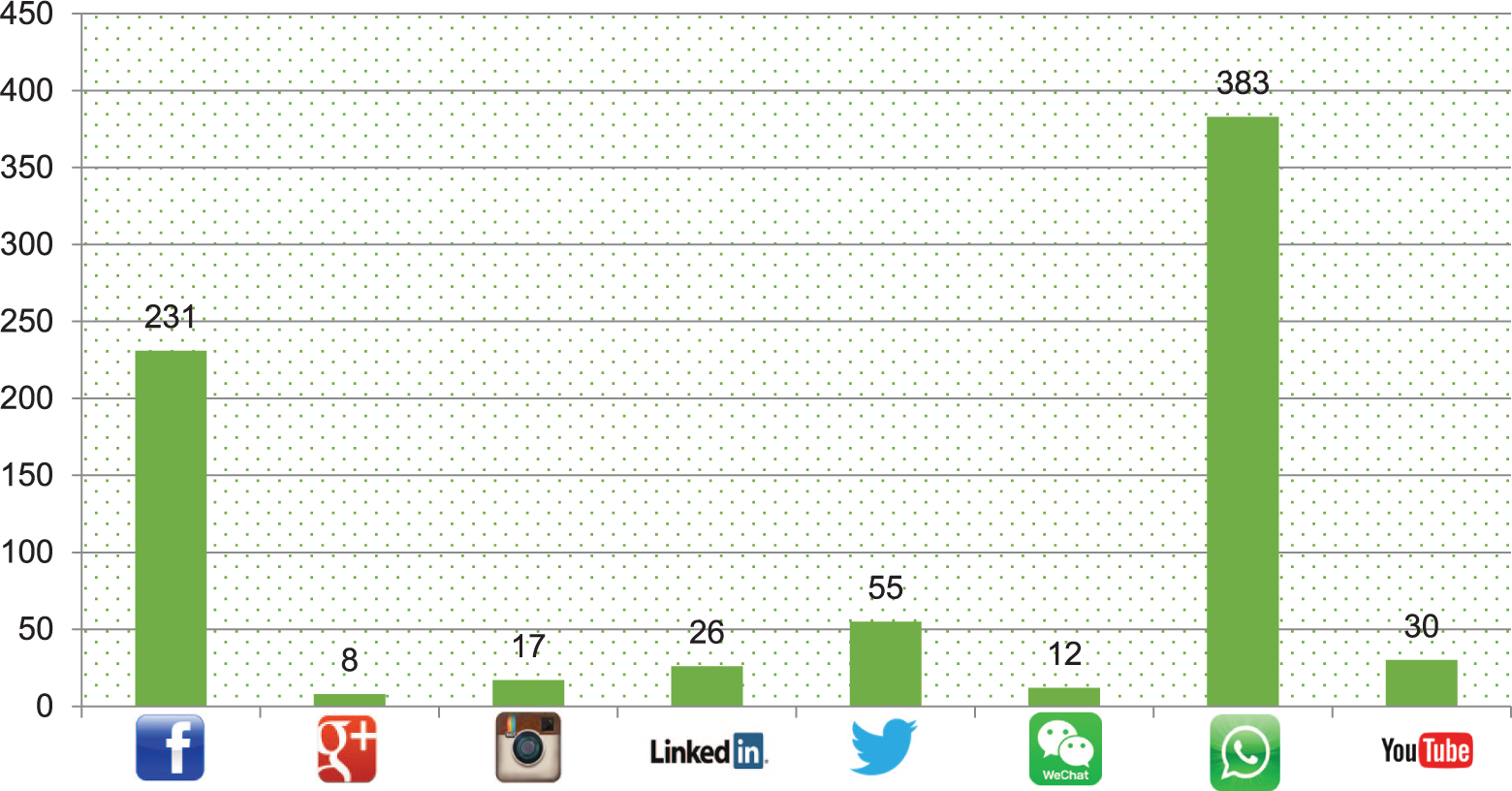
Social media used.
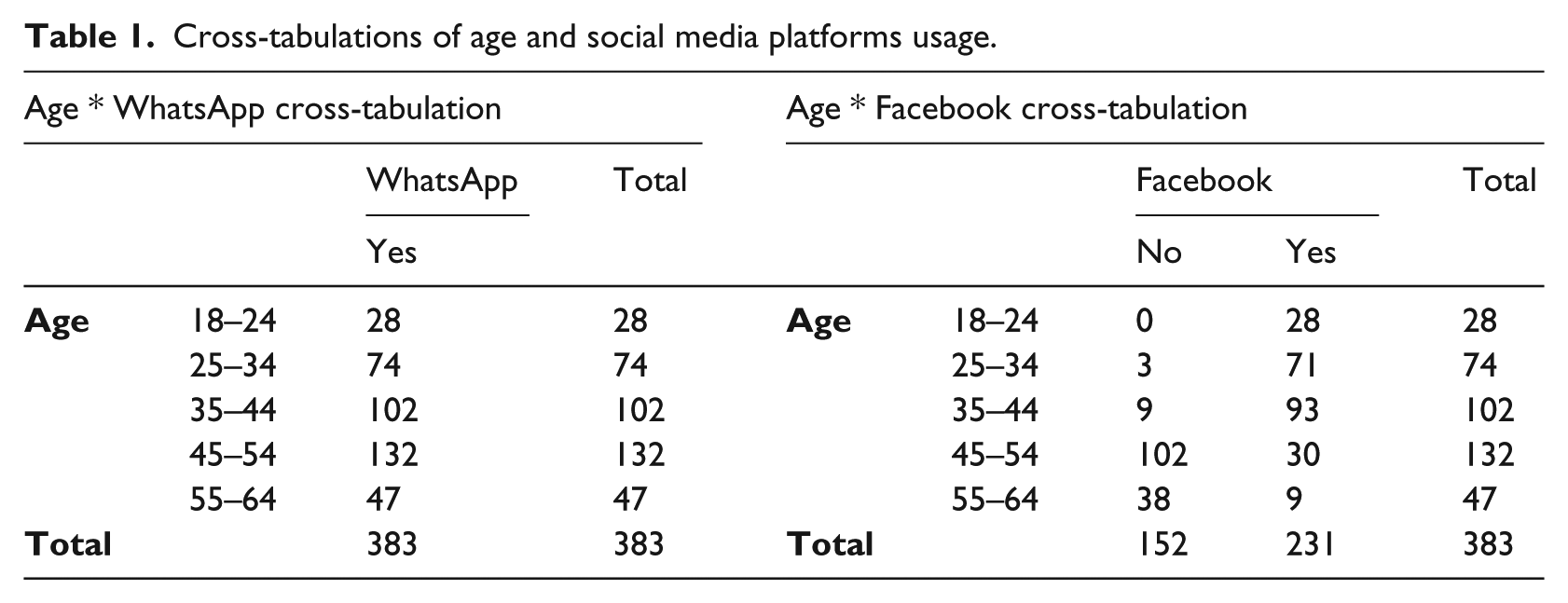
This article investigated whether the age variable influenced the use of these social media platforms; therefore, cross-tabulations between age and various social media platforms used were conducted. Cross-tabulations assist in viewing how variables influence each other (Aldrich and Cunningham, 2016). Table 1 indicates that WhatsApp is used by all age groups, indicating the prevalence and popularity of WhatsApp among respondents. Facebook was mostly used by 18- to 24-year-olds, 25- to 34-year-olds and 34- to 44-year-olds while there was a sharp decrease in its usage by 45- to 54-year-olds and 55- to 64-year-olds. This could be attributed to the differences in exposure and willingness to learn about technology between the young generation and the older generation. Rogers (2003) indicates that demographical differences influence the adoption of an innovation; hence it was important to highlight how the age variable could influence social media usage.
Cross-tabulations of age and social media platforms usage.
Community members as spectators
This study found that the respondents from Raymond Mhlaba Local Municipality that are aware of the municipality’s social media platforms hardly communicated with the municipality on those social media platforms. Only 25 per cent of the respondents were aware of the municipality’s social media platforms as indicated in Table 2. It is evident that the municipality’s social media platforms are not spreading to the community members, the way an innovation should, considering that all the respondents had access to social media. Rogers (2003) indicates that after the awareness stage, adopters have to move to the persuasion stage. The municipality has to therefore persuade community members to participate on their social media platforms.
Awareness of municipality’s social media.

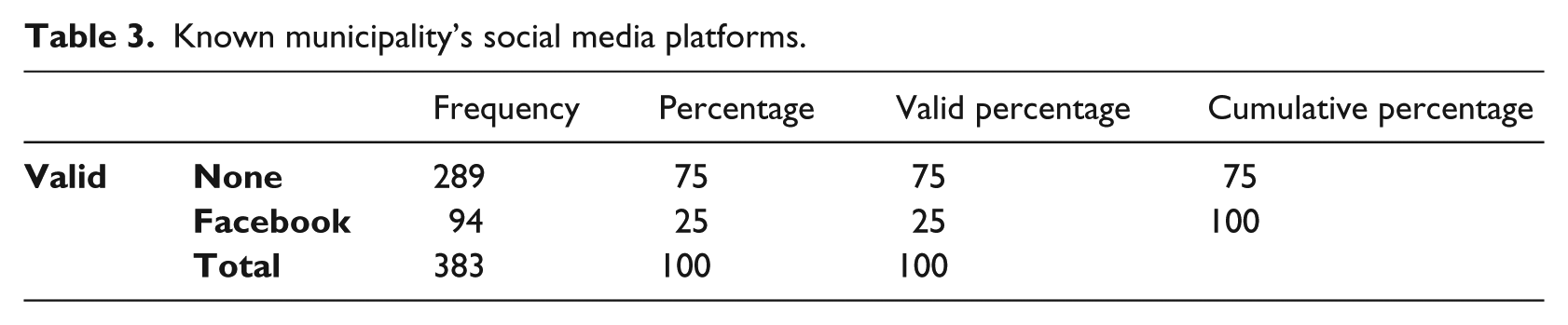
The social media platforms that were known by the 25 per cent of the respondents turned out to be only Facebook as indicated in Table 3. None of the respondents indicated knowledge of the municipality’s website and Twitter account. This indicates the popularity of Facebook among other social media platforms that Raymond Mhlaba Local Municipality owns.
Known municipality’s social media platforms.
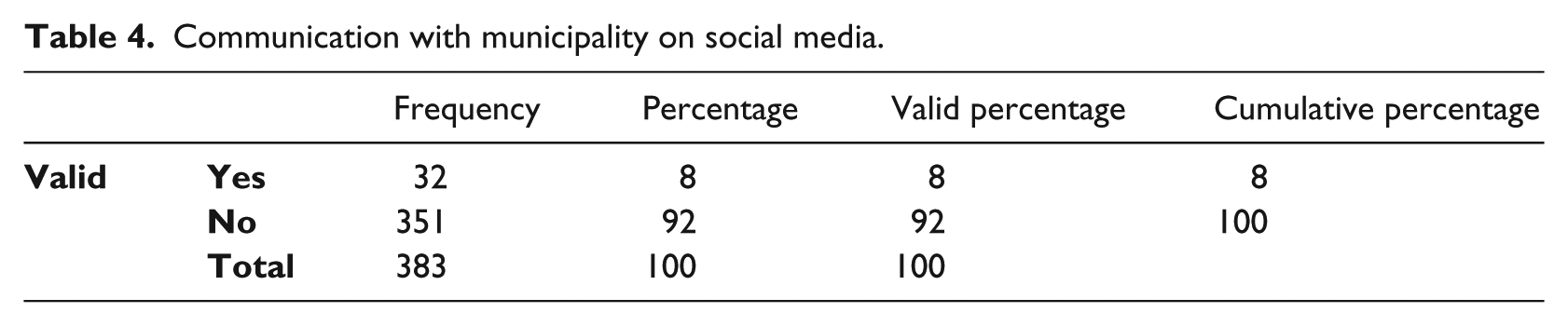
However, the findings revealed that out of the 25 per cent of respondents that know Raymond Mhlaba Local Municipality’s Facebook account, only 8 per cent actually communicate with the municipality on its Facebook page as indicated in Table 4. This is an indication of lack of communication between the municipality and its residents which led to the conclusion that social media is not being fully utilised for communication purposes by the municipality. There is a need to find out why the respondents do not communicate with the municipality on social media.
Communication with municipality on social media.
Language barrier
Raymond Mhlaba Local Municipality used English as the formal communication language on its Facebook page as indicated by 25 per cent of the respondents, while 75 per cent indicated that they did not know the language the municipality used on its social media platforms. These results are represented in Figure 3. These results also correspond with the number of respondents (25 per cent) who knew about the municipality’s Facebook page and those who did not (75 per cent). To ensure that an innovation is adopted, Rogers (2003) explains that there has to be effective communication. Identifying a common language can help the municipality to spread its innovations and educate about water conservation.
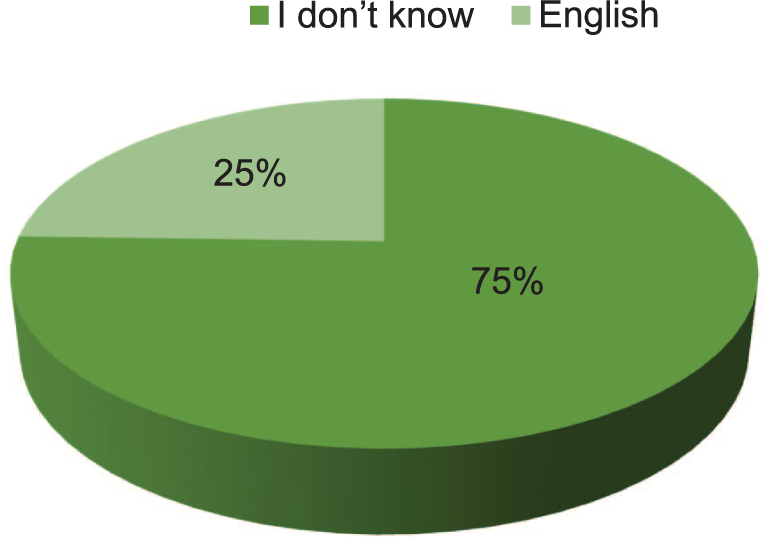
Language used by municipality on social media.
Eighty-one per cent of the respondents indicated that they preferred Xhosa, while 18 per cent preferred English and only 1 per cent preferred Afrikaans (see Figure 4). A content analysis on Raymond Mhlaba Local Municipality’s social media platforms was conducted (see Hove and Osunkunle, 2019) which found that English was the main language that was used. It can therefore be concluded that language is a barrier to the municipality’s social media usage since English is mainly used.

Preferred language.
Lack of water conservation education on social media
This paper sought to find out whether municipalities were educating their communities about water conservation. The data showed that the residents of Raymond Mhlaba Local Municipality were not being educated about water conservation on social media by the municipality. There was no continuous information provision about water conservation on social media. The results are represented in Figure 5.

Are residents informed about water conservation on social media?
The results indicated that 98 per cent of respondents were not kept informed about water conservation on social media by the municipality. Only 2 per cent of the respondents claimed to be kept informed about water conservation on social media while the timeline on Raymond Mhlaba Local Municipality’s Facebook page indicates sporadic water conservation content. It could be that the residents who claimed to be getting water conservation information were directly communicating with the municipality via private inbox options of Facebook. The remaining 98 per cent of respondents indicated that they had not been educated about water conservation on Raymond Mhlaba Local Municipality’s social media account.
If Raymond Mhlaba Local Municipality was not informing residents about water conservation education on social media, probably there were other established ways of educating the community about water conservation. This study sought to identify these ways and the respondents had to indicate all the established methods they were familiar with. The municipality seems to use meetings mostly to inform its residents about conserving water as indicated by 31 per cent of the respondents (see Figure 6). Twenty-four per cent of the respondents indicated that the municipality uses the radio to educate about water conservation. Seven per cent of the respondents revealed that the municipality was using road shows to educate about water conservation. The results also showed that 4 per cent of the respondents indicated that they have encountered water conservation education messages from the municipality in newspapers, while 2 per cent of the respondents attested that the municipality uses posters for educating about water conservation. Another 2 per cent of the respondents indicated that the municipality used the television to educate about water conservation. It is however not clear if the water conservation messages respondents got from the television, radio and newspapers originated from the municipality or were just general water conservation messages from these media. Lastly, 30 per cent of the respondents indicated that the municipality had not established any other way for them to be educated about water conservation. This is alarming, considering the drought and water crisis that Raymond Mhlaba Local Municipality grappled with from 2015 till mid-2017.
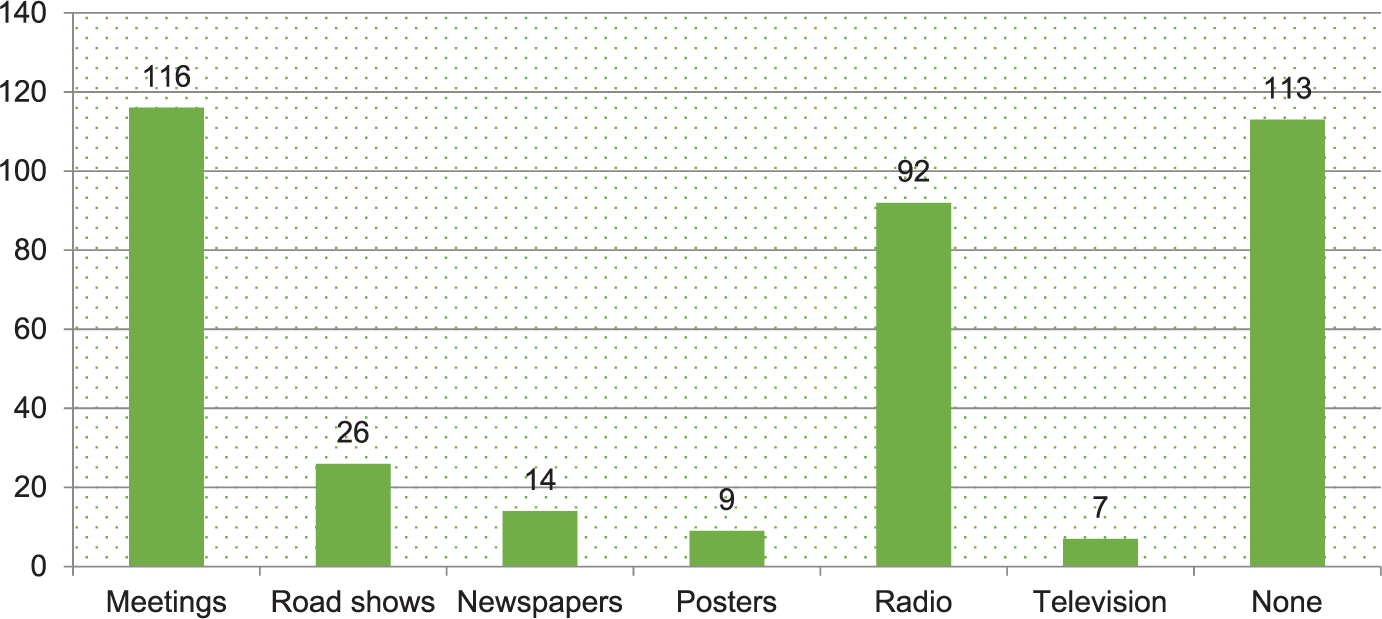
Other established methods of water conservation education.
Satisfaction of residents
The satisfaction levels about Raymond Mhlaba Local Municipality’s social media use indicate that the highest number of respondents (41 per cent) were dissatisfied (see Figure 7). The results showed that 27 per cent of the respondents were not sure how to rate their satisfaction with the municipality’s social media use for water conservation education.
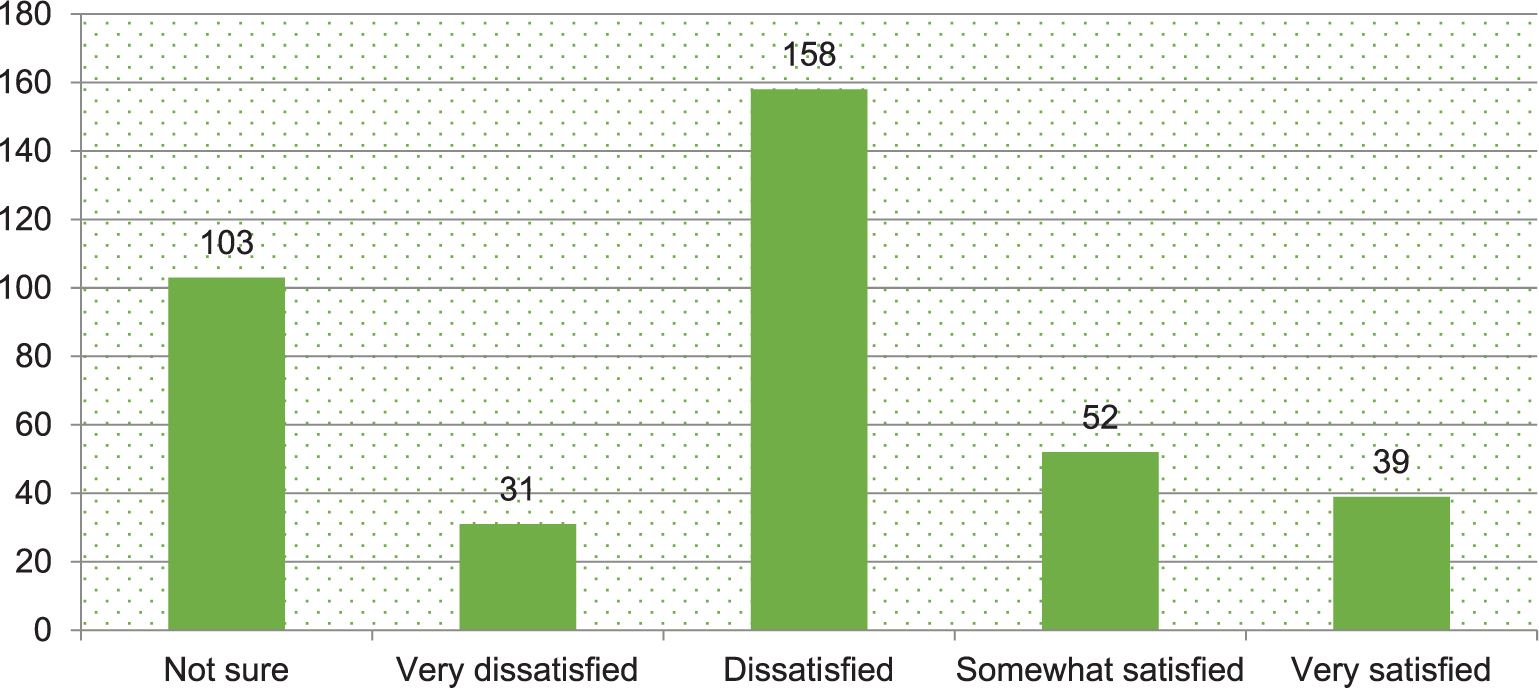
Satisfaction with municipality’s social media use for water conservation education.
Eight per cent of respondents indicated that they were very dissatisfied while 14 per cent of the respondents indicated that they were somewhat satisfied. Lastly, 10 per cent of respondents indicated that they were very satisfied. However, this was a result which was not anticipated since the municipality did not use social media for water conservation education. This could be attributed to the lack of knowledge by respondents on how a functional municipality social media platform should be operated.
Way forward
The respondents indicated their suggestions to the municipality on how to improve its social media usage for water conservation education as indicated in Figure 8. Fifty per cent of the respondents suggested that the municipality has to make its social media platforms known. On the other hand, 18 per cent of the respondents suggested that the municipality had to increase its social media usage as this may increase its visibility on social networks. In addition, 11 per cent of the respondents suggested that the municipality had to encourage participation on social media while 10 per cent of respondents who showed concern about saving water suggested that the municipality had to prioritise water conservation messages on its social media platforms. Furthermore, 8 per cent of respondents suggested that the municipality had to make interesting posts on its social media platforms. Only 2 per cent of the respondents suggested that the municipality had to respond quickly to messages left on its social media platforms. Lastly, 1 per cent of the respondents had nothing to suggest for the municipality to improve.

Suggestions to improve the municipality’s social media use.
Discussion of findings
Demographic variables affecting social media use
From the results, it was evident that WhatsApp and Facebook are the most popular social media platforms used by the respondents. This could be due to the affordability of these social media platforms or their user friendliness when it comes to functionality and smartphones that are bought with WhatsApp or Facebook installed which only need registration or activation. This also indicates that Rogers’ (2003) adoption process has begun as residents are aware of social media usage. Accessibility of an organisation’s social media is paramount (Kaplan and Haenlein, 2010). Municipalities, therefore, have to consider using social media platforms that are accessible and popular among their community residents.
The findings indicated that some residents did not have knowledge of their municipality’s social media platforms; hence this explains why the Raymond Mhlaba Local Municipality’s Facebook page only had 950 likes at the time of writing this article. Male respondents showed high usage of social media as opposed to their female counterparts. Households with younger adults indicated knowledge of municipality social media platforms unlike the older adults. This gap could be because of differences in social media preferences and accessibility or because the municipality is not creating the much needed awareness for their social media platforms. Rogers (2003) states that for diffusion of an innovation to occur, there has to be awareness.
Language was also a barrier that limited usage of social media by residents who indicated that they were comfortable using Xhosa, which is their native language, instead of English. The language used on social media by the municipality versus the community’s preferred language may lead to low satisfaction levels of community residents. Raymond Mhlaba Local Municipality’s use of English on social media could be affecting the satisfaction levels of its residents who mainly prefer the Xhosa language to be used for municipal communications. However, municipalities have to find a solution to accommodate all languages on social media so that no community member is left out and that everyone will be comfortable participating on the municipality’s social media platforms. The municipalities can begin by allowing residents to use a language they are comfortable with on social media. Kaplan and Haenlein (2010) reiterate that organisations have to make social media accessible for all and language barriers have to be removed. Incorporating native languages on social media usage will be beneficial both to the community members who do not understand English and to the municipality as there will be dialogue between the municipality and adult residents. Mergel and Bretschneider (2013) propose that social media has to be introduced gradually by governments so that it can be adopted for use effectively.
Lack of participation
There is little to no participation by residents on the municipality’s social media platforms. Activity levels by municipalities and engagement levels by community members are not equivalent to municipalities’ characteristics, Facebook page followers and likes, or the technological readiness of the population. In South Africa, most people use social media (Statistics South Africa, 2016a); however when it comes to communicating with local municipalities on social media, the research data indicates otherwise. Residents have to participate and desist from being spectators on the municipality’s social media. For water conservation education to occur on social media, there is a need for innovators as opposed to laggards refusing to adopt innovation.
Community members choose to become spectators instead of communicating with their municipality. This indicates the way community members are rejecting the new innovation of engaging with their municipality on social media. The use of social media by municipalities to engage the community in water conservation education can be viewed as new to the rural people who are used to traditional modes of communication such as meetings, print or broadcast media. There is a need for the people to understand, appreciate, assimilate and adopt social media as an innovation. With this in mind, Rogers (2003) indicated that an innovation has to spread to society and this can be achieved through active participation. It is also important to note that water conservation education on social media cannot be easily assimilated when people do not participate on social media. This gives local municipalities a task to improve their social media usage and promote participation of communities they serve. Increased social media usage may attract the innovators to interact with the municipality and cause a ripple effect when sharing on social media till the laggards also begin to participate on social media.
Water conservation on social media
Water conservation as an area of concern is a new idea that has to be instilled in community members’ minds so as to achieve social behaviour change towards water conservation. The idea of drought and water scarcity in Raymond Mhlaba Local Municipality, a region that is mostly humid, is an innovation that has to be accepted by the community. It is therefore paramount that the local municipality uses social media as a way to convince residents that they have to conserve water since they are at risk of facing drought as much as other provinces in South Africa. Servaes (2008) indicates that social media can be successfully used by government agencies for edutainment aimed at community development.
The lack of water conservation education on social media which was highlighted by respondents indicates that Raymond Mhlaba Local Municipality is not fully utilising technological innovations such as social media for community engagement and education. Mawela (2016) discovered that there was sporadic use of social media by South African municipalities and residents alike. There is therefore a need to adopt technological innovation by both the municipality and residents, as the data indicate that the municipality is not educating about water conservation while community members do not interact with the municipality on social media. Rogers (2003) points out that diffusion of innovation does not have to be one-way, but all the involved parties have to participate.
Respondents indicated that there are no other ways of educating about water conservation established by the municipality in addition to lack of water conservation education on social media. This is an indication of how limited water conservation education is in Raymond Mhlaba Local Municipality; hence the low satisfaction levels of respondents. The municipality has to prioritise water conservation education on its social media platforms and support the efforts of Amathole District Municipality. This is much needed as communities need education on saving water. Du et al. (2010) indicates that it is crucial to use a variety of communication media in engaging with the community.
The majority of respondents suggested that the municipality has to make its social media platforms known, indicating their high expectation of using the municipality’s social media platforms. It is therefore important for Raymond Mhlaba Local Municipality to increase social media use and prioritise water conservation education on its social media platforms by making its Facebook, Twitter and website known by community residents (spreading the innovation of communication). The residents need to be made aware of the social media innovation so that the adoption process highlighted by Rogers (2003) can occur.
Conclusion
As shown in this paper, social media use for water conservation education in Raymond Mhlaba Local Municipality is extremely limited, but envisaged and highly anticipated. As water is becoming increasingly scarce in South Africa, there is need for municipalities to educate communities about water conservation practices. Social media can be used to achieve this as it is affordable, interactive and allows fast information dissemination. We conclude that local municipalities have to increase their use of social media for water conservation education. The increase in social media use will make more residents aware of the municipality’s social media platforms. There is also a need for municipalities to encourage participation from the residents and address language barriers on social media. Lastly, we conclude that local municipalities as local governance agencies at grassroots levels have to improve the way they communicate with communities by incorporating social media and also improve the messages they communicate so as to initiate community education and community development.
Recommendations
This article recommends that the municipality should fully utilise its social media platforms so as to educate its community about water conservation by frequently publishing posts that address water conservation. There is a need to advertise the social media platforms to community residents during public meetings or through community newspapers or community media. The municipality has to use persuasive and motivating strategies so that community members are compelled to engage on the municipality’s social media platforms by using simple competitions such as ‘share and win’ or ‘like and win’. In addition, municipalities have to consider what they prioritise for publishing on their social media platforms. Priority content has to be developmental, educational and encouraging discussion or participation.
For future research, this paper recommends interviewing the Raymond Mhlaba Local Municipality’s communications department to understand how they use social media and what they prioritise to be published on their social media platforms. In addition, future research can also integrate quantitative and qualitative research methodologies. A larger sample can also be used to get different perceptions. In addition, both rural and urban areas can be used to allow comparison on how social media is used by different municipalities for water conservation education.
This article showed the usefulness of social media for water conservation and advocates that municipalities use their social media platforms to educate communities about water conservation. Municipalities can use social media not only for water conservation education but also for other things. In South Africa, people have access to social media; therefore it can be used for other developmental issues besides water conservation.
Footnotes
Funding
The authors disclosed receipt of the following financial support for the research, authorship, and/or publication of this article: This work was supported by the National Research Foundation.
