




Abstract
Corruption is the biggest obstacle in the way of human development. In a highly corrupt public life, citizens’ satisfaction seems to be a mirage. But can citizens’ satisfaction be possible even if there is less chance of sounding the death knell for corruption? To investigate this, this study examines the mediating effect of trust in democracy and civil society participation in the relationship of corruption and citizens’ satisfaction in the context of Somalia, considered to be the most corrupt country in the world. Using a survey, a total of 205 valid responses from public service users in Somalia were put into confirmatory factor analysis. The empirical results show the partial mediation of civil society participation and trust in democracy; however, civil society participation is more effective than trust in democracy in mediating the relationship of corruption and citizens’ satisfaction, because of less negative indirect effect.
Introduction
Corruption is a global menace cutting across all types of economies, whether developed, developing, or least developed. There is not a single domain of public life where corruption has not reached. In a highly corrupt public life, achieving satisfaction of the citizens seems to be a Herculean task, and corruption creates all-encompassing chaos in a society. At the outset, studying the effect of perceived corruption on citizens’ satisfaction seems an unusual undertaking, for the obvious reason that, according to common perception, corruption hampers citizens’ satisfaction. There is no doubt that corruption is a major obstacle to economic reform, as it discourages public investment, increases inequality, and obviously affects citizens’ satisfaction with governmental performances in delivering public services (Habibov, 2016; Habibov and Cheung, 2016; Harmel and Yeh, 2011; Justesen and Bjørnskov, 2014; Park and Blenkinsopp, 2011; Weitz-Shapiro, 2008). But if a country bears the tag of most corrupt country continuously over the course of a decade, is there any hope for citizens’ satisfaction? Are there any predictors of citizens’ satisfaction in spite of prevailing highly corrupt practices? These are the most basic questions that provoked the researchers to undertake a study on Somalia.
Whenever corruption is discussed in a global context, Somalia, a country in East Africa, comes to mind. Somalia has been ignominiously identified as the most corrupt country in the world by Transparency International since 2007. In the latest document of the Corruption Perceptions Index (CPI), it is ranked 180th in a global list of 180 countries, making it the most corrupt country in the world with a score of 10 out of 100 (Transparency International, 2019). Interestingly, before 2007, Transparency International had not introduced Somalia into the ranking system. The problem of corruption in Somalia may be attributed to various causes, including civil war, terrorism, and a long political vacuum. But the rampant corruption was exacerbated by lack of administrative capability, weak leadership structures, and a poor payment system (Bertelsmann Foundation, 2012, as cited in Chêne, 2012). The Transitional Federal Government (TFG) also failed to confront the galloping growth of the problem (Chêne, 2012). The first Federal Government of Somalia (since the civil war) took charge in 2012, thus unleashing a parliamentary representative democratic republic. Sarcastically, Somali people refer to this government as democratic, because of massive corruption (Dowladdii Musuqmaasuqa).
Positive results of initiating parliamentary democracy in Somalia were immediately visible, since, by 2014, it had dropped down to second place in the fragile states index; however, the problem of corruption went unabated. To curb this menace, civil society participation can help greatly, but space for growth is limited. The Western concept of civil society does not fit the Somalian context, and most of the NGOs and civil society organizations as recognized by the international agencies emerged on the basis of clan (Gundel and Allen, 2017). Hence, the success of the intervention of these organizations in curbing the problem of corruption needs to be checked. Against this backdrop, the biggest motivation for this study is to test both “trust in democracy” and “civil society participation” as predictors of citizens’ satisfaction in Somalia, the most corrupt state.
Regarding the relationship of perceived corruption and citizens’ satisfaction, many scholars have previously tested the moderating or mediating role of trust in government and transparency (Jahansoozi, 2006; Park and Blenkinsopp, 2011; Pathak et al., 2008; Rawlins, 2008). On the other hand, many studies have linked corruption with satisfaction with democracy (SWD) (Dahlberg and Holmberg, 2014; Dahlberg and Linde, 2016; Dahlberg et al., 2015; Pellegata and Memoli, 2018). Scholars including Neshkova and Kalesnikaite (2019) and Olsson (2014) have studied the effect of corruption on participation, while Zakaria (2013), in the context of Central and Eastern Europe, established that corruption alters the domain of civil society and trust. To the researchers’ knowledge, however, there was no study available that examined the mediating effects of both trust in democracy and citizens’ participation on citizens’ satisfaction in a highly corrupt society.
In light of this, the motivation for this study is to address this research gap by examining the importance of “trust in democracy” and “civil society participation” in relation to perceived corruption and citizens’ satisfaction in the context of Somalia. Basing the study on Somalia, identified as the most corrupt country in the world for several years, lends weight to the research.
To address the main objective, the remaining sections of this paper are arranged as follows. In the next section, the theoretical framework adopted for this study will be discussed, followed by literature survey and hypotheses development. We present the research methodology briefly and also the empirical results. Next, the paper discusses the results, highlighting the implications. Finally, it concludes with due acknowledgment to limitations and providing springboards for future research.
Theoretical underpinning
This study has considered corrupt practices that occurred during the time of service delivery to the citizens by the officials of Benadir Regional Administration, Mogadishu. Hence, we have used principal-agent theory, whereby public officials act as agents to provide services. This theory is popular with economists (Klitgaard, 1988, 1991; Rose-Ackerman, 1975, 1978), while many sociologists and political scientists also refer to it (Miller, 2005), and many anti-corruption literature and policy measures have been influenced by it (Shleifer and Vishny, 1993; Sööt and Rootalu, 2012; Ugur and Dasgupta, 2011; Walton and Jones, 2017). This paper mainly considers the bureaucratic corruption in its purview and interestingly Rose-Ackerman (1986) had extended the principal-agent model to high-level political and low-level bureaucratic corruption. Similarly, by accepting the principal-agent model, Lui (1986) argues that if more officials are corrupt, it is more difficult to detect and arrest corruption. In accordance with the principal-agent theory, corruption is unethical on the part of some agents assigned to act on behalf of some principals (Klitgaard, 1988; Rose-Ackerman, 1978). The basic assumption of the principal-agent theory is the existence of conflicts of interest between both principal and agent. Moreover, the agent fails to determine the results fully and the principal cannot afford to keep a vigilant eye always on the agent’s actions (Groenendijk, 1997). From a careful analysis of contributions from Klitgaard and Rose-Ackerman, it is revealed they have more or less focused on only one relationship of principal and agent—namely the corrupt bureaucrat and their superior. But we have adhered to the extension of relationship between principal and agent as argued by Groenendijk (1997), meaning the relationship between client and corrupt officials has also been considered. This seems logical, as the clients (citizens) offer the bribe to officials in order to expedite their work and corruption occurs in the process.
In this study we have focused on the poor accountability chain between the top level of government (principal) and officials (agent) who accept bribes from citizens to provide the government-produced goods and services (Shleifer and Vishny, 1993). In this case, the government agency (Benadir Regional Administration) enjoys both a monopoly and discretion. Due to the fragile state of machineries and patronages extended to the public officials by their superiors, corruption has become rampant in Somalia. In addition to this unholy nexus between public officials and their superiors, citizens’ offers of bribes provide a conducive environment for exponential growth of corrupt practices. When they obtain the required service in time, the citizens may feel happy, but they would be more satisfied by receiving a quality service without paying extra in terms of bribe. This may be possible if more civil societies are engaged with the government in providing services, which will not only reduce the agency monopoly in providing services, but also enhance the trust of the people in the newly created democratic set-up.
Hence, along with this theoretical conceptualization, this research produced a model for incorporation of citizens’ trust in democracy and participation of civil societies in the relationship of corruption of officials and citizens’ (i.e., service users’) satisfaction.
Literature review and hypotheses development
A total of six hypotheses have been framed along with four variables (perceived corruption, trust in democracy, civil society participation, citizens’ satisfaction) selected for this study. Out of these six hypotheses, four deal with causal effect relationships, while the remaining two are intended to test the mediating effects.
Corruption and citizens’ satisfaction
Citizens’ satisfaction results from the performance of the government in rendering public services. Citizens tend to support the government in the case of satisfactory performance and withdraw support for less satisfactory performance (Habibov et al., 2019). Regarding the effects of corruption, it seems there is no agreement. On the one hand, some scholars have argued for the positive effects of corruption (Aidt, 2003; Grosjean, 2011; Holmes, 2006; Huntington, 1968; Levy, 2007; Nye, 1967). In troubled countries with under-developed public service systems or heavily taxed countries, corruption is a weapon to avoid bureaucratic obstacles, because bribes grease the palm of bureaucrats (Aidt, 2003; Green, 2011; Huntington, 1968; Leff, 1964). Sometimes corruption works in the opposite direction, leading to an increase in total welfare (Becker and Stigler, 1974). In spite of all the positive effects, we cannot legitimize corruption and Mbaku (2008) has rightly stated that the costs of corruption undermine all the benefits. On the other hand, Park and Blenkinsopp (2011) established the negative effect of perceived corruption on citizens’ satisfaction in the context of South Korea. Similar results were also reported from South American contexts (Hiskey and Seligson 2003; Weitz-Shapiro, 2008). Méon and Weill (2010) opined that the negative effect is less for nations that have weak governmental institutions. This particular result needs to be tested in the context of Somalia with its weak institutional framework. After decades of state collapse, parliamentary democracy is in the stage of infancy and it is no wonder that institutional credibility is not strong. Supporting the literatures on negative effects of corruption, we hypothesize:
H1: Perceived corruption has a significant negative effect on citizens’ satisfaction coming from service delivery by Benadir Regional Administration, Somalia.
Corruption, trust in democracy, and citizens’ satisfaction
At the macro level, trust in democracy is a belief of the citizens that the democratic system can lead towards development. But at the micro level, it rests on citizens’ belief system towards free and fair elections, correct use of power for major policy decisions and also adherence to rule of law, accountability, and openness. A fair number of literatures are available linking perceived corruption and satisfaction with democracy (SWD) (Anderson and Tverdova, 2003; Pellegata and Memoli, 2018). But the relation between satisfaction and trust has already been empirically established (Liang et al., 2018). Corruption lays the foundation of legitimacy crises in a political system as it creates political distrust among citizens (Anderson and Tverdova, 2003; Seligson, 2002). Scholars such as Theobald (1990) and Doig and Theobald (2000) were of the opinion that abuse of power undermines citizens’ trust towards political institutions. Taking data from the East Asia Barometer, Chang and Chu (2006) established the effect of corruption on trust in Asian democracies. However, there is little evidence of rigorous study on the effect of citizens’ “trust in democracy” on their satisfaction. Taking 1990 Canadian national survey data, Kornberg and Clarke (1994) offered the positive effect of belief about democracy on satisfaction with the operation of the system. With 7,166 samples across three European countries, Weber et al. (2017) established a reciprocal relationship between trust in politicians and satisfaction with the government. Hence, we hypothesize:
H2: Perceived corruption has a significant negative effect on “trust in democracy” in Somalia.
H3: Trust in democracy has a significant mediating role between perceived corruption and citizens’ satisfaction.
Corruption, civil society participation, and citizens’ satisfaction
Scores of literatures offer empirical support to the role of civil society participation in reducing corruption (Bawa, 2011; Ralchev, 2004; Setiyono and McLeod, 2010), but the aim of this paper is to examine how much corruption affects civil society participation. In this regard, empirical outputs are scarce. Enough empirical findings support the effect of corruption on political participation (Kostadinova and Kmetty, 2019; Neshkova and Kalesnikaite, 2019). In the context of Central and Eastern Europe, Zakaria (2013) established the negative effect of perceived corruption on civil society participation. The finding came from a rigorous analysis of political corruption and post-communist civil society. Civic activity is a wasted effort if citizens feel public servants are unfair in their behavior in dealing with the public (Richardson, 2012). However, it is true that civil society participation can lead to better quality of life (Field, 2003; Halpern, 2005; Putnam, 2000) and civic participation ensures satisfaction, be it wildlife management (Kiwango et al., 2018), urban regeneration (Layson and Nankai, 2015), or any developmental aspect of a country. Civil society organizations promote the idea of active community participation for a healthy social life. It provides a platform to non-state actors to come together over shared interests for the achievement of needs. Hegel (1991/1820), one of the most acclaimed authors in this field, states that human needs, individual satisfaction, and private property are the hallmarks of civil society. But a robust civil society cannot be imagined without the help of government (Laine, 2014). Even Gramsci (1971) placed civil society within the superstructure of the society and what it indicates about institutions, consciousness, political and cultural activities (Williams, 1978). Gramsci’s idea of state is a combination of both civil society and political society, but he rates civil society more highly due to ideological hegemony (Chakraborty, 2016).
In most European countries, civil society is another arm of the state for delivering services (Wallace and Pichler, 2009), and so also in the USA (Evers and Lavalle, 2004). But we have earlier noted that the Western concept of civil society is absent in Somalia, where it is clan-based. Taking data from the European Social Survey, Wallace and Pichler (2009) rightly presented that citizens’ engagement in civil society depends upon their allegiance to association. Hence, we aim to identify how much civil society participation in curbing corruption is leading to satisfaction of the citizens in Somalia. But civil society participation affects the individual satisfaction with a range of public institutions and so also quality of life (Wallace and Pichler, 2009). The beauty of civil society organizations is that they act as a social glue in between individual citizens and governmental institutions. They promote participation, which in turn strengthens democratic values in a society. Participation upholds the trust of the citizens in democracy, but we find fewer empirical studies to support it. Political trust is required more for a stable democratic set-up. There is a link between voluntary associations of the people and social and political trust in some countries, but this is not consistent across all (Newton, 2001). Irrespective of time, place, and type, civil society exists and endeavors to shape the rules to govern the society (Scholte, 2002) and that is the building block for citizens’ trust in democracy. Even Gramsci’s idea of civil society has a democratic role allowing for debates and discussions (Chakraborty, 2016). On any issue, healthy debates create space for consensus, which in turn strengthens citizens’ trust in democratic values. It may not be as comprehensive as liberal democracy, but civil society has strong links with democracy (Chandhoke, 1995; Gellner, 1994). Civil society participation necessarily creates preconditions of democracy including a public sphere (Pietrzyk, 2003) and as a result citizens’ belief in democracy is strengthened. Hence, on the basis of above literature reviews, we hypothesize:
H4: Perceived corruption has a significant negative effect on “civil society participation” in Somalia.
H5: Civil society participation has a significant positive effect on Somali citizens’ trust in democracy.
H6: Civil society participation has a significant mediating role between perceived corruption and citizens’ satisfaction.
Research methodology
In this study, we used a cross-sectional survey design to capture the data. Accordingly, the designed survey instrument consists of 20 items on four constructs (five on perceived corruption, five on trust in democracy, five on civil society participation, and five on citizens’ satisfaction) alongside some questions about the demographic profiles of the respondents. Various literature influenced the framing of the question items: Klitgaard (1988) for perceived corruption, Park and Blenkinsopp (2011) for citizens’ satisfactions, Chang and Chu (2006) and Anderson and Tverdova (2003) for trust in democracy, and Zakaria (2013) for civil society participation. Due to poor factor loading, we dropped three items from the final instrument (one each from citizens’ satisfactions, trust in democracy, and civil society participation). The questions for the survey instrument were close-ended and anchored on a 5-point Likert scale (1–strongly disagree, 2–disagree, 3–undecided, 4–agree, 5–strongly agree). For demographic data, respondents filled their gender, age, educational qualifications, and frequency of visit (monthly) to Benadir Regional Administration, Somalia for availing services. All the questionnaire items were translated to the local language for better understanding. One of the researchers personally administered the survey instrument on the citizens who had come to the Benadir Regional Administration office within the period February to April 2019 (randomly chosen 10–12 per day). A total of 245 respondents participated in the survey voluntarily. Forty questionnaires were dropped because of many blank responses, thus making a total of 205 valid responses. The researchers have taken extra care to maintain the anonymity of the respondents’ personal identifications. The gathered data were stored in SPSS 24 for future retrieval and further analysis.
Results
Respondents’ demographic profile
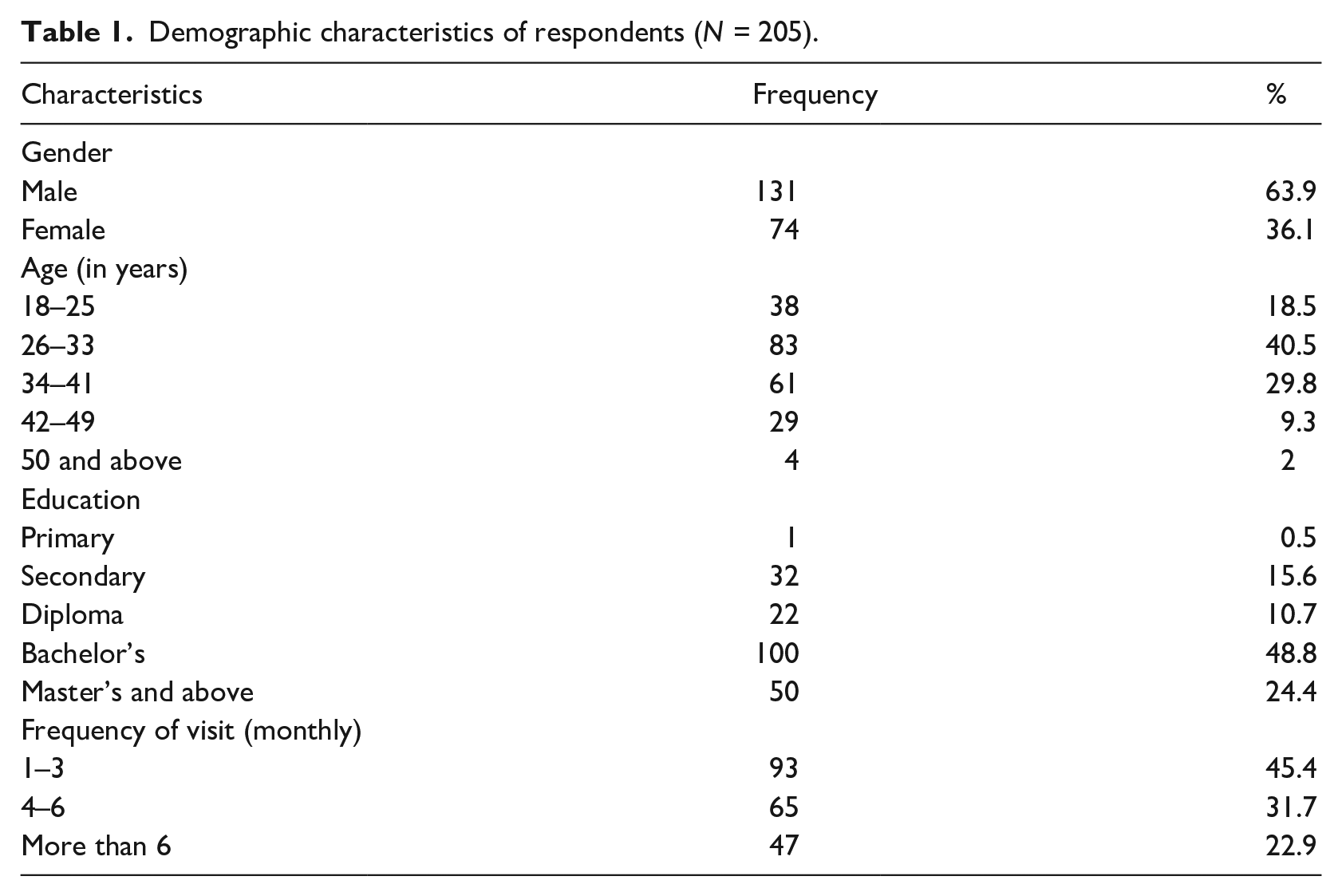
As shown in Table 1, around 64% of all the respondents are male, the reason being that most visitors to the Benadir Regional Administration office in Mogadishu are male. Concerning the age of the respondents, around 89% are young, within the age group of 18–41 years. The young minds can also better respond to the incidences of corruption in public service delivery, their belief in newly established democracy, and also the current practice of civil societies in addressing the problem of corruption in society. As far as educational qualifications are concerned, around 73% of the total respondents have either bachelor’s degree or above, such as master’s or doctorate. It indicates that respondents are quite highly educated and we can rely upon their opinions on various constructs of the study. The researchers also wanted to know the respondents’ frequency of visits to the office concerned for accessing services. A greater number of visits indicates more physical interaction with officials and potentially more experience of incidences of corruption. Of the total respondents, over 50% are visiting the office more than four times a month, while 45% are visiting 1–3 times.
Demographic characteristics of respondents (N = 205).
Descriptive statistics
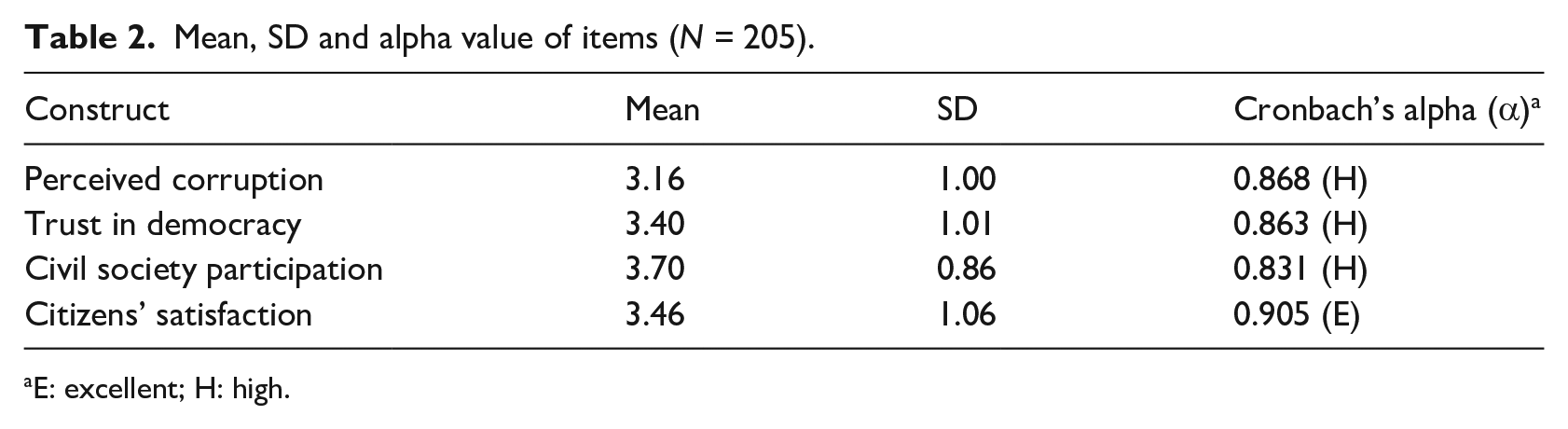
Table 2 offers mean, standard deviations (SD) and Cronbach’s alpha scores of all the four constructs used in the model. For all the four constructs, the mean values are more than the level of 3. This indicates the respondents respond favorably to the constructs. As far as SD of all the constructs are concerned, they were found to be less than 1.00 for civil society participation, and little more than 1.00 for the remaining three. These lower SD scores indicate responses did not fluctuate much across the mean values.
Mean, SD and alpha value of items (N = 205).
E: excellent; H: high.
Cronbach’s alpha is basically a test to determine the reliability, which indicates the establishment of internal consistency of the items measuring the same construct (Hair et al., 1992; Zikmund, 1994). The alpha score for all the constructs mentioned in Table 2 indicates either excellent (α > 0.90) or high (α > 0.70) internal consistency (Gliem and Gliem, 2003). The possible reason for this excellent alpha score for citizens’ satisfaction (0.905) may be due to strong internal consistency among the four items measuring the same construct.
Measurement model
For validating the measurement model, Awang (2012) suggests running a pooled confirmatory factor analysis (CFA). Figure 1 offers the results of the measurement model. The factor loading and squared multiple correlation (R2) for each item should not be less than 0.6 and 0.4 respectively (Awang, 2012). Accordingly, we dropped one item each from “trust in democracy,” “civil society participation,” and “citizens’ satisfaction” due to poor factor loadings. Again, CFA was performed with the help of AMOS 24 by adopting maximum likelihood method (ML). In the validated model, factor loadings for perceived corruption are .74, .75, .71, .80, .78, factor loadings for trust in democracy are .75, .87, .81, .69, factor loadings for civil society participation are .77, .73, .73, .74 and factor loadings for citizens’ satisfaction are .83, .84, .83, .86. The pooled measurement model also satisfies the acceptance level of fit indices (Table 5).
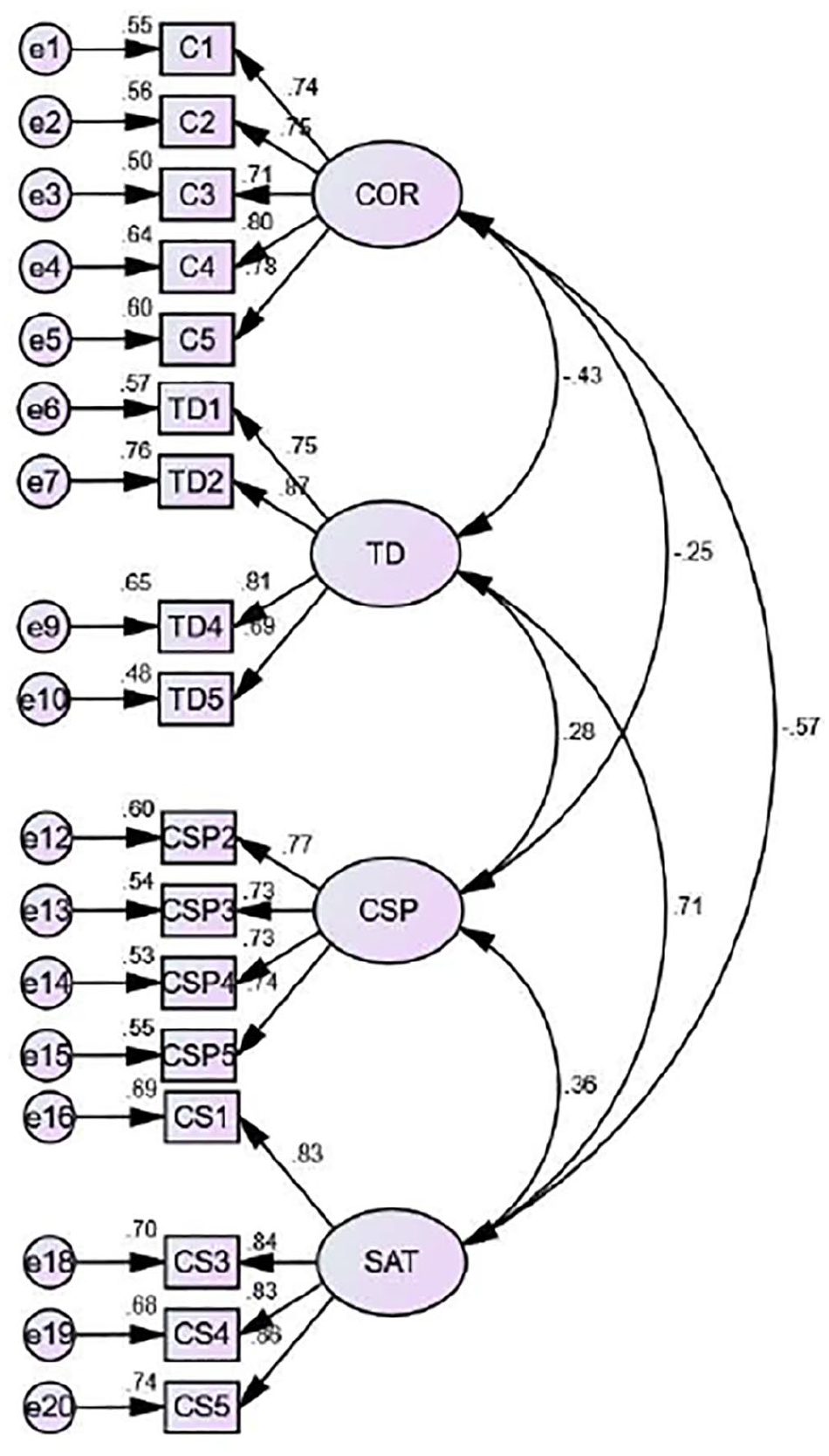
Validated measurement model.
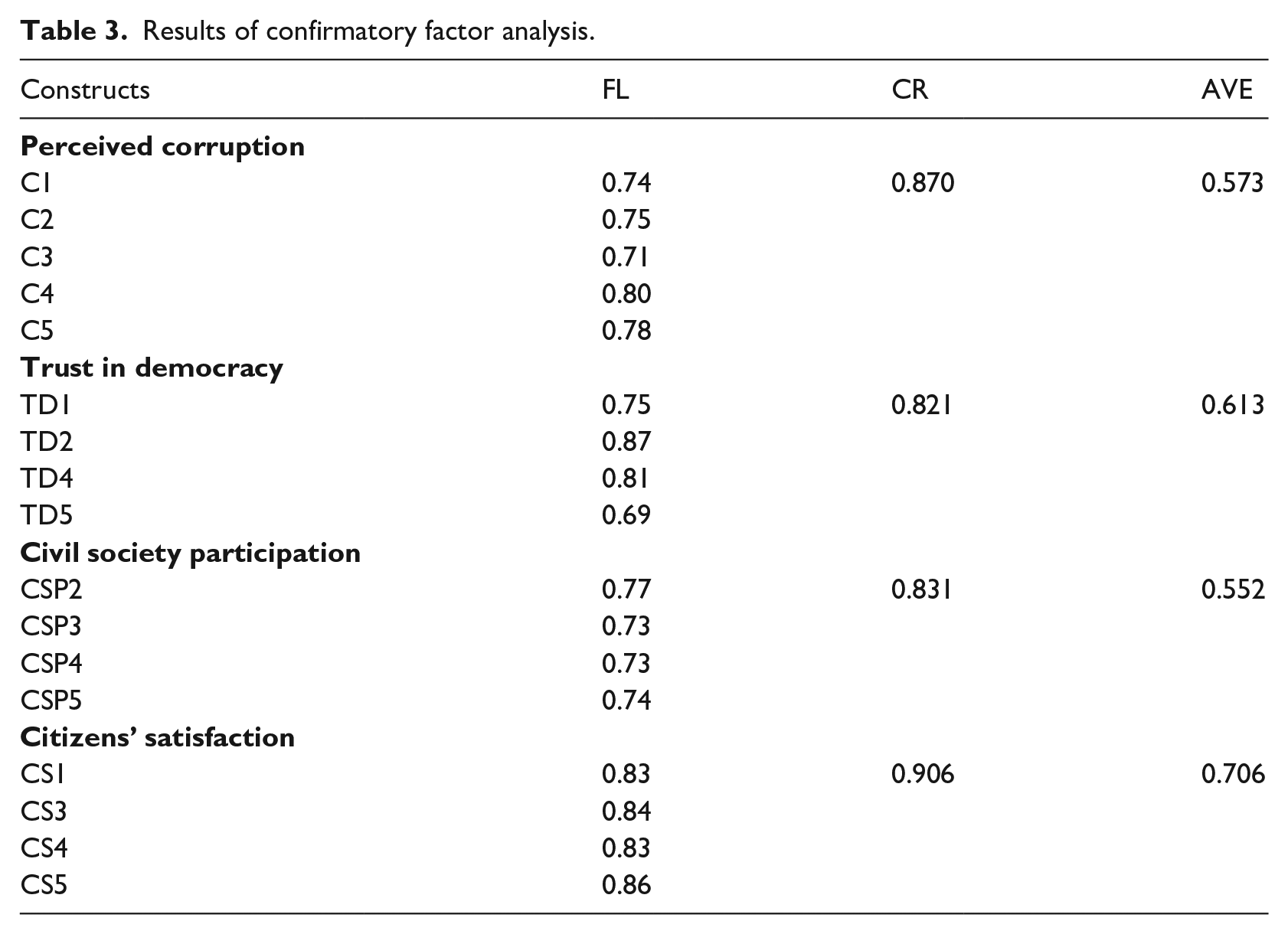
For reliability and validity analysis, Anderson and Gerbing (1988) recommend checking the factor loadings (FLs), composite reliability (CR), and average variance extracted (AVE) for convergent validity. In the previous paragraph, we analyzed the factor loading of each item of each construct. Composite reliability (CR) is a more robust measure than Cronbach’s alpha and it should be more than 0.70 (Hair et al., 1992; Nunnaly, 1978). This research reports the CR value for all the four constructs within a range of 0.821 to 0.906.
AVE is a variance measurement extracted by the latent variable to random measurement error (Netemeyer et al., 1990). Table 3 also gives the AVE scores of all the four constructs (0.552 to 0.706), which is well above the minimum limit of 0.50 (Fornell and Larcker, 1981). The results from FLs, CRs, and AVEs established the convergent validity of the measurement model.
Results of confirmatory factor analysis.
Discriminant validity can be established if the correlation between a pair of latent variables is less than the square root of AVE of each variable. The results offered in Table 4 confirm the establishment of discriminant validity. For example, correlation between perceived corruption and citizens’ satisfaction is −0.511, which is less than the square root of AVE of perceived corruption and citizens’ satisfaction (0.756 and 0.840 respectively).
Discriminant analysis.
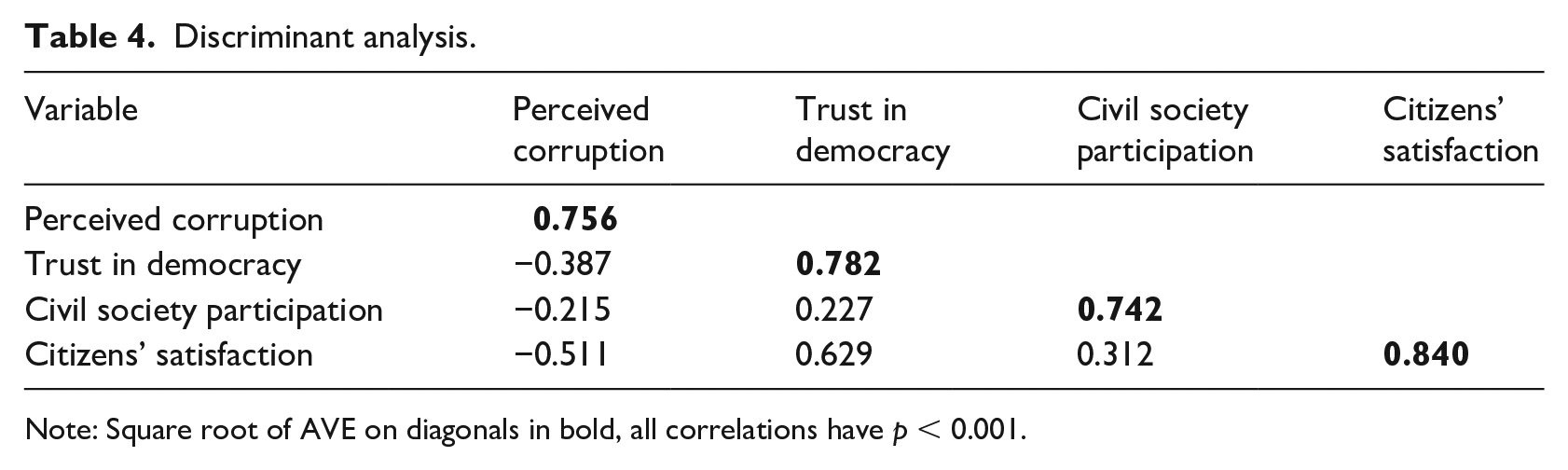
Note: Square root of AVE on diagonals in bold, all correlations have p < 0.001.
Structural model testing
Taking the four constructs, we tested the structural model, where citizens’ trust in democracy and civil society participation act as mediators in between perceived corruption and citizens’ satisfaction. This study reports a number of model fit indices, generated from AMOS. As recommended by Hair et al. (1995, 2010) and Holmes-Smith (2006), we checked the structural model fit from all the three categories, namely absolute fit, incremental fit and parsimonious fit. Wheaton et al. (1977) stressed the need of p value to be significant (above 0.05) but the value of chi-square (χ2) divided by degree of freedom is a better measure and the ratio of the two values (CMIN/df) should be less than three (Marsh and Hocevar, 1985). Our study reports a p value equal to 0.156, which is significant, and CMIN/df value (1.134) is well within the limit.
This research also reports some other fit indices of the model (Table 5), namely Root Mean Square Error of Approximation (RMSEA), Goodness of Fit Index (GFI), Adjusted GFI (AGFI), Comparative Fit Index (CFI), Tucker-Lewis Index (TLI), and Normed Fit Index (NFI). The ideal value of GFI, AGFI, CFI, TLI, and NFI should be equal to or above 0.90 (Bentler, 1990; Bentler and Bonett, 1980; Bollen, 1989; Jöreskog and Sörbom, 1984; Tanaka and Huba, 1985). All the values reported by this study have achieved the accepted level. The RMSEA should not exceed 0.08 (Browne and Cudeck, 1993) and our study reports it to be 0.026.
Model fit indices of the research model.
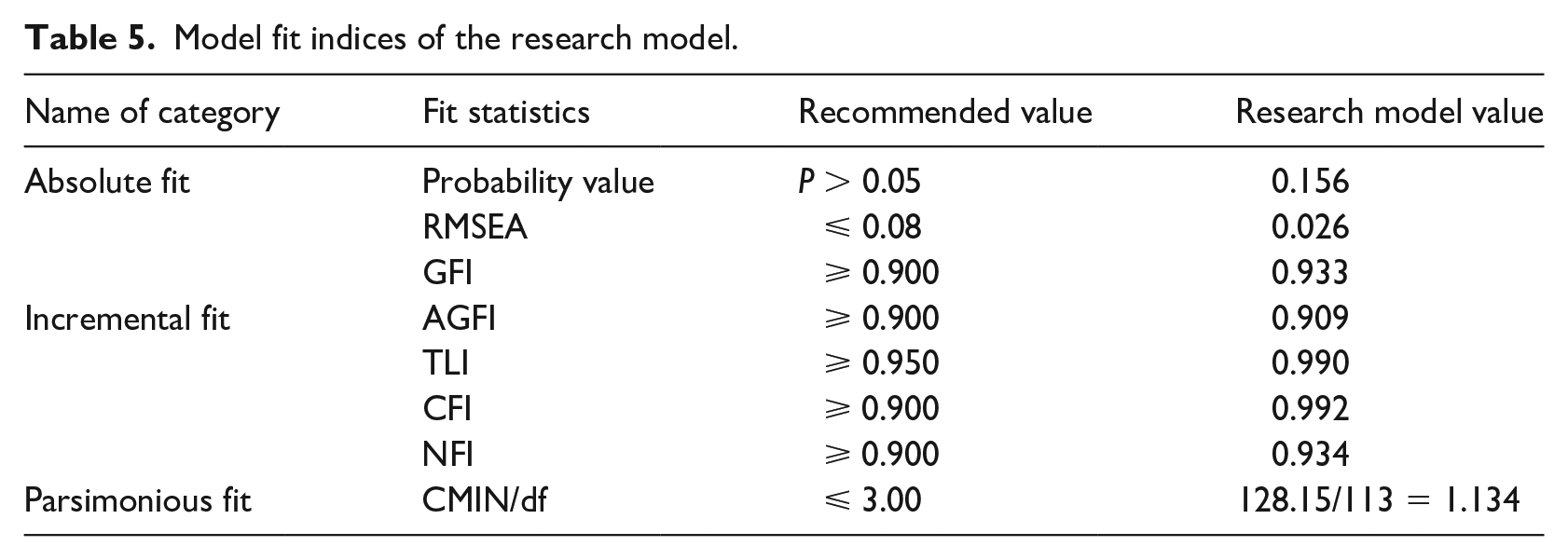
The fit statistics in Table 5 indicate that the research model is adequately fit for the collected data in the context of Somalia and provoke us to examine the path coefficients for testing of the hypotheses of the research model. Table 6 presents the results of the structural equation modelling.
Path coefficients and hypotheses testing.
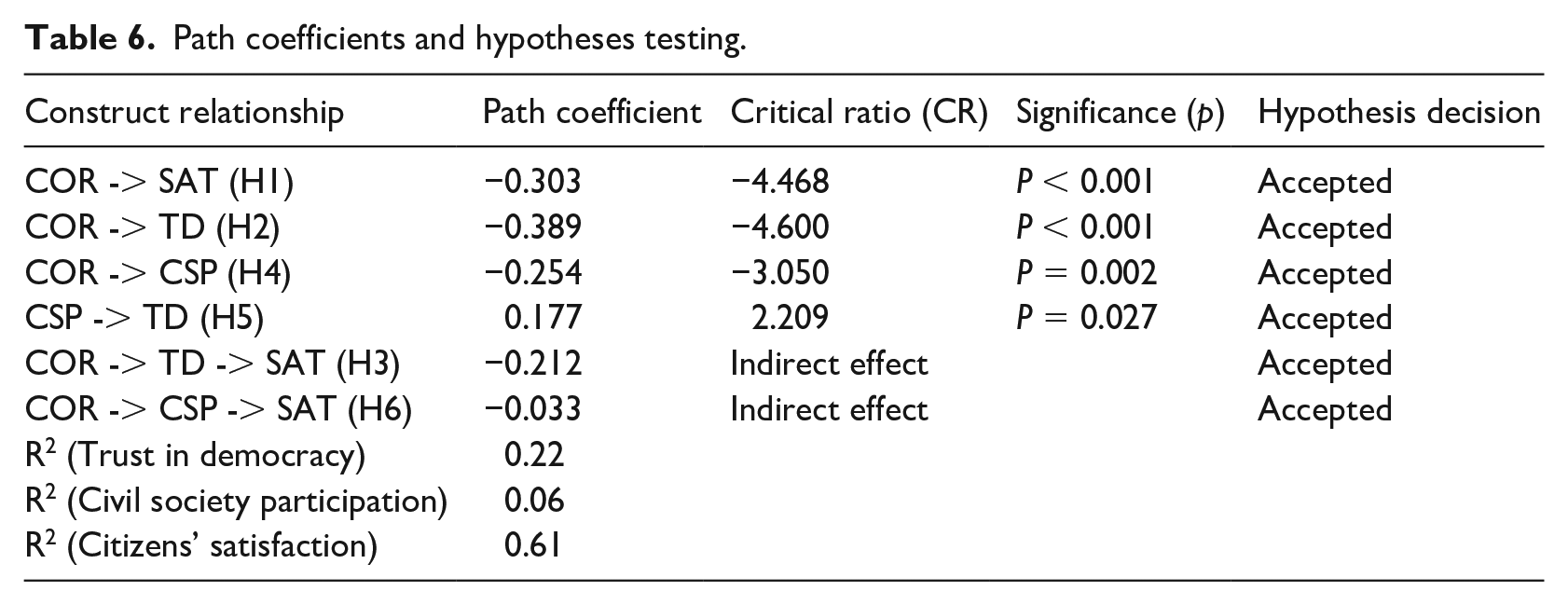
All the hypotheses were supported by the data collected to validate this model in Somalia. The results indicate COR -> SAT (γ = −0.303, p < 0.001), COR -> TD (γ = −0.389, p < 0.001), COR -> CSP (γ = −0.254, p = 0.002), CSP -> TD (γ = 0.177, p = 0.027). Another two hypotheses (3rd and 6th) are based upon mediation analysis. In first mediation, the indirect effect of perceived corruption on citizens’ satisfaction through citizens’ trust in democracy (COR -> TD -> SAT) is −0.212 and significant, because the causal effect relationship of COR -> TD and TD -> SAT are significant (p < 0.001 and p < 0.001 respectively). But as the direct effect is still significant after the entry of the mediator, the model results in a partial mediation. In the second mediation, the indirect effect of perceived corruption on citizens’ satisfaction through civil society participation (COR -> CSP -> SAT) is −0.033 and significant because the causal effect relationship of COR -> CSP and CSP -> SAT are significant (p = 0.002 and p = 0.033 respectively). But as the direct effect is still significant after the entry of the mediator, the model also results in a partial mediation.
Figure 2 shows the validated research model. The variance of the research model shown on satisfaction (i.e., 61%) indicates variables like citizens’ trust in democracy and civil society participation are some of the most suitable mediating constructs to analyze corruption and satisfaction in Somalia.
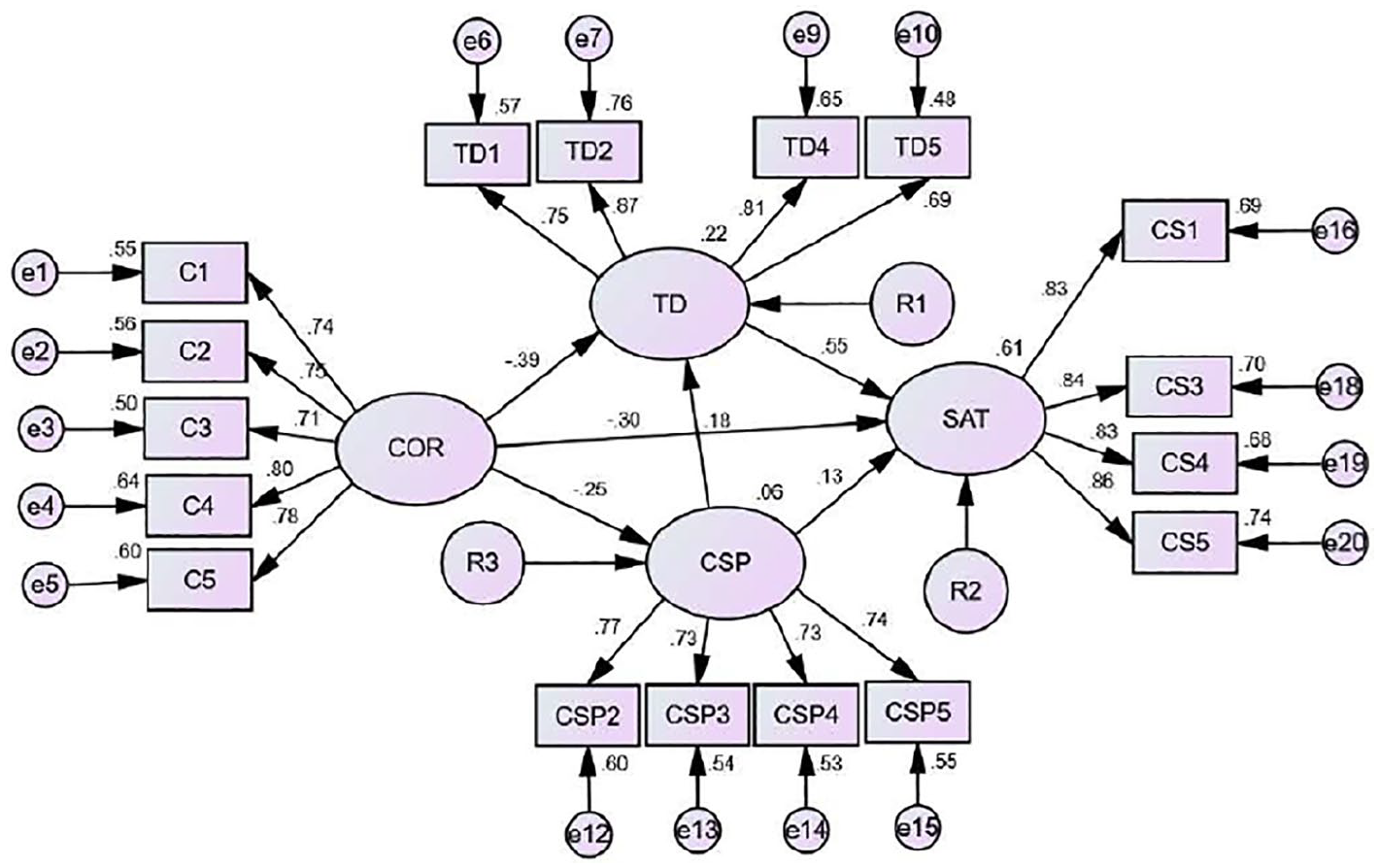
Validated structural model.
Discussion
The purpose of this study is to measure the mediating effect of citizens’ trust in democracy and civil society participation in the relationship between perceived corruption and citizens’ satisfaction in the context of Somalia, considered to be the most corrupt country of the world. The theoretical context of the study is guided by the principal-agent model of corruption (Groenendijk, 1997; Klitgaard, 1988; Rose-Ackerman, 1975, 1978). The hypothesis testing result indicated the significant relation between the four variables (perceived corruption, trust in democracy, civil society participation, citizens’ satisfaction). This study also supported two mediating hypotheses, thus establishing the significant mediating effect of trust in democracy and civil society participation in the relationship between corruption and citizens’ satisfaction. Due to the significant direct effect in both cases even after the entry of mediators, partial mediation occurred.
The significant but negative effect of corruption on citizens’ satisfaction indicates the Somali people are dissatisfied with the corrupt practices experienced while accessing services from government offices. A number of studies (Habibov, 2016; Habibov and Cheung, 2016; Justesen and Bjørnskov, 2014; Park and Blenkinsopp, 2011) exploring the effect of corruption on citizens’ satisfaction have also shown support for this relationship. Moreover, not only citizens’ satisfaction, corruption also negatively affects citizens’ trust in democracy. This finding is an addition to the existing literatures on corruption and its effect on political institutions and also democracy (Anderson and Tverdova, 2003; Chang and Chu, 2006; Seligson, 2002; Theobald, 1990). A recent survey in Somalia conducted by USAID (Robertson et al., 2017) reports that a majority of the respondents are happy with service delivery. It indicated low aspirations of the people. The same survey established the importance of curbing of corruption as vital for democracy. Our study explains the curbing of corruption in public service delivery may enhance citizens’ trust in democracy and satisfaction.
Corruption also negatively affects civil society participation in this study. Zakaria (2013) has found the same result in the context of Central and Eastern Europe. This study also reports the significant positive effect of civil society participation on trust in democracy. In earlier studies, Newton (2001) opined about the link between voluntary associations of the people and social and political trust. Pietrzyk (2003) also had a similar view that civil society participation supports democracy by creating a public sphere. Though the relationship between civil society participation and trust in democracy is significant (p = 0.027), still the empirical value was found to be only 0.177. This also indicates that encouraging civil society participation may build the trust of the people in democracy. Both the trust in democracy and civil society participation are performing the roles of partial mediator in this study result. Hence, more civil society participation can lead to better trust level in democracy and in turn may reduce the negative effect of corruption on citizens’ satisfaction. This can be well validated if we look into the mediating results. With the entry of the mediators (trust in democracy and civil society participation), the negative effect of corruption on citizens’ satisfaction is reduced. The direct effect of corruption on satisfaction was −0.303, but the indirect effect of corruption on satisfaction through trust in democracy is −0.212. It indicates reduction in negative effect on satisfaction. But most interesting result is about the mediation of civil society participation. The indirect effect of corruption on satisfaction through civil society participation is −0.033. Consequently, this huge drop indicates that the negative effect of corruption on citizens’ satisfaction is satisfactorily reducing after the entry of civil society participation as a mediator. Earlier our result has established a positive and significant relationship of civil society participation and trust in democracy. Hence, with the active support from the government, a public space should be created allowing civil societies to prosper. A true community-driven participation is necessary in Somalia, unlike the existing clan-based civil society system. The clan system also should not be completely ignored. Some years ago, Samatar (1992) reported on state destruction in Somalia but argued that kinship was not the culprit. In the present scenario, the Western concepts of civil society can be combined with the traditional clan system. The traditional kinship still has wide popularity. Hence, in simple terms, the so-called tribal leaders can take the responsibility in spearheading the modern civil society movement. The global ideas should be implemented by the local leaders.
Implications
This study reveals that corruption negatively affects both trust in democracy and civil society participation. It also negatively affects citizens’ satisfaction, but trust in democracy and civil society participation reduces the negative effect on satisfaction from corruption. Hence, it is necessary to understand the importance of both civil society participation and belief in democratic process for achieving citizens’ satisfaction in a highly corrupt society. The present study has also analyzed the effect of civil society participation on trust in democracy. This would allow the researchers to focus more upon civil society awareness in bringing social changes, more particularly in countries with a high corruption perception index. The results also have implications for the government of Somalia. The successful mediation of civil society participation and trust in democracy indicates that the government should put all its efforts into creating a public space where civil society can function effectively. In major public service deliveries, the government should have an association with civil society organizations. By doing this, two objectives would be satisfied. First, it may end the monopoly in providing services, which is one of the many causes of corruption. Second, more civic engagement would lead to trust of the citizens. The government of Somalia should also nurture the newly created parliamentary democratic system, which is at the stage of infancy. The government should follow the rule of law and accountability in its functioning. Free and fair conduct of elections will allow the citizens to choose their representatives. This would help in building trust in democracy and satisfaction with government.
Conclusion
This study examined the effect of perceived corruption on citizens’ satisfaction, civil society participation, and trust in democracy in the context of Somalia. The study also examined the mediating effect of trust in democracy and civil society participation in the relationship between perceived corruption and citizens’ satisfaction. The principal-agent model of corruption (Klitgaard, 1988, 1991; Rose-Ackerman, 1975, 1978) was adopted for this study. A total of 205 citizens availing public services from Benadir Regional Administration, Mogadishu, Somalia gave their views for analysis. Including two mediation hypotheses, the results supported all the six hypotheses constructed between four constructs. Our findings indicated corruption had a negative and significant effect on citizens’ satisfaction, trust in democracy, and also civil society participation. But civil society participation was found to be positively associated with trust in democracy. The overall higher variance (61%) explained by the model on citizens’ satisfaction indicates the importance of trust in democracy and civil society participation in a highly corrupt society. The outcomes of this study will help researchers understand how civil society participation and trust in democracy mediated corruption satisfaction model and may relate to other countries marred by a high perception of corruption.
Limitations and future research options
This study used the data from the public service users of Benadir Regional Administration, Mogadishu, Somalia. Such data may not represent the beliefs of those citizens who are not coming to the said office. Hence, utmost care must be taken in making a generalization of the research results across Somalia. The study has used a 5-point Likert scale to capture the views of the respondents. The true feelings of the respondents could have been better recorded by applying some qualitative instruments. Therefore, future research can focus on more public service users of different public institutions. Future research can be undertaken by employing qualitative approaches to understand what is really needed to enhance the civil society participation and trust in democracy. This study has used the principal-agent theory of corruption. Future researchers can attempt to validate other theoretical models by adding the two discussed mediators. This study used citizens’ perceptions on corruptions coming from service delivery by public officials and consequent citizens’ satisfactions, but another study is possible regarding corruption, political satisfaction, and the role of mediators in between. Finally, this study has used perceptions of service users on various constructs, but a study from the officials’ side would be worthwhile to open a new perspective.
Footnotes
Funding
The authors received no financial support for the research, authorship, and/or publication of this article.
