




Abstract
Despite the proliferation of poverty studies, poverty in Brunei Darussalam (hereafter, Brunei) is under-researched. What poverty means in Brunei is, therefore, little understood, and there is a local belief that poverty in the country is unique and relative. Moreover, the terms ‘poverty’ (kemiskinan) and ‘poor’ (miskin) are somewhat sensitive in Brunei, but the reason(s) for this sentiment and preferred terms are not known. This study examines the language and meaning of poverty in Brunei. It also sheds light on the local belief about poverty within the country. The study used an exploratory research methodology and data were collected from poor and non-poor households and key informants. Results show that Bruneians use different terms to refer to poverty or poor people, but preferred terms are ‘living in need’, ‘difficult life’ and ‘needy people’. Bruneians avoid the terms ‘poverty’ and ‘poor’ because they can erode one’s self-confidence or self-esteem. Poverty in Brunei is construed in different ways, but it is mostly perceived as relative, and its nature is not unique.
Introduction
Poverty is one of the defining challenges of the 21st century facing the world. In 2018, about 1.34 billion people from 105 countries were multidimensionally poor – 41.6% and 40.6% of them lived in Sub-Saharan Africa and South Asia, respectively (Oxford Poverty and Human Development Initiative, 2018). Thus, poverty eradication is at the top of the 2030 Agenda for Sustainable Development Goals, which calls for the elimination of all the forms of poverty throughout the world by 2030 (Koehler, 2017; United Nations, 2015). Success in eradicating poverty depends on, among other factors, how much we know about poverty. It is for this reason that numerous poverty studies have been conducted. Global research on poverty includes Narayan et al. (2000a, 2000b, 2009), Narayan and Petesch (2002, 2007, 2010) and World Bank (2001). The scholarly literature on poverty is rich and vast (Whitman, 2008), and a 2018 Google Books search for the keyword ‘poverty’ turned out about 2,350,000 books (Google Books, 2018a) and about 841,000 books for the keywords ‘understanding poverty’ (Google Books, 2018b).
Despite the proliferation of poverty studies, poverty in Brunei is under-studied. A bibliography on poverty in Southeast Asian countries compiled by Salleh (2001) and published by the Universiti Brunei Darussalam library does not have a single publication on Brunei. For this reason, little is known about what poverty means or who the poor are in Brunei (Amir Noor, 2012; Kon, 2015; Rabiatual Kamit, 2014; Thien, 2016a, 2016b; Ubaidillah Masli, 2008). Also, there is a local belief that poverty in Brunei is unique and relative (Rosli, 2008; Thien, 2016a; Ubaidillah Masli, 2008), but such a belief has not been subjected to academic scrutiny. During the proposal development for this study, we observed that the terms ‘poverty’ (kemiskinan in the Malay language 1 ) and poor (miskin) are somewhat sensitive amongst the Bruneians, but no studies have been done to establish the reason(s) for this and what terms they prefer to use. We do acknowledge the pioneering scholarly work of Rose Abdullah and Nurhasanah Morsid (2013) and Rose Abdullah (2015) on poverty in Brunei, which provides invaluable insights into the causes of poverty and poverty reduction efforts in Brunei. However, their work skirts around the meaning and overlooks the language of poverty in Brunei. Furthermore, their work does not explain the belief that poverty in Brunei is unique; although it does explain, but superficially, the claim that poverty in the country is relative.
Brunei is working to achieve a zero-poverty status by 2035 (Department of Economic Planning and Development, 2010). The dearth of knowledge about poverty in the country is seen as an impediment to the country’s efforts to achieve this status. Hence the call for poverty studies, especially ones that are based on Bruneians’ perspectives and experiences about poverty (Amir Noor, 2012; Department of Economic Planning and Development, 2010; Kon, 2015; Thien, 2016a).
This study, therefore, examines perceptions about the language and meanings of poverty in Brunei. These perceptions are drawn from both poor and non-poor households as well as key informants such as grassroots leaders, government, district and non-governmental organisation (NGO) officials, and local poverty experts. The study also analyses the local belief that poverty in Brunei is unique and relative. It specifically addresses the following questions: Are the terms ‘poverty’ (kemiskinan) and ‘poor’ (miskin) sensitive in Brunei? If so, why, and is this exclusive to Brunei? What other terms do Bruneians use to refer to poverty or poor people, and which ones do they prefer to use? Why is it important to understand the language of poverty? What are the meanings of poverty in Brunei, and do the meanings vary between urban and rural areas? Is poverty in Brunei unique and relative, and if so, how and why?
This study addresses the knowledge gap in the language and meaning of- and belief about poverty in Brunei. Specifically, the study provides scholarly insights about: the sensitivity of terms such as ‘poverty’ and ‘poor’ in Brunei; terms relating to poverty used in the country and preferred poverty terms; and the importance of understanding the language of poverty. The study also presents the different meanings of poverty in Brunei and establishes whether the meanings vary between urban and rural areas. Lastly, the study analyses the belief that poverty in Brunei is unique and relative.
The findings of the study are expected to benefit:
(1) Academic researchers in and outside Brunei: the findings on the language and meanings of- and beliefs about poverty in Brunei could be the foundation for future poverty studies in Brunei and could be used as case studies for poverty studies in other countries, especially in Southeast Asia. Moreover, given the dearth of scholarly discourse about poverty in Brunei, this study is expected to stimulate such discourse.
(2) Development practitioners in government, private and civil society sectors of Brunei who are working towards eliminating poverty in Brunei by 2035. The findings will provide these practitioners with knowledge about the local poverty terms and the sensitivity associated with some of these terms, and about the meaning of poverty in Brunei. This is essential for designing, implementing, monitoring and evaluating poverty eradication policies and programmes.
Perceptions of poverty
People are directly and indirectly exposed to poverty in their daily lives. Their poverty perceptions and experiences are, therefore, insightful and should come first in understanding poverty (Chambers, 2005, 2012; Kadigi et al., 2007; Narayan et al., 2000a; Ohio-Ethimiaghe, 2012). People’s perceptions of poverty have been widely used to understand poverty at national and global levels. At national level, for example, people’s perceptions were used: (i) to ascertain the causes of poverty and poverty reduction measures in South Africa (May and Norton, 1997); (ii) to understand the relationship between poverty and ill-health in Zambia (Witola et al., 2011); (iii) to understand the multidimensionality of poverty in Guatemala (World Bank, 2004); (iv) to ascertain the nature of poverty in Sri Lanka (Asian Development Bank, 2001); (v) to understand the effectiveness of tourism as a means of poverty reduction in Vietnam (Truong et al., 2014); (vi) to explore, among other aspects, the influence of the views of non-poor people on people living in poverty in Melbourne, Australia (Kelly, 2016); and (vii) to determine a consensual poverty line in Sweeden (Halleröd, 1995). At the international level, the World Bank’s ‘Consultation with the Poor’ research project, based on a sample of over 40,000 poor people from 50 countries, used perceptions of poverty to understand the nature of global poverty (Narayan et al., 2000a; Parnwell, 2003). Although the approach of understanding poverty through people’s perceptions has its benefits, it also has its disadvantages.
The benefits include the generation of poverty knowledge that is grounded in local poverty realities and that reflects variations of poverty experiences according to context, gender or age (Bevan and Joireman, 1997; Ohio-Ethimiaghe, 2012; Wagle, 2008). Variations (by context, gender and age) of poverty experiences were noted in the World Bank’s study of the perceptions of poverty meanings and causes in 50 countries (Narayan et al., 2000a). Thus, people’s perceptions of poverty do not only provide an in-depth and nuanced understanding of poverty (Ohio-Ehimiaghe, 2012; Parnwell, 2003) but they also exert a profound influence on the effectiveness and legitimacy of anti-poverty policies (Witteveen et al., 2008). In addition, perceptions of poverty reveal the multidimensionality and complexity of poverty (Narayan et al., 2000a; Parnwell, 2003). Perceptions of poverty also reflect the poverty dimensions that matter to people (Witteveen et al., 2008). Lastly, perceptions of poverty have an ethical dimension in that they allow people to deliberate on how poverty should be defined, analysed and measured in their communities (Hulme, 2014; Wagle, 2008).
There are two main disadvantages of using perceptions of poverty in analysing poverty. First, these perceptions could be biased, distorted or misleading owing to socio-economic, psychological and other related influences or conditions (Dhongde and Minoiu, 2011; Howe et al., 2011; Hulme, 2014; Ohio-Ehimiaghe, 2012; Wagle, 2008). However, the biases or distortions associated with perceptions of poverty could be neutralised by either ‘importing’ an objective approach (Ohio-Ehimiaghe, 2012) or drawing these perceptions from people of different gender, age and socio-economic, religious, political and economic backgrounds. Second, perceptions of poverty are criticised for being local, which makes them difficult to compare over time and across societies (Bevan and Joireman, 1997; Hulme, 2014; Wagle, 2008). However, this should not be regarded as a flaw because poverty realities, by their very nature, vary according to gender, age as well as socio-economic, political and geographical contexts (Ali-Akpajiak and Pyke, 2003; Sen and Begum, 2008). For that reason, Lister (2004) and Haase and Foley (2009) have argued that the meaning or nature of poverty should reflect the social, cultural, political and other conditions experienced by a particular society and how these effect the well-being of its people.
Methodology
This study is a part of our three-year (2015–2018) research project on ‘understanding poverty in Brunei Darussalam’, which used the exploratory approach. Two factors influenced the decision to adopt the exploratory approach. First, the lack of prior knowledge about the language and meaning of poverty in Brunei. Hence, the exploratory approach was appropriate for the study since, according to Gratton and Jones (2010), it focuses on generating insights about a phenomenon about which there is little or no prior knowledge available. Second, the choice was influenced by the need for a flexible methodology given the sensitive nature of the issue of poverty in the Bruneian community. The exploratory approach was suitable for the study since, according to McNabb (2010), it is flexible, allows features of the subject under study to be considered as they emerge and researchers to adjust to unforeseen events as they occur.
Data for the study were collected from households and key informants. A total of 208 households (130 urban households and 78 rural households) were purposively selected for the study. Of these, 8.5% classified themselves as poor, 87.7% as average, 0.8% as well-off and 3.1% preferred not to classify themselves. Thus, the study drew perceptions of poverty from both poor and non-poor households. The households responded to the study based on their own experience of poverty at household and community levels. A questionnaire with open-ended questions was used to collect data from household respondents. Access to household respondents was facilitated by District officials and grassroots leaders. The key informants were also purposively selected and included grassroots leaders (ward leaders/Penghulus and village heads/Ketua Kampong), government and district officials, NGOs, and local poverty experts. Semi-structured interviews and a Focus Group Discussion (FGD) were used to collect data from the key informants. The study also used secondary data drawn from a government report. Figure 1 shows the Wards (Mukims) and their respective districts from which the study drew the households and grassroots leaders. The study was approved by the Faculty of Arts and Social Sciences Ethics Committee, Universiti Brunei Darussalam.

Wards covered by the study.
The data collected related to the terms Bruneians use in referring to poverty, the sensitivity of terms such as ‘poverty’ and ‘poor’ and the meaning of poverty in Brunei. Keywords or expressions on poverty terminologies and meanings were inductively coded based on the collected data. The keywords or expressions became themes for understanding the language and meaning of poverty in Brunei. Frequency distributions graphs and tables were used to present and summarise the themes.
Findings
The study affirmed the call for studies on poverty in Brunei. In response to a question on what poverty in Brunei means, a Local Poverty Expert said:
when we say someone is poor, we always have this assumption in our mind: that someone does not live like other people. . .we really do not know who actual poor people are [in Brunei] . . .we make a lot of assumptions. Let us find out what poverty means.
NGO1 and NGO2, District Official 1, and Village Head 1 also reported an absence of ‘right’ knowledge about the meaning and nature of poverty in Brunei and stressed that this is hampering poverty elimination efforts in the country. They also expressed the need for poverty studies in Brunei. This section, therefore, presents the findings on the language and meanings of poverty in Brunei. It also analyses the local belief about poverty in Brunei.
The language of poverty in Brunei
The terms ‘poverty’ (kemiskinan) and ‘poor’ (miskin) are, certainly, somewhat sensitive in Brunei. As Village Head 2 stated:
kadang kadang ada org inda suka diri mcm disebut miskin ani, habis habis tu dorang cakap
kurang mampu, nada ke’upayaan seumpamanya tapi sekiranya kadang kadang kitani
sensitive bah. . . (sometimes poor people do not like to be referred to as poor, they prefer to be considered as people who cannot afford [basic needs] or who are incapable because the term ‘poor’ is sensitive to some. . .)
A similar view was expressed by Ward Head 1, who said that, given the sensitive nature of the term ‘poor’, grassroots leaders never label people who apply for welfare assistance through them as poor, but needy. As the study found, the terms ‘poverty’ and ‘poor’ are not very acceptable in the Bruneian community because they could adversely affect one’s sense of dignity, eroding one’s self-confidence, self-esteem or self-worth.
The terms ‘poverty’ and ‘poor’ are not only sensitive in Brunei but the world over. In Sri Lanka, for instance, “the ‘poor’ do not always want to be considered as ‘poor’ as this label is stigmatic” (Asian Development Bank, 2001: 39). In Uganda, moreover, people living in poverty dislike being labelled as poor, especially in public, as that makes them feel ashamed or worthless (Kyomuhendo and Mwiine, 2011). In Zimbabwe, too, the poor dislike being identified as poor, especially where they do not anticipate assistance because such an identity makes them feel inferior (Gweshengwe, 2019). Similarly, the labelling of people living in poverty is a sensitive issue in southeast Melbourne, Australia (Kelly, 2016).
In order to understand the language of poverty in Brunei, we asked the respondents to name other terms that they use when referring to poverty (kemiskinan). The respondents gave a total of 28 terms 2 (see Figure 2), which confirms Philip and Rayan’s (2004: 2) assertion that poverty “is blessed with rich vocabulary, in all cultures. . .”. The five most mentioned terms or expressions were: tidak or kurang mampu/kurang kemampuan (living in need/cannot afford basic needs); kesusahan dalam kehidupan/hidup susah (hardships/difficulties in life or difficult life); kapih (poor or people in a dire situation, especially due to lack of money); orang susah/keluarga susah (people in hardships or facing difficulties); and orang inda/tidak or kurang berkemampuan (needy people). All of these five terms or expressions, except kapih, are similar to poverty terminologies observed in Rumbewas’ (2006) poverty study in Ayiaw village in Jayapura District, Indonesia. Brunei and Indonesia have similar cultures, and Bahasa is one of the main languages of both countries.
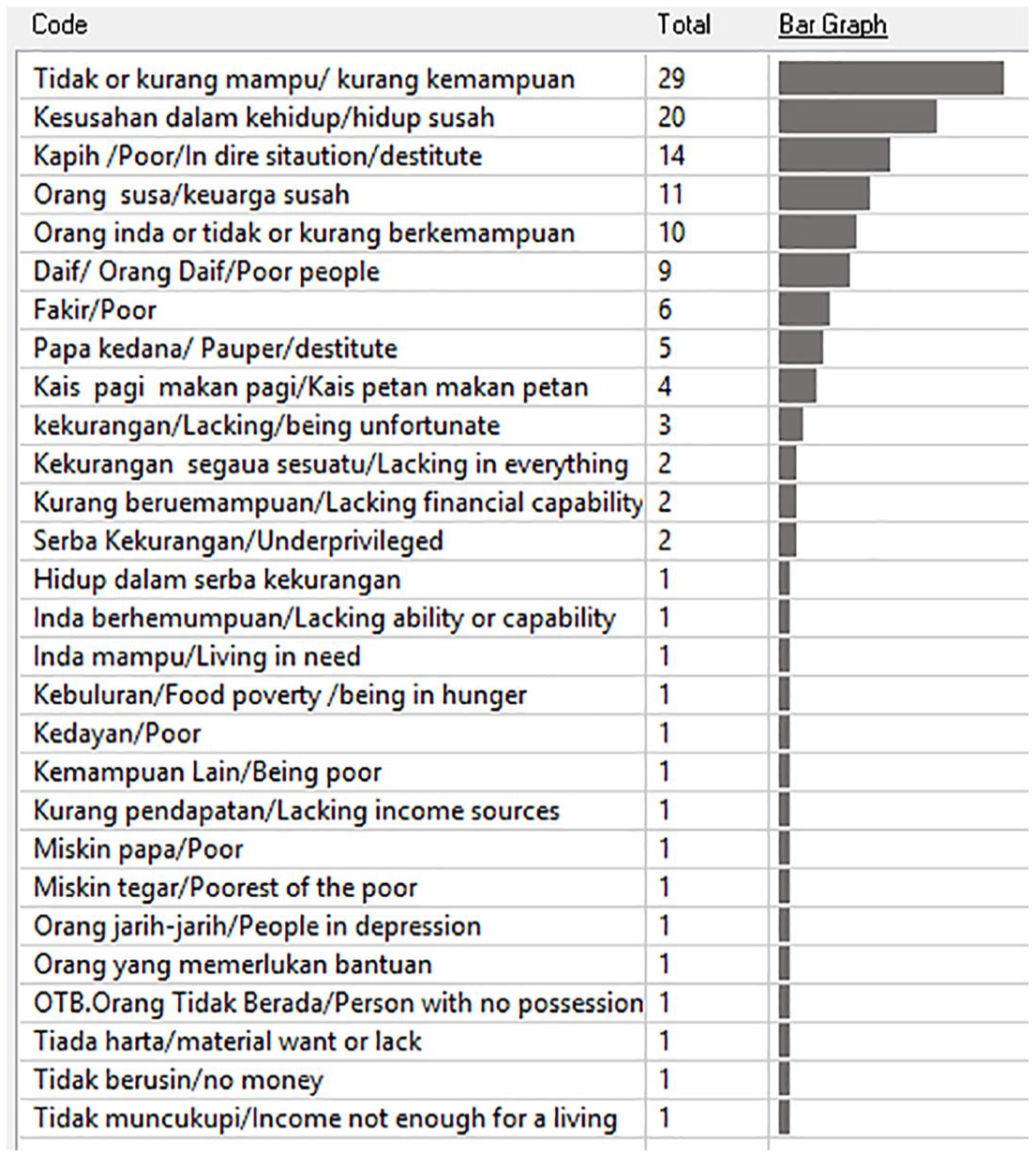
Other local poverty terms used in Brunei.
The fact that ‘tidak or kurang mampu/kurang kemampuan’ (living in need/cannot afford basic needs) was the most frequently mentioned, followed by kesusahan dalam kehidup/hidup susah (hardships/difficulties or difficult life), suggests that Bruneians prefer to express poverty as ‘living in need’ or ‘difficult life’, and describe the poor as the needy or people facing difficulties or hardships (orang or keluarga susah). This observation confirms the assertion by Village Head 2 and Ward Head 1 that the term ‘needy’ is highly preferred when referring to people living in poverty in Brunei.
Based on the findings about the language of poverty presented above, it is clear how important it is to understand local poverty terminologies used in a community. It helps researchers and practitioners to uphold people’s dignity. As the findings reveal, communities have poverty terms that they prefer to use as some terms could erode people’s self-confidence or self-esteem. Furthermore, as Brock (1999) and Ohio-Ehimiaghe (2012) have observed, local poverty terms reflect the forms or dimensions of poverty that a community is confronted with. The poverty terms in Figure 2 reveal the different dimensions of poverty evident in the Bruneian community, which include a lack of basic needs, food insecurity, financial deprivation and material lack. Local poverty terms reflect the severity of poverty that a person or household faces. The terms fakir, miskin tegar, kapi and papa kedana, for instance, relate to extreme or chronic poverty. Lastly, understanding local poverty terms helps to minimise confusion or misconceptions when analysing poverty within a community. Different poverty terms can be used for the same subject (World Bank, 1999), or a single term may refer to different forms of poverty. This has also been observed in this study (see Figure 2). This paper, therefore, agrees with the World Bank (1999) that in understanding poverty in any given community, researchers or practitioners should begin by ascertaining local poverty terminologies.
The meaning of poverty in Brunei
“We must first know what poverty is before we can identify where and when it is occurring or attempt to measure it, and before we can begin to do anything to alleviate it” (Alcock, 1997: 67).
Understanding the meaning of poverty, as noted above by Alcock (1997), precedes ascertaining poverty causes, dimensions, thresholds or lines, spatial distribution, measurement and interventions. As already highlighted in the introduction, the meaning of poverty in Brunei is not well understood. We, therefore, asked the respondents what poverty in Brunei means. The respondents gave various meanings (see Figure 3), based on their direct and indirect exposure to poverty realities within their society.
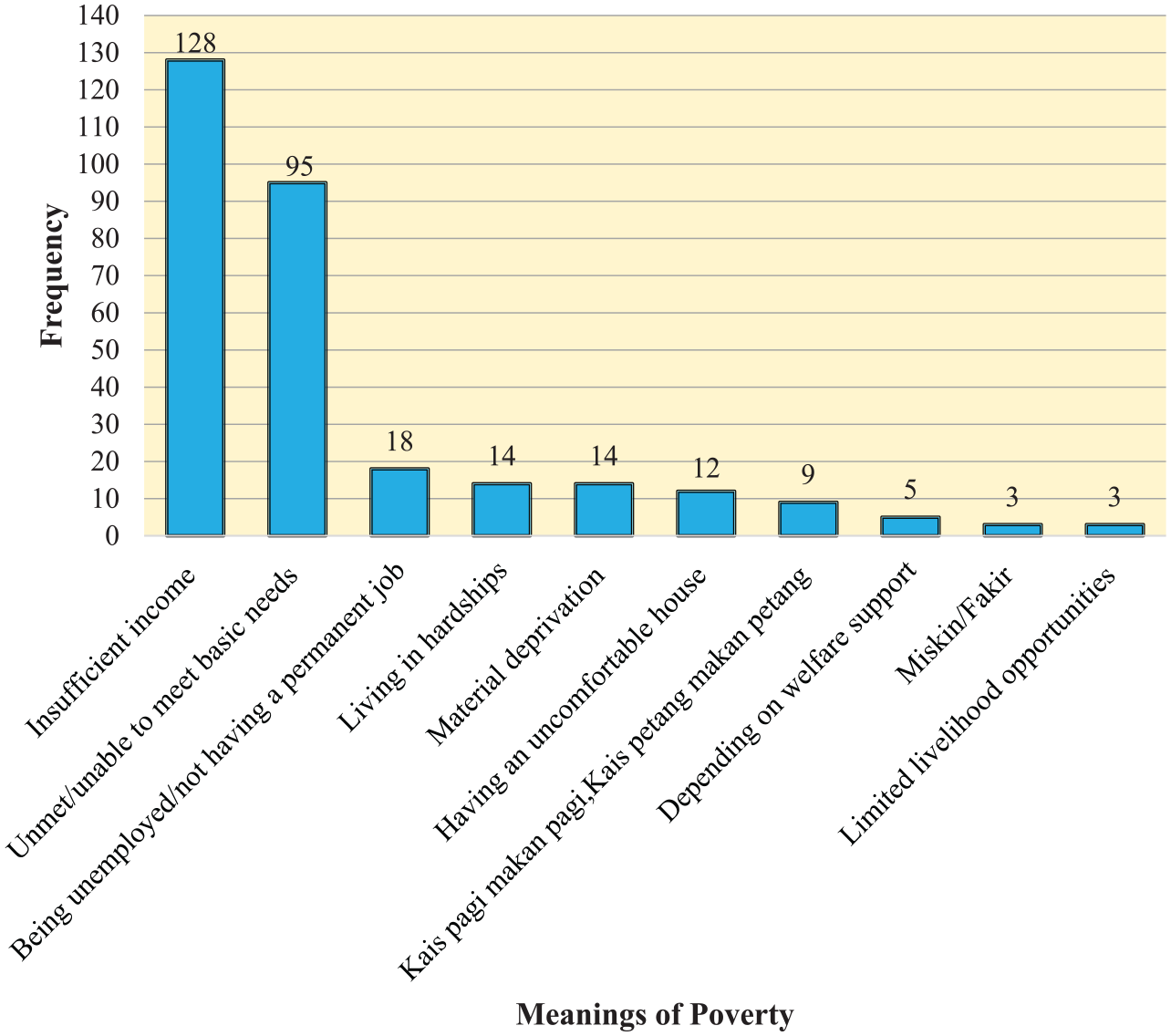
Poverty as defined by Bruneians.
The majority perceived poverty as not having sufficient income and having unmet basic needs or being unable to meet one’s basic needs. Other definitions of poverty given include: being unemployed or not having a permanent job; living in hardship; material deprivation; and having an uncomfortable house. In contrast, fewer respondents expressed poverty as kais pagi makan pagi, kais petang makan petang (labour in the morning for morning food; and in the afternoon for afternoon food); depending on welfare support; miskin and fakir; and having limited livelihood opportunities. All these particular perceptions of the meaning of poverty are common and not unique to Brunei. In Nigeria, for example, people construe poverty as lack of income, being unemployed and being food insecure (Ayoola et al. (n.d); Ohio-Ehimiaghe, 2012). In addition, in the World Bank’s study of poverty in 60 countries including Ghana, Malawi, India, Indonesia and Bangladesh, poverty was perceived as lack of income, unmet basic needs, material deprivation, unemployment, and hardships (Narayan et al., 2000a; Narayan and Petesch, 2002).
In order to understand whether the meaning of poverty varies by the geographical context in Brunei, Table 1 compares the perceptions of the meaning of poverty given by urban and rural households.
Comparison of the perceptions of the meaning of poverty between urban and rural/interior areas*.
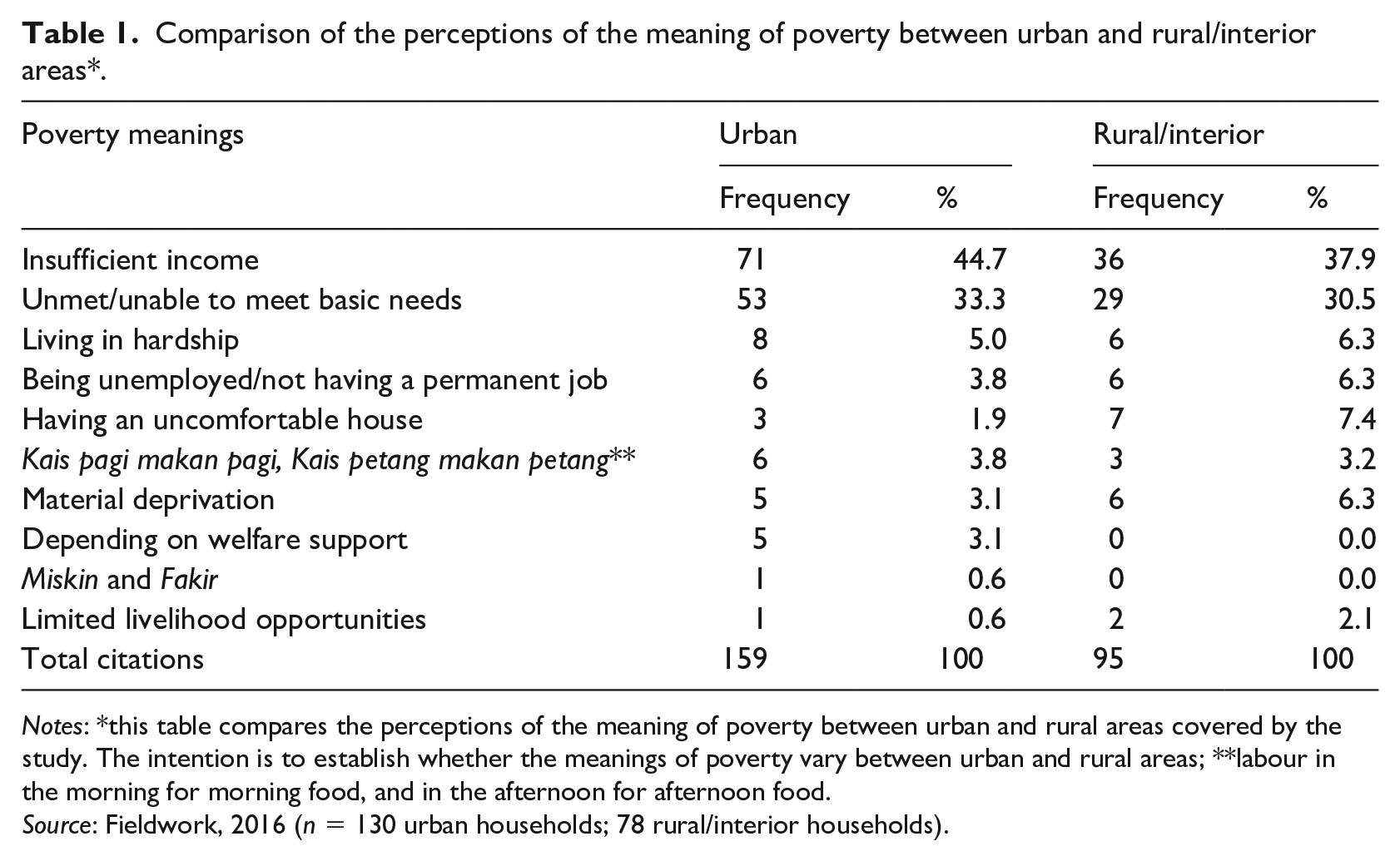
Notes: *this table compares the perceptions of the meaning of poverty between urban and rural areas covered by the study. The intention is to establish whether the meanings of poverty vary between urban and rural areas; **labour in the morning for morning food, and in the afternoon for afternoon food.
Source: Fieldwork, 2016 (n = 130 urban households; 78 rural/interior households).
As Table 1 illustrates, the perceptions of the meaning of poverty presented by urban and rural/interior areas are, by and large, the same in Brunei. ‘Insufficient income’ and ‘unmet basic needs’, respectively, were the most cited meanings of poverty in both urban and rural/interior areas. Thus, the notion that meanings of poverty vary by context (rural versus urban) may be less applicable to Brunei. The reasons could be that many rural/interior areas in Brunei, as noted during fieldwork, have electricity, good roads, and safe drinking water, and rural people mostly depend on urban employment and urban markets for livelihoods.
The differences, albeit minor, are evident in the perceptions of poverty as ‘having an uncomfortable house’, ‘kais pagi makan pagi, kais petang makan petang’, ‘depending on welfare support’, and ‘miskin and fakir’ (Table 1). ‘Having an uncomfortable house’ was cited more in rural than in urban areas. By implication, having an uncomfortable house seems to be a form of deprivation associated more with rural rather than urban areas. ‘Kais pagi makan pagi, kais petang makan petang’ (being food insecure) was one of the five meanings of poverty most mentioned in urban areas but mentioned least in rural areas; and ‘depending on welfare support’ was exclusively cited in urban areas. This could mean that food insecurity and dependence on charity are more urban than rural realities in Brunei. ‘Miskin and fakir’ were mentioned exclusively in urban areas, but these terms are official poverty definitions.
The preceding discussion has highlighted how Bruneians perceive the meaning of poverty and has compared perceptions of poverty in urban and rural areas. These perceptions are explained in detail hereafter. The explanation covers the most expressed poverty meanings and a few of the least mentioned ones.
Insufficient income: according to Village Head 1, Village Head 3 and Household 1 in Labi, money is an important determinant of a better life. Village Head 1 opined that “. . .duit bukan segalagalanya, tapi segala-galanya memerlukan duit” (“. . .money is not everything, but everything requires money”). Similarly, Household 1 in Labi expressed the same, “semua memerlukan wang” (“everything needs money”). From Village Head 1’s perspective, a person can avoid or escape poverty if he/she has money. Accordingly, he recommended that poverty in Brunei should be construed through the income lens. His recommendation was supported by Village Head 3, who said: “kemiskinan atu dari segi wang bah” (“poverty should be defined from the perspective of income”); this helps to understand why poverty as ‘insufficient income’ recurred the most: money is the cornerstone of a better life, although it is not everything. The study analysed the respondents’ explanations of ‘insufficient income’ based on the two questions: (1) What did the respondents mean by insufficient income? (2) Insufficient for what?
For the first question, ‘insufficient income’ was explained as having earnings that do not last for a month. By way of example, Household 1 in Lorong 3, described ‘insufficient income’ as a “small income which lasts just for the first two weeks of the month”. Respondents also explained ‘insufficient income’ in monetary value. Household 1 in Bukit Beruang, for example, quantified ‘insufficient income’ as “$250 sebulan, setiap gaji diterima kebanyakan untok membayar hutang minyak kereta” (“BND 250 per month, where most of the salary is spent on a car loan and petrol”). Grassroots leaders, government officials, and NGOs also described ‘insufficient income’ as a household income of below BND 250 per person per month. The study found that government institutions use BND 250 per person per month as a benchmark in their poverty reduction efforts, although this benchmark is neither an official poverty line nor an official minimum wage. Brunei has neither. However, some of the District Officials, NGOs and grassroots leaders felt that the BND 250 is not enough for the whole month. According to District Official 1, the minimum of BND 250 per person is “becoming, year by year, insufficient because of the rising cost of living or prices of goods, changing needs of people, many children, and debts – housing and car loans to pay.” In support of this observation, grassroots leaders in a FGD stressed that households with a monthly income of BND 600 could be considered poor owing to car and schooling expenses. NGO 1, meanwhile, uses a benchmark of BND 400 per person per month in its operations, factoring in transport, food, clothing and education. This could justify the description of ‘insufficient income’ given by Household 1 in Bukit Bendera, which is “pendapatan bulanan dibawah $400, dan tidak dapat menampung keperluan asas setiap bulan” (a monthly income of below BND400 cannot meet the basic monthly requirements).
With regards to the second question, respondents referred to income as insufficient for:
(1) meeting basic needs. Household 1 in Mumong, for instance, referred to it as “pendapatan tidak dapat menampung keperluan penghidupan dari aspek makanan, kesihatan dan tempat tinggal” (“income that is not enough to meet basic needs such as food, health and housing”). Household 1 in Penanjong, Household 1 in Rimba, and Household 1 in Sungai Teraban added paying for cars, education and utilities to the basic needs list. According to Household 1 in Sungai Teraban, households usually borrow money if their income is not enough to cover basic needs or pay bills, which pushes them into debt. This culture of borrowing money to meet needs and wants in Brunei was also noted by Noor Hasharina Hassan (2017) in her study of daily finances and consumption in Brunei;
(2) acquiring material needs such as household electrical gadgets and furniture. Household 1 in Benutan, for instance, referred to it as “beli barang selalu tidak cukup” (“income that is not enough to buy material needs”);
(3) settling debts and/or housing and car loans: according to Noor Hasharina Hassan (2017), some households in Brunei are servicing housing and car loans. This study has observed this and that some households are also servicing loans borrowed from informal money lenders. Thus, income was reported as insufficient for settling housing and car loans as well as other debts. Household 1 in Telisai, for example, asserted that “tidak mempunyai kewangan yang mencukupi untuk membayar segala hutang . . .” (“not having enough income to settle debts. . .”). The same view was expressed by Household 1 in Pengiran Tajuddin Hitam, which stated that “[the] salary is not enough to pay for cars and debts”. Household 2 in Rimba stated that for low-income earners, post-retirement income is not enough to service housing and car loans taken during the employment period;
(4) savings: income was also reported as being insufficient for savings. Household 1 in Bokok, for instance, expressed that “. . . [there is] no opportunity to save money as the salary is barely enough for basic needs”. Household 2 in Mumong echoed this view, in its assertion “tidak mampu untok menebung dan menyimpan wang untok masa hadapan” (“low income and cannot afford to save for the future”); and
(5) buying farming inputs: in rural areas, income was also reported to be insufficient to buy farming inputs. According to Village Head 3, income for some rural households is not enough to buy farming inputs.
In summation, although money is not everything, money is essential in people’s lives. For this reason, grassroots leaders recommended that poverty in Brunei should be conceptualised through the income lens. The predominance of perceptions of poverty as insufficient income validates these leaders’ recommendation.
The other meaning of poverty to Bruneians is unmet or unable to meet basic needs. In this instance, respondents defined poverty as either lacking basic needs or the inability to fulfil basic needs. The latter definition was advanced more than the former. The respondents referred to ‘lacking basic needs’ as the state of living in absolute poverty or lacking basic needs such as housing, health, food, clothing, education and transport. Village Head 4, for instance, defined ‘lacking basic needs’ as “. . . people who live a life that has absolutely nothing. . .people who lack the daily necessities needed to lead a normal life.” Ward Head 1 defined, albeit not exhaustively, daily necessities or basic needs in the context of Brunei as:
“keperluannya nya umpanya. . .ada kenderaannya, keretanya ada, peralatannya ada, anu kemudahan dalam rumah nya seperti bekalan air ada, eletrik ada, macam alat-alat rumah nya macam kerusinya apa itu ini walaupun ianya nda atu lah, ada barang atu dirumah sudah dikategory kan yang ia mampu lah, cematu” (“everything you need in life, for example, transport, that is, having a car; house assets; basic utilities such as water and electricity; and other household assets such as basic furniture, when you have them at home, you are categorised as able [to afford]”).
Household 2 in the village of Pengiran Tajuddin Hitam, shared the same view, in its assertion: “maksud kemiskinan ialah kekurangan bahan-bahan keperluan hidup seperti kekurangan kewangan, kekurangan makanan, pakaian dan kediaman” (“poverty means lacking basic necessities of life such as finances, food, clothing and shelter”). This understanding of poverty was confirmed by District Official 1, who defined ‘lacking basic needs’ as “not having transport, housing and enough clothing and being food insecure – having only one or two meals instead of three meals.” Where transport was concerned, the emphasis was on owning a car (District Official 2; NGOs 1, 2 and 3). As Household 2 in Rimba stressed: “mempunyai kereta adalah satu kemestian di Brunei” (“owning a car is a must in Brunei”), since public transport, although affordable, is relatively unreliable: buses timetables do not suit the travelling needs of different users (Government Official 1 and 2; District Official 3; NGO 1, 2 and 3).
The respondents’ understanding of poverty as lacking basic human needs substantiates the definition of absolute poverty that emerged from the 1995 World Summit on Social Development in Copenhagen, which defined absolute poverty as “a condition characterised by severe deprivation of basic human needs, including food, safe drinking water, sanitation facilities, health, shelter, education and information” (United Nations, 1996: 38).
As for the ‘inability to fulfil basic needs’, the respondents construed poverty as being incapable of meeting basic human needs. For instance, Household 2 in Telisai, defined poverty as being “unable to provide one’s basic needs such as food, clothing, housing, education and health”. Household 1 in Danau also shared this same view: “kemiskinan adalah keadaan yang tidak berkemampuan untuk memenuhi kehendak harian seperti makanan pakaian, tempat tinggal yang selesa pendidikan dam kesihatan” (“poverty is where one is unable to meet daily needs such as food, clothing, comfortable housing, education and healthy living”). Similarly, Household 3 in Telisai held the view that “sukar untuk memenuhi keperluan asas masakini seperti keperluan makan dan minum, pengangkutan, pakaian lain –lain” (“[poverty is when it is] difficult to meet the basic needs such as food, drink, transport, clothing, etc.”).
As the analysis reveals, the interpretation of poverty as ‘unmet basic needs’ focuses on the ‘ends’ (lacked basic needs), whereas the ‘inability to fulfil basic needs’ places emphasis on the ‘means’ (inability to meet basic needs). As highlighted earlier, the phrase ‘unable to meet basic needs’ recurred more than the phrase ‘unmet basic needs’; accordingly, when analysing poverty through the lens of the basic needs, more focus should be placed on the ‘means’ (inability to fulfil basic needs) than the ‘ends’ (lacked basic needs).
It is vital, however, to heed Village Head 4’s warning that understanding poverty in Brunei based on basic needs can be misleading. He cited the case of a household with a big, comfortable and furnished house, and cars, but which was financially poor and in debt. According to this Village Head, this household’s application for welfare assistance was not successful because welfare agencies do not consider the household to be a poor one since it had a comfortable house and cars. Village Head 4, therefore, suggested that the best way to understand the state of being poor in Brunei was to focus on people’s actual condition of life rather than on ‘things’ such as houses and cars. Village Head 4’s advice was supported by Village Head 5, who stated that poverty studies in Brunei should focus on “what happens inside a house, since there may be poor people who own comfortable houses.”
The perception of poverty as being unemployed/not having a permanent job is linked to income poverty. If a person is unemployed, he/she has no source of income and is, therefore, income poor (Household 1, Pengiran Tajuddim Hitam; Household 4, Pengkalan, Household 4, Pandan; Household 6, Bokok). The respondents explained ‘not having a permanent job’ as not having a secured job, and a person in such a situation is vulnerable to income poverty as he/she does not have a stable income (Household 3, Lumapas; Household 3, Bokok; Household 7, Pandan). According to Households 2, 3 and 7 in Kilup, Lumapas and Pandan, a person who is unemployed or does not have a secured job struggles to pay off debts and meet basic needs. What qualifies this perception of poverty is the lack of a source of income or having an unstable source of income, rendering one unable to meet financial obligations and basic needs.
Associating poverty as living in hardship, Village Head 3 said that: “orang yang miskin, kitani tahu yang hidup dorang atu susah kan, tapi satu masa ia akan senang kan” (“as we know, poor people live in hardship, but one day they will have a comfortable life”). As the respondents explained, ‘living in hardship’ means leading a difficult life or, as Household 4 in Telisai stated, “kehidupan yang tidak stabil” (having an unstable life). ‘Difficult life’, ‘hidup susah’ in Malay (Household 1, Penanjong; Household 2, Sengkarai), means being financially poor or unemployed (Household 1, Sungai Liang; Household 1, Labi II) and unable to cope with the effects of floods (Household 1, Rambai). According to Village Head 1, people with a difficult life are not able to visit places outside Brunei as those with a comfortable life do.
Where material deprivation is concerned, material possessions reported in the study include household furniture, cars and electrical gadgets such as mobile phones and televisions. We noted that cell phones and computers are more important gadgets in Brunei than before and that mobile phones are used as broadcasting gadgets or information platforms. Moreover, the poor can access their welfare assistance details or learn about welfare-related events through mobile phones. Computers are part of the school curriculum, and if someone cannot own one, he/she is unable to move up the social ladder. Thus, lacking these material assets or owning old or pre-owned ones with no resaleable value was perceived as material deprivation by the respondents. Household 3 in Penanjong, for instance, explained material deprivation as “lacking important household assets such as furniture or having old or used ones with no sale value, and a car or having one but very old, as old as 20 years”. Household 1 in Kuala Ungar expressed it as having a “not well-furnished or mostly empty house”. By ‘empty house’, households were referring to a house without assets such as household furniture and electrical gadgets. The households’ interpretation of material lack was in agreement with that of grassroots leaders. Village Head 1 and 2, for instance, viewed material deprivation as lack of material possessions: cars, household furniture, utilities (electricity, water and sewage facilities).
Where poverty was viewed as having an uncomfortable house, the respondents construed poverty based on the condition of one’s house. They perceived having an uncomfortable house as an indicator of poverty. The respondents described an uncomfortable house as a house with inadequate space or rooms; one built of wooden material and shaky; very old and unsafe for living, and in need of refurbishment; and with a leaking roof. Household 2 in Penanjong, for example, classified itself as poor because “keadaan rumah susah, tiang rumahada yang putus” (“the house is in bad condition, a part of its stilts [foundation] is damaged”). The same view was expressed by Household 2 in Sungai Liang, which considered itself to be ‘very poor’ since “sebab rumah tinggal saya beserta anak – anak saya tidak layak apabila musim hujan semua ruangan bocor termasukalah bilik tidur, dan bila [angin] kencang kami selalu merasa cemas dan takut atap rumah terbang – tidak selesa” (“the house roof leaks – during the rainy season every room is wet, including the bedroom, and when there is strong wind, we fear and worry that the wind may blow off the roof – it is uncomfortable”). In addition, Household 1 in the village of Pengiran Kerma Indera Lama, described its house as uncomfortable because the house’s floor was in need of repair. Ward Head 1 and NGO 2 confirmed and expanded this definition by stating that an ‘uncomfortable house’ is one of their poverty indicators. They categorised a family as needy if the family’s house is too small to accommodate all family members, in poor condition and lacking proper infrastructure for utilities such as electricity, water and sanitation.
‘Kais pagi makan pagi, kais petang makan petang’ – is a common Malay expression for being financially broke or food insecure. According to the respondents, the expression means strife or labour in the morning for morning food, and in the afternoon for afternoon food. They, therefore, perceived poverty as being ‘in the surviving mode’ or having a ‘chicken way of living’. Village Head 2, for instance, stated:
“. . .atu tah yang dikatakan nya org tua tua, cari pagi habis pagi, cari patang habis patang makanya besok besok nada lagi lah, atu miskin nama nya tu tapi balum dibrunei tu, payah kan dcari tu. Sentiasa kan orang kan macam membagi bantuan, memengar saja orang, membagi” (“. . .as the old folks say [the poor] labour for food in the morning, for morning consumption, and do the same in the afternoon; as a result, there may not be food available for the next few days. That is what it means to be poor, but in Brunei, that kind of poverty hardly exists because people help each other, people are charitable”.
This kind of poverty, as Village Head 2 and Government Official 1 stated, scarcely exists in Brunei because of the government’s food subsidy and other governmental and non-governmental social safety nets such as food drives, old-age pensions and allowance for single mothers.
Miskin and Fakir are the most common poverty definitions in the public sector for poverty alleviation efforts. Miskin means poor, where a household income covers more than half but not all of the household’s basic needs (Government Official 2; District Official 2; Majalis Ugama Islam Negara Brunei Darussalam, n.d). Fakir means extreme deprivation, where a household does not have an income or when it has an income that covers at most half of the household’s needs (Government Official 2; District Official 2; Majalis Ugama Islam Negara Brunei Darussalam, n.d). From this explanation, it is clear that Miskin and Fakir are monetary-based poverty definitions.
Is poverty in Brunei unique and relative?
Despite the local belief that poverty in Brunei is unique, the analysis from our research found otherwise. The language and meanings of poverty reflect the nature of poverty found in a community (Gweshengwe, 2019). Thus, the language and meanings of poverty discussed in this paper reveal the nature of poverty in Brunei. As we reported earlier, the perceptions of the language and meanings of poverty in Brunei are not exceptional. They are also found in other countries such as Indonesia, India, Nigeria and Zimbabwe. Hence, the nature of poverty in Brunei is not unique. NGO 1 and Village Heads 5 and 6 attributed the uniqueness of poverty in Brunei to the fact that some poor people own cars and beautiful (well-built and comfortable) houses. However, this phenomenon is not peculiar to Brunei. In the United Kingdom, for example, half of the poor people are homeowners (Burrows and Wilcox, 2001; House of Commons, 2009; Wallace, 2016).
This study, therefore, concludes that the nature of poverty in Brunei is not unique. However, it is essential to note that the nature of poverty does not reflect the severity of poverty. The discussion on the nature of poverty in Brunei does not reveal how severe poverty is in Brunei: this was beyond the scope of this study.
Poverty in Brunei is mostly perceived in relative terms. NGO 2, for instance, stressed that poor people in Brunei “are those with a quality of life that is below the expected standard of living in the country, and their children do not enjoy a life that children from better-off families enjoy.” The same view was expressed by the Local Poverty Expert and Village Head 1. The local poverty expert said that “in Brunei when we say someone is poor, that someone does not live like other people.” The Village Head defined poor people as those whose “living conditions are not as good as those who are better off.” According to Government Official 1, poverty in Brunei is more relative than absolute because of the following factors:
(1) sound social protection programmes, that is, social safety nets on education, health, housing, cash transfers, and pensions, etc., which cover almost all vulnerable groups such as female-head households, single mothers, orphans as well as the elderly and unemployed people;
(2) government subsidies for basic needs such as education, health, housing, electricity, water and sanitation, fuel, etc.; and
(3) differences in wages or income, level of education, participation in economic activities or ability to make choices or to seize available opportunities, access to benefits, and health status. This concurs with Rose Abdullah (2015)’s observation on why poverty in Brunei is relative.
The above analysis confirms the existence of the belief that poverty in Brunei is relative. But it does not explain in what sense and ways poverty in Brunei is relative. Accordingly, further studies are needed to explore this particular aspect.
Conclusion
This study examined the language and meanings of poverty in Brunei and analysed the local belief that poverty in Brunei is unique and relative. The study adopted the exploratory research methodology and data were collected from poor and non-poor households as well as key informants.
As the study confirmed, the terms poverty (kemiskinan) or poor (miskin) are somewhat sensitive in the Bruneian society, and according to the respondents, the terms may erode a person’s self-confidence or self-esteem. The study found a total of 28 other local poverty terms used in the Bruneian community. The most common terms were: tidak or kurang mampu/kurang kemampuan (living in need/cannot afford basic needs); and kesusahan dalam kehidup/hidup susah (hardships/difficulties or difficult life). Bruneians prefer to use ‘living in need’ (kurang mampu) for poverty; and ‘needy people’ (orang kurang berkemampuan) instead of the term ‘poor’. The analysis of the language of poverty in Brunei reveals that it is important to understand local poverty terminologies in a given society as it helps researchers and practitioners to uphold people’s dignity, knowing that some poverty terms erode people’s self-confidence or self-esteem. Local poverty terms also reflect the poverty dimensions and severity of poverty in a society. Lastly, understanding local poverty terms helps to minimise confusion or misconceptions in analysing poverty in a community. Different terms may be used for the same subject, or a term may be used to refer to different forms of poverty.
Bruneians perceive poverty in different ways, explaining it as ‘insufficient income’, ‘unmet or unable to meet basic needs’, ‘being unemployed or not having a permanent job’, ‘living in hardships’, and ‘kais pagi makan pagi, kais petang makan petang’ (labour in the morning for morning food, and in the afternoon for afternoon food). Perceptions of poverty meanings are, by and large, similar in urban and rural areas.
As the study concludes, the nature of poverty in Brunei is not unique as it is similar to that of other countries. The study found that the local belief that poverty in the country is unique is attributed to the fact that some poor people in Brunei own cars and well-built and comfortable houses. This phenomenon is common in other countries, such as the United Kingdom. However, poverty in Brunei is largely perceived as relative due to reasons such as sound social protection programmes and differences in wages, level of education and access to economic opportunities.
Footnotes
Acknowledgements
We gratefully acknowledge the contribution of our research assistants: Faiz Zul Hamdi, Nurul Hafizah Matzini, Nur Khairi, Mahrina Pungut, Faith Izasuriawati and Janet Stori; and our translators: Lawrence Wee and Suraya Hussain.
Funding
The authors disclosed receipt of the following financial support for the research, authorship, and/or publication of this article: This study received financial assistance for fieldwork from the Universiti Brunei Darussalam.
