




Abstract
Using the qual-dominant mixed methods approach, this study analysed the impact of the separatist threat and the militarization of elections on voter turnout during the 2017 governorship election in Anambra State, Nigeria. Findings indicate that perceived and real marginalization of the Igbo in Nigeria’s state-building is largely driving the neo-Biafra separatist threat to boycott elections in Anambra State. This does not only account for the state militarization of elections in order to guarantee security; it also inadvertently engendered fear among citizens, undermined voter turnout and exacerbated political exclusion. This study concludes that inclusive political development presents an opportunity for de-escalation of separatist threats, demilitarization of elections and enhancement of voter turnout in Nigeria.
Introduction
The return to multiparty politics and electoral democracy in Nigeria in 1999 was viewed as a positive step towards democratization after decades of military rule. Elections are often seen as an important aspect of democracy that serve the purpose of peaceful change of government and confer political legitimacy on the government in question (Ashindorbe, 2018). Viewed from this perspective, elections putatively represent the expression of the sovereign will of the people. However, the conduct of elections and the rate of voting in emerging democracies, such as Nigeria, appear to have witnessed a steady decline in recent times. They have seldom led to peaceful political transitions. In fact, the electoral process in Nigeria is largely characterized by violence. The most notable case was the 2011 post-election violence following the announcement of the election results (Sesan and Imran, 2018; Taft and Haken, 2019). Significantly, election violence in Nigeria is preceded by elite manipulation of the electorate’s behaviour through ethnic mobilization, hate speech and fake news (Ezeibe, 2015; Ezeibe and Ikeanyibe, 2017; Ikeanyibe et al., 2018; Ikpe, 2014; Mbah et al., 2019a; Mwonzora and Mandikwaza, 2019).
Against the background of anticipated election violence in African elections, the military is often deployed to police elections, and these military personnel often harass and intimidate electorates. In Nigeria, for instance, Human Rights Watch (2019) found that the military personnel often help criminal elements to intimidate voters and consequently promote voter apathy.
Interestingly, low voter turnout in developing countries is largely associated with voter apathy (Tsai et al., 2019). Admittedly, voter turnout is one of the crucial indicators to measure healthy democracy. If the turnout during elections is high, it shows vitality of democracy but if voter turnout is low, it is usually associated with voter apathy and mistrust of the political process (Solijonov, 2016). According to Mohamed (2018: 154), ‘high voter turnout is linked to the survival, successful consolidation, and representativeness of democracy’. In most developing countries, where democracy is nascent, electoral fraud and irregularities are largely associated with administrative deficiencies rather than deliberate fraud and this undercuts voter registration and turnout (Piccolino, 2016; Wellman et al., 2018). Thus, Coma and Trinh (2017) observe that higher turnout is related to high electoral integrity.
In Africa, ‘the efficacy and fairness of elections and the degree of partisanship increase the youth’s decision to vote, while the length of party incumbency is a deterrent to turnout’ (Resnick and Casale, 2014: 1172). Furthermore, Oyedemi and Mahlatji (2016) aver that social economic concerns also affect youth turnout. Thus, a resource-poor individual is less likely to vote than a more resource-rich individual (Wilford and Krivacsy, 2015). Beyond the resource-based model, low voter turnout in Nigerian elections may also be related to significant tension as a result of widespread insecurity across the country and election violence in preceding elections (Lawal, 2019; LeVan et al., 2018; Taiwo and Ahmed, 2015). Nuka et al. (2015) show that the contentious atmosphere within which the 2013 Anambra State supplementary governorship election was conducted made the electorates envisage election violence and this resulted in low voter turnout. Low voter turnout has also been attributed to lack of public trust in the political system and electoral process. In this context, Nwangwu et al. (2018) observe that low voter turnout in Nigeria could be attributed to the manipulation of previous election results in Nigeria by political parties and the election management body. Whereas corruption undercuts voter turnout in countries with low to medium levels of system corruption (Dahlberg and Solevid, 2016), it increases turnout in countries with high corruption levels such as Nigeria, where voters are often induced to participate in the voting process. Evidence from Africa, Mexico and Colombia shows that turnout rates decreased with violence and crimes (Collier and Vicente, 2014; García and Maydom, 2019; Ley, 2018; Mac-Ikemenjima, 2017; Mohamed, 2018; Taiwo and Ahmed, 2015; Trelles and Carreras, 2012). Low voter turnout undermines the legitimacy of democratic trajectory (Resnick and Casale, 2014) and exacerbates the political exclusion that Goal 16 of the post-2015 development agenda seeks to address (United Nations Department of Economic and Social Affairs, 2015). Thus the United Nations Sustainable Development Goals seek to promote social, economic and political inclusion (Ezeibe et al., 2017; Mbah et al., 2019b).
While literature has highlighted the major factors affecting voter turnout, the way in which the threats of violent disruption of elections by separatist groups such as the Indigenous People of Biafra (IPOB) and the militarization of elections affect voter turnout during the 2017 governorship election in Anambra State of Nigeria has not been central to existing academic debate. The 2017 governorship election in Anambra is significant because it was conducted amid heavy militarization after a call for boycott by IPOB, a frontline separatist movement in Nigeria. Anambra State is one of the 36 sub-national governments in Nigeria. The state, which has a complex, sophisticated and dynamic political culture, was created on 3 February 1977 out of the former East Central State. On 27 August 1991, Enugu State and some parts of the present-day Ebonyi State were carved out from Anambra State. Subsequently Awka became the capital of Anambra State. The state is one of the most politically important states in Nigeria (Ilo, 2013). It is the home to Dr Nnamdi Azikiwe (the first [non-executive] President of Nigeria) and Chief Alex Ekwueme (Second Republic Vice President of Nigeria). Nonetheless, elections in the state are characterized by conflict, political manoeuvring, money politics, unprecedented political notoriety and turbulent electoral history over the past 20 years. In 2006, for instance, a sitting governor was kidnapped and nearly forced to resign by his political godfather (Ezeibe and Eze, 2010). Anambra State is also one of the ‘off-cycle’ states in Nigeria, where governorship elections are not held during general elections, comprising the presidential, the national assembly and the governorship elections. The alteration of the sequence of governorship elections in some states in Nigeria was primarily due to electoral irregularities and courts’ annulment of ‘within-cycle’ elections. Other states where off-cycle governorship elections have been held in Nigeria include Edo, Ondo, Osun, Ekiti, Kogi and Bayelsa (Verjee et al., 2018).
The study utilized the qual-dominant mixed methods approach to investigate the impact of separatist threats and militarization on voter turnout in the 2017 Anambra State governorship election. Data were collected through in-depth interviews (IDIs), focus-group discussions (FGDs) and field observation. The FGDs were separately organized with some key stakeholders in Anambra State politics following the call to boycott the governorship election on 18 November 2017 by the directorate of IPOB. These stakeholders are the Anambra State Chapter of Inter-Party Advisory Council (IPAC), some executive members of the three major political parties (the All Progressive Grand Alliance [APGA], All Progressives Congress [APC] and the Peoples’ Democratic Party[PDP]), IPOB, Movement for the Actualization of Sovereign State of Biafra (MASSOB), selected members of relevant civil society organizations (Centre for Democracy and Development, Institute for Innovation in Development, and Policy and Legal Advocacy Centre) and some officials of the Independent National Electoral Commission (INEC) in Anambra State. The FGDs were organized against the backdrop of the insistence of the leadership and membership of IPOB to boycott the November governorship election (or disrupt it) unless the federal government granted Biafraland 1 independence or set a date for a referendum. Three FGDs were conducted at Onitsha (the commercial nerve centre of the state and stronghold of the separatist movements), Awka (the state capital), and Nnewi (the industrial hub of the state). There were eight participants in each of the FGDs. Interviews were held with the Resident Electoral Commissioner (REC) of INEC, the Secretary of INEC and the Chairman of the Anambra State Chapter of IPAC. The IDIs and FGDs were audio recorded and initially transcribed. Thematic analyses of the transcripts were conducted to identify common threads and significant responses. The remaining parts of this paper are discussed under the following sub-themes: understanding elections and voter turnout; IPOB’s agitation and voter turnout in 2017 governorship election in Anambra State; militarization of the election and voter turnout in Anambra State; voter turnout during the 2017 governorship election in Anambra State; and conclusion.
Understanding elections and voter turnout
Democracies across the world provide for the citizens’ political participation through elections. According to Begu (2007), elections at national, state and local government levels are mechanisms for the allocation of power within society. Elections also have reciprocal effects on political efficacy and increase the sense of belonging in political society (Finkel, 1985). The level of electoral participation of the citizens determines to a large extent the success of the electoral system (Falade, 2015). A low level of electoral participation may prevent elections from performing their three main purposes of accountability effect, legitimacy effect and representative effect (Agu et al., 2013). Voting is the most visible and widespread form of citizens’ participation in the electoral process. Consequently, the most widely acknowledged indicator of measuring political participation is voter turnout. The logic is that if a great number of citizens do not create their opinions, elections would produce no incentives for politicians to execute policies in the interest of the people (Agu et al., 2013).
However, the differences in voter turnout among democratic nations are a function of political institutions and electoral laws. Admittedly, lack of confidence in election management bodies and electoral processes due to problems and inconsistencies in the legal framework concerning elections, having a biased election administration, lack of transparency in decision making and electoral procedures, and the way in which electoral disputes are dealt with by the relevant stakeholders can actually be a major hiccup that may lead to voter apathy (Wall et al., 2006). However, DeSilver (2018) posits that the highest turnout rates among Organization for Economic Cooperation and Development (OECD) nations were in Belgium (87.2%), Sweden (82.6%) and Denmark (80.3%). DeSilver (2018: 4) argues that ‘one factor behind Belgium’s high turnout rates (between 83% and 95% of voting age population) in every election for the past four decades may be that it is one of the 24 nations around the world with some form of compulsory voting laws’. In the United States of America, one of the explanations for low voter turnout is based on the notion that voting is ‘irrational’ in the sense that the cost of voting outweighs the potential benefits (Cizmar, 2016). For people to vote, they must take time out of their busy weekday schedules to go to the polls. Hence, some voters perceive few benefits of voting, as they see many opportunity costs associated with the effort of voting. The ‘cost’ of voting in the US also includes electoral laws that may make it difficult for some people to vote (Cizmar, 2016; Wydeven, 2016). These laws may negatively impact voter turnout. The foregoing makes it impossible for some to sneak away from work to vote.
Despite the fact that most African countries, including Nigeria, often declare public holidays to enable people to vote, there is a steady decline in voter turnout following each election in Africa (Kuenzi and Lambright, 2007; Nwankwo, 2017). Table 1 shows the declining voter turnout in Nigeria from 1999 to 2019. Although voter turnout in Nigeria has been on a steady decline since 2003, the 2019 general election recorded the lowest turnout in Nigeria’s 20-year history of democracy (Oladipo, 2019). This low voter turnout in 2019 was higher in the south than in the northern region of Nigeria as a result of the apparent feeling of political exclusion of the southerners, especially those in the south-east. from 2015 to 2019 (Sule, 2019).
Voter turnout in Nigeria, 1999–2019.
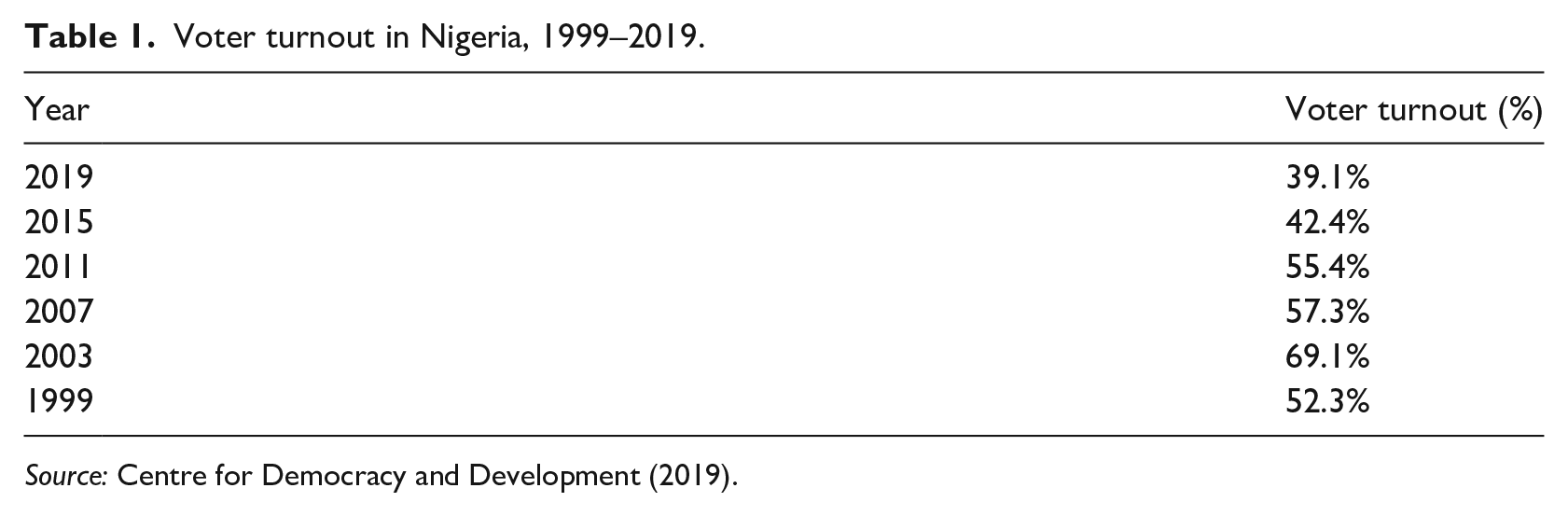
Source: Centre for Democracy and Development (2019).
In Nigeria, political marginalization undermines political participation and by extension hampers political participation and democratic consolidation (Ezeibe et al., 2016; Omodia, 2009). Nwankwo (2017) observes that undemocratic tendencies in Nigeria such as electoral malpractice, corruption and violence discourage mass participation in elections. Similarly, Ibrahim et al. (2015) aver that poor economic conditions such as unemployment and poverty are major drawbacks with regard to voter turnout in Nigeria. Indeed, these factors, especially the unjust and unfair treatment of citizens, facilitate the fading of the centripetal forces that bind different Nigerian nationalities (Anejionu and Ahiarammunnah, 2018). Although these explanations are useful for understanding the problems of election in Africa, they conceal the fact that the activity of separatist groups such as IPOB is promoting voter apathy and undermining voter turnout. IPOB’s vote and die threat and the subsequent militarization of Anambra State created fears in voters. These engendered voter apathy and low voter turnout in the governorship election.
IPOB’s agitation and voter turnout in the 2017 governorship election in Anambra State
Since Nigeria’s independence in 1960, the country has been striving for national unity and development. However, the more it strives for them, the more divided it becomes. In spite of decades of pursuit of national integration, Nigeria remains precariously tethered on the brink of disintegration. At present, old prejudices are rearing their ugly heads again, especially through the Biafra agitation for a separate state. Biafra is a social formation constructed from class considerations which emerged in 1967, but its resurrection in 1999 explains the reinvention of old prejudices that characterize the Nigerian state. Biafra is a social construct and every social construct is seen to make sense only within the specific socio-historical and ideological and class context that produces it. However, Biafra is primarily defined as a primordial group emerging from the Igbo extraction based on ethno-communal and religious affinities. Consequently, Nigerians define themselves in terms of ancestry, religion, language, history, values, customs and institutions. They identify with cultural groups, tribes, ethnic groups and religious communities. People use politics not just to advance their interests but also to define their identity (Huntington, 1993). So, during the build-up to the 2017 governorship election in Anambra State, IPOB’s threats jolted the relevance and legitimacy of the said governorship election in the state.
One of the major triggers of the recent protests by Biafra separatists was the 19 October 2015 arrest of Nnamdi Kanu, the leader of IPOB and director of web-based Radio Biafra, on charges of sedition, ethnic incitement and treasonable felony. Needless to say, IPOB and Radio Biafra represent the most high-profile and radical movement for a separate state of Biafra that currently exists. IPOB came up with the campaign of No Referendum, No Election and advised the citizens of Anambra State to boycott the 2017 governorship election. The order which first appeared on the Radio Biafra Facebook page states, inter alia, ‘18 November 2017 is sit-at-home in the whole of Anambra State. Please, stay indoors on that day to avoid anything happening to you’ (Radio Biafra, 16 July 2017; Nwangwu, 2018: 13). Among others, IPOB used ‘community evangelism’ through handbills, posters, newspapers and social media to discourage voters. In the run-up to the governorship election the members of IPOB also adopted hate campaigns, door-to-door mobilization, the use of Short Messaging Service (SMS) and activation of rumour mills to dissuade voters from voting on election day (Centre for Democracy and Development, 2018). Analysis of how IPOB’s strategies or campaigns impacted voter turnout during the November 2017 governorship election, especially in local government areas considered as IPOB strongholds, is largely predicated on the lens through which the analysis is conducted.
The threat of vote and die which was issued against the Anambra State voters impacted negatively on voter turnout. The threat was intense and voters boycotted the election due to fear of electoral violence and possible loss of life. FGDs with pro-Biafran groups revealed that: The reasons for renewed agitation and call for the boycott of the Anambra governorship election are not only related to political and economic marginalization as well as infrastructural decay in south-east Nigeria but include killings of the Igbo (including pro-Biafra members) across the country, particularly in the north. Other issues that oil the wheel of Biafra separatism include President Muhammadu Buhari’s appointments into the military and para-military organizations, as well as the NNPC. Previous elections in the south-east have not translated into provision of goods and services, infrastructural development or employment. The call for Biafran state and the boycott is desirable and the agitation is a way of sustaining the dream. Despite impeccable evidence of heinous killing of the Igbo across Nigeria, none of the perpetrators has been arrested and tried or even condemned by the federal government. Based on these, the agitation for Biafra is a struggle for equal rights and justice. Consequently, the most driving factors are the killings of the Igbo (due to lack of protection) in many parts of the north and marginalization of the south-east in all aspects in the current Buhari administration (political, economic, administrative, elite manipulation).
On the justification for IPOB’s campaign for the boycott of the 2017 governorship election in Anambra State, pro-Biafran groups further revealed that: There was nothing to show for the previous political participations in Biafraland. The governors and other Igbo leaders have always turned against the people who they are elected to represent. The instrument or strategy being used by the IPOB members to ensure effective boycott is what they called ‘community evangelism’ in which members move into villages to preach and try to convince community members not to come out and vote on 18 November 2017 governorship election in the state. The group, which put its population in Anambra State at 90%, boasted that it would render the election invalid. The agitation and call for boycott of the governorship election in Anambra State is a way of trying to address some of the grievances from past ill-treatment, especially many Igbo people killed since the return to democracy in 1999. This is so because since after the civil war, the federal government did not implement the 3Rs of Reconstruction, Rehabilitation and Reconciliation. The federal government made the Igbo the vanquished against the spirit of ‘No Victor, No Vanquished’ declared by the federal government after the civil war in 1970.
On the impact of the boycott campaign of IPOB on the governorship election, IDI with the REC of INEC in Awka, Anambra State in January 2018 noted that: The call for boycott definitely affected the election negatively. Although there was no official communication between INEC and IPOB on the boycott order of 2017 governorship election in Anambra State, the order dampened the spirit of election officials, parents and guardians. It ultimately provided the basis for the militarization of the 2017 election. These instilled fear in both the election officials and voters, discouraged voters’ participation in the election and promoted the incidence of voter apathy.
Militarization of the election was purportedly aimed at forestalling the disruption of the election by members of the IPOB. Hence, the militarization of Anambra State governorship election was the highest in six out of 21 local government areas in the state that were predicted to witness an election boycott. Table 2 shows the most likely local governments to obey the IPOB’s election boycott order.
Likelihood of election boycott in LGAs of Anambra state.
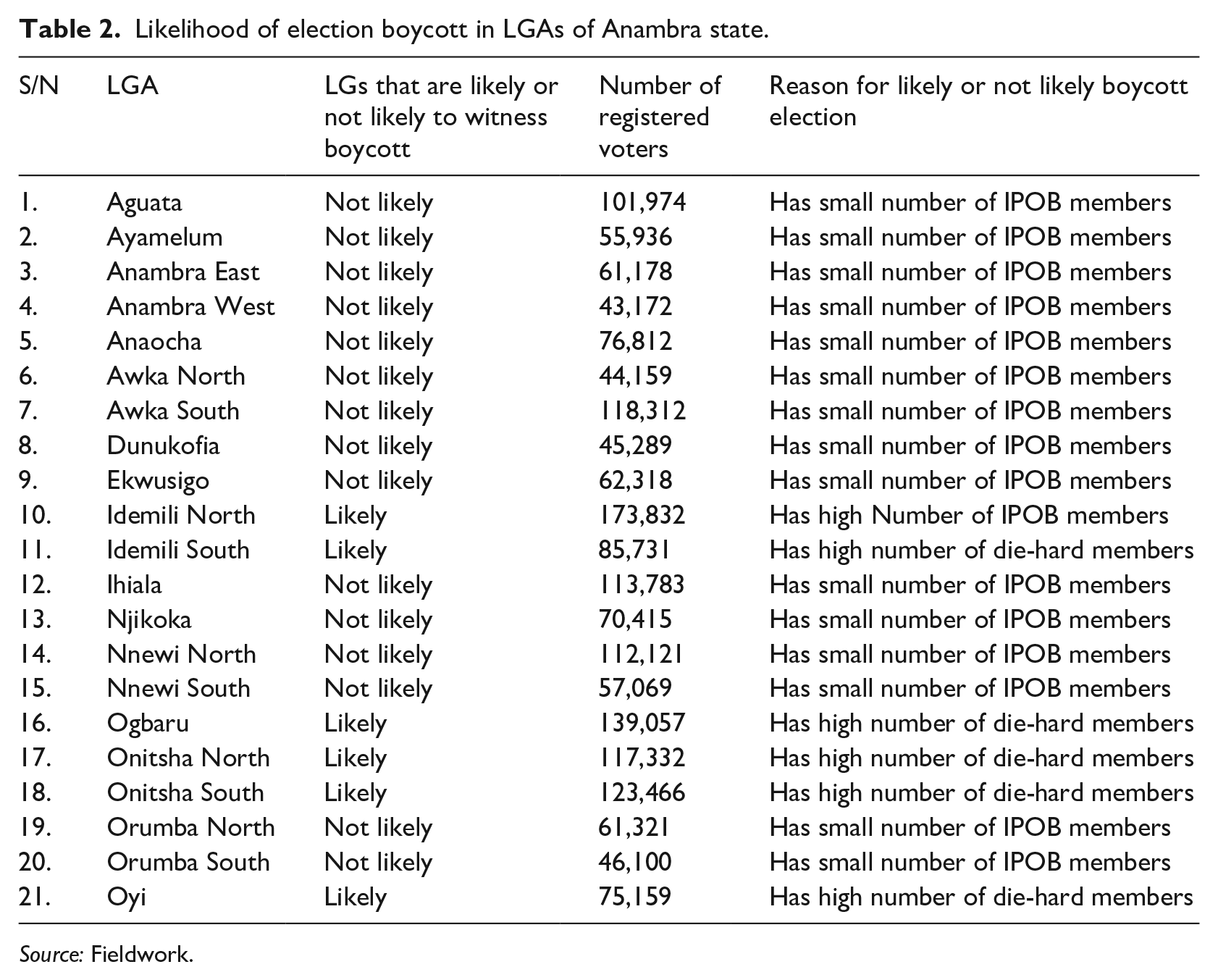
Source: Fieldwork.
These local governments that were predicted to obey the governorship election boycott were the strongholds of IPOB. They also have a good number of registered voters. Table 3 provides a snapshot of voter turnout in proportion to registered voters in the local government areas that are the strongholds of IPOB during the 2013 and 2017 governorship elections in Anambra State.
Comparative analysis of turnout in IPOB strongholds.
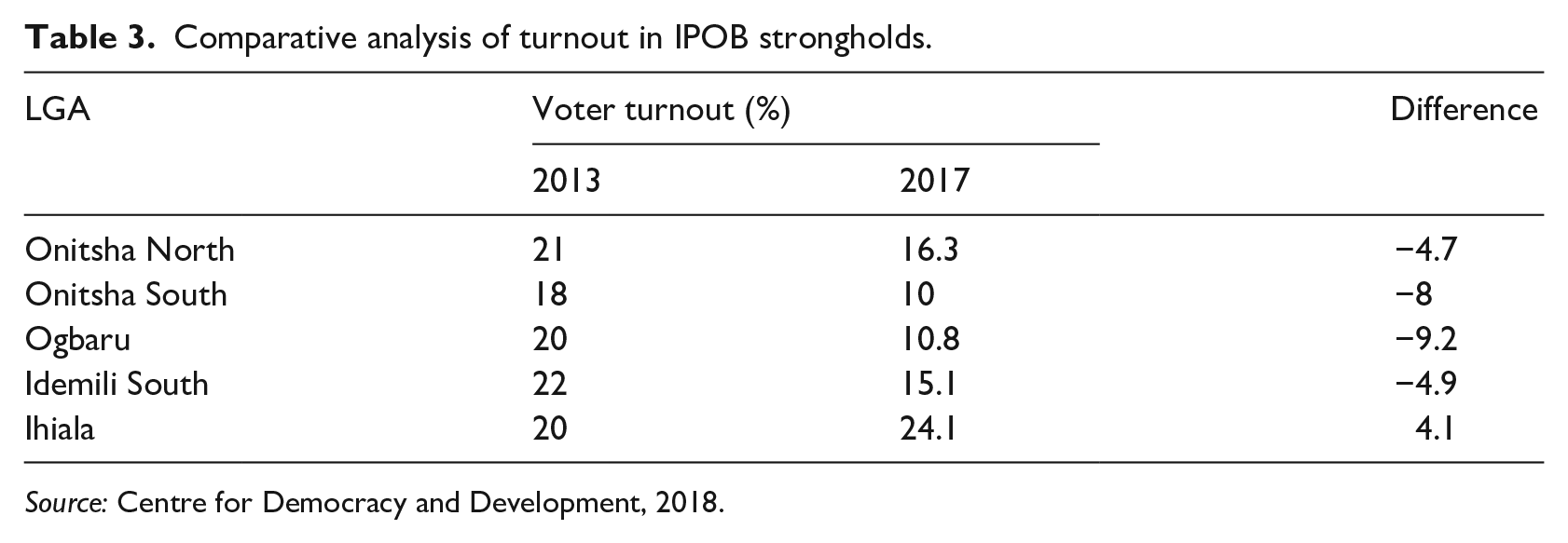
Although voter turnout is expected to be high in election battlegrounds (Cebula et al., 2013), the reverse was the case in Anambra State. As shown in Table 3, the four local governments recorded low turnout relative to the 2013 election, except Ihiala. From this analysis, one may assert that the IPOB campaign impacted the turnout. These other local governments are strongholds of IPOB and they are close to each other. Table 4 shows the position of each local government by voter turnout during the 2013 and 2017 governorship elections in Anambra State.
Voter turnout position table.
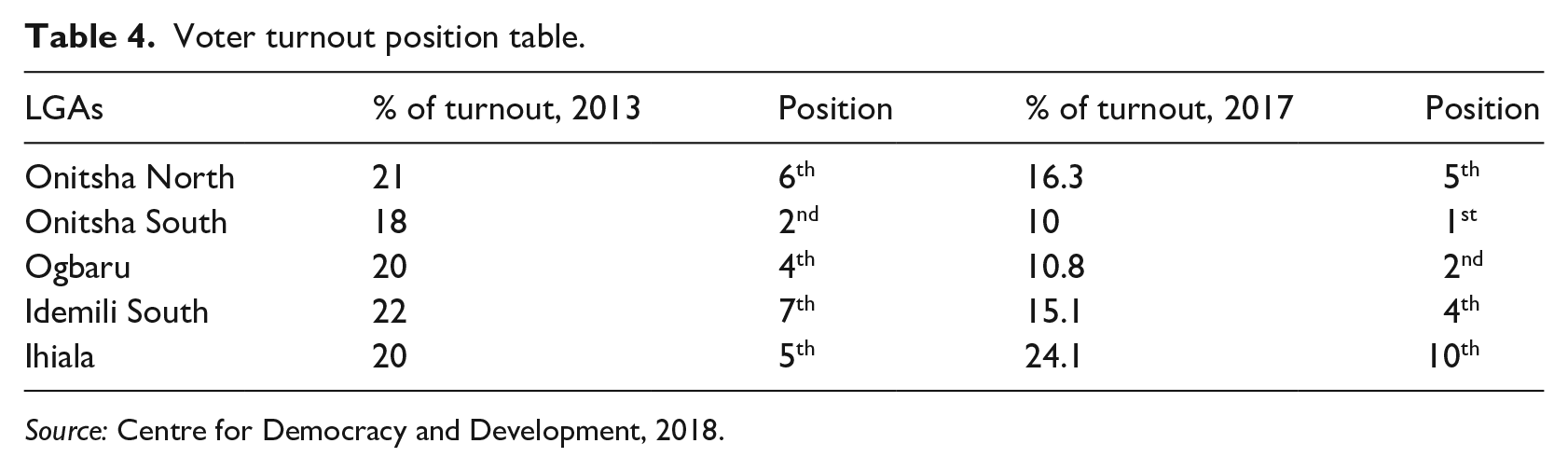
Contrary to the observation that previous levels of voter turnout significantly affect current level of voter turnout (Diwakar, 2008), Ihiala moved downward from 5th to 10th position on the voter turnout position table out of the 21 local government areas in Anambra State. Importantly, this shift presents a case for IPOB influence but there may be other underlying factor(s). For instance, evidence gathered during the election period suggested that IPOB may have sabotaged the election and this resulted into voter apathy. Field observation revealed that many of the transport workers engaged by INEC for smooth deployment of election materials and ad hoc staff on the election day were compromised. This may partly be linked to safety/security concerns and expression of support for IPOB.
The recent upsurge in the demand for a Biafran state calls for an inquiry to understand why the agitation has persisted, nearly 50 years after the end of the Nigerian Civil War. Elections stand out among critical moments in separatist agitations, especially in Nigeria where ethnicity is the dividing factor. This is because they congeal all the hopes and fears of the Biafran group which perceives themselves as collectively victimized (Ibeanu et al., 2016). Such ideas and the threat to boycott and disrupt the 2017 governorship election may be a leading factor in the escalation of culture of violence and militarization of the south-east. In multi-ethnic and plural societies such as Nigeria, appointments into major political positions are critical elements of politics. There is an excessive premium on power, and on positions which convert positions into wealth. In this sense, positions mean wealth and money and to get them, one has to occupy a good political position in government. There is equally a dominance of exclusive rather than inclusive strategies for power and positions, especially under the Buhari-led federal government. These general characteristics make appointments contentious and led to the emergence of discontent and agitations by members of the IPOB, particularly after the 2015 general elections in Nigeria. To be sure, the south-east has not enjoyed adequate representation and appointments in top public offices under President Buhari’s government. In fact, no person was appointed from the south-east states in the region in the first appointments made by President Buhari. This exclusionary tendency led to the founding or revival of various militant and separatist groups such as Niger Delta Avengers, IPOB and MASSOB, among others. In the case of IPOB and MASSOB, there were frequent demonstrations by pro-Biafra activists in major cities in the south-east and south-south, especially Aba, Asaba, Awka, Onitsha, Port-Harcourt and Umuahia (Obasi, 2015). The clashes between these separatist groups and the security agencies intensified after the 2015 general elections. Thus, the group used the opportunity presented by the 2017 governorship election in Anambra State to vent their anger and question their continued membership of the Nigerian federation. Meanwhile, IPOB leader Nnamdi Kanu argued that restructuring was the only condition for the 2017 Anambra State governorship election to be held. IPOB’s call for the boycott of the 2017 governorship election in Anambra State has generated mixed feelings. For instance, the President of Ohaneze Ndigbo, Chief Nnia Nwodo, noted that the leader of IPOB is not the leader of the Igbo and encouraged the Igbo to participate in the 2017 governorship election in Anambra State as scheduled.
Militarization of the election and voter turnout in Anambra State
Militarization of elections is one of the greatest threats to the popularity, safety and credibility of modern democracy. Although the deployment of military personnel to secure elections in Nigeria dates back to the 1959 House of Representatives election (Awa, 1960), it became a subject for intense debate among stakeholders during the build-up to the 2015 general election, when the then opposition political party, the APC, accused the former ruling party, the PDP, of planning to use the military to rig the elections (Innocent et al., 2016). Beyond the use of the military to intimidate opposition parties in Nigeria, it also undermines women’s participation in politics (Inokoba and Zibima, 2014).
In Nigeria, the militarization of elections has become recurrent since 1999, when the country returned to civil rule after long years of military dictatorship. Of course, both general elections and off-cycle elections in the country from 1999 to 2019 are contentious. These elections are often likened to warfare instead of civil activity.
An in-depth interview with the Chairman of the Anambra State Chapter of IPAC in April 2018 indicates that militarizations of elections are highest in off-cycle governorship elections such as in Anambra, Ekiti, Ondo, Osun, Bayelsa, Kogi and Edo. This is because security personnel from other states are deployed to one state.
While the justification for the deployment of the army during the Ekiti, Ondo, Osun, Bayelsa, Kogi and Edo off-cycle governorship elections was anchored on the need to guarantee the sanctity of the electoral processes, the rationale for militarizing the 2017 governorship election in Anambra State was founded on the need to deflect the threat of IPOB (Verjee et al., 2018).
IPOB’s vote and die campaign actually led to the militarization of the 2017 governorship election in Anambra State. Hence, there was a heavy presence of armed security operatives, military tanks, arms and ammunitions in the state. There were over 21,000 police personnel, 10,000 army personnel, 5000 naval personnel and 3000 air force personnel, all fully armed (Umeh, 2017). There were an additional 11,000 armed personnel of the Nigerian Security and Civil Defence Corps (NSCDC) and 3000 security dogs; totalling 50,000 armed security personnel (Umeh, 2017). Although it was alleged in some quarters that these figures are usually inflated by security authorities for illicit monetary gain, they remain official figures available in the official government records. Thus, with only 4608 polling booths in Anambra State, it statistically means that 11 armed security personnel were allocated for each polling booth. No wonder Ibeanu and Mbah (2012) describe elections in Nigeria as warfare. This massive deployment of security personnel for the elections had a negative impact on the voters’ psyche and turnout during the 2017 governorship election in Anambra State.
Voter turnout during the governorship election in Anambra State
A cursory look at the dynamics of voter turnout in Anambra State from 2007 to 2017 shows a progressive decline, except in the 2007 election which is characterized by high level of electoral malpractices. Table 5 shows the trajectory of voter turnout in Anambra State from 1999 to 2017.
Voter turnout in governorship elections in Anambra State, 1999–2017.
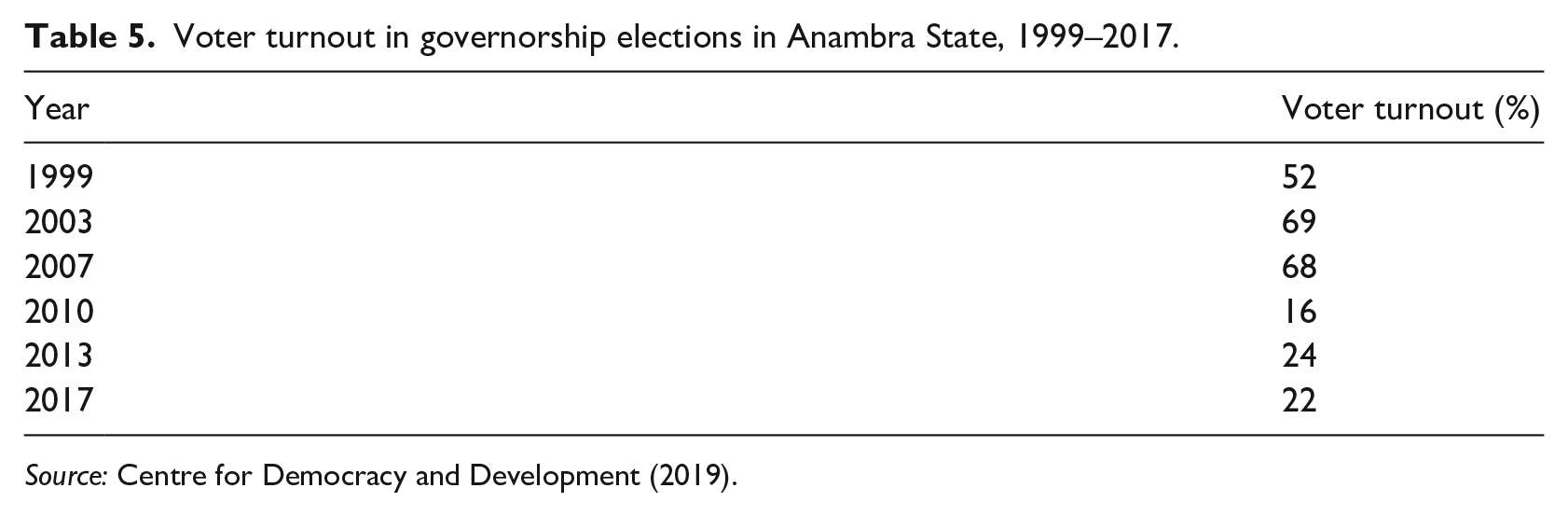
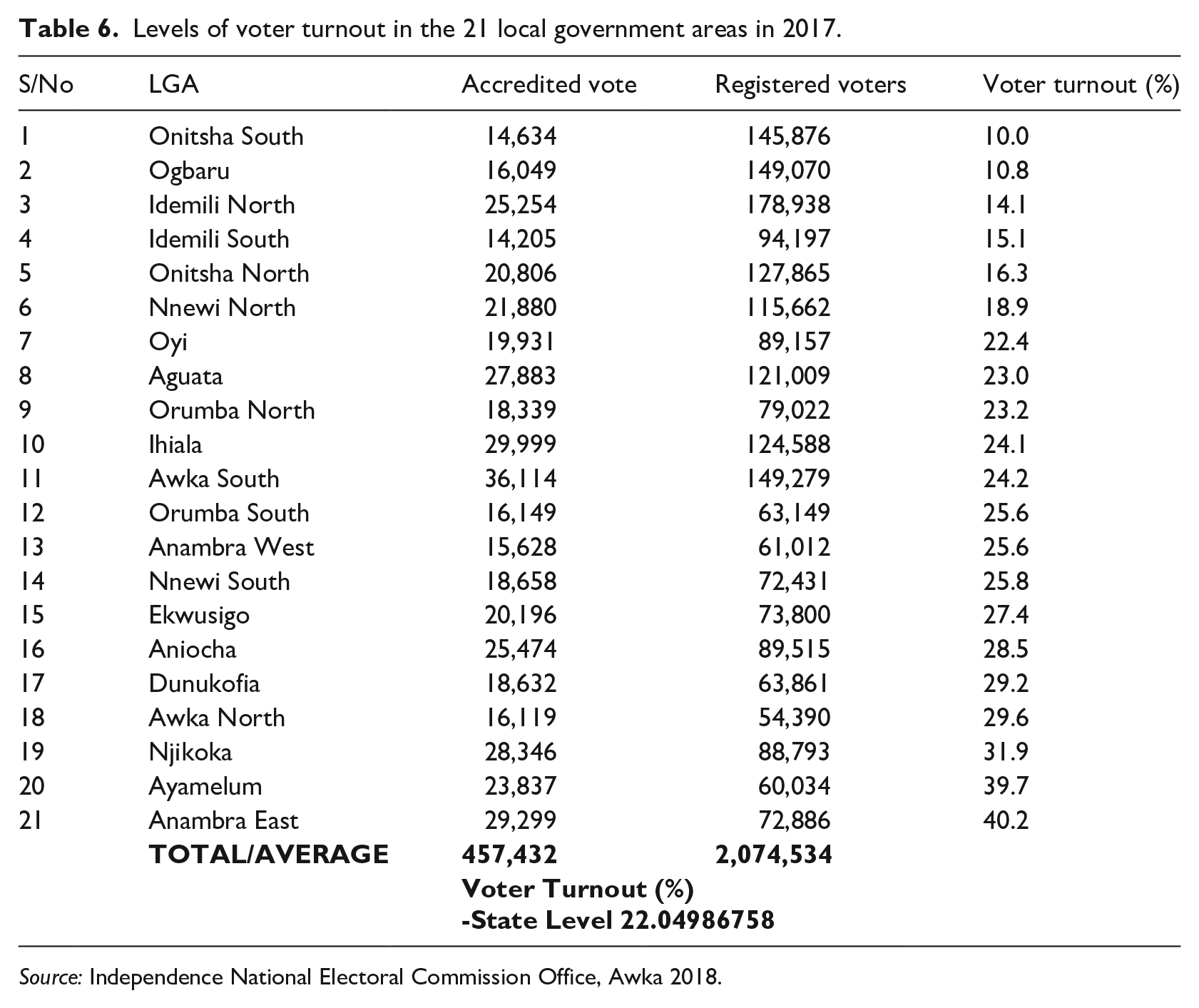
The figures show that ‘within-cycle’ governorship elections in Anambra State recorded higher voter turnout than ‘off-cycle’ elections in 2010, 2013 and 2017 (Centre for Democracy and Development, 2018, 2019). While the general public and the media were predicting an improvement in the 2013 voter turnout due to the high level of electoral competition among three major political parties in the state (APC, PDP and APGA), the 2017 election witnessed a decrease in voter turnout. IDI with the Secretary of INEC on 16 February 2018 shows that the pro-Biafra threat and militarization of the off-cycle governorship election played great role in undermining voter turnout during the 2017 election. Table 6 shows voter turnout in the local government areas in Anambra State.
Levels of voter turnout in the 21 local government areas in 2017.
Source: Independence National Electoral Commission Office, Awka 2018.
Field observation reveals that voter turnout remains low in the political battlegrounds and strongholds of major candidates for the governorship election. For instance, Anambra East, the local governments of the candidates for APGA and APC, had a voter turnout of 40.2%, the highest in the state. However, Ogbaru, the local government of the PDP candidate, had a voter turnout of 10.8%, the second lowest voter turnout in the state. Indeed, Ogbaru remains one of the major strongholds of the IPOB. Following the IPOB’s call for an election boycott, voter turnout dropped from 20% in 2013 to 10.8% in 2017.
One of the major consequences of low voter turnout is the increasing rate of vote trading; this has impacted negatively on political development, especially in Nigeria. There are several fundamental consequences of recurring vote trading. Firstly, the frequency of vote trading during elections, especially in the off-cycle elections such as in the Anambra, Edo, Ekiti, Kogi, Bayelsa and Osun governorship elections and the changing voter behaviour due to increasing buying and selling of votes, perceived winners and free-will voting have vanished from the political system. Although no study has put a figure on the extent of those selling and buying votes and how that has affected perceived winners, data from our interviews show that increasing vote trading is disruptive of the electoral process. Secondly, recurring vote trading has the tendency to affect the electoral process in a more negative way. The increasing capacity of political parties and their agents to mobilize potential vote sellers worsens political corruption and reverses the major gains of liberal democracy in Nigeria, especially credible periodic elections.
Conclusion
IPOB’s election boycott order in Anambra State as a result of the exclusionary state-building phenomenon in Nigeria prompted the militarization of the 2017 governorship election to forestall possible disruption of the electoral process. The increasing capacity of the IPOB to mobilize potential protesters spurred the federal government to massively deploy armed security, especially the military to secure the governorship election in Anambra State. Meanwhile, IPOB’s relationship with the security agencies is largely one of conflict. The clashes between IPOB and the security agencies, especially the military, often lead to loss of lives and properties. Amnesty International (2018) revealed that the military have been involved in arbitrary arrests, detentions and extra-judicial killings of the members of IPOB in south-east Nigeria between 2017 and 2018. Hence, IPOB’s campaign of vote and die as well as the massive deployment of the military for securitization of elections tended to foster fear among citizens. It also discouraged political participation and undermined voter turnout in the 2017 governorship election in Anambra State. Goal 16 of the post-2015 development agenda aims to promote peaceful and inclusive societies for sustainable development, to provide access to justice for all and to build effective, accountable and inclusive institutions at all levels. This study argued that social, economic and political inclusion presents an opportunity for de-escalation of separatist threats, demilitarization of elections and enhanced voter turnout in Nigeria to promote peaceful and inclusive societies for sustainable development and to provide access to justice for all. Perhaps this inclusion is relevant for enhancing citizens’ confidence in the political and electoral processes.
Footnotes
Acknowledgements
We are grateful to the Resident Electoral Commissioner in Anambra State. We are also grateful to the editorial team of JAS and the anonymous peer reviewers for their contributions to strengthen this paper.
Funding
The authors received no financial support for the research, authorship, and/or publication of this article.
