




Abstract
Due to the lack of studies on the effects of US troops on an individual host state, we studied the effects of US troops on South Korea’s politics and economy. Based on security enhancement benefits, we hypothesized that USFK would have positive effects on South Korea’s investment, trade, economic growth, and political development. Employing Heo and Ye’s empirical models, we conducted statistical analyses and found that the effects of USFK on South Korea’s trade, democracy level, and economic growth are statistically insignificant and the effect of USFK on investment is negative and statistically significant. These findings need to be cross-validated with a different measure of estimating USFK’s effects because our measure, size of USFK, may not capture its effects completely although there is no other measure.
Introduction
Since the end of World War II, the United States has played the role of “world police” for regional security and stability. To this end, the US government has deployed a substantial portion of its troops around the world. According to Kane (2012: 255), “Counting one soldier serving in a country for 1 year as a troop-year, the number of US troop-year deployments on foreign soil from 1950 to 2009 is 31 million, or 30,597,594 to be exact.” On average, this means that approximately 456,000 US soldiers, or about a third of US active duty troops, were annually deployed in foreign lands (Heo and Ye, 2019).
Despite the important theoretical and policy implications of the effects of foreign troop deployment on the host nation, few studies have analyzed the political and economic effects of US troops on host nations systematically. Previous studies (e.g., Carafano, 1997; Dobbins et al., 2003) focused on historical cases of Germany, Japan, and Iraq, or arms management after conflict (see Jones and Kane, 2012). The primary reason for the lack of empirical studies was the shortage of readily available information about US troops deployed overseas (Schramm, 2010).
As the US troop deployment data became available, scholars began to examine how US troop deployment abroad affects the host nation (e.g., Bell et al., 2017; Heo and Ye, 2019; Jones and Kane, 2012; Kane, 2012). Yet, previous studies employed a time-series, cross-national research design, examining the data for dozens of countries over several decades. Findings of these studies revealed only the overall effects of US troop deployment on host nations without disclosing the individual effects on specific countries. To fill the gap in the literature, we investigate how the presence of US troops affects South Korea’s economy and politics.
It is important to study the South Korean (Republic of Korea, ROK) case for two reasons. First, ROK has hosted a relatively large size of US troops since the end of the Korean War due to the long-lasting North Korean security threat. With the lasting North Korean nuclear crisis and the recent friction between Washington and Beijing, South Korea has been strategically important for the United States. 1 Thus, US troops in South Korea (US Forces-Korea, USFK) are unlikely to leave the region for the foreseeable future.
Second, Washington and Seoul have recently had disagreements concerning defense burden sharing. US President Donald Trump publicly expressed his discontent about the current level of burden sharing by South Korea considering its wealthy economy and the security benefits they receive from US military presence. By contrast, the South Korean government seems to perceive that the current level of burden sharing is fair as it is the outcome of negotiation (see Lee and Heo, 2001). Due to the disagreement, there was even a report that Washington is considering withdrawing some US forces in South Korea although the Pentagon denied it (Reuters, November 20, 2019).
Theoretically, USFK makes significant contributions to regional security, which produces multiplier benefits. For instance, security enhancement gives way to increases in investment and trade, which indirectly help economic growth. In addition, given the US government’s efforts to promote democracy around the globe, it is possible that USFK may also help political development in South Korea. That said, USFK may harm the South Korean economy due to the opportunity cost of the land used for US military bases, social expenses of crimes committed by US soldiers, and environmental damage caused by USFK (see Bell et al., 2017). Altogether, these harmful effects may dampen bilateral relations.
Hence, in this study, we investigate the effects of USFK on South Korea’s politics and economy, particularly political development, investment, trade, and economic growth employing Heo and Ye’s (2019) empirical models. Findings of this study will have significant theoretical and policy implications.
Previous studies
Positive effects of US troops on host nations
Jones and Kane (2012: 240) and Kane (2012) were the first to conduct empirical analyses on the effects of US troop deployment on host nations. To theorize the effects of US troop deployment on host nations, Jones and Kane (2012) introduced three theories: expenditure theory, diffusion theory, and security theory. The expenditure theory posits that an increase in foreign troop deployment will lead to an increase in host government’s expenditures to meet the needs and expectations. Increased government expenditures by the host government is likely to result in augmenting aggregate demand, which will lead to employment enhancement.
Diffusion theory focuses on the externality effects of foreign troop deployment on the host state, particularly technology transfer. With this theory, Jones and Kane (2012) contend that US troop deployment will increase business cooperation and trade between the host nation and the United States. In the process of economic cooperation, productivity enhancing technologies and advanced knowledge of business management and marketing may transfer to the host nation, which indirectly helps the host nation’s economic growth.
Finally, security theory postulates that the presence of US troops directly and indirectly improves the host nation’s security. Security enhancement includes subduing intra-state violence (e.g., civil war, domestic terrorism) and deterrence from external attack. Considering that security is a necessary condition for economic activities, security enhancement provides the host nation with an opportunity to seek economic growth without significant disruption (Jones and Kane, 2012).
Based on the theories described above, Jones and Kane (2012) analyzed the data for 94 countries that hosted US troops from 1950 to 2000. The results of their analysis reveal that US troop deployment helps host nations’ economic growth. Based on these findings, they contend that US troop deployment has positive externality effects on host nations in addition to security benefits.
In another study, Kane (2012) investigates the effects of US troop deployment on the host nation’s public health and infrastructure. He (Kane, 2012: 256) argues that host governments increase their spending to meet the needs and expectations of US troops deployed, which advances social development by increasing public and private consumption. To test this argument, Kane (2012) analyzes the data on the relationship between US troop deployment and host nations’ social development indicators, such as child mortality, life expectancy, and the number of telephone lines. He finds that the presence of a significant number of US troops results in lower child mortality, higher life expectancy, and more telephone lines.
Heo and Ye (2019) also studied how the presence of US troop affects the host nation’s economy and politics. Agreeing to Jones and Kane’s (2012) security enhancement argument, they presume that US troop presence will enhance regional security and stability, which will facilitate an increase in the host nations’ investment and trade. Given the positive effects of investment and trade on economic growth, they argue that US troop presence helps host nations’ economic growth. Based on the modernization theory that economic development leads to political development, they hypothesize that US troop deployment helps political development indirectly through economic development.
Based on the logic stated above, Heo and Ye (2019) conduct an empirical test using data from 154 countries between 1960 and 2014. Since the security enhancement effects of US troop appearance are likely to materialize when a substantial size of US troops is deployed, they selected only the countries that hosted more than 100 US troops per year on average for the period under investigation. The results of their analysis reveal that as the number of US troop deployments increases, host nations’ investment and trade go up. Host nations also enjoyed a small but positive economic growth. However, US troop deployment was not a meaningful factor for political development.
Negative effects of US troops on host nations
In contrast to the benefits of US troop deployment reported in previous studies, Vine (2015a, 2015b) asserts that the effects of US military deployment in foreign lands is generally harmful. The only short-term benefit may come from construction in building military bases as it will increase capital investment and employment. However, long-term negative effects would be far greater, which include the opportunity cost of the host nations’ land offered for US military bases, environmental damage caused by the US military’s dumping of hazardous materials, human toll due to US soldiers’ violent crimes such as murder or sexual assault, and the common proliferation of prostitution near US military bases around the world. The US military also receives training including in bombing, firing guns, cannons, and missiles, which inflict serious damage on the environment. Moreover, crimes committed by US military personnel where significant cultural differences exist, may tarnish the national image of the United States as well as strain the relationship between the United States and the host nation (Allen and Flynn, 2013; Bell et al., 2017).
According to Vine (2015b), these detrimental effects of US troop deployment can dampen the host nation’s economy in two ways. First, anti-US sentiment can rise, leading to a reduction in US military deployment. This translates into a decrease in US security support for the host nation and may result in a decline in domestic and foreign investment because of the enhanced security concerns. Second, heightened anti-Americanism may aggravate the relationship between the United States and the host nation and cause the volume of trade between the two nations to fall, which can dampen the host nation’s economic growth (Vine, 2015b).
Effects of US troop deployment on South Korea
US forces in South Korea
After the end of the Korean War, the US government made a security commitment to South Korea by signing a Mutual Defense Pact in 1953. Through the treaty, both the US and South Korean governments agreed to “act to meet the common danger in accordance with its constitutional processes.” To this end, approximately 75,000 US troops remained in South Korea near the demilitarized zone (DMZ) and North Korea’s likely invasion routes into South Korea. The troops included two combat divisions until President Nixon withdrew one of them in 1971, which brought down the size of USFK to 43,000. With the end of the Cold War, the size of USFK further shrank during the Bush administration to approximately 37,500 (Heo and Roehrig, 2018).
After the September 11 terrorist attack in 2001, the US military revisited its military strategies to deal with the “new” threat, the so-called Global Posture. To this end, the Pentagon redesigned US troops to be more flexible and expeditionary in order to respond swiftly to the “new” security threats. Secretary of Defense Donald Rumsfeld’s statement in a Senate testimony in 2004 well represents the new plan:
We have entered an era where enemies are in small cells scattered across the globe. Yet America’s forces continue to be arranged essentially to fight large armies, navies, and air forces, and in support of an approach—static deterrence—that does not apply to enemies who have no territories to defend and no treaties to honor. (Rumsfeld, 2004)
In the same testimony, Rumsfeld stated about USFK that, “our troops were virtually frozen in place from where they were when the Korean War ended in 1953.” With the new plan, the Bush administration devised a new approach that would gradually reduce the size of US troops in South Korea over several years. However, the plan was rescinded later. As of 2020, there are approximately 28,500 US military personnel in South Korea including Combat Aviation Brigade, Armored Brigade Combat Team, Cavalry Division, Field Artillery Brigade, and Chemical Battalion along with supporting personnel. USFK also includes Air Force made up of two fighter wings composed of a squadron of F-16 and A-10 aircrafts (see Roehrig, 2014).
According to Heo and Roehrig (2018), USFK has played three important roles since its deployment. First, USFK is an important indication of the US defense commitment to South Korea. Second, USFK plays a tripwire function that leads to “automatic” US intervention in the case of a conflict in the Korean peninsula. Since this function “guarantees” US involvement in case of another war in the region, it is critical in deterring North Korean hostility. Third, with its advanced weapon systems, USFK plays an important role in preventing North Korean military attack in the early stages of conflict if a war breaks out, buying time before more US troops are dispatched.
USFK also provides South Korea with nuclear extended deterrence. In 1958, the US military deployed tactical nuclear weapons to South Korea under the US nuclear umbrella. With the deployment, Washington declared that the US military is willing to use nuclear weapons to defend the ROK. After the end of the Cold War, however, the US military removed all tactical nuclear weapons from the Korean peninsula by December 1991 for two reasons. First, North Korea used USFK’s nuclear weapons as their excuse for nuclear development. To dissuade Pyongyang, Washington removed tactical weapons from the Korean peninsula. Second, the two Koreas agreed to denuclearize the Korean peninsula by signing the Joint Declaration on the Denuclearization of the Korean Peninsula, which became effective in February 1992. 2 Although USFK no longer possesses tactical nuclear weapons, the US government assured the ROK government by repeatedly proclaiming that South Korea is under the US nuclear umbrella. 3
Positive effects of USFK on South Korea
According to Heo and Roehrig (2018: 197), “The central rationale for the ROK-US alliance has been and remains security and the need to deter, and if need be, defend South Korea from attack.” Since the end of the Korean War, South Korea has technically been at war with North Korea because the ROK government never signed the armistice. During the Cold War period, the two Koreas were resolutely entrenched on opposite sides. As a result, throughout the 1960s, North Korea sent agents to collect intelligence and carried out terrorism campaigns. For example, during the peak of the terrorism campaign from 1967 to 1969, North Korea committed more than 750 infiltrations including the unsuccessful assassination attempt of Park Chung-hee and infiltration of 120 North Korean armed commandos in Uljin and Samcheok. The campaign of military threat could foist devastating harm on the South Korean economy, but the damage was limited due to the presence of USFK.
In the 1970s, with the global détente, the relationship between the two Koreas thawed on the surface, but the hostile nature of the bilateral relationship persisted because the fundamental perception of Seoul and Pyongyang toward each other was a zero-sum game. North Korea continued provocation, including unsuccessful assassination attempts of South Korean President Park Chung-hee in 1979 and Chun Doo-hwan in 1983. In 1987, North Korean agents blew up Korean Air Flight 858 over the Andaman Sea killing 115 people on board (Roehrig, 2003, 2009).
As described, the North Korean threat continued throughout the Cold War period, but the presence of USFK provided security assurance, which helped maintain relatively low country risk. As a result, the damage on the South Korean economy incurred from North Korea’s security threat was rather limited.
These security contributions made by USFK to South Korea are nicely summed up in the President of US Chamber of Commerce and Industry Jeffrey Jones’ remarks at the conference on USFK’s Role and Status in the 21st Century in 2002. He said, “USFK and the US-ROK alliance is absolutely necessary for the stable Korean economy. Foreign investors perceive USFK as their investment protection” (Monthly Chosun, 2003). Considering that foreign investment was a critical element for recovery when South Korea experienced a financial crisis in 1997, USFK’s security contribution to the South Korean economy is priceless.
Although ROK military capabilities have substantially improved and regional power configurations have changed over time, the security benefits of USFK are invaluable. Because of USFK’s security contribution, if USFK were completely withdrawn, the price South Korea would have to pay would be very high. First, defense spending would have to increase significantly. According to the Korean Ministry of National Defense’s 2016 Defense White Paper, USFK has 90 aircrafts, 20 Apache helicopters, 50 M1 Abrams Tanks, 50 armored vehicles, 60 PAC-3 Air-Defense missiles, and a unit of THAAD (Terminal High Altitude Area Defense) battalion. The value of these weapon systems is estimated at about US$40 billion (Shindonga, 2018). As a result, if USFK were completely withdrawn, South Korea would have to significantly increases its military spending. In fact, a newspaper, Kookmin Ilbo (2003), estimated that South Korea would have to double its military expenditures if USFK were to leave. 4
The value of USFK is not limited to weapon systems. USFK includes 28,500 US soldiers. If they leave, military experts argue that the Korean military would need to add at least 80,000 more soldiers, and it would cost hundreds of millions of dollars to train and equip them. According to the former commanding general of the First ROK Army, Park Sung-kyu, it is virtually impossible to estimate the replacement cost of USFK because US military has superior capability than any other militaries in early alert systems, intelligence collection, medium and long distance attack capability, and early response in case of a conflict. Moreover, USFK plays a critical role in deterring the North Korean threat, which cannot be replaced (Shindonga, 2018).
In addition to the security benefits, there are two other advantages to US troop deployment in South Korea: (a) a reduction in defense expenditure, and (b) the positive effects on the economy. To estimate the defense spending reduction effects of USFK on the ROK government budget, Cho (2004) estimated the economic effects of US troop withdrawal. Based on his analysis, he argues that if USFK were completely withdrawn from the Korean peninsula, South Korea’s annual economic growth rate would decline by as little as 0.44% and as much as 2.27% (Kwon, 2011). Kwon (2011) estimates how much the defense spending increase would need to be if USFK completely left the Korean peninsula, employing the Korea Institute for Defense Analysis’s Korean Defense Economics Model. The results show that South Korea would have to double its annual defense budget, meaning approximately 10–11% of South Korea’s GDP would be allocated to defense expenditures.
There are four positive effects of USFK on the South Korean economy: (a) facilitating trade, (b) enhancement in aggregate demand through consumption, (c) construction in military bases and operation and maintenance expenses, and (d) purchasing Korean products for USFK (Kwon, 2011).
First, USFK maintains cutting edge weapon systems and plays a stabilizing role in northeast Asia by indirectly facilitating trade (Kwon, 2011; see also Lee, 2000). Second, the size of USFK has been in the range 28,500–75,000 troops. During the tour, some US soldiers’ family members also reside in South Korea. In addition, there are 125,000 South Korean labor workers employed by USFK (Hankyoreh, 2020). Their consumption contributes to enhancing aggregate demand of the South Korean economy. Third, construction in US military bases creates jobs for Korean construction workers and utilizes Korean building materials. Finally, the US military purchases South Korean products and agricultural produce to support the troops. According to Baek et al. (2005), USFK’s contribution to the South Korean economy was estimated to be almost US$1.3 billion in 2004.
Because of the consumption generated by USFK, the Korea Veterans Association and the Korea Retired Generals and Admirals Association asserted that more than 90% of South Korea’s defense burden sharing comes back to the Korean economy in the form of employment, purchasing construction equipment and materials, and other forms of expenses. A similar claim was also made in the 2018 Korea Defense White Paper which stated that, “Most defense burden sharing returns to the Korean economy and contributes to job creation and economic growth” (Chosun Ilbo, 2019). These contributions help the South Korean economy although the direct benefits of employment and aggregate demand enhancement may be limited considering the size of the Korean economy.
Negative effects
In general, the negative effects of USFK on the Korean economy are indirect rather than direct because they are social and environmental. One of the most harmful social effects is prostitution around USFK bases. Since the Korean War, many prostitutes have appeared around USFK military bases. In the 1960s, it was estimated that there were more than 20,000 Korean prostitutes near the 62 USFK military bases (Hankyoreh, 2000). Prostitution not only had culturally harmful effects on Korean society but also caused a serious social issue—mixed race children. Although mixed race children are not a social problem any longer, it was a serious issue in the 1950s and 1960s. There were approximately 25,000 mixed race children, but Korean society did not accept them as fellow Korean citizens due to its ethnically homogenous nature. As a result, mixed children were seriously discriminated against. They were not even required to complete compulsory military service despite South Korea’s conscription system (Lee, 1987).
Crimes committed by US soldiers are another harmful effect of USFK on Korean society. They directly affect Koreans’ perception of the United States as well as USFK, which indirectly influences the relationship between the two countries. Crimes include murder, theft, assault, rape, robbery, and drug trafficking. Annually, US soldiers committed 1,500–2,000 crimes until the early 1990s. However, US soldiers were not subject to the ROK legal authority. South Korea could not indict US soldiers even if they were arrested at the crime scene. As a result, the Korean public perceived SOFA (Status of Forces Agreement) as an unfair treaty and wanted to amend the agreement for decades. After the murder of Yun Geumyi in 1992, SOFA was amended to provide indictment authority to the ROK government. As a result, crime rates declined to about 700 per year on average today. Although the ROK government has indictment authority, only about 30% of US criminals are indicted by the ROK authority considering the security contribution of USFK (News 1 Korea, 2017).
The opportunity cost of land for US military bases is another negative effect of USFK. US military bases in Seoul, Daegu, Chuncheon, and Uijeongbu are located in the middle of cities, which is a hindrance to local development. A good example is the US military base in the Yongsan area in Seoul. Since Yongsan is located between Gangbuk (north of the Han River) and Gangnam (South of the Han River), the US military base there causes serious inconveniences for traffic and city development, which inflict economic and social cost. A similar problem exists in the third largest city, Daegu. In Daegu, the city government planned to construct a beltway surrounding the city in 1968, but it is still not complete due to the US military base, Camp Walker. These cases are just two examples and there are many like them. The total amount of land provided to USFK is approximately 265 square kilometers in 96 regions. The value of the land is estimated at US$12.6 billion (Hankyoreh, 2000).
Finally, environmental damage also negatively affects the Korean economy in the long run. According to Korean National Assembly News On (2019), there have been 144 inspections of USFK bases from 2008 to 2018. Among them, the Korean authority has found the leaking or dumping of toxic waste 80 times. The local authority cleaned the sites and requested reimbursement for the cost to USFK. However, USFK never provided compensation. In addition to the environmental damage, Korean citizens who live near US air bases suffer from airplane noise up to 107 decibels, causing them to complain that normal life is not possible (Hankyoreh, 2000).
Empirical models
Increase in domestic and foreign direct investment
There is a general consensus in economics literature that investment is critical for economic growth. This is because investment provides necessary capital resources for economic outputs. Increases in economic outputs attract more investment, leading to a virtuous cycle of investment increase leading to higher growth and greater investment (Blomstrom et al., 1996).
Nonetheless, there are numerous factors that affect investment. They include security, economic prospect, political stability, regime types, rule of law, individual property rights, interest rates, and so on (Hall and Taylor, 1988). Among them, as noted, security is a key element because few investors are willing to take high risks by investing where security is volatile (Biglaiser and DeRouen, 2007; Jone and Kane, 2012; Kane, 2012). Thus, security affects investors’ decisions whether to invest and whether to reduce or increase investment.
Security not only affects domestic investment but also influences foreign direct investment (FDI). Just like domestic investors, foreign investors also consider risk before making investments. As a result, they avoid conflict-prone states and regions because of the high level of risk for losing capital. Kim (2016) analyzed the effects of conflict on FDI in 95 less developed countries (LDCs) from 1980 to 2000. The analysis results reveal that both internal and external conflicts dampen FDI.
In summary, security is necessary for both domestic and FDI. The US military is typically considered the strongest in the world. Thus, US troop presence will considerably improve security wherever deployed (Collier, 2007). In other words, US troop deployment enhances security in South Korea, which leads to greater domestic and FDI. Based on this logic, we hypothesize that USFK will have a positive effect on domestic and foreign investment in South Korea.
Trade increment
Scholars of the political economy of defense generally agree that conflict has negative effects on international trade (e.g., Anderton and Carter, 2001; Kastner, 2007; Simmons, 2005). The reason for this is that private firms do not want to take high risks by trading with countries that are likely to be or are already involved in conflicts (Morrow, 1999). Even security concerns without conflicts may dampen trade because of (a) the possibility of trade sanctions being imposed, (b) exchange rate fluctuations due to security volatility, and (b) potentially unstable product supply due to security concerns (Kastner, 2007).
As noted earlier, USFK significantly improves security and stability in the Korean peninsula, which is likely to subdue any potential security concerns and risks in the region. South Korea has developed its economy through an export-oriented industrialization approach, meaning trade has been a critical element in South Korea’s economic success. In other words, we hypothesize that USFK has an indirect but positive effect on South Korea’s trade with other countries (see Bove et al., 2014).
Promoting democracy
There are many factors that affect the transition to democracy. One of them is external influence. According to Huntington (1991), an external actor’s influence was one of the factors that facilitated the Third Wave of democratization. Heo and Ye (2019) argue that US promotion of democracy using military deployment as bargaining leverage made a significant contribution to the transition to democracy in many developing countries.
For the South Korean case, President Carter pressured the Park Chung-hee administration by threatening to pull out US troops unless South Korea improved its human rights record. In 1987 when the public protested demanding democracy, the Reagan administration strongly dissuaded the authoritarian Chun Doo-hwan administration from using force to quell the protest. The US influence was a significant element in South Korea’s transition to democracy. What made this possible was US troop deployment, which provided critical security assistance to South Korea (Heo and Roehrig, 2010, 2014).
There is no consensus on the effects of democracy on economic performance. That said, a significant majority of empirical studies show that democracy is more conducive to economic growth than other types of government, because democracy attracts more investment and protects individual property rights (Feng, 1997; Heo and Hahm, 2015; Heo and Tan, 2001; Leblang, 1996; Olson, 1993). Sirowy and Inkeles (1990) assert that democracy is better for economic growth than other types of government because democratic political processes facilitate favorable social conditions to economic development. Thus, we hypothesize that USFK has a positive effect on South Korea’s political development, which indirectly helps economic growth.
Economic growth
USFK provides significant security enhancement in South Korea, which facilitates increases in investment and trade promotion. USFK earlier also helped the transition to democracy in South Korea and now enhances aggregate demand through consumption. Since they directly hire local workforce, there is a positive externality effect on economic growth. USFK also saves the ROK government’s defense budget. Thus, we hypothesize that USFK has a positive effect on South Korea’s economic growth.
Empirical models
To test these hypotheses, we employ Heo and Ye’s (2019) empirical models.
Investment
Heo and Ye’s (2019) investment model is a textbook type model, controlling for government expenditures, growth rate of the previous year, economic openness, interest rates, and democracy level. The model controls for government expenditure because a significant amount of public spending is used to improve economic infrastructure. The rationale for including the growth rate of the previous year is because the previous year’s economic performance affects an investor’s decision to invest. Investors will augment investment if the economy is expanding, or reduce it otherwise. The level of economic liberalization also affects investors’ decisions, and economic openness well represents the level of economic liberalization. Interest rates are inversely related to investment because low interest rates increase access to capital resources and vice versa. Finally, democracy level is included in the model because democracies tend to be more investment-friendly than other types of government due to the rule of law (Olson, 1993). The Investment model is:
Trade
The trade model is based on controlling for exchange rates and democracy level. A country’s currency value against the US dollar is a significant element in determining the country’s international competitiveness, because exchange rates directly affect the price of goods. If exchange rates rise, exports are likely to increase and vice versa. Democracy level is included in the model because democracies typically employ a market system and trade more than other types of government. The trade model is:

Democracy
The democracy model is developed by controlling for economic development, education level, and economic openness. There is a general consensus in the literature that economic development is one of the critical factors that leads to the transition to democracy. Scholars also agree that education level plays a significant role in the democratization process because people with higher education tend to demand their political rights. Economic openness helps the transition to democracy because people learn about the democratic system through trading activities. The democracy model is:

Economic growth
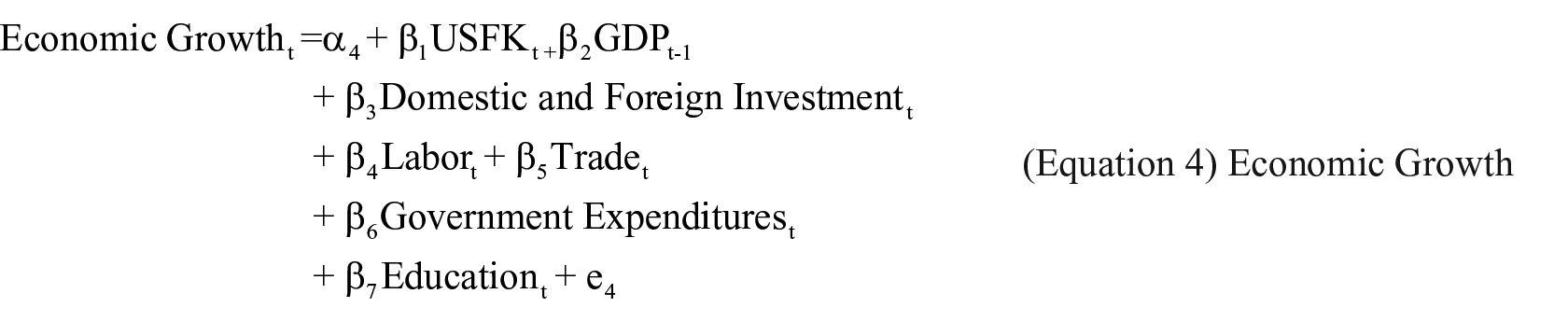
The growth model is a Barro (1990) type model, which is based on assumptions that economic output is a function of capital investment, education level, employed labor, and government expenditures (see Dunne et al., 2005). We also controlled for trade because South Korea has developed its economy by employing an export-oriented industrialization approach. Following common practice, we also added the previous year’s GDP to the model. The growth model is
Empirical analysis
Data
To conduct empirical analyses of the effects of USFK on South Korea’s investment (sum of domestic and foreign investment), trade (total amount of trade volume), political development (democracy level), and economic growth, we collected data for the period 1970–2017. 5 All economic data except foreign investment and employed labor are from the World Bank’s World Development Indicators (WDI). 6 Foreign investment data are from UNCTAS Stat and employed labor data are from Penn World Table version 9.1. 7
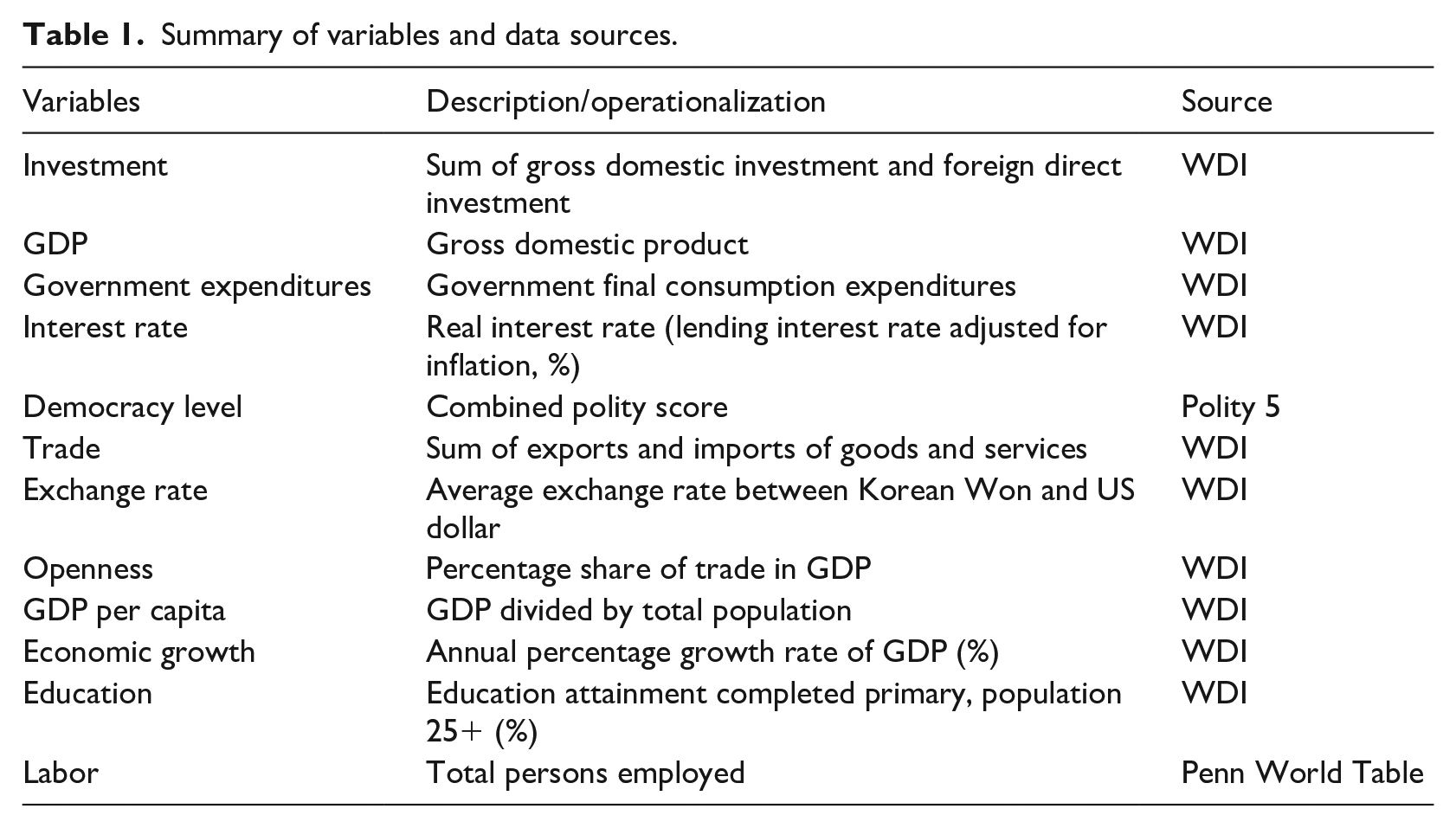
Since the data are in current values, we converted them to constant values (2012=100) using the GDP deflator reported in Federal Reserve Economic Data (https://fred.stlouisfed.org/series/GDPDEF). 8 Data for political development indicator (democracy level) are from the Polity 5 Project. 9 Data for USFK (number of US troops deployed in South Korea) are from Kane’s (2016) US Troop Deployment Dataset and updated with the data from Defense Manpower Data Center’s (DMDC) “Personnel, Workforce Reports, and Publications.” 10 Since the DMDC’s data are published quarterly, we used the numbers reported in the December issue. A summary of the variables and data sources is reported in Table 1. 11
Summary of variables and data sources.
Methods
For estimation, we have four equations, so we can estimate them jointly using Zellner’s (1962) Seemingly Unrelated Regression (SUR) or estimate them separately employing Ordinary Least Squares (OLS). According to Zellner (1962), when there are multiple equations for estimation, joint estimation is asymptotically more efficient (smaller variance) than separate estimation if the error terms in the system of equations are contemporaneously correlated. Otherwise, OLS (separate estimation) is preferable (Judge et al., 1985). To test the contemporaneous error correlation between error terms of the equations, we conducted the Breusch-Pagan Test. The test results reveal that the error terms of the equations are not contemporaneously correlated (
According to Granger and Newbold (1974), if any variable included in the equation of time-series analysis is integrated, the results of regression analysis can be spurious. To this end, they recommend testing for the presence of unit root using the augmented Dickey-Fuller test to determine stationarity. Thus, we conducted the augmented Dickey-Fuller (ADF) test to examine the stationarity of our data. The test results reveal that all the variables except investment, interest rates, and economic growth are non-stationary. If time-series data are non-stationary, the stochastic components of the time-series data contain unit root. In that case, they are unpredictable and cannot be modeled because the results would be spurious. Thus, we differenced them to address this issue.
Findings
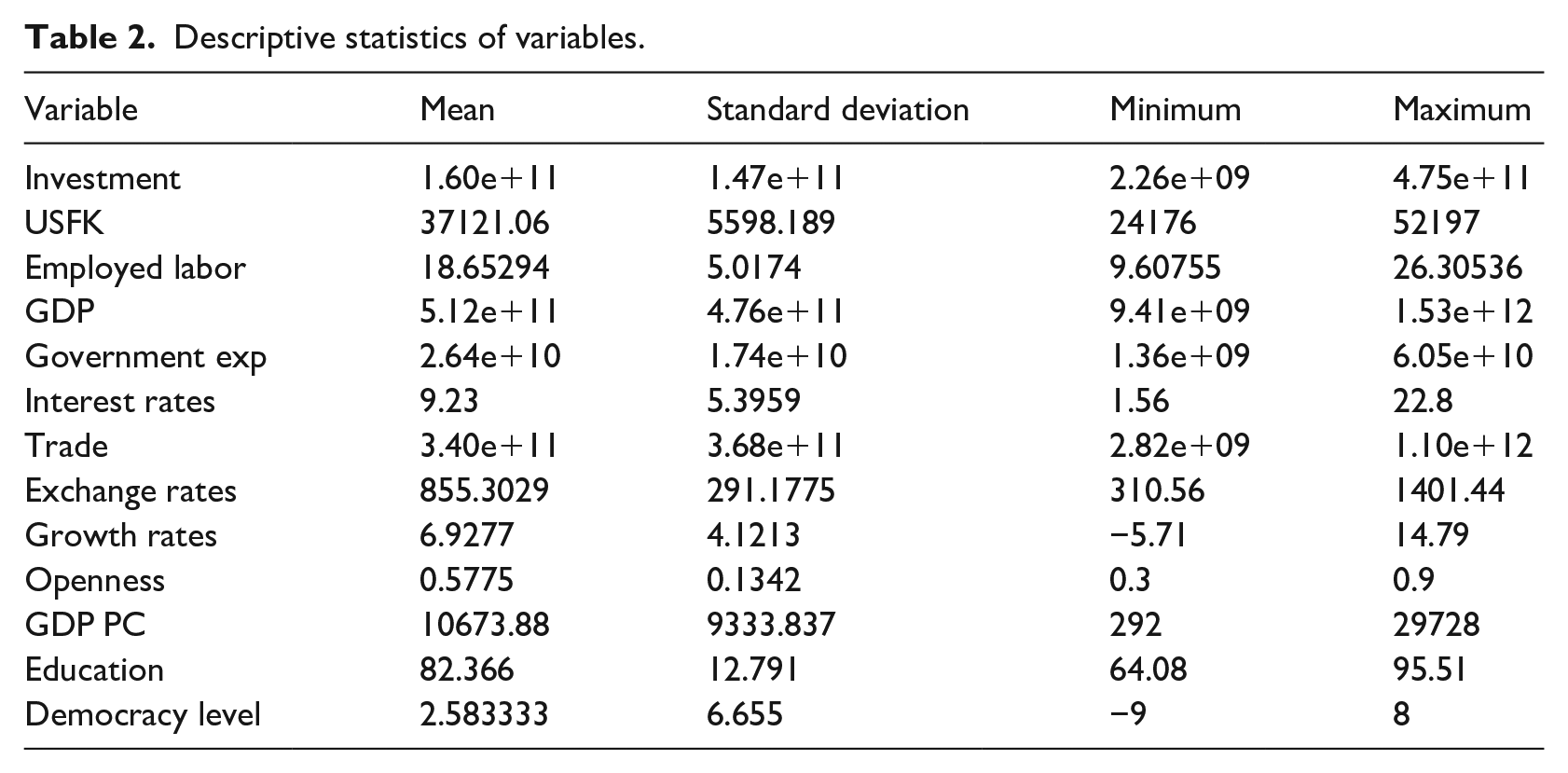
First, we report descriptive statistics of each variable included in the model in Table 2.
Descriptive statistics of variables.
The results of our empirical analyses are reported in Table 3.
Effects of USFK on Korean politics and economy.

p < 0.01, *p < 0.05.
Overall, the results of statistical analysis do not support our hypotheses. In fact, the effects of USFK on South Korea’s politics and economy seem to be limited as the effects of USFK on trade, economic growth, and democracy level are not statistically significant. Surprisingly, the effects of USFK on South Korea’s investment is negative and statistically significant. This result is counterintuitive as security enhancement is likely to attract greater investment. This may be due to the fact that the size of USFK gradually declined over time from 52,197 in 1970 to 24,176 in 2017 while total investment increased from US$2.26 billion to US$475 billion during the same time period. Particularly, FDI rose sharply after the financial crisis in 1997. For example, FDI inflow in 1996 was a mere US$3.9 billion, but reached US$20 billion in 2015. Concurrently, the size of USFK shrank from 36,539 to 28,034.
These results may be a product of the way we measure USFK. There are two possible options for measuring USFK: (a) number of US troops deployed in South Korea (size of USFK), or (b) a dummy variable coding 1 when US troops were deployed in South Korea and 0 when there was no USFK. Since USFK always stayed in South Korea during the period under analysis, we could not use the latter. Moreover, many previous studies employed the former, number of troops deployed in South Korea, for USFK based on the assumption that as the size of USFK increases, the security enhancement effect would also rise (e.g., Heo and Ye, 2019; Jones and Kane, 2012; Kane, 2012). However, during the period of analysis, the size of USFK declined over time as noted, but the ROK economy developed and South Korea transitioned to democracy.
Turning to the result of control variables in the investment equation, as expected, government expenditures showed a positive and statistically significant effect on investment, and interest rates had a negative and statistically significant effect on investment. Yet, the growth rate of the previous year showed a negative and statistically significant effect on investment. Given that investment is likely to increase when the economy is expanding, the result is not reasonable, and we do not have a good explanation for this result. Democracy level and economic openness do not have a statistically meaningful effect on investment.
As noted, the effects of USFK on trade are statistically insignificant. The level of democracy also showed no statistically meaningful effect on trade. But exchange rates have a negative and statistically significant effect on trade. Given that low currency values (high exchange rates) often lead to increases in trade due to comparative price advantages, this result does not make sense. It may come from the fact that South Korea’s exports continuously increased while exchange rates gradually went down from 881 Korea won for US 1 dollar in 1986 to 804 Korean won in 1996. During the 1997 financial crisis, exchange rates sharply went up while exports declined (see Heo and Kim, 2000).
In the democracy equation, none of the control variables showed statistically meaningful effects, and adjusted R2 was merely 0.096. Heo and Ye’s (2019) democracy model was good for estimating the effects of US troop deployment on the host nation’s economy with global data, but the model did not capture the effects of USFK on democracy level in the single case of South Korea.
Finally, control variables in the growth equation showed no statistically significant effect on South Korea’s economic growth except for investment and employed labor. As expected, employed labor has positive and statistically significant effects on economic growth. However, investment implausibly showed negative and statistically significant effects on economic growth.
Conclusion
Despite a plethora of studies in the political economy of defense, few studies have investigated the effects of US troop deployment on host states’ economies. Considering that the United States has deployed its troops all over the world since the end of World War II, it is surprising that there is a void in the literature studying the effects of US troop deployment on host nations. The reason for the lack of study is because US troop deployment data were not readily available. As the data became available, scholars began to investigate the issue. Jones and Kane (2012) and Kane (2012) led the statistical analysis on the effects of US troop deployment on host nations. Heo and Ye (2019) furthered early efforts by examining the impact of US troop presence on the host state’s investment, trade, political development, and economic growth. These empirical studies report positive and statistically significant effects on various aspects of the host nations’ economies. Yet, these studies do not reveal the unique effects of US troops on an individual host state as the analyses utilize time-series and cross-national data including all the countries that host US troops.
To investigate the effects of US troops on South Korea, we conducted an empirical analysis employing Heo and Ye’s (2019) models. The statistical analysis results reveal that the effects of USFK on South Korea’s trade, economic growth, and democracy level are statistically insignificant. The effect of USFK on investment is negative and statistically significant.
Given USFK’s security contribution to South Korea and its role in South Korea’s democratization process, the results are rather counterintuitive. The cause of these results may come from the measure we employed to estimate USFK troop size. Since USFK was stationed in South Korea after the Korean War, the size of USFK has fluctuated. Overall, however, the size of USFK declined. During the same time period, South Korea enjoyed rapid economic growth through export-oriented industrialization. With the growing economy, investment and trade increased, followed by the transition to democracy. In other words, the results of the statistical analysis are not surprising.
That said, it would be desirable to corroborate the findings of this study with another measure of USFK because measuring USFK based on its size may not capture the contribution it makes in the South Korean case. Future studies may also analyze the local effects of USFK on the region where USFK bases are or investigate the role USFK played at a specific time period, such as the transition to democracy in the 1980s and the end of the Cold War.
Supplemental Material
JAAS_2020_prg – Supplemental material for US Military Deployment and Its Effects on South Korea’s Politics and Economy
Supplemental material, JAAS_2020_prg for US Military Deployment and Its Effects on South Korea’s Politics and Economy by Uk Heo and Seongyi Yun in Journal of Asian and African Studies
Footnotes
Funding
The authors received no financial support for the research, authorship, and/or publication of this article.

Supplementary material
Supplementary material for this article is available online.
Notes
Author biographies
References
Supplementary Material
Please find the following supplemental material available below.
For Open Access articles published under a Creative Commons License, all supplemental material carries the same license as the article it is associated with.
For non-Open Access articles published, all supplemental material carries a non-exclusive license, and permission requests for re-use of supplemental material or any part of supplemental material shall be sent directly to the copyright owner as specified in the copyright notice associated with the article.
