



Abstract
Circular labour migration from rural areas has emerged as a key feature of the Indian economy. Generally seen as a positive development, because of its impact of remittances on the household economy of the migrants, circular migration has also been associated with exploitation and unfreedom of the migrant labour. This paper focuses on labour out-migration to the construction sector from one of the economically backward districts of West Bengal, India. Firstly, it examines who participates in this migration process and highlights the nature of such migration. Secondly, it explores the outcomes of labour migration focusing on both the economic as well as the social dimensions. Thirdly, these outcomes are linked with the broader debates on the migration–development linkages. This paper argues that rather than focusing on the short-term and static gains of out-migration, there is a need to investigate the long-term, life-cycle implications of such circular labour migration.
Introduction
Migration and remittances play an important role in the development process, both in the areas of origin and destination. While the developmental implications of remittances sent by international migration has received critical scholarly and policy attention in recent years (De Haas, 2005; Maimbo and Ratha, 2005; Skeldon, 2008), the role of internal migration, in the context of uneven development in large, densely populated economies such as India has also been a matter of concern. Although, mobility in India has been relatively low by international standards (Munshi and Rosenzweig, 2009), the post-reform turnaround in India’s growth trajectory has been accompanied by an increase in internal migration. The increased mobility has generated much hope that internal migration in general, and inter-state migration in particular, is likely to lead to reduction in poverty in the relatively less developed areas (Deshingkar, 2017; Deshingkar and Farrington, 2006). Although migrants fair better than host populations in general (Kundu and Sarangi, 2007), given the diversity in migration streams and outcomes, concerns have been raised regarding the constraints faced by a section of migrants, such as those who are part of the seasonal and circulatory migration streams (Keshri and Bhagat, 2012, 2013; Mishra, 2016b; Srivastava, 2011, 2019).
The recent spurt in migration has taken place in the context of a prolonged agrarian crisis in India (Mishra, 2020; Reddy and Mishra, 2009); as well as growing inter-regional disparities in a period of relatively robust economic growth (Mishra, 2016a). The construction sector has emerged as a major destination for seasonal migrants from rural India 1 . In terms of employment, construction is the largest economic activity after agriculture providing employment to nearly 50 million people in 2011–2012 throughout the country. Between 2004–2005 and 2011–2012, construction witnessed one of the largest net increases in employment for all workers, but specifically for rural males (Thomas, 2014). A large proportion of workers in the construction sector work as informal labour and the sector has emerged as a major destination of migrant workers from rural India (Srivastava and Sutradhar, 2016). Such labour migration to the construction sector tends to be ‘highly organised and segmented’, is often mediated through layers of labour contractors, and results in lower wages, and precarious working and living conditions of the labour force (Mishra, 2019; Picherit, 2012; Srivastava and Sutradhar, 2016). The employment pattern in the construction sector is dominated by male workers, which has been noted by studies based on secondary as well as primary data (Srivastava and Sutradhar, 2016; Tumbe, 2014). The out-migration of rural males to the construction sector from rural India has emerged as an important dimension of rural–urban migration in India. This study examines the processes and outcomes of such migration from rural India.
It focuses on male out-migration from a relatively less developed district in West Bengal, India, considering the regional specificities of the places of origin. While examining the causes and outcomes of migration, the individual, household and community-level factors have been included in the analysis, so as to reflect the constraints under which migration-decisions are taken and how these outcomes get determined.
Data and methods
West Bengal is among the prominent states from which out-migration has been reported in recent years (Government of India, 2017). While migration to and from West Bengal has been widely studied (Maharatna, 2003; Rogaly, 2003; Rogaly et al., 2002), the recent out-migration flows from areas such as North Bengal districts are relatively less studied. In West Bengal, Uttar Dinajpur (UD) holds fifth position among the districts in terms of the rate of out-migration of men from rural areas 2 . It is located in one of the less developed regions of West Bengal 3 . Thus, UD is an important district to understand the out-migration scenario in West Bengal and particularly in North Bengal.
As per the Human Development Report of West Bengal 2004, UD is one of the poorest districts in West Bengal in terms of per capita income, literacy rate and infrastructure (Government of West Bengal, 2004). The district also has the highest number of economically backward villages in West Bengal as well as in North Bengal (50.53%).
The UD district consists of nine blocks and has two sub-divisions: Islampur (five blocks); and Raiganj (four blocks). According to the key informants of the region, Hemtabad, Kaliaganj and Itahar blocks of Raiganj sub-division are the main source areas of out-migration. Migrants mostly go to work in construction industries 4 in different states. Hence, these three blocks were purposively chosen for the field study.
In total, seven villages are selected from these three blocks based on prior knowledge about the history of out-migration to the construction sector. From Hemtabad and Itahar blocks two villages were selected; and from Kaliyaganj – three villages were selected, as Uttar Gauripur and Uttar Lakhipur are relatively small villages and Bhuihara was also added. For the selection of the households, first, a quick house-listing was done in the village, from which ‘migrant households’ were identified. Households in which at-least one male member was staying out for work in the construction sector and those households where migrants have returned back home but are intended to go out for work after some time (till the date of survey) were considered as migrant households. From total out-migrating households in the construction work, about 75% of the households were selected from each village. From each of the migrant households, one male migrant individual working in the construction sector was also interviewed. Thus, in total 323 migrant households were selected for the household survey. The interviews with the migrants were conducted mainly during the two harvesting seasons (November–December for Khariff and May–June for Rabi), and during major festivals, namely, Durga Puja (which is an important festival of Bengalis celebrated in October) and Eid when most migrants return home. Thus, the migrants who returned during this period of the year, that is, May to January were interviewed. The first author stayed in the villages and conducted the interviews in the local language. In few cases, the migrants were not willing to answer and they were dropped from the survey. The questionnaire-based survey was supplemented by in-depth interviews with open-ended questions and focus group discussions (FGDs). To understand the non-migrant’s perception of social mobility of the migrant households, FGDs with non-migrants belonging to the economically better-off 5 households compared to the migrants were also carried out.
Characteristics of circular migration
The process of out-migration has a series of influences on the individual migrants, the households and the local community. Studies have reported both positive and negative outcomes of labour out-migration. The negative outcomes include long working hours, low wages, precarious and irregular employment, exploitation and coercion by employers and the labour agents, poor working and living conditions, all of which contribute to the deterioration of the migrants’ wellbeing (Breman 1994, Olsen and Ramanamurthy, 2000; Reddy, 1990). The positive consequences of migration noted in studies are: better employment and earnings in comparison to the origin areas; increased household welfare because of remittances; better access to information; and positive changes in attitudes and outlook (Deshingkar, 2010). Several studies report greater autonomy and participation of women in decision-making both within and outside the domestic sphere as a result of out-migration of men (Deshingkar and Grimm, 2005). Here, the implications of male out-migration from the study region have been examined at the individual, households and the village levels.
The characteristics of seasonal and short-term migration have been found to be markedly different than that of long-term migration in India (Keshri and Bhagat, 2013; Mishra, 2016b; Srivastava, 2019). Seasonal migrants are generally from the poorer socio-economic groups. Increasingly, in response to the uneven opportunities for earnings and employment, young male workers have started to migrate out of rural areas, for short-periods. Their circulatory migration is generally tied to the seasonality of agriculture (Smita, 2007). But increasingly, the circular flow of labour has taken the form of irregular movements without a fixed period of stay at the destinations. Circular migration is characterised by a continuous engagement of the migrant, both at the origin as well as destination. Repetitive movements, in the sense of ‘a fluid pattern of back-and-forth movement, involving repetition of the cycle’, are among the key dimensions of circular migration (Newland, 2009).
The agrarian structure of the region is marked by a high degree of landlessness and the predominance of small and marginal farmers 6 . Most of the cultivators operate on tiny lands and irrigation is not available for most of the villagers. In recent years, there has been an increase in the area under irrigation through shallow tube wells, but the total area under irrigation in the district is 43%of the net cropped area. For major crops such as paddy, yield per hectare (ha) in the district is consistently lower than that of the state average (Government of West Bengal, 2013). According to the 2011 Census (Census of India, 2011), in UD district, the share of agricultural labourers among the workers was 41%, and that of cultivators was 24%.
Migrating out for work has a long history in the region. However, since the early 1990s it has become a durable and significant part of the livelihood portfolio of the labour households. The male out-migrants were asked about their individual migration histories. During 1990 to 2012, a total of 94% of men had out-migrated for the first time 7 , and among them 91.3% had migrated to the construction sector. The majority of men migrated to cities in North India (79%); Delhi alone was the destination of 56% of migrants 8 followed by Ghaziabad in Uttar Pradesh. During this period, for the first time some workers migrated to the southern states (6.5%) of the country – the majority migrated to Kerala and very few to Mumbai in Maharashtra. For those who have migrated during the period 2013–2015, North India, and the National Capital Region (NCR) of Delhi remained an important destination. The post-reform real estate boom and development of urban infrastructure, such as the metro-line, over-bridge and subways, shopping malls, etc., in and around Delhi, has increased the demand for labour in the construction sector 9 . At the same time, migration to the construction sector in the southern states, particularly to the real estate sector in Kerala, has also increased in the recent period (17% of all migrants in 2013–2015) 10 .
Most migrant males are relatively young. About 60% of migrants are single and around 50% are literate. The majority of these men belong to the Rajbansi community, a Scheduled Caste (SC) group (Table 1).
Socio-demographic characteristics of migrant workers in Uttar Dinajpur.
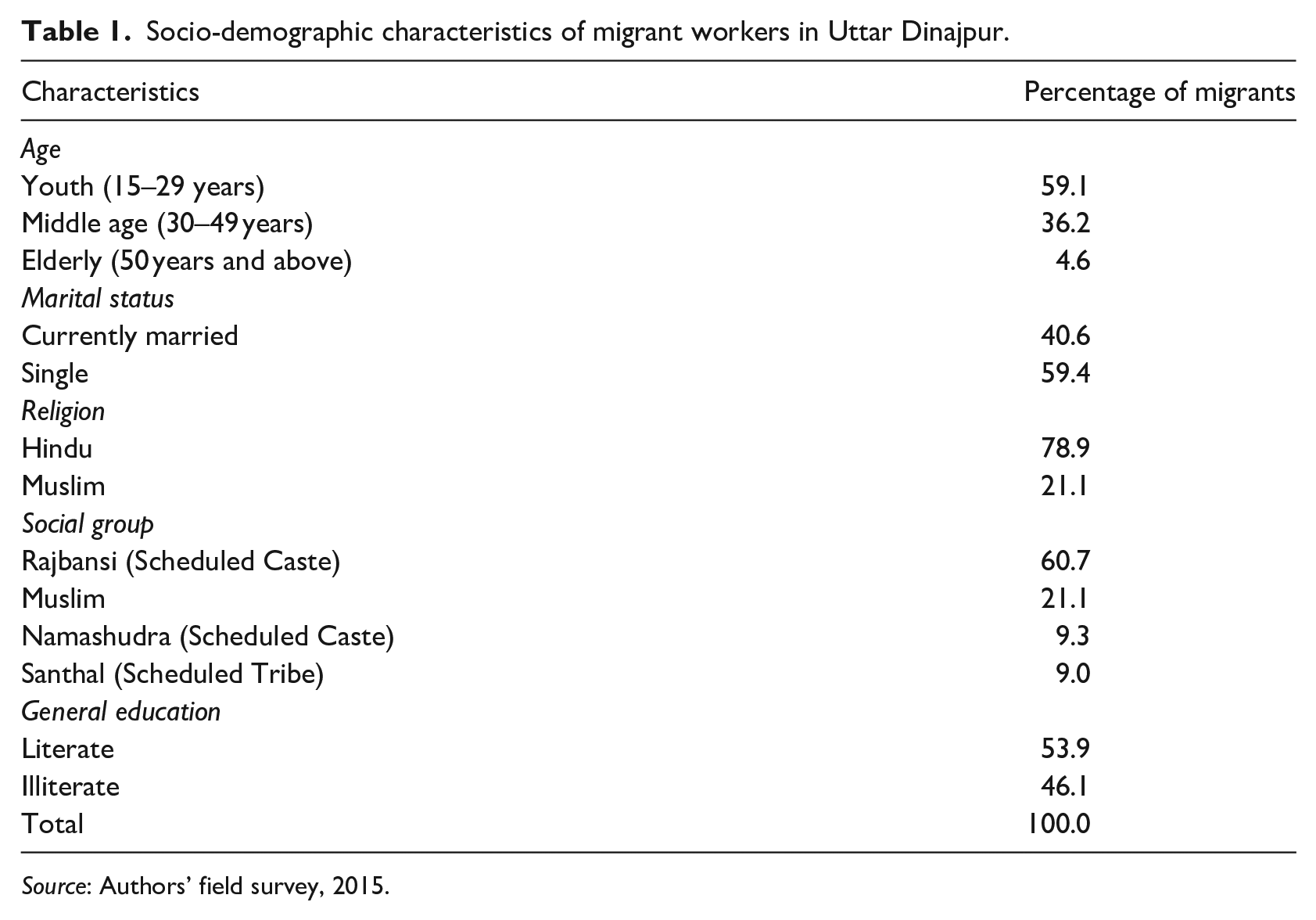
Source: Authors’ field survey, 2015.
One of the changing characteristics of out-migration from the region is that the majority of migrants do not have any fixed period of return to the villages. This suggests the relative weakening of the agricultural labour market as a source of livelihoods within the migrant labour households.
About 77% of migrants do not have any fixed time for their return to the origin, whereas 22% return back home every year at a fixed time during the sowing and harvesting seasons. Circular migration 11 is no longer tied to the rhythms of agricultural cycles. About 35% responded that they stay only less than three months at the village. Moreover, 46% of the migrants have changed their work destinations outside their own state three times, while 15.5% of inter-state migrant workers have changed their work place at least twice to date (Table 2).
Duration of stay at the origin.
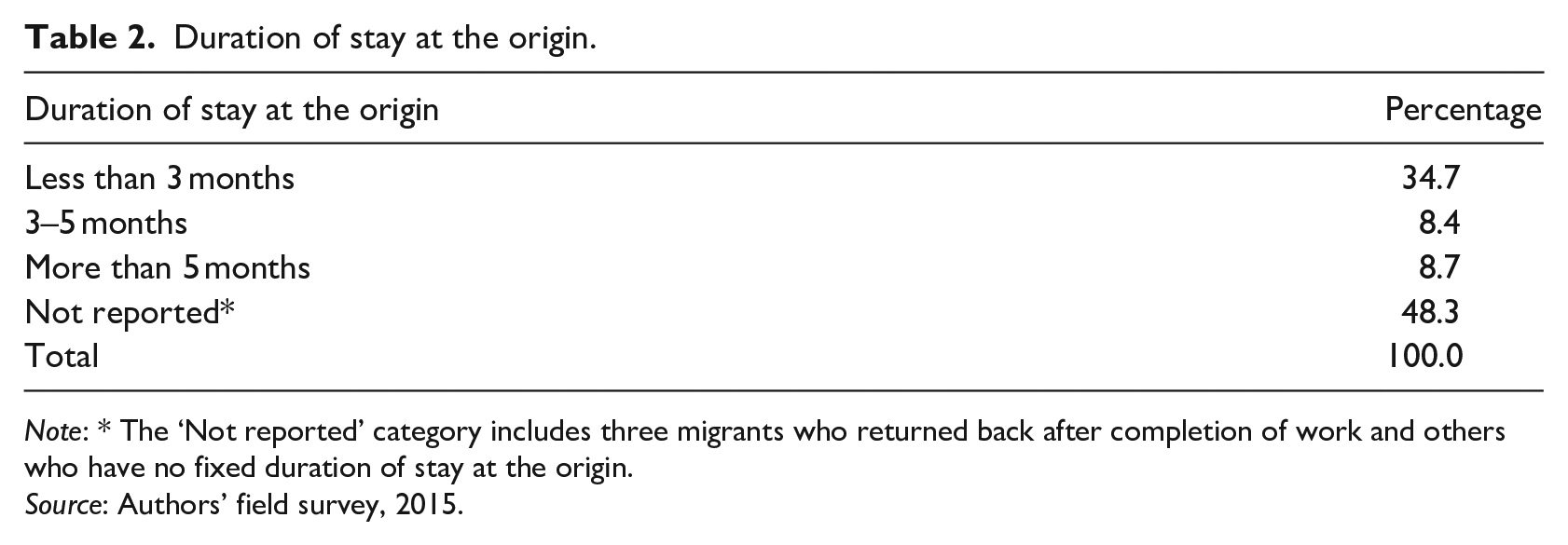
Note: * The ‘Not reported’ category includes three migrants who returned back after completion of work and others who have no fixed duration of stay at the origin.
Source: Authors’ field survey, 2015.
Typically, the period of out-migration ranges from two months to six months at a stretch. The married men have a relatively higher frequency of return to the villages than the unmarried workers. Most of the men have migrated with some prior information regarding the availability of employment at the destination.
There are two major pathways of out-migration from the villages. One is independent migration of the youth, in which networks of family and friends play a significant role in finding employment at the destinations. The other is out-migration through the labour contractors, typically against an advance payment. One such kind of out-migration, called dadan, in which the labourers are required to work-off the loan, has many inbuilt mechanisms identified in the literature as ‘unfreedom’ (Breman and Guerin, 2009; Mishra, 2019). Those who migrated through labour contractors received an advance of Rs 1000/- to 5000/- per episode of migration in general. In case of dadan workers, Rs 10,000 is paid for 62 days of contract work. Social networks play an important role in finding out a ‘good’ labour contractor or thikadar.
Implications of labour out-migration
Economic implications
Economic motivation is generally described as the main reason for labour out-migration. We have examined the economic aspects of labour out-migration, by examining the changes in the occupational pattern of workers after migration, wage differences between origin and destination areas, the significance of remittances, and the wealth status of migrant households.
Occupational mobility
Economic mobility in this study has been defined as when a person gets engaged in any type of work that enables him to earn more than his previous work. Of the total migrants, the principal occupation of 56.04% of migrants was casual labour in agriculture, while 35% were students. Nearly 3% were cultivators and 1.5% were casual wage workers in the local non-farm sector. However, the livelihoods’ portfolio of the workers was much more diverse. Some of those whose principal occupation was casual labour in agriculture, for example, also occasionally worked in the non-farm labour market and vice versa.
When they first moved to the places of work, most men were selected as helpers or unskilled labourers at the bottom levels of construction sectors. Of the 144 workers who worked as casual labour in agriculture, a substantial majority (79.56%) worked as unskilled labour at destination, and nearly 18% worked as low or semi-skilled workers (Table 3). The number of cultivators and workers in the local non-farm economy was relatively small, but they had a better chance of acquiring skills at the destination. What is striking is that among those whose principal occupation was study, nearly 95% worked as unskilled labour at the destination. The ‘occupation at origin’ in Table 3 refers to the principal occupation of the workers before the first-ever cycle of migration, and the ‘occupation at the destination’ refers to the principal occupation at the latest cycle of out-migration. Thus, the observed occupational change has happened over periods of time that are not uniform for each migrant worker. It is quite likely that those who reported ‘study’ as their principal occupation before migration, were relatively new migrants and hence they have joined as unskilled labour at the construction sites. Even then, this points to a pattern of circular migration, where the rural youth instead of continuing with their education, are straight away joining the unskilled labour force.
Occupational transition.

Note: (a) the occupation at origin refers to principal occupation before the first cycle of out-migration. The occupation at destination refers to principal occupation in the latest cycle of out-migration; and (b) figures in parentheses refer to percentage to row-totals.
Source: Authors’ primary survey, 2015.
Economic mobility can be imagined as changes in the shape of the occupational pyramid that tends to change from a bottom-heavy shape with high share of unskilled workers, to a bulging curve in the middle. From the first cycle of migration till the date of the survey, there was some upward mobility in the employment as well as the economic status of migrants. However, the mobility took time as many of the migrants who have acquired some skills post-migration joined as unskilled labour in the beginning. Of the total out-migrants, 82% ended up as unskilled labour, 15% worked as semi-skilled or low-skilled workers, and only 3% worked as a skilled worker in the construction sector.
Wage differences
The main reason behind out-migration from the region is the differences in wages between the origin and destination areas. As can be seen from the data presented in Table 4, there is a substantial difference between the wage-rates of male casual labour wages in the origin and those in construction at the two main destinations. Even after considering the costs of migration and relocation, the differences are attractive enough for the workers.
Wage rate at different destinations in comparison to the place of origin.

Note: * wage rate in non-agricultural public works under the Mahatma Gandhi National Rural Employment Guarantee Scheme in the village was Rs. 169/- for both male and female labourers. Supervisors are paid monthly salaries that have been converted to daily wages.
Sources: Authors’ field survey, 2015.
The conditions of the migrant workers who worked under debt bondage, or dadan were found to be the worst among the migrant workers. In our study sample of 323 workers, 9% of total migrant workers were found to be working under the dadan system. Typically, they take an advance (ranging from Rs 1000/- to 5000/- per worker in a migration cycle) from a labour contractor and they work-off their debts. During the period of work at the destination, they are dependent on the labour contractor for their day-to-day survival needs. The average wages earned by the dadan was approximately Rs 161 /- per day, which is not much higher than the wages for manual labour in the origin areas. Thus, it is not better wages at the destinations, but the non-availability of employment at the origin, poor economic conditions and the need for the lump-sum advance that induce the migrants to move out. Most of the dadan migrant workers have been under such debt-cycles for years together. Most of the dadan migrant workers have migrated to the NCR (Delhi), Uttar Pradesh (Ghaziabad and Kanpur), Rajasthan (Jaipur), Goa, Chhattisgarh and Uttarakhand in their most recent move.
Remittances
As a result of such out-migration, the share of income from non-agricultural sources has increased, as remittances are one of the important sources of livelihoods. Nearly 85% of migrants reported that they remit money back home. The average frequency of remittances was six times per year and the average amount of remittances per year was Rs. 5558/-per annum. Nearly 67% of migrants send remittances once in two months, while 24% of migrants send money every month. About 57% of the migrants send 40%–49% of their wages as remittances. For the households of migrants, remittances hold an important share in the household income. About 30% of these households reported that remittances are the only source of income, while the rest combined them with income from other sources. The remittances are mostly used for daily consumption needs, and repayment of debts. Some households had also spent remittances for repairing the houses, children’s education, medical purposes or for social functions such as marriages. Only 8.7% mentioned that they have been able to save or invest a part of their remittances.
An example of migration-induced earnings for non-migrants in the origin areas is the payments made by the migrants for informal transfer of remittances. More than 70% of migrants did not have bank accounts and transferred their remittances to the account of other individuals in the village, by paying transaction charges, which was between Rs 5/- to 50/- per Rs 1000 of transfer 12 .
Wealth status
Most of the migrants (57%) felt that the economic conditions of their households had improved compared to their previous status. Many of them referred to experiences of food shortages before migration. Now, they feel that their economic condition has improved – they eat food twice a day, have some money left for basic necessities of life and some also educate their siblings, which has enabled siblings to earn. Apart from these improvements, when asked specifically, more than 90% of migrants said that post-migration, the income as well as expenditure of their household has increased. More than 85% of migrants responded that their ‘social status (or prestige) has improved,’ and this is because they are now less dependent on the rich people in the village and they do not starve for food like before. Among the rest, many felt that their ‘economic condition has increased but social status remained the same’. So far as the distribution of households across size-classes according to the wealth status is concerned 13 , it was found that most of the migrant households belong to the poor category 14 (Table 5).
Wealth status of the migrant households.

Source: Authors’ primary survey, 2015.
Skills, information and lifestyles
Given the employment scenario at the origin areas, the scope for returning to the villages is limited for the migrant workers. Though some of them have learned new skills while working in the construction sector, these new skills, such as ‘bending rods’ or ‘fitting rods’, etc. are sector specific and are not in demand in the local labour markets. So, when they return back with their acquired skills, this fails to generate any skill-premium in the local labour market. Thus, there is a limit to which return migrants can bring back useful skills, etc. to the origins, as suggested in the literature (Deshingkar and Grimm, 2005: 44).
Men were happy about their experience of new places and people. They now can speak Hindi and some are also able to understand a few English words. Few got the knowledge about saving money in in bank from the staff members of the project (Delhi Metro Rail Corporation) and about health risks such as human immunodeficiency virus and–acquired immunodeficiency syndrome from the workshop organised by the company at the worksite. Young migrants are aware of the new fashion trends available at the market and thus they prefer to buy clothes from the destination. Migrants also discussed about the work insecurity faced by the Keralite indigenous labourers due to the recent infiltration of cheap Bengali labour to their land. Most of the real-estate companies do not prefer to hire local labourers because of their links with labour unions and local political powers. Overall migrating out in new destinations makes them aware of new culture, places and people along with new skills in construction work.
When asked about changes in their lifestyles and consumption patterns, alcoholism figured prominently in our conversation with the migrant workers. Most of the men said they acquired the habit of drinking alcohol after migration. About 75% of migrant workers, who had no previous drinking habits (or any other habits such as smoking or chewing tobacco) before migration, have now started drinking alcohol. For about 50% of men, who had habits of consuming tobacco products such as bidi, gutka, cigarettes, etc. prior to migration, the frequency of the intake has increased. About 72% of young men belonging to the age-group 30 years and below have developed drinking habits at the destination. Freedom, access to cash and peer-pressure at the destination are cited as the main reasons for indulging in drinking habits by the migrants.
Social status
Apart from the changes in the economic conditions, migrant workers put a lot of emphasis on their changed social status.
Father of a migrant worker said:
Earlier, the rich people of the village enjoyed a lot of power. Now they cannot exercise so much power because we are not dependent on them. Earlier they used to humiliate us using abusive language but now they cannot do so. So, I think our social prestige has increased. The rich households are now facing deep crisis because they are not finding labourers to work for them. In fact, many of them are either selling their land off or leasing out their land because of shortage of agricultural labourers. Some are even mortgaging their lands. . . and they are mostly giving their land away to the so-called poor households of the village. (Father of a migrant, age 75 years, ST, Unemployed)
Another respondent said:
Our prestige has increased, as now people say. . .my son is earning and running the family. (Father of a migrant, age 60 years, SC, Agricultural Labour)
However, there were some who disagreed:
Does going to a foreign land for work raises your prestige? No, it lowers down the status. (Father of a migrant, age 70 years, SC, Agricultural Labour)
On the other hand, the relatively better-off and wealthy villagers appeared to be resentful of the apparent upward social mobility of the poor out-migrant households. For instance, some respondents mentioned that although the conditions of the migrant households have improved economically, their social status in the village continues to remain the same:
Now they see the world through colourful glasses, wear jeans, and another type of trousers. . . Bermuda shorts, put on colourful T-shirts, and ride a bike. . . they feel they have acquired better status in the village. But see. . . they are nothing but migrant labourers. . . people might say that they are educated but actually they cannot even sign their names. . . this is the real situation! Whenever we fix a marriage, and we visit the groom’s house to settle the relationship, at that time if we see any new building or repair of the house then our first enquiry be that ‘whether any person of this house is a migrant labour (bidesh khata) or the money with which the house is building are from Indira awas? If we find migrant labour (bidesh khata) in the house then we do not give our daughter in that house. (Business man, age 45 years, owns 20 bigha land, Rajbansi, SC) Where is the prestige? One cannot earn status/prestige by merely showing off flashy lifestyle- it comes from your birth origin. (Actor in folk theatre, age 38 years, Namashudhra, SC)
A relatively well-off businessman and cultivator said:
Migrants have now better economic conditions than before, but whether their social status has improved or not is a difficult matter to say. (Businessman and big farmer, age 42 years, owns 30–40 bighas of land [01 bighas is equivalent to 1/8 to 2/5 ha] of land, Muslim)
A different response was given by a young businessman and farmer with a large land holding, who said:
Few years back, I wanted to migrate with my neighbour who was a supervisor in the metro-line. He said as I am educated (completed higher secondary), after learning works with them, I can get the work of supervisor, with monthly payment of 10,000/-. I thought after few years of work I will return back and will save the money for future, but when I informed about this to my parents, they scolded me badly and said they are ready to starve but are not willing to send their son in the foreign land to work like others. It is a matter of their prestige. (Businessman and big farmer, age 34 years, owns more than 40 bighas of land, Rajbansi, SC)
Thus, it is understood from the narratives that most of the migrants experienced a self-perceived upward social mobility – for them relief from the dependency on the rich raises their social status, whereas in terms of the response of the community members (mainly from the relatively well-off villagers), their social status remained the same (inferior) as before. Thus, in the eyes of the wealthy villagers, even today the migrants are separated by the greatest distance in social space.
Circular migration in context
The process and the consequences of migration described in the previous sections raise some basic questions regarding the implications of labour out-migration. The impacts of out-migration on migrants’ wellbeing and development in the long run and the relevance of the migration-induced optimism at the micro-level are the key questions which emerge from this research.
The evidence gathered in this research shows that migrants and their families are benefitted in many ways by the process of out-migration. The positive effects of migration at the household levels include the meeting of basic needs of the household (education of the family members/clothing/food etc.), and occasionally, purchase of land, the building of household assets, repairing of houses, repayment of debts, and buying of livestock. At the individual level, positive effects include awareness about the (new) urban fashion trends, operation of smart-mobile phones, travelling to new places or acquiring knowledge about new languages and people. Thus, all these factors show that male migrants play a vital role in the improvement of the living status of their households, and in doing so, they also attain some personal development. However, the heterogeneity of migration outcomes was also revealed through the field survey.
Based on the evidence gathered in this study, the irregular circular migration in manual work to the construction sector can be conceptualised as subsistence migration. This type of migration has helped the migrants and their families to earn enough to meet the basic needs of the households, and avoid extreme deprivations such as food shortages. Asset creation, such as building or repairing houses is limited. There are very few instances where migration has led to investments in productive assets or the creation of new sources of livelihoods. This argument gets clearer when we look at the age profile of those who are migrating and those who have stopped migrating out. Respondents pointed out to the trend that people migrate young and then stopped migrating as they become older. Because of family responsibilities and deteriorating health conditions, many migrants decide to return to their villages after a few years of migration. In case of migrants who were dadan workers, their economic conditions have worsened, as they could not build any assets or save money for the future.
Considering such an outcome, some of the questions that have not been addressed widely in the literature on migration deserve attention. Firstly, the question of the sustainability of the improved lifestyle of migrant workers: are the gains from migration sufficient to improve long-term living conditions of all sections of migrant workers? Secondly, the question of portability of skills across labour markets at the destination and the origin areas deserves further investigation.
Manual work such as construction generates very few skills which can be used at the origin. Most of the migrants are engaged in specific tasks in construction industries. Some return without acquiring any skills and others who manage to acquire some skills find that their skills are not in demand in the labour market at the origin. Thus, the skills that some migrants have learnt in big infrastructure and residential construction projects are not much use for them when they return.
On the other hand, at the micro-level, there are limits to which manual work at faraway destinations could be seen as a durable source of livelihoods. This is because, with time, responsibilities towards family increase and the ability to do hard work decreases. It is seen that for most of the men, the frequency of movement decreases after marriage, and after a few years, the movements stop. They return to work in agriculture in the village. Very few may start their own business or some turn out to be a thikadar, but in this case study, most return migrants work as agriculture labourers or tenants.
An individual migrant is typically part of the circular migration flows for 15–18 years in life, if he starts his journey at the age of 20 years. Boys who migrate at a very early age to earn, could not complete their schooling and when they return back, they are unable to cope up with the village life as they have no interest in agriculture 15 .
Of special significance is the conditions of those who have migrated under the dadan system with tied contracts with labour contractors – they are more miserable than the other wage-based workers. This is because during their work lives, due to low earnings and a long stay at the destination, they are unable to save or build assets. To meet their expenditures, typically they borrow cash from the thikadar or agents, and this makes them perpetually dependent on the labour contractors. Most of these workers try to repay the money in exchange for increasing the number of work-hours/days under that particular thikadar. In doing so, they often get entrapped under a vicious cycle of debts and poverty, characterised by a variety of bondage and unfreedoms (Mishra, 2019).
Thus, the general characterisation of migration as a way out of poverty needs to be further contextualised, considering the specific conditions of migration from different regions in different settings. Even in this study migrants migrating under dadan contracts were found to have a distinctly unfavourable outcome in comparison with those who migrated independently. Further, a static comparison of the earnings, consumption, expenditure and living standards between migrants and non-migrants or a comparison of living standards before and after migration might not be enough to draw lessons regarding the outcome of migration. Such a research design does not consider the longer-term, life-cycle based outcomes of migration.
The structural aspects of internal migration-decisions are typically underemphasised in the mainstream analysis of migration. In contrast, neo-Marxists argue that in the process of migration, the development of the core (here urban developed regions), which drains human resources from the periphery (poor rural areas), is premised on a sustained dependency of the periphery on the extraction of cheap labour from the poor areas which is part of this unequal exchange. The overall process leads to a vicious cycle of poverty at the origin (Mrydal, 1957, cited in De Haas, 2010). Capitalism, as a system, seeks to transfer surplus value through the super-exploitation of the migrant workers (Pröbsting, 2015). In globalising India, circular and seasonal migration is increasingly becoming a part of the labour circulation process, in which even globally integrated sectors and multi-national corporations are employing labour through non-capitalist institutions and identities (Mishra, 2019). Lerche and Shah (2018) have argued that the super-exploitation of the migrant workers is one of the ways through which the spread of capitalism is subjecting workers through a process of ‘conjoint oppression’ (Lerche and Shah, 2018). The evidence presented in this study further advances the argument by emphasising the differentiated nature of the migration flows and the possibilities that migrant workers may be abandoned after a period of relatively better income at the destination. The process of skill acquisition by migrant labour remains confined to a few years of active working life, and skill-mismatch is as much a significant aspect of the reality for those who fail to continue with the cycles of migration.
Yet another aspect that comes out prominently in this research is the linkages between rural distress and out-migration of male labour. In the surveyed villages, lack of adequate employment opportunities, in the context of low productive agriculture and limited economic diversification, create the basis for out-migration. While in a narrow conceptualisation, such migration could be termed as ‘voluntary’, the structural features of the local economy, given unequal opportunities and wealth, force people out from their land. The ‘choice’ to move out is mostly taken against the dire alternatives of unemployment and indignity. Such out-migration of labour, from the relatively less developed regions of the country to the relatively developed states, regions and cities, is part of the processes of uneven development (Mishra, 2016a). This is part of the ‘spatial fix’ by increasingly mobile capital, that prefers to use migrant labour, at times under various forms of neo-bondage, to keep costs low and also to discipline labour (Das, 2012).
Concluding remarks
In sum, out-migration for work outside the state has become a common phenomenon for rural men of Bengal, although this movement is not necessarily of their own choice. It is more out of a mere compulsion to earn and survive. These young men are irregular circular migrants as most of them maintain a continued link with the place of origin, but they do not have any fixed time of return back home and have no fixed destination of work.
Migrants invest a vital period of their lives in the tough manual and low-skilled work and in return, the remittances they send back home help their families with better food, clothing, education and improved housing. Out-migration, in some way, also facilitates poor migrant families to escape from the old dependency on the local rich, but a new dependency on thikadars becomes prominent. Those who migrate through labour contractors under dadan system enter cycles of debt-induced migration that have many features of unfreedom.
An important insight that emerges from this research is the difference between the short-term and life-cycle implications of circular labour migration. While young migrant males get a better income and are able to contribute to the economic betterment of their families, after working for 15–20 years at the destinations, ill-health and family-responsibilities force them to stop the recurrent migration cycles. At this stage, they are back to wage labour in agriculture in the village, and many of them face insecure lives during their middle age and old age. In this backdrop, there is a need to revisit the migration–development linkages, where the static analysis of gains from migration, should be contrasted with long-term, life-cycle outcomes.
In the wake of the COVID-19 pandemic which was first identified in December 2019 in Wuhan, China, and the lockdown of the Indian economy that was suddenly imposed on 24 March 2020, the vulnerability of the circular migrants has come to the limelight. The sudden loss of employment and earnings resulted in an unprecedented reverse flow of migration to the origin areas. A rapid assessment of the condition of migrants in one of the study villages brought out the difficulties faced by the workers at the destination. Their inability to survive beyond a few weeks, and other indicators of distress point to the precarious conditions of work in the informal economy in general and the construction sector in particular (Mishra et al., 2020). The spatial features of such migration, exemplified through the out-migration of male labour from the less-developed regions, suggest that structural dynamics of labour migration under contemporary capitalism is a key constitutive element that determines the migration process as well as its outcomes.
Footnotes
Declaration of conflicting interests
The authors declare that there is no conflict of interest.
Funding
The authors received no financial support for the research, authorship, and/or publication of this article.
