



Abstract
International election observation in Africa is in crisis. This crisis manifests in various ways, including lowering of standards from democracy promotion to ‘peaceocracy’; strategic interest bias; progress bias; low-tech methodologies; dominance over citizen observer groups; and contradiction of verdicts of election observation missions with court judgments. The crisis characterizes the wound of international election observation. The onset of the COVID-19 pandemic found a pre-existing unhealthy condition of international election observation, thereby pouring salt into the wound. It accentuated the existential crisis of international election observation. Observation has to be recalibrated during and after the pandemic. Existing challenges facing international election observation have to be redressed. International election observation has to adapt to the new condition marked by COVID-19. This adaptation should include development and implementation of guidelines on election observation during COVID-19. In the long run, sustainability of election observation rests in the institutional strengthening of citizen-based observer groups.
Keywords
Introduction
The central thesis of this article is that international election observation is in crisis. This crisis manifests in various ways including lowering of standards from democracy promotion to what other scholars have termed ‘peaceocracy’; strategic interest bias; progress bias; low-tech methodologies; dominance over citizen observer groups; and contradiction of verdicts of election observation missions with court judgments in relation to election integrity and legitimacy of outcomes. Pouring salt into this wound is the coronavirus disease of 2019 (commonly known as COVID-19) thereby compounding the existential crisis of international election observation. Election observation has to be recalibrated considerably during and after COVID-19. The pre-COVID-19 challenges facing election observation, noted above, have to be redressed. Election observation has to be re-oriented in light of COVID-19 so that it withstands such public health emergencies now and in the future.
COVID-19 has come at an inauspicious moment, when democracy globally and in Africa is in decline and autocratization is on the ascendancy. As states respond to the pandemic with emergency measures, the health of democracy is jeopardized. One of the risks of emergency measures is the reversal of the gains made on the democratization front. Alan Doss and Mo Ibrahim observe that ‘the pandemic in Africa will not be just a crisis of public health or the economy. It risks becoming a political emergency that threatens the democratic progress that countries across the continent have made in recent years’ (Doss and Ibrahim, 2020: 1).
As states respond to the pandemic with emergency measures, the incentive for autocratization is greater, especially where pro-democracy protests are suspended. Maerz et al. argue that: the early months of 2020 have given additional reason for pessimism: the corona pandemic. While many social restrictions may be justifiable in the face of the pandemic, there is a risk that governments will abuse the crisis to enact measures that are disproportionate to the task at hand and to extend their powers and limit freedoms permanently. . . . In summary, the third wave of autocratisation . . . risks gaining unprecedented momentum (Maerz et al., 2020: 5-6).
Fionnuala Ni Aolain, the United Nations Special Rapporteur on counterterrorism and human rights, warns us that ‘We could have a parallel epidemic of authoritarian and repressive measures following close if not on the heels of a health epidemic’ (Maerz et al., 2020: 6).
Since the onset of the COVID-19 pandemic in Africa, a nascent debate has emerged around the impact of the pandemic on elections pioneered by the International Foundation for Electoral Systems (IFES), the International Institute for Democracy and Electoral Assistance (IDEA) and the United Nations (UN). However, there is no comparable discourse, thus far, addressing the impact of the pandemic on international election observation. This article represents a modest effort aimed at filling this lacuna in academic and policy discourse.
International observation in Africa is undertaken by various organizations. These include the Regional Economic Communities (RECs) and other regional non-state actors; continental intergovernmental organizations such as the African Union (AU) and other continental non-state actors such as the Electoral Institute for Sustainable Democracy in Africa (EISA); and the international inter-governmental bodies such as the European Union and the Commonwealth and international non-state actors such as the National Democratic Institute (NDI) and the Carter Center. They are all signatories to the 2005 Declaration of Principles for International Election Observation and the Code of Conduct for International Election Observers (UN, 2005). These organizations have their own norms, values and standards as well as the codes of conduct for election observation. It is note-worthy that the 2005 Declaration and the specific norms developed by international organizations do not provide guidelines on the conduct of election observation during public health emergency situations such as the COVID-19 pandemic. The development of the guidelines for elections during COVID-19 by the United Nations in May, the Commonwealth in October and the African Union in November is a progressive step in the right direction. All said and done, the firm sustainability of election observation, with or without COVID-19, lies in the institutional strengthening of the often-neglected citizen-based observer groups, whose mandate should be elevated to election monitoring.
The next section focuses on the conceptual and contextual framing of international election observation in Africa. This is followed by a review of the crisis of international election observation in Africa. The subsequent section highlights how COVID-19 constitutes the salt in the wound of international election observation. The conclusion wraps up the debate and highlights key observations.
Conceptual and contextual framing
Key concepts
Four distinct, albeit intertwined, concepts are key for this discussion. These are (a) electoral integrity, (b) election observation, (c) election monitoring and (d) electoral assistance.
Electoral integrity refers to any election that is based on democratic principles of universal suffrage and political equality as reflected in international standards and agreements, and is professional, impartial and transparent in its preparation and administration throughout the electoral cycle (Kofi Annan Foundation, 2012: 6). According to the ACE Encyclopaedia of electoral knowledge, the key principles that undergird electoral integrity include: (a) ethical behaviour, (b) fairness and impartiality and (c) transparency and accountability. Fundamentally, election observation and monitoring are supposed to guarantee electoral integrity.
Election observation denotes a systematic, comprehensive and accurate information gathering (Dundas, 2011: 21). It is a process of systematic gathering of verifiable information on the electoral process as the basis for making an informed, independent and objective decision on the integrity, transparency, inclusiveness and credibility of process and the legitimacy of the election outcome. It is an on-site fact-finding concerning the laws, processes and institutions related to the conduct of elections. It is an impartial and professional analysis of such information. It also involves reaching an informed verdict about the credibility, legitimacy and acceptability of the election outcome (Dundas, 2011: 21). In sum, it entails four steps: (a) watching, (b) seeing, (c) noting and (d) reporting.
Election observation serves eight main functions: safeguarding the integrity of the electoral process; promoting the openness and transparency of the process; enhancing public confidence in the process; diffusing potential tensions; deterring improper practices and attempts at fraud; increasing political credibility; contributing to the acceptance of the election results; and disseminating and strengthening international standards and electoral best practices (African Union, 2013).
Despite the tendency in the literature to use election observation and election monitoring synonymously (see Anglin, 1998; Hyde, 2011; Kelly, 2009, 2010), the two are quite distinct, albeit mutually reinforcing. Election monitoring denotes systematic information gathering and evaluation of the electoral process. Unlike observation, monitoring entails the authority to directly and indirectly intervene in the electoral process with a view to correcting observed deficiencies in election management and breach of law by any of the electoral stakeholders (Dundas, 2011: 21). In sum, it presupposes six steps: (a) watching, (b) seeing, (c) noting, (d) reporting, (e) supervising and (f) intervening.
Electoral assistance is distinct from observation and monitoring. It refers to legal, technical, financial, technological and logistical support to election management bodies (EMBs), civil society organizations (CSOs) and/or parties aimed at ensuring the credibility and integrity of elections and legitimacy of election outcomes. It denotes institutional strengthening and capacity building of electoral stakeholders.
The conceptual framing of international election observation is grounded in the paradigm of democracy promotion. Globally, democracy promotion started during the Cold War era and intensified after the collapse of the Berlin Wall, which triggered Western triumphalism over the Soviet governance model. The West perceived its global mission as the spread of liberal democracy everywhere à la Fukuyama. In his own words, Fukuyama posited the ‘end of history’ thesis bluntly as follows: ‘as mankind approaches the end of the millennium, the twin crises of authoritarianism and socialist central planning have left only one competitor standing in the ring as an ideology of potentially universal validity: liberal democracy’ (Fukuyama, 1992: 42).
Fukuyama’s ideation of a post-Cold War global liberal revolution is corroborated by Thomas Carothers who argues that democracy promotion has always been part and parcel of the foreign policies of the Western countries, and particularly the US foreign policy outreach, which was scaled up in the post-Cold War era, despite inconsistencies at times.
Carothers identifies international election observation as a key component of ‘aiding democracy abroad’. In his own words, ‘if there is one area of democracy assistance that has gained broad visibility, it is election assistance. The ubiquitous international observers at the many high-profile, first-time elections in countries launching democratic transitions over the past two decades have lodged elections assistance in the consciousness of people around the world’ (Carothers, 1999: 126). It is within the conceptual framework of democracy promotion that this article conceives of the mission of international election observation which is currently threatened by the COVID-19 pandemic.
Context
International election observation is a fairly new phenomenon in the post-colonial African political scene. It was never part of the continent’s political development in the 1960s–1980s during the Cold War and the heyday of authoritarian rule of either civilian or military varieties. It became part of efforts towards Africa’s re-democratization process in the twilight of the Cold War era, especially since the fall of the Berlin Wall in 1989 and the demise of apartheid in southern Africa. The raison d’etre of international election observation is the detection and deterrence of election rigging and fraud; assurance of electoral integrity; inculcation of a culture of democracy, constitutionalism, justice, rule of law and human rights; and advancement of peace, security and stability.
Contemporary international election observation in Africa is traceable to Zimbabwe’s independence election of 1980 which witnessed the first large-scale international observation on the continent (Chan, 2019). However, international election observation gained greater momentum with numerous transitional elections following the collapse of the Cold War and apartheid. Thus, notable transitional elections accompanied by a massive horde of international observers included, inter alia, Namibia (1989), Benin (1991), Zambia (1991), Angola (1992), Lesotho (1993) and South Africa (1994).
Since the 1990s, therefore, international election observation has become prominent in Africa and it has also spread to Central America, Eastern Europe and Central Asia and, to a lesser extent, the Middle East and South East Asia (Anglin, 1998: 471). This trend is not surprising because the post-Cold War Africa has been marked by regular multi-party elections which have replaced military coups as a method of transfer of, and control over, state power. These elections attract massive numbers of international observers. Therefore, since the Zimbabwe independence election of 1980, international election observation has become a major visible aspect of elections in Africa (Carothers, 1999: 126).
Hence Carothers’ prediction that ‘election observation will continue to be an important part of international politics for at least the next five to ten years’ (Carothers, 1997: 30). A year later, Anglin predicted that ‘election observers are far from being an endangered species’ (Anglin, 1998: 475). However, more than 20 years now since the above predictions by Carothers and Anglin, international election observation is in deep crisis. Carothers had foreseen this eventuality. He observed that the capacity of international election observation ‘to reinforce shaky electoral processes will be put to many hard tests in regions such the former Soviet Union, Africa, and Asia’ (Carothers, 1997: 30). Anglin also recognized that the performance of election observation needs improvement and its prestige needs restoration (Anglin, 1998: 471).
The dark cloud of one-party and military authoritarianism was cast over the continent between the mid-1960s and the late 1980s. It came as a sigh of relief when the continent experienced a re-democratization process starting with the historic national conference in Cotonou, Benin in 1989: a trend that swept the entire West Africa region sending a domino effect across the continent. For instance, in Southern Africa, the re-democratization wave started with the liberation of Namibia in 1989 followed by the transition from one-party to multi-party system in Zambia in 1991. The transition from military rule to multi-party democracy in Lesotho in 1993 and the demise of apartheid in South Africa in 1994 significantly propelled the continent’s march to democratization. These developments occasioned an epoch-making political sea change that transformed the African political landscape.
Africa’s democratic transformation was a result of both endogenous and exogenous factors. Key among the endogenous factors, the citizen-propelled popular struggles for democracy, human rights and justice loomed large. These were, inter alia, triggered by political repression and worsening socio-economic conditions of the ordinary people due mainly to poverty, inequality and unemployment, the relics of the underdevelopment of the continent left behind by the colonial powers. The external factors included the economic adjustment programmes of the Bretton Woods Institutions, that is, the International Monetary Fund and the World Bank, the end of the Cold War in 1989 and the demise of apartheid in South Africa in 1994.
As military and one-party regimes receded, re-democratization took centre-stage. Multi-party elections have become a key instrument for contestation over state power. Democratic power transfer is much more common now than was the case more than 50 years ago when African countries gained their political independence. Afrobarometer surveys provide solid evidence that popular demand for democracy in Africa is high even though democracy supply lags behind (Gyimah-Boadi and Dulani, 2015). In short, ballots have replaced bullets as fundamental instruments for competition over state power. Africa is relatively more peaceful now having cast aside violent inter-state conflicts, even though violent intra-state conflicts still persist.
Although the late Thandika Mkandawire has described Africa’s political landscape as marked by ‘choiceless democracies’ (Mkandawire, 2006), regular multi-party elections are now in vogue and with them has come the trend of international election observation. Susan Hyde aptly argues that election observation today ‘is widely referred to as an international norm, and it is rare for any country to hold an election without inviting international observers’ (Hyde, 2011: 336). She argues that international election observation has become complicated because today democracy-contingent benefits do not only accrue to ‘true democrats’ as ‘pseudo-democrats’ also lay claim to these benefits, by signaling a commitment to democracy. . . . This change gave true-democrats the incentive to invite observers and led to the belief among democracy promoters that all true democrats invite observers, thus creating the conditions for widespread norm compliance. Pseudo-democrats seeking to maximize international benefits were forced to engage in a complicated calculation, weighing the anticipated value of democracy-contingent benefits, autocracy-contingent costs, and the probability that they could manipulate the elections, cheat and avoid a negative report (Hyde, 2011: 360).
Presently, international election observation faces enormous challenges, manifesting its crisis, as the next section will illustrate.
The crisis of international election observation: the wound
As highlighted in the previous section, Carothers (1997) and Anglin (1998) sounded the early warnings about the tough test ahead for election observation around the world, especially in emerging democracies, including Africa. The latest wake-up call for the calamity confronting international observers was made recently by Cheeseman and Klaas who bemoan the contradiction of the flourishing of elections on the one hand and the erosion of democracy on the other. They drive the point home graphically by detailing ‘the sumptuous’ six-course ‘menu of manipulation’ (Schedler, 2002) of elections in Africa including (a) gerrymandering, (b) vote buying, (c) repression, (d) electronic hacking, (e) ballot box stuffing and (f) playing the international community (Cheeseman and Klaas, 2018: 6-7). Often international election observers tend to fall short in detecting and deterring this ‘menu of manipulation’. This short-coming, in part, compounds the crisis of international election observation today. This has led Chan to conclude, fairly modestly, that ‘electoral observation, while not worthless, has limited worth’ (Chan, 2019: 2). In this section, six dimensions of the wound of international election observation are discussed.
First, the most striking short-coming of the international election observation today is the lowering of the bar from democracy promotion to peace promotion. This is what Elena Gadjanova prefers to term ‘the tyranny of low expectations: low standards are tolerated because of fears of political instability’ (Gadjanova, 2018: 2). She argues that international election observers ‘frequently overlook irregularities and rubber-stamp contests in Africa that would not be tolerated elsewhere because of the perennial expectation of violence and political unrest’ (Gadjanova, 2018: 2). A plethora of global, continental and regional instruments have been developed to guide how this should be done. However, lately, observers seem more content with focusing on stability, peace and order before, during and after elections. This tendency lowers the bar of assessments from the higher goal of democracy to that of mere stability. This explains why in most of their pronouncements after elections, observers are more comfortable pronouncing on either the peaceful or violent nature of elections rather than their democratic quality or lack thereof. So, instead of advancing democratization, election observers have allowed authoritarians to cow them into facilitating ‘the emergence of a peaceocracy, in which the fear of conflict is used to prioritize stability and order to the detriment of democracy’ (Lynch et al., 2019: 627). The retreat from democracy to ‘peaceocracy’ exemplifies the current democratic backsliding in Africa today in which genuine democracies are fast receding and varieties of semi-democracies or electoral autocracies are prevalent. The majority of governments in Africa can be classified as grey-zone regimes which are neither democratic nor authoritarian who have perfected the art of playing the international community, including the election observers. Violent elections in both Kenya and Zimbabwe in 2007 and 2008, respectively, are cases in point where international election observers countenanced imperfect electoral processes fearing escalation of more political violence. Kelly reminds us that under these circumstances, ‘fear of violence has entirely paralyzed the truth’ (Kelly, 2009: 771). In sum, the dominant peace discourse has progressively replaced the democracy discourse, all to the detriment of the credibility of international election observation.
Second, international election observation increasingly exhibits the predominance of other interests besides the altruistic pursuit for democratization per se. These interests open up the observation process to accusations of double standards, bias and dishonesty. Dodsworth attributes the tendency of some international election observers to ‘pull their punches’ to the desire by Western donors to protect development programmes from disruption. . . . Some recount stories of Western aid officials pressuring observers to tone down their reports lest they trigger suspensions or reductions. The strategic interests of Western countries might also play a role. A desire to maintain good relationships with governments that control critical natural resources, are valuable allies in the war against terror or play an important role in peacekeeping are commonly cited as explanations when observers appear to overlook electoral fraud (Dodsworth, 2018a: 385-386).
Judith Kelly argues that election observers sometimes endorse elections to protect the interests of their member states or donors or to accommodate other compelling but tangential organizational norms. At times, these other factors align with the [observers]’s core objectives to assess the election quality; at other times, however, [observers] face a dilemma between accommodating these factors and assessing the election honestly (Kelly, 2009: 766-767).
The two dominant influences on international election observation emanate from member states of the organizations deploying observers and donors that have a stake in a country holding elections. This applies more forcefully to observation by intergovernmental organizations (IGOs) than by international non-governmental organizations (INGOs) and Kelly explains why: ‘because INGOs do not speak directly for any government or donors, they have greater freedom; certainly they do not face formal institutional procedures that allow governments to veto the wording of the election assessments’ (Kelly, 2009: 769).
The interest of member states and donors on international election observation from the developed countries is not difficult to fathom. In the post-Cold War era, evidently, democracy promotion has become an integral part of the foreign policy outreach of the Western world and besides elections have become part and parcel of the political conditionality of aid, trade and investment. The Western countries and the international financial institutions surreptitiously influence election observers to achieve their strategic interests through carrot-and-stick approaches. If the verdict of international observers is positive, such a country will qualify for more trade, aid and investment; it will gain international legitimacy; it will attract more tourism; and will attract more loans and grants. Conversely, if the verdict is negative, such a country is likely to be subjected to curtailed trade, investment and aid flows; it is likely to face sanctions and isolation, thus being reduced to a status of a pariah state; tourism is bound to decline and possibilities of loans and grants are slim (Kelly, 2010). If international election observation is to regain its credibility, it must serve the interests of the countries holding elections and not interests of hegemonic forces within today’s globalized world.
Third, various scholars have also pinpointed the double standard of international election observers in the form of what is termed ‘progress bias’, ‘a tendency to tolerate flawed elections that improved on those held previously’ (Dodsworth, 2018a: 382) and path-dependency, that is, if they did not discover fraud in previous elections, they are most likely not to call it out even if it occurred. Given this progress bias and path dependency syndrome by observers, Geisler argues strongly that ‘African voters have suffered a double deceit: cheated by being prevented from changing their leaders, and cheated by international observers who failed to condemn the seriously flawed elections’ (Geisler, 1993: 616). A case in point here is the 1992 general elections in Kenya where various international election observers, including the Commonwealth Observer Group vacillated their positions and ended up saying that some aspects of the elections were not free and fair, the re-election of President Moi, in many instances directly reflects, however, imperfectly, the expression of the will of the people. The group left the country the next morning after presenting its findings at a press conference at Nairobi airport (Geisler, 1993:616).
Fourth, a new challenge and part of the crisis of international observation is presented by social media and its adverse effects for electoral integrity in Africa. In their study of social media and politics in Nigeria, Cheeseman et al. observe aptly that social media can be either a cure or curse for democratization in Africa depending on context and how it is used (Cheeseman et al., 2020). This latter school of thought is well represented by Odote and Kanyinga who are emphatic that in the case of Kenya’s 2013 and 2017 elections, technology became a curse. It has become a ‘black box’, which few election players have the technical competence to ascertain how it operates. The political parties compete to exploit the black box because whoever gains control of it may turn it to their advantage and win an election (Odote and Kanyinga, 2020: 12).
The challenges posed by social media for democracy and elections include the following: (a) disinformation can distort and harm democratic processes, in particular electoral processes; (b) social media increases polarization which can provide a breeding ground for democratic backsliding; (c) social media contributes to the decline in the quality of information for citizens to make informed choices; (d) weakened media environment undermines checks on government, facilitating unaccountable and corrupt practices; (e) social media can also become a tool to reinforce authoritarianism, populism, narrow nationalism and xenophobia (IDEA, 2019).
Even more worrying is the discovery that the digital revolution contributes immensely to election rigging. A wake-up call was surely the year 2016. In that year alone, two old democracies were manipulated through social media. The now defunct Cambridge Analytica, a private political consultancy firm, abused online personal data of social media users to influence the outcomes of the 2016 US presidential elections in favour of Donald Trump of the Republican Party against Hillary Clinton of the Democratic Party. Trump won the election and at the time of writing this paper, the election campaign was intensifying for the election slated for November 2020 in which Trump is seeking a second term.
The same organization used the same strategy to influence the outcome of the 2016 Brexit referendum in favour of the Leave Campaign which was championed by the Conservative Party against the Remain lobby supported by the Labour Party in the UK. The Leave campaigners won the referendum and at the time of writing this paper, the UK was in the process of negotiating how best to leave the European Union. The Cambridge Analytica story in the US elections and UK referendum is a reminder of the power of social media in disrupting democracies and elections through digital manipulation and digital harassment, manipulation, misinformation and disinformation (Cheeseman and Klaas, 2018; Ekdale and Tully, 2020). Social media is restructuring democratic politics. It is remaking the role of citizens. It is undermining existing democratic institutions.
In a trend that the Kenyan writer, analyst and activist, Nanjala Nyabola, has dubbed ‘digital colonialism’ (Ekdale and Tully, 2020), there is evidence pointing to the involvement of Cambridge Analytica in the 2015 general elections in Nigeria and the 2017 general elections in Kenya elections, reinforcing the fear of digital manipulation of elections in Africa. This trend opens up African elections to foreign influences and interests with deleterious consequences for democratization, by and large. They make a mockery of multi-party elections on the continent. It was only in early 2020 that Kenya and Nigeria signed into law the Data Protection Bill and the Data Protection Regulation respectively (Ekdale and Tully, 2020).
In Kenya, Cambridge Analytica played a key role in both 2013 and 2017 elections in support of President Uhuru Kenyatta. Kenyatta won both elections against Raila Odinga. Cambridge Analytica wrote the Manifesto of Kenyatta’s Jubilee Party, prepared campaign speeches for Kenyatta and conducted two surveys of 50,000 people in both elections to ascertain the voters’ needs, hopes and fears as well as their preferred information channels. The survey results reverberated beyond social media campaigns and were translated into non-internet platforms like radio, television advertisements, billboards and newspaper articles (Moore, 2018). They abused voters’ Facebook data and made it accessible to political parties, government institutions and the electoral commission without their knowledge and consent targeting, largely, young people.
In Nigeria, during the 2015 general elections, a wealthy Nigerian hired Cambridge Analytica to support President Goodluck Jonathan’s re-election bid. During the campaign, the firm worked closely ‘with the Israeli intelligence firm, Black Cube to acquire hacked medical and financial information about Jonathan’s opponent, Muhammadu Buhari. Cambridge Analytica also promoted a graphic anti-Buhari video. The video suggested that Buhari would support Boko Haram and end women’s rights’ (Ekdale and Tully, 2020). In the end, Jonathan lost the election to Buhari.
The main problem is that since its inception during the 1980 independence elections in Zimbabwe to date, international election observation has not yet adapted to high-tech methodologies. Its business model still remains manual and antiquated. International election observers have not yet developed tools, instruments and methodologies for monitoring information and communications technologies, including social media and their impact on electoral integrity. For instance, observers were oblivious of the heavy involvement of Cambridge Analytica in both Nigeria (2015) and Kenya (2017). Chan observes that the election observation process in Africa ‘remains exactly as low-tech as it was in 1980’ (Chan, 2019: 6). He aptly concludes that ‘the protection of electoral democracy today and tomorrow requires sharp observation skills using contemporary technology’ (Chan, 2019: 20).
Fifth, the artificial divide between international observers and domestic citizen observer groups is yet another element that characterizes the crisis of election observation today. According to Nevitte and Canton, ‘internationally driven election observations enjoy huge advantages over domestically driven ones in the areas of funding, training, and logistics’ (Nevitte and Canton, 1997: 49). Yet, the significance of domestic observers to democratization in Africa is incontrovertible.
Civil society organizations play a critical role in election observation. These are non-state social formations within countries holding elections. These are citizens of these countries. Unlike the above group of IGOs and INGOs, these CSOs are in the country permanently. They know the socio-cultural and politico-economic context much better and the implications of elections. They understand the language and unspoken gestures and nuances around the elections. They have more at stake as they are citizens and voters in these countries. This category of election observers is important in that it injects a refreshing methodology that allows for a bottom-up approach in which citizens are at the centre, unlike the approaches by IGOs and INGOs which tend to be top-down and elitist in both form and substance. Their observation is much more thoroughgoing as it covers comprehensively the pre-voting, voting and post-voting phases eschewing the E-Day bias of international observers. Carothers concludes aptly that domestic observers as citizens: embody the crucial idea that the society in question should take primary responsibility for improving its own political processes. Domestic monitoring often involves the establishment and development of substantial local organizations that stay in place after the elections are over, using their newly honed skills for civic education and other pro-democratic undertakings, in sharp contrast to the ‘here today, gone tomorrow’ nature of foreign observers. And domestic monitors can deliver much more ‘bang for the buck’ than can foreign groups, given that their travel, accommodation, and other logistical costs are much lower (Carothers, 1997: 23-24).
For Geisler, citizen observer groups cover the whole spectrum of the democratic process of which they are a part, and therefore, [do] not stop after the elections. Their coverage is also much broader: large numbers of local poll-watchers have been able to cover many more voting and counting stations in a greater sustained effort than international observers are ever likely to achieve (Geisler, 1993: 634).
Using the case study of the Coalition of Domestic Election Observers (CODEO) in Ghana, Sakyi and Oduro argue that domestic election observation provides a golden opportunity for civil society organizations ‘to participate directly in the democratization exercise, and thereby increase public ownership and acceptability of the election results’ (Sakyi and Oduro, 2002: 56).
Evidence points to the effectiveness of citizens in ensuring accountability and transparency of electoral processes by state institutions and election management bodies. An interesting study on the role of Ushahidi in partnership with ReclaimNaija during the 2011 general election in Nigeria by Bailard and Livingstone is one case in point. These authors found that a successful collective action initiative is possible through crowdsourcing election observation through citizen-generated reports based on modern digital technologies. Such success is dependent upon (a) community mobilization and (b) responsive state institutions including the election management bodies (EMBs) (Bailard and Livingstone, 2014). In future, besides deepening the value of the parallel vote tabulation, citizen election observation has to invest heavily in crowdsourcing and crowdmapping to complement traditional election observation methodologies. Therefore, these citizen observer groups should actually be empowered much more and be formally recognized, through a legal provision, not as election observers, but as election monitors so that they have teeth to bite.
Sixth, the crisis of international election observation is manifest by the contradictions of their verdicts with court rulings on election disputes. This is illustrative of their misplaced focus on election-day processes to an almost total neglect of the pre-voting context and post-voting developments as well. International observers use check-lists to undertake this task. What is evident is that the check-lists for election-day activities are much more comprehensive and extensive than those covering pre-voting and post-voting activities. This is yet another inadequacy of international election observation. This, in part, explains why over the past couple of years, the judiciary in Africa has adjudged electoral disputes with pronouncements that contradicted verdicts of international observers. The most recent cases in point here are Kenya (2017) and Malawi (2019).
The majority of the debates on electoral violence, most invariably, make reference to the 2007 elections in Kenya in which more than 1000 people were killed while almost 700,000 others were forcibly displaced as internally displaced persons or refugees. This violence has remained a cloud that hovered over subsequent elections in 2013 and 2017. While international election observers generally gave both sets of elections a clean bill of health, it was the immediate aftermath of the 2017 election that raised the eyebrows of analysts and observers alike. This was yet another incident of international observers pandering to peaceocracy to the detriment of democracy as they feared that calling the election as it was risked plunging Kenya into a political abyss of violent conflict.
Of the eight presidential candidates, only two mattered, namely the incumbent, President Uhuru Kenyatta of the ruling Jubilee Party and the opposition leader, Raila Odinga of the National Super Alliance. The Independent Electoral and Boundaries Commission declared Kenyatta the winner with 54.2% of the vote. Odinga and NASA challenged this election outcome in court (Kanyinga and Odote, 2019). It was the Supreme Court of Kenya that boldly ‘invalidated the presidential poll on the basis that it had not been sufficiently transparent and verifiable’ (Dodsworth, 2018b: 2). Sitting on 1 September 2019, a majority of four against two Supreme Court judges ruled that the presidential election was null and void and ordered a fresh poll within 60 days. This repeat poll was held on 26 October 2017, but was boycotted by Odinga and NASA on the grounds of the continued unfair playing field skewed in favour of the incumbent. Running solo, Kenyatta was declared the winner of the fresh election with 98.3% of the vote with paltry voter turnout of 39% down from almost 80% turnout in August (Kanyinga and Odote, 2019). According to Cheeseman et al., ‘the Supreme Court demonstrated its capacity to act as an independent institution to defend the quality of democracy, when it became only the third court ever to annul the election of a sitting president’ (Cheeseman et al., 2019: 217).
Kanyinga and Odote lament the incident as illustrative of the judicialization of politics and politicization of the judiciary (Kanyinga and Odote, 2019), while on his part, Chege (2018) proposes that ‘Kenyans should do themselves a great favour by abandoning presidentialism and returning to the parliamentary and cabinet government that brought them to independence in 1963’ (Chege, 2018: 170). Our main interest in the Kenya case study is that the mere fact that the judiciary contradicted the verdict of international observers dented the integrity and credibility of international election observation. Statements of the Commonwealth and AU, largely informed by ‘peaceocracy’ demonstrate the discrepancy between the outcome of the election observation and the court judgement in Kenya. The Commonwealth Observer mission commended Kenyans ‘for the peaceful and orderly manner in which they exercised their right to vote . . . noted that voters were able to cast their ballots freely’ (Commonwealth, 2017: 1). The African Union Election Observer Mission proclaimed that it ‘was very pleased to say that the elections were peaceful. . . . The people were permitted to vote in a manner which met the standards set in Kenya law, which was also consistent with the policies of the African Union’ (AU, 2017: 4).
In May 2019, Malawi held its tripartite election, combining presidential, parliamentary and local government polls, which were witnessed by a plethora of international election observers. Malawi’s fragmented party system injected an enormous amount of political tension around the election combined with the extreme poverty that makes citizens easily susceptible to vote buying. In settings like this, contestation for state power becomes a do or die affair, given that controlling the levers of the state is like discovering gold for oneself. The contest was fierce. The outcome was too close to call. In the end, the result of the presidential poll gave the incumbent and leader of the Democratic Progressive Party (DPP), Peter Mutharika, a razor-thin margin of victory with 38.6% of the total valid votes, followed closely by Lazarus Chakwera of the Malawi Congress Party (MCP) with 35.4% and the third position occupied by Saulos Chilima of United Transformation Movement (UTM). Whereas the international election observers had adjudged the election through largely positive verdicts, it was only when the election dispute petitions got to the Constitutional Court that the judiciary overturned these verdicts.
The statements by the European Union and the Southern African Development Community (SADC) focused on the peacefulness of the process and were not in sync with the court judgment in Malawi. The EU concluded that ‘the campaign was competitive with a strong sense of public engagement at rallies and civic education events. However, despite being largely peaceful, there were incidents and heightened tension’ (EU, 2019). The SADC Electoral Observation Mission proclaimed that ‘the pre-election and voting phases of the 2019 Tripartite Elections were conducted in a generally peaceful atmosphere’ (SADC, 2019: 10).
A three-person panel of judges of the Constitutional Court of Malawi were unanimous that: (a) the incumbent was not duly elected and therefore the election results were nullified; (b) the Malawi Electoral Commission (MEC) was incompetent in managing the polls; (c) that a fresh presidential poll be held within 150 days; (d) parliament should enact a law to ensure the use of 50% plus 1 rule for the election of president; and (e) parliament should inquire into the capacity and competency of the MEC. The presidential election was annulled by the courts and a new poll conducted in June 2020 which was won by a coalition involving MCP and UTM resulting in Chakwera becoming the new President of Malawi.
The crisis of international election observation is compounded by the onset of the COVID-19 pandemic tantamount to pouring salt into the wound. It is to this that the next section turns.
The impact of the COVID-19 pandemic on international election observation: the salt
The onset of COVID-19 has compounded the crisis of international election observation thereby pouring salt into the wound. Two trends have marked responses by African countries in relation to scheduled elections during 2020 (see Table 1). One trend is that some countries have proceeded with elections despite the onset of the COVID-19 pandemic. Other countries have opted to postpone elections due to COVID-19.
General elections in Africa, 2020.
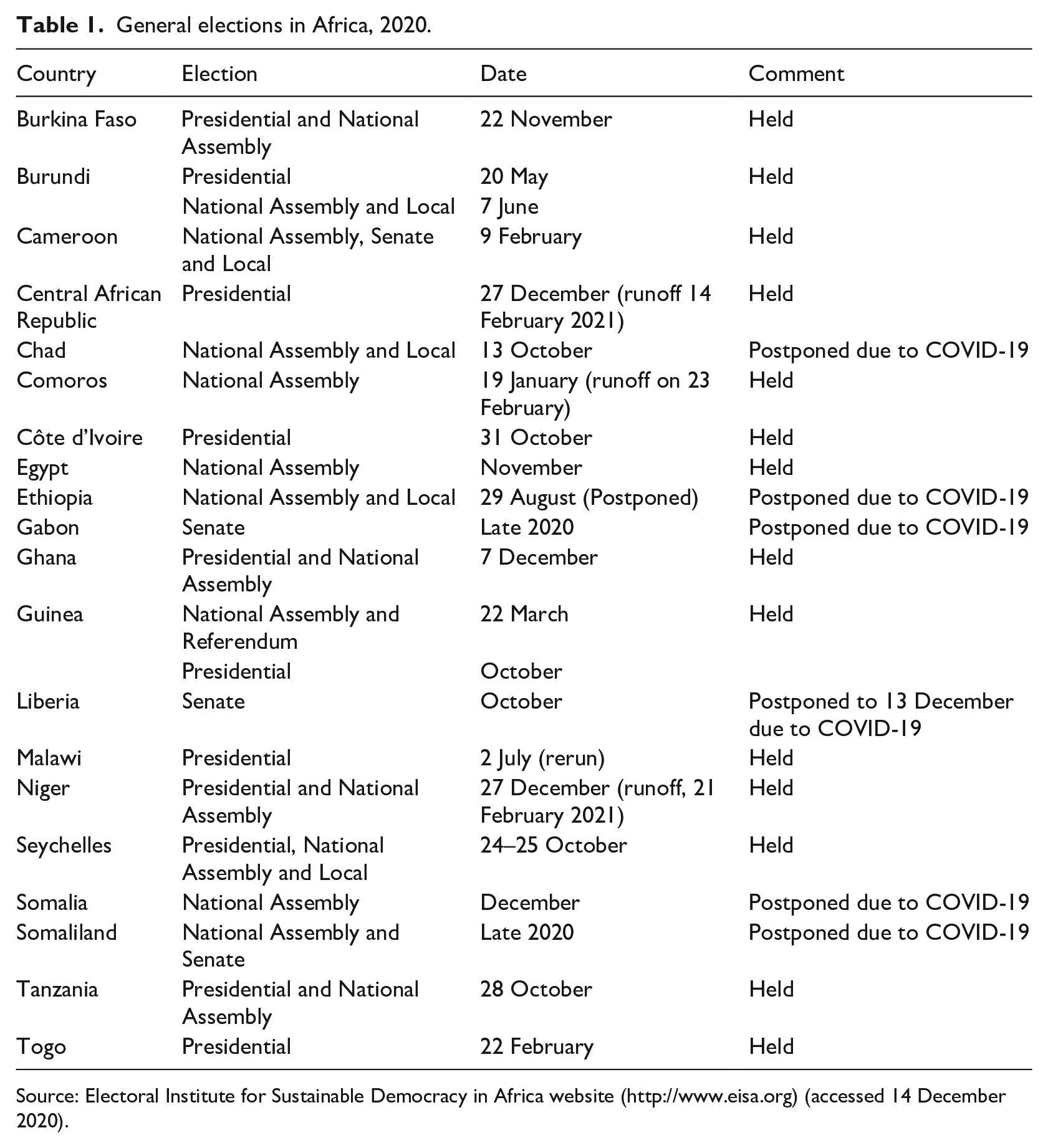
Source: Electoral Institute for Sustainable Democracy in Africa website (http://www.eisa.org) (accessed 14 December 2020).
The majority of countries held elections despite COVID-19, while a few postponed their elections. There are four main matters arising in respect of international election observation in 2020.
First, it has proved difficult for organizations to mobilize observers for deployment during elections in other countries for fear of contracting COVID-19. International organizations, on their own, deliberately decided to suspend deployment of observers fearing possible contraction of COVID-19 or possibly spreading the virus through observers who may be infected but are asymptomatic. This was the case for the first half of 2020. It was only during the second half of the year that some organizations, notably the AU and the Economic Community of West African States (ECOWAS), started deploying observers.
Second, in some instances, international election organizations were unable to deploy observers due to COVID-19 related lockdown measures in place in countries holding elections. Given the lockdown, some countries holding elections made it clear that all observers would be quarantined for 14 days on their arrival. This was one of the reasons why international observers were absent during elections in Burundi, Malawi and Seychelles. Added to this challenge was the requirement that observers undergo COVID-19 tests.
Third, the experience of elections held during the last quarter of 2020 points to a possibility that the old tradition of large hordes of international election observers being deployed may become a thing of the past. The majority of elections during that period were held in West Africa. Both the AU and ECOWAS deployed smaller missions than is traditionally the case for fear of observers contracting COVID-19. Even in other regions, observer missions were relatively small in numbers as was the case in Tanzania (October) and Central African Republic (December). International observers may opt for smaller groups of observers and progressively resort to increased use of technology in election observation.
Fourth, international organizations involved in election observation have been compelled to develop guidelines relating to COVID-19. A number of organizations have developed guidelines for elections during COVID-19 including the United Nations, the Commonwealth and the AU. The United Nations guidelines are more focused on electoral assistance, while those by the Commonwealth and the AU are all-encompassing, including elements relating to election observation.
The Commonwealth recognizes that international election observation has been curtailed by health and travel restrictions due to COVID-19 and makes two complementary recommendations namely that (a) ‘where international observation is not possible, or can only happen in a more limited way, the international community should consider extra support to citizen observer groups who are likely to receive increased visibility as well as scrutiny’ (Commonwealth, 2020: 23) and that (b) ‘they should communicate extra measures they are taking to ensure that their presence is not perceived as a health risk. In this respect, publishing a code of conduct for observers could also be useful’ (Commonwealth, 2020: 23). The second recommendation resonates with the AU guidelines which also encourage international and domestic observer groups to develop specific manuals aimed at ensuring effective and safe observation in the context of COVID-19.
Conclusion
This article has highlighted the crisis of international election observation which manifests in various forms, most notably, lowering of standards from democracy promotion to ‘peaceocracy’; strategic interest bias influenced by the industrialized countries and Africa’s development partners; progress bias whereby the advancement in the previous election influences judgement on the subsequent poll; low-tech methodologies used by observers during the era of the current high-tech information age; dominance of international election observers over citizen observer groups; and contradiction of verdicts of election observation missions with court judgments.
The COVID-19 pandemic is pouring salt into this wound, compounding the existential crisis of international election observation as highlighted in this article. All said and done, the firm sustainability of election observation, with or without COVID-19, lies in the institutional strengthening of the often neglected citizen-based observer groups, which, in fact, should be elevated to become monitoring groups, so as to give them both clout and teeth. Despite COVID-19, more countries held their scheduled elections, while few postponed elections. For the most part, international organizations suspended deployment of observers. Arguably, the absence of, or limited deployment of observers in 2020 denuded external evaluation of the democraticness of elections. During the last quarter of 2020, international election observation resumed, albeit on a limited scale. As part of redeeming election observation, some organizations have developed guidelines for elections during COVID-19, notably the UN, Commonwealth and the AU. Both the Commonwealth and the AU have recommended development of codes of conduct and specific manuals to guide election observers in the context of COVID-19.
Footnotes
Funding
The author received no financial support for the research, authorship, and/or publication of this article.
