




Abstract
This article explores household-level social dynamics of change and their causal effects on future agricultural practices and food security. It does this by employing a place-specific qualitative research methodology in two rural settlements in Shamva District, Mashonaland Central Province. It reveals how these changes have impacted negatively on farm households’ command of assets, including draft power, labour and social networks. Households that had a long history of agricultural excellence started to experience declines in their agriculture, while new households encountered new vulnerabilities. The article concludes by cautioning against any policy that ignores the household as a production unit in Zimbabwe’s agriculture.
Introduction
Studies have shown that rural agriculture has been a significant livelihood portfolio for households across the globe (Adekunle, 2013; Sarris et al., 2006; The World Bank, 2007). Its significance does not only relate to agro-based regions, such as Africa, but extends to mature economies (The World Bank, 2007). Its role in poverty alleviation, employment and food security is widely recognised (Chapman and Greenville, 2002). Worldwide, small farms numerically dominate. Globally, small farms characterise agriculture; with increased fragmentation of landholdings, the number of small farmers has increased significantly.
Writing nearly two decades ago, Kydd (2002) argued, ‘smallholder agriculture is presently a key sustainer of the majority of the world’s poorest people, so the dynamics of smallholder agriculture ought to be a central question for . . . development’ (p. v). Furthermore, recent studies have challenged the conventional wisdom about small farms as traditional, unproductive, inefficient and an obstacle to economic development (Rosset, 2000). This position is crucial because economic activities such as small farming can lead to improvements in household food security and generate employment (Wiggins, 2009).
While acknowledging the contestation on the definition of small farmers (Cousins, 2011), we view them as rural households that engage in rural subsistence agriculture on small pieces of land, and depend extensively on family labour (Bratton, 1988). These are mainly peasants who work their own family-based farms and consist of a diversified assortment of small-sized socio-economic structures that utilise limited technologies and landholdings, ranging from 1 acre to 6 hectares (see, Moyo, 2016).
Notwithstanding these debates, small farms across the globe are in crisis, as evidenced by the withdrawal of both capital and labour from rural farming. Rigg et al. (2019) argues that ‘farmers are ageing across the globe, and not just in the usual suspect countries and regions such as Australia . . . .also increasingly getting documented in countries which are still “developing”’ (p. 1). Studies that have focused on the future of small farming have not only given a chronology of these changing social dynamics, but also illuminated on the dangers that they face in the future (Huang, 2012; Rigg et al., 2019).
Together with the potentially negative consequences of climate change, this threatens the realisation of their potential in achieving food security and poverty reduction. Therefore, agricultural systems like smallholder farming and their role in achieving rural households’ welfare, food security and protection against poverty, need to be understood in a broader social and natural context, paying particular attention to shifts in the social and natural environment. This study contributes to these broader debates on small-farm agriculture by analysing the shifts in the social and natural dynamics in Zimbabwe, and their contributory effects on rural households’ welfare.
Basing our analysis on households’ life histories, we illuminate the crisis inherent in Zimbabwe’s small-farm sector. A central argument we advance is that while agriculture has previously played a central role in livelihoods and welfare, certain household-level social dynamics, have eroded agricultural performance, and compromised their ability to realise rewards from the farming enterprise. We suggest that the changing agriculture production situation at the household level should be understood together with the social changes, including changing household structure and the challenges brought by aging and death of the older generation of farmers.
Small-farm agriculture and social crises
Small-farm agriculture is increasingly viewed as significant for food security, employment and poverty reduction in poor countries. Smallholder farming provides households with the opportunity to produce subsistence crops and avoid the costs and risks associated with acquiring staples from the market (Wiggins, 2009). It thus enhances food supply at household level (Adekunle, 2013; Adenew, 2004), and reduces households poverty levels (Sarris et al., 2006). The associated intensified utilisation of land – the inverse relationship between farm size and production per unit of land – cost effectiveness, and farmer-operated plots, give smaller farms an advantage over large farms (Cornia, 1985; Eastwood et al., 2010; Wiggins, 2009). Given these advantages, small farms have come to occupy a central position in policy debates, and have become central to policy on food security and poverty reduction.
While this significance has been acknowledged, also tacit are the social crises that the sector has endured since the 1990s (Binswanger and Deininger, 1997; Hazell, 1992). According to Bryceson (2000), rural dwellers depend on the pursuit of farming activities, although they struggle to provide sufficient food for themselves. For some, small-farm agriculture is faced with an aging problem and a challenge of replacing the aging generation (Aina, 2007; Huang, 2012; Rigg et al., 2019). This is discussed in studies such as Apt (2012), and Schatz and Seeley (2015), who raised concerns about the declining agricultural production in the countryside, linking this to the domination of the sector by the elderly. For example, Bryceson (2002: 728) find that in Nigeria farming was concentrated around an old cohort of people aged between 46 and 76, which was contributing to declines in smallholder agricultural productivity.
While all the focus is on developing countries, particularly Africa, these social dynamics are not confined to a single region, and are increasingly becoming a global phenomenon, alongside their potential consequences on rural livelihoods. Even in economically advanced countries, such as the United States, debates about an aging and the aged farmer are becoming prominent, amid concerns that fewer emerging farmers will replace them, a situation that may place a sharp shortfall on agricultural production (Ousley, 2017).
Furthermore, there is also an implicit younger farmer challenge. For example, youth have no interest in agriculture activities and do not see it as a viable livelihood activity (Cincotta et al., 2003; Hull, 2014; Losch, 2016; White, 2012). The aspirations of youth are outside agriculture and mainly on waged employment (Leavy and Hossain, 2014; Thebe, 2018). In Lesotho, Boehm (2003) showed how men would leave the land for mining jobs in South Africa, which provided status. While these patterns present typical rudiments of the African countryside, it is leading to labour shortages.
At the centre of our analysis is the interrogation of small-farm agriculture, its historical significance to rural households, farming practices and social changes that have taken place at the household level, which have impacted on agriculture production and food security. In our analysis, we use the capitals of the Sustainable Livelihood Framework (SLF) focusing on the changes to different forms of assets for rural households.
The SLF approach ‘is in line with sustainable development thinking, but provides a more practical way to address the complexities of multiple survival strategies because it focuses on people, their resources and their activities’ (Tao and Wall, 2009: 138). It is often associated with sustainable development, and emphasises five forms of capitals – physical, human, financial, social and natural – as important in livelihood construction (Scoones, 1998).
The concept of livelihoods is very important, especially for highly vulnerable communities such as rural households. It is a concept, which looks at households’ capabilities and strategies needed to sustain a living. It is sustainable if it can exploit capabilities using available assets to withstand shocks and stresses (Ashley and Carney, 1999).
Available assets, in our particular context, relates to access to land, common property resources, livestock and other agricultural tools; household labour, skills and knowledge; social networks including kin; income; and agricultural markets including the Grain Marketing Board (GMB). The connection between, on one hand, assets and agriculture-based livelihoods and, on the other hand, agricultural and food security failure has been studied by many scholars in Zimbabwe (e.g. Andersson, 2007; Jayne et al., 2006), although they did not integrate their analysis to intra-household dynamic of change.
Materials and methods
Study area
The communities in this study are in the Mazowe Basin, which like most of the Mashonaland Central Province, lies within Natural Region II. They are, thus, located in a region of favourable climatic conditions and with high agricultural potential than communities in Natural Regions IV and V, which experience semi-arid and arid climatic conditions. The region has an essentially tropical climate characterised by the following two distinct seasons: cold winters and hot summers. Rains fall mainly in the summer season and stretches from October to March. Annual rainfall can range from 700 mm to 750 mm, which is suited for the production of crops like maize crop.
Most communities are agrarian, comprising a communal area peasantry, newly resettled farmers and irrigation producers, although there is also a high degree of livelihood diversification, with households also combining on-farm and off-farm activities. Besides, farmers in the region have also been the main grain producers in the country since colonial times. Between 1980 and 1989, farmers in Shamva District contributed an average of 396,936 tonnes to Mashonaland Province’s food reserves as indicated in Figure 1 (Grain Marketing Board (GMB), 2019). Shamva District was a central part of Zimbabwe’s maize-based Green Revolution in the 1980s (Arnaiz, 1998; Matondi, 2012).

Marketed maize grain between 1981 and 2015.
Within this region, we conducted our study in two different locations: Bushu Communal Area and Mupfurudzi (Dombojena) Resettlement Area in Shamva District (see Figure 2). Bushu, is an old communal area, established in 1916. Like most communal areas in Zimbabwe, it has a high population of households (140 at the time of research). Most of the households are descendants of the Mazvimbakupa, a Shona ethnic group, and a majority of residents are aging, with ages ranging from 71 years to 87 years (see also Table 1). Land rights and access are communal, under the jurisdiction of the Shamva District Council.
The three types of households identified during fieldwork (2017–2018).
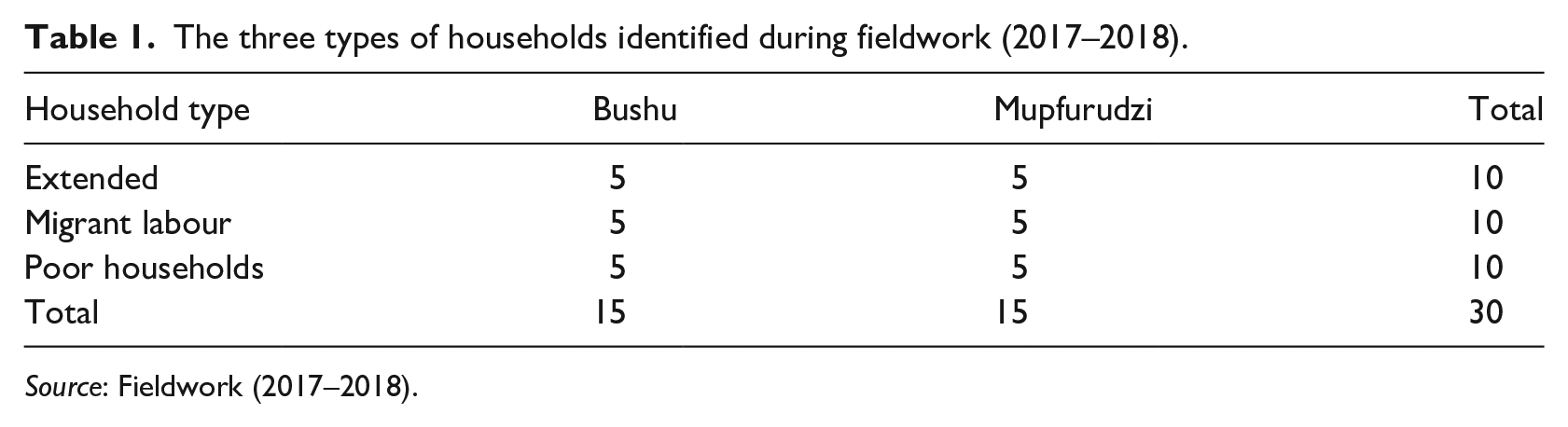
Source: Fieldwork (2017–2018).
Bushu is located on a strip of valley between the Mazowe River and Mupfurudzi River, about 90 km north-east of Harare, and about 9 km north of Shamva Rural Town. The riverine Kajakata, which runs through the village from the Zambayamba Hill, is a significant source of water for watering livestock, although it is not perennial. 1 Given the favourable rains, there is a little pressure to water crops, which are produced under rain-fed conditions.
Most of the soils in the area are the gova, with textures ranging from clayey loams to sandy clay. These are relatively fertile, but prone to erosion. Inherently, the fertility content has declined greatly, with extensive utilisation they have been subjected to since 1916. This has had a negative spin-off effect, with the land needing extensive investment in organic and artificial fertilisers. A greater majority of households occupy and farm on these two dominant soils. Notably, fertile soils are concentrated along river valleys and riverines, which has allowed certain households to develop gardens to produce grain and vegetable crops. There are no dams in Bushu, but there are two boreholes and a network of public and private wells.
Mupfurudzi is a new resettlement area established in 2004, following the implementation of the Fast track land reform and resettlement program (FTLRRP). It is a former commercial farm acquired by government to settle A1 farmers. It is a settlement of 84 households, divided into four villages, on a gently sloping terrain bordered by the Gono and Kanyemba villages to the south and Mupfurudzi River to the north. The settlement neighbours other resettlement schemes like Mutoramhepo, Mupedzanhamo and Murindagomo, and the Principle Irrigation Scheme.
Lying about 23 km north of Shamva Growth Point, and 14 km from Bushu, it is easily accessible by foot. Compared to communal areas in the region, landholdings are smaller, with each households allocated about 3.5 acres, with communal access for grazing. As a newly settled resettlement area, Mupfurudzi is a farming community with relatively younger settlers, with most landholder below 50 years. A majority are from communal areas in the region, although there are also some former farm workers among the settlers.
Compared to the communal areas, this is no place for labour migrants, although households engage in diverse non-farming livelihoods including artisanal mining and vending. 2 As an area formerly designated for settler agriculture, the land is far more fertile than land in former native reserves like Bushu. It is characterised by rich black, red clay and loamy sandy soils, which are well drained. While these soils also erode, they have not been subjected to extensive cultivation and are still relatively virgin. They are good for growing maize and cotton.
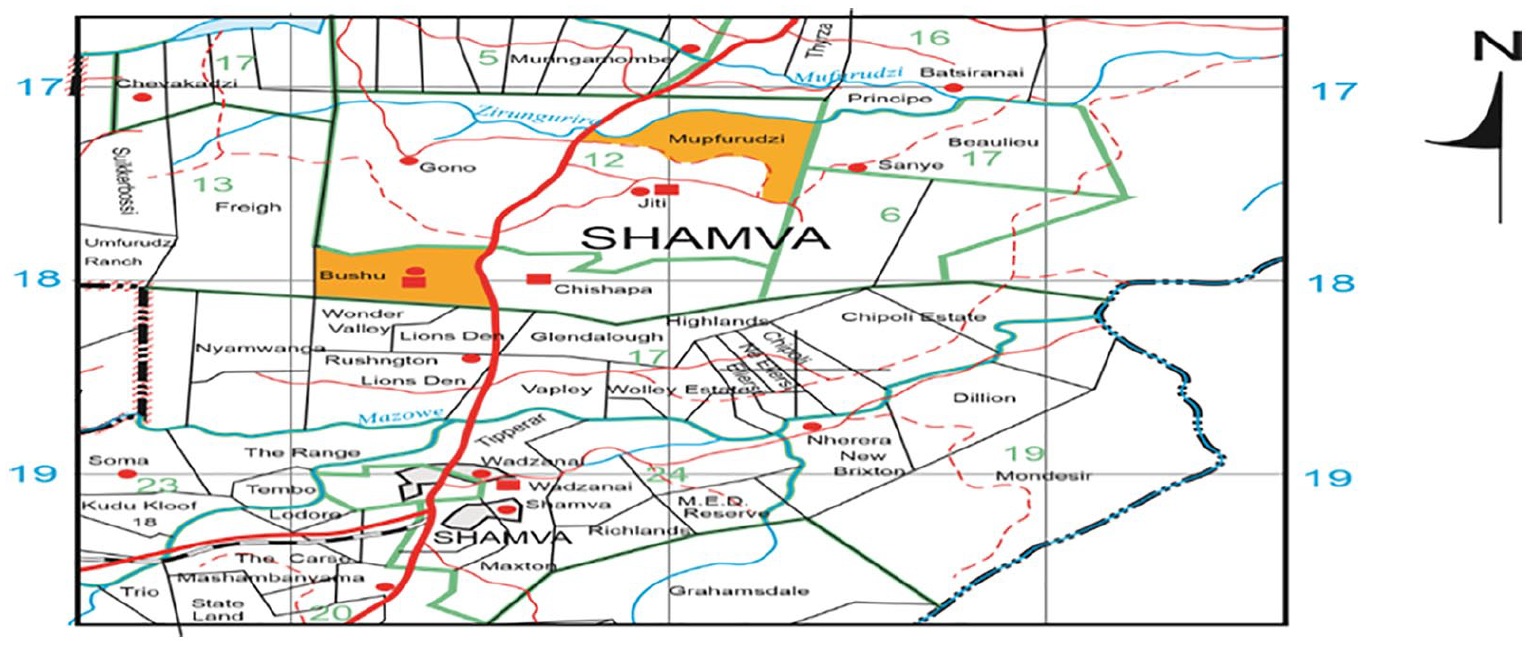
Map of Bushu and Mupfurudzi.
We draw data from a yearlong study conducted in these settlements between August 2017 and 2018. Our study focused on agricultural history, social and economic changes that have happened during the past two decades, and households’ current circumstances, and on the impact of these changes on agricultural practices, using households’ life histories and observations.
During this period, we conducted over 200 household visits, which provided deep empirical insights on the history of households and the social and economic changes that have influenced the present situation. We analysed the present situation, particularly household structure and composition, assets and agricultural practices. We visited households several times, as they were sites of ethnographic fieldwork.
We employed participant observations, direct observations, life history interviews and informal discussions with different members including household heads. The interviews and discussions were conducted in the local Shona language, which is the main language spoken in the region. Altogether, we visited 30 households we had purposely selected following predetermined criteria as highlighted in Table 1, and held over 300 interviews and discussions with men and women of different ages. 3
Explanations of Zimbabwe’s post-2000 agriculture crisis
Debates on Zimbabwe’s agriculture crisis in the 21st century have been dominated by two opposite views. On one hand, is an internalist view of the crisis as a direct consequence of policy; blaming the land reform programme that transferred commercial farmland to peasant producers (e.g. Bond, 2007; Richardson, 2007). On the other hand, is the usual focus on the natural environment, particularly the changing climatic conditions, evidenced by frequency in droughts (see, for example, Collier et al., 2008; Mupangwa et al., 2011).
Although much of the arguments by both sides have merit, and there is evidence of the negative impacts of climate change on agriculture (e.g. Brown et al., 2012; Dinar et al., 2008; Mano and Nhemachena, 2007), and gaps and challenges have been identified in the land reform programme, our argument is that other factors, including household-level analysis, should be factored into the debates.
Proponents point to the displacement of former commercial farmers, destruction of infrastructure, loss of proper rights and lack of capacity among the new settlers (Godwin, 2003; Richardson, 2007; Rutherford, 2008). Thus, these imply, implicitly though, that the acquisition of 145,775 peasants and 22,896 black medium and large-scale commercial farmers (Moyo, 2011a, 2011b), was the sole cause of the crisis.
One criticism of such thinking is that it is rather reductive, reducing a broader problem to a mere policy issue. Chaumba et al. (2003: 534) have argued, . . . these accounts play into a well-rehearsed narrative on ‘African crises’ of economic collapse, political instability, socioeconomic inequalities, corruption, crime and war, and depictions of ‘failed’, ‘vampire’ or ‘collapsed’ African states.
These accounts also ignore evidence of successes of the land reform programme recorded by a number of studies (e.g. Hanlon et al., 2010; Moyo, 2011a, 2011b, Scoones et al., 2011).
From another perspective, focus is on the harsh weather conditions, including perennial droughts (Bird and Shepherd, 2003; Mukwada and Manatsa, 2018), which are evidence of changing climate (Andersson, 2007; Brown et al., 2012; Mupangwa et al., 2011). Indeed, Zimbabwe and the southern African region have faced a series of droughts of differing severity, but proponents often refer to the 2001/2002 drought and its ripple effects (Rouault and Richard, 2005). Although some, like Bird and Shepherd, have highlighted how droughts increased households’ vulnerability to further natural stresses, a few have bothered to factor a household-level analysis.
By neglecting the household as a unit of analysis, and approaching the problem from the national level, the debates have missed a critical viewpoint. Our argument is that rural households are critical stakeholders in the country’s agriculture. Food production did not only relocate to the small-farm sector after independent, small farmers also contributed the bulk of marketed grain (Andersson, 2007; Anseeuw et al., 2012; Bratton, 1986; Jayne et al., 2006; Moyo, 1992).
Agriculture in the history of households
Divided into different types of farmers, the households found in the communal area (Bushu) and resettlement area in Mupfurudzi, are mostly migrants from other parts of the country, who came in search of agricultural opportunities. While the first settlements in Bushu and surrounding areas began in 1916, others arrived in the 1920s and 1930s from places like Chiweshe, Guruve, Mutoko and Rukandami, mostly attracted by good rains and fertile soils. Indeed, many of those households that now occupy resettlement land in Mupfurudzi, are descendants of this migrant community. In Bushu and surrounding areas, they had produced grain crops like finger millet, maize and sorghum, as well as vegetable crops.
Later, some men took advantage of road connection to towns and mines and started to migrate for jobs in places like Banket, Bindura and Shamva. This means that semi-proletarianisation emerged later after settlement, among households. Through life history interviews conducted in Bushu and Mupfurudzi, we identified three distinct forms of households during the period: extended, labour migrant and poorly resourced households. In terms of structure, the first group was large, extended and headed by polygamous men with more than one wife. In Bushu, the Pamire, Mukombe and Tungamirai households fell into this category. On average, households had around 25 adult members, and were almost wholly dependent on household labour, with that of social networks utilised during peak periods.
For example, VaTungamirai’s household included 12 families (comprising mainly of his sons and their immediate families), which lived, socialised and farmed together under his leadership. These included VaTungamirai and his four wives: Muchadeyi, his eldest son and his family; Kurauone, who worked in the mines (but had left his family behind); Farai, who was married and unemployed; Tangai (also unemployed); and youngest sons, Tumai and John (also married and unemployed), and four unmarried sons (Tonderai, Wafa, Urayi and Takunda).
Similarly, in Mupfurudzi, the Kajese, Mukombe, Kawanda and the Mambo were remnants of extended households. VaKawanda, for example, originated from an extended household in Mount Darwin, where he had lived in one compound with his three married brothers and their families, together with their father and three wives.
Migrant labour households, however, exhibited nucleated characteristics. Overall, these were small, headed de facto by women, with absent men and employing additional labour, particularly herd boys. Similarly, poor households were small, with less than eight members, including men who were unemployed. These households had limited livelihood opportunities, and owned nothing else other than their labour. Many had no specialist skills, and survived by selling their labour to rich households to gain income.
Agriculture was the main economic activity for most households, and surplus production was the main purpose. In a rural economy increasingly dependent on the natural environment, and supported by a capitalist sector of mines and small towns, this was terrain for peasants engaged in extensive agriculture and animal husbandry, and worker-peasants supporting rural production through the wage. Those with no wage income depended on their farming, while those with wage income could supplement agriculture activities, although all households practised agriculture, with the former supplying grain to the GMB.
Households produced maize, cotton and other vegetable crops such as groundnuts and round nuts, of which cotton and the later crops were mostly produced for the market. Maize was a staple crop, but it became commercialised after the 1980s when the government started supporting small farmers. With agricultural subsidies for small farmers, and an increasingly input-oriented farming system, some households managed to modernise and commercialise their agriculture, producing tobacco, hybrid maize and even sunflower.
These changes in the agriculture system ushered a new era where households could ‘sustain from their own production and also accumulate wealth’ (Mupfurudzi, December 2018, interview). For worker-peasants, investing in the rural home provided security again unemployment and retirement. The significance of rural agriculture as insurance against labour market shocks and retirement is well documented in literature (e.g. Andersson, 2002; Duggan, 1980; Potts and Mutambirwa, 1990; Thebe, 2020).
Households’ capacity to produce for the market opened up opportunities for educating children, particularly taking advantage of opportunities offered by government. A significant proportion of rural households, notably those with large herds and fields and worker-peasants, provided employment and farming opportunities to poor households. There were a few in both communities who had worked for other households. From Mupfurudzi, James Chimitengure once lived in the Pamire household, where he was working as a herd boy in the 1980s, before moving to Harare in the 1990s.
Households’ farming practice (1980–1990)
Among the many aspects on rural households’ agricultural performance, we need to take account of issues around capitals (as provided for in the SLF), which are critical aspects to any farming system. Some households owned large herds of cattle and used ox-spans for draft power for cultivation, but ox-spans were also critical in mobilising labour. Other households belonged to men who had retired from formal employment, had established rural homes, bought assets including cattle and farming tools, and were embarking on successful farming careers.
Labour migrant households had accumulated agricultural assets from formal employment, but they were never involved in commercial-oriented agricultural production. In terms of income, these received remittances, but relatively few depended entirely on the wage. Those experiencing labour shortages hired labour, while those with close kin relied on kin networks. However, a majority of households commanded agricultural assets, and had access to income either from agriculture or from the wage.
Before the 2000 land reform, the first two categories were mostly successful farmers and perennial contributors of grain to the GMB in the 1980s and 1990s. Migrant labour households engaged in agriculture, but they did not participate actively in the grain market, preferring instead, to store surplus grain. Of the households, which were large and extended, extensive social and human capital including the labour of neighbours and kin, provided labour for on-farm work. A popular form of social and human capital, pertinent to on-farm tasks, was organising nhimbe (community work parties), where labour would be mobilised through feasts or beer drinks. 4
However, a significant proportion of on-farm labour was drawn from social networks of kin and resource-poor farmers.
5
We were informed, Lack of resources did not mean that one would not farm his land. Resources-pooling arrangements were key farming strategies. Households without agricultural resources owned their labor and would offer it to those with resources, and in return, have their fields plowed. These arrangements were popular between extended households or labor migrant households (that faced labor constraints) and poor households. (Bushu, January 2018, interview)
One prominent household in Bushu reputedly had arrangements with numerous households, leasing herds of cattle for them to keep and use for draft power. Others were engaged in reciprocal forms of labour mobilisation, providing tillage in return for labour.
The significant point from our study was that social capital was a significant component of the farming system. For wealth households, the most common form of mobilising on-farm labour was command of draft power, which they used to plough for others. In addition, labour would be hired, while nhimbe and sharecropping arrangement were also key labour mobilising strategies.
With regard to natural capital, the primary productive resource was land, and all households had access to land for farming, although others had bigger fields than others. Land was freely available and accessible by all residents, and no household was without land as land rights were guaranteed. For members of extended households, the most common method for gaining land was through intra-household allocation, although the headman could also allocate them land.
Meanwhile, in this period, farming practices were strongly influenced by certain belief systems, which the elders said were respected and adhered to without question. According to a village elder, This was knowledge passed to us by our ancestors, and we used it to protect crops, animals and our natural environment. We never went to the fields on certain days. We never went to the fields when rains fall after a long dry spell, and we often asked the rain gods to provide us with more rains. These practices have been abandoned. . . ., and where are the rains? Where is the harvest? (Bushu, February 2019, interview)
The findings suggest that the different forms of assets commanded by households influenced the practice of agriculture in the 1980s and 1990s. These main forms of assets – physical, human, social, financial and natural – were a critical part of the agricultural system. The individual households could command these assets, in which case they would invest them into the farming enterprise, or may lack them, but still gain access through their relationship with other households.
All this changed in the 1990s, with the onset of the major drought in 1991–1992 and its aftermath, and the structural reforms induced by the adoption of the Economic Structural Adjustment Programme (ESAP), eroding the progress made in the small-scale agricultural sector since 1980. Following the adoption of ESAP in 1991, the government reduced expenditure on public services (Marquette, 1997), which affected agriculture through the withdrawal of subsidies and reduction of extension services (Kanyenze, 2004).
ESAP also resulted in massive retrenchments from both the public and private sectors of the economy (Moyo, 2007). Retrenched workers, with no jobs, often returned to the rural area, and in many cases were without income to invest in farming. Of course, these factors had a strong bearing on the state of agriculture in the period ahead. However, these national-level factors occurred alongside other changes at the household level, which may have changed dynamics of production for farm households. We discuss these household specific changes in the next section.
Changing social context and its effects
The social changes at household level in the period before 2000 are key to understanding changes in future agricultural performance after 2000. As we have described, household size, wealth and command of labour – from both members and social networks – were key determinants of agricultural performance. In 2018, most households had experienced massive changes in both structure and social influence, which had implications on their agriculture. They had experienced periods of economic upheaval (Economic Structural Adjustment and economic collapse), encountered family tragedies and had been caught by natural household life cycle dynamics.
One of the most striking structural changes was the demise of the extended household institution, formally the defining characteristic of farming acumen in the district. In the study, the extended family institution was clearly in decline. There were no large and extended households in both Bushu and Mupfurudzi, which was putting a great strain on intra-household production processes, with households losing the much-needed family labour and social networks.
In Bushu, a majority of male landholders had died, together with their power and wealth; in some cases, they had aged, together with their wives, and could not expend the same energy on the fields. For example, women headed 10 households in our sample, de jure, while elderly men headed five. Of those households in Mupfurudzi, eight had lost male heads after resettlement, leaving them under female headship. In other cases, particularly in the Communal Area (CA), younger men had taken over the household headship (and were looking after their widowed mothers).
We use the case of the Tungamirai household to demonstrate these social changes. In 2018, the household particularly revealed typical rudiments of disintegration. VaTungamirai had died in 1996; Muchadeyi, his eldest son, had relocated to Mount Darwin together with his brother Kurauone. Farai, Tangai and Tumai had also left to Shamva Growth Point. John, Royai, Taurai, Itai and Tonderai had settled in Goromonzi District, following the death of their mother in 1997. Wafa and Urayai had left for South Africa in 1997 and never returned; and Takunda had married and moved to Mutoko. The once prosperous household was a sorry site, comprising three elderly women and three grandchildren of school-going age.
A significant change to the extended household institution was notable at both the communal area and resettlement farm levels. In Bushu, families (that used to form the extended household unit) either were established as independent nuclear units, or had relocated elsewhere. In Mupfurudzi, the land beneficiary criteria favoured the settlement of nuclear families, and the land available could not cater for an extended family system, mostly premised on the ability of the household to apportion land to different members. Families were effectively divided. In some cases, members of the same household were allocated plots in different villages in the resettlement area.
This was particularly the case with VaKamanda, who had moved from Mount Darwin to Mupfurudzi with his three brothers, whose plots were in neighbouring villages. Similarly, January Pamire, was living in Mupfurudzi with his wife and four children. He had relocated from Madziwa, where he had left the rest of his family. This was his first time to own land and live independently. In Madziwa, he had family and kin, worked family fields and utilised family resources, which had remained behind. When he first moved to Mupfurudzi in 2004, he had five cows and an old plough, inherited from the main household, but his family was small and young, which presented difficulties in working the 3.5 acres of land during the early years.
Changing social dynamics and their implications
Aside from illustrating the dynamics of change at the household level in the period preceding the new millennium, the data bring to light the more central question of how these changing social dynamics may have affected households and their agriculture in later years. As it has become apparent, the death of the extended household institution proceeded together with the development of nuclear households, which meant that the extended household as a unit of social organisation ceased to exist.
Loss of productive assets
The new households could only utilise resources they owned, and pursue independent production activities, which until then, were performed by the broader extended household units. The household collective decisions on farming were now managed by the new male heads, their wives (in case of labour migrant households), or widows (where the husbands had died). If one of the households lacked resources, or failed to manage the farm, the agricultural performance eventual suffered.
In Bushu, relocating households had withdrawn productive resources from the main household. In the case of VaTungamirai’s once powerful household, Muchadeyi, Kurauone, Farai and Tumai had the largest combined family, owned cattle and ploughs, which were lost to the main household when they relocated. VaTungamirai’s three elderly widows remained with old and exhausted equipment and a small herd of cattle, which had been severely depleted by the 2002 drought.
In some cases, such as in that of January Pamire, the household lost productive resources with his relocation to the new resettlement area. His command of productive resources was compromised after relocating in a number of ways. First, he only had five cows including two calves and an old plough (not the type of resources for productive farming). Second, he had a young and small family, and could not mobilise sufficient labour for on-farm work; and three, although his land was limited to 3.5 acres, he was struggling to cultivate it in the absence of draft power and social networks left behind.
Reduction of land area used for production
As already alluded to, the disintegration of extended households also leads to the fragmentation of agricultural land. For instance, splinter households are acceded land by the landholder, which not only reduces the amount of land available to the main household, but also, the land acceded may not be adequate for the new users’ needs. In the event that this happens and the new household needs more land, it may be acceded more land by the village head or other kin; otherwise, it has to move out of the village, and its resources lost completely to the other households.
In Bushu, land fission had happened, and certainly, new households had encroached on arable land that once belonged to the broader household unit. In general, land available for households had reduced. In the communal area, land had degraded and soil erosion had eaten large parts of arable land, while in the new resettlement area, land was generally limited. Similarly, in the resettlement area, land fragmentation was occurring among land beneficiaries: four of the farmers had acquired additional land from poor farmers that had no capacity to cultivate their land allocations. This, it was reasoned, was another way for compensating for land lost when they relocated. 6
Our thesis that the demise of the extended household institution led to decreased agricultural performance lend its support from other agrarian studies. Elsewhere, Thebe (2012) showed how the disintegration of households in a former labour migrant society proceeded together with declines in wealth, power and influence, which impacted negatively on systems of social reciprocity that were key in agricultural production.
Loss of social networks
Life histories linked extended households in the communal area with large social networks of mainly resource-poor households, which relied on exchanges of their labour for draft power. Even though some of the households were still heavily involved in agriculture in 2017/2018, none could command a pool of labour needed for on-farm tasks, and there was a conviction that declines in agricultural production and incidents of food insecurity among poorly resourced households were due to the destruction of these social systems of organisation.
It was also observed that declines in livestock had affected households’ command of ox-spans, which then weakened social reciprocity practices. Command of singe spans and variable rain patterns had forced households with resources to maximise on the available ox span, by either concentrating on their field, or sharing ploughing days with only close family. Amai Tapera, a widow (aged 76 at the time of study), was using the same ox span with her three sons, who had their own homes and fields. She commented, There is only one cattle span here, which caters for four households – my three sons and mine. We take turns, but we lose two days (Sundays and Wednesdays), which are traditionally off-field days. We, therefore, have to maximize by plowing in the mornings and evenings. Even then, because of the variable rain conditions, it is difficult to cultivate all the fields. This has also meant that we cannot extend the span to people outside this group. (Bushi, January 2018, interview)
The relocation of households to resettlement farms also meant that social networks developed in the communal area remained behind, and they had to create new relations in the new area. According to local informants in Mupfurudzi, there were only a few households (mostly young families and households headed by former farm workers) that relied on these systems of social reciprocity. This was attributed to the fact that most households owned resources, but no households were considered the nouveau-riche, to lease cattle or to develop extensive social networks.
Constraints associated with labour availability
A significant way, in which farmers could use the social network system more effectively, was through resource pooling. Such systems were adopted in the resettlement area where a few households were farming alone. While households had readily accepted the demand for productive utilisation of land, only a selected few could command sufficient household labour to achieve these expectations; households were nuclear and small. In a majority of cases, households consisted of two adults (parents) and one or two older children, whose labour was often lost to the farm due to school commitments.
Labour emerged as a major constraint for households in both settings. The average age of the youngest and oldest farmer is represented in Table 2.
Youngest and oldest farmers at the time of fieldwork, 2018.

These figures are based on fieldwork carried out between 2017 and 2018.
For example, in the communal area, there was an aging population (widows and widowers), advanced in years and no longer having the strength to work the fields, and younger families with small children. Even households where there were older children, like that of VaJongwe, had lost this labour to the city and other off-farm activities including gold panning.
VaJongwe was not counted among influential men in the community, and he was not even known for his farming, yet, he depended on farming for both subsistence and income. Like many, he had land and an ox span, but his ability to work the land depended on his command of labour. He had seven children – four boys and three girls. Two of the boys were involved in what is called ‘kukiyakiya’ (hustling) in Harare, while another son was gold panning in Shamva, leaving him only with his wife and the young girls, who were attending school.
The loss of labour to gold panning activities had also affected households in Mupfurudzi, where people engaged in gold panning, whether part-time or full-time. Women and grown-up girls, however, were also involved in vending activities, selling farm products at the Growth Point. Such households would enter into resource pooling or sharecropping arrangements, by bringing together assets that complement one another.
Constraints associated with farming arrangements
Households that struggled for labour would pool existing household labour to work their different fields, while those with different assets would pool these assets to the benefit of both involved. The availability of these strategies in both the communal and resettlement areas made farming possible, even for widows and young households, but this came at the expense of high productivity.
Our interaction with households revealed that households were failing to take advantage of wet days since fields were worked on a rotation basis, which reduced the number of days available for each participating household, and these were further exacerbated by continuous dry spells. One male Mupfurudzi (aged 63) observed, These arrangements are suited for labour migrant households that can supplement their agricultural production. For anyone who depends on the farm, such arrangements do not always work, since they prevent each household from producing to its potential. Farming days are lost through the rotation system, and in a context of high rain variability, not all participating households can take advantage of the rains . . . Then, there are your usual dry spells . . . . potential harvests are lost. (Mupfurudzi, January 2018, interview)
Literature has shown how migrant labour households in communal areas would engage in resource pooling to compensate for the labour of absent, but it also emphasised the limitations of such arrangements, which did not extend beyond ploughing the fields (see Thebe, 2012, 2017).
Yet, others have identified labour peaks ‘at land preparation and planting in November-December, and one at the first weeding in January’ (Baudron et al., 2012: 402). Thus, neither do these arrangements solve the critical areas of labour needed, nor do they improve productivity; rather, they only present opportunities for households to work their fields.
Conclusion
Any investigation of changes in grain production and food security in the two decades of the 21st century in Zimbabwe needs to include household-level social dynamics, be it the changing structure, changing headship, changes in wealth and influence, and changes in command over social capital. As Andersson (2007) puts it, what needs to be understood is the ‘ . . . decline of food production in Zimbabwe’s smallholder farming sector’, a farming sector which ‘became the foremost provider of food, producing nearly 60 percent of the country’s main food crop, maize, since the mid-1980s’ (p. 682).
Following Andersson’s argument, a household-level analysis has shown not only the changes in household social structure (as extended units disintegrated and household heads died), but also the social complex that led small-farm households – whether in the communal area or resettlement farm – to experience reductions in their production. Small-farm households’ agricultural practices are to their command of critical productive assets. These include social assets, which have long been central component of Shona custom.
Until recently, small-farm households (that were mostly large and extended) were affluent agricultural producers, whose productivity was built through their wealth, their power and influence in the community. With the wealth and power, they were able to command family labour, although they also commanded the labour of poor households through systems of social reciprocity. With the agricultural resources they commanded, they were able to sustain from their agriculture, although they also managed to produce marketing surpluses.
However, certain changes driven by natural household-level dynamics led to shifts in household composition and power relations, with serious implications to agriculture and how it is practised. The death of the extended household institution instigated a whole set of social changes, marked by the emergence of the nuclear household as a production unit, and loss of social networks. Household units from extended units were producing independently after withdrawing their productive resources from the main households.
However, the nuclear units could not produce at the levels of the previously extended units due to the fragmentation of resources, and its lack of social capital. This led to reductions in land area used for production and reduced time as resource constraints forced farmers into sharecropping strategies. We have seen how households that relocated to the resettlements left family and social networks behind, and their challenges with labour and lack of social capital, which forced them to pool resources.
Our cautious conclusion is that processes of change at the household level in the period preceding the land reform policy and the 2002 drought, together with their causal effects, are important aspects of the agricultural production and food security question in Zimbabwe, and must be given attention. Agricultural failure experienced in post-2000 might appear to be linked to climatic condition, but it can easily be linked to household-level social changes, which increased households’ vulnerabilities against natural shocks.
Footnotes
Acknowledgements
The authors are grateful to the support of the University of Pretoria and of the households in Bushu and Mupfurudzi (Shamva) and similarly thankful to the Anonymous Reviewers for their comments and suggestions.
Declaration of conflicting interests
The author(s) declared no potential conflicts of interest with respect to the research, authorship, and/or publication of this article.
Funding
The author(s) received no financial support for the research, authorship, and/or publication of this article.
