




Abstract
The agriculture sector, which continues to be pivotal to sustainable growth and development, has been recently mobilising farmers into member-owned producer organisations, or Farmer Producer Companies (FPCs) to enhance production, productivity and profitability of agriculturists, especially the small and marginal farmers in the country. The FPCs, which have been brought in for improved transparency and access to the input and output market with higher negotiating powers leading to sustainability of the small and marginal farmers, are said to provide higher legitimacy and credibility in the immediate business environment. Though Assam too is not behind in forming FPCs, challenges and issues abound. Majority of these FPCs are in the nascent stage of their operations with shareholder membership ranging from more than 500 farmers to over 1500 farmers. It is also seen that from capacity building to taking up business operations, many issues need to be addressed in these FPCs. These FPCs are in need of support in technical handholding and provision of adequate capital and infrastructure facilities including market linkages for sustaining their business operations. The present paper tries exploring and understanding the ecosystem of the FPCs in Assam, which are focussing on small and marginal farmers, and delving into the issues and challenges faced by the FPCs in the state and the possible ways out.
Introduction
The agriculture and allied sector including dairy, horticulture and forestry continues to be pivotal to sustainable growth and development of the Indian economy. Although the share of agriculture in gross value addition in the Indian economy showed a fall of around 15.85% in 2018–2019 (StatisticsTimes, 2019), the sector nonetheless meet the food and nutritional requirements of 1.3 billion Indians (Shah, 2016). But despite recording a modest growth rate and meeting the food requirements of its teeming population, the small and marginal farmers in the agriculture sector have never been in good shape.
India continues to be primarily an agrarian economy with close to 56% of its labour force dependent on agriculture for their livelihoods (National Bank for Agriculture and Rural Development (NABARD), 2018; Ninan, 2019). And, for those dependent on agriculture for their livelihoods, many issues need to be addressed. Many studies in India (Raju et al., 2017; Trebbin and Hassler, 2012) list the challenges faced by the small and marginal producers: (1) rising per unit input costs and shrinking profit margins; (2) episodic, expensive and unreliable access to technology, especially mechanisation; (3) poor connectivity to assured markets; and (4) excessive dependence on vagaries of nature leading to frequent crop failure.
The small and marginal farmers who are not integrated with the market owing to geographical barriers, production issues and other factors like lack of access to appropriate facilities in availing credit, inputs and extension services are in need of an organised platform, facilitating a greater and on-time access to larger markets (Ray and Choudhury, 2015). It is found that new institutional arrangement like the Farmer Producer Company (FPC) have come up across different states of India in recent times to offer the small and marginal farmers the platform for achieving goals which are beyond their resources and for attaining favourable solutions to their problems.
The FPCs, which have been viewed as a hybrid of private companies and cooperative societies (Trebbin and Hassler, 2012), are believed to maintain the original spirit of the cooperatives and, at the same time, blend the efficiency of private companies into the FPCs. The primary objective of mobilising farmers into member-owned producer organisations or FPCs is to enhance production, productivity and profitability of agriculturists, especially the small and marginal farmers in the country. The FPCs have, therefore, been brought in for improved transparency and access to the input and output market with higher negotiating powers leading to sustainability of the small and marginal farmers. In fact, the FPCs have been designed to (1) provide higher legitimacy and credibility to the small and marginal farmers in the immediate business environment; (2) besides primary producers, allow membership to self-help and user groups who are primary producers or are associated with primary producers; and (3) allow co-option of professionals/experts from the governance structure. Therefore, the FPCs while going in for professional management inputs also maintain qualitative governance. At present, there are around 3200 FPCs functioning in the country formed under various initiatives of the Government of India including the Small Farmers Agribusiness Consortium (SFAC), state governments, NABARD and some other organisations over the last 8–10 years (NABARD, 2018).
The critical ecosystem identified for a FPC includes (1) policy environment, (2) technology support, (3) credit support and (4) retail services/market support (NABARD, 2018). For, FPCs to be sustainable, it is important that the critical ecosystem built around them favours the purpose for which they have been formed.
As in other states of the country, Assam too has come up with many FPCs in the agriculture sector to facilitate the small and marginal farmers of assured markets for their produce. These FPCs are mostly single-commodity FPCs producing vegetables such as potatoes, garlic, pumpkin, tomatoes and Naga chillies; fruits such as oranges, pineapples and bananas; and flowers such as marigold. There are also a few other FPCs who unlike the single-commodity FPCs are into more than one vegetable or spices or are concentrating on variegated vegetables together with other products like honey. Promoted by departments like the Department of Horticulture and Department of Food Processing, Government of Assam under schemes like Rashtriya Krishi Vikash Yojana (RKVY) and Mission Organic Value Chain Development (MOVCD), and organisations like the SFAC and NABARD, the FPCs who are mostly registered since the FY 2015–2016 are at the nascent stage of their operations with shareholder membership ranging from more than 500 farmers to over 1000 farmers. The FPCs are spread across the different districts of the state like Kamrup and Baksa in lower Assam sub-division, Morigaon, Karbi Anglong and Nagaon in Middle Assam sub-division and Jorhat, Biswanath Chariali, Golaghat, North Lakhimpur, Dibrugarh and Tinsukia in the upper Assam sub-division.
With distinctive features, the FPCs in Assam are also laden with challenges. Though these FPCs are taking up business operations, it is found that they are in need of support in technical handholding and provision of adequate capital and infrastructure facilities including market linkages for sustaining their business operations. Being a new area, a search on available literature shows that no study is available with respect to depicting or analysing the ecosystem of the FPCs in Assam. Furthermore, attempts are yet to be made to carry out quantitative assessment of the performance of the FPCs in Assam, which raises the necessity to attempt a quantitative assessment of the same. As sustainability of the FPCs are key to empowerment of the farmers, especially for holistic integration of the market forces, understanding the performance of FPCs can also help in promotion of the FPCs in a more focussed manner. The present paper, therefore, tries exploring and understanding the ecosystem of the FPCs in Assam, which are focussing on small and marginal farmers, and also delving into the issues and challenges faced by them.
Materials and methods
Objectives of the study
The broad objectives of the study are outlined below:
To look into and understand the functioning of the FPCs in terms of their ecosystem.
To analyse the performance of FPCs.
Data source and methodology
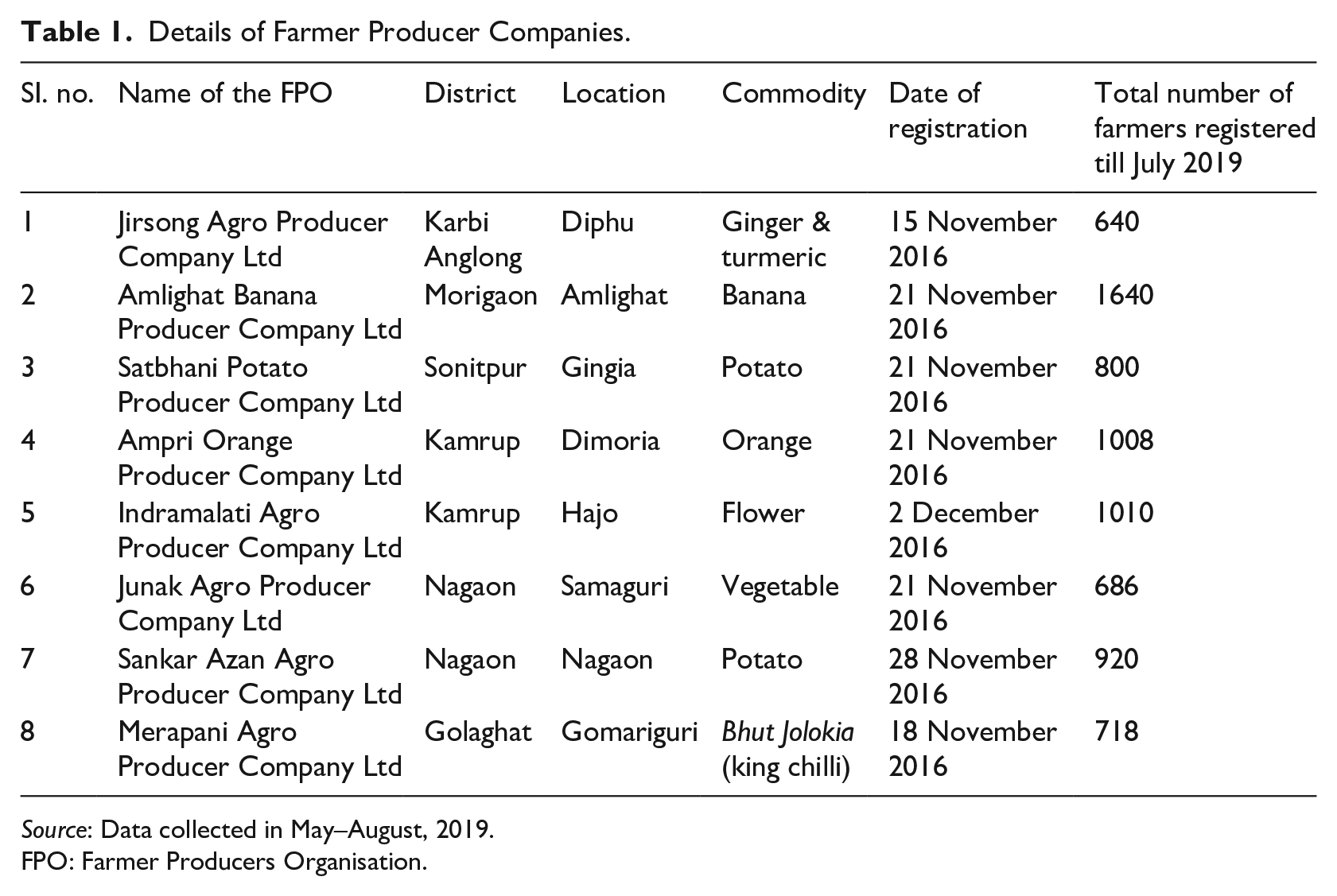
With the joint efforts of the Department of Horticulture & Food Processing, Government of Assam and Associated Tea & Agro Management Services Pvt Ltd, Assam initially came up with 10 FPCs in the year 2016. The present study is based on primary information collected from eight FPCs formed initially in the state from across the districts of Karbi Anglong, Morigaon, Sonitpur, Kamrup, Nagaon and Golaghat in Assam. The details of the FPCs are outlined in Table 1.
Details of Farmer Producer Companies.
Source: Data collected in May–August, 2019.
FPO: Farmer Producers Organisation.
A structured interview schedule has been prepared at the FPC level to elicit the primary data. A database has been developed using IT tools in SPSS for the purpose of data entry, storage and retrieval in the required format.
To compare the performances of different FPCs, a composite Performance Index has been constructed. The index identifies performance of the FPCs across different dimensions. Each dimension is composed of a set of indicators.
Selection of dimensions and indicators
To construct the performance indices of the FPCs, nine dimensions have been identified which define the ecosystem of the FPCs and are important for their sustainability: (1) organisational dynamics, (2) common infrastructure, (3) capacity building, (4) market orientation, (5) participatory business model, (6) convergence with other schemes, (7) benefit sharing, (8) management aspects of the FPC and (9) sustainability of the FPC. Post selection of the core dimensions, indicators have been identified against each dimension to measure the performances of the FPCs. In all, 33 indicators have been identified against the nine dimensions.
Organisational dynamics
The success of any FPC to a large extent depends on collective and joint action, and any FPC needs to achieve organisational dynamics to channelise the activities towards a common goal. Availability of a CEO or equivalent head on regular basis, regular meetings, participatory decision-making, maintaining records in a regular and structured manner, proper maintenance of balance sheet and financial records are some of the important aspects that determine the organisational dynamics of the FPC.
Management aspects
Management aspects are vital for any vibrant organisation and the same is true for FPCs too. Management aspects are often influenced by the policy followed by the organisation in selecting its members. Homogeneous membership, keeping in view the education qualification of its members can go a long way in building up a healthy organisation. Transparent and participatory process followed in selecting the members, therefore, becomes one of the key indicators determining the management aspects of the organisation.
Participatory business model
As FPCs are expected to achieve economies of scale through cluster mode, a viable and sustainable business model and planning is the most crucial element in ensuring economic visibility of the FPCs. A baseline survey followed by a viable annual action plan can help in visualising expected income, expenditure and profit across different business verticals and help farmers realise business opportunities, thus motivating them to work together. For this, involvement of the members in preparing the annual action plan and following it up throughout the year becomes important.
Market orientation
Endeavours towards success of any FPC are ultimately determined by the market forces and market orientation and thus play a crucial role in (un)making an FPC. In fact, linking with market for price discovery, availability of demand and price information can help the FPCs in realising their goal of collective marketing and better income. Parameters like primary processing and packaging of products, procurement of products, product and brand development, direct market linkage and future trading can define the dimensions of market orientation of the FPCs.
Benefit sharing
Sustainability in the long run depends on equitable sharing of benefits and any FPC managing it wins the trust of its members. This distributed trust can help the FPCs in ensuring greater participation and performance of its members, and thus, benefit sharing is vital for the FPCs. The FPCs, however, need to come up with accurate mechanisms for equitable sharing of benefits.
Capacity building
Building capacities in areas such as management, operational and technical skills of the members of the FPCs is instrumental in evolving, understanding and bringing about a holistic, coordinated and unified march towards a common vision. Capacity building, therefore, can be considered as one of the important dimensions of the ecosystem of an FPC.
Common infrastructure
Development of common infrastructure facilities is one of the prime objectives of FPCs to address problems of scientific storage of inputs and harvest, primary and secondary processing, packaging of harvest, housing of common equipment and implements, common market space and so on. The availability of common facility centres, storage facility and common market places can help the FPCs in achieving economies of scale and in value addition and also facilitate market of produce.
Convergence with other schemes
Government policies and programmes as well as support schemes from financial institutions like the NABARD, Small Finance Agri Consortium (SFAC) and so on are being promoted for creating an enabling environment for the FPCs and it is through dovetailing with these schemes, programmes and policies, which can augment the cause of the FPCs towards sustainable business models. Therefore, extent of convergence is one of the important indicators for success of any FPC.
Sustainability
The sustainability goal of any organisation is often defined by factors like the provision of risk mitigation and credit linkage. The sustainability dimension for the present study is hence defined by these two indicators.
The above-mentioned dimensions along with representative indicators are outlined in Table 2.
Identified dimensions and representative indicators of FPCs.

Construction of performance index
The score of 1 is assigned to each individual indicator for its presence in the dimension with respect to the FPC and 0 otherwise. The Performance Index is, therefore, composed of nine dimensions made up of 30 indicators.
The Performance Index is based on the following formula, which is the arithmetic mean of the nine dimension indices (DIs)

where PI = performance index; DI = dimension index; n = total number of dimensions; i = 1, . . ., n.
To compute the DIs, the following formula is used, where performance in each dimension is expressed as a value between 0 and 1

where DI i = dimension index of the ith dimension; Ni = total number of indicators of ith dimension; Yi = total score of indicators of ith dimension; W = weight.
Weight assignment
The weights have been assigned to different dimensions of the performance index on the basis of their importance. Garret’s Ranking Method has been used to define the ecosystem of the FPCs (Garret and Woodworth, 1996). Following the method, during the interviews conducted, the CEOs of the FPCs were asked to assign ranks for all the nine dimensions based on their importance to the FPC, and the outcomes of such ranking have been converted into score values using the following formula:

where Rij = rank given for ith dimension by jth respondent; Nj = number of dimensions ranked by jth respondent.
The percentage position of each rank is then converted into score referring to the table given by Garret and Woodworth (1996). For each dimension, the scores of individual respondents are added together and divided by the total number of respondents for whom the score is added. The mean score for the entire dimension are then arranged together to rank the dimension and to draw conclusions (Sedaghat, 2011).
For the present study, the average score of each dimension obtained from the Garret ranking technique is used as weights for each dimension in calculating the DIs.
Results and discussion
In accordance with the objectives outlined, the findings of the study are presented in two sections in the paper. The first section presents an analysis of the ecosystem of eight FPCs in the state. The second section analyses the performance of the FPCs.
Ecosystem of FPCs
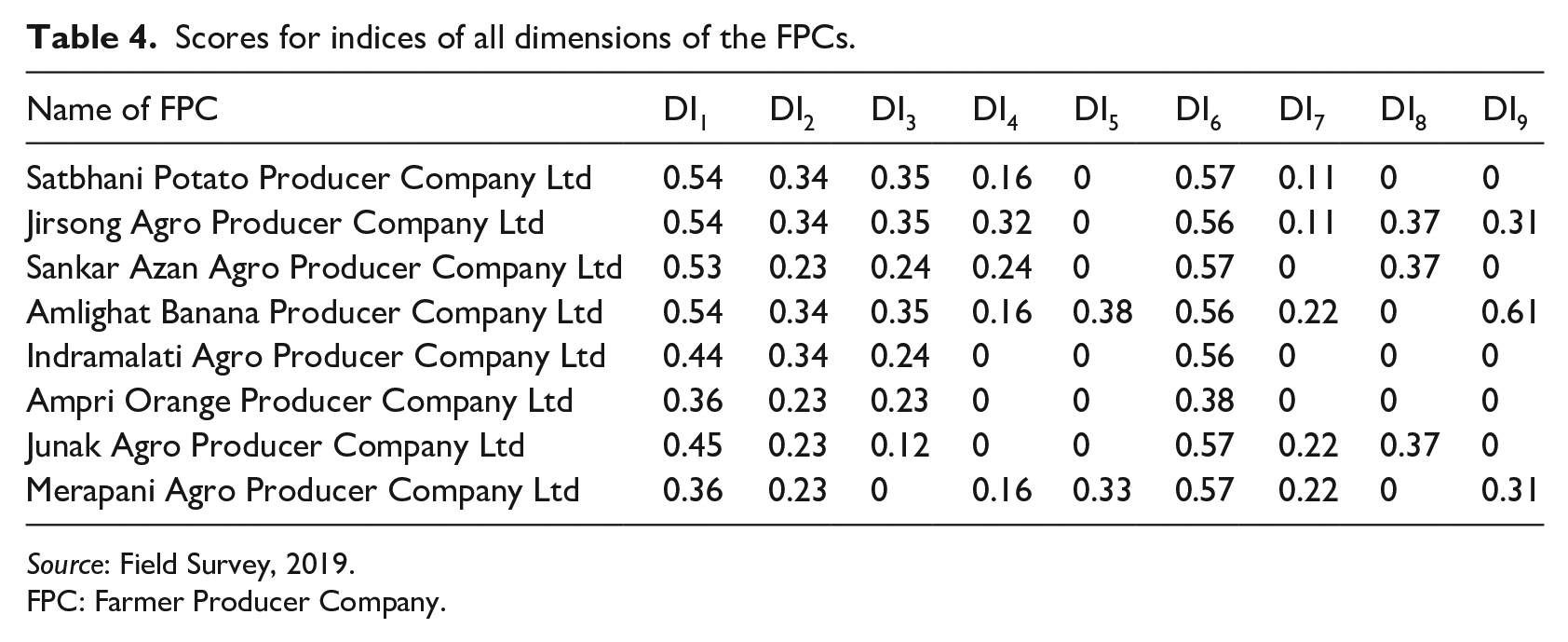
As already depicted in Table 1, the number of farmers as shareholders across the eight FPCs ranges between 640 and 1640. Among these FPCs, three FPCs are primarily into vegetable cultivation and marketing, two each in fruits and spices, respectively, and one in floriculture. In terms of organisational aspects, all the FPCs are registered in the FY 2016. All eight FPCs have a Board of Directors and a CEO to manage the day-to-day functions. The shareholders across all FPCs have bought the shares voluntarily and the FPCs are also found to have opened their bank accounts. In terms of maintenance of office records, financial records and balance sheets, the FPCs like Amri Orange Producer Company, Merapani Agro Producer Company, Indramalati Agro Producer Company and Junak Agro Producer Company Ltd are found lacking. On management aspects, it is found that in terms of resource mobilisation, technology management and marketing management, the FPCs are yet to take the right set of interventions. However, the FPCs are found to be prudent in transparent and participatory selection of their members. It is perhaps because of the low education attainment of the members that the FPCs have failed in managerial aspects necessitating more handholding and capacity building for better managerial practices. With respect to business planning and baseline survey, there is a need for greater participation of the members as most of the members of the FPCs are not aware of the business plans and baseline survey information. In terms of market orientation, it is found that FPCs like Jirsong Agro Producer Company Ltd and Sankar Azan Agro Producer Company Ltd have gone for primary processing, branding as well as packaging of products, while Satbhani Potato Producer Company Ltd, Amlighat Banana Producer Company Ltd and Merapani Agro Producer Company Ltd have only gone for procurement of products and basic primary processing. Three FPCs, namely, Indramalati Agro Producer Company Ltd, Amri Orange Producer Company Ltd and Junak Agro Producer Company Ltd have failed to carry out any market oriented activities for their FPCs. Furthermore, for all FPCs, future trading, product development and direct market linkage with external buyers and export are still a far cry. In case of usufruct sharing, barring Amlighat Banana Producer Company Ltd and Merapani Agro Producer Company Ltd, the other FPCs have so far not taken steps towards sharing of benefits. With regard to capacity building aspects of the Board of Directors and CEOs, it is encouraging to find that that they have received basic training on operational and management aspects of the FPCs. However, there is a need to percolate the capacity building initiatives to the members at large. In terms of common infrastructure, it is seen that three FPCs, namely, Amlighat Banana Producer Company Ltd, Junak Agro Producer Company Ltd and Merapani Agro Producer Company Ltd have CFCs and common storage facilities, whereas Jirsong Agro Producer Company Ltd and Satbhani Potato Producer Company Ltd have only common storage facility. The rest of the FPCs do not have any common infrastructure. None of the FPCs are found to have common market facility, which is deterrent to enabling market access. In terms of convergence of schemes, except Jirsong Agro Producer Company Ltd, Sankar Azan Agro Producer Company Ltd and Junak Agro Producer Company Ltd, the others have failed to dovetail with any government programmes and schemes. Furthermore, except three FPCs, namely, Jirsong Agro Producer Company Ltd, Amlighat Banana Producer Company Ltd and Merapani Agro Producer Company Ltd, the rest of the FPCs have failed to materialise credit linkage with Banks and other financial institutions. Almost no FPC, except Amlighat Banana Producer Company Ltd, has any risk mitigation strategy for coping with vulnerabilities and ensuring sustainability.
Performance of FPCs
The results of the ranking of the dimensions are presented in Table 3. The results demonstrate that among the nine dimensions, sustainability of the FPC (D9) is of foremost importance followed by management aspects of the FPC (D2), capacity building (D6), market orientation (D4), organisational dynamics (D1), participatory business model (D3), convergence with other schemes (D8), benefit sharing (D5) and common infrastructure (D7) respectively.
Garret ranking of the dimensions.
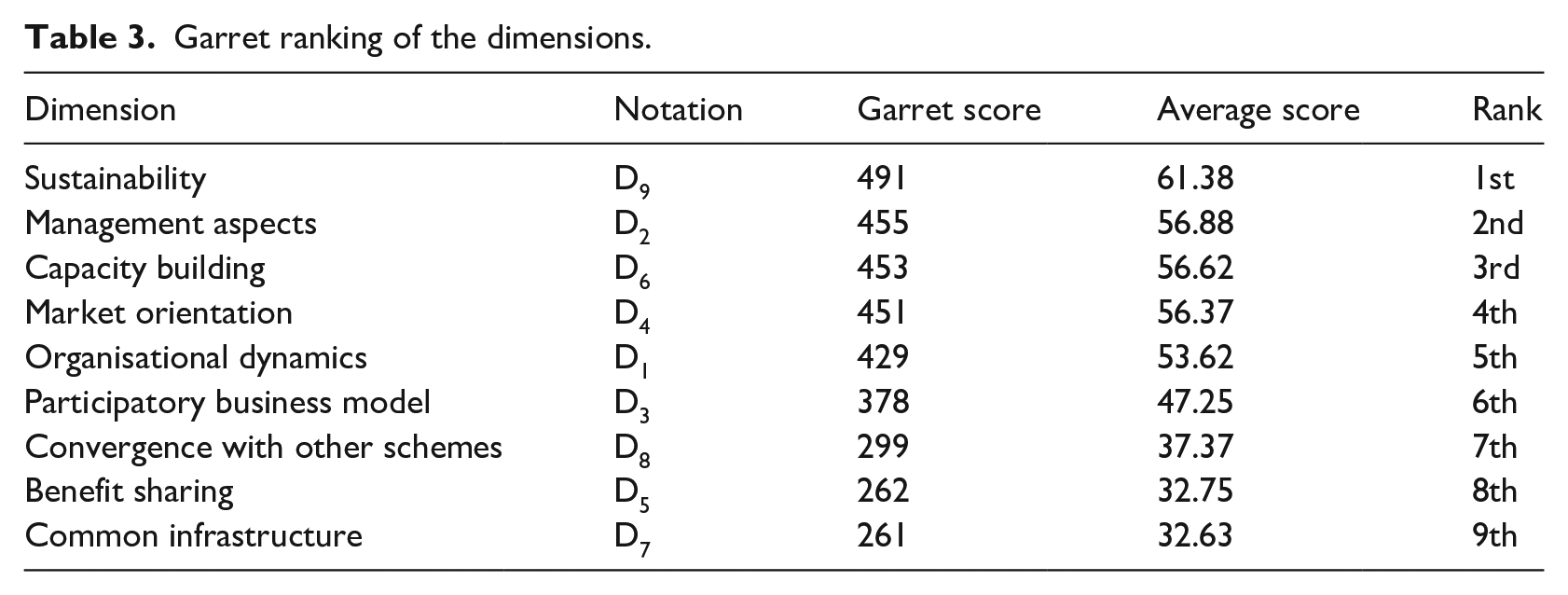
Here, the average Garret Score of the dimension divided by 100 is taken as the weight to construct the DIs. The scores for respective indices of each dimension of the FPCs are presented in Table 4.
Scores for indices of all dimensions of the FPCs.
Source: Field Survey, 2019.
FPC: Farmer Producer Company.
Post calculation of the DIs for all nine dimensions of the FPCs, the Performance Index of the FPCs has been constructed using the following formula

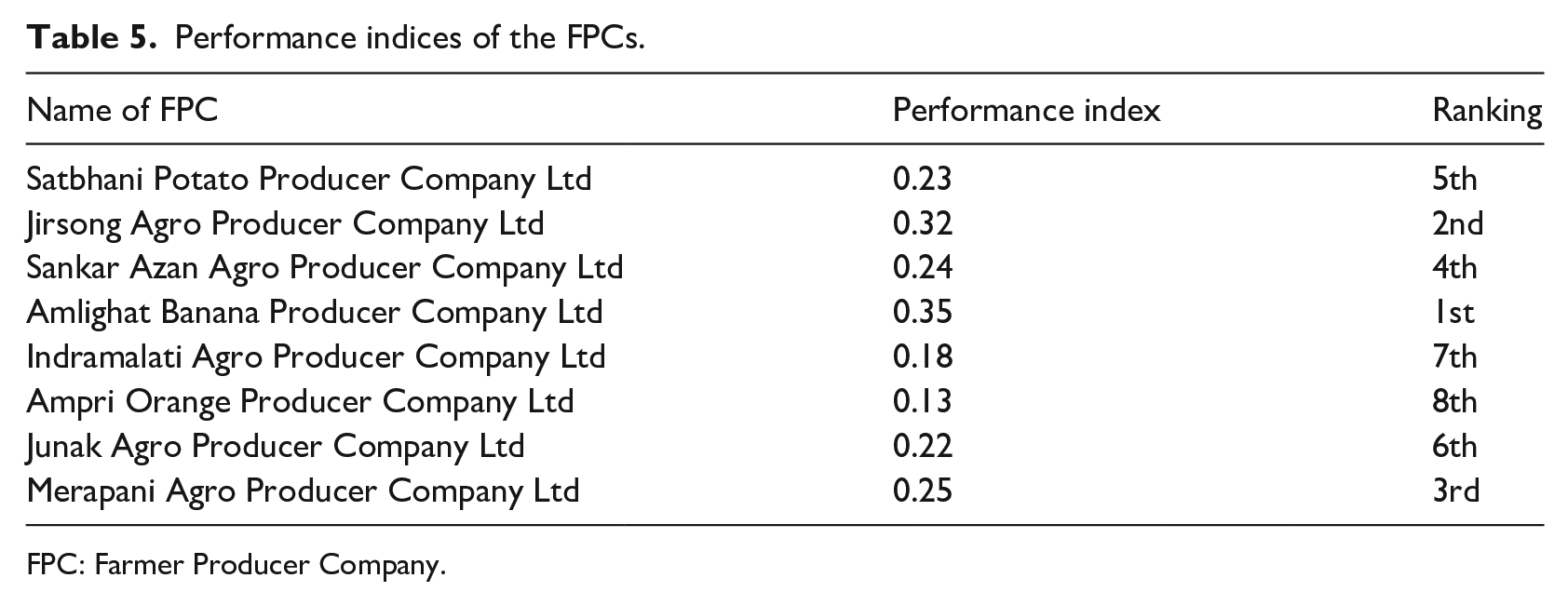
The scores of performance indices of the different FPCs are presented in Table 5 along with the respective rankings.
Performance indices of the FPCs.
FPC: Farmer Producer Company.
Table 5 depicts that it is the Amlighat Banana Producer Company Ltd, which ranks first in terms of the Performance Index with an index value of 0.35 followed by Jirsong Agro Producer Company Ltd with an index value of 0.32, Merapani Agro Producer Company Ltd with an index value of 0.25, Sankar Azan Agro Producer Company Ltd with an index value of 0.24, Satbhani Potato Producer Company Ltd with an index value of 0.23, Junak Agro Producer Company Ltd with an index value of 0.22, Indramalati Agro Producer Company Ltd with an index value of 0.18 and Ampri Orange Producer Company Ltd with an index value of 0.13.
FPCs like the Amlighat Banana Producer Company Ltd, Jirsong Agro Producer Company Ltd, Merapani Agro Producer Company Ltd and Sankar Azan Agro Producer Company Ltd are found to have better index values in terms of the Performance Index. These FPCs have better organisational dynamics in terms of having a regular CEO, organising regular meetings and making the process of decision a participatory one by involving all members of the FPC. Besides, these FPCs also are found to maintain records in continuum including financial records. The FPCs are working on participatory business models giving equal weightage on capacity building of its members. With better infrastructure facilities and strong market linkages, the two FPCs score more in the Performance Index. However, FPCs like the Satbhani Potato Producer Company Ltd, Junak Agro Producer Company Ltd, Indramalati Agro Producer Company Ltd and Ampri Orange Producer Company Ltd score low on the Performance Index. These FPCs are found to have low scores in market orientation, benefit sharing, common infrastructure and convergence with other schemes. The FPCs are found to be lacking in having better mechanisms for equitable sharing of benefits. The FPCs also do not have adequate common infrastructural facilities. They are yet to take steps for having convergence and sustainability policies.
Conclusion
Assessment of the performance through PI reveals that the index scores for all FPCs are more tilted towards lower values, which entail strengthening of the FPCs for ensuring sustainability in the long run. Among the FPCs, the better-off FPCs are performing in terms of organisational dynamics, participatory business model, marketing orientation and capacity building, whereas all the FPCs are found lagging in management aspects. Barring two FPCs, the other FPCs are yet to go in for benefit sharing. Majority of the FPCs have failed in convergence and sustainability front.
In this light of the foregoing discussion, the performance measure used in the paper can be helpful for both internal and external assessment of the FPCs, which can help them in coming up with outcome and sustainability oriented efforts. In the light of the empirical evidences and findings of the study, there is, therefore, a need to stress upon providing handholding services to the existing FPCs for ensuring sustainability, upscaling and for economic and social empowerment of the shareholder producers of the FPCs. Here underlies the role of policy makers and support institutions to ensure the facilitation of necessary support in terms of infrastructure, linkage promotion, market facilitation and capacity building. If the FPCs can be promoted in a sustainable manner ensuring the performance parameters, it would go a long way in realising equitable rural growth in agriculture productivity and export.
Footnotes
Funding
The author(s) received no financial support for the research, authorship and/or publication of this article.
