




Abstract
The tourism industry sustains the economies of many nations across the globe through contributing to the Gross Domestic Products (GDP); creation of employment and infrastructure development. However, its sustainability is vulnerable to various temporal and spatial environmental, socio-economic and political events. In the Zimbabwe case, the politico-economic crises of the 2000s and the COVID-19 pandemic have variedly impacted on the prevalence of tourism with the actors (such as employees, tourists and recreational facility owners) involved in this industry having been seriously impacted. Using the precarity conceptual framework, this article critically analyses the impact of the politico-economic crises induced by the Fast Track Land Reform Programme of the early 2000s and the COVID-19 pandemic on the actors involved in tourism. Information regarding the impact of the political crises and COVID-19 pandemic on tourism in Kariba town is missing in the literature, yet Kariba is one of the most popular tourist destinations in Zimbabwe and Southern Africa. The article discusses the precarity of these tourism actors in the context of the politico-economic crises as well as the COVID-19 pandemic. We define ‘precarity’ as a condition of vulnerability and uncertainty. Our results indicate that for employees, these factors have resulted in uncertainty in the tourism business with some shutting down and others scaling down their operations resulting in redundancy and vulnerability of the workers. For tourists, the successive lockdowns and surge in COVID-19 cases in Zimbabwe resulted in (re)booking and (re)cancellation of bookings; the politico-economic crises resulted in fear among the potential clients and a drop in the number of international tourists. The recreational and accommodation service operators have had the challenge of making food (and other resources) orders for trips that are eventually cancelled due to the surge in the COVID-19 cases. The article draws from data gathered in 2021 through face-to-face interviews with different stakeholders in the tourism industry including employees, hotel and boat owners, Zimbabwe Tourism Authority officials and local politicians in Kariba resort town.
Introduction
Using the precarity conceptual framework, this article considers the precarity of different actors involved in the tourism industry in Kariba town, mainly in the context of the Zimbabwe politico-economic crises and COVID-19. The article is a historical analysis of the ways in which the politico-economic challenges and COVID-19 have generated the precarity of different actors in the tourism industry. These actors involve employees, tourism business operators (hoteliers, lodge and boat owners) and tourists. We define ‘precarity’ as a condition of vulnerability and uncertainty.
The politico-economic crises referred to in this article were, arguably, an effect of the Fast Track Land Reform Programme; and they involve the political violence of the 2000s directed towards farmers of foreign origin (white farmers) (Helliker et al., 2021b; Ndakaripa, 2021), as well as the supporters of the newly created opposition party Movement for Democratic change (MDC) by Zimbabwe African National Union – Patriotic Front (ZANU PF) supporters (war veterans and youths). This Programme, that dramatically co-opted the farm occupations since 1998, redistributed land from white-owned farms and estates, as well as state lands, to more than 150,000 farmers under two models, A1 and A2. The A1 model allocated small plots for growing crops and grazing land to landless and poor farmers, while the A2 model allocated farms to new black commercial farmers who had the skills and resources to farm profitably, reinvest and raise agricultural productivity (Mkodzongi and Lawrence, 2019). The number of large capitalist farms, mainly White-owned, fell by around 75%, while there was a 16% drop in the number of large foreign and domestically owned agro-estates (Moyo, 2011). The fervour surrounding these dramatic events and their explanation was vastly heightened, as well as being framed by, a massively debilitating economic crisis. This was marked by a world record hyperinflation, a vast shrinkage in GDP, high unemployment rates, food shortages, currency devaluation, high inflation rates and corruption (Cliffe et al., 2011; Ndakaripa, 2021).
The ZANU PF government believes that economic crises were to a larger extent engendered by the economic sanctions imposed on Zimbabwe in the early 2000s by the United States and European Union following the land reform exercise which targeted white farmers. Between 2000 and 2003, Zimbabwe received a set of sanctions mainly from the United States, the United Kingdom, Australia, Canada and the European Union (Chingono, 2010). The country has now been under sanctions for two decades (Ndakaripa, 2021) and the country remains in crisis (Helliker et al., 2021a). Beyond the land reform, it has also been stated that these aforementioned powers-imposed sanctions on Zimbabwe because of other reasons such as widespread reports of political and election violence, alleged human rights abuses, violation of property ownership rights and disrespect for rule of law (see Chingono, 2010: 066). Sanctions also encountered with the droughts experienced during the 2001–2002 season and corruption among the political leaders in Zimbabwe to worsen the economic situation in Zimbabwe. These economic problems were more pronounced before the Government of National Unity (GNU) in the year 2008 and post-GNU from 2013 onwards. During these periods, the tourism industry in Zimbabwe was significantly impacted and there was a sharp decline in tourists arrival (Chibaya and Matura, 2018). The chief causes of the decline in tourism included violence and political instability that emanated from the Fast Track Land Reform Programme which fuelled negative international publicity about Zimbabwe; shortage of basic commodities; harsh macro-economic environment; shortages of foreign currency; erratic fuel supplies; cholera outbreaks; and the 2008 global financial crises (Chibaya and Matura, 2018; Zhou, 2014). The other cause was the wanton destruction of the wildlife conservancies some of which housed the most popular tourist attractions and closure of accommodation units (Chibaya and Matura, 2018; Wolmer, 2004). During 2009–2013, there was temporal economic stability. Although the status of tourism improved with the help of the marketing initiatives from the Zimbabwe Tourism Authority (ZTA) (Karambakuwa et al., 2011), it did not return to its 1990s booming levels.
During the post-GNU era, studies have documented the various economic crises that have befallen Zimbabwe. Like the pre-GNU crises, the post-GNU crises is characterized by currency devaluation, cash shortages, unavailability of foreign currency, unemployment and so on (see Gukurume, 2018; Matanzima, 2021; Matanzima and Saidi, 2020). The nexus between politico-economic crises and tourism in Zimbabwe has received fair attention in recent scholarship (Kabote et al., 2014; Karambakuwa et al., 2011; Mutana et al., 2013; Zhou, 2014). While some scholars have focussed on the impact of the politico-economic crises on tourism (Kabote et al., 2014; Zhou, 2014); others have shown the strategies that have been used to revive the tourism industry in different quarters including efforts made by ZTA (Karambakuwa et al., 2011). Currently, there are no studies that discuss the impact of these politico-economic crises on tourism specifically in Kariba town. An existing study on tourism in Kariba considers seriously the interrelationship between climate change and tourism (Dube and Nhamo, 2020). This previous paper, however, does not discuss the nexus between tourism, COVID-19 and politic-economic crises. Therefore, this article is an important contribution to our understanding of tourism in Kariba in general, and Zimbabwe in particular.
The COVID- 19 pandemic’s emergence has perpetuated and worsened the crippled state of tourism in Zimbabwe. Since the outbreak of COVID-19, social, economic and personal lives have been plagued by uncertainty (and precarity), and the impact on the tourism and hospitality industry is particularly evident. The unfolding COVID-19 crisis has caused a major fall in tourism activity around the world. All activities related to tourism have been paralyzed (Marco-Lajara et al., 2022). For instance, recreational activities, hotel and lodge renting as well as food, beverages and restaurant services have been severely impacted by the COVID-19- related lockdowns, travel restrictions and border closures across the globe (Dube et al., 2021). Tourism activities involving direct contact between consumers and service providers have been those most adversely impacted by restrictions imposed on movement and social distancing (Rogerson and Rogerson, 2021).
International tourism, which was thriving in many regions (such as in Latin America) in the period before 2020, was severely impacted by the significant drop in the number of international tourists across the globe and the closure of international borders (Mulder, 2020). Domestic tourism was also adversely affected in many countries because of intercity travel bans and the closure of many tourism sites and attractions, such as museums, beaches and natural parks (Mulder, 2020).
The literature on the intersections between COVID-19 and tourism is burgeoning across the globe. Due to limited space, we do not engage in a sustained review of this literature, but rather we state different themes discussed in the previous literature, through citing examples of these studies. Different scholars have focussed on COVID-19 and different themes within the broader field of tourism. Through providing empirical cases studies, a large corpus of studies has explicitly and implicitly documented the impact of COVID-19 on tourism across the globe (see, for instance, Baum et al., 2020; Filimonau et al., 2020; Yan et al., 2021; Yang et al., 2020). Some have focussed on the impact of COVID-19 on GDP of different countries; some scholars have examined the plight of workers in tourism during the pandemic (Baum et al., 2020; Filimonau et al., 2020); others have focussed on the image of certain tourist destinations located in COVID-19 hotspot and tourists perceptions regarding certain destinations; the literature is also emerging that is focussing on prospects for tourism recovery in the post-COVID-19 world (Assaf and Scuderi, 2020; McCartney et al., 2021, Nhamo et al., 2020), another important theme that has also been written about is Vaccines and tourism (Williams et al., 2022), among other themes. More empirically rich case study assessments of the intersections between COVID-19 and tourism focus on other parts of the world (such as Asia, Latin America and Europe) outside Sub-Saharan Africa (Rogerson and Rogerson, 2021: 1029). Henceforth, more empirical case studies (focussing on particular tourism destinations and attractions) are needed within the sub-Saharan region, let alone Zimbabwe, that explicitly and implicitly discusses the entanglement between COVID-19 and tourism.
The literature on COVID-19 and tourism in Zimbabwe is growing and focuses on different important aspects (Chigora and Katsande, 2021; Makoni and Tichaawa, 2021; Matura, 2021; Ncube et al., 2021; Woyo, 2021). For example, Makoni and Tichaawa explore the impacts of COVID-19 on the informal sector businesses/ operations within the tourism industry. Key issues they highlight are impacts on the supply of basic commodities and household income of the traders; and traders’ survival strategies during the course of the national lockdown and implications on the way forward (Makoni and Tichaawa, 2021). Other studies have focussed on measures taken, by different actors, to promote domestic tourism during and after the COVD-19 pandemic in Zimbabwe (Matura, 2021; Woyo 2021; see also Ncube et al., 2021). This is particularly important in situations where border closures block international tourism. The main identified strategies utilized to promote domestic tourism in Zimbabwe during and post-COVID-19 pandemic were making tourism products affordable and accessible, improving the income levels of Zimbabweans, developing appealing packages, and programmes; tapping into the visiting friends and relatives market, embarking on aggressive marketing campaigns, introducing incentive travel particularly for civil servants, and a continued commitment to the observance of all COVID-19 prevention, and treatment guidelines (Matura, 2021: 85). None of the studies trace the precarity of tourism actors before and after COVID-19.
Against this background, this article demonstrates the precarity of different actors in the tourism industry. It shows how particular politico-economic crises and COVID-19 events engendered the precariousness of these actors. The politico-economic crises and COVID-19 engendered entangled precarities for different actors both temporally and spatially.
This article argues that though the COVID-19 pandemic has a severe impact on the operating and working conditions of the actors in the tourism industry, the politico- economic crises have also impacted on these actors. The article starts by discussing how the precarity concept is applied in this study. It will then describe the tools used for data collection and further discusses the findings.
The precarity concept and the tourism field
The term précarité was coined by a number of French sociologists from the 1960s onwards, not least Pierre Bourdieu, to describe contingent or casual employment (Adams and Darby, 2020). This condition of employment insecurity emerged from the dual processes of neoliberalism and globalization (Wilmsen and Adjartey, 2020). The precise combination of characteristics that allow forms of work or employment conditions to be classified as precarious have been shown by such scholars as Standing (2011) and Kalleberg (2009). What is common across their classificatory schemes, however, are notions of economic risk, unpredictability and uncertainty over continued employment (Adams and Darby, 2020: 924).
While precarity has been applied mainly to the labour market, there is a growing view among sociologists that limiting the term to specific forms of employment relationships is overly restrictive. For example, during the 1980s and 1990s, précarité in France became widely conceived both in academic and political discourse as extending beyond the sphere of work and into the general precariousness of life (Adams and Darby, 2020; see also Butler, 2013). The precarity concept has further been applied in different fields of study such as development-induced displacement and resettlement (Matanzima, 2021; Wilmsen and Adjartey, 2020), urban and rural livelihoods (Gukurume, 2018; Nhiwatiwa and Matanzima, 2022) and (im)mobility and migration (Banki, 2013; Martin et al., 2019). Constituted by extreme flexibility, impermanence and insecurity, it is seen to be the cause of a series of psychosocial pathologies in contemporary society, such as heightened anxiety about one’s future (Dines, 2018). As Andrea Muehlebach notes, precariousness and associated neologisms such as ‘precarity’ and ‘precarisation’ have become shorthand for the ‘multiple forms of nightmarish dispossession and injury that our age entails’ (Muehlebach, 2013: 298).
Although precarity defines the insecurity and vulnerability of workers, it is also a site of potential mobilization whereby the precarious demand an end to their precarity (Wilmsen and Adjartey, 2020). Thus, in some instances, the Precariat are not mere recipients of their precarious condition. The ‘precarious resistance’ concept later emerged to deepen our understanding of resistance and worker’s responses in the context of precarious work (Hlatshwayo, 2019). Lewchuk and Dassinger (2016: 119) elaborate further and argue that ‘precarious resistance is the individualized, informal and under-the-radar strategies that workers employ to shape workplace outcomes, and how these strategies might translate into broader collective action’. Henceforth, there is the potential to overcome work exploitation (Le et al., 2015). This article will also show some of the forms of resistance and resilience that the actors in the tourism industry engage in to evade some of the forces that render them precarious. For instance, tourism business operators have formed associations which are platforms to discuss their grievances and use these as mouthpiece to demand an end to their precarious operations. However, different forms of precarious resistance are often unsuccessful largely because the precarious are hardly unionized (Martin et al., 2019). As Lewchuk and Dassinger argued ‘for workers in precarious employment, the fragmentation of employment, and the lack of an ongoing relationship with a single group of workers from one job to the next, makes it difficult for them to resist through unions or even informal groups of workers’. This is particularly the case with workers in the tourism industry (and tourists in general) at Kariba; their high levels of precarity have undermined their potential for solidarity and collective action, as shown below.
There is a fair amount of tourism literature that critically engages with and offers revisionist perceptions of the concept of precarity (see Cañada, 2018; Dines, 2018). For instance, Dines (2018) using the Naples case study has critically engaged with the idea of ‘precariousness’ to make sense of the complex relationship between tourism, heritage and everyday social life in central Naples. Ultimately, he demonstrates the contra conventional formulations of precariousness that elicits both anxiety and emancipatory release in making sense of the allure and repulsion that the Naples historic centre exerts in tourist encounters with the city. In doing so, he diverts from dogmatic utilizations of the precarity concept to elucidate negative situations, by pointing to the opportunities that precarity can offer in the everyday life of people. Based on Dines’s assumptions, this article while predominantly unearthing the negative experiences of actors in tourism over time, it will also show how the precariousness of these actors protected them from death and torture during the politico-economic crises as well as contracting the coronavirus. Their operating and working uncertainties while bad, they somewhat protected them from contracting the virus as they were confined in their homes most of the times.
Furthermore, the precarity concept has also been applied within the tourism field to understand the precarious working conditions of workers (Baum et al., 2020; Cañada, 2018; Edralin, 2019; Lee et al., 2015; Shircliff, 2020). For instance, Lee et al. writing specifically for Seychelles, point out that the international tourism industry in the country – even in a situation of high or growing demand – creates structurally driven precarity for tourism workers who are predominantly low-paid, low-skilled and increasingly recruited from overseas (Lee et al., 2015: 194). Cañada’s (2018) research highlights a marked deterioration in hotel maids’ working conditions in recent years, most notably involving (a) a reduction in their salary and the loss of professional categories, (b) work overload, (c) greater uncertainty in the duration of employment, timetables and work schedule, (d) deprofessionalization, (e) segmentation, division and an increase in competition between hotel staff, (f) the accentuation of health problems and (g) a decrease in the capacity of representation and the defence of workers’ collective interests. What is common within these studies is their reporting of very poor working conditions of workers in the tourism sectors of different states.
However, this study’s analyses of precariousness extends beyond the experiences precarities of workers only, to include tourists (both international and domestic) as well as tourism business operators’. It does so through the provision of an empirically rich Kariba case study. So far, there is no literature that has applied the precarious concept to understand the historical experiences of tourism actors within the contexts of politico-economic crises and COVID-19 in Zimbabwe. We discuss different and complex forms or entangled precarities that different actors have experienced over space and time. We show how COVID-19 pandemic serves to perpetuate and worsen the precarity of an already precarious population. By so doing, it correlates with the study by Baum et al. (2020) on COVID-19 and tourism that questions whether the situations faced by hospitality workers during the pandemic are different from the precarious lives they normally lead or just a (loud) amplification of the ‘normal’. This is a very crucial argument that must be reiterated largely because in most of the developing world the severity of COVID-19 pandemic is gaining much attention and the politico-economic conditions rendering precarious tourism are increasingly becoming overlooked.
The literature on post-COVID-19 tourism recovery is burgeoning rapidly and may surpass the available literature on the precariousness of tourism in the era before the pandemic. This may lead governments and policy planners into focussing on the damage caused by the pandemic, and not the damage that has already been caused by the politico-economic and environmental factors within the developing world. There is a need to holistically study tourism from a historical point of view and incorporate all the factors impacting different actors, for better policy formulation.
Study site and methodology
Qualitative research for this paper was conducted in Kariba resort town. Kariba resort town lies along the Lake Kariba, north-western parts of Zimbabwe. Kariba is home to diverse ethnic groups employed in different economic sectors (such as tourism, conservation, fishing and electricity generation) that have been concentrated around the Lake Kariba, since the late 1950s when it was created. The population of Kariba resort town is around 26,000. The Lake Kariba is 223 km long and 40 km wide. The Kariba Dam is one of the famous tourist attractions in Zimbabwe. Numerous recreational activities occur in and around Lake Kariba; and these activities include boat cruising, game viewing, parasailing, fishing, speed boating, hunting and sport fishing. Wildlife living in and around Lake Kariba also enables game drives. Kariba town is home to such animals as elephants, lions, buffaloes, hippos, crocodiles, different bird species, leopards, baboons, zebras and so on.
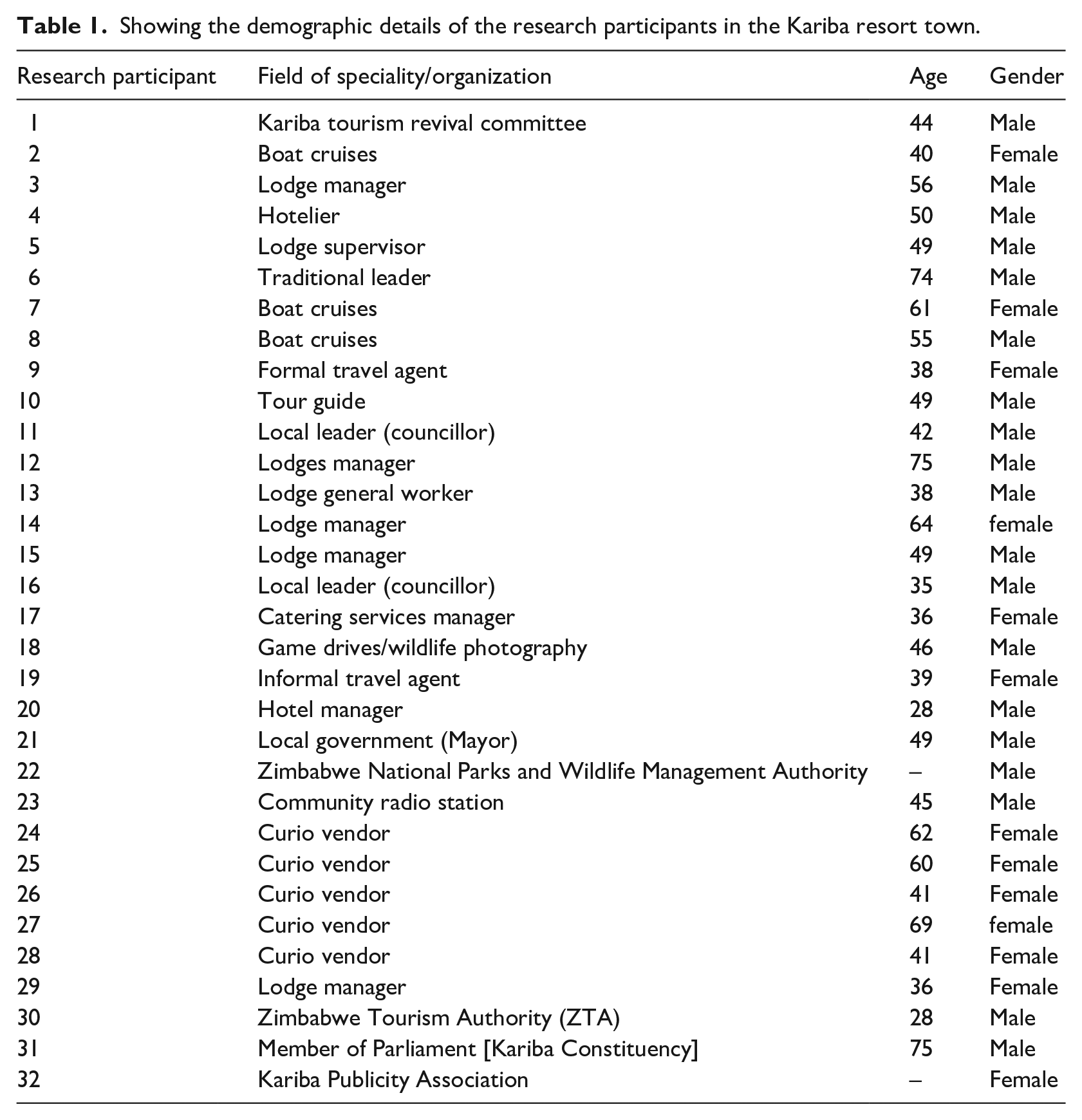
Semi-structured interviews were conducted with local politicians, traditional leaders and key stakeholders within the tourism industry. These research participants come from different divisions within the tourism industry and the politicians hold different local-level political posts (see Table 1). Employees, such as general managers and workers, in hotels and lodges were directly asked to narrate their working experiences during the politico-economic crises and the pandemic. Hotel, lodge and boat owners (operators) narrated their own experiences together with those of the tourists (both international and domestic). Much information was gathered at a time when Kariba was regarded as a COVID-19 hotspot, between June to August 2021, when tourists were barred from visiting Kariba. Thus, we did not have the chance to interview tourists. Our analyses of the precariousness of the tourists both before and during COVID-19 draw from the information provided by the tourism operators who had direct contact with the tourists and managed their bookings. We believe that the information provided by the operators regarding the experiences of the tourists is authentic as they had direct contact with each other. In addition, the general experiences of tourists in Zimbabwe have also been reported in secondary literature in Zimbabwe, and this study makes reference to this literature. Other people interviewed, such as politicians and traditional leaders, narrated the general overview and performance of tourism in Kariba resort town.
Showing the demographic details of the research participants in the Kariba resort town.
All COVID-19 general safety measures were followed during the research. Both the researchers and research participants masked up and maintained social distance. On arrival at an informant’s home or office researchers sanitized their hands. Both researchers were double vaccinated during the time of the research.
Consent was sought from each participant through a mobile phone or in person; followed by an appointment for the interview. The average duration of interviews was 60–90 minutes. Interviews were conducted in people’s homes or in their offices. Shona and English languages were used during the interview sessions. English was used because some operators are of foreign origin and they are unable to speak Shona, the local language. The research participants were asked to choose sites that were convenient to them for conducting the interview sessions. Interview sessions were recorded. Data obtained were transcribed and thematically analyzed.
Literature on tourism, politico-economic crises since the 2000s and COVID-19, in Africa and Zimbabwe in particular, was reviewed. Such words as ‘tourism’, ‘politics’, economic crises’, ‘fast track land reform’, ‘COVID-19’ and ‘Zimbabwe’ were entered in such search engines as Google scholar and SCOPUS to find relevant literature to the study.
Findings and discussion
For coherence’s sake, we commence by discussing the impact of the politico-economic crises of the 2000s, followed by the impact of COVID-19 on the actors in the tourism industry. However, apart from coherence we also aim to show that COVID-19 is not the only factor that has hampered tourism in Zimbabwe in general, and Kariba in particular, but rather it has worsened the precarity of tourism and different tourism stakeholders which was initially engendered by the Fast Track Land Reform Programme two decades ago.
Politico-economic crises and the vulnerability of actors in the tourism industry
The politico-economic turmoil that has characterized Zimbabwe society since the early 2000s has significantly impacted Kariba local tourism. Although these problems have been occurring at macro (i.e.) national level, their impacts have been significantly pronounced at micro-level mainly in resort towns such as Kariba. Prior to the year 2000, many tourism stakeholders in Kariba state that tourism was thriving, with it providing jobs for many local youths (and other economically active groups). The decimation of tourism in Kariba was observable at the beginning of the 21st century. In further elaborating this observation, the Kariba District Member of Parliament (MP)
1
stated that, Prior to the year 2000, Kariba was a playground for White people, mostly Zimbabwean but with significant numbers of foreign tourists, mainly South Africans. With the collapse of our economy, disposable incomes were eroded and at the time of hyperinflation, they became virtually non-existent. Consequently, local tourism collapsed resulting in many tourism operations becoming no longer viable. Hotels and many houseboats fell into disrepair, most hotels and many houseboats have since ceased to operate. Sadly, and coincidentally, the wildlife populations in the surrounding areas have been decimated. It is undeniable that wildlife is a major attraction for tourism and the reduced attraction due to the reduced numbers has exacerbated the decline in tourism.
The MP summarizes the status of tourism in Kariba since the year 2000. The dwindling in the number of ‘white’ [foreigners] visitors in Kariba was a negative effect of the violence that characterized the implementation of the Fast Track Land Reform Programme in the early 2000s (Helliker et al., 2021a). As Chibaya and Matura (2018) write, land reform-induced violence contributed to a significant decline in international tourist arrivals in Zimbabwe as the country was regarded as an unsafe destination across the globe. During the height of the crisis, international visitors declined sharply and hotels reported a one-digit occupancy figure triggering a ‘tourism crisis’ (Zhou, 2014). According to the ZTA report (cited by Chibaya and Matura, 2018), between 1980 and 1999 when a gradual land reform policy regime was implemented, Zimbabwe’s tourist arrivals grew at an average rate of 17, 5% and tourism receipts increased by an average annual growth rate of 18% in US$ terms. After the land reform in 2002, there was an 8% decline in tourist arrivals, while revenue receipted an 8% drop as compared to 2001. One boat owner reiterated: In the early 2000s, our tourism industry in Zimbabwe was negatively affected by the political violence. The economic and political landscape during the fast-track land reform programme was very rough. Violence was too much in the 2000s. Tourists feared to visit Zimbabwe.
The land reform- induced violence resulted in an international outcry of the fate of the ‘whites’ in Zimbabwe. Zimbabwe was labelled a racist nation, and this resulted in most ‘white’ tourists opting to visit other tourism destinations in Southern Africa such countries as South Africa and Zambia. The political turmoil at the time rendered the tourists precarious, especially those of foreign origin with ‘white’ skin. Fear of being harassed and tormented by the ZANU PF youths and war veterans was entrenched within the foreigners/tourists minds. ZANU PF youths and war veterans often created military-style bases in different parts of the country. In Kariba town, a base was also created overseen by a ZANU PF youth member from Karoi known as Black Jesus. Supporters of the newly created opposition party Movement for Democratic Change were also tormented across the country. Workers in the tourism industry were associated with the MDC as they were employed in ‘white-owned’ and dominated tourism businesses. Whites were believed to be the sponsors of the MDC. Therefore, employees in the tourism industry became precarious at the time, as they were uncertain about their future in the post-land reform programme era. This was largely because most of their employers were going into exile in the neighbouring countries.
The political strife in the country had a domino effect; it further impacted the Zimbabwean economy, which had a bearing on the tourism industry. Towards the mid-2000s, the European Union, the United Kingdom and the United States imposed economic sanctions (and travel bans on certain politicians) on Zimbabwe. Consequently, serious economic crises characterized by high unemployment rates, food shortages, high inflation rates, cash shortages, currency devaluation became the order of the day. The noticeable significant drop in the number of tourists visiting Kariba resulted in the closure of numerous hotels and the destruction of many houseboats that were lying idle. Examples of the hotels that closed include Kariba Breezes hotel and Kariba Lakeview Inn Hotels, including other several individually owned lodges. Owners of these businesses were negatively impacted. Some of the boat owners were whites – who owned farms – who then moved to neighbouring countries such as South Africa and Zambia to expand their businesses. As the MP stated, most of their boats became idle and got dilapidated over time.
The prevailing economic crises since the early 2000s have engendered serious logistical challenges for the players in the tourism industry, particularly the international and domestic tourists. Most of our research participants have reiterated that logistical challenges are seriously hampering tourism. First, the absence of reliable airlines that transport tourists from other tourist destinations such as Victoria Falls and the Harare International airport to Kariba town airport is a major problem. During the time of this study, there was only one charter flight from Harare International Airport to Kariba that was astronomically priced. According to our informants, the cost of a ‘one-way’ ticket was USD 240 and that of a ‘return’ ticket was USD 380 per individual. Such prices forcedm tourists to opt for road transport instead. Most tourists travel as families and they may face problems in covering flight costs of all the family members. In the case of the domestic tourists most of whom receive their salaries in ZWL$ (Zimbabwean currency), they cannot afford to obtain USD required for purchasing chartered flights. ZWL$ to USD exchange rates are exorbitant. Second, the dilapidated road networks in Zimbabwe are also a challenge. Narrating these challenges, one female boat owner indicated that, We are affected by logistical challenges. We have no air transport, there are only chartered flights that are expensive. Domestic tourists do not afford these expensive charted flights. Clients get tired of driving on the pot holed roads.
On the same note, another female interviewee stated that Also our roads from Harare to Kariba are now too bad hey. The roads of Zimbabwe are now too dangerous to travel on for our clients. . ., it is the Ministry of Roads of Zimbabwe that should maintain these roads. Why should we maintain the roads when we pay operating licenses to the government?
The Zimbabwe government’s capacity and capability to implement serious infrastructure development programmes have been seriously impacted by the economic crises. The issue of dilapidated road networks in Zimbabwe remains topical and is a serious problem.
The worsening economic crises in Zimbabwe, especially during the 2008 crisis and in the post-GNU period, continue to seriously affect the hoteliers and boat owners in different ways. One of the ways these actors are impacted is through the payment of exorbitant operating licence fees. Though, like anywhere else in the world, hoteliers (and boat owners) have steadily been able to reduce costs and increase employees’ workload as a result of mass unemployment sparked by the financial crisis, beginning in 2008 (Cañada, 2018), their strategies have not achieved the desired impact. Different government departments, such as Zimbabwe National Parks, Zimbabwe Tourism Authority, Lake Navigation and so on, demand operating fees from operators which has a direct impact on the profitability of the business. One boat owner complained that, I have dropped my prices so much [to attract clients] that I am not even making anything out of it [tourism business]. All I am doing is paying, paying government all the bloody fees for Lake use, national parks and radio licenses. And I still need to pay salaries, and I still need to do maintenance of boats. It is just a night mare. These prices [operating fees], they have to put down their prices. Their prices are astronomical.
During the time of this study, ZTA, National Parks and Lake Navigation department required exorbitant annual fees. For example, ZTA charged USD 500 annually. It is important to note that these charges differed from division to division. In addition to the annual fee paid to National Parks, there was the everyday Lake entry fee charged per each person: for domestic clients, it is USD 5, and for international clients it is USD10. Even during the COVID-19 era, whenever lockdown restrictions were relaxed, these government departments demanded these payments. Failure to meet these fees, one is forced to close their business, though due to corruption and bribery some may continue operating. Cases of tourism players bribing officials in these departments are often told in Kariba. Some tourism players have operated in Kariba for many years and have become acquaintances with responsible authorities to an extent that they are often not penalized for missing licence fee deadlines.
Exorbitant operating fees rendered operators precarious as they did know whether they would meet these charges or not as business was very low. Acquiring clients during the political-economic crises of the 2000s and the economic crises in the post-GNU (Government of National Unity) period was difficult (and uncertain) for them. Tourism business operators were not cushioned by the government during the COVID- 19 successive lockdowns, which significantly impacted their operations. Another boat owner bemoaned that ‘the government should at least waive these fees, especially during this period when our businesses are not functioning properly’. For the operators to be able to meet these costs, they charge more on tourists which makes ‘Kariba an expensive tourist destination’, as one research participant remarked. Different operators interviewed suggested different ways through which they could be assisted by the government in relation to their inability to meet these charges in the context of the deepening economic crises. For instance, the Chairperson of the Kariba Tourism and Business Indaba (KTBI) suggested the need for a ‘one-stop-shop’, where all government departments were supposed to charge one combine reasonable fee rather than have each department charging its on separate fee. He said that this was the cause of the astronomical fees that they were/are being charged.
High inflation rates, currency devaluation, cash shortages and unstable foreign currency exchange rates experienced between 2008 and 2009 and during the post-GNU period (2013–2021) also impacted the tourism sector and rendered the tourism actors precarious. The challenges were/are encountered when either tourists or operators require USD for payment of goods and services locally. While the bank rates were/are artificially low, the black market rate was/is high. All local banks lacked/ lack the USD [other foreign currencies] that can be exchanged at the official rate with the ZWL$, especially between 2000 to 2008, and between 2016 to the present day. This has forced people to buy the USD on the streets/black market. One research participant complained that: There should not be black markets. If you want to swap money you go and swap it in the streets. The stores where we buy food for tourists and other goods are increasing their prices by the black-market rate and not the bank rate. That’s a sad thing. We are all suffering now isn’t it. We were never cushioned by the government. I never got anything from the government.
The streets/black markets rates are unstable, and vary from town to town and city to city. For example, in August 2021, the Kariba black market rate was ZWL$ 140 per USD 1, whereas in Harare it was around ZWL$ 160 per USD 1. Such uncertain fiscal situations rendered tourists and operators precarious, as they were unsure where to purchase the USD from, as well as pay for services and goods from. There was no easily available solution to the currency crisis in Zimbabwe, especially during the post-GNU period. The Bond note that was introduced to solve the cash crisis in Zimbabwe was also scarce (Matanzima and Saidi, 2020; Southall, 2017). The unstable Zimbabwean financial system also excludes or greatly limits the country from the international credit card system that most tourists use to great convenience when travelling. Thus tourists have to carry cash which is inconvenient and risky. There are few services that can be paid for securely using credit cards and without the tourists being prejudiced severely through exchange rate disparities. Furthermore, due to economic instability, currency devaluation and sheer complexities of money in Zimbabwe, prices of commodities constantly changed. Between 2000–2008 and 2016–2019 in particular, Matanzima (2021) observed that ‘prices of commodities were changing dramatically causing serious uncertainty among different peoples’, including tourists and hotel operators. High inflation rates impacted the purchasing power of the tourism operators.
Due to the deepening economic crises, unavailability of basic commodities on the shelves has also characterized Zimbabwean society. In many instances, this triggers panic buying and the thriving of black market. Such a situation was more pronounced during the 2008 crises, where stores and wholesales were empty, and the black market dominated, which sold basic commodities like sugar, rice, mealie meal, meat and soap at astronomical prices. Running hotel and catering services at the time was a huge challenge. For operators purchasing expensive goods significantly impacted the profitability of the business. Local hotels such as Cutty Sark Hotel and Lake View Inn did not survive these challenges which led to their ultimate closure. Operators were no longer able to run the business, let alone meet the worker’s salaries.
Due to high unemployment rates in Zimbabwe, there is now a proliferation of bogus tourism agents in Kariba resort town. It is estimated that Zimbabwe has over 90% unemployment rate. Unemployment has been engendered by company closures and redundancy (some of which are related to the effects of the pandemic). One boat male owner describes bogus agents in the following words: they operate informally. They do not have offices. They are unregistered with Zimbabwe Tourism Authority, neither do they pay taxes to ZIMRA (Zimbabwe Revenue Authority). They operate on their mobile phones and laptops. They look for clients online. Some of the bogus agents are based in Kariba, some are based in Harare.
Most formal operators are frustrated by the mushrooming of bogus agents whom they say ‘make money out of nothing’. Bogus agents look for clients online (via platforms such as Facebook, WhatsApp, Instagram, etc), yet they do not offer accommodation and boating services. When they obtain clients/tourists they charge them hire accommodation and boating fees. They then bring these tourists to formal accommodation and boating operators at very lower and negotiated prices. Formal operators are now competing with bogus agents for tourists; they are always uncertain if they will get clients or not with the existing competition and dwindling numbers of international and domestic tourists. One formal operator complained that ZTA (Zimbabwe Tourism Authority) is not protecting us from these informal operators. It is their duty to protect us. They should find ways to eliminate the informal operations that are ballooning in Zimbabwe.
Similarly, the KTBI Chairperson also complained that ZTA is doing nothing to protect us from the political and economic challenges we are facing today. ZTA is not even doing anything tangible in terms of marketing destination Kariba and protecting operators.
These informal agents’ way of doing tourism business impacts the operations of the formal operators in Kariba. Tourism income that comes through the informal channels is not included in the national GDP. Formal operators pay taxes and other fees to different government departments, yet they obtain low income from a very low number of clients.
COVID-19 and the precarity of actors in the tourism industry
The COVID-19 regulations such as border closures, travel bans and lockdowns immensely impacted Kariba local tourism in many ways. The COVID-19 regulations in Zimbabwe were included in the Statutory Instrument 83 of 2020. The statutory document guided the enactment of various activities (tourism included) in the country. One woman boat owner remarked: ‘lockdowns caused on and off business’. From this statement, we clearly observe the precarity of the tourism industry which further rendered its actors precarious.
During the March 2020 lockdown, tourism went to a standstill. Nothing was happening within the tourism industry. Over time as restrictions eased, the Zimbabwean government propagated for the resumption of tourism, but those involved in tourism already faced many challenges. Successive lockdowns continued each time there were spikes in the number of cases within the country, resulting in the either shutting down of business or slow performance of business.
The closure of borders was the initial and major impact on tourism. This hindered the coming in of international tourists from European, Australian, American and more importantly South African markets in Kariba. Even when Zimbabwe borders were opened, the continued border closures of these aforementioned countries also impacted the tourist arrivals. To facilitate easy travelling of the international tourists, borders of both the source and the receiving countries were supposed to be open. The closure of the Kariba border post which was also another route used by other tourists from Zambia and abroad was also a major blow to the local tourism.
During the COVID-19 lockdowns and intercity travel bans, the government of Zimbabwe imposed police roadblocks on the routes interlinking cities (and along the routes within urban areas) in a bid to contain the spread of the coronavirus. When Kariba was declared a hotspot in July 2021, the roadblocks became more pronounced in routes that connects Kariba with the rest of Zimbabwe. Closer to Kariba town the roadblock at Quarry Mine Compounds and Makuti were the most problematic for Kariba tourism. Our informants reiterated that the issue of roadblocks during the COVID-19 pandemic was a serious problem that both directly and indirectly impacted all actors involved within the tourism industry. Tourists were directly impacted as they travelled by roads and were often harassed by the police. One tourism operator explained that during the intercity travel bans. The police roadblocks did not help us at all. They threatened tourists and even wanted them to spend nights at the roadblocks. 80% of tourists complained about the roadblocks. Local policemen sabotaged tourism rather than support it during the pandemic.
The police also demanded bribes/money from the tourists who violated the curfew hours (or any other COVID-19-related regulations such as masking up and maintenance of social distance within their vehicles). Some tourists spent more time parked by the roadblocks along the Kariba-Harare highway road liaising with the police regarding payment of fines among other issues. The roadblocks have poor sanitation conditions as there are no toilets or water sources. Plus, the scorching weather conditions of Kariba frustrated many tourists when they parked at the roadblock for longer periods. Tourists became precarious at this time and were also vulnerable to police bribery. Recreational and accommodation services operators as well as the employees were indirectly impacted by the imposition of roadblocks. First, roadblocks negatively impacted tourists’ desire to travel and resultantly the number of tourists dropped. Business became low for the operators who ended up paying very low wages to their workers. It also led to the redundancy of the workers in most tourism firms.
To compound all this, in July 2021, Kariba town was considered a hotspot of COVID-19, which had a bearing on the image of Kariba as a tourist destination. Announcing the localized lockdown, Chief Director of Curative Services in the Ministry of Health and Child Care Maxwell Hove said the restrictions were meant to prevent a spike in infections and give health facilities a better chance to contain the virus (Africa, 2021). The town was shut from the rest of the country (and the world). Both international and domestic tourists feared arriving in Kariba. Hotel and lodge occupancy declined during this period. The verity that Southern Africa was an epicentre of a highly contagion variant tarnished its image and resulted in tourist hesitancy. As Rodríguez et al. (2021) argue, currently many individuals are willing to travel depending on the safety and hygiene measures against COVID-19 that exist throughout the trip, including the hotel stay. Even when the restrictions were eased around August, tourist hesitancy impacted the incoming of tourists. Operators were financially impacted. As one female boat owner bemoaned: The impact of COVID- 19 on the tourism industry has been very terrible. As long as people don’t take the vaccination and start taking it serious, we all gonna end up going out of business. My boats are sitting. They have gone out once this month; the last two months they haven’t gone out.
The last 2-month period referred to in the above quotation was the time when Kariba was declared a hotspot. Even though tourism was opened over time (beginning of August), the Ministry of Transport and Infrastructural Development had not allowed movement of any form of transport at the time, and boating is under the Ministry of Transport and Infrastructural Development. Thus, even if one finds clients, getting them into a boat was not allowed. All these inconsistencies in the implementation of the restrictions caused serious uncertainties in the operation of tourism. Tourism became a precarious undertaking. Moreover, COVID-19 regulations such as social distancing also impacted the tourism business. Boats were not supposed to be at full capacity to maintain social distance. Two or more families were not supposed to be on board within a single vessel. One boat owner stated that My boat carries 24 people at full capacity. Now with COVID-19, I am not allowed to carry so many people, and I cannot even have two families to come on it at once.
During all these uncertainties induced by the COVID-19 pandemic, employees within the tourism industry were the most affected. During lockdowns, they were forced to take unpaid leave meaning they had to survive with no money. The low business also resulted in most employees losing their jobs. It became difficult for them to find new jobs due to stiff competition on the employment market. These employees led precarious lives. Formal cross-border trade which was an alternative livelihood for most unemployed people in the Kariba borderland (Matanzima, 2021), was also shut down due to border closures. While many cross-border traders stopped business, others continued illegally cross over to Zambia through the Lake Kariba in canoes at night. Though some joined the fishing activity at Lake Kariba, its sustainability was also impacted by the pandemic and lockdowns. It has been reported that national parks officials harassed and confiscated people’s fishing gear during the lockdowns (Nhiwatiwa and Matanzima, 2022).
Precarity during the Omicron variant period
The emergence of the COVID-19 variant dubbed, Omicron, forced in the United Kingdom, the United States, and European Union to impose travels bans on Southern Africa, including Zimbabwe in which Kariba resort town is located, in November 2021. These countries are home to most international tourists that visit Southern Africa. Omicron was first identified in South Africa (Reuters, 2021). These travel bans were imposed towards the December holidays when many tourists travel. Tourists ended up not knowing whether they would travel or not. Bookings cancellations and postponements became the order of the day. This increased the uncertainty of the tourism industry in the region, and Kariba resort town specifically. People in the tourism industry became hopeless about all the December bookings. However, with increasing research about Omicron, more data on its mildness became available resulting in many nations starting to reverse their travel bans on Southern African countries. Emerging data from South Africa indicated that Omicron caused less severe illness. Data which looked at hospitalizations across South Africa between 14 November and 4 December found that ICU occupancy was only 6.3% – which is very low compared with the same period when the country was facing the peak linked to the Delta variant in July (WHO, 2021).
Due to the fear of COVID-19, any emerging variant [or strain] causes countries to swiftly impose lockdowns, travel bans, border closures and other COVID-19 restrictions without adequate research. During the 2-week period when southern Africa was closed to the rest of the world, both the tourists and local tourism players were impacted by the cancellation of bookings. Tourists’ arrival dwindled. Most tourists hurriedly cancelled bookings. Though airlines were not charging cancellation fees, tourists lost huge amounts of money through the irreversible credit card charges. (Re)bookings were also costly. Other measures such as mandatory quarantine for all international arrivals for periods up to 14 days at own cost, ensured that no tourists would come into the country. Accommodation service owners, recreational facility operators and employees did not obtain any income during that period. Though the global north later reversed its travel bans on Southern Africa, players in the tourism industry narrated that there were not many changes as the damage had already been done. As one research participant commented: ‘tourism is a very sensitive industry that is easily impacted by external forces’, and can take time to return to normalcy.
Precarious resistance and the agency of tourism actors
Building on the precarious resistance conceptual framework, this section discusses the agency of the actors in the tourism industry. Tourism business operators in Kariba have not been mere recipients of their precariousness. Over the years, they have formed different boards and associations that represent them in engaging with the government so that it addresses their problems. Such associations as Kariba Publicity Association (KPA) and Kariba Tourism and Business Indaba (KTBI). KPA concerns itself mainly with the marketing of destination Kariba. While KTBI does the same, it also represents the tourism and business players within Kariba, brings their grievances to the government’s attention, and demanding their redressing as well as ‘advocating for good tourism policy making’ as its chairperson stated. Despite the work of these associations, tourism in Kariba still needs to improve. The demands of these associations have not been fully realized. There is a need for the political will of the government to promote the infrastructural development and marketing of the destination Kariba. Continued neglect of destination Kariba over other destinations such as Victoria Falls shows that precarity is a political programme that renders certain people precarious while protecting the interests of the other.
We have shown that those who lost their jobs looked for alternative livelihoods. Engaging in alternative livelihoods such as fishing at Lake Kariba can be regarded as precarious resistance (and resilience). People search for survival strategies even though they are precariously positioned. This suggests that the precariat are not mere recipients of their precarious situation. Fishing and illegal cross- border assisted people in making ends meet during this period. Off- laid workers took advantage of residi.
Conclusion
Using the Kariba case study, this article discussed the precarity of various actors within the tourism sector engendered by politico-economic crises and COVID-19. The actors studied in this article include the tourists, tourism business operators and employees. Contemporary burgeoning literature considers mainly the intersections between tourism and COVID-19, and the entanglement between tourism and other crucial issues such as politico-economic crises is increasingly overlooked. While this article considers the impact of COVID-19 on actors in the tourism industry, it also looks beyond the pandemic to include the impact of the politico-economic crises bedevilling Zimbabwe. The politico-economic crises studied in this article commenced in the year 2000, followed by the years of stabilization between 2009 and 2013, and continued crisis in the post-2013 period to the present. This crisis situation has been characterized by political strife, social unrest, demonstrations, protests, hyperinflation, high unemployment rates, food shortages, cash shortages and so on. This article has assessed the precarity of different actors in the context of this crises situation. We have argued that COVID-19 pandemic has worsened the precarity of already precarious groups of people caused by the long-standing politico-economic crises.
The article has extended the literature on the precarity of workers within tourism through discussing the precarity of other actors such as tourists and tourism operators. The aim has been to argue that politico-economic crises and COVID- 19 have rendered different actors precarious in different spatial and temporal settings. In addition, this precariousness has not been prevalent among employees only, but operators and tourists have also been precariously positioned since the 2000s.
Footnotes
Funding
The authors disclosed receipt of the following financial support for the research, authorship, and/or publication of this article: From the University of Zimbabwe Lake Kariba Research Station (ULKRS).
