



Abstract
The November 2017 Zimbabwean elections were highly anticipated and contested since they came after the dethronement of the late former president Robert Mugabe. ZANU-PF’s Emmerson Mnangagwa was declared the winner, an announcement the then Movement for Democratic Change-Alliance (MDC-A) challenged through the court. In the same context, the MDC-A leader, Nelson Chamisa used the phrase and hashtag ‘Godisinit’ as part of his challenge to Mnangagwa’s legitimacy and in connecting with his followers and supporters. The study used digital ethnography to examine the use of Christianity by Chamisa and how his followers received it on Twitter. The study argues that the conflation of religion and politics discounts the relevance of fundamental political strategies important in challenging oppressive governments.
Introduction
Zimbabwe’s 2018 harmonised elections held on 30 July were highly anticipated and contested. They were the first elections held after the late former president Robert Mugabe’s dethronement through a military-assisted coup codenamed ‘Operation Restore Legacy’. Before the coup, Mugabe had fired Mnangagwa from the vice presidency position and from the Zimbabwe African Nation Union – Patriotic Fund (ZANU-PF) party. However, immediately after the coup, Emmerson Mnangagwa was reinstated into ZANU-PF and sworn in as interim president in November 2017. The elections were crucial as they offered a chance to cure the coup’s legitimacy malaise and the president’s pledge to promote democracy (Chikwawawa, 2019). For Nelson Chamisa of the Movement for Democratic Change–Alliance (MDC-A), the election was to serve as a platform on which to endorse and legitimise his leadership since his rise to the presidency within the party was marred with controversy (Mwonzora and Hodzi, 2021). The authors further state that the election was an opportunity to market his political brand nationally, beyond the party.
Chamisa and the MDC-A used various campaign methods in marketing their brand, including social media. In 2018, the MDC-A launched a Sustainable and Modernisation Agenda for Real Transformation (SMART) political manifesto. The manifesto’s pillars were (1) Governance, Nation Building and the Consensus State, (2) Sustainable, Shared and Inclusive Economy, (3) Citizen Rights, Interests and Protection, (4) Social Justice and Delivery, and (5) Reconstruction and remodelling the country’s infrastructure (MDC Alliance, 2018). In tandem was the ‘Generational Consensus’ campaign, which the MDC-A utilised. The campaign advocated for enhanced youth political participation in Zimbabwean political processes, including party leadership and electoral voting (Mwonzora and Hodzi, 2021).
Chamisa’s social media campaigns used the hashtag ‘Godisinit’, which he described as a faith statement than a political tool. Along with the hashtag, Chamisa utilised different Christian symbols, including prayer vigils on and offline and prayer and fasting days to help defeat Mnangagwa’s rule (Mpofu, 2021; Mudzanire and Banda, 2021; Tarusarira, 2020). Given Chamisa’s approach, Mudzanire and Banda (2021) submit that although no particular religion is aligned with the state, Christianity dominates the political space, resulting in political discourses often branded with biblical imagery, including the idea of divine ordination of the president.
Observably, the use of the Christian doctrine by Chamisa is embedded in the profoundly entrenched use of religion in Zimbabwe. During the colonial period, prominent religious leaders who engaged in the struggle for independence used the Christian doctrine to uphold liberation and black theology calling for a new Zimbabwe free of oppression (Dube, 2021), currently to explain Zimbabwe’s economic situation, and as a potential solution to the challenges facing the people in the country (Chibango, 2016). However, Pentecostalism advances the prosperity gospel, sells hope, performs ‘miracles’, provides healing, and promises wealth or economic empowerment to its members (Chibango, 2016; Mpofu, 2021; Vengeyi, 2011). Embedded in the doctrine is also what Chibango (2016) calls a ‘spirituality of short-cuts’, whereby people believe that they can get immediate tangible results. The varied uses of Christianity present how the Christian doctrine has been manipulated and applied in mass coping with realities. Such utilisation of Christianity has strong roots in power relations; the powerless often seek spiritual recourse or interpretation of their circumstances, thereby giving them a sense of hope. The essentialist application of religion/spirituality has implications for human agency in public policies. Therefore, attention is given to analysing practices that manipulate Biblical texts for continued subjugation of the people.
The appropriation of Christian precepts in Chamisa’s political discourse informs the thrust of this study. Several studies have analysed the use of religion in political discourse, focusing on political leaders (Dube and Nkoane, 2018; Mpofu, 2021; Mudzanire and Banda, 2021; Tarusarira, 2020). However, in this study, I contend that it is also crucial to analyse how ordinary citizens (as receivers of political messages) perceive and interpret the appropriation of religious precepts in political discourses. I highlight that the appropriation of Christian symbols, if abused, can create an impression that God sanctions political events – a viewpoint detrimental to the application of human agency and responsibility in political matters. Although it may be challenging to analyse the effects of this appropriation on people’s faith, results reveal that people questioned the place of God in politics, thereby calling into question the appropriation of religion in politics.
The 2018 harmonised election and the court case
The 2018 elections were held after Mugabe’s dethronement from power through the ‘Operation Restore Legacy’ military coup in November 2017. While the Zimbabwe Defence Forces (ZDF) army generals premised the coup on the need to restore principle upon which the liberation struggle was forged, it resulted in the political demise of Mugabe. On 21 November 2017, the government’s spokesperson, Jacob Mudenda, announced Mugabe’s resignation, replaced by his former righthand man, Emmerson Mnangagwa. Mnangagwa’s readmission into the ZANU-PF party and government by the Constitutional Court was a clear sign that gerontocracy had won, and handing over power to younger generations was remote (Southall, 2018). As interim president, Mnangagwa called all Zimbabweans to embrace a new era, let bygones be bygones and forget the past, and introduced the ‘Zimbabwe is Open for Business’ mantra (Mungwari, 2019). He promised electoral reforms and Zimbabwe’s re-engagement with the international community (Beardsworth et al., 2019). Mnangagwa’s calls were premised on democratic values, making the 2018 elections highly anticipated.
The election campaign period was generally peaceful with some political tolerance, a total of 107 political parties were registered, and there were 23 presidential candidates compared to the 2013 election, wherein there were five candidates (Chikwawawa, 2019; Solidarity Peace Trust, 2018; The Carter Center, 2020). The electoral reforms also included the introduction of the Biometric Voter Registration voting system; and an invitation to a wide range of international observers, including the European Union, United States, Southern African Development Committee, African Union, and the Commonwealth, to monitor and report on the election (Solidarity Peace Trust, 2018). While the aforementioned were some of the positives, contesting political parties and civil society raised concerns about the accuracy of the voters’ roll and its late release, the design, printing and distribution of the ballot papers, postal voting, and the alleged partisan status of the ZEC, and the lack of equal access to the public media (European Union Election Observation Mission, 2018; Solidarity Peace Trust, 2018).
Nevertheless, ZANU-PF and Mnangagwa won the elections. Mnangagwa received 50.6% and Chamisa 44.3% of the presidential vote; ZANU-PF won 144 seats while the MDC-A won 64 on the parliamentary vote; thus, according ZANU-PF a two-thirds majority in the House of Assembly before the allocation of proportional women’s seats (Solidarity Peace Trust, 2018). The parliamentary and the presidential results were announced on 1 and 2 August, respectively. After announcing parliamentary results and declaring ZANU-PF winners on 1 August, the commission stopped releasing results for some 18 hours, leading to speculation that ZANU-PF had lost the presidential election and that ZEC was helping the party rig the election (Mpofu, 2021). The emergence of Mnangagwa as the political victor of the July 2018 elections was not well received by Chamisa’s MDC-A and its sympathisers (Hove and Chenzi, 2020). On 1 August 2018, protestors stormed the streets of Harare in protest over delayed results claiming and alleging that the ZEC was biased and was fraudulently rigging the polls in favour of Mnangagwa (Mwonzora and Xaba, 2020). The 1 August protests resulted in the government deploying the army, killing six civilians (Mungwari, 2019). In the dead of night on 2 August, ZEC declared Mnangagwa the victor, with 2,460,463 votes to Chamisa’s 2,147,436, a development regarded as being ZANU-PF’s effort to demobilise the opposition and weaken the agency that had already built up regarding the election results (Mpofu, 2021; Mwonzora and Xaba, 2020). In the following days, the army carried out a crackdown in Harare’s high-density suburbs, including beatings, assaults, harassment of people, and alleged rape cases (Mungwari, 2019).
Aiming to reverse Mnangagwa’s political victory, Chamisa and the MDC-A resorted to nonviolent resistance depicted in the popularly known as kuzvidira jecha (pouring sand) grounded in Zimbabwe’s fast-paced economic deterioration fuelled by the fluctuating currency, corruption, price hikes in basic commodities and fuel worsened by artificial fuel shortages, and the opposition exploited these developments to mobilise Zimbabweans to push for its regime alteration agenda (Hove and Chenzi, 2020). Along with the economic jeopardisation project, Chamisa filed a court case on 10 August 2018, challenging Mnangagwa’s political win. Chamisa raised questions about the legitimacy of the elections based on section 93 of the Zimbabwe Constitution, accusing ZEC of irregularity, involving a mistake or noncompliance with the law, consequently affecting the validity of the election as it deprived citizens of a free and fair election (Solidarity Peace Trust, 2018). The irregularities against the ZEC included partisanship, failure to provide a complete voters roll, counting of Presidential ballots and undue influence on voters (Solidarity Peace Trust, 2018).
However, on 24 August 2018, the Constitutional Court maintained the ruling by ZEC that Mnangagwa was the duly elected President of Zimbabwe. The court dismissed Chamisa’s case citing that he lacked ‘clear, sufficient, direct and credible evidence that the irregularities that he alleged marred the election process materially existed’ (Constitutional Court Decision, 2018). The court further dismissed the case with costs meaning that the applicant [Chamisa] had to bear the costs of all the parties in the case (featuring 25 respondents). It is unheard of in Anglophone Africa for a court to order costs in a constitutional matter of grave national interest. (Kaaba, 2019)
It is important to note that the same court initially reinstated Mnangagwa after his expulsion. There is a functional relationship between Mnangagwa and the army in influencing the judiciary system. Consequently, Mnangagwa was sworn in as Zimbabwe’s president, defeating Chamisa, who maintained the statement and hashtag ‘God is in it’.
Methodology
This study used digital ethnography to trace the online interaction between Chamisa and his followers. The study gathered data from Twitter following the growing trends in online communication in Zimbabwe. There were 1.55 million (10.2% of the population) social media users in Zimbabwe in January 2022. 1 Analysing social media use in Zimbabwe, Marima (2019) observed that Facebook and WhatsApp dominate the market share, followed by Twitter and YouTube. Twitter had 232.4 thousand users, while Facebook had 1.30 million users in Zimbabwe in early 2022. 2
Digital ethnography builds on pre-digital ethnography and is traceable in anthropology centralised on the lived reality of people, which it aims to examine (Varis, 2016). Similarly, digital ethnography is used to address social questions in digitised spaces. It encompasses ethnography of virtual spaces (virtual ethnography), cyberspace ethnography, ethnography of new media, online ethnography, and social media/new media ethnography (Kaur-Gill and Dutaa, 2017). It is used to examine the culture of individuals and groups through data-gathering methods mediated by computer-mediated communication (Murthy, 2011; Pink et al., 2016; Tarusarira, 2020). Digital ethnography comprises ethnographic approaches to studying human interactions on the Internet. For this study, these online interactions reflect how the supporters and followers responded to Chamisa’s use of Christian precepts during and after the court case.
Capturing the nature of online communicative practices (Varis, 2016) allowed the attainment of data from Chamisa’s Twitter page and the response he gained from his followers. The objective of the study was to analyse the responses of Chamisa’s followers on his appropriation of religion in politics in 2018. Therefore, the study purposefully selected data to achieve this objective. The objective of purposeful sampling was to record different emerging themes to document and analyse different interpretations and responses by Chamisa’s followers. Thus, the researcher identified various critical discourses emerging from data collected on Twitter, which helped simplify analysis by organising data into themes.
The study concedes that digital ethnography has inherent limitations surrounding the researcher and the researched. During the online communication between Chamisa and his followers and supporters, the researcher did and could not bear any influence on the communication process. Due to the many respondents on Chamisa’s Twitter page during the electoral period, the study could not quantify the number of studied participants but rather organised data into themes, thus allowing an organised analysis. A related limitation the researcher encountered is that online space makes the private and public boundaries indistinguishable, posing critical ethical questions for the ethnographer to address (Kaur-Gill and Dutta, 2017). Despite the online space being a medium of public accessibility, researcher and participant correspondents are deemed private (Kaur-Gill and Dutta, 2017). For this study, online spaces and communication are defined as public sphere where data are openly and readily accessible. This ease of accessibility mitigates the need for informed consent for observing and collecting the data (Paccagnella, 1997). This stance helps in utilising the data gathered from Chamisa’s Twitter page. This utilisation is also done with the understanding that the researcher could not have private conversations with Chamisa’s followers. In dealing with the variety of limitations, the researcher considered that digital ethnography involves an instance of human subject research because the researcher deals with human activities and behaviours in an online community setting (Pfeil and Zaphiris, 2010). While the online space as a field site allows for data to be used without permission from owners, it was of paramount importance for the researcher to consider ethics in dealing with virtually attained data in relation to respondents being studied in online spaces.
The researcher chose this period to trace the use of religion in a political period of high contention because of the precedence that the Second Republic was to set after the demise of Mugabe from political power. Since independence, election periods have characteristically been contested and highly anticipated in Zimbabwe; thus, due to the change in power within the government, there was heightened anticipation of changes in dominant electoral patterns. The electoral and court case periods were critical for this study as they were to indicate Mnangagwa’s form of rule. Although the sample size of Twitter threads provides insight into people’s understanding of the political space from a religious perspective, the study concedes that digital ethnography is not fully representative of the broad perspective of Chamisa’s followers on electoral matters. The study also highlights that in a context like Zimbabwe, where Internet coverage is lacking in some areas such as the rural areas, the use of social media in political campaigns is elitist as its reach is mostly on urbanites and those with smartphones. As of 2 February 2020, Chamisa has 916,700 Twitter followers.
Theoretical framework: critical biblification
The study uses critical Biblification as a theoretical framework. Gunda (2015) proposed the theory in relation to the intersection of religion and the public space in Zimbabwe. Gunda states that Biblification points to the widespread use of biblically derived symbols in the Zimbabwean political space as the ‘Biblification’ of the public space. The notion points towards using the Bible and its symbols within the public sphere in Zimbabwe for various reasons, including gaining political mileage, justifying political power and coercion.
Zimbabwe is predominantly Christian; thus, the Bible and references to God accompany discourses in secular places involving power and governance. Gunda (2015) thus points out that critical biblification focuses on mitigating the careless appropriations of the Bible by politicians and public figures. The theory engages texts and theological themes because of the blatant Biblical abuses detected in various African situations (Gunda, 2015).
For analysis purposes in this paper, critical biblification is important because it helps understand the appropriation of the sacred texts and references to God made by Chamisa in a political conflict. Gunda suggests that while it does not absolve the potential of the text to be manipulated, through critical biblification of the public sphere, it is possible to use the reality of the text in understanding God’s involvement in the reality of our lives. By so doing, the critical biblification focuses on conscientising Christians, especially the multitude of ordinary believers, on the dangers of abused religion and sacred texts to the welfare of society at large (Gunda, 2015). Writing on religion and poverty in Africa, Chitando (2020) states that one possible solution is transformative theological education that empowers the ‘whole people of God’ to become active citizens who demand accountability from their leaders (community, business, political). The objective of theological education becomes empowerment of society to critically engage religion and politics for social transformation. In this study, the theory is used to advance that human agency and action are critical notions in Zimbabwean political matters. In this study, the theory functions as an analytical tool that helps critically analyse the (mis)use of the Bible in advancing oppressive and skewed political agendas. This study deploys critical biblification of the public space to theologically analyse Nelson Chamisa’s use of God to substantiate his contestations in the 2018 election period. At the same time, critical biblification is used to analyse the responses Chamisa attained from his followers and supporters through social media interaction.
Gunda (2015) proposes that the Bible can be used to reconfigure social relations by re-engaging with its texts since these are already so influential in Zimbabwe society. Considering the results in this study, Gunda’s observation is valid as the results show various thematic responses Chamisa’s posts generated. The results section shows that some were infused with Biblical comparisons and theodicy. A critical engagement with the use of religious doctrine and social media is timely and important in Zimbabwe, considering the looming 2023 elections.
‘Godisinit’ during and after the court case in the 2018 elections
This section uses data gathered from Chamisa’s Twitter page and his interactions with his followers during and after the court case. The study analysed the responses of Chamisa’s followers and assessed the implication of the appropriation of religion and politics in the 2018 elections period in Zimbabwe. Related questions encapsulating this objective are as follows: With what implications did Chamisa employ Christianity in a politically polarised 2018 context? How did Chamisa’s followers and supporters interpret the phrase and hashtag ‘God is in it’? In the analysis, the following themes discussed in the subsequent section emerged: ‘A contested understanding on divine preordination of political leaders’, ‘Of Adonijah and Joab: Theodicy in Politics’ and ‘The court case, evidence and God in politics’.
A contested narrative on the divine ordination of political leaders
The narrative of political leaders as preordained is not new on Zimbabwe’s political spectrum. It has been used on many occasions, including during the rule of the late president Mugabe, who was declared God-ordained to rule the country by some religious leaders. His wife, Grace Mugabe, also declared that Mugabe was to rule even from the grave. These conceptions define politicians as bearing a divine mandate to rule the country. However, an interesting development occurred when Mugabe, the supposed ordained leader to rule until death, was removed from power through a coup. Mnangagwa then assumed power and was also defined as God-ordained and went to great strides in defining his rule based on religious conceptions. Therefore, the question is what does such a conception mean to the opposition political parties and their leaders when they also define themselves as ordained to rule the country? Such a case is Nelson Chamisa, who defined himself as a legitimate and God-ordained ruler of Zimbabwe during and after the 2018 elections and the court case. The conception also resonated with his followers, who regarded him as ordained by God to rule the country.
Before establishing the Movement for Democratic Change (MDC) under Morgan Tsvangirai in 1999, Chamburuka (2012) argued that in religious and political circles, Romans 13:1-7 was rarely quoted. The text centralises submitting to government authorities and defines them as being instated in power by God. However, the MDC’s establishment in 1999 saw an immense use, with orthodox ZANU-PF ‘faithfuls’ reiterating that Mugabe and their party were God-ordained; therefore, there was no room for dissenting voices, and every citizen was compelled to adhere to the status quo. This narrative made politics an exclusive space where any opposition voice was not to engage. However, the 2018 elections brought about a narrative that negated ZANU-PF’s religio-political conception. While Mnangagwa inherited and maintained the narrative of God-ordainment of ZANU-PF in the Second Republic, Chamisa also claimed that God was in his political endeavours. Chamisa’s followers also claimed that Chamisa was given a mandate by God to rule the country. A few days after the judgement on the court case by ZEC, Chamisa took to Twitter to strengthen his followers, stating that he was aware of their concerns since ZEC had declared Mnangagwa as the winner. Chamisa’s statement attained response from his supporters, as in Figure 1, where they claimed that God had chosen him; hence, he was being prepared.

Chosen and prepared by God.
The electoral contestations were deemed by some of Chamisa’s followers a time of preparation for him to rule the country. Mpofu observed that as a qualified pastor, Chamisa saw his entry into politics as God-ordained and sent into politics by God to shed light into the dark space of the political and deliver Zimbabwe from the tyranny of ZANU-PF (Mpofu, 2021). Chamisa’s follower in Figure 1 compares him to the Biblical Joshua, who took over from Moses and led the Israelites into the promised land of Canaan (see The Old Testament Bible, Joshua 3:1-5:12). To a degree, the likening of Chamisa to Joshua assumes that the late former president of the MDC and former Prime Minister Morgan Tsvangirai was the ‘Moses’. Tsvangirai was to set Zimbabweans free from Mugabe’s oppressive rule. The MDC under Tsvangirai provided an alternative platform through which people and many civic groups challenged ZANU-PF and Mugabe’s rule. Vengeyi (2011) points out that with its formation, the MDC gained support from non-governmental organisations, human rights organisations, student unions and mainline churches, and numerous Christian leaders that voluntarily offered to work with and for MDC. Within this frame, Tsvangirai was regarded as the liberator of Zimbabweans, a role that Chamisa was to assume as the party leader. With such comparisons, Chamisa is defined as a liberator chosen by God to lead Zimbabweans from the oppressive ZANU-PF rule that has transitioned from Mugabe to Mnangagwa.
Another follower interprets the development as not being the end of Chamisa and his political party; instead, the follower implores God to give Chamisa wisdom. This wisdom can be understood manifold: how Chamisa was to deal with the loss, strategise and pursue the case in the courts. This is similar to one follower from Ghana who understood the electoral loss as temporal and was to be annulled by the court. This was, however, not guaranteed and did not occur since, after challenging Mnangagwa’s win on 24 August 2018, the court upheld ZEC’s position. Chamisa’s loss in the election and electoral case may have put the understanding that ‘God was in it’ in a complex position. Does the loss mean that God was not in it? This question is encapsulated in the thread in Figure 2 by one respondent who asked Chamisa: What is God saying? Isu vanhu tapererwa (We are now in despair).
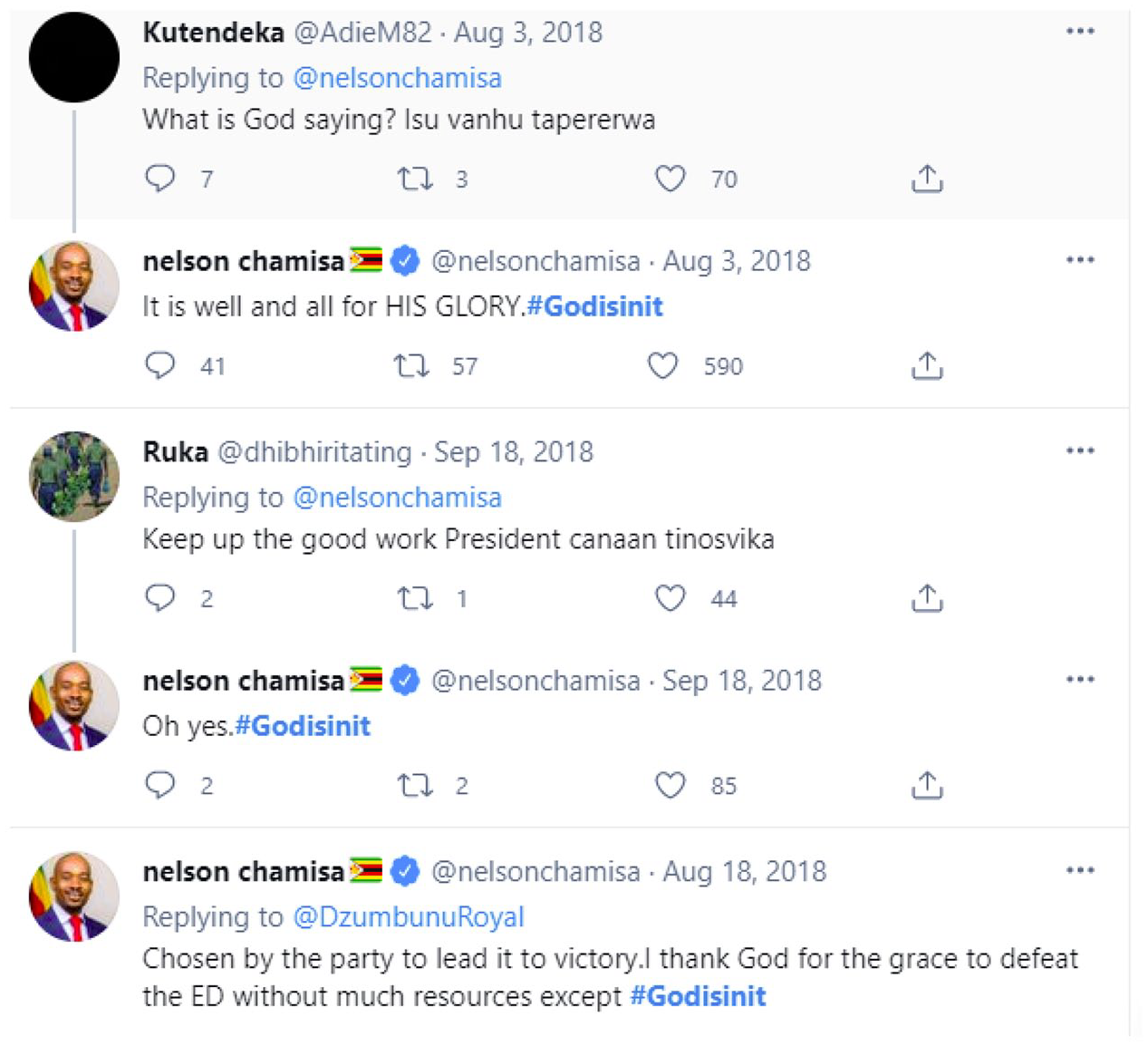
Despair, lack of resources but led by God.
The question ‘What is God saying?’ asked by Chamisa’s follower encapsulates how the conception of God having been in Chamisa’s electoral quest may have given people hope. However, in the wake of the loss, the people questioned this understanding. In his reply, Chamisa alluded that he was given the grace to defeat Mnangagwa without many resources because God was in his political campaign. Tarusarira (2020), observing Chamisa’s followers and their response to his call for a 7-day prayer and fasting in 2019, states that while some citizens believe in the miraculous power of prayer in politics, others call strongly for realpolitik strategies to bring about political change. Concurring with Tarusarira, I argue that within the period under study and beyond, conceptions of reliance on the spiritual for political win point towards the need for fundamental political strategies beyond mere belief in divine involvement in elections. There is a need for a hybrid system that centralises transformative religious education for citizens to better understand their place in society.
The religious perspective also appealed to those who saw Zimbabwe’s problems through a spiritual lens. Within this frame, when one assesses the use of Biblical texts, imagery and practices such as days of prayer and fasting, it can be argued that Chamisa primarily targeted Christians. However, the outlook can also be questioned based on the interreligious presence in Zimbabwe. Although the religious space is predominantly Christian (Mudzanire and Banda, 2021), there is religious diversity in the country, marked by a presence of the Islamic and African Traditional Religions, among other religious communities. The question becomes which God does Chamisa refer to and what do these references mean in relation to other religious communities? This harkens back to an all-encompassing political strategy that does not lean on Christian exceptionalism. The MDC Alliance (2018) manifesto refers to fundamental socio-political and economic issues, starting with a foreword with biblical references and the #Godisintit. Arguably, the reference is to Christianity than other religious communities. In this regard, I argue that there is a need for a reconfiguration that encompasses other religious communities in the political discourses that reference God.
Similarly, the need for remobilisation and realpolitik strategies is based on the observations that Twitter is slowly emerging as an elitist public sphere where influential people in society are found (Nyoka and Tembo, 2022). Due to social media being highly used in urban areas, arguably the use of social media as an interactive platform was accessible to the urban population in big cities such as Harare, Gweru and Bulawayo. The elitist use of social media relegates the rural folk in communicative processes. Rural areas are primarily regarded as a stronghold for ZANU-PF, the revolutionary party, which enjoys support from traditional leaders and their villages. This support is mainly from a generation with direct links with the liberation war who regard ZANU-PF as their liberator; hence, they vote for and support the party. This support is also cemented by violence and intimidation from the government, especially during election time. Such a case is the 2008 election period where ZANU-PF militia youth used force and violently coerced people into voting for ZANU-PF.
Of Adonijah and Joab–theodicy in politics
Figure 3 shows Chamisa’s online communication and interaction with his followers on the last day he presented his case on 22 August. In the thread, Chamisa shows optimism about what was to be the outcome of the court case. The leader used the #Godisinit and thus contextualised God in the case and its proceedings. However, on 25 August, Chamisa decried the country’s state of the rule of law after the Constitutional Court had declared Mnangagwa the duly elected president. Chamisa expounds a level of theodicy in his statement by asserting that he remains focused because God was in it. This conflation of religion and politics expounds a level of theodicy that the followers resonate with and help expound in their communication with the political leader.

Everything happens for a reason.
In Figure 3, one of Chamisa’s followers references Adonijah and Joab, who conferred to have the former become king since King David was old and frail even though Solomon was to inherit the throne (1 King 1:1; 5ff). Joab was King David’s nephew and commander of his army who ensured the death of Uriah so that King David could have Bathsheba as his wife (2 Samuel 7). Adonijah, with the help of Joab, prepared a feast celebrating the illegal enthronement. However, upon hearing this, King David countered it and anointed Solomon as king (1 Kings 1:32-35). The reference offers theodicy and justifies the court case and the related political events.
In the biblical reference, Mnangagwa, like Adonijah, took the helm of power, although it was not his. In this case, Chamisa is likened to Solomon, chosen and appointed by King David to rule Israel. Chamisa is thus regarded as the one chosen to rule Zimbabwe. Therefore, for Mnangagwa to assume power was regarded as temporal. At the same time, Chamisa was being prepared for what was to come – his enthronement. The reference to the Bible and the use of #Godisinit was not only used to explain the political events occurring but was also used in efforts to strengthen the followership of Chamisa amid a tense period.
The study further maintains that using the phrase and #Godisinit created some form of complacency in fundamental politicking strategies. This is mainly because, after the court case, some followers of Chamisa implored him to wait for divine intervention as though this would solve the country’s political crisis. In this study, the reliance on God in Zimbabwe’s political space during the election and postelection demobilised citizens’ power in terms of political participation and influence on the election and court case periods. For instance, in Figure 3, one follower states to Chamisa that he is chosen and that since he presented his challenge in the court, he should now leave everything to God. Another follower states that everything happens for a reason, and thus Christians understand this. Such sentiments create an understanding that the political space consists of events ultimately decided on by God, not the people. There is a need to frame theodicy in ways that are not oppressive to the people in their political participation and understanding of political events. During the court challenge, ‘the Zimbabwe Amalgamated Churches Council (ZACC) urged Chamisa to drop his challenge of the electoral results for the sake of the economy and further argued that it is God’s will that Mnangagwa was elected. Of course, this narrative and theological advice to submit to authority as it comes from God were meant to form and strengthen a narrative of peace and stability, which is unsustainable in the long run in a context of disputed legitimacy’. (Mpofu, 2021: 16)
The challenge with such endorsements, mainly from institutions such as ZACC, overlook the critical role of democratic politics as they explain political events within the sanctioning of God and their desire to see temporal economic reformation while political legitimacy issues are swept under the carpet.
A comparative analysis can be done given one follower of Chamisa who stated that they support him because he does not use the term God in vain (see Figure 3). The use of God by Chamisa is thus understood as a legitimate method. In a 2020 press conference, Chamisa stated the following: Isu semusangano tinoteedzera Mwari (MDC-A as a political party follows the dictates of God). God is in it, is a statement of faith, a testament of what we believe in. The voice of the people is the voice of the people. The voice of God is the voice of God. Vamwe vangu vanoti (some say, [Emerson Mnangagwa]) the voice of the people is the voice of God, ayehwa I blasphemy, ipaganism (No, that is blasphemy, it is paganism) . . . Zimbabwe payasvika yakuda mutungamiriri anoziva ivo Mwari (Where Zimbabwe is, now requires a leader who knows God). (Chamisa, 2020)
Therefore, the declaration by Chamisa explains the ‘God is in it’ slogan and hashtag not only as a theologically coined phrase meant to garner support from the generality of the masses, but it is a way of life. This harkens back to what Tarusarira observed, stating that Chamisa, who studied law and political science at the University of Zimbabwe and theology at a local theological school, identifies himself as a politician and a pastor whose politics are guided by his Christian faith (Tarusarira, 2020). His beliefs inform the use of the slogan; hence, it is a legitimate use requiring support from his supporters. However, Chamisa criticises Mnangagwa for using God in his political campaign. This criticism reflects Chamisa’s understanding of the 2018 elections as functioning on the good versus evil duality where ‘good’ reflected Chamisa, God and the MDC-A, while ‘bad’ reflected Mnangagwa, the Devil and ZANU-PF. In his religio-politico discourses, Mnangagwa used the phrase ‘the voice of the people is the voice of God’. The statement can mean that Mnangagwa considered the people as having legitimate power in political decisions.
While Chamisa used the Bible and a theologically framed discourse during and after the court case, his followers and supporters on Twitter also used the Bible to strengthen the political leader and themselves. Soon after the declaration of Mnangagwa as the presidential winner by ZEC, Chamisa took to Twitter in the following Figure 4.

Trust in God.
Chamisa’s post alleges electoral rigging by ZANU-PF. Due to this rigging and the partiality by ZEC, Chamisa then declared that they would do to avert the declaration and ensure that MDC-A would be recognised as the legitimate winner. It is against this understanding that the followers react and use the Bible to preach to Chamisa and the entire followers of Chamisa. The use of verses in political discourses is rampant; thus, it is unsurprising to see the followers of Chamisa using them in their communication and response to him. Responding to the post-2000 crisis, the Bible has been used as a source of strength in the country’s heightened period of conflict and socio-economic and political crises. The Bible is a vital tool in providing hope, courage, and comfort during times of distress, and in the Zimbabwean space, it has been turned to by various social, economic, and political persons at crucial moments either to rally people against or towards specific programmes (Chitando, 2012). Ordinary people, including women, have also turned to the Bible during socio-economic and political trials, tribulations, and post-2000 crises (Vengeyi, 2011).
In a similar outlook, assessing the use of religion in Zimbabwean politics, Dube and Nkoane (2018) observed that religion, in the Zimbabwean political milieu, has developed broadly in terms of consecration and repudiation. Consecration refers to religious leaders being sympathetic to a political party or the government of the day, which, in this case, is Zimbabwe’s ZANU PF government, and being rewarded by being enthroned, promoted, and supported in their religious activities.
Repudiation refers to the use of religion in denouncing malpractices by political leaders. However, in the findings of this study, consecration is not only used to give legitimacy to ZANU-PF. During and after the election, MDC-A and Chamisa also garnered religious support from supporters and leaders, in some cases using theodicy and biblical references meant to position Chamisa as the legitimate winner and ordained ruler of Zimbabwe. It is unsurprising that post-2018 elections, the Bible was also used by Chamisa and his followers in search of courage and strength during the period of heightened political tensions.
In a 2012 study, Chitando traces the use of the 2 Chron 7:14 verses during the crisis years in Zimbabwe. The verse concentrates on repentance and the consequent act of God hearing them out. Chitando (2012) argues that during the 2000–2008 crisis, the reading of this passage during the Zimbabwean crisis had some positive dimensions while also shifting blame from politicians tasked with guiding the country to citizens. Chitando (2012: 274) further argues that the use of the text ‘tended to suggest that the country’s failure had a spiritual origin, thereby glossing over failed policies and other factors’. The use of these Biblical texts is foregrounded in the Zimbabwean society’s appropriation of the Bible in a context of chaos and political turmoil.
In terms of theodicy and politics, I concur with Tofa (2012), who citing verses such as Psalm 103:6, which reads ‘God, who does what is right, is always on the side of the oppressed’, argues that while the argument that God is on the side of the oppressed is Biblically and spiritually valid; this is hardly applicable in contemporary politics because it gives the oppressed a passive approach to fighting against their oppressors and oppressive institutions. Similarly, Chaumburuka commenting on church–state relations, points out that many Christians have adopted a pacifist approach because they lack a clear orientation on the church’s role in politics. Chaumburuka further points out that the blame can mainly be levelled on the quality and relevance of theological training that the clergy receive in theological colleges and seminaries or the lack of the ability to apply learnt theories and principles (Chamburuka, 2012).
While Chamburuka’s argument is on theology students, I extend the argument by pointing out the training of theologians as critical in their engagement with the political space. It is also essential to have a citizenry conscious of its role within the religio-political space. Theodicy functions in finding meaning to life events, but it is also essential to understand and use a critical approach that evaluates and extends the citizenry’s role in public life. While Chamisa and his followers may have found comfort in using the Bible to explain the rigging, the court case and the loss using theodicy, it is also crucial for the same people to develop a framework that uses the church and Bible as ‘the source of the renaissance of democracy in our community’ (Chamburuka, 2012).
The court case, evidence and God in politics
In the build-up to the court case, Chamisa and the MDC-A claimed an outright victory. Along with these claims were the allegations that ZEC was state captured in its delay in publishing the results and its declaration of Mnangagwa and ZANU-PF as winners. To challenge this, in the build-up to the court challenge, Chamisa claimed that they had evidence of V11s showing the inconsistencies in voter results. However, the MDC-A’s representatives failed to produce such evidence during the court case. V11 forms refer to the return forms at each polling station, which all representatives of the contesting parties sign before data are computed (Mwonzora and Xaba, 2020). While claiming God’s intervention in and after the elections, Chamisa may have lost support from the general masses who were following his case.
In Figure 5, one follower claims that Chamisa had no evidence and such failure to produce the much-needed evidence that may have reverted Mnangagwa’s win resulted in the wastage of time during the court challenge. The MDC-A’s failure to produce comprehensive evidence in the form of V11 forms, in both the court of public opinion and in the court of law, caused some to conclude that the opposition did not have the evidence after all, since it did not station party agents in some of the polling stations across the country, mainly in ZANU-PF rural strongholds. (Mwonzora and Xaba, 2020: 8)
The MDC-A lacked cumbersome strategies to delegitimise Mnangagwa’s ascendency to the presidency. Also, this failure is related to MDC-A’s strategy in the run-up to the elections. Mpofu observed that Chamisa’s campaign strategies which used the #Godisinit and #Beholdthenew encapsulates the MDC-A’s underfunded campaign compared to ZANU-PF’s, which had a well-coordinated and resourced campaign, evidenced by the number of motor vehicles they bought for the project and a survey of their billboards and campaign posters on the streets (Mpofu, 2021). The efficiency of a campaign should not only be based on the number of cars and billboards ZANU-PF had, but they provide an insight into how the party marketed its project. However, ZANU-PF controls the media space and access to televised campaigns were primarily reserved for Mnangagwa and ZANU-PF. Implicitly, ‘#GodIsInIt suggested MDC-A’s meagre-resourced campaign was left in the hands of God [and] Chamisa’s camp saw the 2018 elections in a good versus evil binary’ (Mpofu, 2021: 13). While Chamisa and the party had a manifesto and campaign plans, the appropriation of God pointed towards his win being determined divinely since he regarded himself as having a divine mandate to save the people from the oppressive rule of ZANU-PF.

The need for new political strategy.
The distribution of political support is divided in the country. The rural folk is deemed a support base for the ruling party ZANU-PF while the urban, mostly Harare and Bulawayo, are strongholds for MDC-A. MDC-A, for a period, has been criticised for its lack of presence, especially in rural areas. Accessibility to the rural folk is a major challenge for MDC-A. The ruling party ZANU-PF enjoys support from traditionalists who regard the party as their liberator. At the same time, the party has strong gatekeeping in rural areas, for instance, through traditional leaders who are paid by the state receive cars and other tokens to guard their loyalty to the party. Traditional leaders have been actively involved in political campaigns, campaigning for the ruling party, threatening known or suspected opposition supporters with eviction from their fiefdoms or, ordering opposition supporters facing threats of eviction to pay a fine of an ox to be forgiven were reported (Kurebwa, 2020). Attempts by the opposition to penetrate these areas have often been met with severe political violence against opposition members and ostracisation of opposition supporters from their communities.
In their post-2018 election September survey, Bratton and Masunungure found out that this divide, to an extent, reflects demographic structures. Ruling party supporters tend to be older, less educated women who live in rural areas and get news from government radio. Opposition supporters have opposite characteristics: younger, educated, urban men who consume news from the internet and social media. (Bratton and Masungure, 2018: 2)
In the above figure, one follower of Chamisa states that whatever the outcome of the court case, there was a need for Chamisa to plan and strategise for the upcoming 2023 elections. The follower must have a guiding religious/theological base while also having a political strategy that can lead to success in the coming elections. This also falls into the observation of Zimbabwe’s political parties ‘manifestos and their lack of a clear-cut exposition of central political and economic ideologies, which Chipere (2020) calls the ‘Zimbabwean soul’. Arguably these ideologies can be understood as frames through which political parties can appeal to the masses.
In the aftermath of the court case and Chamisa’s loss, the political leaders and pastor provided a statement that mostly sums up the Zimbabwean situation where democracy is contested. As mentioned, the introduction of the MDC in 1999 under Tsvangirai was a monumental occurrence in Zimbabwe’s political landscape as it challenged the ZANU-PF hegemony. In response, ZANU-PF and Mugabe regarded opposition politics as western fronts, puppets and sell-outs who were to be tamed. The taming came through the beating and torture of Tsvangirai, his subordinates, and supporters at the peak of Zimbabwe’s socio-economic and political crisis in 2008. Upon this background and loss of the court case, Chamisa opined that the road to Zimbabwean democracy and justice is marred with challenges. The description came after Chamisa lost the court case, which he may have regarded as the only way to avert Mnangagwa’s political ascendency. After the court ruling, reflecting polarised opinions, people used the decision to observe the complexities of Zimbabwe’s politicised judicial system and the validity of the opposition’s evidence (Bratton and Masungure, 2018). While Chamisa claimed God’s centrality in his political campaign and court case, other followers and respondents to his online communication did not take his rhetoric well. This is encapsulated in the following figure, Figure 6, which shows a follower who disagreed with Chamisa.

God, power and politics.
The response in Figure 6 brings out critical points in how some people interpreted Chamisa’s instrumentalisation of God in his political communication. First, it reveals that some did not regard God as having a central place in the court case. Second, the response highlights the contestations regarding entry into politics. The follower regards Chamisa as a power-hungry political leader. The basis of such claims is not defined. However, they fall into the same narrative perpetuated by ZANU-PF and its leaders, who assert the political space as its reserve and for one to dissent, they are a voice of regime change. Third, the respondent leaves one wondering what they mean by asserting that ‘a Man of God should know well what God says about leaders’. The respondent utilises Chamisa’s vocation, including being a pastor apart from being a political leader. This is used in analysing what Chamisa understands about the Bible and what it says about the leaders. Although not explicitly stated, it can be argued that the respondent references Romans 13:1-7, which states that people should obey governing authorities for God establishes them. The respondent implores Chamisa to leave God out of politics and, at the same time, obey authorities.
Zimbabwean elections are known for irregularities such as rigging and coercive methods to control the political space favouring ZANU-PF. The political system operative in Zimbabwe is quite difficult to characterise as either a democracy or an illiberal society in which elections are regularly held according to the country’s Constitution despite not being free and fair (Rwodzi, 2020). Elections are held in the country, but their legitimacy and credibility are often questioned. The ruling party, ZANU-PF, and its leaders view the opposition as threat to the hegemony, especially since the inception of the MDC. Mugabe endeavoured to hold on to the seat of power through various means, including violence, force, manipulation of the electorate, and rigging in the 2002, 2008 and 2013 presidential elections (Dombo, 2014).
In the 2013 elections, through the registrar’s office, the government is alleged to have employed Nikuv Projects International, an Israeli company, to rig the elections favouring ZANU-PF (Masvingise and Matenga, 2013). While there were always clear indications that the MDCs 3 Tsvangirai would continue to face significant challenges in attempting to defeat ZANU PF at the polls, the sheer scale of the latter’s victory in the 2013 elections left many Zimbabweans and political observers stunned (Solidarity Peace Trust, 2018). Informed by such a background, in the run-up to the 2018 elections, Chamisa promised anti-rigging mechanisms for the elections to be credible. However, the MDC leader did not deliver on the promise; hence, one follower questions Chamisa on the topic. The follower questions ‘Chamisa’s empty rhetoric’ (Chipere, 2020: 313) and implicitly submit that reliance on God devoid of political strategies is rhetoric and misuse of faith. The use of God in politics should also be accompanied by complementary strategies that can help achieve political objectives.
Conclusion
The study’s objective was to analyse how Chamisa’s use of religion was perceived by his followers and supporters on Twitter during the 2017 election and the court case. Chamisa utilised online spaces to buttress his political campaign using the phrase and hashtag ‘God is in it’, which he defined as a faith statement. The study revealed that the use of Christianity was received differently by various followers and supporters. Some took the time to categorise Chamisa within the frame of divine ordination in politics. However, some deemed Christianity’s use in politics as unfitting. That is, they regard politics and religion as separate entities. It also emerged that some implied an evil versus good dichotomy, wherein Chamisa was regarded as the good presential candidate while Mnangagwa was the evil one who was to be ousted from power. Other respondents interpreted Chamisa’s loss to Mnangagwa and the courts as pointing towards preparation for the mission to rule Zimbabwe. It is also important to note that others castigated the use of God in Chamisa’s politics, citing that he needed to strategise for the upcoming 2023 election if he wants to unseat Mnangagwa. The castigations also rest on the need for Chamisa to revere the authorities. From the preceding, it is apparent that the use of religion in politics is a continual practice while also being a complex element considering the responses from the general citizens.
Footnotes
Funding
The author received no financial support for the research, authorship, and/or publication of this article.
