




Abstract
The year 2016 is remembered globally for the adoption of the New York Declaration and its Comprehensive Refugee Response Framework (CRRF) as the new global refugee response model. In this regard, Ethiopia has been one of those African countries that have adopted the Declaration, made specific CRRF pledges and has become a CRRF pilot country. Such national policy move heralded the shift of refugee policy in Ethiopia in the post-2016 era. Nonetheless, compared to the focus accorded to refugees and the role of international institutions and donors, the role of African hosting states in the governance of refugees and how they navigate internal and external demands and adopt policies have been paid little scholarly attention. This study, therefore, aims to fill in this scholarly gap and contribute to the existing debate in the academic and policy circle on state response to refugees in the era of CRRF from the Global South perspective by providing an empirical insight into the nature, dynamics and shift of refugee policies in Ethiopia and the factors that contributed to this effect.
Introduction
The year 2016 is remembered globally for the introduction of the New York Declaration for Refugees and Migrants and its Comprehensive Refugee Response Framework (CRRF) as a global refugee regime. It heralded a new era of refugee protection and optimism for global cooperation between Global North and Global South, something that was lacking in the past (Betts, 2005, 2008; Betts and Kainz, 2017). Being host to a significant number of refugees in the world, the role of African states was paramount in terms of adopting the New York Declaration and making specific CRRF pledges to promote refugee-friendly policies. 1 Ethiopia has been one of such prominent African states.
Ethiopia has not only adopted the Declaration and made nine CRRF pledges 2 in 2016 but also played an active role in the new face of North-South global cooperation. It was a co-host during the 2016 Leaders’ Summit and has been selected as one of the few CRRF pilot countries in the world (Administration/Agency for Refugees and Returnees Affairs (ARRA), 2017). It was also one of the five co-conveners during the first Global Refugee Forum (held in December 2019 in Geneva) along with the major refugee-hosting countries in the world, including Costa Rica, Germany, Pakistan, and Turkey. Moreover, Ethiopia has been taking part in the regional migration frameworks under the auspices of the Inter-governmental Authority on Development (IGAD). Being host to a large number of Somali refugees, Ethiopia has also adopted the regional CRRF model to address the protection needs of the Somali refugees within a regional framework. 3 Currently, Ethiopia hosts more than 800,000 refugees that came from some 26 countries in rural camps and urban locations (UNHCR, 2020: 5, 13); and it is also the third-largest refugee-hosting state in Africa (next to Uganda and Sudan) and seventh in the world (IOM, 2021).
However, the making of Ethiopia’s nine pledges was a landmark decision in the country’s history since it not only allows refugees to enjoy some fundamental rights (like the right to work, the right to movement and documentation) but also was made against the backdrop of the country’s long-standing encampment and restrictive policy that failed to formally recognize local integration as a durable solution for refugees. Essentially, the encampment policy follows a ‘care and maintenance’ model, whereby refugees are placed in camps built along the international border to ensure their humanitarian assistance and protection and also manage the costs of hosting them. This entails then that refugees are viewed not only as victims but also as sources of insecurity to the environment, socio-culture, economy, politics and regime of the hosting state (ARRA, 2011, 2015; Samuel Hall, 2014). Also, the vast majority of the present refugees in Ethiopia come from South Sudan, Somalia, Eritrea and Sudan – countries (save South Sudan) that have engaged in conflict and hostile relations against the Ethiopian state at different periods (Bariagaber, 2006), putting the security of the state at risk by creating a fertile ground for cross-border insurgencies like Al-Shabab and other armed groups. Furthermore, the country’s refugee agency (Refugee and Returnees Service (RRS) 4 ) has been placed back under the National Intelligence and Security Service (NISS) in 2021 through the proclamation that was adopted to determine the powers and duties of the executive branch of government (GoE, Proclamation No. 1263/2021). This has been clearly articulated under Article 64 (about the establishment of RRS) and Article 101 (about the RRS institutional placement under NISS).
Viewed against these existing policies and practices, thus, the making of the pledges in New York heralded a shift in Ethiopia’s refugee policy as it slackened the existing restrictive policies and introduced a more refugee-friendly policy. Such a drastic policy shift was not without its consequences as well. Rather, it had normative, institutional, cooperative and financial implications on the governance of refugees in the country.
Nonetheless, compared to the focus accorded to refugees and the role of international institutions and donors, the role of African hosting states in the governance of refugees and how they negotiate internal and external demands and adopt policies has been paid little scholarly attention. Except for a few works such as Callamard (1994), Rutinwa (1999), Crisp (2000), Loescher and Milner (2005), Milner (2009, 2013), and Fellesson (2021) and other commissioned works (Crawford and O’Callaghan, 2019; Nigusie and Carver, 2019), there is a dearth of scholarly literature on the subject, particularly in the current CRRF era and specifically on Ethiopia. While the latter two focused on the recently adopted global CRRF approach and the examination of its progress in East Africa (like Uganda, Kenya, Rwanda and Ethiopia), studies such as Callamard (1994), Rutinwa (1999), Crisp (2000), Loescher and Milner (2005), Milner (2009, 2013) and Fellesson (2021) investigated the dynamics of refugee formation and the associated impacts of hosting refugees on the hosting states and communities on one hand and the nature and dynamics of refugee policies on the other hand in Africa in general and among a few selected countries in particular (like Guniea, Kenya, Malawi, Tanzania) in the post-independence Africa and the post-Cold War world order. None of these works (save Fellesson, 2021) captures the dynamics of the current CRRF-inspired refugee regime in Africa.
This study, therefore, aims to fill in this gap and contribute to the literature on state response to refugees in Africa in the CRRF era by providing an empirical analysis of the nature and dynamics of refugee policies in Ethiopia and the factors that contributed to the shift. This paper aims to interrogate why and how Ethiopia’s shift in refugee policy became possible in 2016. It is also situated within and interested to contribute to the politics of refugee protection in the context of South-South flows and North-South relations. To this end, the key drivers that facilitated the shift and emergence of a new refugee policy in Ethiopia are examined by employing both primary and secondary sources. Key informant interviews (KIIs), proclamations, reports and secondary as well as online sources have been used. The interviews were conducted in 2021 both in person and virtually.
Existing theoretical debate: why constructivist perspective?
This research is guided by constructivist IR theory. This is because neither realism nor liberalism mainstream IR theories could explain why states collaborate or fail to collaborate to address issues related to refugees at the global level. The dynamism in terms of the emergence of global refugee regimes (like the New York Declaration) falls within the purview of constructivist theory, rather than liberalism or realism.
For realists, the management and control of international borders have been viewed as a priority for states, leading to the extent of the securitization of the border and migration and refugees. Refugees are viewed as part and parcel of the question of national interests as well. Nonetheless, realism has a mere conventional intellectual standing towards national security, which is state security. As such, it views refugees and other migrants as a direct threat to state sovereignty and national security (Troeller, 2003). On the contrary, liberalism stresses the importance of trans-national interactions, international cooperation and international institutions as well as addressing the refugee issue in a multilateral and collective manner. It is premised on morality and moral claims are also seen as pre/non-political principles, and these principles are supposed to guide states’ behaviour and action. Yet, international law involves national interest politics and is not also binding rules on states. Liberals also fail to account for the limited impact of international institutions on the immigration policies of states (Meyers, 2000).
The advantage of constructivism theory to this study is that it supports the idea that agency (the Ethiopian state) and structure (the global refugee regime) have mutually constituted each other and responded to the changing circumstances of the post-Cold War period and adopts a broader view of the notion of security and securitization (Hopf, 1998). In this regard, the security implications of refugees are limited not only to areas of the traditional politico-military (state) security but also in other areas like social, economic and environmental issues (Bali, 2008; Watson, 2007). Framed in this manner, thus, constructivism theory enables the authors to answer the basic question: how is that countries of the world, which failed to create a collective front in the past, have been able to produce a multilateral front to treat the migration and refugee issue as a global concern in 2016? And why and how did the shift of refugee policy in Ethiopia become possible in 2016? It helps to explain how Ethiopia’s state identity is crafted and in turn shaped its interest and policy.
As shown in Figure 1, the making of the pledges and shift of refugee policy was made possible in Ethiopia due to the intersection of three inter-related factors – international, domestic and refugee-related factors, not merely because of a one-sided interest of either Ethiopia, the developed countries, or refugees. It was the cordial interactions of these three inter-related factors that encouraged the country to endorse the New York Declaration and its CRRF model at the global level and try to implement it at the domestic level. As it is discussed below, it is also beyond the ‘we pay, you host’ logic and interest of the rich Global North countries. The whole policy and cooperation change did not come out of moral or humanitarian imperative either, but rather almost only from political and national interest concerns; thus, the shift of refugee policy should be viewed from the overall migration policy of the developed countries in the North and the countries of Global South.

The conceptual illustration of the interaction of the three drivers.
Genesis of Ethiopia’s refugee policy
Ethiopia has been hosting refugees since the ancient period. In the ancient and early modern period, refugees in Ethiopia were small in number, elite and educated; they were facing persecution due to religious and ethnic identity differences, and they usually came from distant places like the Middle East and Armenia. The first well-recorded group of refugees in the past was the arrival of the followers of Prophet Mohammed in the 7th century from Saudi Arabia. Their flight was associated with religious controversies (Ahmed, 2017). Armenian refugees were the other group that came to Ethiopia due to fear of persecution and genocide under the Ottoman Turks in 1915. Particularly, the arrival of the famous ‘Arba Lidjoch’ (the Forty Children) Armenian refugees on 6 September 1924 is noteworthy (Adjemian, 2013). Ethiopia’s treatment of these refugees was based on a personal decision, usually, the King’s and the Emperor’s, not based on codified and formal legal frameworks and procedures.
Since the 1960s, however, Ethiopia began to witness the arrival of a large number of refugees, mainly from the neighbouring countries. The refugees at this time have been fleeing from drought, famine, civil war, violence and a state of insecurities in their home states. The first group of refugees to arrive in Ethiopia were South Sudanese people from Sudan due to the outbreak of the First Civil War in Sudan (1955–1972); and its associated displacement led to the opening of the first refugee camp in Ethiopia – Itang camp in the Gambella region in 1969 (Bayissa, 2010). Then, refugee flows from Somalia (in the late 1980s), Eritrea (in the 2000s), Sudan, Syria and Yemen (in the 2010s), and others came to take place in Ethiopia and continued unabated to this day.
In response to the massive influx, the state began to adopt non-personalized and ad hoc operational refugee policies and practices with a more formalized institutional structure. However, the formal and organized state response has not been uniform throughout the post-1960s period. Rather, it has been punctuated by landmark changes that could be divided into three phases: 1960–2004, 2004–2016 and post-2016.
State response towards refugees from the 1960s to 2004 could be characterized by the absence of legal frameworks and also Ethiopia’s reservations to critical pro-refugee stipulations of the 1951 Geneva Convention. Despite being a party to the Geneva Convention, Ethiopia has declared its reservations during its ratification of four important stipulations, namely, exemption of refugees from exceptional measures simply based on the refugee’s nationality (Article 8), placement of a provisional measure on refugees in a time of war or other exceptional national security conditions (Article 9), application of non-restrictive measures on refugees’ access to wage-earning employment (Article 17(2)) and provision of refugees with elementary education, in the same way, they treat their nationals (Article 22(1)). To Ethiopia, these four provisions of the Convention ‘are recognized only as recommendations and not as legally binding obligations’ (UN, 1951, page 8). Such a position confirms the supremacy of state interests, with a detrimental effect on refugees’ lives in the country of asylum.
State response was also conducted without a clear legal, policy, and institutional framework that guides refugee protection operations in the country, a gap which is viewed as tantamount to ‘no ratification’ of the Geneva Convention (Markos, 1997: 390). As to Zelalem (2017: 46), “this lack of domestic legal regime was astonishing and unfortunate, as refugees sometimes ended up being victims of treatments that fell short of international standards”. These challenges have been observed by Kibret Markos’ (1997) study of the treatment of Somali refugees in Ethiopia. Yet, contrary to the government’s official reservation, some refugees were still able to access primary education in the camps, but not secondary education. This permission, which emerged out of the government’s goodwill, allowed around 4000 Somali refugees out of around 300,000 to attend primary education (Markos, 1997: 375).
Ethiopia’s treatment of refugees entered a new era with the introduction of refugee law in 2004 (Refugee Proclamation No. 409/2004). The introduction of the refugee legal law signalled a change of assumption in the government and the need for a working document that sets out the legal and institutional frameworks as well as the rights and responsibilities of refugees. Some of the major drivers that prompted the government of Ethiopia to introduce a refugee law in 2004 were the size and scale of the influx of refugees, the long and protracted situation of refugees, the need to domesticate and facilitate the implementation of the international instruments, and the incumbent government’s political interest in refugee protection (KII2; GoE, Refugee Proclamation, 2004).
The 2004 proclamation did not provide many details in terms of the rights and privileges of refugees. It focused on document-related rights like the issuance of an identity card and a travel document. The proclamation entitled refugees to ‘other rights and be subject to the duties contained in the Geneva Convention and the OAU Refugee Convention’ (Article 21(1) (d))), but without clearly indicating what these other rights and duties are that refugees were entitled to in the country. It restricted the free movement and area of settlement of the refugees. Also, it treated refugees as foreigners; as a result, refugees were prohibited from accessing education and engaging in wage-earning and other formal economic engagements in the country (Article 21(3)). Essentially, thus, such a protection regime was based on a narrow perspective of refugee protection and emphasized the country’s encampment policy, where it saw refugees as passive recipients of humanitarian aid who should be placed in a refugee camp and just be provided with food and other basic services to survive until they either return to their country of origin or resettle to a third country.
Despite this restrictive regime, refugees were able to engage in the informal economic sector (Da Rugna, 2005). The government also introduced the Out-of-Camp Policy (OCP) in 2010. The OCP scheme allowed refugees with medical, security and other pressing personal reasons to leave refugee camps and reside in urban locations provided that the refugees meet certain conditions, including having a sponsor, who guarantees to be responsible for and cover the living expenses of the refugee in the city she or he chooses to live in; the sponsor has to be a relative of the refugee; the sponsor has to be an Ethiopian; and the sponsor has to sign an agreement with ARRA in Addis Ababa (KII4; Samuel Hall, 2014: 16).
Nonetheless, the OCP entailed that the refugee had to support himself or herself economically and could not access any humanitarian assistance. Refugees could not also access the labour market formally and legally. Thus, to survive, they had to depend either on the person who sponsored them or from relatives abroad through remittance. Most importantly, it was a decision that benefitted almost solely Eritrean refugees, at least until the introduction of the CRRF pledges in 2016, as after this period the scheme was officially expanded to other groups in the country (KII5). This claim was supported by the data collected from primary and secondary sources including the interviewees from RRS itself as well as by the very framing of the OCP pledge itself: “to expand its Out of Camp Policy to all refugees as defined by Ethiopian laws and policy documents, to benefit 75,000 refugees, or 10% of the current total refugee population in Ethiopia”. The phrase ‘to expand its Out of Camp Policy to all refugees’ entails that the opportunities to OCP were restricted to a certain refugee group in the past, which was the Eritrean refugees group. Moreover, as to Brown et al. (2018), ‘Although OCP status is only for Eritreans, there had been recent lobbying to open this up to other nationalities’ (emphasis added; p. 27). The rationale for allowing the Eritrean refugees to be the only exclusive beneficiaries of the scheme is premised on the profile of the Eritrean refugees – young, skilled, literate and from urban areas; and the shared and strong socio-cultural and ethnic similarities of the refugees with the hosts and the existence of networks of the Eritrean refugees with the hosts to sustain their livelihood outside of the camps (Samuel Hall, 2014: 17).
The out-of-camp scheme was also said to have been politically driven, as it was influenced by the government’s existing foreign policy against the Eritrean state. Against the backdrop of the then Ethio-Eritrean hostility, as to some informants who used to work for RRS and other humanitarian agencies operating in the Eritrean refugee camps, the TPLF (Tigray Peoples Liberation Front)-led government of Ethiopia was argued to have been working to damage Eritrea by recruiting and supporting opposition political groups in Ethiopia, even among the refugees. And within this context, ‘too much’ care was accorded to Eritrean refugees and the opposition groups to freely operate in the country (KII5). Such observation is also supported by Ludi and Yohannes (2020) who stated that Ethiopia supported a number of opposition groups in Eritrea, such as the Kunama and some sections of the Afar, and also tried to bring together the divided Eritrean opposition, while Eritrea wooed the Afar and provided support to the Somali and Oromo opposition movements in Ethiopia. (p. 14)
More than 2000 Eritrean refugees were able to benefit from free university scholarships by joining public universities, which enabled many of them to pursue their dreams. Also, Eritrean asylum-seekers were accorded ‘humanely’ treatment and warm reception by the members of Defense Forces and the local people by offering them food, water, a place to stay soon after reaching the Ethiopian border until their movements to the screening center and refugee camps which is appreciated by all the asylum seekers. (ARRA, 2015: 12–13)
Moreover, the lack of official document on the OCP scheme has made it difficult for all actors to be equally and fully aware of and understand the essence, modality, scope and beneficiaries of the scheme. It also led to the creation of divergent interpretations of the nature of the scheme and the eligibility criteria. For instance, UNHCR had a different interpretation of some the eligibility criteria, namely the nationality of the sponsor and the exclusivity of the beneficiaries (Samuel Hall, 2014: 16).
Ethiopia’s drive toward transforming its refugee policy
Considerations of three important issues were vital in driving the shift of Ethiopia’s policy towards refugees, namely, respect for the international refugee regime, achieving domestic interests, and interest to balance refugee-oriented burdens and benefits. A discussion of each of these drivers is in order below.
International factor
As the government authorities have indicated, the country is interested in ‘meeting its international obligations as a signatory to both the UN and OAU refugee conventions’ (ARRA, 2017: 3). Thus, the international factor for the change of Ethiopia’s refugee policy is related to the emergence of a new global refugee regime through the adoption of the New York Declaration (NYD) and its CRRF approach (UN General Assembly, 2016); and with that the need to respect and abide by the principles of this global refugee regime that the country has produced it in the first place along with the other UN members became imperative. The shifting of policy towards refugees in the country could be seen as a way of accepting the new international regime and interest to harmonize its domestic refugee policies accordingly. By so doing, the country wants to show its ‘global solidarity’ with the refugee protection and be seen as a ‘good’ and ‘pioneer’ state that domesticates international refugee protection regimes as per the international agreements. In this regard, the country played its agency and influenced the adoption of the NYD and at the same time was influenced by the NYD as the international regime to regulate its refugee protection accordingly.
The adoption of the NYD (as the new global refugee regime) by the UN member states, including Ethiopia, was the outcome of the intersubjective interaction of states’ interests globally. It was the result of the convergence of specific national and collective global interests. The impacts of large movements of the refugees and irregular migrants were assumed as a problem for both rich and poor countries at this time. The need for a global solution and cooperation between the states of Global South and Global North was thus envisioned and eventually made possible in September 2016 in New York. Reflecting this interest, the main objective of the NYD has been agreed to be addressing the root causes of large movements of refugees and irregular migrants through a ‘win-win’ global cooperation among countries of origin, transit and destination (UN General Assembly, 2016, NYD, para. 11, emphasis added).
The push for global cooperation at this time was spearheaded mainly by the developed countries of the Global North, while the same quest from Global South has failed in the past due to asymmetrical interest and power relations between the countries from both hemispheres. For instance, the refugee-hosting states’ request for burden-sharing and cooperation with the developed world through some UNHCR-led initiatives fell on deaf ear, particularly those African initiatives – the International Conferences on Assistance to Refugees in Africa (ICARA) I of 1981 and ICARA II of 1984 (see Betts, 2008). Such sort of polarized interests allowed states and regions to try to achieve their national interests in a fragmented manner, but with a detrimental effect on the development of global governance of migration and refugees (Betts and Kainz, 2017).
Since the late 2000s, however, the discourse on migration in the Western world was assuming a new turn, which ultimately came to alter the lack of incentive for global cooperation among the rich countries. While immigrants, asylum-seekers and refugees have been presented as a security problem in Europe since the 1980s (Huysmans, 2000), the economic crisis of 2008 and the arrival huge number of Syrian refugees into the borders of the EU in 2015 (in what has been termed as ‘summer of migration crisis’) exacerbated the already closed and xenophobic attitude and placed forced displacement and immigration agendas at the centre of political and societal discussions in Europe (Bank and Fröhlich, 2018). This led Europe to consolidate its borders (‘Fortress Europe’) via a selective, restrictive and externalization migration policies, on one hand, and to stem the flow of irregular migrants from the source via the establishment of partnerships, on the other hand, like the multi-level EU-Africa partnerships (EU, 2015; Markussen, 2018).
Moreover, the domestic politics of the then administrations of the USA and Europe were dominated by the liberal policies (of such former leaders as President Barack Obama of the US, Chancellor Angela Merkel of Germany, Prime Minister David Cameron of UK, President François Hollande of France) that were pro-refugees, pro-foreign aid, pro-assistance to developing and refugee-hosting countries, and win-win global cooperation, with the thinking that such an approach would help reduce the burden of refugees reaching those countries in large numbers. Ethiopia was part of this agenda due to the secondary migration of the Somali and Eritrean refugees to Europe via the Sudan-Libya route (KII1).
Eventually, such exercise of regional collaboration (like the EU-Africa partnership), the increased political dimension of migration and refugee issues among states, and the process of learning and confidence-building created via the meetings and consultations conducted over the years (Betts and Kainz, 2017: 11) led states to develop interest for closer collaboration and the emergence of global cooperation with the adoption of the NYD. The adoption of the NYD signals the fact that the interests and priorities of those countries of the Global North and Global South meshed together. The main issues that hindered the creation of global cooperation in the past have been addressed by the NYD, as each party tried to accommodate the interests and priorities of the other.
Specifically speaking, contentious issues such as burden-sharing and durable solutions (mainly local integration) have been clearly articulated in the Declaration in a manner it aligns with the interests of both sides. For instance, the major objective of the Declaration has been agreed to be the management of the root causes of forced displacement and problems related to refugees (the interests of the donors) through responsibility-sharing (the interest of the hosting states). Also, the solution to address the root causes of refugee problems was articulated in the form of ‘preventive diplomacy’, which entails ‘the prevention and peaceful resolution of conflict, greater coordination of humanitarian, development and peacebuilding efforts, the promotion of the rule of law at the national and international levels and the protection of human rights’ (para. 12). Thus, the NYD links the refugee issue with the wider governance issues of origin states – development, peace, human rights and rule of law – something that was lacking in the past negotiations.
Nonetheless, states’ commitments, which have been made based on their national realities, are not open-ended and without limits. The conditions under which the expectations from and responsibilities of each of the hosting states and that of the donors have been indicated in the Declaration. These conditions include the following: ‘within available resources’, ‘to the extent possible’, ‘with existing humanitarian principles’, ‘to the extent possible’, ‘as appropriate’, ‘where appropriate’ and ‘as appropriate’. By the same token, Ethiopia’s pledges are assumed to be implemented ‘within available resources’ and through ‘joint projects’. Thus, despite the whole fanfare around international cooperation, the usage of such languages in the Declaration and pledges places conditions on the implementation of the CRRF approach, indicating the primacy of the state interests over the refugee issues. Finally, despite committing to liberalize their migration and refugee policies by expanding the criteria and opportunities for entry and resettlement initiatives, the interests of the developed world on border control are still clearly articulated in the Declaration.
Domestic factors
A range of domestic drivers has been at play to foster the country to make and accept the international refugee regime and bring change in its refugee response regime domestically. The first domestic factor is related to concern for the country’s image and identity as a generous refugee-hosting country and the need to extend such history and reputation. Internationally, Ethiopia is known for its open-door policy towards refugees. And it is common to read such statements: ‘Ethiopia has a long-standing history of hosting refugees. The country maintains an open-door policy for refugee inflows and allows humanitarian access and protection to those seeking asylum on its territory’ (UNHCR, 2020: 5). As a result, there has been a moral and humanitarian interest to continue its history of hosting refugees. The statements made by Zeynu Jemal, former Deputy Director of RRS, show this Ethiopian interest: For Ethiopia, protecting and assisting refugees is part of its ancient history. The country maintains its generous open-door asylum policy despite the ongoing large movement of refugees into its territory. We always extend our welcoming arms to those who flee persecution and conflicts . . . (ARRA, 2017: 3)
Similar historical narrative and Ethiopia’s benevolence were highlighted by Demeke Mekonnen, Deputy Prime Minister at the first Global Refugee Forum in December 2019: Ethiopia has a proud history of providing protection and assistance to refugees and asylum seekers which dates back to the 7th century. While we have our developmental challenges and limited resources and despite the significant strain on our natural resources, Ethiopia has kept its doors open for refugees. We strongly believe that such a longstanding generosity is a demonstration of exemplary levels of solidarity to our brothers and sisters of the people of our region.
An interest to be seen as the leading country in refugee protection internationally and keep that leadership was also another reason. Ethiopia’s long history of independence and being the only African state that was not colonized as well as being the seat of the African Union also augmented this leadership argument. Ethiopia’s willingness to sign the IGAD-led regional CRRF frameworks could be seen within this argument as well: . . . The government had a huge interest to be seen as a pioneering country in the refugee issue in the world by sharing its experiences. The acceptance and recognition of the Ethiopian government among the international community have been paramount. . . . Ethiopia’s refugee policy and the law were considered a model in many African countries. . . . The Ethiopian government has been taking the lead in many international assignments related to refugee protection. And as a result of this, the government has been given recognition by states in Africa and among the international community. So, there was an interest to resume this trend and be exemplary to the world. (KII2)
Moreover, the global multilateral platforms have been also used as an instrument of diplomacy and foreign policy to inform the international community about the existing situations in the country to build the country’s image and garner international support for the existing government. The statements made at the first Global Refugee Forum in December 2019 by Demeke Mekonnen, Deputy Prime Minister and Foreign Minister, echo this argument: The Global Refugee Forum comes . . . at an opportune time for my country, Ethiopia, which is passing through deep political and economic reforms foregrounded on the cardinal principles of togetherness, integration and synergy in our volatile region. The new administration led by Prime Minister Abiy Ahmed has made important strides in introducing democratic reforms in Ethiopia. These measures include the release of thousands of political leaders, journalists, and bloggers and abolishing restrictive laws that stifled dissent. Opposition parties who were in exile were invited to return to their country and are now freely operating. . . .
In addition to these historical, leadership, diplomacy and image building imperatives, the country’s shift in refugee policy has been driven by economic rationale. As an international humanitarian worker stated, the 2016 Summit, with their emphasis on global partnership and the use of developing solutions to improve refugee response, were seen as a good opportunity by the government of Ethiopia to bring development interventions to areas where the government had not already made meaningful development investments in the major refugee-hosting regions, such as Gambella, Beninshangul-Gumuz, Somali, and Afar. (KII6)
The CRRF pledges have been, thus, made cognizant of the country’s existing structural economic ills, unemployment, development and transformation plans on one hand and the potential external financial assistance the country could obtain on the other hand. An attempt has also been made by the government to align the nine pledges with the country’s Growth and Transformation Plan (GTP) II (2015–2020) (ARRA, 2017: 7). Particularly speaking, the right to work pledge was announced against the backdrop of the multi-million and multi-donor Jobs Compact project, where donors pledged 500 million USD for the implementation of the pledges. This project (funded by the World Bank, European Union, European Investment Bank (EIB), and UK’s Department for International Development) focused on the establishment of industrial parks and the creation of jobs for both refugees and hosts, where 30% of the jobs would be committed to refugees and the 70% would be allocated to Ethiopians (EIB, 2016).
In the immediate years before and during the New York Summit, there was a huge interest in industrial park development in Ethiopia to create jobs for the nationals and accelerate the country’s development, while western powers were interested in reducing the flow of irregular migration from Ethiopia and other countries. As someone involved in Ethiopia’s Jobs Compact project preparation noted, [In 2015 and 2016], the government was working on a very ambitious program to build several industrial parks in Ethiopia. But, the critical constraint to this government plan was the lack of finance. . . . There was a very large amount of investor interest to come to Ethiopia to invest. The country was a little bit politically stable at that time and there was sort of real buzz, particularly in the government sector, about the potential for Ethiopia. . . . (KII3)
Accordingly, the Jobs Compact was about bringing all of these interests together. It was a negotiated settlement that satisfied the interests of both parties – construction of industrial parks and creation of jobs (Ethiopia’s interest) and the reduction of on-ward secondary migration from Ethiopia to Europe (donors’ interest). Werner Hoyer, President of the European Investment Bank, rationalized the nature and relevance of the Jobs Compact for the donors, Ethiopia, and the refugees in the following manner: [Jobs Compact] is a ground-breaking project – a showcase for Sub-Saharan Africa – and one that perfectly reflects our conviction that creating job opportunities and economic resilience in countries impacted by the migration and refugee challenge is the right way ahead. It’s also an excellent example of how the EU bank is helping Europe act beyond its borders to tackle the refugee and migration challenges which now affect nearly every part of the globe. Giving refugees the chance to work alongside local people makes sense. (EIB, 2016: paragraph 6)
As to other informants of the study, the economic justification is a bit exaggerated, however. For these people, the country’s decision to make the 2016 pledges has been seen simply as a formalization of the existing informally local integration of refugees through the Out-of-Camp Scheme, education, wage employment, land lease and crop-sharing arrangements. Thus, when the financial commitment came from the international community (like the Jobs Compact), it simply encouraged the country to go ahead with its plans of improving the lives of refugees; the economic support played a ‘facilitating’ factor. The country’s pledge of 10,000 hectares of land was prompted by the relatively successful land lease scheme of the joint UNHCR and IKEA Foundation in Dollo Ado, Somali region (KII5). Nonetheless, as opposed to the previous experience, what has changed in the new national refugee regime is that the pledges and their associated expectations were indicated measurably in terms of amount and the conditions under which the pledges would be implemented and achieved.
Refugee-related factors
In addition to the international and domestic drivers, it was the refugee-oriented issues that further facilitated the shift of refugee policy in Ethiopia. These refugee factors are related to the size of the refugee population, impact of refugees, refugee–host relationships, Ethiopia’s relationship with the refugees’ country of origin, and diplomatic and foreign policy imperatives of the country. These refugee-oriented issues influenced and were influenced by both the favourable domestic conditions and the emergence of a friendly refugee regime at the global level. From the government’s perspective, it was a pragmatic consideration of these diverse refugee-oriented issues that encouraged the government to make refugee-friendly pledges.
As the graph in Figure 2 below exhibits, the country has been witnessing a growing trend of the influx of refugees into its territory over the years during 2016 and beyond, particularly with the arrival of a significant number of refugees from South Sudan since the end of 2013. The number of refugees has shown a significant increment, particularly between 2012 and 2018. By the time the country was making the pledges in New York, it was hosting close to 800,000 refugees, which made the country the second-largest refugee-hosting country in Africa (next to Uganda) and the fifth in the world (ARRA, 2017).
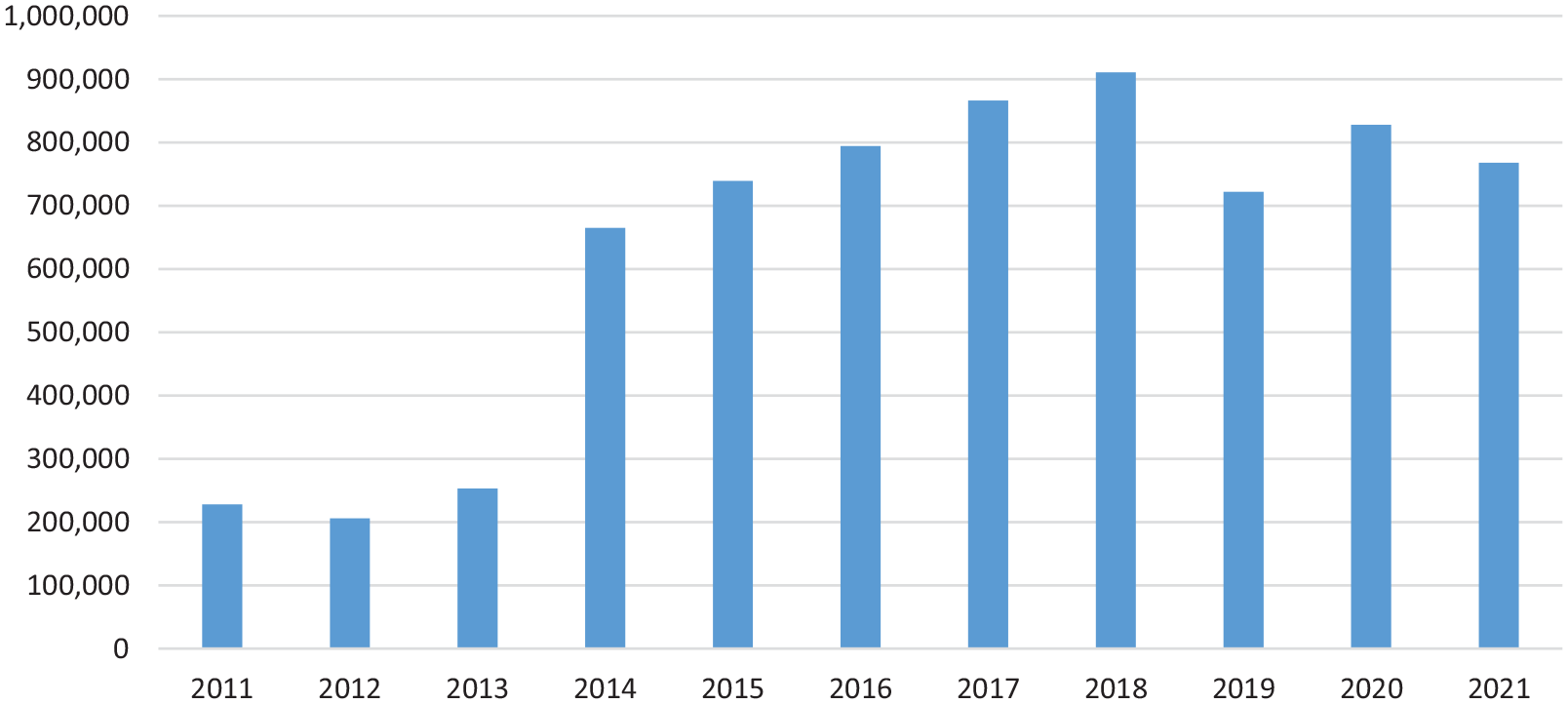
Estimated number of refugees in Ethiopia: 2011–2021.
To put this number into perspective, the total number of refugees in the country is estimated to be less than 1% of Ethiopia’s population. Yet, this insignificant percentage at the national level is significant at the regional level, particularly in the Gambella region. In this region, the refugee population surpasses the total number of hosts, where the former made up around 57% of the overall population at the end of October 2017 (UNHCR, 2017). Thus, as to an informant from ARRA, of all the refugee-hosting regions, it is in the Gambella region where the size of the refugee population has become a critical issue and has negative implications for the implementation of the new refugee regime in the region (KII6).
Except for the Eritrean refugees in the Tigray region and a small proportion of the urban refugees, the majority of these refugees are sheltered in rural refugee camps that are located in underdeveloped regions, peripheral, arid areas, lacking government and private sector investment and economic connection with the centre. Local communities have also been frustrated over the differentiated provision of and access to public services, whereby they believe that refugees have access to better services compared to them to the extent of explicitly saying ‘do we have to be a refugee to get better treatment and public service’ (KII2, former RRS employee). Thus, such negative perception, presence of a significant number of refugees, area of settlement and absence of a strong economy make the local hosting communities vulnerable to the impacts of refugees, as refugees share the scanty resources available with the hosts.
This, in turn, affects the nature of the refugee–host relationship in the country and becomes the source of tension and conflict between refugees and hosts, but with different levels of complexity across the refugee-hosting regions. Admittedly, compared to other regions, the refugee–host relationship has been difficult and ‘toxic’ in the Gambella region (Bayissa, 2010; Carver et al., 2020). It is then against this context that the government made the pledges intending to access additional resources from the international community and bring development to these impoverished peripheral regions to address the concerns of hosting communities and also benefit both its nationals and refugees in an inclusive manner.
The government has also been facing constant demands from the refugees to expand their rights and privileges in the country as per the international regimes: . . . Refugees were increasingly frustrated with the encampment and lack of mobility. They felt hopeless in the camps. . . . the hosting communities have been asking why refugees were sitting idle in the camps; why refugees were not working [on the one hand] and why refugees share the local resources [on the other hand]. (KII12)
The frustration with the encampment policy and lack of hope in the camps has left no option for some refugees, but to make secondary migration to Europe, particularly among the Eritrean refugees. Against this frustration, Eritrean refugees held a demonstration in the camps, where they urged the international community to pay attention to solve their plights and tried to pressure the donors (ARRA, 2015). With this, the issue of secondary migration became a source of mutual concern to Ethiopia and the EU and also shaped the emergence of the CRRF global refugee model.
Furthermore, refugees have been viewed and used as a foreign policy tool in the country’s relationships with its neighbours and beyond. As the government has indicated, one of its fundamental refugee protection principles has been to ‘materialize its foreign policy goal of building sustainable peace with all of its neighbours through strengthening people to people relations’ by using refugees on its soil (ARRA, 2017: 3). The strengthening of people to people relations, being one of RRS’s missions, aims to ensure or enable refugees to have a positive attitude towards the Ethiopian people and government. Accordingly, this entailed the government supporting refugees to establish healthy relationships with local communities and providing preferential treatment to encourage them to feel at home and to use them as ambassadors of Ethiopia upon their eventual repatriation and/or as proxies in Ethiopia’s conflict with the respective country of origin. However, not all refugees have cordial relationships with the hosts and have been treated equally by the Ethiopian government, as treatments have been extended to refugees depending on their relative relevance to the country’s foreign policy. Accordingly, the treatment of South Sudanese and Eritrean refugees has been influenced by Ethiopia’s relationship with Sudan and Eritrea, respectively, than by the interest to respect humanitarian and international legal obligations.
The Ethio-Sudanese relationship, shaped by the Nile water politics and boundary dispute, has been oscillating between hostility and friendship since Sudan’s independence in 1956. And depending on the existing quality of their relationship, both states allowed and supported each other’s opposition groups to operate across the border between 1961 and 2005. For instance, as Smock’s (1982) study shows the Sudanese government was offering support to Eritrean refugees in Sudan during the Cold War, which was one of the sources of antagonism between the Sudanese and Ethiopian states: Sudanese sympathy for Eritrean refugees is reinforced by their support for the liberation effort. Although the Fronts have not organized military camps inside the Sudan, the E.P.L.F. [Eritrean Peoples Liberation Front] and the E.L.F. [Eritrean Liberation Front] did have offices there, and virtually all Eritrean supplies for the war, coming from various Arab states, pass through Sudanese ports. (p. 254)
It was within this context that Ethiopia established a camp for the South Sudanese refugees (which also includes members of the rebel group) in 1969; allowed the rebel groups to have a military base in the Gambella region; and also provided them with material and diplomatic support so that they could challenge the Sudanese government. But, when cordial relations were restored between Ethiopia and Sudan as well as between Sudan and its rebel groups, the sheltering and treatment of refugees also changed in Ethiopia, where thousands of refugees have been made to repatriate to Sudan, leading to the temporary closure of camps (Aalen, 2014; Bayissa, 2010; UNICEF, 1991).
Likewise, the treatment of the Eritrean refugees has been influenced by changing nature of the Ethio-Eritrea relationships. The two countries have fought a bloody war from 1998 to 2000 and engaged in a proxy war by supporting each other’s opposition groups from 2000 to 2018. Against these antagonistic inter-state relationships, Eritrean refugees were accorded special attention by the TPLF-led Ethiopian government compared to other refugee groups, like through the Out-of-Camp Scheme and the provision of university scholarships (ARRA, 2015). However, with the removal of the TPLF leadership and the coming of Prime Minister Abiy Ahmed to power in 2018, the two countries have ended their hostile relationship and entered into rapprochement, to the extent of engaging in joint military campaigns against the TPLF-led Tigray regional government since November 2020. This turn of events domestically came to shape, inter alia, how the Eritrean refugees came to be treated in the country later on.
In this regard, ARRA (the country’s refugee agency) passed two important decisions concerning Eritrean refugees in April 2020. First, RRS decided to change the refugee status determination (RSD) criteria from prima facie to mixed criteria (both prima facie and individual-based determinations). As to the government, the reason behind this change was the lack of strict application of the individual-based procedure in the past and the need to align Ethiopia’s asylum granting procedure with the prevailing conditions of the original state (Eritrea) as though the domestic condition of human rights protection, democracy and constitution were different now. Second, RRS also decided to close the Hitsats refugee camp and relocate the Eritrean refugees to May-Ayni and Adi-Harush camps. This merger was justified by the sheer size of refugees who were granted the permit to move and reside outside of camps and the poor quality of social services provided to the refugees in Hitsats camp (ARRA, 2020, letter written to partners on 9 April 2020). However, as data from government informants revealed, the new RSD is argued to have targeted mainly the youth for the youth are the ones who are understood to escape Eritrea’s forced military conscription; and also the government is said to be interested in ensuring that only Eritrean refugees are benefitting from the resettlement opportunities, not ethnic Tigreans (Ethiopian) (who by their language similarity) are believed to have benefitted from the refugee system in the past (KII13).
Conclusion
By taking the case of Ethiopia, this paper tried to show how the role of hosting states from the Global South is central in the governance of refugees and how they negotiate multi-level pressures in the process. It was argued that the adoption of the New York Declaration and the making of pledges, which heralded the shift of refugee policy in Ethiopia, was made possible due to the availability of conducive conditions and triangular interaction of three sources: international, domestic and refugees. These three factors were meshed together to encourage the country to endorse the Declaration and implement the CRRF model. Nonetheless, the making of the pledges and its associated shift in refugee policy should not be viewed as something totally new, radical or even open-ended. Rather, it should be seen as a scaling up and official recognition of some of the informal provisions entertained by the Ethiopian state in the past. Moreover, Ethiopia’s refugee response in the post-1960s in general and the post-2016, in particular, could be characterized by its consistent, progressive, context-driven and pragmatic nature. The consistency is related to the county’s continued open-door refugee policy despite the multi-dimensional impacts of refugees and national predicaments. Progressive entails the country’s current response has been incremental, building from the previous experiences and gradually moving for the betterment of refugees’ lives in the country. And finally, its pragmatic and context-driven element is related to the country’s rational and calculated decision to make the pledges and shift its refugee policy that is contingent on the fulfilment of some basic conditions – like the availability of resources from the donors and the capacity of the country. And such state thinking essentially entails a negotiated securitization of refugees, as the state tries to negotiate between the threats and benefits of refugees while keeping the encampment policy in place and making refugee-friendly interventions dependent on conditions.
Footnotes
Declaration of conflicting interests
The author(s) declared no potential conflicts of interest with respect to the research, authorship and/or publication of this article.
Funding
The author(s) disclosed receipt of the following financial support for the research, authorship and/or publication of this article: This study was part of the PhD research funded by Bahir Dar University, Ethiopia.
