




Abstract
After the Covid-19 pandemic began to wreak havoc around the world in January 2020, Taiwan managed to stay mostly Covid-free due to swift and efficient action taken by the government to contain the outbreak. However, after the country experienced its first significant wave of domestically transmitted cases in May 2021, vaccines became a highly salient issue because Taiwan did not have enough doses to immunize all its citizens. In this study, we investigate how Taiwanese appraise the government’s overall efforts to acquire vaccines. We hypothesize that, apart from a partisan divergence of opinions, some citizens would hold ambivalent attitudes toward the way the government handled the vaccine procurement process. Results from multivariate regression analysis indicate that the effect of party identification on evaluations of government is conditionally dependent on citizens’ level of ambivalence. Specifically, increased ambivalence offsets the strong effect of party affiliation on government evaluation, especially for political independents and supporters of opposition parties.
Introduction
For most of 2020 and the first few months of 2021, Taiwan was an anomaly on a planet ravaged by the novel coronavirus disease (Covid-19). With its close economic ties with and geographic proximity to China, Taiwan had been predicted to be one of the countries worst affected by the pandemic. However, Taiwan leveraged the bitter lessons it had learned from containing the 2003 severe acute respiratory syndrome (SARS) outbreak and responded to the Covid-19 crisis with rapid control measures, prudent actions, and transparency (Chen, 2021; Wang et al., 2020). Initially, there were no large-scale local outbreaks in Taiwan, and the total number of confirmed domestic cases and deaths was extremely low by global standards. Taiwan’s success in keeping Covid-19 at bay not only earned the island country widespread international recognition and praise, but also dramatically boosted public support for President Tsai Ing-wen and her government at home (Wang and Cheng, 2021). While much of the world was subject to painful or prolonged lockdowns, life in Taiwan went on pretty much as it had done in pre-pandemic times.
But Taiwan’s sense of normalcy was abruptly upended in May 2021, when a cluster of Covid-19 cases in a hotel housing quarantined airline pilots led to infections rippling through the island. At that point, the Taiwanese government suddenly found itself ill-prepared to handle a spike in cases—mostly triggered by new highly transmissible variants of the virus—that would have been unthinkable a few months prior. At a time when countries around the world had already started mass vaccination programs, Taiwan was struggling, due both to a shortage of vaccines and an initial lack of interest in getting vaccinated among the public.
As shall be explained in a subsequent section, after the May 2021 surge in cases, the issue of when and how the Taiwanese government could acquire enough vaccines to inoculate its population became extremely salient. For a variety of reasons, the government was struggling to obtain vaccines from abroad. Before this most recent outbreak, Taiwan had only about 0.3 million doses of Covid-19 vaccines in stock for a population of more than 23 million. Now that the public had started to seriously worry about contracting the virus, demand for the shots far exceeded supply. In these circumstances, who to blame for the insufficient (or slow) acquisition of Covid-19 vaccines became a highly divisive question within Taiwanese society—with some accusing China of interfering with Taiwan’s vaccine deals and others faulting the Tsai administration for incompetence or for putting ideology and politics ahead of public health.
This study takes a small step toward understanding how the Taiwanese public has assessed the government’s overall efforts to acquire Covid-19 vaccines. We examine how Taiwanese citizens consider the issue of vaccine procurement from the perspectives of party identification and attitudinal ambivalence. That is, do they think about this issue along partisan lines, or does the issue of vaccines generate ambivalent evaluations of the government? And how is party identification related to political ambivalence? Answers to these questions would provide us with a finer picture of how citizens structure their opinions toward this critical aspect of governmental work in the pandemic era. Moreover, while much has been written about how Taiwan stopped the spread of Covid-19 at the beginning of the outbreak, to our knowledge there are (as yet) few scholarly analyses of Taiwan’s performance in the pandemic’s second year and beyond. As the global fight against the disease shifts its strategic focus from containment and mitigation to mass vaccination and future coexistence with the virus, we believe it is worthwhile to explore Taiwanese attitudes to these pandemic responses.
In the next section, we briefly present the two basic theoretical constructs used in the study to explain citizens’ evaluations. This is followed by a discussion of Taiwan’s quest to acquire Covid-19 vaccines. Here we describe how vaccines—which on the face of it, constitute a public health rather than a political issue—became so contentious in Taiwan. After an overview of the data and operationalization of the variables, the ensuing sections present the results of the statistical analyses, with a brief conclusion in the final section.
Party identification, ambivalence, and political opinion
Political scientists have long recognized that party identification is a core and strong determinant of mass political attitudes and voting preferences (Campbell et al., 1960; Fiorina, 1981; Green et al., 2008). For many citizens, party identification serves as a “touchstone for relating to the political world” (Keele and Wolak, 2006: 673), and this affective attachment acts as a powerful “perceptual screen” as well as an informational shortcut that shapes their attitudes on different public policy issues (Bartels, 2002; Carsey and Layman, 2006). A rich body of public opinion research provides evidence that citizens’ political perceptions and policy evaluations are systematically connected to whether their favored party is in office (Bartels, 2002; Bisgaard, 2015; Evans and Andersen, 2006; Jerit and Barabas, 2012).
At the extreme, these studies suggest that the underlying motivation to defend one’s partisan identity can induce individuals to process new information selectively, even dismissing at times any information that does not conform to prior attitudes and beliefs (Taber and Lodge, 2006). This is because people “want” to think that their party is performing well, so they tend to reject information that does not align with their predefined conclusions, and to seek out or uncritically accept information that does (Bisgaard, 2015). On this basis, a core expectation is that party identifiers are predicted to give markedly more positive evaluations of government actions if they identify with the party in power, and negative evaluations if they identify with the opposition.
Thus, the fact that citizens of different partisan stripes can diverge greatly in their political perceptions and world views should not come as a surprise. However, citizens are obviously not equal in their level of adherence or psychological attachment to a party, and not every policy or issue can be neatly divided along party lines. When facing a topic of public concern, especially one that has competing perspectives, some individuals can quickly take one side of the debate, while others may find it more difficult to reach a decision because they see merits on both sides.
Indeed, recent public opinion and political psychology research has increasingly acknowledged that people’s political opinions may not be as unidimensional and bipolar as traditionally conceptualized (Craig and Martinez, 2005; Feldman and Zaller, 1992; Lavine et al., 1998; Lavine et al., 2012; Rudolph and Popp, 2007; Thompson et al., 1995). Rather, individuals regularly internalize both sides of a political issue or attitude object, forming and developing opinions that are not simply positive or negative evaluations, but simultaneously positive and negative, or “ambivalent” (Lavine, 2001: 915). By nature, people who experience ambivalence are more conflicted in their political judgments due to the concurrent presence of mixed feelings, heterogeneous beliefs, and opposite reactions (Meffert et al., 2004; Rudolph, 2011). Ambivalent individuals are generally less responsive to party cues than strong party identifiers (Basinger and Lavine, 2005). It is important to underscore that, while the degree to which people experience ambivalence may vary from person to person, ambivalence is conceptually distinct from neutral or indifferent attitudes, which derive from the lack of either positive or negative evaluations (Schneider and Schwarz, 2017).
Nevertheless, despite a large volume of research that has examined the various relationships among party identification, party cues, and political attitudes (Johnston, 2006), the magnitude and nature of partisan influence on public opinion formation in the light of citizens’ potentially ambivalent attitudes remain under- or unevenly explored in the literature. For instance, it is unclear if and to what extent people’s partisan predispositions and levels of ambivalence interact with other salient political concepts, such as assessments of government performance in the management of public affairs. We also do not know whether the established association linking partisanship and ambivalence with political attitudes would function on ostensibly apolitical issues, or on issues that are extremely urgent and short-term. In addition, apart from a handful of studies (e.g. Chang et al., 2014; Chang and Wu, 2019; Chang and Wu, 2022), research on citizens’ ambivalent political attitudes outside of a US or European setting continues to be scarce. By studying how Taiwanese public opinion is shaped by party identification and ambivalence, this study hopes to advance understanding in the aforementioned areas.
The politics of vaccines in Taiwan
For 16 months after the Covid-19 pandemic began to wreak havoc around the world, Taiwan managed to stay mostly virus-free due to swift and effective action taken by the Democratic Progressive Party (DPP) government under Tsai Ing-wen. Effective control measures, such as strict border controls, contact-tracing and quarantine for anyone testing positive, and a soft mandate encouraging people to wear masks in public, essentially kept the pathogen out of the country, and allowed 23.5 million Taiwanese to largely lead normal lives. Despite Taiwan’s success in containing the virus—it once went more than 250 consecutive days without a new locally transmitted infection (Thornton and Griffiths, 2020)—the Tsai administration, nevertheless, began discussions with major pharmaceutical companies about purchasing their vaccines in the fall of 2020. To meet the country’s vaccination objectives and reduce dependence on foreign vaccines, the government also decided to invest in the research and development of domestically produced vaccines, an initiative that received strong bipartisan support.
In February 2021, the government announced that it had ordered 10 million doses of the AstraZeneca (AZ) and 5 million doses of the Moderna vaccines and had negotiated the purchase of another 4.76 million doses through the global COVAX platform. In a radio interview that month, Taiwanese health minister Chen Shih-chung revealed that Taiwan had also signed a deal for five million doses of vaccine with the German manufacturer BioNTech (BNT), but the company backed out of the agreement at the last minute, possibly due to “political pressure” from China (Gan, 2021). 1 Arguably, these official announcements of vaccine purchases were meant to inform and reassure a watchful public that the government was working diligently to procure vaccines from abroad.
Taiwan kicked off its mass vaccination program after the first shipments of around 3000 AZ vaccines arrived in Taiwan in March and April 2021. The first people to receive shots were medical staff and other front-line epidemic prevention workers. The program was later expanded to include police officers, care workers, the elderly, and the military. By mid-April, people outside the government’s priority list could get vaccinated too if they were willing to shoulder the cost. Yet at that time, Taiwanese people’s interest in getting vaccinated was low, for three reasons. First, most Taiwanese did not perceive any benefit in vaccination when there seemed to be so few confirmed domestic cases. Second, foreign media reports of blood clots and other adverse reactions to the AZ vaccine possibly scared off many individuals. And third, vaccine hesitancy also played a small role because some citizens were speculating that a better (or safer) vaccine would be made available later. To allay the public’s fears about AZ and boost vaccine acceptance, public figures such as Premier Su Tseng-chang volunteered to be jabbed to underscore the government’s confidence in the vaccine’s safety.
When Taiwan experienced its first major Covid-19 outbreak in late April and early May 2021, public demand for vaccines quickly shot up as the number of confirmed cases and deaths surged. In a little over a month, Taiwan reported over 10,000 new locally transmitted cases; for context, just 2 months prior, there had been only about 1000 cases since the start of the pandemic (Ritchie et al., 2020a). To prevent further spread of the virus, Taiwan’s health authorities issued a nationwide Level 3 Covid-19 alert, which amounted to a “soft” or partial lockdown.
With less than 2% of the population inoculated and a very low vaccine stockpile (Ritchie et al., 2020b), the urgent need to contain the virus intensified the political discord surrounding vaccines in Taiwan. Hoping to tap into this wide public anxiety, distress, and discontent over the issue of vaccines (or the lack thereof), the Kuomintang (KMT), the largest opposition party in Taiwan, ramped up its criticism of the Tsai administration. KMT politicians blamed the DPP government not only for letting in the deadly virus by irresponsibly relaxing Covid-19 quarantine restrictions, but also for delays in vaccine shipments that resulted in Taiwan not having enough doses to immunize the population as needed. Other KMT party elites slammed the DPP government for its lackadaisical effort in acquiring vaccines and for being biased against Chinese-made vaccines such as Sinovac and Sinopharm on ideological grounds. They even accused the Tsai administration of obfuscation because it could not explain why Taiwan was experiencing delays or did not know when the vaccines already purchased would be delivered. Indeed, the resurgence of local infections also came at a most inopportune moment when there was a shortage of Covid-19 vaccines worldwide.
The KMT elites attacked other aspects of the government’s vaccine policies as well. When private firms and nongovernmental organizations (i.e. Foxconn, the Taiwan Semiconductor Manufacturing Company, and the Buddhist Tzu Chi Charity Foundation) offered to negotiate and purchase BNT vaccines on the government’s behalf, the opposition accused the Tsai administration of putting up legal and technical barriers to prevent these groups from upstaging it. The KMT also blasted the government’s decision to grant emergency use authorization to a locally developed vaccine known as Medigen without data from phase 3 clinical trials (Silver, 2021), despite the fact that the party had initially given its full support to the development of a domestically produced vaccine. 2 Members of the opposition believed that by expediting the approval process for Medigen, the Tsai administration was jeopardizing the health of Taiwan citizens, or worse, using them as “lab rats.”
Whether or not the opposition parties’ criticisms of the government had merit, the issue of vaccines had needlessly become an antagonistic one. Before, during, and after the outbreak, leaders of the KMT and other opposition parties questioned and challenged nearly every one of the Tsai administration’s vaccine decisions, perhaps expecting to score political points at the DPP’s expense. And at times they succeeded in turning public opinion against the government, as several media polls conducted around that time suggested declining approval ratings for President Tsai and her administration. In all fairness, however, the delay in vaccine shipments was not something that the Tsai administration truly had control over.
Many other countries in the region faced similar difficulties or delays in receiving Covid-19 vaccines, not to mention reports of wealthier countries buying up and hoarding vaccines. Also, Covid-19 vaccines made in China are banned by law in Taiwan, and there was no widespread demand among Taiwanese citizens to purchase Chinese-made vaccines, given reports of their low levels of efficacy. Moreover, the allegation that the DPP government attempted to hamper private organizations from purchasing vaccines has thus far not been proven. As for the controversy over the Taiwan government’s decision to fast-track the homegrown Medigen vaccine, it is difficult to say with certainty whether the decision was correctly made. We must leave this debate to future scholars because only time and new medical evidence can tell if the Tsai administration was right in granting emergency use authorization to the Medigen vaccine.
Nevertheless, Taiwan’s vaccine shortage was gradually and ultimately resolved when millions of doses, primarily donated by the United States and Japan, began to arrive at the beginning of June. 3 These timely foreign donations—from two of Taiwan’s closest partners in the region—played a critical role in stabilizing public sentiment in Taiwan, and greatly reduced the political pressure on President Tsai and her administration. Slowly over the next few months, batches of Covid-19 vaccines that Taiwan had itself purchased started to arrive, too. More importantly, with these millions of doses on hand and steadier deliveries of vaccines from global manufacturers, Taiwan finally was able to get on track with its mass vaccination campaign, weeks later than desired but surely better late than never. However, even after the vaccination drive was in full swing, the KMT continued its criticism of the government’s vaccine measures, a further testament to the politicization of the vaccine issue.
Research hypotheses, data, and methods
From the foregoing description of the vaccine situation in Taiwan, two hypotheses can be proposed on how Taiwan citizens would be expected to evaluate the government’s vaccine procurement effort. First, we consider the effect of party identification. Recent empirical studies show that across a host of countries, party identification—often measured by one’s alignment with the governing party—continues to exert strong influence on evaluations of government performance as well as other political attitudes and behaviors, even in the context of the Covid-19 pandemic (Altiparmakis et al., 2021; Camobreco and He, 2022; Pickup et al., 2020). Therefore, given that vaccines constitute a salient issue that has been regrettably politicized in Taiwan, our first hypothesis is:
Hypothesis 1 (party identification): With respect to the issue of vaccine procurement, supporters of the Tsai administration (“pan-greens”) will rate the government’s effort more positively than opposition party supporters (“pan-blues”) and political independents, or alternatively, pan-blue supporters and political independents will evaluate the government’s effort more negatively than pan-green partisans.
Second, as noted previously, political scientists have also long recognized the significance of attitudinal ambivalence in public opinion research because individual political attitudes are often the outcome of competing (or conflicting) considerations (Lavine, 2001). While ambivalence can often imply heterogeneity and instability of opinions, ambivalent individuals are more likely to see the complexity of political issues and more likely to be even-handed in making decisions (Keele and Wolak, 2008). Previous research has shown that ambivalence reduces extremist attitudes. In the context of this study, when Taiwan was hit with its worst outbreak since the Covid-19 pandemic began and life-saving vaccines simply had not arrived, the straight-up, unambivalent partisan would either rush to blame the government (if she identified with the opposition party) or attempt to defend and rally behind the government (if she identified with the ruling party). But the ambivalent partisan likely would not have acted that quickly. Possessing as they do both negative and positive reactions, ambivalent people are often “pulled toward the middle” by their contradictory dispositions, thus producing attitudinal moderation (Meffert et al., 2004). Under these circumstances, we hypothesize that ambivalence would offset or counteract the effect of party identification:
Hypothesis 2 (ambivalence): The relationship between party identification and evaluations of the government’s vaccine procurement effort is conditionally dependent on level of ambivalence. More specifically, ambivalence mitigates the negative evaluations of the government among pan-blue supporters and political independents, thus offsetting the effect of party identification.
For our analysis, we utilize data provided by the 2021 Image of China Survey, a project sponsored by Taiwan’s Ministry of Science and Technology. The national telephone survey was conducted by the Academia Sinica Center for Survey Research from 27 September to 25 October 2021. A total of 1920 eligible respondents successfully completed the survey, for a sampling error of ±3.1% at the 95% confidence level. Survey respondents were all 20 years of age or above and residents of Taiwan.
The 4-month gap between the May 2021 surge and the survey implementation period allowed respondents to provide a more comprehensive and considered retrospective evaluation of the government’s attempts to acquire vaccines, although we do acknowledge that there might be some recall bias. By the time the survey was finalized in late October, the vaccine shortage crisis in Taiwan was over, as nearly 30 million doses of Covid-19 vaccines had been delivered to Taiwan in the preceding months. These shipments included both Taiwan’s own purchases as well as domestic and foreign vaccine donations.
In this study, the main dependent variable is citizens’ overall evaluation of government efforts to procure Covid-19 vaccines. In the survey, respondents were asked: “In general, how would you rate the performance of the central government regarding the issue of ‘vaccine procurement,’ where ‘0’ means very poor and ‘10’ means very good?” All respondents who failed to provide an answer were removed from the analysis and treated as missing. This variable has a mean of 5.38 and a standard deviation of 3.15. For more details on the coding and description of all the measures, please see the appendix. 4
Our primary independent variables are the respondents’ (1) party identification and (2) their attitudinal ambivalence on the issue of vaccine procurement. For the first variable, we asked the question: “There are many political parties in Taiwan. Which political party best represents your views?” Respondents were provided with a short list of the more prominent political parties in Taiwan and their answers were then recorded. For ease of interpretation, we subsequently re-categorized these responses into three main voting blocs: (1) supporters of the “pan-green” camp, which consists of the incumbent DPP and its allies; (2) supporters of the “pan-blue” coalition, which comprises the main opposition party, the KMT, and its allies; and (3) political independents, which include individuals who did not feel they identified with any political party, as well as citizens who said that their electoral decisions are solely based on the qualifications of the candidates, not of the parties. Out of the 1911 respondents who answered the question, 768 (40.2%) identified with the pan-green camp, 711 (37.2%) were pan-blue partisans, and 432 (22.6%) categorized themselves as independents without any clear party affiliation.
With respect to the second independent variable, we used two open-ended questions to tap the attitudinal ambivalence of citizens toward government work in vaccine procurement. In one question, respondents were asked to list (up to) three things that they found satisfactory about the central government’s attempt to obtain vaccines. If the respondent indicated that nothing was positive about it, a response of “0” (zero) was entered. In a similar manner, respondents were asked to list (up to) three things that they found unsatisfactory about the central government’s bid to acquire vaccines. Again, a response of “0” was entered if the respondent did not specify any aspect of the government’s work with which they were dissatisfied or unhappy. 5 From the patterns of responses to the two questionnaire items above, we then employed the following formula proposed by Thompson et al. (1995) to calculate an ambivalence score for each respondent
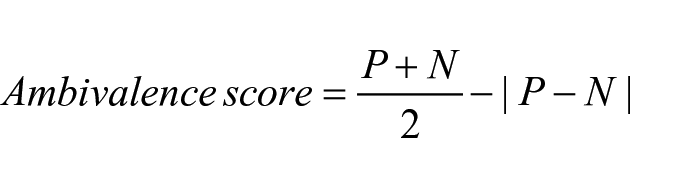
where P and N equal the number of positive and negative reactions toward the government’s vaccine procurement effort, respectively. Individuals exhibit ambivalence when they have a similar number of positive and negative reactions; they do not if they only have one-sided opinions (i.e. all positive or all negative). Here, values for both P and N range from 0 to 3, so the ambivalence scores range from a low of −1.5 to a high of +3. In general, we refer to individuals with ambivalence scores greater than zero as “ambivalent,” and label those with scores less than zero as “univalent” or “one-sided.” Individuals with an ambivalence score exactly equal to zero are typically termed “indifferent” in the literature (Thornton, 2013).
In addition to the two explanatory variables above, we included the respondent’s gender, age, level of educational attainment, ethnicity, and national identity (i.e. Taiwanese, Chinese, or both Taiwanese and Chinese) as demographic control variables. We also collected information on the respondents’ levels of political knowledge, perceived sense of political efficacy (popularly defined as a citizen’s belief that he or she can understand and influence political affairs), and their frequency of using different media channels/platforms (e.g. traditional media outlets, social media and online news websites, political talk shows, and YouTubers and influencers) to obtain political news. Finally, we also controlled for the respondents’ (1) satisfaction with government protocols (such as the establishment of a four-tier alert system) to contain the spread of the virus, and (2) satisfaction with the roll-out of Covid-19 subsidy and relief measures (e.g. the Quintuple Stimulus Vouchers program, personal loan extensions, and employment and tax assistance). The inclusion of these latter two variables serves to distinguish different areas of the government’s pandemic response, so that the respondent’s assessments of vaccine procurement can be isolated from her other evaluations.
Discussion of findings
Do Taiwanese feel that the central government did a good job in the procurement of vaccines, or a poor one? In Table 1, we list the top responses provided by citizens with respect to what they saw as satisfactory. As can be seen from the table, 64.6% of all responses were “None,” which is a powerful indication that, for most Taiwan citizens, there were few laudable things to say about the way the Tsai administration dealt with the vaccine shortage problem. According to the table, the four most common positive feedback items were that (1) the government purchased enough vaccine doses for everyone (3.9% of all responses); (2) the government took active steps to assist private organizations in buying vaccines on its behalf (3.5%); (3) many countries donated their Covid-19 vaccines to Taiwan (2.6%); and (4) the government invested in and helped develop a successful domestic vaccine (2.1%).
What Taiwan citizens found satisfactory about the Government’s vaccine procurement effort—top responses.
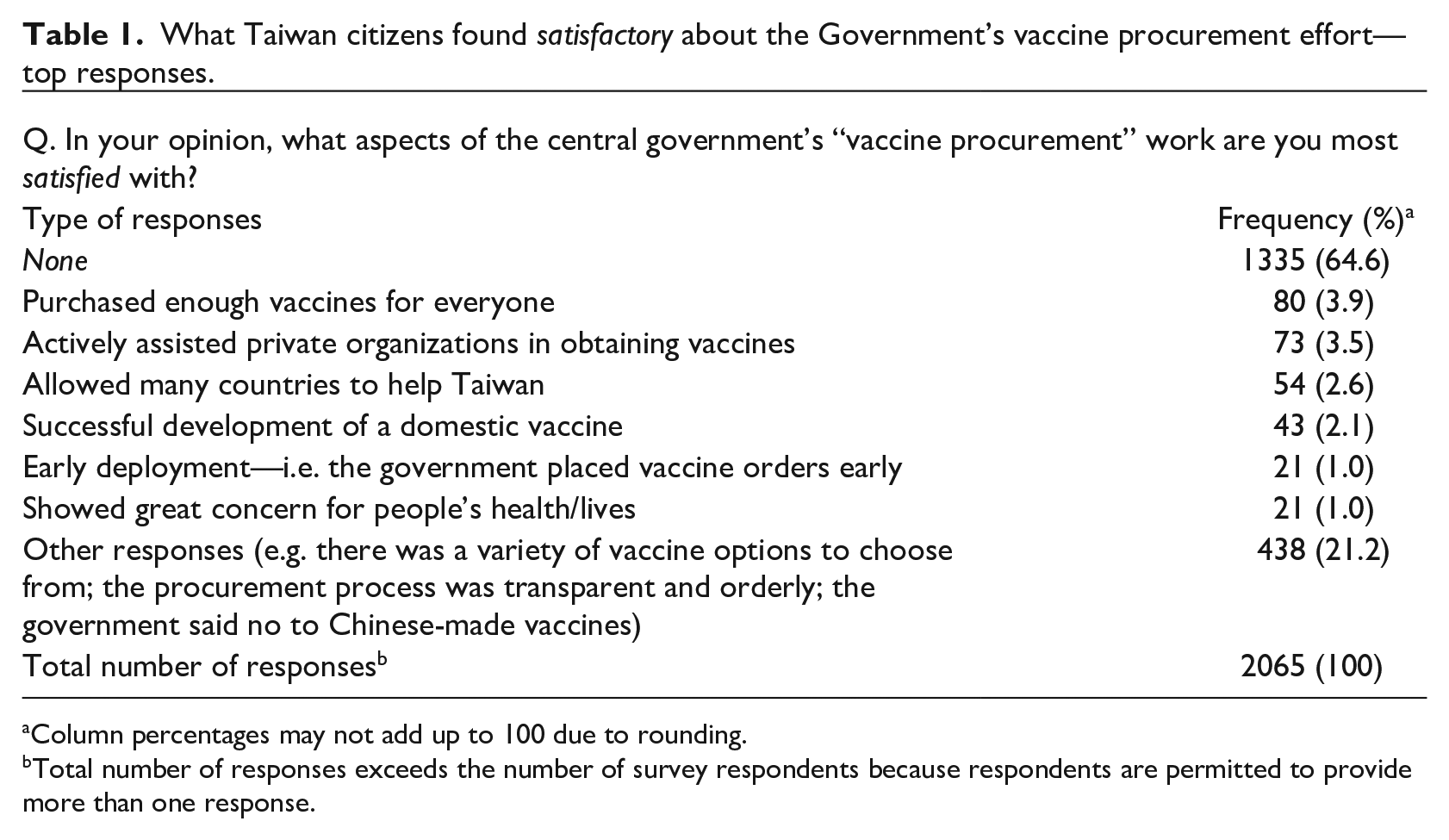
Column percentages may not add up to 100 due to rounding.
Total number of responses exceeds the number of survey respondents because respondents are permitted to provide more than one response.
Table 2, by contrast, lists the most common responses to the question of what Taiwan citizens found to be unsatisfactory. Here we immediately note that the share of “all” responses is much lower (28%), meaning that there was indeed much grumbling and discontent among Taiwanese. From the table, we note that the top 2 complaints from citizens were that the central government acted too slowly in the acquisition of vaccines (19.8%), and that the Tsai administration did not purchase enough vaccines (14.9%). It is notable that these two grievances represent over a third of all responses. Other criticisms of the government’s work include hindering or thwarting private organizations’ attempts to obtain vaccines (4.7%); putting too much faith in the development of domestic vaccines (4.2%); and the allegation that the entire vaccine procurement process had been a “black box” and not at all transparent (4.1%).
What Taiwan citizens found unsatisfactory about the Government’s vaccine procurement effort—top responses.
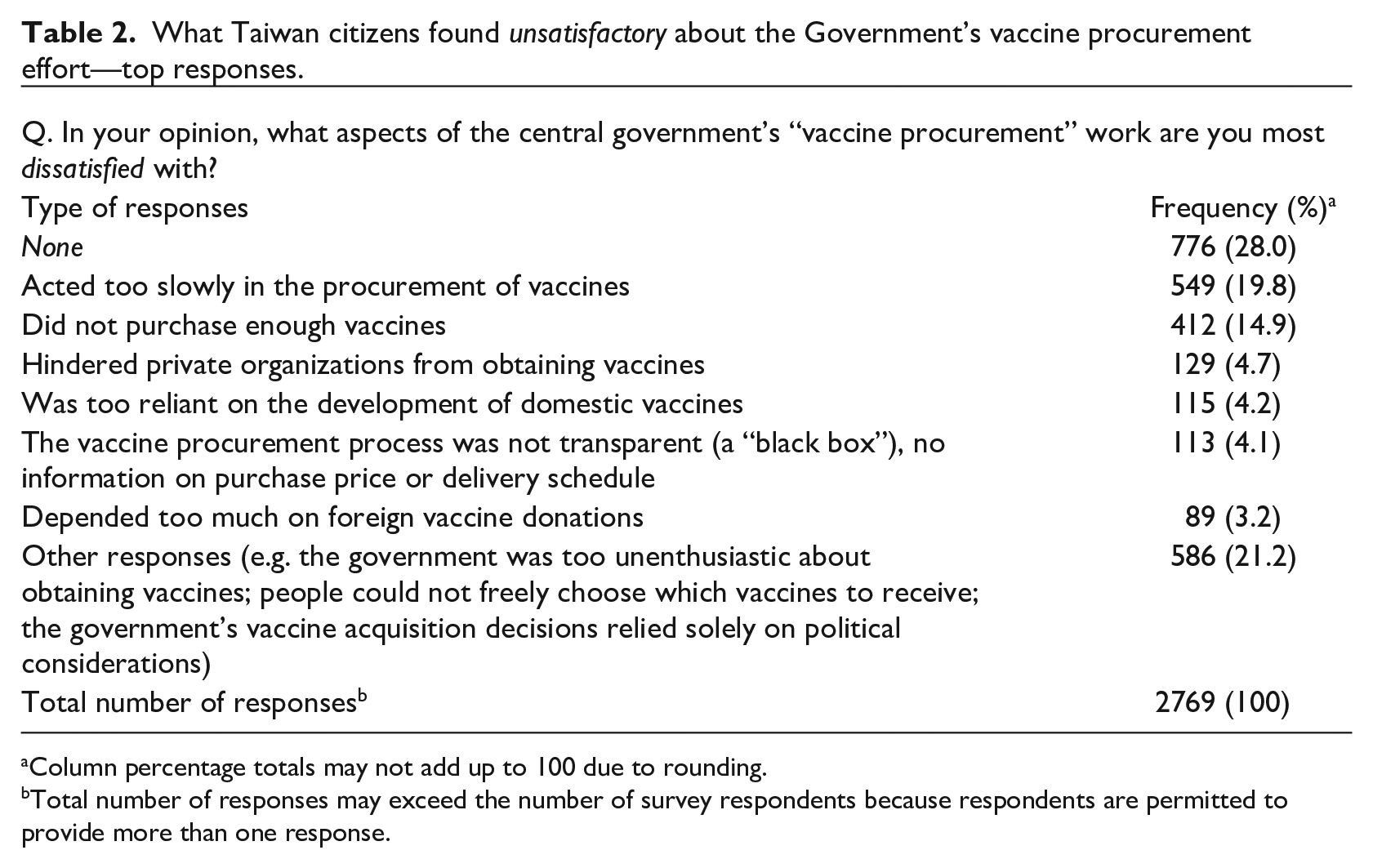
Column percentage totals may not add up to 100 due to rounding.
Total number of responses may exceed the number of survey respondents because respondents are permitted to provide more than one response.
The frequencies of the responses reported above give us a good idea of the level of displeasure, anxiety, and frustration among the Taiwan public concerning the lack of vaccines. Our next task is to uncover whether this level of dissatisfaction is associated with party identification, and whether the respondents arrived at those opinions in similar ways (i.e. under a comparable mix of positive and negative feelings). To do so, we first calculate the ambivalence score for each respondent, and then examine whether the respondent’s ambivalence score is contingent on his or her party identification.
Results of the cross-tabulation are presented in Table 3. Looking at the last column (total), we can see that overall, 64.7% of the respondents can be categorized as univalent (ambivalence scores less than 0), 24.3% as indifferent (ambivalence scores equal to 0), and 11.0% as ambivalent (ambivalence scores greater than 0). When breaking down these percentages by the respondents’ party alignment, however, we find that as many as 80.3% of pan-blue voters are univalent, compared to 59.2% and 53.2% of the independent and pan-green supporters, respectively. This result means that most pan-blue partisans did not experience discord in their opinions. In contrast, political independents have the largest share (32.2%) of individuals classified as indifferent, while their pan-green counterparts have the highest share of ambivalent citizens among the three groups, at 15.7%. Given the widespread discontent in Taiwan regarding the shortage of vaccines, this finding is consistent with the argument that supporters of the ruling party—in this case, the pan-greens—are more likely to feel torn or suffer conflicting evaluations when the government they support is struggling to manage the nation’s affairs (Lavine et al., 2012). An analysis of variance (not shown) further indicates that pan-blue supporters, political independents, and pan-green supporters differed significantly in their mean ambivalence scores, F(2, 1896) = 87.7, p < 0.001.
Cross-tabulation between ambivalence and party identification.
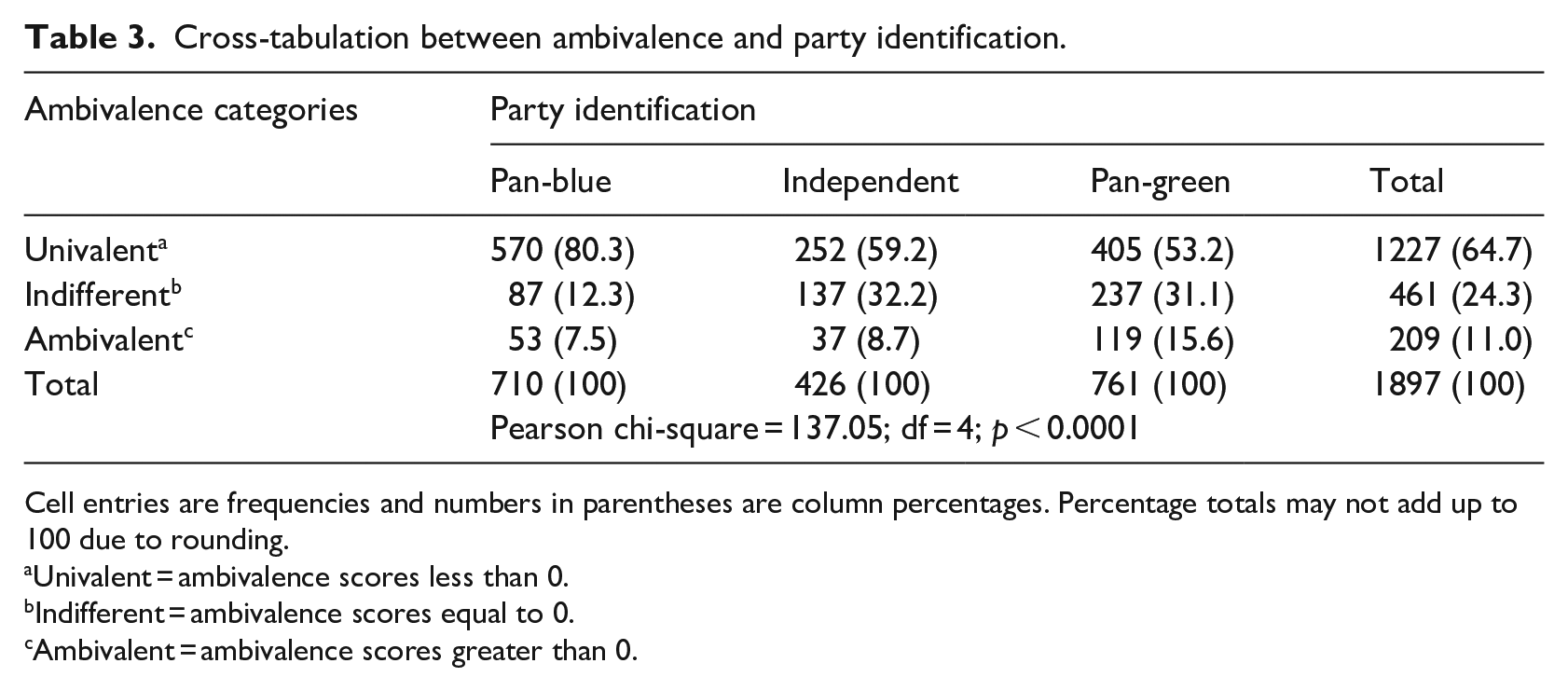
Cell entries are frequencies and numbers in parentheses are column percentages. Percentage totals may not add up to 100 due to rounding.
Univalent = ambivalence scores less than 0.
Indifferent = ambivalence scores equal to 0.
Ambivalent = ambivalence scores greater than 0.
What factors predict citizens’ evaluations of the Taiwan government’s efforts to procure vaccines? Table 4 reports the results of a multivariate regression analysis using ordinary least squares (OLS), with evaluations of government serving as the dependent variable. Two separate models are presented: Model 1 includes all the independent variables and control variables described above. Model 2 further adds a product term between party identification and ambivalence for identifying an interaction effect. Examination of the regression coefficients yields several findings, which are described below.
Regression model for estimating citizen evaluations of the Government’s vaccine procurement effort in Taiwan.

DV: dependent variable; SE: standard error.
Significance levels: *p < 0.05; **p < 0.01; ***p < 0.001.
First, in Model 1, the regression coefficients associated with party identification or affiliation are statistically significant and have negative signs. On a 10-point scale, the ratings of the Tsai administration’s vaccine procurement effort for pan-blue members and political independents are, respectively, −1.16 and −0.58 points lower than for pan-green identifiers. The findings confirm Hypothesis 1, which states that party identification and party cues will strongly influence people’s assessments of the government.
Second, citizens’ ambivalence is positively and significantly associated with evaluations of the government’s work on vaccines. This result implies that ambivalent citizens perhaps accept (or at least acknowledge or recognize) that Taiwan’s difficulties in securing vaccines during the first half of 2021 were not entirely due to government mistakes. After signing deals with Western vaccine manufacturers at the beginning of the year, the Tsai administration could not have known that vaccine deliveries would be severely delayed, or that the May outbreak would completely upend its vaccination plans.
Third, there are other significant predictors in the model, including political efficacy, satisfaction with government pandemic protocols, satisfaction with Covid-19 subsidy and relief packages, age, and national identity. On the other hand, political knowledge, frequency of using different media sources for political information, gender, education, and ethnicity are insignificant predictors.
In Model 2, we test for interaction between party identification and ambivalence in predicting the dependent variable. Indeed, the coefficients on the product terms are statistically significant and have signs opposite to those on the constitutive terms. This finding supports Hypothesis 2, showing that the effect of party identification on assessments of the government’s vaccine procurement effort is conditionally dependent on the level of ambivalence.
To better illustrate the results of interactive Model 2, Figure 1 plots the predicted evaluations of the government regarding vaccine procurement for the three voting blocs with respect to the level of ambivalence. The figure indicates that, holding all other variables at their mean levels, an increase in the level of ambivalence is associated with more positive appraisals. But we also find that the rates of increase (i.e. the slopes) are different for each group. That is, the tendency for pan-blue supporters and political independents to give the government higher marks grows stronger as their level of ambivalence increases. At the maximum level of ambivalence (+3), members of the pan-blue camp are predicted to give evaluations that are roughly one full point higher than those provided by the pan-greens; for fully ambivalent political independents, it is two points higher. This result is aligned with the idea that ambivalent voters rely less on party cues for their judgments (Basinger and Lavine, 2005). Figure 1 also shows that the marginal effect of ambivalence on pan-green supporters is small. Given that the DPP is the ruling party, pan-green supporters are likely to rate the government’s procurement work more consistently than other voting groups, regardless of their level of ambivalence.
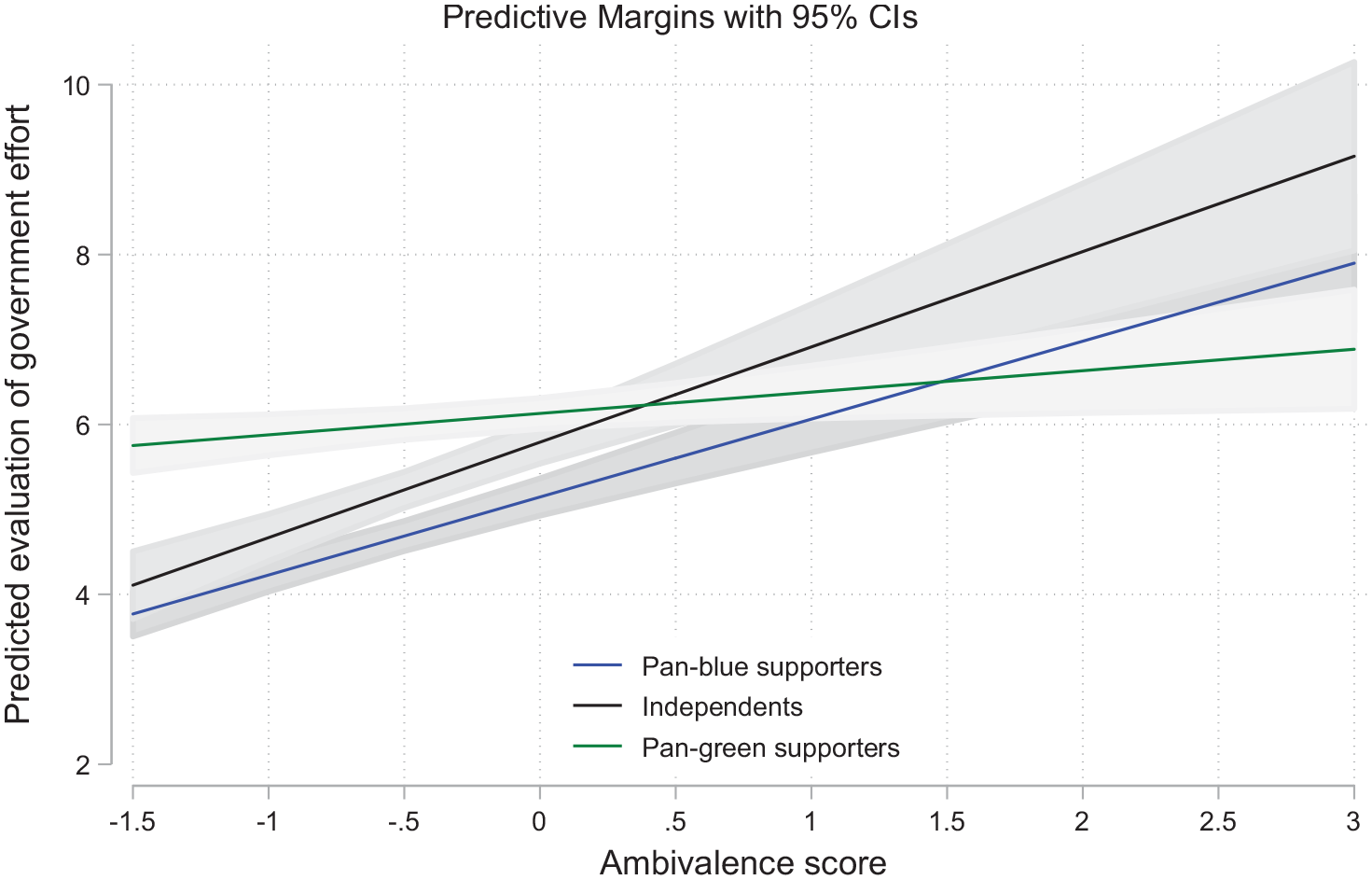
Predicted evaluation of the Government’s vaccine procurement work, by party identification.
Conclusion
In this study, we examine how party identification and ambivalence interact to shape citizens’ opinions in one critical area of the government’s response to Covid-19. We focus on the issue of vaccines because it became highly salient after Taiwan witnessed a sudden spike in local Covid-19 infections in May 2021. Vaccines and the issue of vaccine procurement—something that should have been a public health matter reserved for medical and other professionals—became a battleground for the country’s two main political forces. The vaccine issue became part of what is considered to be “routine” politics in Taiwan.
The politicization of the vaccine issue implies that this might be another instance of party identification being the source from which Taiwanese derive their political attitudes and opinions. In our analysis, we find that there are strong partisan differences in people’s evaluations of how the Tsai administration handled vaccine procurement, with pan-blue identifiers providing the lowest evaluations and the pan-greens the highest, a result that is hardly surprising. Yet we have also found evidence that the effect of party identification on performance evaluation depends significantly on the individual’s level of ambivalence. This suggests that voters are not a monolithic group that always thinks or acts as it is told to by party elites. And by overlooking the role of ambivalence in opinion formation, researchers may be missing the complete picture.
Although Taiwan’s vaccine shortage problem faded away before it became catastrophic, there is no denying that the Tsai administration dodged the proverbial bullet thanks to timely vaccine donations from other countries. Unlike other aspects of the government’s work during the pandemic, the procurement of vaccines was one area in which Taiwan citizens thought the government’s performance was unsatisfactory, and our survey data show just that. If newer and more contagious variants of Covid-19 cause the pandemic to persist, ensuring more diverse sources of vaccines should clearly be a priority for the government.
This study has several limitations which point to opportunities for future research. First, although we have a measure of ambivalence, we have not delved deep enough into the sources or causes of this ambivalence. Second, due to data limitations, the impact of the information environment on individual-level ambivalence and decision-making remains untested. Third, as with most opinion surveys, the relationships revealed in the study are based on cross-sectional data and cannot demonstrate causality. Further research that uses experimental designs would better identity the specific conditions under which ambivalent attitudes interact with party identification, and how they jointly affect the evaluations of a third object, such as a policy issue or a candidate.
Supplemental Material
sj-dta-1-jas-10.1177_00219096221137675 – Supplemental material for Party Identification, Ambivalence, and the Issue of Vaccine Procurement in Taiwan
Supplemental material, sj-dta-1-jas-10.1177_00219096221137675 for Party Identification, Ambivalence, and the Issue of Vaccine Procurement in Taiwan by Alex Min-Wei Lin and Chung-li Wu in Journal of Asian and African Studies
Footnotes
Appendix 1
Appendix 2
Descriptive statistics.

| Variable | N | Mean or % | SD | Min | Max |
|---|---|---|---|---|---|
| Evaluation of the government’s vaccine procurement | 1900 | 5.38 | 3.15 | 0 | 10 |
| Ambivalence score | 1905 | –0.44 | 0.68 | –1.5 | 3 |
| Party identification | 1911 | 2.03 | 0.88 | 1 | 3 |
| Pan-blue supporters | 1911 | 37.21% | – | – | – |
| Independents | 1911 | 22.61% | – | – | – |
| Pan-green supporters | 1911 | 40.19% | – | – | – |
| Political knowledge | 1920 | 1.89 | 0.69 | 0 | 3 |
| Sense of political efficacy | 1846 | 7.52 | 2.43 | 3 | 12 |
| Satisfaction with government’s Covid-19 protocols | 1873 | 2.96 | 0.87 | 1 | 4 |
| Satisfaction with Covid-19 subsidy and relief measures | 1882 | 2.61 | 1.00 | 1 | 4 |
| Frequency of using media to obtain political news | 1832 | 10.74 | 3.01 | 4 | 16 |
| Gender (female = 1) | 1920 | 0.50 | 0.50 | 0 | 1 |
| Age | 1900 | 53.93 | 14.52 | 20 | 95 |
| Education (by level) | 1918 | 2.52 | 0.90 | 1 | 4 |
| Junior high school or below | 1918 | 16.01% | – | – | – |
| High school | 1918 | 28.36% | – | – | – |
| University | 1918 | 43.80% | – | – | – |
| Graduate school | 1918 | 11.84% | – | – | – |
| Ethnicity | 1879 | 2.03 | 0.52 | 1 | 3 |
| Taiwanese Hakka | 1879 | 11.92% | – | – | – |
| Taiwanese Minnan | 1879 | 73.39% | – | – | – |
| Mainlander | 1879 | 14.69% | – | – | – |
| National identity | 1891 | 1.47 | 0.54 | 1 | 3 |
| Taiwanese | 1891 | 54.89% | – | – | – |
| Both Taiwanese and Chinese | 1891 | 43.20% | – | – | – |
| Chinese | 1891 | 1.90% | – | – | – |
N: observations; SD: standard deviation.
Funding
The author(s) disclosed receipt of the following financial support for the research, authorship, and/or publication of this article: This study was supported by Taiwan’s Ministry of Science and Technology (grant number: MOST 108-2410-H-001-071-SS3).

Notes
Author biographies
References
Supplementary Material
Please find the following supplemental material available below.
For Open Access articles published under a Creative Commons License, all supplemental material carries the same license as the article it is associated with.
For non-Open Access articles published, all supplemental material carries a non-exclusive license, and permission requests for re-use of supplemental material or any part of supplemental material shall be sent directly to the copyright owner as specified in the copyright notice associated with the article.
