



Abstract
This paper reviews the institutional reforms in agricultural commodity markets in India and examines their implications for spatial efficiency in supply chains of the markets. In order to remove inefficiencies in the traditional supply chain, the Agricultural Produce Marketing Committee (APMC) Act was revised, and a Model APMC Act 2003 was introduced with the provisions for establishing private markets/yards, direct purchase centres, farmers markets for direct sale, contract farming and promotion of public–private partnership in the management and development of agricultural markets. Initiative has been taken to set up a National Agricultural Market as an all-India electronic trading portal to develop a ‘common national market’ for agricultural commodities. The institutional reforms in agricultural marketing system since the early 1990s appear to have contributed towards improving the spatial efficiency in rice and wheat markets. The finding of an increase in the extent of spatial integration of markets after the reforms and the tendency of the prices to move towards a common stochastic trend lend support to the idea of setting up a ‘common national market’ for agricultural commodities. Further reforms in the marketing system with better infrastructure facilities would strengthen market integration and improve efficiency in the supply chains.
Keywords
Introduction
There has been an increasing emphasis on the development of efficient supply chain in agricultural commodity markets in India due to its importance as a strategy for achieving higher efficiency in the agricultural sector. A supply chain process involves activities of various economic agents including farmers, middlemen, traders, processors, service providers, and retailers who join together to improve productivity and the value added from their activities. The activities of the participants in a supply chain process help increase competitiveness and efficiency in the agricultural markets.
The traditionally practised supply chains suffer from inefficiency due to the existence of many intermediaries between the farmers and the consumers. This type of marketing mechanism has yielded ineffective and inefficient farm-market linkages, leading to high transaction costs, post-harvest losses and lower income to farmers. Many regulations, controlling the storage, transportation, exports, imports and direct marketing of agriculture produce by farmers, were in existence. The Agricultural Produce Marketing Committee (APMC) Act was passed in 1963 in order to regulate agricultural commodity markets, protect the farmers from market shocks, and help them to get the justified price for their produce. It has, however, been argued that this Act has yielded inefficiencies in the agricultural markets over the past several years. The APMC Act was revised, and a Model APMC Act 2003 (State Agricultural Produce Marketing (Development and Regulation) Act 2003) was introduced in September 2003. The Model APMC Act 2003 provides for the establishment of private markets/yards, direct purchase centres, consumers/farmers markets for direct sale, contract farming and promotion of public–private partnership in the management and development of agricultural markets. Recently, initiative has been to set up a ‘common national market’ for agricultural commodities, for which the Centre would work closely with the states so that necessary amendments are made in their respective APMC Acts for establishing private yards/markets. Realising that liberalisation of agricultural commodity markets can lead to allocative efficiency and long-term growth in agriculture, India has embarked on liberalising the agricultural commodity markets as a part of the comprehensive economic reforms since the early 1990s. The National Agricultural Market (NAM) as an all-India electronic trading portal (eNAM), launched in April 2016, has been designed to create a ‘common national market’ for agricultural commodities, unifying the existing APMC mandis (markets). The three farm laws 2020, consisting of two new Acts and one major amendment to an existing Act, were enacted by the Union Government with a view to transforming Indian agriculture by attracting private investment and promoting growth. However, the laws could not be implemented due to strong opposition from thousands of farmers backed by several farmer groups.
This paper reviews the institutional reforms in agricultural commodity markets and examines their implications for efficiency in supply chains of the markets. The next section briefly reviews the institutional reforms in agricultural commodity markets, and then examines their implications for spatial efficiency in selected rice and wheat markets. The last section summarises the major findings and draws policy conclusions.
Institutional reforms in agricultural marketing
Indian agricultural marketing system was traditionally based on government interventions in the form of various restrictions on internal and external trade in agricultural commodities. The policies were primarily intended to promote agricultural growth, attain long-term food security and stabilise prices of agricultural commodities. Agricultural price policy was considered a part of the package of policies designed to promote investment and growth in agriculture. Price incentives in the form of support and procurement prices for various crops are offered to farmers to achieve the objectives. Government regulations on internal and external trade in agricultural commodities include licencing requirements and stocking limits for wholesale and retail trade, restrictions on storage, pricing and movement of agricultural commodities across regions, canalisation of trade in agricultural commodities through state trading agencies, quantitative restrictions on foreign trade, and high tariffs on imports of agricultural commodities. The Essential Commodities Act 1955 is the most pervasive Act containing most of the restrictions.
These restrictions, by repressing private trading, did not promote competition for fair play of the market forces. The World Bank (1999) reported that the government’s procurement, distribution, and buffer stock programmes have had negative impact of repressing private trading in food grains, undermining its potential contribution to long-term food security. Parikh et al. (2003) argued that these interventions have produced adverse effects on gross domestic product and consumer welfare. This prompted many to argue in favour of liberalisation of agriculture as a part of the structural adjustment and liberalisation programmes that the Indian government has been implementing since 1991. The World Bank (1999) proposed that the government should intervene in food grain market only when price fluctuations are outside the desired price-band. It should facilitate smooth operations of the market and should not exercise unnecessary control over it.
The APMC Act 1963 has yielded inefficiencies in the agricultural markets. The Act has prevented development of a competitive marketing system in the country due to the monopoly of regulated markets, providing no assistance to farmers in direct marketing, organising retailing, supplying raw material to agro-processing industries and adopting innovative marketing system and technologies. By mandating the selling of agricultural commodities through regulated markets, farmers are prohibited from direct selling of commodities to consumers. The bureaucrats exercise absolute power in the management of APMCs, and market fees are charged for each transaction, raising the transaction costs. The statutory levies and other charges have been a major source of market distortion with cascading effects on commodity prices passing through the supply-chain. For wheat, the taxes/levies were 14.5% of the minimum support price (MSP) in Punjab, 11.5% in Haryana, 8.5% in UP and 3.6% in Rajasthan in January, 2014 (Government of India, 2015). These interventions distort price signals in spatially separated markets because of which agricultural prices do not converge efficiently, and regional markets remain segmented. Such interventions insulate regional markets from each other and act as barriers to spatial integration of agricultural markets.
The regulated marketing system suffers from ineffective laws, lack of information flows and quality check, high transaction costs for farmers, lack of options other than broker system, dual role of broker and wholesaler, and so on. Due to the deficiencies in the traditional supply-chain, the farm–market linkages have become weak and imperfect, causing lower marketing margins to farmers but high prices for retailers and consumers (Pachouri, 2012). The margin in transactions between buyers and sellers at wholesale markets varied between 13% and 26% (Minten et al., 2009). Banerji and Meenakshi (2004) argued that the regulated marketing system lacks integration and efficiency, causing high level of wastage of produce. Chand (2012) argued that the marketing system has been suffering from inefficiency, policy distortion, poor infrastructure, fragmented marketing channels with no connection between prices paid by consumers and those received by producers. Thus, the APMC Act, introduced to promote fair trade in agricultural commodities, has become the major impediment to the development of agricultural markets.
Recognising the importance of a liberalised agricultural market, India has embarked on liberalising the agricultural commodity markets as a part of the comprehensive economic reforms involving structural adjustment and liberalisation programmes since the early 1990s. It has been argued that liberalisation of agricultural commodity markets can lead to allocative efficiency and long-term growth in agriculture. Economic liberalisation, involving increasing withdrawal of government interventions from the agricultural commodity sector, make agricultural prices dependent on the market forces. Government interventions are likely to distort price signals in spatially separated markets because of which agricultural prices may not converge efficiently, and regional markets may remain segmented. Such interventions may insulate regional markets from one another and act as barriers to spatial market integration, defined as a situation in which the prices of a commodity in spatially separated markets move together and price signals and information are transmitted smoothly. On the other hand, liberalisation of agricultural commodity markets can strengthen spatial market integration by removing barriers to movement of commodities across markets, and allowing price signals and information to be transmitted smoothly and the market forces to determine agricultural prices. An efficient agricultural marketing is considered to be essential for the development of the agriculture sector, since it provides outlets and incentives for production, and contributes greatly to the commercialisation of agriculture.
A number of policy reforms, liberalising domestic trade in agricultural commodities, were adopted. Some of these include (a) relaxation of restraints on inter-state movement of food grains; (b) restructuring of the public distribution system; (c) liberalisation of licencing requirements and stocking limits for wholesale and retail trade, and of selective credit controls used to regulate institutional credit to traders; (d) curtailment of state trading activities; (e) relaxation of restrictions under the Essential Commodities Act 1955; (f) permission to the corporate sector to enter the agricultural markets through contract farming; (g) permission to many domestic and multinational firms to participate in the marketing and processing of agricultural products; (h) introduction of forward trading in many agricultural commodities; and (i) removal of marketing restrictions on some crops (Ghosh, 2013).
The Indian government has initiated some fundamental reforms in the agricultural marketing system to remove inefficiencies in the traditional supply chain. A series of domestic market reforms have been introduced to improve the efficiency of marketing system and to attract private investment. As a step towards liberalisation of agricultural markets, the licencing requirements and the restrictions on buying, stocking and transporting select commodities including wheat, rice, oilseeds and sugar were removed in February 2002. The APMC Act was revised, and a Model APMC Act 2003 (the Model Act) was introduced in order to protect the interests of farmers and to promote private sector’s participation in agricultural marketing, removing the monopoly of brokers and barriers in the prevailing marketing system. The Model Act provides for improved regulation in marketing of agricultural produce, development of efficient marketing system, promotion of agricultural processing and agricultural export, establishment and proper administration of markets and appropriate infrastructure for marketing. It provides for direct marketing of agriculture produce, contract farming, establishment of markets in private and cooperative sectors and development of infrastructure by the private sector.
The key features of the Model Act are the following. The Act (a) provides for direct sale of farm produce to contract farming sponsors; (b) allows contract farming under written agreement recorded in the market committee and enables e-trading; (c) provides for setting up ‘special markets’ for ‘specified agricultural commodities’, mostly perishables; (d) permits private persons, farmers and consumers to establish new markets for agricultural produce in any area to facilitate direct sale of agricultural produce to consumers; (e) requires a single levy of market fee on the sale of notified agricultural commodities in any market area; (f) replaces licencing with registrations of market functionaries which would allow them to operate in one or more different market areas; (g) provides for the creation of marketing infrastructure from the revenue earned by the APMC; (h) allows establishment of private market yards and purchase of agricultural produce directly from farmers; (i) provides freedom to the farmers to sell their produce directly to the contract-sponsors or in the market set up by private individuals, consumers or producers; and (j) allows common registration of market intermediaries with a view to increase competitiveness of the markets for agricultural produce (Ghosh, 2017; Government of India, 2015).
As agricultural marketing is a state subject, the Ministry of Agriculture has been persuading the state governments to modify their respective APMC Acts and implement the marketing reforms along the lines suggested in the Model Act. The extent of marketing reforms varied widely across the states; while some are reform-oriented, others are either intermediate reformers or lagging reformers (Ghosh, 2017). The states, where reforms to APMC Act have been done, include Andhra Pradesh, Arunachal Pradesh, Assam, Goa, Gujarat, Himachal Pradesh, Jharkhand, Karnataka, Maharashtra, Mizoram, Nagaland, Odisha, Rajasthan, Sikkim, Tamil Nadu, Tripura and Uttarakhand. The states/union territories, where reforms to APMC Act have been done partially, include NCT of Delhi, Madhya Pradesh, Chhattisgarh, Haryana, Punjab and Chandigarh. The states/union territories, where there is no APMC Act and hence not requiring reforms, are Bihar, Kerala, Manipur, Andaman & Nicobar Islands, Dadra & Nagar Haveli, Daman & Diu, and Lakshadweep. The states/union territories, where administrative actions have been initiated for the reforms, include Meghalaya, Haryana, Jammu & Kashmir, West Bengal, Puducherry and Uttar Pradesh (Government of India, 2013).
In order to reduce the multiple layers of intermediaries and to give the farmers the opportunity for direct selling of agricultural produce by providing alternative marketing channels, some states have taken initiative in this regards by establishing farmers’ markets like Apni Mandi (Punjab, Haryana), Kisan Mandi (Rajasthan), Safal (Karnataka), Shetkari Bazars (Maharashtra), Hadaspur Vegetable Market (Pune), Rythu Bazaars (Andhra Pradesh), Uzhawar Santhai (Tamil Nadu) and Krushak Bazaars (Odisha). Since market information is very important for agricultural marketing system, the ICT-based Central Sector Scheme of Marketing Research and Information Network (MRIN) was introduced in 2000 to provide regular and timely information regarding the prices of agricultural products prevailing in the markets (Ghosh, 2017). As marketing infrastructure is crucial for the growth of integrated marketing system, the Grameen Bhandaran Yojana (Rural Godown Scheme) was launched in 2001 to provide assistance for creating scientific storage capacities with allied facilities. In 2004, the Ministry of Agriculture introduced a scheme entitled ‘Development/Strengthening of Agricultural Marketing Infrastructure, Grading and Standardisation’, under which investment subsidy is provided on the capital cost of general and commodity-specific infrastructure for marketing of agricultural commodities and for strengthening and modernisation of existing wholesale, rural and periodic agricultural markets. As the scheme is reform-linked, such facilities are extended to those states in which the APMC Act has been amended to allow setting up of agricultural markets in private and cooperative sectors (Government of India, 2013).
Some of the recent initiatives, taken by the government in agricultural marketing, include the following: (a) Recognising the need for setting up a ‘common national market’ for agricultural commodities, the Union Budget 2014–2015 stated that the Centre would work closely with the states so that necessary amendments are made in their respective APMC Acts for establishing private market-yards/markets; (b) for the development of a ‘common national market’ through e-platforms, the Department of Agriculture approved Rs. 2000 million for the implementation of a scheme for Promotion of NAM through Agri-Tech Infrastructure Fund (ATIF) during 2014/15–2016/17; (c) the states were advised to declare their respective state a ‘single market’ with one licence valid across the entire state, and to remove all restrictions on movement of agricultural commodities within the state (Government of India, 2015); and (d) three farm laws were legislated by the Union Government in September 2020 for transforming Indian agriculture by attracting private investment and promoting growth. The laws could not, however, be implemented due to strong opposition from farmers.
National Agricultural Market
The NAM as an all-India electronic trading portal (eNAM) has been designed to create a common national market for agricultural commodities, unifying the existing APMC mandis. Launched in April 2016, eNAM is a single-window network providing all APMC related information and services to facilitate farmers, buyers, traders, exporters and processors with a common electronic platform for trading agricultural commodities. This includes commodity arrivals and prices, buy and sell offers, provisions for responding to trade offers, among other services. While the physical flow of commodities continues to take place through mandis, online trading (virtual market) would reduce transaction costs and information asymmetry. eNAM would integrate the existing 585 APMCs, presently conducting agricultural trade in the country. Online trading would (a) promote uniformity, streamlining procedures across the integrated markets; (b) remove information asymmetry between buyers and sellers and promote real time price discovery, based on actual demand and supply; (c) promote transparency in auction process and access to a nationwide market for the farmers, with prices commensurate with quality of their produce and online payment; (d) provide facilities for grading and standardisation of agricultural produce; and (e) ensure availability of better quality produce at more reasonable prices to the consumers (Ghosh, 2018).
eNAM utilises the opportunities of technology for agricultural marketing, as it is a techno-infrastructure platform to be promoted through ATIF. Farmers can sell their produce directly using electronic auction system. Selling of produce through online auction beyond the traditional borders of regional markets may give them higher prices. Small Farmers Agribusiness Consortium (SFAC) was assigned the task of implementing it in association with the strategic partner (Nagarjuna Fertilisers & Chemicals Ltd.) in three phases covering 250, 200 and 135 mandis during 2015–2016, 2016–2017, and 2017–2018, respectively. The Central government allocated Rs 2000 million for the establishment of eNAM in the budget 2016.
eNAM is expected to ensure remunerative prices to farmers from the open market and reduce the demand for price support mechanism. This e-marketing platform would help the farmers marketing of their produce in a better way, getting market related information and facilitating better price discovery through efficient, transparent and competitive marketing platform with access to large number of buyers from within and outside state through transparent auction processes. It would also increase farmers’ access to markets through warehouse-based sales, obviating the need to transport such produce to the mandis. It would facilitate the emergence of integrated value chains in agricultural commodities and help movement of the commodities across the country. Roy et al. (2017) argued that a common agricultural market can provide several benefits to the participants in the value chain. It implies spatial integration of markets and it has significant implications on price discovery, farmers’ income, market liberalisation and other policy reforms. However, there are serious concerns over the question of whether eNAM can really make a difference to agriculture in general and farmers in particular and help the farmers to get enough benefit from farming.
Functioning of eNAM
Under the existing state-level APMC laws, farmers can sell their crops after harvesting only in the regulated market yards or mandis, restricting them to sell their crops to the traders licenced to operate in the mandi under the concerned APMC’s jurisdiction. On the other hand, trading in the electronic platform would benefit the farmers, as they can sell their crops to buyers anywhere in the country. Similarly, buyers including large traders, processors and exporters would also be benefitted, as they can undertake online trading from anywhere in the country and they do not need to depend on middlemen for trading to take place. Under this condition, the market forces, rather than the monopoly power of traders, would determine the prices of the crops. It would ensure right prices to farmers for their crops, and also benefit the ultimate consumers, giving them the opportunity to get agricultural commodities at competitive prices.
However, in reality, it may not be as simple with farmers. In view of the fact that the marginal and small farmers with an average landholding size of less than two hectares constitute more than 80% of farmers in the country, the possibilities for better price discovery through a widened universe of buyers, both local and online, are quite limited for them, as most of them do not take their crops to the mandis but sell off to the local traders even before that. Even the farmers who would like to carry their crops to the mandis, transportation and other costs may not induce distant farmers to go for bidding online (Ghosh, 2018).
Due to resource constraints, the marginal and small farmers are often involved in contract with trader-cum-moneylender, who offers credit/inputs to farmers on condition that they would sell their crops to him at some pre-agreed prices immediately after harvest. Under the linked contract, the farmers do not have any choice for bidding online but to sell their produce to the concerned trader-cum-moneylender. Government interventions in the credit and product markets may not be enough to change this practice. Farmers can benefit from e-trading, if they could find ways for aggregating their produce to volumes large enough to allow them to effectively participate in the online trading process. Farmers’ organisation and cooperative can play an important role by facilitating aggregation bypassing the local traders and even the local mandis in the process that is fundamental to the success of any ambitious virtual market experiment like eNAM (Ghosh, 2018).
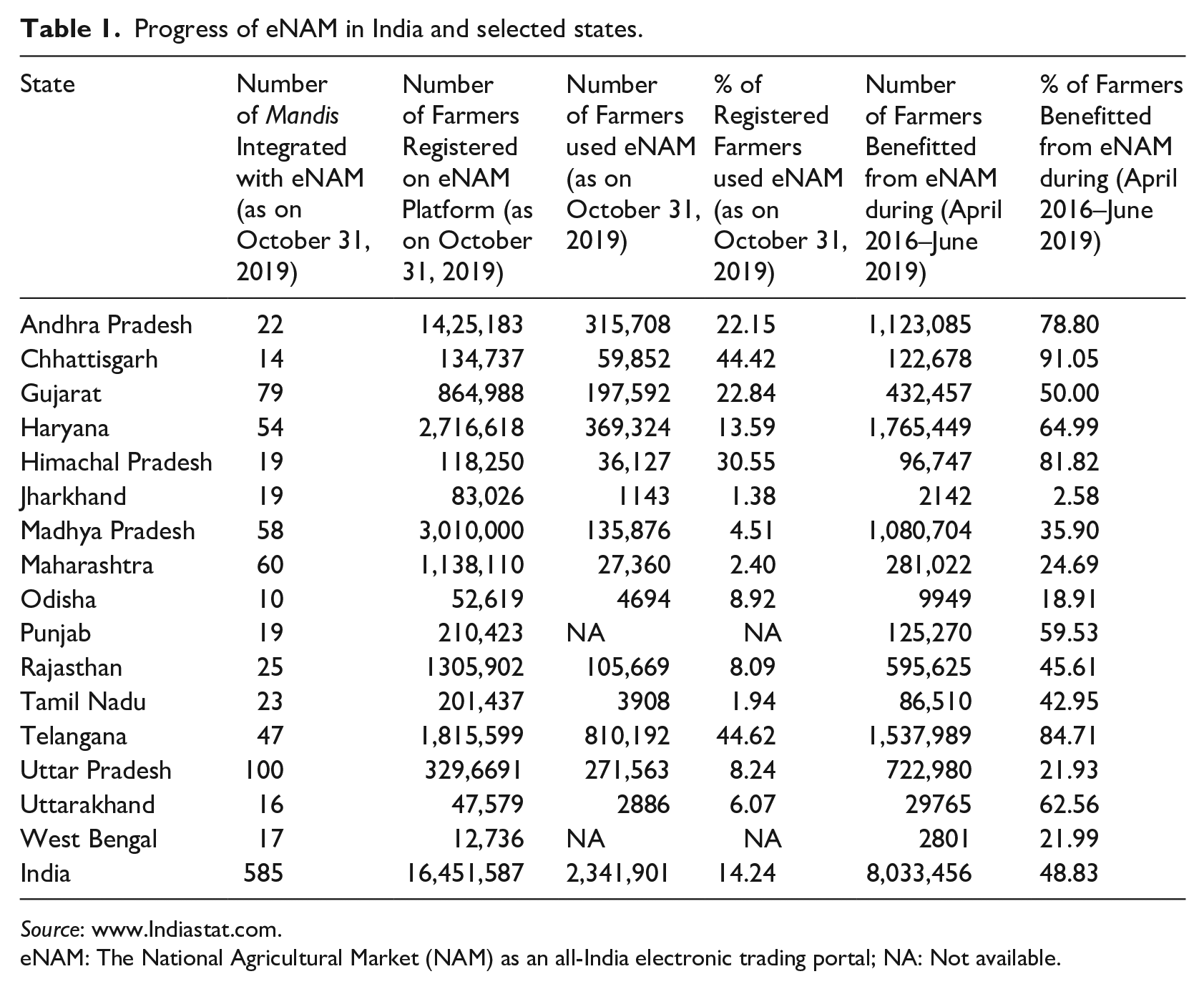
Table 1 reports the progress of eNAM in India and some selected states. As on 31 October 2019, 585 APMC markets (mandis) were integrated with the eNAM platform but only 14.24% of the registered farmers used the platform and 48.83% of the registered farmers, who used the platform during April 2016 to June 2019, were benefitted. There are, however, wide inter-state variations in the number of mandis integrated with eNAM as well as in the number of registered farmers, and in their number and percentage who used the platform and derived benefits from it.
Progress of eNAM in India and selected states.
Source: www.Indiastat.com.
eNAM: The National Agricultural Market (NAM) as an all-India electronic trading portal; NA: Not available.
The extent to which farmers can derive benefit from eNAM depends crucially on the magnitude of reforms in the APMC Act in the states. Karnataka is the forerunner in market reforms and in devising innovative practices to improve the functioning of agricultural markets and bring competitiveness. The unified online agricultural market initiative, under which every farmer who brings produce to the APMC market has a choice to use the common online trading platform or the platform of commission agent for auction of their produce after getting an identification number for the lot, was launched in Karnataka on 22 February 2014. The unified market platform (UMP) was designed to facilitate transparent, integrated e-trading mechanism and to provide facilities for grading and standardisation of agricultural commodities for seamless trading across mandis. This marketing model has received overwhelming response from farmers in the state and has shown impressive results in a short period. Looking at the success of the Karnataka model, some states such as Andhra Pradesh, Gujarat, Maharashtra and Telangana have started adopting the model (Chand, 2016). The model can be adopted in other states to take advantage of modern technology to improve agricultural marketing, making it more efficient and competitive. In view of the fact that while some states are most reform-oriented, others are either intermediate or lagging reformers, it is imperative for the states to speed up reforms in the APMC Act and play a proactive role in providing necessary infrastructure and related services to facilitate online trading in agricultural commodities (Ghosh, 2018).
The farm laws 2020
Three farm laws, consisting of two new Acts and one major amendment to an existing Act, were legislated by the Union Government in September 2020 with the objective of transforming Indian agriculture through acceleration of growth by attracting private sector investment in building infrastructure and supply chains for farm produces in national and global markets. ‘The Essential Commodities (Amendment) Act 2020’ sought to remove commodities like cereals, pulses, oilseeds, edible oils, onion and potatoes from the list of essential commodities, permitting almost unrestrained hoarding, and allowing their regulations only under extraordinary circumstances.
‘The Farmers (Empowerment and Protection) Agreement on Price Assurance and Farm Services Act 2020’ sought to provide legal sanction for contract farming, under which farmers will produce crops as per contracts with corporate investors, including agri-business firms/large retailers for a mutually agreed remuneration. However, there were apprehensions that corporate investors, as dominant players in agricultural supply chains, would bind farmers with weak bargaining power to unfavourable contracts and dictate terms and conditions for the supply of farm produce.
As per ‘The Farmers Produce Trade and Commerce (Promotion and Facilitation) Act 2020’, ‘any farmer or trader or electronic trading and transaction platform shall have the freedom to carry on the inter-State or intra-State trade and commerce in farmers’ produce in a trade area’. The Act, by way of providing farmers the freedom to sell their produce anywhere and whoever they want to, wanted to allow farmers to get better prices through competition and cost-cutting on transportation. However, it has been argued that the Act will curtail the power and revenues of state governments, as the farmers can sell their produce outside APMC mandis avoiding the levies and fees. It will create a few large private traders who will exercise monopsony power against farmers, particularly, the small and marginal ones, who will become price takers. Thus, the Act will not only undermine the working of APMC mandis but also weaken the MSP system, leaving the fixation of prices of the farm produces at the hands of corporate agencies. This would lead to corporatisation of agriculture, with the market along with the monsoon, would determine the destiny of farmers. Due to strong opposition from thousands of farmers backed by several farmer groups and a stay order from the Supreme Court of India, the three farm laws could not be implemented. Yielding to the pressure of farmer groups and keeping in mind forthcoming Assembly elections in some states, the Indian government finally repealed the laws in November 2021.
Impact on spatial efficiency in agricultural supply chains
From policy standpoint, it is useful to evaluate the implications of the institutional reforms for spatial efficiency in agricultural supply chains and how these reforms alter the convergence of commodity prices across geographically dispersed market centres. This is important in view of the fact that, if the commodity markets are integrated, then the government may minimise its interventions in those markets. Since integration of markets implies that a scarcity in one market will be transmitted to other markets, it is redundant to undertake the same programme like procurement of food grains and open market sale in all the markets. As food grains move across markets in response to the market signals, integration of food markets enhances regional food security by ensuring regional balance among food-deficit, food-surplus and non-food cash crop-producing regions. The study of market integration offers a clear picture of the process of transmission of price signals and information across marketing chains.
Since the extent of spatial market integration determines the transmission speed of price changes due to any policy reforms across regional markets, the effects of market liberalisation should be evaluated on the basis of what happens to the prices for producers and consumers and also on the basis of functioning of the markets. Liberalisation was found to have positive impact on the functioning of Ethiopian grain markets through increased short-run integration (Dercon, 1995). Based on the performance of Indonesian rice markets, Ismet et al. (1998) argued for limiting government interventions in the integrated markets by rationalising its price stabilisation and buffer stock activities, and allowing the private sector to contribute as much as possible.
Several attempts were made to evaluate spatial integration of agricultural commodity markets in India. See for example, Ghosh (2000, 2003, 2008, 2010), Ghosh and Ghoshray (2018), Ghoshray and Ghosh (2011), Jha et al. (1997, 2005), Palaskas and Harriss-White (1993), Roy et al. (2017). These studies offered mixed results on the degree of spatial integration of agricultural markets. Roy et al. (2017) observed that barring some low-value cereals, markets for most agricultural commodities lack integration which undoubtedly makes a case for the establishment of NAM. A very few studies (e.g. Ghosh (2011, 2013, 2017)) evaluated the implications of institutional reforms in agricultural commodity markets for spatial integration (efficiency) of the markets. Effectiveness of the institutional reforms in improving the spatial efficiency of agricultural markets was evaluated in terms of their impact on the extent of market integration.
Spatial integration of markets
The policy reforms and the consequent changes in the marketing system are expected to improve the performance of agricultural commodity markets. The reforms in internal and external trade would promote private investment and participation and improve spatial efficiency of the marketing system. The linkages among regional agricultural markets are likely to be strengthened, and the degree of spatial market integration would improve during the post-reform period. For assessing the impact of agricultural policy reforms on market integration, we need to examine the extent of market integration during the post-reform period vis-à-vis the pre-reform one. It is expected that the institutional reforms – liberalising agricultural commodity markets, limiting government interventions and allowing the private sector to contribute its best in the markets – would lead to an increase in the extent of market integration.
We have investigated inter-state spatial integration of rice and wheat markets by estimating long-run linear relationship between the prices of state-specific variety of rice/wheat quoted in some selected markets across states. We have applied the maximum likelihood method of co-integration (due to Johansen and Juselius, 1990) to monthly wholesale prices of rice and wheat during March 1984 to October 2019 (1984:3 to 2019:10). In order to compare the extent of food market integration between the pre- and post-reform periods, we have divided the entire period into two sub-periods. Although the reform process directly related to agriculture were initiated since the mid-1990s, the large-scale economic reforms involving structural adjustment and liberalisation programmes, especially those related to internal and external trade, initiated since July/August 1991, have important implications for agriculture in general and agricultural commodity markets in particular. For this reason, we have considered March 1984 to July 1991 (1984:3 to 1991:7) as the pre-reform period, and August 1991 to October 2019 (1991:8 to 2019:10) as the post-reform one. Since the agricultural policy reforms in the early 1990s were mostly related to internal and external trade in agricultural commodities, their effects would be largely felt in the commodity markets and prices. Moreover, since the reform process has been continuous, the effects of agricultural policies during the post-reform period would be reflected in the extent of spatial integration of agricultural commodity markets.
The data on rice and wheat prices quoted at different market centres of the selected states were compiled from Government of India (various years), and a database website, viz., www.Indiastat.com. The choice of the states and the market centres from each state was constrained by the availability of consistent data for the period. For rice, we have considered the wholesale prices of state-specific variety of rice quoted in four markets represented by Allahabad (Uttar Pradesh), Balasore (Odisha), Patna (Bihar) and Siliguri (West Bengal). For wheat, the wholesale prices of state-specific variety of wheat quoted in four representative markets viz., Ambala (Haryana), Gorakhpur (Uttar Pradesh), Jaipur (Rajasthan) and Ludhiana (Punjab) were used.
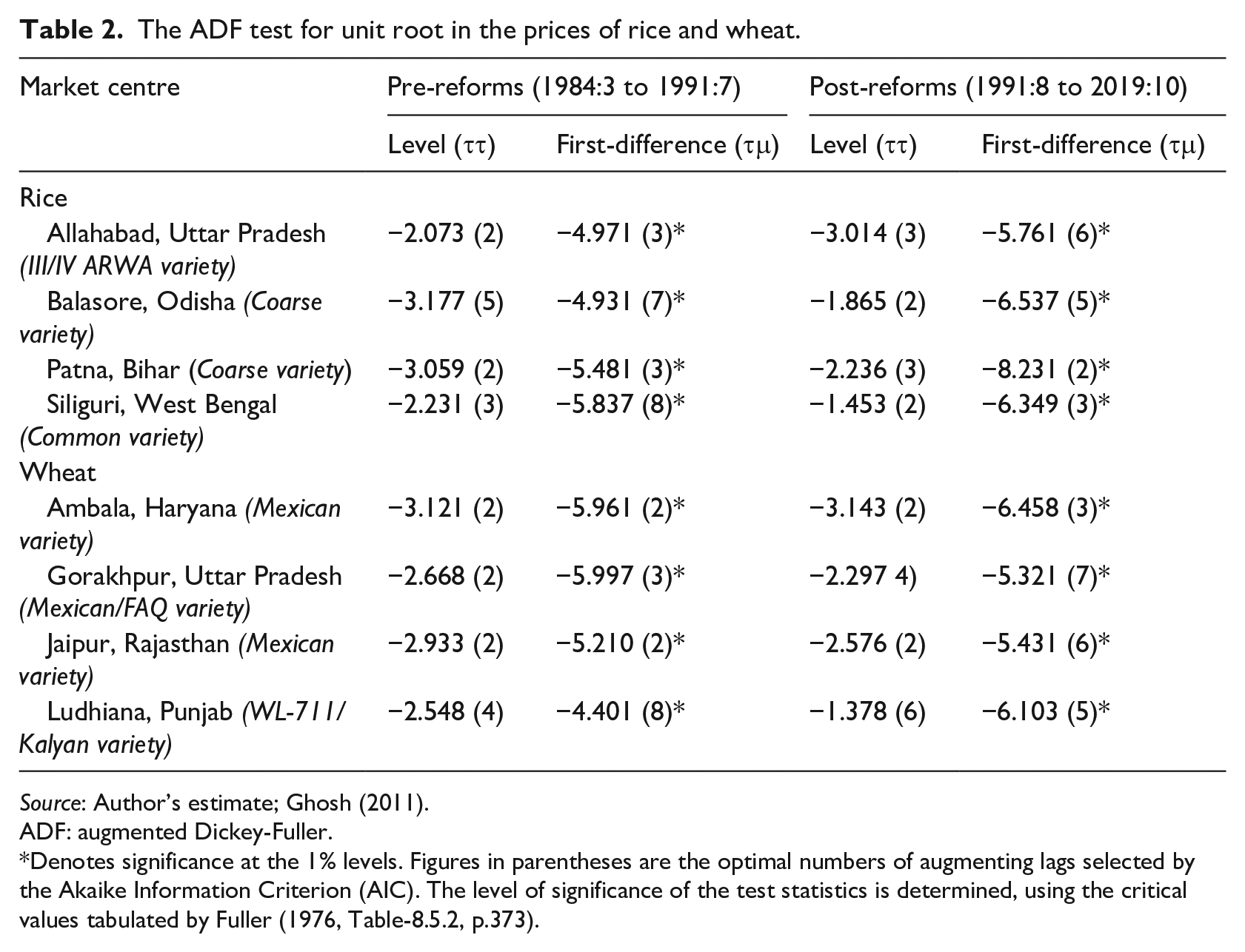
Before undertaking co-integration tests, we have applied the augmented Dickey-Fuller (ADF) test (Dickey and Fuller, 1979, 1981) to check whether all the prices are non-stationary and integrated of the same order. The ADF test results for the rice and wheat prices in levels and first-differences, reported in Table 2, reveal that all the prices are non-stationary in levels but stationary in first-differences, implying that the prices contain a single unit root and are integrated of order one, I(1) for both the periods.
The ADF test for unit root in the prices of rice and wheat.
Source: Author’s estimate; Ghosh (2011).
ADF: augmented Dickey-Fuller.
Denotes significance at the 1% levels. Figures in parentheses are the optimal numbers of augmenting lags selected by the Akaike Information Criterion (AIC). The level of significance of the test statistics is determined, using the critical values tabulated by Fuller (1976, Table-8.5.2, p.373).
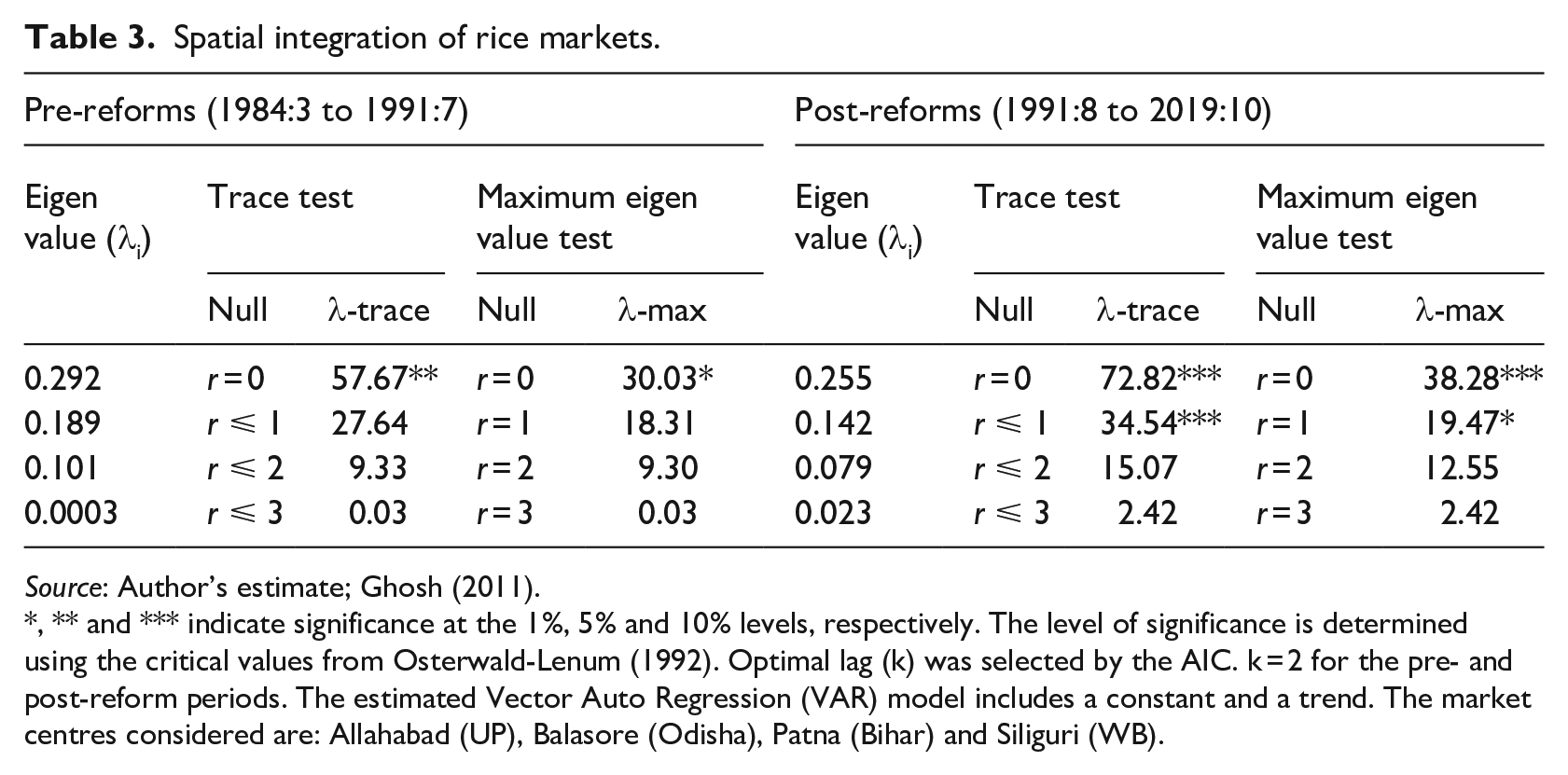
For assessing the impact of agricultural policy reforms on market integration, we have compared the extent of market integration between the pre- and post-reform periods. The results obtained from the maximum likelihood method of co-integration for rice (Table 3) reveal only one statistically significant co-integrating vector during the pre-reform period, suggesting that the Indian rice market system represented by the four markets across states was integrated to an extent during this period. However, the extent of spatial integration of the rice markets has unambiguously improved, as the number of statistically significant co-integrating vector has increased from one in the pre-reform period to two during the post-reform period.
Spatial integration of rice markets.
Source: Author’s estimate; Ghosh (2011).
, ** and *** indicate significance at the 1%, 5% and 10% levels, respectively. The level of significance is determined using the critical values from Osterwald-Lenum (1992). Optimal lag (k) was selected by the AIC. k = 2 for the pre- and post-reform periods. The estimated Vector Auto Regression (VAR) model includes a constant and a trend. The market centres considered are: Allahabad (UP), Balasore (Odisha), Patna (Bihar) and Siliguri (WB).
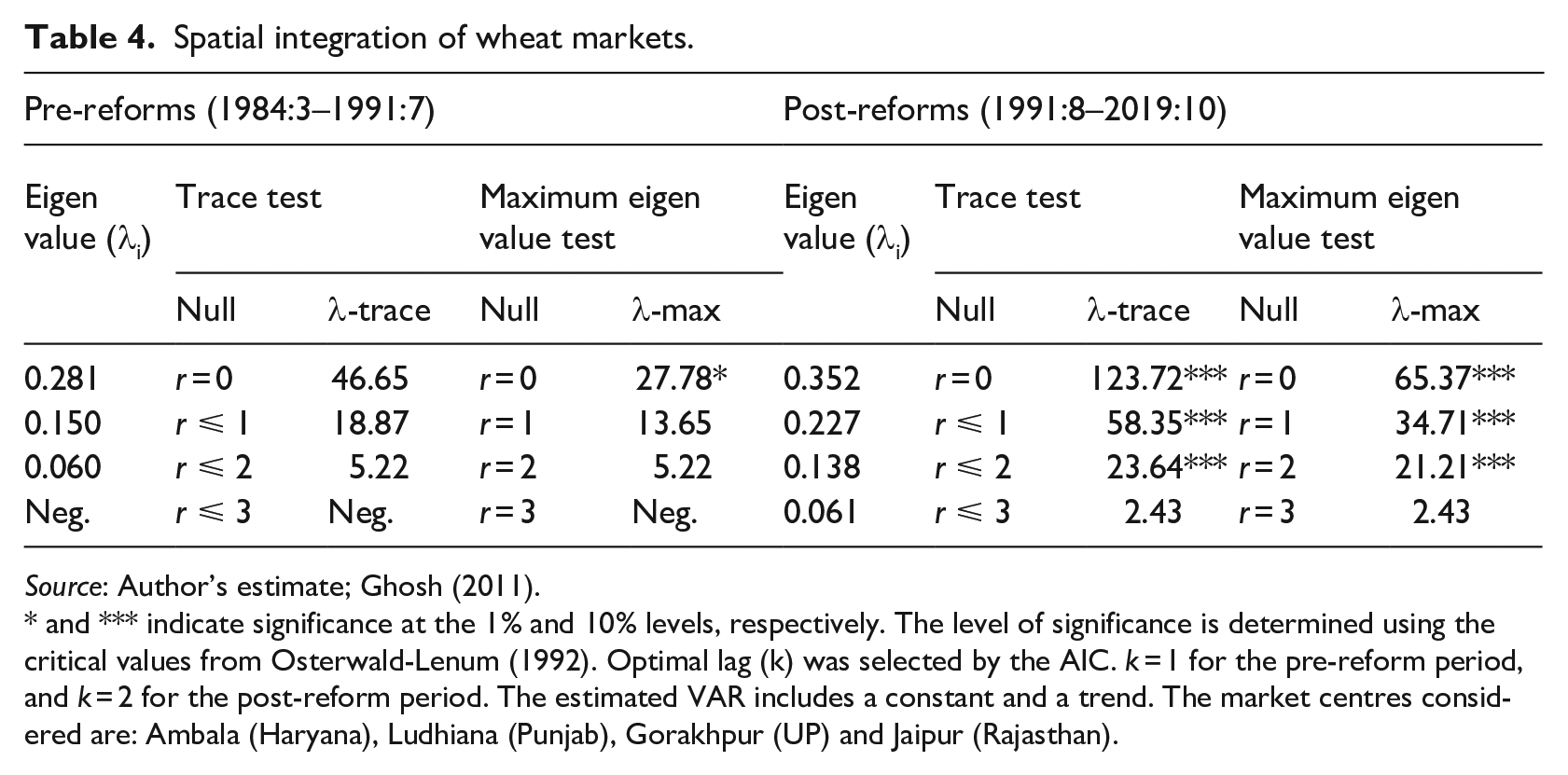
For wheat, while the λ-max test shows only one co-integrating vector, the λ-trace test reveals no co-integrating vector at all during the pre-reform period. However, the extent of market integration across the states has improved greatly during the post-reform period, as both the tests show three significant co-integrating vectors and hence one common stochastic trend (Table 4). The presence of a common stochastic trend implies that the prices are pair wise co-integrated and the regional wheat markets across the states are integrated to such an extent as to validate the relative Law of One Price (LOP) during the post-reform period.
Spatial integration of wheat markets.
Source: Author’s estimate; Ghosh (2011).
and *** indicate significance at the 1% and 10% levels, respectively. The level of significance is determined using the critical values from Osterwald-Lenum (1992). Optimal lag (k) was selected by the AIC. k = 1 for the pre-reform period, and k = 2 for the post-reform period. The estimated VAR includes a constant and a trend. The market centres considered are: Ambala (Haryana), Ludhiana (Punjab), Gorakhpur (UP) and Jaipur (Rajasthan).
Overall, the extent of market integration has improved during the post-reform period relative to the pre-reform one. The regional markets, which were either segmented or poorly integrated during the pre-reform period, are found to be strongly integrated during the post-reform period. The institutional reforms in agricultural marketing system since the early 1990s appear to have contributed towards improving the extent of spatial integration of the markets. Since infrastructures, such as, storage, transport, and communication networks strengthen spatial integration of markets by reducing transaction costs, it is imperative for the government to provide necessary infrastructure facilities for the functioning of NAM successfully. Institutional reforms in the marketing system along with better infrastructures would strengthen market integration by helping movement of agricultural commodities and transmission of price signals and information smoothly across spatially separated markets. The finding of an increase in the extent of market integration after the reforms, and the tendency of the prices to move towards a ‘common stochastic trend’ extend support to the idea of setting up a ‘common national market’ for agricultural commodities.
Summary and policy conclusions
This paper has reviewed the institutional reforms in agricultural commodity markets and examines their implications for efficiency in supply chains of the markets. The traditionally practised supply chains suffer from inefficiency due to the existence of many intermediaries between farmers and consumers, leading to high transaction costs and yielding ineffective and inefficient farm-market linkages and lower income to farmers. Recognising the importance of liberalised agricultural markets, the government has embarked on liberalising agricultural commodity markets as a part of the comprehensive economic reforms involving structural adjustment and liberalisation programmes since the early 1990s. Some fundamental reforms in the agricultural marketing system have been initiated to remove the inefficiencies in the traditional supply chains. A series of domestic market reforms have been introduced to improve the efficiency of marketing system and to attract private investment. The APMC Act was revised, and a Model APMC Act 2003 was introduced with the provisions for establishment of private markets/yards, direct purchase centres, farmers markets for direct sale, contract farming and promotion of public-private partnership in the management and development of agricultural markets. Recently, the government has taken initiative to set up eNAM to develop a ‘common national market’ for agricultural commodities, unifying the existing APMC mandis. The virtual market is expected to ensure right prices to the farmers for their crops, and also benefit the ultimate consumers, giving them the opportunity to get agricultural commodities at competitive prices. The extent to which the farmers can derive benefits from eNAM depends crucially on the magnitude of reforms in the APMC Act in the states so that they can have access to such a virtual market.
The institutional reforms in agricultural marketing system since the early 1990s appear to have contributed towards improving the extent of spatial integration of agricultural markets, as the regional markets, which were either segmented or poorly integrated during the pre-reform period, are found to be better integrated after the reforms. The finding of an increase in the extent of market integration after the reforms and the tendency of the prices to move towards a ‘common stochastic trend’ lend support to the idea of setting up a ‘common national market’ for agricultural commodities. Further reforms in the marketing system with better infrastructure facilities would strengthen market integration by helping movement of agricultural commodities and transmission of price signals and information smoothly across spatially separated markets.
Footnotes
Funding
The author(s) received no financial support for the research, authorship, and/or publication of this article.
