



Abstract
This study attempts to explore the meaning of secularism among the tertiary educated young people and to understand their perception on related issues. This paper follows mixed methods, namely convenience surveys and content analysis of credible secondary sources. From the findings, it is interesting to see that many of them opine about having ‘state religion’ besides ‘secularism’ as a basic constitutional principle (61.9%/38.1%). They believe in equal treatment for all minority religions, while at the same time they share their perception of giving priority to ‘Islam’ as the dominant religion (57.1%), which could be labelled ‘paradoxical’. This article argues that the ideological perception is going into transition among the young people in Bangladesh with the transition of socio-economic context, which is different from the previous linear understanding of pro-secular and anti-secular dynamics. This paper also provides some pragmatic way outs from young people on how to secure the rights of minority religions in Bangladesh.
Introduction
After a war of independence against Pakistan in which 1.3 million Bangladeshis were killed (Codron, 2007), Bangladesh was founded as a secular state in December 1971, based on the nation’s ethnolinguistic Bengali identity (e.g. Siddiqi, 2011). Secularism was one of the four guiding principles that Bangabandhu Sheikh Mujibur Rahman used to create Bangladesh’s constitution in the midst of a war-torn nation. The regime of Bangladesh’s founding leader, Sheikh Mujibur Rahman, was overthrown in a military coup in 1975, less than 4 years after the nation gained its independence. General Ziaur Rahman’s military government, which took power after months of unrest, removed both the basic tenets of socialism and secularism from the constitution (Islam, 1984). Although the first civil regime suffered from some contradiction in applying the ideals of secularism (O’Donnell, 1984), the deadliest blow to the aspiration of a meaningful liberal democracy was the ongoing state-level patronization of anti-secular forces and their religion-based politics by all the regimes between mid-1975 and 1996. The reintroduction of secularism at the state level in 2011 has not resolved tension between the pro-seculars and the anti-seculars, that is, Islamists. Bangladesh’s politics proceeds to be entangled over secularism.
Till date, academicians and researchers opine that the perception of secularism is divided into two ideological divisions, pro and anti-secular. But this study shows that there is another evolving perception toward secularism, particularly among the new educated generation, which is more assertive in nature than pro and anti-secularists. Pro-secularists argue for two types of secularism in the state: hardliners advocate for total separation of religion and state, while moderate secularists believe the state should balance religion and state. Anti-seculars, mostly Islamists, show their view from the lens of majoritarianism that Islam is the majority religion in this country and so Islam ought to be the prioritized religion in Bangladesh. The country has seen communal violence and violations of the rights of minority religions because of religious feelings or communalism (Odhikar, 2021), where minority religions suffer the most. Bangladesh has recently celebrated its golden jubilee. It is important to know how people, especially young people, feel about religion to know how tolerant and accepting the society is. This paper answers the question of whether there is any change in perception among the present generation about the secularism issue while we are vocal about the liberal social system. This research tries to find the view of the present educated generation about their perception of the secularism principle in Bangladesh. Then it explores the relationship between religion and politics in this country. The research findings help to direct the social dynamics in the country and assist in putting it on the right track to create a more tolerant society. This paper also provides food for policymakers to create more inclusive policies for securing minority religions’ rights and forming moral codes for the current youth population in Bangladesh, because today’s generation is the protector of human rights in the coming days.
Methodology
The paper includes mixed methods, which help to address research questions in an appropriate and principled manner (Bryman, 2012; Creswell, 2015; Creswell and Plano Clark, 2011), that is, convenience survey following a semi-structured questionnaire and content analysis of the existing secondary literature. A historical analysis of the literature was required to fully comprehend the subject. A historical survey of the literature helps to find the ground perception of secularism in Bangladesh. The convenience survey using a semi-structured questionnaire was prepared to get the present scenario about the perception of tertiary educated people in this country. For conceptualization purposes, the relevant national and international research, scholarly articles, reports, plans, policies, and other documents were examined. Open-ended questions were used to gather opinions and suggestions, which were then utilized to validate the paper’s findings. This study was conducted in Bangladesh with respondents from all districts. Only university students are the respondents in this survey. A structured questionnaire was used to collect quantitative data using a convenience sampling technique. A total of 77 (n = 77) surveys were taken to meet the research objective, where a variety of educational institutions ensured to provide authentic and diversified views from this type of respondent. As the respondents are students, their age limit is 19–30 years.
Meaning of secularism in Bangladesh
The word “secular” was coined by Latin Christians. Jerome used it to translate the Greek terms that meant earthly events in the New Testament. A political movement called secularism aims to keep religion and the state separate (often termed as the separation of the church and the state). This can entail parting ways between a government and a state religion, replacing religious law (such as Halakha and Sharia) with civil law, and putting an end to religious discrimination. A secular nation must be dedicated to ideals drawn at least in part from nonreligious sources and must uphold these ideals (i.e. means). Included in these goals should be equality between and within religions, harmony, freedom of religion, and freedom from torture or other degrading treatment, discrimination, and exclusion based on religion.
The National Secular Society (2017) identifies threefold perspectives of secularism. They are:
A public space where religion may participate but not rule. Separation of religious institutions from public institutions.
The right to practice one’s religion or belief without endangering others, as well as the freedom to modify it or abandon it in accordance with one’s conscience.
Equality, so that none of us will be disadvantaged or benefited by our religious choices thereof.
What, then, does secularism mean in the context of Bangladesh? The simplest way to understand it could be to go back to how the word is written in Bangla in the Bangladeshi Constitution. The word dhormo niropekhota, which translates back into English as ‘religious neutrality’, was chosen by National Professor Anisuzzaman to translate the original English text. Jose Casanova may have provided the academic explanation of secularism that most closely matches the term’s original Bangladeshi understanding as: some principle of separation between religious and political authority, either for the sake of the neutrality of the state vis-à-vis each and all religions, or for the sake of protecting the freedom of conscience of each individual, or for the sake of facilitating the equal access of all citizens, religious as well as non-religious, to democratic participation. Such a statecraft doctrine neither presupposes nor needs to entail any substantive ‘theory’, positive or negative, of ‘religion’.
The aforementioned explanation adequately captures it. Bangladesh cannot wait for the secularization of culture to take place prior to actually adopting secularism as a central tenet of statecraft since neither is it desirable nor is it the purpose of secularism. This definition also makes it clear that there is no relationship between secularism and atheism, or any antagonism, rejection, or dismissal of religion, religious beliefs, or religious philosophy. The survey results tell us what young people mean by it (Figure 1). Most of the respondents say secularism means freedom of belief, and the second large group opines that it means no discrimination against any religion in the country. Another group says that it defines the relationship between state and religion.

Perception on the Meaning of secularism in Bangladesh.
Till date, academicians and researchers opine that the perception of secularism is divided into two ideological divisions: pro- and anti-secular. But this study shows that there is another evolving perception toward secularism, particularly among the new educated generation, which is more swinging in nature than pro- and anti-secularists. Pro-secularists argue for two types of secularism in the state: hardliners advocate for total separation of religion and state, while moderate secularists believe the state should balance religion and state. Anti-seculars, mostly Islamists, show their view from the lens of majoritarianism that Islam is the majority religion in this country, and so Islam ought to be the prioritized religion in Bangladesh. This country has seen communal violence and violations of the rights of minority religions because of religious feelings or communalism (Odhikar, 2021), where minority religions suffer the most. This country has recently celebrated its golden jubilee. It is important to know how people, especially young people, feel about religion to know how tolerant and accepting society is. This paper answers the question: is there any change in perception among the present generation about secularism issue while we are vocal about liberal social system? This research tries to find the view of the current educated generation about their perception on secularism principle in Bangladesh. Then it explores the relationship between religion and politics in this country. The research findings help to direct the social dynamics in this country and assist in putting us on the right track to creating a more tolerant society. This paper also provides food for policymakers to create more inclusive policies for securing minority religions’ rights and forming moral codes for the current youth population in Bangladesh, because today’s generation is the protector of human rights in the coming days.
Relation between politics and religion
Politics is the way people run things in society, while religion is about how people interact with God. In this way, the connection between politics and religion was ruptured, and a boundary was formed between the two, placing societal issues and personal matters on opposite sides of the divide. However, religion has a significant impact on the choices made by international leaders. Shireen Hunter, Research Professor at Georgetown University, examines this frequently overlooked connection between religion and policymaking in her most recent book, God On Our Side: Religion in International Affairs. Hunter stated that religion influences politics in all countries, despite the notion of religion affecting politics typically being linked with non-Western countries (Hunter, 2016). The development of culture and traditional identity is greatly influenced by religious traditions, even in Europe, which is becoming less and less religious. She claimed that customs like the melody of church bells swinging are a component of a “culture religion” and, as such, have significance even when they lack profound theological significance.
The Pew Research Centre finds countries in the world are moving to favor a specific religion, even in well-known secular countries. According to a Pew Research Center review of data spanning 199 countries and regions worldwide, more than 80 countries favor a particular religion, either as an official, government-endorsed religion or by giving one religion preferential treatment over other faiths (Pew Research Center, 2017). According to Hunter, governments can also motivate their population by using religion. According to estimates, 84% of people worldwide believe in a higher power, which means that the majority of people have moral standards that are susceptible to manipulation by their governments. Hunter stated, “Power always needs ideas, and any cause needs ideas to work.” Power frequently comes with a price, and to make sacrifices, one needs a cause to support. People are easily persuaded to accept obligations for the sake of their faith because they unquestionably believe in religion. The role of non-state entities like ISIS or Hezbollah is another important consideration when discussing religion in international affairs. Hunter thinks non-state actors are not an imminent threat to the nation-state order, despite the attention paid to their development. Now, if we attempt to comprehend how Bangladeshi youth view the relationship between religion and politics, we discover that the majority of respondents believe it to be positive (Figure 2). Ghosh (1993) opines that religion is a complex variable in Bangladeshi politics following its shared history and geography. In this study, the respondents opine that politics and religion are interconnected where one influences the other and vis-à-vis.

Perception on relation between religion and politics.
Background: secular foundation and contradiction with secularism in Bangladesh
State-level policies have effects on the mindset of citizens, their lifestyle, and also their belief systems. Being a Muslim majority country, Bangladesh has faced a long debate on the secularism concept. When secularism was installed in the constitution, there was no public consensus on whether it was suited for the socioeconomic background of Bangladesh. Moreover, secularism was abolished later without any public referendum then either. It is a research gap to discover what the field-level perception of the secularism concept in Bangladesh is, how general people would like to share their opinion on it, and more importantly, who is aware of this concept: the educated people. The secularism concept is mostly misinterpreted as anti-Islamic or merely a Western concept, where Western culture and lifestyle are trying to be promoted in a religious majority country like Bangladesh (Alam, 1993b; Haider, 2008).
However, over decades of struggle that culminated in the 9-month War of Independence, Bangladesh began its path as an autonomous state in December 1971. In this war, people from many different communities took part, mostly motivated by the desire to achieve socioeconomic freedom and, more roughly speaking, a pluralistic Bangladesh. This idea was shared by the East Bengali Hindus who had opted to remain in what would eventually become East Pakistan (Novak, 1994). After attaining independence in December 1972, it added secularism as one of the four state principles to the constitution, unlike the handful of nations with a majority of Muslims. The government declared in November 1972 that the proposed constitution would outlaw all forms of religious communalism and forbid the state from exalting any religion or tolerating its misuse for political ends. In December 1972, secularism was incorporated into the constitution of the third-largest Muslim-majority country on earth. The Father of the Nation, Sheikh Mujib explains his notion of secularism as: Secularism does not mean absence of religion. You are a Muslim, you perform your religious rites. The Hindus, Christians, Buddhists all will freely perform their religious rites. There is no irreligiousness on the soil of Bangladesh but there is secularism. This sentence has a meaning and the meaning is that none would be allowed to exploit the people in the name of religion . . . No communal politics will be allowed in the country. (Cited in O’Connell, 1976: 69)
In addition, Article 12 of the constitution forbade all forms of communalism, the use of religion for political gain, and the persecution of anyone who practices a specific religion in order to make the principles of secularism a reality. Paragraph 2 of Article 38 states that: no person shall have the right to form or be a member or otherwise take part in the activities of, any communal or other association or union which in the name of or on the basis of any religion has for its object, or pursues, a political purpose.
Secularism’s recognition as a guiding state concept at the time formally met one fundamental requirement of a contemporary liberal state order after independence, namely, that the distinction of politics and religion is important to maintain “neutrality” between other religions (Bhargava, 2007: 20–24). The constitution also forbade the establishment of and enrolment in any sort of religious group with political objectives.
The first attempt at secularism failed miserably. In August 1975, a military coup overthrew the first democratic government and killed Sheikh Mujib and his family (Rashiduzzaman, 1978). According to the political narrative that is currently in place and is backed by the current ruling regime, which was initiated by General Zia’s military rule, Bangladesh’s state-sponsored Islamization commenced in the middle of the 1970s. Secularism was eliminated from the constitution by the military dictatorship that succeeded it (1975–1981), and the following military regime continued along the same lines by making Islam the official religion of state (Alam, 1993a). Political, intellectual, and social groups that are against secularism have always backed military juntas and anti-secular civil regimes that are against secularism at the state level.
Multiculturalism was eliminated from the constitution by the first junta, which was led by Ziaur Rahman, and other policies were implemented to reduce its effect on the government and the populace (Hashmi, 1994). In the preamble and Article 8 of the constitution, “absolute reliance and faith in Almighty Allah” was substituted for the word ‘secularism’ by the Second Proclamation Order No. 1 on 23 April 1977. A new clause (1A) was added to the constitution that stated “absolute trust and faith in Almighty Allah” should be the “foundation of all deeds.” The proclamation replaced the Quranic verse “Bismillah-Ar-Rahman-Ar-Rahim” (“in the name of Allah, the Beneficent, the Merciful”) at the start of the preamble with Article 12, which created secularism. It also repealed Article 38, which prohibited the formation of any associations that disturbed the social, religious, or communal order.
After the first military dictator was assassinated in 1981, General H. M. Ershad founded the second military dictatorship, which lasted from 1982 to 1990 (Talukder Maniruzzaman,1992). He heavily incorporated Islam, carrying on the legacy of his predecessor. General Ershad also asserted that Islam serves as the foundation for the state’s philosophy. He stated in a speech at the start of his administration: Islam is our ideal and it is the only way to our emancipation. The existence of the country will be at stake if we fail to establish Islam in Bangladesh. We, the nine crore [ninety million] Muslims (of Bangladesh) will certainly speak about Islam, think about Islam and dream about Islam. This is our only way for emancipation. (Cited in Rahman, 1985: 2)
By passing the Eighth Amendment to the Constitution in 1988, he made Islam the state religion. Along with the constitutional reforms, the military dictators undertook a number of initiatives to detach the state apparatus from the concept of secularism and spread anti-secular ideology in society with the aim of thwarting secular forces and destroying secular values (Hashmi, 2004). Massive increases in funding for madrasa (Islamic religious institutions), undue emphasis on religious teaching in public schools, and constant references to Islam in state-run media were all implemented in contrast to secularism following independence (Jahangir, 1998; Riaz, 2007). Anti-secular sentiments tried to be established by the inclusion of one majority religion-related provision in the constitution. Again, the pro-secular party, the AL began expressing its desire to revive the 1972 constitution, which would reintroduce secularism at the administrative level after AL’s electoral victory in 2008. It is true that Bangladesh is a Muslim majority country, but the Liberation War was brought into being by following secular Bengali sentiments in 1971. Religion was not a priority in this country’s freedom struggle. But when, in the later years, anti-secular elements were inserted into the constitution, there was no protest or mass movement against this insertion. So, we can say there are two views where one supports secular ideas and the other part welcomes one particular religion’s dominance in the state system. We have no hard data which was conducted to measure public perception of secularism then. The existing literature shows that there are two types of views on secular ideas in Bangladesh. This study aims to re-examine the perception among the present generation through a public survey among educated young people to understand their views on this basic principle.
Trinary views of secularism among contemporary educated people in Bangladesh
The secularist’s view maintains that the official embrace of secularism as one of state values was not unique. They describe the establishment of Bangladesh through a war as a result of pro-secular Bengali nationalist organizations defeating nationalism centered on religion in Pakistan (Jahan, 1973). The Liberation War and the establishment of Bangladesh, according to pro-secularists, were the results of a pro-secular anti-Pakistani campaign that took place between 1947 and 1971. The secular idea is the same among some people at present in Bangladesh. They also believe that Bangladesh was born in the sense of a pro-secular idea in 1971. For the time being, secularist principles were altered with anti-secular elements in both legal provisions and in practice. Anti-secular beliefs are mostly inspired by Islamic and Muslim sentiments in this country. Besides these two spectra, according to our study results, Bangladesh has another emerging different dynamic of thought, which is seen as paradox (Table 1). Swinging secularists want state religion and at the same time argue for minority religions’ freedom and equal treatment by the state. They say secularism helps to uphold the rights of the minority religions in Bangladesh, where again they share their view that it is okay to have Islam as a state religion besides secularism as a fundamental state principle (Figure 3) data collected from survey.
Swinging secularists.


Responses of people to the survey questions: A = May having a State Religion create hindrance to other religion?; B = Is it okay to having secularism as basic principle in the constitution?; C = Secularism is best for giving equal respect to other religions besides Islam?; D = Is it okay of having Islam as state religion besides secularism as basic principle?; E = Politicians give priority to all religions before and after election?
Pro-secular views
There are two types of views in the pro-secular group: hardliners and mild pro-secularists. For the hardliners, secularism as a guiding principle of government cannot be ensured by the coexistence of religious faith and secularism. Because of this, “freedom” from “religious notions” has been noted as a requirement. They argue that Bangladesh came into being by taking the secular idea of Bengali identity and the participation of mass people in the Liberation War, irrespective of religion. If religion matters most in this region, then Pakistan might have existed after 1971. As the historic freedom struggle was carried out by a secular identity, hardliner secularists opine about the secular nature of the state. In order to increase support for secularism, the radical pro-secularists recommended that the state’s leaning toward any particular religion was rejected, in 1972’s constitution. In this context, it is said that the state’s “apathy” toward religion was something to be admired. More importantly, it was said that not believing in God, being an atheist, or following any other religion should be seen as a right and that the government shouldn’t get involved.
Following the independence war in 1971, there were several milder interpretations of secularism in contrast to the radical ones. According to moderates, secularism is not atheism but rather the government’s disregard for all religions. This sect denounces ‘the reactionary elements’ for organizing plots to undermine secularism and fomenting religious hate in Bangladesh. (Majumder, 2016). They contended that secularism promotes the right of individuals to enjoy religious practices and beliefs of his/her. The moderate seculars stressed proactive measures to uphold the principles of secularism when the first constitution was drafted and also in this post-independence age. Thus, it is recommended that there is no problem if students study all major religions and religious groups in school. Also, it was suggested that the government should protect the independence of all religions and not pick one as the ‘official religion’. The moderate supporters of secularism charged that ‘one segment of religious clergymen and some others’ had incited the ‘uneducated and less educated’ masses against various social, political, and religious reforms in order to increase their influence and power in Bangladeshi society and create a theocratic state. But the birth of Bangladesh and also her social appearance is secular in nature. Milder pro-secularists in Bangladesh also claimed that the country should not avoid using ‘traditional Muslim styles’ in official ceremonies, processes, and political activities besides other religions in order to properly uphold secular objectives of the state. It is also believed that the ideas of secularism took a long time to materialise in a society, and individuals’ roles in that process were no less significant than those of the government.
Perception of anti-seculars
Though Bangladesh is multi-ethnic country, Islam religion is predominant in the country. Historically, religion plays a vital role in political, social and even economic spheres in the Indian subcontinent. It is known that religion has not come in these countries with the force of sword but the countries in this area have witnessed religious extremism in the course of time. The birth of Pakistan in 1947 was on the mere basis of religious identity diminishing other existing socio-cultural plurality in that society. Bangladesh was born in 1971 by breaking this conception that a country can exist with only the supplication of religion. The country was carried out through secular Bengali identity irrespective of religion, although some anti-secular cohorts are active to influence the secular nature of the state. From the inception of the country, there have been various arguments against secularism principle where religious sentiment is prevalent.
When the first constitution was formed in 1972, the anti-secularists argue that including secularism was a plot against Islam as well as a plan to advance communism, atheism, and promiscuity in Bangladesh (Rahman, 2018). As the secularism principle was added in the constitutions at the tenure of Bangabandhu Sheikh Mujibur Rahman, under the flag of Awami League, anti-secular groups frequently accuse this political party for making this religious country irreligious. Rahman (2018) further said that anti-seculars contend that the AL’s secularism encourages youngsters to engage in extramarital relationships and removes social constraints on unrestricted sex. in the society. The continuous pressure from this sect changed the nature of the constitution during the military regime of 1975 to 1990. The regime was compelled to include Islamic words in the constitution to appease this sentiment and legitimise their regime. Still the 8th Amendment of the constitution on 9th June 1988 where stated that ‘Islam shall be state religion’ (Article 2A) cannot be changed.
Moreover, secularism is allegedly utilised in Bangladesh as a tool for achieving political objectives, according to those who reject it or who criticise it. Anti-seculars contend that secularism can be fit with socio-cultural background of this country as the most of the people practice one religion, Islam. They make claim that secularism is the cause of immoral activities like unrestricted sex and promiscuity in the society. It was evident in 2013 when the whole country split between two blocks, pro-seculars and anti-seculars camps on the trial of war criminals where pro-secular camp demands for the immediate trial of the war criminals. It is also known as Shahbagh Movement where young people gathered forming Ganojagoran Mancha (Platform for popular uprising) and also stay at night for this demand. On the other hand, the anti-secularists used religious sentiments extensively to shield their leaders from prosecution and made a sincere effort to label all pro-secularist acts as irreligious, which in fact persuaded or confused a sizable portion of the population. But the anti-seculars group accuses this movement vehemently, for instance, they painted the movement as a gathering of admirers of ‘free mixing’ and ‘reckless sex life’ in order to incite a popular mood against the Sahbagh Movement that also later became a rallying point of the pro-secular forces (Parvez, 2021). Even the Manch has even been criticized for serving as an atheist’s platform to oppose Islam (Arman, 2018).
Secularism is uttered by the anti-seculars as the ideology borrowed from the western concept which does not suit the socio-cultural background of Bangladesh. Moreover, they also assert that India has a decisive hand in imposing secularism as the guiding principle in the constitution because it is the big neighbour with a Hindu majority and the principal corroborator during the Liberation War of Bangladesh (Sood, 2013). The anti-secular perception also more or less exists today in Bangladesh. But this study finds that the views on secularism have changed now-a-days which seems like a paradox or swinging in nature.
Rise of swinging secularism in contemporary Bangladesh
From the beginning of its birth, it is seen that there are two views of secularists in Bangladesh, as explained above. On one hand, the pro-liberation party AL installed and reinstalled pro-secular provisions in the state system; on the other hand, military dictators and other Islamic centrist parties supported anti-secular elements in the state structure. Still, there was no study yet to find the views of the youth population about the secularism issue in Bangladesh. For this reason, in the survey, questions related to the constitutional provisions about secular elements and anti-secular elements were given for their views on this issue. Moreover, they are given questions to determine their own understanding and view on this issue. In 2009, AL began a new period of their rule (2009–2014), which was intended to restore the previous state’s former secular philosophy. The 15th amendment to the constitution, which also restored Article 12 of the 1972 constitution, eliminated the fundamental predicate of “total trust and faith in Almighty Allah” and restored secularism (Salehin, 2013). Both the requirement of the official religion and the words bismillah-ar-rahman-ar-rahim (in the name of Allah, the Beneficent, the Merciful) were observed simultaneously. This shows that such groups of people are exploiting fundamental values in their negotiations in an attempt to hold onto power or for any other objective. Replace the text in Article 2A with: The state religion of the Republic is Islam, but other religions may be practiced in peace and harmony in the Republic,” the amended constitution reads: “The state religion of the Republic is Islam, but the State shall ensure equal status and equal right in the practice of the Hindu, Buddhist, Christian and other religions. (The Constitution of the People’s Republic of Bangladesh, 2011: 2)
Taking into account this article, there has been asked a question: is it okay to have a state religion in securing rights for other religions in our country? 66.7% of respondents said ‘yes’. That means they believe Islam should be the state religion of Bangladesh. But there has been a question just after the previous one, is it okay to have ‘secularism’ as our state principle as one of our constitutional basis? Most people say that ‘yes’ (61.9%), it is important to have ‘secularism’ as a state principle. Moreover, people are not satisfied with the present usage of the word ‘secularism’. They say (61.9%) that the present practice of the secularism principle is not in action as our constitution provided. On the contrary, almost 60% of people support the coexistence of ‘state religion’ and ‘secularism’ in the constitution. So, there is a paradox among the tertiary educated people in Bangladesh about the relationship between religion and politics.
One of the respondents said that Islam is the majority religion in Bangladesh, so if freedom and rights of the Islam religion are protected, all religions’ rights will automatically be preserved. Others said, as Islam religion never teaches hating others, it is better to maintain Islamic rules in protecting all other religions in Bangladesh. This paradox was also evident in a Gallup poll conducted between 2006 and 2009, which found that between 96% and 100% of Bangladeshi adults consider religion to be an important part of their daily lives. In the same poll, between 81% and 86% of the people who answered were very interested in going to religious services or places of worship, and between 92% and 98% of them had a lot of faith in religious groups (Naurath, 2009).
The overwhelming bulk of Bangladeshi Muslims regard themselves as pious and God-fearing, according to Griffiths and Hasan (2015). However, many scholars argue that the political parties enforced secularism as a value from above rather than on the basis of a popular consensus. Hakim (1998) similarly observes: Bangladesh accepted secularism as a general principle without ever fully debating if its civil society was capable of upholding this mostly Western modernist ideal. The nine-month independence war’s brutalities carried out by Pakistani forces did not erode Bangladesh’s population’s commitment to Islam. As previously, they were steadfastly committed to following the rules of their Islamic faith.
From this point of view and also from our collected data, it is clear that secularism has not grounded its social demand yet. But time and perceptions are changing. Bangladesh is now crossing a transition period both in terms of the political as well as the socio-economic system. Young people think about their own religion as well as they are also concerned with the rights of other minority religions. Simultaneously, they argue that it is okay to have a state religion with the principle of secularism. Secularism and Islam cannot coexist because secularism advocates for other religious people’s freedom to practice their respective religions. This trend shows that a mixed type of sentiment for secularism has been seen among the younger generation. The middle class is growing, which is a good sign for democratic prospects, as Francis Fukuyama (2015) says. Although some people argue for state religion, a big part of the younger generation is talking about human rights and calls for religious coexistence in society. A new generation is becoming more vocal about human rights and equal opportunity for minority people in Bangladesh.
Securing all religions’ rights: how is this generation thinking?
The historical demography of Islam in Bangladesh shows that spiritual qualities like religious harmony and active participation of all social classes in society once predominated, but these historical teachings seem to have been forgotten. Bangladeshi Muslims have demonstrated a strong devotion to the religion ever since Islam first flourished there, which was largely made possible by the saints’ and Sufis’ peaceful missionary work. This study also seeks to establish pluralism in politics by identifying strategies for securing the rights of various religions. Open-ended questions in the survey tried to identify their thinking about protecting minority religions’ rights.
There was a final open-ended question in this survey on how to protect all religions’ rights in our country (Figure 4). Most respondents believe religion and politics should be kept separate, which is why politicians cannot use religious sentiments to secure vote banks. One of the respondents argues for educating and rehabilitating extremists, particularly those who are religious extremists. The government can arrange a training program to isolate the marked extremists in the country. We need to convince the religious leaders to spread liberalism in the local areas. Historically, communalism is intrinsic to the Indian subcontinent. Till date, Bangladesh has been seeing communal violence sometimes all over the country. For example, in Sylhet, one Hindu majority village was attacked by some perverted extremists after hearing fake news (Islam, 2021). The attackers ransacked houses, allegedly looted valuable assets, and damaged their Hindu idols inside the temples. These types of extremist acts are happening in many places across the country.
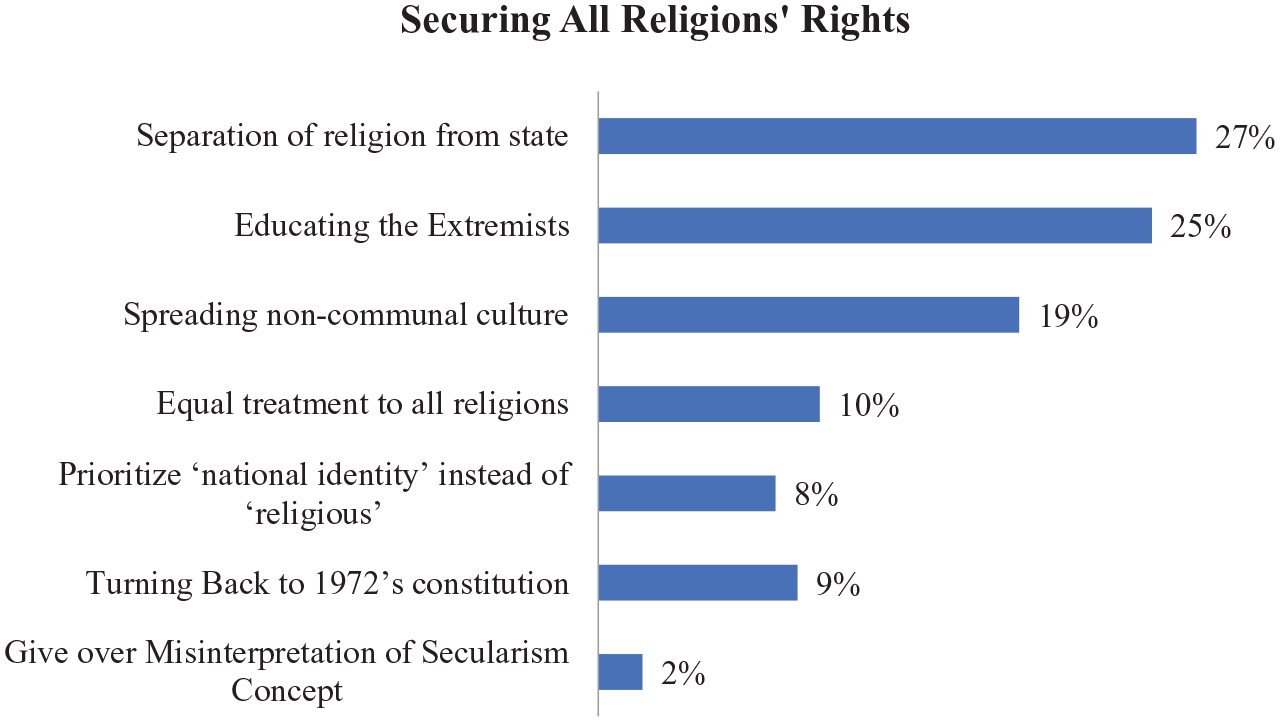
Perception on Securing all religions’ rights.
Constitutionally, every religion has the right to be equally treated. The minority religion should have the same facilities as the majority religion. No one must create any hindrance to the spreading of religious thoughts of their own. Research data shows that identity based on ethnicity is becoming stronger day by day in the world (De Witte, 2020). Populist politics is placing itself against liberal practices, which are entirely threatening democracy as well as stability in the world. Bangladesh needs to go on the path of plural identity; prioritizing ‘national identity’ instead of ‘religious identity’. And the politicians can play a vital role here. The 1972 constitution was formed in the sense of communal harmony and no one was left behind. Secularism was inserted so that all religions might enjoy equal freedom as a majority religion could. But later, it had been changed, and the politicization of Islam was visible in Bangladesh. The present generation thinks that the state has to ensure equal opportunity for all religions and freedom to practice their own religion without any explicit or implicit hindrance.
Conclusion
Although it has been reinstated at the state level, secularism cannot be claimed to have gained ground in Bangladesh’s society. The findings of this study also highlight the disagreement over the concept of secularism among Bangladesh’s tertiary educated population. Many people favor one particular religion’s primacy in the constitution while also arguing against the secularism ideal. They were found to believe that the majority area should get preferential treatment under the state structure. But the ray of hope is that they care about minority religions’ rights and their prominence in the nation. It is clear that some people with postsecondary education in Bangladesh support a strict form of secularism, while others advocate for a moderate, tolerant form, but the swinging view is dominant among the respondents. Whoever makes the case against secularism is on the side of Islam, which is the most common religion. Some believe that Bangladesh, where the majority of the population practices a particular religion, cannot be a secular society. Similar to many other countries with a majority of Muslims, secularism has come to be associated with anti-religious sentiment, atheism, and, categorically, anti-Islamism. Although the state is officially secular, this unavoidable social reality and the intermittent political expediency of the primary pro-secular group ultimately prevent the fulfillment of a key requirement of secularism, namely, equitable treatment for all religions (Kuru, 2007). However, the younger generation is concerned about the rights of Bangladesh’s religious minorities. The survey results provide guidance on how to safeguard the freedom and rights of religious minorities in this nation. More needs to be invested in social steering to change people’s perceptions of Bangladesh’s secularism and protect the rights of minority religions. The prime limitation of this research is its smaller sample size. This research could be more concrete and empirical if the sample size was big and resources were available. There will be opportunities in future to conduct this research based on a broad sample size, which might help to establish a more liberal, tolerant, and human-centric society. Policymakers can also get food for [re]designing state policy toward young people.
Footnotes
Declaration of conflicting interests
The author(s) declared no potential conflicts of interest with respect to the research, authorship, and/or publication of this article.
Funding
The author(s) received no financial support for the research, authorship, and/or publication of this article.
