




Abstract
After years of fighting, disagreements and geographical division, the Kurdistan Democratic Party (KDP) and the Patriotic Union of Kurdistan (PUK) signed a Strategic Agreement in 2006, leading to the unification of their different administrations. While the KDP-PUK Strategic Agreement prevented the two ruling parties from engaging in another violent conflict, and established a mechanism for unifying their two different administrations, it also appears to have been ineffective in facilitating the institutionalisation process and institutional stability. This study examines how the KDP-PUK Strategic Agreement shaped the governing system in the Kurdistan Region of Iraq (KRI) for a decade and identifies the reasons for the poor performance of political institutions. It demonstrates that the governing structure reflected partisan interests following the Strategic Agreement, making it difficult to establish stable and functional political institutions.
Keywords
Introduction
Iraqi Kurdistan
Since the establishment of a de facto semi-autonomous Kurdistan region in 1992, the Kurdistan Democratic Party (KDP) and the Patriotic Union of Kurdistan (PUK) have dominated the region’s political landscape. In the first elections in 1992, the two major Kurdish political parties (the KDP and the PUK) won all seats due to a 7% electoral threshold, which prevented other political parties from winning seats. As a result, they developed a power-sharing arrangement known as the ‘50–50 split’, in which they divided almost everything equally between themselves. However, this formula did not work effectively, and 2 years later, in 1994, a civil war broke out between the two factions, who engaged in violent conflict against each other. The conflict shaped a governing system that divided the region into two separate zones, with the KDP governing Erbil and Duhok and the PUK controlling Sulaymaniyah for a decade. After 4 years of fighting, the two conflicting sides decided to end their civil war in 1998 under the auspices of the US-mediated Washington Agreement.
After the collapse of the Ba’ath regime in 2003, the KDP and PUK attempted to create a joint front to present Kurdish national demands in the new political process in Iraq. Inside the Kurdistan region of Iraq (KRI), they also stepped towards unifying their administrations and military forces through a Strategic Agreement (hereinafter ‘the Agreement’), which represented the ruling parties’ requests for the division of high-ranking positions and the creation of a power-sharing framework that satisfied both factions. Political settlement is a crucial step for any society that has witnessed civil wars, providing a pathway to a more effective governing system and long-lasting instructional stability. In the case of the KRI, the paper attempts to show that the Strategic Agreement was a necessary step, as it prevented both parties from engaging in another violent conflict, and it laid the groundwork for unifying their divided administrations; however, it had manifested practical and contextual limitations in terms of building an effective governance structure and political stability.
Theoretical background
The Strategic Agreement between the KDP and the PUK can be considered a political settlement since it meets almost all the conditions of the political settlement approach. Much of the groundwork for political settlement analysis can be found in the work of Mushtaq Khan in his critique of New Institutional Economics (NIE) in the 1990s, and his updated version in 2010 (Khan, 1995, 2010). The most theoretical-based definition of political settlement originated from historical political economy, mainly developed in the works of Mushtaq Khan, which defined political settlement as a description of the distribution of power across organisations [political parties] that are relevant for analysing a specific institutional or policy problem” (Khan, 2017: 4). Khan (2017) believes that institutions and policies define the rules that determine resource allocations among different factions. These rules can affect various political groups in very different ways; therefore, based on their goals and capacities, these groups might be anticipated to support, oppose or misrepresent certain institutions or policies.
Building on the earlier work of Khan (1995), Di John and Putzel (2009) considered political settlements to be ‘bargaining outcomes among contending elites’ (p. 4). According to them, utilising political settlement analysis to understand the condition of a state or a government is useful for several reasons. First, one of the vital understandings emerging from the literature is that it is not the ‘design of institutions’ (i.e. formal institutions) which determines either political or economic outcomes, but the underlying political settlement. Second, the various levels of performance of states or governments can be understood by examining the political settlement, which also provides a route to understanding the reform directions that may carry when it comes to fundamental functions of state or government. Finally, through an analysis of existing literature on ‘elite bargains’, it has been concluded that bargains located at the heart of the political settlement provide an explanatory framework to understand paths of state fragility and resilience and how these relate to processes of development and poverty reduction. Depending on this, analysing the Strategic Agreement would be useful to understand and evaluate the performance of the governing intuitions in the KRI.
Furthermore, in its first few years, the definition of the political settlement underwent modest modification until it emerged in a practice paper by the United Kingdom Department for International Development (DFID) on building peaceful states and societies in the following terms: Political settlements are the expression of a common understanding, usually forged between elites, about how power is organised and exercised. They include formal institutions for managing political and economic relations, such as electoral processes, peace agreements, parliaments, constitutions and market regulations. But they also include informal, often unarticulated agreements that underpin a political system, such as deals between elites on the division of spoils. (DFID, 2010: 22)
Based on Khan (1995, 2010) conceptualisation and the definition of the DFID (2010), the political settlement of ‘Strategic Agreement’ formed the governance structure of the KRI for more than a decade. Understanding the Strategic Agreement through the study of political settlement is very vital for identifying the Settlement’s weakness and evaluating the performance of established institutions.
Furthermore, the political organisation plays a central role in shaping political settlement and can have a considerable influence on its consolidation, particularly in terms of achieving resilience, and the extent to which a settlement enhances the development of subsequent actions. Historically, the most influential kind of political organisation has been political parties, which can promote an ideology and a strategy (Di John and Putzel, 2009). Michels (1962) argues that ‘it is organisation which gives birth to the domination of the elected over the electors, of the mandataries over the mandators, of the delegates over the delegators. Who says organisation, says oligarchy’ (p. 241). For Michels, the principle of oligarchy in modern democratic parties arises from the ‘technical indispensability of leadership’; for him, the most mature democratic organisations, such as European social democratic parties, become divided into elite fractions who pursue their own interests within parties (ostensibly representative political organisations) by exploiting the resources of party members (Michels, 1962 and Korom, 2015). He also pointed out that ‘at the outset, leaders arise spontaneously; their functions are accessory and gratuitous. Soon, however, they become professional leaders, and in this second stage of development they are stable and irremovable’ (Michels, 1962: 240).
The political parties in the KRI share many characteristics, particularly in terms of leadership style, as almost all political parties in the Region have single charismatic leaders-for-life. The KDP, the most powerful political party since its establishment in 1946, has only had two leaders, Mullah Mustafa Barzani (1946–1979), and his son, Masoud Barzani (1979–present). Since its establishment in 1975, Jalal Talabani was the PUK’s General Secretary, and his son Bafel Talabani succeeded him after his death in 2017. The same scenario can be observed for Islamic parties. The Kurdistan Islamic Union (KIU) saw Salah Al-Din Muhammad, the party’s founder, re-elected as its leader for seven of the eight held conferences since its establishment in 1994. Ali Bapir, who founded the Kurdistan Islamic Group (KIG), has been the undisputed Party President since he established it in 2001.
Therefore, the political groups and competing elites as per the paradigm of Michels (1962) are an essential element of political settlement, because if powerful political parties do not get an acceptable distribution of advantages from an institutional structure, they try to change it, as explained by Khan (2010). From this, it can be noted that powerful political parties attempt to build institutions in a manner that serves their best interests. Therefore, the performance of the institutions reflects the interest of the political parties engaged in the political settlements. Political settlement analysis provides a framework for looking at ‘interrelationships between institutions, policies, political stability and economic growth’ (Khan, 2016: 6).
For Khan (2016: 6), political stability has a direct link with the political settlement arrangement, in that political stability relies on whether a political settlement results in the allocation of political ‘rents’ (e.g. strategic objectives and control over resources) that strong groups (political parties) find satisfactory. In other words, if the distribution of power is not in alignment with the interest of powerful groups, it is expected that they will attempt to correct the imbalance through various means, and if the institutional processes for correcting the imbalance do not work, the chance of disruptive of institutions will increase. Consequently, it is essential to comprehend the political settlement that characterises the relative power of the key political actors to contextualise issues surrounding the maintenance of political stability, which is dependent on the distribution of various types of political rents.
The power distribution across political entities (constituting different aspects of the political settlement) is a crucial factor in determining outcomes which can be termed the degree of political stability (Khan, 2016). However, it is also important to mention that sometimes new actors arise that are not part of the pre-existing political settlement; in this situation, the new actor tries to change the balance in its interest and weaken the legacy political settlement. For example, the Gorran Movement emerged as a strong opposition group in the KRI in 2009, and was not part of the previous Strategic Agreement; therefore, it challenged the Agreement and raised reform slogans in all political sectors. In return, the KDP and the PUK used different means to maintain their hold of power and continue their power-sharing structure.
Therefore, this study adopts Khan (1995, 2010) conceptualisation of political stability. Understanding the concept of political stability within the framework of political settlement enables a reasonable analysis of the study of the KDP-PUK’s Strategic Agreement and its consequences for political stability in the KRI. However, the concept of political stability has been defined differently and has been attributed to different factors, by various scholars. For Ake (1974: 586), political stability refers to the regularity of the flow of political exchanges, including the communications and transactions of actors and people in interaction; consequently, to the extent that the flow of political exchanges is irregular, the political system is unstable; to the extent that it is regular, the political system is stable.
Lijphart (1968: 9) defined stability as the ‘system’s ability to survive intact’, whereby ‘the capabilities of the system are sufficient to meet the demand placed upon it’. Similarly, Lane and Ersson (1999) viewed political stability as a form of social order and regime persistence. According to Hurwitz (1973), the defining elements of political stability include (a) the absence of violence; (b) governmental longevity and duration; (c) the existence of a legitimate constitutional regime; (d) the absence of structural change; and (e) multifaceted social attributes. While being aware of the multifaceted nature of these overlapping definitions and their concepts in relation to political stability, this paper fundamentally adopts the operational definition and theoretical lens of Khan (1995, 2010) to explore political settlement in the context of the KRI.
Methodological note
Although this study is largely based on a review of secondary literature on KRI, 12 semi-structured qualitative interviews carried out with former government officials, members of Parliament and senior members of political parties who had firsthand knowledge of the government and their own parties. The interviewees who participated in the study include Farid Asasard, secretary of the PUK’s Leadership Council; Ari Harsin, a former PM for the KDP in the Kurdistan Parliament, and currently a member of the KDP’s Leadership Council in Sulaymaniyah (Halabja); Yousif Mohammed, the Kurdistan Parliament’s former speaker and a senior member of GM; Abubakr Karwani, a former member of the KIU’s Political Bureau, and one of the candidates for KIU leader in the Seventh Party Conference in 2016; Dara Muhammad Amin, the Minister of Environment in the Fifth Cabinet, and co-founder of the KIG; Dlawer Ala’Aldeen, Former Minister of Higher Education (2009–2011) and the President of the Middle East Research Institute; Muhammad Hawdyani, Former Minister of Labour and Social Affairs (2014–2019) and an official of the KIU’s Relations Office; Rebwar Babkai, an MP for KDP in the Kurdistan Parliament; Hakim Sheikh Latif, Former Iraqi MP for GM and a legal expert; Adnan Osman, MP of the GM in the third term of the parliament (2009–2013), former GM’s spokesperson and former Secretary of the GM National Assembly; Ali Hama Salih, a GM MP in the Kurdistan Parliament and former head of the GM’s parliamentary bloc; and Nask Tofiq, a member of the KIU’s Executive Council.
The interview process with each interviewee was between 30 and 45 minutes and conducted in the KRI at the participants’ offices between July 2021 and June 2022. The interviews were recorded and then transcribed and quoted below where appropriate.
KDP-PUK Strategic Agreement and power-sharing formula, post-2003
The removal of the Ba’ath regime by the United States in 2003 strengthened the role of the Kurdish political parties in Iraq and possibly alleviated the trauma experienced by the Kurdish population under Saddam Hussein. The invasion thus redefined the Kurdish position within Iraq and made them one of the main participants in rebuilding the Iraqi political process. Since then, the Kurds have played a significant part in Iraq’s central government in Baghdad, having been granted a say in the country’s national political affairs. Furthermore, the Iraqi Constitution adopted by a national referendum in 2005 established a federation system in Iraq for the first time in the county’s history (Iraqi Constitution, 2005). It recognised and legalised self-rule in the KRI, maintaining the institutions established under the No-Fly Zone (i.e. the Regional Government, Parliament, Presidency, and Internal Security Forces) (Arif and Mokhtar, 2022; Bengio, 2017; Rogg and Rimscha, 2007). This was a promising achievement for the Iraqi Kurds, who had endured decades of ethnic suppression throughout the history of Iraq.
Inside the KRI, they also needed to reconsider their relationships and re-establish a new governing system. In practice, on 1 December 2004, Jalal Talabani, the PUK’s leader, with a delegation from his party, visited Masoud Barzani, the KDP’s leader in Sari Rash (north of Erbil) for bilateral talks. After this meeting, they declared in a press conference that they had signed an Agreement (originally called the ‘Sari Rash Agreement’) to divide all higher offices at both the federal and regional levels between the KDP and the PUK (Mustafa, 2013). According to the terms of the Agreement, for the sake of the ‘Grand National Interest of Kurdish People’, both sides had agreed and decided to create a joint list for participating in the upcoming elections for the elections to the Iraqi and KRI parliaments. Furthermore, the Agreement outlined a 50–50 power-sharing arrangement, whereby Jalal Talabani would be the President of Iraq, and Masoud Barzani would be the President of the KRI. Regarding the higher posts in the KRI, they agreed that KDP personnel would be awarded the KRI Prime Minister and Parliament’s Deputy Speaker positions, while the Speaker of Parliament and Deputy Prime Minister posts would be for the PUK (Asasard, 2021a; Mustafa, 2013).
The Agreement led to the establishment of the Kurdistan Alliance (al-tahaluf al-Kurdistani) to participate as a single list in the elections for the Kurdistan Parliament, Iraqi Parliament, and Provincial Council, which were held together on 30 January 2005 (The Kurdistan Parliament, 2005a). This was the first general election held after the fall of the Ba’athist regime in Iraq. According to the Agreement, Masoud Barzani was elected by the Kurdistan Parliament as the President of the KRI, and Jalal Talabani became the President of Iraq in the same year (Mustafa, 2013). This was an initial step of applying the Agreement, and introduced a power-sharing system that framed the KRI’s governing system for more than a decade (Fantappie, 2018).
In January 2006, the PUK and the KDP reaffirmed their promise to reunify their two administrations inside the autonomous region of Kurdistan, putting all three of the provinces (Erbil, Sulaymaniyah and Duhok) under unified administration (Ekurd Daily, 2006), which was a massive step forward from the civil wars of the 1990s. However, it took the Kurdistan Parliament a year to form a unified government due to a number of unresolved issues regarding the KRI’s presidency law and the positions accorded to the KDP and the PUK in the forthcoming united government (Mustafa, 2013). Given the significance of the deal as a political settlement for ensuring the stability and security of the KRI, a detailed plan was prepared for its signing at the Kurdistan Parliament, which included inviting international officials as well as US diplomatic and military personnel. On 21 January 2006, Adnan Mufti, the Parliament’s speaker, inaugurated a special Parliamentary session in Erbil by welcoming the guests, including ambassadors from the US (Zalmay Khalilzad), the UK, Japan and Iran, as well as local political party representatives. Then, following a reading of the settlement aloud, Barzani and Talabani signed it, to the warm applause of attendees (Ahmed, 2012). In 2007, this preliminary phase was escalated in the wider political settlement of the ‘Strategic Agreement’, which appeared to work to consolidate the relationships between both parties and shape the future structure of the government formations in the KRI (Ekurd Daily, 2007).
The Strategic Agreement reaffirmed the Sari Rash Agreement, particularly regarding the distribution of high offices and participation in elections with a joint list. The Strategic Agreement consisted of a preamble with eight sections and 26 articles. For example, in the third section of the Agreement, both parties admitted that the authority of the Kurdish government should include and extend to all of the KRI’s territory. This was an attempt to reunify the divided administrations between the KDP and the PUK, but the effect of the two administrations remained in place in the KDP and PUK zones. Other sections of the Agreement mentioned issues such as having a shared agenda over the Iraqi situations and matters, unifying KRI’s representative offices abroad, establishing a mechanism for monitoring the application of the Agreement and organising media (Asasard, 2021b).
The settlement appeared to be necessary from a neutral perspective for several reasons. First, it offered some measure of security and gradual stability to the region, ending the conflict between the two parties and eliminating the possibility of another civil war. Farid Asasard believes that the Agreement was an essential step because ‘it established the foundation of stability in the KRI’ (interview with author, 1 August 2021). Ari Harsin, a member of KDP’s Leadership Council in Sulaymaniyah-Halabja, also asserted the importance of the Agreement, observing that the history of conflicts between the KDP and the PUK dates back to the 1960s, leading to lack of trust, mandating an orchestration to guarantee the prevention of returning to another civil war. This became a fundamental principle for the settlement to bring security, stability and peace between the two main parties in the region (interview with author, 31 August 2021).
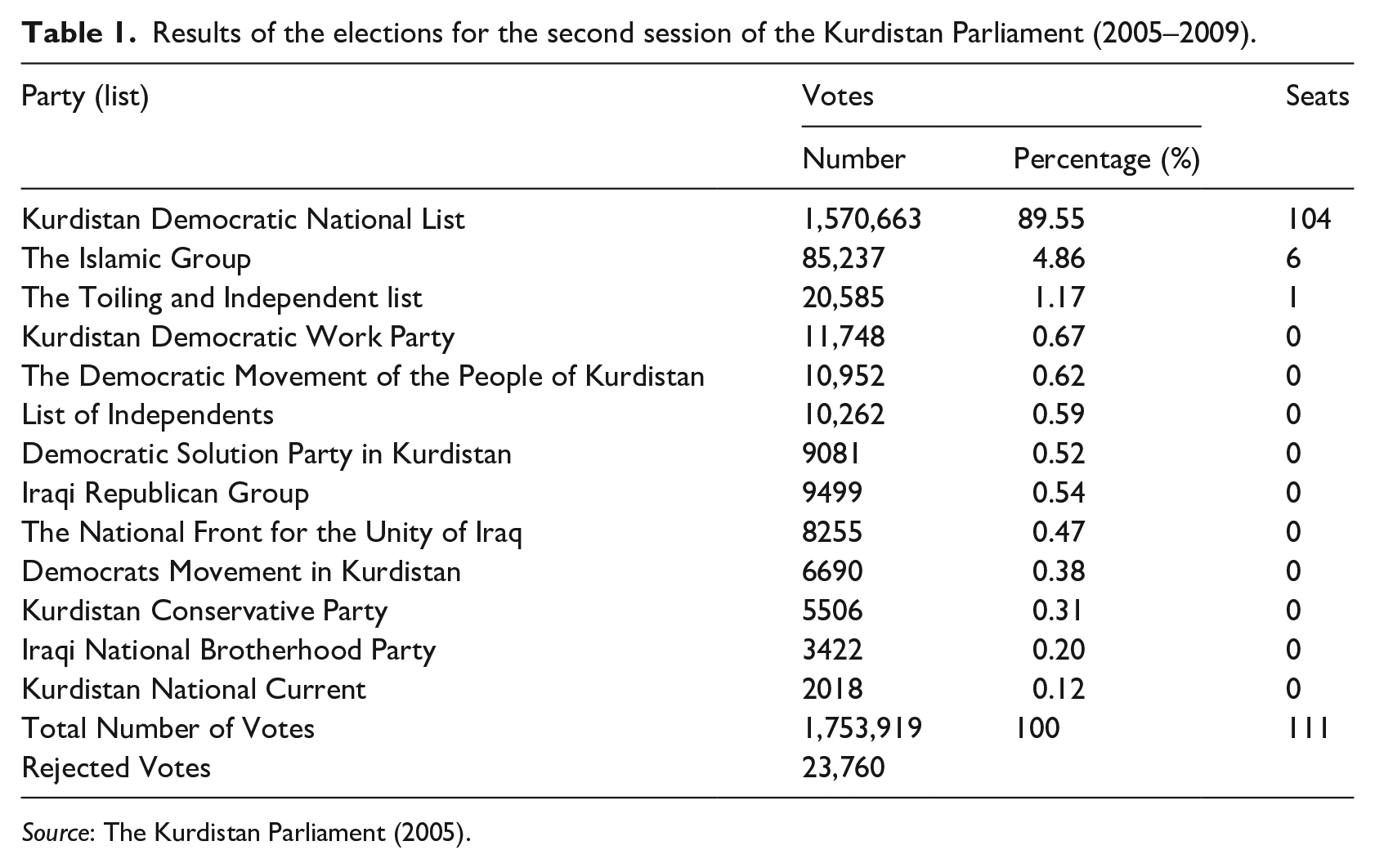
Second, the reconciliation between the KDP and the PUK encouraged them to participate with a joint list (the Kurdistan Alliance) in the 2005 and 2010 Iraqi Parliamentary elections (The Iraqi Parliament, 2010). This unity likely strengthened the Kurdish stance in restructuring the Iraqi political process, advancing Iraqi Kurds’ interests in the Iraqi Constitution. The settlement was critical step in unifying the two different administrations founded between the KDP and the PUK in 1996. Rebwar Babkai, an MP for the KDP in the Kurdistan Parliament, maintains that the Strategic Agreement was a necessary step since it practically unified the two administrations, and brought stability to the area. He further contends that since the KRI does not have a constitution, the Agreement played a crucial role in establishing the governance structure (interview with author, 26 February 2022). In practice, in 2005, the second round of elections for the Kurdistan Parliament were held, and the KDP and PUK participated in a joint list (the Kurdistan Democratic National List). Consequently, the parties collectively won 106 of 111 seats in the Parliament (The Kurdistan Parliament, 2005a). Finally, the pact had its part in developing the region’s economy, leading to an economic boom in the 10 years that followed. During that time, the KRI received 17% of Iraq’s oil revenues, and attracted foreign investments, especially from Turkey, facilitated by a friendly investment law and stable environment (Hassan, 2015).
Despite the importance of that settlement, it did not eliminate the potential factors that could increase the region’s insecurity and instability. First, some parts of the arrangement were not implemented, and did not meet the agreed timeline for its implementation. In this regard, Farid Asasard said ‘In my opinion, 30 to 50 percent of the Strategic Agreement between the KDP and the PUK has been implemented’. He believes that some sections of the Agreement were implemented as described, and some sections have initially been implemented but then ignored, while others have never been put in place (interview with author, 1 August 2021). In other words, those parts related to splitting control over the region’s security forces, governance posts, and financial revenue went into effect, while others on unifying the security forces, introducing good governance, and depoliticising state institutions have been partially fulfilled or never carried out. Yousif Mohammed, a former speaker of KRI’s Parliament, considers the Strategic Agreement as an arrangement to divide the high political posts in Baghdad and KRI and link these posts together; for example, the position of KRI’s President was equivalent to the President of Iraq. He also asserts that the content of the Agreement remained secret for a long time, and when its content was later leaked, it did not include anything regarding building good governance, establishing a strong political and economic system, introducing institutionalised government, depoliticising security forces, or creating a national security force (interview with author, 31 July 2021).
The absence of a constitution in the KRI allowed both ruling parties to use the Strategic Agreement as a ‘de facto constitution’ due to their domination of the political landscape of the region (Jameel, 2017). Critics observed that in the post-2003 context, writing a modern constitution for the KRI was more vital than the Strategic Agreement to formulate the governing system, because the main problem of the region is the lack of a dignified constitution that protects the right all groups and ethnicities, and which could unify all formal institutions, including military and security forces (Xoshnaw, 2020). In addition, the accord is considered as an instrument in the hands of both parties for retaining political dominance over the KRI. Mufid Abdulla referred to the settlement as ‘a marriage of convenience to share the oil income and wealth of Kurdistan between themselves and their families and cronies’ (Abdulla, 2012).
Among the most notable changes in a few years following the Strategic Agreement was the emergence of the GM in 2009 as a splinter from the PUK as a strong opposition party and as a challenger to the entrenched duopoly of the conventional Kurdish political system. In the 2013 parliamentary elections the KDP and the PUK participated in separate lists, and Jalal Talabani disengaged from political life later the same year, which led to questioning the durability of the Strategic Agreement. Abu Bakr Karwani, a former member of KIU’s political bureau and a twice unsuccessful candidate for the post of KIU’s Secretary-General, maintained that the Strategic Agreement played a role in promoting peace and security in the KRI since those capable of causing instability were largely the KDP and the PUK at that period. Both parties possessed potential powers to access violence – and, even before that, they were the ones who had experienced civil wars (interview with author, 9 August 2021). This indicates that stability in the KRI depends on the will of the KDP and the PUK, because together they control all potential powers. As North et al. (2007) observed, ‘in a fragile [political settlement], each faction in the dominant coalition has direct access to violence, and violence potential is a principal determinant of the distribution of rents and resources’ (p. 11).
Karwani claimed that while the Agreement had brought about some stability, it was fragile, transient and non-institutional, because the settlement was more about sharing privileges and advantages as well as establishing a temporary understanding, which would inevitably run into problems if the circumstances changed. He also believes that the Agreement was not broad enough to include all Kurdish groups, particularly younger generations and people with newly formed ideas, or to account for the outside world’s impacts on Kurdistan. Examples include the formation of the GM in 2009 and the Arab Spring in 2010, which directly resulted in an internal reaction inside KRI and subsequent demonstrations a year later (interview with author, 9 August 2021).
From this perspective, it can be said the united cabinet (2006–2009), called the Fifth Cabinet per se, was an inclusive government in the sense that it included all political groups, including minorities, to eradicate resistance. However, it is important to note that an inclusive government is not necessarily the result of an inclusive political settlement; the government at the time was indeed overtly inclusive, but the political settlement, which included only the KDP and the PUK, was not. Therefore, smaller parties such as KIU and KIG were included in the government, but not in the settlement between the two main parties. As a result, towards the end of the Fifth Cabinet, smaller parties included in the government began criticising the power-sharing agreement and demanding reform, having realised their negligible influence in the Cabinet.
Therefore, the Strategic Agreement prioritised the interests of dominant political parties and the distribution of power above reforms and the establishment of institutionalised government. Through this settlement, the KDP and the PUK were able to shape the governing system in their favour, particularly between 2005 and 2009, due to a lack of strong opposition groups. In this regard, Ali Hama Salih (former head of the Gorran bloc in the Kurdistan Parliament) explains, All the Agreements I have seen and witnessed between political parties had some superficial paragraphs and articles about the political system, healthy management, and reforms; nonetheless, the outcome was a division of power and high political positions between them. That is why, year after year, the governing system is not going forward; even the posts within the Judicial Council of Kurdistan are divided between them, not to mention the security force and other governmental offices. (Interview with author, 4 August 2021)
Generally, the KDP and the PUK have never amended the Agreement’s sections and articles, reducing its capacity to adapt to new situations and deal with new challenges that arose between them. Thus, the carefully crafted equilibrium was shaken with the emergence of GM as a strong opposition party and a splinter group from the PUK in 2009, wiping off up to half of the party’s votes (Salih, 2016). Beginning in 2012, when Jalal Talabani disengaged from political life due to illness, the PUK lost much of its cohesion due to internal rivalry and defections. The PUK’s series of strategic errors enabled the internally coherent KDP to further consolidate its control of the KRI, including its hold on the oil and gas infrastructure, as well as on national (Iraqi) funds from Baghdad (Saleem and Skelton, 2020). Furthermore, the Agreement faded further when the KDP and the PUK participated with separate lists in the 2013 Kurdistan Parliamentary elections, and the PUK faced a major defeat, becoming the third party (after the KDP and the GM). Thus, the KDP no longer considered its alliance with the PUK, and picked the GM as its primary partner for the new Kurdish government.
Several other issues, including disputes over how to deal with Baghdad and the Syrian crisis, exacerbated the split between the KDP and PUK. For instance, in 2018, both the KDP and PUK had different candidates for Iraqi President, which had previously been reserved for the PUK, with the support of the KDP (Aldroubi, 2018). The following sections discuss the effect of this political settlement on the government formation and performance, particularly with regard to
A unified government under the strategic agreement
After years of divided administrations, a reunited fifth KRI cabinet was formed in May 2006 as a consequence of the political settlement between the KDP and the PUK in 2005, and the changed situation in Iraq after 2003. The established cabinet was based on the elections for the second term of the KRI’s Parliament, held in 2005 (13 years after the first elections, under the UN No-Fly Zone). It is worth noting that despite the abolition of the 7% election threshold for obtaining parliamentary seats, and opening the door for parties to compete for seats under the electoral law in 2005, 13 lists participated, yet only three of them won seats. Among independent parties, the Islamic Group in Iraqi Kurdistan won six seats, and one seat went to the Toiling and Independent List. The Kurdistan Democratic National List collectively won 104 of 111 seats in the KRI Parliament, broken down as follows: KDP (40), PUK (38), KIU (9), Kurdistan Communist party (3), Kurdistan Democratic Socialist party (2), Independents of Nationalities and Religions (5), and one seat each for the Workers’ Party, Toilers in Kurdistan, Kurdistan National Democratic Union, Assyrian Movement, Assyrian Democratic Movement, Beit Nahrain Democratic party, Chaldean Democratic Party and Turkmen Democratic Movement (Salih, 2019) (Table 1).
Results of the elections for the second session of the Kurdistan Parliament (2005–2009).
Source: The Kurdistan Parliament (2005).
The Fifth Cabinet was the first unified government established in 2006, and almost all political groups became part of it. Critics point out that none of the major governing parties agreed to become opposition owing to various reasons, including lacking trust, the role of the KRI’s security and military forces, and budgetary and administrative organisations. To maintain this balance, they opted to operate the KRI jointly (Al-Zaidi and Mohammad, 2012). In addition, it is also noted that other parties felt practically compelled to cooperate with this government, since it seemed that both ruling parties would not accept any opposition group against them. For example, when the KIU decided to take part in the 2005 Iraqi general election with a separate list from a coalition block of other Kurdistan parties, a group of the KDP followers attacked their offices in Duhok city on 15 December 2005, which resulted in murdering three high-profile members of this party and burning their offices (Al- Zaidi and Mohammad, 2012).
Both the KDP and the PUK accepted to equitably distribute ministerial and key positions (Yoshioka, 2015: 25). Under the Agreement, Nechirvan Barzani from the KDP was appointed as Prime Minister, and Omer Fattah from the PUK as Deputy Prime Minister. Adnan Mufti (a PUK politician) was named as the speaker of the KRI’s Parliament, while the Deputy Speaker was from the KDP (United Nations High Commissioner for Refugees, 2006). Both parties agreed to rotate the Prime Minister and Speaker offices every 2 years. During the Fifth Cabinet the process of position exchanges did not happen in 2008; it was the PUK’s turn, and was supposed to form a new government, but the internal disputes among factions within the PUK led the KDP to keep the Prime Minister position for the next 2 years. According to the unification treaty, the KRI Presidency was allocated to the KDP. As a result, the KDP (or more precisely, the Barzani family) controlled both executive branches, thereby consolidating their monopoly on economic resources and the whole political structure.
Both ruling parties agreed to formulate an inclusive form of government that included all political parties with seats in the Parliament. The goal was to gain the support of most political parties and prevent any opposition groupings from criticising their policies in the Parliament. The 50–50 power-sharing formula between the KDP and the PUK was repeated once again, with participation from some other political parties. The number of ministers in this Cabinet increased to 40, allowing each political party to have a formal position within the government (The Kurdistan Parliament, 2006). At least nine of them had no portfolio or office, and were referred to as Ministers for the Regions, with no vote in the Cabinet but the same privileges, financial rights and pension. For the other 31 actual ministers, 14 of them were headed by the PUK, and 13 by the KDP. Islamists held three ministries, and Turkmen and Assyrians had one each (Gunter, 2008: 56). Furthermore, During the Fifth Cabinet, the PUK and the KDP continued to share three major ministries: Interior, Justice and Peshmerga. In a way, each minister was represented in the Council twice, by the responsible Minister and by a ‘Minister of State’ from the opposite party. For example, the Interior Minister was the PUK’s Osman Haji Mahmoud, and the Minister of State for the Interior was Karim Sinjari from the KDP (Chapman, 2009).
In addition, the Ministry of Finance was not successfully unified during this time. According to Article 5(d) of the Unification Agreement, the Ministries of Finance, Peshmerga Affairs, Justice and Interior were to be united in 1 year (National Legislative Bodies / National Authorities, 2006). The reason for having two ministers for a single ministry was the deep distrust between both sides, and the importance of these focal ministries as a source of power to each political party in its zone. Even after the official unification of these ministries in subsequent governments, the two administrations maintained de facto separation via their politicised personnel. Dara Muhammad Amin, Minister of Environment in the Fifth Cabinet and one of the KIG’s co-founders, said that the high number of ministers in that Cabinet was a strategy for including all political parties and minority groups in the government, at the very least by assigning each one a minister. Despite the lack of unification in the mentioned ministries, it was a significant step towards resolving numerous issues and unifying education, higher education, municipal and other service ministries, particularly in light of the fact that it was the first unified government since the civil war of the 1990s (interview with author, 29 November 2021).
Therefore, the Fifth Cabinet was an inclusive government by all measures. It was a large cabinet to satisfy all parties, as there was no party or political force left in the Parliament that did not participate in the government. This, however, did not result in the actual involvement of other political parties in decision-making, as the two governing parties retained control of key ministries and economic and military power. As Mohammed Rashid Mawati, a leading member of the KIU, said ‘look at the distribution of ministerial posts – as if they were divided only between the two [ruling] parties. It is nothing more than the 50–50 sharing in the previous [Unified] government until 1994. It is even less [worthy] now’ (Radio Free Europe/Radio Liberty, 2006).
It can be argued that the role of other political parties was very limited in the government and had no power to challenge the KDP and the PUK’s agenda. Thus, this formula blocked the way for the emergence of the legitimate and effective political opposition so that it would be able to play as an observer of the government’s work and then shows its flaws and deficiencies in Parliament. Nask Tofiq, a member of KIU’s Executive Council, pointed out ‘we as KIU participated in the fifth cabinet and soon realised that the Agreement between the KDP and the PUK was not to create national military and institutionalised institutions but was to divide power, sources, and posts’ (interview with author, 16 October 2021).
This was seen as a twofold approach by KIU, to avoid being accused of mismanagement and involvement in corruption. In March 2008, four political parties, including the KIU in Parliament, presented a reform project to the government and hoped this would transform into an opposition front in the KRI. That reform initiative was not considered by the ruling parties and did not result in the formation of any opposition front.
Emerging Gorran movement and challenges to the Strategic Agreement
At the end of 2005, several members of the PUK’s Political Bureau sent a letter to the Secretary-General of the party, Jalal Talabani, calling for radical reforms within the party, defining the powers of the Secretary-General, activating the political office, and holding by-elections. Within the party, carrying out comprehensive reforms within the government and activating them and ensuring basic services for citizens (Alo, 2015). Later, Nawshirwan Mustafa, Deputy Secretary-General of the PUK, resigned from all his positions within the party and formed a media organisation named Wsha (‘Word’) in March 2007, containing a website, satellite channel and a printing press. Mustafa tried to bring about a change in the entire political system in the KRI by creating an effective political opposition. He explained his leaving the PUK by stating ‘I used to think that the reform of the government depends on the reform of the political party, but later I gave up and went out and my other comrades stayed’ (Mohammed, 2014).
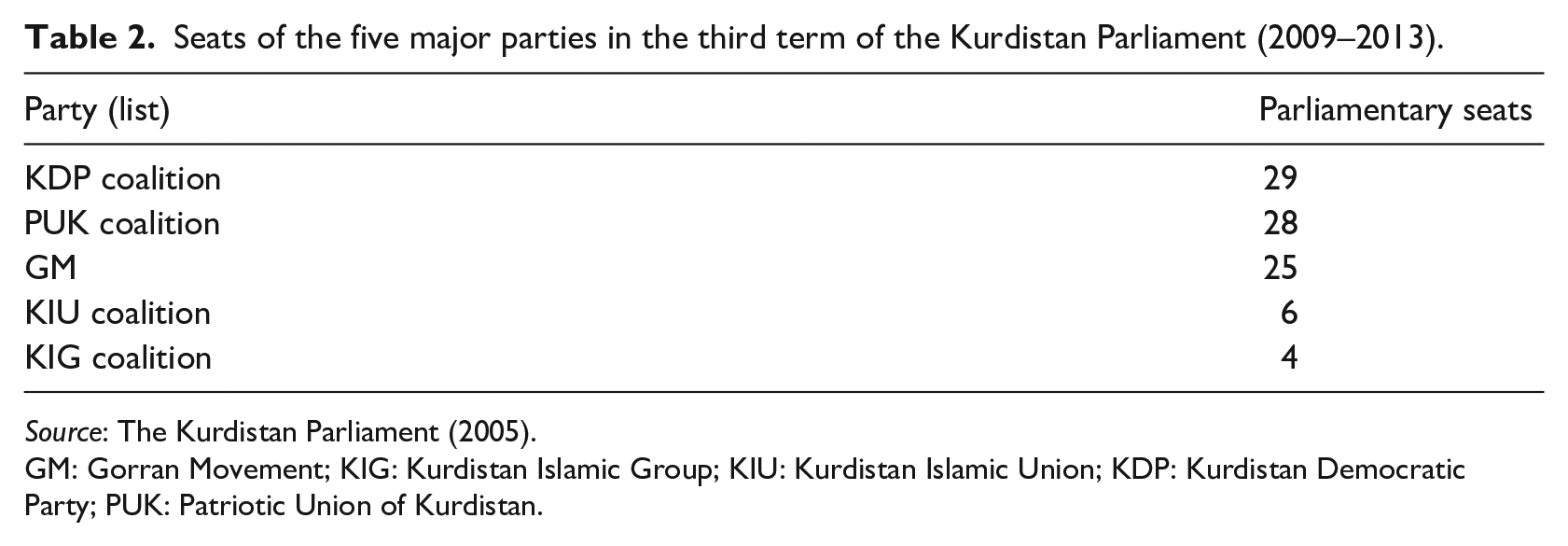
In 2009, Nawshirwan Mustafa formed the GM and participated in the 2009 KRI general elections, winning 25 of 111 parliamentary seats. It is a widely held view that the existence of a high level of corruption, lack of transparency in governmental institutions and interference of political parties in all aspects of society contributed to the GM’s success in its first election in 2009. The GM highlighted all these issues in its election campaign, which attracted more widespread public support. It also took advantage of the general malaise of disenfranchisement to insist on a total reform of the political structure that had been formed by the KDP and the PUK in the region (Hama, 2022).
As mentioned previously concerning the theoretical background of studies of political settlement, emerging new players who are not part of the existing political settlement (which reflects the major political players of the status quo ante), the new actor attempts to alter the equilibrium in its favour, and undermine the legacy political settlement. For instance, the GM was a strong opposition force in the KRI in 2009 outside the framework and parameters of the Strategic Agreement; consequently, it challenged the Strategic Agreement and promoted reform slogans in all political sectors against the ruling parties. In such a situation, it is reasonable to imagine that the parties (and beneficiaries) of the Strategic Agreement, the KDP and PUK, would reflexively want to maintain the status quo (and their powers and privileges) by using various reactionary measures to prevent the insurgent challenger, including institutional disruption if institutional processes per se failed to achieve their aims.
In 2009, GM’s decision to remain as an opposition group made it simple for the KDP and the PUK to adhere to their Strategic Agreement in the distribution of power and forming a new government. Therefore, after 3 months of intense discussion and negotiations, on 28 October 2009, the Sixth Cabinet was formed, with Barham Salih, Deputy General Secretary of the PUK, becoming the Prime Minister, and Azad Barwari, a member of KDP’s Political Bureau, becoming the Deputy Prime Minister for 2 years and rotating after 2 years (The Kurdistan Parliament, 2009). In this Cabinet, while some smaller parties and minorities, including communist parties, the Turkman front, Assyrian representatives, Islamic movements, and the Kurdistan Socialist Democratic Party participated in the government, some other powerful parties like the GM, which had 25 seats, and two major Islamic parties (the KIU and the KIG) stayed out of the government, and became opposition. It was the first time in the history of the KRI that the two ruling parties had a substantive opposition, as the three opposition parties collectively held 35 seats, and announced themselves as an opposition front (Table 2).
Seats of the five major parties in the third term of the Kurdistan Parliament (2009–2013).
Source: The Kurdistan Parliament (2005).
GM: Gorran Movement; KIG: Kurdistan Islamic Group; KIU: Kurdistan Islamic Union; KDP: Kurdistan Democratic Party; PUK: Patriotic Union of Kurdistan.
While the emergence of strong opposition in the Parliament was significant for democratic practices, it did not result in a meaningful change in the ruling parties’ attitudes and behaviour towards the issues confronting the KRI and opposition demands for reform in the entire governing system, particularly with regard to the institutionalisation of formal institutions, unification of security forces, and combating corruption. For example, Dlawer Ala’Aldeen, a minister in the Sixth Cabinet, claimed that during the 2009 election campaign, only the PUK offered over 20,000 public employments. In addition, in 2010, at the demand of KDP and PUK officials, approximately 20,000 new employees were recruited to various government institutions based on localism, partisanship, and family loyalty (Ala’Aldeen, 2013: 210). As Ali Hama Salih observed, both ruling parties illegally added thousands of individuals to the list of pensioners’ payments during that period. Those individuals did not work in the public sector to be eligible for that salary; in fact, several received the privilege of a minister without ever serving as one for a single day (interview with author, 4 August 2021).
Asasard pointed out that every government has a strategy for resolving unemployment issues, but in Kurdistan, this process began without a plan; for example, everyone who completed university or even those without a degree were employed and became salary recipients. Many of them performed poorly or had no duties in public offices, because they were employed on the basis of the ruling parties’ demands rather than their skills or abilities, much less public service requirements (interview with author, 1 August 2021). This mismanagement in the public sector exacerbated the partisan networks of patronage and nepotism throughout official institutions in the KRI, which grew increasingly difficult to confront or resolve, since public servants received payments without playing a role or delivering services from public offices. Moreover, its negative impact became more apparent when the KRI faced an economic crisis due to the cut of the KRI’s share of the budget by the central government.
According to available data, 1,219,922 people are in receipt of salaries or stipends in the KRI (including public sector employees, pensioners, and social care). However, most employees were added randomly based on partisan reasons rather than skills during 2003–2013, creating a huge expense for the public purse, and the government was unable to pay full salaries, particularly between 2015 and 2019; this led to widespread protests and payment demands, exacerbating instability in the region. This type of policy resulted from and further reinforced the politicisation of public institutions and the absence of a formal hiring procedure. Therefore, the dominant ruling parties took advantage of this opportunity to increase their support by offering public jobs and luring other parties into corrupt practices to buy their political support.
At this juncture, the opposition blocks began to talk about important issues such as corruption of the public officials, the weaknesses of the government institutions and political parties’ dominance of governmental affairs in the Kurdistan Parliament, and through their media outlets they raised public awareness about such issues. Their campaign was exceptional in its intensity, focussing on both parties’ legacies. They disclosed hundreds of scandals involving the governing parties’ corrupt and politicised dealings. Their campaign sparked enormous public discontent, especially given that most people previously saw corruption as a key hindrance to the region’s development (Jameel, 2017).
Nevertheless, the GM’s campaign against the ruling parties did not effect a tangible change in the governing system, since both dominant parties continued to govern in the same manner and had no intention of implementing substantial reforms in the governing system. Costantini and O’Driscoll (2020) believe that the GM was unable to put remarkable influence on the system because it lacked the strength of the KDP and the PUK; they described the GM’s weakness as follows: The Gorran movement remained in a difficult position: without having security forces at its command and an extensive class of politicians-cum-businessmen as the KDP and PUK do, it lacked – and lacks – the same degree of penetration in society as its older competitors. In addition, its electoral victories did not translate into the administrative level, where the party still has little influence compared to the KDP and the PUK in the respective areas of influence. With no military or financial leverage, exerting pressure upon the existing Kurdish leadership is extremely difficult.
Furthermore, the KDP and, more particularly, the PUK began cutting off the salary of those who supported the GM, especially those in the army and security services. As a result, the expression ‘Cut off Livelihood’ (Nan Braw) gained widespread usage. According to Zemen press, between 2009 and 2012, over 6000 supporters of the GM were punished by ruling parties, whether by cutting their salaries or forcibly transferring them from their jobs and places of residence (Salih, 2019). It was anticipated that the creation of a genuine opposition would result in the development of governance systems and pressure the dominant parties to initiate changes and reforms, but after a few years, such hopes vanished. After realising that they could not change the ruling party’s way of governing through Parliament, the GM issued a seven-point statement on 29 January 2011, which welcomed the Arab Spring waves of change and expressed disappointment about ‘the apathy and indifference of the current authorities of Kurdistan toward the demand of the people’. As stated by the GM, the purpose of this statement was ‘to bring the KRI out of its years-long political crisis’ (Sbeiy, 2011). The main points of the statement called for dismantling the Sixth Cabinet and forming a caretaker government to oversee the preparations for an early general election.
This showed that the opposition wanted to use a mechanism other than parliamentary proceedings to pressure the ruling parties and encourage the people to embrace the Arab Spring ethos and seek to overturn the moribund political system in Kurdistan’s streets. Therefore, the GM directly challenged the KDP and the PUK and shook the political landscape, ultimately irritating both ruling parties. It became evident that the ruling parties had no intention of making substantial reforms, particularly at the request of their opposition party. People’s widespread dissatisfaction with government performance, political parties’ interference in government issues, and the GM’s call for radical change sparked a series of protests, particularly in the PUK-controlled zone. After 1 month of protests and opposition’s pressure, Masoud Barzani appeared at the Kurdish Nawruz (New Year) celebration and promised a reform plan for KRI institutions. The plan included reforms in many sectors by emphasising on fair access to public sector services and political rents, unification of the security forces in the KRI and transparency in the income of the political parties and medias among others (The Statement of President Barzani on the Occasion of Nawroz, 2011). He also reiterated that the reform package would be implemented immediately, and the people would see the effects within 3–4 months.
Barzani also established a high-profile committee and assigned it primary responsibility for reforming all the concerns outlined in his speech. Ala’Aldeen (2013: 129) believes that although the KRI presidential reform committees began their processes, they failed to make substantial progress in the reform projects owing to a lack of transparency, distortion of their work, and intervention of influential figures. He also contended that their investigations were more detrimental than beneficial, since they resulted in market stagnation and slowed investment initiatives.
However, the ruling parties continued to focus on their Strategic Agreement; as part of that deal, Prime Minister Barham Salih resigned in April 2012, and a new Cabinet was established for 2 more years led by Nechirvan Barzani, the Deputy KDP General Secretary, as Prime Minister, and Emad Ahmad, a member of the PUK’s Politburo, as Deputy Prime Minister. Nerchirvan Barzani attempted to include the opposition groups in his new Cabinet, and established a broad-based government, to avoid repetition of the problems and criticisms that had faced the Sixth Cabinet (Ala’Aldeen, 2013). The new Prime Minister also promised reforms in a way that deliver better services to the people of Kurdistan and make better provision for the disadvantaged and poor (Ekurd Daily, 2012).
The Seventh Cabinet was established without elections, and obtained a confidence vote without the participation of the opposition groups in the confidence session. Thus, the opposition parties remained outside the Cabinet, and focused on criticising the government and ruling parties through their media outlets and Parliament. Therefore, the formation cycle of the Sixth and Seventh Cabinets and the rotation of the Prime Minister showed that even after the emergence of strong opposition parties, the governing system run based on the power-sharing structure between the KDP and the PUK as part of their political settlement.
Four years of political crisis and polarisation (2014–2018)
The fourth parliamentary elections were held on 12 September 2013, in which 31 political parties competed, and 17 lists won seats in the Parliament (Table 3). For the first time since the Strategic Agreement the KDP and the PUK ran with different lists. The results of the election overturned the traditional political landscape, as the PUK won only 18 seats and lost its place as the second most popular party to the opposition GM, which won 24 seats.
Results of the elections for the fourth term of the Kurdistan Parliament (2013–2018).

GM: Gorran Movement; KIG: Kurdistan Islamic Group; KIU: Kurdistan Islamic Union; KDP: Kurdistan Democratic Party; PUK: Patriotic Union of Kurdistan.
Source: The Kurdistan Parliament (2013).
However, the PUK’s ruling partner, the KDP, increased its parliamentary seats to 38, and became the dominant party (Rudaw, 2013). The Islamist opposition parties also increased their seats, and unprecedentedly reached 17 seats combined, only one seat behind the PUK. This shifting of the political map was different from the past, because the KDP was no longer capable of forming a Cabinet in cahoots with the PUK, since the latter was no longer of equivalent weight to carry the duopoly in Parliament (Pargeter, 2015). In other words, it was no longer easy for the two ruling parties to divide everything between themselves according to the Strategic Agreement.
On the one hand, the KDP became the largest party in Parliament, but it had to form a new cabinet in coalition with other political parties. On the other hand, the opposition parties, including the GM, expressed their intention to participate in the new government (GM’s Official Website, 2013). The KDP appointed Nechirvan Barzani to form the new government, but negotiations with other political parties took almost 9 months to establish the new Cabinet and obtain Parliament’s vote of confidence (KNN, 2014). This process was hampered by the resentful PUK being reluctant to accept its changing fortunes and the new political landscape as a result of the elections. Finally, on 18 June 2014, the KDP was able to form a broad-based government with the support of other major political parties, in which Nerchirvan Barzani from the KDP became the Prime Minister; Qubad Talabani, Jalal Talabani’s son, became the Deputy Prime Minister; and Yousif Mohammed, a GM politician, was appointed as the Speaker of Parliament. Other political parties received proportional allocations of Cabinet positions according to the election outcomes (Xebat, 2014).
While both the ruling parties and other participating factions in the government (including the GM) pledged to commit this Cabinet to reform and service the people, it was the most troublesome cabinet in the KRI’s history due to many internal and external challenges. The Cabinet faced a big problem when the Iraqi central government stopped sending the KRI’s national budget allocation in response to the KRI’s economic policies (particularly contracting oil and gas deals with Turkey, bypassing the central government). Thus, the KRI government experienced a severe financial crisis. At the same time, Daesh (ISIS) attacked the KRI’s 800 km border, and captured Mosul from the fleeing Iraqi Army in 2014. Consequently, the KRI’s security forces, particularly the Peshmerga, played the main role in fighting ISIS, and Kurdistan became a safe place for protecting 2 million internally displaced persons from elsewhere in Iraq (Rudaw Research Center, 2018).
While the government was preoccupied with these difficulties, a political crisis erupted in 2015, when the GM, the PUK, the KIU, and the KIG requested an amendment of the 2005 Presidency Law, which the KDP and Masoud Barzani strongly opposed. Nawshirwan Mustafa and his party wanted to amend the presidential law to reduce and redistribute the president’s powers and change the governing system, from a presidential to a parliamentary one (Ala’Aldeen, 2016; Chomani, 2016). The KDP dominated the KRI Legal Council, and they used this power to extend the presidential term for another 2 years (until the next presidential election).
GM insisted on amending the presidential law and changing the governing system from presidential to a Parliamentary one, which polarised the political parties and deadlocked the negotiations over the change of governing system. Consequently, after the extension of the presidential term and the government’s inability to pay salaries for government employees, thousands of people gathered in Sulaymaniyah and surrounding cities on 9 and 10 October 2015, to demand unpaid salaries of employees and bring an end to the ongoing presidency (Nader et al., 2016; Sbeiy, 2015a). The protestors blamed the KRI government and the KDP for the economic crisis, and razed the KDP’s office in Qaladiza, and attacked another KDP office in Said Sadiq. Meanwhile, some protestors surrounded the KDP-associated Rudaw TV’s office in Sulaymaniyah, throwing rocks at the windows (Al Arabiya English, 2015; Niqash, 2015). The security forces worried that the waves of protests might spread to Erbil, and to prevent this from happening, it restricted social media access in Erbil and Dohuk and closed the offices of KNN, GM’s satellite TV station, which had directly covered the protestors’ activities (KNN, 2015; Sbeiy, 2015b). According to local news outlets and Human Rights Watch, at least five people were killed and around 180 people wounded following clashes between demonstrators and security forces (Human Rights Watch, 2015; Westga News, 2015).
KDP’s officials blamed GM for changing the direction of demonstrations to attack KDP offices and creating instability (KDP’s Official Website, 2015). On 12 October, in response to the GM’s involvement in the protest and its desire to amend the presidential law, KDP denied entry of the Speaker of Parliament into Erbil, where the Parliament is located (Reuters, 2015). One day later, Prime Minister Nechirvan Barzani expelled all ministers affiliated with the GM in the government and sent them home. According to Rudaw (2015), Nechirvan Barzani had expressed deep concern and disappointment over Goran’s alleged involvement in attacks on local offices of his KDP in Sulaymaniyah province. These events questioned the political stability of the KRI. Moreover, they demonstrated the fragility of the governing system, in which a powerful political party can, by definition, oust another party from the government for proposing a bill that is not in the powerful party’s best interests.
Protests became increasingly frequent at this juncture, as the government continued to be unable to pay monthly payments regularly, and reforms began cutting public sector salaries between 25% and 75% in February 2016. This policy almost paralysed public offices, particularly in Sulaymaniyah, because some employees boycotted their offices in protest at their unpaid or reduced salaries (KNN, 2018). This caused considerable instability. When the Kurdistan independence referendum was announced in 2017, the political landscape in Kurdistan was in a deadlocked situation, since KDP expelled GM’s ministers from the government in 2015 and closed the Parliament for 2 years, but the Parliament reconvened only 10 days before the referendum and approved it (O’Driscoll and Baser, 2019). Amid disagreement among Kurdish political parties, Masoud Barzani declared that a Kurdistan independence referendum (including Kirkuk and other disputed regions) would be held on 25 September 2017.
The polarisation among the political parties was very evident during the campaign for the referendum, and when the President of the KRI announced the referendum, some political parties such as Gorran and KIG did not participate in the meeting of the announcement and protested. Parliament, which had been closed since the conflict between the KDP and Gorran in 2015, reopened a few days before the referendum and approved a law to conduct the referendum without the participation of the Speaker. The KDP utilised this approval in nationalist rhetoric against other parties, arguing that it would be unpatriotic to reject the referendum. However, the GM, KIG, and a small faction within the PUK worried about the referendum and its consequences, and the political polarisation among the political parties continued after the referendum, particularly when the Iraqi military forces took control of the disputed territories following the withdrawal of the Kurdish forces on 16 October 2017 (O’Driscoll and Baser, 2019). Both the KDP and the PUK blamed each other: for the KDP, the fall of Kirkuk cannot be described as anything but a betrayal by the PUK, and for the PUK, the fall of the Kirkuk was the result of the referendum by the KDP (Hama and Hassan, 2019).
Following the severe responses from Baghdad and neighbouring countries after the referendum, a month later on 24 October, the KRI government, in a statement, suggested freezing the referendum’s outcome in exchange for ‘begin an open dialogue between the Kurdistan Regional Government and the Federal Government on the basis of the Iraqi Constitution’ (Rudaw, 2017). This demonstrated that the KRI leadership miscalculated the circumstances and timing of the referendum, and believed they could endure its repercussions. Therefore, when the KRI realised it would pay a higher price if it followed the post-referendum procedures, it chose to freeze the referendum’s outcome. Simultaneously, tensions between political parties reached a peak, as the GM and KIG formally withdrew from the Eighth Cabinet in December 2017, requesting the dissolution of the government and the establishment of a caretaker government (Xendan, 2017).
Due to the political instability, on the same day of freezing the referendum’s result, the Kurdistan Parliament approved a law that delayed the elections for Kurdistan Parliament for 6 months without the participation of GM and KIG’s blocs. The GM’s bloc in Parliament described the extension of the parliamentary term as another coup, motivated by personal and party interests, and violating the rights of Kurdistan’s voters (GM’s Official Website, 2017). In October 2017, during this political turmoil, and after 12 years as President of KRI, Barzani resigned from his position and advocated freezing the KRI presidency and dividing the President’s power between Parliament and the Cabinet until the next presidential election (The Kurdistan Parliament, 2017).
Institutional stability in the KRI
The post-2003 governmental structures in the KRI were established based on the Strategic Agreement between the KDP and the PUK, both of which retain their own military forces, which have not unified completely until now. While the Agreement was critical in that it prevented the two ruling parties from engaging in another violent conflict, and established a mechanism for unifying their two different administrations, it also appears to have been ineffective in facilitating the process of institutionalisation and institutional stability. Generally, it can be said that the factors that play a role in institutional weakness and lack of institutional stability include the political parties’ dominance over formal institutions, particularly parliament and the judiciary, and the lack of trust between the political factions in the KRI. The ineffectiveness of Parliament is one of the consequences of the Strategic Agreement between the two ruling parties, both of whom, according to Muhammad Amin, see themselves as the owners of revolutionary legitimacy, claiming that they battled and struggled in the mountains to liberate this region and therefore have the right to rule it. In this milieu, the Kurdish parliamentary system was not formed on the democratic principles, which is why there is no separation of powers in this system.
The ruling parties control all three branches of government and their officials, ensuring that they do not act independently. For example, all judges in the PUK zone are appointed with the PUK’s permission, and the KDP follows the same procedure in its zone of influence (interview with author, 29 November 2021). In the same vein, Muhammad Hawdyani, former Minister of Labour and Social Affairs (2014–2019), points out that the executive authority has dominated the legislative and judiciary, with parties controlling all three. Ruling parties, for example, appoint judges, and their influence plays a role in parliament. Therefore, the parliament became a dysfunctional and inefficient institution and a rubber stamp for legalising KDP and PUK agendas (interview with author, 18 October 2021). Similarly, Dlawer Ala’Aldeen says the Kurdistan Parliament has been weakened term after term either intentionally or unintentionally. He argues that in a democracy, decision-making should be vested in the government and formal institutions, with parliament as the highest authority; conversely, in the KRI, the most significant decisions are made outside of the Government and Parliament (i.e. formal governmental institutions), since the leadership of the two dominant parties is the primary decision-maker in the KRI. Therefore, the KRI’s Parliament has become a tool of political power rather than a powerhouse, as instituted in conventional democratic systems (interview with author, 8 June 2022).
It can be observed that the ruling parties dominate almost all governmental institutions; therefore, the governing parties’ behaviour has directly affected how formal institutions are implemented, ensuring that the institutions of government support their interests, as witnessed in the Strategic Agreement. If other political parties attempt to reform or alter the institution, dominant parties try to preserve or distort institutional mechanisms of governance, as exemplified by the closure of Parliament in 2015 (when the GM wanted to amend the Presidential Law through Parliament, the KDP disrupted Parliament for 2 years, and prevented its GM-affiliated speaker from entering Erbil). Subsequently, the GM’s ministers were expelled from the Cabinet, and the KDP filled their positions. This situation led to a long-standing political stalemate and political instability, as well as the withdrawal of KIU and KIG from the government. This indicates that Kurdistan’s Parliament is not institutionalised, rather it is dominated and controlled by ruling parties.
Asasard states that the KRI’s Parliament is implementing decisions made outside of Parliament, as described above. There is a ‘coalition’ democracy, but not a real democracy in the KRI; any important issues require agreement by political parties and then bring it to parliament for approval (interview with author, 1 August 2021). Furthermore, Adnan Osman, a former speaker of GM, describes that the problem in Iraqi Kurdistan is that the necessary institutions for a democratic transition have not yet been built. As a result, prior to discussing the separation of such institutions, it is necessary to first discuss the extent to which they are genuinely in existence (i.e. their effectiveness as functional governmental institutions). For example, while there is a Parliament in the KRI, it is ineffective and inefficient; it appears dysfunctional because it does not play the crucial role for which it is theoretically intended. It is just a platform for discussion, and not a body tasked with holding the government to account. It does not consider itself superior to the Council of Ministers, despite the claim that a parliamentary form of government is present (interview with author, 7 February 2022).
Since its establishment, the Kurdistan Parliament was unsuccessful in holding elections on time for all five of its terms, resulting in numerous extensions to governmental terms of office. The Parliament extended its first term for a year in 1995; 3 months in 1996, and then until 1998 later in the same year and then for an indefinite period in 1998. Consequently, the first term of Parliament lasted for a decade (1995–2005). The second term was extended for 2 months in 2009, and the third term for nearly 2 months in 2013. In 2017, the fourth term was also extended for 8 months. In October 2022, Parliament extended its fifth term for another year (The Kurdistan Parliament, Law No. 1 of 1995; Law No. 1 of 1996; Law No. 1 of 2017; Law No. 19 of 2013; Law No. 2 of 1996; Law No. 2 of 1998).
Thus, over its total of five terms thus far, Parliament has extended its tenure eight times. In the last 30 years, it has only held five rounds of elections, when it should have held nine regular elections. The Kurdistan Parliament regulates and exercises powers according to Law No. 1 of 1992 and its bylaws; however, none of these mention the extension of parliament, and article 6 of its bylaws provides the condition that each term of Parliament should end 4 years from its first meeting (The Kurdistan Parliament’s Bylaw, 2018). From a legal perspective, Hakim Sheikh Latif, Former Iraqi MP and a legal expert, believes that Parliament does not have the power to extend its own term because, in a democratic system, the voters elect the representatives for a certain period of time specified in the law, and when that period expires, they lose their representative status. One of the pillars of representative democracy is that representatives or councils are elected for a fixed term, at the end of which their representation ends (interview with author, 28 June 2021).
Pay Institute for Education and Development, a non-governmental and non-profit organisation, was part of a project to monitor the Kurdistan Parliament from 1 September 2021 to 28 February 2022, implemented in cooperation with the American National Endowment for Democracy (NED). The Institute reported the Parliament’s dysfunction and ineffectiveness, noting that it only held 13 meetings during the period, when it should have held 53. In addition, it observes that in 3 years and 3 months, the Parliament held only 89 meetings, while according to its Bylaw, it was supposed to convene 240 times. In terms of monitoring the government, the report concluded that Parliament had failed to perform its oversight function during that period, since no members of the Council of Ministers had been questioned, no parliamentary committee had been formed to investigate issues, no minister had lost a vote of confidence, and no votes for withdrawal of confidence had been cast (Pay Institute for Education Development, 2022). Furthermore, through nine cabinets and five parliamentary terms, there were 282 presidents, deputies and ministers, none of whom had experienced withdrawn confidence, comparing poorly with the Iraqi Parliament in this regard (Draw Media, 2021).
According to a report by Sarkawt Galali (2020), a member of the Finance Committee in the Kurdistan Parliament, after the elections and the formation of the Kurdistan Regional Government in 1992, the KRI had no budget law for 18 years. For example, since 2014, which coincided with the Iraqi cuts of the KRI’s budget, the Kurdistan Parliament has not been able to force the government to send its budget project to the Parliament for approval. This implies that in 8 years, the revenues and expenditures are questionable and outside the supervision of Parliament. According to Article 56: 5 of the Law of the National Assembly of Kurdistan – Iraq, one of the main duties of Parliament is approving the budget annually (The Kurdistan Parliament, 1992), and Article 98 states that the government should submit the budget project to the Kurdistan Parliament in early October each year (before the fiscal year). If the government failed to do that, the Parliament should ask the Minister of Finance for an explanation and give a period of grace of 15 days if a valid reason for delaying is proffered (The Kurdistan Parliament’s Bylaw, 2018). The fact that Parliament cannot even compel the government to submit budgets for approval and oversight exposes its lack of effectiveness to oversee the government’s duties and performance.
In the absence of a Constitution, the KRI has relied on a set of laws, instructions and norms to run the region. Lacking a constitution has also created difficulty in explanations of some issues and laws, as in the case of KRI presidential terms. When the second term of Barzani’s presidency ended in 2013, the KRI Parliament extended his tenure for another 2 years, and again in 2015, the KRI Judicial Council also extended another 2 years to him, as will be discussed later.
This reflects the consensus among the major political parties, particularly the KDP and the PUK, whereby no confidence can be withdrawn from any minister without their consent. In reality, the Kurdistan Parliament cannot withdraw confidence from any minister without the permission of the major parties. It is inconceivable that no minister has committed violations, corruption, or performed poorly during 30 years of governance in a conflict-ridden and impoverished society with a poor governance framework, amid many failures, including the outbreak of civil war, the waste of public wealth, massive endemic corruption, violations of public revenue disbursal and open smuggling at border points. This has been the case across all five sessions of Parliament. This historical development of the Kurdistan Parliament, the dominance of the KDP and the PUK and its forcible closure attest to its weakness and inefficiency, and imply that the two ruling parties had made use of Parliament to further their sectional interests. When they failed to achieve their own factional goals, the institutions of state were suspended or closed. This exposes the fundamental lack of independence of the Parliament, and shows that its ongoing function depends on the political will of the governing parties.
The presidential crisis is another core factor associated with institutional weakness and stability. Articles 1, 2 and 3 of the Presidential Law of 2005 state that the KRI’s president holds the highest executive power in the Kurdistan Region, and citizens will elect the President for 4 years, for not more than two terms (The Kurdistan Parliament, 2005b). The President’s authority has long been a source of contention between the KDP and the PUK, since the KDP fundamentally favours a presidential system, while the PUK and other political parties prefer a parliamentary system like that of Iraq. There is a paradox in this regard as Article 17 of the law states that for a president must be chosen by Parliament for his or her first term. The Parliamentary election of Masoud Barzani as the first KRI President in 2005 was a part of the Strategic Agreement between the KDP and the PUK, demonstrating how elites’ political will and political settlement play a decisive role in the institutionalisation or deinstitutionalisation of the governing system, and that the law is designed in their favour (Khalil, 2016: 101). In 2009, Barzani was popularly elected as President for his second term, as a joint candidate of the KDP and PUK. At the end of Barzani’s second term in 2013, he was legally invalid to stand for re-election as the incumbent, as per the Presidential Law.
However, the 2013 disagreement over the position widened the gap between the opposition and the bipartisan faction of the incumbent. Despite the disagreement between opposition parties, the KDP and the PUK used their simple majority to extend Barzani’s tenure for another 2 years. The extended term was set to expire on 19 August 2015, and would not be renewed (The Kurdistan Parliament, 2013). In 2015, the position revived a major political crisis, since the GM sought to resolve the presidential and governing system issues by voting in Parliament. In contrast, the KDP wanted to extend Barzani’s term for a third time, based on the recommendations from the Kurdistan Consultative Council. To disrupt GM’s efforts, the KDP prevented the Parliamentary speaker (a member of GM) from entering Erbil, as described previously, and expelled the GM’s ministers from the government.
Rebwar Babkai viewed these events not as violations of basic democratic premises, but as emergency measures necessitated by the ISIS insurgency in the KRI, which was most acute during the period 2014–2015 (following the fall of Mosul). In this extraordinary context, governance and constitutional issues concerning the legality of Barzani’s extended premiership might be viewed as irrelevant given the critical security situation. Moreover, the KRI needed Barzani’s strong leadership (and bipartisan support from the main factions) to deal with the threats of ISIS to the KRI. Therefore, Parliament asked Barzani to remain in his position, because of his charisma, experience, and relationships at the regional and international levels. He also stated that it is normal to delay elections during a national threat, because dealing with extreme security threats is an absolute priority for any nation during crises (interview with author, 26 February 2022).
This view is clearly based on pragmatic security concerns that may be considered valid in practice, but this poses clear contradictions with the principles of institutionalisation, because the presidential office in the KRI should be impersonal, and the rules should apply regardless of personnel charisma or party’s dominance. In contrast to the democratic principle and institutionalisation, Parliament was closed for over 2 years, until being convened for 10 days before the 2017 Kurdistan independence referendum. GM, the second-largest party, declined to participate, stating that ‘the reactivation process does not meet the legal framework and has no national concession on the step’ (KNN, 2017). Generally, since the formation of the presidential office in 2005, Barzani remained President, either legally or illegally, until 29 October 2017, when he resigned in response to the consequences of the Kurdish independence referendum held on 25 September 2017.
In conclusion, the historical background of the presidential office, its extension (whether legitimately or illegally), the personalisation of the office and its suspension all illustrate the instability of the office and the impacts it has on institutional stability in the KRI.
Conclusion
The KDP-PUK Strategic Agreement characterised and shaped the political stability and governance structure in the KRI for more than a decade. Despite the Agreement’s significance in uniting the region’s two separate administrations, it failed to engender institutional stability or the institutionalisation of formal democratic institutions and norms. From 2009 onwards, opposition parties tried to introduce reforms in the governing system, seeking to fight corruption and institutionalise governmental institutions through Parliament’s oversight duties and popular mobilisation. However, the ruling parties undermined these pressures, and continued their traditional governing style based on their Strategic Agreement. Thus, GM’s insistence on amending the presidential law and the KDP’s refusal of this demand led to a political turmoil in 2015 and the termination of Parliament for nearly 2 years, with the expulsion of the GM’s ministers in the government.
Furthermore, throughout those years, a series of demonstrations erupted, demanding the payment of the public employees, because the government was unable to pay regular salaries. This led to political instability and deadlocked efforts for reforming the governing system, as the GM and KIG withdrew from the government and demanded its dissolution (and the creation of a caretaker government, pending new elections). The lack of constitution and institutionalisation, a factional partisan parliamentary system and other challenges weakened the role of Parliament during those periods, as the ruling parties exploited their absolute majority in the Parliament to approve and interpret laws in their own favour and mutual interests.
Footnotes
Funding
The author(s) received no financial support for the research, authorship and/or publication of this article.
