




Abstract
Although the Democratic People’s Republic of Korea’s (DPRK) nuclear program has been a challenge to international security for three decades, the world still knows little about its nuclear intentions. A recently available dataset of Korean Central News Agency’s English publications (1997–2018) provides a complete coverage of DPRK’s nuclear activities in the time span. Our study employs the Louvain method of community detection in large networks to detect patterns and trends in North Korea’s nuclear rhetoric. We have two findings: Pyongyang’s primary objective is deterrence, although it also utilizes nuclear development to boost regime legitimacy. This secondary intention of legitimization is more prominent under Kim Jong-un than under Kim Jong-il, but still not as salient as deterrence. Our results suggest a policy approach of engagement and deterrence.
As one of the world’s most difficult and dangerous proliferation challenges, the nuclear program of the Democratic People’s Republic of Korea (DPRK or North Korea) has been constantly in headlines for three decades. Its development and the negotiations to freeze or reverse its development have also been on and off, never having a clear picture. The Trump administration had the most drastic policy shift on this issue, from “fire and fury” (Baker and Sang-Hun, 2017)—a serious threat of war, to a historic Singapore Summit Joint Statement—with high hope of denuclearization and permanent peace on the Korean Peninsula. Yet, no substantive progress had been made until the end of Trump’s term. The North Korean status quo is so persistent that both Trump’s hawkish and dovish approaches since 2017 have failed to change much (Kelly, 2019). The Biden administration has adopted a middle ground policy option between Obama’s “strategic patience” and Trump’s “grand bargain.” Whether this “calibrated and practical” approach will be effective is yet to be seen (The White House, 2021). Despite all these dramatic events around this proliferation case, there is a lack of consensus about the intentions and policy goals of North Korea’s nuclear program. Rather, there are vehement disagreements about this question and the appropriate policy approach toward North Korea in Washington, its allies, and the international community at large.
Along its long path to nuclear acquisition and from there on, especially during the 2003–2008 Six-Party Talks period, North Korea has shown erratic behavior in justifying its nuclear program and dealing with the international community. At one point, it agreed with the ultimate goal of denuclearization and even reached an agreement with involved parties, for instance, the September 19 Joint Statement in 2005 signed at the Fourth Round of the Six-Party Talks (Fu, 2017). The Singapore Summit Joint Statement in 2018 was merely a reiteration of this 2005 agreement but on a bilateral basis. At another point, despite President Obama’s “we will extend a hand if you are willing to unclench your fist” message (Fu, 2017: 17), North Korea announced the launching of an experimental communication satellite and declared its exit from the Six-Party Talks in April 2009 and conducted a nuclear test in the following month. These inconsistent and contradictory words and actions have created plenty of confusion to the international community and in return enormous distrust toward the regime in Pyongyang. North Korea thus has been described as irrational, belligerent, or unpredictable at best, by hard-liners in the United States and its allies. Due to the intense debate and divisive political climate, it has become even harder to produce an independent, objective, and neutral analysis of North Korea’s nuclear policy. Almost any analysis would be affected by a highly politicized reporting of a story and a biased source of information. The literature on North Korea’s nuclear ambitions has once been summarized by Hymans (2008) as “cloud of ignorance” (p. 259). Now after another decade, it seems Hymans’ assessment remains relevant. In this article, we aim to provide a systematic and neutral analysis of North Korea’s nuclear intentions based on an unsupervised computational processing of North Korea’s nuclear-related news articles across two decades.
The importance of states’ intentions is obvious in the study of international relations. Walt (1985) considers offensive intentions as one of the four factors determining the level of threat that states may pose. North Korea’s nuclear weapons program certainly poses a severe threat to the integrity of the international non-proliferation regime. However, does its nuclear capability threaten the security of South Korea, Japan, and US interests in the region? Is it a stabilizing or destabilizing factor to the balance of power in Northeast Asia? All these questions depend on what intensions Pyongyang has for building a nuclear capability. Do North Korea’s nuclear rhetoric and narrative show any consistent patterns? What can we infer from these patterns about North Korea’s intentions in building a nuclear force? For instance, is nuclear capability a last resort to the regime for its survival (a deterrence function)? Or, does the regime have more ambitious goals, for instance, to coerce a unification upon South Korea? Have these intentions changed over time and across generations of leadership?
The values of answering these above questions are manifold. First, it speaks to the literature on nuclear proliferation. It will be a good test for Sagan’s (1996) three proliferation models in explaining states’ motives in pursuing a nuclear bomb. Second, it will provide insights to the global non-proliferation efforts and policy implications to the effectiveness of the Non-Proliferation Treaty. Third, it will shed lights on US foreign policy debates over the North Korea challenge, especially on its negotiations with the regime to end the nuclear crisis. The division within the US policy community about the intentions and goals of North Korea’s nuclear program is extremely sharp. Some argue that North Korea’s intentions are fundamentally aggressive, and the negotiations opened by President Donald Trump would not be worthy pursuing at all (Panda and Narang, 2018; Washington Post Editorial Board, 2018). Others claim that North Korea’s need for such a program derives from basic insecurity and fears of US preemptive strikes. Policy options range widely from hard-liners’ isolation, containment, and military action to doves’ unconditional engagement or even unilateral military withdrawal from the peninsula (Cha and Kang, 2004). Fourth, an enhanced understanding of North Korea’s nuclear intensions promotes better understanding of the regime by the outer world and thus avoids misperceptions and miscalculations in the events of crisis.
Out of Korean Central News Agency’s (KCNA) 13,132 nuclear-related news articles, we build a semantic network of the most frequently used and most connected words. We then use the Louvain method of community detection in large networks to identify topics in North Korea’s nuclear rhetoric. Results show that there are several outstanding topics in Pyongyang’s nuclear narratives. We use these detected topics to deduce North Korea’s nuclear intentions. Among the detected topics, external threats from the South 1 (deterrence as nuclear intention) prevail. Meanwhile, the topic of using nuclear development to enhance ideological propaganda (regime legitimization as nuclear intention) is also discernible. Moreover, the pattern of changes in topics demonstrates a dramatic shift starting in year 2011, when Kim Jong-un became the supreme leader. Under him, the legitimization rhetoric has become significantly more prominent than in his father’s era. As Pollack (2018) has observed, Kim Jong-un’s direct involvement contrasts markedly with that of Kim Jong-il, who did not participate in any launch activities, which also occurred far less frequently during his rule. Nonetheless, under Kim Jong-un, legitimization still comes short to replace deterrence as North Korea’s primary nuclear intention.
The remainder of this article proceeds as follows: we will first outline the various intentions that states typically have when pursuing a nuclear program. Next, we focus on the debates with respect to North Korea’s nuclear intentions, both in the scholarly and policy communities. As one will see, the division of judgments on North Korea’s intentions lies at the root of policy hyperboles regarding this small country. In the following section, we will discuss our dataset of nuclear-related news articles published by the KCNA from 1997 to 2018. The topic modeling method we use, the Louvain method of community detection in large networks, will be explained as well. We will then present and interpret our results and discuss their policy implications as the United States and the international community continue to pursue denuclearization on the peninsula. Finally, we conclude by highlighting our findings and contributions.
Various intentions in pursuing a nuclear weapons program
The nuclear proliferation literature identifies various intentions of states establishing a nuclear program, ranging from firmly desiring nuclear weapons to ambivalently exploring without a defined end goal. The most common intention of a state pursuing a nuclear weapons program (at least a suspected one) is for self-preservation as a response to perceived external security concerns. For instance, nuclear weapons were not only essential for the security of superpowers during the Cold War but also the best option for Britain, France, and China to have robust and effective security with economic efficiency (Goldstein, 1992). Paul (2000) extends the logic to nuclear-capable states and finds regional security contexts and security interdependence with both allies and adversaries to be major factors in play in those countries’ nuclear decisions. Since the collapse of Soviet Union, the geopolitical and security dynamics in Northeast Asia have been constantly evolving to North Korea’s disadvantage. To a certain extent, nuclear weapons may have become the most cost-effective way for Pyongyang to preserve security (H. Zhang and Wang, 2019).
On the other hand, this serious desire for nuclear weapons on a security rationale can well be driven by an aggressive goal of power augmentation, as suggested by offensive realism. Once acquiring nuclear weapons, states can become more belligerent in pursuing goals in preexisting disputes or previously articulated interests (Bell, 2015). Therefore, North Korea’s nuclear ambitions are interpreted by some policymakers and scholars as a means to conquer South Korea and thus unify the Korean Peninsula. At least, nuclear-armed North Korea would be able to prevent American intervention into its unification efforts, if not targeting on South Korea and Japan. In short, nuclear weapons are ideal for states to pursue security. However, this goal is a spectrum with one end as survival and the other end as aggression.
If the external security threats are not badly severe or there are alternatives to nuclear acquisition, a nuclear program can still be used as a bargaining chip. In the US-led efforts of counter nuclear proliferation, it creates opportunities for a proliferating state to bargain away its nuclear latency to secure security, political, and economic benefits from the United States. There is evidence to suggest that some states may have deliberately moved ahead on the nuclear weapons path, by collecting information, conducting studies, procuring equipment, and constructing facilities, to attract or drive up the value of US rewards offered to them in return for nuclear reversal. For instance, countries such as Brazil may have been thinking about adopting nuclear reversal anyway, and wanted only to extract a US offset or payoff before carrying out that policy (Levite, 2002: 79–80). The Japanese case is a convincing example of extracting US security guarantees as a condition for nuclear abstinence. Japan has repeatedly made it clear that the United States is a key player in its security and specifically nuclear policy, both by emphasizing the importance of US extended nuclear deterrence and by notifying the United States of a Japanese report investigating the costs and benefits of Japanese nuclearization (Kase, 2001: 56, 60). Moreover, Italy is believed to deliberately exaggerate its desire for nuclear weapons and the progress of its nuclear program so it could use this misperception as leverage in bargaining predominantly with the United States. The suspension of its nuclear weapons program in the 1950s fruited into very favorable nuclear arrangements with the United States, as well as political and economic benefits (Levite, 2002: 66). Interestingly, recent studies on nuclear latency suggest that US rivals are more able to extract benefits than US allies (Mehta and Whitlark, 2017). Given North Korea’s difficult economic conditions, this could be a valid motive for Pyongyang to take on the nuclear path.
Moreover, nuclear weapons can be sought after by a state to serve the parochial interest of a political coalition to win out power competition. Due to the prestige and elevated power status that nuclear weapons can bring to a state, the acquisition of them under a particular leadership can be seen as a major achievement and thus an important source of political legitimacy (Sagan, 1996). Depending on the regime type and dynamics of the domestic politics of a state, the ruling coalition may either undertake the path of proliferation or embrace the international non-proliferation norm (Solingen, 2007). The Indian government under Prime Minister Gandhi in the early 1970s rushing to a peaceful nuclear explosion was an example of this domestic political theory of proliferation (Sagan, 1996: 65). As a totalitarian regime, the Kim family is in constant need of reinforcing its ruling base. This need was likely at its peak in the early years of Kim Jong-un, as he was not even widely known before succeeding his father Kim Jong-il. The Kim regime was at its weakest point during this power transition. Leading North Korea to become a nuclear-armed state could well be a strong source of political legitimization for Kim Jong-un.
The debate about North Korea’s nuclear intentions
In the assessment of threats posed by a nuclear-armed North Korea, its intentions are as much important as its nuclear capabilities, if not more. The sharp division of views on North Korea is derived from divergent judgments about the regime’s nuclear intentions. These different judgments lead to competing and even contradictory policy approaches in American foreign policy in dealing with the proliferation threat. Due to the vast ambiguity on North Korea’s nuclear intentions and the wide disagreements around the issue, back in 2004, Cha and Kang (2004) suggested to pursue engagement “for the purpose of testing the North’s intentions and genuine capacity to cooperate” (p. 249). This somewhat demonstrates the frustration observed on scholars and policy makers working on the North Korea issue. A systematic and scientific analysis of North Korea’s nuclear intentions can provide enormous value to the debate over North Korea. In light of the nuclear proliferation literature, this section reviews commonly held views about North Korea’s nuclear intentions among scholars, policy analysts, and policy makers. These views can be grouped into four approaches, from which we develop our hypotheses. It is worth noting that these four approaches are not necessarily mutually exclusive. Pyongyang could well have more than one intention in pursuing a nuclear capability.
The first approach holds that North Korea purposely develops and maintains a nuclear capability to preserve its security. The United States and North Korea are still technically at war—the 1953 armistice was never replaced by a peace treaty. Despite various assurances that Washington does not seek a regime change (BBC News, 2017; Morello and Gearan, 2018), American foreign policy overall has been openly hostile toward the regime in Pyongyang. In the 2002 State of the Union Address, President George W. Bush included North Korea in the “axis of evil.” Until the 2018 Singapore Summit, the United States had been unwilling to discuss a peace treaty or normalization of relations with North Korea. More importantly, due to the severe power imbalance between the North and the South in the post-Cold War era, conventionally armed North Korea has become extremely vulnerable facing a militarily superior ROK-US alliance (H. Zhang and Wang, 2019). Meanwhile, the Sino-North Korean alliance periodically drifted into a loose, devalued, and inactive social contract, leaving security guarantee from China unreliable (Cook et al., 2021). Therefore, the pursuit of a nuclear program is consistent with North Korea’s attempts to provide for its own security. To this end, North Korea’s desire for nuclear weapons has been genuine and determined, although this desire could be well disguised by its tactical “compliance” diplomacy. Scholars in this vein believe that North Korea has no genuine intention to abandon its nuclear capability (Panda and Narang, 2018; H. Zhang and Wang, 2019). The logic is simple—North Korea needs nuclear weapons to close the power gap between itself and its adversary across the 38° parallel. Thus, the intentions of the North have been to acquire a credible nuclear capability and use it to counterbalance the threats from the South—for instance, to deter US preemptive strikes. Acquisition and possession are the ultimate goal of North Korea’s proliferation behavior. This deterrence intention has been identified as the primary rationale of Pyongyang and is widely acknowledged in both academic and policy communities (Pollack, 2018).
This security concern has been used by the Kim regime to justify its proliferation behavior, claiming that it needs the “powerful treasured sword” (KCNA, 2018) as deterrence against US preemption. In its propaganda campaign, the regime routinely denounces the joint military exercises held by the United States and South Korea as provoking threats. Nuclear weapons are praised as “to reliably guarantee the security of the state and the safety of the people.” They provide the “firm guarantee” that future generations of North Koreans will “enjoy the most dignified and happiest life in the world” under the Kim regime (KCNA, 2018). Therefore, one can expect the denouncement and condemnation of US hostility and security threat to be a main theme in North Korea’s nuclear propaganda campaign. Instead of using the word “deterrence,” Pyongyang may justify its proliferation behavior as a measure of “self-defense.”
Hypothesis 1. North Korea’s nuclear program aims to develop a deterrence function. It relentlessly seeks acquisition and possession of nuclear weapons as a means to counter the external threats it faces from the South.
The second approach, typically taken by “sunshine policy” supporters, holds a “negotiation” thesis. Viewing North Korea’s nuclear program is due to its legitimate security concerns, this approach asserts that North Korea uses its nuclear program and capability as a bargaining chip (Son, 2009). North Korea’s ultimate goal is not to possess a nuclear bomb, but rather the security of the Kim regime and the state, ideally via a peace treaty with the United States. In other words, Pyongyang is putting its chips on the table, ready to bargain away its illicit nuclear program (and today its already acquired nuclear capability) in exchange for economic aid and a US pledge of non-aggression (Sigal, 2002b). Scholars and policy analysts taking this approach argue that, in the various crises that broke out on the peninsula, the sole purpose of North Korea’s misbehaviors—including nuclear tests—was to draw a reluctant American government into negotiations (Michishita, 2009). For instance, in October 2002, North Korea bluntly admitted the existence of a secret highly enriched uranium (HEU) program, which back then was a bombshell for the international community. Sunshine policy advocates view this admission as a “cry for help” (Carter, 2002; Sigal, 2002a), and assert that North Korea was seeking direct talks with the United States rather than a credible nuclear capability (Cha and Kang, 2004). Unfortunately, the Bush administration insisted on six-party talks and the Obama administration withheld engagement with Pyongyang until the latter changed its behavior.
The way to resolve the nuclear crisis on the peninsula is by addressing the security concerns of North Korea, advocated by this view. To dismiss the country’s security fears is to miss the cause of its actions (Cha and Kang, 2004: 245), since this country consistently maintains that it wants the United States to lower the pressure. Unconditional engagement and continued negotiation with North Korea are advocated by this group of moderates. With an appropriate package of incentives including economic aid and normalization of diplomatic relations, North Korea would come clean on its weapons of mass destruction and integrate into the world community. Along this line, one would expect North Korea to urge for talks and negotiations at times of crisis, in the name of building peace and stability and denuclearization on the peninsula. From a negotiation perspective, one would also expect North Korea to overstate its nuclear progress to secure more favorable deals with the United States and South Korea for a nuclear reversal. Moreover, Volpe (2017) finds that the Goldilocks point for a proliferating state to reach an optimal bargain is when it can produce fissile material. Therefore, if this bargaining chip assumption holds, North Korea would be actively “selling” its nuclear latency to the United States in the early 2000s—before its first nuclear test in 2006.
Hypothesis 2. North Korea’s nuclear program is a bargaining chip. It is to draw the United States and its allies to negotiate for aid and a package of non-aggression and normalization of relations.
The third line of thought believes that North Korea is a rogue state. Its pursuit of a nuclear weapons program is designed for blackmail and aggression. Therefore, its nuclear intentions are fundamentally unchanged (Friedman, 2018; Spring et al., 2002). This view is widely held among hard-liners who advocate a harsh policy toward the Kim regime. They find the regime’s nuclear program aggressive in nature. The goal of acquiring and maintaining a nuclear force is to threaten South Korea and reunify the peninsula under DPRK’s flag. This hawkish skepticism sees no real change in the regime’s underlying intentions during these years, despite its diplomatic rhetoric sounds the contrary. North Korea’s serial violations of its non-proliferation commitments during these years have removed any uncertainty in regard to its intentions. For instance, then assistant secretary Kelly pointed out that, North Korea’s pursuit of the HEU program started before President George W. Bush took office in 2001. The program was covertly operating as Pyongyang was enjoying the benefits of Kim Dae-jung’s sunshine policy from 1999 to 2002 (Cha and Kang, 2004). Therefore, the regime’s accusation of Bush’s “axis of evil” address as the cause for its HEU program is groundless. To hard-liners, the only policy worth pursuing is isolation, containment, and military action if necessary.
Despite being a popular understanding of North Korea’s nuclear intentions, and even it held true, Pyongyang would by no means openly acknowledge these “evil” intentions. However, if true, these intentions should be reflected in the languages used by the regime. Rhetoric such as “reunifying the Korean nation,” “defeating American Imperialism,” and “reunification of the peninsula” would be indicators of these aggressive and evil intentions.
Hypothesis 3. North Korea’s relentless pursuit of a nuclear capability is driven by its aggressive and belligerent intentions to threaten the South and reunify the peninsula.
The fourth interpretation of North Korea’s nuclear program views it as an instrument to boost national pride and thus enhance the regime’s legitimacy—a legitimization approach. This line of thought is supported by the domestic politics model of nuclear proliferation (Sagan, 1996; Solingen, 2007). Despite its totalitarian rule, North Korean politics does show fierce power competition and division within the small and closed ruling circle. There are very limited sources to study the dynamics and divergence of parochial interests in North Korean politics. However, one can certainly observe its existence in the traumatic events of Jang Song-thaek’s execution in 2013 and Kim Jong-nam’s assassination in 2017. Therefore, it would be logical for North Korea’s propaganda apparatus to attribute its successful nuclear cause to the paramount leader, whoever that would be, the great leader, the dear leader, or the supreme leader. Likewise, the propaganda system uses progress in North Korea’s nuclear program to praise the party, the state, and to elevate the international position of the North Korean nation. The isolated regime utilizes the privilege of a nuclear weapons power as a source of political legitimacy. The Kim regime is believed to have tied its fate to the possession of the world’s most lethal weapons (Pollack, 2018).
Hypothesis 4. North Korea pursues a nuclear program to boost national pride and thus enhance regime legitimacy.
Data and method
To investigate North Korea’s nuclear intentions, we examine its official news articles covering its nuclear programs. Due to the lack of information about North Korean leaders’ nuclear thinking and military writings about nuclear strategy, official media is one of the few channels that serve to convey the policies and thoughts of the isolated regime. The KCNA is North Korea’s official state news agency. Our study focuses on KCNA’s English-language reports of North Korea’s nuclear and missile activities for a couple of reasons. First, KCNA is the official mouthpiece of the North Korean government. For a totalitarian regime, its official media serves as the spokesperson of the government and thus can be viewed as representing the regime. Second, English articles are meant to communicate to the international community. Therefore, it is reasonable to believe that these articles contain important information about North Korean policies and intentions that the regime intends to convey to the outer world. Also, English articles are created for a foreign audience and thus should contain fewer messages that only serve as domestic propaganda (T. Rich, 2014).
Nonetheless, these materials certainly speak from Pyongyang’s standpoint and serve the interests of the regime. Such sources must be taken with a grain of salt, especially considering Pyongyang’s strong motives in justifying its proliferation behavior. However, this does not nullify the benefits of analyzing North Korea’s own texts. In fact, these open-source materials are important and valuable for intelligence gathering. For instance, the US Central Intelligence Agency (CIA)’s Open Source Enterprise regularly translates and collects North Korean newspapers. The analytical value of North Korean own documents and official news coverage have been widely acknowledged and called on by the scholarly community as well (Snyder, 1999; Song, 2011). Analysis of these materials can detect behavioral patterns of the regime and create new knowledge about it. Rich (2014) finds a positive correlation between North Korea’s nuclear mentioning and its references to the United States. Sukin (2022) identifies a positive correlation between the severity of threats issued by Pyongyang and its likelihood of engaging in provocative actions, including nuclear and missile tests. As a result, North Korea’s official media materials shall not be equated as blanket propaganda, but deserve rigorous studies. In this article, we do not offer any direct and subjective interpretation of what the regime says. Instead, we conduct a sophisticated computational analysis to detect systematic patterns in the nuclear rhetoric of the regime.
The KCNA articles are extracted from KCNA Watch, an independent media aggregator that focuses on North Korean media. 2 KCNA Watch downloads and stores original KCNA articles on the day of their publication. Its KCNA.co.jp database 3 includes KCNA digital archives dating back to 1997, when English versions were first made available online by the agency. Since North Korean media have been found altering content of their reports for political purposes (O’Carroll, 2013), using KCNA Watch’s database rather than the original one ensures our analysis is based on the original data rather than doctored ones, which reflect political purposes at the time of alteration.
To focus exclusively on articles pertaining to North Korea’s nuclear program, we select articles that contain any of the following words and their various forms from 1 January 1997 to 31 December 2018: “nuclear,” “atomic,” “hydrogen,” “rocket,” “missile,” “satellite,” “test,” “launch,” or “proliferate.” In total, there are 13,132 articles in our dataset. 4 Figure 1 shows the distribution of articles by year. Over the time span, North Korea’s nuclear activities are more active under Kim Jong-un than they were under Kim Jong-il. These activities reached to their peak in the year of 2017, when North Korea was believed to acquire an intercontinental ballistic missiles (ICBMs) capability (H. Zhang and Wang, 2019: 150).
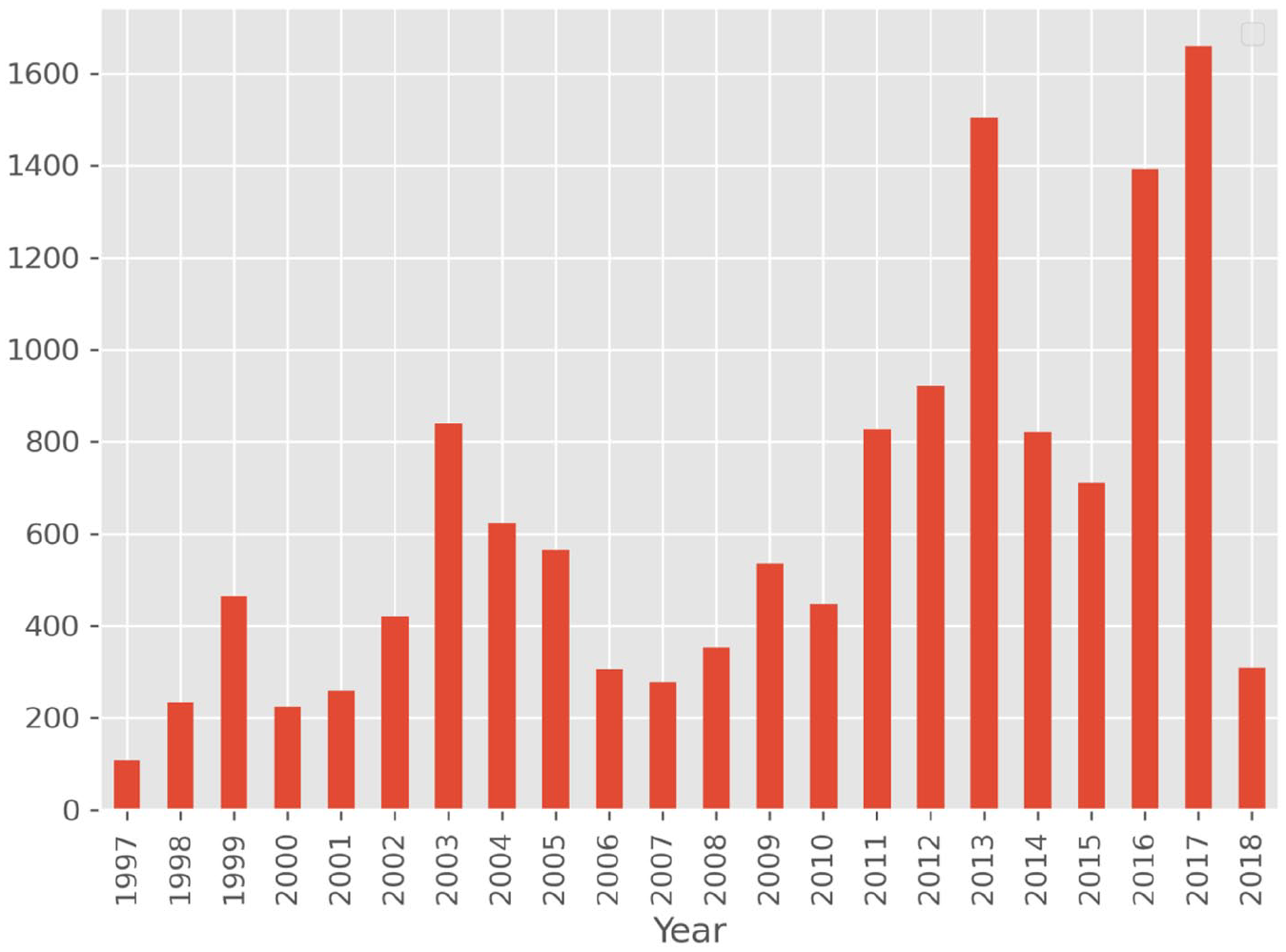
Number of nuclear-related news articles by year.
It is impractical for researchers to read through this volume of articles in a limited time. To reveal valuable information and detect systematic patterns in North Korea’s nuclear rhetoric, we employ a class of text-as-data techniques that are based on machine learning and can uncover patterns that human coders could miss. Thanks to its improvement, computer-assisted textual analysis has recently been widely used in social sciences research (Gabbay and Thirkill-Mackelprang, 2011; Pettitt, 2012). It has been an especially popular research method in studying North Korean politics (McEachern, 2009; T. S. Rich, 2012; Whang et al., 2018; W. Zhang and Zinoviev, 2018), given that other types of data are extremely scarce in this area. However, most of these studies only use a fraction of the available materials, thus likely missing long-term patterns in North Korea’s texts. We utilize topic modeling to discover the underlying structure and tease out hidden themes in North Korea’s 22 years of nuclear-related news articles. Topic modeling is an unsupervised classification approach for discovering topics contained in documents and articles. It analyzes the words of the original texts, then uses these words to determine which themes run through the aggregated texts, how those themes connect to each other, and how they change over time. Below are the steps we go through in processing and analyzing this immense set of texts.
The articles go through standard processing including deleting stop words, lemmatization, and tokenization. Stop words refer to the most common and short function words, such as “a,” “an,” “the,” “at,” “on,” and so on. Since these words do not have substantive meanings, they are filtered out before processing to reduce “noises” in the text and improve computing performance. Lemmatization converts a word from its various inflected forms to its base form, so its various forms are counted and analyzed as a single item. For instance, “aggression,” “aggressive,” and “aggressor” are treated as one same word—“aggression.” However, exception is given to “Korea” and “Korean,” as these two are highly frequent words and have nuanced references in this project’s context. Tokenization breaks phrases into sequences of words and relevant word groups. For example, “United States” is recognized as a word group instead of two separate words. Likewise, “Bush administration,” “nuclear weapons,” “nuclear war,” “nuclear deterrence,” and “preemptive strike” are all considered as word groups and treated as single items.
Using the processed articles, we generate a list of 2000 most frequently used words. From the list, we curate a markers list of 1004 words that are relevant or seemingly relevant in reporting North Korea’s nuclear and missile programs. We acknowledge that the selection criteria are based on our familiarity with North Korean politics and its foreign relations. However, this manual curation is always necessary, as there are service verbs and adverbs such as “go,” “use,” “always,” and “strongly” in the top 2000 list but irrelevant to our subject of study. If some words that we select happen to be rare or isolated, they will be filtered out by the network construction algorithm in the later steps. In our model, a word becomes a semantic network node (a true marker) if it occurs at least 50 times in the corpus of articles. Otherwise, it will be dropped out of the makers list. Next, two node words are considered to be in co-occurrence when they are at most four words apart in a sentence. They are in connection if they co-occur more than 10 times in the corpus of articles. If that happens, the two words make an edge in the network, as both of them are nodes and the pair is connected. Our criterion in defining co-occurrence and connection is strict to ensure close connection between words. Wider gaps between words could generate more but weaker connections and thus more noises. 5 This is how the semantic network of markers is constructed and the process leaves 639 words on the network.
Co-occurrence and connection of words have patterns. When co-occurred words also appear in pair frequently across articles, it is likely that they are used repeatedly to discuss the same topic. To perform this analysis, we apply the Louvain method of community detection in large networks (Blondel et al., 2008)—an unsupervised machine learning technique—to find communities of nodes, which would translate into clusters of words in our project. This is an algorithm developed by computational mathematicians to quickly extract the community structure of large networks. Applying it to semantic networks, we use it as a new method of topic modeling for contextual analysis. These clusters detected by the algorithm in the semantic network represent the dominant topics of the articles in our dataset. When a word is included in multiple clusters, the algorithm assigns the word to the cluster in which it has the closest connection. Most importantly, the number of clusters (topics) in the network is determined by the algorithm, so the connections in each cluster are at their maximum strength. This process is called modularity optimization. As a result, the quality of the clusters detected by Louvain method is outstanding as measured by modularity (Blondel et al., 2008).
Results and findings
The optimized semantic network of markers is shown in Figure 2(a). The network is multidimensional, meaning that the distance between two nodes on the two-dimensional figure does not represent their actual distance in the network. Our algorithm detects five communities in the network and they are marked in different colors. Among these five communities, at least three of them (Topics 1–3 on Figure 2(a)) stand out to bare eyes as their nodes form obvious clusters. The other two communities in the network are less visible on a two-dimensional display, but are identifiable to the algorithm. Figure 2(b) provides a close-up view of the network’s central part. The size of the word nodes is proportionate to their frequency in the dataset. By looking at these words, we have a broad sense of what topics the clusters cover.
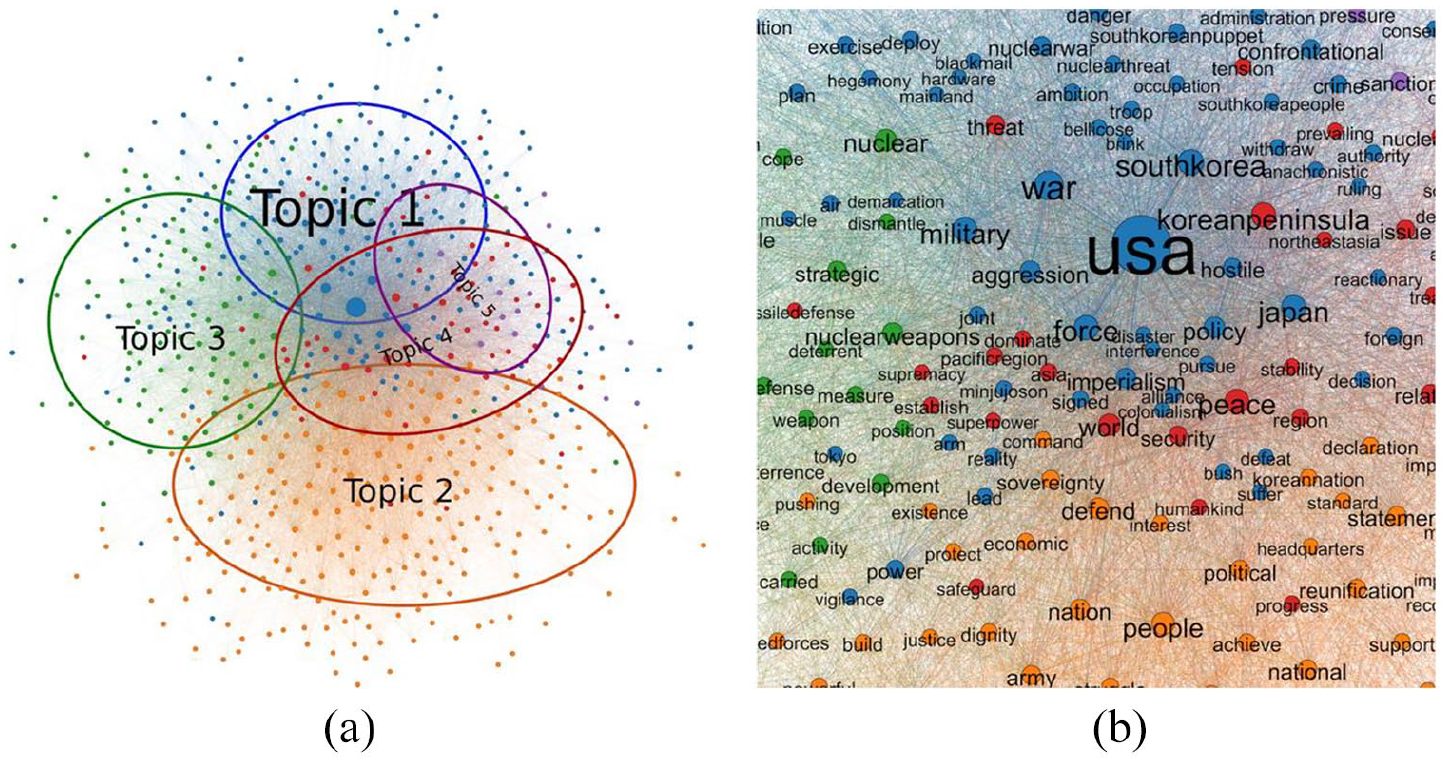
(a) Semantic network of markers and detected topics. (b) A close-up view of the semantic network.
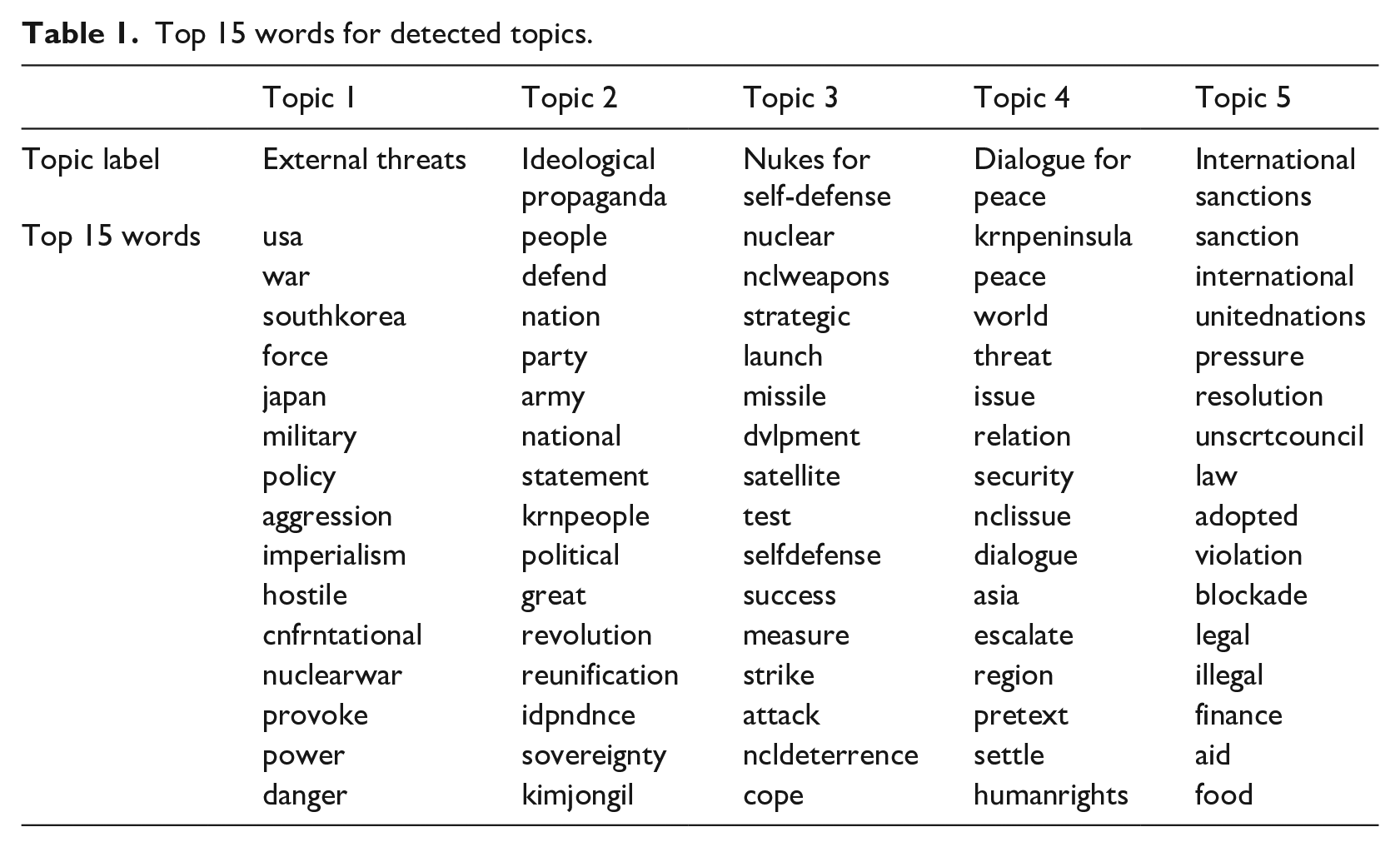
The five clusters detected in the semantic network represent the most salient topics in North Korea’s nuclear rhetoric. Each cluster is made of approximately 100 words. To better understand each cluster, we first look into their most frequent words to identify topic themes. Due to space limitation, Table 1 presents only the 15 most frequent words for each cluster. Topic 1 emphasizes on external security threats from the “United States,” “South Korea,” and “Japan,” with deploring words such as “aggression,” “imperialism,” “hostile,” “confrontational,” and “provoke.” We label it as “external threats.” The words contained in Topic 2 are tailored around the “great” “socialist” 6 “revolution” led by the regime. Nuclear program seems to be pursued in the name of “people,” “nation,” and “Korean people.” “Party,” “army,” and “Kim Jong-il” are clearly linked to this topic. We name this topic “ideological propaganda.” Topic 3 seems to report and praise North Korea’s nuclear program, with “nuclear weapons,” “missile,” “satellite,” “launch,” “development,” and “test” as top words. These top words are linked to positive words such as “self-defense” and “success.” “Nukes for self-defense” is a good label for this topic. Topic 4 stresses on the issues of “peace” and “security” on the “Korean Peninsula,” in “Asia” and the “world.” It talks about “dialogue” and “settle.” We choose “dialogue for peace” as its topic label. Topic 5 seemingly talks about “international” “pressure” North Korea receives for its nuclear program, such as “sanction,” “United Nations,” “resolution,” and “UN Security Council.” We call this topic “international sanctions.”
Top 15 words for detected topics.
Next, we look into each topic’s complete vocabulary to test our hypotheses. The complete vocabulary of a topic provides a more comprehensive picture of what Pyongyang desires to achieve with its nuclear arsenal. North Korea’s nuclear intentions can thus be inferred from these topics. The words forming a topic are proportionally displayed in a word cloud. Figure 3 presents the word clouds of Topics 1 and 3, as they together provide a direct test of the claim that, North Korea’s nuclear program is driven by security concerns (Hypothesis 1). Topic 1, “external threats,” condemns security threats from the US and South Korea alliance, using bombshell words such as “imperialism,” “South Korean puppet,” “warmonger,” and “nuclear war.” Notably, “preemptive strike” and “drill” (referring to US-ROK joint military drill) are assigned to this topic by the algorithm. The fact that these words are highly relevant with each other and together constitute an outstanding topic proves the validity of our method. The existence of Topic 1 in North Korea’s nuclear rhetoric confirms that Pyongyang is indeed concerned about the conventional military superiority enjoyed by the South and fears of a regime change. As noted by Pollack (2018), North Korea has repeatedly argued that it would be vulnerable to US decapitation and regime change without nukes. The regime believes that its nuclear weapons erode the credibility and durability of US-ROK alliance. Topic 3, “nukes for self-defense,” focuses on praising North Korea’s nuclear development. It contains words used to report about North Korea’s nuclear activities, such as “conduct,” “test,” “fire,” “launch,” “development,” “success,” and “capability.” Meanwhile, “self-defense,” “countermeasure,” and “legitimate” seem to praise and glorify its weapons. In this topic, external threats are also mentioned, with words such as “Washington,” “arms race,” “aircraft carrier,” “aegis,” and “missile threat.”
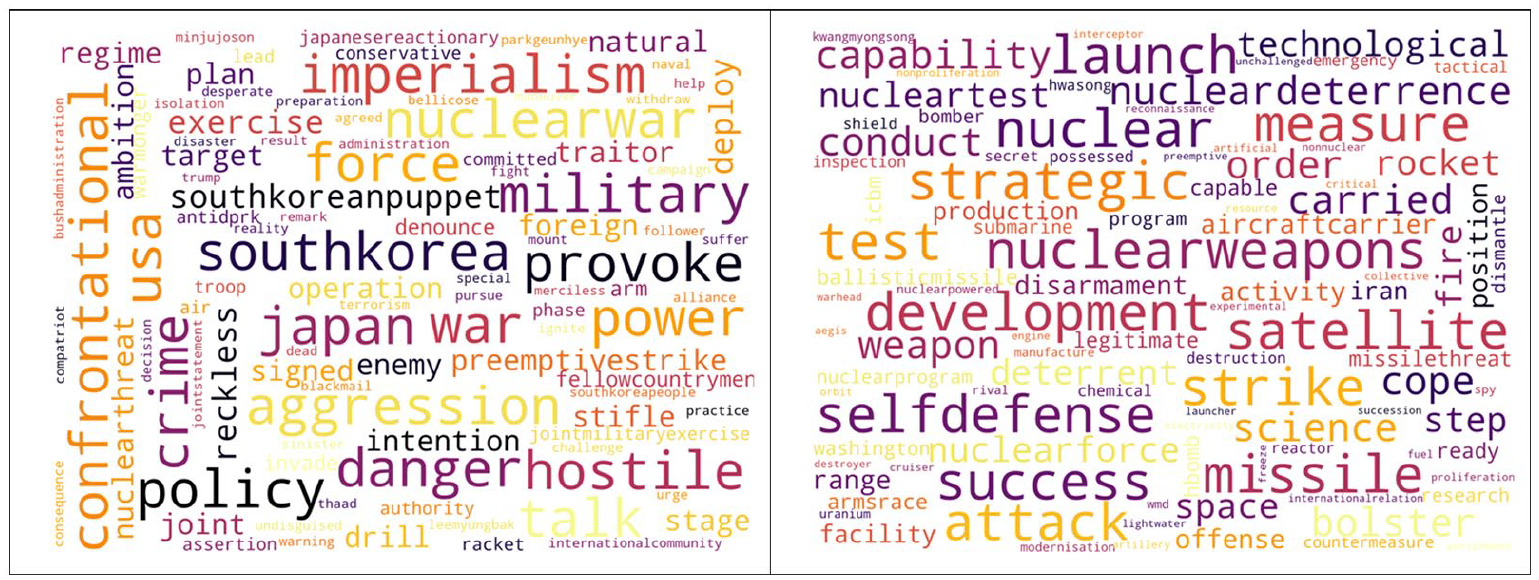
Word clouds for Topic 1 (external threats) and Topic 3 (nukes for self-defense).
These two topics detected by our topic modeling method in North Korea’s nuclear rhetoric are in line with Pyongyang’s primary self-declared nuclear rationale—to defend itself against potential US preemptive strikes and a regime change. In its talks with Washington, Pyongyang repeatedly expresses its concerns over the “Libya Model” of denuclearization (Specia and Sanger, 2018). Moreover, Washington’s interventionist foreign policy, for instance, its invasion of Grenada in 1983, is believed to have triggered North Korean nuclear development (Young, 2017). Kim Jong-il warned in his final will that “possessing a sufficient amount of nuclear weapons is the way to keep peace on the Korean peninsula” (Pollack, 2018). According to the regime, a nuclear bomb would help it win the psychological war with the United States by undermining and delegitimizing US extended deterrence to South Korea. Pyongyang’s deterrence intention for its nuclear program does sound like a self-serving propaganda; however, it is echoed by observers who take a rational approach with respect to the regime (Sagan, 2017; H. Zhang and Wang, 2019). Moreover, these two detected topics seem to represent the two parts of the same narrative of deterrence. To argue that its nuclear arsenal is for a just cause of “self-defense,” North Korea’s propaganda machinery needs to first blame an external threat, and then establish its necessity. Thus, the intention of nuclear deterrence generates two detectable topics in our dataset. In short, the results of these two topics support that there exists a consistent pattern in North Korea’s nuclear rhetoric. The regime has constantly made clear that it needs a nuclear arsenal to deter US preemption for its own security.
Topic 2’s word cloud is shown in Figure 4. It gives us a complete picture of what Pyongyang intends to convey about its nuclear program and “great socialist revolution.” The regime takes a big deal of pride in its nuclear program. Positive words with high frequency such as “victory,” “great,” and “achieve” are prominent in this topic. Meanwhile, Pyongyang’s rhetoric clearly links its nuclear “achievements” to its leaders, ideologies, the “party,” and the “army.” Names of all three supreme leaders are part of this cluster, with Kim Jong-il being most frequently mentioned, followed by Kim Jong-un and then Kim Il-sung. Their titles such as “chairman,” “supreme leader,” “marshal,” and “general secretary” all appear in this topic, making the topic integral and outstanding. Besides leaders, North Korea’s two main ideologies, “Juche” and “Songun,” are among the most frequent words in this topic. They are probably cited to explain the success of the nuclear program. Expectedly, the regime’s two primary legs, the Workers’ Party of Korea (“WPK”) and the Korean People’s Army (“KPA”), both show up in this topic, seemingly to take credit from their nuclear achievements. Most noticeably, the regime attaches its nuclear adventure to its paramount cause—the socialist revolution and struggle. Developing nuclear weapons is viewed as a stepstone leading to the victory of socialist revolution. In 2012, North Korea amended its constitution to declare itself “a nuclear nation” (Fu, 2017). Pyongyang also promotes its nuclear adventure in the name of the “people” and the “Korean people,” and ties nukes to “independence,” “sovereignty,” and “reunification.” This “ideological propaganda” topic provides support for the claim that North Korea’s nuclear program has a function of promoting ideological control and boosting regime legitimacy (Hypothesis 4). By elevating its nuclear development to the altitude of socialist revolution—the ultimate mission of the WPK—the Kim regime garners domestic support for this costly adventure. In return, the progress and success in nuclear development provide a stronger political base and legitimacy to the regime. Therefore, the regime and its nuclear program are mutually reinforcing.
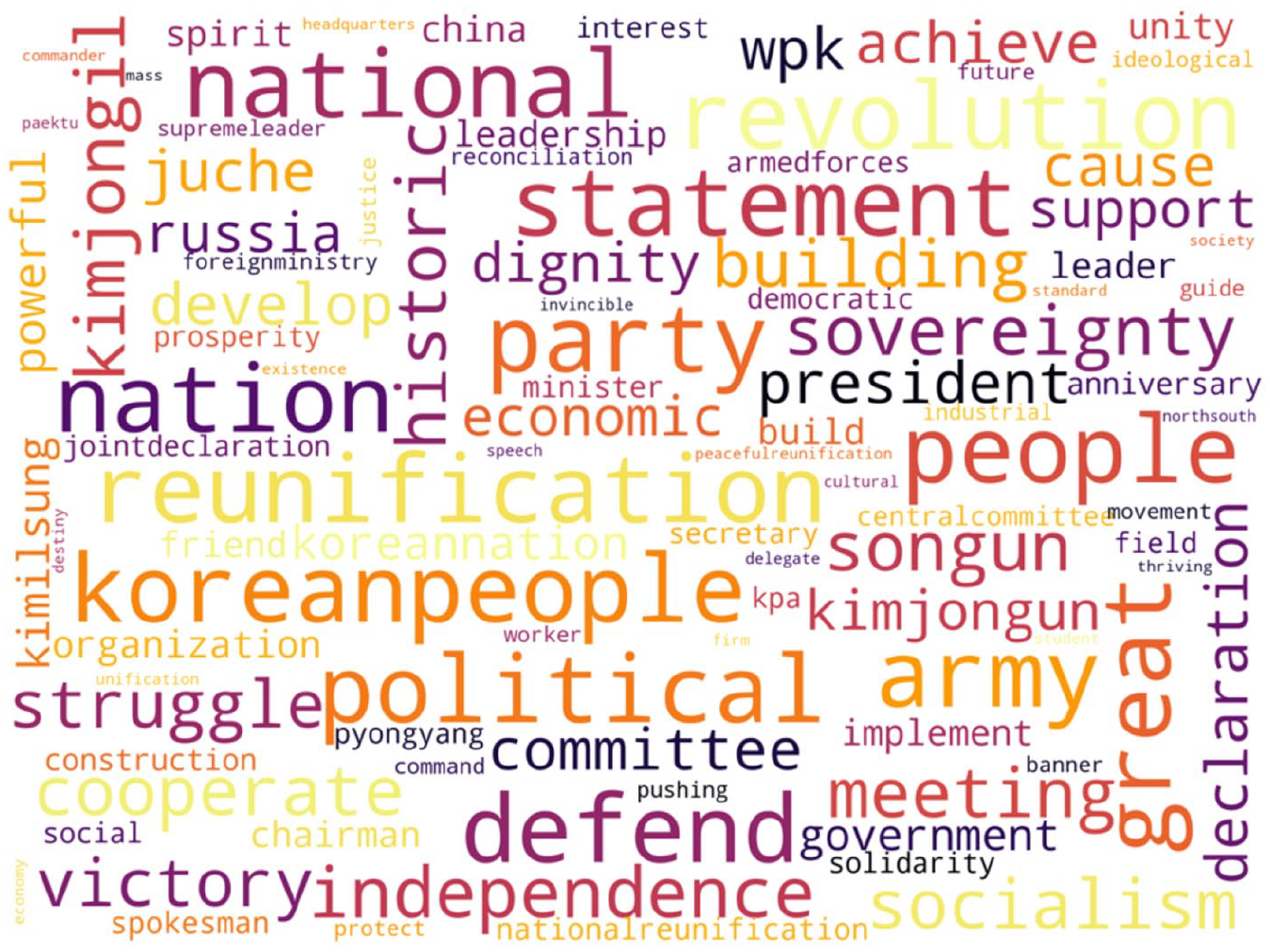
Word cloud for Topic 2 (ideological propaganda).
Topic 4, “dialogue for peace,” speaks to Hypothesis 2 about the bargaining chip assumption. Its word cloud (shown in Figure 5 on left) covers the intermittent talks and negotiations between North Korea and the international community throughout the years. “Denuclearization” and “Six-party talks” are by default key words, but not with prominence. Instead, “Nuclear issue” and “human rights” seem to be the most important negotiation agenda items. It is worth noting that “human rights” is a frequent word in KCNA’s nuclear coverage and even assigned to this particular topic by our algorithm. One can imagine that human rights are an item that the United States always brings to the negotiation table and the KCNA is obliged to mention it along with the nuclear issue side by side. “Korean peninsula,” “Asia,” “region,” “security,” “world,” “peace,” “improve,” “relation,” “dialogue,” and “agreement” are all salient words used by the KCNA to construct a grand narrative in covering this topic. Nonetheless, “non-aggression,” “security” “guarantee,” and “treaty”—things that Pyongyang would like to achieve—are with less importance. Diplomacy and negotiations have always been advocated in North Korea’s nuclear rhetoric, and Pyongyang does publicly remain open to dialogues and talks. However, the relative insignificance and lack of detailed negotiation items in the word cloud may suggest that the negotiations have rarely entered into substantive details.
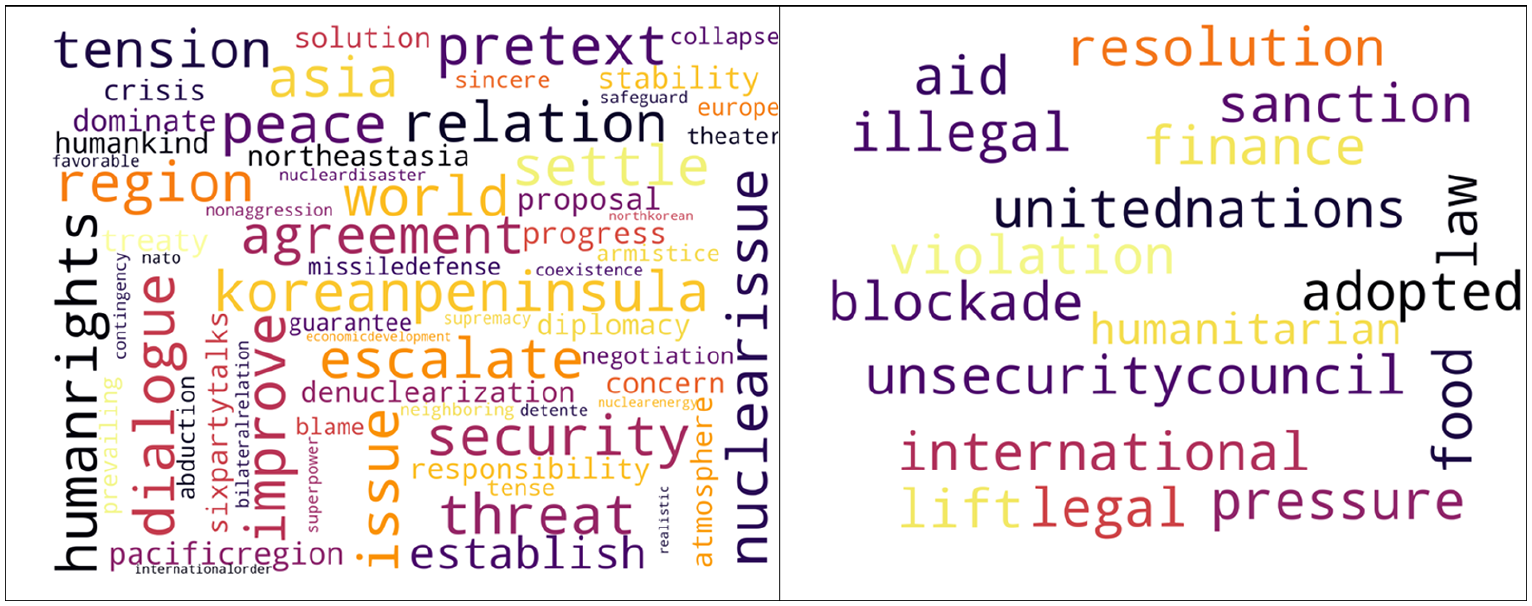
Word clouds for Topic 4 (dialogue for peace) and Topic 5 (international sanctions).
Has North Korea used its nuclear capability to extract concessions from the United States? The word cloud does not provide confirmative evidence to this end. Volpe’s (2017) Goldilocks principle states that the optimal point for a proliferator to strike a bargain is when it becomes capable of producing fissile materials. We therefore do not expect North Korea to hold this strategic goal after it crossed the threshold of nuclear testing in 2006. Nonetheless, sticking to denuclearization is diplomatically beneficial to North Korea. “Dialogue for peace” is an important topic in its nuclear rhetoric, but not its genuine intention. Sunshine policy supporters argue that Pyongyang ratcheting up nuclear rhetoric is not a sign of hostility but diplomatic maneuver to push the United States toward future negotiations (Michishita, 2009). While pushing for talks may be true, but it is unlikely that Pyongyang will trade a peace agreement at the price of denuclearization, given the low weight of Topic 4 in its overall nuclear rhetoric (see Figure 6). This point echoes Sagan’s (2017) observation that North Korea’s nuclear arsenal is not a bargaining chip but a potent deterrent designed to prevent a US attack.
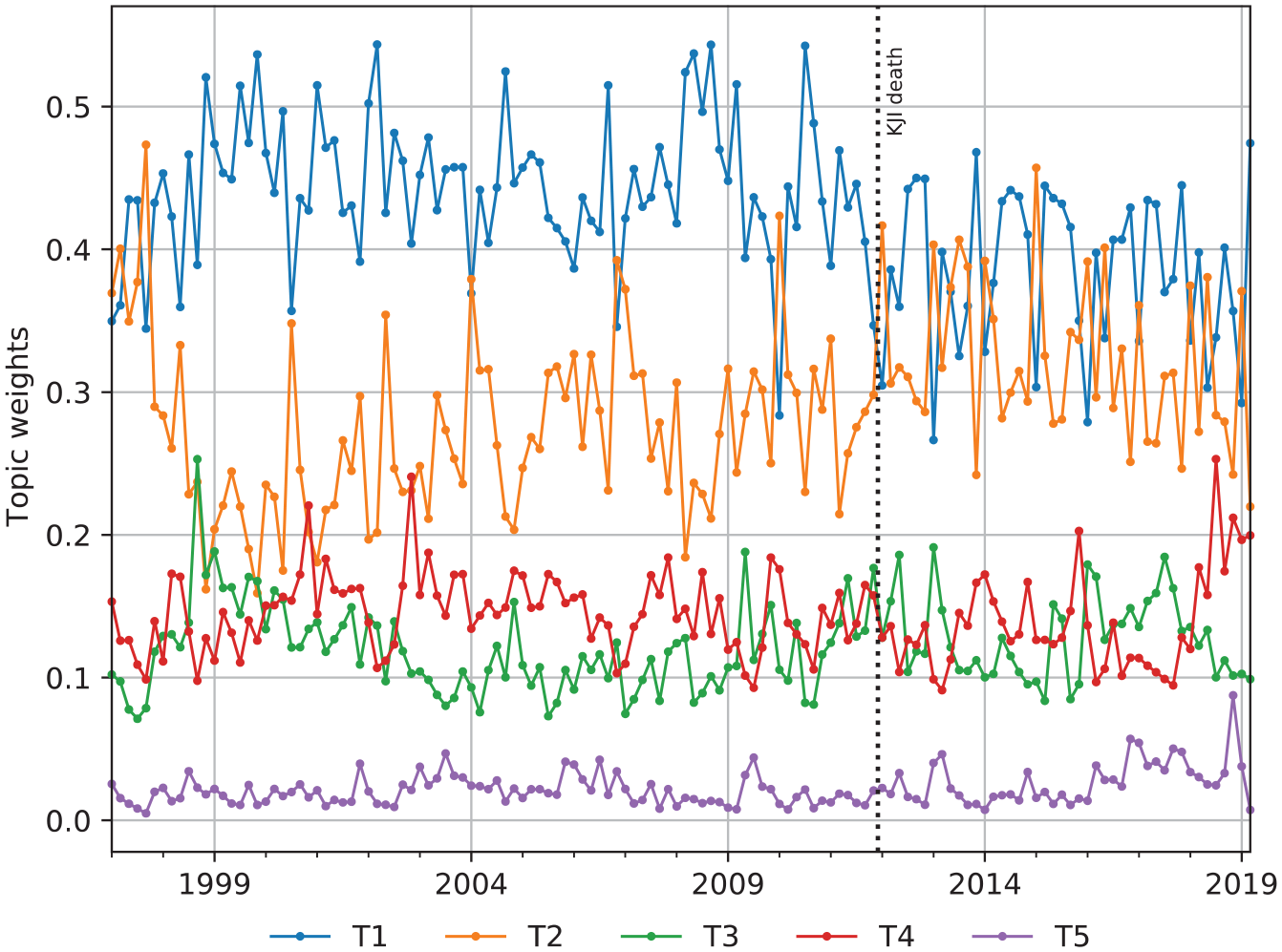
Topic’s weight over time.
Topic 5, whose word cloud is presented on right in Figure 5, talks about the “pressure” North Korea receives in forms of “UN” “sanctions” and “Security Council” “resolutions.” The “violation” of “international” “law” appears to be a talking point under this topic. However, we cannot tell Pyongyang’s attitude on this issue, as both “legal” and “illegal” show up in this topic. Some less frequent words seem to point to the benefits North Korea receives from its interactions with the international community, for instance, “humanitarian” “aid” and “food.” This relatively small topic is an objective coverage of the sanction issue of North Korean nuclear crisis. We are not able to interpret this topic any further, as it would require readings into the particular articles containing these key words. Despite its high relevance to North Korea’s nuclear program, this topic does not reveal information about its nuclear intentions.
Interestingly, the statement that North Korea has a malign purpose of forcing reunification upon South Korea by developing a nuclear force (Hypothesis 3) is not reflected in any of the detected topics. “Reunification” and “national reunification” do appear frequently in KCNA’s nuclear coverage. However, they do not form a separate topic. Rather, they are assigned to the topic of “ideological propaganda” (Topic 2) by our topic modeling algorithm. Pyongyang tends to bundle reunification into its ideological propaganda, and therefore consolidate political support for the regime. The mission of reunification is tied to nuclear development through a mechanism of regime legitimization. Reunification by nuclear coercion does not make up a separate topic in the regime’s nuclear rhetoric. We therefore reject Hypothesis 3.
Some scholars observe that Pyongyang may actually utilize its nuclear program for a combination of functions (Habib, 2011), instead of just one exclusive intention. To test this claim, we examine the relative importance of each topic and how it changes over time. We group articles by a 3-month interval. The interval width at 3 months is selected to balance between robust analysis and sufficient sample size. A topic’s weight is measured by the percentage of node words from this topic over the total node words during each 3-month period. In other words, the more words coming out of a topic’s vocabulary, the more that topic weighs in North Korea’s nuclear rhetoric in a given interval. Figure 6 presents the evolution of each topic’s weight by every 3 months from 1997 to 2018. The curves on the chart are obtained first by averaging over consecutive 3-month periods and then smoothed by applying the running average to every two neighbors. For example, if the original time series is T1, T2, T3, T4, and so on, the plotted series is (T1 + T2)/2, (T2 + T3)/2, (T3 + T4)/2, and so on. Smoothing is used only for the purpose of displaying the data.
The results on Figure 6 show that the most salient topic over time is Topic 1 (blue curve), which focuses on external threats. Below the blue curve is the orange curve for Topic 2—“ideological propaganda.” Clearly, the external threats topic outweighs the ideological propaganda topic across time in Pyongyang’s nuclear rhetoric. In other words, deterrence is the primary intention of North Korea’s nuclear efforts, whereas regime legitimization is a subordinate objective. More interestingly, the curves of these two topics always go in opposite directions with one another across time. When Topic 1 is at peak, Topic 2 is at valley, and vice versa. Indeed, we find that Topic 1 and Topic 2 have a negative correlation (r = −0.6). One explanation for this is that external threats and ideological propaganda are two major topics employed by the regime to justify its nuclear program. When one topic dominates the coverage, the other topic statistically declines. Another notable observation is that the importance of Topic 1 decreases after Kim Jong-il’s death in the end of 2011 (event marked on the figure), whereas the weight of Topic 2 increases after the same event. The space between the two curves on the figure obviously narrows after the year of 2012. A reasonable explanation could be that in Kim Jong-un era, security threats have already been alleviated by the presence of an arsenal and thus, the need to justify nuclear possession on the ground of external threats has decreased. Meanwhile, the new leader has a stronger need to glorify his regime using the success of its nuclear program.
Topic 3’s (“nukes for self-defense”) curve entangles with that of Topic 4 (“dialogue for peace”). Between 2003 and 2008, Topic 4 outweighs Topic 3. This result accurately captures and displays the historical facts of Six-party Talks during the time period. Topic 4 reaches its peak with a significant jump in 2018, almost catching the weight of ideological propaganda (Topic 2). This is likely due to the first Trump–Kim meeting in that year, when dialogue was regarded high and peace seemed reachable. The issue of international sanctions (Topic 5) remains consistently the least important topic in North Korea’s nuclear rhetoric.
Implications
This study carries important implications for the study of nuclear proliferation and non-proliferation. External security threats are systematically detected in North Korea’s 22-year nuclear rhetoric to be the primary justification for its nuclear program. As a result, deterring US preemption and regime change is dominant in Pyongyang’s nuclear intentions. Whereas Pyongyang’s propaganda apparatus naturally speaks on behalf of the regime using security concerns as convenient self-justification, we also see reasonableness and merit in North Korea’s deterrence intention for its nuclear acquisition and possession. Moreover, a clearer and more accurate understanding of North Korea’s nuclear intentions enhances international efforts of non-proliferation. Policy-makers shall be reminded that if security concerns of the proliferating states are not addressed, any efforts to counter proliferation will only have limited success (H. Zhang, 2015, 2021). Sukin (2022) finds that Pyongyang becomes more provocative and belligerent when the survivability and deterrent power of its nuclear force is challenged by the installments of missile defense systems in South Korea. It might be time for relevant parties to re-evaluate their goal of denuclearization on the Korean Peninsula. Therefore, our research has valuable implications for the policy community dealing with the Korean nuclear crisis.
In particular, our findings add to the debate on US policy toward North Korea. Factors explaining nuclear proliferation are clustered by the literature into three categories—supply side, demand side, and institutional (Sagan, 2011). US policy approaches in dealing with North Korean nuclear issue have mostly derived from the supply side factors. It is alleged that Pakistan exported nuclear weapons design knowledge to North Korea in exchange for the latter’s missile technology (Montgomery, 2005: 172). Therefore, non-proliferation efforts have been mostly focused on sanctions, embargo, and isolation to restrict North Korea’s access to fissile materials and nuclear weapons technologies. However, these supply side policy measures have not been effective in impeding North Korea’s progress in nuclear and missile technologies. The demand side factors have not been given sufficient attention. A solid understanding of North Korea’s demands provides insights into policy solutions to solve the problem and to guide US negotiations (if intended to pursue) with the regime.
Pyongyang asserts that it fears of US hostile policy and preemption, and that nuclear weapons provide a robust deterrence to preserve its security. These words are not just propaganda, but represent North Korea’s nuclear intentions. They need to be taken more seriously. Acknowledging North Korea’s security needs might be the first step toward an effective solution to solve the problem. Although at odds with the principle of non-proliferation, accepting North Korea’s nuclear capability might be a necessary pill to swallow for greater good. Indeed, this approach has been loudly advocated in the policy community. Bowden (2017) argues that acceptance is the least bad option for the United States, although no US president would openly announce it. Panda and Narang recommend that the United States should coexist with a nuclear-armed North Korea and encourage it to be a responsible nuclear weapons power like India (Panda and Narang, 2018, 2019). A tacit acknowledgment of North Korea’s nuclear status in exchange for more strategic interests in the region can be a good deal for the United States. In this sense, the engagement approach pursued by Trump administration was going in the right direction. However, this three-decade-long problem cannot be solved by one grand bargain. Both the United States and North Korea shall prepare to take small and incremental steps (Lankov, 2021). Biden administration’s unannounced “step by step” policy approach (Einhorn, 2021) seems a feasible and viable one going forward. In the meantime, US extended deterrence to South Korea and Japan shall be strengthened and thus reassure these allies. As proved effective during the Cold War against the Soviet Union and China, US deterrence policy will work again against today’s North Korea—a lesser nuclear power.
Conclusion
The world knows little about Pyongyang’s nuclear intentions due to the extreme scarcity of materials to study this closed regime. The only source available has been Pyongyang’s own words released through its state media. Nonetheless, the world is divided about how to interpret these words, as scholars and policy makers hold competing and even opposing scopes regarding the regime in Pyongyang. Our study offers a systematic assessment of Pyongyang’s nuclear rhetoric over the course of 22 years. It reveals important and valuable information about North Korea’s nuclear intentions. The primary goal of North Korean’s nuclear weapons development is to preserve its own security. The regime consistently believes that a nuclear deterrent is necessary to counter external security threats. This narrative has been the most salient topic in North Korea’s nuclear news articles. Meanwhile, North Korea does use its nuclear weapons development to boost regime legitimacy through its ideological campaign. This secondary intention of legitimization is more prominent under Kim Jong-un than under Kim Jong-il, but still not as salient as deterrence. While the topic of “dialogue for peace” does appear in our topic modeling results, we do not have strong evidence indicating that North Korea has a goal to use its nuclear capability as a bargaining chip. Moreover, our results do not support the claim that North Korea intends to use nuclear weapons to coerce reunification upon South Korea. Our findings are in line with preeminent nuclear politics scholar Scott Sagan’s understanding of North Korea’s nuclear arsenal—“[It] is not a bargaining chip. It is a potent deterrent . . .” (Sagan, 2017: 81)
The data used in this project are the words of the regime in Pyongyang. We acknowledge that one should always be cautious about the incentives North Korea has to misrepresent its motives. Nevertheless, equating North Korea’s own words as blanket propaganda appears unwarranted (T. Rich, 2014). To avoid bias caused by a certain perspective, this project does not offer interpretation of any particular pieces of North Korea’s statements or news articles. Instead, we work on a pile of 13,132 articles with natural language processing techniques. We utilize an algorithm to extract community structure of large semantic networks. This is a computational processing of North Korea’s nuclear-related news articles across two decades, with little subjective human intervention. What we have found from this mega dataset is a consistent pattern lasting across two generations of North Korean leaders. This does not mean the world should trust the regime, but the regime does mean what it says. The consistently self-declared intention of deterrence by the regime shall be taken seriously. Dismissing it is to miss the key to solving this long-lasting nuclear crisis.
Acknowledging North Korea’s security needs might be the first step toward an end to the crisis on the peninsula. North Korea has been a de facto nuclear weapons power since 2006 and the world has so far peacefully lived with it. Given the extreme importance of a nuclear deterrent to its survival, Pyongyang is unlikely to bargain away its nuclear capability. Nonetheless, given its inferior nuclear arsenal compared to other nuclear powers, it would be suicidal for the regime to launch aggression on the United States or its allies in the region. Washington can trade tacit acceptance with Pyongyang with a commitment to not proliferate to other countries. Following this approach, North Korea would hopefully return to the international community and act responsibly. Meanwhile, the United States can continue to contain and deter Pyongyang’s malign behavior if it remains so.
Footnotes
Acknowledgements
This article benefited from feedback received at a number of seminars and conferences, including the International Studies Association (ISA) 2019 convention in Toronto, Canada, the American Political Science Association (APSA) 2020 virtual convention, and the ISA 2022 convention in Nashville, TN. In particular, the authors would like to thank Rongbin Han, Marcus Holmes, Ivan Ivanov, Jeff Kaplow, Ning Liao, Todd Robinson, A. Maurits van der Veen, the anonymous reviewers, and the Journal of Asian and African Studies editorial staff for constructive criticism and guidance. They also thank the Korean Central News Agency (KCNA) Watch team for compiling the most complete North Korean media dataset. All errors and oversights remain their own.
Funding
The author(s) received no financial support for the research, authorship, and/or publication of this article.
