



Abstract
This research examined the associations between resilience, fear of COVID-19, coronavirus anxiety and COVID-19 burnout. The study also aimed to validate the COVID-19 Burnout Scale (COVID-19-BS) in Urdu. Participants included 812 Pakistani young adults (55.7% males; mean age 26.4 ± 8.7 years). Results supported a one-factor solution for the COVID-19-BS with high reliability. Mediation analysis showed that resilience mediated the relationships between fear of COVID-19 and coronavirus anxiety with COVID-19 burnout. The study provided preliminary evidence that fear of COVID-19 and coronavirus anxiety might be significant risk factors for burnout among the Pakistani general population, and resilience might mitigate the impacts of these factors.
Introduction
The COVID-19 pandemic is the first and the most devastating global health crisis of the 21st century, and this has drastically changed life from personal hygiene to global growth. Since late December 2019, most countries have struggled to cope with COVID-19 adversities in several ways, such as smart lockdowns, limiting local and international travelling and cancelling gatherings and events (United Nations Development Programme [UNDP], 2020). This pandemic has brought about extremely stressful and difficult situations for the world in general and developing countries such as Pakistan in specific. Abilities to cope with such stress and distress is called resilience. However, the concept of resilience is very broad in its functions. The American Psychological Association (APA, 2014) characterized resilience as a mechanism of adjustment to threat, tragedy, trauma, adversity and significant other life stressors.
Primarily, fear is a flexible and fluctuating emotion that produces energy to cope with any potential threat or dander. However, fear may be non-functional and incompatible with the real threat, impairing insight and negatively affecting individual and social levels (Yıldırım, 2019). The current pandemic of COVID-19 affected psychological well-being and general health and induced fear (Majercakova Albertova & Bolekova, 2022; Yıldırım & Şanlı, 2023). Ahorsu et al. (2022) described fear of COVID-19 as a fearful and anxious mood resulting from fear of being infected and diagnosed with COVID-19. Fear of COVID-19 has been noticed as a dominating emotion that deteriorates the basic human ability of resilience to cope with distress. Kirmani et al. (2015) reported a significant negative link of fear of COVID-19 with resilience. Measures taken during a pandemic such as lockdowns, self-quarantine, social distancing have forced individuals to restrict social relationships in other terms social support, which minimizes the human ability to bounce back and cope with complexities (Kassam, 2019). Although fear is functional as it persuades and sensitizes threatening situations, it is maladaptive and hinders effective coping. Fear of COVID-19 inculcates uncertainty and lack of control over situations, which minimizes resilience (Garfin et al., 2020). Likewise, Lee (2020) found that individuals with a high level of fear of COVID-19 have a low level of positive tendencies and resilience.
Burnout is a state of exhaustion of human psychological resources (e.g. emotions) experienced after exposure to a chronic stressor. Some of the leading stressors and risk factors of burnout are career pressures, social isolation, reduced quality of work, increased work pressure, workload and stressful environment (Murali et al., 2018). Moreover, burnout, in general, is explained as a psychological syndrome specified by emotional exhaustion, reduced personal accomplishments and feelings of cynicism (Koutsimani et al., 2019). The COVID-19 pandemic changed personal circumstances and workplace parameters, challenges and requirements that resulted in burnout experiences other than workplace settings. Most of the research on burnout since December 2019 emphasized understanding its mechanism and outcomes in health care workers as they were the front line warriors during the pandemic (Brooks et al., 2020; Vagni et al., 2020) and very few addressed general populations (Yıldırım and Solmaz, 2020). As the COVID-19 pandemic compromised several personal, social, mental and professional aspects of routine life, people in quarantined experienced several psychological issues such as frustration, fear, stress and burnout (Brooks et al., 2020).
According to the demands-source model of burnout, the combination of various factors such as social restrictions (e.g. social distancing and lockdowns), the psychological stress of coping with an unfamiliar disease (e.g. COVID-19 pandemic) in an unpredictable environment may lead to an increase in the ratio of burnout. Resilient individuals can bounce back, overcome, return to the pre-crisis state, cope well with unpredictable, stressful challenges, and meet their targets efficiently (Aziz & Yıldırım, 2020; O’Brien & Burke, 2021; Yıldırım & Çiçek, 2022;Yıldırım et al., 2022). From this perspective, resilience plays a protective function in stressful exposures and prevents psychopathologies during the COVID-19 pandemic (Brooks et al., 2020).
Given the above-reported literature, it seems very clear that fear of COVID-19 is a significant risk factor for disturbing the overall mental health systems. In addition, a high level of fear of COVID-19 affects resilience, which may increase burnout”s vulnerability. Resilience was found to mediate the effect of unpleasant thoughts and emotions and problem-focused strategies to minimize the stress, which directs towards the notion that resilience may also likely mediate the effect of fear of COVID-19 on stress-characterized emotions such as burnout (Vagni et al., 2020). Furthermore, other risk factors for increasing the chronicity of burnout may need psychological support, much time spent searching for information about COVID-19, and a high degree of apprehensions and fears about being infected with COVID-19 (Domínguez-Salas et al., 2020).
Likewise, resilience is negatively linked with burnout (Yıldırım and Solmaz, 2020) and somatization, anxiety, depression and subjective well-being (Yıldırım & Arslan, 2022). In continuation to this, past studies also explored the fear of COVID-19 as an outcome of the covid pandemic with a primary focus on exploring associated factors minimizing the effects of negative and obsessive thoughts (Ashraf et al., 2020) and fears associated with COVID-19 (Yıldırım and Güler, 2021).
In addition, the protective role of resilience against the fear of COVID-19, with burnout conditions caused by COVID-19, has been examined (Yıldırım and Solmaz, 2020). Given this context of research on COVID-19, it could be inferred that resilience plays a preventive role in minimizing the COVID-19-associated apprehensions and fears. So, it is well suggested that a good demonstration of psychological resilience enhances life satisfaction and inhibits psychological burnout (Fletcher and Sarkar, 2013).
Coronavirus anxiety is dysfunctional anxiety linked with the COVID-19 pandemic (Lee, 2020). Several factors include an increased number of covid infected patients, growing death ratio, misperceiving symptoms as of COVID-19, and fear of worsening symptoms of cough, flu and fever during the COVID-19 pandemic induced high level of dysfunction anxiety in people (Xiang et al., 2020). Pandemics at the global level affect lives massively, ranging from personal to professional levels; in an economic crisis, people left with no jobs/jobs are badly affected. Job worries and insecurities, social distancing, prolonged quarantines and restricted movements increased the risk of psychiatric symptomologies such as somatic complaints, depression, anxiety and stress (Mumtaz et al., 2021). Several studies reported excessive fears, apprehension and anxiety related to pandemics (Ahorsu et al., 2022; Yıldırım et al., 2020). In the last decade, particularly since the outbreak of COVID-19, research testing the link between anxiety and burnout has grown. A meta-analysis review (Koutsimani et al., 2019) of 34 empirical studies on anxiety–burnout found that variation in the strength of the link between anxiety and burnout may be attributed to the measurement differences of measurement differences in these constructs. Moreover, a significant increase in this area of research is noticed as 52% of the studies were carried out during 2018, which seemed more likely to increase in the following years. In addition, it seems appealing to infer that a high level of burnout may be due to an increased level of anxiety.
Coronavirus anxiety is a specified psychological condition characterized by excessive behavioural, emotional, somatic and cognitive worries (Ahmed et al., 2009). As restricted surroundings, socially limited environment, and lack of personal and social communications induce stress, apprehension, fears and anxiety, coronavirus-related anxiety may lead to burnout (Koutsimani et al., 2019). It seems plausible and well known that the high risk of getting infected with the virus spreading worldwide until its third wave increases the worries and fears of getting the virus for themselves and their relatives, leading to burnout in performing tasks that require durability. Moreover, during this worldwide health crisis of the COVID-19 pandemic, the most significant causes of burnout were anxiety about getting infected with COVID-19, prolonged working hours and excessive exposure of covid-related information (Kansoun et al., 2019). Koutsimani et al. (2019) reported a strong link between anxiety and burnout in a study carried out during the COVID-19 pandemic. During the high anxiety-provoking first wave of COVID-19, Spain was one of the most affected countries by the COVID-19 pandemic, and many Spanish employees (41%) reported a high level of emotional burnout (Luceño-Moreno et al., 2020).
Resilience as a protective factor in the link between coronavirus anxiety and burnout
It is a very well-known observation from the past literature that resilience acted as a buffering factor against burnout (Yıldırım and Solmaz, 2020), whereas COVID-19-related anxiety may induce burnout (Koutsimani et al., 2019; Luceño-Moreno et al., 2020). Simply put, resilience functions as a protective factor in promoting health by relieving pressures. In general, three models of resilience are being tested in past research; compensation, protection and challenge models. The compensatory model tests the direct effects of resilience, whereas the protection model tests the indirect (mediated) effect (Song et al., 2021). Individuals experiencing a high level of COVID-19-associated fears, apprehensions, worries and anxieties are confronted with a high level of COVID-19 burnout due to adverse life challenges during a pandemic. However, due to complexities potentially experienced during a pandemic, the relationship between fear of COVID-19 and coronavirus anxiety with COVID-19 burnout may be more complex. There might be other factors affecting the link between fear of COVID-19 and coronavirus anxiety with COVID-19 burnout. Resilience is a potential factor that may explain these links in a more precise and elaborative capacity considering the negative impact of fear and anxiety of COVID-19 on burnout (Yildirim, 2019). In the present study, compensatory and protection models of resilience are tested. Resilience is a protective factor in the link between anxiety, depression and stress. Hence, we assumed that coronavirus anxiety is inversely linked with resilience which in return may potentially act as buffering factor against burnout.
Present study
It is plausible to argue that the current COVID-19 pandemic is a highly stressful and difficult period setting a ‘new normal’, especially in underdeveloped countries struggling hard despite all other challenges. Fears and anxieties about COVID-19 are persistent and relatively long-lasting states since the pandemic in late December 2019. Therefore, it is important to investigate how the human ability to bounce back functions with fear of COVID-19, coronavirus anxiety and burnout in the general population under such complex circumstances. The purpose of the present study was to examine the links between fear of COVID-19, coronavirus anxiety, resilience and COVID-19 burnout. To end that, we hypothesized that (1) fear of COVID-19 and coronavirus anxiety would have a negative effect on resilience and a positive effect on COVID-19 burnout; (2) resilience would have a negative effect on COVID-19 burnout; (3) resilience would mediate the impacts of fear of COVID-19 and coronavirus anxiety on COVID-19 burnout (see Figure 1).

Mediation model depicting the mediating effect of resilience in the relationship between fear of COVID-19, coronavirus anxiety and COVID-19 burnout.
Method
Participants
The sample included 812 participants with a mean age of 26.4 (SD = 8.7). Of the participants, 55.7% were males, and 68.4% were single. The majority (75.7%) reported average socioeconomic status and were highly educated (35.1% undergraduate and 40.9% postgraduate). In terms of experience with COVID-19, 13.1% of participants were confirmed with COVID-19, with 21.9% of them reported that their family members were confirmed with COVID-19. Only 22.5% of participants were vaccinated. A detailed description of the participants is presented in Table 1.
Demographic and clinical characteristics of the sample.

Measures
Fear of COVID-19 Scale (FCV-19 S)
The FCV-19 S is a 7-item self-report scale to assess fear related to COVID-19 (Ahorsu et al., 2022). Each item is responded on a 5-point response format (strongly disagree = 5, disagree = 4, neutral = 3, agree = 2 and strongly agree = 1). A sample item is ‘I am most afraid of coronavirus-19’. The scale is translated into Urdu by Mahmood et al. (2020). A higher score indicates a greater level of fear. In the current study, the scale had good internal consistency values (α = .87).
Coronavirus Anxiety Scale (CAS)
The CAS is a five-item scale designed to assess dysfunctional anxiety during pandemics (Lee, 2020). Items on the scale are answered based on a 5-point response format (not at all = 0, rarely = 1, less than a day or two = 2, several days = 3, more than seven days = 4 and nearly every day over the last two weeks = 5). A sample item is ‘I felt dizzy, lightheaded, or faint when I read or listened to news about the coronavirus’. The adaptation of the scale in Urdu was conducted by following the translation guidelines of the Mapi Research Institute (2012). The Cronbach’s alpha coefficient for the scale was 0.91 in this study.
COVID-19 Burnout Scale (COVID-19-BS)
The COVID-19-BS is a 10-item self-report scale to assess burnout associated with COVID-19 (Yıldırım and Solmaz, 2020). Each item is scored on a 5-point Likert-type scale (never = 1, rarely = 2, sometimes = 3, often = 4 and always = 5). A sample item is ‘When you think about COVID-19 overall, how often do you feel tired?’ In this study, the COVID-19-BS was translated and validated in Urdu (see Results section). The Cronbach’s alpha coefficient for the scale was 0.91 in this study.
Brief Resilience Scale (BRS)
The scale was constructed to measure one’s ability to overcome adverse situations (Smith et al., 2008). The scale comprises six items rated on a 5-point Likert-type scale, and each item is calculated based on respo nses ranging from 1 (strongly disagree) to 5 (strongly agree). A sample item is ‘I tend to bounce back quickly after hard times’. The scale is translated and validated in Urdu by Khan and Batool (2020). A high score on the BRS is indicative of greater resiliency. In this study, Cronbach’s alpha coefficient was 0.76.
Procedure
We used the translation-back translation method by Brislin et al. (1973) to adapt the COVID-19-BS into Urdu. The English version of the COVID-19-BS was translated into Urdu by the authors of the present study. Then the scale was translated back into English by three bilingual experts from academia who were experts in both languages. Afterward, the back translation was evaluated in terms of grammar and content by the study’s authors. Participants for this study were recruited online on various social networking sites. An informed consent form was provided on the first page of the online survey. All participants had to indicate their confirmation for voluntary participation in the study. Responses were completely confidential and anonymous.
Data analysis
Confirmatory factor analysis (CFA) was run to explore the factor structure of the COVID-19 Burnout Scale (COVID-19-BS) using SPSS-AMOS (v.26). Chi-square/degree of freedom ratio (χ2/df), Tucker–Lewis fit index (TLI), comparative fit index (CFI), standardized root mean square residual (SRMR) and root means squared error of approximation (RMSEA) were utilized to assess the fit of the model to data. The statistics that present a ‘good’ fit are represented by CFI and TLI ⩾ 0.95, SRMR ⩽ 0.05, RMSEA ⩽ 0.08 and χ2/df < 3 (Hu and Bentler, 1999). Pearson’s correlation coefficient was computed to explore the relationship between the analysed variables. The SPSS macro-PROCESS (Hayes, 2017) was used to conduct mediation analyses (Model 4). Furthermore, the bootstrapping approach with 10,000 resamples to estimate the 95% confidence intervals (CI) was performed to show the significance of indirect effects.
Results
Psychometric analysis
While using maximum likelihood estimation, the results of CFA demonstrated that the proposed one-factor solution of the COVID-19-BS was replicated in this sample. The model-data fit produced a good model fit: χ2(df = 35) = 162.93, χ2/df = 4.66, p < .001, TLI = 0.96, CFI = 0.97, RMSEA = 0.07 and SRMR = 0.03. All items on the scale significantly contributed to the associated factor. The standardized item factor loadings varied from 0.64 to 0.78.
Descriptive statistics
Descriptive statistics, internal consistency estimates and correlation matrix are reported in Table 2. Skewness and kurtosis values, respectively, ranged between 0.33 to .91 and −0.11 to 0.67, demonstrating that all analysed variables had approximately normal univariate distribution based on the conventional criterion of skewness and kurtosis scores ⩽|1| (Kline, 2015). The internal consistency reliability estimates of the scales had adequate-to-strong reliability estimates ranging from α = 0.76 to α = 0.91.
The results of descriptive statistics and correlation analysis.

p < 0.01.
Correlation analysis
Correlation results showed that fear of COVID-19 was positively correlated with coronavirus anxiety and COVID-19 burnout and negatively correlated with resilience. Coronavirus anxiety was positively correlated with COVID-19 burnout and negatively correlated with resilience. Furthermore, COVID-19 burnout was negatively correlated with resilience. Alpha coefficients and correlations between study variables are also indicators of reliability, convergent and divergent validity of the Urdu version of the COVID-19 Burnout Scale.
Testing the mediating role of resilience
Following preliminary findings, we tested the mediating role of resilience in the relationships between fear of COVID-19, coronavirus anxiety and COVID-19 burnout. To end that, we run two separate mediation analyses, as shown in Tables 3 and 4. First, the results indicated that fear of COVID-19 had a significant negative direct effect on resilience by explaining 4% of the total variance in resilience. Fear of COVID-19 also had a significant positive direct effect on COVID-19 burnout, while resilience had a significant negative direct effect on COVID-19 burnout. Resilience partially mediated the effect of fear of COVID-19 on COVID-19 burnout. Altogether, these two variables accounted for 33% of the total variance in burnout. Second, the direct effects of coronavirus anxiety on resilience and COVID-19 burnout were, respectively, negative and positive. Resilience partially mediated the relationship between coronavirus anxiety and COVID-19 burnout. Coronavirus anxiety explained 5% of the total variance in resilience, while coronavirus anxiety and resilience collectively accounted for 27% of the total variance in COVID-19 burnout.
Unstandardized coefficients for the mediation model.
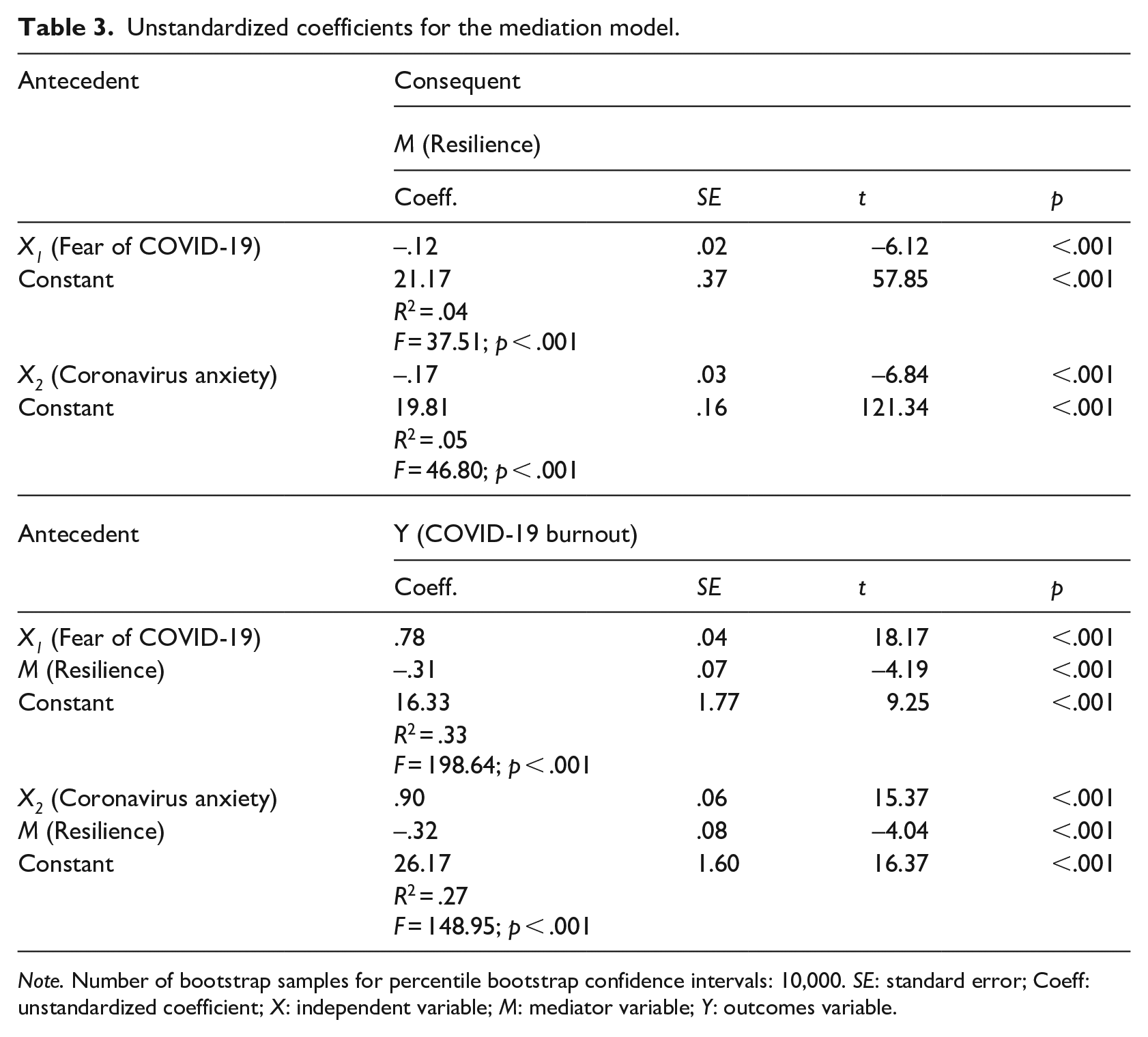
Note. Number of bootstrap samples for percentile bootstrap confidence intervals: 10,000. SE: standard error; Coeff: unstandardized coefficient; X: independent variable; M: mediator variable; Y: outcomes variable.
Regression coefficients for direct and indirect links between fear of COVID-19, coronavirus anxiety, resilience and COVID-19 burnout.
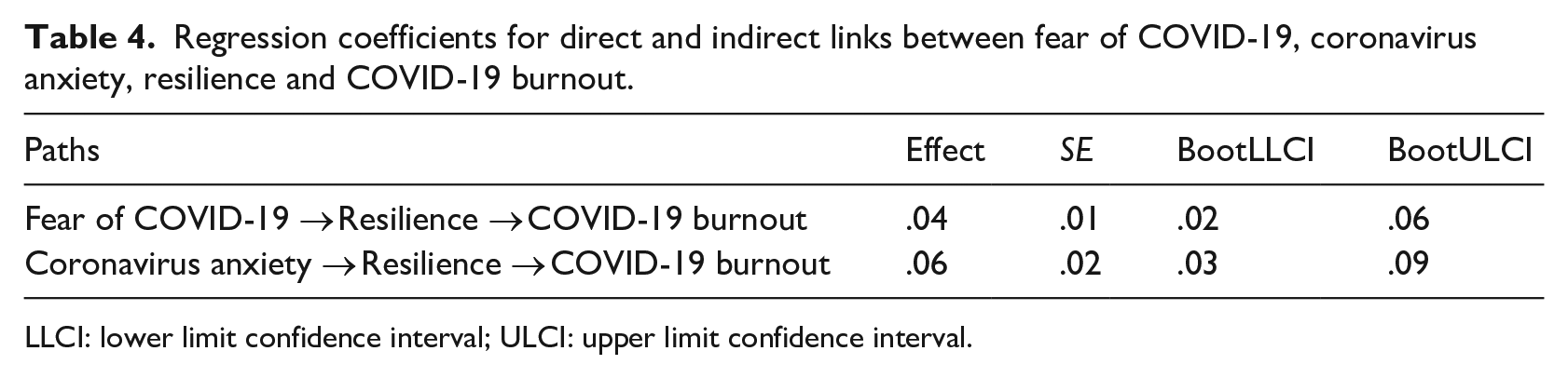
LLCI: lower limit confidence interval; ULCI: upper limit confidence interval.
Discussion
The COVID-19 pandemic has an adverse impact on the overall life in the general and mental health of individuals in specific around the globe. From the first wave of the COVID-19 pandemic to the ongoing fourth wave, much research examined its outcome in multiple directions. The current study aimed to explore the mediating link of resilience between fear of COVID-19, coronavirus anxiety and COVID-19 burnout. Concerning the Pakistani context, a few studies investigated psychological strengths linked with well-being and mental health outcomes in young adults (Green & Yıldırım, 2022) and depression in older adults (Mumtaz et al., 2021). As the negative impact of the COVID-19 pandemic on psychological well-being is worldwide, it is necessary to explore the factors that play a protective role in minimizing the adversity of a pandemic. None of the documented past Pakistani studies examined resilience associated with COVID-19-related factors such as fear of COVID-19, coronavirus anxiety and COVID-19 burnout. Furthermore, to date, an empirical study is limited regarding exploring the mediating role of resilience in the relationship between fear of COVID-19 and coronavirus anxiety with COVID-19 burnout. Therefore, findings from the current study extend the understanding of resilience with these pandemic-related specific factors.
The findings from the current study demonstrated a significant positive link and direct effect of fear of COVID-19 with coronavirus anxiety and COVID-19 burnout, and a negative association and a direct effect on resilience. These results align with the past empirical studies reporting fear of COVID-19 is negatively linked with resilience (Kirmani et al., 2015). Specific fears include being diagnosed with a disease in a pandemic, unavailability of sufficient resources for treatment, and proper management of ailment. Moreover, such fears are not induced suddenly but structurally and rapidly; smart or complete lockdowns, social distancing, self-quarantines, restricted social interactions and social distancing in the context of low social support induce fears and apprehensions, which in turn adversely affect human ability to confront challenges (Kassam, 2019). In general, resilience played a protective role in reducing fear of COVID-19 and functioned as a shield in the sample of highly educated adults (Hu et al., 2022; Yıldırım & Tanrıverdi, 2021). Past studies supplement the current study findings that fear of COVID-19 negatively links with psychological resilience (Yıldırım and Arslan, 2022; Yıldırım and Güler, 2021). Individuals with high psychological resilience were less likely to be identified with worries, apprehensions and fears of COVID-19 (Yildirim, 2019). In addition, it was noticed that individuals with a higher level of resilience are likely to experience low levels of COVID-19-associated disturbances.
The present study also found that resilience partially mediated the effect of fear of COVID-19 on COVID-19 burnout; and the link between coronavirus anxiety and COVID-19 burnout. These results are in line with several past findings (Min et al., 2013; Yıldırım and Arslan, 2022), concluding that resilience plays a protective role against negative mental and physical health consequences and increases the endurances during adverse circumstances such as pandemics. Furthermore, COVID-19 burnout was found significantly predicted by psychological resilience (Yıldırım and Solmaz, 2020). Resiliency advocates positive outcomes and healthy personality characteristics despite aversive and unfavourable life circumstances. In this context, it is safe to conclude that resilience is one significant factor in balancing individuals’ feelings of fear of COVID-19, anxieties and burnout and being less affected by its negative outcomes (Fletcher and Sarkar, 2013).
Limitations and suggestions
As there is no research without limitations, likewise current study has some drawbacks. Majority of the sample comprised those who themselves or any of their family members were not identified with coronavirus and were not vaccinated. So, lesser/no direct exposure to pandemics may be a reason for the partial mediational role of resilience in linking fear of COVID-19 and coronavirus anxiety with COVID-19 burnout. Another deficiency was to collect data online-only, which cannot minimize the response bias, subject bias and intervention of and non-uniformity of environmental factors in which participants filled out the questionnaire. The current study was primarily quantitative and based on a cross-sectional research design that cannot guarantee causality. A longitudinal follow up of study utilizing qualitative approaches, and semi-structured interviews may enhance the authenticity of the current study findings and provide more reliable information about fluctuating and consistent behavioural patterns. Likewise, there is a need to replicate the present study findings across various cultures to examine differences and similarities in the research outcomes.
Contributions and conclusion
The present study findings contribute to understanding the significance of one of the positive and important pillars of personality – resilience in explaining the link between COVID-19-related factors (i.e. fear, anxiety and burnout). Psychological resilience acts as a factor that mitigates the strong association of COVID-19 fears and anxieties with COVID-19 burnout. These findings are significant in their usefulness by building the ability to bounce back in circumstances of psychological stresses, traumas and adverse situations. Furthermore, our findings demonstrated that a higher level of psychological resilience serves as a buffer for individuals confronting worries, apprehensions, anxieties and burnout during pandemics such as COVID-19. Put differently, by strengthening psychological resilience, one can preclude negative mental health consequences like COVID-19-related fears, anxieties and burnout. Focusing on and strengthening psychological resilience in the context of the current pandemic is quite vital. These results are a valuable addition to prior knowledge in international literature and the Pakistani context. In addition, the present study findings also support using the Urdu version of COVID-19 as the cost-effective, convenient, comprehensive and short scale for assessing COVID-19 pandemic-related burnout.
Footnotes
Data availability
Authors agree to make data supporting the results presented in this paper available upon reasonable request.
Declaration of conflicting interests
The author(s) declared no potential conflicts of interest with respect to the research, authorship, and/or publication of this article.
Ethical approval
This study was approved by the Ethical Review Board of the Department of Humanities, COMSATS University, Lahore. All procedures performed in studies involving human participants were following the ethical standards of the institutional research committee and with the 1964 Helsinki Declaration and its later amendments or comparable ethical standards.
Funding
The author(s) received no financial support for the research, authorship, and/or publication of this article.
Informed consent
Informed consent was obtained from all individual adult participants included in the study.
