




Abstract
This article examines the evolving political trajectories of the African National Congress (ANC) in South Africa and the South West Africa People’s Organization (SWAPO) in Namibia, two liberation movements that transitioned into dominant ruling parties after independence. While their liberation credentials initially conferred legitimacy and enabled early state-building, their prolonged incumbency has led to the entrenchment of party-state conflation, elite patronage, and institutional stagnation. Through a comparative analysis, the article explores how these liberation legacies have shaped post-colonial state institutions, electoral behaviour, and democratic development in the two countries.
Introduction
The democratic trajectories of post-liberation states in the Global South have long been shaped by the enduring influence of liberation movements turned ruling parties. This dynamic is particularly pronounced in Southern Africa, where the African National Congress (ANC) in South Africa and the South West Africa People’s Organization (SWAPO) in Namibia have dominated post-independence politics. Born out of the of anti-colonial and anti-apartheid struggles, these parties forged profound symbolic and emotional ties with their citizenries. Their rise to power marked the culmination of long and painful liberation struggles, symbolising the achievement of long-denied majority rule. However, as these parties have acceded to governmental power, they have shaped state institutions in ways that undermine substantive democracy. By privileging elite self-enrichment over the fulfilment of liberation-era promises, they have systematically undermined development, the rule of law, and democratic governance (Soler-Crespo, 2019).
This article examines the evolution of the ANC and SWAPO as liberation movements and their subsequent transformation into dominant political parties. In both South Africa and Namibia, the liberation legacy has served as the cornerstone of post-independence political legitimacy, allowing these parties to establish de facto dominant-party systems (distinct from a one-party system, which allows only one legally recognised party and excludes political competition (De Jager & Du Toit, 2013: 7)). While this hegemony offered a sense of continuity and national unity in the early years of democracy, over time it has contributed to the emergence of power-hungry corrupt politicians, institutional stagnation, declining state capacity and, weakening political accountability. With the moral capital of the liberation struggle increasingly exhausted, and governance failures mounting, the electoral dominance of these parties has begun to erode leading the slow death of these national liberation movements (Gumede, 2017: 27).
The 2024 general elections in South Africa marked a historic turning point as for the first time since the end of apartheid the ANC failed to secure a parliamentary majority. Similarly, SWAPO’s electoral performance in Namibia has steadily declined since 2019, reflecting growing voter disillusionment. These shifts signal a broader trend across the region, where the formerly unchallenged liberation parties are now facing a legitimacy crisis. Voter turnout is falling, particularly among younger generations with no direct memory of the liberation struggle era, and opposition parties are gaining traction, often leveraging populist rhetoric to galvanise support. This political realignment raises important questions about the long-term impact of liberation parties on democratic development.
This article investigates the dual legacy of liberation parties as both advocates for and gatekeepers of democracy. On one hand, their role in achieving national independence and establishing democratic institutions cannot be overstated. On the other, their prolonged incumbency has in many cases constrained the function of democratic systems by conflating state and party, curtailing political competition, and breeding patronage-based governance. Crucially, the absence of meaningful electoral alternation has entrenched their dominance and diminished the accountability mechanisms essential to democratic renewal (Bratton, 2013: 265). Without the real prospect of being voted out of power, these parties face few incentives to reform or respond substantively to public dissatisfaction. As a result, the very legitimacy that once underpinned democratic consolidation is now being challenged by the failure of liberation parties to renew themselves ideologically, structurally, and ethically.
Through a comparative analysis of Namibia and South Africa, the article explores how liberation histories have shaped party legitimacy, political culture and democratic trajectories. It also critically assesses the political consequences of declining support for liberation parties by posing the question of what happens to democracy when these foundational actors lose their grip on power. More specifically, is the weakening of liberation movements an opportunity for democratic deepening, or does it risk political instability and populist backlash? By situating these questions within the broader literature on dominant-party systems and democratic consolidation in post-liberation states, the article contributes to a growing body of work that re-evaluates the role of historic liberation movements in contemporary governance.
Theoretical frameworks
There is an extensive body of literature on dominant-party systems seeking to uncover the mechanisms through which power is maintained (Bogaards, 2004: 174; Arian and Barnes, 1974). Scholars such as Kenneth F. Greene’s (2007: 36) resource-based theory offers a particularly robust framework for unpacking the mechanics of party dominance in formally democratic regimes. Rather than relying on overt authoritarian tactics such as electoral fraud, dominant parties often entrench their power through systemic advantages, most notably, monopolistic control over economic and political resources. Levitsky and Way (2010a: 57–60) build on this perspective, identifying three central mechanisms through which dominant parties maintain power in competitive authoritarian regimes: unequal access to resources, the media, and the law. Although these features are often associated with autocratic systems, they are equally observable in dominant-party democracies, where incumbents exploit state institutions while preserving the procedural façade of electoral legitimacy.
Expanding on Greene’s theory, a useful analytical approach distinguishes between control over economic and political resources. Economic resources include access to public finances, procurement contracts, regulatory authority, and fiscal instruments, all of which can be deployed to reward allies and punish dissenters (Magaloni, 2007: 20). Political resources encompass influence over the legislative process, control of public broadcasting, appointment powers, and the capacity to shape dominant ideological narratives. Through these mechanisms, dominant parties construct an uneven playing field that curtails the development of a viable opposition and undermines meaningful political competition.
Although this article does not seek to provide an exhaustive account of how the ANC and SWAPO have maintained electoral dominance over decades, it is nonetheless necessary to consider these strategies. The tools and institutional advantages wielded by these parties, ranging from preferential media access to the fusion of party and state, have direct implications for democratic quality in South Africa and Namibia (Greene, 2007; Levitsky and Way, 2010a). By shaping the contours of political participation, these mechanisms constrain accountability and erode public trust in electoral institutions. A broad understanding of dominant-party strategies is therefore essential for any serious assessment of democratic resilience in post-liberation states.
This study also considers Gumede’s (2017) analysis of the political culture of African liberation movements turned governing parties. His paper identifies the structural, ideological, and behavioural patterns that have contributed to democratic stagnation, institutional decay, and the erosion of public trust in many post-liberation states, as illustrated in Table 1 below. The framework incorporates scholarship and insights from across the field and will serve as a broad critical lens through which to examine and compare the contemporary political dynamics of liberation movements in South Africa and Namibia, with particular attention to how these elements continue to shape governance.
The elements of political culture of African independence and liberation movements.
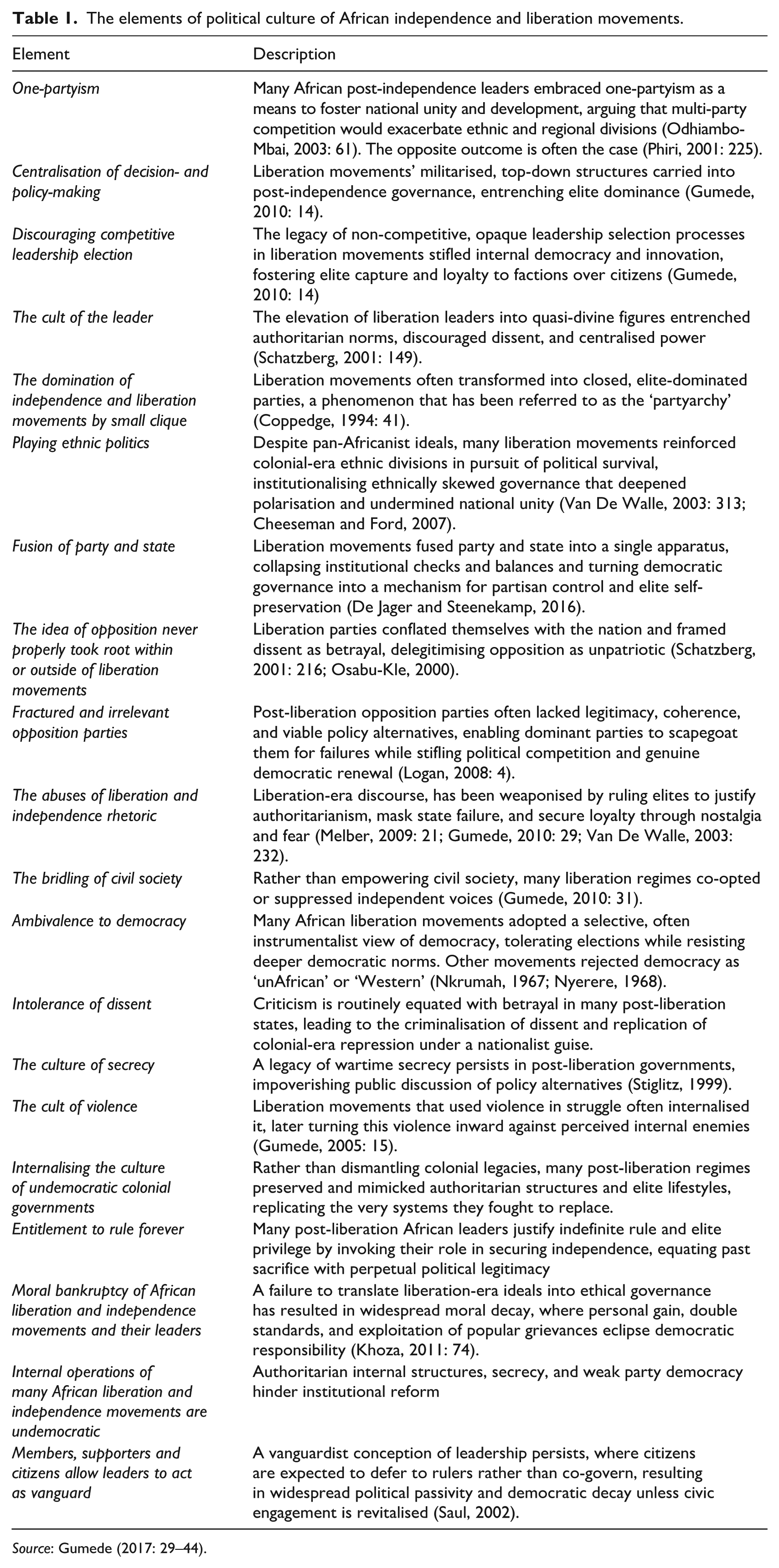
Source: Gumede (2017: 29–44).
This study also draws on Michael Bratton’s (2013) multidimensional framework investigating the relationship between Democracy and Governance in Sub-Saharan Africa, to interrogate how the entrenchment of liberation parties affected the quality of governance in South Africa and Namibia. Bratton uses a nuanced framework for assessing governance along three core dimensions, administrative, economic, and political, each disaggregated into measurable indicators (Bratton, 2013: 259–262). By applying the framework illustrated in Table 2, one can examine not only whether democratic procedures exist but also whether they translate into substantive gains for citizens across these governance dimensions.
Democracy and governance (adapted from Bratton, 2013).
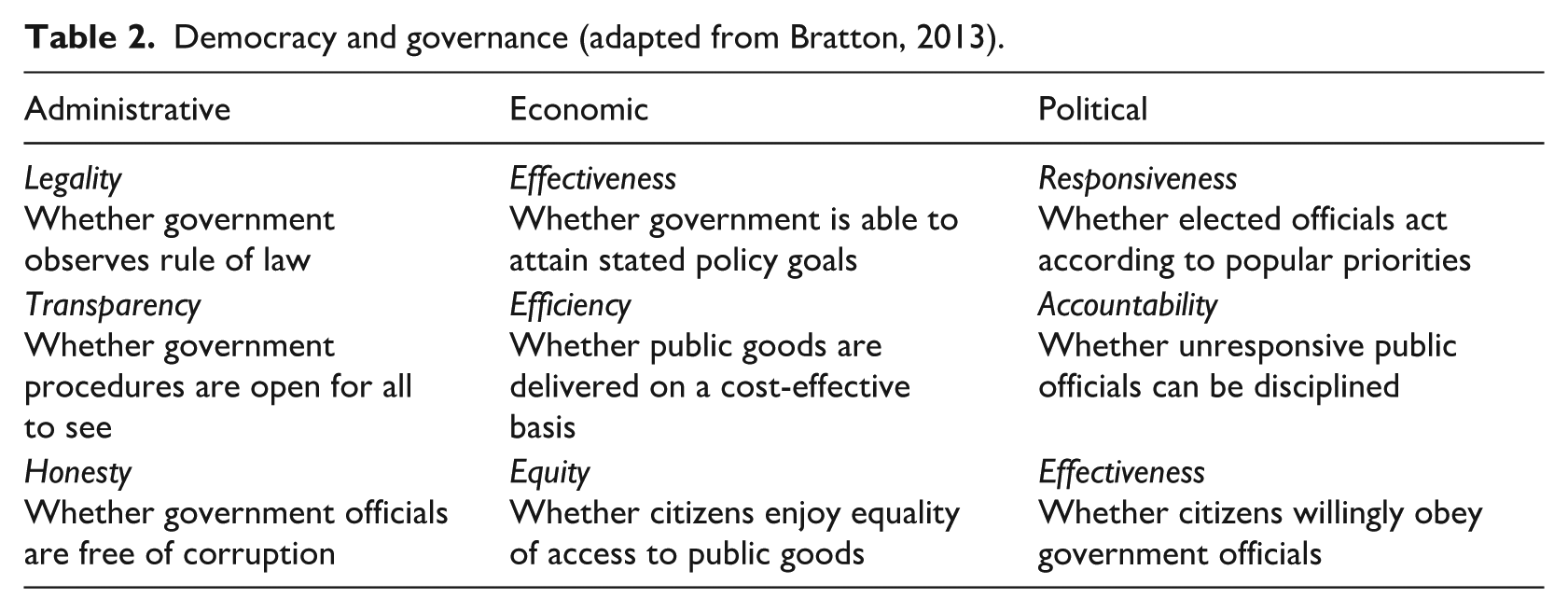
The use of this framework enables this study to depart from the traditional paradigms of transition and consolidation that dominated the analysis of new democracies in the 1980s and 1990s (Linz, 1996). These older frameworks, while useful in capturing a historical moment, tend to focus narrowly on teleological questions, namely, whether a country has become a ‘real’ democracy and what institutional preconditions are required to make that democracy ‘secure’ (Beetham, 2000; Friedman, 2019: 3; Giliomee and Simkins, 1999: 12; O’Donnell, Schmitter & Whitehead, 1986; Schedler, 1998: 91–91). Given that both South Africa and Namibia have sustained formal democratic institutions for over three decades and are still classified as electoral democracies according to V-Dem data (V-Dem Institute, 2024: 17), the core concern is no longer whether these states are democracies per se. Rather, the analytical focus of this article is on the quality, legitimacy, and trajectory of democracy under prolonged single-party dominance. In doing so, the study aligns with recent scholarly shifts that emphasise the erosion of democratic substance under conditions of dominant-party rule, even in contexts where procedural democratic markers remain intact (Diamond, 2015; Levitsky & Way, 2010b: 57).
The rise and transformation of South Africa’s liberation movement: the African national congress
The rise of the movement
The African National Congress (ANC), founded in 1912 as the South African Native National Congress, emerged as a response to the systematic exclusion of black South Africans from political and economic power in the Union of South Africa (African National Congress, 2025). Initially conceived as a moderate, elite-driven organisation focused on petitioning the colonial state, the ANC’s transformation into a mass liberation movement was catalysed by the introduction of apartheid policies, particularly following the National Party’s electoral victory in 1948 (Suttner, 2012: 728). During the 1950s and 1960s, the ANC evolved into a revolutionary force, shaped by the growing radicalisation of its leadership and the strategic pressures of state repression. This shift was exemplified by the formation of Umkhonto we Sizwe (MK) in 1961, a militant wing committed to armed resistance against the apartheid regime (Ellis, 2012: 625; Suttner, 2012: 726).
A critical turning point in this transformation was the Sharpeville Massacre of 21 March 1960, when South African police opened fire on a peaceful anti-pass law 1 protest organised by the Pan Africanist Congress (PAC) in the township of Sharpeville, killing 69 people and injuring over 180 with many shot in the back while fleeing (Lodge, 2011). The sheer brutality of the state’s response shocked the nation and the world, delegitimising the apartheid regime and galvanising international condemnation. In the immediate aftermath, the government declared a state of emergency and banned both the PAC and the ANC (Suttner, 2012: 729). For the ANC, Sharpeville marked the break with non-violent resistance. Forced into exile, its leadership turned to underground operations and began cultivating support abroad. In this context, the ANC successfully forged strategic alliances with the Soviet Bloc and African liberation networks, while also leveraging the moral capital of the Sharpeville tragedy to position itself as the principal representative of the anti-apartheid struggle (Weiss and Rumer, 2019: 4). The massacre thus not only radicalised the movement’s tactics but also played a foundational role in internationalising its legitimacy and cause.
By the 1980s, the ANC had consolidated its status as the primary liberation movement in South Africa, underpinned by a combination of internal grassroots mobilisation and a an international campaign of economic sanctions and diplomatic pressure. Its ability to maintain ideological coherence while navigating the complex terrain of militant struggle and international diplomacy enabled the ANC to survive and grow despite intense repression and exile (African National Congress, 2025). The unbanning of the movement in 1990, followed by the release of Nelson Mandela from prison and the negotiated transition to democracy marked the movement’s formal ascendancy to power. Its pivotal role in facilitating a relatively peaceful transition from apartheid to democracy earned it significant domestic and global legitimacy, shaping the moral authority it would carry into the post-apartheid era (Ellis, 2012: 635).
The ANC and the new South Africa
The ANC’s official ascension to power in 1994, following South Africa’s first democratic elections, marked a historic turning point for the nation and its democratic trajectory. Ushering in an era of majority rule the ANC’s victory signalled not only the formal end of apartheid but also the beginning of a new constitutional order grounded in universal suffrage, human rights, and democratic governance. Securing over 60% of the national vote the ANC’s triumph was more than a political success; it was a symbolic moment representing the culmination of decades of anti-colonial and anti-apartheid struggle. The party entered government not merely as a political organisation but as the embodiment of national liberation and the main vehicle for democratic transformation (Southall, 1994: 630). This conflation of party and nation initially fostered unity and hope, but it also laid the foundations for a dominant-party system in which the boundaries between party, state, and society became increasingly blurred (Butler, 2005: 735). In this sense the ANC’s rise to power marked both the birth of democracy in South Africa and the emergence of structural tensions that would shape its democratic consolidation.
The ANC inherited a state apparatus that was deeply racialised, economically exclusionary, and institutionally fragmented. The ANC’s broad-based legitimacy rooted in its liberation credentials proved critical in managing the volatility of a fragile post-authoritarian transition. The formation of the Government of National Unity (GNU), which included the former ruling National Party and the Zulu Inkatha Freedom Party (IFP), reflected a commitment to inclusive governance and political compromise, mitigating fears of retribution or majoritarian domination (Southall, 1994: 630) The ANC also played a key role in the drafting of the 1996 Constitution, a document widely lauded for its progressive articulation of rights, socio-economic justice, and democratic checks and balances (Klug et al., 2000: 433). In this early period, the party’s hegemony appeared to align with democratic deepening, facilitating political stability, institutional reform, and the expansion of civil and political rights.
Yet South Africa’s democratic transition must also be understood within the broader context of settler colonialism and the negotiated nature of the political settlement (Southall, 2003: 256). Rather than a revolutionary rupture, the ANC’s rise to power was the outcome of a carefully brokered compromise with the apartheid regime. While crucial in avoiding civil conflict this mode of transition meant that many structural and institutional features of the apartheid-era liberal-capitalist order remained largely intact. Consequently, the post-apartheid state adopted a democratic framework grounded in procedural liberalism and the protection of individual rights, but lacked the structural capacity and political space to pursue the more radical redistributive and transformative objectives central to the liberation struggle. As Mahmood Mamdani (1996) cautioned, post-colonial transitions that fail to dismantle colonial institutional logics often reproduce exclusionary and hierarchical state-society relations. In the South African case, the negotiated settlement produced what scholars such as Adam Habib (2013: 70) have termed a ‘compromised’ or ‘constrained’ democracy, one in which the formal mechanisms of democratic governance coexist with persistent socio-economic inequalities and limited material transformation for the majority.
The ANC’s dual identity as both a liberation movement and a governing party also planted the seeds for future democratic challenges. Its moral authority that was derived from its role in the struggle discouraged the development of a robust opposition and reinforced the party’s dominance within the political system. Over time, the liberation narrative became the primary source of political legitimacy, eclipsing technocratic governance and fostering an implicit belief that electoral success was both a reward and an entitlement for past sacrifice (Lodge, 2011). This narrative, while unifying in the early years, contributed to the entrenchment of a dominant-party system, one that would gradually strain the very democratic institutions the ANC helped to build.
From liberation movement to dominant party
Three decades into South Africa’s democratic dispensation, the ANC remains the country’s most historically significant and electorally dominant party. Yet its transformation from a liberation movement to a governing party has been fraught with tension, contestation, and institutional decay. Once viewed as the custodian of democratic transition and national reconciliation, the ANC has become increasingly associated with internal fragmentation and governance failures leading to a waning legitimacy (Hartley et al. 2023). The party’s claim to moral authority, grounded in its leadership during the anti-apartheid struggle persists rhetorically yet its governance record has eroded the credibility of that legacy.
The early post-apartheid period was marked by an attempt to forge an inclusive political order through a Government of National Unity (GNU), in which executive power would be shared under the terms of the 1993 interim constitution. While this arrangement was formally committed to reconciliation and multi-party cooperation, in practice it was short-lived. The ANC rapidly asserted its political hegemony, and by 1996 the formerly ruling National Party (NP) withdrew from the GNU citing marginalisation and the absence of genuine power-sharing (Friedman, 2019). This episode signalled an enduring feature of post-apartheid politics: the ANC’s tendency to conflate electoral majoritarianism with democratic legitimacy, thereby undermining the pluralist ethos the transition ostensibly sought to institutionalise (Habib and Taylor, 1999).
Rather than cultivating a robust multi-party democracy, the ANC’s dominance fostered what Suttner (2006: 289) refers to as a conflation of state and party in which the boundaries between the ruling party and the state became increasingly blurred. This dynamic enabled the centralisation of power within the executive and facilitated elite control over state institutions, often at the expense of democratic accountability. The ANC’s liberation narrative that was long a source of political capital, gradually ossified into a mechanism for deflecting criticism and entrenching loyalty within party ranks and among segments of the electorate.
Over time, internal cohesion within the ANC gave way to factionalism, driven by ideological rifts and competition for access to state resources. The party’s alliance with the Congress of South African Trade Unions (COSATU) and the South African Communist Party (SACP) began to fray under the pressures of neoliberal economic policy, most notably the Growth, Employment and Redistribution (GEAR) strategy, which alienated labour constituencies and intensified internal ideological tensions (Marais, 2011: 112). These fissures deepened under the presidency of Jacob Zuma, whose ascent to power marked a shift towards populist mobilisation, patronage politics, and institutional capture. By the 2024 general election, the ANC’s share of the national vote had declined to just over 40%, a historic low that underscored the erosion of the party’s electoral hegemony and its increasingly contested role as the dominant political actor (IEC, 2025).
Despite these systemic failures, the ANC has continued to invoke its liberation credentials in electoral discourse, framing each election as a continuation of the anti-apartheid struggle and positioning opposition parties as threats to the revolution’s gains. While this rhetoric retains some resonance among older voters and within traditional party structures, it has become increasingly ineffective in addressing the demands of the younger and more politically diverse electorate. For many citizens born after 1994 historical memory carries less political weight than lived experiences of unemployment, inequality, and inadequate public services. As Schulz-Herzenberg and Mattes (2023: 1316) show, the moral economy of the liberation narrative may no longer sufficient to guarantee political legitimacy in the face of deteriorating socio-economic conditions.
The state of the ANC and South African democracy
The ANC’s continued centrality in South African politics represents a complex democratic legacy. While the party was indispensable in the early institutionalisation of democratic norms, particularly under the leadership of Presidents Nelson Mandela and Thabo Mbeki, it has also become a key source of democratic erosion in more recent years. The initial post-apartheid period saw the ANC preside over the crafting of a progressive constitution, the strengthening of judicial independence, and the emergence of a vibrant civil society and media sector. These early achievements laid a durable foundation for democratic governance and helped secure South Africa’s reputation as a model of peaceful transition.
However, as several scholars have noted, the ANC’s liberation legacy has also embedded an anti-pluralist political culture that is ill-suited to democratic consolidation (Butler, 2017; Southall, 2014: 333). Over time, the conflation of party, state and national identity, what Mamdani (1996) terms the ‘movement-to-government complex’, has enabled a governing style that prioritises loyalty and struggle credentials over institutional integrity and democratic responsiveness. The party’s internal policy of cadre deployment, 2 initially justified as a mechanism to transform the apartheid-era bureaucracy, has increasingly undermined meritocratic governance and fostered politicisation of the civil service (Swanepoel, 2021: 440). Moreover, the placement of cadres instead of capable professionals has led to service delivery failures and poor governance. The logic of patronage, embedded in the ANC’s internal structures, ultimately facilitated the emergence of a rent-seeking political elite and weakened institutional accountability (Lodge, 2014).
Patronage reached its peak during the presidency of Jacob Zuma (2009-2018) that had led to democratic recession. Described as ‘state capture’ the phenomenon systematised elite repurposing of state institutions for private enrichment and revealed the extent to which the ANC’s internal decline had compromised democratic governance (Public Protector’s Report, 2016). Institutions such as the South African Revenue Service (SARS), the National Prosecuting Authority (NPA), and state-owned enterprises were hollowed out to serve factional and private interests, eroding public trust in the state’s capacity to act in the public good (Alence and Pitcher, 2019: 6; Labuschagne, 2017: 57, Judicial Commission of Inquiry into Allegations of State Capture, Corruption and Fraud in the Public Sector including Organs of State, 2022). Importantly, the state capture period did not merely reflect episodic corruption but indicated a structural subversion of democratic institutions which scholars of democratic backsliding describe as executive aggrandisement through legal, bureaucratic, and procedural manipulation (Bermeo, 2016: 6; Levitsky and Ziblatt, 2018; Southall, 2019).
Despite these erosions, South Africa’s democracy has shown surprising resilience. The establishment of the Judicial Commission of Inquiry into Allegations of State Capture (State Capture Commission/Zondo Commission) in 2018 represented a key moment of institutional pushback, driven in part by sustained pressure from civil society and the media. The Commission’s findings laid bare the mechanisms of elite collusion and offered a detailed blueprint for institutional reform. Yet the ANC-led government’s failure to implement many of its recommendations has reinforced the perception that senior party figures remain insulated from accountability, a critique echoed by legal scholars and political commentators alike (Calland and Sithole, 2022; Madonsela, 2023).
The 2024 general election marked a rupture in South Africa’s post-apartheid political settlement. With the ANC falling below 50% of the national vote for the first time since 1994 (IEC, 2025), the country entered an era of coalition politics and increased electoral competition. This shift opens new possibilities for democratic renewal, but it also introduces challenges associated with fragmentation, populism, and governance instability (Booysen, 2015). Emerging opposition parties, ranging from technocratic formations to ideologically populist movements, reflect both voter disaffection and the search for political alternatives beyond liberation-era loyalties.
The ANC’s legacy is thus contradictory. While it was foundational in building the democratic state, its failure to adapt to the normative and institutional demands of a mature democracy could be a contributor to democratic backsliding (Southall and Rotberg, 2014). The party’s continued invocation of liberation credentials to justify present-day failings is increasingly out of step with a younger electorate, whose political consciousness is shaped less by historical memory than by lived experiences of inequality, unemployment, and service delivery failures (Seekings and Nattrass, 2005). As the political landscape transitions away from dominant-party rule, South African democracy faces a critical juncture: the possibility of pluralism without coherence and contestation without consolidation. Whether this dynamic catalyses democratic deepening or promotes further fragmentation will depend on the extent to which political institutions, civic actors, and emergent coalitions can uphold the foundational ideals of accountability, responsiveness, and inclusion. Ideals the ANC once championed but has increasingly struggled to sustain.
SWAPO, democracy and the limits of dominant-party rule in Namibia
Rise of the movement
During the 1960s, the SWAPO emerged as the principal liberation movement in Namibia, gradually gaining regional and international recognition. Originally founded as the Ovamboland People’s Organization (OPO) in 1959, the movement reconstituted itself in 1960 as SWAPO to reflect a broader national constituency and to project an inclusive vision of Namibian liberation (Saunders, 2018: 159). Namibia, formerly a German colony, came under South African administration following the First World War, when the League of Nations granted South Africa a mandate to govern the territory, then known as South West Africa, with the eventual aim of guiding it towards independence (Du Pisani, 1984: 178). Instead, the apartheid regime entrenched its racial policies in the mandate, treating it as a de facto fifth province and systematically denying political rights to the majority (Du Pisani, 1993: 29; Namibia-UNTAG: Background, n.d.; Silvester, 2015: 506; Wallace and Kinahan, 2011: 239, 243).
In response, SWAPO and other nationalist organisations mobilised against South African colonial rule and the imposition of apartheid (Leys & Saul, 1994: 127). While SWAPO initially adopted a peaceful strategy, it shifted to armed resistance following the International Court of Justice’s advisory opinion that South Africa’s continued presence in Namibia was illegal (Saunders, 2018: 159). This marked the beginning of a guerrilla war waged by SWAPO’s military wing, the People’s Liberation Army of Namibia (PLAN), aimed at exerting pressure for independence. However, these military efforts were not pursued in isolation; rather, they complemented a sustained diplomatic campaign that engaged the United Nations and other international actors. The armed struggle and diplomatic engagement functioned in tandem, shaping a dual-track strategy that would ultimately contribute to the broader process of decolonisation and the eventual transition to democratic rule.
During the 1970s, SWAPO’s influence and the armed struggle against the apartheid regime intensified significantly. The decolonisation of Angola in 1975, following political and economic upheaval in Portugal, had a profound impact on the Namibian liberation movement. Angola’s independence created a critical geopolitical opening: it enabled PLAN, SWAPO’s military wing, to establish bases along Namibia’s northern border, thereby expanding the scope and intensity of the armed conflict (Leys & Saul, 1994: 125; Melber et al., 2017: 300; Williams, 2011: 693). This development also facilitated a surge of young Namibians fleeing through Angola into Zambia to join the liberation effort (Williams, 2011:693). SWAPO’s growing military capacity, combined with its continued diplomatic engagement, reinforced its role as the principal force opposing South Africa’s white minority rule in Namibia.
The liberation of Namibia and the formal end of apartheid rule within South West Africa culminated in the country’s independence in 1990. While the sustained efforts of SWAPO and its armed wing, PLAN, played a visible role, bolstered notably by Cuban military support, the decisive turning point was shaped by broader geostrategic realignments during the Cold War. The implementation of United Nations Security Council Resolution 435 (1978), coupled with pressure from key international actors including Cuba, the Frontline States, Nigeria, and the Organisation of African Unity (OAU), created the conditions for a negotiated transition. SWAPO, despite initial reservations, ultimately agreed to the process under the influence of these allies. In 1989, Namibia held its first free and fair multi-party elections for a Constituent Assembly (whose members formed the National Assembly at independence), marking a watershed in the country’s democratic evolution. SWAPO emerged as the dominant political force, securing 56.9% of the vote (Melber, 2009: 465; Melber, 2015: 50). Other parties, including the Democratic Turnhalle Alliance (DTA) and United Democratic Front (UDF), gained 28.4% and 5.6%, respectively (Melber, 2015: 50). In this way, Namibia’s independence was not solely the product of armed struggle but also the result of a complex interplay between domestic resistance, international solidarity, and strategic global negotiations.
SWAPO’s rise to power
At the time of Namibia’s liberation in 1990, SWAPO held a singularly dominant position in the national imagination, both as the leader of the anti-colonial struggle and as the custodian of the country’s democratic aspirations. Its legitimacy was not only derived from its role in leading the armed resistance, but also from its formal international recognition. The OAU and the United Nations had endorsed SWAPO as the sole legitimate representative of the Namibian people, thereby positioning it as the political force most capable of delivering independence. As such, at the moment of transition, democracy in Namibia was inseparable from the political ascendancy of SWAPO. Its assumption of power in the country’s first free and fair elections in 1989 was thus widely interpreted not merely as a political victory, but as the culmination of a decades-long struggle for justice, sovereignty, and popular representation.
Yet, the democratic meaning of SWAPO’s ascension was not straightforward. While the movement articulated a vision of a democratic Namibia during the liberation struggle, its internal political culture reflected a more centralised, militarised, and hierarchical structure. Slogans such as ‘One nation, one party, one leader’ and ‘SWAPO is the Nation and the Nation is SWAPO’ reveal a discursive tendency towards the conflation of party and state (Melber, 2009: 469). This fusion, while perhaps strategic during wartime mobilisation, carried implications for post-independence political pluralism. The symbolic and institutional centrality of SWAPO created an environment in which opposition was often marginalised, and where the legitimacy of alternative political voices was subtly, and at times overtly, diminished. Nonetheless, the initial transition was carried out through inclusive and competitive elections, and SWAPO’s formal commitment to constitutional democracy offered a framework within which political contestation could occur.
From liberation movement to dominant party
In Namibia’s most recent general election, held in November 2024, SWAPO once again secured a majority in both the presidential and parliamentary contests, thereby extending its tenure in government for an eighth consecutive term (Electoral Commission of Namibia, n.d.). This outcome stands in contrast to the trajectories of several other former liberation movements across Africa, many of which have either been voted out of power or compelled to enter coalition arrangements. SWAPO retained its parliamentary majority with 53% of the vote, while Netumbo Nandi-Ndaitwah, the presidential candidate representing SWAPO, was elected as Namibia’s first female president with 57% of the presidential vote (Namibia: SWAPO Wins Again, 2025: 24704). This electoral result not only reaffirms SWAPO’s enduring dominance in Namibian politics but also marks a historic milestone in terms of gender representation at the highest level of government. Namibia is the only country, in which the three highest state positions (president, vice president and speaker of the National Assembly) are since 2025 held by women.
Although SWAPO managed to secure the majority of votes, the 2024 election results reflect a marked reduction in SWAPO’s electoral support, suggesting a sustained downwards trend in voter confidence. Furthermore, voter turnout in Namibia has gradually declined since the country’s first democratic election. While turnout has fluctuated over the years, the overall trend points to decreasing electoral participation. In the 2019 general election, only 60% of registered voters cast their ballots, a significant drop from the 70.5% turnout recorded in 2014 (Electoral Commission of Namibia, 2019). This decline suggests a growing sense of voter apathy, potentially linked to disillusionment with political elites, perceptions of corruption, and diminishing faith in the effectiveness of electoral processes. Although the 2024 elections saw a modest resurgence in turnout, with 75.68% of registered voters participating, this figure still falls short of the 97.3% turnout in 1989 and the 84.8% recorded in 2004 (Electoral Commission of Namibia, n.d.).
Internally, SWAPO faces growing factionalism and generational tensions that threaten its coherence and stability. The rise of figures such as Panduleni Itula, a former SWAPO insider who ran as an independent presidential candidate in 2019, has revealed deep ideological and leadership rifts within the party (Kariseb and Kasita, 2021: 14). Itula’s strong performance in that election, followed by the formation of the Independent Patriots for Change (IPC), a centrist opposition party advocating for anti-corruption and institutional reform, has further challenged SWAPO’s internal unity. In addition, long-standing grievances from the SWAPO Party Youth League (SPYL) regarding marginalisation in decision-making processes and limited opportunities for political advancement have amplified demands for reform (Melber et al., 2017). While the election of Netumbo Nandi-Ndaitwah as Namibia’s first female president may signal a symbolic shift, her leadership must navigate entrenched intra-party power dynamics, especially the dominance of the old guard within SWAPO, which has historically shaped the party’s leadership and internal alignments (Namibia: Swapo Congress, 2023: 23839). Externally, SWAPO’s legitimacy is increasingly tested by its response to governance challenges, particularly issues of transparency and corruption. Scandals such as the ‘Fishrot’ case have severely damaged the party’s reputation and contributed to the decline in voter trust (Kleinfeld, 2019; Melber, 2020). Uncovered in 2019, the ‘Fishrot’ corruption scandal revealed the illicit allocation of lucrative fishing quotas in exchange for bribes involving Icelandic fishing companies and high-ranking SWAPO officials (Kleinfeld, 2019). The revelations were widely disseminated in both local and international media and sparked widespread public outrage. The fallout from the scandal significantly tarnished SWAPO’s image and likely contributed to its reduced electoral performance in 2019 and 2024 (Melber, 2020: 14–15). Moreover, the procedural irregularities during the 2024 elections, while ruled by the Supreme Court as not having violated the constitutionality of the process as claimed by opposition parties, have cast further doubt on the robustness of Namibia’s electoral process under SWAPO’s watch. As the party navigates a more competitive and demanding political environment, it faces not only the challenge of institutional renewal but also the existential test of whether it can evolve into a modern, accountable political force. Crucially, this transformation, or lack thereof, will determine not only the party’s future, but also the trajectory of Namibian democracy itself. With some commentators warning of a potential ‘ZANUfication’ 3 of SWAPO and questioning whether it would accept electoral defeat should it lose its absolute majority, the party’s commitment to democratic norms may soon face its most consequential test.
The state of SWAPO and Namibian democracy
SWAPO continues to enjoy considerable advantages linked to its long-standing incumbency, particularly in terms of access to state resources. Some scholars argue that this has contributed to the emergence of ‘competitive authoritarianism’, where the electoral process remains formally democratic, but material and institutional advantages skew the playing field in favour of the ruling party (Melber et al., 2017: 286). While Namibia retains many core democratic institutions, including a constitutionally enshrined separation of powers and a generally independent media, these safeguards have come under increasing pressure. Recent setbacks include a decline in press freedom rankings (Matthys, 2024) and concerns over the rule of law, particularly after Parliament defied a Supreme Court ruling on same-sex marriage by passing a restrictive Marriage Bill widely condemned as homophobic. According to the V-Dem Democracy Report 2025, Namibia has been placed on a global ‘Watchlist’ of countries at risk of autocratisation, with the recent decline in its democracy score attributed largely to attacks on media freedom and freedom of expression under former President Hage Geingob and his Minister of Information and Communication Technology, Tjekero Tweya (V-Dem Institute, 2024: 45).
Namibia’s opposition landscape has long been characterised by fragmented, resource constraints, and weak ideological coherence, limiting genuine political competition and inadvertently reinforcing SWAPO’s electoral dominance (Cooper, 2014: 112). However, this dynamic began to shift in the 2019 general elections. Notably, opposition parties adopted a more strategic posture, forming electoral alliances and coordinating candidacies in an effort to erode SWAPO’s dominance (De Jager, 2025). The UDF, for instance, withdrew its presidential candidate to support the Popular Democratic Movement (PDM), contributing to a significant reduction in SWAPO’s presidential support and ending its parliamentary two-thirds majority. While these developments signal a degree of political maturation and growing competitiveness, they still don’t seem to hold the capacity to present a cohesive national alternative.
The democratic legitimacy of SWAPO has been eroded by incidents of corruption and electoral irregularities. The Fishrot scandal, as discussed earlier, is a prominent example that has significantly damaged public trust in both the party and the state. Afrobarometer data (2024a) indicates that 65% of Namibians believe corruption has increased, suggesting a growing perception of political decay. Allegations of electoral misconduct, such as violations of the Electoral Act and the discovery of discarded ballots, further undermine confidence in democratic processes (Lemon, 2007: 838). While Namibia has historically benefitted from an independent judiciary and a robust media environment, recent developments point to growing constraints.
Dominant-party rule and democratic evolution in post-liberation states: A comparative analysis of the ANC and SWAPO
The political trajectories of liberation movements in post-colonial Africa pose enduring questions for democratic theory. In particular, the transformation of former liberation movements into dominant political parties raises concerns about the durability and quality of democracy in contexts shaped by nationalist struggle. Yet, in contexts where electoral turnover has not occurred democracy risks becoming hollowed out. Drawing on theoretical literature on dominant-party systems and post-liberation movements, this section compares the trajectories of the ANC and SWAPO, highlighting how their liberation origins, political culture, and post-independence political strategies have shaped the democratic landscape of their respective countries.
Political culture
The political cultures nurtured by former liberation movements in power, such as South Africa’s ANC and Namibia’s SWAPO, reflect a complex legacy of their origins in anti-colonial and anti-apartheid struggle. Many of the characteristics identified by Gumede (2017) as typical of post-liberation movements are evident in the practices and institutional cultures of these parties since gaining power. Having emerged from liberation as the legitimate voices of their nations, both parties successfully leveraged the symbolic capital of struggle to consolidate authority in the post-independence period. The slogan ‘SWAPO is the nation and the nation is SWAPO’ exemplifies the conflation of party and national identity in Namibia. Likewise, the ANC has consistently positioned itself as the custodian of South Africa’s democratic transition and the guarantor of freedom, framing continued electoral support as a historical obligation rather than a rational policy choice (Shai et al., 2018: 4)
In both countries, liberation credentials have become critical markers of access to power (Melber, 2019: 538). The practice of cadre deployment, justified as part of a transformative agenda, has often led to the appointment of party loyalists to key positions in public administration, frequently at the expense of merit and institutional competence. What began as an effort to dismantle racially exclusive bureaucracies has, in practice, evolved into a system of patronage that undermines public accountability and contributes to state dysfunction (Swanepoel, 2021: 452; Pitcher et al., 2009: 127).
Moreover, liberation rhetoric has been deployed to delegitimise political opposition and suppress dissent. Critics of the ruling parties are frequently portrayed as enemies of the revolution or proxies for foreign interests, effectively narrowing the space for democratic debate and contestation. In South Africa, the ANC has framed opposition parties as betraying the ideals of the struggle, while in Namibia, SWAPO routinely dismisses opposition actors as relics of the colonial era or as lacking national representativeness in contrast to its own pan-ethnic liberation credentials. This discursive strategy has helped sustain electoral loyalty, particularly among older voters, where voting becomes an act of reaffirming historical allegiance rather than an evaluation of contemporary governance (Bratton et al., 2012; Schulz-Herzenberg and Mattes, 2023).
The entrenchment of this political culture is perhaps most starkly illustrated in the major corruption scandals that have rocked both countries. In South Africa, the state capture era under Jacob Zuma, and in Namibia, the Fishrot scandal, expose how liberation credentials can be weaponised to evade scrutiny and justify elite enrichment. These episodes reveal a broader erosion of democratic norms, in which historical sacrifice is used to mask contemporary failures of leadership and accountability.
Furthermore, both the ANC and SWAPO retained centralised and hierarchical structures rooted in their military pasts, with strong tendencies towards internal cohesion, top-down decision-making and resistance to internal dissent (Southall, 2014: 333). Leadership succession within both parties has often been managed through opaque and tightly controlled processes, where loyalty to the leadership core supersedes democratic contestation. In 1997, Thabo Mbeki was presented to the ANC rank and file as the sole candidate for party president, a decision orchestrated by the party elite without broader consultation or competition (Gumede, 2005: 123). Similarly, in Namibia, Sam Nujoma unilaterally selected Hifikepunye Pohamba as his successor in 2004, a move that sidelined internal debate and consolidated the culture of handpicked leadership (Melber, 2003; Reddy, 2015: 192).
This pattern has persisted in more recent years. In 2017, Cyril Ramaphosa’s ascension to the ANC presidency, while technically contested, was the result of high-level factional bargaining rather than a transparent and open leadership race. His narrow victory reflected deep internal fractures, but also the persistence of elite-driven succession processes, with limited grassroots input (Booysen, 2021: 56). In Namibia, Hage Geingob’s designation as SWAPO’s presidential candidate in 2014 and again in 2019 followed a similar logic (Melber, 2003). While framed as democratic, these processes were largely shaped by the party’s inner circle, with challengers marginalised or discouraged.
Despite their historical commitment to non-racialism and pan-Africanist ideals, both the ANC and SWAPO have, at various points, engaged in forms of ethnic politics that undermine their nationalist narratives. While overt ethnic mobilisation is often denied by party elites, both parties have subtly drawn on ethnic loyalties to consolidate power, manage internal rivalries, and marginalise opposition. In Namibia, SWAPO’s historical base in the Ovambo ethnic group, who constitute the largest demographic bloc, has translated into a persistent pattern of Ovambo dominance in government, the civil service, and party leadership structures (Melber, 2014). Similarly, although the ANC presents itself as a broad church representing all racial and ethnic communities, internal factional alignments have at times mirrored ethnoregional divisions. During leadership contests, most notably in the Zuma era, ethnic appeals, particularly to Zulu nationalism, were employed to mobilise support and portray internal critics as culturally disconnected or elitist (Everatt, 2024: 136). While neither party has devolved into outright ethnic parties, their instrumental use of ethnicity reflects a pragmatic, if troubling, tendency to rely on identity-based mobilisation when their hegemonic status is threatened.
Taken together, these dynamics reveal how the post-liberation political cultures fostered by the ANC and SWAPO have shaped the nature and limits of democratic development in South Africa and Namibia. However, it is important to acknowledge that not all elements of Gumede’s (2017) framework are equally visible in these contexts. Unlike some other post-liberation regimes, neither the ANC nor SWAPO has routinely employed political violence against citizens as a tool of repression in the democratic era, nor have they engaged in systematic suppression of civil society. South Africa, in particular, retains a robust civil society and independent judiciary, which continue to act as important counterweights to executive overreach.
The opposition
In Namibia, the 2019 presidential candidacy of Panduleni Itula, a SWAPO member running as an independent, marked a decisive rupture with party orthodoxy. Itula’s campaign was notable not only for its strong performance, garnering 29.4% of the vote, but also for its appeal to disillusioned young voters, many of whom perceived SWAPO as increasingly detached from its liberation-era ideals and unresponsive to contemporary socio-economic challenges (Melber, 2023). Once expelled from SWAPO, his subsequent formation of the IPC in 2020 represented a significant institutionalisation of this dissatisfaction. The IPC positioned itself as a reformist, anti-corruption movement committed to ‘renewing’ Namibian democracy and governance. While its ideological positioning remains somewhat diffuse, its emphasis on transparency, youth mobilisation, and good governance reflects an attempt to construct a counter-narrative to SWAPO’s liberation legacy. Nonetheless, critics argue that the IPC lacks a clearly defined policy platform beyond anti-SWAPO sentiment, raising concerns about its long-term coherence and programmatic depth. Notably, while IPC became with the results of the elections in 2024 the official opposition party in the legislative period for 2025 to 2030, Itula did in the presidential elections not maintain the support of 2019.
In South Africa, the erosion of ANC dominance has been accompanied by the ascendance of ideologically assertive challengers. The Economic Freedom Fighters (EFF), founded in 2013 by expelled ANC Youth League leader Julius Malema, represents a radical left-wing alternative that blends revolutionary Pan-Africanist rhetoric with populist economic demands. The EFF advocates for the nationalisation of mines, expropriation of land without compensation, and the decolonisation of education, drawing support primarily from young, urban, and economically marginalised black South Africans. The party’s performative style of opposition politics, characterised by parliamentary disruptions and symbolic dress, has both captivated and polarised the electorate (Onapajo and Isike, 2017; Paret, 2018). More recently, the formation of the uMkhonto weSizwe (MK) Party, aligned with former President Jacob Zuma, has introduced a new layer of factional contestation within the ANC’s historical base. While the MK Party’s ideological contours are still emerging, its appeal appears grounded in a blend of ethnic Zulu nationalism, personal loyalty to Zuma, and populist anti-establishment rhetoric. Similarly, ActionSA, led by former Johannesburg mayor Herman Mashaba, advances a technocratic, market-oriented vision focused on anti-corruption, immigration control, and urban governance. While it lacks the mass mobilisation appeal of the EFF or MK Party, ActionSA has attracted middle-class and urban voters frustrated by both ANC inefficiency and EFF radicalism.
Together, these developments reflect a growing diversification of political alternatives in both countries, but they also underscore a fragmentation of opposition politics. The ideological and strategic disunity among opposition parties, ranging from the technocratic centrism of ActionSA, a relatively new party advocating for anti-corruption, good governance, and market-friendly policies, to the militant socialism of the EFF, a radical leftist party pushing for land expropriation without compensation and nationalisation, may inhibit the formation of effective coalitions capable of unseating liberation-era parties. This dynamic echoes broader patterns in dominant-party systems, where the weakening of hegemonic incumbents is not always matched by the institutional consolidation of viable alternatives (Levitsky and Way, 2010b).
Governance and dominant parties
The following Table 3 draws on Michael Bratton’s (2013) multidimensional framework for assessing governance in Sub-Saharan Africa. This framework poses a critical question: while dominant-party systems are often associated with threats to democratic consolidation, to what extent can governance shortcomings be directly linked to the characteristics and dynamics of dominant-party rule? By disaggregating governance into administrative, economic, and political dimensions, Bratton’s approach enables a more nuanced analysis of how the legacy and continued dominance of liberation movements influence not only democratic practice but also the substantive quality of governance in South Africa and Namibia. The table incorporates data from the first round of the Afrobarometer survey conducted in each country, shortly after their inaugural democratic elections, and compares it to the most recent available data, allowing for a broad overview of how governance has evolved under prolonged liberation party rule.
Comparison of key governance indicators in South Africa and Namibia as measured in 2000 and 2022 and 1999 and 2024, respectively.
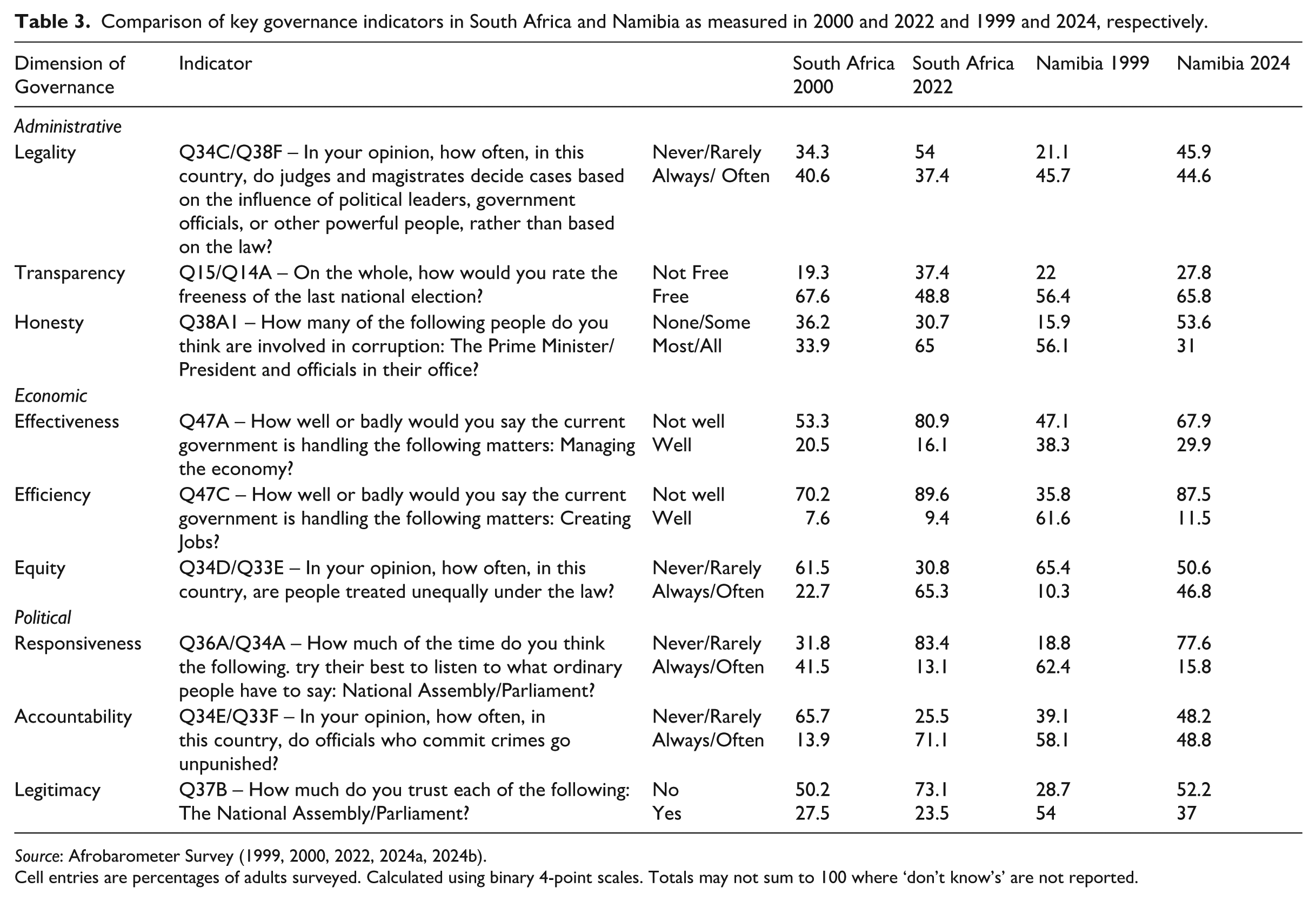
Source: Afrobarometer Survey (1999, 2000, 2022, 2024a, 2024b).
Cell entries are percentages of adults surveyed. Calculated using binary 4-point scales. Totals may not sum to 100 where ‘don’t know’s’ are not reported.
The data reveal a consistent and concerning decline across almost all governance indicators in both South Africa and Namibia since their first democratic elections. While both the ANC and SWAPO initially enjoyed strong public legitimacy the durability of their dominance appears to have undermined the quality of governance over time. This supports Bratton’s (2013) argument that free elections, while necessary, do not automatically translate into capable or accountable government, especially in dominant-party systems where political power remains concentrated and unchecked.
In the administrative dimension, declines in perceived legality, transparency, and honesty suggest a weakening of core rule-of-law principles. In South Africa, for instance, the percentage of respondents who believe judges base decisions on political influence rose from 40.6% in 2000 to 54% in 2022. In Namibia, this figure also remains high at 44.6% in 2024. Trust in electoral transparency has also deteriorated: in 2000, 67.6% of South Africans rated their elections as free, compared to just 48.8% in 2022. Namibia follows a similar pattern. Such findings suggest growing public scepticism about the impartiality of key democratic institutions and processes, which is exacerbated by long-standing practices like cadre deployment and blurred lines between party and state.
The economic indicators paint an equally bleak picture. In South Africa, perceptions of government performance in managing the economy and creating jobs have deteriorated dramatically. By 2022, 81% of respondents said the ANC government was handling the economy badly, up from 53% in 2000. A staggering 89.6% said the same about job creation, up from 70.2%. Namibia exhibits similar trends, though starting from a higher performance base. These patterns align with Greene’s (2007) and Levitsky and Way’s (2010a) theories that dominant parties, shielded by incumbency advantage and rhetorical legitimacy, face fewer incentives to perform effectively or distribute resources equitably once secure in power. The reliance on state resources to maintain loyalty and control contributes to economic mismanagement and inefficiency, particularly as elite patronage networks crowd out merit-based governance.
Perhaps most troubling is the decline in political governance, particularly in responsiveness, accountability, and legitimacy. In South Africa, belief that parliament listens to citizens dropped from 41.5% in 2000 to just 13.1% in 2022. In Namibia, the drop is similarly stark. Meanwhile, the perception that officials go unpunished for crimes has increased in both countries, suggesting a growing culture of impunity. Trust in parliament has plummeted in South Africa from 50.2% to 27.5%, and while Namibia’s levels are higher, they too have declined over time. These figures demonstrate how dominant-party rule can erode democratic legitimacy, as the gap between citizen expectations and institutional performance widens.
These declines raise a critical question: can democratic institutions thrive when political competition is minimal and incumbents feel insulated from electoral consequences? The data suggest not. Instead, dominant-party systems, particularly those rooted in liberation movements, appear to foster complacency, elite capture, and resistance to reform. The initial moral authority of the ANC and SWAPO, while once a unifying force, has increasingly become a shield for poor performance and weakened accountability.
Nonetheless, it is important to note that not all features typically associated with dominant-party decline are equally present. As our earlier section noted, Gumede’s framework includes elements like the cult of violence and the bridling of civil society, practices that, while present in other post-liberation contexts, have been relatively subdued in South Africa and Namibia. Both countries retain relatively open media environments and active civil societies, which serve as partial counterweights to executive overreach. This suggests that while dominant-party rule has weakened governance, it has not yet resulted in full democratic erosion, though the trajectory remains concerning.
Conclusion
The comparative trajectories of Namibia and South Africa demonstrate that the legacies of liberation struggles remain profoundly embedded in the political culture, institutions, and electoral behaviours of democracies under former liberation movements. Both ANC and SWAPO have drawn heavily on their liberation credentials to sustain political dominance in the post-independence era. However, this dominance has proven to be a double-edged sword: while it facilitated early state-building and institutional consolidation, it has also entrenched party-state conflation, constrained democratic competition, and cultivated patterns of elite insulation from popular demands.
As the evidence suggests, the legitimacy of these movements, once rooted in their historic role as anti-colonial vanguards, is increasingly being contested by a generation of voters (dubbed the ‘born free’) less tied to liberation memory and more attuned to issues of governance, inequality, corruption and service delivery. Declining electoral support for both SWAPO and the ANC signals a weakening of the post-liberation consensus and a recalibration of the political field. In Namibia, SWAPO’s erosion of support in recent elections reflects growing frustration with elite patronage and youth unemployment, while in South Africa, the ANC’s decline has opened the door for new political formations.
This path of transition invites critical reflection on the future of democracy in post-liberation states. On the one hand, the weakening of dominant parties may herald an opportunity for democratic deepening. A more competitive party landscape, coupled with the reactivation of civil society and an increasingly assertive electorate, could foster greater accountability and institutional renewal. Indeed, theories of democratic consolidation suggest that alternation in power and the erosion of hegemonic party rule are necessary preconditions for resilient democratic systems (Lindberg, 2006).
On the other hand, the decline of liberation parties also carries significant risks. In contexts where dominant parties have fused with the state and suppressed opposition, their weakening may generate institutional uncertainty, elite fragmentation, and political instability. The potential for populist backlash, particularly in settings of socio-economic precarity and identity-based mobilisation, poses challenges to democratic norms and civic tolerance. As Levitsky and Way (2010b) caution, the unravelling of dominant-party systems does not necessarily lead to liberalisation; in some cases, it can result in illiberal retrenchment or democratic decay.
Ultimately, the futures of Namibia and South Africa will depend not only on the trajectories of their liberation movements but also on the capacities of their institutions, civil societies, and emerging political actors to negotiate a new democratic settlement. The post-liberation period thus represents both a challenge and a possibility. By tracing the evolution and erosion of liberation party hegemony, this article underscores the need to re-centre questions of legitimacy and political adaptation in the study of African democracies.
Footnotes
Authors’ Note
The initial framing of the research question was generously contributed by Sonia Twongyeirwe, whose insights helped shape the conceptual foundations of this paper.
Funding
The authors received no financial support for the research, authorship, and/or publication of this article.
