




Abstract
This study investigates how regulatory frameworks and statutory provisions shape investigative reporting on corruption in Zimbabwe’s media. Drawing on qualitative research, it explores the interplay between law, institutional dynamics and journalistic autonomy. Despite legislative reforms, the findings show that enduring legal ambiguities and state interference undermine freedom of expression, access to information and journalistic autonomy. The study argues that safeguarding anti-corruption journalism requires the repeal of restrictive laws, political commitment to uphold press freedom, strengthening the Zimbabwe Media Commission and integration of legal support units within newsrooms to enhance institutional capacity.
Introduction
Corruption is a defining feature of Zimbabwe’s political and institutional landscape. Ranked 158th of 180 countries and scoring 21 of 100 on the Corruption Perceptions Index (Transparency International, 2024), the country remains the most corrupt nation in the Southern African Development Community. Civil society organisations, such as the Crisis in Zimbabwe Coalition (2021), have characterised corruption as a national crisis and a crime against humanity, highlighting how its pervasiveness undermines state legitimacy and erodes public trust.
Given the country’s widespread corruption, robust mechanisms capable of holding power to account are imperative, with the media occupying a central position in the accountability framework. Within this broader media ecosystem, the press, comprising journalistic institutions engaged in reporting, investigation and editorial oversight, assumes a key role in mediating the relationship between power and the public (Schauseil, 2019). Functioning as the ‘fourth estate’, it scrutinises state and non-state actors, exposes wrongdoing, amplifies civic voice and promotes transparency. Various international organisations emphasise the press’s capacity to create environments that deter corruption and reinforce institutional accountability (Organisation for Economic Co-operation and Development, 2018; Transparency International, 2012; World Bank, 2021).
However, while intended to serve as a watchdog against abuse of power, the Zimbabwean press faces severe constraints. The International Press Institute (2023) highlights how legal frameworks are routinely weaponised to suppress dissent, limit investigative reporting and criminalise journalistic practice. The prosecution of editors, such as Faith Zaba, for satirical commentary and the prolonged detention of journalists like Blessing Mhlanga for broadcasting dissenting voices (Farisè, 2025), exemplify the state’s calculated use of law to discipline and control the media.
While previous studies have highlighted broad limitations on press freedom (Mano, 2017; Mashingaidze and Buchanan-Clarke, 2021; Mlotshwa, 2019), less attention has been devoted to examining how specific statutes structure the conditions under which corruption reporting occurs. The study addresses this gap by pursuing two key objectives: (1) to analyse how Zimbabwe’s legal framework structures journalistic practices in reporting corruption and (2) to explore how journalists exercise professional agency as they navigate tensions between statutory constraints, political pressures and ethical standards.
The study contributes to scholarship by providing an empirically grounded account of how Zimbabwe’s legal framework structures journalistic practice in corruption reporting. It extends current debates on press freedom by foregrounding the everyday experiences and strategies through which journalists navigate restrictive laws and political pressures. Rather than viewing media practitioners as passive victims of repression, this study highlights their professional agency and the subtle forms of resistance that emerge within constrained spaces.
The remainder of this article is structured as follows: it reviews the literature on press freedom and the nexus between press freedom and corruption reporting. It also examines Zimbabwe’s legislative environment, outlines the methodology, presents the findings and discusses the implications of the study. The paper concludes with recommendations and areas for further research.
Press freedom conceptualisation and structuration
Despite its normative appeal and widespread endorsement, press freedom remains conceptually fragmented and politically contested. Classical liberal conceptions, most notably articulated by Siebert et al. (1956) and they defined press freedom primarily as the absence of state interference. Emerging within the ideological polarities of the Cold War, this definition reflected a normative emphasis on media independence as a safeguard against authoritarian control. Lowenstein (1970) and Weaver (1977) reinforced the liberal logic by equating press freedom as the unrestricted right to communicate, report and publish without political or legal constraint.
While foundational, liberal formulations oversimplify the relationship between media and power by positioning the state as the principal source of restriction on journalistic freedom. As Maniou (2023) argues, this framing disregards the subtler, yet equally consequential constraints embedded in economic, institutional, political and cultural systems. The assumption that legal independence automatically ensures freedom of expression fails to recognise how ownership concentration, regulatory asymmetries and political patronage combine to delimit journalistic practice. Consequently, the liberal model remains conceptually significant but analytically insufficient for interpreting press freedom in complex and politically volatile settings.
Contemporary scholarship responds to these limitations by advancing a relational understanding of press freedom, one that situates it within the interplay of political economy, institutional configuration and normative culture. McQuail (2003) and Curran (2007) assert that press freedom extends beyond legal autonomy and must be examined as a socially embedded practice shaped by power relations and material conditions. Curran’s (2007) distinction between liberal and radical democratic models is particularly instructive, as the former privileges the negative liberty of being free from interference while the latter introduces the positive responsibility of promoting pluralism, justice and representation. Such a shift repositions the press as an active participant in democratic life, rather than a detached observer.
Despite the conceptual progression, dominant models of press freedom remain largely rooted in Western institutional contexts that assume stable pluralism, predictable legal protections and functional democratic norms. Such assumptions become problematic when applied to semi-authoritarian environments, where pluralism is politically mediated and journalistic practice operates within conditional tolerance. Maniou (2023) observes that the direct transposition of Western frameworks often conceals the contingent, negotiated and context-specific realities through which media operate in repressive or hybrid regimes. Thus, the recognition of formal and informal constraints is necessary to understand how press freedom manifests within diverse political contexts.
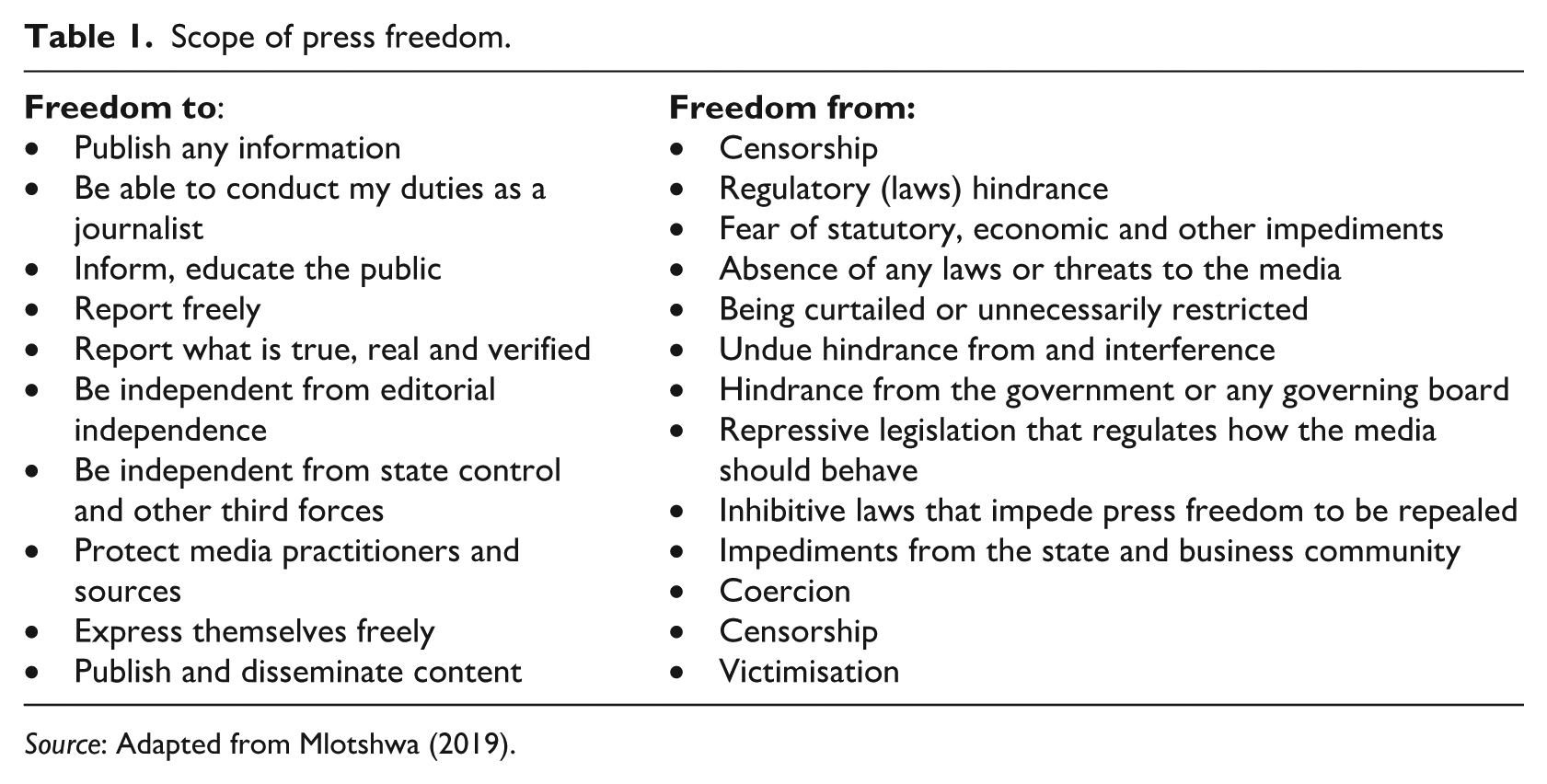
Building on these conceptual developments, the dual-axis model of press freedom offers a lens for understanding the operational realities of Zimbabwean journalism. The model distinguishes between two interrelated dimensions: the ‘freedom to’, referring to journalists’ capacity to report, publish and investigate independently; and the ‘freedom from’, referring to the protective conditions necessary to practise journalism without coercion, censorship or legal reprisal to (Mlotshwa, 2019). The two dimensions are mutually reinforcing, since legal rights are insufficient if not supported by institutional safeguards and material conditions that enable their exercise. Table 1 illustrates how these principles are operationalised in practice.
Scope of press freedom.
Source: Adapted from Mlotshwa (2019).
While Table 1 illustrates press freedom dimensions, the focus shifts to their operation within Zimbabwe’s context. Structuration theory provides a lens for analysing this relationship, situating journalistic action within a recursive interaction between agency and the legal-political structures that both enable and restrict practice (Giddens, 1984). Media law, encompassing statutory instruments, licencing regimes and enforcement practices, defines the boundaries of reporting, yet everyday journalistic decisions can simultaneously reproduce or reshape these constraints. Thus, structuration allows an analysis of how journalists navigate legal and political pressures to expose corruption within a context characterised by systemic limitations and political volatility.
Empirical review on press freedom and corruption
The relationship between legal frameworks and corruption reporting is mediated by press freedom (Binhadab et al., 2021; Dutta and Roy, 2016). Multilateral institutions, such as the United Nations Development Programme, the Organisation for Economic Co-operation and Development, the World Bank and Transparency International, conceptualise press freedom as a structural safeguard for transparency and accountability. The underlying rationale is that where the press operates independently of political or economic interference, it can scrutinise power, expose malpractice and mobilise civic oversight. In this sense, press freedom functions simultaneously as a legal condition and a normative value that underpins democratic accountability.
Empirical evidence reinforces the theoretical relationship between press freedom and corruption reduction. Hamada et al. (2019), Breen and Gillanders (2020) and Chong et al. (2020) demonstrate that higher levels of press autonomy are statistically associated with lower incidences of corruption. Similarly, Brunetti and Weder di (2003) and Camaj (2013) find that legal protections for journalists strengthen governance by enabling investigative scrutiny and deterrence. Binhadab et al. (2021) illustrate that institutional guarantees of media independence correlate with reduced bribery and public-sector misconduct.
The necessity of press freedom is visible where it is constrained. Transparency International (2020) associates high levels of corruption with weak legal protections for journalists and the strategic use of intimidation by political elites to suppress dissent. Similarly, the Reporters Without Boarders (2025) warns that the global environment for journalism has reached a critical juncture, noting that most countries now fall within ‘difficult’ or ‘very serious’ conditions. The sustained decline reflects a structural erosion of press autonomy in which legal, economic and coercive forces converge to silence accountability mechanisms.
Within most African countries, harassment and intimidation of journalists form part of the architecture of governance control. In Ghana and Kenya, journalists exposing corruption face systematic threats and politically motivated prosecutions (Mwaura and Cohen, 2024; Odeku, 2019). In the Gambia, colonial-era statutes on defamation and licencing sustain legal uncertainty and compel self-censorship (Bah, 2023), while in Nigeria, the ostensibly progressive Freedom of Information Act remains undermined by bureaucratic obstruction and inconsistent enforcement (Eze, 2024). The prosecution of journalists for activities ranging from satirical commentary, as in the case of Faith Zaba, to the broadcasting of dissenting voices, exemplified by the detention of Blessing Mhlanga (Farisè, 2025), illustrates how legality is an instrument of repression in Zimbabwe.
Beyond overt repression, the relationship between press freedom and corruption reporting is neither straightforward nor universal. Talebi et al. (2021), drawing on cross-national data from 30 countries, demonstrate that press freedom’s impact is conditional on structural factors, such as institutional capacity and governance culture. Similarly, Kalenborn and Lessmann (2013) conceptualise press freedom as a ‘conditioning variable’, effective only within contexts of functional accountability systems and rule of law.
These findings explain anomalies, such as Nigeria, where an ostensibly free press coexists with entrenched corruption (Suleiman, 2017) and China, where restrictive media control persists despite moderate levels of perceived corruption (Transparency International, 2024). Such contradictions show that press freedom operates relationally and is shaped by the institutional and political ecosystems within which it is embedded.
Furthermore, complexity arises when disaggregating the types of press restrictions. Freille et al. (2007) argue that informal political interference often exerts a corrosive impact on anti-corruption efforts than formal legal constraints. For instance, political manipulation of media narratives in Pakistan and Colombia undermines watchdog journalism more effectively than formal legal constraints (Freille et al., 2007). The Zimbabwean experience reflects a similar paradox, where constitutional guarantees of press freedom coexist with pervasive coercion, intimidation and politicised legal enforcement (Mashingaidze and Buchanan-Clarke, 2021), exemplifies this very tension. This disjunction between de jure protection and de facto suppression exposes the fragility of media autonomy when state power remains unchecked.
Also, a narrow focus on press freedom risks overlooking the internal contradictions within media systems themselves. Practices, such as ‘brown-envelope journalism’, reveal that threats to integrity can emerge internally, particularly where journalists operate under economic precarity or political patronage. Spence (2021) observes that even in nominally open systems, financial inducements and clientelist relationships can erode editorial independence. Ethnographic accounts from Tanzania and Ethiopia, where ‘sitting fees’ and ‘blessing fees’ are commonplace, demonstrate that media corruption reflects broader structural and institutional vulnerabilities (Asomah, 2021; Kasoma, 2009; Transparency International, 2013).
Taken together, the empirical literature shows that the relationship between press freedom and corruption is complex and contingent on context. Understanding how these dynamics unfold within Zimbabwe context provides insight into how press freedom is practised, constrained and redefined.
Overview of Zimbabwe’s media legislative framework
Press freedom in Zimbabwe is shaped by the interplay between constitutional ideals and the legislative mechanisms that enact or undermine them. Two constitutional milestones, the 1979 Lancaster House Constitution and the 2013 Constitution illustrate the shifting yet continuous negotiation between aspiration and control. The pre-2013 period, grounded in inherited colonial laws, institutionalised a logic of regulation through restriction whereas the post-2013 period, while outwardly reformist, retains structural continuities that sustain state oversight of journalistic practice. The following discussion explores this dynamic by tracing the pre-2013 legal environment and the post-2013 reforms.
Foundational legislation and the pre-2013 media environment
The foundations of media regulation lie in the negotiated settlement of 1979, which ended colonial rule but preserved its coercive institutional logic (Mutsvairo and Muneri, 2019). The Lancaster House Constitution recognised freedom of expression but did not explicitly guarantee media freedom or access to information as independent rights. Its broadly framed limitations, justified in the interests of state security, public morality and order, conferred extensive discretionary powers on the executive (Chitimira, 2017). Thus, the Constitution prioritised political stability over the protection of open discourse.
Following independence in 1980, the new government inherited not only the colonial state apparatus but also its coercive logic of information control. The Law and Order (Maintenance) Act (LOMA), a central instrument of colonial repression, remained in force and provided the legal and ideological framework for media regulation in the post-independence period (Mashingaidze and Buchanan-Clarke, 2021). The acquisition of outlets, such as Zimpapers and the establishment of the Zimbabwe Mass Media Trust were framed as developmental measures, yet in practice they institutionalised political oversight and executive dominance over the press. This pattern captured what Moyo (2004) described as ‘change without change’, where reformist rhetoric masked the reproduction of colonial structures of control within a nationalist paradigm.
Consequently, despite promises of democratisation, the media operated within a hybrid system that combined limited journalistic professionalism with systemic repression. The Willowgate scandal exemplifies how investigative reporting could not only momentarily challenge entrenched power but also provoke retribution (Mpofu, 2021). While investigative reporting exposed corruption from high echelons of government, the subsequent dismissal and redeployment of editors highlighted the high cost of challenging power. The scandal reflected a conditional freedom, permitted when politically convenient but suppressed when it threatened the ruling elite’s legitimacy.
Mounting domestic and international pressure for reform led to the repeal of LOMA in 2002 and the enactment of two key statutes: the Access to Information and Protection of Privacy Act (AIPPA) and the Public Order and Security Act (POSA). Although framed as modernisation efforts, both laws entrenched executive control. AIPPA claimed to promote transparency and protect privacy. However, its requirement for compulsory journalist registration and media licencing under a government-appointed commission created a gatekeeping system that facilitated censorship (Moyo, 2009; Mututwa et al., 2021).
Similarly, POSA was enacted to safeguard national security and maintain peace but functioned as a legal instrument to police political expression. Section 15 criminalised the publication of statements deemed ‘prejudicial to the state’, an ambiguity that allowed selective enforcement against critical journalists and opposition figures (Mashingaidze and Buchanan-Clarke, 2021). The law’s sweeping provisions ensured that public order became a pretext for the restriction of public discourse.
In addition, the Criminal Law (Codification and Reform) Act (2004) extended this framework by embedding restrictions on expression within the criminal code. Provisions criminalising statements deemed insulting to the president or harmful to national interests broadened the state’s reach into the domain of expression and transformed legitimate critique into a prosecutable offence (Media Institute of Southern Africa Zimbabwe, 2024). The Interception of Communications Act (2007) strengthened this legal repression by granting the executive authority to monitor communications without judicial oversight (Munoriyarwa and Chiumbu, 2019). The absence of procedural safeguards, such as notification or data handling protocols, facilitated arbitrary surveillance and functioned as a deterrent to investigative work, particularly in cases involving corruption or state malfeasance.
Collectively, these laws entrenched a system in which press freedom was contingent on state tolerance rather than constitutional protection. The Lancaster Constitution’s permissive clauses enabled their enactment, providing a constitutional rationale for the restriction of speech in the name of stability. Consequently, constitutional vagueness and statutory precision reinforced each other: one authorised control in principle and the other executed it in practice. The result was a media landscape in which the law, rather than protecting expression, became its primary instrument of constraint.
Post-2013 legislative environment
The adoption of the 2013 Constitution marked a critical juncture in Zimbabwe’s legal and political trajectory. Emerging from the transitional politics of the Inclusive Government established after the contested 2008 elections, the Constitution sought to redefine the relationship between the state, citizens and media institutions. Sections 61 and 62 explicitly guaranteed freedom of expression, media freedom and access to information (Republic of Zimbabwe, 2013). These provisions addressed the silences of the Lancaster Constitution by explicitly codifying freedoms that had previously been implied, signalling a shift towards a rights-based framework.
Nevertheless, constitutional reform did not automatically translate into structural transformation. The operationalisation of these rights was dependent on enabling statutes, many of which retained the coercive legacies of the pre-2013 era. Laws, such as AIPPA and the POSA, remained in effect until 2020 and 2019, respectively, sustaining a dual legal regime where progressive constitutional ideals coexisted with repressive instruments (International Press Institute, 2023). The continued enforcement of these laws reflected the state’s reluctance to relinquish regulatory control, even under a new constitutional dispensation.
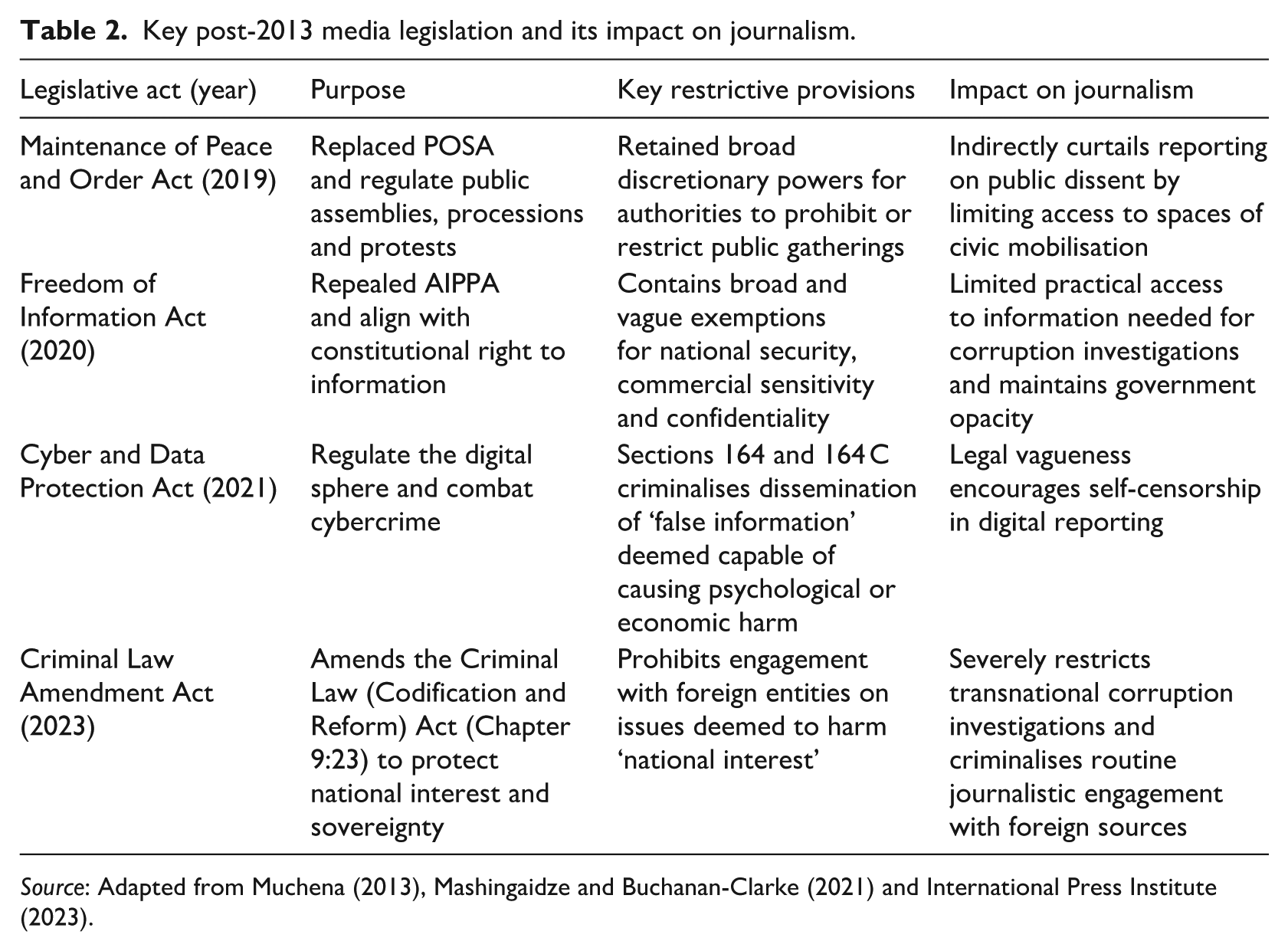
Subsequent legislation enacted to align with the 2013 Constitution adopted a reformist tone yet largely reproduced established mechanisms of control. Table 2 outlines the main statutes introduced after 2013 and their implications for journalistic practice. Through vague definitions, securitised language and expansive exemptions framed around national interest and public order, these laws extended executive discretion rather than limiting it.
Key post-2013 media legislation and its impact on journalism.
Source: Adapted from Muchena (2013), Mashingaidze and Buchanan-Clarke (2021) and International Press Institute (2023).
The legislative framework outlined in Table 2 shows a consistent trajectory of securitisation and bureaucratic control. Despite being framed as instruments of reform, the post-2013 statutes embed clauses that protect state institutions from accountability and sustain opacity in the governance of information. References to ‘national security’ and ‘sovereignty’ dominate legislative discourse, suggesting that statutory revision functions as political performance than as genuine democratisation. The repeal of POSA with the Maintenance of Peace and Order Act illustrates this symbolic reformism, as overtly coercive language is moderated while executive discretion to restrict assembly and expression persists. Mashingaidze and Buchanan-Clarke (2021) concur that reform therefore operates as a mode of adaptation which modernises the architecture of control while preserving its coercive essence. Accordingly, the state’s legislative strategy reflects ‘adaptive authoritarianism’, where liberalising language conceals mechanisms of surveillance, intimidation and bureaucratic obstruction.
Empirical evidence from organisations, such as the International Press Institute (2023) and the Media Institute of Southern Africa Zimbabwe (2024), document continued surveillance, intimidation and arrests of journalists under these rebranded laws. The prosecution of media practitioners for activities ranging from satirical commentary, as in the case of editor Faith Zaba, to broadcasting dissenting voices, exemplified by the prolonged detention of journalist Blessing Mhlanga (Farisè, 2025) illustrate how the legal system continues to function as a tool of victimisation.
Ultimately, the relationship between the 2013 Constitution and its subsequent laws exposes structural contradictions. While press freedom, freedom of expression and access to information are constitutionally enshrined, they are simultaneously undermined through broad exemptions and discretionary enforcement that convert constitutional rights into conditional privileges dependent on political tolerance.
Methodology
This study adopted a qualitative research design to explore how Zimbabwe’s legislative framework is experienced, interpreted and navigated within journalistic practice. Following Creswell (2013), this design facilitated an in-depth examination of lived experiences and interpretive meanings central to understanding journalistic practice. An inductive research strategy was employed to allow theoretical insights to emerge from the data (Saunders et al., 2019) and aligning with the study’s exploratory aims amid limited empirical literature on corruption reporting. Unlike quantitative methods, the strategy enabled engagement with the socio-legal complexities that frame journalistic decision-making.
Data collection incorporated primary and secondary sources to ensure triangulation and depth (Taherdoost, 2016). The primary data set was drawn from 15 purposefully selected participants: six journalists, three editors and six civil society actors. Journalists were included as primary informants with direct experience in corruption reportage, while editors provided institutional perspectives on newsroom and regulatory constraints. Civil society actors were drawn from media-focussed organisation, including advocacy networks, media rights bodies and independent and offered insights into the intersections between journalism, policy frameworks.
Participants were identified through purposive and snowball sampling, using professional networks on platforms, such as X and LinkedIn, to locate individuals actively contributing to public discourse on corruption. Snowball sampling, facilitated through editorial referrals and the Information Development Trust, a non-profit media accountability advocacy initiative, enhanced participation and promoted trust in an environment marked by limited openness and institutional caution. Consistent with qualitative research standards (Constantinou et al., 2017; Hennink and Kaiser, 2022), the sample size was sufficient as it obtained rich, contextually grounded data and achieved thematic saturation.
Secondary sources, including media reports, government policy documents and scholarly literature, were analysed to contextualise the primary findings. These materials were selected based on their relevance and credibility and served to ground the analysis within existing scholarship (Bell et al., 2022).
Data analysis was conducted using a thematic analysis framework, which enabled the systematic identification of recurring themes and patterns across the transcripts. Following Clarke and Braun’s (2021) reflexive methodology, the coding framework was developed iteratively, with codes refined through continuous comparison to ensure they accurately reflected the complexity of the data. To enhance credibility, member checking was employed to allow selected participants to validate preliminary findings, thereby validating the interpretations and refining the final thematic classifications. The analytical process was supported by ATLAS.ti 24 software, which facilitated efficient data organisation and maintenance.
Ethical considerations were central to the study, which forms part of a doctoral project approved by the Stellenbosch University Research Ethics Committee: Social Behavioural and Education Research (Ref: 97102). The consent protocols prioritised confidentiality and anonymous participation to safeguard participants and facilitate open, candid engagement. Anonymity was maintained through the use of pseudonyms and the systematic redaction of all identifiable information throughout data collection and analysis.
Findings
The study’s findings are organised around three interrelated themes that emerged from the data: conditional press freedom, legalised suppression and performative transparency. Together, these themes highlight how Zimbabwe’s legal and institutional framework systematically constrains the media’s ability to report on corruption.
Conditional press freedom on corruption reporting
The findings suggest that press freedom in Zimbabwe is not experienced as a constitutionally protected right but as a conditional and strategically mediated privilege. Participants consistently described an environment marked by legal uncertainty and subtle repression. While acknowledging a reduction in overt state violence post-Mugabe, they framed this not as genuine liberalisation but as a tactical ‘recalibration of control’. ZW4 remarked that ‘journalists have more space to report and criticise the government without immediate severe repercussions’, while ZW8 noted that ‘media freedom has slightly improved, but political corruption reporting still faces risks’.
These remarks align with the Reporters Without Borders (2023), which attributes Zimbabwe’s modest press freedom improvements to the reduction of overt state violence rather than substantive reform. Similarly, Carson (2019) argues that post-authoritarian regimes often deploy symbolic reforms to signal democratic progress while maintaining coercive structures beneath the surface.
Participants also voiced scepticism towards recent legislative changes, which were described as cosmetic and strategically ambiguous. ZW5 argued that reforms were instrumentalised to serve state interests, while ZW6 critiqued the legal climate as replacing ‘rule of law with rule by law’. This framing, supported by Lipman (2009), Murat (2018) and Ayodeji-Falade (2021) reflects how legalistic facades can simultaneously perform democratic legitimacy and maintain authoritarian logic.
Legal clauses were identified as central to the reproduction of constraint. Specific mention was attributed to the Criminal Law (Codification and Reform) Act (2004), particularly Sections 31 and 33, which criminalise reporting deemed prejudicial to the state or insulting to the presidency. ZW1 underscored the chilling effect of these provisions, stating that certain stories do not see the light of day because publishing them could mean arrest or worse. Participants also referenced the Interception of Communications Act (2007) as a tool of surveillance that intensifies professional insecurity. ZW9 described confidentiality as ‘a luxury we cannot afford anymore’, reflecting the fear that compromises source protection and editorial integrity.
Nonetheless, within this constrained environment, journalists reported employing anticipatory self-censorship and discreet source protection strategies. ZW5 explained that decisions to withhold or modify stories reflect deliberate, rational assessments of likely repercussions, demonstrating the exercise of agency even within repressive frameworks.
The implications of this legal design are far-reaching. Rather than overt censorship, repression materialises through anticipatory self-censorship, legal ambiguity and surveillance. Chitagu (2018) and Hamada et al. (2019) reaffirm that repressive clauses operate as mechanisms to internalise constraint and journalists, in this environment, prioritise personal and professional survival over investigative reporting. Consequently, the normative role of the media, to hold power to account, is compromised.
Institutional failure further entrenches the media environment in Zimbabwe. Participants critiqued the Zimbabwe Media Commission (ZMC) as lacking independence and operational efficacy. Descriptions ranged from ‘toothless’ to ‘politically captured’, with concerns centring on the body’s lack of independence and susceptibility to partisan manipulation. Regional parallels support the finding. Wasserman (2024) observes that regulatory bodies ostensibly established to protect press freedom across many African contexts often facilitate state control. In the Cameroonian case, Lambiv (2016) notes that the regulatory body frequently operates as an instrument of coercion, directly implicated in the persecution of journalists. These insights reinforce the notion that institutional failure is structurally embedded within the media governance landscape.
Legalised suppression of freedom of expression
Building on the conditionality of press freedom, the findings show how freedom of expression is functionally suppressed through the instrumentalisation of law, particularly when it challenges political power. This victimisation is a constant and tangible threat. For example, journalist Blessed Mhlanga was detained for 72 days in early 2025 for interviewing a former official who criticised the presidency, while national weekly editor Faith Zaba was arrested for publishing a satirical piece deemed insulting the president (Farisè, 2025).
Participants unanimously depicted this environment as one where constitutional guarantees are void upon any criticism of the state. ZW13 cited the repeated arrests of investigative journalist Hopewell Chin’ono as emblematic of this trend, arguing that the law is deployed not to protect public interest, but specifically to penalise dissent. The victimisation aligns with scholarly analysis which underscores how formal legal procedures are often used to cover coercive state intent (Chikowore, 2020).
A similar account was supported by reference to the editorial suppression of The NewsHawks, an investigative outlet. ZW9 pointed to its inability to publish follow-up stories on the forced resignation of senior army generals implicated in corruption. The NewsHawks (2024) cited direct intimidation from military intelligence operatives and surveillance of their movements as contributing factors. ZW9 articulated the resultant chilling effect: ‘we are no longer sure what is reportable, so we stay silent or soften the truth’.
Furthermore, ZW4 highlighted that the government’s coercive apparatus, while not always overtly violent, operates through psychological intimidation. These findings resonate with comparative studies, illustrating how legislative frameworks can simultaneously invoke rights and enable repression. In examining the Gambia, Bah (2023) describes a mode of ‘informational authoritarianism’ whereby the government deploys laws and procedures to repress dissent while preserving a façade of legality. Similarly, Hamid (2019) notes that elite control over information access and government transparency creates a structurally closed media system in Sudan. Accordingly, these comparative cases reinforce the Zimbabwean experience, in which legal ambiguity is not a flaw but a design feature of authoritarian governance.
The legislative framework was repeatedly critiqued for its vagueness. ZW2’s remark: ‘it is not what you say, it is what they say you meant’, emphasises how subjective legal interpretation promotes strategic ambiguity. As Hamada et al. (2019) argue, such vagueness advances journalistic risk-aversion and recalibrates media practice around risk minimisation rather than public interest. Consequently, freedom of expression in Zimbabwe cannot be assessed through constitutional texts alone. It must be understood as an operational reality structured by punitive legal ambiguity and selective enforcement.
Performative transparency and access to information restrictions
While Section 62 of the Constitution and the Freedom of Information Act presumably guarantee the right to information, the study identified a pronounced gap between Zimbabwe’s formal commitments to transparency and the practical realities of information access. The right to information, guaranteed by the Constitution and the Freedom of Information Act, was widely described by participants as performative. ZW7’s account of a 5-year, unsuccessful attempt to obtain fiscal data illustrates how bureaucratic deferrals and obstruction have become normative.
Also, several participants observed that government institutions frequently cite vague ‘national security’ or ‘public safety’ exemptions to deny access. While legal on paper, such mechanisms function as instruments of censorship in practice. These experiences are reiterated by the Voluntary Media Council of Zimbabwe (2023) and state of the media report by Media Institute of Southern Africa Zimbabwe (2024), which document the habitual denial of journalistic requests for information in public institutions.
The persistent inaccessibility of information is structural and rooted in administrative cultures that long predate the current regime. Makombe (2018) attributes these enduring practices to colonial-era bureaucratic systems characterised by discretion and secrecy, arguing that postcolonial administrations have not only inherited but actively sustained and reconfigured these institutional paradigms.
This structural inaccessibility is reinforced by institutional failure. Participants uniformly described the ZMC as complicit in preserving information asymmetry. This finding resonates with theories of regulatory capture, where such bodies are deliberately ‘burrowed out’ to simulate oversight while preventing genuine accountability (Pressman, 2018). This reveals a paradox: while overt repression has declined, structural and legislative barriers have been fortified to hinder the media’s watchdog role.
Despite these structural barriers, the study highlights that journalists continue to exercise agency. Journalists noted that they employ strategies, such as repeated follow-ups, leveraging professional networks and utilising informal channels to access information and pursue accountability. These adaptive practices show that, although the right to information in Zimbabwe is systematically undermined, journalistic persistence mitigates some of the constraints.
Theoretical implications: the structuration of press freedom in Zimbabwe
The findings highlight a paradox in Zimbabwe’s media landscape, where overt repression has declined, yet structural and legislative barriers continue to limit the media’s capacity to function as an independent watchdog. Contrary to studies that focus predominantly on visible forms of repression (Hamada et al., 2019; Pressman, 2018; Voltmer, 2014), this study highlights subtler mechanisms, such as symbolic legal reforms and the institutionalised weakness of regulatory bodies.
Drawing on structuration theory, the study demonstrates how press freedom in Zimbabwe is shaped by the interaction between legal structures and journalistic agency. While journalists retain the capacity to make decisions, these decisions are made within a field defined by legal ambiguity, institutional decay and entrenched bureaucratic practices that prioritise secrecy over transparency. In practice, choices, such as avoiding certain topics, softening critiques or prioritising safer stories, are not externally imposed, but result from anticipatory assessments of potential consequences.
Journalistic agency is thus pre-emptively constrained by structural factors. The recursive interaction between these constraints and journalists’ adaptive behaviours creates a self-reinforcing cycle: legal ambiguity and weak oversight encourage self-censorship, and these cautious practices, in turn, legitimise the continuation of restrictive structures. Consequently, state control operates less through direct coercion and more through the strategic management of uncertainty and risk, illustrating how power is reproduced and maintained.
Therefore, the study’s theoretical contribution lies in refining the understanding of the structure-agency relationship in semi-authoritarian contexts. It demonstrates that journalists’ agency is not only shaped by legal frameworks but is constrained in advance by the anticipation of how these frameworks might be applied. Rather than navigating freely within the law, actors constantly assess potential risks, leading to self-censorship even in the absence of direct threats. In this way, political control is exercised less through overt coercion and more through the strategic use of legal ambiguity and weak institutional oversight, which effectively compels compliance and sustains the appearance of legitimacy.
Conclusion
This study examined the relationship between legal frameworks and journalistic practice in corruption reporting in Zimbabwe, revealing a system of ‘performative legality’ where formal guarantees of freedom are systematically undermined. While overt repression has declined, the state has replaced brute force with a sophisticated architecture of legal claw-back clauses and psychological intimidation. The inconsistent enforcement of constitutional protections has transformed legal guarantees into instruments of control. These constraints erode editorial discretion and reduce investigative capacity, particularly when corruption allegations involve high-ranking officials.
Given these findings, a meaningful realignment of the legal order is necessary to strengthen the media’s watchdog role. Vague clauses within laws, such as the Official Secrets Act, must be narrowed and clarified to prevent their use as a tool for discretionary prosecution. The replacement of criminal with civil liability in speech-related disputes and establishing independent judicial oversight of surveillance would significantly reduce the state’s punitive leverage on journalists.
Legal reform, while essential, remains ineffective if enforcement institutions lack independence. Genuine press freedom requires political will that translates constitutional commitments into institutional integrity. Strengthening the Zimbabwe Media Commission through the timely implementation of the Zimbabwe Media Commission Amendment Bill and the Media Practitioners Bill presents an opportunity to reinforce editorial autonomy and professional accountability. The envisaged co-regulatory model, which delegates specific powers of the Commission to professional bodies, could enhance self-regulation, but only if accompanied by safeguards against political interference and transparent oversight mechanisms. Sustainable reform therefore rests on state restraint and inclusive engagement with journalists, civil society and media organisations to ensure regulatory practices uphold constitutional principles of press freedom.
Beyond these top-down reforms, reinforcing journalists’ agency within the current constrained environment is necessary. Developing collaborative protection collectives, whereby multiple outlets co-publish sensitive investigations, can deter targeted retaliation. Equipping journalists with training in digital security and data analysis can also enable secure collaboration, facilitating corruption exposure through data-driven methods and reducing reliance on vulnerable human sources.
Future research could build on this study’s findings by examining journalists’ experiences across diverse media sectors to identify outlet-specific challenges and opportunities. In addition, investigating how emerging technologies, such as social media, data analytics and artificial intelligence, might be harnessed in anti-corruption efforts presents a promising avenue for further study.
In conclusion, this research contributes to understanding of how governments can control the media not by outlawing free speech but by twisting the language of law and democracy for their own ends. The Zimbabwean case serves as a critical and timely reminder that a free press depends not on the laws written in books but on the political and institutional integrity that gives those laws life and meaning.
Footnotes
Acknowledgements
The authors would like to thank the participants of this study for their time and valuable insights.
Data availability statement
The data that support the findings of this study are not openly available due to the confidential nature of the interviews and to protect participant anonymity, in accordance with the ethical approval granted for this research.
Declaration of conflicting interests
The authors declared no potential conflicts of interest with respect to the research, authorship and/or publication of this article.
Funding
The authors received no financial support for the research, authorship and/or publication of this article.
Ethical approval and informed consent statements
Ethical approval for this study was granted by the Stellenbosch University Research Ethics Committee: Social Behavioural and Education Research (Ref: 97102). All participants provided informed consent before taking part in the study.
