




Abstract
This article examines how Zimbabwe’s liberation war (1963–1980) fractured the spatial and conceptual boundaries between “front” and “rear,” transforming rural landscapes into operational zones. Focusing on Tanda, a guerrilla transit zone in northeastern Zimbabwe, it shows that this collapse enabled rural women to wage economic warfare against Rhodesia’s settler economy through acts of cattle sabotage, such as stealing, slaughtering, and concealing settlers’ livestock. These actions not only sustained guerrilla fighters but also destabilised the economic foundations of white minority rule, striking at cattle breeding programmes and property regimes central to colonial capitalism. The study also shows that these actions were polyvalent, blending survival strategies, revenge for colonial dispossession, and nationalist sentiment, while simultaneously challenging patriarchal control over cattle, a key symbol of wealth and authority in Shona society. It argues that Tanda women’s cattle sabotage constituted a form of economic warfare that disrupted Rhodesia’s settler political economy and temporarily reconfigured gendered power relations, without producing lasting post-independence gender equality. Drawing on oral histories and archival sources, the article reframes Tanda women’s acts of cattle sabotage as a strategic intervention in the political economy of war, linking micro-level acts, such as the killing of Phineas, an imported Brahman bull, to macro-level disruptions in Rhodesia’s political economy. By foregrounding Tanda women’s economic sabotage rather than wartime domestic roles, the article moves beyond recuperative narratives of women’s participation, situating Tanda women as active agents in Rhodesian economic warfare who targeted the settler economy through economic subversion within fractured geographies.
Keywords
Introduction
In early 1972, the guerrillas, also known as comrades, entered Tanda, under Chief Makoni, in northeastern Zimbabwe. Given Tanda’s proximity to Mozambique, it became guerrilla’s entry point to and from Mozambique and, at times, served as a battlefield. Upon the arrival of guerrillas, Tanda women slaughtered “Phineas,” a Brahman bull, to feed their comrades in 1972. Phineas had been imported from America by white farmers in the Magirazi area for crossbreeding, yet his role changed in 1972 due to the Tanda women’s anticolonial actions. The brave women of Tanda organised and stole the bull from the farmers’ paddocks and killed it to feed the guerrillas. The killing of Phineas, a prized Brahan bull imported by settler farmers, epitomises how women leveraged wartime chaos to disrupt the Rhodesian economic foundation. These acts, I argue, were not mere theft nor only motivated by the need to feed guerrillas, but a calculated intervention in the political economy of war. The act highlights the crucial roles that Tanda women played during the Zimbabwean war of liberation. They demonstrate that the Zimbabwean liberation struggle (1963–1980) was not confined to the conventional battlefield; it fractured the spatial and conceptual boundaries between the “rear” (home front) and the “front,” transforming rural landscapes into theatres of war. Rural landscapes, particularly borderland communities and guerrilla transit zones such as Tanda, were transformed into active sites of conflict. As guerrilla warfare tactics demanded fluid movement between Mozambique and Zimbabwe, civilians, especially women, were drawn into the warfare in unprecedented ways. This article argues that Tanda women’s cattle sabotage constituted a form of economic warfare that disrupted Rhodesian political economy and temporarily reconfigured gendered power relations, without producing lasting post-independence gender equality.
This context, combined with Tanda women’s long-standing grievances against the colonial administration, drove them to engage in cattle sabotage: a strategy of resistance and economic warfare that challenged the exploitative system underpinning white minority rule and thus undermined the Rhodesian political economy. Oral testimonies from Tanda women point to a more layered set of motives: actions consciously aligned with Zimbabwe African National Union (ZANU)/Zimbabwe African National Liberation Army (ZANLA) and the broader liberation struggle, intertwined with everyday forms of resistance intended to ease immediate burdens, among others. This study contends that the blurred boundaries enabled Tanda women to weaponise settlers’ cattle, as instruments of economic warfare against the Rhodesian settler economy. Through acts of cattle sabotage like stealing, slaughtering, and concealing livestock, Tanda women not only sustained guerrilla fighters but also undermined the economic foundation of white minority rule. These actions were polyvalent: they combined survival strategies, revenge for colonial disposition, and nationalist sentiments. This study does not collapse all forms of sabotage into a single category of nationalist resistance. Instead, I view these acts as multivalent practices whose meaning shifts across time and perspectives: from colonial criminalisation to guerrilla strategy, to Tanda women’s own recollections that blend revenge, care, and patriotism. This study thus shows how Tanda women re-signify what the Rhodesian state called “stock theft” as acts of resistance and agency. It demonstrates how the war reconfigured power relations, granting women agency in reshaping both the political economy and gendered power relations.
This study also demonstrates that Tanda women’s wartime contributions were neither isolated from nor passive in relation to the broader suffering that colonial policies inflicted on rural women. As early as the 1960s, Tanda women actively opposed measures such as destocking, dip taxes, and enforced contour ridges. The adverse effects of individual land tenure and conservation measures under the 1951 Native Land Husbandry Act (NLHA) did not resolve overcrowding; instead, they increased landlessness in Tribal Trust Land and deepened women’s socioeconomic hardship. In response to these hardships, Tanda women actively expressed their discontent by undermining the Rhodesian economy through acts of sabotage directed at settler farmers. Thus, the killing of settler-owned cattle by Tanda women also served as acts of liberation, signalling their frustration with the colonial administration by deliberately weakening the Rhodesian economy. Accordingly, the study links gendered micro-level actions, such as the killing of Phineas, to broader macro-level consequences.
Previous studies on the role of women in African liberation struggles, conducted by scholars such as Cleaver and Wallace (1990), Stott (1990), Lyons (1990), Walker (2002), Kriger (1992), and Simbanegavi (2000), among others, have focused mainly on recuperative history and gender role transformation, emphasising women’s participation in domestic support roles or their symbolic presence in nationalist propaganda. Simbanegavi (2000) explores the complex and often paradoxical experiences of women in the Zimbabwean liberation war, particularly within the ZANLA forces. Her work challenges the sanitised nationalist narrative by documenting how women were recruited for essential logistical duties, such as transporting food and ammunition, while simultaneously subjected to systemic sexual exploitation and gender-based violence. Ultimately, she reveals the disconnect between the revolutionary promise of equality and the persistent patriarchal control enforced by both military and traditional authorities. Pattenden (2024) argues that, during the war, both ZANU and the Zimbabwe African People’s Union (ZAPU) instrumentalised representations of women in their propaganda, using them primarily to delegitimise the Rhodesian government and to advance the armed struggle, rather than pursue genuine female liberation. In contrast, O’Gorman’s (2011) study shifts the focus from grand military narratives to the localised resistance and survival strategies of rural women. She challenges romantic nationalism, arguing that women often occupied a dangerous “middle ground” between state forces and guerrilla fighters. Her study also examines how women navigated complex identities and systemic violence while pursuing both national liberation and personal survival. Of particular relevance to this study is Gorman’s illustration that the frontline of the struggle ran directly through the daily lives of ordinary women. Similarly, Tanda women lived the hardships of the liberation struggle in their daily lives. Building on these insights, this study analyses Tanda women’s cattle sabotage as a gendered political-economic strategy rather than as mere symbolic participation or an extension of domestic labour.
Kriger’s (1992) book offers a revolutionary history that replaces the myth of spontaneous peasant solidarity with a more complex portrait of rural society shaped by conflict, fear, and victimisation. She argues that instead of being driven by a unified revolutionary spirit, civilians were often caught between the brutal coercion of ZANU guerrillas and the demands of the nationalist party(s). By examining these internal social tensions, the author shows that many individuals supported the rebellion not out of political ideology but to settle personal scores or survive local power struggles. This aligns with S. Urdang’s (1974) conceptualisation of women’s role in Guinea-Bissau’s liberation struggle, which she characterises as a “revolution within a revolution.” She contends that women fought on two fronts: against colonial domination and against patriarchal subjugation. This study, like Urdang’s, moves beyond narratives that portray women as merely “passive” victims and instead presents Tanda women as crucial political actors. In the Rhodesian political economy of that period, many men had migrated to towns and cities for work or left to fight at the front, leaving most rural civilians as women, children, and the elderly (Weinrich, 1979). Tanda women served as the guerrillas’ primary source of surveillance and intelligence, as well as food, shelter, and other critical information.
This study benefits from Enloe’s (1988: 160) and Sylvester’s (1987: 505) arguments that anticolonial movements and the decentralised structures of guerrilla armies can create opportunities for significant social transformation for women. As a result, previously perceived feminine gender roles and domestic duties gained political relevance. Staunton (1990) highlights how women continued to be confined to kitchen duties, with slogans such as “forward with the cooking stick.” However, the killing of Phineas by the Tanda women challenged the idea of reducing women to mere domestic duties during the war. For Tanda women, provisioning was not simply an extension of maternal care or domesticity, but the final, visible stage in a chain of insurgent practices.
While Tanda’s proximity to Mozambique facilitated guerrilla movements, it also turned women’s homes into battlefields, making them some of the earliest participants in the conflict. Tanda women’s wartime agency was shaped not only by this proximity but also by their rural marginality. Drawing on Cloke (2006) and Halfacree (2017), rurality is understood as a socially constructed space characterised by economic deprivation, infrastructural neglect, and political invisibility. Rurality is not merely about geography; it encompasses limited access to resources, poor infrastructure, entrenched cultural norms, and economic marginalisation. Due to their existence in a remote rural area, Tanda women experienced a double marginality rooted in both gender and place. This rurality was further compounded by its position as a borderland community, adding additional layers of vulnerability and complexity to women’s lives. Marginality is a complex form of disadvantage in which a group or community faces vulnerabilities arising from unfavourable environmental, economic, social, and political conditions. These conditions created both constraints and opportunities for insurgency during Zimbabwe’s liberation struggle. Tanda women’s acts of cattle sabotage and logistical support, therefore, also arose from their marginal position within colonial and patriarchal systems, enabling them to weaponise everyday resources against Rhodesia’s settler economy. In Tanda, women’s marginal position within these systems, intensified by policies such as destocking, dip taxes, and the NLHA, produced acute vulnerability but also fostered insurgent ingenuity.
This study incorporates the voices of rural women into the historiography of war in Zimbabwe and, more broadly, Africa. It seeks to balance both “her-story” and “his-story” in African war historiography, with a particular focus on Zimbabwe. Historiographical writing on the Zimbabwean war, which emerged mainly in the 1980s and 1990s, relies primarily on male perspectives (Pattenden, 2024: 427). This is evident in the abundance of biographies of male ZANU-PF leaders, such as S. Chan’s (2003) work on Robert Mugabe, Bhebe’s (2004) on Simon Muzenda, and Miles’s (2020) The King Maker on Rex Nhongo. By contrast, there are relatively few biographies of ZANU-PF women, such as those of Sally Mugabe and Joyce Mujuru, and Fay Chung’s autobiography, which offers a historical and personal account of Zimbabwe’s liberation struggle and its aftermath. The exclusion of rural women’s voices from Zimbabwe’s historiographical literature reflects the dominant, male-centric narratives that characterise liberation struggles worldwide (Mudeka, 2014). Their absence from official archives reflects a male-centric historiography that privileges militarised heroism over other forms of resistance, like economic sabotage. This study challenges that omission by foregrounding the roles of Tanda women during the Second Chimurenga. It situates rural women as strategic actors in the destabilisation of Rhodesia’s settler economy. It advances the growing “history from below” scholarship by shifting focus from battlefield heroism to the economic and spatial aspects of rural women’s resistance.
The study critiques existing scholarship, especially earlier nationalist and male-centric narratives that marginalise women’s roles in the struggle (Bhebe and Terence Ranger, 1995; Ranger, 1985). Building on the historiographical work of Kriger (1992) and O’Gorman (2011), whose accounts of Zimbabwe’s liberation move beyond a traditional gender binary, this study gives Tanda women a voice by historicising their wartime experiences. This work extends O’Gorman’s critique of a rigid gender binary and nationalist narratives to the specific context of Tanda women’s experiences. Like O’Gorman, it challenges earlier, predominantly experiential accounts of “me” that privilege heroic male guerrilla figures and marginalise women, instead foregrounding the complexity, ambiguity, and multiplicity of rural women’s wartime roles. It goes further, however, by using a localised, gender-focused case study to demonstrate how Tanda women’s everyday practices, negotiations, and survival strategies constituted historically significant forms of participation.
The study distinguishes between situational wartime agency and structural gender transformation to explain why women’s expanded wartime roles did not translate into post-independence equality. Situational agency is defined as a fluid, war-enabled, temporary form of agency, whereas structural transformation involves enduring changes in gendered power relations. It draws on Simbanegavi’s argument that nationalist rhetoric on women’s emancipation during the war primarily served as propaganda to secure women’s support, which was crucial to the success of guerrilla warfare and the war’s outcome. She added that references to women’s emancipation were not embedded in ZANLA’s core ideology, which helps explain why high-ranking commanders continued to sexually abuse women. As Pattenden (2024) explains, women’s rights were absorbed into the broader political conflict, so the supposedly “progressive” messaging remained largely rhetorical rather than truly substantive. In this context, the Zimbabwean war of liberation afforded Tanda women, and women more broadly, a form of situational wartime agency that temporarily transformed gender roles during the conflict. However, because this transformation was situational rather than structural, patriarchal power relations persisted, constraining women’s emancipation in the post-colonial period. Consequently, Tanda women’s cattle sabotage should not be read as evidence of enduring female empowerment, but as a form of insurgent political-economic agency generated by the war’s spatial and social disruptions of guerrilla warfare.
Study area
Tanda is a Communal area in Makoni North District, Manicaland Province, Zimbabwe. 1 It was initially named Laurencedale in 1891, after the settlers’ leader, Laurence Van der Byl. 2 The village’s name was later changed to Headlands in 1897, which is divided into the following Tribal Trust Lands: Tanda, Mufusire, Chendambuya, Maparura, Chinyudze, Mayo, Chikore, Chinhenga, Tsikada, and Nyahowe.
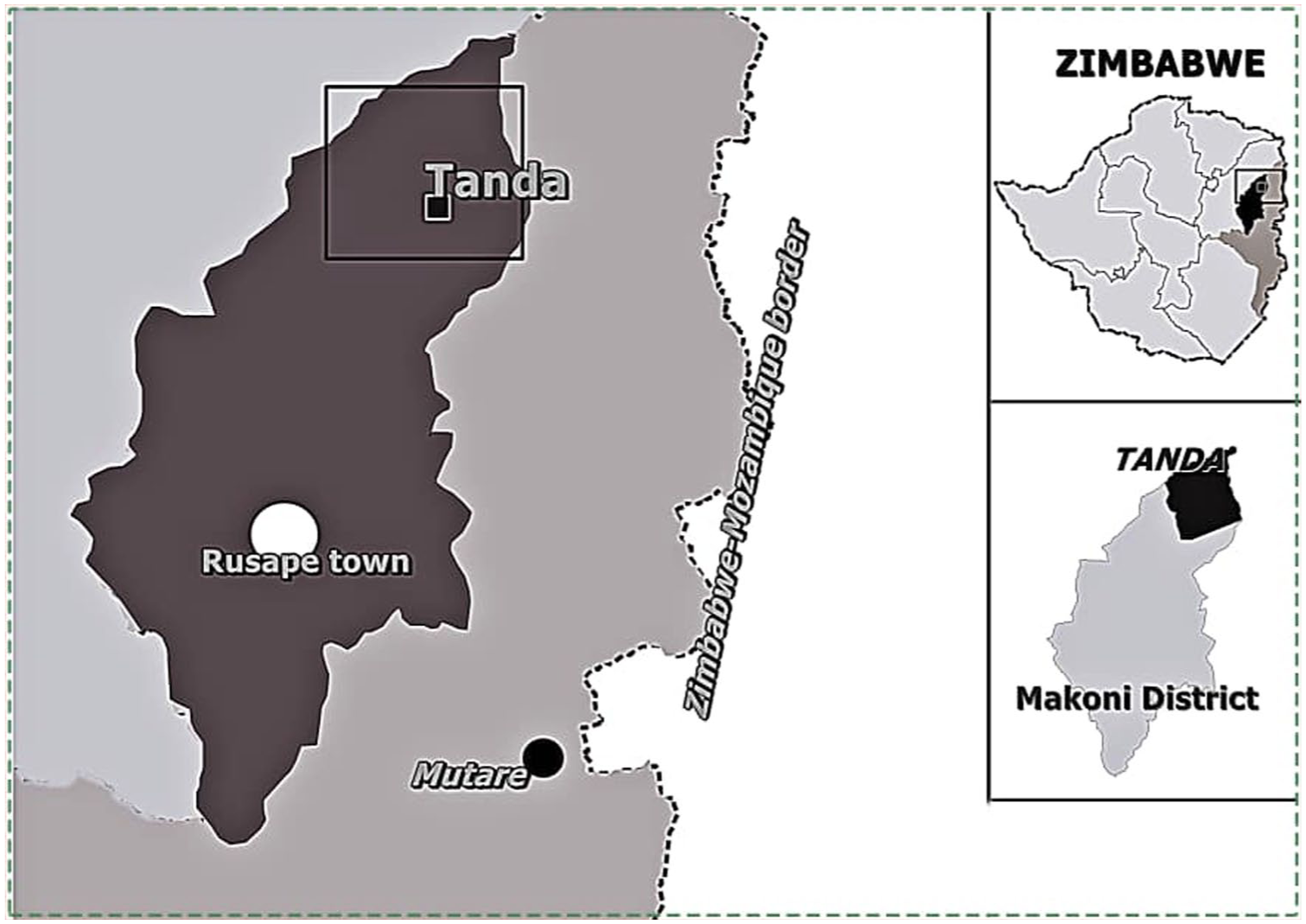
Map of Tanda (Compiled by Sekai Kashamba).
Methodology
This study adopts a qualitative research paradigm, using oral interviews and focus group discussions (FGDs). Three FGDs were held in Tanda, each with six to eight participants: one for men, one for women, and one mixed. Face-to-face interviews were conducted with women, chiefs, headmen, and community leaders. Referral and snowball sampling were employed to select participants, particularly women and others who had been in Tanda during the liberation war. In total, 30 people were interviewed. I visited Tanda twice, in 2024 and 2025, for initial and follow-up interviews, which helped participants recall additional details. Traditional leaders, especially headmen, identified those present in Tanda during the war and those who later settled there, clarifying people’s connections to Tanda’s war-related history. FGDs were also used to corroborate information from individual interviews, sometimes bringing men and women together to validate women’s accounts.
Oral histories were central to this research, capturing the experiences of Tanda’s women during the liberation struggle. Through life stories and memories, participants showed how these events shaped their lives over time. As Nyachega (2024) argues, oral histories are not created in isolation but are shaped by socioeconomic and political narratives rooted in colonial and post-colonial experiences. Accordingly, this study treats oral histories not only as sources of information about past events but also as forms of memory work shaped by the contexts in which they are narrated. This aligns with studies on Zimbabwean war memory that highlight how grassroots communities actively construct and interpret their own past, as seen in Chakawa and Nyandoro (2020). Interviewing eyewitnesses has helped document the experiences of people “hidden from history” (Perks and Thomson, 1998). Hove and Dube’s (2005) analysis further illustrates this dynamic, showing how events such as the Manama School abduction are remembered, contested, and politicised in various ways, and how collective memory is shaped by competing agendas and selective silences. Vernick-Giles (2011) similarly argues that oral history is particularly effective for illuminating past events that other methods cannot capture. Here, oral histories provided personal interpretations of the killing of Phineas from participants such as Mrs Madume, which contrast with the colonial press, especially the Rhodesian Herald, which framed the killing as an act of terrorism in Tanda influenced by guerrillas. Yet, as Miescher et al (2001: 163) notes, oral histories offer insights into “moments of subjective reflection about the past,” even though their subjectivity raises questions about whether they can reveal what actually happened. I conducted my interviews more than four decades after the liberation struggle, in a post-colonial context shaped by established nationalist and local war narratives. I remain aware of the biases that accompany memory, political context, and other factors in people’s interpretations of history. Even so, the Rhodesian Herald’s report on the killing of Phineas confirms that the event occurred, while Tanda men’s claims that women masterminded the killing of the Brahman bull support the assertion that Tanda women stole and slaughtered Phineas.
I read testimonies from Tanda women and men, both as recollections of wartime experiences and as present-day narratives that respond to dominant expectations of what counts as “heroic” or “patriotic” contribution. The story of Phineas, which emerged as a “chorus” across multiple interviews, is a case in point. Its repeated retelling, embellishment, and communal recognition suggest that it operates as a performative narrative through which Tanda women claim moral authority, bravery, and political significance. Acknowledging the performative and selective nature of such memories, I approach oral accounts critically and reflexively, triangulating them with archival sources where possible. At the same time, I take seriously what their narrative form, emphases, and silences reveal about how wartime resistance, gender roles, and suffering are remembered and reimagined in contemporary Tanda. The repeated and elaborated telling of the Phineas story, including by men, highlights not only its historical importance but also its contemporary symbolic role as a marker of patriotic sacrifice and feminine bravery. These sabotage narratives function both to reconstruct women’s wartime motives and to remember resistance in ways that claim moral capital in post-colonial Zimbabwe.
Archival data were collected from the National Archives of Zimbabwe (NAZ), including newspaper articles, delineation reports, government gazettes, Native Commissioners’ reports, minutes of meetings, colonial press, and ZANU newsletters. Although these sources are biased, written by colonial officials with specific agendas that often portrayed Africans negatively, they still provide valuable primary information and must be read critically. Records on Tanda in the NAZ were sparse. While Tanda appears in delineation reports and colonial newspapers, especially concerning violence during the liberation war and the killing of Phineas, other colonial-era records are minimal. The region attracted significant colonial attention during Zimbabwe’s war of liberation, when it served as a guerrilla transit point between Zimbabwe and Mozambique. Colonial newspapers, mainly the Rhodesian Herald and Manica News, reported on Tanda during the height of the liberation war, primarily for security reasons. Their coverage cast anyone supporting the guerrillas as a terrorist and enemy of the state. This was not unique to Tanda; as Nyachega (2017) notes, “colonial officials’ war reports simply presented civilians as passive victims of the war and terrorists.” Consequently, even the killing of Phineas was reported as an act of sabotage by Tanda women. These limitations necessitated a critical reading of archival files. To address this weakness, I employed data triangulation, with oral histories serving as the principal source.
Hidden networks of resistance: Tanda women, economic sabotage, and liberation logistics, 1963–1980
Revolutions are neither unitary nor static, as Mary Ann Tétreault (1994) points out, they, “. . . are attempts to guide the process of political change along a preferred path of system transformation. . . Different participants hope for different outcomes or different emphases among a set of shared goals.” While the nationalist leaders often cast the war as a unified popular effort, 3 the reality was far more complex. As Simbanegavi points out, by invoking a rhetoric of unity, nationalists advanced strategic objectives, mobilising popular support while simultaneously legitimising their own authority. The Zimbabwean revolution was marked by contradictions: different participants pursued varying goals, and some Africans actively collaborated with the Rhodesian state as auxiliaries, informants, or members of the Rhodesian Security Forces (RSF). These divisions highlight that the liberation struggle was not a unified endeavour but a contested and fragmented process, shaped by competing interests, coercion, and survival strategies. Tanda women’s experiences reveal differentiated motives, methods, and meanings. This section interrogates one such local formation: how Tanda women’s cattle sabotage constituted economic warfare aimed at disrupting the Rhodesian political economy.
Tanda women’s cattle sabotage was not driven by a single cause. Rather, a layered set of factors led them to target settler farmers’ herds as a way to signal their discontent to the government. Tanda women raided the settler-owned cattle to feed the guerrillas and to avenge the loss of their cattle during forced destocking. 4 From as early as the 1960s, Tanda women mounted organised resistance against the colonial conservation regime through both public protest and covert sabotage. Their tactics included destroying dip tanks, refusing to pay dip taxes, poisoning settler livestock, burning crops, and setting fires to create pasture (Ranger, 1985: 158). Mrs Mudambo notes that by the 1960s, Tanda women were already protesting the harmful effects of the NLHA, which had caused destocking and overcrowding, by filling the dip tanks with stones. 5 According to Mrs Madhume, “We women were the first to refuse to pay dip tax. We went at night to put stones in the dip tanks. They (settlers) forced us to pay dip tax, arguing that chemicals are expensive . . ..” 6 Her husband, Mr Madhume, says, “Women started the demonstrations here in Tanda. They refused to pay the dip tax. They were very united, and when they started, they never stopped.” 7 Mr Mudambo, well known for his fearless roles as mujibha (male war collaborators) in Tanda, utters the same sentiments that “here in Tanda, it is the women who started the revolt, we destroyed dip tanks, and the killing of Phineas made the war more intense in 1972.” 8 Munro (1998: 271) echoes these sentiments when he writes that, “in early 1964, women in Tanda Tribal Trust Land (TTL) refused to dip their cattle in protest against the lack of government services, leading to the arrest of 300.” The Rhodesian Mail reported that the Tanda women were the first to destroy dip tanks and European crops in Makoni District. 9 In their study of the Tonga-Goba people’s wartime experiences, Matanzima and Nyachega (2024) demonstrate that this community’s support for guerrillas was not simply a reaction driven by displacement caused by the Kariba Dam construction. Instead, it was a layered response shaped by ecological grievances, efforts to preserve cultural survival, long-standing marginalisation, and the colonial regime’s broken promises. Therefore, acts of settler cattle sabotage by Tanda women were polyvalent, combining the provision of food to guerrillas and revenge to colonial dispossession they suffered under colonial land and conservation laws.
Mrs Madhume said that in 1974, they went to settler farms as a group of women at night and destroyed tobacco crops. 10 She added that several times, they (women) cut parameter fences at white paddocks to facilitate stock theft at night, mutilating and hamstringing cattle and sometimes deliberately setting fires to the pastures on white-owned ranches. 11 Burning settler crops, poisoning livestock, and setting fires in pastures were intended to devastate the Rhodesian agricultural sector, a key economic pillar of the regime. Sabotaging dip tanks undermined disease control, raising costs and risks for ranchers. Crop burning and cutting fences further undermined securitisation efforts and accelerated stock losses. In this way, conservation infrastructure, long central to the settler agrarian order, was transformed into a source of vulnerability. This supports the argument that Tanda women’s cattle sabotage, which intensified at the height of the Zimbabwean liberation struggle, was also a deliberate act of resistance aimed at destabilising the Rhodesian political economy and substantiates the claim that Tanda women were active political actors in the war.
At the start of my interviews in Tanda in early 2024, the story of Phineas repeatedly surfaced. It was recounted by both men and women who had participated in the war, with particular emphasis on women’s roles. Mrs Madhume narrates the story vividly; although she struggles to recall her age, she vividly remembers how she and other women slaughtered the famous Phineas bull to feed the guerrillas.
In 1972, a group of guerrillas came and demanded food, and we told them we had slaughtered all our goats and chickens and no longer had anything for a relish. They asked us why we complained about the lack of relish when there were many cattle in the white farmer’s paddocks . . . That night, the other women and I went, with our babies on our backs, to the paddocks in the Darken area and stole a very fat bull. We did not know the bull had been imported from America two weeks earlier. We slaughtered it overnight, roasted some of the meat, and hid the rest in the caves and trees in the mountain. When the white farmers realised that Phineas was missing, they suspected that the guerrillas had killed the bull. They came here on their horses, asking every woman, Wadya Phineas? (Did you eat Phineas?). Houses were searched, and anyone found with any beef was beaten, and their huts were burnt. They tortured and assaulted us, but we never told the Rhodesian forces where Phineas was. They never found out that we killed and slaughtered Phineas to feed our children (guerrillas).
12
Mr Eliot Madhume remembers that “Phineas was killed before he even started his task . . ..” 13 The records by the Agricultural Department confirm the importation of the Oxen Braham breed from America in 1972 14 and that Africans in Tanda killed the bull weeks after its arrival. In his novel, Nyawaranda (1985) describes the killing of Phineas as the event that marked the beginning of the war in Tanda. The story of Phineas illuminates not only the critical roles played by Tanda women in the liberation struggle but also a well-calculated act motivated not merely by guerrilla provisions. It was a calculated strike against wealth and a symbolic assertion of Tanda women’s agency. Walking for long distances overnight with babies on their backs, sneaking into white paddocks, stealing a colossal beast, slaughtering it overnight, and hiding the meat in caves and on trees in the mountains shows tremendous determination by Tanda women to support the war. Tanda women’s determination went beyond simply feeding the guerrillas. Through these actions, they defied conventional feminine roles and asserted their agency, openly expressing their discontent with forced destocking and colonial dispossession. The killing of Phineas, therefore, functioned not only as a political act but also as economic warfare aimed at destabilising the Rhodesian political economy.
The beef industry was one of the cornerstones of the Rhodesian economy, particularly after the failure to discover a “second Rand” in the colony. In chapter five of his PhD thesis, Machingaidze (1980) examines the role of the state in supporting the Rhodesian beef industry. Building on the work of Phimister (1976) and Machingaidze (1980), Samasuwo (2000) shows that the beef industry expanded rapidly during the Unilateral Declaration of Independence period (1965–1971). By the peak of the Second Chimurenga, the industry had become a formidable sector in the Rhodesian economy. This context helps explain why Tanda women, in their efforts to destabilise the Rhodesian political economy, targeted settler-owned cattle. Samasuwo (2000) argues that guerrillas adopted a strategy of “liberating” cattle, and that systematic cattle rustling by guerrillas and peasants severely damaged the Rhodesian beef industry as a form of economic subversion against the white-dominated economy. Working with mujibhas, guerrillas moved out of their operational zones at night to raid cattle from white ranchers and farmers (Samasuwo, 2000). In Tanda, women, not men, carried out these raids, exploiting their invisibility to Rhodesian forces. This was also partly due to security reasons, as women were less susceptible to the RSF. Thus, Phineas’ killing was also symbolic of material resistance to settler control of resources.
The settler farmers raised concerns over the loss of their cattle at the hands of guerrillas during the war. For example, in 1975, the farmers complained to the government about “unsatisfactory records of detention of stock thieves,”
15
and another rancher accused the Magistrate of being too lenient in imposing a stronger penalty on the offender.
16
The British Broadcasting Corporation (BBC) also reported that Settler landowners and ranchers have lost vast areas which were formerly grazing land to the liberation forces. Large herds of cattle are reported to have been driven either to the liberated or semi-liberated-liberated zones . . .
17
Tanda women became significant players in the guerrilla strategy of “liberating the cattle.” What the Rhodesian state called “stock theft” were acts of economic warfare and agency by Tanda women.
The most affected white farmers and ranchers were those located along the broad curve of guerrilla advances, primarily in the country’s eastern and western regions. In 1976, for example, Umutali Post reported that white farmers in Chipinge had experienced an economic boom since 1975; however, it also acknowledged that white ranchers, especially those near the border, had not shared that prosperity due to increased cattle rustling.
18
A 1977 report by the Manicaland District Commission also indicates a rising number of stock thefts from white farmers, which were associated with acts of terrorism. It reported that between the 1st July 1976 and 16th February 1977, cattle numbering 3292 and estimated to value $326,950 have been stolen from (white) farms in the Mayo, Headlands and Macheke areas of the Makoni District; that these cattle were driven into Weya, Tanda, and Chikore and Zimbiti Tribal Trust lands . . . and . . . that the terrorists have held and are holding meetings in the Tribal Trust lands mentioned above with tribesmen instructing them to steal European-owned cattle; that the tribesmen of these Tribal Trust lands have willingly carried out the instructions in question and have assisted the terrorists and continue to do so in their declared aim of disrupting the agricultural economy of the areas mentioned above.
19
The rise in stock theft of settlers’ cattle indicates that wartime disorder opened up opportunities for opportunistic actors to raid for personal gain. As Nyachega and Mwatwara (2021) show, borderlands have become spaces of ambiguous economies in which wartime violence merges with opportunistic activities such as cattle rustling, robbery, and ambushes. Thus, the growing incidence of stock theft in Tanda can be understood as the result of a combination of necessity, opportunism, and political defiance.
The situation compelled the government to impose strict penalties on those found guilty of stock theft, including sentences of up to 9 years in prison, severe flogging, and the establishment of protected villages. The state’s response to acts of cattle saboteurs during the war signalled recognition that cattle raiding constituted economic warfare rather than mere criminality. 20 Despite these measures, Tanda women continued to engage in acts of sabotage, either killing them for meat (to feed guerrillas) or allowing the carcasses to decompose (frustrating the whites). 21 Mrs Muchenje noted that the whites rarely suspected women of such actions, as it was primarily men who faced the harshest punishments. 22 In Tanda, the war took an unexpected turn: women emerged as leaders in cattle raiding and even in acts of violence. This shift not only transformed rural spaces but also expanded Tanda women’s agency, enabling them to reshape the political economy and gendered power relations.
Simbanegavi (2000: 19), in her study, acknowledges that in Dande, raiding of cattle was done by men, and women assisted in the driving of the looted cattle out of white farmers; she argues that “once the raiders had made it out of the settlers’ farms, young women could join them to drive the looted cattle into the relative safety of the villages.” This was the opposite of what happened in Tanda. In Tanda, women engaged in “hunting and raiding operations,” and Mrs Madhume says that RSF was less suspicious about women; “in most cases, when we saw them (settler farmers), we pretended as if we were fetching firewood, yet busy studying the area for our mission at night.” 23 Mrs Manhuhwa, who suffered a lifetime injury after being beaten by RSF following the disappearance of Phineas, says, “With the killing of Phineas in 1972, settler farmers accepted the reality that their cattle herds were at threat . . . From then, RSF surveillance increased in Tanda . . ..” 24 Cattle assumed great importance during the Zimbabwean War of Liberation. While the issue of land was the most important driving force behind the war, cattle became pawns in the vicious demise of colonialism in Zimbabwe.
One interlocutor, Mrs Nemasango, said, “It was risky to steal cattle from the settler farmers, but we encouraged each other as women to go and steal to feed our sons.”
25
Mrs Moyosvi said Settler farmers got angry when Phineas was killed . . . they were forgetting that they inflicted the same pain on us when they forced us to reduce our herds to three cattle per family . . . at least we were killing their cattle for good reasons, we wanted to feed our sons who were fighting for our freedom.
26
Given that Farm guards were armed, and the RSF did a door-to-door search for illegal meat and cattle bones, women were at high risk of being shot or imprisoned by the Rhodesian government for stock theft. Tanda women say that “cabbages” was a coded word for beef from stolen cattle from settler farms, used to mislead soldiers because they would ask young children what they ate for supper, and the children would reply, “Sadza and cabbages.” 27 Besides being the code to mislead soldiers, the word “cabbages” alluded to its abundant supply (Simbanegavi: 2000). By using the coded word “cabbages” to refer to beef and avoid detection, Tanda women demonstrate a carefully calculated determination to disrupt settler ranching, a cornerstone of Rhodesia’s political economy.
During the Zimbabwean liberation war, young women in Tanda served as chimbwidos (female collaborators). According to Mrs Mapfumo, the chimbwidos washed and ironed clothes for the guerrillas. Mrs Kaitano recalled, “I was a chimbwido during the war; I used to carry food to the bases . . .. We worked as a group of girls, and our main duties were washing and ironing guerrilla clothes.” Similarly, Mrs Musakwa explained, “I used to work with the chimbwidos; we transported guns and letters to the guerrillas.” The roles of chimbwidos extended beyond domestic chores to include political responsibilities, such as gathering intelligence, serving as lookouts, and acting as couriers between camps. For the Tanda women, these activities were also acts of liberation. Being a chimbwido demanded great bravery, as it was extremely dangerous. In 1974, 12 chimbwidos were killed when Rhodesian forces attacked a mountain base in Chingume Village. The mountain was later named Gomorevasikana (Girls’ Mountain) in honour of the girls who lost their lives.
In addition to engaging in acts of economic sabotage, Tanda women also served as guides, leading guerrillas along Tanda’s routes to the Mozambique border. Tanda women, such as Mrs Madhume and Mrs Mudambo, played a significant role in guiding guerrillas into and out of Zimbabwe. According to Mrs Mudambo I used to walk a long distance with guerrillas, showing them a short path to the border . . . I escorted them to the border at night. Many comrades who used this path at some point ate from my pots and slept at my house. It was not easy. I was extra cautious to avoid being caught by the RSF. It was a secret between me, my husband, and the guerrillas. We did all these in the middle of the night to avoid being caught.
28
According to Mrs Madhume, “directing guerrillas needed extra intelligence; comrades never asked directions from any person; they usually asked the person whom they trusted . . . my first time to assist comrades with directions was in 1974 . . . from then, comrades on their transit to and from Mozambique came to my home and asked directions . . ..”
29
Giving directions to comrades is one of the critical roles played by Tanda women, and it cannot be underrated. Women were more vital in escorting comrades because Smith’s forces were less suspicious of them (Stott, 1990). Spirit mediums like Mrs Zvigo and Mrs Chiganyura legitimised the guerrilla presence and advised on operations, consistent with findings from Dande, where spirit mediums anchored insurgent authority (Lan, 1985: 158; Ranger, 1981: 32). According to Mr Mudambo Once comrades entered Tanda, they would consult local spirit mediums, who would speak with the Mhondoro (royal ancestral spirits) to welcome them to the area . . .. The late Mrs Zvigo and Mrs Chiganyura were the prominent spirit mediums during the war.
30
According to Mr Chinganyura, a son of the late spirit medium Mrs Chiganyura, My mother was a spirit medium. I was young then, but I used to see her welcoming comrades at our home; she took them into the hut, and when possessed with the spirit . . . she would tell comrades where to attack, when, and how, and she would tell them safe directions to use to avoid confrontations with RSF. . ..
31
This fusion of scared authority, local knowledge, and tactical guidance embedded insurgency within village social fabrics and further eroded the rear-front distinction.
Insurgent gendered economics and the limits of emancipation
As women mediums in Tanda endorsed the presence of guerrillas to win the masses’ support (Weiss, 1986: 73), they gained new power and status. However, the power and relevance that women’s mediums gained due to the war need not be overemphasised for gender equality because spirit mediums were not ordinary women. They already had social and political respect in Tanda, and the war amplified their power and status. Although Tanda women gained political significance during the war, they were not appointed to political positions, such as war village coordinators or district committees. Thus, for guerrillas, gender was respected when spelling civilian roles during the war.
According to Mrs Manhuhwa, village committees and district committees were for men; they were the ones who assigned cooking duties to women and different tasks to chimbwidos and mujibhas. 32 The war enabled Tanda women to enter areas traditionally closed to them; however, their political and combative roles did not translate into equal acceptance in society or within the guerrilla movement. Simbanegavi (2000: 3) argues that the rhetoric of women’s emancipation by ZANU was just a myth and propaganda. Despite women’s varied roles in undermining the Rhodesian economy and in supplying and protecting guerrillas, the liberation struggle ultimately failed to dismantle hierarchical gender norms. The continued dominance of patriarchal authority cautions against linear narratives of wartime transformation and instead calls for analyses that clearly differentiate situational agency from enduring structural change.
Food provision has been perceived as one of the significant roles that Tanda women played during the liberation struggle. The women interviewed demonstrated self-consciousness and self-confidence, which they attributed to their contributions to the success of the liberation through food provision. Food provision to the guerrillas included a wide range of activities carried out by women in support of the struggle, for example, purchasing supplies such as soap, cigarettes, clothes, and meat; cooking; requesting and organising supplies from neighbours to share the costs; killing their chickens and goats; sneaking food out to the bases at nights; washing clothes; and providing warm water for bathing. According to Mrs Kamupira I cooked for the guerrillas. Comrades came at night when they approached a homestead; the Mujibha shouted, “Visitors are here,” and we knew that by “visitors” they meant guerrillas . . . we would walk up and start slaughtering chickens and cooking sadza for them . . . we closed the door very tightly so that light rays would not show outside. When we finished cooking, we would take the food to the bases at night, and after they finished eating, the Pungwe would begin, during which we sang Chimurenga songs and slogans.
33
Mrs Madhume stressed the importance of women as food providers, saying that “women contributed better than men because comrades could have died if they were not given food.” 34
These acts of provisioning were not merely domestic contributions but insurgent, gendered economic practices within a war economy. This spatial rupture enabled Tanda women to move beyond subsistence to deliberate economic sabotage. Food provision to guerrillas thus functioned as both sustenance and a weapon, turning women’s sabotage into a strategic blow against the colony’s political economy. Yet, while these wartime openings expanded Tanda women’s agency, they did not dismantle entrenched patriarchal hierarchies after independence, revealing the limits of emancipation beyond the liberation struggle. As Kriger (1992) and Lyons (1999) note, women’s participation in war is not equivalent to emancipation. The roles of Tanda women in Zimbabwe’s liberation war, therefore, demonstrate how gendered invisibility can be turned into an insurgent advantage, enabling them to weaken the Rhodesian economy and emerge as influential political actors during the conflict.
Conclusion
This study has demonstrated that the Zimbabwean liberation struggle did more than mobilise rural communities; it fractured the spatial and conceptual boundaries between “front” and “rear,” turning everyday spaces into arenas of resistance. Within this fluid geography, Tanda women weaponised cattle sabotage as a calculated tactic of economic warfare, simultaneously destabilising Rhodesia’s settler economy and sustaining guerrilla fighters. These acts were multi-purpose, rooted in survival, revenge for colonial dispossession, and nationalist solidarity. By emphasising economic sabotage rather than domestic roles, the study moves beyond narratives that cast women as “passive” victims or secondary supporters. It presents Tanda women as strategic actors in the political economy of war, linking micro-level cattle raids to macro-level disruptions of Rhodesia’s capitalist system. This reframing demonstrates how the war reshaped space, the economy, and gendered power relations, and it advocates a broader conception of agency in African liberation history. In doing so, the study portrays Tanda women as political actors within the Rhodesian political economy, not only within gender debates. Whereas much of the gendered war historiography restricts women to the terrain of sexual violence and victimhood, this analysis highlights cattle sabotage as a form of women’s agency within a broader project of economic warfare. Their wartime roles helped reshape gender norms and raised hopes that these changes would lead to genuine gender equality after the war. Nationalists’ promises of women’s liberation, gender equality, and an end to oppression in the post-colonial era energised Tanda women’s participation. Yet, like many women in Zimbabwe, Tanda women ultimately faced disillusionment and what Lyons describes as a sense of false hope, as the rhetoric of women’s emancipation quickly evaporated after independence. The paradox between Tanda women’s central role in waging economic war and their marginalisation in its aftermath underscores the need to rewrite liberation histories so that women’s labour, sacrifice, and political agency are neither romanticised nor forgotten but recognised as foundational to the making and unmaking of colonial power. In fact, any meaningful rewriting of African liberation history must account for women not only as symbols of suffering or support but also as architects of economic resistance whose agency unsettled both colonial and patriarchal power, and whose unfinished demands for justice remain part of the liberation project today.
Footnotes

Funding
The authors disclosed receipt of the following financial support for the research, authorship, and/or publication of this article: This article forms part of my PhD research, which was funded by the Gerda Henkel Foundation through the Lissa Maskel Doctoral Fellowship at Stellenbosch University.