



Abstract
This article lays the foundation for how Eurocentric and Afrocentric organizations employ decision-making models differently. An investigation of the archetypes for each organization and its cultural dimensions develops the bases from which to draw conclusions about their decision-making preference. For the purposes here, decision-making includes rational, emotional, political-coalitional, and garbage-can models. This paper also reviews how emotions impact those processes. Findings show that Eurocentric organizations tend toward more rational and political models with strategic use of emotions. Afrocentric organizations deploy more garbage-can or holistic models. When members from Eurocentric organizations employ political models, they aim to please leadership. Members in predominately Afrocentric organizations frown on such behavior. Members from Afrocentric organizations express emotions more freely and with less strategic intent than their counterparts. When members from these cultures encounter each other, having an understanding of these decision-making models may help unpack the negative connotation associated with the concept of cultural baggage.
Keywords
The colloquial term cultural baggage conjures images of people traveling to and fro with suitcases and attachés in tow. When interacting with others from diverse cultural backgrounds in organizations or church, people struggle to be heard and understood. Their cumbersome luggage impedes articulation and reception of meaning. Through this lens, cultural differences hinder dialogue and even organizational performance. While individuals from diverse cultural backgrounds may have varying worldviews and may express and conceive things differently, understanding these differences helps to facilitate exchanges that occur within organizations.
This article explores four decision-making models and their applicability to Afrocentric and Eurocentric organizations. Many researchers (Ouchi and Jaeger, 1978; Schiel, 1990; Warfield-Coppock, 1995) have contemplated Afrocentric and Eurocentric or Western organizational archetypes. For example, Warfield-Coppock noted the differences between the two groups by developing conceptual frameworks for organizations that labeled Caucasian American as Eurocentric and African American as Afrocentric on the basis of their general geography of origin. Warfield-Coppock’s study based principles within organizational psychology that aimed to comprehend the cultural dynamics specific to the two organizational types. The Eurocentric organization concept derived from predominantly Western and European traditions of capitalism. The Afrocentric organization drew elements from humanistic principles specific to African worldviews. Table 1 outlines the conceptual differences between the two.
Conceptual Framework for Organizations
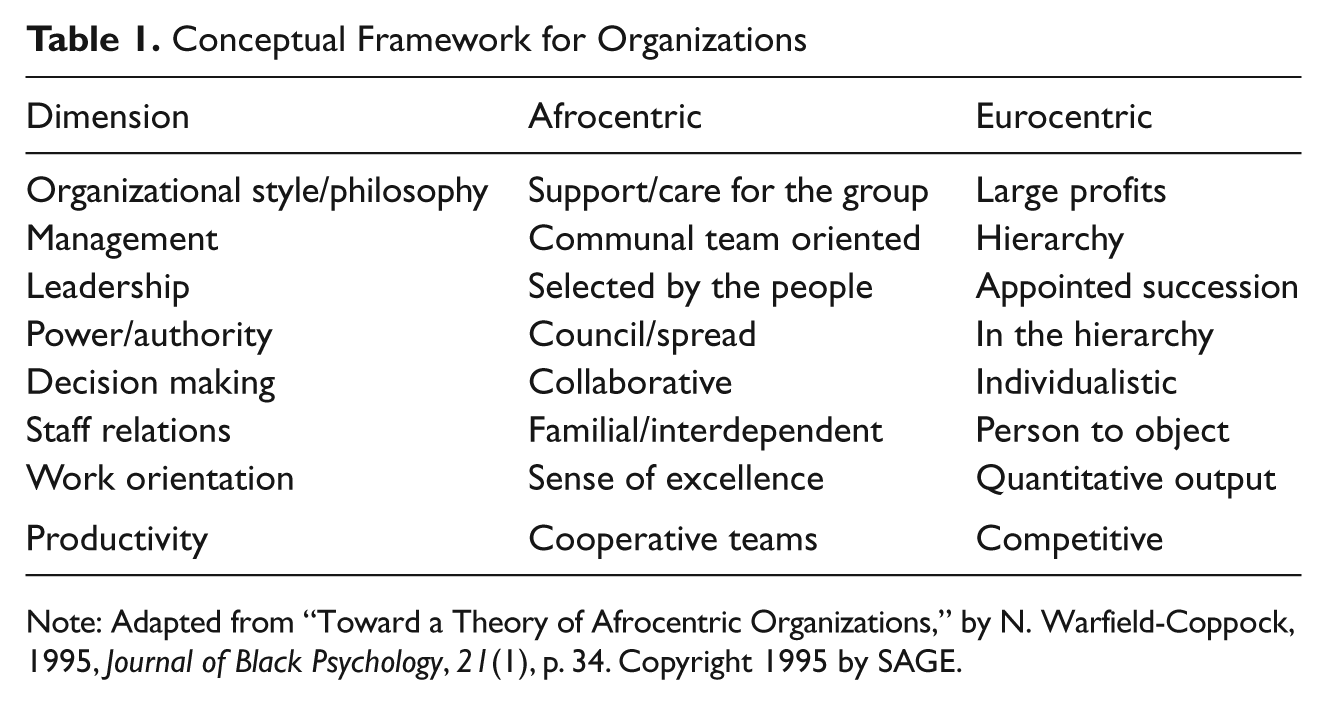
Note: Adapted from “Toward a Theory of Afrocentric Organizations,” by N. Warfield-Coppock, 1995, Journal of Black Psychology, 21(1), p. 34. Copyright 1995 by SAGE.
In similar fashion, Hofstede (1980, 1985) compiled national cultures and their organizational value systems. The findings showed individualism and masculinity with small power distance and weak uncertainty avoidance within U.S. organizations. African cultures that impact the African American’s unconscious sense of understanding were derived from what Hofstede (1985) clustered as West African (Nigeria, Ghana, Sierra, and Sierra Leone) and East African (Kenya, Ethiopia, and Zambia). Both cultures scored as collectivist and feminine with large power distance and weak uncertainty avoidance on Hofstede’s value dimensions. Table 2 displays these dimensions.
Hofstede’s Cultural Dimensions

Individualism connotes a preference for a “loosely knit social framework” where people look out for self and family (Hofstede, 1985, p. 282). Collective cultures indicate a preference for a “tightly knit social framework” where people anticipate that everyone looks out for others within their community of reference (Hofstede, 1985, p. 282). Masculinity refers to a preference for achievement, heroism, assertiveness, and material success (Hofstede, 1985). Femininity shows a proclivity for taking care of each other, relationships, and modesty (Hofstede, 1985). Power distance explains the “extent to which the members . . . accept that power in institutions and organizations is distributed equally” (Hofstede, 1985, p. 281). A weak power distance would indicate that the power and decision making between the leaders and members may be shared more than that of those in a culture with high power distance. Uncertainty avoidance measures the degree that people “feel uncomfortable with uncertainty and ambiguity” which promotes beliefs of certainty and maintains institutional conformity (Hofstede, 1985, p. 282).
Decision-Making Models
Cultural differences relay that individuals have “an underlying metaphor” where information, events, and messages become processed through a “lens that colors people’s perception of objects and messages in their environment” (Briley, Morris, & Simonson, 2000, p. 157). These preferences impact communication and decision-making in organizations. They compose the story that people unconsciously remember and rehearse about themselves and the world around them. These factors drive organizational decision making. As such, the following information lays the groundwork for comprehending the rational, emotional, political-coalitional, and garbage-can models for decision making.
Rational decision making consists of “unidirectional, linear processes” where individuals clearly identify their roles and responsibilities and how they shape the world around them (Beach & Connolly, 2005, p. 127). This model of decision making implies the availability and accessibility of information to those who partake in a decision process. Organizational members envision their collective goal and understand their role in helping to reach that goal. A plethora of research (normative decision and prescriptive theories) focus on different elements of rational decision making because the nature of the model seeks to define, understand, and contain the processes that people and groups employ.
The rational decision-making model fits the Eurocentric organization. With a combination of individualism and masculinity in the organizational dimension, a typical corporation would include a hierarchical structure where individuals focus on internal controls. Companies that compose the Fortune 500 list demonstrate rational decision-making on the basis of profitability measures alone. An accountability criterion requires them to regularly deliver financial data to Wall Street and to achieve increasing levels of profitability if they want to remain on the prestigious list. Warfield-Coppock’s (1995) framework matches this organizational type with the following descriptors: large profits and quantitative output. Fortune 500 organizations include highly specialized merchandising, operational, financial, and real estate divisions that strive to control costs and increase efficiency and productivity. They receive commendation and list continuance on the basis of their ability to control measures, lower costs, and manage their budgets.
An international retailer, “Company Growth,” exemplifies a combination of small power distance and weak uncertainty avoidance, which leads members to view their workplace as an adhocracy (Hofstede, 1985). Mintzberg and McHugh (1985) defined adhocracy as an organization that relies on “strategy making with planning, assuming that strategies are formulated before they are implemented” (p. 161). Company Growth develops an annual plan a year in advance and systematically implements that plan through the upcoming year. Since it is a retailer, it has defined seasonal activities that offer peak opportunities to maximize sales. All business operations aim to prepare for the peak season, and during the season, organizational members cease all other activities.
Members from Company Growth rely on unilateral relations to support departmental goals. Allies look out for each other. Warfield-Coppock’s (1995) description of the Eurocentric organization called for applicability of competition and a win-lose environment. These members readily employ the political decision-making strategy, which entails organizational members who seek allies and coalitions to support their individual efforts. Nutt (1976) categorized some of the “devices” that compose political decision-making as “contraction, coopting, consortium, and absorption” (p. 91). Mintzberg and McHugh (1985) outlined the political ramifications of an adhocracy in this way:
The organization [uses] . . . highly trained experts . . . [who] combine their talents in multidisciplinary teams, . . . housed in specialized units, . . . deployed in temporary teams to work on their projects. . . . Power over different decisions is diffused in uneven ways, subject to the availability of information and expertise needed to deal with the issue at hand. (pp. 161-162)
From this perspective, organizational members may ignore marginal goals and prioritize personal winning and unilateral support of their allies to gain territorial control. Political partners strive for cooperation, mutual support, and commonality to further their personal agenda and solve conflict. Those who share power and control wield specialized information like a weapon.
Investigating a third Eurocentric model through Savory and Butterfield’s (1999) research on farming reveals that the traditional Western perspective saw that cows were destructive to the land. Under this guise, farmers herded cattle and kept them fenced in small areas so not to destroy the land around them. This element of control, while different from the previous example, depicts the Eurocentric organizational mindset of focusing on a goal (the animal in this case) and putting controls and procedures in place to meet that goal with little flexibility to augment direction.
In contrast, Beach and Connolly (2005) defined the garbage-can decision-making model as existing “with unclear or inconsistent goals, using technologies that are not well understood by its organization’s members, and relying upon decisions in which the members are inconsistent participants” (p. 127). Organizational leaders and members who employ this methodology or lack of methodology seem to exist or find success in spite of themselves. This model correlates logic with a garbage can to distinguish how decision-making elements that search and apply solutions to problems resemble the hodgepodge of debris that finds itself mixed in a wastebasket. Despite the negative nomenclature, those who employ this methodology simply do not sort their processes in a neat, orderly, and traceable fashion so that a solution and problem can be packaged and articulated as having a logical and linear relationship.
Relationships and interactions seem disjointed to the linear mindset; however, they behave more holistically. Holistic decision-making postulates that goals are met when members collectively and simultaneously seek, plan, and implement solutions while they evaluate their surroundings and adjust accordingly (Savory & Butterfield, 1999). Goals have a feedback loop that allow members to enhance and correct missteps along the way. This outlook accepts that environments and organizations constantly change on the basis of internal and external events. Organizations that employ the holistic decision-making model “empower people to identify and achieve what is best for them” (Savory & Butterfield, p. 9). Holistic decision making offers flexibility.
Savory and Butterfield’s research on farming saw the need for cows to live on land with extensive borders because cow deposits enrich the soil. This perspective sees a long-term need in the midst of short-term problems. The apparent borderless and free-space concept means that farmers think about the end product, the animals, and the land in the process of their work. This comprehensive model seems chaotic and catastrophic during the execution but beneficial in the end. Here, farming fits into the Afrocentric organizational model.
Another Afrocentric organization, the Mary McLeod Bethune Institute in Los Angeles, California, demonstrates the holistic decision-making model versus the garbage-can model when it comes to offering education to students (Kifano, 1996). The curriculum emphasizes that students understand their historical background and cultural context of the United States alongside other enrichment and academic pursuits. The institute aims to develop students who are socially conscious and academically prepared. As such, the curriculum pulls resources from the community and texts. Teachers engage students and their families. Instruction and meetings may take place in the school system and in the student’s home. School personnel care about the student’s complete development as a human being in the world.
A third Afrocentric organization, “Company Balance,” demonstrates the garbage-can or holistic decision-making model. It publishes three magazines for international distribution. As an Afrocentric company, it values working with a sense of excellence coupled with mutual respect, support, and collaboration. These values make goal attainment complex because success rests in qualitative measures that assess how goals were accomplished. Using these parameters, Company Balance revisits the initial plan as often as necessary to tweak strategy. With a collectivist and feminine self-concept, the management resembles a communal team orientation. Leaders head teams and cast vision, but members have large responsibility for supporting and executing the vision. Members do so without tight controls. Leaders care about the spiritual and emotional well-being of members and allocate time to daily centering, where employees pray, read the bible, meditate, and so on. The annual leave policy allows members to share leave hours with others in need. Whenever members have extenuating health or family concerns, they receive support at work. Company Balance cares about profitability and its people equally.
Hofstede (1985) categorized organizations with a large power distance and weak uncertainty avoidance as a family. In families, individuals demonstrate loyalty and respond to parental presence. As such, Company Growth members perform better when in proximity to leadership. Power and control belong to leadership implicitly. Leaders do not have to demand or demonstrate their power; naturally, others bequeath it. Members may engage in political posturing to gain favor from leadership, but peers do not respect such pomposity.
Emotions in Organizations
Researchers have begun to examine the impact that emotions have on the decision-making process (e.g., Beach & Connolly, 2005). Isen (1993) studied how positive mood affects creativity and cognitive decision-making ability and found that “people who feeling good may be alert to possibilities and may solve problems both more efficiently and more thoroughly” (p. 273). Negative emotions associated with regret and disappointment help people to “shape their decisions” to avoid undesired consequences. The status quo bias connotes that people are reluctant to change the status quo “without good reason” (Beach & Connolly, 2005, p. 108). Overconfidence refers to when people’s level of confidence about a decision oftentimes is higher than warranted on the basis of outcomes. Finally, when people perceive a decision as risky despite the facts, they are less willing to employ it. These components encompass a perspective on how negative and positive emotions drive the decisions that people employ.
Members from both Company Growth and Company Balance display emotion; however, organizational members perceive it differently. Both companies possess a weak uncertainty avoidance, indicating likelihood for risk aversion. In Company Growth, emotions drive competition and profit. Members may display disappointment or pleasure to spur performance. In Company Balance, emotions flow more freely in response to disagreements or excitement. In this setting, emotions do not attempt to evoke a response. They merely reflect a member’s internal feelings. Members may display negative or positive emotion during meetings without any conscious attempt to affect another person.
Conclusion
Comprehending the differences between Eurocentric and Afrocentric organizations unpacks cultural baggage so that people travel freer of concerns about offending others or misinterpreting their experiences. Knowledge of self and others increases the capacity for people to grow, become balanced, and positively impact their surroundings. In Hosea 4:6, the prophet proclaims that “my people are destroyed for lack of knowledge” (New Revised Standard Version). The information contained in this article aims to help others understand their environment and discern how to communicate ideas and concepts to their business counterparts. Respect and cooperation among organizational members develops a foundation from which to extend similar treatment to others in diverse contexts.
Footnotes
The author declared no potential conflicts of interest with respect to the research, authorship, and/or publication of this article.
The author received no financial support for the research, authorship, and/or publication of this article.