




Abstract
This article examines the extent and intensity of Facebook usage among African American college students and investigates their reasons for using Facebook. As expected, 98% of students in the survey had a Facebook account, and a large number of Facebook “friends.” Younger users spent significantly more time on Facebook than older ones. Our findings underscore the importance of cultural influence for African American online users. Displaying photographs and personal interests on Facebook signals racial identity among African American college students. Personality traits, such as self-esteem, trust in people, satisfaction with university life, and racial identity, were not significant predictors on the time spent on Facebook.
Facebook, one of the most popular social network sites (SNSes), had over 600 million active users—1 in 13 people on earth—as of January 2011. Launched in 2004 for college students only, it has since opened its membership to everyone ages 13 and older with a valid e-mail address. In the United States alone, there are an estimated 155 million users. One out of every 8 min online is spent on Facebook. Over one third of these users access Facebook from a mobile device (http://www.comscore.com).
SNSes were defined by boyd and Ellison (2008) as web-based services that allow individuals to (a) construct a public or semipublic profile within a bounded system, (b) articulate a list of other users with whom they share a connection, and (c) view and traverse their list of connections plus those made by others within the system (p. 211). Most early research on the SNS focused on identity presentation, online friendship behaviors, and privacy issues. In the past 3 years, however, researchers from diverse backgrounds and training have focused more on the effects of personality traits on Facebook usage worldwide.
Nevertheless, very little research has been done to examine the uses and benefits among the minority population. The present study aims to explore the use and perceived benefits of Facebook among African American college students. It also examines the potential effects of personality factors and racial identity on Facebook behavior.
Literature Review
Facebook Usage and Benefits: Individual Differences
Research has found that people use SNSes as a means of self-presentation and for building and maintaining contact with others. In a frequently cited article, Ellison and her colleagues (Ellison, Steinfield, & Lampe, 2007) suggested a positive relationship between Facebook use and social capital, defined as resources available to people through their interactions. Individuals with a larger, more diverse network of contacts are thought to have more social capital than individuals with a smaller, less diverse network.
Previous studies suggested that Facebook also provides means for a user to post information about himself or herself and to get feedback through wall postings from Facebook “friends” but that this “friendship” does not correspond to the same label offline (Tong, Van Der Heide, Langwell, & Walther, 2008; Walther, Van Der Heide, Hamel, & Shulman, 2009; Walther, Van Der Heide, Kim, Westerman, & Tong, 2008). This raises questions about the meaning of friend status. However, Pempek, Yermolayeva, and Calvert (2009) suggested that college students used Facebook most often for interaction, primarily with preestablished relationships offline, rather than for meeting new people or finding help with schoolwork.
As SNSes support interpersonal interaction, their use may be a function of personality (Zhong, Hardin, & Sun, 2011, p. 1266). Recently, it was found that those who spent more time on SNSes were less likely to have high proclivity for effortful thinking but more likely to be media multitaskers. To college students, the information on an SNS seems to be more effective in influencing emotional variables, such as liking and mood, than cognitive ones, such as effortful comprehension of the messages.
Gonzales and Hancock (2011) suggested that selective self-presentation on Facebook profiles enhanced the self-esteem of college students who participated in the experiment. Correa and her colleagues (Correa, Hinsley, & Gil de Zuniga, 2010) suggested that extroversion and openness to experiences were positively related to social media use, while emotional stability was a negative predictor. Kalpidou, Costin, and Morris (2011) found that spending a lot of time on Facebook was related to lower self-esteem, even though having a lot of Facebook friends was positively related to social adjustment.
Seder and Oshi (2009) found that among White college students, having a more homogeneous friendship network was positively associated with higher life satisfaction and less misunderstanding. Conservative and religious White college students reported more homogeneous friendship networks.
Raacke and Bonds-Raacke (2008) found gender differences in Facebook usage, with male students having significantly more friends linked and more people “friended” for dating purposes than female students. Their more recent study (Bonds-Raacke & Raacke, 2010) reported that students spent an average of over 2 hr per day on Facebook. The average number of friends was 450 for male students and 256 for female participants. The most common reasons for using Facebook, according to Bonds-Raacke and Raacke (2010), included “to keep in touch with old friends,” “to keep in touch with current friends,” “to post/look at pictures,” “to make new friends,” and “to locate old friends”; less commonly reported reasons included “to learn about events,” “to post social functions,” “to feel connected,” “to share information about yourself,” “for academic purposes,” and “for dating purposes” (p. 28).
Most of this research involved populations of college students different from those used in this study.
Facebook Usage and Benefits: Cultural Differences
About 70% of Facebook members live outside of the United States (http://www.comscore.com). As a result, there has been a great deal of research on the cultural differences on the use of SNSes in different regions of the world.
Vasalou, Joinson, and Courvoisier (2010) examined Facebook users from four European countries and the United States. They concluded that culture has an effect on both users’ motivations and their time investment on Facebook. Underwood and her colleagues (Underwood, Kerlin, & Farrington-Flint, 2011) aimed to study two distinct modes of online behaviors among university students in the United Kingdom: broadcasting and communicating. In their analysis, they found in fact three groups of users: broadcasters, communicators, and high-interaction people. According to their analysis,
communicators were more likely to have anchored relationships and focus more on maintenance of close-knit social friendships. Broadcasters, on the other hand, were more likely to engage in self-promotion and self-orientation. The high interaction group had lower quality interaction and greater comfort in lying. (Underwood et al., 2011, p. 5)
A study in the Netherlands found no significant relationship between time spent on instant messaging or an SNS and the size of three different layers of offline networks: support group, sympathy group, and outer-layer friends (Pollet, Roberts, & Dunbar, 2011).
In a study among Canadian students, Ross et al. (2009) found relatively few significant relationships between personality variables defined by the Five Factor model of personality and Facebook usage. They explained that levels of extroversion were not related to number of Facebook friends or time spent on it. On the other hand, Christofides, Muise, and Desmarais (2009) explored Canadian students’ information disclosure and personality factors. Their findings revealed that information disclosure was significantly predicted by need for popularity as well as level of trust and self-esteem.
In Australia, Wilson, Fornasier, and White (2010) found that extroverted and less conscientious individuals reported higher levels of both SNS use and addictive tendencies. They suspected that extroverts tend to require a high level of stimulation and a large social network. Ryan and Xenos (2011) examined Australian adults who are Facebook users and nonusers. Facebook users were more extroverted and narcissistic, but less conscientious and lonely, than nonusers.
In South Africa, Johnston’s team (Johnston, Tanner, Lalla, & Kawalski, 2011) replicated research done by Ellison et al. (2007). They reported that Facebook intensity was positively associated with bridging social capital but considerably less so with bonding. Amichai-Hamburger and Vinitzky’s (2010) study with university students in Israel showed that the highly extroverted group had a significantly larger number of friends than did students in the least extroverted group.
A number of studies compared college students in the United States and in Asia (Barker & Ota, 2011; Ji et al., 2010; Kim, Sohn, & Choi, 2011). Barker and Ota (2011) examined female college students in the United States and Japan. American women are much more prone to public expression with and celebration of peer groups. Japanese women, on the other hand, communicate their closeness via diaries in Mixi. Kim and his team (2011) reported that American and Korean college students showed a similar pattern of daily use of an SNS on average. However, American students had significantly greater motivation for seeking entertainment, while Korean respondents sought social support and information. They also illustrated a huge difference in the size of network of friends, with an average of 412 for American students and 81 for Korean counterparts. This may indicate different ways students value interpersonal relationships, as American students seemed to use an SNS primarily for casual relationships, while Korean students seemed to seek social support that may require deeper involvement and commitment. Ji and his team (2010) compared Facebook users in the United States, Korea, and China for bridging and bonding.
Facebook and African American College Students
In one of the first studies of a Black SNS, BlackPlanet, Byrne (2007) examined the relationship between public discourse about community issues and civic participation. She reported that the most popular online forums were about relationships (55%), heritage and identity (9%), religion and spirituality (6.6%), current events (4.2%), and women (3%). However, none of these discussions moved beyond a discursive level of civic participation.
Given the importance of the college years for the exploration of racial self-identification, according to Grasmuck and her colleagues (Grasmuck, Martin, & Zhao, 2009), Facebook is a potentially rich site for enhancing understandings of racial identity and display. They pointed out that little is known about African American online users. They examined the projected identity using visual cues about race through photographs. Content analysis of 12 African American students’ Facebook profiles projected a visual self that was dramatically more social than 71 other students’ (Grasmuck et al., 2009, p. 173). By identifying favorite quotes, favorite music, movies, and other preferences, they also presented a “cultural self.”
DeAndrea, Shaw, and Levine (2010) examined cultural differences in self-construal and self-expressions in Facebook’s “About Me” section among White, African American, and Asian college students. They reported that African American students reported significantly more internalized attributes than other groups. Furthermore, the proportion of pure psychological attributes and first-person singular pronouns were highest among African American students (DeAndrea et al., 2010, p.13).
A study done by Martinez-Aleman and Wartman (2009) suggested that African American and Hispanic students seemed particularly concerned with how they would be read by others, especially faculty and White students (p. 86).
Very little research has been done thus far on the minority users of Facebook, as reviewed above. The following research questions were formulated for the present study:
What is the extent and intensity of Facebook use among African American college students?
What are the major motivations for using Facebook?
Is Facebook use among African American college students related to personality traits and racial identity?
Method
Sample Selection
A total of 232 African American students at one of the largest historically Black colleges and universities (HBCUs) in Houston, Texas, participated in the survey in October and November of 2010. The university has student enrollment of about 9,100.
The average age of the sample was 21.90 (SD = 4.69) with a range of 17 to 51. The sample consisted of 48% males and 52% females. In terms of academic classification, 28% were freshmen, 24% were sophomores, 22% were juniors, 20% were seniors, and the rest were graduate and professional school students. Only 6.5% of the respondents were married, 2.2% were divorced or separated, and the rest were single. About 66% of the students lived off campus and 34% lived on campus.
Measures
In addition to demographic information, the survey questionnaire contained items on time spent on the Internet, ownership of a Facebook account, and time spent on Facebook on a daily basis. These items were adapted from Ellison et al. (2007) and other previous studies. Intensity of Facebook use was measured by the frequency of checking Facebook on a computer or cell phone within the previous day. A Likert-type scale item asked respondents whether they feel out of touch if not logged onto Facebook. The appendix contains the three-part survey instrument developed for the present investigation.
In line with previous research, the current study attempted to explore the relationship between Facebook use and personality of African American students. Four personality scales were included in the survey. An eight-item scale from the Multidimensional Model of Racial Identity was adapted from research by Sellers, Smith, Shelton, Rowley, and Chavous (1998). Their instrument provides a conceptual framework for understanding the significance of race in the self-concepts of African Americans (Sellers et al., 1998, p. 19). In particular, the Racial Centrality scale employed in the current study measures the extent to which a person defines himself or herself with regard to race. For example, one of the statements said, “Overall, being Black is an important part of my self-image.” Another statement in the scale, reversed for coding, said, “Being Black is not a major factor in my social relationships.” Responses for these items were scored on a 5-point scale from strongly agree to strongly disagree.
Seven items from Rosenberg’s (1965) Self-Esteem Scale measured the self-acceptance aspect of self-esteem. The first item stated, “I feel that I am a person of worth, at least on an equal basis with others.” Another item said, “I feel that I have a number of good qualities.” Each item was answered on the same 5-point scale from strongly agree to strongly disagree.
Trust in People, also developed by Rosenberg and used by the Survey Research Center (Robinson & Shaver, 1973), consisted of three items in a forced-choice format. It asked the following: (a) “Generally speaking, would you say that most people can be trusted or that you can’t be too careful in dealing with people?” (b) “Would you say that most of the time, people try to be helpful, or that they are mostly just looking out for themselves?” and (c) “Do you think that most people would try to take advantage of you if they got the chance or would they try to be fair?” Summed scale scores ranged from 0 to 3.
Finally, four items on the Satisfaction With University Life scale were adapted from Ellison et al. (2007).
Procedures for Data Collection and Analysis
The researcher and graduate assistant collected the survey forms with the cooperation of instructors in different areas of the university. The survey instructions promised confidentiality and provided the option of not completing the questionnaire.
Statistical analyses were performed using SPSS.
Results
The primary purpose of the current study was to explore use and appreciation of Facebook among African American college students. Findings from the survey are presented as major research questions.
Research Question 1: What Is the Extent and Intensity of Facebook Use Among African American College Students?
Out of 232 total participants, 98% of students in the survey had a Facebook account. Table 1 presents time spent on Facebook on a daily basis. About 74% of the sample spent 2 hr or less; 16%, 2 to 3 hr; and 4%, 3 to 4 hr. Nearly 6% of these students said they spent over 4 hr on Facebook daily.
Time Spent on Facebook Daily

There was a significant age effect, as illustrated in Table 2, χ2 = 17.20, df = 8, p < .05. Students older than 30 spent far less time on Facebook compared to 18- to 29-year-olds. However, there was no significant gender difference, contrary to previous research, χ2 = 2.90, df = 4, p > .05.
Age Differences on Facebook Use (N = 219)
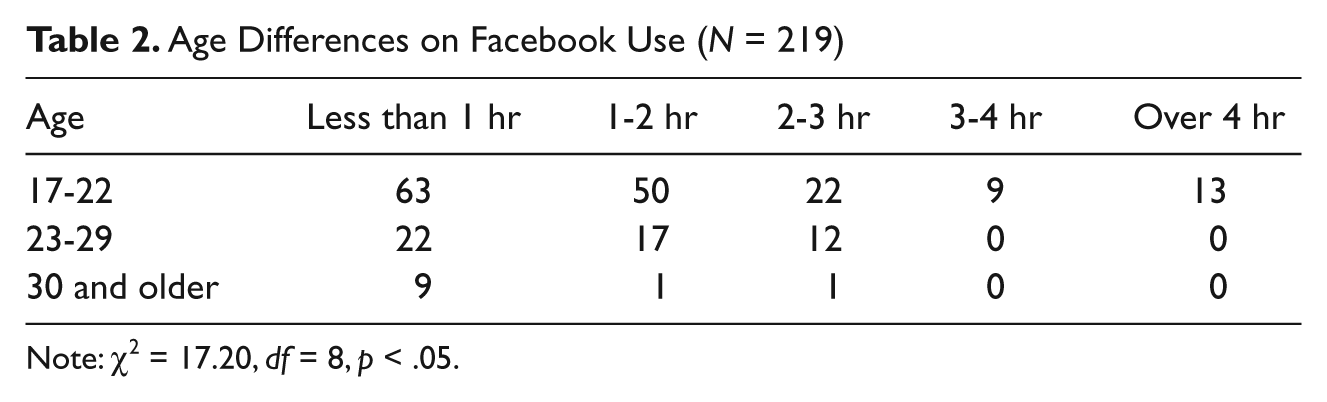
Note: χ2 = 17.20, df = 8, p < .05.
In order to determine the intensity of Facebook use, self-report of the number of visits to Facebook within the previous day was obtained. About 33% of the respondents reported 1 to 5 times, while 27% reported 6 to 10 times. However, 17% of the sample visited Facebook’s site more than 20 times. One Likert-type item asked participants how they feel when not logged onto Facebook. Over 13% strongly agreed that they felt out of touch, 25% agreed, and about 43% strongly disagreed or disagreed (Table 3). Although the majority of the students did not feel that time spent on Facebook interfered with schoolwork, 29% admitted that it sometimes did.
Intensity of Facebook Use

Correlation between first and second item was r = .497, p < .05.
Research Question 2: What Are the Major Reasons for Using Facebook Among African American College Students?
The average number of Facebook friends of the sample was 583. Fewer than 14% of Facebook friends were non-Black. Therefore, these African American students interact and communicate mainly with other African American friends, creating their own community. About 42% of the participants said their prime use of Facebook was to keep in touch with friends and family, while 9% said it was to meet new friends (Table 4). Unlike previous research findings, promoting or helping business was the third important reason at 7.5%. Nearly a quarter of students reported a combination of motivations.
Most Important Reason for Using Facebook
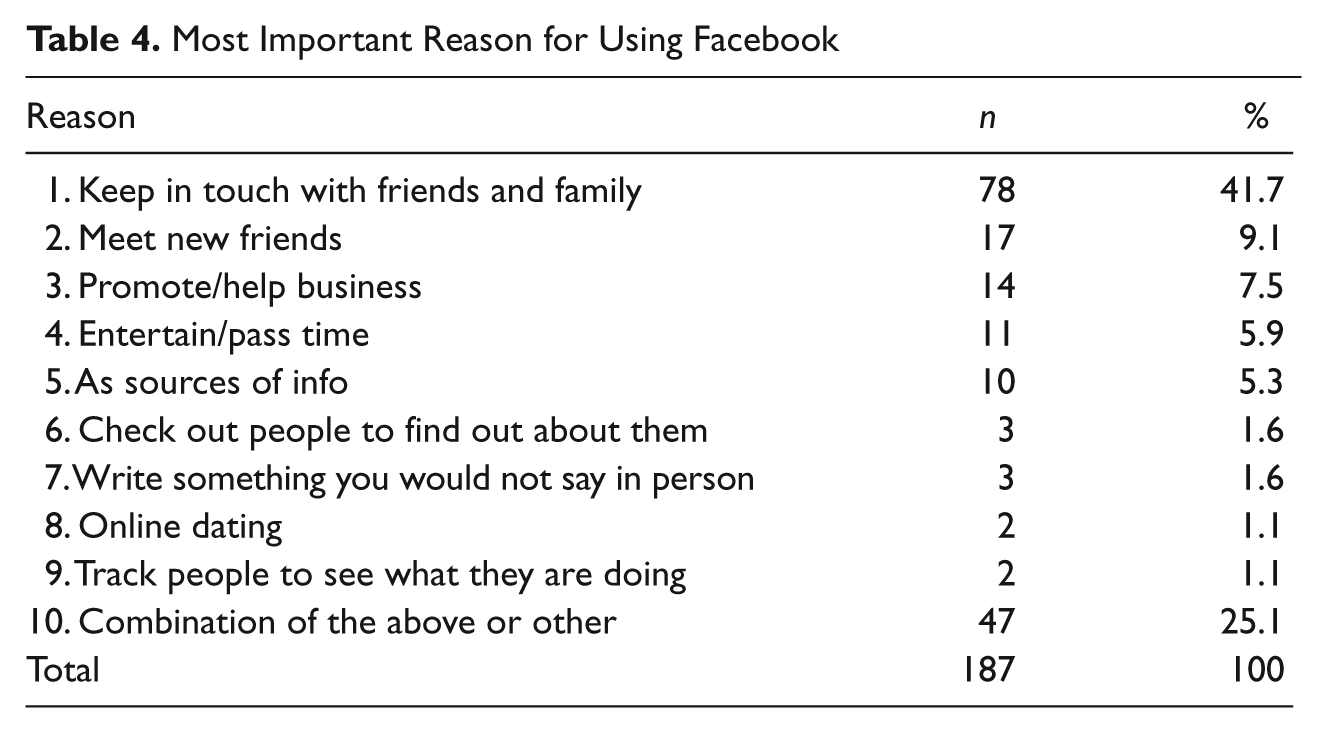
In order to examine whether African American college students exhibit cultural or racial cues on their Facebook profiles, the researcher asked them about different elements of self-presentation. As shown in Figure 1, 94% of the sample included a self-photograph. In addition, nearly 90% included hometown and 86% included high school information. However, only 22% of these students included a cell phone number, and 38% included a physical description.
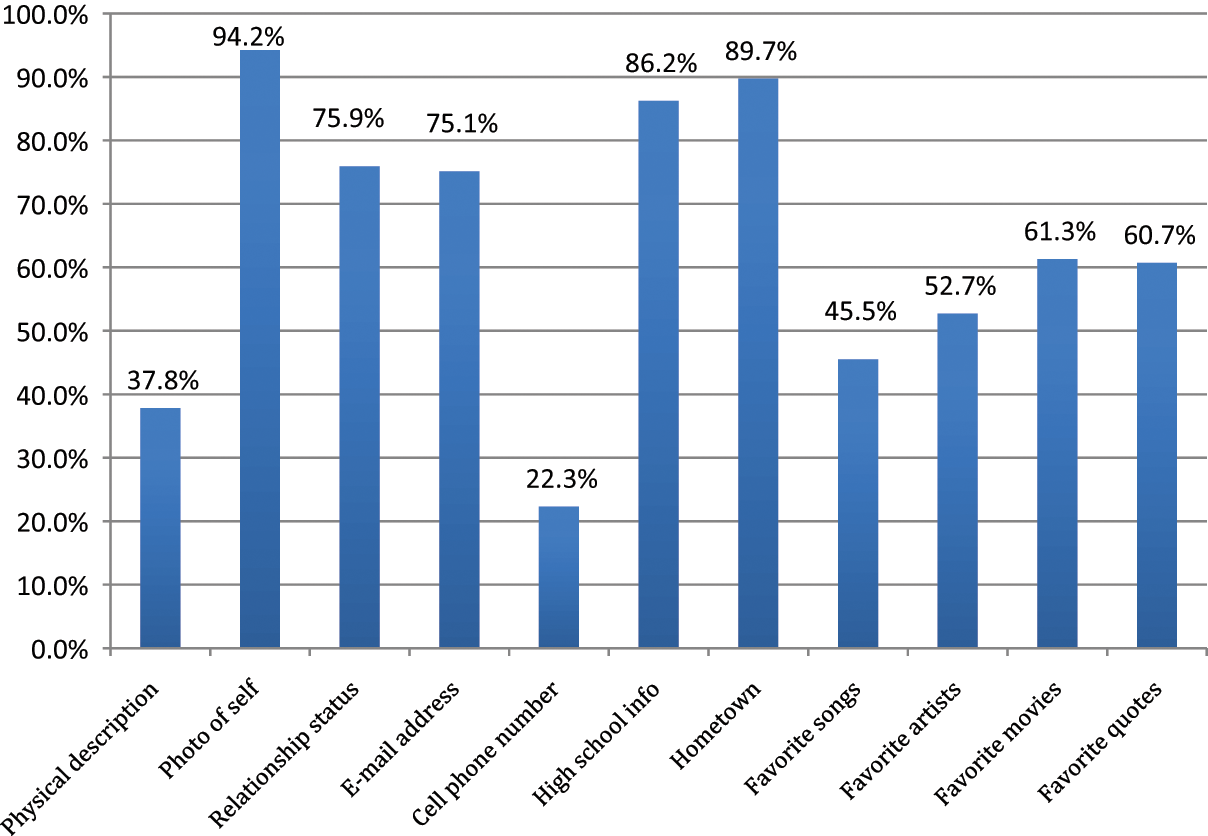
Profile elements on Facebook
More male students than female students posted a self-photograph, but this was not statistically significant, χ2 = 3.32, df = 1, p = .069. In addition, more male students than female students included cell phone information, χ2 = 4.45, df = 1, p = .035.
Research Question 3: Is Facebook Use Among African American College Students Related to Personality Traits and Racial Identity?
Effects of racial identity and personality traits on Facebook use were examined. Racial identity and personality factors were not related to time spent on Facebook. Only time on the Internet was significantly related, as presented in Table 5.
Regression on the Time Spent on Facebook (N = 174)

A combination of demographic and personality traits as well as time on the Internet explained 45% of the variance on time spent on Facebook among African American college students. Correlation analyses among racial identity and personality are summarized in Table 6. Racial identity and self-esteem of the participants were positively related (r = .275, p < .01), but trust in people and satisfaction with university life were negatively related (r = –.146, p < .05).
Intercorrelations Among the Scales
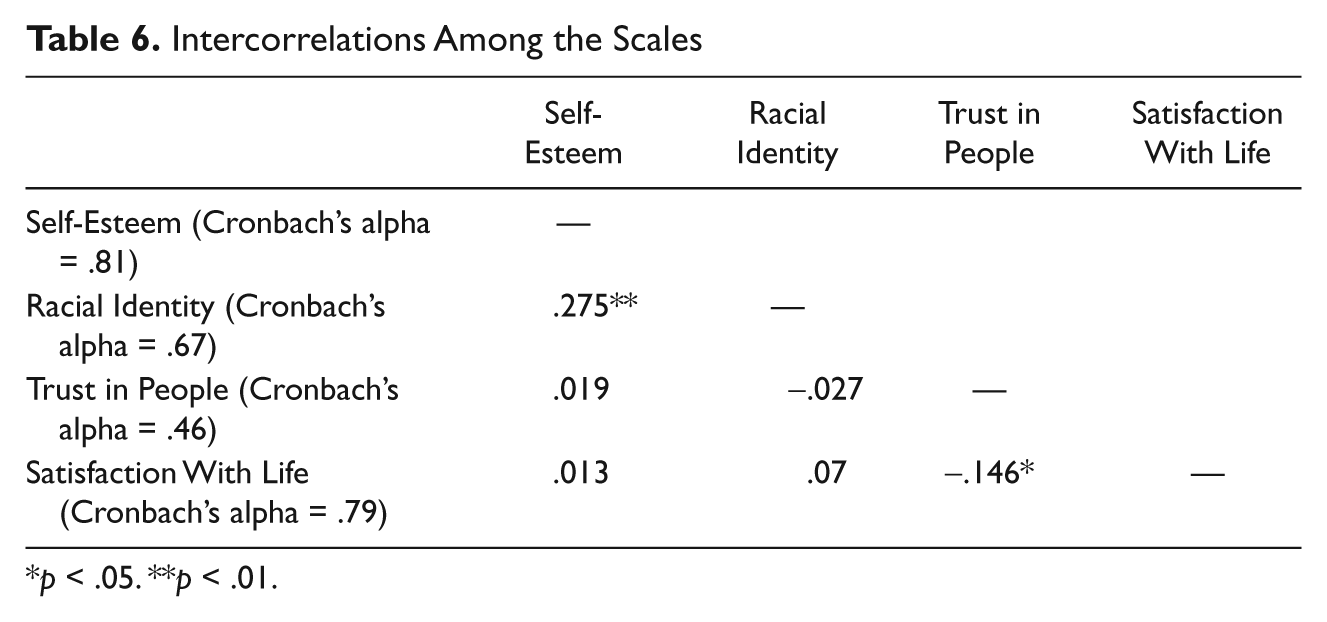
*p < .05. **p < .01.
Conclusion and Discussion
This study was conducted to research social media in the African American college community. From our data, African American college students are active users of Facebook. Our findings correspond to the results of previous research that suggested extensive use of SNSes among college students. There was no significant gender effect on time spent on Facebook in this sample, contradicting previous findings (Kolek & Saunders, 2008; Park, Kee, & Valenzuela, 2009).
Our data revealed a significant age difference: Younger users spent more time on Facebook than older students, agreeing with previous studies by Christofides et al. (2009), Pempek et al. (2009), and Park et al. (2009). A small segment of our sample spent over 4 hr each day on Facebook. As Fodeman and Monroe (2009) said, “using Facebook takes time, often a lot of time. This irresistible need to connect can make the users all-consumed” (p. 36).
Students in the survey also reported a large number of Facebook friends (M = 583), more than in previous research, despite having little trust in people in general. Bonds-Raacke and Raacke (2010) reported an average of 450 friends, and Tong et al. (2008) reported 395.
Our data correspond with results from a study done by Grasmuck et al. (2009) on self-presentation on Facebook. African American students on this HBCU campus often seem to be talking and communicating with other members of African Americans. Our findings also underscore the importance of cultural environment for African American online users. Displaying their photographs and personal interests on Facebook signals racial identity among African American college students.
Additionally, Facebook offers the opportunity for users to share additional information about themselves, including cultural interests, such as favorite movies or songs (Figure 1). This allows them to create a social and cultural identity that can provide additional information that is important to them. The ability to name favorite artists, as over half of respondents do, lets others know with whom Facebook users identify. The majority also list favorite quotes, which gives yet another avenue to self-expression, revelation of personality, and identification of personally meaningful passages.
Our findings suggest that cultural and ethnic differences in interpersonal relationships both online and offline seem more important than personality traits. Personality variables, such as self-esteem, trust, and satisfaction with university life, were not significant predictors of Facebook use in our survey. Even though self-esteem and racial identity were significantly and positively related, time spent on the Internet was the only reliable predictor of time on Facebook. As Gilbert, So, Russell, and Wessel’s (2006) study explained, African American students at HBCUs may be buffered from psychological stressors in an environment in which most of their peers and teachers are African American (p. 118).
One limitation of the current study was the choice of personality traits examined as predictors of Facebook use. Previous studies employed different dimensions of personality, such as extroversion, conscientiousness, or agreeableness. Furthermore, the current investigation surveyed only online friendship. Face-to-face interaction and offline friendship were not explored. Future research should further explore online and offline friendships among African American college students and an array of relationship types, such as close friends, mere acquaintances, and total strangers. By conducting in-depth interviews with these students in the future, we will understand better about the implicit cultural meanings of self-presentation, friendships, and storytelling. Future research should examine potential negative effects of Facebook use on academic performance among college students. Hew (2011) concluded that Facebook has very little educational use and few benefits for students. Hanson and her colleagues (Hanson, Drumheller, Mallard, McKee, & Schlegel, 2011) discussed that these college students face multiple commitments, including work, paying bills, and taking part in academic and social groups in addition to their classes. Given the competing demands on the students’ time, the potential effects of Facebook use, both positive and negative, merit further study.
Footnotes
Appendix
The author declared no potential conflicts of interest with respect to the research, authorship, and/or publication of this article.
The author received no financial support for the research, authorship, and/or publication of this article.