




Abstract
Academic interest in homeschooling has increased over the past decade, as what was once perceived as a marginal development has, in fact, turned into a significant and growing phenomenon. There has been, in recent years, a noticeable surge in African American involvement in the homeschooling movement as well. However, there continues to be a general paucity of research on the motivations of homeschooling Black parents. It is the purpose of this article, using an Afrocentric lens, (a) to explore one of the main reasons African Americans increasingly choose to educate their children at home, namely, their strong desire to protect their children from the ill effects of school-related racism; (b) to provide a historical and philosophical contextualization of the African American experience with racism in schools; and (c) to present empirical evidence regarding African American motivations for homeschooling.
Homeschooling, which at first was considered a fad, has turned into a significant and lasting phenomenon. Indeed, it is estimated that over 2 million children are being homeschooled today in the United States, as opposed to 300,000 in 1990, thus indicating a remarkable surge over a relatively short period of time (Gathier, 2007; Ray, 2010). In fact, homeschooling, which grew by 74% between 1999 and 2007 (Grady & Bielick, 2010), appears to be the fastest-growing form of education in the United States today. While White homeschooled students still represent about 75% of all homeschooled children, there has been a noticeable increase in African American involvement in the homeschool movement as well. In 1999, it was estimated that nearly 10% of all homeschooled children were Black, and those numbers appear to be consistently growing (Coleman, 2003; Fulbright, 2006; Ray, 2010). However, the motivations behind Black parents’ decision to educate their children at home have seldom been given careful attention, as the common and implicit assumption seems to be that African Americans’ disengagement from the school system is dictated by reasons quite similar to those cited by European Americans, such as quality of education or religious beliefs. However, the very unique experiences of African Americans in this society should be cause for caution. It is the purpose of this article to present empirical evidence regarding African American motivations for homeschooling. While previous studies (Fields-Smith & Williams, 2009; Llewellyn, 1996; Romm, 1993) have been limited by narrow geographical scopes and small participant pools, my study sought to overcome these limitations by drawing from a much larger number of households distributed over a wide geographical area. A second objective is to explore in depth, using an Afrocentric perspective, one of the main reasons African Americans increasingly choose to educate their children at home, namely, their strong desire to protect their children from the ill effects of school-related racism. This desire, which I refer to as “racial protectionism,” is best understood, I contend, as an operationalization of African agency. Such an approach allows one to evaluate Black homeschooling parents’ motivations on their own terms while avoiding the pitfalls of the pseudo-universalism of the European experience.
African American Motivations for Homeschooling
Numerous attempts have been made to explore the motivations informing parents’ decision to homeschool (e.g., Bielick, Chandler, & Broughman, 2001; Collom, 2005; McDowell, Sanchez, & Jones, 2000; Green & Hoover-Dempsey, 2007; Ice & Hoover-Dempsey, 2011; Isenberg, 2007; Knowles, 1991; Lange & Liu, 1999; Mayberry, 1989; Pittman, 1987; Van Galen, 1991). What clearly transpires from a review of this literature is that the motivations of homeschooling parents do not lend themselves to easy and neat classifications. At best, one arrives at categories that must be broad enough to encompass the multitude of experiences that they claim to capture. Yet their very broadness undermines their usefulness (Isenberg, 2007). At the heart of this difficulty lies the fact that the homeschooling population’s heterogeneity has considerably increased over the past decades. Thus, categories such as the “pedagogical” and “ideological” ones proposed by Van Galen (1991) that managed to capture the two main groups of homeschoolers in the 1980s, namely, the libertarian political left and the religious right, must be considerably enlarged to include parents who homeschool because of their dissatisfaction with public and private schools, family needs, and academic concerns, for example. Furthermore, such categories should arguably also be able to reflect the motivations of racially underrepresented groups, which have been glaringly absent from most of the literature mentioned above. As a matter of fact, only a few studies have dealt more specifically with African American homeschooling families (Romm, 1993; Llewellyn, 1996; McDowell et al., 2000; Fields-Smith & Williams, 2009). However, it is important to recognize, as cogently argued by McDowell et al. (2000), that “clearly, the decision to homeschool for African American parents contains a great many critical and diverse elements that are simply not a factor for Euro-Americans” (p. 130). One such critical factor is racism. Indeed, the three studies that sought to explore the motivations of Black homeschooling parents unmistakably and consistently identified racism as an important factor in the African American decision to homeschool. Romm (1993, p. 160), who interviewed four African American homeschooling families, states that one the main purposes of homeschooling for these four families is to “allow them to cope effectively with experiences of racial discrimination.” In a similar vein, Llewellyn (1996), who edited a collection of statements by 15 African American homeschooling families, mentions that some of them “are tired of the racist, sexist propaganda that masquerades as truth in history textbooks” (p. 15). Likewise, 19 of the 24 Black homeschooling parents interviewed by Fields-Smith and Williams (2009) indicated that experiences of racial discrimination, inequities, prejudice, and racism played a significant role in their decision to teach their children at home. These findings point to the importance of what I call racial protectionism, which I describe more fully below. My own study on the motivations of Black homeschooling parents is offered as an attempt to fill the conspicuous absence of the African American voice in scholarly discussions about motivations for homeschooling.
That racism should be expected to play a significant role in the decision by African American parents to homeschool is not surprising, since there is hardly any area of African American life that is not severely impacted by White racism (Feagin, 2010). This is especially true of schools, where institutional and individual racism is particularly visible in the Eurocentric orientation of the curriculum, White teachers’ often negative attitudes and behaviors toward Black children, the disproportionate placement of African American children into special education classes, and the disproportionate number of African American children targeted for punishment in schools. A brief survey of the main and recurrent issues faced by Black children as a result of school racism is required to understand homeschooling as a viable, if not necessary, alternative for many Black parents.
School-Related Racism
The curriculum
The wholly Eurocentric nature of most public and private schools’ curricula is no mystery; indeed, American schools tend to focus on Europe, held as the natural norm for all. European culture and thought are implicitly presented as universal and Europe as the only place from which great ideas and discoveries originated (Asante, 2007; Hilliard, 1997). The outcome of the quasiexclusion of Africa and African-descended people from the curriculum is a general school-sanctioned ignorance about, and disdain for, Africa and its descendants. The invisibility of Africa in the curriculum has a de facto double effect. On one hand, it reinforces the racist assumption that Africa does not matter and is indeed inferior. On the other hand, it leads one to the no-less-racist conclusion that African people have not done anything worth mentioning, hence their omission in textbooks and classroom discussions. The concept of the “null” curriculum (Eisner, 1994), which refers to the powerful messages that the omission or reduction to footnote status of certain information conveys to students and teachers alike, is particularly relevant here. This by-default curriculum, which chooses to ignore or marginalize the cultural and historical depth of African American children, is a pervasive and potent form of institutional racism. The devastating psychological impact of such a Eurocentric and racist perspective on the African American experience has been observed and ranges from poor self-esteem to outright self-hatred.
Teachers’ attitudes and behaviors
According to the National Center for Education Statistics (2005), 85% of all teachers are White, with White females alone making up 84% of the White teaching force. Children of color, on the other hand, represent over 40% of the student body, and this percentage is expected to grow significantly in the decades to come. As privileged members of a racist society, White teachers often participate, consciously or not, in the “marking of whiteness as invisible, colorless and as the inevitable norm” (Solomon, Portelli, Jean Daniel, & Campbell, 2006). Furthermore, they also often bring into the schools the many racist stereotypes and attitudes that have been ingrained in them, in particular, the notions that Blacks lack in intelligence or that Blacks are notoriously lazy and bent on criminality (Feagin, 2010), with equally racist notions of White innate intellectual and social superiority. This state of affairs is all the more problematic in that, as noted by Feagin (2010, p. 323), Whites commonly deny being racist, insisting instead that they are “colorblind,” that is, they do not see color but see only people. This widespread denial makes it quite difficult, if not impossible, for teachers’ racist biases to be recognized and kept in check (McKown & Weinstein, 2008; Oates, 2003; Sleeter, 2004). In fact, according to Bonilla-Silva (2010), not only is color blindness a form of denial, but it is itself the most current expression of the “new racism” that has developed since the 1970s. Finally, most teachers do not have the cultural knowledge base necessary to teach students of African descent. Indeed, during their academic training, teachers actually learn very little about African history and culture. Yet, as Asa Hilliard (1997) insists, such knowledge is necessary for successful teaching: Having no sense of chronology, no sense of where African people are in the world, and no sense of African culture limits a teacher’s ability to understand students with whom they may work. Such teachers see students merely in episodic terms and cannot place students in context. This results in varying degrees of alienation of students from school experiences, the impairment of communication, a reduction in motivation and effort, and ultimately in low achievement. (p. 138)
There are two areas where teachers’ (and administrators’) unchecked prejudices have been particularly visible and tragic: the overreferral of Black students to special education programs and to the criminal system.
Disproportionality placement in special education classes
Many have noted how, through tracking, schools effectively structure and maintain social and racial inequality (Gamoran, 1992; Oakes, 1985). Nowhere, maybe, is this more glaring than in the overrepresentation of Black students in special education classes, that is, classes reserved for children with mental defects (Cartledge & Dukes, 2009; Chinn & Hughes, 1987). African American students are more than twice as likely to be labeled “mentally retarded” as European American students, and although they make up only 17% of the student population, they nonetheless represent 33% of those enrolled in programs for children with mental retardation (Donovan & Cross, 2002). In some states, such as Virginia, those numbers are even higher, with African American pupils composing 51% of special education classes (Cartledge & Dukes, 2009, p. 383). In a study conducted a few years ago, Mandell, Davis, Bevans, and Guevara (2008) unmistakably revealed the existence of racial bias in the referral process as they exposed ethnic disparities in special education labeling among children with identical clinical profiles. Quite predictably, the use of psychotropic medication has also significantly increased. Therefore, while one might applaud schools’ efforts to accommodate Black students with special needs, including cognitive ones, the picture that has emerged after decades of special education is a sobering and disquieting one on many levels, including the highly subjective or arbitrary nature of the diagnosis process, students’ failure to improve, and the negative impact of special education placement on African American students’ life chances. Indeed, in addition to the humiliation and ostracism associated with being labeled deficient and in need of “special” treatment, special education often ends up being an “educational grave” (Dunn, 1968) for most, as it severely limits one’s ability to pursue postsecondary education. Yet the latter has been unmistakably linked to higher personal incomes, greater productivity, economic growth, and overall better quality of life (Sum, Khatiwada, & McLaughin, 2009). Furthermore, special education referrals often go hand in hand with unfair school punishment.
Disproportionate school punishment
Starting in the 1980s, a new get-tough approach, parallel to the newly declared “War on Drugs” on the streets of America at the same time, was adopted in American public schools, creating a quite harsh reality for many students. In the name of zero-tolerance policies, schools were increasingly policed. Surveillance cameras, metal detectors, searches, arrests, and referrals to the justice system became common in many schools, with security guards highly visible and active. This resulted in a dramatic increase in citations, school-based arrests, out-of-school suspensions, and expulsions (New York Civil Liberties Union [NYCLU], 2010).
However, as in the case of special education referrals, it has become obvious to many that school punishment is used in a racially discriminatory manner and affects disproportionately poor children of color, especially African Americans and Latinos (Gregory & Mosely, 2004). A recent report by the NYCLU (2010) reveals that the best demographic indicators of children who will be suspended are not the type or severity of the crime, but the color of their skin, their special education status, the school they go to, and whether they have been suspended before.
Black students account nationally for 34% of all suspensions. The situation is even more dramatic for Black special education students, who make up 32% of youth in juvenile detention nationwide. This corroborates claims that referrals to special education are often made as a form of disciplinary action against Black children. According to a report issued by the Southern Poverty Law Center (Losen & Skibba, 2010), Black male students are today over three times more likely than White students to be suspended and Black female students more than four times more likely than White females to be suspended. Let me note here that the overrepresentation of African American boys in particular in school discipline referrals and exclusionary consequences is not a recent phenomenon but has been well documented since the 1970s (Children’s Defense Fund, 1975; Fenning & Rose, 2007; Skiba, Michael, Nardo, & Peterson, 2002).
In reality, harsh school punishments are one of the primary mechanisms through which the “school-to-prison pipeline” operates (NYCLU, 2010). Minor infractions are used as pretexts to channel large numbers of young people out of school and into the criminal justice system to feed the prison industrial complex that has blossomed over recent years. Furthermore, as noted in a recent report by the University of California–Los Angeles’s Institute for Democracy, Education, and Access (IDEA), a high incidence of suspensions and expulsions leads to greater dropout rates (Sum et al., 2009), which in turn open the door to a myriad of problems, such as chronic unemployment, teenage pregnancy, poverty, inability to form and support a family, and eventually, incarceration (Sum et al., 2009). In other words, many Black youth seem to be set up by a racist system for a vicious cycle of poverty, illiteracy, delinquency, and personal frustration.
Theoretical Tools
This study of African American homeschooling as racial protectionism is informed by Afrocentricity. First articulated in 1980 by Molefi Kete Asante (1980) in his seminal essay Afrocentricity: The Theory of Social Change and further developed in subsequent essays (Asante, 1990, 1998, 2007), Afrocentricity is a philosophical and theoretical perspective “whose essential core centers on interpretation and explanation based on the role of Africans as subjects in historical, cultural, and social reality” (Asante, 2007, p. 42). Indeed, while Eurocentric analyses tend to deny African agency to naturally posit African people as mere and poor imitators of Europeans, Afrocentricity maintains that Africans are best understood and served as people capable of historical and cultural initiatives of their own (Asante, 1990). Asante (1998) explains that an agent, in our terms, must mean a human being who is capable of acting independently in his or her own best interest. Agency itself is the ability to provide the psychological and cultural resources necessary for the advancement of human freedom. (p. 40)
A significant attribute of agency is that although it is a given, basic human feature, it can be exercised or given up. The activation of one’s agency is predicated upon one’s consciousness. Afrocentricity distinguishes two major types of consciousness: consciousness of oppression and consciousness of victory. For example, individuals afflicted with a consciousness of oppression may be quite aware of racism but may have resigned themselves to be victimized by it, thus giving up their agency. On the other hand, individuals endowed with a consciousness of victory, while perfectly aware of racism, decide to fight it and do their best to defeat it, thus exercising their agency. Afrocentric scholarship then aims at identifying and capturing African agency at work and, in the process, renders suppressed truths self-evident (Mazama, 2001). My Afrocentric study of homeschooling therefore seeks to discuss and understand African American homeschooling as an exercise in agency inspired by the desire to defeat racism through physical removal from one of its major spheres of operation, school. This proactive and protective stance I have chosen to label racial protectionism. Let me note in passing that there is a long and rich tradition of initiatives taken by African Americans to create safer spaces in a racist society.
Research Design and Data
In order to capture the voice and agency of African American homeschoolers, I conducted 74 interviews across a wide geographical area, stretching along the Mid- and South Atlantic and the Midwest during the spring and summer of 2010. In addition to the interviews, I also relied on surveys, focus groups, and participant observations of Black homeschooling parents in order to provide a comprehensive view of the Black homeschooling experience (see Table 1). Indeed, the largest pool of participants came from Chicago and its surrounding suburbs (29.7%); followed by the metropolitan areas of Philadelphia (25.7%); Washington, D.C. (17.6%); New York (10.8%); and Atlanta (8.1%).
Place of Interviews
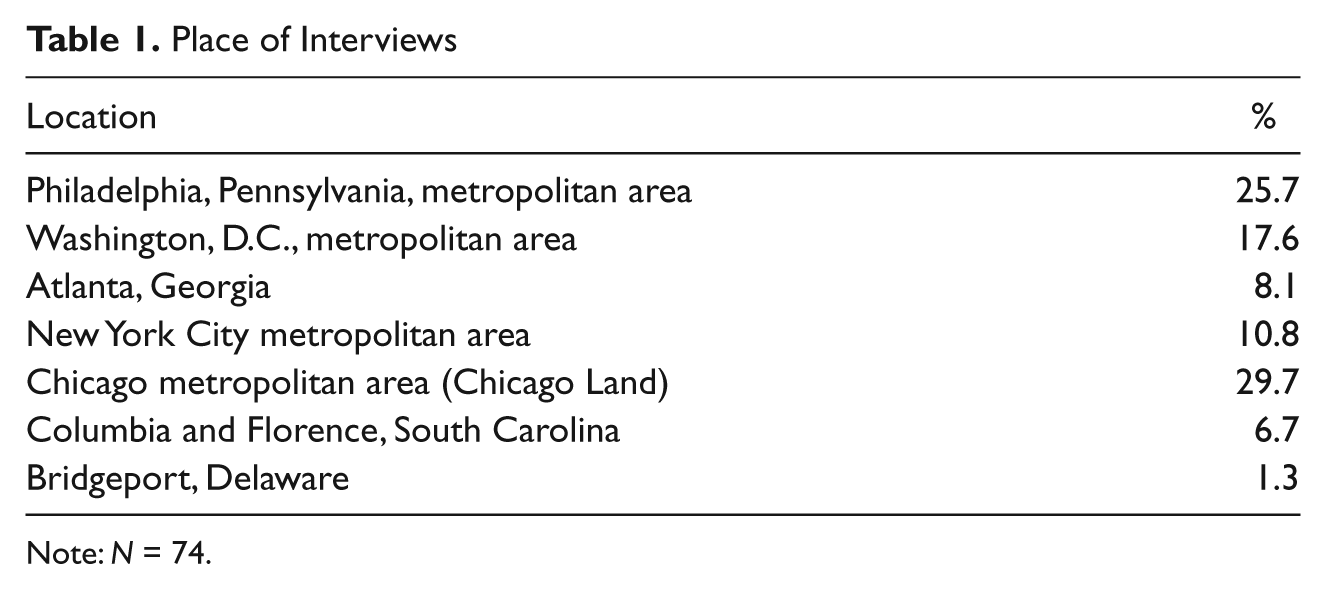
Note: N = 74.
A snowball sampling procedure and active recruitment from local and national homeschooling associations accounted for a majority of respondents. The interviews consisted of two parts: a survey that sought demographic and background data for each homeschooling family. This was followed by a semistructured, open-ended interview with the participating parent, where issues touched upon in the survey were further explored and elaborated upon by parents. Over 80% of the interviews were conducted with one parent, usually the mother (n = 60), representing the homeschooling family. The interviews ranged from roughly 1.5 to 2 hr in length and were analyzed using an open coding method, whereby the interviews’ content (i.e., data) was divided into meaningful segments and then scrutinized to allow common categories or themes to emerge (Strauss, 1987). Connections were then made amongst the categories and subcategories in a process referred to as axial coding. In other words, I sought connections amongst the various emergent categories. This, in turn, led me to the final stage of analysis, known as selective coding, whereby a “story line” or main theme emerged (Strauss & Corbin, 2008). As a follow-up, three focus group sessions were conducted in the fall of 2011 to further investigate the homeschooling experience of Black families. The focus groups consisted of 5 to 6 mothers in a large metropolitan area in the Northeast of the United States. Finally, on many occasions, observations were made at forums specifically geared for homeschoolers (e.g., science museums or sporting events). The data gathered in the focus groups and participant observations were used to complement and triangulate the data gathered in the individual interviews and surveys. The information presented in this study, however, is largely culled from the surveys and interviews. Table 2 considers the demographic characteristics of the participants interviewed. As can be seen, there is little variation in the ethnicity of Black respondents interviewed. The majority of respondents self-identified as native-born African Americans, with only a few self-identifying as foreign-born or racially mixed. In terms of family description, the average family consists of 3.2 children, and most were brought up in a two-parent household (91%).
Indicators of Respondents’ Demographic Background

Note: N = 71.
Average number in household = 3.2.
In terms of education, over 80% of the mothers and over 60% of the fathers have an undergraduate college degree or more. These figures are significantly higher than the national trend of only 19.4% of Blacks with a bachelor’s degree or higher in 2010 (Aud et al., 2011). These figures aside, a substantial number of homeschooling households have parents with no college degree. For example, almost 20% of mothers and close to 40% of fathers do not possess a college degree.
Findings
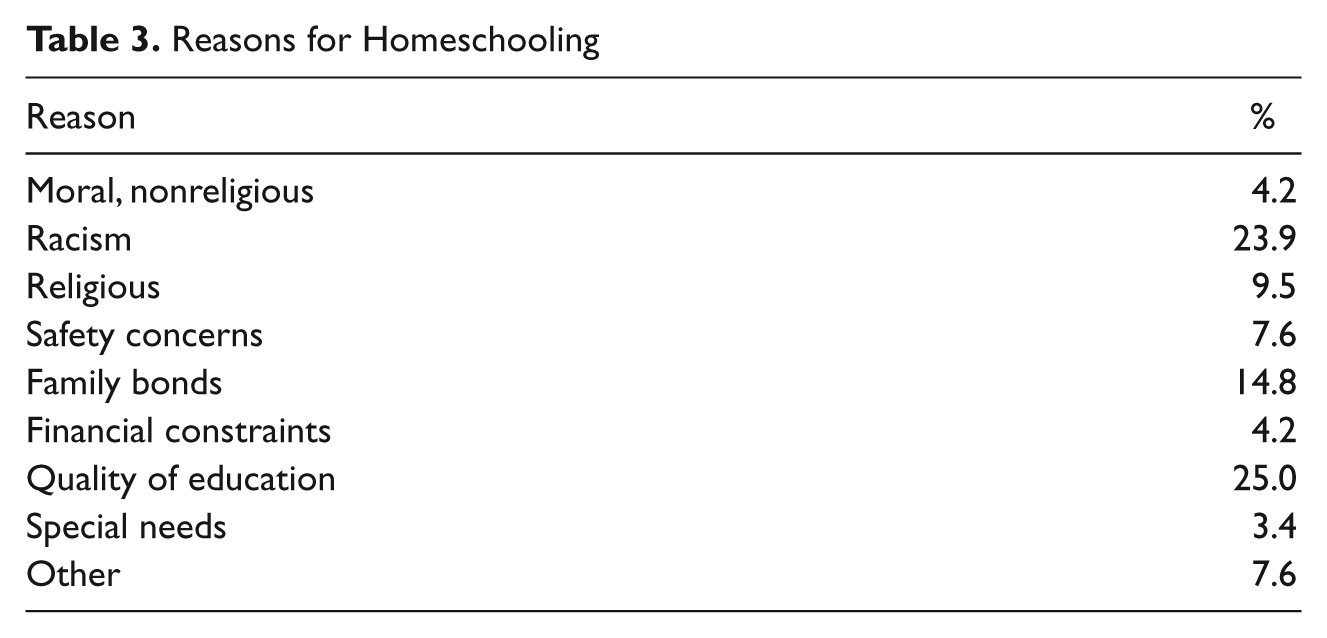
When asked in the open-ended interviews to delve into their motivations for homeschooling (Table 3), most parents offered a series of motives and were rarely motivated by single factor. Among the many reasons given, a concern with the quality of education provided in brick-and-mortar schools was most often mentioned (25%). This finding is consistent with previous research and indeed consistent with the history of homeschooling in America (Gathier, 2007). But unlike other research on homeschooling, and unique to the African American experience, the second most mentioned motivating factor for homeschooling was a concern with racism (23%). Indeed, it is fair to say that a preoccupation with racism and discrimination undergirds most of the responses regarding motivation for homeschooling. African American parents’ inspiration to homeschool their children was often couched as a desire to protect one’s child from possible racist actions or, as is often the case, as a reaction to an egregious racist incident when their children attended school. Indeed, in many interviews, cultural compatibility of the learning experience and the fight against institutional and individual racism undergird other reasons provided by the participants. That is to say, for example, parents who mention religion or family bonds as their motivation for homeschooling do so within a context that acknowledges institutional racism and the imperative of a curriculum that espouses a positive self-image of African American people.
Reasons for Homeschooling
Racial Protectionists: Coming to Terms With Racism
I have chosen to label racial protectionists those Black parents who have opted to educate their offspring at home at least in part in an attempt to shield their children from the racism they have experienced in school or that they do not wish their children to be subjected to. Those parents typically displayed an acute awareness of institutional and individual racism and how it has historically impeded Black lives. Schools and their agents are seen as playing a critical role in the reproduction of the racist social setup and are therefore understood as being antithetical to African American welfare. Indeed, racial protectionists shared the view that schools, public or private, could not, given the racist nature of American society, be emotionally safe for Black children. Racism was talked about as an inevitable fact of American life and schools as a place where Black children were bound to experience dire racial oppression and hostility in the form of the suppression of African American cultural identity and imposition of Whiteness as the ideal norm, the inculcation of anti-Black attitudes and beliefs along with the acceptance of White superiority, unjust and quick criminalization, low expectations, unnecessary referrals to special education tracks, and outright meanness and impatience. The curriculum and the teachers were identified as the two main sources of this racial oppression and hostility.
Curriculum
A large number of parents expressed great displeasure over the reduced and distorted presentation of Black history and achievements in most schools and explained how this prompted them to educate their children at home in order to impart culturally and historically relevant and meaningful information to them. Stephanie, the mother on one boy in Washington, D.C., cogently summed up the views of many homeschooling Black parents when she stated, Slavery did not begin Black history. And, if you’re educated in an American school, that’s what you’re led to believe. You learn that, you know, there was this place in Africa called Timbuktu. Now there were slaves, and the slaves were treated poorly, and then, and then came Abraham Lincoln, and then came Martin Luther King. And then there was the other guy called Malcolm X, and then, you know, now there’s Barack Obama. And that’s Black history, you know. And, you might get in there once in a while, oh yeah, there was this woman called Harriet Tubman and, you know, a Black man invented the traffic light, if you’re really lucky.
Teachers
Most striking, however, were the racial protectionists’ numerous complaints about teachers as major agents of covert and overt racism. This is consistent with the literature that suggests that White teachers often display problematic attitudes and behaviors toward Black students (Ferguson, 1998; Hilliard, 1997; Kunjunfu, 2002; McKown & Weinstein, 2008). Teachers were commonly described as being unresponsive and overly critical of Black children, mean to them, unsupportive, unwilling or unable to show compassion and patience, abusing their authority, and treating Black children like animals. Nicole, for instance, recalled a particularly devastating and eye-opening personal experience when she was a student teacher in a kindergarten class with 40 Black and Latino students taught by a White female teacher. She noticed how one little 4-year-old girl was struggling with learning to read and how her self-esteem was profoundly affected by her failure to progress. Nicole asked the lead teacher for permission to provide individual help to the girl, only to be faced with incomprehensible refusal: She [the teacher] said, “When she wants to learn, she will learn.” And of course, this was a White female and there, everyone is that classroom was Black and Latino. And I just sat there and I was just . . . I mean, when she said it, I just couldn’t believe she was telling me no; and I had no options, that I couldn’t help this child even though I’m right here, and she’s right here, but I couldn’t. And so that really devastated me. That really made me see, you know . . . in that classroom, it is the children and it is that one adult and no one knows what goes on in there, and no one has control over it but that one teacher. And that’s it. That’s when I decided that when they would come, I would not send my children to school because there was no way I could allow anybody to mistreat them like that.
The impatience with, and lack of support of, Black students’ academic efforts speaks in part to the lower or worse expectations that many White teachers are said to have of Black students. Leticia, mother of four children in Chicago, Illinois, shared the following: My daughter was probably in like, her 4th day of school ever, and I remember talking to her teacher and she said, “She can’t do this, she can’t do that, she can’t do anything else,” and I was like, “Excuse me? She is 5! She’s never been to school before in her life, what do you mean, “She can’t do this, she can’t do that”? What is she supposed to be, magic? Is she supposed to come to school already knowing everything? From then on, the teacher started calling her the “caboose” in the classroom. Every time I spoke with her, she had a complaint: “She is always late, she is too loud,” and so I said, “What do you do to help her?” Then she wouldn’t say anything, she wouldn’t give me an explanation.
This impatience also manifested in the unwillingness to tolerate Black children’s childlike behaviors and the quickness to associate them with disorder. Ayanna, mother of two males, recalls her experiences with the private school attended by her sons in New York City: I got so disrespected to my face and I just felt my boys were treated like criminals, like little precriminals. They would say, “Your son is being aggressive.” He was second grade, and he had a fight over blocks. I mean . . . I was getting called . . . and this was a private school . . . I got called at work all the time. They said, “He’s really aggressive; we’re really worried about him.” And he was turning into a terror, and he was in such a terror himself, and I said . . . you know what, I forgot he used to be the angel child. He used to be just the little, perfect angel, . . . the little halo thing. And we were at war, me and my son were at war . . . and my husband and I were at war with this kid, you know what I’m saying?
Furthermore, many parents described outrageous racial insensitivity on the part of many White teachers as their initial reason for homeschooling. In one case, a White English teacher at an expensive nonsectarian private school in Philadelphia asked the class to write an essay with the following as their prompt: “A fat black woman eating chicken on the bus.” The White teacher and students found this prompt to be quite hilarious, but Ashley’s daughter, the only Black student in the class, obviously did not. This was the final straw in a series of recurrent racial offensive statements and assignments, and the parents pulled their daughter out to homeschool her. Michelle, mother of three children in Philadelphia, cited the No Blacks Allowed and Whites Only signs posted on the walls of her son’s kindergarten classroom in the same private school, one day during Black History Month, as prompting her to educate her son at home. When confronted, the White teacher denied being even aware of the signs on the walls, which led Michelle to the conclusion that with such a teacher, the racial climate in the classroom could only deteriorate and cause her son increased and unbearable discomfort.
In addition, corroborating the research that shows that Black children are far more likely to be punished and referred to special education programs than White students, many Black homeschooling parents also indicated that they had no doubt that their children were indeed unfairly targeted in school, for either punishment or testing. Homeschooling was presented as a remedy to this unfair treatment. For some, such as Tina, the mother of one male in New York, double standards are quite obvious: Black boys in particular are not nurtured in most environments, especially those that are more White. I feel that—and not just in school—that if little Johnny is having a bad day, he’s having a bad day. If Robert, my Black boy, is having a bad day, he’s a problem, he’s aggressive. He’s not. I know him very well. I know when he’s wrong and let him know that. I even had parents of White kids tell me, “My kids do that, and the school doesn’t approach me like this.” They noticed it.
Likewise, unnecessary demands for testing to identify the deficiency responsible for Black children’s alleged behavioral problems were often reported. Regina, mother of two, recalls how her son, while in kindergarten in a predominantly White public school in Virginia, was recommended for special education and eventually was labeled “mentally retarded” after only a few weeks of school, when she could see that there was nothing wrong with her son’s intellect and behavior: They wanted to put him in a mentally retarded classroom setting where children really did have serious handicaps. And I mean, it was really severe at times; you could see some of those kids could not move physically. Joseph was not handicapped; he’s a functioning child. He can see, he can speak, he can hold a conversation. And, I said, “Why would you put him in that environment?” So I always fought to keep him mainstream to the point where sometimes I thought they thought I was argumentative. But I said, “I am his advocate and if I don’t fight for him as his mother, no one will.” But then, they tested him and put that label on him, and if they put his name in, it will come up as [mentally retarded].
Finally, in addition to identifying specific sources of racism in the school, whether the curriculum, teachers, or administrators, some parents also indicted integration itself as the main source of the predicament in which so many schooled Black children find themselves today.
Taking stock of the failure of integration
Indeed, some parents expressed their disenchantment with the aborted promises of Brown v. Board of Education. While the 1954 court decision had generated great hope, it is felt that African Americans were misled into thinking that racism would disappear and that African Americans would enjoy equal opportunities. For Akira, mother of two children in Halifax, Virginia, African Americans were in fact tricked into fighting for integrated schools, which engineered their demise. Underlying her critique of the school system is thus a devastating indictment of integration itself: We have to be realistic about it; the system is not created for us. Also, we have to understand that the schools, the so-called schools that the civil rights movement, Brown v. Board of Education, all that Plessy v. Ferguson stuff fought to get us into, that equal access, wasn’t really good for us. It just wasn’t made for us. I guarantee you, if a lot of those young men were homeschooled, they wouldn’t be in jail today. We have to be realistic about it; the system is not created for us. Somebody put in our heads that being around your own kind was the worst thing in the world. How you need to be in better neighborhoods, in neighborhoods where people don’t want you, in schools where people don’t want to teach you. They’ll burn crosses in front of your lawn because you’re the first Black neighbor. Why would you want to move to a neighborhood or a school where people don’t want you?
Homeschooling as an Exercise in Agency
In light of the multifaceted negative situations that Black students experience because of individual and institutional racism, it is hardly surprising that homeschooling is embraced by a growing number of African American parents. The latter are concerned for their children’s emotional well-being, intellectual development, and knowledge of self and have come to the conclusion that the American school system is antithetical to their children’s optimal growth.
As explained by Chris, father of three in Atlanta, the compounded effect of years of ill treatment can be severe: So there are a lot of things that happen over time where you take a child that is remarkable, and you punish them, put them in time out, make them feel bad about themselves, and honestly, just do things that are mean to children. But it happens every day and parents have no clue, they’re so busy and they’re just happy that their school . . . that their child is going to a good school. How do you define a good school? People will tell you it’s a good school. That’s it. I guess if your child is not in detention and they’re not getting arrested, then things are going well.
Not going along with the plan
Racial protectionists, unlike those parents who “have no clue” and are “so busy” and “just happy,” made the conscious decision to remove their children from an environment perceived to be abusive and destructive, thus exercising their agency, that is, their ability to act in their own best interest. A few Black parents never sent their children to any school at all, and some plan to keep them home through high school, and even through college, in order to protect them for as long as they can from the devastating effects of White racism. For some, sending Black children to school, in fact, made no sense at all, given the long and persistent history of racial oppression in this country. Akira, whose children were never schooled, for example, is adamant: Why would I have my children instructed and taught by the enemy? I’ve always seen White teachers somewhat as the enemy, White school establishments, institutes, as the enemy. Why should I give my children to the enemy to be taught?
Similar sentiments are echoed by Richard, father of two in Philadelphia: I mean, the heart of the reason to me would be you don’t allow an enemy to teach your child. We’re allowing people who have historically oppressed us to educate our children; that is ridiculous, like that’s foolish. Why would I allow my oppressor to teach my child who they are, who they’re supposed to be?
Many racial protectionists clearly articulated their decision to educate their children at home as a conscious and deliberate resistance strategy against racism. In this context, homeschooling equates with a refusal to surrender one’s children to a system bent on destroying them. Ayanna, who does not have any illusions about the system, put it in these words: I say America doesn’t love my children. It’s obvious America doesn’t love my children. They have a plan for my children, I’m sure you know the statistics for prisons and et cetera. That is the plan for my children, and I’m not going along with it.
In that context, homeschooling, that is, the act of reclaiming one’s children and taking responsibility for their education, appears to many as the only viable route out of the crisis created by the persistence of racism, as Karen, mother of three children in New York, argues: I think we need to stop hoping for them to do it for us. They’re not going to do it for us . . . they’re not going to do it . . . you know what I mean? Like improve our schools . . . and I don’t even believe in school anymore. When you do the research about schooling . . . I think homeschooling is really the answer. I mean everyone is trying to get the scholarship and get this and get the internship, and I’m like, “No, man, we can really do it, we can really fix this.” I think it’s the most powerful radical thing I can do in my life: homeschool my Black children. I think it’s really the answer, not “Oh, we need better standards, we need better testing.” I feel that homeschooling is the best opportunity for us.
For many parents, one of the most gratifying rewards of exercising their agency through homeschooling is not only liberation from the shackles of racism but also a priceless peace of mind. Kemet, mother of two males in Chicago, stated among many, Homeschooling is very positive, you know. It’s liberating, you know. I just feel that we are who we’ve been waiting for, you know. No longer do I have to feel like I have to wait by the phone because school is going to call me. It was so much pressure. No longer do I have to pick my son up and hear him say, “Mom, am I a bastard? That’s what I learned in school today.” And he was 5. So no longer do I have to listen to a White teacher, who’s in her 20s, who hasn’t lived long enough, doesn’t have children, never went to the day care center, tell me she thinks she knows my child, you know, and that he has [attention deficit disorder] and he has all As. No longer do I have to subject myself to the ignorance and the racism of the American education system, which does not teach our children and we cannot expect it to.
Creating a Space of Our Own
One of the critical aspects of homeschooling as a conscious and active exercise of agency is the creation of a liberated and protected space. Freedom and protection are obtained through two main strategies: imparting self-knowledge and imparting self-esteem through teaching about Africa and African Americans.
Self-knowledge and self-esteem are intimately linked to imparting a definite sense of identity as African or African American while making the Black child the center of his or her learning experience. Zawadi, in New York, explained about her only daughter, She’s an African child so she should know where she comes from, just like . . . I would think a Chinese girl should know about the history of China. I feel like she is an African child, and although we don’t live in Africa, we live in America, she should know her history and her culture and be proud. I feel like it gives us a sense of self-esteem and self-respect to know your lineage and every aspect of it.
Likewise, reflecting on the omission of Black historical achievements from the curriculum, Jonathan, the father of two in Richmond, Virginia, recalls his own experience and explains how homeschooling allows the Black experience to be not an afterthought or a footnote but the starting point for teaching his daughters: So the sense of identity we wanted to give them was one, a sense of who we’re as a family but also a sense of our historical perspective being primary, not being “extra.” That was very important to us and one of the reasons we do it [homeschool]. It’s integrated in all we do. We talk about history, and we don’t call it “history,” necessarily. We just talk about the figures in history, either from Africa or African American communities, and that’s how they learn different things. We had a course once on astronomy, and we talked about Benjamin Banneker’s contributions in a very natural discussion. We also cover other things, but we start from that.
The treatment of the Black experience as central and not peripheral is also expected to generate much needed self-esteem. Indeed, many parents who reported going out of their way to provide exposure to Black people who have achieved greatness in their domain, for example, literature, science, or history, did so in order not only to educate their children about their history and culture but also to instill racial pride and confidence in them and, ultimately, self-respect. Stephanie, among many others, told how I want him to know that, you know, Black people did just as much, if not more; Black people actually built this country. Black people invented, and discovered, and explored just like everyone else. One of the things I very much want to do with Bernard is to travel. I believe that travel is very important.
For Linda, mother of two in Philadelphia, the critical point is to impart in her children the notion of Black resilience and strength throughout history: I make a point of teaching African American history to my children; that’s the foundation. But I don’t teach them, oh, we were slaves. I teach them in the sense, look at where we’ve come from, and look at where we are now. There’s something in us that’s in no other people. We have strength that doesn’t exist everywhere because of what we’ve come through.
In fact, Brenda, the mother of three in Philadelphia, is convinced that, thanks to homeschooling and the emphasis on Black achievements, she has been able to spare her children exposure to, and internalization of, the notion of Black inferiority and inadequacy: People tend to marginalize Black kids, and have a lower expectation, and you know, stereotypes. And, at this point, my children don’t have any idea of stereotype. They don’t have any idea of an inferior expectation for them. They just don’t know this concept.
Discussion and Summary
The overall aim of this study was to gain insight into the experiences, views, and actions of African American parents who choose to educate their children at home to protect them from the racism that they are bound to encounter in most schools. I was particularly interested in highlighting African American agency as the mechanism undergirding the decision to homeschool, as I object to the notion that African Americans’ motives for homeschooling can simply be subsumed under White motives. The interviews conducted for this study illustrate how, indeed, racial protectionism—the conscious act of protecting one’s child from school racism—plays a critical part, as many African American homeschoolers feel that racism interferes in a profound and destructive manner with their children’s ability to develop their full academic potential as well as a healthy sense of worth and self-confidence. The curriculum and White teachers’ racial prejudices and racist actions were the two main sources of complaint.
The wholesale Eurocentric orientation of most schools’ curricula, in a society that, ironically, is becoming increasingly Brown and Black, speaks volumes about a pervasive European ethnocentrism that parades as universal. Peggy McIntosh’s (1988) often-cited list of things she can take for granted, as a White woman living in a racist society, included the following: “When I am told about our national heritage or about civilization, I’m shown that people of my color made it what it is” as well as “I can be sure that my children will be given curricular materials that attest to the existence of their race.” Not so for Black people, who are at the receiving end of racism and who are made largely irrelevant in the best-case scenario.
Furthermore, the attitudes and actions of White teachers, whose most common reaction is to deny their own racism, were questioned by many parents. White teachers were consistently portrayed as overly critical, unresponsive, unqualified, insensitive, offensive, mean, irresponsible, hypocritical, and using double standards. An issue often ignored in the literature about Black children’s educational experiences, that is, the racism of White elite schools, repeatedly surfaced in the findings. Indeed, while much of the literature focuses on the plight of materially impoverished children of color, subjected to a deficient education in overpoliced and half-dilapidated facilities, many of the parents who were interviewed had the means to send their children to expensive private schools but chose not to. Many had horrifying experiences there that traumatized their children and sometimes the whole family. When combined with curricular issues, teachers’ racism produced a grim and disturbing picture, with systematic invisibility and depreciation being the common lot of Black children attending White-dominated schools. This is the context in which many African Americans’ decision to keep their children at home, in order to spare them disrespect and destruction, must be understood.
Most importantly, one must keep in mind that the decision by an increasingly large number of Black parents to take back their children’s education in their hands is part and parcel of the long and rich history of African American parental involvement in the access to, and shape of, the academic training and socialization of Black children. Too often, previous research on African American homeschooling has presented it as simply an epiphenomenon of the failure of public education (Taylor, 2005). While such a view may not be incorrect, it nonetheless fails to appreciate homeschooling as the latest phase of the African American struggle for adequate education, that is, an education that not only takes place in a nurturing environment and provides a sound academic foundation but also acknowledges the historical and cultural experiences and accomplishments of African Americans. In that sense, African Americans have consistently taken issue with, and asserted their determination to end, the devastating abuses, marginalization, and contempt commonly experienced by Black children in European-controlled schools, and homeschooling is the most recent expression of such actions. Moreover, the rise of homeschooling among African Americans unmistakably refutes the strange notion of Black opposition to education (Lundy, 2003).
Finally, it would be shortsighted to reduce African American homeschooling to mere reaction or resistance to racism. Indeed, by taking the constant threat of racial harassment and discrimination out of the picture, and by giving parents effective control over the curriculum and methods of instruction, homeschooling provides African American parents the space and time to educate and socialize their children for optimal personal development. The nurturing of self-esteem and knowledge of self as African American through the teaching and treatment of African American history and culture as central occupies a critical place in that scheme for building competent and self-confident Black children. In fact, many of the parents who shared their experiences and stories expressed the wish that more African American parents would embrace homeschooling as the only viable alternative, given the notorious and persistent failure of schools to facilitate African American children’s academic, social, cultural, and emotional harmonious development.
Suggestions for Future Research
It is suggested that future research undertake a longitudinal study of African American homeschoolers to examine the potential benefits of homeschooling in order to make adequate comparisons to the nonhomeschooling population. This method would also allow researchers to assess the social and psychological development of homeschooled children, as well as the lifespan consequences of homeschooling, as these children enter college. Future research would also do well to investigate the microlevel dynamics of parent-child relationships in the African American homeschooling context. How do parents—if at all—communicate messages of identity, motivation, and overall success? Also significant would be the assessment of the correlation between parental educational level, income level, residential segregation, and other indicators of wealth and status and the decision to homeschool.
Footnotes
Declaration of Conflicting Interests
The authors declared no potential conflicts of interest with respect to the research, authorship, and/or publication of this article.
Funding
The authors received no financial support for the research, authorship, and/or publication of this article.