



Abstract
In this article, historical womanist theory, which situates Black women as a unique racialized and gendered laboring class in the United States, is empirically validated through testing of several key fundamental assumptions of the theory. This research identifies ways in which images of Black women’s reproduction and parenting are manipulated in order to justify ongoing regulation and dominance of Black labor: biological, reproductive, and productive through an analysis of popular film and policies that disproportionately impact Black women in the United States.
In this article, I empirically validate historical womanist theory (HWT) through a test of several of its key assumptions. I offer a brief exploration of the role of popular film in crafting media representations of Black motherhood as a manipulative tool in the construction of U.S. welfare policy. I explore the rationale behind population-specific policies, which are devised by politicians; the ways in which these policies are bolstered by social rhetoric; and how this rhetoric leads to these policies being sanctioned by the people.
Historical Womanist Theory
Historical Womanist Theory (HWT) is a theoretical framework which is essential to analyzing the unique social, political, and economic positions of Black women within the United States. HWT fundamentally provides an analysis of the political economy as it relates to Black women and labor. HWT is deeply rooted in Karl Marx and Friedrich Engels’s dialectical and historical materialist paradigm. As the relationship of Black women to the U.S. economy is long and convoluted, understanding the unique position of Black women’s labor in the United States requires complex historical analyses. As such HWT synthesizes key features of several other perspectives rooted in race, class, and gender analysis, including womanist theory, material feminism, Black feminism, and critical race theory. Beyond this grounding in established theories, HWT offers an innovative original analysis that offers a comprehensive conceptual framework of the social, political, and economic location of Black women as a unique laboring class.
HWT illustrates how Black women have been historically contextualized as instruments of production. This theoretical lens situates Black women as (a) a population of African descent in a nation historically and fundamentally rooted in a racialized slave economy, (b) women in a profoundly patriarchal structure, and (c) laborers: productive, reproductive, and biological, within a capitalist system.
Assumptions of Historical Womanism
Historical womanism is predicated on several key assumptions: (a) Bureaucracy and institutionalized racism promote and enable the racialized patriarchy required within a capitalist structure (Williams, 2004); (b) the needs of the political economy determine Black women’s position in the U.S. social structure; (c) tools and technology profoundly control the position of laborers in U.S. economy (Marx, 1857/1971; Marx & Engels, 1848/1992); (d) Black women are a unique laboring class within the racialized patriarchal structure of the United States (Rousseau, 2009); (e) there are a set of intersecting oppressions that impact Black women, concomitantly relating to race, class, gender, and sexuality (Collins, 1990; Crenshaw, 1996); (f) the classed and racialized oppression that accompanies Blackness in the United States is not specific to Blacks of any gender, as such a certain universality exists that is inclusive of men and women (Collins, 1996/2006; Phillips, 2006); (g) even though there are shared experiences, each gender experiences unique oppressions specific to their social location (Rousseau, 2009); (h) social rhetoric is meaningfully constructed and manipulated as a tool of oppression (Rousseau, 2009); and (i) the only way to overcome these oppressions is to develop consciousness, vision, and strategy (Katz-Fishman, Gomes, & Scott, 2006). Understanding the assumptions of HWT, in this article, I am able to contextualize population-specific policies in historical and ongoing efforts to regulate Black motherhood.
Testing Key Assumptions of Historical Womanism
In substantiating the validity of this theoretical framework, I test several key assumptions of HWT as it applies to welfare reform policy. I explore the rhetoric surrounding Black motherhood in order to determine how, if at all, it relates to changes in welfare policy. Dorothy Roberts’s (1997) Killing the Black Body provides a meaningful foundation for this analysis, while Ange-Marie Hancock’s (2004) The Politics of Disgust, further elucidates the concept of rhetoric feeding into public policy. Although each of these works similarly test and highlight many of the assertions made here using related theoretical foundations, this analysis explicitly employs HWT. In exploring the issue of rhetoric and welfare reform, HWT asserts three key assumptions: (a) The needs of the political economy dictate policies that disproportionately impact Black women; (b) social rhetoric is consciously constructed and manipulated as a tool of oppression; and (c) Black women experience a unique oppression that is at once raced, classed, and gendered.
Data Sources
I examine popular U.S. film releases with meaningful representations of Black mothers over three policy periods—(a) 1990-1995: the period of welfare reform debate, (b) 1996-2008: the period of welfare reform, and (c) 2008-present: the so-called “postracial” period. In exploring the rhetoric of these policy periods, I illustrate how popular film is purposefully used in the construction of negative social rhetoric which informs social policy that disproportionately impacts Black women, thus, illustrating the ways in which HWT historically locates Black women in today’s political economy.
In exploring the social rhetoric surrounding Black motherhood in particular policy periods, I assembled a list of 83 feature length films theatrically released in the United States since 1990. Although comprehensive, this list is not meant to be an exhaustive catalog of films over the time period. Films chosen for this study each contain meaningful representations of Black mothers/motherhood, in that her role is key to the arc of the primary characters of the film and/or foundational to the evolution of the plot. The sample of films was compiled using film release data from the Internet Movie Database (IMDb) and the American Film Institute (AFI). Due to the nature of this research, films are excluded for the following factors:
Independent films were excluded, as they are often vehicles that work to subvert the mainstream film industry and often have limited release and therefore limited consumption. While the growing popularity of independent films with increasing budgets, close ties to the major film studios, and their ever-widening reach has blurred the line between independent films and blockbusters, I purposefully chose to include only major studio releases. Note that exceptions were made for films produced by the “art house” or “independent” films division of major studios, as they typically experienced widespread audiences comparable with mainstream releases.
Films that are meant to be ironic and/or subversive in nature, such as the parody, Don’t Be a Menace . . . (1996); or the fantastical White Man’s Burden (1995), which portrays Blacks and Whites in a subverted hierarchy.
Films that illustrate Black characters yet have no substantial representation of Black families, Black mothers, or Black motherhood.
Films that primarily represent Black mother imagery through male actor/character dressed as a woman, that is, the Big Momma’s House franchise, The Nutty Professor franchise, and Tyler Perry’s Madea franchise.
Methodological Choices
While it is evident in much sociological research that in analyzing race, control groups are useful in determining causality, it is important to note that no “control group” was used in the analysis of these findings for several important philosophical and methodological reasons.
First, as my point of departure is not in fact Whiteness, creating a so-called control group of Whites, which places people of color outside of the norm by default, does not make sense philosophically or methodologically. As a Black woman–centered analysis, it is important that this work does not reinforce the normalization of Whiteness.
Furthermore, comparing rhetoric across races is not relevant to this particular theoretical construct. One of the assumptions of HWT is plurality. As such, I am not asserting this analysis about negative social rhetoric in comparison with any other population. Instead, I am drawing the connections between negative social rhetoric and social policy for this particular group. There is no evidence that the data would illustrate major similarities or differences between the rhetoric surrounding Black motherhood and White motherhood or Latina motherhood, and so on. That is not my argument. This research is uncovering the linkages to a particular Black population. I am trying to understand how the rhetoric specific to this population informs policies that meaningfully impact this population. Equally important, even if the data were similar, the outcomes and analyses would still be unique to each population, given the economic, political, and historical contextualization of HWT.
Finally, the limited representations of Black motherhood is an important element of the findings of this study. Whiteness has been so normalized within U.S. society that the cadre of films that would display rhetoric about White motherhood would be so extensive and varied in its representations compared with the brief catalog of available films for this study, that a comparison would seem gratuitous and incongruous. Out of nearly 200 films commercially released in 2011, only two had meaningful representations of Black motherhood. It simply does not make sense for the data available to draw a comparison.
Data Collection
Negative Social Rhetoric Motifs (1990-2011)
As illustrated in Table 1, the data for the period of 1990 to 2011 indicate three major motifs contextualizing Black mothers/motherhood in film: (a) survival, (b) desperation, and (c) silent/absent. These motifs were uncovered through the analysis of 83 commercial films released in the United States between 1990 and 2011. The key themes discussed within this analysis emerged through multiple screenings, focus group discussions, and careful coding of the films by a single analyst.
Rhetorical Themes.

The first viewing was a general showing of the film. These viewings included several viewers and were followed by discussion. These focus groups were useful in processing the emerging themes, as this analysis does not rest on the intention of the creator of the rhetoric, but the outcome on the highlighted communities. More often than not, these film discussions were among Black women. The women varied in age, sexuality, geographic location, and nationality; however, all of the women have lived in the United States for the majority of their adult lives. These focus groups lacked a diversity of educational attainment, as all participants had a minimum of graduate-level education. Although, this does pose some methodological questions, it also provides a unique opportunity to hear the educated middle-class Black woman’s voice. Note that some films, such as The Help (2011), so highlighted White womanhood, that they necessitated discussions with White women as well. These groups were mixed race groups, including Black and White women in the discussions.
This data collection method was important to this analysis for two major reasons. First, film is a social medium. It was important to experience the films in the forum in which they were meant to be experienced, socially, colloquially, and informally. Second, it was important to de-emphasize scientific analysis of the data, in order to experience the social outcomes of the rhetoric as organically as possible. Note that, though notes were taken, these groups did not include a static interview schedule nor were they recorded or transcribed, as the goal was to unearth the general reaction and sentiment of the viewing, rather than the analysis of the group.
The second viewing of the film was a private viewing in which I took notes of key rhetorical themes. I noted instances when Black mothers were being defined or explained in some way, as an effort to weave together the narrative of Black motherhood being constructed by the particular film. As the narratives were forming, the elements of survival, desperation, and silence or absence repeatedly appeared. Eventually, it became apparent that most stories within the larger narrative could be categorized as one or the other of these salient recurring themes. Thus, the motifs emerged naturally through this secondary coding process.
Although there were not multiple coders on this project, I did participate in focus group discussions of my analyses with diverse groups of women, both after the first viewing and after the second review and initial coding, in an effort to validate my theoretical analyses. As HWT asserts that the social rhetoric that is used to define Black women occurs independent of Black women, it felt imperative that diverse populations of Black women be consulted in the construction of any critique of this rhetoric. Again, this was not a static process, as it was an effort to uncover the organic nature of rhetoric within everyday society.
The films were then reviewed a third and final time for the purposes of this study. This viewing was to reassess the validity of the original analyses, with the benefit of hindsight, focus group discussions, and other outside research on the recurring themes. This viewing included taking notes on particular dialogue that reinforced the predominant themes.
It is important to note that several films constructed multilayered narratives of Black motherhood, some of which at times even conflict. Although at times, for illustrative purposes, I may briefly discuss one of these lesser themes, for the purposes of analyzing the data, I chose the predominant narrative that most closely represented/reinforced the overall themes of the film. For example, Boyz in the Hood (1991) exhibits obvious themes of the absent Black mother, the desperate Black mother, and the Black child attempting to survive the “bad Black mother.” Although each of these themes is important to the overall film, the theme of survival is reinforced repeatedly throughout the majority of the characters and each Black mother in the film is to be “survived” on some level or another. Therefore, this film is categorized as having a “survival” motif.
Although each of the major motifs present themselves in any given era, specific themes present themselves more clearly in a given period, depending on the trending policies of the economic moment. In sum, the survival motif is predominant in the welfare reform debate period of 1990-1995, the desperation motif is prevalent in the welfare reform period of 1996-2007, while Black motherhood/mothers are silenced or absent in the current so-called postracial period from 2008-present. The following is a discussion of the presentation of negative social rhetoric in the given policy periods. Note that, though pointed rhetoric speaks to specific policy periods, the themes re-present themselves time and again and in myriad ways. As negative social rhetoric flourishes from its own historical contextualization, the following analysis draws on data from across various policy periods, as well as from within a given economic moment. Furthermore, supporting literature analyzing these trends may well discuss a phenomenon that was developing in 1994, which did not fully present itself within this medium until 2004. Therefore, the literature may exist in advance of the film.
Data Analysis
Assumption 1: Political Economy
As historical womanism assumes the needs of the political economy dictate the lives of Black women in the United States as a unique working class, I examine how economic policies impact Black women in the United States during the key policy periods leading up to and since the era of welfare reform. As evidenced by Figure 1, the nature of the economy in the period of welfare reform was tumultuous. Since the mid-1960s when welfare reform first became a meaningful agenda, the economy has careened to its lowest depths for the working class majority and skyrocketed to its highest heights for the wealthiest.

Nature of the economy in the period of welfare reform.
Technological advancements are at an all-time high with advancements in the computer chip. The mode of production has evolved from automation to computerization for global consumption. Along with computerization comes a specialization of skills that replaces the “unskilled” wage laborer. Corporations develop the capability to outsource and there is an emergence of the global corporation, with headquarters in Latin America, overseas factories, and the proliferation of the online marketplace. With corporate access to cheap abundant labor, American workers lack economic stability and job security. This coupled with overwhelming technological advancements that both reinforce the construction of a global village and widen the chasm between skilled and unskilled laborers, leads to a less-confident unstable economy.
Nature of welfare reform policies
Since the declaration of the war on poverty in 1964, the welfare reform debate has been at the forefront of conservative family and economy policy concerns. 1 This war, constructed in a period of uncertainty, was characterized by great social and political unrest. Welfare has long been on the front lines of this war. As the face of poverty was a woman and the face of welfare was Black, this debate was immediately raced, classed, and gendered. Due to the long-standing historical relationship between Black women and the State as a labor source, these policies disproportionately affect Black women and in turn, Black families.
Assumption 2: Social Rhetoric
With the needs of the economy becoming increasingly demanding, U.S. mass media is employed as a tool of oppression in its dissemination of social rhetoric that supports policies that serve the interest of the State’s needs. Popular media, including radio, television, and film of the 1960s, 1970s, and 1980s, often reinforced that Black women and girls were (a) sexually deviant and lacked “traditional” morality, that is, the Whispers song Olivia (Lost and Turned Out); (b) needed to return to “traditional” family values through hard work and acquiescence, that is, television series, such as Good Times; and (c) sexually deviant welfare queens, that is, the 1970s Blaxploitation-genre and 1980s hood-genre movies. As the nation moves toward a debate about changes to the welfare system, popular film illustrates the sentiment toward Black motherhood, parenting, and families, as well establishes itself as a representative of reality. False though these representations may be, they are invaluable in the construction of negative social rhetoric surrounding Black motherhood. According to Rousseau (2009), Social rhetoric is disseminated throughout society by various far-reaching methods. Some means of distribution include: educational institutions; music; television; films; comic strips; novels; advertising; as well as oral traditions. (p. 207)
Black women’s reproduction has a unique historical relationship to the political economy. Black reproduction has been periodically exploited for profit and socially, culturally, and economically problematized, leading to political policies that restrict, regulate, and control Black reproduction. Mass media representations of Black women, mothers, and motherhood often indicate the sentiment of a given policy period. Although movies are clearly not the only source for negative social rhetoric, film is a multibillion-dollar industry that tends to have its pulse on the people, regardless of age, race, sexuality, or class.
That’s entertainment?
While society ostensibly comprehends the artistic license taken by filmmakers and the so-called entertainment value associated with inaccurate and/or one-dimensional portrayals of various populations in radio, television, and film, we often fail to grasp the depth of its reach (Turner & Kamdibe, 2008). The three key reasons why media misrepresentation should not be dismissed as simple entertainment are (a) lack of exposure, (b) lack of diversity of representation, and (c) reinforcing notions of difference. These conditions facilitate social rhetoric being used to understand the group, to explain their behaviors, and eventually to justify the regulation, domination, and control of the population (Rousseau, 2009).
Lack of exposure to racial/ethnic diversity
The United States remains an incredibly segregated space that reinforces generations-old processes of marginalization. Therefore, it is not uncommon for the only knowledge of a marginalized group to be drawn from is through the media. Therefore, a White middle-class heterosexual man living in suburban Ohio may perceive Blacks as lazy or unwilling to do their part, as his only frame of reference could be political rhetoric and various entertainment outlets. He does not have to be ill-informed or malicious, simply a typical American who lacks exposure to racial/ethnic diversity.
Lack of diversity of representation
If the same negative social rhetoric existed alongside an array of more varied representations, the issue would be far less dire. With a lack of choices, there is a clear message indicating that these representations are not the result of artistic license or expecting the audience to suspend disbelief, but instead are accurate portrayals of these populations.
Reinforcing notions of difference
These one-dimensional representations of marginalized peoples reinforce the notion of the “other.” This negative social rhetoric fosters the fundamental belief that there is an “us” and a “them.” Reinforcing the dichotomization of race, class, status, and power only further serves to facilitate processes of marginalization.
Welfare Reform Debate Policy Period (1990-1995)
The debate over welfare reform, while a long-standing political discussion, reached its apex in the early 1990s. This period saw the onslaught of rhetoric which conflated the problems resolving poverty among the chronically poor classes and the Black family. This rhetoric portrayed Black motherhood as a tool of manipulation and the Black mother as a conniving hustler intent on defrauding the government. This national discussion was led by political debates which included derisive and colloquial language, such as “welfare queens” and “crackheads” (Hancock, 2004).
In the period of welfare reform debate, Table 1 illustrates that 50% of the films represent surviving bad Black mothers. This is a common phenomenon; half of the films in any given period fit the surviving a “bad Black mother” model. This reinforces the notions of the pathological and deviant nature of Black women, in any given era. This is logical given the historical vilification of Black women/womanhood, the Black family, and Black reproduction (Moynihan, 1965; Roberts, 1997; Rousseau, 2009). However, in the era of welfare reform debate we see a preponderance of films of the hood genre. This type of film, though arguably political in its intent and revolutionary by nature, is effectively the Blaxploitation film of the 1990s. These films demonstrate the ensuing hopelessness and underlying danger of the Black children in these urban families, that is, Boyz in the Hood (1991), Juice (1992), and Menace II Society (1993). In these films, the lack of meaningful mothering or the poor parenting she does provide, leads the children, typically boys, left to survive on their own. Finding familial ties among gang members, seeking leadership from the local drug kingpin, these boys come of age in violent amoral environs that inevitably lead them to prison and/or death, thus reinforcing the need to fear urban Black men while vilifying Black mothers as the root cause of deviance within urban inner city communities.
Survival
The motif of survival illustrates a child attempting to survive a “bad” Black mother, bad sometimes meaning poor, inferior, or deficient, and at other times meaning evil, awful, or wicked. At times, there is a conflation of the two meanings represented in one tragically bad mother character, that is, Menace II Society (1993) or South Central (1992). These films illustrate Black boys’ road to ruin as it is paved by growing up in the ghetto with cruel, unloving, and irresponsible Black mothers. Sometimes the mother’s mistreatment is depicted as benign neglect or denial of her child’s need for help, parenting, or intervention, that is, Woman Thou Art Loosed (2004) or Jungle Fever (1991). These films illustrate women who are ignorant of their children’s problems, watching them in dire need of protection and support, suffering child sexual abuse, falling into drug addiction, yet turning a blind eye to the problems. In the current era, she is more often than not portrayed as vicious in her physical and/or emotional abuse, for example, Daddy’s Little Girls (2007) and Precious (2009). These films, from the later period, illustrate the evolution of this particular theme. We see that the previously hateful, bitter, and irresponsible Black mother of the previous era has turned into a cold calculating psychopath. She is violent and terrifying, representing a monster that could attack without the slightest provocation. No longer ignorant of someone else harming her children or a fallen victim of the streets, she is the one who beats her children, she is the perpetrator of child sexual abuse, she teaches them antisocial norms, and deliberately fosters an amoral environment. In the current era, surviving a “bad” Black mother becomes a nearly insurmountable task.
Welfare Reform Policy Period (1996-2007)
Once welfare reform policy was passed in the form of the Personal Responsibility and Work Opportunity Reconciliation Act of 1996 (PRWORA), there was an immediate shift in the national rhetoric surrounding Black mothers. The rhetoric around the policy invoked accountability and the freedom for welfare recipients to work. Suddenly Black mothers had been taken in hand and now allowed to contribute to society rather than left to wallow in the lifestyle of entitlement and manipulation that had been previously attributed to Black motherhood. The rhetoric began to reflect that PRWORA was a policy created to save these women from resorting to acts of desperation just to survive. And film began to show us just how desperate these women had become.
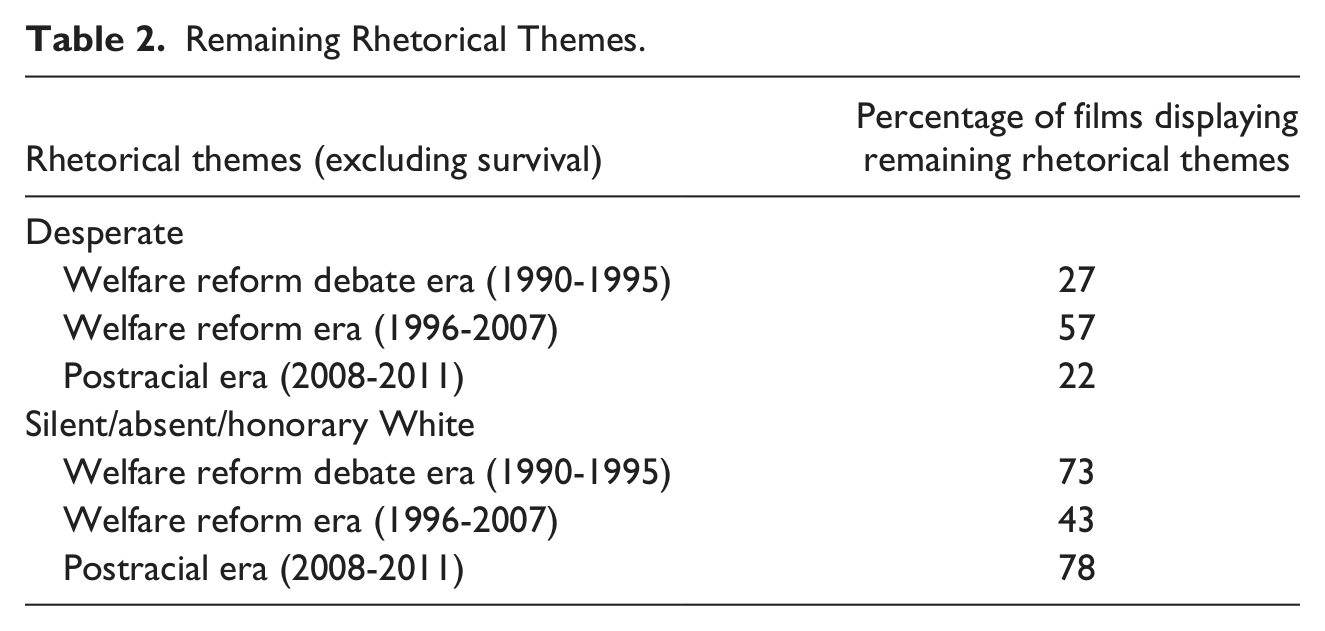
As previously stated, the data indicate there is a clear preponderance of films that depict the survival motif throughout each era. Table 2 illustrates that 57% of the remaining films in the welfare reform policy period (1996-2007) illustrate images of the desperate Black mother. The overwhelming rhetoric of this policy period reinforces the notion that, left to their own devices, Black women will resort to the worst behavior in order to achieve their desired outcomes. There is a clear indication that she will have wanton interracial affairs, prostitute herself, lie, cheat, steal, and even murder, if something isn’t done to save her from herself, thus, falling in line with and reaffirming the ongoing need for welfare reform.
Remaining Rhetorical Themes.
Desperate
The motif of desperation is illustrated in films that depict the Black mother, seeking rescue from poverty, loneliness, parenting, working, and so on. Often, she seeks this deliverance in the form of a relationship and more often than not, the relationship is sexual in nature and/or with someone White and/or wealthy and/or unattainable, for example, Waiting to Exhale (1995) and The Bodyguard (1992). As we can see from these two examples, inner city poverty is not a requirement for this theme. It seems that wealth, talent, success, and healthy communities are insufficient resources to save the Black woman, raising the question: What is she being saved from? Herself? Her Blackness? Her womanhood? This motif harkens back to the historical construction of Black womanhood as problematic by virtue of its very existence.
When redemption is not sought in the form of a relationship, the Black mother is often depicted as seeking money above all else. Whether for love or money, the mother in these depictions is often so desperate that she will even commit crimes such as prostitution, bribery, and/or murder, for example, Set It Off (1996) and Mad Money (2008). These films portray Black mothers who, even in their efforts to save their families from poverty and suffering, make poor irresponsible choices that lead to quick money in the short run, but disgrace, prison, and/or death in the long run.
“Postracial” Policy Period (2008-2011)
Since the election of a biracial president in 2008, the United States has been touted as a “postracial” phenomenon. In the president’s lifetime, Blacks have moved from disenfranchisement to meaningful positions of authority and power, culminating in his election. Unfortunately, this notion of a postracial America is primarily characterized by a pervasive color-blind racism, rather than a ubiquitous rejection of historical bigotry (Bonilla-Silva, 2010). Americans now perceive the nation as one whose people neither depend on nor require entitlement programs for survival. Instead, as evidenced by our president’s own success, each of us must commit to work hard and pay his or her own way.
A phenomenon in the current era sees a trend toward films cloaked in, inspired by true events, and feel-good inspirational family fun. The Blind Side (2009) reduces the tragic true story of an abused and neglected young boy to a plot device in the fashioning of a sports star and the constructing of a White savior. The highly popular film The Help (2011), which is often misrepresented as a journalistic field study, rather than a fictional story written by a White author, harkens back to the nostalgia of days gone by. Other films, like Jumping the Broom (2011), present Blacks as existing somehow beyond race/racism, while simultaneously reinforcing myriad stereotypes. Yet, the negative social rhetoric around Black motherhood is as intensely vilifying as ever. Enshrouded in uplifting tales of perseverance, survival, and the triumph of the human spirit, the rhetoric promulgated through popular films in the recent era has represented Black motherhood as villainously as ever. Today’s subtle, often secondary representations, that is, The Blind Side (2009) and Precious (2009), appear conciliatory in comparison with yesterday’s blatant (mis)representations, that is, Claudine (1974) and Boyz in the Hood (1991). However, the outcomes remain the same, the denigration of Black motherhood. A whopping 76% of films beyond those depicting the survival motif represent the silent or absent Black mother.
In this era, we see rhetoric reinforced in films of the Black child that survives the worst odds imaginable. Black youth with bad Black mothers are no longer the tragic heroes and heroines of their stories, left in prison or dead at film’s end, as was so often the case in the hood-genre films of the late 1980s and early 1990s. Instead, the films in the so-called postracial era present uplifting feel-good imagery of Black youth who have indeed overcome and managed to survive.
No films better represent this change in tide than the films of 2011. Only two films categorize this particular period; however, each film speaks volumes about the true state of race and race relations in the United States today—Jumping the Broom and The Help.
Silent/absent/honorary White
As shown in Table 2, 78% of the films (upon exclusion of the recurring survival motif) illustrate a silent/absent theme. Note that the silent/absent motif presents very differently depending on the political period. Black mothers in the welfare reform debate era are overwhelmingly presented as silent alongside the strong presentation of the problematized “bad Black mother.” While this motif presents as absent/honorary White Black motherhood in the current era, I have placed them together because it appears evident that they are two sides of the same coin.
Both models represent a narrative of a lack of Black mothering model. The earlier approach to the silent parent (as illustrated in films in the welfare reform debate era) vilifies Black mothers for their lack of responsible hands-on parenting capabilities as seen in Just Another Girl on the IRT (1992) while films displaying this rhetoric in the later period often present these absences out of necessity. The Black mother is often forced to relinquish much of her parenting power by not playing an active role in her child’s life, that is, The Book of Eli (2010) and Our Family Wedding (2010). The absent Black mother is either removed from the family entirely (via death, incarceration, or some other abandonment) or her role as a Black parent is diluted and she is presented as an honorary White parent as seen in films such as Away We Go (2010).
The honorary White mother motif—not to be confused with the White savior model illustrated in The Blind Side (2009)—occurs when race is ignored or mocked (even affectionately), that is, “just how Black do you think this baby is going to be?” 2 This motif is also present when the Black mother is the only non-White character/protagonist in the film, yet race is never referenced. In this scenario, the Black mother is often either completely desexualized, supplying support to other characters in the film, or she is partnered with someone White, in which case she is often hypersexualized. In these films typically, gender and race are both evident, but sexuality and culture are unreferenced or hyperbolized, that is, Monster’s Ball (2001), Moonlight and Valentino (1995), and Heart and Souls (1993).
Other times, the Black mother may be replaced with an actual White surrogate parent/parent-figure, for example, The Blind Side (2009). In these scenarios, the White parent/parent-figure is idealized as a model of humanity and goodness, as they are willing to make the sacrifices needed to take over where the Black parent failed, thus constructing a White savior model. The honorary White model can work in the reverse as well. In some films, the Black mother is presented as a surrogate parent-figure to a White child, even while her own child is unparented as seen in films such as The Long Walk Home (1990), The Secret Life of Bees (2008), and The Help (2011). 3
On reviewing data for 1990 through 2011, only 83 films were appropriate for the sample. This is an important note. Out of over 4,000 films released, only 83 films had meaningful representations of Black motherhood. In 2011, only two films fit those criteria, Jumping the Broom and The Help. Given the current state of rhetoric surrounding Black motherhood in film is being represented by only two resources, it seems important to offer an in-depth analysis of the available data.
Jumping the Broom
Though race—specifically, Blackness—is highlighted in the recent film, Jumping the Broom, class is also a major element of its representations. In its discussion of class, this film simultaneously idealizes and critiques a highly Eurocentric model. Juxtaposed to this model is the representation of the male protagonist who survived the “bad Black mother.” The character of the mother of the groom clearly embodies the mammy stereotype for the new millennium. The overweight, dark-skinned, wholly desexualized, insecure, clingy, emasculating Black mother, alongside her best friend who embodies Sapphire, represents the negative elements of Black womanhood and Black motherhood. Meanwhile, the affluent, educated, idyllic family is so modeled after a European archetype that they even speak French among one another periodically. The film further presents other Black stereotypes, including (a) the tragic mulatto, in the film’s female protagonist—the bride, whose White father abandoned her young, wild, and foolish Black biological mother after impregnating her as a reckless teen; (b) Jezebel in the form of the vampy seductress maid of honor, who is eventually tamed; (c) the Magical Negro in the form of the longtime house servant, who illustrates the nuances to the roles class plays; (d) the ghetto thug, embodied by the groom’s cousin—presented as a jealous back-biter, with little capability to form meaningful relationships; as well as (e) for the so-called postracial era, the bevy of characters that pulled themselves up by their bootstraps and transcended their class status through education and hard work (Harris-Perry, 2011; Jewell, 1993; Rousseau, 2009). This film, on the surface, is a display of the beauty of Blackness, the diversity of Black cultures, and may even be considered a bit of a critique of the material nature of the capitalist system. However, underneath the surface, this film clearly reframes the historical negative social rhetoric for the new audiences of today’s era.
The Help
While the highly acclaimed 2011 film, The Help, is presented to the new millennium audience as an indictment of the world as we once knew it, the film is clearly critical of the bravado and inhumanity wielded by middle-class Whites in the midcentury South. It further highlights the varied impacts of the structural racism, which dominated the lives of Black women who served as domestic laborers. Yet, the film fails to thoroughly explore the lived experiences of Black women of the era. Instead, the Black women are only seen in relation to the White women and their families. Rather than investigate the nature of the abusive relationship suffered by one leading Black protagonist, we never even visibly see the husband—instead, like Charlie Brown’s parents and teachers, he is only experienced off-camera, while for the primary Black protagonist, the audience is never given any context whatsoever, other than having lost her son to an accident while he worked doing hard physical labor at a local mill. We never hear or see a husband or partner. She seems to have nothing beyond her grief, her religion, and her White charges. The women in the film only exist in the context of caring for White women and their children even while their own children are home being cared for by others, or worse, are already forced to work in order for the family to survive financially. The Black women in the film are literally silent enigmas—seen, but not heard—until a naive 23-year-old White woman lends them her voice, clarifies their position, and subsequently brings the civil rights movement to Jackson, Mississippi. As the film draws to a close, we see the beloved Black heroine of the film unfairly terminated from her employment. The job lost, for all intents and purposes, represents the loss of her entire identity. The job is lost because she spoke out against the oppressive establishment that denied Black women basic labor rights, including retirement, health care, and job security. Yet, as we watch her walk away from the only life she has ever known, our heartstrings are not tugged by the inhumanity of it all, but by the cries of the White child she must leave behind. As with the other film rhetoric of the era, this film reinforces historically damning stereotypes that promote negative rhetoric around Black womanhood/motherhood.
Assumption 3: Unique Oppression
The great irony of course is that the films which meaningfully depict images of Black women in the given time period are primarily films presented by Black directors. Although almost exclusively male, one might expect Black media to be more positively displayed when originating with Black filmmakers. However few of the films in the period were manufactured and distributed by Black filmmakers. Films produced by Harpo Productions mogul, Oprah Winfrey and films written, directed, and produced by and starring Spike Lee and Tyler Perry are few and far between in this cadre of films. 4
Black women experience a unique oppression that is at once raced, classed, and gendered.
The 1990s saw an updated resurgence of the historical notion of the White Man’s Burden. The State began claiming that it is the nation’s responsibility to train Black women how to be productive members of society. Perceived to have been lazy, irresponsible, and childlike, for far too long, the State decided it was time to teach Black women to take financial responsibility for herself and her children. She should earn her right to the public safety net that had previously been an entitlement of all American citizens, by participating in the wage labor system, or end all benefits. Given the history of Black women and labor in the United States, this is an ironic ultimatum, as Black women have historically been a primary source of labor in both the wage and slave labor systems.
In the era following welfare reform, though it is evident that reform methods have failed on myriad levels, the State continues to apply pressure to dissolve the system entirely. In 2008, moving into a stage of financial crisis unrivaled since the Great Depression and ushering in a new social era with the election of a biracial president, the United States boasted a postracial culture.
Welfare reform ushered in the era of work programs such as EarnFare, WorkFirst, and Wisconsin Works. These programs forced the participant to provide unpaid labor to an employer in an effort to reimburse the State for the costs of her monthly food stamp stipend. Once enough hours have been logged to repay this so-called debt, the participant may work for pay, presuming the employer has hours available and the participant does not earn more than what welfare guidelines indicate. Often this is less than US$50 for up to 35 hours of work (Block, Korteweg, Woodward, Schiller, & Mazid, 2006; Corcoran, Danziger, Kalil, & Seefeldt, 2000).
Along with the mission to foster a sense of fiscal responsibility and developing a strong work ethic in welfare recipients, the State also takes up the charge to address certain moral concerns about families on welfare. The State criminalizes personal decisions within welfare recipients’ lives, by claiming that common practices, such as extramarital cohabitation, premarital sex, single motherhood, and teen pregnancy are tantamount to welfare fraud (Block et al., 2006; Corcoran et al., 2000).
In the years since the onslaught of welfare reform, we have seen a meaningful rise in abortion and sterilization rates among Black and Latina women. It is arguable that updated technologies have made these procedures more accessible, not just for poor women or women of color, but to all women in the United States. That said, we still must note that after generations of demonizing Black reproduction, vilifying Black motherhood, and forcibly and strategically sterilizing undesirable populations, Black women have sterilizations and abortions in the United States more than any other demographic. 5 With few options other than to be degraded by intrusive policy, forced to work as unpaid laborers, offered cash incentives not to reproduce, and threatened with legal actions as fraudulent criminals for simply dating, many former welfare recipients have declined future benefits. So perhaps welfare reform has proven “successful,” but at what costs?
Conclusion
HWT locates Black women as a unique laboring class within the capitalist structure. In testing key assumptions of HWT in this article, I purposefully link the regulation and dominance of U.S. public policy, in this case welfare, to the needs of the political economy. Historically, the needs of the U.S. economy have dictated the social rhetoric surrounding any given population. This rhetoric influences public opinion. In turn, public opinion leads to acceptance and support of policies specific to a given population. Using a brief comparative study of popular American films released theatrically since 1990, I offer tangible examples of how rhetoric surrounding Black motherhood is used to manipulate the masses in order to support the State’s economic agenda. I tested three key assumptions of HWT in exploring the issue of rhetoric and welfare reform: (a) The needs of the political economy dictate policies that disproportionately impact Black women; (b) social rhetoric is consciously constructed and manipulated as a tool of oppression; and (c) Black women experience a unique oppression that is at once raced, classed, and gendered. In sum, the image of Black motherhood is clearly manipulated from one policy period to the next depending on the needs of the economy. Black motherhood is represented as a burden to be survived during the period leading up to welfare reform, while the period of welfare reform presents Black mothers as desperate to do anything to survive, and finally, Black mothers/motherhood are/is silenced or absent in the current so-called postracial period. This research identifies ways in which images of Black women’s reproduction and parenting are manipulated in order to justify ongoing regulation and dominance of Black labor: biological, reproductive, and productive. In making these connections, historical womanism provides a context for examining policy as an expression of hegemonic control and media as a hegemonic tool of oppression, allowing us to situate Black women as a unique labor force.
Footnotes
Declaration of Conflicting Interests
The author declared no potential conflicts of interest with respect to the research, authorship, and/or publication of this article.
Funding
The author received no financial support for the research, authorship, and/or publication of this article.