



Abstract
Research has shown that urban-residing African American women engage in volunteer work at impressive rates. However, few studies have empirically assessed the factors that account for volunteerism within this population. This study explores the relationship between demographic variables, early religious involvement, current religious involvement, empathy, perspective taking, and volunteer engagement among African American women residing in a large urban center (N = 211). Findings from multivariate analyses revealed that current religious involvement positively predicted women’s volunteer engagement. Age was found to negatively predict volunteer engagement but positively predict the number of hours women spend volunteering per year. The implications of these findings are discussed and future lines of research considered.
African American women have a remarkable history of volunteer engagement (Cash, 2001; Cohen & Kapsis, 1978; Farmer & Piotrkowski, 2009; Gilkes, 1998). Through their willing service, women have transformed the educational, social, political, and economic welfare of the communities in which they live and through which they traverse (Farmer & Piotrkowski, 2009; Gilkes, 2001; Stewart, Settles, & Winter, 1998). This substantive history of engagement begs the following question: What inspires African American women to volunteer? Efforts to address this question in psychology have been limited. Certainly, research on volunteer engagement among women as a broad social identity group has flourished (e.g., Kulik, 2010; Parkinson, Warburton, Sibbritt, & Byles, 2010; Rotolo & Wilson, 2007). Scholars also have elucidated factors associated with volunteerism among African Americans generally (e.g., Cohen & Kapsis, 1978; Mattis et al., 2004; Mattis et al., 2000; Musick, Wilson, & Bynum, 2000; Reeder, Davison, Gipson, & Hesson-McInnis, 2001). However, few studies have explored the factors that are associated with volunteerism among African American women specifically. As Higginbotham (1992) notes, scholars in both ethnic/cultural studies and feminist studies have overlooked African American women’s prosocial engagement as an area for serious study: Where the former often has failed to consider gender, the latter has given race and culture short shrift. This work addresses the gap in understanding African American women’s prosocial behavior by examining how multiple aspects of social location, including age, cultural practices (e.g., religious involvement), socioeconomic status (e.g., education and income), and traits putatively associated with gender (e.g., empathic concern and perspective taking), inform African American women’s volunteer engagement and time spent volunteering.
Defining Volunteerism
Penner (2002) defines volunteering as “a long term, planned, and discretionary prosocial behavior that benefits strangers and occurs within an organizational context” (p. 448; see also Penner, Dovidio, Piliavin, & Schroeder, 2005). Wilson (2000) similarly locates volunteerism within a subset of prosocial behaviors that occur in an organizational context. Because Penner’s definition of volunteerism discounts an array of factors including time, life demands, and the availability of opportunities to serve that might hinder an individual’s ability to make a “long term” commitment to volunteer service, we instead define volunteerism as an individual’s volitional engagement in unpaid work, occurring within an organizational framework, and undertaken with the primary aim of advancing the well-being of others. A single organizing question guides this work: What are the factors that predict volunteerism among African American women living in urban contexts? Grappling with this question requires attention to existing scholarship on the link between volunteerism and four dimensions of social identity and social location: urbanicity, race, culture, and gender. We address each of these in turn.
Urban Life, Empathy, and Prosocial Behavior
Social scientists historically have conceived of urban environments as crucibles of insurmountable overpopulation, poverty, crime, and social, structural, and environmental decay. Building on this view, Milgram (1970) proposed an Urban Overload Hypothesis, which asserts that chronic exposure to these adverse sociostructural conditions has enduring psychosocial consequences. Namely, he argues that these conditions produce a high level of stress that overwhelms urban dwellers, depletes their ability to attend to the plight of others, promotes social norms that reinforce non-involvement, and minimizes the likelihood that they will extend themselves to help those in need.
This negative representation of urban residents had lain unchallenged beneath the surface of social scientific discourse for decades—and, indeed, this view of urban life, urban overload, and their effects on prosociality has received some empirical support over the years (cf. Bridges & Coady, 1996; Reisig & Cancino, 2004; Sherrod & Downs, 1974). However, Milgram’s highly deterministic formulation of the link between urbanicity and prosociality fails to contemplate at least three critical points. First, while America’s urban centers are, indeed, characterized by significant structural challenges and by the presence of stressogenic conditions, these spaces also are ripe with assets including ethnic, class, and cultural diversity, as well as myriad forms of human, material, social, and cultural capital (Gordon, 2003). Second, regardless of the stresses inherent in the contexts in which they live, some individuals may, by virtue of social location (e.g., gender, age) and personality orientation, be predisposed to behave compassionately or caringly to others who are in need. Finally, some people residing in urban centers may be embedded in ideological or moral communities (e.g., religious institutions or religious communities) that may inspire them to care for the welfare of others and that may provide crucial opportunities for prosocial involvement. As a first step to our empirical study, we address these points below with particular attention to their relevance for exploring the urbanicity-volunteerism link among African American women.
Empathic Concern and Volunteerism
At the heart of Milgram’s classic formulation of prosocial behavior in urban contexts are the a priori assumptions that empathy is a catalyst of prosocial behavior and that empathic concern is a principal casualty of urbanicity. The former assertion has been well investigated. Indeed, the empathy-altruism hypothesis has been the most rigorously examined and the most well-supported hypothesis in research on prosocial development. This hypothesis is rooted in the notion that empathic concern (i.e., sympathy and compassionate concern for the well-being of others) leads individuals to engage in helping behaviors aimed at preserving the welfare of others.
Empirical studies of altruism have consistently demonstrated a positive association between empathic concern and prosocial, particularly altruistic, behavior (Batson, 2010; Batson et al., 1995; Eisenberg & Fabes, 1998; Piliavin & Charng, 1990). In the context of volunteerism research, however, this hypothesis has received inconclusive support. Some studies have found a positive association between empathy and this particular manifestation of prosocial engagement (Bekkers, 2005; Finkelstein & Brannick, 2007; Penner, 2002; Penner & Finkelstein, 1998; Unger & Thumuluri, 1997). However, others have not (Davis, Hall, & Meyer, 2003; Finkelstein, Penner, & Brannick, 2005). Importantly, African Americans seldom comprise most targeted volunteer populations, and many studies fail to report the racial background of study subjects or to provide analyses that account jointly for race and gender (e.g., Davis, Hall, & Meyer, 2003; Davis et al., 1999; Finkelstein et al., 2005; Unger & Thumuluri, 1997). As such, the extent to which extant findings are relevant to African American women volunteers is unclear.
It is noteworthy that there is a link between empathy, social identity, and context. In particular, studies have consistently demonstrated a link between gender and empathy such that women and girls tend to score significantly higher on indices of empathy than their male counterparts (see Eisenberg & Fabes, 1998; Markstrom, Huey, Stiles, & Krause, 2010; Palmese & Schmidt, 2013). Further, there is some limited evidence that people who live in urban contexts score lower on indices of empathy than people residing in rural ones (Kalliopuska, 1994).
Taken together, these findings would appear to support Milgram’s thesis. However, the link between empathy and volunteerism has not been investigated empirically in research focused on African American women who reside in urban contexts. Even more, no studies have investigated these relationships in relation to religiousness—a cultural ideological framework that scholars theorize is associated with both empathic concern and selfless giving.
African American Religious Involvement
Social scientists have established a robust relationship between religious involvement and volunteerism (Borgonovi, 2008; Goss, 1999; Hodgkinson & Weitzman, 1996; Mencken & Fitz, 2013; Musick et al., 2000; Wilson & Janoski, 1995; Yeung, 2004). Scholarship focused on Black religious organizations, and Black churches in particular, points to an especially robust link between religiousness and prosocial community engagement. Indeed, Black churches have had central roles in the social, political, and economic transformation of African American communities since the antebellum period (Billingsley, 1999; Billingsley & Caldwell, 1991; Carson, 1990; Lincoln & Mamiya, 1990). Steeped in an ideology that sees social justice and social responsibility as central spiritual missions (see Raboteau, 1989), African American religious institutions have been responsible for launching vital initiatives to provide a range of supports including, but not limited to, housing, employment training, family and individual counseling, economic development, emergency supports, health care, health education, and political and legal supports to African American communities (Caldwell, Chatters, Billingsley, & Taylor, 1995; Gilkes, 2001; Littlefield, 2005; McRoberts, 2003; Samuels, 2011). These supports have helped these communities to survive and thrive in the face of adversity.
In keeping with this asserted link between religiousness and prosocial involvement, research has found volunteerism among African Americans to be strongly associated with church attendance (Gilkes, 2001; Mattis et al., 2004; Musick et al., 2000). For African American women in particular, religious organizations serve as a primary catalyst for volunteer engagement (Cash, 2001; Cohen & Kapsis, 1978). African American women are more likely to be active church members and are more subjectively religious than are African American men (Higginbotham, 1997; Taylor, Mattis, & Chatters, 1999). Their religious affiliation also increases their likelihood of becoming involved in volunteer activity (Gilkes, 2001; Penner, 2002).
The pathways by which religion informs volunteerism are not clear. Musick and colleagues posit that religious institutions are contexts that provide opportunities for African Americans to become involved in volunteer work and serve as contexts in which there is an improved likelihood of being asked to volunteer (Musick et al., 2000). Alternatively, it may be the case that religion motivates volunteerism by instilling a belief in the necessity of doing work to help vulnerable others, by reformulating volunteer activity as an authoritative form of devotional practice, or by creating a social environment in which religious group activity revolves around volunteer-related activities and events (Batson et al., 1989; Lam, 2002). Einolf (2011) found that women have wider social networks as a result of their participation in religious life. These networks may be dense with the kinds of social capital needed to stimulate volunteerism (e.g., knowledge of opportunities to become involved, access to information regarding volunteerism). In light of these research findings, we anticipate that members of religious institutions will more likely be volunteers than will non-members. We also anticipate that they will dedicate more time to such work.
It is possible, too, that religiousness promotes prosocial behavior by stimulating people’s capacity for empathy and perspective taking. This proposition certainly seems reasonable as many religions including the Abrahamic religions (Judaism, Islam, and Christianity) emphasize compassion for those who are in need. However, to date, empirical findings regarding the link between empathy and religiousness have been equivocal. Markstrom and colleagues (2010) and Duriez (2004) found no link between religiousness and empathy. Saroglou and colleagues found no correlation between religiousness and empathy in self-reported data, but did find a significant link between these factors when data were reported by siblings (Saroglou, Pichon, Trompette, Verschueren, & Dernelle, 2005). As has been noted earlier, these studies have not focused on the experience of African Americans generally, or African American women in particular.
Clearly, a theoretical gulf lies between Milgram’s conceptualization of urban spaces as inimical to prosocial behavior and an empirical record demonstrating that African American women who inhabit these spaces frequently engage in volunteer work (Cash, 2001; Cohen & Kapsis, 1978; Gilkes, 2001)—a form of prosociality that Milgram’s Urban Overload Hypothesis would find improbable. This study addresses this gap by applying a culturally sensitive and gendered approach to understanding prosocial behavior. Whereas Milgram’s approach to urban social norms overlooks interpersonal differences, omits cultural influences, and homogenizes city dwellers, our approach provides a nuanced and population-specific theoretical lens to more accurately assess the ways in which urban-residing African American women interact with others in their social environment. By asking what inspires urban-residing African American women to volunteer, our research question provides an empirical account of prosocial engagement that is, to date, absent from both the psychological and sociological literatures. In filling this literature gap, our research provides an overdue counterpoint to prevailing negative depictions of African American women’s urban sociality. Furthermore, in identifying factors that motivate volunteerism among urban-residing African American women, our research aims to offer information that might assist volunteer-based organizations identify and attract individuals from this population who may be willing to volunteer. Focusing on a sample of urban-residing African American women, we examine the extent to which two domains of empathy identified by Davis (1983; empathic concern and perspective taking) and religiousness are associated with the likelihood of volunteering as well as the amount of time that women dedicate to volunteer work.
Method
Participants
Data for this study were collected from a community sample of African American women (N = 211) residing in a large city in the American Northeast. Participants were recruited through flyers posted in public venues in the community, including restaurants, community centers, laundromats, and nail salons. No incentives were provided for participation. Surveys were distributed and completed at each recruitment site. Surveys took approximately 15 minutes to complete.
Descriptive statistics for demographic variables are presented in Table 1. Participants (N = 211) ranged from 16 to 83 years of age with a mean age of 32.42 years (SD = 13.94). Among participants, 44.5% (n = 94) had completed some college, 22.7% (n = 48) had earned a college degree, 13.7% (n = 29) had earned a graduate or professional degree, and 18.9% (n = 40) had a high school diploma or General Educational Development (GED). With regard to annual income, 9.0% (n = 19) earned less than US$10,000 annually; 21.4% (n = 45) earned between US$10,000 and US$29,999; 32.7% (n = 69) earned between US$30,000 and US$49,999; 12.3% (n = 26) earned between US$50,000 and US$69,999; and the remaining 24.6% (n = 52) earned more than US$70,000 annually.
Means, Standard Deviations, and Ranges for Demographics and Study Measures (N = 211).
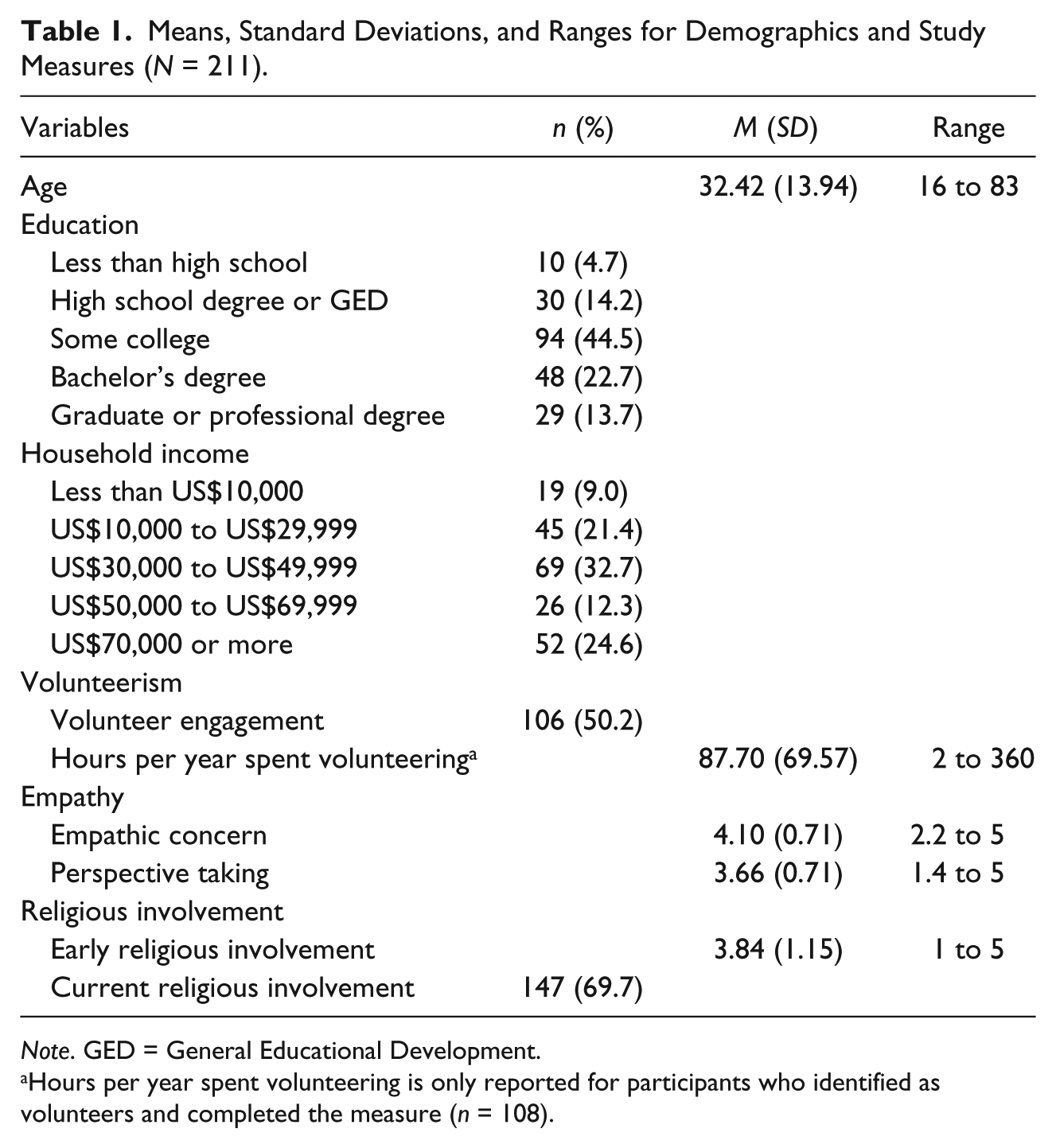
Note. GED = General Educational Development.
Hours per year spent volunteering is only reported for participants who identified as volunteers and completed the measure (n = 108).
Measures
Volunteerism was assessed in two distinct ways. First, participants responded to the prompt, “Are you involved in any volunteer activities?” Responses to this item were scored dichotomously (0 = no and 1 = yes). Second, participants were also asked, in an open-ended question, to record how many hours they volunteered each year (“How many hours per year do you spend doing volunteer work?”).
Religious Involvement was assessed with four items borrowed from the National Survey of Black Americans (NSBA; see Jackson, 1991) and the National Survey of American Life (NSAL; see Jackson et al., 2004) to assess religiousness. Early Religious Involvement was measured using three items: “When you were a child, how often did you attend religious services?” “When you were a child, how often did your parents or caretakers attend religious services?” and “How important was religion to your family when you were growing up?” The first two items utilized a 6-point Likert-type scale (0 = never, 1 = once or twice a year, 2 = once a month, 3 = two to three times a month, 4 = four to five times a month, and 5 = six or more times a month), and the latter item used a 6-point Likert-type scale (0 = not at all important to 5 = very important). This index had an observed Cronbach’s alpha of .84.
Current Religious Involvement was assessed using a dichotomously scored stand-alone item: “Are you a member of a religious institution?” (0 = no and 1 = yes).
Empathic concern
Four items from the Interpersonal Reactivity Index (IRI; Davis, 1983) were used to assess empathic concern (α = .65). Sample items include, “I often have tender, concerned feelings for people less fortunate than me,” and reverse coded items such as, “Other people’s misfortunes do not usually disturb me a great deal.” Each participant indicated how truly each statement reflected her empathic concern on a 5-point Likert-type scale (1 = not at all like me to 5 = very much like me). Empathic concern was calculated as an average of scores on the four items.
Perspective taking
Perspective taking was assessed as a mean of scores on four items from the IRI (α = .77). Index items included, “Before criticizing somebody, I try to imagine how I would feel if I were in their place”; “I believe that there are two sides to every question and try to look at them both”; “I try to look at everybody’s side of a disagreement before I make a decision”; and “When I’m upset at someone, I usually put myself in their shoes for a while.” Participants responded to items on a 5-point Likert-type scale (1 = not at all like me to 5 = very much like me).
Results
Predicting Volunteer Engagement
Of the 211 participants surveyed, 106 (50.2%) identified as volunteers, while the remaining 105 (48.8%) did not. Correlations between predictors of volunteerism and volunteer outcomes are presented in Table 2. As expected, current religious involvement, as measured by membership in a religious institution, had a positive and significant bivariate association with volunteer engagement (r = .271, p < .001). Age was also significantly, yet negatively, associated with volunteerism at the bivariate level (r = −.205, p < .01), indicating that younger participants were more commonly identified as volunteers than older participants.
Intercorrelations Between Demographic Factors, Interpersonal Reactivity, Religiousness, and Volunteerism (N a = 211).
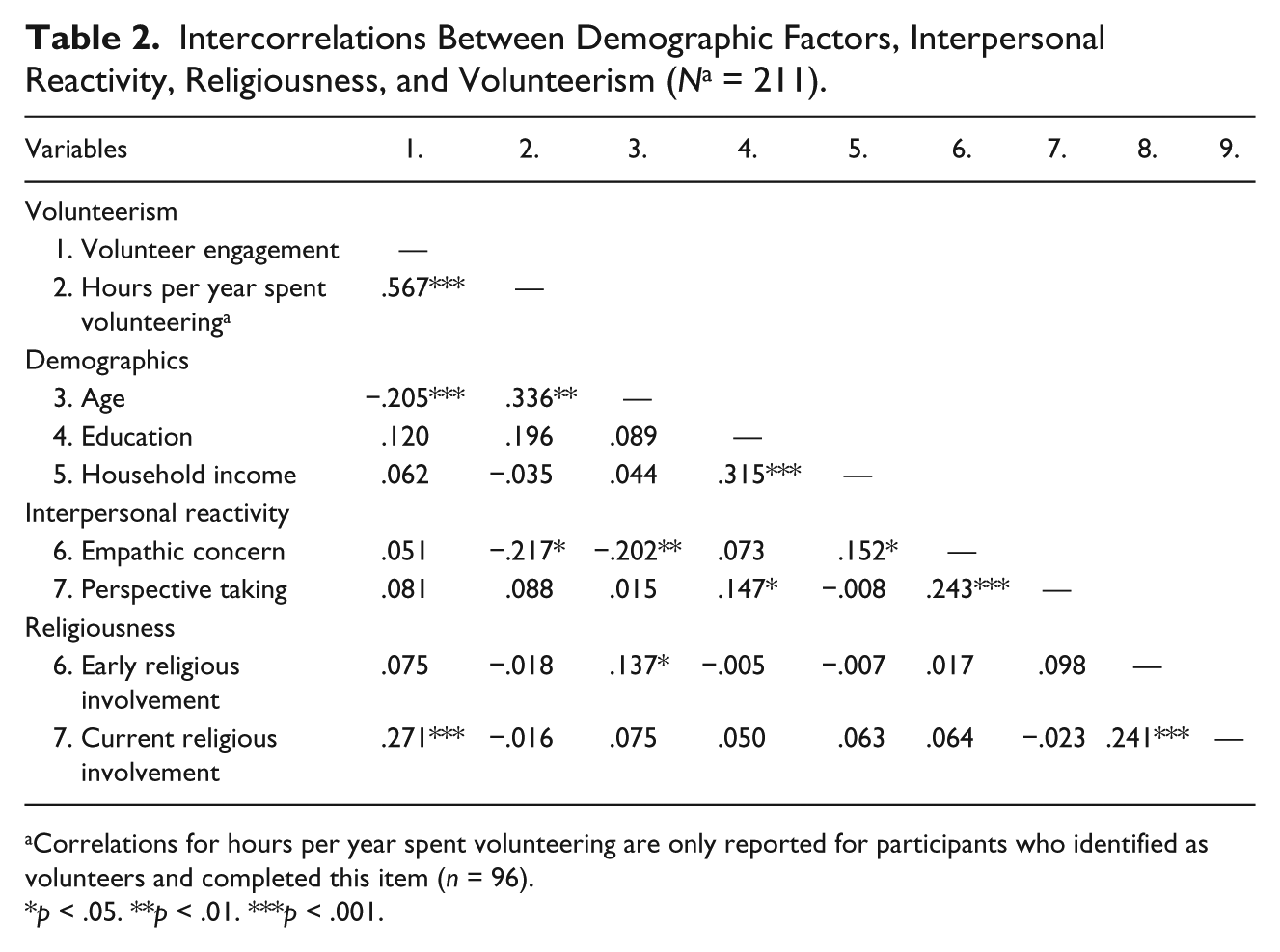
Correlations for hours per year spent volunteering are only reported for participants who identified as volunteers and completed this item (n = 96).
p < .05. **p < .01. ***p < .001.
To further probe the relationship between age and volunteer engagement, we segmented the sample into three age brackets: adolescents and emerging adults younger than 24 years old (n = 78; 37.0%), early- and middle-aged adults from 24 to 40 years of age (n = 71; 33.6%), and adults older than 40 years of age (n = 62; 29.4%). Volunteer engagement by age bracket is presented in Figure 1. Participants in the youngest group were more likely to identify as volunteers than not, participants in the middle-aged group were as likely to be volunteers as not, and participants in the oldest group were more likely to not be engaged in volunteer work, χ2(2) = 10.081, p < .001. We also explored the relationship between education and volunteer engagement. Specifically, we compared volunteerism reported by women who had completed a college education (n = 77; 36.5%) with women who had not received a college degree (n = 134; 63.5%). Analyses revealed no relationship between educational attainment and likelihood of engaging in volunteer activities, χ2(1) = 0.439, p = n.s.

African American women’s volunteer engagement as a function of age and education.
Intercorrelations between demographic variables, religiousness, interpersonal reactivity, and volunteer engagement are presented in Table 2. Age had a significant and negative bivariate relationship with volunteer engagement, r = −.205, p < .01, suggesting that younger participants more frequently identify as volunteers. Current religious involvement, as measured by current church membership, was significantly and positively associated with volunteer engagement at the bivariate level, r = .271, p < .001. Early religious involvement was not associated with the likelihood of volunteering.
To further explore the relationship between our independent variables of interest and volunteer engagement, we conducted a binary logistic regression analysis to assess which variables predict volunteer engagement within our sample (see Table 3). The independent variables included in the analysis were chosen on the basis of their conceptual relevance to social location (e.g., age, income, and education), the lived experiences of African American women (e.g., religious involvement), and personality factors posited to affect prosociality by past research (e.g., empathic concern and perspective taking). The regression model was significant, Nagelkerke R2 = .198, χ2(7) = 33.86, p < .001. Age was a significant and negative independent predictor of volunteer engagement, b = −.04, Wald’s χ2 = 12.29, p < .001. Empathy and perspective taking did not significantly predict the likelihood that women would engage in volunteer work. Membership in a religious institution emerged as a significant and positive independent predictor of volunteer engagement, b = 1.35, Wald’s χ2 = 15.40, p < .001, with members being, on average, 3.87 times more likely to volunteer than non-members.
Logistic Regression Analysis Predicting Volunteer Engagement (N = 211).
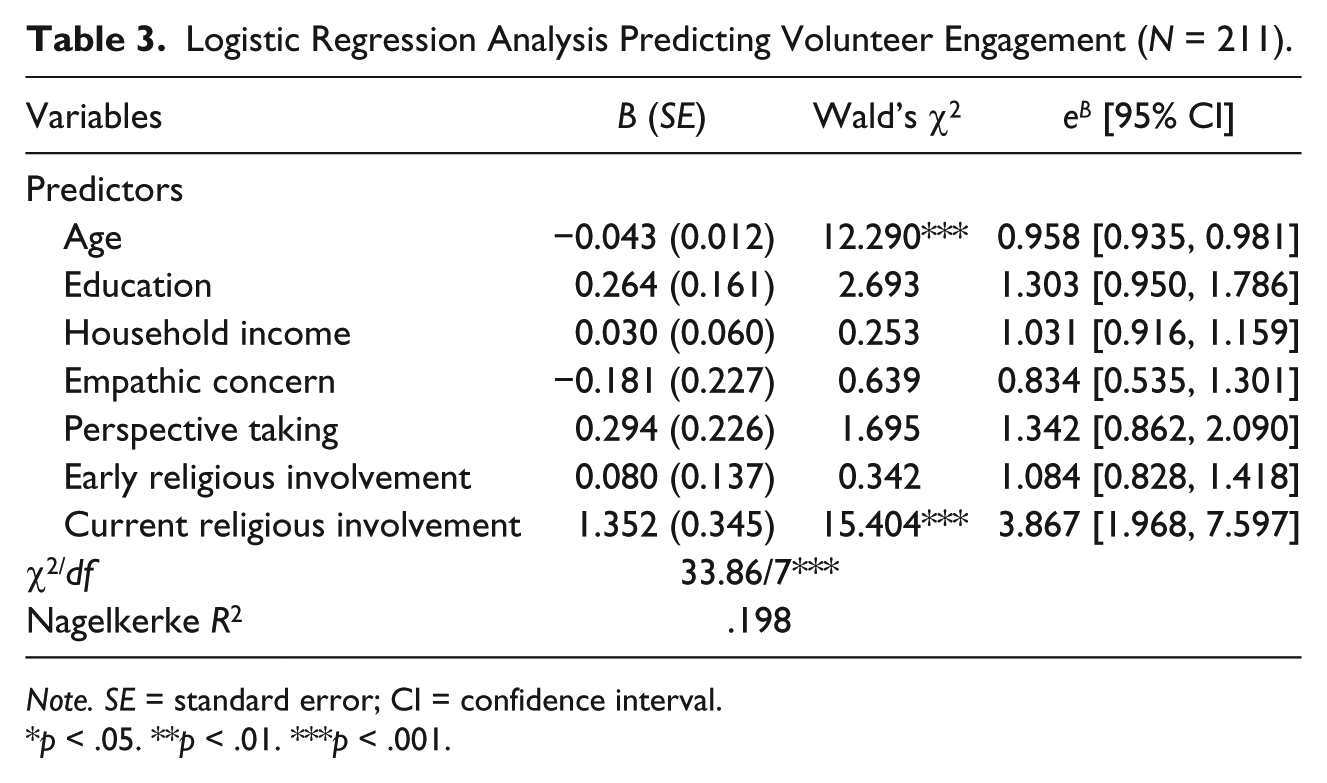
Note. SE = standard error; CI = confidence interval.
p < .05. **p < .01. ***p < .001.
Predicting Hours Per Year Spent Volunteering
Of the 106 women who identified as volunteers, 98 reported the number of hours they spent volunteering per year. Two influential outliers (Cook’s d > 1.0) were removed from our analyses, leaving 96 participants. These women spent between 2 and 360 hours per year engaged in volunteer activities, with an average time spent volunteering of 87.70 hours per year (SD = 69.57).
Using the aforementioned age brackets, we explored whether women in different age groups differed in the amount of time they devoted to volunteer activities. A one-way ANOVA revealed significant mean differences in time spent volunteering between age groups, F(2, 93) = 5.75, p < .01. Bonferroni post hoc comparisons reveal that differences in hours per year spent volunteering between participants in the adolescent and emerging adult bracket (n = 44, M = 70.18, SD = 60.49, Median = 55.00) and the “over 40” bracket (n = 17, M = 133.18, SD = 72.25, Median = 156.00) were significant, t(25.15) = −3.19, p < .01. No other significant mean differences between age groups were found. We also assessed whether there were differences in time spent volunteering between women who had not completed college and those who had: Women with a college degree (n = 40, M = 97.83, SD = 67.43, Median = 79.50) spent more hours volunteering each year than did women without a college degree (n = 56, M = 71.32, SD = 58.58, Median = 60.00); this difference was significant, t(94) = −2.051, p < .05.
We calculated bivariate correlations between our independent variables and hours per year spent volunteering only within this subset of the study sample (see Table 2). A natural log transformation was performed to normalize the distribution of hours per year spent volunteering for these purposes. Age was positively and significantly associated with time spent volunteering (r = .336, p < .001). Intriguingly, empathic concern had a significant and negative association with hours per year spent volunteering (r = −.217, p < .05). Perspective taking and religiousness variables were not significantly correlated with time spent volunteering.
Finally, we ran a multiple regression model predicting hours per year spent volunteering from demographic factors, religiousness, and interpersonal reactivity (see Table 4). The regression model was significant, R2 = .163, Adjusted R2 = .097, F(7, 88) = 2.45, p < .05, and accounted for 16.3% of the variance in time spent volunteering. Age independently predicted time spent volunteering, β = .30, p < .05. Empathic concern, despite having a significant bivariate association with time spent volunteering, was not an independent predictor of time spent volunteering after controlling for other demographic and religious predictors, β = −.12, p = n.s.
Multiple Regression Analysis Predicting Number of Hours Volunteered Per Year (n = 96).
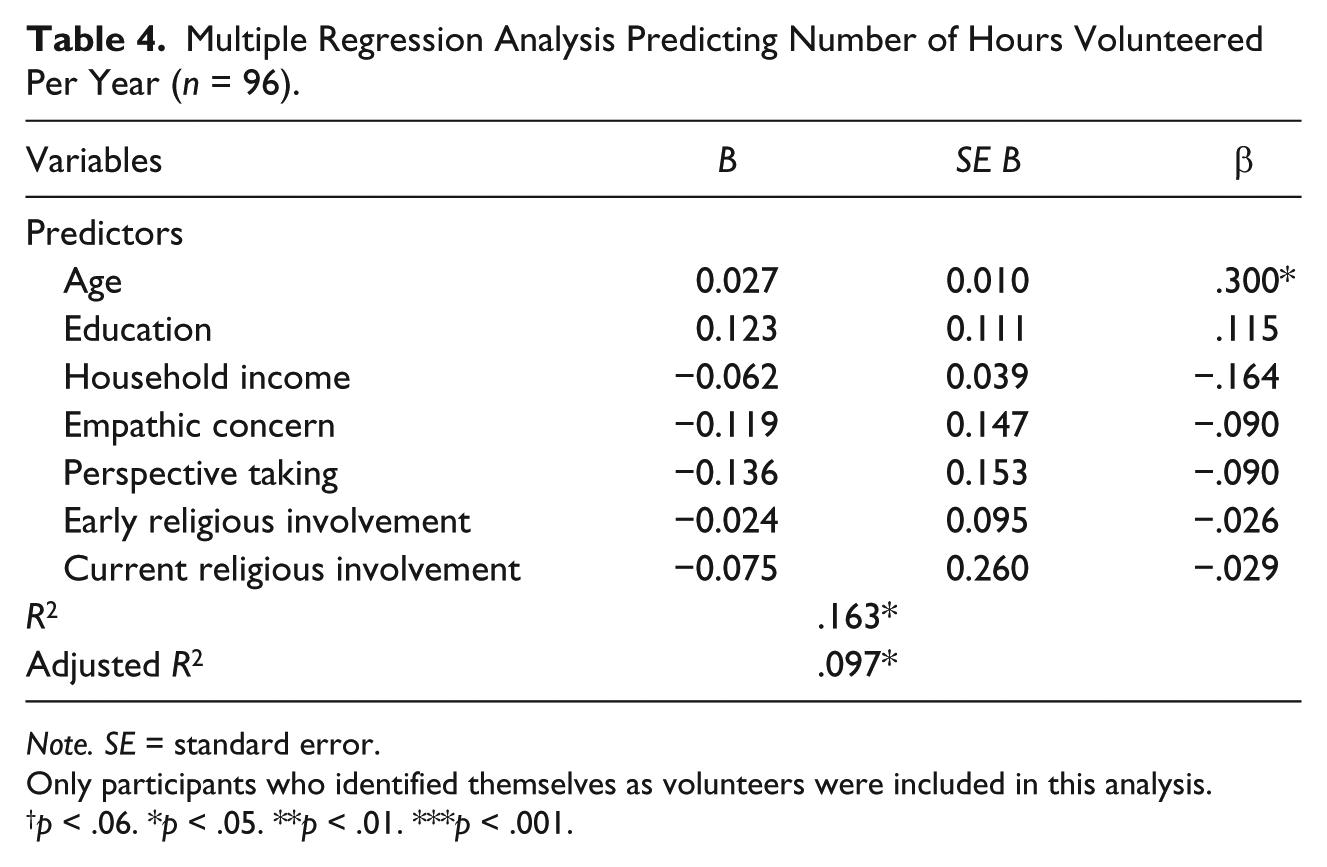
Note. SE = standard error.
Only participants who identified themselves as volunteers were included in this analysis.
p < .06. *p < .05. **p < .01. ***p < .001.
Discussion
Empirical research on volunteerism has largely overlooked the volunteer service performed by African American women living in urban areas. The present study redresses this oversight by exclusively assessing the extent to which factors that theoretically pertain to the lived experience of African American populations (i.e., religiousness) as well as factors related to individual differences (i.e., empathic concern and perspective taking) predict volunteer engagement for African American women.
Almost half of the sample participants identified as volunteers. Those who did reported volunteering an average 87.70 hours per year, and some participants spent nearly 1 hour per day (i.e., 360 hours per year) engaged in volunteer work. These numbers corroborate Cohen and Kapsis’s (1978) assertion that volunteering is normative among African American women living in urban areas. This high rate of volunteerism implicitly challenges Milgram’s (1970) contention that an urban environment suppresses prosocial behavior. At the very least, Milgram’s assertion regarding prosocial disengagement appears to require qualification with regard to African American urban-residing women.
Findings from our multivariate analyses revealed that volunteer engagement was negatively predicted by age, but that hours per year spent volunteering were positively predicted by age. In other words, more young women identified as volunteers than did older women, but the older women who were engaged in volunteer activity devoted substantially more time to these activities than did their younger counterparts. The finding that young African American women are actively engaged in volunteer work contradicts the widespread notion that emerging adults are self-absorbed or not prosocial (e.g., Twenge, 2013). However, the limited time they spend engaged in these activities, compared with older women, may reflect the differing priorities of women in these age groups. For instance, young women may be more engaged in navigating the challenges of identity development associated with emerging adulthood, which the literature suggests may be particularly difficult for African Americans on account of additional racial stressors (Arnett & Brody, 2008). By contrast, older women face a different set of contextual and developmental boons and barriers: On the one hand, older women have greater work and family obligations in addition to greater health concerns when compared with younger women, making opportunities to volunteer more difficult for them to realize. However, older African American women are also more religiously and politically motivated and empowered to give back to their communities (Gilkes, 2001). Slevin’s (2005) research, for instance, demonstrates how older African American women find meaning and purpose in taking on roles as “community mothers,” serving as moral exemplars, and shunning traditional notions of retirement (see also Gilkes, 2001). Our findings contribute to the positive and expanding narrative of older African American women by testifying to the many hours these women devote to volunteering in these capacities. Future research should explore the developmental trajectory of African American women’s volunteerism to better understand the evolution of their service over the life course.
Contrary to resource theories that assert that human capital (e.g., income and education) is positively related to volunteerism, and contrary to findings that have provided empirical support for human capital theories (e.g., Wilson, 2000), we found no relationship between income or education and either the likelihood of volunteering or the amount of time dedicated to volunteering among this sample of African American women. These findings stand in contrast to findings regarding the factors that are associated with volunteerism among African American men. Mattis et al. (2000) found that among African American men, higher levels of educational attainment were associated with a greater likelihood that men would be involved in volunteer activities, although education was not related to time spent volunteering. These differences in patterns of finding suggest the need for gendered approaches to understanding volunteerism among African American adults. Considered in relation to findings from Musick et al. (2000) regarding the role of being asked to volunteer in actual involvement in volunteering, it is feasible that African American women may be likely to be asked to volunteer regardless of their level of education.
To our surprise, empathic concern emerged as a negative correlate of volunteerism. Stated otherwise, more empathic women in our study spent fewer hours volunteering than less empathic women. In keeping with findings reported by Hoffman (1981), these findings suggest the possibility of an “empathic overarousal” effect in which highly empathic individuals become affectively overwhelmed at the sight of others’ suffering—so much so that they must withdraw from helping behaviors as a means by which to regulate their own affect. This would be consistent with the tenets of Milgram’s overload hypothesis. On the one hand, past research on trait empathy and volunteerism has not provided much support for this account (e.g., Davis et al., 1999). On the other hand, few studies have assessed urban-residing African American women’s volunteer behavior, so it is possible that this empathic overarousal is relevant for understanding the experience of African American women. Future studies should examine the viability of this empathic overarousal thesis using measures of empathy that have stronger psychometric properties.
As it stands, the literature provides a poor account of the effect that empathic concern has on prosocial behavior. Whatever the reason for this finding, we stress that the negative relationship between empathic concern and volunteerism—to the extent that this finding is valid—does not imply that highly empathic African American women are not prosocially engaged. Indeed, those African American women who have a strong affective response to those who are in need may discharge those needs in other prosocial ways—for example, through civic activism or through acts of everyday kindness performed outside of organizational contexts (Mattis et al., 2009).
We also examined the extent to which early religious involvement and current membership in a religious organization are directly associated with volunteer engagement. Our research brings greater clarity to the role that religiousness plays in volunteer engagement within the African American community. For women in our study, being a member of a religious organization was a significant independent predictor of the likelihood of volunteerism. Early religious involvement was not related to or predictive of either index of volunteerism. Together, these findings lend support to research that has underscored the pivotal role of church life in community development within the African American community (Billingsley & Caldwell, 1991; Cohen & Kapsis, 1978). To our knowledge, no previous studies have differentiated the effects of early versus current religious involvement on women’s volunteerism, and no research has assessed how these different experiences of religious participation affect volunteer engagement versus time spent volunteering.
These findings have implications for understanding the development of African American women’s volunteer behavior over the life course. Penner’s (2002) interactionist model of volunteerism contends that volunteerism is more than a behavior—it is also a form of identity. The relationship between current religious involvement and volunteer engagement further suggests that, for these women, volunteerism is maintained by continued involvement in organized religion. Future research should identify factors (e.g., specific messages, beliefs, and practices) that mediate the relationship between religious involvement and volunteer behavior, and explore the extent to which these messages and practices cultivate an identity of giving among African American women who volunteer.
Limitations and Future Directions
A few limitations to our findings merit consideration. The educational backgrounds and annual incomes of the participants in the study suggest that the findings of this study are not generalizable to all African American women. Indeed, the women in this sample appear to be better educated and more materially well resourced than African American women generally (U.S. Census Bureau, 2012). Studies involving more diverse samples from within this population will prove useful. Importantly, the profile of this sample reinforces an important point: There is a tendency in research on urban-residing African Americans to implicitly equate urbanicity with poverty. The diversity of this sample should serve as a reminder of the intragroup heterogeneity among urban-residing African Americans and should serve as encouragement to resist homogenizing views of city-dwelling African American people.
We conducted this study to assess the link between religiousness, individual differences, willingness to volunteer, and the time spent volunteering among African American women who live in urban centers. Our data do not allow us to assess the specific kinds of activities in which these women choose to engage when they volunteer, nor do our data allow us to examine the specific organizations within which their volunteering takes place. Future research should, however, determine how the factors considered in this study inform where women choose to volunteer their time, and the kind of work in which they engage.
Religious involvement was found to be a positive predictor of volunteerism within our sample. Our method of assessment, however, did not tap the nature of these African American women’s religious backgrounds, their religious and denominational affiliations, or their specific theological beliefs (e.g., Hale-Smith, Park, & Edmondson, 2012). These more specific factors may be relevant to better understanding the interplay between religious life and volunteerism: African American women join churches of varying size that differ not only in their liturgical emphasis on community work but also in their ability to provide volunteer opportunities to congregants (Drewery, 2008). Variations in church orthodoxy and denomination produce differences in volunteer engagement as well (Wilson & Janoski, 1995). While many scholars have suggested that specific religious beliefs affect volunteer behaviors (e.g., Lam, 2002; Mattis, 2002), little research has explored this relationship within African American communities. Understanding the beliefs that promote prosocial engagement for African American Christians and non-Christians (e.g., African American women Muslims) will allow for a particularly nuanced view of the link between religious belief and practices that promote social welfare.
Finally, churched men and women who volunteer their time to transformative community service may make at least two important distinctions between service work conducted in and through the church and similar work conducted through the secular contexts. First, some churched individuals may view their service work not as product of their own volition but as work given to them by God and that must be carried out as a matter of faith. Second, churched individuals may have a lexicon of service work that may have important implications for research on the topic. In sum, individuals may describe at least some aspects of their work not as volunteerism but as “church work,” “outreach work,” “committee work,” “community work,” or “ministry work.” In future studies involving African American women, it may be prudent to explore the nuanced vocabulary of service used by churched individuals and to inquire about the amount of time that women dedicate to these various forms of service. This approach may provide a more culturally situated approach to research on volunteerism among African Americans.
Footnotes
Declaration of Conflicting Interests
The authors declared no potential conflicts of interest with respect to the research, authorship, and/or publication of this article.
Funding
The author(s) disclosed receipt of the following financial support for the research, authorship, and/or publication of this article: This work was generously supported by an Altruistic Love grant to J. S. Mattis from the Fetzer Institute and the Templeton Foundation.