



Abstract
Although graphic lynching photographs have become a popular topic of academic study, today’s lynching iconography does not rely on spectacle. This essay explores how the shift to figurative representations of lynching affected anti-racist strategies. In particular, it examines how one organization and two authors of the Black Power/Black Arts Movement era—the Black Panther Party, playwright Ed Bullins, and novelist John Edgar Wideman—responded to this change. The Black Panthers and Bullins employed empty and cartoon noose imagery to retaliate against White power. They put the noose into the hands of a Black mob and made it into a tool of revenge. However, this strategy backfired, replacing one vision of mob violence with another, glossing over the costs of revolutionary violence, and allowing White culture to deny the racist meaning of the empty noose. John Edgar Wideman’s 1973 novel The Lynchers illustrates this, demonstrating that the empty noose image, even reclaimed for anti-racist purposes, has not been useful for African American liberation. Early anti-lynching activists like Ida B. Wells-Barnett were right in their insistence on gruesome spectacle in the fight against lynching, and their strategy remains necessary even in the 21st century, long after the era of frequent lynchings.
Photographs of charred bodies and graphic atrocities dominate scholarship on lynching, and for good reason. Spectacle stirred both racist anger and anti-lynching responses. But this spectacle peaked when lynching did, as lynchers sought souvenirs and anti-lynching activists incited public outrage about injustice. Today, racist symbolism more often appears as an empty noose carrying the memory of past violence and the threat of future aggression. In fact, most of my students in African American literature courses are surprised to learn that burnings or beatings can be classified as lynchings. This essay explores how the shift to figurative, generic representations of lynching affected anti-racist strategies. In particular, it examines how one organization and two authors of the Black Power/Black Arts Movement era—the Black Panther Party, playwright Ed Bullins, and novelist John Edgar Wideman—responded to this change.
The Black Panthers and Bullins employed empty and cartoon noose imagery—alternatives to spectacle—to retaliate against White power. They put the noose into the hands of a Black mob and made it into a tool of revenge rather than oppression. However, I argue that this strategy backfired, replacing one vision of mob violence with another, glossing over the real costs of revolutionary violence, and allowing White culture to deny the racist meaning of the empty noose. John Edgar Wideman’s 1973 novel The Lynchers illustrates this fact, demonstrating that the empty noose, even reclaimed for anti-racist purposes, has not been useful for African American liberation. Empty and cartoon noose imagery have only allowed the public—both Black and White—to claim innocence about the significance of mob violence. Early anti-lynching activists like Ida B. Wells-Barnett were right in their insistence on gruesome spectacle in the fight against lynching, and their strategy remains necessary even in the 21st century, long after the era of frequent lynchings. Today, such imagery can help explain and reject the use of empty or cartoon nooses in contemporary culture. When Sarah Palin and Barack Obama effigies both appeared in nooses in the 2008 Halloween decorations (Kim and Abdulrahim, 2008), more graphic and historically accurate dialogue about the history of lynching might have helped combat the use of the noose symbol to express either right- or left-wing political messages.
The Hanged Body Replaces the Burned One
In the first half of the 20th century, lynching was a pressing fear for Black Americans. Literary and political texts often expressed that fear by portraying lynching in graphic ways. As Philip Dray (2002) outlines in his history of lynching, At the Hands of Persons Unknown, White southern newspapers relished the details of alleged Black rapists and murderers paying for their crimes. Moreover, many participants in lynch mobs took photographs or gruesome souvenirs to document the event. Especially because many graphic images of lynching were taken as souvenirs and celebrations of anti-Black violence, it seems counterintuitive that anti-lynching activists relied on similar (and sometimes even the same) images and descriptions in their campaigns.
Ida B. Wells-Barnett was one of the early advocates of this strategy (Dray, 2002). For example, when Wells-Barnett distributed a pamphlet titled The Reason Why the Colored American Is Not in the World’s Columbian Exposition at the 1893 Chicago World’s Fair, which was designed to protest the dearth of exhibits on Black culture in the exposition while also publicizing the injustice of lynching, she included images and depictions taken directly from lynchers and their supporters. Her pamphlet included a souvenir photograph of a lynching and an inscription by a lynch mob participant on the back, reading “this S-O-B was hung at Clanton Ala. Friday Aug. 21st/[18]91 for murdering a little boy in cold blood” (Wells-Barnett, 1893, pp. 35-36). By including both front and back images of the document, Wells-Barnett expressed her outrage not only at the physical horror of the lynching but also at the White man who celebrated it.
Later in the same document, she cites another example of an 1892 lynching in Memphis by using graphic text from The Memphis Commercial in support of the lynch mob: As the body hung to the telephone pole, blood streaming down from the knife wounds in his neck, his hips and lower part of his legs also slashed with knives, the crowd hurled expletives at him, swung the body so that it was dashed against the pole, and, so far from the ghastly sight proving trying to the nerves, the crowd looked on with complaisance, if not with real pleasure. The Negro died hard. The neck was not broken, as the body was drawn up without being given a fall, and death came by strangulation. For fully 10 minutes after he was strung up the chest heaved occasionally and there were convulsive movements of the limbs. (p. 32)
Here, as in the first example, Wells-Barnett reproduced the graphic imagery of those who supported the lynch mobs, but while they used it as salacious gossip or voyeuristic pleasure, she employed it as evidence of atrocity and admission of White guilt. She forced readers to grasp the reality of lynching violence while highlighting the pleasure that White participants and supporters gained from these atrocities. She put both dead bodies and the violent pleasure of the White mob on display. While the article she cited assumed the guilt of the lynched man as a rapist, Wells-Barnett focused on proving the guilt of the lynchers, using their own language against them: “The personnel of the mob,” she said, is given by the Memphis Appeal-Avalanche. It says, “At first it seemed as if a crowd of roughs were the principals, but as it increased in size, men in all walks of life figured as leaders, although the majority were young men.” (p. 34)
The Appeal-Avalanche, she suggested, was giving away evidence that implicated a large swathe of the White community. She unearthed that evidence to advance the anti-lynching cause.
Wells-Barnett was not alone in her belief that portraying graphic spectacle was an important tool for combating lynching. Numerous literary authors in the first half of the 20th century did the same, and many did so by focusing less on the image of the noose and more on burnings. While hangings were always the most pervasive form of lynching, in Walter White’s 1929 account Rope and Faggot, he records approximately 13% of lynchings between 1917 and 1927 that involved burning, and literary writers were particularly compelled by these stories. In Mary Burrill’s (1919/1991) play “Aftermath,” for instance, the character Millie responds to her brother John’s question “You mean they lynched dad” with the explanation that “they burnt him down by the big gum tree” (p. 149). James Weldon Johnson’s (1912/2007) Autobiography of an Ex-Colored Man similarly describes “a scorched post, a smoldering fire, blackened bones, charred fragments sifting down through coils of chain; and the smell of burnt flesh—human flesh,” while Claude McKay’s (1920/1922) poem “The lynching” represents a victim as a “hanging char” and “the ghastly body swaying in the sun” (Johnson, 1912/2007, p. 146; McKay, 1920/1922, p. 51). These authors continued in Wells-Barnett’s footsteps by highlighting the gruesome side of lynching and also, in many cases, by focusing on the lives and families of particular individuals who were attacked.
Trudier Harris (1984) notes that figurative images of lynching—less macabre and less tied to specific individuals—increased as lynching itself decreased. Philip Dray (2002) identifies 1937 as the date of the last “spectacle lynching,” with crowds gathering to participate in and witness the murder (p. 406). Cultural representations of lynching began to change by the late 1930s, as graphic depictions gave way to the noose as a metaphor for lynching and other forms of racism (some of which were equally lethal, such as wrongful execution at the hands of the state). Images of burning and mutilation associated with lynching became more rare, and the noose itself—often depicted hanging empty or holding a generic cartoon body—took center stage. 1 Recent scholarship and gallery displays of lynching photographs, such as those from James Allen’s (2000) collection Without Sanctuary, have helped revive the memories of grisly lynchings, and although the renewed publication of such material has been controversial, its benefits emerge more clearly when contrasted with the problems of sanitized noose imagery.
Some of these problems became evident in the 1960s and 1970s, during the era of Black Power and the Black Arts Movement, when Black political activists and writers began to adopt an empty or cartoon noose, attempting to make it into a source of Black power rather than a symbol of Black oppression. As the works of John Edgar Wideman and Alice Walker reveal, however, the “un-spectacular” noose created problems for Black liberation, not increased power.
The Black Panther Party: Turning an Oppressive Noose Into Revenge
The Black Panther Party embraced the cartoon noose in the late 1960s to investigate the nexus between institutional and mob power that it invoked. While the noose represented Black oppression by White mobs and White institutions, they believed, it could also represent the power of Black mobs and Black institutions.
The Panthers recognized that the empty noose is a complicated image, in part, because it has a history associated with the state as well as the mob, including a history separate from anti-Black violence. Hanging prevailed as the primary method of capital punishment in the United States until electrocution made headway in the early 20th century, and public hangings remained common until the late 19th century (H. W. Allen, Clubb, & Lacey, 2008). Town squares often displayed the gallows, where the invisible hand of the state did the hanging. In certain circumstances, then, an empty noose represented state power over the populace, with its ability to punish either justly or unjustly.
The lynching noose, by contrast, belonged not to the state but to a mob that was tacitly state-sanctioned. Lynchers used a tool of the state to enact vigilante violence, and as anti-Black lynching became more prevalent in the late 19th century, the meaning of the noose itself began to morph, encompassing both state violence (the history of the death penalty) and vigilante violence (anti-Black lynching). The Panthers recognized the link between state and mob violence in lynching metaphors and used the noose to declare their opposition to racism and the American government. In doing so, they also announced that their visions of revenge lynching were driven not only by a Black “mob” but also by a newly imagined revolutionary “government.”
The Black Panther Party did not reject graphic images of lynching, and it sometimes published historical lynching photos in its Black Panther newspaper. But the Panthers were less interested in the particular facts of lynching and more interested in the way noose and lynching iconography could help them discuss contemporary state oppression. They accepted generic noose imagery because it helped them link the noose that stood for capital punishment to the one that symbolized lynching. This link was not new. The National Association for the Advancement of Colored People (NAACP) and the Communist Party had used the term legal lynching in the first half of the century to describe inequalities in the justice system for African Americans. The Scottsboro Boys case of the 1930s, in which a group of young Black men was accused of raping two White women, was the most famous example. And as L. V. Gaither (2006) reminds us in his book Loss of Empire, lynching at its height often accompanied the legal process of arrest and imprisonment. Policemen, judges, and jail keepers were often complicit or involved in illegal lynchings.
The Panthers leapt on this connection because both Huey Newton and Bobby Seale were on trial for murder in the late 1960s and could have faced the death penalty (Darnton, 1970; 1995 Conn. Acts 16). Newton was charged in the death of policeman John Frey after a 1967 shootout, and Seale was accused of ordering the murder of suspected police informant Alex Rackley in 1969. The jury in Newton’s case found him guilty of voluntary manslaughter, but the conviction was overturned, and Seale went free when the judge declined to re-try the case after the initial trial resulted in a hung jury (Oelsner, 1971). While the death penalty ultimately did not come into play, Panther members felt its threat acutely, and they associated it with lynching. A March 1970 issue of their newspaper The Black Panther made this case repeatedly. The front cover depicted Bobby Seale in the electric chair, suggesting the threat of state violence, and page 7 displayed a lynching photograph and historical news stories about lynchings, titled “400 years of lynchings” (1970). The following week, the paper printed another page of lynching stories, this time titled “400 years of fascism,” accompanied by the drawing of Seale in the electric chair (Big Man 1970). The violence of the mob and the state coexisted in Panther imagery.
However, the Panthers were more interested in lynching as an abstract symbol than in historical links between lynching and the death penalty. In the drawing of Seale and the “400 years of lynchings” title, they generalized racist lynching beyond its historical bounds. Lynch mobs attacked Americans of all races in the early 19th century, and it wasn’t until 1885, decades after slavery’s end, that it affected primarily African Americans (Waldrep, 2006). But in the Panther drawing of Seale, he appears as a slave, barefoot in suspenders and tattered clothing. Their examples of lynchings, meanwhile, occur only between 1935 and 1941—hardly 400 years. The Panthers defined lynching vaguely, then, relying not on specific historical information but on an imprecisely defined “fascism” and the general history of Black oppression.
Even as they relied on lynching imagery to portray Black oppression, the Panthers hesitated to focus too much on the lynched body. This may have reflected the militancy of their political moment. They wanted imagery that depicted not just oppression but also revolt. As a result, the Panthers worked to transform the lynching image from a mark of victimization into one of power by yoking suggestions of oppression and resistance together. The Black Panthers frequently depicted lynched Black figures, but they also portrayed Panthers in control of nooses. A 1970 drawing by cartoonist Ralph Moore depicts a Panther smoking a cigarette and holding a machine gun as he watches Richard Nixon hang. A 1969 cartoon by Emory Douglas (Figure 1) shows pigs representing politicians, cops, businessmen, and the U.S. military hanging from a tree. In another Douglas (1970) illustration (Figure 2), a vulture standing for the “fascist U.S. government” is lynched by an electrical cord and hit over the head with a light bulb—a reference to Seale’s potential fate in the electric chair. Images of “reverse lynching” continued to emphasize the coexisting symbols in the noose: state power from capital punishment and racist oppression from lynching. Moreover, Panthers claimed the right to both state and mob power for themselves. Nikhil Pal Singh (1998) argues that the Panthers skillfully built an alternate state structure, complete with a minister of defense, a substitute police system, and programs for social welfare. In their depiction of lynching, the Panthers displayed their ability to embody an alternate state power and a Black revolutionary mob power. They envisioned themselves wielding the state power of the electric chair for their own purpose while also snaring White enemies, including the president, in a reverse lynch mob’s net. Like outlaw lynchers, they claimed the symbols of legal execution while retaining vigilante status.
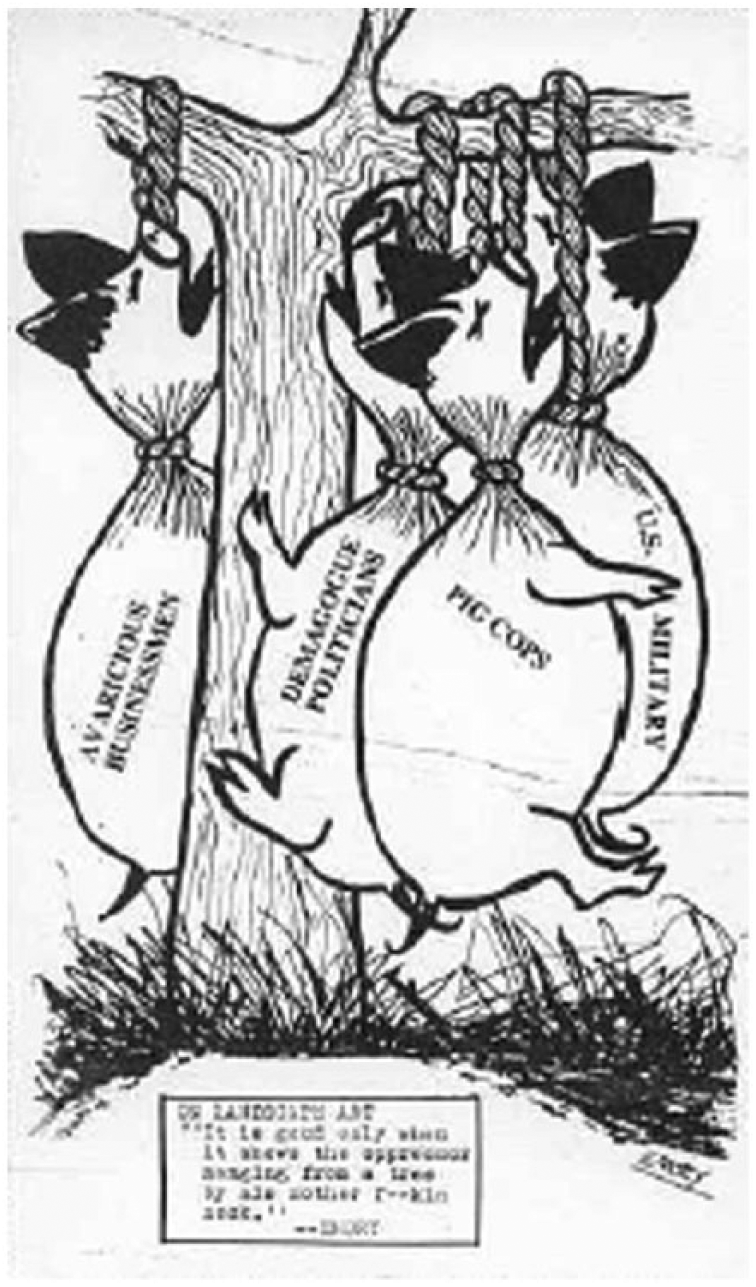
The Black Panther, January 4, 1969. Credit: © 2014 Emory Douglas / Artists Rights Society (ARS), New York.

The Black Panther, April 6, 1970. Credit: © 2014 Emory Douglas / Artists Rights Society (ARS), New York.
In the three images cited above, the Panthers took hold of the lynching metaphor as a symbol of revolution. In each case, the cartoons depict the lynching of capitalist America and its symbols and downplay violence against individuals. The cartoon depicting the lynching of Nixon is the only one that portrays a particular individual in a noose, but since the organization did not carry out assassinations of political figures, it is likely less of a threat on Nixon’s life and more of a commentary on his status as head of state. If the Panthers could catch the head of state in their noose, they could establish a new, revolutionary government. In the other images, lynching imagery is even more overtly about revolution. The hanging figures are not individuals but animals—pigs in one case and a vulture in another—standing in for the capitalist state and its supporting components. The violence in these images presents revolution as an act of reverse lynching—revenge not necessarily against individuals but against the system that allowed racist lynching to exist. Emory Douglas’s caption to the four hanging pigs claims that “[landscape art] is good only when it shows the oppressor hanging from a tree by his mother f–kin neck.” Just as lynching had been a public spectacle, Douglas suggests visualizing an anti-racist, anti-capitalist revolution. Yet the hanging figures in his imagery were cartoon animals representing broad segments of society. They were not the individual police officers the Panthers actually confronted. And this lack of specificity became a problem for the Panthers both in their political actions and in their rhetoric. Who exactly were those pigs to be lynched? By whom and under what circumstances? What did a reverse lynching look like in real life? Was it offensive or defensive? Was this a revolutionary war or a lynch mob after scapegoats?
On the one hand, the Panthers’ use of the lynching metaphor powerfully expressed how legal and illegal violence have historically been intertwined. Revolutionary action, they argued, may simply be the precursor to a new state power. “Legitimate” and “illegitimate” forms of violence are not absolute and unchanging. However, their metaphorical reverse lynchings also glorified vigilante justice. By using the noose—a symbol of mob violence—as a signifier of revolution, they delegitimized their own revolutionary ideas. They metaphorically suggested that their revolution would take place through mob violence, charged with the emotion and spontaneity of a lynch mob rather than the thoughtful planning of sophisticated political actors. While the image may have been satisfying as an expression of revenge, it was not a useful way to imagine an anti-capitalist revolution that would foster organized democracy.
Moreover, perhaps the Panthers’ use of the noose as a metaphor led them to see “justice” within their movement in the same emotional way that a lynch mob did, sidestepping democratically agreed upon trial and punishment procedures in favor of precipitous violence against the accused. Whether Bobby Seale or a police infiltrator ordered the murder of Panther and suspected police informant Alex Rackley, there is strong evidence that some Panthers were involved, and Rackley was found shot to death with a noose around his neck (Bass & Rae, 2006). Once they held the noose, even metaphorically, the Panthers found that it could slide out of control, transforming them from victims into victimizers, not from victims into heroes.
Retaliatory Lynching in the Black Arts Movement: Ed Bullins’s Jo Anne!!!
The Black Panthers envisioned a cartoon noose held by Black vigilantes. Similarly, Black Arts dramatist Ed Bullins (1976/2006) embraced the empty noose as a tool for Black revenge in his play Jo Anne!!! Bullins revised the lynching drama to include a White man’s rape of a Black woman, portraying a symbolic revenge lynching as the just response. The play was based on the 1975 murder trial of Joan (pronounced Jo Anne) Little in North Carolina. At 19, the real, historical Little had been convicted of breaking and entering, and while in jail she was attacked by guard Clarence Alligood, who, according to Little, forced her to perform oral sex while threatening her with an ice pick. In retaliation, Little seized the pick, stabbed him in the chest, and fled (McNeil, 2008). According to the coroner’s report, his body was found naked from the waist down with semen on his penis and leg (Davis, 2002). Little turned herself in a week later and was eventually acquitted of murder by a racially integrated jury (McNeil, 2008).
The historical Little killed Alligood in an act of self-defense. As a Black woman, she took control and defended herself from a White attacker. But Bullins’s fictional take on Little’s story reveals the empty, symbolic noose as a source of power for Black men. He structures his play around the trial and the ghost of Alligood, reimagined as “All Goode.” As each character testifies to his or her version of the events, the rape and murder scene replays on stage. Meanwhile, feminist and Black Power activist characters use Jo Anne’s struggle to advance their own, while Jo Anne faces All Goode’s ghost and meets two anonymous Black men who save her.
The lynching metaphor applies to two moments in the real Little’s story: her murder of Alligood as retribution for rape, and her trial, in which she faces the death penalty. She is both the “lyncher” and the potential “lynch” victim. Little didn’t need a Black lynch mob to help her kill Alligood, but she did need help as a possible “lynch” victim of the state. The White-dominated law, in other words, threatened her more than outlaw White behavior. In response, Bullins places the revenge lynch rope in the hands of a Black male character as well.
Throughout the play, three characters act as a White lynch party: the prosecutor, All Goode’s ghost, and Judge All Goode Hopgoode (who merges with All Goode’s ghost). They traipse across the stage with an empty noose in search of Jo Anne. By portraying the prosecutor and judge as lynchers, Bullins compares the death penalty to lynching. But this is not his only analysis. During Jo Anne’s flight from the lynchers, she encounters two Black men who save her from the ghost of the White man she has already killed and the death penalty she might face. Both men are more symbolic than real. One is identified as a “Cabin Dweller” and seems like a remnant of the slave era: Jo Anne is surprised he was “modern” enough to learn about her on the radio. The Cabin Dweller hides Jo Anne and plays the Sambo to put the prosecutor off the trail, exhibiting passive aggression when he attacks a “roach” by slamming an ax into the ground between the prosecutor’s feet. This secretly rebellious but outwardly docile character is supplemented with another anonymous figure, the “Black Townsman,” who repeatedly enters the scene asking for the “claim office.” These requests come to fruition at the play’s end, when the townsman enters the courtroom with a blind White woman representing justice. He carries a noose and hangs it symbolically about All Goode’s head as the Cabin Dweller announces that “we black men cannot let our women be raped and nearly murdered in the prisons of America” (Bullins, 1976/2006, p. 175). All Goode, now both a ghost and the judge, is metaphorically killed a second time, this time by a Black man with a noose. The townsman “claims” All Goode as payback for lynching history and for Jo Anne’s rape, while Jo Anne is protected from the prosecutor’s lynch mob. As in a historical lynching, the rapist’s true identity doesn’t matter—judge and jailer are indistinguishable to the mob. By giving judge and jailer the same name, Bullins includes the audience into the mob. We, too, are unable to distinguish the actual perpetrator from a stand-in. Moreover, the symbolic reverse lynching here represents a triumph of Black masculinity. Jo Anne’s successful revenge against her rapist is not sufficient—a secondary revenge is needed to reinstate Black male power.
Bullins’s vision of revenge lynching isn’t limited to outlaw justice. Two less likely figures also protect Jo Anne: the White liberal lawyer Cane and the White female figure of justice. While Cane originally deems the facts of Jo Anne’s case “fantastic,” he is contrite when Black lawyer Scott reminds him that “it may seem fantastic to you, but it [rape] happens to our black women year in and year out” (p. 169). Soon, Cane becomes protective, and Scott encourages Jo Anne to “please trust both of us and the people we assign to your defense team” (p. 169). Not only does the White lawyer help Jo Anne, but the Black townsman can enact his revenge only in the company of a White lady justice, suggesting that Jo Anne’s freedom comes not simply through vigilante justice but also through the justice system. In this final scene, Bullins may indicate that Jo Anne’s acquittal signifies a growth (albeit limited) in institutional power for Black Americans. In contrast to the Black Panther Party’s vigilante vision of revenge lynching, Bullins suggests that the metaphor of reverse lynching could include greater democracy in the justice system—a more peaceful option.
As Genna McNeil (2008) notes in her historical study of the Little trial, Joan Little herself had faith in the justice system. She turned herself in and testified on her own behalf in the media and the trial. McNeil argues that “despite her recognition of racism in the larger society, Joan Little still chose to view the courtroom as a place of temporary protection for citizens” (p. 246). And her confidence paid off. The jury, composed of six African Americans and six Whites, seven women and five men, found her not guilty (Coakley, 1975; McNeil, 2008). Little, like Bullins, combined a vision of revenge and reform: She killed her attacker but retained confidence that a jury could override the justice system’s ingrained racial prejudice.
Yet Bullins’s final scene remains troubling. His ultimate vision of justice is All Goode’s lynching, not Jo Anne’s freedom. The metaphor of vigilante vengeance, in other words, trumps the courtroom victory, and Jo Anne’s feelings and future are not addressed. Bullins concludes with the satisfaction the male characters get from seeing All Goode “lynched,” and this symbolic rather than gruesome depiction of lynching prevents Bullins from investigating the consequences of the revenge lynching narrative. Throughout his play, Jo Anne frequently declares that she is a person and not a symbol, and the Black lawyer instructs misguided feminists to “remember Jo Anne . . . she’s not only a symbol . . . she’s real” (Bullins, 1976/2006, p. 154). But in a story that employs allegorical characters like All Goode, the Cabin Dweller, and lady justice, Bullins’s insistence on individuality falters. Elsewhere in the play, Jo Anne admits that “I don’t represent the old South . . . but the new. That’s right. I’m of the new South. The young, new, black South” (p. 148). Jo Anne is a symbol. If she were not, her case would have less political import. She interests feminists, Black Power activists, White liberals, and Bullins himself because she stands for the “new South”—a generation of young African Americans combating White oppression. And although her particular case may have called for a reverse lynching as an act of self-defense, it did not necessarily point to the need for it as a wider practice. In making Little too much of a generic symbol and not enough of an individual—and in employing a symbolic noose in place of a more detailed discussion of retaliatory violence—Bullins fails to advance the political conversation about the difference between self-defense and rebellious violence.
Questioning Retaliatory Violence in John Edgar Wideman’s The Lynchers
While Bullins and the Black Panthers fail to acknowledge the problems with their cartoonish noose symbolism, John Edgar Wideman (1973/1986) recaptures more successful uses of the lynching metaphor in his novel The Lynchers. He responds to the reverse lynching fantasies mushrooming around him by showing the problems of the empty or cartoon noose and re-emphasizing the real human victims in lynching iconography. In The Lynchers, Wideman takes on Black Arts subject matter by examining the effect of poverty, racism, and revolutionary rhetoric on four young Black men in Philadelphia. What, his characters wonder, would revolution really look like? In their estimation, the proper spark would be the lynching of a White policeman. They plan to kill and maim a Black prostitute, Sissie, who works for him; presenting her body to rile up the Black community, they intend to kidnap the police pimp and stage his lynching for a bloodthirsty Black mob, inciting a new era and a break with White supremacy.
By reversing the lynching spectacle, his characters believe, the Black community could unite emotionally and politically and explode a primary image of White power. The group’s leader Littleman tells his three co-conspirators, We must show how the cops are symbolic. How they are too few and how these few can be made to disappear. We will lynch one man but in fact we will be denying a total vision of reality . . . When one man kills it’s murder. When a nation kills murder is called war. If we lynch the cop we will be declaring ourselves a nation. (pp. 116-117)
The characters see lynching as a symbol of institutional power wielded by the people, and Wideman drives the symbolism of lynching home throughout the text: “a great artist must have conceived the first lynching,” Littleman muses. The protagonist Wilkerson, a co-conspirator, remarks that the word “lynching” is essential to their rebellious act (p. 61). For them, lynching is an idea more than a reality. The individual human who is attacked is unimportant, and violence against that person becomes symbolic rather than real. Lynching, they believe, is the symbolic essence of White power, and to topple White power, they have to become lynchers themselves.
For these characters, the rewriting of the lynching story also allows Black men to assert their masculinity within a narrative that had emasculated them. Historically, lynching affected both men and women, but men were lynched more frequently, especially for the supposed crimes of murder and rape. In her accounting of 160 lynchings of African Americans in 1892, originally published in 1900, Ida B. Wells-Barnett (2002) identified five women. The two most common charges against all those lynched were murder (58 lynchings) and rape (46 lynchings). Although many lynchings occurred for reasons other than rape, Dray (2002) outlines how the Black male rapist narrative remained at the heart of lynching. Even when no rape was originally alleged, the crime was often added to the original charge to stir up crowd sentiment for the killing, and castration of the victim or his corpse was a frequent result (Dray, 2002).
In the real history of anti-lynching resistance, women like Ida B. Wells-Barnett and members of the National Association of Colored Women (in addition to White women like Jessie Daniel Ames and allies with the Association of Southern Women for the Prevention of Lynching) defended Black men against these charges and also publicized the plight of women attacked by lynch mobs (Dray, 2002). The threat of lynching haunted women as well as men, and the fight against lynching was waged by men and women together. Wideman’s male characters of the 1970s, however, see the resistance to racism and lynching as a project for men trying to confirm their masculinity. They all initially struggle with gender identity and see revenge rape and murder as modes of reclaiming it. The crew’s leader Willie Hall, known by his comrades as Littleman, is physically stunted and impaired. Although his co-conspirators see him as a leader, a pair of White cops identify him as a “crazy black dwarf” (p. 121). When he meets the woman who will become his girlfriend, he angrily assumes that she pities his disability: “a wave of resentment was hot in his throat. Perhaps she saw him all too well. Broken man, tethered to braces and cane. Barely as high as her chin. Why should she fear him?” (p. 124). Feeling emasculated, Littleman envisions raping her and wishes that she had caught him urinating on the beach where they met so she could have seen “the healthy ramrod of his manhood” (p. 125). After she becomes his partner, his resentment rises again when he faces workplace discrimination because of his disability and is unable to provide financially for her.
The other characters, too, struggle with gender identity. Lenny Saunders is haunted by his inability to save his mother from poverty and madness, envisioning himself as a Jack the Ripper who will prove himself through violence. Another conspirator, Graham Rice, lacks self-confidence and obsesses about others using or dismissing him. On the morning of the proposed lynching, his paranoia leads him to shoot the fourth member of the group, Wilkerson, who has come to retrieve the weapons. Before his final encounter with Rice, Wilkerson is the book’s protagonist and the most reluctant to use violence. An Afrocentric schoolteacher, Wilkerson feels pained about his feeble attempts to woo a colleague. Academic success does not give Wilkerson the confidence he needs to win her, and he hopes the lynching will break him out of his passivity.
The fantasy of power that these young men devise revolves around murdering a Black woman. By reversing the lynching myth to bolster their masculinity, they lash out not only at the White establishment but at a woman in their own community. They break down the solidarity between Black men and women that had been a characteristic of the historical anti-lynching movement. Moreover, they contribute to the oppression of Black women as sexual objects for both Black men and White men. As a prostitute, Sissie is expendable. While they consider the specifics of their own gender oppression, the male characters fail to see how both White and Black men have degraded and objectified her as a woman.
The characters begin to realize the error of their ways when first Saunders and then Wilkerson develop sympathy for the prostitute’s daughter Lisa. Fatherly inclinations appear as a positive counterpoint to aggressive masculinity. However, Wideman makes it clear that the characters do not become fully enlightened. Their sympathies extend only to an innocent child—they never see the humanity in Sissie herself. Moreover, their plan also fails because of a combination of incapacitation and anxiety: Littleman is trapped in a hospital room after being beaten by cops, Rice’s self-doubt leads him to shoot Wilkerson, and Wilkerson’s death or incapacitation leaves Saunders waiting alone for his comrades to put the plan in action. The lack of violence at the end is not a result of the characters’ thoughtful reconsiderations but a happenstance that allows the viewer to see the holes in the reverse lynching fantasy.
Even if Wideman’s characters do not come to any epiphanies, the novel suggests two important things. First, it indicates the ways that lynching symbolism is tied to anxiety about masculinity. Second, it shows us that reclaiming lynching symbolism doesn’t remake sexual and gender identities in positive ways. In a 1988 interview with James Coleman, Wideman says, It’s a borrowed myth, the myth of lynching, or the ritual of the lynching. So it’s borrowed from the oppressor. And it’s negative. What happens in the later books I think is—if we want to simplify it, I guess—the attempt to find positive rituals and myths that can shore up, that can reconstruct, the sense of reality in the black community, in its own terms, in terms that have been there all along. (TuSmith, 1998, p. 70)
Wideman advocates shunning the oppressor’s tools, and as Trudier Harris adds, he also indicates that the Black community is not willing to stoop to the level of the oppressor. After all, although the men assume the community will sanction the lynching just as White communities did in the early 20th-century south, Wilkerson’s discussion of the plan with his girlfriend and Littleman’s unsuccessful attempt to convert hospital attendant Anthony suggest otherwise. The hospital attendant evades Littleman’s advances, making comments like “I ain’t ready for this” and “I’m gone on about my own business now and you tend to yours” (pp. 192-193). Eventually, when Littleman won’t take no for an answer, Anthony simply disappears. Wilkerson’s girlfriend Tanya is more direct in opposing the plan, telling him that “if there ever was such a plan, it was nonsense and anybody who’d see it otherwise is insane” (p. 237). Although the characters imagined their action would represent community sentiment, these discussions make it clear that they are lone actors.
Wideman’s novel demonstrates how Black Power activists like the Panthers and Black Arts Movement writers like Bullins had failed to acknowledge that the masses might not support revenge violence. Lynching is mob power based on the idea that a group of angry people can overpower an individual, a racially under-represented community, or the government. And, as many Black Power activists would argue, the power of “the people” can be positive. However, lynching images depict the dark side of extra-legal protest, especially if it involves violence. Lynch mobs rule by the brute force of a small group rather than the collective will of the entire community through the organized structures of democracy. They deny victims—even those who have potentially committed crimes—the right to the democratically agreed upon process of the legal system. By asking his readers to sympathize with his protagonists while also siding against them, Wideman inserts a real human body back into the empty lynching noose that had become prevalent since the 1930s. He begins his novel with a 20-page preface that portrays many vivid historical accounts of lynching and racism through a compilation of excerpts from historical and cultural documents. At the end, he leaves the reader with a concrete appreciation of what violence against the White cop and the Black prostitute Sissie would have meant. Wideman continues the tradition of earlier 20th-century lynching texts and cautions against simplistic uses of lynching imagery in contemporary politics.
Interpreting the 21st-Century Noose: A Symbol of Undemocratic Power
Wideman was not alone in re-emphasizing the specific body in place of the empty noose at this time. In her short story, “The Flowers,” published the same year as The Lynchers, Alice Walker (1973/2001) follows a little girl walking across a field on an idyllic day. Picking flowers in “the peacefulness of the morning,” she stands on the eye of a decapitated man. Walker depicts the scene in gruesome detail: “Her heel became lodged in the broken ridge between brow and nose,” and “his head lay beside him.” She also finds the “rotted remains of a noose” and a “barely there” remnant of a rope hanging from the tree above (p. 120). In this very short story, Walker provides little historical context except to say that the girl comes from a sharecropping family. The story of lynching is told only by the noose and the horrific treatment of the body itself—dismembered and left to rot without burial. As she traces the experience of a young African American girl coming to terms with a terrifying reality, she relies on the same technique that Ida B. Wells-Barnett used nearly a century before: depicting the grotesque horror of the maimed human body.
While writers like Walker and Wideman insisted on the importance of understanding lynching through the injured body long past lynching’s peak, the continued prevalence of the empty or cartoon noose in our contemporary culture more often obscures the history of racial violence. In 2006, a group of White high school students in Jena, Louisiana, hung three empty nooses from a schoolyard tree to assert their territory against a perceived interloper who was Black. Black students who retaliated in an after-school fight were charged with attempted second-degree murder, and the subsequent controversy brought a discussion of noose iconography into the media. According to news reports, the school’s principal treated the incident as a “prank” (Goodwyn, 2007). School board member Billy Wayne Fowler told NPR that the nooses were hung in “a joking manner” (“Is Jena Getting a Bad Rap?” 2007). Historically, the noose has not been used jokingly—it conveys indignation or aggression. Pranks or jokes may be mean-spirited, but they make the target feel ridiculous, not threatened. The response to the absurd claims of the principal and school board member are evident in the works of the writers and activists cited above. Nooses—even cartoon nooses and empty nooses—are deeply serious. They imagine, encourage, and lead to violence. Wideman and Walker, in particular, offer warnings about the noose, reminding us that when its imagery is taken to its logical conclusion, the result is mob violence and the loss of particular people with complex lives—neither purely villainous nor heroic.
When the noose is employed by Whites as a threat or by African Americans as a tool of revenge, it declares the right of a small group to make emotional decisions about “justice.” White mobs in the early 20th century viewed the lynch rope as a tool for more expedient “justice” against African Americans they viewed as targets. As Ida B. Wells-Barnett graphically and skillfully outlined, these were not acts of justice but crimes. Wideman, on the other hand, helps us question whether reverse lynching, as either a metaphor or a reality, exhibits the same problem: It promises a false “justice” rather than a real revolutionary change. And as the conversation about Jena, Louisiana, played out in the mainstream media, Wells-Barnett’s strategies might have been useful in identifying exactly what the lynch rope historically meant: not just anti-Black violence as a generic concept but specific, brutal attacks against individuals as part of a larger racist social structure. Perhaps even in the 21st century we need those graphic reminders to challenge the notion that hanging nooses could be simply a joke or a prank.
Footnotes
Declaration of Conflicting Interests
The author declared no potential conflicts of interest with respect to the research, authorship, and/or publication of this article.
Funding
The author received no financial support for the research, authorship, and/or publication of this article.