




Abstract
The primary goal of the current study was to explore the influence of ethnic identification and parental attachment on the body esteem of Black women who were members of a Black sorority. To date, there has been no published research examining determinants of body image in this population of Black women. The authors hypothesized that ethnic identity and attachment to mother would predict body esteem in this population. One hundred twelve women (M age 39.3) were surveyed, and hierarchical regression analysis revealed that attachment to mother was a significant predictor of body esteem, especially with regard to physical condition and weight control. The findings from the current study suggest that the mother-daughter relationship remains influential in the development of positive body esteem over the life span.
Introduction
Body image is measured by the difference between an individuals’ actual and ideal body size, focusing on the drive for thinness and level of body dissatisfaction. Membership in a sorority is reported to increase body dissatisfaction and the drive for thinness in women (Rolnik, Engeln-Maddox, & Miller, 2010). Basow, Foran, and Bookwala (2007) concluded that sorority women have higher levels of body consciousness due to increased social pressures to be thin. Sorority membership for Black women appears to be a meaningful component of their ethnic identity as Black sorority women maintain lifelong involvement through participation in graduate chapters, which serve as support networks providing protection from many social concerns (Patton & Bonner, 2001). In addition, many Black women join the same sorority as their mothers and grandmothers (Mitchell, 2012) highlighting the important bond between mothers and daughters. Given the role that Black mothers play in the development of their daughters’ body image (Franko & Roehrig, 2011), there is a need to also investigate the influence of parental attachment in this community. To date, there have been no published studies examining ethnic identity, parental attachment, and body esteem in this population. The paucity of research in this area prompts a need for more investigations into the experiences of Black women in sororities.
Therefore, the primary goal of the current study was to explore the influence of ethnic identification and parental attachment on the body esteem of Black women who are members of a sorority. Post-collegiate Black sorority women were chosen for this study because they offer a unique perspective as most investigations on the body esteem of Black women focus on young women in college or community samples of low-income women.
Historically, Black women have been thought to reside in a culture that shields them from developing body dissatisfaction and eating disorders. The acceptance of a larger, curvier body (Overstreet, Quinn, & Agocha, 2010), higher esteem (Hesse-Biber, Howling, Leavy, & Lovejoy, 2004), and definitions of beauty that are not tied to body size (Franko & Roehrig, 2011) are noted determinants of the positive body image found in Black women. Breitkopf, Littleton, and Berenson (2007) reported that in comparison with White women, Black women had diverse definitions of beauty resulting in a more positive assessment of their weight and higher self-esteem.
More recent examinations propose that similar levels of body dissatisfaction are found in both White and Black women alike. While familial messages appear to protect them from developing a poor self-image (Franko & Roehrig, 2011; Hesse-Biber et al., 2004), increases in levels of body dissatisfaction have been reported by Black women of all ages (Latner & Wilson, 2011). Black women who view themselves as overweight or desire to be thinner (Harris, 2006) are as likely to develop body dissatisfaction and disturbed eating as their White counterparts.
Black women who value and accept a larger body, while having a more positive psychological outcome with regard to body image, may face negative ramifications on their physical health (Breitkopf et al., 2007). Quality of life affected in relation to physical functioning, social stigma toward larger bodies, and decreased motivation for achieving a healthy body weight (Cox et al., 2010) can be issues for overweight women. Therefore, further examination into the body image and self-esteem of Black women may shed light on how a positive view of their bodies may in turn increase risk for developing negative physical outcomes as a result of being overweight and obese.
The convergence of self-esteem and body image forms the concept of body esteem (Roberts, Cash, Feingold, & Johnson, 2006), which appears to be a more appropriate measure of the body image of Black women as it focuses on satisfaction with specific body parts and not an overall societal definition of thinness (Poran, 2006). Body esteem refers to attitudes about the body (Oswald, Franzoi, & Frost, 2012), which for women focuses on sexual attractiveness, weight concern, and physical condition. Black women typically score higher than White women on body esteem measures (Schooler, Ward, Merriwether, & Caruthers, 2004). Therefore, body esteem will be the focus of this examination of body image in Black sorority women.
Ethnic identity
Ethnic identity “is a sense of self as a group member that develops over time through an active process of investigation, learning, and commitment” (Phinney & Ong, 2007, p. 279). It can be defined using the following four components: (a) ethnic self-identification, (b) ethnic constancy, (c) ethnic knowledge, and (d) ethnic affect, all of which contribute to ethnic values and behaviors (Knight, Bernal, Garza, & Cota, 1993). As a component of identity development, ethnic identity has been linked to positive increases in psychological health as a result of contact and interaction with other members of one’s ethnic group (Phinney, 1993).
Black women with a strong ethnic identification are less likely to internalize the societal values of the United States regarding standards of beauty (Franko & Roehrig, 2011). Within-group identification may provide a buffer against acceptance of the thin ideal, consequently protecting minorities who identify more with their own culture (Rogers Wood & Petrie, 2010). Identification and association with one’s own group can positively affect body esteem as messages about appearance are gained from those that provide cultural support. Black women with values related to their ethnicity are more likely to value a larger, curvier body and reject the notion that a thin body is the ideal (Sabik, Cole, & Ward, 2010).
On the other hand, Black women low in ethnic identification may be at higher risk for having lower body esteem. Facing pressure from society regarding standards of beauty can cause more emphasis to be placed on body size for those women who do not receive positive messages through contact or identification with their culture of origin. Sabik et al. (2010) suggested that Black women who were oriented toward the dominant cultural group had higher body dissatisfaction and were more concerned with dieting and their weight. A Black woman’s perception of the ideal body can be considerably affected by her level of interaction with and acceptance of White cultural definitions of beauty (Baugh, Mullis, Mullis, Hicks, & Peterson, 2010; Davis, Sbrocco, Odoms-Young, & Smith, 2010).
Black Sorority Membership
Membership in ethnic organizations is linked to the ethnic identity development of racially under-represented students during college (Sidanus, VanLaar, Levin, & Sinclair, 2004). Patton and Bonner (2001) emphasized the function of college sororities as sources of identity development, providing agency and upward mobility for Black women. The first component highlighting the unique experience of Black sorority women is a lifelong commitment to and participation in the sorority after college. Many Black sorority women remain active and identify with their sorority throughout their entire lives, as they continue to value sisterhood while serving the community at large (Hernandez, 2008). The second component is the significance of generational relationships, with many Black women joining the same organization as their mothers and grandmothers (Mitchell, 2012). While this does occur in non-Black sororities as well, the lifelong commitment inherent in Black sorority membership allows for an additional bond to develop between mothers and daughters.
Relationship With Mother
Previous research has identified three main sources of influence and stress for women concerning their bodies: parents, peers, and the media (Rodgers & Chabrol, 2009). Regarding parental influence, mothers may be a significant factor in the body esteem (Smolak, 2011) of their daughters. Through modeling behaviors and verbal messages, mothers teach daughters the cultural norms of beauty and how to critique their own appearance (Clarke & Griffin, 2007).
Research with White daughters and mothers has emphasized the negative messages and pressure found in this relationship. But for Black women, maternal messages about body image appear quite different. Black mothers tend to provide positive support for body shape (Hesse-Biber et al., 2004), which helps to protect young Black women from finding value in a thin body (Franko & Roehrig, 2011) and defining themselves based on appearance. Black women report receiving negative attention from mothers if they lost weight or seemed too thin (Wilson, Musham, & McLellan, 2004), as this was as a sign of distress and not the ideal (Reel, SooHoo, Summerhays, & Gill, 2008) in the Black community.
Investigations of maternal influence tend to focus on the relationship between adolescent daughters and their mothers, but there is evidence to suggest that mothers remain a primary source of body esteem for their daughters throughout adulthood. Adult women report that their body esteem is affected through recollections of messages received from mothers over time. These messages construct how women currently feel about their bodies, with women who report criticism and negative comments from mothers being more likely to consistently report dissatisfaction from a young age (Clarke & Griffin, 2007). Therefore, learning about the perception of relationship with mother is essential when studying the body esteem of adult women.
Based on the above review of literature, the current study will examine the following hypothesis:
Method
Participants and Study Design
The mean age of participants (N = 112) was 39.3 (SD = 13.4), with a range of 22 to 59 years. Although body dissatisfaction is found among women of all ages, it appears to decrease with age (Grogan, 2011). Therefore, the age diversity found within this sample was addressed by collapsing age based on categories of adult development resulting in 33.2% young adults (age 22-28), 29.9% adults (age 30-38), 28.7% middle-aged adults (age 39-51), and 9.2% older adults (age 52-59). The majority of the sample identified as Black or African American (91.7%) and 67% of participants were not married. Participant marital status was as follows: 36.8% reported being single/never married, 18.4% dating/an unmarried couple, 32.2% married, and 12.6% separated/divorced. College attendance is a requirement for joining a sorority; therefore, 41.4% had a bachelor’s degree, 40.2% had a masters’ degree, and 18.3% had a doctoral or professional degree. Eighty-one percent of participants earned an annual income of US$90,000 or less (10.3% less than US$10,000; 12.6% US$10,001-US$30,000; 19.5% US$30,001-US$50.000; 26.4% US$50,001-US$70,000; and 12.6% US$70,001-US$90,000), and the majority of the sample was located in the southeastern United States (76.1%).
Purposive sampling methods were used to recruit participants as previous research has highlighted numerous barriers to body image research with Black sorority women (Coker, Huang, & Kashubeck-West, 2009; Parks, 2008). As members of Black sororities, the researchers were able to identify gatekeepers in the Black sorority community in order to gain access to participants. The researchers contacted chapter presidents, and membership chairs, to request access to the email addresses of sorority members. Additional postings were made on sorority-affiliated webpages found on social media sites. Participants were asked to complete an online survey using Qualtrics. Informed consent was obtained via a yes/no question at the beginning of the survey, and those who agreed to participate were taken directly to the first question. Entry into a drawing to receive a US$10 gift card was used as an incentive to all those who completed the survey. No identifying information was recorded or could be linked to participant responses. All research procedures were approved by the university’s institutional review board.
Measures
The Multigroup Ethnic Identity Measure (MEIM; Phinney, 1992) is a 15-item self-report scale that measures level of ethnic identification. It is comprised of two subscales: ethnic identity search, and affirmation, belonging, and confirmation. Participants are asked to rate statements such as “I have a strong sense of belonging to my own ethnic group” and “I am active in organizations or groups that include mostly members of my own ethnic group” on a 4-point scale where 1 = strongly disagree and 4 = strongly agree. The total scale coefficient alpha for this sample was .86.
The Inventory of Parent and Peer Attachment (IPPA; Armsden & Greenberg, 1987) mother subscale was used to measure attachment to mother or a mother figure. The initial measure was developed to assess trust, communication, anger, and alienation in relationships between adolescents, their parents, and peers. As a self-report measure, the mother subscale of the IPPA consists of 25 items and uses a 5-point scale (1 = almost never or never true to, 5 = almost always or always true) to rate participant views of attachment to mother. Although developed for use with adolescents, this subscale was chosen to measure the unique aspects of adult mother-daughter attachment in the Black community. Items such as “My mother helps me understand myself better” and “I like to get my mother’s point of view on things I’m concerned about” allowed researchers to measure current attachment, resulting in a high reliability within this sample (α = .94).
The Body Esteem Scale (BES) measures body esteem in both males and females (Franzoi & Shields, 1984). Participants respond to statements regarding their feelings of 35 body parts and functions using a 5-point Likert-type scale with 1 = strong negative feelings and 5 = strong positive feelings. The measure can be divided into subscales that, for females, examine sexual attractiveness, weight control, and physical condition. Cronbach’s alpha for the current sample on the total measure was .95. Each subscale also had high reliability: sexual attractiveness (α = .86), weight concern (α = .93), and physical condition (α = .91).
Results
Correlational analyses were conducted to reveal the correlational nature of variables and avoid multicollinearity. In order to identify whether subscales on the BES had a significant relationship with parental attachment or ethnic identity, they were included in the analysis (Table 1). No significant relationships were found between ethnic identity and parental attachment or body esteem. There were significant relationships between two of the three BES subscales (weight control and physical condition) and parental attachment. This result suggests that women with higher attachment to their mothers also had more positive perceptions of weight control and physical condition.
Means, Standard Deviations, and Correlational Analyses of Study Variables.
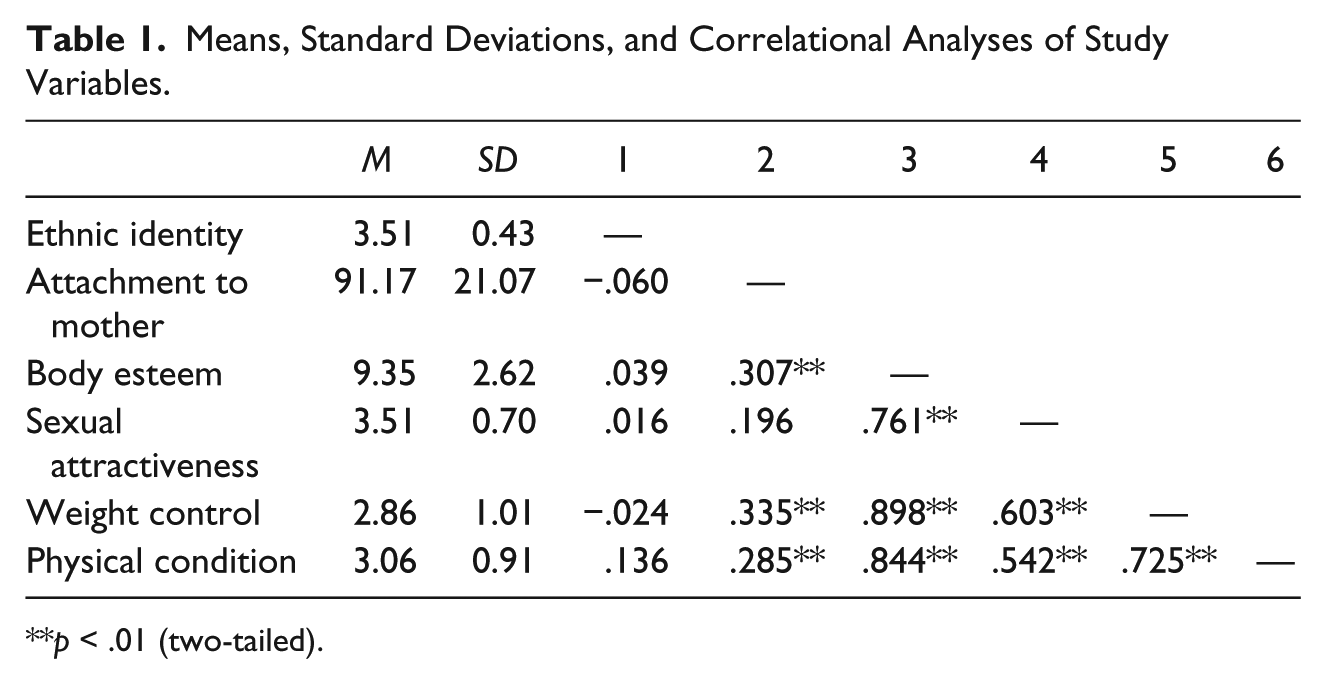
p < .01 (two-tailed).
A hierarchical multiple regression analysis was used to predict body esteem from parental attachment and ethnic identity, after controlling for age and marital status (Table 2). These variables were chosen based on their well-documented impact on body esteem. The importance of appearance concern appears to decrease with age (Grogan 2011) as older women report higher body esteem and less body dissatisfaction. Also, married women tend to be heavier and express less weight concern than non-married women (Averett, Sikora, & Argys, 2008). In addition, the researcher wanted to control for the effect of age given the diversity of age found in the current sample (22-59). Table 3 displays more strong negative or moderate negative feelings toward weight control and physical condition reported by younger and non-married women (Table 3). Therefore, age and marital status were entered at Step 1, explaining for 2.7% of the variance. After entering ethnic identity in Step 2 and parental attachment in Step 3, an additional 9.7% of the variance was explained. The total variance explained by the final model was 12.4%, R2 = .82, F(4, 95) = 2.91, p < .05. Additional hierarchical regression analyses were run to examine whether ethnic identity and parental attachment would predict individual components of body esteem (weight control, physical condition, and sexual attractiveness). Using each subscale of the BES as the criterion variable, significant results emerged for weight control, R2 = .16, F(4, 92) = 3.66, p ≤ .009, and physical condition, R2 = .10, F(4, 95) = 3.47, p ≤ .01, but not sexual attractiveness, R2 = .04, F(4,91) = .90, p ≤.46.
Hierarchical Multiple Regression Analyses Predicting Body Esteem From Ethnic Identity and Parental Attachment.

Body Esteem Subscales by Age and Marital Status.

Tests for multicollinearity indicated a low level was present (tolerance = .983 and .994) for ethnic identity and parental attachment, respectively.
Discussion
The findings of the current study provide evidence that parental attachment to mother is a significant predictor of body esteem, namely, physical condition and weight control, for this sample of Black sorority women. It is not surprising that the sexual attractiveness aspect of body esteem was not significant, as Black women report that interpretations about their sexuality is derived from the media, men, and comparisons to other women (Poran, 2006), and not from their mothers. Black mothers encourage self-esteem, provide compliments (Hesse-Biber et al., 2004), and reinforce body acceptance through the disapproval of weight loss and looking thin (Wilson et al., 2004).
As previous research has highlighted the important role that Black mothers play in the body esteem of their young daughters (Franko & Roehrig, 2011), the current investigation suggests that this relationship is important for adult women as well. Future research should examine the specific aspects of mother-daughter relationships in the Black community (e.g., communication, attachment, respect) and those found among Black sorority women that contribute to positive body esteem. Examinations into other racially under-represented groups could provide additional mechanisms of the transmission of positive messages from mothers to daughters.
Ethnic identification did not emerge as a significant predictor of body esteem. A possible explanation for this finding may be as a result of the lack of variability in ethnic identification found within this sample. For this group of women, the median ethnic identification score was 3.5 on a scale of 2.11 to 4.00 indicating that most women had a strong ethnic identification. It may be possible that belonging to an ethnic organization, namely, a Black sorority suggests that participants were highly identified with the Black community. Minorities who become members of an ethnic organization in college have increased levels of ethnic identification and affiliation to their ethnic group (Sidanus et al., 2004). Membership in a Black sorority becomes a significant part of identity as it provides a culture of sisterhood, support, and empowerment for Black women (Berkowitz & Padavic, 1999). Or perhaps, those who are already high in ethnic orientation are more likely to seek out and join an ethnic organization. It is beyond the scope of this investigation to examine the role that sorority membership plays in the development of ethnic identity and body esteem, although it could be assumed that sororities may provide additional protective factors through support from and positive interactions with other Black women. Future investigations should compare the ethnic identity and body image of Black women who are in sororities to those who are not. Other studies should also investigate these variables in Black women who are currently enrolled in college, in addition to examinations of those who have never attended college. This information could provide insight into the impact that college and the sorority experience have on the development and maintenance of an ethnic identity and body esteem.
Limitations
Several limitations should be considered with the results of the current study. The current sample size was small; therefore, the results cannot be generalized to all Black women who are members of a sorority. Also, because there was no comparison group (non-sorority Black women), the role of sorority membership cannot be assumed influential to results. Therefore, the results of this study may be more applicable to Black women in general, until more examinations are conducted comparing Black sorority women to Black women with no sorority affiliation. In addition, the cross-sectional nature of the study prevents assumptions of causal relationships between variables. Future research should use longitudinal methods to investigate the development of ethnic identity and body esteem over time. Although significance was found between relationship with mother and several measures of body image, utilizing retrospective questions may have influenced the results to be more positive in nature. The passage of time (i.e., variable age groups in the sample) could have affected the validity of measures used in this study. The differing life experiences of women in each of these categories and the subsequent impact on the perception of their relationship with their mother should be taken into consideration. Finally, the use of a measure of parental attachment (IPPA) with adults that was initially developed for adolescents may have influenced the results. Although the results of the current study suggest that the role of mother remains influential throughout the life span, future investigations (e.g., qualitative interviews) could yield more in-depth information about the changing nature of the mother-daughter relationship over time and how these changes might affect body image and self-esteem.
Footnotes
Acknowledgements
We would like to thank the anonymous reviewers whose edits and suggestions were influential in the completion of this article.
Declaration of Conflicting Interests
The authors declared that there are no potential conflicts of interest with respect to the research, authorship, and/or publication of this article.
Funding
The authors disclosed receipt of the following financial support for the research, authorship, and/or publication of this article: This work was supported by the East Carolina University Division of Research and Graduate Studies under Research Startup Funds.