



Abstract
Racial gerrymandering in the U.S. state of South Carolina offers a case study to take a unique look at political control, power management, and government communication from the critical perspective of hidden reward structures. These reward structures result from strategic messaging by which an elite’s perspectives deliver to them power by marginalizing others and their perspectives. More specifically, we interrogate one dominant narrative advanced in the United States—American Exceptionalism—by highlighting the irony of how South Carolina elected officials use the 1965 Voting Rights Act to assure a Black Democratic member of the House of Representatives, but simultaneously by gerrymandering elected officials actually reduce the likelihood of a second Democratic representative of any race/ethnicity. Using the paradox of the positive as a critical political public relations framework, we highlight the ways that American Exceptionalism is used to impose control, a control that favors one voting perspective to the marginalization of others in U.S. Southern politics.
Keywords
Gerrymandering refers to a practice in politics that seeks political advantage for a particular party or group by manipulating district boundaries to create partisan advantaged districts (Lublin, 1997). The 1965 Voting Rights Act prohibits racial discrimination in voting, and one piece of that legislation allows for the creation of “majority-minority” districts in order to avoid or remedy violations of the Voting Rights Act of 1965’s prohibitions on drawing redistricting plans that diminish the ability of a racial or language minority to elect its candidates of choice (Lublin, 1997). This act was significant, especially in the region of the South known as the Deep South, because it was argued that Whites (who constitute a population majority) would never willfully elect a Black person into office. Lublin (1997) in his groundbreaking work highlighted the paradox of representation in gerrymandering.
In the current study, we extend this discussion to the realm of communication and public policy. We argue that political elites can use communication tactics such as lobbying and the creation of terministic screens (application of the Voting Rights Act), under the guise of promoting exceptionalism, to circumvent the will and just representation of the people. Such actions can be viewed as counter to the facilitation of a fully functioning society (Heath, 2006), which is a normative framework that argues via communication and public relations, organizations have untapped potential to make society a better place to both live and work.
Because we are applying critical theory to explore and illuminate the intersections of law, power, and race in society, this study is a critical race theory (CRT) study (see Delgado & Stefancic, 2012). In research, CRT has been used to examine ways in which laws function to establish, protect, and reproduce White racial power in the United States (Harris, 1993)—even though the law is supposed to be objective and neutral (Delgado & Stefancic, 2012). Law is also assumed to represent democratic processes and principles that seek common ground in the interest of making society/community an increasingly good place to live. Ultimately, CRT responds to post-racial society proponents who argue that race matters are concerns of a bygone era by highlighting ways in which U.S. workplaces remain sites of Whiteness and unequal racialized privilege and power for Whites, despite the fact that the law (a) opened the door for formal racial integration and (b) was supposed to legislate away such forms of discrimination and marginalization (Delgado & Stefancic, 2012). This study is an extension of prior public relations studies (Logan, 2011; Pompper, 2005; Waymer & Heath, 2016; Waymer & Street, 2015) that have used CRT.
In particular, we continue research that deconstructs governmental discourse and communication (Waymer, 2009, 2013a), and do so via a critical examination of a case study of South Carolina’s approach to determining voter district boundaries as ostensibly rewarding politicians by an empowered citizenry; with this case study, we problematize, via the critical public relations lens of the paradox of the positive, the notion of American Exceptionalism and the roles it plays in inhibiting society from being more fully functioning. That claim is also central to the ideology of American Exceptionalism, which, in the case under consideration here, leads paradoxically to marginalization rather than empowerment.
We first provide an overview of political public relations literature followed by a discussion of the American Exceptionalism ideology. Next, we preview the paradox of the positive. Finally, we critically examine the spirit of exceptionalism enacted by the United States via the case study of Black voter (dis)empowerment in South Carolina to reveal the ways that exceptionalism provides a hegemonic platform upon which elite actors take self-advantage of lofty principles under the auspices of making society more fully functional.
Critically Examining U.S. Exceptionalism: The Case of South Carolina
Political public relations research accounts for but a small fraction of the overall body of political communication research (Kiousis & Strömbäck, 2010; Lee, 2012; Levenshus, 2010; McKeown & Plowman, 1999; Strömbäck & Kiousis, 2011; Strömbäck, Mitrook, & Kiousis, 2010; Trammell, 2006; Xifra, 2010). This study continues in the praxis and theory-building vein by critically exploring ways that modern political public relations strategies exploit the soft power of social capital (see Heath & Waymer, 2014a, 2014b; Ihlen, 2005, 2007) and contribute to Black voter dilution via the discursive vehicle of national exceptionalism.
Examining critically that claim of exceptional nationalism, we use the paradox of the positive (Heath & Waymer, 2009; Waymer, 2013b) to highlight the irony of how South Carolina elected officials use the 1965 Voting Rights Act to assure the election of a Black Democratic member of the federal House of Representatives, but simultaneously by gerrymandering elected officials reduce the likelihood of a second Democratic representative of any race/ethnicity. Thus, some could argue that democratic principles are being used to subvert democracy.
Often exclusively associated with the advancement of corporate interests, public relations plays more roles, including shaping and responding to the public policy issues management arena (Heath & Waymer, 2011), which in turn helps the advancement of democracy and the democratic principles of informed and enlightened choice making. In this regard, political public relations not only engages in reputation management and issues contests, but through many ancillary tools it is also routinely applied in the political arena to debate issues and position fields of candidates. As such, governments at all levels communicate with constituents to shape and exploit the political arena. Specific to the study at hand, political public relations is a means by which groups, politicians, and government, acting collectively as government, create the normative conditions for political engagement and enactment.
Political public relations is characterized by the constitutive nature of bifurcating discourses and binary choices. Thus, its discursiveness tends toward positive statements for and negative statements against. Our thesis is that such reasoning can be expanded by applying the paradox of the positive to demonstrate how positive enactments and statements can have negative consequences in general and dilute the Black vote in particular.
For evidence to feed the analysis of the role and impact of political public relations, the state of South Carolina as an enactor of American Exceptionalism was chosen for the following:
South Carolina is chosen because state politics there have and continue to be contentious ground; thus, that contention serves as the “State’s” rationale for factional decision making. To make that point more lucid, consider the following: (a) South Carolina became the first Southern state to declare its secession from the Union to help form the Confederacy; (b) state officials flew the confederate flag (a controversial symbol) atop the Statehouse in 1962 during the centennial commemoration of the Civil War (1861-1865). This defiance occurred during a time when there was groundswell support for the civil rights movement and the federal court decision that ordered desegregation of public schools; and (c) immediately following the court-ordered desegregation of schools, Whites began forming segregated academies—private, White-only schools designed to educate Whites separately from Blacks. One of the first such academies was Wade Hampton Academy (named after Wade Hampton II who was the owner of the greatest number of slaves in the South before the Civil War) founded in Orangeburg, South Carolina; (d) controversy still surrounds the flying and subsequent removal of the confederate flag in South Carolina. The National Association for the Advancement of Colored People (NAACP) levied an economic boycott on South Carolina in 2000, demanding the removal of the flag from the Statehouse lawn (Slade & Hartshell, 2013); however, it took the shooting deaths of nine Black church goers of Emmanuel African Methodist Episcopal (AME) Church in Charleston, South Carolina by a White man, Dylan Roof, for the confederate flag to be removed from the state capitol (Rogers, 2015). Roof, who hoped the killings would trigger a race war, prominently displayed the confederate flag in pictures and in his online White racial supremacy rants and posts (Macpherson, 2015).
In addition, we argue that duplicitous use of legislation such as the Voting Rights Act (originally designed as a “positive means” to ensure that underrepresented groups have access to vote) in South Carolina inspired the gerrymandering of voting districts, so that two thirds of the population (White and Republican) enjoy six sevenths of the representatives to the U.S. House of Representatives. As mentioned above, in the current study, we argue that political elites can use the application and promotion of the positive attributes of the Voting Rights Act, under the guise of championing American Exceptionalism, to circumvent just representation of the people and essentially dilute the power of the Black vote. To understand the significance of this claim, two terms need to be defined: American Exceptionalism and the paradox of the positive.
American Exceptionalism
Some might argue that placing the word “American” before the word “exceptionalism” is a bit of a double statement. In the United States, exceptionalism is a notion often endorsed by those persons right of center in political, social, and economic ideology. Moreover, advocates of American Exceptionalism articulate via media the belief that America is uniquely different than other nations in many qualitatively important ways (Brooks, 2013; Lipset, 1963, 1996). Supporters of American Exceptionalism, drawing inspiration from the American colonial experience and the American Revolution, believe that from that era in world politics democracy and self-determination continues a discursive, ideological, and functional impetus. At the heart of the exceptionalism concept is the sort of “Americanism” hegemony that is defined by and instantiates democracy, republicanism, individualism, egalitarianism, liberty, and laissez-faire.
Ivie and Giner (2009) captured the spirit of American Exceptionalism best when they defined it as an “ensemble of traditional myths” that “typically evokes attitudes of national autonomy and superiority” (p. 360). The authors further nuanced American Exceptionalism:
Whether it is Woodrow Wilson calling the nation to make the world safe for democracy, Ronald Reagan leading a crusade for freedom, or Bill Clinton speaking of America as the world’s one essential nation, American identity is expressed in opposition to a fallen world. The nation’s independence of action on the world scene, although perilous, is celebrated as its heroic mission to conquer evil and advance civilization. Americans habitually imagine themselves as a morally elevated people set apart from the rest of the world and living in a land of opportunity that is the envy and aspiration of humankind. In a word, the United States customarily identifies itself as an exception to the rule of human history—as an innocent nation exempt from earthly constraints and endowed with the manifest destiny of a chosen people. (pp. 360-361)
The chosen people metaphor is essential as the rationalizing discourse of empowerment and marginalization. Thus, it is important to deconstruct the myth of American Exceptionalism, understand it as a “rhetorical dynamic . . . a flexible cultural formation that continues to operate on and within U.S. public discourse and political culture” (p. 513).
The religious/political/economic interpretations of American Exceptionalism are derived from the metaphor by Massachusetts’s first governor, John Winthrop, who announced, “We shall be as a city upon a hill, the eyes of all people are upon us.” His new colony was to be “A Modell of Christian Charity.” When applied communicatively, exceptionalism helps inform the sociopolitical conditions of developing, implementing, and critiquing individual and collective discourse, as well as public and private policy. As political discourse, politicians and pundits battle over what is exceptional, and who most champions exceptionalism.
Exceptionalism, however, has been challenged as both a selfish (not service oriented) discourse and a flawed, ironically dysfunctional example of the beacon on the hill metaphor because there are instances when the United States has fallen far short of that ideal (Mann, 2011)—especially when such claims have been used to justify terror and tyranny (Mercier, 2015). Such ironies, paradoxes, and critiques become even more pointed (see Wilder, 2013) when it is noted that the origins of slavery in the original U.S. Colonies were connected with both John Winthrop’s orders and the creation of the U.S. institutional system of higher education: “Under John Winthrop’s instructions, Captain William Pierce sold seventeen Pequot War captives into bondage at Providence Island in the Caribbean in exchange for cotton, tobacco, salt, and enslaved Africans” (p. 29). This exchange led one slave to be in service to Nathaniel Eaton, the first instructor at what would become Harvard. In short, at Harvard, religious training became intertwined with slavery, and soon laws were created in the City on the Hill to “regulate the unfree” (p. 31). The burden of exceptionalism can, and does, rationalize the need to guide the process, even if in self-interested (rather than empowering) ways.
While American Exceptionalism has found fertile ground and has several advocates in the political climate of the early 21st century, it is wise to pause to critically interrogate this societal discourse to highlight what it is, how it operates, and its potential hegemonic influences in government communication generally and political public relations specifically. This sort of investigation and line of inquiry are hallmarks of critical scholarship in general. Specifically, critical scholarship aims to dig beneath the surface of social life—especially that which is influenced by the power, reach, and scope of mass communication—to uncover the embedded assumptions that inhibit society members from a full and true understanding of how the world works (Thompson, 1990). While critics might challenge the appropriateness or rigor of analyses that employ CRT specifically (Subotnik, 1998) and other critical scholarship generally (Bottomore, 2002), both critical scholarship and the Frankfurt School approaches in particular have been used to advance scholarship in multiple humanities, social science, and management-related disciplines, and they have been used to both study and enact political engagement (Wiggershaus, 1995). As such, in this study we join in the effort of other communication scholars that address, critically, American Exceptionalism and the implications of that myth on society and political outcomes (Ivie & Giner, 2009; Motter, 2010; Rojecki, 2008). We argue that American Exceptionalism has (or creates) blinders as the paradox of the positive in action.
Paradox of the Positive
The paradox of the positive focuses on an imperfection in discourse that is most evident when people in positions of power make public, optimistic announcements of messages; political policy position; and actions they are taking or implementing that are supposed to provide favorable outcomes for the publics who they represent (Heath & Waymer, 2009; Waymer, 2013b). Sometimes, the emphasis on the positive simply is a blinder to the negative aspects and consequences or messaging and public policy positioning (Heath & Waymer, 2009). On the surface, represented publics are expected to desire and welcome these announcements. Announcements of “good news” seem to demonstrate that leaders are actively seeking to advance or improve publics’ quality of life in some way; however, by digging deeper, it becomes evident that these seemingly favorable plans can be damaging to key publics they are purported to represent. In sum, pronouncements by public officials, “good news” for some, may instantiate bad news for others.
Heath and Waymer (2009) critiqued the assumption that a positive presentation of some matter, such as July 4 celebrations to honor the Declaration of Independence, can ignore the dysfunction, hypocrisy, and inadequacy of that principle. In their particular case, they used Frederick Douglass’s critical voice that rebuked those that boasted of the exceptionalism of the Declaration of Independence as a doctrine of universal freedom and equality to prove their point that the paradoxical promotion of the positive constrains discourse to a point where it can mask the negative aspects of a particular policy, event, or course of action. In short, Frederick Douglass’s 1840 critique pointed to slavery as being an institution neither of freedom nor of equality.
The paradox of the positive is never trivial because, as Kenneth Burke (1968; see also Heath, 1986) wrote, the discursive fact is that humans are beset with their pursuit of perfection. Central to Burke’s societal and communication analysis of humans is his definitional stance that humans are a symbol-using species who invented the negative through language (given that it does not exist in reality), and whose language separates themselves from their natural condition. Thus, through language, humans become goaded by hierarchy (transcendence) and driven by the principle of perfection. The invariable search for perfection can, and does, lead to imperfect consequences. Thus, it should come as no surprise then why the perfection, the positivism of both the Declaration of Independence and American Exceptionalism, fails.
In sum, American Exceptionalism is a paradigm exemplar of the paradox of the positive, and in this particular case an example presentation of the perils of humans’ aspiration for perfection. We now highlight gerrymandering as a hegemonic application of American Exceptionalism. Republicans (and Democrats) tout and celebrate the Voting Rights Act, as evident by the following statements of the Republican National Committee Chairman Reince Priebus’s statement on the 50th anniversary of the Voting Rights Act:
We owe a great deal to those who stood up to discrimination, threats of violence and even death to push for the passage of the Voting Rights Act in 1965 . . . The Voting Rights Act of 1965 enjoyed broad Republican support, but protecting citizens’ right to vote in free and fair elections is not merely a Republican priority. It is an American priority. (Graham, 2015, para. 2)
However, to highlight the ways in which gerrymandering serves as a hegemonic application of American Exceptionalism, we take the liberty of extrapolating from the aforementioned quote of Priebus to demonstrate paradox and irony of how U.S. Republicans in South Carolina are benefiting from gerrymandering:
To demonstrate their commitment to the essence of the Voting Rights Act, Republicans put as many voters as possible into one district—especially in the South—so that it assures a Black member of the federal House of Representatives. They want the district to be so solid that it assures that particular voting outcome. What more could the State do to assure Black representation and fulfill the ideal of the Voting Rights Act?
In the case that follows, we problematize that very question.
Method
The authors, in June 2015, used the prescriptions set forth by case study method to analyze the 2014 campaign and election results in the seven congressional districts in the U.S. state of South Carolina. According to Patton (2002), “The case study should take the reader into the case situation and experience—a person’s life, a group’s life, or a program’s life” (p. 450). This particular method is valued in applied research because this qualitative approach has the capacity to “open up a world to a reader through rich, detailed, and concrete descriptions of people and places” (p. 438) in such a way that the reader can understand the phenomenon studied, and draw his own interpretations and conclusions about meanings and significance of events. The authors began by consulting sites such as politico.com, and the South Carolina Democratic Party. Politico.com was consulted to gather accurate data on election results. The South Carolina Democratic Party page was consulted because the vast majority of Blacks, particularly in the South, vote for Democratic candidates.
This analysis is grounded in the civil rights language of the Voting Rights Bill as well as the means by which it was passed and its impact:
President Lyndon B. Johnson pushed through the landmark Civil Rights Act of 1964 (outlawing segregation in public places) and his eventual Republican opponent, Sen. Barry Goldwater, opposed it. Johnson got 94 percent of the black vote that year, still a record for any presidential election. The following year Johnson signed the 1965 Voting Rights Act. No Republican presidential candidate has gotten more than 15 percent of the black vote since. (Jackson, 2008, paras. 4-5)
After considering the Act, the authors then conducted a Google search of “gerrymandering in South Carolina”; more than 80,000 results emerged. The authors reviewed the first 100 links for relevance (as Google sorts pages from most to least relevant) and pages of results (100 entries), and found consistency in the representation and complexity of views presented on gerrymandering in South Carolina. The major themes from that analysis are presented below as evidence for examining how a paradoxically positive commitment to democratic principles and processes can be, and is, a dysfunction.
Analysis: Disproportional Representation
The paradox of the Voting Rights Act is that it was intended to assure that Black voters’ rights would not be infringed by gerrymandering, but the critical irony is that commitment to such ends can lead to “super” majority-minority districts in which racial or linguistic profiles of voters are used to create districts that cannot fail to achieve the purpose of the Voting Rights Act (Barreto, Segura, & Woods, 2004; Lublin, 1997). A consequence, however, of that advantage is an “unintended consequence.”
The demise of the Southern Democrats now puts the party at a distinct structural disadvantage in Congress, particularly in the House. The young, nonwhite and urban voters who have allowed Democrats to win in presidential elections are inefficiently concentrated in dense urban areas, where they are naturally drawn into overwhelmingly Democratic districts by congressional mapmakers. (Cohn, 2014, para. 21, emphasis added)
Scholars have highlighted how the creation of majority-minority districts might dilute minority influence in surrounding areas and can lead to an overall decrease in support for minority-sponsored legislation (Cameron, Epstein, & O’Halloran, 1996). This process is also observable for South Carolina. As research of the state of South Carolina highlights, since 1960 Blacks have constituted approximately one third of the state of South Carolina’s population (Whites constituted approximately two thirds), but Blacks have never had more than one representative out of seven in the House.
It is important to note that having two out of seven Blacks in the House of Representatives is not necessarily the answer to the challenge of disproportional representation because if the Black were a Republican, she or he might fit the bill in terms of racial categorization but would not represent the ideological or political interests of the vast majority of Blacks in the state because most Blacks in South Carolina support the Democratic party.
Moreover, White Democrats in the state of South Carolina are almost completely marginalized by gerrymandering. For example, the current senior leadership of the South Carolina Democratic Party, which includes a chair, first vice chair, second vice chair, and third vice chair, is composed of two Black persons and two White persons. Yet, only one district in the state currently has a Democratic representative. That district is the result of gerrymandering to create a majority-minority district (District 6, see Figure 1 for image of South Carolina congressional districts), which not only leads to disproportional representation of Blacks in the state of South Carolina but also almost completely nullifies the vote of White and other non-Black Democrats in the state.
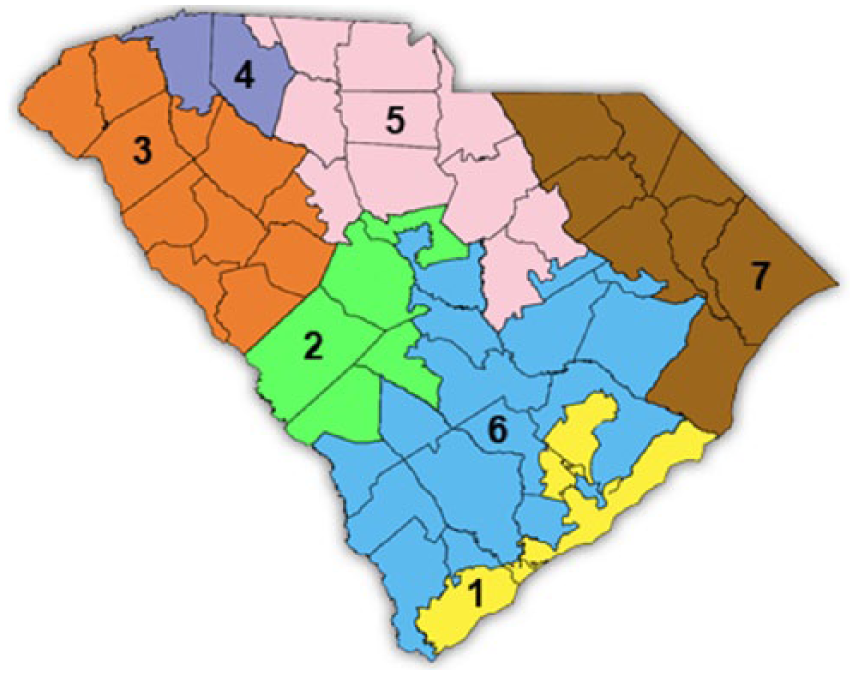
South Carolina congressional districts.
Black South Carolinians: Underrepresented in the U.S. Congress
To make the first point of disproportional representation of Blacks more lucid, consider the 2014 election results in the state found in Table 1. We highlight two districts (5 and 6) for this portion of the analysis. When looking at District 6, one sees that the Black Democratic candidate, incumbent Jim Clyburn, won by being awarded 72.8% (125,172 votes) of the overall votes for his district. His closest competitor was awarded 25.4% (43,658) of the overall votes for the district. Proponents of majority-minority districts would say that this is positive proof that the democratizing process works. A political map was drawn in the sixth district to ensure that Black South Carolinians would have the opportunity to elect the candidate of their choice. However, closer scrutiny of the election results—particularly in the fifth district—and the gerrymandered maps highlight how the process can actually, paradoxically, dilute the voting power of Blacks.
South Carolina 2014 Congressional District Outcomes.
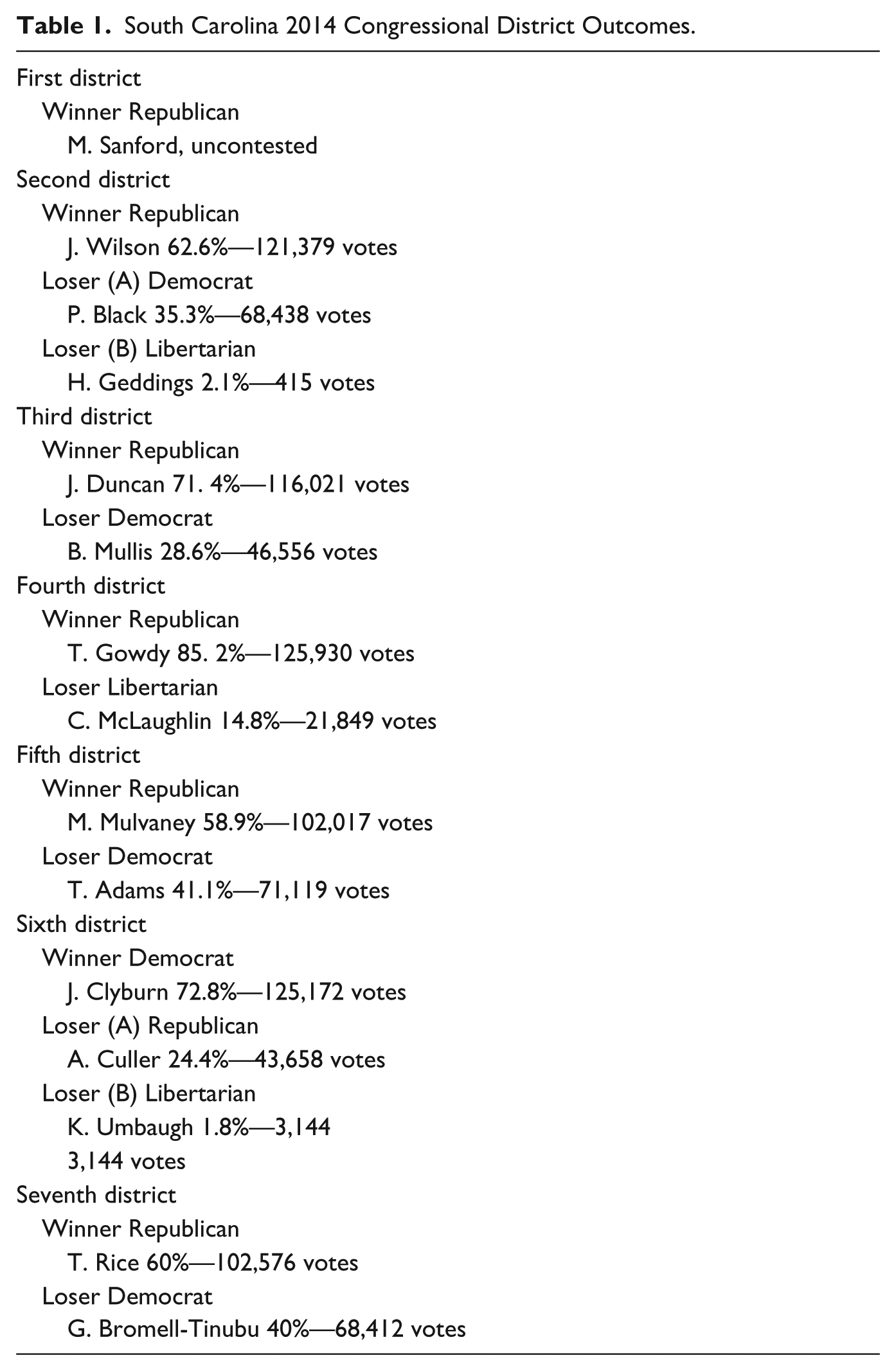
Figure 2 is a map of South Carolina and all of its counties. When juxtaposing Figure 2 with Table 2, which is a list of all of the South Carolina counties separated into the fifth and sixth congressional districts, their populations, and their racial composition, and with Figure 1, which is a congressional map, one sees that a very large Black population resides in both the districts. What is most telling, however, is how one portion of Richland County (in the middle of the state and clearly gerrymandered in Figure 1) is aligned with District 6, and the other portion is aligned with District 2 (a overwhelmingly majority White district). Richland County is the home of the capitol city, Columbia, South Carolina, and has a population of nearly 400,000 people—45% of which are Black; thus, positioning and pairing a large portion of that county with District 2 effectively diminishes the voting power of a large portion of the state’s Black citizens.
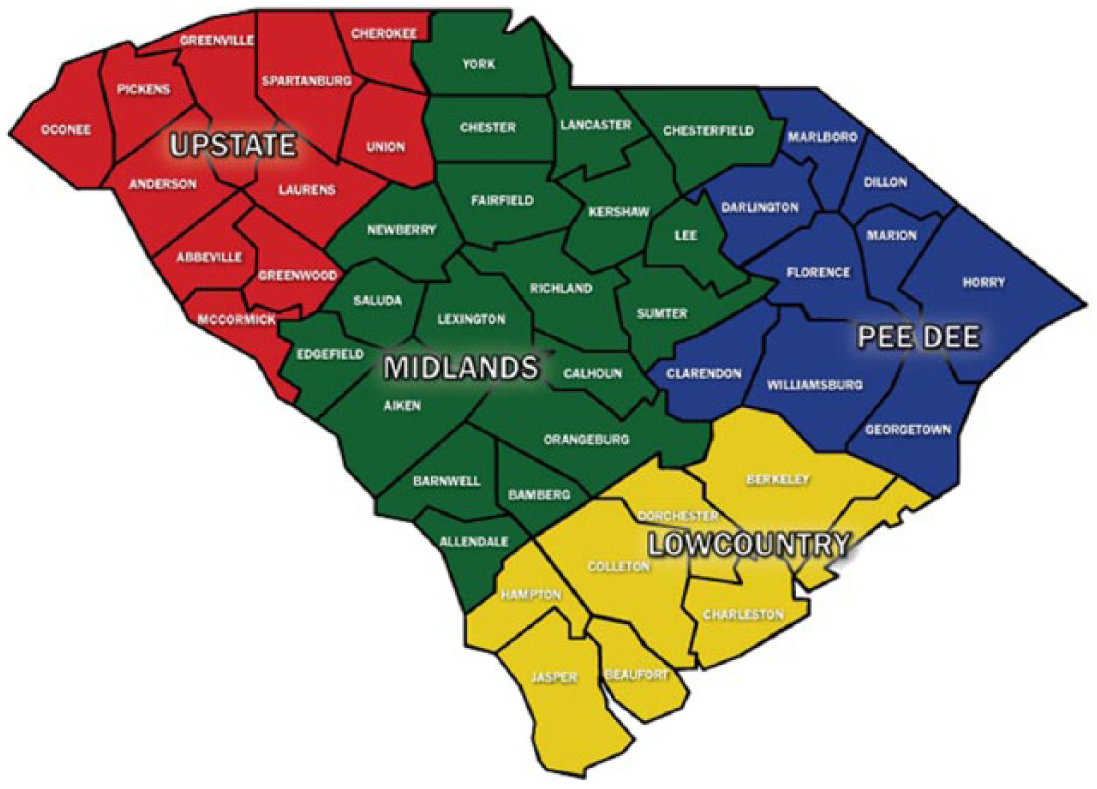
Map of South Carolina by County and Geographical Region.
Fifth and Sixth Congressional Districts 2010 Populations and Racial Composition.
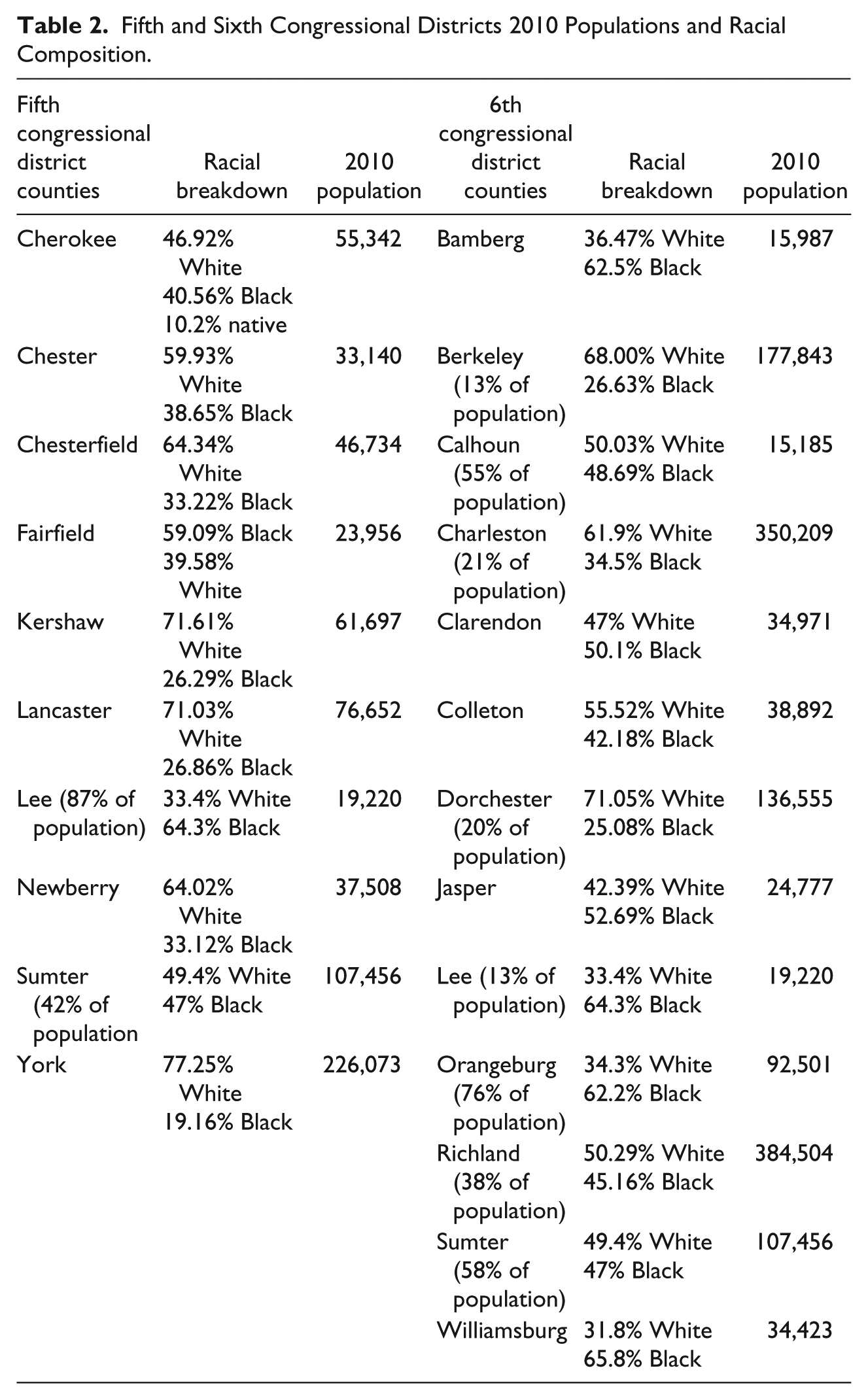
In addition, allocating a portion of Richland County to the fifth congressional district (whose major cities such as Rock Hill, SC and Fort Mill, SC are considered a part of the Charlotte, NC metropolitan area) from the second district would not change the voting outcome in the second district (a majority White district) since the winner in that district won by more than 50,000 votes. However, such actions would likely change the outcome in the fifth district. In a similar vein, allocating a portion of Richland County from the sixth congressional district (with its Black elected official) to the fifth district would likely not change the sixth congressional district’s outcome but could definitely change the outcome in the fifth congressional district. Lublin (1997) wrote:"African Americans usually cannot elect black representatives in 40-50% black districts without the aid of coalition partners, particularly Latinos, but their votes effectively veto the election of conservative representatives. (pp. 3-4)." Given the sixth district as drawn is more than 60% Black and the winner won the election by more than 80,000 votes, a reallocation of Black votes to the fifth congressional district from the sixth congressional district is not likely to change the outcome in the sixth congressional district (Black elected democrat), but could easily alter the voting outcome in the fifth congressional district.
In sum, given (a) that Richland County butts up to the border of the fifth congressional district but is already split among two districts (second and sixth), and (b) Clyburn in the sixth congressional district won by earning nearly 3 times the vote of his closest competitor, (c) the Democratic candidate Adams (a White Democrat) in the fifth congressional district was awarded 41% of the votes for his district, one could hypothesize that a simple reconfiguration of the fifth and sixth districts (or even the second district) focusing on Richland County could lead to a second Democratic seat in the House of Representatives, which is more closely representative of the Black population in the state. This outcome would be more ideal in terms of representation for Blacks in the state of South Carolina; however, does such a maneuver represent the interests of the Democratic Party as a whole? In discussing this point, we highlight a subtheme that emerged from our analysis: the death of the White Southern Democrat.
Demise of the White Southern Democrat
In 2014, University of Georgia Political Science Professor Charles Bullock told CNN,
Thirty years ago virtually all districts in Congress from the deep south were represented by white Democrats . . . but “they’ve become extinct.” . . . “Democrats have fallen about as far as they can” . . . He noted that Republicans, who took over Governorship and state legislatures, redrew House districts to elect African American Democrats to represent minority areas, they made the other districts more reliably Republican . . . Unless Democrats take back state houses and can readjust the shape of congressional districts in the deep south, Bullock said white Democrats “may be looking at being closed out of Congressional delegations until the 2030’s.” (Walsh, 2014, paras. 4-7)
Although some might consider Professor Bullock’s statements to be hyperbole, they mirror reality. However, no White Democrats currently serve in the federal congress as representatives of the southeastern United States. Gerrymandering has effectively dampened the power of the Southern White Democratic voice in particular and the Democratic voice in general.
To achieve such ends, policy elites use political public relations, issue communication, legal interpretations, and management preferences to influence public policy process and outcomes. They have strategically influenced the composition of U.S. House of Representatives to their advantage (Berman, 2012; Fang, 2014; Wolf, 2014).
The Republican Party both in general and in the South in particular is leveraging its power and influence granted to them via constituent elections to craft for themselves desirable policy outcomes and strategically gained reward. But they do so, ironically, by championing the principles of democracy for Black citizens.
Among the pieces of evidence to prove this point is the fact that voters in one South Carolina congressional district elected former governor Mark Sanford to the Congress over a centrist White Democrat, Elizabeth Colbert Busch, despite Sanford being caught lying to the citizens of South Carolina: He “stole from them” and using taxpayer dollars “left the state to sleep with his mistress in Argentina as their representative” (Fuchs, 2013, para. 1).
Fuchs questioned how this outcome could be possible. In her research, one source stated,
If the Republicans could have found a worse candidate than Sanford, you know, someone who lived on cardboard under a bridge, they could still have won the 1st district in SC. Perfect example: on the peninsula of Charleston, there is a ultra-high income group South of Broad Street [that] votes heavily Republican. The East side is predominantly poor and black. The 10-20 blocks in the middle are business areas and residential blocks that are enjoying the effects of gentrification. Those who move in and participate in the renewal of an area tend to be liberals—professors, gays, young people who can buy low and wait for the area to turn around. All of [that] middle area was safely tucked into the 6th district in a Republican gerrymandering exercise. They basically gave it to Jim Clyburn . . . so, he’s good for life, and the 1st District is now safely Republican. (Fuchs, 2013, para. 5)
Thus via the process of gerrymandering, elites—under the guise of honoring the principle of the Voting Rights Act—have the power to simultaneously weaken the voting power of underrepresented groups (see also Canon, 1999; Lublin, 1997) and severely limit the power of White Democrats in the South.
Thus, what South Carolinians are left with is a team of congressional representatives that satisfies, and even advances the letter of the law but does not accurately reflect the ideological and political perspectives of the citizenry. It also racializes the vote whether de facto or de jure. As such, it undermines democratic processes while claiming just the opposite.
So we return to the paradox and irony of how U.S. Republicans in South Carolina justify gerrymandering:
To demonstrate their commitment to the essence of the Voting Rights Act, Republicans put as many voters as possible into one district—especially in the South—so that it assures a Black member of the federal House of Representatives. They want the district to be so solid that it assures that particular voting outcome. What more could the State do to assure Black representation and fulfill the ideal of the Voting Rights Act?
We highlight another irony. The paradox of that “empowering” positive of American Exceptionalism used in this case to “preserve the integrity” of the Voting Rights Act is that said empowerment in fact disempowers all Democrats. Thus, if White Democrats make a public fuss and communicate about the “Death of the Southern White Democrat” they are met with a powerful discourse that can blame them for challenging gerrymandering, the Voting Rights Act, and by extension American Exceptionalism. Their aspiration for positive political processes sets them against a countervailing case for perfection.
GOP elites, by advocating for the upholding of the majority-minority districts, leverage their social capital to gerrymander White Democrats into congressionally Black (majority-minority) districts, thus effectively lessening the power of the Democratic voice overall and severely dampening the voice of White Southern Democrats. One implication of this analysis is that Southern Democrats may need to argue that ideological/political misrepresentation is of equal or possibly greater importance in the South than accurate racial representation alone (see also Canon, 1999, for the foundation upon which this premise is built). When Black Southern Democrats divert some of their attention to debating the validity of the Voting Rights Act with Supreme Court Justices who question the constitutionality of the Act (Bendery, 2013), there is less attention focused on the overall political representation of Southern Blacks in general and a larger portion of Southern citizens of all races in particular. Thus, new arguments and perspectives are not only needed but also warranted to offset this imbalance.
Critical Implications: South Carolina, Political Philosophy, and Practice
According to Fair Vote (a non-for-profit that looks to ensure fair voting for all citizens), the problem with gerrymandering is as follows:
[It] encourages manipulation of our elections by allowing incumbent politicians to help partisan allies, hurt political enemies and choose their voters before the voters choose them. The current process is used as a means to further political goals by drawing boundaries to protect incumbents and reduce competition, rather than to ensure equal voting power and fair representation. (Fuchs, 2013, para. 4)
Gerrymandering misuses acquired social capital, and therefore runs counter to the creation of a fully functioning society based on democratic principles and processes because elites use their power (social and political capital) to create voting districts that support their aims, yet misrepresent the interests of others. Such processes arguably strengthen society, make it exceptional, because citizens feel and can realize how their interests truly are expressed in public policy. A denial of that process, in this case through strategic political public relations, can create undemocratic conditions which motivate people not to participate and convince them that their interests are marginalized.
In sum, in the United States, elites use political public relations strategies to exploit the soft power of social capital, so as to privilege certain interests and deem them worthy of reward because of American Exceptionalism. Examining critically that claim of exceptional nation, we have critically demonstrated how that claim is problematic.
In a fully functioning society, political and social capital should be a “credit union” (where the customers own the institution and profits are returned to all owners in the form of dividends) as opposed to the version of political and social capital as a bank (a for-profit entity that self-interestedly returns dividends to elite owners). What would a credit union approach to a fully functioning society in the U.S. political process look like?
One respondent, Edward Kirby, in response to Fuch’s (2013) questioning of the election of image-troubled Mark Sanford issues his perspective on gerrymandering reform:
From the Constitution; Article 1, Section 2, Clause 3:
“The number of Representatives shall not exceed one for every thirty thousand, but each State shall have at least one Representative . . .” So reduce the average size of our existing districts by dividing each district in half. Then do it again and again until it can’t be done without falling below that 30,000 number. [Thus, each current district would be turned into approximately 20.] Then, pass a law—or, more likely, amend the Constitution—so that every time a district exceeds 60,000 citizens, it splits in two again. Gerrymandering would be minimized if not even eliminated over time. Campaign finance issues would dissolve. [When you have that few people, then what would you need money for? Kinko’s bills?] The House would obviously increase in size. Given 100 million voters in the last election, we would have 10,000 voters in each district electing 10,000 representatives. That would be huge compared to what we are used to, but at least we would have democracy restored to the nation and—who knows?—maybe even have the government work for us again. For what its worth, the number originally considered at the Constitutional Convention was 40,000. But George Washington—in one of the few times he asserted himself during the Convention—stated that the 40k number was too high and would surely lead to tyranny. As of 2010, the average size of a Congressional district was around 700,000.
And when people challenged the financial feasibility of this proposal, people like John Cross stated, “It might make sense if they [Representatives] did all their work by Internet and they were paid just a small stipend and maybe 1 or 2 trips to DC a year.”
Conclusion
While this critical case study did not gather empirical data and only analyzed one state’s political practices of gerrymandering, the findings can be used to broaden the discussion about power and politics: Who gets to determine how voting districts are structured? Who benefits most from such structuring? Are there other ways that can be developed and/or used to ensure better representation in politics?
The paradox of the positive, as highlighted through American Exceptionalism and optimistic announcements of the moral rightness of the Voting Rights Act, demonstrates that as much as communication can achieve agreement, harmony, and unity, it can also provoke a profound sense of alienation. Huspeck (1997) sets the tone for such discussion: “Through critical assessment of the conditions of modern institutional life we may better overcome the multiple forms of alienation that follow as a consequence of humans dominating other humans” (p. 274). The paradox distorts communication (Deetz, 1992; Habermas, 1987).
Layers of meaning, advanced and challenged through political public relations, can use positive arguments to achieve negative consequences. That can both be true of the structures of the political arena, as social capital is achieved and spent through the creation and enactment of politically bound reward systems. The critical importance of such analysis, the unpacking of discourse layers, reveals the flaws in the discourses for perfect political systems and outcomes. Such discourses mask the interest of power, and the control of the processes and policies by which communities seek to manage their movement into an eternally uncertain future. Self-governance is ostensibly a sharing of the risks and rewards of the human condition, but the key question, the users and critics of discourse, should ask is whose interests are advanced and whose interests are at risk (Heath & McComas, 2015)?
As it deals with the binary decisions of elections and public policies, political public relations bears the special ethical responsibility of advancing collective interests. As is the case, for public relations in general, how does the represented interest yield self-interest to collective interest? How that question is answered in practice not only defines, creates, and spends the social capital of American Exceptionalism, but it also offers a critical perspective for judging the ability of political public relations to advance self-governance. In an era when people are mobilizing to shout, “Black Lives Matter” they should simultaneously be shouting “Black Votes Matter”: This is paramount because it is evident that both are under attack.
Footnotes
Declaration of Conflicting Interests
The authors declared no potential conflicts of interest with respect to the research, authorship, and/or publication of this article.
Funding
The authors received no financial support for the research, authorship, and/or publication of this article.