




Abstract
The technology of glassmaking is complex. This complexity has been cited for the exclusion of the development of ancient glass technology from certain regions of the world, especially Africa, South of the Sahara. Thus, much of the existing scholarship on the technology of ancient glass has focused on the Middle East, Mediterranean, and Southeast and South Asia. Although the discourse on indigenous African technology has gained traction in Black studies, the study of ancient glass seems to have been left mainly in the hands of specialists in other disciplines. Drawing from archaeological and historical evidence from Ile-Ife, Southwest Nigeria, in tandem with the result of compositional analysis, this article examines the first recognized indigenous Sub-Saharan African glass technology dated to early second millennium
Introduction
The technology of glass is one of the most amazing inventions of humankind. Some of the interesting characteristics that set glass apart from other early materials are its shiny and colorful nature with the incredible translucency. Furthermore, the complexity involved in glass technology and the transformation glass objects brought to spectra of human society, especially in the areas of ritual, political, social status, and economy, are of great significance. Of all glass objects, beads appear to have had, and still have, a significant role in African societies as well as among African American and African diaspora. Although the multiple roles of glass bead as an object of self-beautification, aesthetic functionality, sociopolitical status, ritual and spiritual significance, and economic power have gained attention in Black studies (Drewal & Mason, 1998; Ogundiran, 2002, etc.), the technology and techniques of production have been given little attention.
Research on ancient glass technology has focused attention extensively on the Middle East, the Islamic world, the Mediterranean, the South and Southeast Asia, the Roman world, and the medieval Europe. Thus, the earliest technology of glass is dated to the second millennium
The new set of data recently recovered from archaeological investigations at Igbo Olokun in Ile-Ife southwest Nigeria (Figures 1 and 2) have helped to start a nuanced discussion on indigenous primary glass working/making in West Africa dated to the 11th century or earlier. While glass beads and other glass-related artifacts have been recovered from first millennium
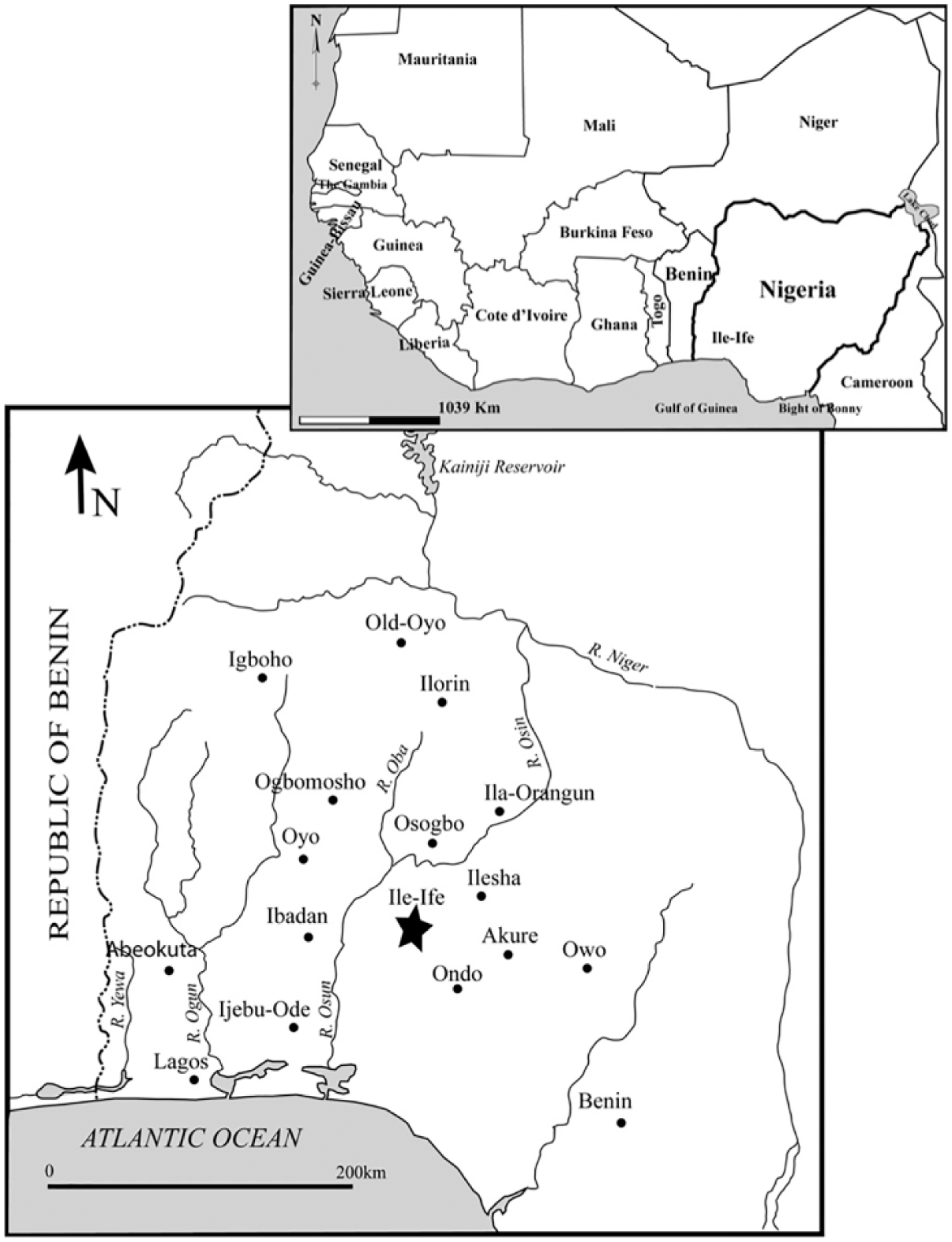
Location of Ile-Ife and other major towns and cities in Southwest Nigeria.
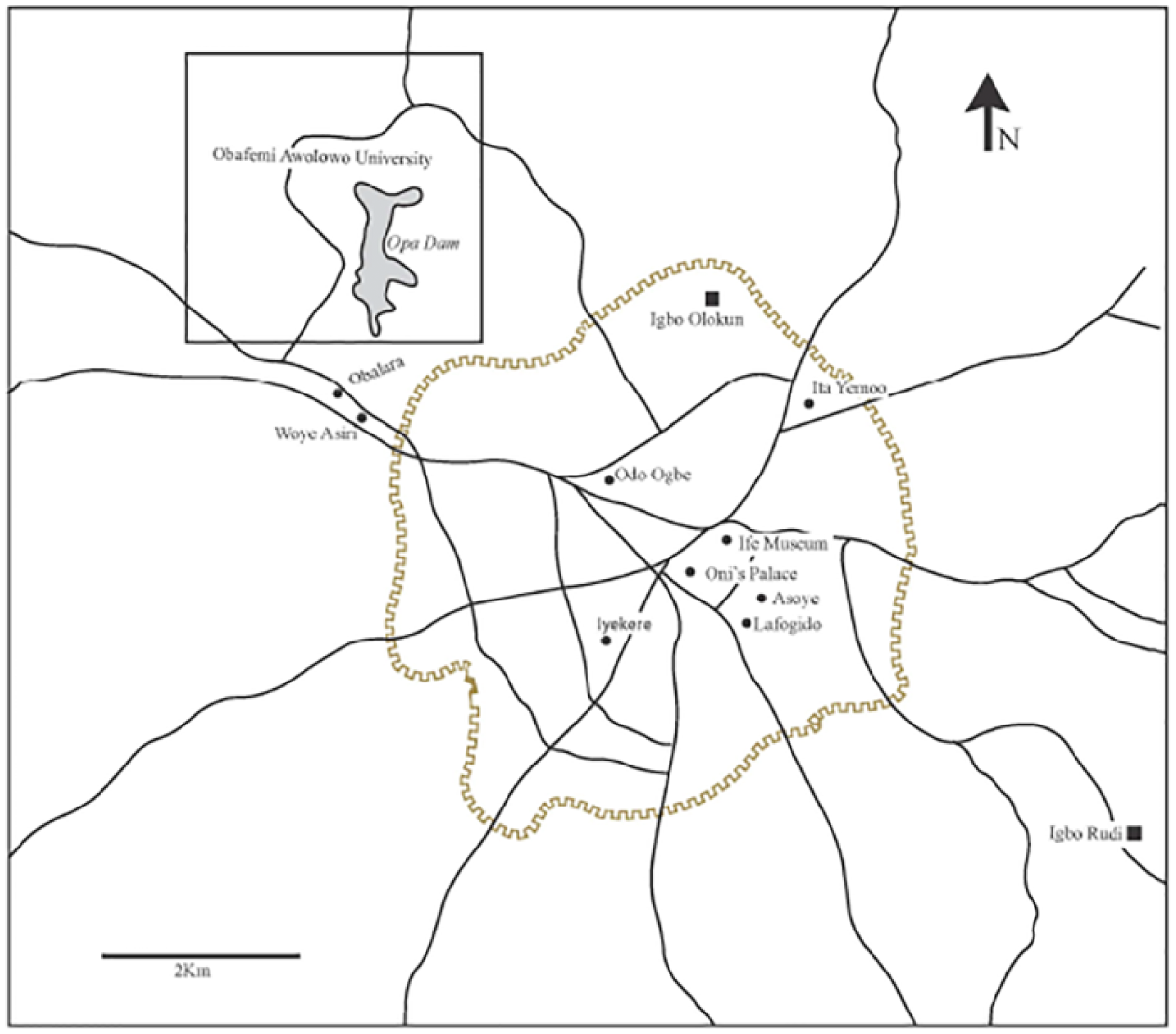
Location of Igbo Olokun and other archaeological site mentioned in the text in the context of Ile-Ife.
Radiocarbon dates from archaeological sites in Ile-Ife associated with glass beads and other glass-related artifacts.
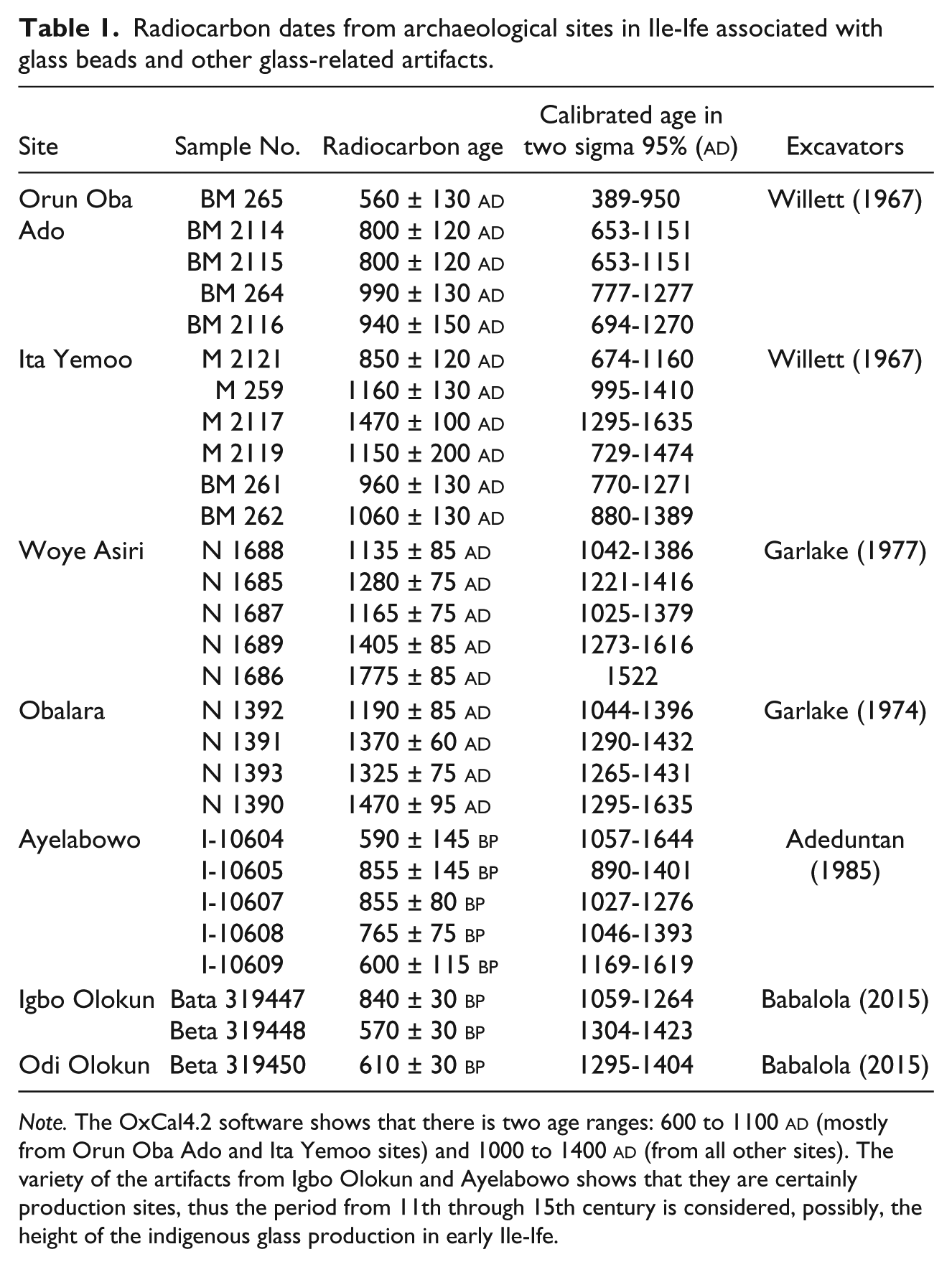
Note. The OxCal4.2 software shows that there is two age ranges: 600 to 1100
In this article, I discuss some of the data from the archaeological investigations at Igbo Olokun to redress aspects of indigenous glass technology in Yorubaland dated to at least 11th century
Genealogy of the Notions of Indigenous Glass Industry in Early Yorubaland
The idea of indigenous ancient primary glass production in Yorubaland started as speculation—a discussion that was based on the presence of some glass-related materials from the random archaeological site with little or no contextual detail. During his expedition in Ile-Ife in 1910, Leo Frobenius (1913/1980) encountered glass-lined crucible and interpreted it to have been used in glassmaking, although Frobenius was of the opinion that the entire Yoruba civilization was an offshoot of the ancient Greek Atlantis culture. There is no gain dwelling on the criticism of Frobenius narrative as his view has been severally criticized and no longer hold ground in Black historiography.
In his writing on Black African superiority on the world’s Economic and Cultural Revolution, Cheikh Anta Diop—one of the frontrunners of Afrocentrism—speculates that there must have been local glass industry in southern Nigeria:
. . . [the glass industry] is least expected and had already at that time attained a semi-industrial stage, the workers having organized into veritable guilds (with community workshops, refectories, and dormitories). [The craftsmen] utilized as raw material sand, sherds, and glasses, which they blow or mold into various objects . . . besides beads of the Egyptian, Phoenician, or Venetian origin, there are those of properly local creation. (Diop, 1987, p. 205)
Diop’s statement portraits a co-existence of both imported glass that was reworked and locally made glass fabricated to beads and other objects. Other scholars have also made suggestions similar to that of Diop on the utilization of both imported and locally made glass among the Yoruba. Omotosho Eluyemi (1978, 1987) was the first Yoruba indigenous archaeologist to echo the argument for the local primary glass production in Yorubaland with an industry located in Ile-Ife. Between the 1970s and 1980s, Eluyemi carried out excavations at Igbo Olokun and also conducted an ethnographic survey of craft production in Ile-Ife. From the excavations, he recovered varieties of related glass materials including beads and crucibles as well as shallow furnaces. Eluyemi (1987) argues that early glass bead maker in Ife would have, perhaps, used both quartz materials and crushed glass as the raw material in the local glass industry. This notion of the indigenous glass industry in Ile-Ife became an integral part of Eluyemi’s scholarship, yet it lacked empirical evidence from compositional studies.
John Adeduntan’s (1985) excavations at Ayelabowo site in Ile-Ife yielded several glass beads, fragments of the glass-lined crucible, and production debris. Charcoal samples collected from the excavated units were radiocarbon dated to the 11th century. Based on the occurrence of the production-related artifacts, Adeduntan (1985) argues that Ayelabowo site was a local glass bead–making industry. Horton (1992), in his article, “The Economy of Ile-Ife,” suggests that when it comes to glass production, “we should have to give strong consideration to the possibility of indigenous manufacture of the raw glass [in early Ile-Ife]” (p. 132).
In sum, since the period of Frobenius till the end of the 20th century, the argument for the indigenous primary glass industry in Yorubaland was at best speculative. Although Eluyemi and Adeduntan worked with archaeological materials, mere classification and description of the artifacts are not sufficient enough to make a convincing case for early indigenous glass production. The descriptive narrative of archaeological materials for arguing for local glass production is problematic and highly limited in its data output and usability for making such critical argument. The location of the study of ancient glass in the fields of material science and geochemistry among other natural sciences also pose a challenge. While Claire Davison’s (1972) work provided the first data on the chemical composition of Ile-Ife glass beads, her interpretation privileged external sources for Ile-Ife glass beads over local production, despite the uniqueness of the composition of the Ile-Ife glass. However, the availability of nuanced compositional and geochemical data that significantly supplemented the existing, but meager, archaeological data in the early 2000s brought about a paradigm shift in the discussion of primary glass production in early Nigerian societies. Thus, attention was on the possibility of local primary glass production.
The works of Lankton et al. (2006) and Ige (2010a, 2010b) took the lead in this new direction. Lankton and his colleagues chemically analyzed several samples of glass beads, cullet, and glass-lined crucibles of Ile-Ife origin but selected from the collection of the British Museum and the Natural History Museum of the Obafemi Awolowo University, Ile-Ife. From the analysis, they recognized that most of the samples are of unusual high lime high alumina (HLHA) composition (Lankton et al., 2006). Comparison of the contents of the Ife HLHA glass with the database of the composition of the Middle East, Roman, ancient Islamic, and Southeast Asian glasses revealed that the simultaneously high content of the lime and alumina are unprecedented. The concentration of these oxides separates the Ife glass from other known compositional groups (Brill, 1999; Brill & Stapleton, 2012; Wedephol, Simon, & Kronz 2011). As a result, Lankton et al. (2006) conclude that the HLHA glass is evidence of a glassmaking tradition unique to West Africa, which was locally manufactured in or near Ile-Ife, southwest Nigeria. Considering the unique composition of the HLHA glass, Ian Freestone (2006) suggests that combination of alkali feldspar material in the form of immature granitic sand lime-rich mineral (snail shell) would have resulted in this unique composition. Experimental work by Akin Ige (2010b) further advanced and affirmed the argument for the availability of the raw materials suitable to produce glass within the vicinity of Ile-Ife.
More recent work by Ogundiran and Ige (2015) at early Osogbo site has not only demonstrated the possibility that the technology of the HLHA glass spread across the Yoruba region in post 16th century but also argued that indeed “our [black] ancestors were material scientists.” The works of Ogundiran (2014), Ogundiran and Ige (2015) in Oshogbo and that of the author Babalola (2015) in Igbo Olokun have proved that combination of archaeological data from known and well-documented context and compositional analysis brings a better insight on understanding early Yoruba indigenous glass industry.
Igbo Olokun in the Context of Ile-Ife: Historical and Archaeological Background
The archaeological site of Igbo Olokun, popularly referred to in the literature as Olokun Grove, is located in the northern section of the city of Ile-Ife at a proximity to the north gate of the city wall (Figure 2). Named after a Yoruba goddess of wealth, Olokun tradition has it that Olokun was one of the wives of early Oonis (Kings) of Ile-Ife. She was very industrious and purportedly the first to manufacture glass beads in Ile-Ife. A vast piece of land was consecrated for Olokun as a sacred grove with shrine constructed for her goddess within the grove. There is another Olokun shrine at Ilode compound, Ile-Ife where oral tradition and historical memories at Ile- Ife claimed that Olokun lived in her days. An annual Olokun Festival is still held in Ile-Ife during which sacrifices are taken to the shrines (Eluyemi, 1987) to appease the goddess. It is hard to date the period of the existence of Olokun by the oral tradition. However, the occurrence of glass beads, crucibles, and glass debris in association with terracotta and brass/bronze works have been used to date the time of the manufacturing of glass beads in Ife to the “classic” Ife period (12th-15th century
The abundance and prevalence of glass beads and crucible fragments that litter the surface at Igbo Olokun have, on one hand, affirmed the grove as an ancient industrial site and, on the other hand, attracted much attention over several decades. As a result, a deluge of excavations had been carried at the site both by the professionals and amateurs who were only interested in the archaeological fortune of the site. Most of the excavations were either not fully reported or never published. These shortcomings were parts of the motivation for the dissertation work of the author at the site (Babalola, 2015).
During our investigation at Igbo Olokun in 2011 through early 2012, we excavated four trenches with the depth ranging from 70 cm to 130 cm below the surface. The stratigraphic profile of the units and the chronometric dates from charcoal samples collected from the excavation dated the site to the period between the 11th and 15th century
Glass Beads, Glass Debris, and Crucibles: Classification and Composition
Plenty of glass beads from the investigation at Igbo Olokun have allowed a better understanding of the Ife glass beads attributes such as colors, shape, and size. Several thousands of the recovered glass beads from across the excavated units consist predominately of monochrome beads in shades of blue; shades of green, yellow, dark gray, or black; and colorless. The assemblage is dominated by blue (Figure 3). Some polychrome beads were also present in the form of multi-color stripes or spiral. The most intriguing of all is the category with mostly colorless core and red coating on the exterior. The colorless core and red-coated outer beads are indicative of sophisticated bead-making technique. The beads appear in various shapes ranging from tubular to cylindrical to oblate. The beads are small with the majority measuring <5 mm. The bead shapes and sizes are connected to the technique of production as well as the technological know-how of the crafters.
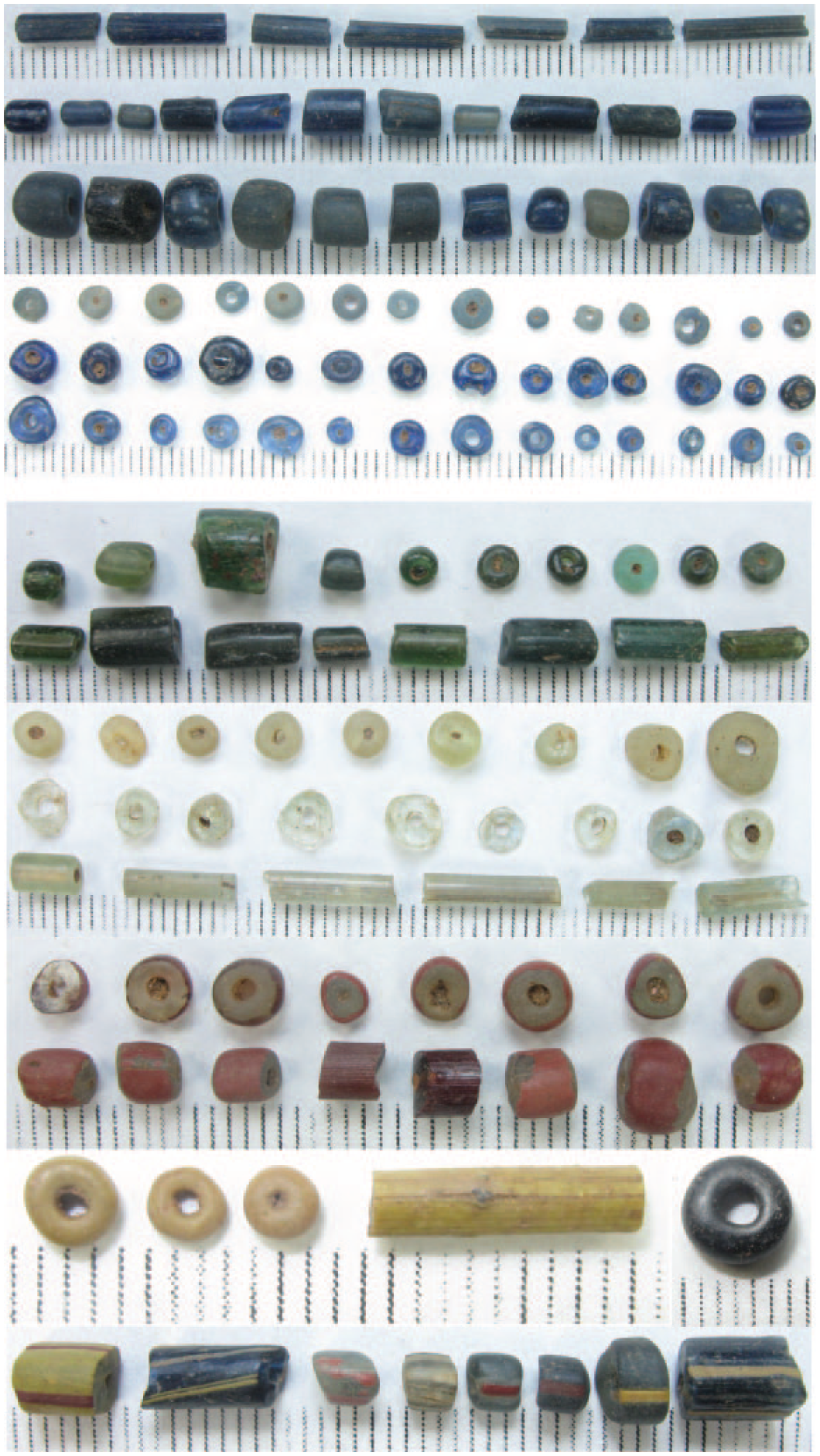
Glass beads from Igbo Olokun in different colors and shape.
About 3 kg of the production debris recovered from the investigation offers an incredible avenue to reconstruct the stages involved in glass bead making at the Igbo Olokun glass workshop. Although larger part of the production debris is yet to be thoroughly analyzed, preliminary examination shows that the waste consists of collapsed tube, tube fragments, glass cane, beads fragments, droplets, crucible glass fragments, cullet, and clumped beads among others. I should say that the use of the term cullet in this article should not be mistaken for broken or fragments of imported glass materials as it may have been referred to in some literature. Rather, I use the term cullet to represent glass fragments from the assemblage that seems not to belong into any of the identified categories. The cullet could have resulted from broken off of any of the recognized waste. Detailed study of the wastes that focused on the reconstruction of the chaines operatoire of glass bead making at the Igbo Olokun glass workshop is planned for publication elsewhere.
Glass-lined crucibles formed another major group of material recovered from our investigation at Igbo Olokun (Figure 4). In fact, to date, no archaeological site of the pre-mid second millennium
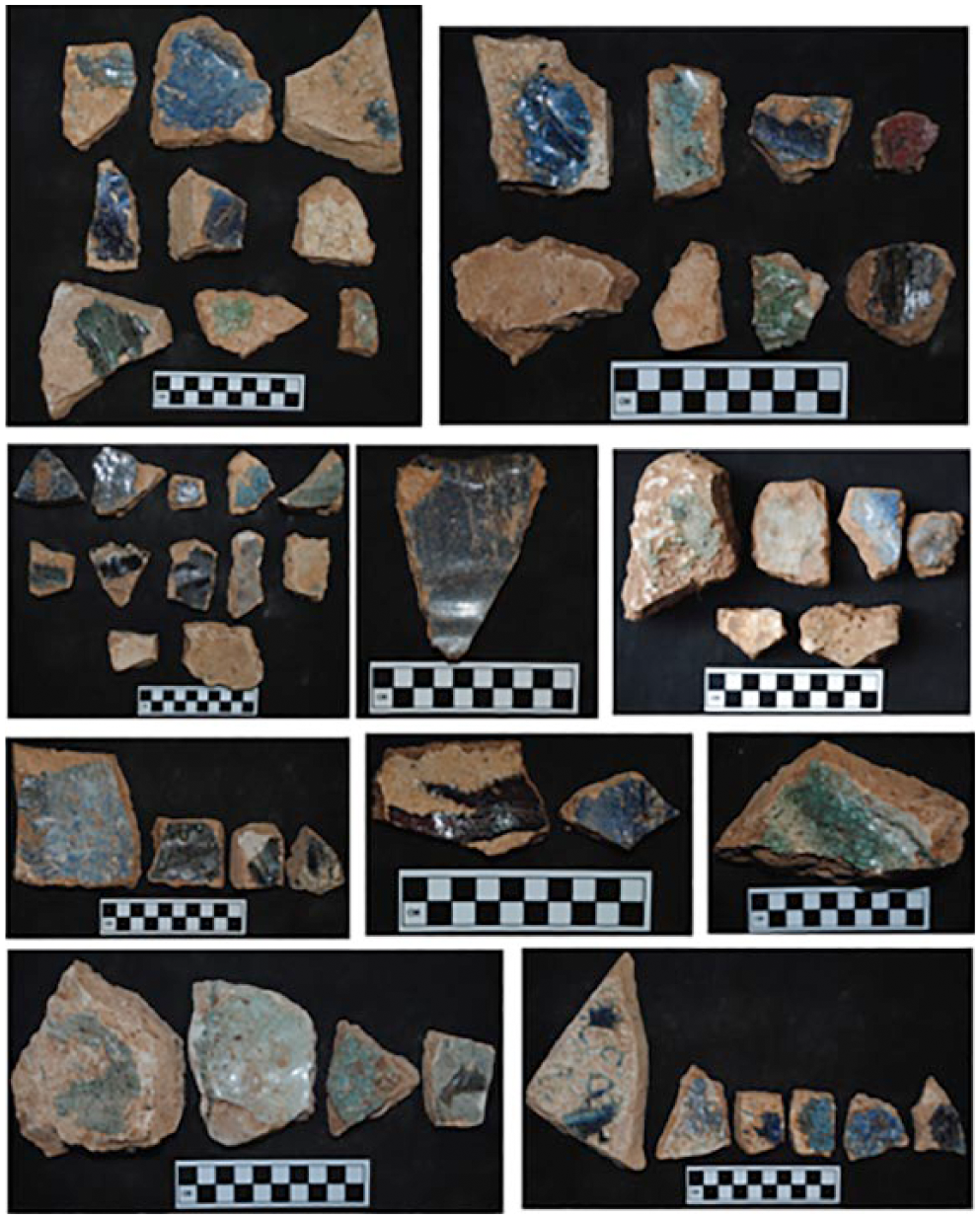
Selected glass-lined crucible fragments from Igbo Olokun.
Compositional Analysis of Ile-Ife Glass
When working with this set of material discussed here, there are two things that one must attempt. First is a detail classification, which helps to understand the nature of the assemblage. This type of examination I have done in the brief overview of the material presented above. Second is the compositional analysis of the elemental constitutes of the glass. Chemical analysis helps to identify the raw materials used, source(s) of the glass, and the technique and process of production. This type of scientific method has often entrusted in the hands of the specialists in fields such as material science, chemistry, geochemistry, and archaeometry. Hence, several decades of elemental studies of ancient glass have provided interesting data in understanding the development, spread, and production of glass.
Studies of the raw materials of ancient glass have shown that most belong to the soda-lime-silica glass category, which originated from the glass workshops in the Middle East. This glass, as well as other glass types, is formulated based on the fact that these elements are the main constituent of the glass, although the source of the alkali differs, which causes variations in the composition (Brill, 1999; Turner, 1956; Wedepohl, Simon, & Kronz, 2011). There are three major compositional groups for ancient glass: mineral soda (alkali derived from natural sodium-rich mineral), plant ash (alkali derived from the ash halophytic plant), and wood ash (alkali derived from the ash of burned down wood, for example, oak, etc.) glass (e.g. Henderson, 2013). Studies have shown that there are other minor groups including the Southeast and South Asia soda-alumina glass (Dussubieux et al., 2008; Dussubieux, Gratuze, & Blet-Lemarquand, 2010) and the high lead glass (Wedepohl, Ingeborg, & Gerald, 1995; Wedepohl & Baumann, 1997; Mecking, 2013). The occurrence of any or combination of these compositional groups on an archaeological site is an indication of origin and spread of a particular glass technique as well as its production.
Given this, several samples of Ile-Ife glass were analyzed using Laser Ablation Inductive Coupled Plasma Microscopic Spectrum (LA-ICP-MS) and Scanning Electron Microscope With Energy Dispersive Spectrometry (SEM-EDS) techniques. Dr. Laure Dussubieux of the Field Museum Chicago helped with the LA-ICP-MS, while the University College London Qatar Doha (UCLQ) material science laboratory was used for the SEM-EDS analysis. Results of the analysis show that neither of the more than 100 Igbo Olokun glass samples analyzed so far is of the soda-lime-silica glass nor do they belong to the soda-alumina and the high lead groups. Rather, they are all low soda glass with the majority of HLHA composition (Table 2; Figure 5). Two other groups are identified: low lime high alumina (LLHA) and low lime medium alumina (LLMA; Figure 5). Table 2 presents the average concentration of the major and minor elements in each of the recognized groups. Examination of the trace elements of the Igbo Olokun glass reveals that the recipe was connected to the local geologic material.,.The concentration and distribution of the colorant oxides in the samples also suggest an active indigenous production.
Average Concentration of the Major and Minor Elements of the Igbo Olokun Compositional Groups.

Note. The figures are in weight percentage. HLHA = high lime high alumina; LLHA = low lime high alumina; LLMA = low lime medium alumina.
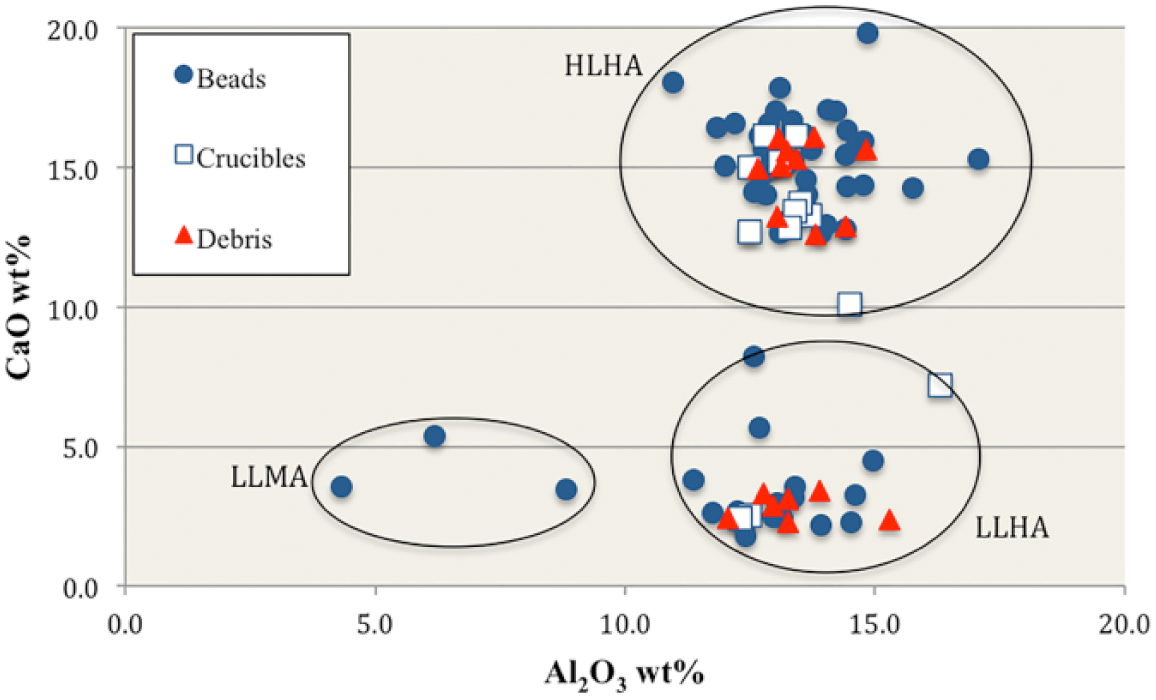
Alumina versus lime content of the Igbo Olokun glass showing the overlap of the glass beads, crucible glass, and production debris.
The results of the compositional analysis of Igbo Olokun glass affirm Lankton et al.’s (2006) assertion on the uniqueness of the HLHA glass to Ile-Ife. Their work presented a compelling argument for local primary glass production of a unique glass with the combination of high lime and high alumina content. Recent works by Babalola (2015) and Ogundiran and Ige (2015) have confirmed the preponderance of the HLHA in early Ile-Ife and its appearance in other Yoruba communities in the 17th century. The uniqueness of these Ife glasses among other known compositional groups in West Africa as well as from around the globe has been pointed out (Babalola, 2015; Babalola et al., 2017; Freestone, 2006; Ige, 2010a & b; Lankton et al., 2006; Ogundiran & Ige, 2015). It is now clearer that the recipe for this glass was local to Southwest Nigeria. From this evidence, it is logical to argue that there was an indigenous glass technology in early Ife located at Igbo Olokun and perhaps specialized in glass bead making using sophisticated techniques.
The Indigenous Glass Bead Making at Igbo Olokun
Davison was the first to provide us with composition data on the Ife glass, which formed the basis for understanding early glass industry in Ife for over four decades. Here, I will like to reiterate few points on her description of Ife glass beads in reaching her conclusion. Describing the Ife glass, Davison (1972) argues that there is “no particular idiosyncrasies which might alert one to the possibility of local manufacturing” (p. 259). Commenting on the technique of production of the beads, she describes the beads as “cane beads, [which] requires knowledge of the art of glassblowing”—a technique that was not known in West Africa until the later time. Davison went further to use the term casual to describe some of the Ife beads. These “casual” beads, according to Davison,
. . . appear to be made by a rather ad hoc combination of drawing, winding, and pressing, but not blowing . . . Some bear applied stripes, which are not marvered in, which can be picked off with the fingernail, and which are sometimes crooked. (Davison, 1972, pp. 261-262)
Putting Davison’s (1972) argument in context, covertly, she suggested that perhaps the beads striped were made in Ife, but by crude technique and definitely, as she concludes, that the “archaeological remains of the Ife glass industry are . . . interpreted as evidence of a reworking activity . . . it seems unlikely that the beads were produced at Ife” of imported glass (pp. 260-271). In the rest of this section, I will discuss the evidence from our investigations at Igbo Olokun that support the fact that the Ife glass beads were not only made locally but also that the techniques were rather sophisticated and the glass was made from local raw materials.
In the study of ancient craft production, identification of the location of activity is of great significance (Renfrew & Bahn, 2008). To recognize the production locus, data relating to the volume of manufactured objects and size of manufacturing debris are essential. The density of the finds from Igbo Olokun unequivocally reveals an industrial site that engaged in a complex activity. The diversity in the assemblage represents a complete chain of glass bead making from melting of glass to bead treatment—a process that was rather complex for an early industry. To make any glass object, the craftsmen first need glass. Glass can be acquired either through primary glassmaking (gathering and melting of raw materials to make glass) or secondary glass working (including collecting of broken glass shards for recycling) in making objects of one’s choice. Archaeological, historical, and compositional evidence have shown that ancient societies around the world employed both of these means in making glass objects including beads. While workshop of primary glassmaking can be separated from that of secondary glass working, these two activities can also be carried out in the same workshop (Sode & Kock, 2001). The evidence from Igbo Olokun suggests these two processes might have been conducted at the site.
In Sub-Saharan Africa, there has been no archaeological site that yielded glass crucibles as we have them from Ile-Ife in association with other production debris. If the glass was not made at the site, there would be no need for the occurrence of glassmaking apparatus—in this case, the crucibles. Elsewhere, studies have shown glass-lined crucibles as necessary machinery in glassmaking (Rehren, 1997; Rehren & Pusch, 1997). Considering the presence of numerous fragments of glass-lined from 11th- to 15th-century context in Ife in association with unprecedented production debris indicate that glass working activities were carried out at the site. Study of the attributes and properties of the Ife crucible, including the form, fabric, microstructure, and compositions, has shown that the crucibles were used in high-temperature activity rather than just being used in remelting of imported glass (Babalola & Rehren, 2016). Although there is archeological evidence of secondary glass working across Sub-Saharan Africa indicated by the presence of glass cullet (broken glass vessels) and beads with marks of reheating (e.g., Cisse, 2011; Wood et al., 2012), none of the sites yielded glass-lined crucibles.
There are also ethnographic accounts on local glass manufacturing in the 19th-century West Africa. Nadel (1940, 1942) reported the processes of glassmaking from mixing of local sand and natron soda, possibly transported from the Lake Chad area, to make local glass called biniki among the Nupe people of Nigeria. The addition of colored European bottle glass for the coloring of the glass, other activities at the glass workshop, and the tools used were equally mentioned (Robertshaw, Weise, et al., 2009). Similarly, there are reports on the production of the Ghanaian Krobo glass beads. Interestingly, none of these accounts indicate the use of the glass-lined crucible. This lack of glass crucible at the other stated sites, therefore, shows the uniqueness of the production technique at Ile-Ife and the importance of the crucibles as “technical vessels” used in glassmaking (Pusch & Rehren, 2007).
One of the ways to determine whether or not the glass beads from Igbo Olokun were locally made from the glass melted in the crucibles is to compare the chemical signature of the two sets of materials. Results of the compositional analysis thus reveal a perfect match among the glass beads, crucible glass, and the production debris (Figure 5). The firm connection between these different kinds of glass materials from Igbo Olokun is an indication that they all belong to a glass technological tradition with recipes unique to the industry. It can, therefore, be argued that the glass industry at Igbo Olokun was making beads from the locally melted glass rather than imported glass as seen in other places in Sub-Saharan Africa (e.g., Cisse, 2011; Robertshaw, et al., 2010; Roberthshaw, Magnavita et al, 2009; Wood, 2016; Wood et al., 2012).
Davison (1972) has argued that beads from Ife were possibly not locally made because of lack of evidence of glass blowing techniques. Glass blowing technique was first known in 50
Davison (1972) assumes that the air bubble that forms the perforation in drawn beads could only be made by blowing technique, J. Lankton’s (personal communication, February 28th 2016) ethnographic work in Java has demonstrated another way to make the air bubble. In this situation, a pointed iron rod is used to punch the glass gather through the hollow in the iron rod that contains the hot glass gather, which leaves the air bubble. While it is hard to argue that such punching techniques were used at ancient Ile-Ife, it is evident that other methods besides blowing technique could be used to achieve the same result. Thus, the glassworker at Igbo Olokun could have adopted techniques different from the blowing. In addition, it is certain that the Ile-Ife beads were locally made using the drawing technique to form the tubes from which beads were cut.
James Lankton’s (personal communication, February 28th 2016) and Francis’s (1990) studies also reveal the varieties of wastes generated through the drawing technique. These studies show that although glass tubes can be drawn by different techniques using different tools, the generated wastes often look similar. The categories of production wastes recovered from Igbo Olokun such as collapsed tubes, tube end, malformed tube, and other bead-making debris (Babalola, 2015) are similar to those reported from the glass bead–making centers in Java (Lankton, personal communication, 2016) and Papanaidupet and Purdalpur in India (Francis, 1983, 1991; Kanungo, 2016). There is also a great resemblance between the bead-making debris recovered from Mupon in Myanmar (Lankton, 2015) and Arikamedu in Southern India (Francis, 2004) and the assemblage from Ile-Ife. Whether or not the drawn technique adapted at glass workshop in Igbo Olokun was linked to that of India is widely unknown. In fact, there is no way we can determine this archaeologically. What is certain, however, is that the appearance and the nature of the production debris from Igbo Olokun are similar to those from the studies mentioned above. This similarity suggests Ife glass beads were made by drawing technique, which could not have necessarily required blowing as Davison (1972) has suggested.
As earlier stated, the overall small size of the beads from Igbo Olokun is interesting. The making of tiny glass tubes, often less than 5 mm in size, with perforation parallel to the length of the tubes from which beads were cut, mirrors advance indigenous technique. While we cannot determine the length of the drawn tubes before they were cut into beads, a recent study has estimated that glass beads between 200,000 and several million would have been made from each crucible from Igbo Olokun depending on their size (Babalola & Rehren, 2016). Production of beads of such magnitude from a single crucible is indicative that production was on a large scale suggesting that the finished product must have had large market locally, regionally, and trans-regionally. Establishment of the glass industry and the proliferation of beads would have had a significant impact on the aspect of the culture such as economic, religion, social order, and the entire society as a whole.
A Historiography of Glass Beads in Yorubaland and Beyond
The establishment of an indigenous African glass and glass beads industry dated back to, at least, the late first millennium
The transformation in the Yoruba political system, which instituted the sacred kingship system, between the ninth and 11th centuries, coincided with the production of an indigenous glass/glass bead at Ile-Ife, perhaps at a smaller scale, and possibly for the royal house and the affluence in the society. Ogundiran (2003) has suggested that the representation of beads on the stone figures dating to the pre-11th century at Ile-Ife may signify important political status. Also, oral tradition in Ile-Ife has indicated a complex centralized political system between the 10th and 11th century
By the beginning of the 12th century, the use of glass beads as articles of power and the political office was ubiquitous in the Yoruba-Edo speaking region. The ceremonial kingship of political systems formed at Ile-Ife in the “late formative period” spread across the Yoruba region and beyond, resulting in the demand of glass beads that served as a symbol of power and authority (Ogundiran, 2003, p. 43). Archaeological evidence in the form of bronze figures in Ile-Ife has shown that ruling elites were elaborately decorated with beads worn on the head and around the neck, waist, wrist, and ankle (Willett, 1967, 2004). Some of the Ile-Ife bronze figures and terracottas sometimes are adorn with beads covering almost the entire body “from head to toe” and “encircled with and sealed in beads” (Ogundiran, 2002, p. 437). These artworks may represent the display of wealth and/or political/religious position. Beads were also used to decorate the staff of office, which signifies authority.
The expansion of the Ile-Ife sacred kingship political ideology further afield in the western Niger area would have opened up more market for Ife glass beads. The historical account has demonstrated that political office holders from the neighboring communities were on a pilgrimage to Ile-Ile purposely for endorsement and issuance of beaded and sacred staff of authority. The imperial city-state of Old-Oyo and Benin empire were among the cities and communities that regularly ordered supply of beads and beaded objects such as the staff of power and crown of ase—(power) as markers of political authority, affluence, and acceptance of public office (Egharevba, 1968; Ogundiran, 2003).
Beyond the Yoruba-Edo speaking region and the political and religious symbolism, Ife glass beads were also traded among other early West African societies, perhaps for economic gain. Ile-Ife was an active partner in the early long-distance commerce, first the trans-Saharan and later trans-Atlantic trade and exchange. Ile-Ife HLHA glass beads have been found in important West Africa trade entrepot such as Gao (Mali) as well as in the early European settlement and slave entrepot of Elmina (Ghana; Decorse, 2001; Brill & Stapleton 2012; P. Robertshaw, personal communication, June 2014). Records of the 11th to 14th century Arab scholars reveal trade in blue dichroic West African glass beads. By 16th and 17th centuries, the West African dichroic glass beads, possibly, including the locally made Ile-Ife beads, had spread and gained significant popularity in the international market to the extent that they were being imitated in Europe (Davison, Giauque, Clark, 1971). Perhaps, one of the characteristics of the indigenous Ile-Ife glass beads that made it so desirable in the regional and intercontinental bead market was its good quality. Experimental work by Davison, Giauque, and Clark (1971) has demonstrated that Ife glass would maintain its consistency at more than 900°C and not be altered during cooling.
Accounts of early Europeans in West Africa indicate the importance of akori, perhaps of Ile-Ife origin, in the pan-West African regional commerce. Ryder (1969) explains that the beads bought by the Portuguese in the 16th century at Benin were Ile-Ife segi mainly the tubular blue translucent glass beads (Fage, 1962). The trade in glass beads often involves “middlemen,” who helped in the movement of the goods to the coast where most trading and exchange transactions took place. Archaeological survey of Isoya (near Ile-Ife) has revealed trade routes connecting Ile-Ife to the outside world (Eluyemi, 1977). The pre-18th century trade routes allowed Ile-Ife goods (glass beads in this context) to spread to the Coast and other West African kingdoms and cities. These routes, probably, run from Ile-Ife through Isoya to the coast and presumably to Badagry and Cotonou (glass beads in this context) (Eluyemi 1977).
The social, economic, and symbolic significance of glass beads in West African culture was also transposed to the Americas. Stine (1990) gives accounts of the patronage of the colonial merchants and planter in African and Indian trade. Similarly, records of the activities of European slave middlemen on the coasts of West Africa also point at purchase of glass beads. Archaeological investigations of African American sites have shown the preponderance of glass beads (e.g., Ascher & Fairbank, 1971; Good, 1976; Pogue & Esther, 1991; Praetzellis & Praetzellis, 1992; Stine et al., 1994). Blue glass beads have been identified to dominate African American site in South Carolina and Georgia region of the United States between the 17th and 9th century (Stine et al., 1996). As millions of enslaved Africans in the south of the United States originated from West and Central Africa where glass beads played significant cultural and socioeconomic roles, Stine et al. (1996) suggest that “bead use among enslaved Africa Americans represents a pan-African cultural phenomenon derived from African origins” (p. 53). Archaeology evidence of the occurrence of the Ile-Ife type of glass beads at the slave-trading post of Elmina in the 16th century, Ghana (Decorse, 2001), strongly support the trans-Atlantic distribution of the Ife beads. Although this assertion is hypothetical, it is a logical one to make while we wait for composition studies of glass beads from African American sites.
Conclusion
The findings from the author’s ongoing archaeological investigations at Ile-Ife have revealed substantial archaeological and compositional evidence not only to legitimize Igbo Olokun as an early glass production site but also to provide a compelling argument for indigenous African glass technology dated to the 11th century or earlier. Contrary to the conventional thought that Sub-Saharan Africans only remelted important glass, it is evident that primary glass industry existed in the sub-continent prior to the European contact. This article has provided empirical evidence beyond reasonable doubt to substantiate Lankton et al.’s (2006), Freestone’s (2006), and Ogundiran and Ige’s (2015) argument of the uniqueness of the Yoruba HLHA glass and its variants. The data set presented in his article shown the ingenuity of the ancient Yoruba glassmakers. Archaeologists, historians, and anthropologists working on early Ile-Ife have not fully studied or understood this high level of inventiveness . Evidently, the glassmakers at Igbo Olokun worked on glass melt produced from raw materials locally sourced to manufacture glass beads of diverse color, size, and shapes using a complex and highly sophisticated technique similar and equal to the techniques used in other glass workshops known in the old world. Lankton et al. (2006) have suggested that the production of small drawn beads, as in the case of Igbo Olokun, Ile-Ife, marks well-organized sophisticated craft tradition.
Archaeological evidence indicates that the establishment of the glass industry at Ile-Ife was contemporaneous with the emergence of social-political complexity in Yorubaland and the outlier communities. As Ogundiran and Ige (2015) has rightly argued, this uniquely Yoruba glass technology was used to “produce glass beads that served as the currency for negotiating political power, economic relations, and cultural/spiritual values” (pp. 19-21) among the Yoruba, West Africans, and the African diaspora. Hence, the role of glass bead as an object of social-political status, economic power, and spiritual symbolism became more relevant and widely accepted. Archeological, historical, and ethnographic accounts indicate the distribution of the Ile-Ife glass beads regionally and across early West Africa societies through the trans-Saharan trade and later in the trans-Atlantic trade. The European merchants, planters, and the enslaved Africans, perhaps, would have acted as the conduit through which the Yoruba glass beads reached the Americans. However, the argument that the Yoruba glass bead reached the Americas can only be confirmed by compositional studies—a research agenda the author would further pursuit in near future.
Finally, I should state here that this article has not argued that the glass industry at Igbo Olokun, Ile-Ife, was the first or the only center of glass bead production in Africa, south of the Sahara. Although the evidence from Igbo Olokun is unprecedented in Sub-Saharan Africa, it not inconceivable that there was multiple regional glass production centers in the region. However, the argument for “multiple early primary glass centers” in Sub-Saharan Africa would have to await empirical archaeological and compositional evidence. The article has addressed a pertinent issue that bothers on the ancient history of indigenous glass technology in West Africa with an implication for a better understanding of African indigenous technology in Black studies. It has provided insight on the nexus between glass industry/local glass beads making and the social, political, economic, and ritual transformations that occurred in West African and among African diaspora from the early period to present.
Footnotes
Acknowledgements
I sincerely acknowledge the overwhelming support I received from Professor Adisa Ogunfolakan, Director Natural History Museum, Obafemi Awolowo University Ile-Ife, Professor Ige, Dr. Tubosun, Dr. Ajala, Mr. Adekola, Mr. Ajekigbe, Mrs. Adejoke Eluyemi, Mr. Bode Adesina (former curator, Ile-Ife Museum), all my field assistants and many other individuals. I thank Dr. Jeff Fleisher and Dr. Susan McIntosh for their supports. Professor Thilo Rehren facilitated my visits to Doha, I also benefited tremendously from his wealth of knowledge on ancient glass production. Dr. Laure Dussubieux of the Field Museum, Chicago did the Laser Ablation Inductive Coupled Plasma Microscopic Spectrum (LA-ICP-MS) analysis. I thank Dr. James Meen of the Material Science Laboratory, University of Houston for introducing me to the fundamentals of glass compositional analysis. I also thank the two anonymous reviewer(s) for their comments and suggestions.
Declaration of Conflicting Interests
The author declared no potential conflicts of interest with respect to the research, authorship, and/or publication of this article.
Funding
The author disclosed receipt of the following financial support for the research, authorship, and/or publication of this article: The research that birthed this article was partly funded by the department of Anthropology, Rice University, and the generous funding from Dr. Jeff Fleisher and Dr. Susan McIntosh. The Social Science Research Institute, Rice University, funded compositional analysis of the glass samples and 14C dating of charcoal samples. Scanning Electron Microscope With Energy Dispersive Spectrometry (SEM-EDS) analysis was carried out in the Material Science laboratory of the University College London Qatar Doha (UCLQ). I thank UCLQ and Qatar foundation for funding my multiple trips to Doha