




Abstract
This article tests the thesis that policing today is a consequence of its history with the Black community. The author provides a brief historical account of policing in America as it pertains to Blacks from slavery to the 21st century. An account of the role of the slave patrols and the various codes and laws enacted to control Blacks are also discussed. This research will examine the historical relationship between police and the Black community by taking a closer look at the killing of unarmed Black men from January 1, 2015, to December 31, 2015, using and analyzing newsprint retrieved from two data sources. Specific cases are discussed, and the author provides possible solutions to address the social problem of the killing of unarmed Black males by police.
Introduction
Police killings of unarmed African American men have been highly publicized and heavily debated as a horrific social problem. The actual number of civilians killed by police is unknown as only 3% of our nation’s 18,000 police departments voluntarily submit this information to federal agencies (Davis & Lowery, 2015). Moreover, this study will show that unarmed African American men are being killed by police at a rate of almost 5 times that of unarmed White men. The purpose of this article is to test the thesis that policing today is a consequence of its history, and offer up possible solutions to resolving the growing conflict.
Brief History of Policing Blacks in the United States
The death of unarmed Black men at the hands of law enforcement in the United States is not a recent phenomenon and can be traced back as early as 1619 when the first slave ship, a Dutch Man-of-War vessel landed in Point Comfort, Virginia. It is a well-known fact that many enslaved Africans were killed prior to the voyage to America because of overcrowding, unsanitary conditions, and inadequate provisions on the ships. However, these conditions were not as cruel as the conditions they would face upon landing in the colonies. As more slave ships arrived with human cargo, many states adopted laws to govern the enslaved Africans and enslaved African ownership. The most widely adopted laws were the Slave Codes, which were influenced by the highly successful Barbadian Slave Law. The Barbadian Slave Codes were laws set up by the British to justify the practice of slavery and legalize the planters’ inhumane treatment of their enslaved Africans. Under these codes, the enslaved Africans had the status of farm animals or chattel and had no human rights (Gaspar, 1999). The Slave Codes in the United States originated in Maryland and Virginia and defined the status of the slave, more specifically the enslaved African, as a piece of property that could not engage in activities that their White owners participated in. In other words, they had no rights. Likewise, the Slave Codes permitted masters to inflict punishment on enslaved Africans for what they deemed unacceptable behavior (Wadman & Allison, 2004). According to documents from the Alabama Department of Archives and History:
In 1833, the state of Alabama passed a series of slave codes with the hopes of preventing a slave uprising from ever happening in their state. These laws impacted the entire Black population, free and enslaved in addition to the white population. The Alabama Slave Codes would inspire other states to adopt similarly strict laws under the belief that strict slave codes would save the lives of Southern Whites. (http://www.archives.state.al.us)
Furthermore, the U.S. Supreme Court supported this belief as demonstrated in the Dred Scott decision which held that Dred Scott, an enslaved African, could not sue for his freedom because he was considered a piece of property devoid of rights (Finkelman, 1997).
The Slave Codes ultimately gave rise to the slave patrols or paddy rollers, as they were known by enslaved Africans, in the colony of Carolina around 1704 (Klockars, 1985), followed by Virginia in 1727, North Carolina and Tennessee in 1753, and Georgia in 1757, and by the end of the 18th century, slave patrols were in every slave state in the country (Burchett, 2016). In Kentucky, the slave patrols expanded to include protection on the roads from highwaymen and other threats to the White slave owners. Slave patrols are considered the first real advance toward modern-day policing and were charged with policing enslaved Africans and free Blacks (Conser & Russell, 2000; Klockars, 1985; Roth, 2010). Patrollers according to Parenti (2001), “worked only at night, riding from plantation to plantation, stopping Black people, searching their homes for contraband and whipping any enslaved African caught traveling without a written pass (https://www.thenation.com/article/policing-color-line/).” The Southern slave-holding states depended heavily on the slave patrols as the first line of defense. Bogus (1998) makes a compelling argument that the second amendment to the constitution, “the right to bear arms” was enacted so that the congress could not take away the state’s ability to arm local militia of which was used to maintain control over enslaved Africans. The slave patrols helped protect the financial interest of slave owners from attacks by Abolitionists like Nat Turner, slave revolts like the ones led by Gabriel Prosser in Richmond in 1800 and by Denmark Vesey in Charleston in 1822, and the growing concern of runaways. In the early 1800s, many of the Southern states began to pass legislation granting increased authority to slave patrols with the express purpose of protecting the Southern way of life (Reichel, 1992; Walker & Katz, 2012) while maintaining economic stability. Understanding the origins of the slave patrols may help shed light on the early origins of American law enforcement as they were born out of the need to police enslaved Africans and control the behavior of Black people. This is not to insinuate that the Northern states did not have similar legislation, as laws were passed to control enslaved Africans who had escaped to the North. For instance, states like New York and Connecticut passed laws to control enslaved Africans as well (Kappeler, 2014). Moreover, Congress passed the Fugitive Slave Laws in 1793, which enforced article 4 section 2 of the Constitution of the United States, which states,
No Person held to Service or Labour in one State, under the Laws thereof, escaping into another, shall, in Consequence of any Law or Regulation therein, be discharged from such Service or Labour, but shall be delivered up on Claim of the Party to whom such Service or Labour may be due. (U.S. Constitution Article 4 Section 2, repealed 1864)
This law allowed for runaway enslaved Africans to be returned to their owners. Later, in a vigorous attempt to build relationships with the Southern slave-holding states, congress added more restrictions and harsher penalties in the Fugitive Slaves Laws of 1850, which granted enslaved African owners, or anyone with an affidavit stating that he owned a enslaved African, the right to return the individual in question to the holder of the affidavit. The Fugitive Slaves Laws also denied Blacks the basic rights that Whites enjoyed. For example, Blacks were denied the right to a trial and the right to testify on their own behalf. Law-enforcement officials everywhere were required to arrest people suspected of being a runaway enslaved Africans on as little as a claimant’s sworn testimony of ownership. These laws were not well received in the north and were perceived as legalized kidnapping by many Northerners, former enslaved Africans, and freedmen; likewise, some states like Vermont and Wisconsin passed laws that circumvented the Fugitive Slave Laws. Later, in 1864 around the start of the Civil War, the slave patrols were disbanded as slavery was abolished with the 13th Amendment.
Growth of Urban Police Departments
The end of the slave patrols gave rise to police departments circa 1833 in Philadelphia, followed by the Boston Police Department in 1838, the New York City Police Department in 1844, and the Chicago Police Department in 1851. Like today, the police chiefs were appointed by local elected officials. One of the main duties of the newly formed police departments was to control the increase in crime that resulted as a consequence of urbanization. For example, in New York from 1790 to 1845 the population rose from 33,000 to 370,000, and the majority of this population boom can be attributed to increased number of immigrants (Dempsey & Forst, 2013). Police departments were springing up in most major cities during this time of major growth, urbanization, and civil unrest (Johnson, 1981). For example, the Philadelphia Nativist Riots, the New York Astor Place Riots, and the Buffalo Riot of 1862 consisted of fighting between Nativist and Immigrants. The common thread in many of the early civil riots centered on unfair treatment by police on minorities as representatives of the ruling class, poor living conditions, unfair labor practices, unemployment, and also clashes with other immigrant groups. Clearly, police departments had a function of controlling immigrants with brute force and brutality (Steffens, 1931), but ultimately their goal was to protect the financial interest of the wealthy, much like the slave patrols protected financial interests of enslaved African owners. This control over immigrants could not have been possible without the aid of police (Cashmore & McLaughlin, 2013). The increased rioting and civil unrest provided the basis for creating more organized police departments (Walker, 1999) which were based on the Peelian model. 1
Similar to the English system of policing, the first American policemen were unarmed until 1858 when New York City policeman shot and killed Mr. John Hollis, an unarmed Irish immigrant, with an unauthorized personal firearm. Mr. Hollis at the time was running away from the policeman and thus posed no threat. The policeman was exonerated from any wrongdoing despite public outcry (Blumenthal, 2015). A similar incident occurred in Boston (Steffens, 1931), and shortly thereafter, police departments began arming their police force. More importantly, this historical incident marks the first time a newspaper reported the killing of an unarmed man by a policeman. The public sentiment of the police held by the immigrant community was that police were political pawns controlled by the wealthy. Moreover, the police believed that respect was earned through brute force and brutality (Staufenberger, 1980). Consequently, this was also a time of mass police corruption and political battles raged to reform and control the various police departments (Berman & Berman, 1987; Bopp & Schultz, 1972; Miller, 1999; Wadman & Allison, 2004).
Similar problems of brutality and corruption were also rampant in the Southern states during this time as well, as the citizens were forced to adjust to life after slavery. Many Southern states found ways to circumvent the new federal government and maintain their control over the newly freed Blacks after the civil war. Moreover, the laws that were passed in the south after the Civil War did not afford any protections to Blacks as they were not part of the governing body nor considered equal.
Southern States and the Black Codes (1865-1866)
Historically stereotyped as an undesirable group, Black people during the reconstruction era continued to be targets of laws and statutes that insured that this disadvantaged group was kept within defined limits that were acceptable to the powerful majority. Despite their technical emancipation from slavery, Southern legislators sought ways to creatively constrain Black people geographically to retain the Black workforce (Novak, 2015). This sentiment gave rise to the Black Codes, which thrived in the south in 1865-1866 during reconstruction and were intended to limit the rights of newly freed enslaved Africans (Jenkins & Heersink, 2016). Some aspects of the Black Codes in many Southern states included the requirement for Blacks to sign yearly labor contracts and more alarming, apprenticeship laws forced young Black minors into unpaid labor for planters. Those who were noncompliant risked being arrested for vagrancy, paying heavy fines, or being forced into unpaid labor.
Moreover, in a concerted effort to continue to pay very low wages to Blacks, Whites who offered higher wages were punished. In addition, Black people were prohibited from holding occupations outside of being a farmer or servant; however, other occupations were allowed under the condition that the Black workers pay higher annual taxes of which most could not afford. For Whites to maintain their economically superior position and keep Black laborers in-line, policeman and oftentimes the state military were used as a means to enforce these unjust laws (Du Bois, 2004; Forte, 1997; Stewart, 1998). The Black Codes varied from state to state in their treatment of Black people (Black Codes, 2016) and Florida was known to have the harshest Black Codes (Richardson, 1969). The Black Codes remained in effect until 1866 and were further rendered unlawful with the passing of the 14th Amendment.
Jim Crow (1880s-1965)
After a brief period of respite from racial tyranny resulting from the North’s angry reactions to the oppressive Black Codes, the Jim Crow laws ushered in another era of White supremacy that was even more rigid and oppressive to Black people (Stewart, 1998). The fictional name, Jim Crow, was widely used as a derogatory term for Blacks and the “Jim Crow” laws referred to the highly repressive laws and customs that were designed to restrict Black rights (Andrews, 2014; Martinot, 2014). As described by Roback (1984), one function of the Jim Crow Laws was designed to control the Black labor force:
(1) enticement laws and contract-enforcement laws, which were designed to limit competition in the labor market to the beginning of each contract year; (2) vagrancy laws, which were designed to prevent Blacks from being unemployed or otherwise out of the labor force; (3) emigrant-agent laws, which were designed to restrict the activities of labor recruiters; and (4) the convict-lease system, which provided punishment for Blacks who violated the above or other laws. (pp. 1163-1164)
All of the former confederate states with the exception of Tennessee declared new vagrancy laws between 1890 and 1909 that were harsher and stricter than before. Much like the Slave Codes of the early 1800s and the Black Codes of the late 1800s, the Jim Crow Laws were considered a way of life and included written and unwritten etiquette that Blacks followed when interacting with White. Listed below are a few examples:
Whites did not use courtesy titles of respect when referring to Blacks, for example, Mr., Mrs., Miss., Sir, or Ma’am. Instead, Blacks were called by their first names. Blacks had to use courtesy titles when referring to Whites, and were not allowed to call them by their first names. (www.ferris.edu/jimcrow/what.htm) Jim Crow laws touched every aspect of everyday life. For example, in 1905, Georgia established separate parks for Blacks and Whites. In 1930, Birmingham, Alabama, made it illegal for Blacks and Whites to play checkers or dominoes together. (www.ferris.edu/jimcrow/what.htm)
These laws were enforced by White policeman and remained in effect through the 1960s (Du Bois, 2004; Stewart, 1998). Blacks who violated the written or unwritten Jim Crow laws increased the chances of coming into contact with a brutal police force.
Policing in the Black Community
Historically, the relationship between Blacks and police has been tempestuous at best (Moore, Robinson, Adedoyin, Brooks, et, al.,2016). Hawkins and Thomas, in their text White policing of Black populations: A history of race and social control in America., explicate how modern policing was used to keep Blacks in the ghettos in the late 19th and early 20th century in Europe (Hawkins & Thomas, 1991). This practice became commonplace in America as well, and once again policing was being used as a means of social control, protector of the interest of the wealthy, and in this instance by controlling Blacks (Brown, 2004; Cashmore & McLaughlin, 2013). Overpolicing in the Black community has been highly debated in recent years. Researchers argue that the possibility for police misconduct increases in communities that are economically challenged and where the residents are ethnic minorities (Mollen Commission, 1994; Weitzer, Tuch, & Skogan, 2008). This is arguably the current policing strategy employed today, as the majority of Blacks still reside in poor urban overpoliced areas (Gilbert & Ray, 2016).
Cashmore and McLaughlin (2013) found a disproportionate amount of brutality inflicted on Blacks and other ethnic minorities in disadvantaged communities, and it was widely known that police oftentimes abused Black citizens in this environment with impunity. To this end, residents of communities with above average crime rates have a more negative perception of police than those who live in areas with little or no crime (Brown & Reed Benedict, 2002; Weitzer, 2002). Weitzer, Tuch, and Skogan (2008) explain, “Dominant-group attitudes toward other racial groups are shaped by a sense of superiority over racial others and by a desire to defend dominant-group interests against threats, whether real or perceived” (p. 400). In other words, this air of superiority is what gives policemen authority to police Blacks by any means necessary in an effort to protect the dominant class. An example is the war on drugs and how President Nixon’s former aide, John Ehrlichman explicitly stated that it targeted Blacks and Latinos (http://www.cnn.com/2016/03/23/politics/john-ehrlichman-richard-nixon-drug-war-blacks-hippie/). This action is very similar to the attitudes and function of the slave patrols. As a direct consequence of these negative, unjust interactions, young ethnic minorities oftentimes are the targets of this treatment and thus harbor hostile feelings toward the police (Brunson & Miller, 2006; Leiber, Nalla, & Farnworth, 1998; Lundman & Kaufman, 2003; Ostrom & Whitaker, 1974; Sharp & Atherton, 2007; Terrill & Reisig, 2003).
Racial Profiling
Racial profiling is the disproportionate targeting of individuals based on race or ethnicity (Gelman, Kiss, & Fagan, 2006; Kamalu, 2016). Similarly, racial profiling has been conceptualized as the targeting of an individual based on race and not on criminal activity (Satzewich & Shaffir, 2009). Basically, racial profiling is treating people differently based on race (Ramirez, Hoopes, & Quinlan, 2003) and marginalization (Chambliss, 1994; Mulcahy & O’Mahony, 2005). Racial profiling is not just limited to unwarranted stops by law enforcement of racial and ethnic minorities or “driving while Black” (Harris, 2002; Lundman & Kaufman, 2003) but can occur when “shopping while Black” (Gabbidon, 2003; Harris, 2003) and even “standing while Black” (Garrett, 2000). Racial profiling by law enforcement has led to mistrust in the police force by African Americans and other marginalized ethnic minorities (Cochran & Warren, 2012). This sentiment was also expressed by Blacks during the slavery era and by freed Blacks as well. Racial profiling is not a new concept as there are historical accounts of Blacks beings stopped and harassed simply because of race and not criminal activity as far back as slavery when such tactics were legal. There are many other tactics used by law enforcement that have targeted ethnic minorities. For instance, stop and frisk has been a controversial policing strategy as well (Gelman et al., 2006). Similarly, Ingersoll (1991, as quoted by Cramer, 1994) states,
. . . starting in 1751, the French Black Code required Louisiana colonists to stop any Blacks and, if necessary, beat any Black carrying any potential weapon, such as a cane. . . . If a Black refused to stop on demand and was on horseback, the colonist was authorized to shoot to kill. (p. 1)
This passage is an indication that similar stop and frisk laws existed during slavery as well; however, it was legal then and today it is ostensibly about criminal suspicion and, ostensibly, race neutral.
I hold that police and policing tactics are a reflection of society and are an attempt to control what is perceived as a threat to the majority, and that is currently people of color in general, and Black men in particular. Furthermore, current policing tactics are not a new phenomenon but a thinly veiled reflection of policing of the past. I also argue that social media has thrust these unjust actions into mainstream America and now Americans are forced to deal with this growing social problem. This research will examine the historical relationship between police and the Black community by taking a closer look at the killing of unarmed Black men from January 1, 2015, to December 31, 2015.
Method
The most effective way to analyze the data was to employ content analysis. According to Holsti (1969), a content analysis is “any technique for making inferences by objectively and systematically identifying specified characteristics of messages” (p. 14). Basically, this study is retrospective in design as the purpose was to review newspaper articles and electronic media on police killings of unarmed men printed between January 1, 2015, and December 31, 2015, in two databases. Content analysis is highly regarded as a preferred methodology as it requires that data be examined and interpreted to elicit meaning, gain understanding, and develop empirical knowledge (Corbin & Strauss, 2008). For the purposes of this study, the researcher used two searchable databases and elicited meaning from the findings.
Data Source
In an interview with The Washington Post on December 8, 2015, James Comey, director of the Federal Bureau of Investigation (FBI), calls lack of data on police shootings “ridiculous and embarrassing” (Kindy, 2015). That is to say that there is no federal mandate requiring police departments to report shootings by police that result in the death of a citizen to any federal agency. Reporting is strictly voluntary and until recently, there has not been a source of accurately reporting police shootings since only 3% of the nation’s 18,000 police departments comply (https://www.washingtonpost.com/national/fbi-director-calls-lack-of-data-on-police-shootings-ridiculous-embarrassing/2015/10/07/c0ebaf7a-6d16-11e5-b31c-d80d62b53e28_story.html). This study merges two databases that have been tracking police shootings for the past couple of years: the oldest existing U.S. newspaper, The Washington Post (People Shot Dead by Police in 2015), founded in 1877 (see https://github.com/washingtonpost/data-police-shootings), and The Guardian (The Counted), a British newspaper founded in 1821 (see https://www.theguardian.com/us-news/ng-interactive/2015/jun/01/the-counted-police-killings-us-database). I find these two sources to be credible as they rely on local established news sources for reports on police shootings and are vetted and scrutinized before being uploaded into the databases. I searched the two databases and web-based news sources using the following search terms: Gender: Male; Race: African American Males, White Males, Black Males, Latino males; and Weapon: Unarmed. Based on the results from the search, the researcher and two graduate assistants compared both databases tracking police killings and compiled a list of unarmed citizens who died at the hands of police and/or while in police custody from January 1, 2015, to December 31, 2015.
Next, I compared the names of the victims from each database and looked for differences. For example, if a victim appeared in one database and not in the other, the original article was retrieved and checked for validity (based on reporting source(s)). I fact checked the data source by conducting an Internet search (using the search terms above) of over 300 newspaper articles covering police shootings from local and national newspapers that resulted in the death of unarmed citizens by police and compared the results to the final list from the two databases. I conclude that the list compiled is accurate based on the credible sources available; however, there is a chance that an incident was not covered by a news source, so there is a possibility of underreporting.
Findings
Intercoder reliability was achieved after the author and two research assistants triangulated the findings from both datasets. We agreed on the final number of unarmed men killed by police and the definition of unarmed. Figure 1 depicts the actual number on unarmed White, African American, and Latino men killed by police. There were 101 White men, 79 Black men, and 39 Latino men. The 79 African American men killed by police represent approximately 36% of unarmed men killed by police yet African American males are only 7% of the U.S. population. Though alarming, these figures do not measure the impact of the deaths by race as accurately as in Figure 2.
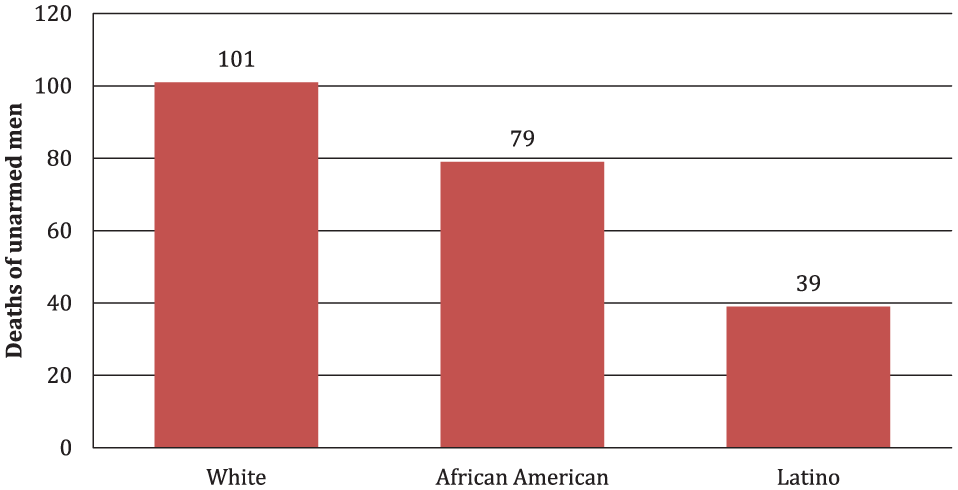
Number of unarmed men killed (2015).
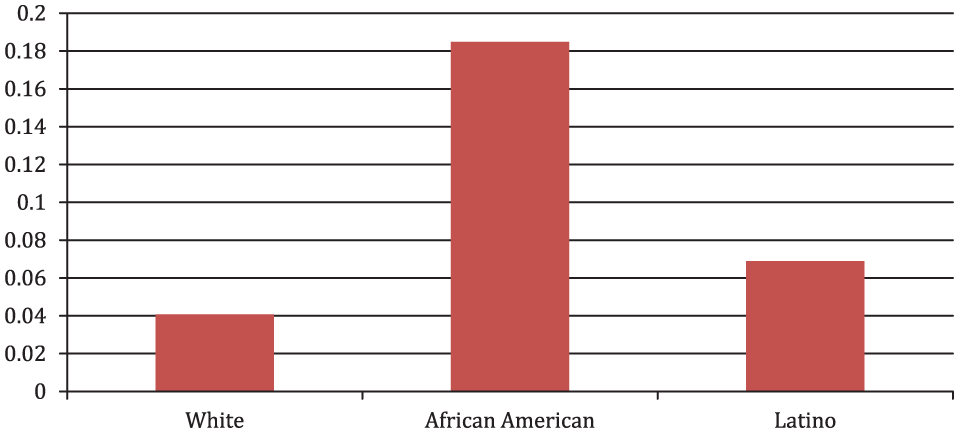
Number of unarmed men killed per 100,000 (2015).
As noted in Figure 2, unarmed Black men were killed at an alarming rate of .41 per 100,000 as compared with Latinos at .14 and White men at .08 per 100,000. Unarmed Black men were killed at a rate of close to 5 times that of White men.
A further analysis of the data by state revealed that unarmed Black men killed by police in 15 of the former slave-holding states represent 41% of unarmed individuals killed by police across the United States. Listed in Figure 3 are the former slave-holding states with the most homicides by police in 2015. These four states represent 27% of all unarmed individuals killed by police in 2015. Maryland has five deaths which account for 83% of unarmed men killed by police in the state. Virginia has three deaths which represent 75% of the unarmed men killed by police; Florida has six deaths representing 43% of unarmed men killed by police followed by Texas with six deaths as well, accounting for 38% of the deaths of unarmed men by police. California was not an enslaved African–holding state; however, it has the most deaths by police in 2015 at nine. Black men represent only 3% of the state’s population but account for 20% of unarmed men killed by police.

Former slave-holding states with the highest number of killings of unarmed African American men by police in 2015.
A very sobering finding is worth noting. Maryland and Virginia are the two states that originated the Slave Codes (Wadman & Allison, 2004) and they have the highest percentage of Blacks killed by police of all former enslaved African–holding states at 83% and 75%, respectively, followed by Florida at 43%, which had the harshest Black Codes (Richardson, 1969), and then Texas at 38%. A closer investigation into Texas revealed the population of Texas after the Civil War was approximately 100,000, of which 30,000, or 30%, of the population were former enslaved Africans (Campbell, 2016); therefore, it is not unreasonable to assume that the enforcement of the Black Codes made Texans feel safe, and protected their cash crop, cotton, as well as provided cheap labor from the newly emancipated Blacks. Throughout the history of the United States, unjust written and unwritten laws, as well as cultural practices, have regulated Blacks in an attempt to protect the interest of Whites.
Discussion
The highly publicized deaths of Mike Brown, Alton Sterling, and Freddie Gray are important in that they continue to bring into the media and public attention the unjust homicides of unarmed African American males by police; however, they also overshadow the other deaths of other unarmed African American males. For example, Gregory Gunn, an unarmed Black male from Montgomery Alabama, was killed by a policeman as he was walking home. Keith Childress, an unarmed 23-year-old Black male, was shot and killed when police in Las Vegas mistook his cell phone for a firearm. Jamar Clark, an unarmed 24-year Black male in handcuffs, was shot to death by Minneapolis Minnesota police officers who claimed that during a scuffle he felt Clarks hand on his weapon; the officer stated he resisted arrest, but eyewitnesses state he was compliant. Eric Harris, an unarmed 44-year-old Black male, was shot and killed by police; the officer claimed this was an accident because he inadvertently fired his gun instead of his taser. Keith Harrison McLeod, an unarmed 19-year-old Black male adolescent, was shot and killed by police for filing a forged prescription and running away from the officer. We should also not forget the unarmed African American men suffering from mental illness that were killed by police, nor the unarmed African American men who fell victim to the disease of addiction and were killed by police. This list is just a small sample of unarmed African American men who were killed by police. Even more alarming, we found that only 10 of the policemen involved in the homicide of unarmed African American men were actually charged and of those 10 officers, only two were convicted, and of those two, only one officer received jail time ( https://mappingpoliceviolence.org/unarmed/ ).
Conclusion
Deaths of any kind are unsettling and disturbing, as the death of a loved one can disrupt a family or even a community. When the death of an unarmed African American citizen happens at the hands of police officers, it can upset a city, a state, and even the entire nation. In recent years, these kinds of deaths have sparked protest movements that align with the specific set of circumstances surrounding these shootings. The deaths of Mike Brown in Ferguson, Missouri prompted the “Hands Up Don’t Shoot" movement; Freddie Gray in Baltimore, Maryland triggered the “No Justice No Peace” movement; Eric Garner in Staten Island, New York spurred the “I Can’t Breathe” protest; and the “Black Lives Matter” movement has become a multifaceted, comprehensive, international movement. Civil unrest resulting from actual and perceived unjust treatment by law enforcement can also lead to retaliation and death of policemen such as in Dallas and Louisiana. Civil unrest in the United States as it pertains to unjust treatment of African Americans and other marginalized people can be traced back to the first recorded enslaved African revolt in Carolina, the Stono Rebellion of 1739. If one investigates the history of uprisings and rebellions, it is generally caused by the unjust treatment of a people. We should work to break that cycle before more lives are taken. I would like to offer a few recommendations to address the growing concern of unjust treatment, actual and perceived, by police toward African Americans.
Limitations and Future Research
One of the main limitations of this study was that official documentation of police killings of civilians is not tracked by any government agency. Thus, we were forced to rely on mass media accounts. Moreover, there were only two main data sources, and they did not agree on the actual number of unarmed men killed by police. Future research should investigate the race of the officer(s) involved in the killing, the socioeconomic status of the victim, the environment in which the incident occurred, and the personnel record of the officer(s) to uncover patterns in the history of police brutality. In addition, a rhetorical analysis of the newsprint will also yield interesting findings.
Recommendations
Policy Recommendations
As explained by James Comey, director of the FBI, police departments are under no obligation to report shooting deaths to any federal agency. This should serve as a call to action for social workers, since one of their core values is social justice and the NASW Code of Ethics calls for social workers to challenge social injustice (National Association of Social Workers [NASW], 1999). This is also a wake-up call for community activists to contact their congressmen and senators to push for a bill that would mandate police departments to report any deaths at the hands of police officers (similar to the legislation in California). This can also be further enforced by withholding federal funding to the departments that do not comply. The data from the report can be used as a means of holding individual police departments accountable for deaths of unarmed Black men. The use of high-tech body cams should be mandatory for all police officers as they can help to deter abuse and misconduct as well as support the patrolmen’s actions throughout the day as they perform their duties. Body cams can also be used in training and retraining police officers by systematically reviewing the data from the camera’s detailing the officers’ interactions with the Black community and offering other alternative and less lethal ways to engage.
Individual Recommendations
Black parents should prepare their young children on the safest way to interact with policemen when stopped by having “the talk.” The “talk” (not about the birds and the bees) is about effective and safe ways in which Black youth should address policemen and also stand up for their rights in a respectful and hopefully safe way. There are multiple sources available online to assist parents with suggestions and examples.
Community Recommendation
Increasing the number of Black police officers in African American neighborhoods is a start, as research has shown that African Americans have a more positive view of African American police officers than they hold for White officers (Decker & Smith, 1980; Skogan, 1979). This belief may be influenced by past and current interactions with White policeman as well as the perception of White policeman held by the Black community. This claim can be substantiated by over three decades of research that show that race is the most important factor in perceptions of police (Weitzer, 2002). Moreover, Allen and Parker (2013) found that
Police officers generally do not reside in the communities where they patrol, which often leads residents in Black communities to believe that police officers are indifferent and do not care about the residents or the general well-being of the community. (p. 82)
Likewise, their study suggests that if officers lived in the same communities as the ones they patrol, they would have a more tolerant attitude, thus diminishing any sort of profiling (Allen & Parker, 2013). This finding supports the recommendation of increasing African American patrolmen in the Black community. Moreover, the presence of more Black police officers may also serve as a deterrent for White police officers to interact with Black men in a more civil manner.
Police departments should intentionally increase positive interactions with those they are policing, as this is one way to show that Black lives do matter; for instance, the push for increased community policing. According to the U.S. Department of Justice,
Community policing is a philosophy that promotes organizational strategies, which support the systematic use of partnerships and problem solving techniques, to proactively address the immediate conditions that give rise to public safety issues, such as crime, social disorder, and fear of crime. (https://ric-zai-inc.com/Publications/cops-p157-pub.pdf)
This has been demonstrated to have positive results, as evidenced by the Midnight Basketball Leagues which are in operation across the country, and have had a positive influence on police/community relations (http://amblp.com/). This may help to assuage some of the mistrust young people have toward policemen, as Leiber and colleagues (1998) have found that young people distrust police more than any other group. Moreover, research shows that Black people fear police more than they fear crime. Thus, satisfaction with police may lead to crime reduction as people would be more willing to cooperate (Block, 1971; Brown & Reed Benedict, 2002). Other research has shown this to be true but adds that more affluent Black people have a more positive view of police (Weitzer, 1999).
Police community forums are also effective at increasing positive relations between the community and police. This suggestion may also help to change the negative perspective some police offices have about Black youth. The forum allows community members an opportunity to openly voice their concerns about their community and also about the interactions with police in a safe space. This also provides adolescents with an opportunity to voice their concerns and also provides police officers with a forum on which to voice their concerns as well. An example can be found in Athens, Georgia, the Blue and You Police-Community Forum (http://news.uga.edu/releases/article/athens-blue-and-you-police-community-forum-0416/) where dialog is fostered between police and youth. Police and community forums can also be used as a hedge against history repeating as it pertains to policing Blacks. Overall, police and Black citizens must make strides toward resolving the growing conflict that has taken over the country or the possibility of more civil unrest will occur and history will surely repeat itself.
Footnotes
Declaration of Conflicting Interests
The author declared no potential conflicts of interest with respect to the research, authorship, and/or publication of this article.
Funding
The author received no financial support for the research, authorship, and/or publication of this article.