



Abstract
This is a review of the theoretical development of the concept of racism. From its 1960s activist roots, the concept lost its theoretical content in its 1970s popularization. Now racism describes virtually anything having to do with racial conflict. The concept is reintroduced and used to analyze the post-1970s race relations propositions. The declining significance of race, symbolic racism, color-blind racism, and unconscious racism missed the structural regressions brought on by the “southern strategy” to mask indirect and covert ways to continue racial oppression. As a result, the new Jim Crow was missed in race relations since the 1980s. A reconsideration of the theory of racism calls for a strategic approach to race relations research. Research should focus on the etiology of racism among European Americans and the central role played by White elites and the media in maintaining historic cultural and institutional arrangements.
Racism’s earliest usage has been traced to the 1902 edition of the Oxford English Dictionary as a description of U.S. policy toward Native Americans (Howard, 2016). For the first half of the 20th century, the term was used interchangeably with “racialism.” The term’s use is relatively new in the social sciences (Barot & Bird, 2001) and began with Ruth Benedict’s Race and Racism (Benedict, 1945) and in Edmund Soper’s Racism: A World Issue (Hankins, 1947). In both books, “racism” described incidences in the world community of animus between groups based on visible physical differences. With the possible exception of the term “prejudice,” no other word gained such popular usage in the United States to describe social conflict as did racism in the second half of the 20th century.
Two developments popularized the term. The first was use as propaganda against anti-Semitism and the racial eugenics that targeted Jews in Germany in the 1930s and during the Second World War (Blaut, 1992). The second popularization came from U.S. civil rights activists during the 1960s. Activists saw the political independence of former colonies in Africa and Asia as hollow prizes that did not change the economic dependence of newly independent states on their former colonial masters (Nkrumah, 1965). Domestic U.S. civil rights victories did not lessen economic inequality between Black and White Americans in the South or elsewhere. In addition, a civil rights movement shortcoming was not having a specific strategy to effectively combat the covert and indirect ways that racial hierarchy was maintained in the North and Midwest; this shortcoming was the basis of the “black power” critique of the civil rights movement (Levy, 1998). Martin Luther King Jr. and the Southern Christian Leadership Conference highlighted this shortcoming in their unsuccessful attempt to address racial economic inequality in Chicago during the summer of 1966 (Ralph, 1993). A better understanding was needed of what they were up against and how to change it.
This article has four objectives: The first is to revisit the concept of racism that evolved from 1960s civil rights activism, to note its theoretical promise. The second objective is to show that the major concepts of racism that took the place of the original notion in interpreting race relations since 1970 did not fulfill racism’s early promise. The third objective is to outline what the activist concept of racism would be now if elaborated as theory and used in race relations. Finally, this article will suggest a way to advance the activist theory of racism and to make it a useful tool in contemporary research on race relations.
Racism: Emerging Concept
Members of the Student Nonviolent Coordinating Committee (SNCC) needed to make sense of what they were struggling against and how best to attack it (Forman, 1972). They needed a conceptual model. First, it was clear to them that the racial hierarchy they were up against dated back to slavery, was intergenerational, and part of the culture. Second, racial discrimination was institutionalized in different ways in the South and in the North. There was the overt and highly elaborate Jim Crow system in the South; then there was a covert and indirect system in the North. Third, they realized that individual acts of racial animus against African Americans were social in origin and did not originate solely from individuals actors. Individual Whites learned their animus as part of their socialization. What had to be worked out was how these three key realities were connected and operated and could be changed (Carmichael & Thelwell, 2003).
The first writing to connect two of the three realities, institutional racism and personal racial animus, was Stokely Carmichael (Kwame Ture) and Charles Hamilton’s Black Power (1967). It was based on Kwame Ture’s specific experience in Mississippi. The Jim Crow order of Southern small-town communities and expected social relations between races created a near perfect model of racial oppression. Carmichael and Hamilton first referred to this oppressive alignment as “personally and institutionally racist.” The missing piece of history and culture was viewed as part of the institutional barrier. The first writing to describe all three pieces of the puzzle as distinct levels (cultural-historic, institutional, and individual) in a single concept of racism was James Jones’ (1972) Prejudice and Racism. This early discussion was elaborated on in his later essay, “The Concept of Racism and Its Changing Reality” (Jones, 1981).
Theory Never Developed
Anyone familiar with 1960s liberation rhetoric heard racism described as “cultural, institutional and individual.” The links between these levels were assumed. The three component concept of racism was primed for development as a theory. A ProQuest search of Sociological Abstracts of publications since 1990 using the terms “racism . . . theory . . . critiques” generated 637 references of discussions and research on racism. No publication elaborated on a theory of racism with cultural, institutional, and individual levels, phases or components. Based on monitoring the literature on racism, it is my contention that the literature on racism in its first three critical decades moved away from its early promise to develop a theory (Sage Race Relations Abstracts, 1981-2007). We now see each level (cultural, institutional, and individual) elaborated as distinct racisms. The original intent of linking the three levels in a single theory has been lost. Also lost is the promise that a theory of racism can come out of practice and be enhanced by further activism. What is now published are constructs that offer one-dimensional and reductionist explanations of race relations.
Racisms Without Theory
The government-compelled dismantling of Jim Crow segregation as legally sanctioned and overt practices in the South did not end institutional and individual racism. Covert expressions of racial animus replaced easily identifiable forms. The failure to create testable theories of racism left activists and academics alike without a conceptual tool to make sense of the post–civil rights racial divide. How well did sociological theory over the past 50 years accurately explain the relations between races? With the three levels of racism in mind as a basis for theory, a brief review of the four major propositions is in order.
Declining Significance of Race
Did race really decline in significance, heightening the importance of social class and culture (Wilson, 1978)? If you replace an overt system of racial hierarchy with a covert one, race’s salience will appear to decline. However, a new system of controls where Whites are privileged and Blacks are disadvantaged still exists (Friedman, 1975). The only change is the institutional means to maintain inequality. Some theorists fell for this tactical shift in racism’s institutional deployment. The outcome is the evolution of a new system of racial controls that is largely without description or commentary—referred to as a “new Jim Crow” (Alexander, 2011).
In retrospect, the idea of a declining significance of race should have been apparent as a missed reading of the 1970s. Covert racism in cities existed simultaneously with covert racism in the rural South. It is still very much with us. This includes steering by real estate agents and block busting (Kwate, Goodman, Jackson, & Harris, 2013); denying home loans and charging higher mortgage interests rates to Blacks (Woods, 2012); maintaining racially segregated schools by using unequal home values as the basis of school funding (Johnson, 2014); using seniority as a basis for employment (Byron, 2010), making Blacks the last hired and the first fired; and criminalizing Black men in the application of laws (Meares, 2014).
None of these practices is overtly racist. Schools, employers, police and courts, banks, and real estate function as they should. Racial motives are imminently deniable. Racism is evident only in outcomes. The declining significance of race is an insight about post-1960s institutional change that is simply incorrect. Race has not declined in significance. Only the institutional mechanics for maintaining racial hierarchy changed. More important is that there is no theory from this insight to explain current or future change.
Symbolic Racism
With the increasing sophistication of survey research and computer analyses, we can do more frequent and in-depth assessments of public opinions and beliefs. Important adjuncts to understanding modern race relations are explorations of White attitudes and beliefs toward Blacks and other people of color. Sears (1988) and Sears and McConahay (1973) first used the term “symbolic racism” to describe a new finding. White Americans supported the principles of equality for Black Americans, but at the same time do not support efforts to implement these principles. They decisively rejected the old Jim Crow racism and overtly racist sentiments, even in the South. In addition, Whites had much less personal animus against Black people than in the past and believed that White racism no longer existed. These researchers hypothesized that the origin of this conditional and relatively benign racism was in respondents’ traditional conservative socialization, which held negative views of Blacks.
Oddly enough, there is no prior literature on traditional conservative socialization. With regard to racism’s three levels, symbolic racism is a form of individual racism that is not influenced somehow by social structure or institutions. Perhaps, it is just a coincidence; symbolic racism appeared simultaneously with color-blind political conservatism. In which case, symbolic racism has institutional roots, just not the ones suggested by its authors. Here again is a post-1970s insight about race relations that is questionable as theory.
Color-Blind Racism
In the late 1980s, conservative talk radio discovered “color-blindness” as a solution to the race problem (Hilliard & Keith, 1999; Spence, 2006). Color-blindness is a direct application of indirection: If you do not know a person’s race, you cannot discriminate against them. Conservatives saw color-blindness as a way to make unnecessary affirmative action, the Civil Rights Act, the Voting Rights Act, and all other measures they allege that discriminate against White people. Conservatives even advocated taking questions about race off the U.S. Census and any federally funded survey. Some White Americans even began to claim that they no longer saw a person’s race or color. Therefore, they could not be racist nor act with racial bias.
Critiques of color-blindness both as public policy and as personal practice were to the point. While claiming color-blindness, advocates were hard at work trying to degrade institutions that maintain even an appearance of equity. Color-blindness was a central rationale for the conservative American Civil Rights Institute’s promotion of California Proposition 209 outlawing the use of race, sex, or ethnicity in public life (Hicklin, 2007). Color-blindness was the rationale for Michigan’s Proposal 2, which had the same objectives as Proposition 209. Both propositions are now law. There is no more direct translation of an idea into institutional life than making it a law. The bottom line is that people who claim color-blindness still manage to racially discriminate, and their color-blind public policies still have racially discriminatory outcomes (Bonilla-Silva, 2006). Racism has not gone away or disappeared under color-blindness. The result is only “color-blind racism.” Here again, there is no theory.
Unconscious Racism
Unconscious racism focuses on the individual racism that affects institutional practice. The concept poses that racial bias exists subconsciously and is the source of discriminatory behavior against people of color in public accommodations, job applications, and court cases. Unlike other racisms, unconscious racism can be demonstrated in social psychological experiments (Eberhardt & Fiske, 1998). White subjects were shown people of different races in photos; their reactions were recorded showing unconsciously attributed racial stereotypes to these images. For example, dark-skinned Black men were closely associated with crime and danger; light-skinned men were more commonly associated with attractiveness and goodness. There are some questions as to how and to what extent conscious racism works beyond experimental settings; direct measures using surveys and interviews have not consistently supported this proposition (Blanton & Jaccard, 2008). However, the research on unconscious racism is the first attempt to isolate the subliminal connection between unconscious bias, discriminatory behavior, and racist institutional practices. What unconscious racism does not affirm is the source of unconscious bias in culture. What it does tell us is that culturally derived attitudes and beliefs regarding race are unconscious as well as conscious.
Other racisms
There are other descriptions of racism: laissez-faire racism, ideological racism, hi-tech racism, identity racism, environmental racism, and police racism. There are almost as many racisms as there are adjectives to describe racial encounters. What all of these racisms have in common is that the concept of racism has no theoretical content. What has been the outcome of decades of atheoretical racism?
A Consequence
The single most important organized effort since 1970 to push back civil rights gains and reaffirm racial hierarchy has been the rise of political conservatism. No theoretical construct in the social sciences regarding race saw this coming. President Johnson predicted that the Democratic Party would lose the South with passage of the 1964 Civil Rights Act. Opposition to two decades of civil rights reforms coalesced in 1981 with the election of Ronald Reagan as president of the United States. The key to Reagan’s election and to reversing civil rights gains was the “Southern Strategy” described by Lee Atwater, Reagan’s campaign manager from South Carolina. Atwater’s view was that there should be no more direct reference to Black people and to race. Indirection and “color-blindness” were the ways to do this.
You start out in 1954 by saying, “Nigger, nigger, nigger.” By 1968, you can’t say “nigger” — that hurts you. Backfires. So you say stuff like forced busing, states’ rights and all that stuff. You’re getting so abstract now [that] you’re talking about cutting taxes, and all these things you’re talking about are totally economic things and a byproduct of them is [that] blacks get hurt worse than whites. And subconsciously maybe that is part of it. I’m not saying that. But I’m saying that if it is getting that abstract, and that coded, that we are doing away with the racial problem one way or the other. You follow me—because obviously sitting around saying, “We want to cut this,” is much more abstract than even the busing thing, and a hell of a lot more abstract than “nigger, nigger.” (Lamis, 1999, pp. 7-8)
With Atwater’s quote, we see in stark relief the creation of a new expression of cultural racism (indirection). We also see the linking of cultural racism through indirection with the Republican Party’s plans of action to shape American institutions for decades to come (Heatherly, 1981). The effective of using racial indirection soon became evident in surveys. White attitudes toward Blacks had steadily improved from 1963 to 1972, but began to reverse after the implementation of the Southern Strategy in the 1970s (Condran, 1979; Cummings, 1980). A plurality of Whites moved toward a broad based conservatism that analysts thought might be connected to racial attitudes (Chin, 1985; Sniderman, Piazza, & Tetlock, 1986). How did they explain such a reversal? A social psychological construct, working class authoritarianism, was posed as the explanation (Grabbs, 1980). Really? The intentionality and agency of Atwater and other shapers of public opinion were missed completely.
A hardening of White attitudes toward Blacks through indirection was necessary to put in place covert institutional efforts to roll back racial progress. For example, in urban centers with large Black populations, use of at-large elections was an indirect way to avoid “minority dominance” of Whites—Black majority rule. All through the 1980s, covert media appeals to race via the Southern Strategy called for “White” unity and resistance to Blacks (Hilliard & Keith, 1999; Spence, 2006). Attempts to elect Black mayors in Chicago and Los Angeles struggled against unspoken White voter opposition. Even the Ku Klux Klan leader, David Duke, retired his white Klan robe and hood, put on a suit and tie, and refused to directly refer to Black people. By doing so, he made a creditable run for governor of Louisiana (Ellison, 1991; Rose, 1992).
Media using the Southern Strategy convinced many Whites that racial discrimination no longer existed. Kluegel and Smith (1982) showed the extent to which these White beliefs about Black advancement were conditioned by the media. Another explanation for emerging White opposition to Black progress was White perceived self-interest and a sense that affirmative action violated their egalitarian principles (Kluegel & Smith, 1983; Smith, 1981). A decade later, a series of surveys reaffirmed that White opposition to redressing racial inequality was not due to racial prejudice per se, but was again a reflection of self-interest (Bobo & Kluegel, 1993; Kluegel, 1990; Schumann, Stech, & Bobo, 1985). Once more, social psychological phenomena explained away any intentional and institutional efforts to produce these outcomes. Meanwhile, Black gains had not only stopped, they were reversed in education, housing, income, and employment (Jaynes & Williams, 1989).
The Three Levels of Racism
If James Jones’ three levels of racism evolved into a theory, what would it look like? Would this theory have anticipated the Southern Strategy? To see if should potential exists, we have to look specifically at each level and then outline how the levels link together.
Cultural Level
The cultural level is not a separate theory of racism (Blaut, 1992). It is one of three components of a theory. The cultural level of racism is an attempt to account for the following. Slavery in the U.S. ended in 1865 and was followed immediately by the Black Codes, which maintained Black subordination. By 1910, the Black Codes had evolved into a new system of Black oppression, Jim Crow (Ranney, 2006; Tischauser, 2012). Then, the 1964 Civil Rights Act ended Jim Crow, but the animus against Black people and efforts to subordinate them continued. Some point out that a third system of oppression is emerging—a New Jim Crow (Alexander, 2011; Massey, 2007). How do we account for the intergenerational continuity of racial animus despite efforts to eliminate it?
The dilemma is that racism defies legal solutions, social movements, and changes in economy, in people and in the times. There is only one explanation for the continuity of racism 50 years after activists posed the original concept of racism. Its transmission is cultural because it has distinct norms, attitudes, beliefs, and values and is a particular worldview. This transmission of racism is not a theory; it is an empirical fact. An ideology, philosophy, justification, or social theory based on this fact is not the same thing. In the original activist description of racism, its empirical reality was described as a cultural phenomenon.
Institutional Level
Civil rights activists who entered the Deep South in the 1960s were confronted by a total institution (Carmichael & Thelwell, 2003; Forman, 1972). In small Southern towns, every human institution was organized overtly around racial hierarchy—Jim Crow. Parks, schools, store entrances, courts, movie theaters, jobs, housing, churches, swimming pools, hospitals, and even cemeteries were racially segregated. Whites had the better facilities; Blacks had the worst. Blacks had to show deference to Whites. In contrast, Northern racism was indirect and faceless, the opposite of a total institution. Ironically, racial segregation of housing, jobs, and schools was more thorough than in the South (Massey, 2007). Public places were integrated. There were no formal racial codes of public etiquette. No one in prominence advocated racial segregation, admitted to it, controlled it, or took responsibility for it. Racism was covert with White-over-Black racial hierarchy as the outcome, just as it was in the South.
The difference between the North and South was in their institutional expressions of racism. They were two distinct ways to organizing racial hierarchy. Both ways had the same goal of Black subordination. It was at this institutional level of racism that activists focused their efforts (Better, 2008). Racial segregation laws could be reduced; schools integrated; curricula and pedagogy changed; housing, real estate, and bank mortgage practices scrutinized; and hiring goals could be established. Racial discrimination in voting rights could be eliminated. Racism nationwide could be addressed through institutional change, repeatedly and in each generation.
Individuals Level
Individual acts of racism constitute the third level of racism (Shah, 2008). To their credit, activists recognized that for most Whites the motivation of individual acts of racism was not innate. It was highly varied and conditional. Those who had lived and worked with Blacks as peers were less likely to be prejudice and might even oppose racism (Williams, 1975). Those who were better educated and well informed were also less likely to be prejudice; this characterized many fellow White civil rights activists. Where racial prejudice was not the norm and acts of racism were not tolerated, only a small minority of Whites were still compelled to act out racism (Pettigrew, 1981). It is hypothesized that this small group did so primarily out of some psychological and personality disorder. Most White Americans who were racist were malleable, were taught racism, and therefore, could be untaught.
Theory of Racism
Intrinsic to the 1960s activists’ notion of racism was interaction between cultural, institutional, and individual levels. Think of racism as a stool; it stays upright and serves its purpose because it has three legs. Each leg is necessary and works in conjunction with the others. All three legs together are necessary and sufficient for the stool to stay upright; no one or two of the three legs can hold the stool up by themselves. The premises of this theory of racism follow:
Cultural racism (the presumption of White supremacy and Black inferiority) precedes and preconditions institutional expressions of racism. Without racist cultural scripts, institutional expressions of racism would not occur.
Cultural racism provides the blueprint and architecture for the organization of institutional racism, its objectives (White dominance), and criteria for success (White privilege). Cultural racism is passed on intergenerationally and is part of the content of White racial identity.
Institutional racism is essential for both the perpetuation of White privilege and of White dominance. Institutional racism keeps racism going within and across generations. It in turn reinforces cultural racism.
Institutional racism precedes and preconditions individual expressions of racism. Cultural racism is also a necessary precondition to individual racism, but its influence is mediated through institutional racism.
Cultural racism regulates the intensity and frequency of individual acts of racism by the extent to which institutional racism has been deployed. Hypothetically, if institutional racism is increasingly deployed, acts of individual racism will increase. If institutional racism is poorly deployed, individual acts will have little reinforcement.
The following illustration (Figure 1) shows the links and interdependencies between the levels of racism.
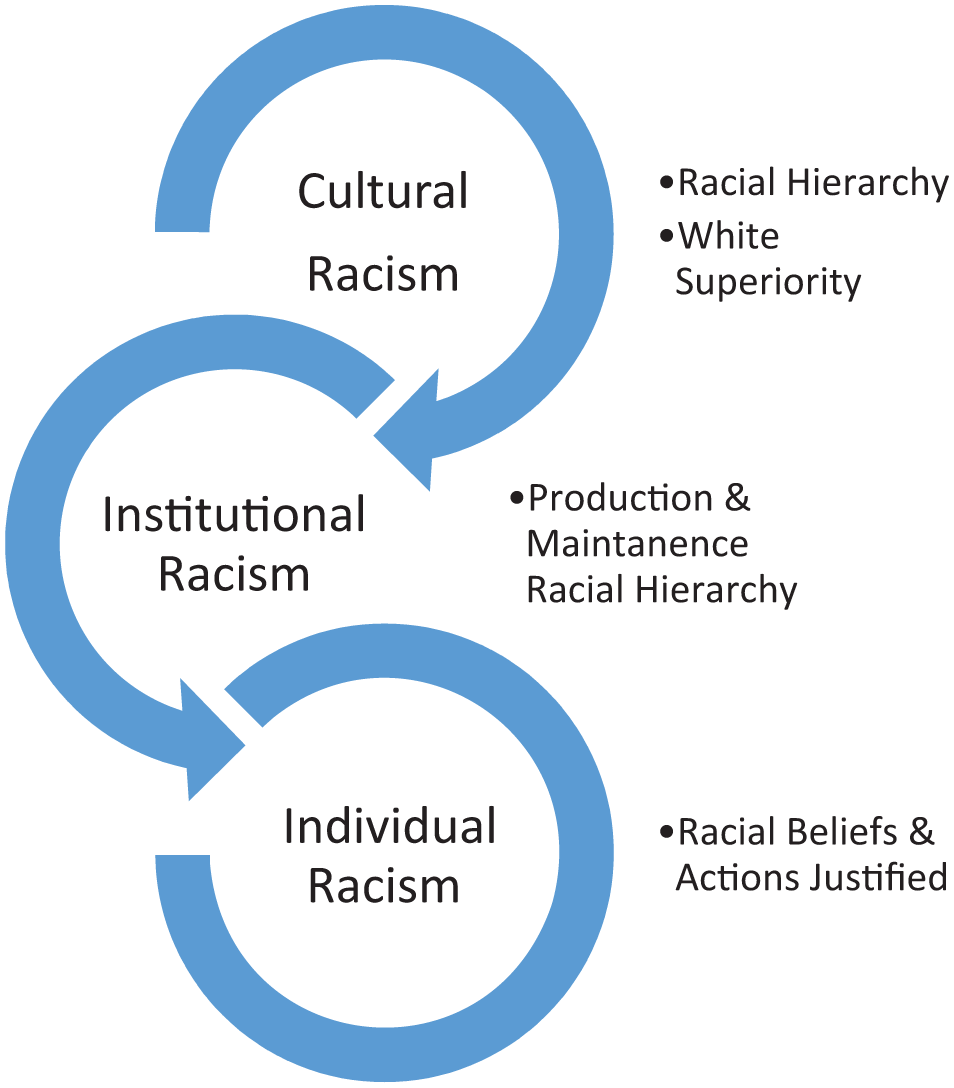
The activist theory of racism.
In the illustration, cultural racism is the blueprints for the operation of institutional racism in American life. It is the objective of institutions to fulfill cultural scripts. Through institutional racism, cultural racism gets operationalized within and across generations. Then, institutional racism in turn provides reinforcement for individual beliefs in racial hierarchy and provides justification for individual efforts to maintain racial hierarchy—individual racism.
The above premises that connect the three levels of racism have two corollaries for the functioning of the system as a whole.
For example, what if high school honors classes are used to privilege White students and the general education track disadvantages students of color? The solution is to make certain that White students who are not really honors material go into the general track and that students of color who are talented go into the honors track. Have you eliminated institutional racism? Not at all. One’s struggle has only begun. Realignment back to White privilege becomes apparent when White parents, whose children were moved to the general track, sue and/or leave for private and alternative schools. White students still in the honors track will leave soon after as well. The school’s principal will be criticized for driving White students out and eventually removed. The school budget will get cut. Eliminating one or two institutional practices will not end racism. The reaction of a series of other institutional players (district officials, teachers, courts, and parents) is to return to the cultural expectation of White racial privilege. Finally, if institutions do not fulfill their purpose, they can be abandoned.
When Whites are the predominant students in K-12 or in state universities, the quality of schools, teachers, faculty, and programs are maintained. Confidence in the systems and their graduates is high. The schools and universities are well funded even in hard times. If it is perceived that students of color are becoming the majority, efforts to maintain quality wane, confidence declines, and budgets get cut, repeatedly. If the non-White presence cannot be reversed by other institutional players (i.e., legislature, courts, criminal justice system), that institution will be allowed to decline until it collapses. Then, it will be reorganized, privatized, or have its function—educating students—distributed to other institutions.
In K-12, charter schools are a form of abandonment. Predominantly Black and Latino school systems are allowed to continue declining in exchange for a few charter schools that educate a small number of students. In public higher education, state governments will continue to defund public higher education until they reach a point where the only option will be to close or privatize them—to be taken over by for-profit educational corporations. In the same way, Black communities are redlined by banks and denied municipal services until they physically and socially collapse. Then, they are re-cycled for White use through gentrification. In both cases, White privilege and hierarchy are maintained.
Implications
When the three levels of racism get fully elaborated, it has implications. First, the theory of racism does not see racism as an outcome of some impersonal process “by which social, economic and political forces determine the content and importance of racial categories” as in racial formation theory (Omi & Winant, 1994, p. 61). A process does not necessarily have intentionality, the ability to refine, change, and redirect itself nor is a process motivated by status and material wealth, to name a few deficiencies (Feagin & Elias, 2013). If it is a process, racism is the unfolding of racial hierarchy as a culture script through institutional and individual levels of social organization. As long as the cultural content of White supremacy is unquestioned, institutional and individual racism are normal outcomes across time.
Second, there is a reason why the theory underlying racism was not developed. U.S. race relations literature has historically been about either finding a way to get Black people accepted by Whites or to resolving conflicts between the races (Pettigrew, 1991). Fundamentally, the “race problem” is thought to be a Black problem. This paradigm could not conceive of focusing the study of racism on Whites, specifically, asking what motivates some White people to act racist and others to be antiracist (Zuberi & Bonilla-Silva, 2008). Saenger (1965) commented two generations ago that “no objective research has been undertaken on the effects of social prejudice on those who harbor it” (p. 23) and Weston (1972) wrote “Whites have been neglected as a subject of study (in race relations)” (p. xiv). Little has changed. Application of the theory of racism could open this door. Without such a theory, the reaction to the civil rights movement and subsequent efforts to roll back its gains are missed for what they are by social scientists and activists alike. This theory could have anticipated the Southern Strategy and the rise of Trump because it focuses on White institutional responses to change. It focuses on the ways that racism adjusts to challenges.
Since 1981, no theory has developed as an alternative to the theory of racism that can anticipate and accurately identified changes in White racial attitudes and behaviors as the outcome of intentional human agency. To do this would minimally require monitoring new uses of cultural racism and the creation of new institutional practices. The theory of racism can do this only to the extent that changes in culture, institutional practices, and individual racial behaviors are viewed as integrated and preconditions to one another and mutually reinforcing.
Conclusion
There are fundamental questions about racism unexplained by the theory of racism. What would happen if the people who are considered racially inferior suddenly disappeared or were no longer identifiable? The answer from the current racial paradigm, where Black people are the sources of the race problem, is that racism would disappear. If Blacks disappeared, it might be that some other group may find themselves at the bottom of social hierarchy or it might be necessary to reinvent social hierarchy in the United States altogether. If the reality is the latter, the answer to this question might require replacing the theory of racism. The source of racial animus explained by the theory of racism may have some other and more fundamental motivation that we have yet to discover.
Another question is what if the central propositions in the theory of racism are simply wrong. We assume that if institutional racism ceases to exist for several generations, cultural racism would wane and eventually disappear. From an international and comparative perspective, there is evidence to the contrary. Cuba has been the best laboratory in the last half century in attempts to eliminate racism. Soon after the 1954 revolution, the new government passed laws against institutional barriers to racial equity and made very conscious efforts to eliminate racial hierarchy (Benson, 2016). After 60 years and almost three generations, Afro-Cubans enjoy the least racial inequality in education and health of any Afro-descendants in the West (Belizan, Cafferata, Belizan, & Althabe, 2007). Yet cultural racism still exists in Cuba (Bodenheimer, 2015) and new institutional barriers are already evident in tourism, where Black participation is clearly discriminated against (Roland, 2011). This suggests that once the notion of racial hierarchy is engrained in a culture, racism is permanent. The most we can ever hope for is to reduce racism as much as possible in each generation. The theory of racism may needs revision to reflect this reality.
The notion of cultural racism is also open to question. Cultural content virtually defies definition (Vandenberg, 2010). Culture is taken-for-granted shared attitudes, beliefs, and values. Anything cultural is difficult to measure. What is racism’s specific content in the totality of American culture? Whatever it is, it too defies definition and measurement. How can we know whether this content exists and can be changed intentionally in any way? Likewise, can cultural racism be increased or decreased intentionally, and under what circumstances? Because we do not have answers to these questions, the theory behind the concept of racism is only as accurate as the concept of cultural racism. If we cannot get a better handle on what is cultural racism, then the idea of interaction between cultural, institutional, and individual racisms has limited utility. It took generations to create racist cultural content, but now can that content be upended and replaced in a few years or months (Mohammed, 2011)? The idea that deeply embedded cultural content such as racism or Whiteness can be upended by media turns on its head the idea that culture takes generations to produce (Llosa, 2015). Can one electoral or advertising campaign, that takes place over a few months, reinforce or undo cultural content that took generations to create? If this is the case, then electronic and social media are far more powerful and influential than we imagine.
A Contemporary Note
The need to advance the theory of racism and other notions that integrate culture, institutions, and individual influences could not be greater. Decades of continuous indirect appeals to affirm White racial superiority by the Republican Party have produced a monster. A segment of the conservative White electorate has rejected established Republican Party politics as unable to deliver on its ideological promises to reverse White working-class economic decline and to roll back big government, civil rights, globalism, and political correctness. The Tea Party in 2010 was the prelude, and now the Party has been taken over by its most extreme elements in a Donald Trump presidency. Race has not declined in importance. It was central to the 2016 election. The need to hide racism in symbolic indirection or color-blindness has been rejected. There is nothing unconscious about Trump and his electorate’s racism. Lee Atwater moved conservatives away from direct racism. Donald Trump has brought them back.
If there was ever a bold and clear demonstration of the theoretic propositions of the theory underling racism, the Trump presidency is it. Cultural racism is evident in his appeals to return to the nostalgia of unquestioned White supremacy and paternity. Institutional racism is evident in the rejection of all institutional practices that constrain White supremacy in day-to-day life and in the lack of specifics as to what social and civil rights policies a Trump administration will pursue. Individual racism is already apparent in the violence and hostility of Trump supporters toward people of color. Their cultural views are linked to their institutional objectives to roll back civil rights gains. This real-life illustration of elements in the theory of racism strongly suggests that this theory is worth serious consideration and elaboration.
Footnotes
Acknowledgements
The author acknowledges James Forman, Walter Stafford, Robert Fullilove, and all of the other activists who risked their lives to end Jim Crow and to define racism.
Declaration of Conflicting Interests
The author declared no potential conflicts of interest with respect to the research, authorship, and/or publication of this article.
Funding
The author received no financial support for the research, authorship, and/or publication of this article.