




Abstract
This article seeks to contribute to the reconstruction of an African-centered ecophilosophy and political ecology. Employing Cheikh Anta Diop’s theory of African cultural unity, it considers the Ndi Igbo philosophy Omenala, its paradigmatic implications for Africana studies, and its capacity to demonstrate the continuity of indigenous African socioecological praxis cross culturally. In addition, it explores the relevance of Omenala to the development of an authentic social history of African people and as a theory to analyze contemporary problems in the African world. Three key issues are addressed. First, the article accounts for the absence of ecological theory within Africana studies. Second, it explicates the cultural and philosophical basis for an African-centered ecophilosophy and political ecology. Third, it envisions new approaches and areas of inquiry within Africana studies.
Introduction
All philosophies contain preconceived notions of what it means to be a human being and, by extension, what constitutes human development. They “possess a set of attributes, an overt or implicit set of empirical and normative views, which are goal oriented about (1) human nature, (2) the process of history and (3) the nature of socioeconomic and political arrangements” (Eatwell & Wright, 1999, p. 14). Historically speaking, philosophies undergirding the discipline of Africana studies have been, for the most part, anthropocentric in their orientation. Africana studies paradigms have attempted to engage the problems of African people principally by addressing social conditions, without considering that human life and development cannot be extricated from the earth’s history and its predetermined ecological processes. This discussion seeks to demonstrate how an African-centered ecophilosophy and political ecology can help to expand and clarify critical theory within the discipline of Africana studies. By employing Cheikh Anta Diop’s theoretical framework of African cultural unity, we will consider the Ndi Igbo philosophy Omenala, its paradigmatic implications for Africana studies, and its ability to contribute to the development of an authentic social history of African people. In light of contemporary concerns over environmental racism, global warming, species extinction, food insecurity, global economic instability, and their impact on the African world, we will analyze the effects of European cultural hegemony and modernity through an African-centered, environmental lens. This discussion will unfold in three stages. First, we will account for the absence of ecological theory within Africana studies. Second, we will explicate the cultural and philosophical basis for an African-centered ecophilosophy and political ecology. Third, we will consider new approaches and areas of inquiry within Africana studies.
Culture, Ecology, and the Problem of Urban Centered Africana Studies
Literature Review
Within existing academic texts in the field of Africana studies, ecophilosophy and environmental problems are scantly addressed or altogether ignored. Typically, the lens of radical Western political economy informs how the field approaches the issues. This ideal is most often labeled the land question, which primarily focuses on the notion that land is the basis for economic justice, national liberation, and independence. This perspective argues that the unresolved question of land reform remains at the heart of socioeconomic problems facing African people. Maulana Karenga’s Introduction to Black Studies explores the historical problem of land reform as a matter of concern for African Americans during reconstruction (Karenga, 2002). Manning Marable’s The New Black Renaissance: The Souls Anthology of Critical African-American Studies follows this same trend devoting a chapter, by Jeffrey R. Kerr-Ritchie, to the origins of the term 40 acres and a mule (Marable, 2005). Abdul Akalimat’s Introduction to Afro-American Studies: A College Primer approaches the land question in a similar fashion allotting a chapter to the political economy of rural African American communities and their role in “the emergence of an African-American nationality” (Akalimat, 1986). In Molefi Kete Asante and Maulana Karenga’s edited volume, Handbook of Black Studies, Africana ecophilosophy appears briefly in a three-page article by Elisa Larkin-Nascimento titled “Kilombismo: An African Brazillian Orientation to Africology” (Asante & Karenga, 2006). Larkin-Nascimento argues Kilombismo’s stance is strongly ecological based upon its foundations in the “profoundly environmentalist philosophy of African religious culture in Brazil, in particular Cadomble” (Asante & Karenga, 2006, pp. 301-303). Kilombismo opposes environmental pollution and favors all forms of environmental improvement that can ensure healthy life for children, women, men, animals, marine life, plants, forests, rock and stone, and all manifestations of nature. (Asante & Karenga, 2006, pp. 301-303)
Tallmadge Anderson and James Stewart’s Introduction to African-American Studies: Transdisciplinary Approaches and Implications only devotes two and a half pages to environmental justice and racism as an extension of the subfield of science, technology, and African Americans (Anderson & Stewart, 2007). Nathaniel Norment’s African-American Studies Reader, Jeanette Davidson’s African-American Studies, Serie McDougal’s Research Methods in Africana Studies, Joyce A. Joyce’s Black Studies as Human Studies, and James Conyers’s Qualitative Methods in Africana Studies are examples that completely ignore the relevance of ecophilosophy and political ecology to the discipline of Africana studies.
The absence of ecophilosophy and political ecology within Africana studies is largely linked to the sociohistorical and geographical context in which it developed as an academic discipline. As an outgrowth of the Black Freedom Movement (Williams, 2016), Africana studies emerged as a proactive strategy to institutionalize the intellectual demands of the struggle. It sought to redefine the meaning and function of educational institutions for predominantly urban African American communities, while challenging prevailing political and economic arrangements. Simultaneously, socioeconomic forces within the United States would have a profound impact on the praxis of the Black Freedom Movement, more specifically urbanization. Urbanization, in the context of Western modernity, is characterized by (a) an anthropocentric, secular perception of nature; (b) the hegemony of mass consumption and industrialization; (c) the devaluation of indigenous, rural knowledge; (d) mass rural to urban migration; and (e) the concentration of political and economic power within urban centers. Most often, critiques of urbanization within the Black Freedom Movement and Africana studies are shaped by the assumptions of radical Western political economy, that is, the unequal distribution of wealth and power is its primary focus. Black radicalism, for instance, perceives racialized capitalism as the fundamental contradiction affecting African-descendant communities. Although it occasionally uses culture as a tool of analysis, it is normally limited to an examination of the internal dimensions of African community development. Political economy and culture are typically perceived as separate and distinct methodologies. Sundiata Cha-Jua’s (2000) Black Studies in the New Millennium and Cedric Robinson’s (2000) seminal work Black Marxism are notable examples. Black Feminism, as another example, argues for methods that focus on the intersections that exist between race, class, and gender oppression. Similarly, capitalism is perceived as problematic, yet critiques are limited to standard approaches to radical Western political economy coupled with emphases on the feminization and racialization of inequality, hence the importance of intersectionality. Patricia Hill Collins’s (2000) Gender, Black Feminism and Black Political Economy and Angela Davis’s (1990) Women, Culture and Politics reflect this tendency. African-centered approaches, to a degree, follow similar patterns. Racialized capitalism is perceived as an extension of the broader reality of Eurocentrism and is vaguely contrasted with preenslavement/precolonial “communal” forms of indigenous socioeconomic organization. At the same time, it often relies heavily on radical, Western political economy to frame its critique of economic inequality. For this reason, African-centered thought is often criticized for its inability to offer a sound analysis of the contemporary problems of African-descendant communities who, in the current period, overwhelmingly find themselves located within and/or influenced by the capitalist metropoles. Marimba Ani’s (1994) Yurugu and Justin Gammage’s (2012) African-Centered Economics and Africana Studies reflect this tendency. For the purpose of this discussion, it is important to reiterate that across the theoretical spectrum within Africana studies, urbanization as a sociocultural phenomenon is not perceived as problematic. As a discipline, it typically perceives both the urban built environment and mass consumption as desirable. From an ecological perspective, however, urbanization is inherently problematic. Without an ecological analysis within Africana studies, critiques of capitalism are limited to the realm of Western, radical political economy. The focus remains on the social relations of production (unequal distribution of wealth, power, and technology), to the exclusion of humanity’s relationship with the natural world. In essence, human sociohistorical development is extracted out of the earth’s history and its ecological processes.
Mechanistic Thinking, Urbanization, and Eurocentrism
Urbanization, as an ideological phenomenon and approach to constructing the built environment, has its roots in the scientific and political revolutions of Western Europe during the 17th and 18th centuries. According to Carolyn Merchant (1987), Since the Scientific Revolution of the seventeenth century, the West has seen nature primarily through the spectacles of mechanistic science. Matter is dead and inert, remaining at rest or moving with uniform velocity in a straight line unless acted on by external forces. Change comes from outside as in the operation of a machine. The world is a clock, adjustable by human clock makers; nature is passive and manipulable. (p. 267)
Capitalism and industrialization would serve as “outside” forces subduing nature and indigenous communities in the economic interest of Europe and its political and religious elites. In doing so, Western modernity asserted itself as a hegemonic force in the emerging world order, setting the stage for conflicts over perceptions of nature between indigenous people and European colonizers. The “modern” history, worldview, and socioeconomic problems of African people can be understood within this context. Mechanistic thinking, the view that the compartmentalization, manipulation, and study of the parts of nature are more important than understanding nature as a self-organizing, dynamic system, becomes prominent during this period. It forms the basis for the production of knowledge within Western Social Science (WSS). One of the central aims of Africana studies has been to challenge WSS and its legitimacy. Consistently, it argues that compartmentalization is one of WSS’ major flaws. According to James Stewart (2005), Although the prevalence of interdisciplinary social science initiatives is increasing, discipline specific research remains the norm. This high level of compartmentalization reinforces tendencies to produce studies yielding only minor incremental additions to knowledge about highly specialized topics and there are few incentives to develop the type of comprehensive analysis envisioned by Africana Studies theorists. (p. 83)
By placing ecological questions at the center of Africana studies, it is possible to advance the project of transcending the limitations of compartmentalization while reinforcing the interdisciplinary vision of the discipline.
Culture, Ecology, and Africana Studies
One of the challenges in explicating an African-centered ecophilosophy and political ecology is adapting indigenous African thought and practice to Western modernity. This is not a question of synthesis but, more important, a question of relevance. African-centered thought must make indigenous African concepts both reasonable and applicable to the historical and contemporary realities of African people. As Kwame Agyei Akoto (1992) argues, the ideology (African Centered thought) has been forcefully and clearly addressed for generations, but overall the ideology has lacked coherency and adequate theoretical clarity to apply at the grassroots level of organizing, or apply to the conditions encountered in personal interactions. The conceptions of culture, history, politics and spirituality have not always been presented in a coherent fashion. (p. vi)
The challenge of adaptation is difficult because there is a tendency for indigenous African culture within Africana studies to be used as a mere reference and not as a foundation for socioeconomic praxis (Karenga, 2008). Beyond suggesting that African people have a spiritual connection to the earth, little work has been done to reveal the specific ways that indigenous African culture perceives nature and how this informs the construction of technology, the built environment, political, and socioeconomic institutions. African-centered theory’s emphasis on culture, as an analytical approach to synthesize our understanding of the multiple dimensions of reality that shape and influence human life and development, is the antidote to the problem of compartmentalization. As Ama Mazama (2003) suggests, “our main problem is precisely our, usually unconscious, adoption of the Western worldview and perspective and their attendant conceptual framework” (p. 4). New conceptual models are needed that situate ecology at the center of our understanding of human culture, the historical development, and contemporary socioeconomic problems of African people. An ecological approach to history, reasserts the idea of nature as historical actor (Merchant, 1989).
Non-human nature, therefore, is not passive, but an active complex that participates in change over time and responds to human induced change. Nature is a whole of which humans are only one part. (Merchant, 1989, p. 8)
By recentering ecophilosophy in Africana studies discourse, this article locates itself within the expanding tradition of Africology (Asante, 1992). From an African perspective, “operating and acting from a centered position” (Asante, 2007) requires a psychospiritual, intellectual, social, and methodological commitment to building reciprocal relationships with nature.
Omenala: Cultural and Conceptual Foundations for an African-Centered Ecophilosophy and Political Ecology
According to Nwala, Omenala is an Ndi Igbo (Igbo people) term that can be literally translated as “that which obtains in the land or the community, according to the custom and social tradition of the community” (Nwala, 1985, p. 58). The literal translation of Omenala, however, does not capture the multiple ways that it is understood and conceptualized as a form of praxis in precolonial Igbo society. First and foremost, Omenala is an expression of the Igbo understanding of the cosmos and how the universe works.
It reflects the cosmic order which keeps the world going and without which too, the very existence of nature and the world would be jeopardized including the welfare of the communities and all the beings who reside in it. There would be chaos, and the community would lose its normal balance with nature. (Nwala, 1985, p. 61)
In addition, Omenala is associated with the multiple, interrelated ways in which the progenitors of Ndi Igbo constructed social, economic, spiritual, agroecological, and technological knowledge, and relationships. It definitively represents the “ways of the ancestors,” that is, how best to organize life and to develop human beings to ensure the continuity and sustainability of Igbo culture and society. According to Igbo philosophy, Omenala reflects a cosmic order because it reflects a body of beliefs and mores without which the community would mean nothing and without which, in fact, as the Igbo see it and said earlier, the community would cease to exist because it must have lost its touch with reality and the source of their very existence. (Nwala, 1985, p. 61)
It is the basis of morality and social justice. It provides a context for negotiating conflict, making political decisions, managing ecosystem resources, educating children and adults, and “the actual practice of the customs as they apply to any aspect of social and ritual life of the various communities in Igboland” (Nwala, 1985, p. 60). As an interrelated cultural system, Omenala links Igbo conceptions of natural law to the social construction of Ndi Igbo. It guarantees reciprocal relationships between the individual, nature, and society. It reflects, in particular, continuity between Ndi Igbo spiritual beliefs, knowledge of the social and natural sciences, and the construction of socioeconomic institutions.
Omenala refers to the Igbo attitude to life and their basic conceptions about nature, society and life. It embraces the whole system of civilization of the Igbo in both theory and practice. (Nwala, 1985, p. 8) It was an ideology, which emerged from their natural and social environment, especially from their mode of production, the basis on which Igbo society was organized (Nwala, 1985, p. 8)
According to Ndi Igbo cosmology, Omenala was given to human beings by Ala the Alusi, or deity, of the fertile earth. Ala is known as mother of all things. She is also perceived as the guardian of ethical behavior. According to Kamalu, Omenala can be loosely translated as “actions in accordance with the earth” (Kamalu, 1998).
The notion of the earth as mother, the source of subsistence and economic stability and the progenitor of all things related to ethical behavior and social cohesion, is a common idea within indigenous African philosophy. It is not unique to Ndi Igbo and reflects what Cheikh Anta Diop (1989) has described as the “profound cultural unity” of African people “still alive beneath the deceptive appearance of cultural heterogeneity” (p. 1). This can be demonstrated through a cross-cultural analysis of indigenous African socioecological praxis.
In ancient Kemet, Maat represents quintessentially the spiritual, ideational, and material force compelling human beings to maintain “right” relationships with nature. Maat was considered the mother Ntr [deity] of truth, justice, righteousness, and harmony. Being as such she represented order both in the universe and within human communities. According to Karenga (2006), “Maat was the unifying principle that bound all together, from the star to humans, to the fish in the sea and the chick in the egg, fleas, worms, in a word—all that is” (p. 385). For this reason, the people of ancient Kemet, like other Africans, engaged and understood nature not as an abstract concept, but as an experienced reality. Their sense of oneness with it was heightened by their sense of the sacred which pervades the world and embraces animals, plants, mountains, river, wind, rock, flood, sun, moon star and other modalities of being. (Karenga, 2004, p. 389)
Among the Akan of present-day southern Ghana, the earth is called Asase Yaa, earth Mother born on Thursday. According to Donkor, on Thursday Akan people may not till the earth because this period of time is devoted to consecrating the earth. Any acts that desecrate the earth must be avoided. These may include spilling blood (homicide) on her, sexual indiscretion on the open field, toxic waste, and indiscriminate use of land. (Donkor, 1997, pp. 28-29)
For indigenous African culture, the earth is conceptualized as a living, divine phenomenon. It is both sacred and material. Nature is perceived as the source of all knowledge related to the spiritual, social, and economic needs of human communities. Bakongo thought asserts that the earth is futu dia n’kisi diakanga Kalunga mu diambu dia moyo, a satchet (parcel) of medicines tied up by Kalunga [the creator] for life on earth. This futu or funda contains everything that life needs for its survival: medicines, food, drink, et cetera. The futu of medicines consists of chemicals actually known and unknown by man, which substances exist for one purpose only: life on earth. (Fu-Kiau, 1991, pp. 111-112)
The notion of earth as a living phenomenon is rooted in the cosmological perspective that everything in the universe, all that exists on earth, was created by a primordial force/energy. One of the many names for the creator used by Fon people of present-day Benin, ancient Dahomey, is Se Gbo. It is an appellation that means “Great Energy.” The creator is perceived as the substance of life that permeates all things animate and inanimate; everything is said to share in this energy, and by extension, everything is interrelated. This echoes the Akan notion of the creator as the “Great Spider” Ananse Kokoroko, the architect of the universe. The universe is described as a giant web of interdependent beings spun by the creator. According to Ikeke (2013), the “African perception of the cosmos is life-centered; life is the essential characteristic of the universe, a universe in which all beings are interconnected” (Ikeke, 2013, p. 346). The Gamo people of present-day Southwest Ethiopia in the African Rift Valley affirm this fundamental assumption.
The defining aspect of land-use in the Gamo highlands is a set of intricate and well enforced traditional laws called Wagas. These laws stem from the belief that everything is connected and bound in a delicate balance. Together they form a natural resource management system that dictates everything from interpersonal relationships to the conservation and preservation of pasture, forest, soil, and water. Because all of the Wagas are interconnected, if any one aspect is denied or imbalanced then the whole system is understood to be at risk. (Global Oneness Project, 2009, p. 1)
Without overstating the obvious, it is important to consider that Africana studies’ emphasis on interdisciplinary scholarship is an extension of this fundamental truth, that is, social and natural phenomenon are characterized by interconnectedness, complexity, and dynamism. Progressive tendencies within the Western academy have, to a degree, followed suit partially as a result of the global consensus on the industrial-based causes of climate change and ecological instability. Critiques of mechanistic thinking called systems thinking have garnered more attention and support.
At the forefront of contemporary science, we no longer see the universe as a machine composed of elementary building blocks. We have discovered that the material world, ultimately, is a network of inseparable patterns of relationships, that the planet as a whole is a living, self-regulating system. (Capra & Luisi, 2014, p. xi)
The African conception of the earth as Mother and the universe as an interconnected phenomenon gave birth to indigenous political economies that were, generally speaking, sustainable in socioeconomic and ecological terms. Bamana people, for instance, distinguish between two forms of economic activity: ka bolo, production for life, and ka wari nyini, production for wealth accumulation (Wooten, 2009). Ka bolo is associated with the cosmological concept badenya, “things born of the mother.” Badenya refers to all things that create and maintain social cohesion, solidarity, and equity within a given society. This principle manifests itself as sociopolitical and economic practices defined by the commons. The commons is rooted in the idea that all human beings must have access to the most fundamental social and economic resources that give life. On an economic level, land, including forest and water resources, is held in common. All adults, provided they are socially and ecologically informed and responsible, have the right to land for the production of goods and services, in particular subsistence needs, that is, food, clothing, shelter, medicine, art, and so forth. Typically, common lands are distributed in a decentralized fashion among extended families within a given community. The elders of each extended family are responsible for the equitable distribution of land among their adult descendants. In traditional African thought, land is not a commodity; it cannot be bought or sold. Land belongs to the ancestors and the children yet unborn, all of whom make up the extended family. The values of the commons encompass other areas as well. Typically labor for the production of homes, staple foods, community security, festivals, and so forth, is nonmonetized and cooperative. Community members are organized into age sets across extended families. They exchange labor out of moral obligation to one’s community and ancestors, an extension of the worldview that all things in the universe are interdependent. Food and music are exchanged for services rendered. What one receives is expected in return. The dokpwe (Herskovits, 1948) system of Fon people and the cibo system of Bamana people follow this pattern.
Cibo labor closely resembles the kind of festive labor events described in other areas of West Africa and beyond. A typical cibo involves hosting a large group of men (often in excess of 75 individuals) from the home community and neighboring villages for a day of work in the field. The participants in this kind of collective labor event do not typically receive monetary compensation, but the host provides them with some or all of the following: high-quality meals, tobacco, kola nuts, beer and coffee. These events are usually quite spirited and fairly social. (Wooten, 2009, pp. 72-73)
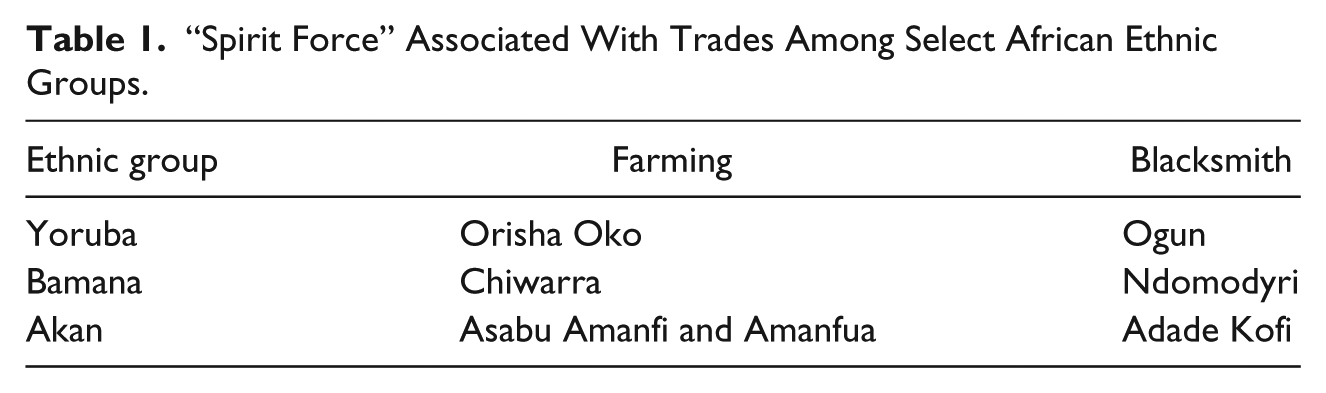
In addition to age set and extended family systems as institutions to organize labor, the guild system was a prominent feature of precolonial African societies. It organized community members into various industries, for example, blacksmiths, farmers, midwives, potters, weavers, hunters, architects, and brass smiths. In the indigenous African context, they were also spiritual societies. Each industry was linked to a particular honored ancestor or spirit force that was responsible for passing on the manufacturing, ecological, and moral knowledge associated with the trade in question (see table 1).
“Spirit Force” Associated With Trades Among Select African Ethnic Groups.
The guild system is significant for two reasons: (a) as a decentralized, cooperative form of socioeconomic organization; and (b) as an alternative to the notion that the creative and efficient production of goods and services is strictly dependent upon competition and the profit motive. Guilds are more often than not voluntary associations. As voluntary associations in a subsistence economy, socioeconomic class distinctions, within and across industries, are minimized. In addition, their decentralized makeup ensures democratic control by producers. The motivating force behind the guild system was not simply commodity production but human development. The spiritual dimension of guilds committed members to a process of initiation that linked the production of goods and services to the guild member’s human development, creativity, and respect for the natural resources that served as raw materials for the industry in question. Amadou Hampata Ba explains this in his discussion, The Living Tradition.
In the traditional African society, often-human activities had a sacred or occult character, particularly those activities that consist in acting on matter and transforming it, since everything is regarded as alive. Every artisanal function was linked with an esoteric knowledge transmitted from generation to generation and taking its origin in an initial revelation. The craftsman’s work was sacred because it imitated the work of Maa Ngala (the creator) and supplemented its creation. The relationship of traditional man with the world was therefore a living relationship of participation not of pure utilization. (Hampata Ba, 1990, pp. 180-183)
Ka wari nyini, production for wealth accumulation, is correlated with fadenya, “things born of the father.” Fadenya is associated with rivalry, individual pursuits, activities that break social norms for the greater good, as well as the accumulation of individual wealth. In contemporary Bamana culture, ka wari nyini activities are attached to the local market economy where goods and services are exchanged for money. Ka wari nyini, however, is pursued only after meeting obligations related to Ka bolo. Typically, this is concurrent with the ebb and flow of labor demands required by local agriculture.
Due to the seasonal nature of labor demands in the rain-fed farming cycle, most people do not devote too much time to such personal activities until the close of the year’s farming season. However, once their obligations to the food economy are met, most people—young and old, male and female—at least devote some time to producing or collecting products that they sell in nearby markets. (Wooten, 2009, p. 88)
Another important feature of indigenous African political economies is its emphasis on subsistence. Mischaracterized by Western political economy as inefficient, uncreative, laborious, and often unable to produce a sizable surplus, the subsistence mode of production emerges out of an alternative set of assumptions concerning economic development. The goal of subsistence production is to maximize security, which, at times, includes but is not exclusively associated with the accumulation of individual wealth (Altieri & Hecht, 1990). In precolonial Africa, wealth was not synonymous with money or financial capital, but instead it was linked with possessions, for example, land, seed stock, livestock, manufactured goods, and so forth (Ayittey, 1991). Indigenous societies, therefore, remain highly conscious of the ecological origins of goods and services exchanged between individuals and communities. For this reason, a more accurate description of the exchange of goods and services in indigenous societies would be ecological exchange not economic exchange (Altieri & Hecht, 1990). Ecological exchange has a twin focus, the reproduction of the human community and the maintenance of biological diversity. The notion of ecological exchange is an extension of the idea that nonhuman life-forms have intrinsic value beyond their use value to human economies. African philosophy maintains that the most tangible expression of the creator is nature. Nature is the conduit through which humans comprehend how the universe functions, what the Minianka call Kle-kolo (the path of the creator; Diallo & Hall, 1989). The Alusi for Ndi Igbo, the Orisa for the Yoruba, the Ntrw for Ancient Kemet, the Nkisi for the Bakongo, the Vodun for the Fon, and so forth, are all expressions of nature as sacred, yet concretely experienced, in the day-to-day interactions between human beings and local ecologies. This also expresses itself in the concept of totem. Among the Shona people of present-day Zimbabwe, for instance, the mutupu (totem) is an animal that has a progenitorial relationship with a given extended family. For the Shona, “most aspects of nature are perceived as kin, endowed with consciousness and the power of ancestral spirits. Trees, animals, insects, and plants are all to be approached with caution and consideration” (Taringa, 2006, p. 201). The Akan abusua (extended family) uses the akyneboa in a similar fashion. In addition to the totem, indigenous African societies also use the concept of taboo. According to Nehusi (2016), “the earliest known representation of this system, in Afrika and in all humanity, is in the society of Kemet” (p. 11). In ancient Kemet, taboo was associated with the concept bwt. Among the Yoruba, eewo means “things forbidden” or “things not done” (Boteye, 2013). Taboos are the prohibition of certain activities that will disrupt or cause fissions within the existing socioecological order. Taboos can be given to individuals, families, or communities. Oftentimes taboos are linked to the consumption of certain foods, natural resources, and/or relationships to nonhuman life-forms. Shona culture maintains, “that if one does not relate to sacred aspects of nature according to prescribed taboos and restrictions the ancestors would be angry [kutsamwa]” (Taringa, 2006, p. 205). Taboos are extended to entire ecosystems as well. This is particularly true for forest systems. Within the African context, forests are perceived as sacred storehouses of biodiversity and needed ecological resources. Use of forest resources is managed by a number of taboos and prohibitions against overexploitation.
In traditional times, African people lived and dwelled in the midst of the forest. The forest like mother earth was seen as a source of life. African people respected and reverenced the plants in the forest. Not far away from African villages and towns were sacred groves inhabited by sacred trees and abode of ancestral guardian spirits. These groves were centers of biodiversity. (Ikeke, 2013, p. 347)
Another expression of the earth-centered nature of indigenous African societies is the approach to the built environment. Given the culture’s emphasis on maintaining social and ecological harmony, the built environment, that is, homes, agricultural fields, market places, burial sites and monuments, shrines, artisan work spaces, and so forth, are constructed using local natural resources and local knowledge within the realm of local ecologies. According to Charles Finch, “the material form of African civilization was subsumed by nature” (Finch, 2007). This gave birth to a range of sustainable architectural styles, community planning strategies, waste disposal methods, road systems, and innovative modes of transportation. In addition, the built environment was defined by a blend of psychospiritual and socioeconomic needs. The land was both a source of individual and collective identity as well as the setting in which the ethical and social dimensions of human growth and development were understood and transmitted from one generation to the next.
In African tradition, the social order begins with the occupation of the land inherited from the ancestor-founder of the lineage. This ancestral heritage is the actual soil where the Africans are born and raised, grow, and organize their own descent and immortality. This land is more than a birthplace, it is a living environment, the total environment which has witnessed rituals sacralizing birth, childhood, adolescence, adulthood, healing processes, and death. This land is truly a spiritual universe. (Montilus, 1989, p. 33)
Within the indigenous African context, technological development, socioeconomic exchange, and the built environment materialize, expand, contract, and coexist within the ecological limits of the bioregion of a given indigenous community and what Western-trained ecologists call biocapacity. Every bioregion has a unique ecology that sets rules and limits for the use of natural resources and the exchange of energy. Human and nonhuman, animate and inanimate life-forms extract resources, consume resources, and create waste. The ability of all life-forms, within a given bioregion, to coexist and self-reproduce is what can be described as ecological stability. Maintaining ecological stability is a central feature of indigenous cultures in general and African culture in particular. To summarize, the vast majority of precolonial African societies approached development through Omenala, a complex of ecologically centered, mutually supporting values, socioeconomic institutions, and approaches to the built environment (see Figure 1).
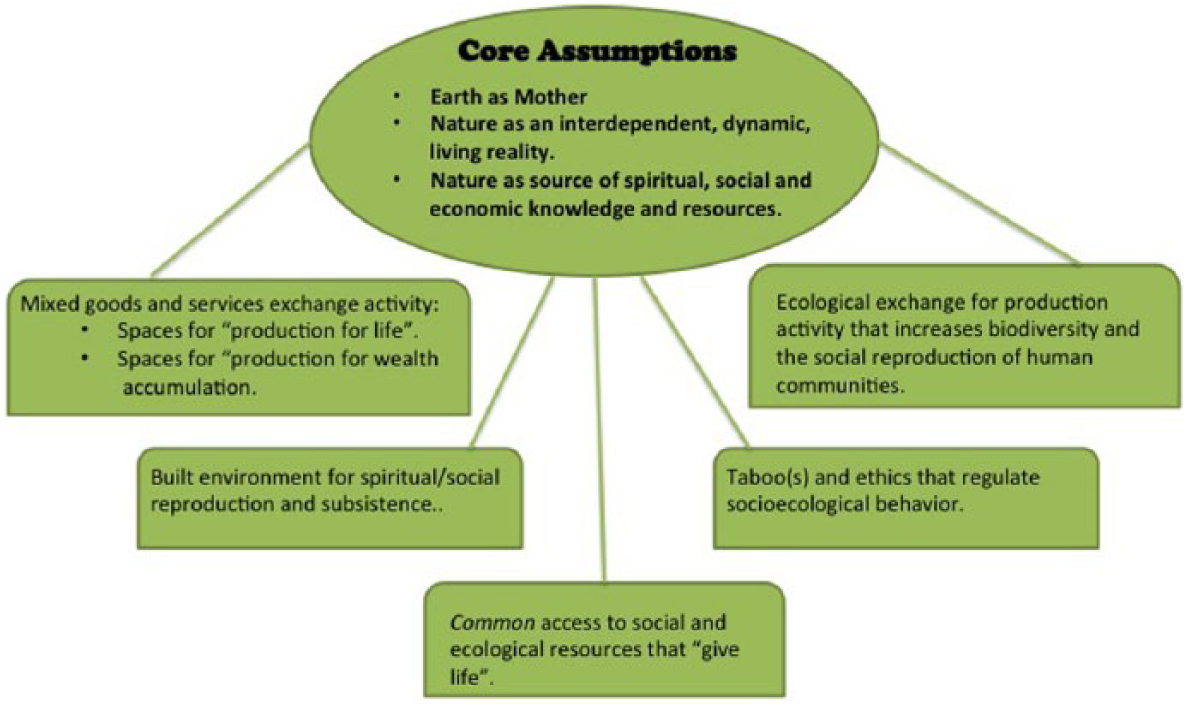
Omenala: African-centered ecophilosophy and political ecology complex.
Urbanization, in the European context, is the antithesis of Omenala. Its historical origins can be associated with the rise of capitalism, the industrial revolution, and the colonization of the indigenous world by Europe. Philosophically speaking, it is an outgrowth of mechanistic thinking. It is an approach to the built environment and community planning predicated upon an anthropocentric view of the universe and nature. At the heart of capitalism is the singular logic of individual-wealth accumulation.
The objective of human development is for the individual to pursue his self-interests unrestrained by the mandates of community and/or the “limitations” of the natural environment. The notion of earth as Mother and nature as an interconnected, living phenomenon under which human socioeconomic activity must be subsumed is perceived as constraining to both the creativity and freedom of the individual from the perspective of European philosophy. Nature, from the viewpoint of an emerging, capitalist ethic and epistemology, is nothing more than an inexhaustible pool of resources underutilized by European peasants and indigenous communities. Underutilization is understood as the logical consequence of a “primitive” worldview that sacralizes and has reverence for nature, yet, because of “ignorance” and the dearth of technological development, is forever victimized by its power and unmitigated influence. Western science becomes the “new way” of thinking to overcome these obstacles. It supposedly emancipates the individual from the constraints of religious ideas and nature and its “success is attributed to such things as foresight, insight, or genius for improving the environment” (Weiskel, 1987, p. 276). Western science deems the values and socioeconomic practices of Omenala as contributing factors to underutilization and barriers to the full realization of human consciousness and the development of industrial civilization. The advent of the concept of private property, that is, the privatization of agricultural lands, forest resources, water, and so forth, to replace the commons, is touted as an indispensable legal and economic strategy to increase economic productivity and eliminate poverty in the European countryside and among indigenous people in newly colonized territories. The enslavement of African people is a product of this history. Both nature and African people were considered raw materials for industry and beneficiaries of European civilization.
The colonial revolution extracted native species from their ecological contexts and shipped them overseas as commodities. It placed cultured European humans above wild nature, other animals, and “beastlike savages.” (Merchant, 1989, p. 2)
The European, urban, built environment emerged as physical spaces to organize and institutionalize mass production and consumption. It is dependent upon colonizing and absorbing the energy of the countryside in the form of natural resources and human labor. Its growth and expansion are reliant on the steady, increasing influx of people to serve as both workers and consumers. Community planning, housing, the development of roads, the disposal of waste, systems of transportation, production systems, and so forth, are shaped by the mandates of affluence. The more a given community consumes, the more valuable it is perceived by Western, industrial society. Consumption habits are determined by the racialized, unequal distribution of wealth and power. Those who have the capacity to consume more determine, to a large extent, the spatial organization of urban centers. Relationships to the land base are no longer defined by the psychospiritual, social, economic, and ecological praxis that characterizes Omenala. Narrow, secular, racialized, economic interests define them. The cultural and biological reproduction of human communities, in concert with nature and the maintenance of biodiversity, is replaced by an approach to development that circumscribes individual and collective identity to the production and consumption of commodities in a hierarchical fashion. “Humanness” is defined primarily by the capacity to acquire more “things” in the name of improving one’s standard of living, regardless of conflict of interest based on socioeconomic status. Ethnic, spiritual, familial, artisanal, and ecological relationships are distorted and subordinated to economic exchange relationships whose ultimate aim is to accumulate wealth in the hands of European elites and their compradors in former colonial territories. Everything is commodified and monetized for this purpose. This requires the compartmentalization and disarticulation of the most fundamental aspects of indigenous cultures and societies, that is, ka bolo, socioeconomic production for life.
The roles that were once fulfilled by families and communities for free have been “taken apart, function by function, and sold back to people, who missed the things that these once provided. People have become purchasers of community and care, rather than participants in it.” (Walker & Goldsmith, 1998, p. 217)
The European, urban, industrial environment is, quintessentially, motivated by ka wari nyini, socioeconomic production for “wealth” accumulation (Kunnie, 2013). From the perspective of the Bakongo, European inspired, urban, industrial economies are described as Tumba or Nzo, the pyramid/pile economy (Bunseki Fu-Kiau, 2007). Within the Tumba economy, social and ecological resources serve the interest of elites. The motion of the productive forces moves progressively toward the summit of the pyramid where very few benefit. Wealth is hoarded or “piled up,” out of reach for the majority of the community. Consequently, the Tumba economy is characterized by incessant conflict because “the entire social body and its environment are in the service of the few owners of the means of oppression and production” (Bunseki Fu-Kiau, 2007, p. 65). The opposite of the Tumba economy is the Nkat’ a ngongo, the horizontally spiral economic system. Unlike the Tumba economy, the Nkat’ a ngongo, characteristic of indigenous African political economies, is like a cylinder. Social and ecological resources are distributed horizontally. It is characterized by what Fu-Kiau calls a “collectively accepted level of individual accumulation (CALA)” (Bunseki Fu-Kiau, 2007, pp. 67-68). CALA is symbolized by the Nkat’ a ngongo, a standard basket of goods that meets the subsistence needs of Bakongo households (Bunseki Fu-Kiau, 2007). In other words, each extended family’s consumption and production needs cannot undermine the social or ecological basis for another extended family to meet its needs. In the Nkat’ a ngongo economy, ka bolo is primary. This allows for the redistribution of surplus through localized market activity and what Western anthropologists have described as “gift economic exchange,” that is, community rituals and/or festivals celebrating major life or historical events that involve the nonmonetized exchange of socioeconomic resources.
To summarize, it is important to consider that Africana critical theory must root itself in the ecophilosophy and political ecology of indigenous Africa if it is to offer a sharper analysis and critique of European modernity and its impact on African people in the contemporary world. Africana critical theory must resist compartmentalization by recentering ecophilosophy as a common thread weaving its way through all aspects of African cultural thought and practice. This, in turn, will address some of the theoretical limitations that Africana studies has inherited from the tradition of radical, Western political economy.
Omenala: Implications for New Areas of Inquiry and Approaches to Africana Studies
An African-centered ecophilosophy and political ecology creates an opportunity for Africana studies as a discipline to (a) discard the stereotype that it is strictly confined to the realms of the humanities and social sciences and (b) expand its ideological contributions to social movements and organizations attempting to address the contemporary problems of African people (Tillotson & McDougal, 2013). Two important examples are the Environmental Justice Movement (EJM) and the Black Food Movement (BFM). EJM and BFM emerged during the latter half of the Black Freedom Movement, 1972 to 1981. Initially, both were largely concerned with the experiences of predominantly rural, African American communities. The EJM sought to address the disproportionate incidences of industrial waste facilities being placed in low-income communities of color, consequently contributing to higher rates of cancer, endocrine, and respiratory diseases. (Taylor, 2011) The BFM sought to challenge the rapid loss of African American farmland through forced sales, the racist practices of U.S. Department of Agriculture (USDA) employees, rural-to-urban migration, and a genuine disinterest and disdain for farming because of its historical linkages to slave labor (G. R. Grant, Wood, & Wright, 2012). Ideologically speaking, both the EJM and the BFM have grounded their critiques, strategies, and tactics within the tradition of African American liberalism. The U.S. state is perceived as, paradoxically speaking, both the problem and solution. In the case of the EJM, solutions include better oversight, protection, and community involvement with environmental protection agencies. The BFM advocates for a more equitable distribution of farmer subsidies, loan programs, and greater access to conventional agricultural markets. Both the EJM and the BFM lack, to some degree, a cultural basis for their movement organizing. African-descendant communities in the United States typically perceive both the environment and farming as secondary to police brutality, income inequality, and overt racism. An African-centered ecophilosophy and political ecology would contribute to expanding the contours of movement discourse by recentering the land question (Bandele & Myers, 2016). It would demonstrate that both the exploitation of people and the exploitation of nature are twin realities. In addition, it can provide the philosophical context for African Americans to consider that personhood, collective identity, and the natural environment are interconnected phenomena that form the basis for group consciousness and genuine community development (Tangwa, 2000).
The questions of environmental justice and land reform are not narrowly confined to U.S. borders. They are, in fact, international issues and have implications for expanding Africana studies contributions to Pan-Africanism. Critiques of industrial models of production, that is, conventional agriculture, fossil fuel–based energy systems, Western-styled urbanization, and so forth, are in order (Kunnie, 2013). For instance, it provides an opportunity and context for Africana studies’ scholars in the areas of agriculture and development studies to unearth and explore the ways that traditional agroecological knowledge can be used to rebuild local food economies on both the African continent and in the African diaspora (Alliance for Food Sovereignty in Africa, 2016). Beyond agriculture, the fields of conservation biology, restoration ecology, and bioremediation are important as well. Low-income, African-descendant communities in the capitalist metropoles, Caribbean and African nations in the Global South are most impacted by human-induced climate change. The conservation and restoration of local ecosystems and biomes is considered to be an important strategy to slow down and mediate the impact of climate change. African-centered ecophilosophy, political ecology, and traditional ecological knowledge can play an important role in restoring forest systems, water systems, agricultural lands, degraded wetlands, and bioremediation of electronic and industrial waste, nonsensically imported from Western countries by African elites to gain access to foreign currency. This also provides an avenue to increase the number of students and scholars in Africana studies in fields typically associated with the natural sciences. A commitment to the innovation and production of green technologies, fusing both African indigenous knowledge systems with Western ecotechnical knowledge, should drive Africana studies’ curriculum development, applied, and theoretical knowledge (Pope, Smith, Shacks, & Hargrove, 2011). This has obvious implications for our survival as a discipline given the overemphasis on Science, Technology, Engineering and Math (STEM) within U.S. higher education. This approach also has the capacity to advance the development of indigenous African knowledge systems. No body of knowledge is without its own potential for dogma. Although this discussion explores the positive aspects of African-centered ecophilosophy and political ecology, weaknesses do exist. One example is the notion that indigenous African socioecological praxis is not always based on environmental consciousness, but fear of the “unknown” and spiritual sanctions from the ancestors. Taringa argues, In the light of this we can note three attitudes to nature. These are to maintain, obey and act on it. The first two are related to sacred aspects of nature. They are primarily based on fear of reprisal from powerful ancestral spirits. As we mentioned in the discussions above the attitudes are one of placation appeal and coercion. Sacred aspects are not indifferent. They are morally significant. They care. They are involved in conduct. So they constitute a system of moral consequences. This is why respect (for nature) is based on fear rather than on environmental consciousness. (p. 211)
In this regard, we must consider the wisdom of Cabral. A return to the source requires both an internal critique and assessment of the positive and negative aspects of indigenous African culture in addition to a critical assessment of the lessons learned from African contact with European cultural hegemony and exploitation (Cabral, 1973).
In the realm of political economy, an African-centered ecophilosophy provides a theoretical basis for reconsidering economic development in the African world. It critiques “catch up development” strategies, in both capitalist and socialist forms, because of their commitment to the fallacy of perpetual growth rooted in the unlimited extraction and consumption of natural resources (P. I. Grant, 2009). It calls for a “new anthropology” of economic systems that abandons the polarized capitalist versus socialist typology. It prioritizes the maintenance of biodiversity and the sociocultural reproduction of human communities as the main goals of economic development.
Finally, an African-centered ecophilosophy and political ecology will position Africana studies to expand its understanding and critique of science, technology, and society. African culture’s emphasis on biocentrism provides a piercing analysis of Western modernity, science, and technological progress. It situates itself within the broader context of the indigenous call to decolonize science. It moves beyond the tendency, within Africana studies, to discuss the “African origins” of science and technology while ignoring contemporary problems of alienation, inequality, and development. It inspires Africana studies’ scholars to answer the following questions: How should we understand and interact with nature? What, on a material level, do we “need” to develop genuinely as human beings? How should socioecological wealth be distributed? What role should technology play in society and what values should govern its development?
In conclusion, the absence of an African-centered ecophilosophy and political ecology within Africana studies suggests that there is a relative disregard, among Africana studies’ scholars and social movement activists, for environmental and land-based issues. This is problematic for a number of reasons. At the same time, however, it is understandable given European ideological hegemony over environmental justice and sustainable development discourse.
This ecohesitation has been conditioned in part by African suspicion of the green discourses emanating from metropolitan Western centers. Also, African experiences of nature, it is often argued, are different and other. Indeed, there is good cause to worry that environmentalism and ecologism are new forms of dominating discourses issuing from Western or First World centers. And the suspicion that environmentalism in all its various shades of green (including red greens) is a white thing is borne out by the explosive growth of research and participation in it by white scholars in and outside Africa. (Slaymaker, 2001, p. 133)
Africana studies must address these problems appropriately to ensure that African people have agency and are not simply following the lead of “green ideologues” external to African communities. We must find ways to reacquaint African people with our earth-based sensibilities, philosophies, and socioecological practices. In doing so, we will unearth ancient tools to address the most pressing problems facing African communities today. Rediscovering these tools requires a deeper commitment to the study of African indigenous knowledge systems. As Zegeye and Vambe argue “Africa needs to evolve its own language of (sustainable) development” (Zegeye & Vambe, 2006). Given the depth of African culture, there is a wealth of knowledge and wisdom to draw upon if we are willing to use it as a foundation for praxis and not merely as a reference.
Footnotes
Acknowledgements
In addition, I thank Tiffany Austin and Marva Hinton for assistance in editing the article.
Author’s Note
The Faculty Research Awards Program in the School of Graduate Studies and Research at Florida A&M University supported the research for this study.
Declaration of Conflicting Interests
The author declared no potential conflicts of interest with respect to the research, authorship, and/or publication of this article.
Funding
The author disclosed receipt of the following financial support for the research, authorship, and/or publication of this article: The Faculty Research Awards Program (Project No. FRAP 2016-17) in the School of Graduate Studies and Research at Florida A&M University supported the research for this study.