




Abstract
The history of Penkye is linked to that of Winneba township since it is the first place the Effutu people settled in the town. Located along the coast, majority of its residents are employed in the fishing industry. Intriguing about Penkye is how social and economic livelihoods of residents are entangled in gender roles and reciprocity. The article delves into the institutional embeddedness of fishing and community life. It examines how gender ideologies differentially inform men and women’s roles in the fishing economy. Drawing on interviews conducted with community members, the study constructs economic life stories for men and women within the fishing community. It analyzes how they formulate livelihood strategies differently from other parts of the country as a result. The study concludes that such realities defy the ideologies of the impersonal market economy propagated by the capitalist ideology, thereby questioning the basis of neoliberal ideology that market prices are solely determined by demand and supply interactions.
Introduction
Fishing tradition along the coast of Ghana has existed long before 1200. The country’s marine coastline is 550 kilometers, stretching from Aflao in the east to Half Assini in the west (Atta-Mills, Alder, & Sumaila, 2004; Bank of Ghana, 2008). Fishing is the main occupation of the indigenous communities along the coast and those living close to major rivers in the country. The sector employs about 10% of the labor force with most of them using dugout boats/canoes, sometimes powered with outboard motors and basic technology (Bank of Ghana, 2008; Britwum, 2009). The lifestyles of people in the fishing communities are embedded in the fishing occupation itself with the two invariably linked.
Most fishing communities have preserved their culture and tradition despite the changes in many sectors of the country. For example, in most cases, payments for services provided to fishermen are in kind, with fishes instead of money. This phenomenon is not only common to fishing areas in Ghana but also found in fishing communities in some countries (see Yodanis, 2000). One peculiar feature of fishing communities is the strict gender division of labor. Again, this is not limited to fishing communities in Ghana but also in other areas (Bank of Ghana, 2008; Britwum, 2009; Hapke & Ayyankeril, 2004; Yodanis, 2000). While men are responsible for fishing, women are usually involved in basic fish processing and marketing. The gender division roles played by both men and women are culturally embedded in the institutions within the communities (Odotei, 2003). They are pursued in their life courses as institutional norms which no one questions. Both men and women are trained differently by their parents and the community on the roles they play in the fishing industry. They are socially learned as they grow up (Yodanis, 2000). As described by Schultz and Haines (2005), the fishing industry shows a classic case of cooperation among men and women where organization of fishing activities become interdependent. Neither gender would survive without the other (Williams, Williams, & Choo, 2006). Although women are not involved in fishing, the role women play is as important as that of men; hence, both exercise some authority in their areas of specialization (see also, Yodanis, 2000).
There are indigenous communities along the coast of Winneba of which Penkye is the oldest with the history of the Winneba revolving around it. Penkye is known for its fishing activities, and for the preservation of the Effutu 1 culture. Fishing activities in the community are done on gender basis as in other fishing communities in Ghana (Britwum, 2009) and many parts of the world (Hapke & Ayyankeril, 2004). Apart from fishing, access to other livelihood assets such as housing is also on gender basis.
The article discusses the results from a study focusing on the perspectives of gender roles in the fishing industry in Penkye. It reveals to the reader how work and family, homes, and tradition are intertwined in the community. The article demonstrates the power of gender in reproducing division of labor based on societal dictates. It does not argue based on segregation against any sex. It rather argues based on cultural and traditional preservation which have not been diluted by the principles of the market economy. There are many studies about fishing in Ghana, including the trend of migration among fishing communities (Odotei, 2003), the decline of the fishing industry (Atta-Mills et al., 2004), the dynamics of fish marketing (Sterkenburg et al., 1976), and the gender division of labor in the fishing industry (Britwum, 2009). This study enriches the corpus of knowledge by taking a stand on the perspectives of Polanyi’s economic embeddedness in social institution to explain the gender division of labor in the study community. It therefore discusses how people’s social and economic lives are entangled within the system of cooperation and dependence in gender roles and reciprocity.
Embeddedness of Gender and Reciprocity
Embeddedness explains how human economic behaviors are affected by social relations, and thus, how social structure or relations affect economic life (Uzzi, 1997). This is the view of many disciplines in the humanities and social sciences (Granovetter, 1985), thus people’s economic and noneconomic behaviors were embedded in the premarket societies (Granovetter, 1985; Polanyi, 2001) and that people’s “actions were to safeguard their social standings, social assets and social claims” (Polanyi, 2001, p. 45). Embeddedness stresses the role personal relationships and structures play in generating trust and discouraging malfeasance in economic transactions (Granovetter, 1985).
Granovetter (1985) argues that, today, the economy is a different sphere, separated from social relations. Economic transactions are no longer defined by social or kinship obligations but based on rational gains of individuals (Granovetter, 1985). The market economy which is a system directed principally by market prices dominates modern society (Polanyi, 2001). In a competitive market, a producer or a consumer cannot influence prices of goods regardless of the number of goods demanded or supplied. Therefore, social relations are separated from people’s economic behavior in a typical market-based society (Granovetter, 1985).
But as Polanyi (2001) argues, it is important to maintain social ties because social obligations are embedded in reciprocal relations. There are different views on the way social structure affects people’s economic behavior (Uzzi, 1997). This is expressed differently in different cultures even in modern societies, thus reinforcing the argument that economic practices are socially expressed and manifested in different spatial contexts (Hess, 2004).
Zukin and DiMaggio (1990, see Dequech, 2003; p463) conceptualized four types of embeddedness: cognitive, cultural, structural, and political embeddedness (See Dequech, 2003; p463). This study aligns itself with the cultural embeddedness, which is the role of shared collective understandings play in shaping economic strategies and goals (Dequech, 2003). Society’s collective decisions and understanding on how social features affect economic behavior are also closely linked to strategies they employ economically. Culture is about habit people develop and their thoughts and behaviors toward things. By the regulatory forms put in place because of culture, people’s behaviors are constrained (Dequech, 2003). It therefore influences how people in a specific society apply rules of engagement in economic integration (Fiske, 1991; Kesteloot, 2002), especially the market logic (Dequech, 2003).
Gender division of labor is a concept used in many ways to analyze the different roles men and women play in the society (Rubin, 2009). This also includes work differently done by men and women for pay. Studying jobs from gender perspectives helps to analyze how gender division of labor affects availability of employment to both sexes (Torns, Carrasquer, Moreno, & Borràs, 2013). In many cultures, gender division of labor is developed through time and becomes part of people’s life courses. The life cycle theory contextualizes the lives of people in a given culture and how their lives are linked to each other and to the society as a whole (Elder, 1998). Gender work life course is therefore seen as a multilevel phenomenon including structured pathways, social organizations, institutions, and social trajectories of individuals’ developmental pathways (Elder, 1998).
Reciprocity, on the contrary, is exchanges between people with close network relationships. It is based on people constituting a group because they are related by a common substance (Fiske, 1991) such as families and friendship relationships. It can also be seen among people in social organizations and ethnic networks. Trust is what engineers the exchanges that take place and is rooted in long-range relations (Polanyi, 2001; Hess, 2004). According to Fiske (1991), features of reciprocity can be captured in three words: kin, kind, and kindness. Reciprocity is based on institutions dependent on familial or social obligations which may not necessarily be based on a two-way transfer of equivalent value of the market system (Carroll & Stanfield, 2003). Exchanges in a reciprocity system are normally through voluntary cooperation which is loosely sustained by cultural customs (Harvey, 1973). Sanctions on people who break the chain of trust in reciprocal relationships are subtly defined but greatly felt by those who become victims. Reciprocal relations have elements of power embedded in them (Polanyi, 2001).
Sometimes, a market system can be diluted with reciprocal relationships. If that happens, such a system is called a reciprocal market. A reciprocal market, therefore, is a market system influenced by social relations such as marriage, ethnicity, or friendship. Here, market prices are negotiated on the basis of relationships (Danso-Wiredu, 2016).
In societies where work is highly divided on gender basis, such divisions have mostly developed and existed through history and are therefore entangled with people’s everyday lives (Hapke & Ayyankeril, 2004). This study therefore discusses gendered roles within the study area and its direct linkage with livelihood strategies. The economic behavior of people in the study area is influenced by ideological factors underlying the gender division of labor, thereby creating a reciprocal market at the wholesale level of the fish transactions among close families and friends. The study supports Polanyi’s argument that people’s economic lives are embedded in their social relations. It argues that unlike Polanyi’s clear distinctions between the market and the reciprocity systems, in Penkye, the two are sometimes combined, giving rise to a reciprocal-market system.
Research Methodology and Setting
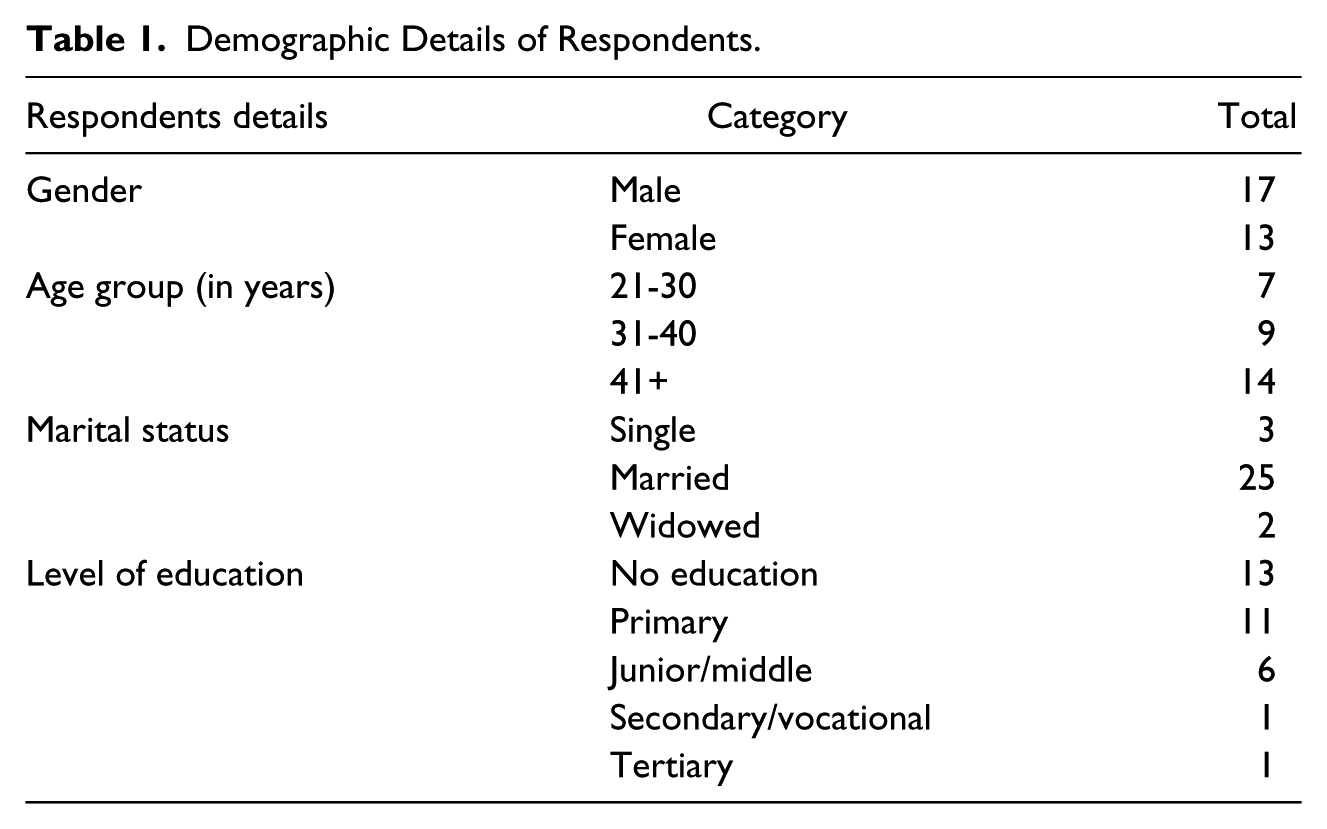
The research is part of a study conducted in four poor communities in two Ghanaian cities from March 2012 to March 2016. The author spent 4 months in Penkye interviewing a wide range of leaders and residents on livelihoods, especially strategies for livelihood acquisitions. Thirty interviews were conducted using a semistructured interview guide. Demographic details of respondents are shown in Table 1. All respondents were purposefully selected with the help of community leaders. Questions asked included reasons for the gendered division of labor, coping strategies in their jobs, general livelihood strategies, and respondents’ views on the community. For almost 3 years into the research, observations were also done by the researcher who regularly visited the community. All information was qualitatively collected and analyzed.
Demographic Details of Respondents.
The history of Penkye is intertwined with that of Winneba because it is the first location settled by the people of Effutu when they migrated from Mankesim 2 area. Interviews with opinion leaders reveal Winneba was established by descendants of Kwamena Gyarteh, Ayirebi-Gyan, Gyarteh, and Edwey. The descendants came by sea and pitched camp at what is now called Penkye. Prekye in Effutu means “to land.” By 1400, Penkye had long been settled. It is also significant in the economic life of Winneba since, by 1720, Penkye was already a port for gold, corn, palm oil, and slaves. The community existence is driven by fishing, and hence, Penkye continues to be a busy fish landing center in Winneba. According to the 2010 Population Census, the population of Penkye was a little over 2,700 (Ghana Statistical Service, 2012).
Figure 1 is a three-in-one illustration of Penkye as part of Ghana, the Central Region, and its specific location in the Winneba township.

A map of Winneba with Penkye.
Fishing in Penkye
Fishing and its related activities employ almost everyone in Penkye, although there are a few others who are employed in other entrepreneurial activities like hair dressing, carpentry, and artisanal building. The fishing industry offers subsidiary job opportunities for such people in the lean seasons of their respective occupations. Apart from the need to be healthy and energetic, those involved in the fishing business are skillful swimmers and can identify fertile areas for fishing. Women are skillful in different ways of processing fish, for example, smoking, drying, and frying. In order not to stay idle, the women occupy themselves with alternative jobs such as retailing of foodstuffs when their husbands are at sea. The skills to perform these tasks are learnt in the community, at the household level, and on the job as children grow and perform tasks strictly on gender basis, with men going for fishing and women processing the fish. The contrasting excerpts below underline the gender division of labor in the community, for, whereas the women are trained to be fish mongers, men are pushed into the arduous task of going to sea.
According to Esi, a 32-year-old fishmonger, I smoke fish. I started helping my mother in fish processing when I was fifteen years. I started my own when I was nineteen years, I smoke the fishes and send them to Swedru for sale.
In contrast, Kwaarta, a 28-year-old fisherman, noted, At age fifteen, my father took me along anytime he was going to sea till I matured as a fisherman. I also started taken my boys along when they were twelve and nine years old
In a similar view, Mensah noted, I have been in the fishing business all my life, that is since I was old enough to help my father who was also a fisherman. Identifying the fishes in large quantities is like a skill we learn. We can easily identify them when we see them together at one place
According to Esi, Kwaarta, and Mensah, both men and women are trained on their respective roles to enable them to get the needed skills before indulging in the business. The training is done on gender basis—fathers or men train their sons or young men and mothers or women in the same way train their daughters or young women. These are acceptable norms in the community which no one questions. Their behaviors and actions are in accordance with the gender division of labor concept widely discussed in the literature and briefly discussed earlier in this work. The gender roles are cyclically embedded in the everyday lives of the residents as noted by Elder in 1998.
The main type of fishing at Penkye is the offshore one. Men go to sea in search of fish with outboard motors attached to their boats/canoes (as shown in figure 2). They sometimes spend days on sea before returning, at times empty-handed. Each fisherman is either “company” owner or belongs to a fishing company. The company comprises the number of people that work on a particular boat. The sizes of the boats range from small ones employing three people to large ones employing over 20. Unemployment is not common because boat owners always look for workers. There are varying conditions before people are employed: Some employees come with their nets and others come with nothing, and in each case, conditions and means of sharing the catch differ. Wages paid for boat/canoe servicing are rated in quantities of fish.
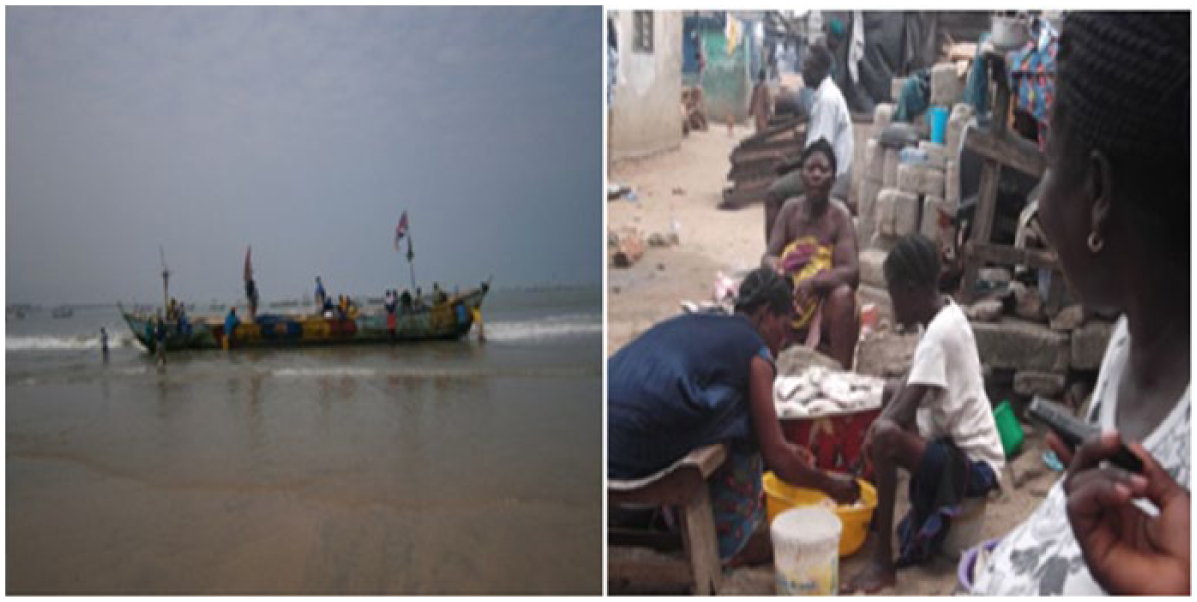
Fishermen ready for sea and women preparing fishes for smoking.
There are numerous fishing companies in Penkye. Fishermen who work on the same boat/canoe belong to the same company. Company names are derived from the names on the boats. Company members could be close or extended family members or friends and families together. Companies have rules which guide the members to settle disputes if they arise or share their proceeds. Mensah, a company owner, shares his experience of the fishing business, how company members are employed, the rules for sharing fishes, and conditions attached to the rules below:
Mensah’s Story
I am 74 years; I was born in Penkye and have lived all my life in Penkye. Abasam is the name of my company which has been extended to my personality and even my houses. I have been in the fishing business since I was old enough to help my parents who also worked in the fishing industry. I had no education. I have two wives and seven children, some of my children are also working in the fishing business. I have my own net, outboard motor and a canoe. I am the director of the company and employs people for the company. Our fishing type is called “wetter or safe” (name after the fishing net in Effutu). We go to sea between two weeks and one month in search of fish. Our work is like lottery, sometimes we go for a month and return with nothing, other times too, we get more fish than expected. We depend on what the sea gives us. I employ anyone in the community that expresses interest in the business who undergoes successful interviews. We get recommendations about new employees (who are mostly our extended family members) from the community members. We inquire from a few people who might know those we employ whether they can be trusted. There is no limit on the number of people we take, we employ as many people that are available, sometimes we divide ourselves if we are many. My company employs only men because our kind of business is only men affair. There is no standard wage or salary but an agreement among the members of the company, anytime we get fish, we first deduct the cost of the pre-mix fuel used, money for maintaining the machines and nets used. The rest of the money is shared equally among the members. Money here is calculated in amounts of fish. If for any reason, we do not get fish on a day, the cost is noted and anytime we get fish, we deduct both costs before sharing the profit. If I am in Winneba, I sell my fish to my wives, but if I find the fish somewhere, I sell it to the women in those communities. Whilst we are away from our families and homes, we get accommodated and fed by the women we sell the fish to, in that case, the women get the same concession as we give to our wives.
It is evident from Mensah’s narration that migration from the community in search of new jobs is minimal because the fishing industry provides a reliable source of employment regardless of one’s level of formal education. Employment is inherited largely along family lines or acquired in the community based on gender division of labor as noted by Esi and Kwaarta. Another important assertion made by Mensah is that fishing companies are owned by men in public. The uncertainty of the amount of fish catch put the fishing industry at par with most informal sector jobs where earnings from job done are difficult to predict. The unpredictability coupled with the need to be with the fishing crew as much as possible discourages most female entrepreneurs from venturing into that side of the industry. Mensah also depicts the essence of trust, cooperation, and understanding among company members to bolster reciprocal relations, especially at high seas. Obviously, that reciprocity is not limited to family members. It is a social insurance in an unpredictable environment of physical danger and uncertain business activities. Women who provide similar services to the fishermen when they are outside Winneba, like cooking and accommodating, also get similar concession with the pricing of fishes, just as is given to their wives in Winneba. This practice contradicts one of the tenets of a market economy where Granovetter (1985) explains social relations are separated from people’s economic behavior.
There is in-kind payment for work done by the fishermen. Under the in-kind payment system, fishermen bargain for certain quantities of fish as payment for work done. This is based on a cooperative arrangement called nnoboa under which people offer services and expect a concomitant payment at the due time. For example, people who supply fishermen with nails and wood are given fish in return as payment.
Fishing communities operate according to rules which generally define the roles individuals play within the community. For example, company owners are men as evidenced in Mensah’s narration. Women may own companies, but they are publicly entrusted to their sons, brothers, or husbands. Company owners usually sell the yield from fishing trips to their wives. The women then pay their husbands to cover their expenses and for their upkeep. They then sell the fish and use the proceeds to cater for their children and to cook for their husbands. This act again contradicts the theory on a market economy. Esumanba, Baasiwa, and Arko share their views on this process: My husband sells his fish to me when he returns from sea. If they are plenty, I sell some fresh and then fry the rest, he gives the price for sale and it includes his chop money [daily money from husbands to wives or boyfriends to girlfriends], I then sell the fish, I normally get much more money than he sold it to me. (Esumanba) I get some of the fish from my husband. Sometimes, I have other people that supply fish to me. I bargain the price with my husband like I do with other fishermen. There is no chop money from our husbands, the chop money is inclusive in the sale of the fish to us. We suffer a lot here as women. (Baasiwa) When we return, we give our fish to our wives to sell for us, we instruct them how much to sell the fish, after sales, my wife returns my money to me, she also increases the price of the fish to make her profit. Her chop money is included in the cost. (Arko)
Customary practices demand that those who have companies or own nets sell their catch directly to their wives while single women, widows, or women married to nonfishermen buy fish from the wives of net and company owners. Comments made by the following respondents confirm this observation: I buy fish from the men at the sea shore. Since my husband is dead, I cannot depend on a reliable source of supply, I now depend on people to get my daily supply, it’s usually my friend’s husbands or friends of my late husband. (Esi) I buy my fish from someone’s wife, my husband died five years ago. Someone sells the fish to the wife, the wife in turns sells it to her friend before the person sells it to me, by the time it gets to me, so much has been added to it. I always get virtually no profit. (Abata) It is easier to go with those with nets so they can also give their catch to their wives because if they come with nothing to their wives, they think they are working for you and feel reluctant in doing so. (Kwadwokom)
The customs and traditions surrounding boat ownership on one hand and right to sell fish on the other hand guarantee the investments people make. The wives and those who have direct social links to the fishermen like Esi as a wife of a deceased friend are assured their source of supply with reduction in actual pricing of the fish. The basis for the catch given to their wives and at a reduced price is that their wives use the profit to look after the home. That is why the logic of marketing is compromised here. The fish catch is sold but not at a regular market price. Unlike their wives, Esi’s case brings to light the reciprocal relationship between friends just as couples. Some fishermen had friendship with her deceased husband, and it forms the basis for the reciprocal market to exist in the case of Esi. The reciprocal market regarding wholesale of fish is, however, exclusionary since the fish market at the wholesale is monopolized. Women like Abata, therefore, pay much higher prices to be part of the system. The monopoly safeguards the investment of their wives and friends by keeping them in business. The culture of reciprocal market dominant in Penkye is embedded in the society which changes the economic behavior of the people. Their actions support Polanyi’s (2001) and Granovetter’s (1985) arguments on how social ties influence people’s economic behavior in the traditional societies. The behavior of those involve in fishing industry is largely like the premarket economy. But the story of Abata also shows the rational of a market economy is employed when the need arises.
Other Livelihoods
The communal use of housing facilities deconstructs the idea of a house as consisting of a sleeping place, and other components like toilets, bathrooms, and in-built water source. In Penkye, the community members live as one household members; share many things in common, ranging from housing to housing facilities. Facilities that are usually located in people’s homes have collective usage at the community level. People’s individual activities are therefore scrutinized by other residents because of the open access and collective livelihoods. Community members see themselves related and can directly or indirectly have linkage with each other by blood, marriage, or friendship. It is therefore easy for them to also extend the same logic to marketing of fishes. The section briefly explains the communal lifestyles among the residents.
Penkye land belongs to the residents on communal land ownership basis. A link with the Gyarteh-Otuano family lineage is what qualifies a person to have access to land in the community. Nonindigenes are therefore excluded from land access in the community, and land sale is extremely difficult because of the communal land ownership system. There is a regulatory authority which operates through heads of families to allocate land for housing and other purposes.
Houses in Penkye are the indigenous family compound. (A compound house is usually a one-storey structure, comprising a series of single rooms surrounding a square courtyard). The courtyard is a center for activities and interaction among residents. The houses are family owned and are occupied by extended family members of the deceased owners who are hardly known to the occupants. Men and women usually live in separate houses, likewise husbands and wives. The compounds of houses belonging to women are also situated ovens for smoking fish as shown in Figure 3.

A compound house for women in Penkye.
People generally do not pay rent when they live in such houses and so may not make any financial contributions to the upkeep of the structural integrity of the buildings. Housing is accessed on a reciprocal basis in Penkye, with kinship ties and marriage being primary qualification entitling one to the arrangement. The reason for the reciprocity in accessing housing is that money and resources used to build houses belonged to the generations of families which the current residents are linked to. Rooms in the houses are inherited from generation to generation, and mostly men and women live separately. This is mainly due to the tradition of polygamy common in the community and also to the fact that ovens for processing fishes are located only in houses belonging to women. A man with more than one wife cannot obviously share his single room with his wives. We learn more about housing arrangements in the following excerpts: I live in my father’s house. My father is no more alive but the rooms have been shared among his sons. It is our family house and I have a single room allocated to me. I share the room with my two sons. My wives live in their mothers’ houses with my daughters. The boys sleep on the compound at night, no bedrooms for them because their fathers have only single rooms which we share with their mothers at night, that is why we have a compound in every family house. (Baidoo) I live here with my mother and my siblings as well as three of my children. The house belongs to my mother’s side. At times, I go and sleep in my husband’s house at night when I have no fish to smoke. The fish smoking ovens are sited only in our mothers’ houses, there is none at where our husbands live so it’s difficult to live in your husband’s house and do this kind of business. (Baasiwa)
Accommodation in the community is largely accessed freely with men and women living separately, with both Kwaarta and Baidoo, for instance, linking the action to that of polygamy. However, Baasiwa defends the tradition of men and women living separately with a more economic explanation when she noted, “the ovens for smoking fishes are sited in our mothers’ house.”
In Penkye, none of the houses has toilet facility; residents use the toilet at a nearby community, Ponko Akyir built by the Effutu Municipal Assembly (EMA) or they use the sea shore to ease themselves. Houses have no showers; there are communal showers instead, some built by the Municipal Assembly and maintained at the communal level; users only buy water for shower. A few homes have meters from the Electricity Company of Ghana (ECG); others which have no light get it from those that have the meters. Water can be bought from houses that have pipes or from the showers.
The Embeddedness of Gender and Reciprocity in Daily Activities
When asked about why the livelihoods of the people are strictly gender divided, some of the responses were, “It was just tradition that explains why women for example do not fish.” “It is a part of culture, a custom, we met it, it was instituted by our forefathers,” a respondent said. And indeed, there are cultural traditions of fishing communities which contribute to women’s not fishing. The study reveals that there are strong superstitions, such as the belief that having a woman on a boat, and even near the water for fishing, is bad luck. Such strong beliefs in culture enforce both men and women in the fishing communities to stick to their gender roles. It does not in any way mean any of them is more important than the other or that the roles played by women are inferior to that of men as regularly assumed, any time there is gender division of labor (Anker, 1997; Reed & Dahlquist, 1994). It shows from the study that each commands power and domineering influence in the roles they play. It is again not true that women in fishing communities are involved in unpaid jobs as written by Yodanis (2000), for example. Women in the study communities are involved in the processing and marketing of fish; this role makes them equally important as the men who go for fishing.
The meanings of some strategies employed for the gendered roles are socioeconomic in nature. One reason why men and women live separately from each other as explained by Baasiwa has both social and economic implication, depicting the embeddedness of their accommodation strategies in their tradition and also directly linked to their economic lives. There are houses specifically built for women; such houses are identified with ovens sited at the compounds as shown in Figure 3. Her comments also reveal economic implications; if she sleeps at her husband’s place on the days she should work, her working hours will be reduced. Hence, she must return to her mother’s house to smoke fish for the market.
There is a direct social influence on fishing prices as discussed above, indicating personal interference in the market processes and thus leading to a reciprocal market. Examples of such relationships from the study are marital, friendships, siblings, and even sympathetic instinct like the case of Baasiwa who is sympathized by her husband’s friends who reduce the fish pricing for her. Wives, for example, provide care to their husbands and children, and in exchange, they are kept in business by their husbands who supply them fish at wholesale in reduced rates. How much a person pays for buying fish from fishermen depends solely on the social relations. We learn from Mensah that when they end up in other communities, they have women who give them accommodation and feed them as well; in such instances, those women get the same concession as what they give to their wives in Winneba.
Again, the study reveals evidence of reciprocal relationships in the community; access to land and rooms in houses is usually free for relatives of the owners. As earlier explained, a link to the Effutu ethnic group among Gyarteh-Otuano families qualifies a person to access land or accommodation on reciprocal basis, the idea being that their ancestors contributed to the building of the houses and acquisition of the land, and hence, the present generation also gets the opportunity to benefit from it. Such reciprocities extend to many other activities in the community. For example, it is common for community members to make donation to support each other in merry making like outdooring of babies or during funerals as is done in many Ghanaian communities; though people are not obliged to do so, residents do so wittingly in a reciprocal manner. The reciprocal relations are also linked to the notion of community members living as one big family; hence, each resident’s burden or happiness is shared among the community members.
Conclusion
With the story of Penkye told above, what can this study add to our understanding of embeddedness of gender, reciprocity, and livelihoods? As the study shows, parents or the community train their male and female children differently in relation to the roles they perform in the fishing activities. Children therefore grow to accept such roles as instituted traditions that they usually do not challenge.
The study has also proven that the rationality of the economic processes in the study community is embedded in their everyday lives intertwined with marital and other social relations. The community has seen less infiltration of the current global neoliberal market economy regarding pricing of fishes at the wholesale level. The difference between the system largely operating in Penkye and the prevailing market conditions in most parts of the country is that, in Penkye, wholesale fishing largely operates on trust, greatly influenced by marital relations.
This can be seen as a preserved culture or a reaction to the market. A preserved culture in the sense that the study proves that family and ethnic system which is found as the basis for social relationships in the community is a preserved culture in the Ghanaian society. The rent-free compound housing system discussed has also survived over the years as part of the Ghanaian culture. It is practiced in most parts of the country among indigenous communities. In the same way, reciprocal market discussed in the study is also common in many other ways in the country where people get reduction on prices because they are related to sellers one way or the other. The study therefore concludes that market system rules are not the same globally, and that where the market system is greatly influenced by reciprocal relations, the rules on marketing and profit maximization are relaxed, creating a reciprocal-market system—a system which greatly contravenes the tenet of the market economy.
Footnotes
Declaration of Conflicting Interests
The author declared no potential conflicts of interest with respect to the research, authorship, and/or publication of this article.
Funding
The author disclosed receipt of the following financial support for the research, authorship, and/or publication of this article: This work is part of a completed PhD programme supported by Kuleuven under the The Interfaculty Council for Development Cooperation (IRO) funding program.