



Abstract
This article deals with the issue of the kinship of ancient Egyptian civilization with the neighboring ones. To the melanin-level proof offered by Cheikh Anta Diop and Obenga’s evidence of the linguistic relatedness of Kemet to the south-Saharan Africa, this article adds a theological proof. The article shows that the Eastern and Western epistemic paradigms brought by Persians and Greeks was destructive to the scientific nature of the religion ancient Egypt shared with Sumer and primitive Christianity; while, as seen through Kôngo religion which is demonstrated to be the continuation of kemetic religion, the epistemic paradigm of African traditional culture nurtures this religion. Therefore, the natural theological kinship of ancient Egypt is with south-Saharan African rather than with Asia and Europe.
Introduction
Through the conquest of Napoleon Bonaparte, “Egypt’s destiny passed into the hands of the French” (Rappoport, n.d., chap. 2 §1) at the close of the 18th century. The discovery and examination of the vestiges of the newly conquered lands of kemet by the scientific expedition that accompanied the French army of Napoleon triggered the reflection, to become later the debate, about the kinship of this ancient civilization with neighboring ones.
The prejudiced demeaning attitude previously adopted by Europeans against Black people (Levy-Bruhl, 2002) rendered it difficult for the majority of Western Egyptologists to accept the evidence of the kinship between south-Saharan Africa and ancient Egypt. Efforts were rather made to attribute the emergence of this civilization of the banks of the Nile to the West or Asia. Alluding to this situation, Gordon (2008) writes, The Europeanizing and Asianizing of ancient Egypt are instances of the exceptionalist rule, whereby an ancient African nation (or group of nations) is literally taken out of Africa because of an analytical reduction of civilization into things European and Asian. (p. 62)
In 1974, a “Symposium on the Peopling of Ancient Egypt and the Deciphering of Meroitic Script” (United Nations Educational, Scientific and Cultural Organization [UNESCO], 1978, p. 8) was held in Cairo by the UNESCO. The Symposium was held from January 28 to February 3 as part of “the necessary measures for the preparation and publication of a General History of Africa” (p. 6).
Dr. Cheikh Anta Diop and Dr. Theophile Obenga were among the 20 Egyptologists conveyed. During this event was raised the question of the race of ancient Egyptians. Dr. Obenga “endeavoured to prove that there was a genetic linguistic relationship between Egyptian (ancient Egyptian and Coptic) and modern Negro-African languages” (UNESCO, 1978, p. 83). A series of demonstrations he offered led to conclusion that “morphological, lexicological and syntactic similarities amounted to convincing proof of the close relationship between ancient Egyptian and Negro African languages of today” (p. 83).
As for Dr Diop, he brought “samples of skin taken from mummies found in Mariette’s excavations” (p. 77). The participants could examine the samples and verify the “presence of a considerable quantity of melanin between the epidermis and the dermis” (p. 77). Moreover, he also “emphasized, with supporting examples, the family resemblance between ancient Egyptian and Wolof” (p. 78).
The Symposium was an opportunity for the African scholars to prove that “the Pharaonic Egypt was African in culture, character, temperament, thought, meaning, and language” (Obenga, 2014, p. 118). In this article, we intend to offer an additive theological proof of the kinship between the ancient civilization of the Nile and south-Saharan Africa. Our rationale for this purpose will be the following:
A cosmological argument exists which constitutes a natural systematic theology, a scientific model of religion.
This model, the kemetic cosmological argument (KCA), is perfectly congruous with the religions of ancient Egypt and Sumer, with primitive Christianity and with Kôngo religion, Bukôngo.
Western Christianity and Islam diverge totally from the basic doctrines of KCA; that is, from the scientific content of the religion of ancient Egypt.
The factor of the divergence of these two religions from KCA are the onetime influence of Persia and the sway of Grecian philosophy in the Egypto-Sumerian bastion.
It follows that Eastern epistemic paradigm and the Western one (which is patterned on Grecian philosophy) destroy the imprint of KCA, while the African traditional epistemic paradigm (as seen in Kôngo religion, Bukôngo) nurtures this scientific trend of religion.
This rationale will lead us to the conclusion that, on the theological level, ancient Egypt shares a natural kinship with south-Saharan Africa because, first of all, it is immersed with it in the same epistemology rather than with any civilization of Asia or Europe that are rather antagonistic to its theological and epistemological settings; second, as seen in Bukôngo, south-African religious paradigm nurtures the scientificity of kemetic religion, while Western and Eastern influences destroy it.
Presentation of the KCA
Since Plato’s book titled the Law, cosmological arguments have been used by various Western and Muslim philosophers to establish the existence of the creator of this temporal universe supposed in Western philosophy to be the Most-high God (Koons, 1998). To arrive at this demonstration of the existence of God, cosmological argument goes from “the presence of the cosmos back to a creator of the cosmos” (Thompson & Jackson, 1996, p. 2).
Briefly, the KCA can be introduced in this way:
This temporal universe is an aggregate of individualities and particular circumstances; thus, our universe has an individuality. The possession of this particular nature is an element of contingency.
A necessary cause thus exists which includes this universe and explains its contingency. Being related to an individual universe, this cause is individual.
The individual nature of this necessary cause implies the existence of other ones endowed at least with potential causation.
The possession of individualities by these necessary causes requires an explanation.
An absolute necessary cause exists which includes all the above relative necessary causes and explains their contingency.
Being ultimate, this absolute necessary cause is the Supreme Being. Thus, the Supreme Being is absolutely without any contingence and absolutely infinite, infinite in the nature of his individuality and in the quantity of individualities he includes, because any lesser essence will entail contingency.
Being without any contingence the Most-high is indivisible; thus, as an expression of the individuality of the Supreme Being, the Father-Mother, 1 each relative necessary cause, each Child 2 of God, manifests his fullness. This fullness we call the Word.
Since the Children of God taken around any Child of God are a necessary individuality, this individuality manifests the Word. Thus, the Word is the fullness of God in and around any Child of God.
Since the absolutely noncontingent Father-Mother is the sum total of reality and the Child of God is his manifestation, the Father-Mother, the Child and the Word are inseparable in their substance, existence, and activity. The Father-Mother always acts in the Child through the Word, and the Child always acts for the Father-Mother thanks to the Word. This is solar trinity.
Essential Theological Content of KCA
As a systematic natural theology, KCA so far covers the following domains of theology: theology proper, the doctrine of the Word, anthropology, pneumatology, soteriology, theodicy, ethics, and so on (Luyaluka, 2014, 2017, 2018).
As deduced from the KCA, the essential doctrines exposed by the KCA are the following:
The existence of a transcendent Most-high God who is absolutely without any contingence.
The existence of a Creator different from the Supreme Being.
The existence of the notion of the Word, the manifestation and activity of the fullness of the Most-high in and around human beings and Gods.
Trinity as the unity of the Father-Mother, the Child, and the Word in substance, existence, and activity. It results from this trinity that, since the Most-high is without any contingence, creation is the direct conscious work of two distinct principles: the Creator and the Word.
Salvation as a victory over sin to be won through the Word.
The Scientific Nature of KCA
KCA is a deduction from empirical facts of this temporal universe (the existence of individualities, of particular circumstances, and the law of causality); it differs from the various arguments offered by Western philosophy, by being not presupposed on the concept of theism taught in Western Christianity or Islam, a theism in which the Most-high God is conceived as the “creator and sustainer of the world” (Meister, 2009, p. 7). This Western notion of monotheism has been demonstrated to be unscientific, that is, a logical impossibility (Meister, 2009).
Western cosmological argument only happens to demonstrate the existence of a first cause of this temporal universe. About this, Rowe (2010) insists that “It is important to recognize, however, that even if some argument for the first step should be entirely successful, there remains the difficult task of establishing that the first cause or self-existent being is God” (p. 373). Contrary to this limitation, KCA, as a natural systematic theology, extends beyond this demonstration and evidences the attributes of God and the main doctrines of a religion based on the concept of sin and salvation. By this extension, KCA results in a deterministic cosmology that explains the dynamics (gravitation, rotation, translation, and equilibrium of the bodies) of the universe at the astronomical and subatomic levels, a holistic “theory of everything.”
As a deduction from empirical facts of this temporal universe, KCA is a scientifically valid paradigm because in a deduction “it is not possible for the premises all to be true while the conclusion is false” (Ladyman, 2002, p. 264). Moreover, the conclusions about the dynamics of the universe drawn through the courtesy of KCA are verified through simple derivative mathematics. This makes the KCA, thanks to its “theory of everything,” the most simple and efficient approach of the explanation of gravitation at the astronomic and subatomic levels (Luyaluka, 2014).
The Epistemological Setting of KCA
Grecian philosophy and the scientific paradigm that results from it are based on a materialistic epistemology labeled lunar (due to its focus on matter, like the moon orbiting around the earth, as the ultimate nature of reality). The lunar paradigm involves a dichotomy (Igboin, 2012) of the visible and the invisible in which religion is excluded from the scientific explanation of the temporal universe (Magnan, n.d.).
On the contrary, KCA implies that, since the Most-high is absolutely without any contingence and includes all reality, the temporal universe is only a perspective of spiritual reality, that is, of the Supreme Being, and his eternal manifestation. It results from this perception that the reality of being is spiritual; thus, soul (the immortal consciousness) is spiritual and is free from the body (a mere appearance), an African perception of things found in Nigeria where according to Omotosho (2014) “to the Yorubas of southern Nigeria our world like Plato’s empirical world is a mere appearance” (p. 62). The epistemology dictated by KCA, labeled solar due to its focus on God as the ultimate reality, implies an indefectible unity of the visible plane of the temporal universe and the invisible ones (the abode of the Gods; Ani, 2013), a holistic cosmological view. In this scientific paradigm, reason, an activity of the soul, is defined as being essentially revelatory; it is a series of direct and/or indirect revelations leading to knowledge (Abioje, 2005; Luyaluka, 2016).
It results from solar paradigm that the highest scientific means of acquisition of thoughts are intuition, dreams, visions, and oracles. Therefore, in this epistemology religion belongs naturally to the domain of science. The two other fields of solar science are wisdom and elucidative knowledge (the explanation of the validity of solar religion and wisdom through deduction; Luyaluka, 2016).
The Epistemological Setting of Ancient Egypt and Sumer
One of the tenets of ancient Egypt is the affirmation of the freedom of the soul from the body. This freedom was evidenced in the iconography by the depiction of the soul as a bird or a butterfly hovering over a body or a corpse (Maspero, n.d.). This freedom of the soul is at the center of the revelation of the Egyptian book of the dead as the affirmation of the continuity of life in the beyond. About this freedom of the soul, Mackenzie (1907) affirms, It was conceived that the Ka could leave the human body during sleep, or while the subject lay in a trance. It then wandered forth and visited people and places, and its experience survived in memory. Dreams were accounted for in this way as actual happenings. (p. 88)
It follows from this perception of the soul that ancient Egypt was evolving in solar epistemology, hence the importance placed on oracles, which were even used for judicial decisions (Diop, 1972) or for solving scientific questions as reported by Herodotus (n.d.) in his An Account of Egypt about the extent of the Nile.
As for Sumer, Kramer (1981) incidentally informs us that its civilization was also evolving in solar epistemology, because the Sumerians affirmed the freedom of the soul. He writes about them that the soul flies from Dumuzi’s body “like falcon flies against another bird” (p. 297). It must also be added that Gilgamesh’s crave for “tangible, physical immortality” (p. 185) is reminiscent of the central theme of the Egyptian Book of the Dead, the continuity of life in the beyond, which is the corollary of the freedom of the soul. Moreover, the Sumerians shared with Egyptians the same trust is the superior agency of oracles. Kramer (1981) writes about this: “The king of Kish rendered justice through ‘an oracles of Sataran’” (p. 39).
It is obvious from this analysis that being immersed in solar epistemology, the religion of ancient Egypt and Sumer could only be of solar epistemic nature as it will be evidenced below.
The Epistemological Setting of Primitive Christianity
Christianity, Judaism, and Islam claim a common descent from Abraham’s faith. Now, the common solar epistemological setting shared by Egypt and Sumer implies that by leaving Ur for Canaan, Abraham did not leave the setting of solar epistemology because Ur belonged to Sumer and Egypt exercised “total control” (Pierre, 2001, p. 92) on Canaan. Abraham’s involvement in solar epistemology is confirmed by its being continued in the immersion of primitive Christianity in the same paradigm.
The attachment of Jesus and his disciples to solar epistemology is seen in their adamant defense of the continuity of life in the beyond, a corollary of the freedom of the soul from the body. This position is seen in the following sample of citations: Mathew 22:31-32; 1 Corinthians 15:16; 1 Corinthians 15:39-43, and so on, which can be summarized in the following saying, “the dead raise,” that is, soul is immortal.
This view was debated by Jesus and his disciple against the Sadducees who, “eager to bring [in] Grecian culture and thought” (Stedman, 2012), denied the freedom of the soul from the body. The attitude of the Sadducees recalls Athenians reluctance to hear Paul on the issue of resurrection of the dead at the Areopagus: “And when they heard of the resurrection of the dead, some mocked: and others said, we will hear thee again of this matter” (Act 17:32).
What has been established here proves that primitive Christianity shared the same solar epistemology with ancient Egypt and Sumer; therefore, it should be naturally expected that the religions of all these three cultures be nomenclature-variants of the same truth. The expected similar nature of these three religions should be confirmed by their being congruous with KCA.
Comparative Theology: KCA, Egypt, Sumer, Primitive Christianity, and Bukôngo
The comparative study we offer in this section will be restricted to the essential doctrines of solar religion as dictated by KCA, because these will be enough to prove the deviation of the Eastern and Western paradigm from solar religion.
Hierarchy of the Divinities
KCA revealed the existence of a hierarchy of divinities on the top of which are found the Most-high God, the Creator, and the Word; to this must be added the manifestations of the Supreme Being on higher temporal planes to be counted as lower Gods. Since the Most-high has no equal, this constitutes a hierarchical monotheism, i.e., one supreme God and his manifestations. Table 1 exhibits the congruous nature of the hierarchy dictated by KCA and the four religions being studied.
Comparative Table of Hierarchies of Divinities.
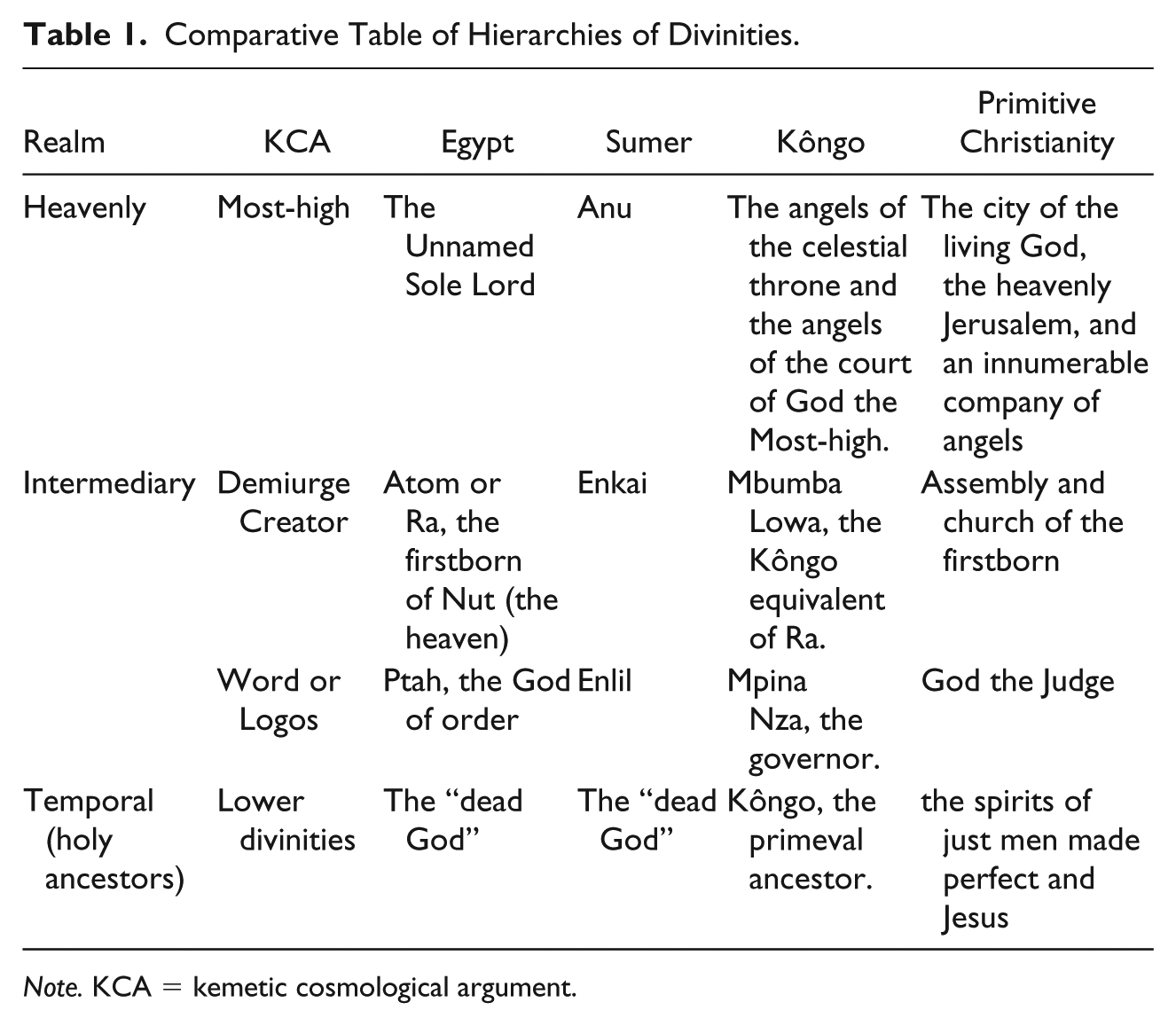
Note. KCA = kemetic cosmological argument.
The existence of the Most-high God in ancient Egypt is affirmed clearly by the Pyramid Text of Unas, which speaks of him as the “Great One” and the “Sole Lord.” Moreover, the Egyptian book of the dead speaks of Ra, the creator, as a “self-begotten and self-born” and as the Child of Nut, the heaven. The last image alludes to a causative order higher than Ra, while the first is a reference to the Creator’s appearance in the temporal order as not being the conscious work of the transcendent Most-high. The Egyptian hierarchy is from Memphis theology.
The hierarchy of primitive Christianity is taken from the Bible (Hebrew 12:22-24). The expression firstborn in Christian hierarchy is in plural, while it is in singular in the Egyptian hierarchy; however, the Egyptian Book of the Dead speaks of “the Company of the Firstborn Gods” and KCA establishes the possibility of the existence of other creative orders.
As for the hierarchy of Bukôngo, it is furnished by a prayer of the great Kôngo prophet Simon Kimbangu (Bandzouzi, 2002). The similarity between the hierarchy of Bukôngo and that of primitive Christianity is striking as both are related to the practice of prayer. In both hierarchies, the Most-high is not directly called upon; this is an indication of the transcendence of the Supreme Being.
Transcendence of the Most-High
The transcendence of the Most-high in KCA is seen in the fact that he is absolutely without any contingence; thus, contrary to the lower divinities, he is cognizant of no temporal order; hence, as seen above, prayers were not addressed directly to him. This solar practice of prayer is confirmed in ancient Egypt because the Most-high was not even named nor represented (Rawlinson, 1886).
In Sumer, the Most-high God was called An or Anu. His transcendence is seen in the fact that “by far the most important deity . . . one who played a dominant role throughout in rite, myth, and prayer, was the airgod, Enlil” (Kramer, 1981, p. 88). This transcendence is also seen in the fact that “the god exercising the supreme power was Enlil” (Cuvelier, 2006, p. 4).
Aside from the proofs furnished above, the transcendence of the Most-high in primitive Christianity is also taught by these stanzas of the Lord’s prayer: “Our Father who art in the heavens (ουρανοις), let thy name be sanctified, let thy kingdom come, let thy will be done as in heaven (ουρανω) so upon the earth” (Mathew 6:9 Darby). The Bible clearly claims that “the heavens, and the heavens of heavens, cannot contain [the Most-high]” (1 Kings 8:27, French Darby). Hence, the “Father who art in the heavens” to whom prayers are offered is a lower God in a temporal plane.
In Bukôngo, the transcendence of the Supreme Being, Nzâmbi Ampûngu Tulêndo, is affirmed by Bittremieux (1936) in these terms: N’zâmbi cannot have equal, He is not even . . . the “primus inter pares” or the term of an animist evolution, a polytheist one, or another, but the One, the Inaccessible, the Great Chief, who from his empyrean dominates everything. (p. 133)
About this transcendence of the Most-high, Van Wing (1956) adds “Nzâmbi is unique, apart from everything else, invisible and yet living, acting in sovereignty, independent, elusive and inaccessible” (p. 305).
Two Creative Principles Different From the Most-High
Solar trinity, as exposed through KCA, teaches us that the creator cannot act without the Word; therefore, creation is the direct conscious work of two principles: the creator and the Word. This aspect of solar creation is affirmed by James (2009) in this way: The same first pair of pre-creation Gods are together present, i.e., Ptah, the primeval Hill, who is the thought and word of all the Gods, together with Atum, who rests upon Ptah. Atum, i.e., Atom [or Ra], having absorbed the thought and creative power of Ptah, then proceeds with the work of Creation. (p. 74)
The same pattern of two creative principles is seen also in Sumer where, according to Langdon, Enlil “assisted in the creation of mankind” (p. 2). Being the Word, Enlil is symbolized by the air, that is, the breath, symbol of the speech (Cuvelier, 2006; Kramer, 1981). According to James (2009) Ptah is “the thought and word (emphasis is ours) of all the Gods” (p. 74), the Logos; he is the God of order.
When the Bible affirms, “And God said, Let us make man in our image, after our likeness” (Genesis 1:26), it gives a clear indication that the Creator was not alone in the process of creation. Table 1 shows that while the Word is called God of order in Memphis and judge in Christian hierarchy, he is the governor (Mpina Nza) in Bukôngo; an attribute which is consonant with Sumerian nomenclature.
Salvation by the Word
According to KCA, due to the absolute noncontingency of the Father-Mother, solar theodicy shows that the fall of human beings is the result of the bad use of their free will. This fall can only be cured through purification because the absolutely noncontingent Most-high cannot be reconciled with evil. Moreover, since the Father-Mother always acts through the Word, and since even in the state of fall human beings are not separated from the Word, it follows that salvation can only be through the temporal manifestation of the agency of this principle.
We learn from the Egyptian Book of the Dead that once in the beyond the Osiris Ani claims the right to become an Osiris (i.e., a Child of God) since he lived a life of purity, i.e., he vanquished sin. Horus, the temporal expression of the Word, is said to be the advocate of Ani. That Horus is the temporal manifestation of the Word is seen in the fact revealed by the Egyptian book of the dead that this divinity is “Dweller in Hearts, in the Dweller in the body”; this recall the presentation of the Word as the manifestation of the fullness of God in human beings and Gods, the divinity which abides in them.
The existence of the doctrine of sin is taught in Sumer by the story of the flood, as can be read in these questions: “how did you inconsiderately decide about the flood? To cast its fault and its sin on sinners alone?” (Cuvelier, 2006, pp. 17-18). Moreover, Gilgamesh’s crave for “tangible, physical immortality” (Kramer, 1981, p. 185) and the existence of “priest of purification” (p. 362) show that Sumerians and Egyptians relied on the same schema for salvation.
Salvation in primitive Christianity is taught by 1 John 3:1-3. Where we learn that the believers are a Sons of God. But they are sons only potentially because “it doth not yet appear what we shall be,” now KCA shows that we shall be Children of God, that is, what we have been before the fall. This recalls the case of the Egyptian Ani who is called Osiris but claims the right to become an Osiris, this means that he was so on earth only potentially. Now the condition for the Christian believers to become “Sons of God” in a manifest way is that “every man that hath this hope in him purifieth himself, even as he [the Christ, the Word] is pure.”
In Bukôngo, the word for sin is sumu; it originated from suma (to plant). From suma one gets the antonym sumuna (to uproot). The fact of being uprooted is called sumuka. Sumuka cuts any plant from the source of life and condemns it to perish. Now the Kôngo word for the action of sinning is also sumuka; thus, by analogy one learns that sin cuts the sinner from the source of life and condemns him to death.
The impulse to sin comes from nkadi ampêmba (the devil). Now this expression does not designate a person (Van Wing, 1956) but an attitude. Nkadi ampêmba literally means the rejection of mpêmba (the kaolin symbol of purity, but also water as the holy abode of holy ancestors; thus, mpêmba symbolizes purity). Therefore, the remedy for sumu (sin) is a reconciliation with mpêmba through purification by the agency of Kimahûngu or Kimalungila, the Word in the temporal realm (Fukiau, 1969).
Synthesis
All the points that have been raised here demonstrate a perfect theological convergence between, on one side, ancient Egypt, Sumer, primitive Christianity, and Bukôngo, and, on the other side, KCA as a scientific model of religion. It is thus clear that, being a later civilization, Kôngo culture has kept intact in its religion, Bukôngo, the scientific religious paradigm of the land of kemet.
Persian Influence on the Egypto-Sumerian Spiritual Culture Inherited by the Jews
History teaches us that the civilization of Sumer, including its solar nature, was continued by that of Akkad and later by the Babylonians (Cuvelier, 2006). The conquest of Babylon by Cyrus in 597 The dualism between Good and Evil, Truth and Lie, presented in the good god, Ahuramazda, and Ahriman, the evil god. Men’s lives are a struggle between these two powers, but they hope to achieve redemption and enter paradise after death. (Brosius, 2006, p. 68)
From the Persians the Jews adopted the concepts of duality, of the paradise, and the notion of a God of evil which is reflexive of “Ahriman or Satan of the Persians” (Volney, 1826, p. 182). Volney (1826) comments on this issue in this way: it was the serpent that, under the name of Ahriman, formed the basis of the Zoroaster system; and it is him, ô Christians and Jews! who became your serpent of Eve (the celestial virgin) and that of the cross, in both cases, the emblem of Satan, the enemy, the great adversary of the ancient days, sung by Daniel. (p. 190)
We have seen that KCA defines the Most-high as being absolutely without any contingence, the Gods are his manifestations; hence, there is no God of evil. A God of evil does not appear in Egyptian pantheon nor in the Sumerian. It should be noted that in Egypt a possible candidate for an equivalence to Satan is the God Set who according to Diop was “described as red, as were all other evil beings” (UNESCO, 1978, p. 78). However, the Egyptian Book of the Dead speaks of this “son of Nut” in this terms, “Horus purifieth Set and Set strengtheneth, and Set purifieth and Horus strengtheneth” and adds also that “Set had dominion over his evil power.” Now if this God is capable of purifying and being purified and of exerting dominion over his evil nature, then, he is not essentially evil as Satan, the God of evil, is believed to be. The absence of the notion of Satan in Bukôngo is seen in the fact that it does not define nkadi ampêmba (the devil) as a person (Van Wing, 1956).
Therefore, the notion of Satan came from the “exposure to Persian religion and its Zoroastrian-based dualism” (Hamilton, 1992, p. 988). This adoption by the Jews of the notion of a God of evil sowed the seeds of the deviation of Abrahamic religions from KCA, the seeds of the destruction of the scientific notion of theism inherited from Abraham. This is the case because a real God of evil is a negation of the all-powerfulness of God and his absolute noncontingency. To avoid this pitfall, KCA demonstrates the illusory nature of evil (Luyaluka, 2014).
Grecian Influence on Bequeathed Egypto-Sumerian Spiritual Culture
We have seen above that the Grecians relied on lunar epistemology which is founded on the notion of matter as the ultimate nature of reality; while Egypt and Sumer, and later Babylon, relied on solar epistemology in which reality is perceived as being ultimately spiritual. Moreover, solar epistemology is consonant with solar religion. In conquering the Middle East, Alexander the Macedonian intended Babylon to become “an eastern capital of his empire but he died shortly in 323 BC” (Ibrahem, 2012, p. 86).
Due to the fact that Alexander’s army and the armada of scientists that accompanied it did not go back home, Babylon “became an unrivaled intellectual center for science, philosophy, medicine and education” (p. 87). Thus, the Middle East faced the sway of Grecian lunar philosophy and its epistemology. We have seen that the influence of Grecian thought was detrimental to the foundation of solar epistemology as it denied the freedom of the soul.
Negative Influence of Grecian Philosophy on Islam
While the religions of ancient Egypt and Sumer (inheritted by Babylon) were congruous with KCA, the adoption of a materialistic epistemology resulted in the surrender of hierarchical monotheism which is consonant with solar epistemology. One of the characteristic of the Grecian paradigm was the worship of many God, though some enlightened minds, like Xenophanes, had the inkling of monotheism. Xenophanes said about this situation: “many gods exist according to custom but only one true God exist according to nature” (Latourette, 1980, p. 98).
In its contact with this Grecian custom, the Arabic world, which then meant the land of Babylon, first of all fell in a Grecian-customary polytheism that the prophet Muhammad will later fight without reverting to hierarchical monotheism. “Allah is the Creator of all things: He is the One, the Supreme and Irresistible” (Sura 13:16). This notion of the Supreme-Being-Creator has been shown to be a logical impossibility (Meister, 2009). The KCA shows that the act of creation is an act of contingency which cannot be attributed to an immutable Supreme Being. Moreover, a creation ex nihilo implies the possible existence of a reality greater than the creator which includes the creation and creator; now such a reality is a negation of the supreme nature of the Most-high as the greatest possible reality.
On the contrary, the materialistic influence of Grecian philosophy, as seen in their rejection of the immortality of the soul, that is, of its divinity, could only result in a materialistic perception of human beings. This naturally implied the surrender of the doctrine of the Word as the divine-Child-nature of human beings. Solar epistemology implied, through this doctrine, a spiritual anthropology in which the human being is in reality a “Child of God.” KCA has shown that due to the absolute noncontingency of the Most-high, human being is never deprived of the Word. The surrender of this doctrine is well expressed in the following verse: The Jews call Uzayr a son of God, and the Christians call Christ the son of God. That is a saying from their mouths; (in this) they but imitate what the unbelievers of old used to say. Allah’s curse be on them: how they are deluded away from the truth! (Sura 9:30).
Thus, by abandoning solar epistemology, the Muslim faith abandoned also the fundamentals of KCA, the basic doctrines of the scientific religion advocated by ancient Egyptians and Sumerians, a religion embraced by Abraham and bequeathed to Babylon.
Negative Influence of Grecian Philosophy on Christianity
We have seen above that the dichotomous view of West brought by Greeks found in Sadducees a receptivity prepared by the dualistic epistemic seeds sowed by Persians. Even though Jesus and his disciples resisted against the negative influence of Grecian philosophy in their culture, history teaches us that this influence eventually prevailed in Western Christianity and Rome became the center of the new faith. Now, Romans, like Grecians, bathed in the same materialistic lunar epistemology. Thus, hierarchical monotheism was abandoned and monotheism became the doctrine of a Supreme-Being-Creator despite the evidences of hierarchical monotheism given above. As shown below, Plato’s philosophy was instrumental in this move.
We have seen above that ancient Egypt, Sumer, Kôngo, and KCA are unanimous about the existence of three distinct principles: the Most-high God, the Demiurge Creator, and the Word or Logos. Although the Logos participates in the process of creation, as required by solar trinity, he is distinct from the demiurgic Creator.
Santrac (2013) writes that “according to some church fathers, Plato’s idea of a Good (the Idea of the Good) has been recognised as analogous with the notion of a Christian God” (p. 2). Now Plato added to his idea of Good “the Demiurge or Architect or Creator of the universe” (p. 2) and a third divinity known as “World Soul or Psyche” (p. 2). Moreover, Plato’s Demiurge has been identified to “the Logos of God” (p. 2).
Santrac (2013) adds that “the Christian Trinity or the inner dynamics of the relationship between the Father, Son and Holy Spirit have been formulated using Plato’s distinction between the Good, [Logos] and Pneuma (World Soul)” (p. 2). Therefore, Plato’s influence led to a two-step deviation from KCA. First, it introduced the confusion between the notion of the Creator and that of the Logos which are two distinct creative principles in Egyptian and Sumerian theologies; and second, it brought the replacement of the solar “Father-Mother”-Child-Word trinity by the Father-Son-Holy Spirit trinity of Western Christianity (Ekeke, 2013). 3
Due to the adoption of Western epistemic paradigm, Christianity strayed away from the religion bequeathed by ancient Egyptians and Sumerians, a religion which is proved by KCA, its systematic natural theology, to be a scientific episteme. Straying away from this true faith of Abraham, Western Christianity fell from scientific pinnacle and became a mere “system of beliefs held to with ardor and faith” (Woolf, 1977, p. 977) which, contrary to KCA, is denied any direct participation in the scientific explanation of the universe (Magnan, n.d.).
Conclusion
This article dealt with the issue of the kinship of ancient Egyptian civilization with the neighboring ones. To the melanin-level proof offered by Cheikh Anta Diop and Obenga’s evidence of the linguistic relatedness of kemet to the south-Saharan Africa, this article added a theological proof.
The article demonstrated that the religions of ancient Egypt, Sumer, as well as primitive Christianity are consonant with KCA, a systematic natural theology which constitutes a scientific model of religion. This scientific religion has been preserved in Kôngo religion, Bukôngo.
Contrary, the influence of Eastern epistemic paradigm, brought by the one time influence of the Persians, on the culture of the Middle East introduced duality and the notion of a God of evil which is antagonistic to the absolute noncontingency of the Most-high dictated by KCA.
Moreover, the influence of Grecian philosophy resulted in the negation of solar epistemology, a paradigm which is consonant with solar religion advocated by ancient Egyptians and Sumerians. The negative influence of Grecian philosophy is seen in the fact it resulted in the surrender of the hierarchical monotheism by Christianity and Islam and the negation of the doctrine of the Word, the divine-Child-nature of human beings, by the Muslim faith; while Plato’s philosophy led to the confusion between the Creator and the Logos and the surrender of solar trinity. These lunar influences are deviations from KCA and make of lunar religions mere beliefs rather than scientific epistemes as was the religion of ancient Egypt.
Thus, the article has established the fact that Eastern and Western epistemic influence were destructive to the religion ancient Egypt shared with Sumer and primitive Christianity, while the south-Sahara-African culture, as seen in Bukôngo, nurtures this religion; hence, it has been theologically established that the natural kinship of ancient Egypt is with south-Saharan Africa rather than with Eastern and Western civilizations.
Footnotes
Declaration of Conflicting Interests
The author declared no potential conflicts of interest with respect to the research, authorship, and/or publication of this article.
Funding
The author received no financial support for the research, authorship, and/or publication of this article.
