




Abstract
Obesity remains a prevalent public health epidemic, and African American (AA) adults are disproportionately affected by obesity more than any other ethnic group, particularly in the Southern region of the United States. Addressing poor dietary habits is important for improving obesity rates among AAs, but there has been limited research that has focused on specifically developing culturally tailored interventions. With a recent number of soul food restaurants serving exclusively vegan meals opening up across the country to appeal to AAs and others interested in eating healthier soul foods, there is a unique opportunity to explore how these restaurants might impact AA dietary habits. The purpose of this study was to assess how owners of vegan soul food restaurants located in states within the Black Belt region view their roles as promoters of health in their community and to identify strategies that they use to make plant-based diets (PBDs) more culturally appealing in the AA community. In-depth interviews were conducted with owners (N = 12) of vegan soul food restaurants from seven states. Five themes emerged from the interviews related to (a) the restaurants providing access to vegan meals, (b) restaurant owners educating their customers about vegan diets and healthy eating, (c) using fresh ingredients to make vegan soul foods taste good, (d) addressing limited cooking skills among AAs, and (e) discussing nonhealth reasons to become vegan. The findings indicate there may be future opportunities for health educators to partner with these restaurant owners to improve healthy eating among AAs.
Background
Current research has estimated that almost 4 in 10 adults (39.8%) in the United States are now classified as having obesity (Hales et al., 2017). Racially underrepresented groups are disproportionately affected by obesity, and African American (AA) adults have the highest age-adjusted prevalence rate for obesity (47.8%) than all other ethnic groups (Ogden et al., 2014). There are also disparities in obesity rates by region in the United States. There are greater rates of obesity in the Southern states, particularly in the Deep South, Central Appalachia, and the Carolina areas (Slack et al., 2014). The rising obesity rates in the South are leading to a rapid increase in new cases of diabetes among both AA and White adults (Conway et al., 2018).
Poor dietary habits and excessive energy consumption are major contributors to obesity and chronic diseases (Wright & Aronne, 2012). AAs typically consume fewer fruits and vegetables and more processed fast foods than Whites or other racially unrepresented groups (Bowman & Vinyard, 2004; Centers for Disease Control and Prevention, 2007; Neumark-Sztainer et al., 1998; Satia et al., 2004). Many dietary disparities have been associated with the built environment, since AA communities tend to have more fast food restaurants but fewer supermarkets and stores selling healthy foods than White neighborhoods (Reitzel et al., 2016; Zenk et al., 2009, 2014). Results from built environment interventions targeting racially diverse neighborhoods to improve residents’ diet quality (i.e., more fruit and vegetable consumption) have been mixed (Cummins et al., 2014; Reitzel et al., 2016). There are likely other factors to consider for better understanding the underlying causes of racial disparities in obesity rates and eating behaviors (Schoeller & Kushner, 1996).
Previous work has indicated that one of the barriers to healthy eating for AA adults is the perception that eating healthily means giving up a part of their cultural identity (James, 2004; Kittler et al., 2011). Food culture has a significant influence on AA food choices, since AA dietary patterns have evolved from a long history of slavery, discrimination, and segregation (James, 2004; Kittler et al., 2011). Many AA adults living in the Black Belt region (i.e., the crescent-shaped region that extends 300 miles long and 25 miles wide from southwest Tennessee to east-central Mississippi and then east through Alabama, Georgia, and the Carolinas) report regularly eating foods like collard greens, fried chicken, and other “soul foods” because of cultural preferences and family traditions (Yang et al., 2013). Soul food is the term used to describe the ethnic cuisine that enslaved Africans prepared in the Deep Interior South for survival (James, 2004; Kittler et al., 2011; Miller, 2013; Van Deburg, 1992; Yang et al., 2013). Enslaved Africans had to make use of the limited resources provided to them to create foods in a foreign land under extremely disempowering conditions (Avieli & Markowitz, 2018; Devine et al., 1999). Many of these soul foods remain popular among Black and White adults in the South today (Yang et al., 2013).
However, when consumed in large portions, some soul food items, like fried chicken, chitlins, or pork, contain high fat and sodium content that often exceed the recommended dietary guidelines (Airhihenbuwa et al., 1996). Despite the public health concerns, soul food continues to serve as a means for AAs to stay connected to their roots and traditions (James, 2004). Other staple soul foods, such as the various green vegetables, okra, and black-eyed peas, have high fiber and low caloric density because they are sourced from plants (Rankins et al., 2007). Soul food’s early history in the 1400s, prior to the European Slave Trade, suggests that most West African tribes actually ate a mostly plant-based diet (PBD) (Miller, 2013). This has led to a health-conscious movement that has prompted a number of vegan soul food restaurants to recently open up throughout the South that provide completely plant-based (i.e., no foods containing meat, diary, or animal products), healthier versions of traditional soul food dishes (Severson, 2017). The increase in vegan soul food restaurants are based on events like the Baltimore Vegan Soulfest, and other Black vegan movements throughout the United States, which have increased AAs’ interest to learn about the health benefits of PBDs (Rodricks, 2014).
PBDs are associated with a lower body mass index (BMI) and a lower risk for certain chronic diseases, such as diabetes, cardiovascular disease, and some cancers compared to the standard American diet (Fraser, 2009). The observed health benefits from PBDs are based on an increased consumption of fruits, vegetables, nuts, phytonutrients, whole grains, and the exclusion of animal products, which are typically high in cholesterol and saturated fat (Fraser, 2009). The standard definition of a PBD is the avoidance of meat, poultry, and fish; however, there are several categories of PBDs (Fraser, 2009). Some PBDs might include dairy products (i.e., lactovegetarian diet) or select animal products like fish (i.e., pesco-vegetarian diet) (Fraser, 2009). Evidence suggests that AA adults may experience health benefits like lower blood pressure and serum cholesterol levels, as well as an improved BMI by following a PBD than an omnivorous diet (Fraser et al., 2015; Melby et al., 1993, 1994). In addition, the 2015 edition of the U.S. Dietary Guidelines identified a vegetarian diet as one of the three main healthful dietary patterns and that most people would benefit from basing meals around plant sources (Millen et al., 2016).
Based on the potential health benefits from consuming plant-based foods and the increasing number of vegan soul food restaurants in the South that provide healthier versions of traditional soul food dishes (Brown, 2013), there may be opportunities for these restaurants to impact dietary behaviors in local AA communities. However, it is not known how these restaurants may impact the health in their communities and how owners of these restaurants perceive their roles in promoting the health of their customers or their local communities. Therefore, the purpose of this study was to assess how owners of vegan soul food restaurants located in states in the Black Belt region view their roles as promoters of health in their community and to identify strategies that they use to make PBDs more culturally appealing in the AA community. The following research questions were assessed:
Methods
Development of the Interview Guide
This research used constructs from Social Identity Theory (SIT) and the Social Ecological Model to inform the development of interview questions. A conceptual model is presented in Figure 1. The model considers the strategies that owners of vegan soul food restaurants use to promote the consumption of vegan meals (Bronfenbrenner, 1992; Tajfel, 2010). Specifically, this model emphasizes the social identification construct from SIT by focusing on how the restaurant owners would define their own personal identity from multiple social groups (AA, vegan, restaurant owners, etc.). The bottom portion of this model illustrates potential individual and environmental variables that owners of vegan soul food restaurants may perceive that they influence among the patrons and people in their communities. Bronfenbrenner’s (1992) ecological model defines human development as being shaped from complex “layers” of interactions between individual attitudes and behavior with interpersonal and environmental factors. Ecological models are most effective for guiding public health interventions when they are tailored to the specific health behaviors of the target population (Sallis et al., 2015). The specific ecological constructs considered were knowledge and attitudes about food (individual level), social networks that people establish eating relationships with (interpersonal factors), and the availability and cost of vegan meals (community/organizational level).

Social identification of how owners of vegan soul food restaurants influence ecological factors to increase the consumption of vegan foods.
Once questions were developed, the interview was pilot tested with two different vegan soul restaurants in Baltimore, Maryland. After the first pilot test, some interview questions were removed that were deemed redundant and others were reworded. The modified interview questions were then used for a second pilot test with a different restaurant and the questions were deemed appropriate for use as the final interview guide.
Sampling
A list of vegan soul food restaurants had been identified from preliminary work. Two trained reviewers conducted an online search for restaurants located in the 16 states in the South region and the District of Columbia as defined by the Census Bureau (U.S. Census Bureau, n.d.). Two reviewers searched for restaurants that served vegan soul foods from the following websites: Google, Yelp, Happycow.net, and Facebook. The search terms “vegan soul food,” “vegan southern food,” “vegan soul food restaurants,” and “vegan southern restaurants” were used.
To be included in recruitment for this study, the restaurants had to have a vegan menu (e.g., free of any animal products) with three or more of the following staple soul food items: black-eyed peas, okra or greens (collard greens, kale, mustard greens, or turnips), candied yams, sweet potatoes, vegan substitutes for macaroni and cheese, vegan substitutes for cornbread, and/or vegan substitutes for common soul food meat-based dishes, such as fried or barbeque chicken, ribs, and catfish. The rationale for these particular menu items is that scholars tend to agree that soul food has roots in Southern cuisine and that many of the meals originated from Africa (Henderson, 2007; Opie, 2010; Van Deburg, 1992; Witt, 1999). Therefore, the focus of the menu items was to select dishes that were common in the South, as well as foods that were transplanted from Africa (e.g., okra and black-eyed peas).
Both reviewers independently searched for restaurants using the search criteria and then reviewed each other’s lists to reach a final consensus for which restaurants to include. When there was a discrepancy for selecting a restaurant, both reviewers examined the restaurant’s menu together and came to a final consensus.
Once restaurants had been identified, the following inclusion criteria were required for the interviews:
The restaurants had to be located in one of the 11 Black Belt States (Wimberley & Morris, 1997). Specifically the following states assessed were Texas, Arkansas, Louisiana, Tennessee, Mississippi, Alabama, Florida, Georgia, South Carolina, North Carolina, and Virginia (Wimberley & Morris, 1997). These states are all a part of the Census Bureau’s definition of the South region. The rationale for using the Black Belt Region is that these are states with a high percentage of AA residents (Wimberley & Morris, 1997). Black Belt states also have higher rates of poverty and lower educational attainment compared to national averages, which is important to consider for public health (Falk & Rankin, 1992; Wimberley & Morris, 1997; Yang et al., 2013).
The restaurant owners had to identify as AA. The rationale for focusing on AA-owned restaurants is that some of the most popular vegan-based soul foods, like black-eyed peas, kidney beans, lima beans, sweet potatoes, yam, and okra were not indigenous to America but were transplanted from Africa during the Atlantic Slave Trade (Henderson, 2007; Opie, 2010; Van Deburg, 1992; Witt, 1999). Therefore, these foods have a historical meaning to many AAs over standard vegan meals. Given the fact that soul food is rooted in Black culture and history, it would be reasonable to interview owners who identify as AAs.
The goal was to interview a minimum of 12 owners (~1 per state), since saturation from qualitative interviews has been reported to occur within the first 12 interviews (Guest et al., 2006).
Study Design and Analysis
Approval for this study’s procedures was obtained from the University of South Carolina’s Institutional Review Board. Participants were asked to give verbal consent prior to the interviews being recorded. After the interviews were transcribed, the audio files were destroyed. No names or identifying information were printed in the transcribed interviews. Instead, a random letter or symbol was used to replace full names.
A combination of in-person interviews and phone interviews were used. Phone interviews were used for restaurants that were geographically far in an effort to save costs. Despite the perception that telephone interviews are lower in quality than face-to-face interviews (i.e., the lack of visual cues), there is little evidence that data loss or distortion occurs, or that interpretation and quality of findings is compromised when interview data are collected by telephone (Novick, 2008). The in-person interviews took place at the restaurants. The interviews were semistructured and lasted approximately 30 to 40 minutes each. A demographic questionnaire was administered at the end of each interview and asked for participants’ age, gender, ethnicity, educational attainment, the number of years that their restaurant had been open for, and the most popular item on their menu. Each participant received a $10.00 Amazon gift card for completing an interview.
All interviews were recorded, transcribed, and coded in NVivo, version 12. Two researchers separately coded all of the interviews using an inductive, opening coding process for thematic analysis (Corbin & Strauss, 2008). Upon completion of the independent coding, both researchers reviewed each other’s analysis and discussed and resolved any major discrepancies (Curry et al., 2009). The results of major themes that emerged from the analysis are presented in the results section along with representative quotes.
Results
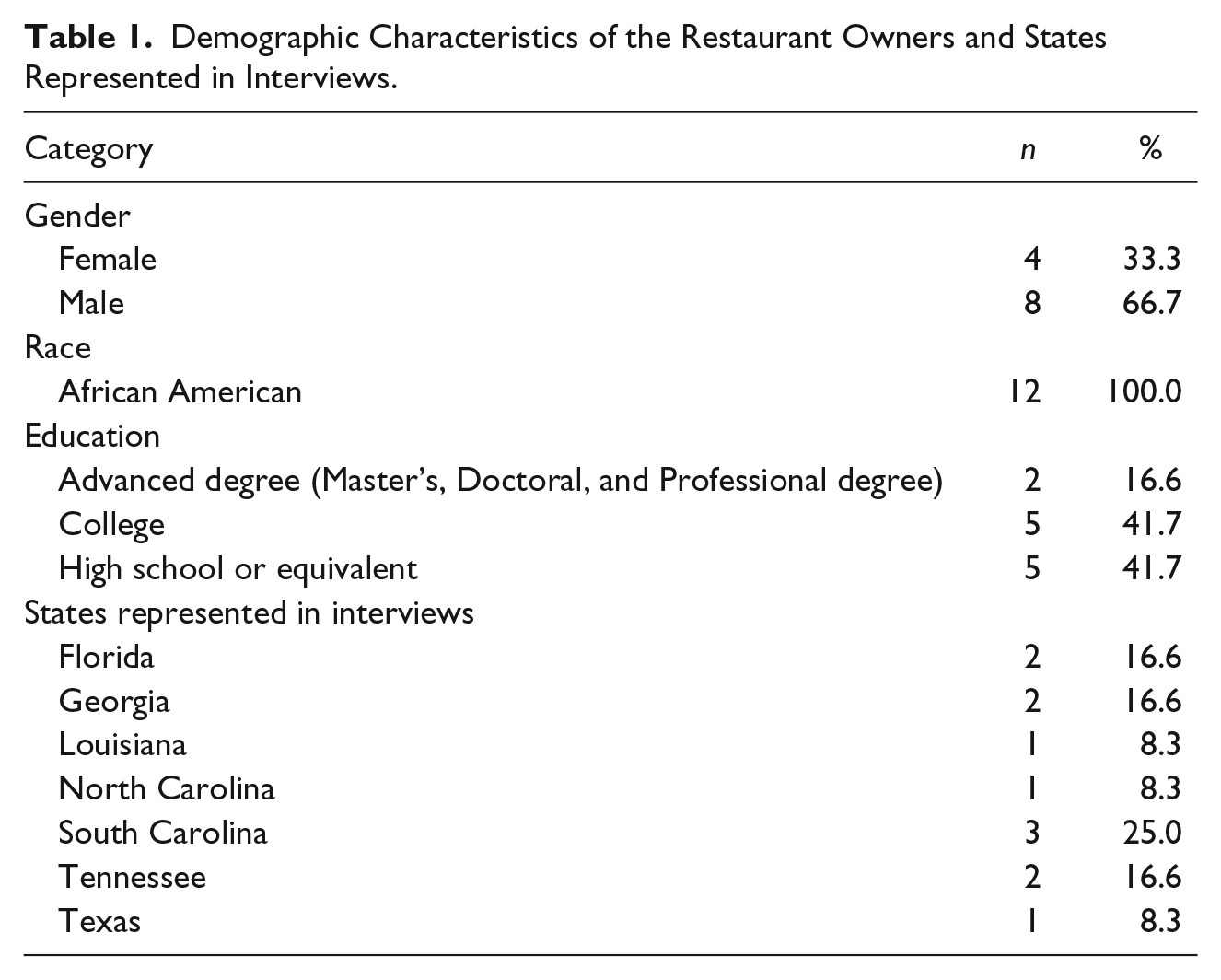
Based on the search criteria, some states did not have any restaurants that met the inclusion criteria. As a result, a total of 27 restaurants throughout seven states were identified and available to sample for interviews. All 27 owners were sent an initial request for an interview and 20 responded. Among the 20 who responded, 12 agreed to an interview. Therefore, a total of 12 owners from seven different states (Florida, Georgia, Louisiana, North Carolina, South Carolina, Tennessee, and Texas) were interviewed. The mean age of the participants was 40.6 ± 9.8 years, and they were all AA (n = 12, 100%), mostly male (n = 8, 66.7%), and the majority were college educated or had an advance degree (n = 7, 58.3%; Table 1).
Demographic Characteristics of the Restaurant Owners and States Represented in Interviews.
Five themes emerged from the interviews related to how restaurant owners of vegan soul food restaurants view their roles as promoters of health in their community and strategies that they use to make PBDs more culturally appealing among AA adults: (a) The owners believed opening their restaurants provided their communities more access to vegan meals; (b) the owners often educated their customers about vegan diets and healthy eating by having discussions with them; (c) the owners emphasized quality and fresh ingredients to make vegan soul foods taste good; (d) many owners felt that AA adults lack cooking skills to prepare vegan-specific meals; (e) the owners also discussed nonhealth reasons for following a vegan lifestyle with their patrons to encourage them to become vegan.
Providing Access to Vegan Meals
At the time of the interviews, the restaurants had been in business as little as 2 months to as many as 39 years. When it came to opening a vegan soul food restaurant, most of the owners had noted that limited dining options for healthy eating in their communities interested them to provide restaurants that were exclusively vegan. In addition, many of them felt that consumers have become more interested in trying PBDs in recent times. As one owner had said, So pretty much if you’re asking about what influenced me to start, I mean it’s supply and demand I guess. There was a demand there. So I just try to supply it. (O#11)
When asked about challenges that AA adults in their local communities face when it comes to eating more plant-based foods, many owners noted that the high cost of healthy meals (n = 6, 50%) and limited access to stores or restaurants that provide quality plant-based meals (n = 5, 41.7%) as significant barriers. Two examples: I think it really is just having access to healthy food you know? That’s really the biggest thing for a lot of our neighborhoods. A lot of people are not willing to drive you know 10, 15 miles just to get something that’s going to be better for them. (O#9) Food deserts. We still have food deserts. The black neighborhoods still have food deserts. I remember Brooklyn it was a food desert where I live in Flatbush. Now gentrification is required and not only can I get almond milk, but I can get like eight different almond milks and eight different ice creams. And I can get five different cashew cheeses. I could go into a vegan cheese shop that has all nut cheeses in Brooklyn. I mean completely a different environment from it was before. Whereas here, in this part of Florida, there are little to no options for vegan foods. (O#3)
Most of the owners felt that by opening their restaurants, they could address the limited availability of vegan foods in nearby neighborhoods. A few of the owners also mentioned growing up in communities with an unhealthy food environment themselves. They felt that their restaurants could ultimately make an impact in their communities. For example, one owner noted, Catastrophically, the African American health in South Carolina is, and has been, dreadful for the last 30 years. It’s getting worse every year. It’s starting to affect youth a lot more in the last decade and probably more so than ever before. And it’s a real problem. So the easiest way to change something is to put energy towards something that allows change to happen. And that’s why I opened a vegan restaurant. (O#5)
Educating the Customer About Vegan Diets and Healthy Eating
The most prevalent theme that emerged from the interviews was that all of the owners at some point have had discussions with their customers about the health benefits of vegan diets or eating healthier in general. Since most of the customers who dine at these restaurants were not vegan, many of the owners regularly approached them and engaged with them about vegan diets. For example, one owner reflected on his approach by saying, For people looking to transition, we’re usually their first stop. So we are given that type of responsibility to educate the customer first. The first thing I always say is “Are you Vegan?” And if they say no, you know I welcome them and tell them they came to the right place. And I start asking simple questions, like “What do you know about veganism?” Then they start asking questions about ingredients and things like that. And you know it’s all about making the customer feel comfortable. (O#11)
Some owners felt that educating patrons about what specific foods are vegan and what a vegan lifestyle means was a first step toward getting people in their community to try more vegan foods. One owner mentioned, Most people, to be honest, aren’t even sure what vegan means. It’s kind of thrown in this box, when they figure it means no animals. But sometimes we get crazy questions like “Well, what kind of potatoes?” Or “Is it real rice?” You know what I mean? So people don’t really have like a basis for what vegan actually means. (O#4)
Others felt that they were simply trying to encourage their customers to pursue healthier eating, whether that meant being vegan or not. Two examples below: My restaurant is a judgment-free zone where the focus is not necessarily on becoming vegan or being healthy, but on eating better and allowing that to take you to better health. (O#11) Even if a customer has no intentions of ever converting to a vegan diet, I still believe they come away with the knowledge that cutting down on fatty foods and eating more plant-based foods can benefit them.” (O#2)
Most of the owners pointed out that people in their communities had the perception that vegan diets were culturally foreign to them. One owner noted, I really think culture is an issue too. Where people think that being vegan is somehow unnatural. People say that eating plant-based foods is an acquired taste. And yet they eat chitterlings. So you mean to tell me you can eat chitterlings without any issue? But eating broccoli is an acquired taste? I’ve literally had folks tell me that eating processed foods or refined sugar is their “normal” food. So getting people to realize that being vegan isn’t a foreign way of eating is important. (O#1)
The owners also noted that many AA families had been raised with only knowing how to prepare plant-based soul foods with oils, gravies, and animal products high in fat. In other words, showing patrons how to make these foods with only vegan ingredients would help to make them perceive vegan soul foods as normal. One example: Most people have grown up eating collards, eating sweet potatoes, eating mac and cheese, and all of those foods can be prepared without animal fat or animal protein. But very rarely are people presented with that opportunity. So even when beans are prepared people instinctively think ham hock has to be in them, or bacon fat, or some piece of animal, and that’s completely not necessary. All of the food that we eat can be either duplicated in a vegan manner or prepared in a way that doesn’t require anything to that, you know? (O#4)
Emphasizing High-Quality Ingredients and Good Taste
Almost all of the owners mentioned that one way they make vegan soul foods appealing to their patrons was emphasizing the quality of the ingredients. Many of the restaurants use fresh ingredients, and some used only organic foods. They believed that their patrons would notice the difference in meal quality at their restaurants in comparison to what they would get from standard restaurants. Examples: We use fresh ingredients. We take the time to prepare the meal from scratch. (O#1) I’m using fresh produce that’s coming from a farm. I’m not just opening a can and putting something in a microwave. (O#4) If you want to pay 8 dollars for a plate of vegetables, know that they came from a can. Know that they were warmed up in a microwave, more than likely, know that the quality is just not the same. (O#6)
When probed about the cost of organic or natural ingredients and the potential expenses to the patron, many of the owners felt that the prices of the items on their menu were reasonable. Although their prices might not compete with cheap fast food meals, it was still a better investment for customers to purchase healthier meals upfront, rather than to settle for low-quality foods and face potential health issues in the future. Two examples: Would you rather pay for it on the front end? Or pay for it on the back end with medications and health issues later? (O#1) In the long run it’s more costly to eat unhealthy fast food and get high blood pressure then it would be to simply pay a few more dollars for clean food. (O#7)
In addition to emphasizing high-quality ingredients, many of the owners felt that vegan-specific soul foods can taste good and be healthy for the consumer. For example, one owner said, I wanted to show people, particularly people in the black community, how they can get healthier eating delicious, healthy cuisine, dispelling the myth that in order to eat well, one must sacrifice taste. (O#1)
Several of the owners also felt that peoples’ perceptions of vegan meals being bland or unappealing in taste were a major barrier for getting people to eat more plant-based meals. Some examples: In my opinion, it’s very simple. The food has to taste great. Not just good, but great. It has to taste so great that people want to keep eating it. (O#7) I think people would eat what tastes good. Unfortunately for a great deal of time vegan food just has a reputation of not tasting good. You know when people say vegan they think cardboard or grass. Something that’s very unappealing. Most of my customers aren’t even vegan, they just happen to enjoy good food. The perk is that it’s healthy. So I believe if you present people with an option that’s not only taste good, but is healthy for them and is something they can identify with, then they would embrace more vegan foods. (O#4)
Cooking and Lifestyle Habits
Another issue identified from many of the owners was that they felt many people in their communities lack cooking skills for preparing vegan-specific meals. One owner discussed this issue by mentioning, A lot of people get discouraged from preparing their own meals and if you eat out every single night then yes, vegan meals will be expensive. You know instead of just going to the store grabbing you a bag of apples, or blueberries, or some grapes and kind of popping those around the day and eat some granola, then going home and making some potatoes yourself. Making a baked potato or baked sweet potato is pretty simple and affordable as an example. So I think it really just comes down to how you live your lifestyle. (O#9)
At the time of the interviews, 7 of the 12 owners said that they offered cooking classes or demonstrations. Some charged for their classes, while others were free for anyone to attend them. A few of the owners said that they did not offer classes at the time because of limited time and staffing. One of the owners who did not offer cooking classes indicated that it was important for her to provide some type of educational resources for people in her community. She noted that, Having a class, even if it’s not anything to grow our business, is still important to do. And it’s a community that I live in. It’s a community of people that I care about. So even if it does nothing for the business, it’s still essential to do. (O#4)
Nonhealth Reasons for Eating Vegan Soul Foods
In addition to emphasizing healthier soul foods, many of the owners also expressed the importance of eating plant-based foods for ethical reasons. They felt that speaking to their customers about animal and environmental welfare would further motivate them to consider being vegan. One owner remarked, I try to get people to not just solely focus on health, because the reason being is that you know when you choose the vegan lifestyle every component of it opens up your eyes to every angle. Whether it be animal rights or environmental welfare, they all affect each other no matter what choice you would like to choose. (O#9)
Another nonhealth theme that emerged from these interviews was the fact that a number of the owners felt that choosing to be vegan was a revolutionary act. One owner (O#10) made the analogy that learning to eat healthy plant-based foods was similar to being “woke” because he was unlearning to eat traditional soul foods with animal products that had been introduced to him by his family for years. He believed that part of educating his customers about a vegan lifestyle was to insist that most of the foods that they were raised on eating were the result of conforming to norms and traditions that were bad for their health.
Similarly, others were very critical of the dietary guidelines because they felt that they were created by agencies and individuals who did not have the best interests for the Black community. Two examples: I would say 99% would choose a plant-based diet. But some people just don’t know. Like for example, the food pyramid. That was not created by any doctor or any nutritionist. That was created by the dairy industry, who eventually paid millions to the board of education and the government to put this information in our youth from Kindergarten through preschool. (O#11) People are relying on the government to heal them, to treat them, and then they’re going home. And instead of changing their diet, they’re relying on pharmaceuticals, medicine, and pills. And that’s what’s getting them into even worse [health] conditions. (O#8)
Most of the owners felt that they had to take it upon themselves to educate themselves about diet rather than to conform to what the guidelines suggested. One owner, O#1, said that “when I stopped listening to the blogs, and the recipes, and stuff, I just started listening to my body,” he was able to reach the conclusion that a PBD was best for himself. O#10 explained that most AAs were not aware that their “true” diet was a PBD because of the historical events from slavery that had changed their eating patterns. He specifically mentioned that, Most African Americans don’t even realize what their true diet is. Like, when they were captured as slaves they didn’t bring the traditional foods that they were eating for generations with them. They were basically put on a diet of starch and blood because it was cheap. And it was the cheapest thing for the slave master to feed them. So, I would say to look into your historical diet. (O#10)
This revolutionary mind-set was also a discussion point that some of the owners used to speak to their patrons when encouraging them to pursue a vegan lifestyle. The owners expressed that being vegan was a way to be in charge of one’s health without conforming to what others had to say or tell them to eat.
Discussion
This study assessed how owners of vegan soul food restaurants located in states in the Black Belt region of the United States view their roles as promoters of health in their community and identified strategies that they use to make PBDs more culturally appealing in the AA community. The study found five major themes from the interviews that indicated owners of vegan soul food restaurants focus on: (a) providing access to vegan meals, (b) educating and informing customers about vegan diets and healthy eating, (c) using fresh ingredients to make vegan soul foods taste good, (d) addressing limited cooking skills among AAs, and (d) discussing nonhealth reasons to become vegan.
When the owners were asked about why they opened a restaurant that specifically focused on vegan soul foods, most of them indicated that their communities had limited dining options for vegan meals. Some of them pointed out that they perceived Black neighborhoods in particular as having less access to healthy meals. A number of previously published built environment studies have confirmed this. Black neighborhoods tend to have more fast food restaurants compared to White neighborhoods (Reitzel et al., 2016; Zenk et al., 2009, 2014). In addition, Black neighborhoods also tend to have fewer supermarkets compared to predominantly White neighborhoods, which means having less access to fresh fruits and vegetables (Morland et al., 2002). One study comparing a nationally representative sample of individuals and zip code addresses, based on Census data, reported that there were half (52%) as many chain supermarkets in Black neighborhoods than White neighborhoods (Powell et al., 2007). Therefore, it is likely that these vegan restaurants have potential to expose AA residents who live in communities typically devoid of healthy, plant-based meals to vegan soul foods. This in turn could create interest among AA residents to try eating more plant-based foods.
All of the owners reported engaging with their customers about eating habits or discussed the health benefits of a vegan diet. Owners reported that many of the customers who come to these restaurants were nonvegans either interested in trying out plant-based soul foods, or to simply enjoy a healthier cuisine. The ability of the restaurant owners to discuss healthy eating with their patrons could be an opportunity for a “teachable moment,” where the owners motivate individuals to spontaneously take up healthier eating habits (Phelan, 2010). The concept of a teachable moment has been conceptualized in other public health behaviors, such as smoking cessation or pregnancy (Phelan, 2010). Individuals are reportedly more likely to be motivated to make behavioral change from a recent health event, such as cancer diagnosis or becoming pregnant (Phelan, 2010). In this particular instance, patrons wanting to change their eating habits might be more receptive to listening to the owner of a vegan soul food restaurant discuss the benefits of a vegan diet or healthy eating in general, when he or she would otherwise not be motivated to make dietary changes due to being motivated to trying plant-based foods.
Restaurant owners noted that one of the major barriers for AAs to eat more plant-based foods was the lack of cultural familiarity with vegan foods in general. As one owner had indicated in his interview that although AAs often cook collards or other plant-based foods, they often do so with animal fats, gravies, or other sauces that are high in fat and cholesterol. One of the reasons for the lack of familiarity with vegan foods among AAs might be because of the perception of veganism as a predominantly White movement (Polish, 2016). Foods like tofu or quinoa are often marketed in mainstream veganism, which simply do not have the same appeal and familiarity as foods like collards, vegan pulled “pork” sandwiches, and others that have an African diaspora (Polish, 2016). With more vegan soul food restaurants being established across the country, there is greater opportunity for people in the AA community to experience vegan culture from foods connected to their roots and traditions. In addition, more resources that are culturally tailored to the AA community, such as the “African Heritage Pyramid,” have been developed, to conceptualize what a traditional West African diet looks like (Oldways, 2011).
Another notable theme was the concept of making vegan soul foods taste good from the use of fresh ingredients. There are many drivers of food choice, but taste is one of the strongest predictors for food preferences (Glanz et al., 1998). Taste preferences are often less negotiable than other determinants of food choice, including convenience and cost (Glanz et al., 1998). In fact, taste exerts such a powerful influence on food choice, one report suggested that the food industry should promote taste first and nutrition second (Regan, 1987). As such, it was not surprising that many of the owners felt that many AAs expressed little interest in vegan diets because of their perceptions of the foods tasting bland. Many of the owners expressed using spicy seasonings as a way to flavor their foods without added fat or cholesterol. Therefore, having patrons come into the restaurants and experience good tasting, vegan soul foods for the first time would likely be another way for more AAs to become interested in vegan diets.
Along the lines of preparing foods that taste good, the owners also noted that many people in their communities lack basic cooking skills. Research has indicated that more people are in fact eating away from home and not cooking as many meals at home as previous generations did (Smith et al., 2013). This is important to consider because people who eat more foods away from home tend to have diets that are more energy dense with added sugars and fat (Larson et al., 2006). In addition, one of the barriers for dietary acceptability of PBDs is the perceived difficulty of preparing plant-based meals (Barnard et al., 2009). Having restaurants that provide familiar-tasting plant-based meals could potentially help with this issue by giving an individual a break from cooking all the time or inspiring him or her to learn recipes from the restaurant that they could try at home. Since many of the owners indicated that their restaurants do provide cooking classes, there are already opportunities for patrons to acquire necessary cooking skills for making healthier meals.
The last theme that emerged from the interviews was that many owners also felt that it was important to talk to their patrons about nonhealth reasons for being vegan. Many of them had talked about animal welfare and the importance of choosing plant-based foods to be more environmentally friendly to the planet. Many people do follow vegan or vegetarian diets for these reasons in addition to just health (Elorinne et al., 2016; Radnitz et al., 2015). Some of the owners felt that by talking to their patrons about ethical reasons for following a vegan diet over and beyond just health would further motivate them to try more plant-based foods. Some research does in fact support this theory because people are more likely to find it rewarding to seek behavior change that supports their values and benefits society, rather than viewing diet as sacrifice or burden (Robinson, 2010). The choice to choose a vegan lifestyle not only impacts the owners’ dietary preferences but also their business practices as well. Preparing food products for ethical reasons may resonate with patrons to support these small business owners because consumers favorably view businesses that practice corporate social responsibility (Chernev & Blair, 2015).
The other nonhealth aspect of being vegan that came up was the concept of not conforming to norms, traditions, or even the dietary guidelines that emphasized animal products. This revolutionary mind-set could also be a unique way to appeal to AAs to motivate them to try more plant-based foods. Making people feel that being vegan is in fact a part of Black culture and Black identity is important for getting AAs interested in trying plant-based foods. As others have noted, although veganism is meant to be inclusive by definition, it has historically been associated with White people of privilege (Harper, 2011).
Strengths and Limitations
As an exploratory study, there are notable strengths to this work. This work utilized a conceptual model that included both individual- and environmental-level constructs from the social ecological model to frame the interview questions. A review of a dozen studies that applied the social ecological model to examine ways to improve fruits and vegetables consumption among low-income AAs reported that only five of the studies focused on constructs at the community or organizational level (Robinson, 2008). In addition, many of the constructs theorized in this model were supported from the interviews. For instance, at the individual level, this modeled proposed that vegan soul food owners may see themselves as having influence over peoples’ knowledge and cooking skills about vegan foods. Most of the owners stated that they educated their customers about plant-based foods and provided cooking classes to help patrons learn how to cook vegan soul foods. At the community and organizational level, the conceptual model proposed that vegan soul food owners may influence the availability and cost of vegan foods in their communities, and many of the owners felt that their restaurants did make an impact on those issues in their communities.
This study was innovative by focusing on small business owners of local restaurants as champions for promoting health in their community. This is different than other public health interventions that aimed to have large chain restaurants reduce portion sizes or offer healthier foods on the menu (e.g., fruits and vegetables) (Economos et al., 2009; Gase et al., 2014; Gittelsohn et al., 2008). This study also contributes to the literature on PBDs by focusing exclusively on ethnic minorities. Recent reviews of clinical trials have noted the lack of diversity in research that focuses on vegan and vegetarian diets (Barnard et al., 2015; Huang et al., 2016).
There were also some limitations to this work. One limitation to the study was the small sample size; however, there was a limited sample frame to choose from (27 restaurants throughout seven states) because four of the states (Alabama, Arkansas, Mississippi, and Virginia) had no restaurants that met the inclusion criteria. Another limitation was the challenge of determining menu criteria for identifying the restaurants. While standardized menu criteria from other research and soul food cookbooks were used to identify restaurants, many entrees still varied from restaurant to restaurant. Some soul food restaurants had numerous soul food entrees, while others had only one or two soul food–specific entrees but met the inclusion criteria due to having several side dishes (like collards or mac and vegan “cheese”). The availability of these menu items made it challenging to distinguish some vegan soul food restaurants from ordinary vegan restaurants. It should be noted that vegan soul food may still be a relatively new concept. A Google Trends analysis for the search term “vegan soul food” doubled in popularity from 2017 through 2019 (Google, 2019). Google Trends assesses how frequently search terms are entered into Google’s search engine relative to the website’s overall search volume during a given period of time (Seifter et al., 2010). The data are normalized and presented on a scale from 0 to 100, where a search term of 0 indicates a very low search volume for the given time period and search term of 100 indicates a very high search volume for the given time period (Seifter et al., 2010). From January through December of 2017, the trend values ranged from 14 to 56, but from January 2018 through September 2019, the trend values ranged from 36 to 100 (Google, 2019). Finally, it is not clear what the precise demographics of the patrons at these restaurants are in terms of ethnicity. Many of the owners had suggested that they had a 50:50 mix of either AA or non-AA customers. Since most of these restaurants had only recently been opened for business (7 of the 12 restaurants had been open for 3 years or less), it is not clear if the demographics of customers will change over time to either more AA patrons or non-AA patrons.
Conclusion
Based on the need for more culturally tailored dietary interventions for AA adults and the growing popularity of vegan soul food restaurants, there is potential for public health researchers to partner with interested restaurant owners and focus on getting AAs to eat more plant-based foods. The National Academies of Medicine and the World Health Organization have recommended restaurants to be place-based intervention sites to have strategies and promotions that improve healthy eating behaviors to reduce the obesity epidemic (Committee on Accelerating Progress in Obesity Prevention, 2012; Vandevijvere et al., 2015). Locally owned vegan soul food restaurants are set up to provide a healthier alternative to traditional soul foods at a reasonable cost, and some are even able to provide cooking classes to patrons. In contrast, many traditional chain restaurants in the United States have made limited progress with promoting healthful options or improving the diet quality of their menu items (Kraak et al., 2017).
In conclusion, AAs have been a traditionally understudied population in nutrition research, and more work is needed to find innovative and culturally relevant ways to help them meet the recommended dietary guidelines. Establishing partnerships with vegan soul food restaurants to target or enable more AA adults to eat plant-based foods could be a promising first step for reducing obesity disparities in the South.
Footnotes
Author’s Note
Anthony Crimarco is now affiliated with Stanford Prevention Research Center, Stanford University Medical School, Stanford, CA and Marian Botchway is now affiliated with Eck Institute for Global Health, University of Notre Dame, Notre Dame, IN.
Declaration of Conflicting Interests
The authors declared no potential conflicts of interest with respect to the research, authorship, and/or publication of this article.
Funding
The authors disclosed receipt of the following financial support for the research, authorship and/or publication of this article: Research reported in this publication was supported in part by a T32 Training Grant from the National Heart, Lung, and Blood Institute (NHLBI) of the National Institutes of Health (Grant #: T32HL007034).
